
Beijing Muslim History: Old Halal Notes from the Southern City (Part 1 of 5)
Reposted from the web
Summary: Beijing Muslim History: Old Halal Notes from the Southern City is presented here as a firsthand travel account in clear English, beginning with this scene: Chongwen:. The account keeps its focus on Beijing Muslim History, Southern Beijing, Hui Muslims while preserving the names, places, food, and historical details from the Chinese source. This is part 1 of 5.
Part 1 of 5
Table of Contents
Chongwen:
1. Douzhi Ding (Jinxin Douzhi Shop) at Huashi outside Chongwenmen
2. Rongxiangcheng Hui Muslim snack shop (Jinfang Snack Shop) outside Chongwenmen
Xuanwu:
1. Xianbing Porridge Shop at Meishi Bridge outside Qianmen
2. Yangtou Ma (Sheep Head Ma) at Langfang Ertiao outside Qianmen
3. Yitiaolong Mutton Restaurant outside Qianmen
4. Ai's steamed rice cake (aiwowowo) stall on Menkuang Hutong outside Qianmen
5. Fushunzhai spiced beef shop at the south entrance of Menkuang Hutong outside Qianmen
6. Bai's tofu pudding (doufunao) on Menkuang Hutong outside Qianmen
7. Baodu Feng (quick-boiled tripe) on Menkuang Hutong outside Qianmen
8. Niangao Wang (Rice Cake King) on Menkuang Hutong outside Qianmen
9. Mujiazhai at Zangjia Bridge outside Qianmen
10. Xiangjugong halal pastry shop on Qianmen Street
11. Ha's sesame flatbread (shaobing) shop at Liulichang outside Hepingmen
12. Nanlaishun snack shop at Caishikou outside Xuanwumen
13. Zhengxingde tea house at Caishikou outside Xuanwumen
14. Scalded dough fried cake (tangmian zhagao) at the Hui Muslim breakfast shop a short distance left from the east entrance of Xiangluying Sitiao Hutong outside Xuanwumen
15. Jubaoyuan on Niujie
16. The large halal canteen at the north entrance of Niujie Street.
17. A child selling malt sugar sticks (maiyatang) on Niujie Street.
18. A vendor selling sticky rice cake (qiegao) on Niujie Street.
19. Steamed corn buns (wotou) from the old neighbors of Niujie Street.
20. Soybean paste noodles (zhajiangmian) from the old neighbors of Niujie Street.
21. The Barbecue King (Kaorou Wang) at Tianqiao.
Others:
1. Hui Muslim businesses roaming the streets and alleys.
2. A halal rice cake (niangao) stall at the temple fair.
3. Mutton stall (yangrou chuangzi).
4. Shopkeeper Hua, who sells beef head meat from a wheelbarrow.
5. Bai Family Sesame Flatbread Shop (shaobing pu).
6. A roasted mutton stall in the hutong.
Chongwen.
1. Douzhi Ding (Jinxin Douzhi Shop) at Huashi outside Chongwenmen
Douzhi Ding's stall is in front of the Fire God Temple (Huoshen Miao) on the north side of the road, in the middle-west section of Xihuashi.
The owner of Douzhi Ding's stall is naturally surnamed Ding; he is a Hui Muslim named Ding Derui. His stall is unique. It features a large table over three meters long and one meter wide, with long benches lined up in front. On the table are two glass covers; one protects various pickled vegetables and spicy shredded salted vegetables, while the other holds sesame flatbreads (shaobing), crispy fried dough rings (jiaoquan), and other staples. There are also two wooden signs on the table, carved with eight large characters: 'Hui Muslims from the Western Regions, Douzhi Ding's Shop'. Ding Derui follows old traditions to boil the mung bean milk (douzhi). He uses a large clay pot and a betel nut ladle (binglang shao), simmering it over a low fire while adding raw mung bean milk to the pot as it cooks. He makes his mung bean milk (douzhir) with the perfect thickness, so it does not settle or become watery. It tastes sour, fragrant, and sweet, making it very delicious and addictive.
Outside Hademen by Zhang Fan
The stall is located to the left of the Fire God Temple gate in West Huashi. It has tables facing west and opens every day at noon. The table is over 10 feet long with benches in front. Two large glass covers sit on top, protecting large fruit plates filled with pickled cabbage, pickled cucumbers, small pickled radishes, and pickled asparagus. Spicy mustard greens are served with the mung bean milk. In spring, they serve quick-pickled kohlrabi, and in winter, they serve spicy dried radish cubes. Customers who buy fine pickles get chili oil. The food includes sesame flatbread (shaobing) and fried dough rings (jiaoquan).
The owner, surnamed Ding, is a Hui Muslim. He keeps two wooden signs on his table with eight green-painted characters: Western Region Hui, Ding's Mung Bean Milk. Most customers are regulars who visit every day at the same time. On market days, the benches are full, and business is booming. In January 1958, food stalls were merged into cooperatives. Ding's Mung Bean Milk moved to Suanshikou and is now the Jinxin Mung Bean Milk Shop, which still follows the traditions of Ding's Mung Bean Milk.
Reminiscing about Hademen by Niu Qingshan
Ding's Mung Bean Milk started as a shoulder-pole business. He was the first to sell it, and he was already famous in Beijing during the Qing Dynasty. People called this Hui Muslim man and his carrying pole Ding's Mung Bean Milk. It was not until 1910 that the third generation of Ding's Mung Bean Milk set up a stall in front of the Fire God Temple in the middle of Huashi Street. They finally had a long table and a permanent large pot. For a mung bean milk business, this was considered very successful. That was a famous open-air snack street in Beijing, second only to Menkuang Hutong. At that time, various stalls lined up in front of the Fire God Temple, stretching east all the way to Yangshikou.
Blues in the South of the City by Xiao Fuxing
2. Rongxiangcheng Hui Muslim snack shop (Jinfang Snack Shop) outside Chongwenmen
Rongxiangcheng Snack Shop, located at 17 Hademen Outer Street, is a well-known eatery in the Chongwenmen area.
The shop opened in the early Republic of China period. The owner was Man Leting, known as Man Liu, a Hui Muslim from Shandong. The manager was Ai Lianying. The shop's sign, Rongxiangcheng, was inscribed by the famous scholar Jiang Chaozong.
Inside the shop, there is another plaque, Cangzhen, inscribed by the Zhili clique warlord Wu Peifu. The shop started by selling beef and mutton. By the 1940s, business improved significantly, and it expanded from two storefronts to four. As the business grew, they changed their strategy to combine the mutton trade with the snack trade (qin hang).
In the past, Beijing mutton shops were called mutton trades (yang hang), and their business was very seasonal. Since spring and summer are the growing seasons for sheep, they could not be slaughtered until after autumn. Because of this, people in the trade said, 'The mutton business is idle for half the year.' Old Beijingers also said, 'When visiting graves at Qingming, the mutton sellers close their doors.' To change this idle period, the shop adapted to market needs by buying Japanese refrigeration equipment. During spring and summer, they sold homemade popsicles, soda, and other frozen foods (leng shi). In autumn and winter, they focused on mutton again. This change kept them busy all year and made the shop's name increasingly famous.
In Beijing, this combined business model was common, with different terms: two shops under one manager was called 'four edges' (si ba bian), and renting out a portion to others was called 'carrying a robe' (tiao pao). Rongxiangcheng was the former, and their snack section focused on frozen foods, which was quite new at the time.
Just before the liberation, war blocked mutton shipments from Inner Mongolia to Beijing. The mutton trade plummeted, and Rongxiangcheng was no exception. At this time, Man Kaiqi, a fellow townsman of Man Leting, came to the shop. He came from a background in a traditional pastry shop (bobo pu). In the old snack trade, a pastry shop was considered lower in status than a bakery but higher than a restaurant. Rongxiangcheng simply stopped selling mutton and switched to snacks and frozen foods. Man Kaiqi's skills were put to good use. Under his management, they offered up to 20 varieties of snacks: sticky rice cake (qiegao), fried cake (zhagao), sesame ball (matuan), fried dough twist (mahua), sweet rice ball (yuanxiao), sugar ear (tangerduo), steamed rice cake (aiwowo), soybean flour cake (lvdagun), apricot tea (xingcha), millet porridge (miancha), tofu pudding (doufunao), sesame flatbread (shaobing), fried dough cake (youbing), and bean paste bun (doubao). This made Rongxiangcheng a famous Hui Muslim snack shop in the Chongwai area.
After the Cultural Revolution, Rongxiangcheng was renamed Jinfang Snack Shop. In the mid-1990s, due to the expansion of Chongwai Street, the shop moved to the Tianqiao intersection for a time. Its current location is on the east side of the south entrance of Chongwai Street. This time-honored shop in the South City has started its glorious journey once again.
Reminiscing about Hademen by Niu Qingshan
The place that stays in my memory the most is Jinfang Snack Shop. When I first returned to Beijing, it was winter, and it was still pitch black when I got up early for work. I didn't have time to eat breakfast at home, so I pushed my bike through the underpass and across the railway; down the slope was Baiqiao Street, and further west was Huashi Street. There were few people in the morning, the streetlights were dim, and it was very quiet; the northwest wind blowing head-on was so strong it made it hard to open my mouth. Luckily, after riding a short distance, I could see the bright lights of Jinfang Snack Shop on the north side of the road ahead. I locked my bike and lifted the cotton door curtain to go inside; the heat rushed into my face, and more than half of the chill on my body disappeared at once. My favorite thing to eat in this shop is the millet flour porridge (miancha); it is thick, fragrant, and hot enough to burn your mouth. You cannot rush drinking millet flour porridge; there is a trick to it: regular customers never use chopsticks or spoons, they rotate the bowl and drink from the edge, finishing it until the bottom is clean. With these two crispy fried dough rings (jiaoquan) and a bowl of millet flour porridge in my stomach, my whole body felt warm, and the next 40 minutes of the journey wouldn't leave me frozen with a twisted face and numb hands and feet.
Reading Beijing Figures: Impressions of Huashi (Postscript). Written by Chen Guangzhong.
Xuanwu.
1. Xianbing Porridge Shop at Meishi Bridge outside Qianmen
There are two meat pie and porridge shops at Meishi Bridge, and they are halal restaurants. These two shops have the same owner; one is on the east side of the road and the other is on the west, which is called one owner running two shops. They are open 24 hours a day without interruption; when the east shop puts up its door panels to close, the west shop takes its panels down to open, so customers can always get meat pies and porridge. Since it is a meat pie and porridge shop, the meat pies are naturally their specialty. The meat pies are filled with beef, also known as meat cakes (roubing); they are large, full of filling, and oily, which really satisfies a craving. If a guest asks for a full-sized meat pie (roubing), it is much larger than the standard version, measuring about 1.2 feet in diameter. Even someone with a big appetite cannot finish half of one.
Cuisine of East Beijing by Wu Zhengge
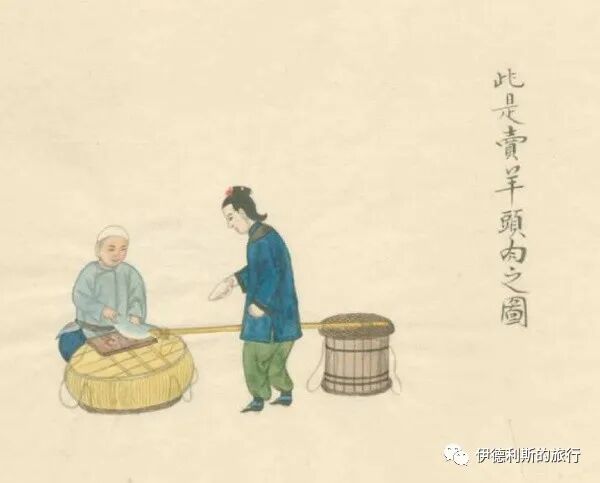
2. Yangtou Ma (Sheep Head Ma) at Langfang Ertiao outside Qianmen
Beijing lamb head is a local specialty. It is sliced as thin as paper and sprinkled with salt and pepper powder. Lamb head meat includes the cheek (lianzi), the tongue and root (xinzi), the roof of the mouth (tianhuaban), the tongue tip (tongtianti), the eyes, the hooves, and the tendons. Aside from the tendons, the cheek meat has the deepest flavor. The sellers of lamb head meat are all Hui Muslims. There was only one halal stall, located at the back door of the Yuxing Restaurant on Langfang Second Alley. The owner was a man named Ma who sold his own goods. Unlike other workshops that sold wholesale without cleaning, his meat was clean. He added five-spice powder to his salt and pepper, making it extra fragrant and clean. He also sold boiled beef tripe (niudu) at a very low price.
The Life of Old Beijingers by Jin Shushen
At the west entrance of Menkuang Hutong, there was a lamb head meat stall in front of the Yuxing Restaurant that was considered a famous local snack of the area. The vendor arrived every day near dusk. He brought his own light bulb and wire, which he connected to the restaurant's power to light up his stall. He used a special knife, one foot long and five inches wide, to slice the cheek, tongue (xinzi), and eyes for customers to enjoy with their drinks. When he sliced the cheek, he made it so thin it was almost transparent. He laid it on white paper, sprinkled salt and pepper from a long-necked glass bottle, mixed it by hand, and then wrapped it up. It tasted delicious. Customers loved the taste of the meat and admired the vendor's skill. Every night when the lights came on, a crowd would gather at the intersection of Langfang Second Alley and Menkuang Hutong to watch him slice the meat. People traveled from far away to Menkuang Hutong just to eat this lamb head meat. I once asked about that Hui Muslim vendor. I only knew his surname was Ma and he lived on Niujie. He likely passed away after the Cultural Revolution, and I do not know what happened to him.
Ye Zufu Talks About Beijing by Ye Zufu
3. Yitiaolong Mutton Restaurant outside Qianmen
Yitiao Long Lamb Restaurant processes its meat carefully and slices it very thin. After slaughtering and skinning the lamb, they select only the hind legs. They place the meat on a clean surface with natural water, cover it with a reed mat, place an oilcloth over the mat, and put a block of ice on top. This is called pressed meat (yarou). The meat is pressed for a full day and night to draw out the blood and impurities, which makes the meat firm and easy to slice. This pressed meat (ya rou) is better than frozen meat because frozen meat, like frozen cabbage, breaks down the lamb's texture and makes it lose its tender, savory flavor, which makes it taste bad. Yilong is just like Zhengyanglou; they slice the meat thinly and serve it on plates according to the cut. The seasonings are complete.
When eating hot pot lamb (shuan yangrou), people usually eat sesame flatbread (shaobing) as their staple food. The sesame flatbread (shaobing) at Nanhengshun (Wang Dongsi: Yilong's original name is Nanhengshun) is also different from other places; for every basin of dough, they use ten jin of flour, with nine jin of plain flour and one jin of leavened dough. Ten jin of flour requires one jin and two liang of sesame paste. The sesame flatbread (shaobing) is first seared on a griddle, then baked in an oven, searing the bottom first and then the sesame-topped side (just for a quick touch). This kind of sesame flatbread (shaobing) has plenty of sauce, is cooked through, and is perfectly flaky and crisp.
When customers are almost full, they order a bowl of Nanhengshun's homemade, thin and uniform mung bean mixed noodles (lvdou zamian) served dry. Mung bean mixed noodles (lvdou zamian) are great for cutting through the greasiness of meat; a bowl of these noodles absorbs the floating oil from the hot pot and cleanses the palate, making these thin and uniform noodles another specialty of Nanhengshun.
Miscellaneous Talks on Old Beijing by Wang Yongbin.
4. Ai's steamed rice cake (aiwowowo) stall on Menkuang Hutong outside Qianmen
It is currently the first lunar month, the time when ai'ou wowos are on the market. Beijing's ai'ou wowos are similar to Fengtian's cool rice cakes (lianggao) and are both sold during the first lunar month, but ai'ou wowos are soft and delicious, and cannot be compared to cool rice cakes (lianggao). Cool rice cakes (lianggao) are made by steaming glutinous rice flour, using it as a wrapper, filling it with sesame and white sugar, and sprinkling it with rice flour. On the surface, they look like ai'ou wowos, but they are essentially just a variation of sticky rice cakes (niangao); after a while, when the wind blows on them, they still get hard.
Ai'ou wowos are made by boiling whole glutinous rice grains until cooked, waiting for all the steam to evaporate, and then putting them in a basin to form a soft, fluffy texture. Using this rice-grain texture, they wrap in various sweet fillings, sprinkle with glutinous rice flour, and add red dots to distinguish the types of fillings. This item is called an ai'ou wowo, which is also a type of cold snack. Isn't the Changdian temple fair happening right now? Ai'ou wowos are a seasonal treat, but for the best-looking and best-tasting ones, go to the entrance of Tongle Teahouse on Menkuang Hutong. There is a small cart there that is kept very clean. A Hui Muslim man sells ai'ou wowos there throughout the year. He uses real glutinous rice and good fillings. Eating a couple of his is a unique experience that you must try.
Beijing Dream Splendor Record by Mu Ruga.
5. Fushunzhai Beef Shop on Menkuang Hutong outside Qianmen.
We must start with the famous Fushunzhai beef shop at the south entrance of the hutong. Its spiced beef (jiang niurou) is tender and delicious, easily matching the spiced lamb (jiang yangrou) from Yueshengzhai. They also use a pot of original beef broth to cook meat for sale every day, with a set amount sold at specific times, and it sells out very quickly. The shopkeeper is a Hui Muslim named Liu. Later, this spiced beef shop moved to Qianmen Street and merged with Yueshengzhai.
Ye Zufu Talks About Beijing by Ye Zufu
6. Baodu Feng in Menkuang Hutong outside Qianmen.
Summary: Beijing Muslim History: Old Halal Notes from the Southern City is presented here as a firsthand travel account in clear English, beginning with this scene: Chongwen:. The account keeps its focus on Beijing Muslim History, Southern Beijing, Hui Muslims while preserving the names, places, food, and historical details from the Chinese source. This is part 1 of 5.
Part 1 of 5
Table of Contents
Chongwen:
1. Douzhi Ding (Jinxin Douzhi Shop) at Huashi outside Chongwenmen
2. Rongxiangcheng Hui Muslim snack shop (Jinfang Snack Shop) outside Chongwenmen
Xuanwu:
1. Xianbing Porridge Shop at Meishi Bridge outside Qianmen
2. Yangtou Ma (Sheep Head Ma) at Langfang Ertiao outside Qianmen
3. Yitiaolong Mutton Restaurant outside Qianmen
4. Ai's steamed rice cake (aiwowowo) stall on Menkuang Hutong outside Qianmen
5. Fushunzhai spiced beef shop at the south entrance of Menkuang Hutong outside Qianmen
6. Bai's tofu pudding (doufunao) on Menkuang Hutong outside Qianmen
7. Baodu Feng (quick-boiled tripe) on Menkuang Hutong outside Qianmen
8. Niangao Wang (Rice Cake King) on Menkuang Hutong outside Qianmen
9. Mujiazhai at Zangjia Bridge outside Qianmen
10. Xiangjugong halal pastry shop on Qianmen Street
11. Ha's sesame flatbread (shaobing) shop at Liulichang outside Hepingmen
12. Nanlaishun snack shop at Caishikou outside Xuanwumen
13. Zhengxingde tea house at Caishikou outside Xuanwumen
14. Scalded dough fried cake (tangmian zhagao) at the Hui Muslim breakfast shop a short distance left from the east entrance of Xiangluying Sitiao Hutong outside Xuanwumen
15. Jubaoyuan on Niujie
16. The large halal canteen at the north entrance of Niujie Street.
17. A child selling malt sugar sticks (maiyatang) on Niujie Street.
18. A vendor selling sticky rice cake (qiegao) on Niujie Street.
19. Steamed corn buns (wotou) from the old neighbors of Niujie Street.
20. Soybean paste noodles (zhajiangmian) from the old neighbors of Niujie Street.
21. The Barbecue King (Kaorou Wang) at Tianqiao.
Others:
1. Hui Muslim businesses roaming the streets and alleys.
2. A halal rice cake (niangao) stall at the temple fair.
3. Mutton stall (yangrou chuangzi).
4. Shopkeeper Hua, who sells beef head meat from a wheelbarrow.
5. Bai Family Sesame Flatbread Shop (shaobing pu).
6. A roasted mutton stall in the hutong.
Chongwen.
1. Douzhi Ding (Jinxin Douzhi Shop) at Huashi outside Chongwenmen
Douzhi Ding's stall is in front of the Fire God Temple (Huoshen Miao) on the north side of the road, in the middle-west section of Xihuashi.
The owner of Douzhi Ding's stall is naturally surnamed Ding; he is a Hui Muslim named Ding Derui. His stall is unique. It features a large table over three meters long and one meter wide, with long benches lined up in front. On the table are two glass covers; one protects various pickled vegetables and spicy shredded salted vegetables, while the other holds sesame flatbreads (shaobing), crispy fried dough rings (jiaoquan), and other staples. There are also two wooden signs on the table, carved with eight large characters: 'Hui Muslims from the Western Regions, Douzhi Ding's Shop'. Ding Derui follows old traditions to boil the mung bean milk (douzhi). He uses a large clay pot and a betel nut ladle (binglang shao), simmering it over a low fire while adding raw mung bean milk to the pot as it cooks. He makes his mung bean milk (douzhir) with the perfect thickness, so it does not settle or become watery. It tastes sour, fragrant, and sweet, making it very delicious and addictive.
Outside Hademen by Zhang Fan
The stall is located to the left of the Fire God Temple gate in West Huashi. It has tables facing west and opens every day at noon. The table is over 10 feet long with benches in front. Two large glass covers sit on top, protecting large fruit plates filled with pickled cabbage, pickled cucumbers, small pickled radishes, and pickled asparagus. Spicy mustard greens are served with the mung bean milk. In spring, they serve quick-pickled kohlrabi, and in winter, they serve spicy dried radish cubes. Customers who buy fine pickles get chili oil. The food includes sesame flatbread (shaobing) and fried dough rings (jiaoquan).
The owner, surnamed Ding, is a Hui Muslim. He keeps two wooden signs on his table with eight green-painted characters: Western Region Hui, Ding's Mung Bean Milk. Most customers are regulars who visit every day at the same time. On market days, the benches are full, and business is booming. In January 1958, food stalls were merged into cooperatives. Ding's Mung Bean Milk moved to Suanshikou and is now the Jinxin Mung Bean Milk Shop, which still follows the traditions of Ding's Mung Bean Milk.
Reminiscing about Hademen by Niu Qingshan
Ding's Mung Bean Milk started as a shoulder-pole business. He was the first to sell it, and he was already famous in Beijing during the Qing Dynasty. People called this Hui Muslim man and his carrying pole Ding's Mung Bean Milk. It was not until 1910 that the third generation of Ding's Mung Bean Milk set up a stall in front of the Fire God Temple in the middle of Huashi Street. They finally had a long table and a permanent large pot. For a mung bean milk business, this was considered very successful. That was a famous open-air snack street in Beijing, second only to Menkuang Hutong. At that time, various stalls lined up in front of the Fire God Temple, stretching east all the way to Yangshikou.
Blues in the South of the City by Xiao Fuxing
2. Rongxiangcheng Hui Muslim snack shop (Jinfang Snack Shop) outside Chongwenmen
Rongxiangcheng Snack Shop, located at 17 Hademen Outer Street, is a well-known eatery in the Chongwenmen area.
The shop opened in the early Republic of China period. The owner was Man Leting, known as Man Liu, a Hui Muslim from Shandong. The manager was Ai Lianying. The shop's sign, Rongxiangcheng, was inscribed by the famous scholar Jiang Chaozong.
Inside the shop, there is another plaque, Cangzhen, inscribed by the Zhili clique warlord Wu Peifu. The shop started by selling beef and mutton. By the 1940s, business improved significantly, and it expanded from two storefronts to four. As the business grew, they changed their strategy to combine the mutton trade with the snack trade (qin hang).
In the past, Beijing mutton shops were called mutton trades (yang hang), and their business was very seasonal. Since spring and summer are the growing seasons for sheep, they could not be slaughtered until after autumn. Because of this, people in the trade said, 'The mutton business is idle for half the year.' Old Beijingers also said, 'When visiting graves at Qingming, the mutton sellers close their doors.' To change this idle period, the shop adapted to market needs by buying Japanese refrigeration equipment. During spring and summer, they sold homemade popsicles, soda, and other frozen foods (leng shi). In autumn and winter, they focused on mutton again. This change kept them busy all year and made the shop's name increasingly famous.
In Beijing, this combined business model was common, with different terms: two shops under one manager was called 'four edges' (si ba bian), and renting out a portion to others was called 'carrying a robe' (tiao pao). Rongxiangcheng was the former, and their snack section focused on frozen foods, which was quite new at the time.
Just before the liberation, war blocked mutton shipments from Inner Mongolia to Beijing. The mutton trade plummeted, and Rongxiangcheng was no exception. At this time, Man Kaiqi, a fellow townsman of Man Leting, came to the shop. He came from a background in a traditional pastry shop (bobo pu). In the old snack trade, a pastry shop was considered lower in status than a bakery but higher than a restaurant. Rongxiangcheng simply stopped selling mutton and switched to snacks and frozen foods. Man Kaiqi's skills were put to good use. Under his management, they offered up to 20 varieties of snacks: sticky rice cake (qiegao), fried cake (zhagao), sesame ball (matuan), fried dough twist (mahua), sweet rice ball (yuanxiao), sugar ear (tangerduo), steamed rice cake (aiwowo), soybean flour cake (lvdagun), apricot tea (xingcha), millet porridge (miancha), tofu pudding (doufunao), sesame flatbread (shaobing), fried dough cake (youbing), and bean paste bun (doubao). This made Rongxiangcheng a famous Hui Muslim snack shop in the Chongwai area.
After the Cultural Revolution, Rongxiangcheng was renamed Jinfang Snack Shop. In the mid-1990s, due to the expansion of Chongwai Street, the shop moved to the Tianqiao intersection for a time. Its current location is on the east side of the south entrance of Chongwai Street. This time-honored shop in the South City has started its glorious journey once again.
Reminiscing about Hademen by Niu Qingshan
The place that stays in my memory the most is Jinfang Snack Shop. When I first returned to Beijing, it was winter, and it was still pitch black when I got up early for work. I didn't have time to eat breakfast at home, so I pushed my bike through the underpass and across the railway; down the slope was Baiqiao Street, and further west was Huashi Street. There were few people in the morning, the streetlights were dim, and it was very quiet; the northwest wind blowing head-on was so strong it made it hard to open my mouth. Luckily, after riding a short distance, I could see the bright lights of Jinfang Snack Shop on the north side of the road ahead. I locked my bike and lifted the cotton door curtain to go inside; the heat rushed into my face, and more than half of the chill on my body disappeared at once. My favorite thing to eat in this shop is the millet flour porridge (miancha); it is thick, fragrant, and hot enough to burn your mouth. You cannot rush drinking millet flour porridge; there is a trick to it: regular customers never use chopsticks or spoons, they rotate the bowl and drink from the edge, finishing it until the bottom is clean. With these two crispy fried dough rings (jiaoquan) and a bowl of millet flour porridge in my stomach, my whole body felt warm, and the next 40 minutes of the journey wouldn't leave me frozen with a twisted face and numb hands and feet.
Reading Beijing Figures: Impressions of Huashi (Postscript). Written by Chen Guangzhong.
Xuanwu.
1. Xianbing Porridge Shop at Meishi Bridge outside Qianmen
There are two meat pie and porridge shops at Meishi Bridge, and they are halal restaurants. These two shops have the same owner; one is on the east side of the road and the other is on the west, which is called one owner running two shops. They are open 24 hours a day without interruption; when the east shop puts up its door panels to close, the west shop takes its panels down to open, so customers can always get meat pies and porridge. Since it is a meat pie and porridge shop, the meat pies are naturally their specialty. The meat pies are filled with beef, also known as meat cakes (roubing); they are large, full of filling, and oily, which really satisfies a craving. If a guest asks for a full-sized meat pie (roubing), it is much larger than the standard version, measuring about 1.2 feet in diameter. Even someone with a big appetite cannot finish half of one.
Cuisine of East Beijing by Wu Zhengge
2. Yangtou Ma (Sheep Head Ma) at Langfang Ertiao outside Qianmen
Beijing lamb head is a local specialty. It is sliced as thin as paper and sprinkled with salt and pepper powder. Lamb head meat includes the cheek (lianzi), the tongue and root (xinzi), the roof of the mouth (tianhuaban), the tongue tip (tongtianti), the eyes, the hooves, and the tendons. Aside from the tendons, the cheek meat has the deepest flavor. The sellers of lamb head meat are all Hui Muslims. There was only one halal stall, located at the back door of the Yuxing Restaurant on Langfang Second Alley. The owner was a man named Ma who sold his own goods. Unlike other workshops that sold wholesale without cleaning, his meat was clean. He added five-spice powder to his salt and pepper, making it extra fragrant and clean. He also sold boiled beef tripe (niudu) at a very low price.
The Life of Old Beijingers by Jin Shushen
At the west entrance of Menkuang Hutong, there was a lamb head meat stall in front of the Yuxing Restaurant that was considered a famous local snack of the area. The vendor arrived every day near dusk. He brought his own light bulb and wire, which he connected to the restaurant's power to light up his stall. He used a special knife, one foot long and five inches wide, to slice the cheek, tongue (xinzi), and eyes for customers to enjoy with their drinks. When he sliced the cheek, he made it so thin it was almost transparent. He laid it on white paper, sprinkled salt and pepper from a long-necked glass bottle, mixed it by hand, and then wrapped it up. It tasted delicious. Customers loved the taste of the meat and admired the vendor's skill. Every night when the lights came on, a crowd would gather at the intersection of Langfang Second Alley and Menkuang Hutong to watch him slice the meat. People traveled from far away to Menkuang Hutong just to eat this lamb head meat. I once asked about that Hui Muslim vendor. I only knew his surname was Ma and he lived on Niujie. He likely passed away after the Cultural Revolution, and I do not know what happened to him.
Ye Zufu Talks About Beijing by Ye Zufu
3. Yitiaolong Mutton Restaurant outside Qianmen
Yitiao Long Lamb Restaurant processes its meat carefully and slices it very thin. After slaughtering and skinning the lamb, they select only the hind legs. They place the meat on a clean surface with natural water, cover it with a reed mat, place an oilcloth over the mat, and put a block of ice on top. This is called pressed meat (yarou). The meat is pressed for a full day and night to draw out the blood and impurities, which makes the meat firm and easy to slice. This pressed meat (ya rou) is better than frozen meat because frozen meat, like frozen cabbage, breaks down the lamb's texture and makes it lose its tender, savory flavor, which makes it taste bad. Yilong is just like Zhengyanglou; they slice the meat thinly and serve it on plates according to the cut. The seasonings are complete.
When eating hot pot lamb (shuan yangrou), people usually eat sesame flatbread (shaobing) as their staple food. The sesame flatbread (shaobing) at Nanhengshun (Wang Dongsi: Yilong's original name is Nanhengshun) is also different from other places; for every basin of dough, they use ten jin of flour, with nine jin of plain flour and one jin of leavened dough. Ten jin of flour requires one jin and two liang of sesame paste. The sesame flatbread (shaobing) is first seared on a griddle, then baked in an oven, searing the bottom first and then the sesame-topped side (just for a quick touch). This kind of sesame flatbread (shaobing) has plenty of sauce, is cooked through, and is perfectly flaky and crisp.
When customers are almost full, they order a bowl of Nanhengshun's homemade, thin and uniform mung bean mixed noodles (lvdou zamian) served dry. Mung bean mixed noodles (lvdou zamian) are great for cutting through the greasiness of meat; a bowl of these noodles absorbs the floating oil from the hot pot and cleanses the palate, making these thin and uniform noodles another specialty of Nanhengshun.
Miscellaneous Talks on Old Beijing by Wang Yongbin.
4. Ai's steamed rice cake (aiwowowo) stall on Menkuang Hutong outside Qianmen
It is currently the first lunar month, the time when ai'ou wowos are on the market. Beijing's ai'ou wowos are similar to Fengtian's cool rice cakes (lianggao) and are both sold during the first lunar month, but ai'ou wowos are soft and delicious, and cannot be compared to cool rice cakes (lianggao). Cool rice cakes (lianggao) are made by steaming glutinous rice flour, using it as a wrapper, filling it with sesame and white sugar, and sprinkling it with rice flour. On the surface, they look like ai'ou wowos, but they are essentially just a variation of sticky rice cakes (niangao); after a while, when the wind blows on them, they still get hard.
Ai'ou wowos are made by boiling whole glutinous rice grains until cooked, waiting for all the steam to evaporate, and then putting them in a basin to form a soft, fluffy texture. Using this rice-grain texture, they wrap in various sweet fillings, sprinkle with glutinous rice flour, and add red dots to distinguish the types of fillings. This item is called an ai'ou wowo, which is also a type of cold snack. Isn't the Changdian temple fair happening right now? Ai'ou wowos are a seasonal treat, but for the best-looking and best-tasting ones, go to the entrance of Tongle Teahouse on Menkuang Hutong. There is a small cart there that is kept very clean. A Hui Muslim man sells ai'ou wowos there throughout the year. He uses real glutinous rice and good fillings. Eating a couple of his is a unique experience that you must try.
Beijing Dream Splendor Record by Mu Ruga.
5. Fushunzhai Beef Shop on Menkuang Hutong outside Qianmen.
We must start with the famous Fushunzhai beef shop at the south entrance of the hutong. Its spiced beef (jiang niurou) is tender and delicious, easily matching the spiced lamb (jiang yangrou) from Yueshengzhai. They also use a pot of original beef broth to cook meat for sale every day, with a set amount sold at specific times, and it sells out very quickly. The shopkeeper is a Hui Muslim named Liu. Later, this spiced beef shop moved to Qianmen Street and merged with Yueshengzhai.
Ye Zufu Talks About Beijing by Ye Zufu
6. Baodu Feng in Menkuang Hutong outside Qianmen.
