
Halal Travel Guide: Singapore - Asian Civilisations Museum and Islamic Art
Reposted from the web
Summary: This Singapore article visits the Asian Civilisations Museum and looks closely at Islamic art, trade history, ceramics, textiles, and cultural objects. It keeps the original museum observations, object names, and historical details for English readers.
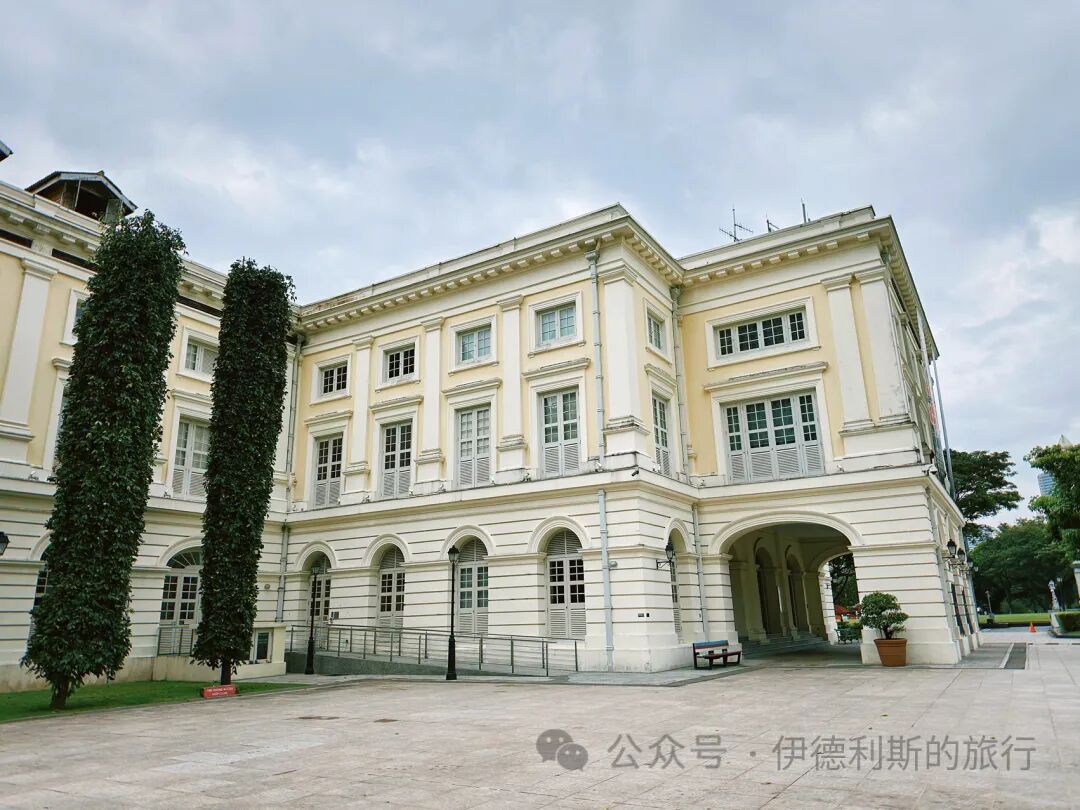
The Asian Civilisations Museum in Singapore sits by the Singapore River in a neoclassical building from 1867. It first focused on crafts from Malay and Southeast Asian indigenous peoples. After the 1990s, it expanded its collection to include West and South Asia, becoming a museum that shows the meeting of different Asian cultures and civilizations.
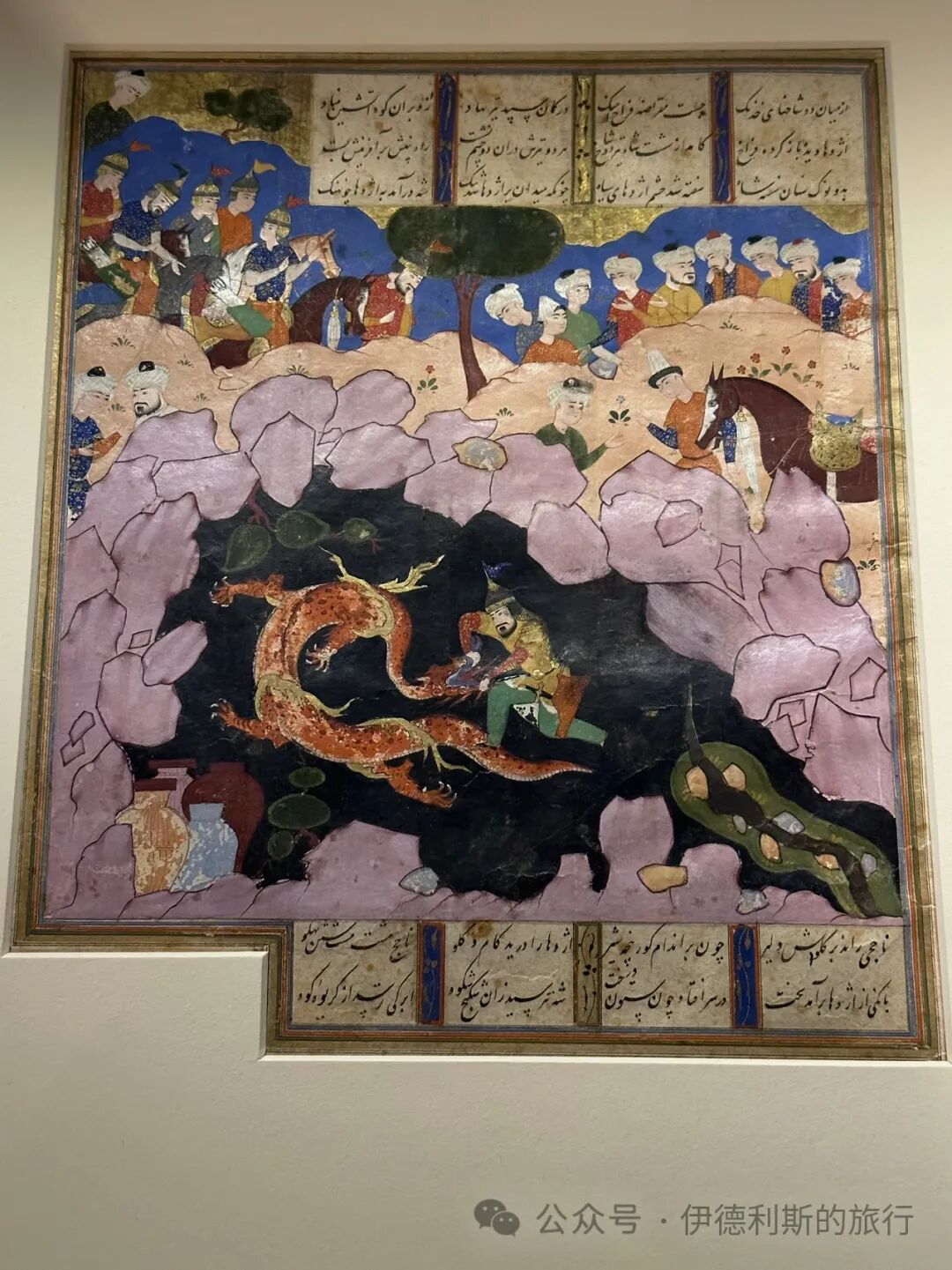
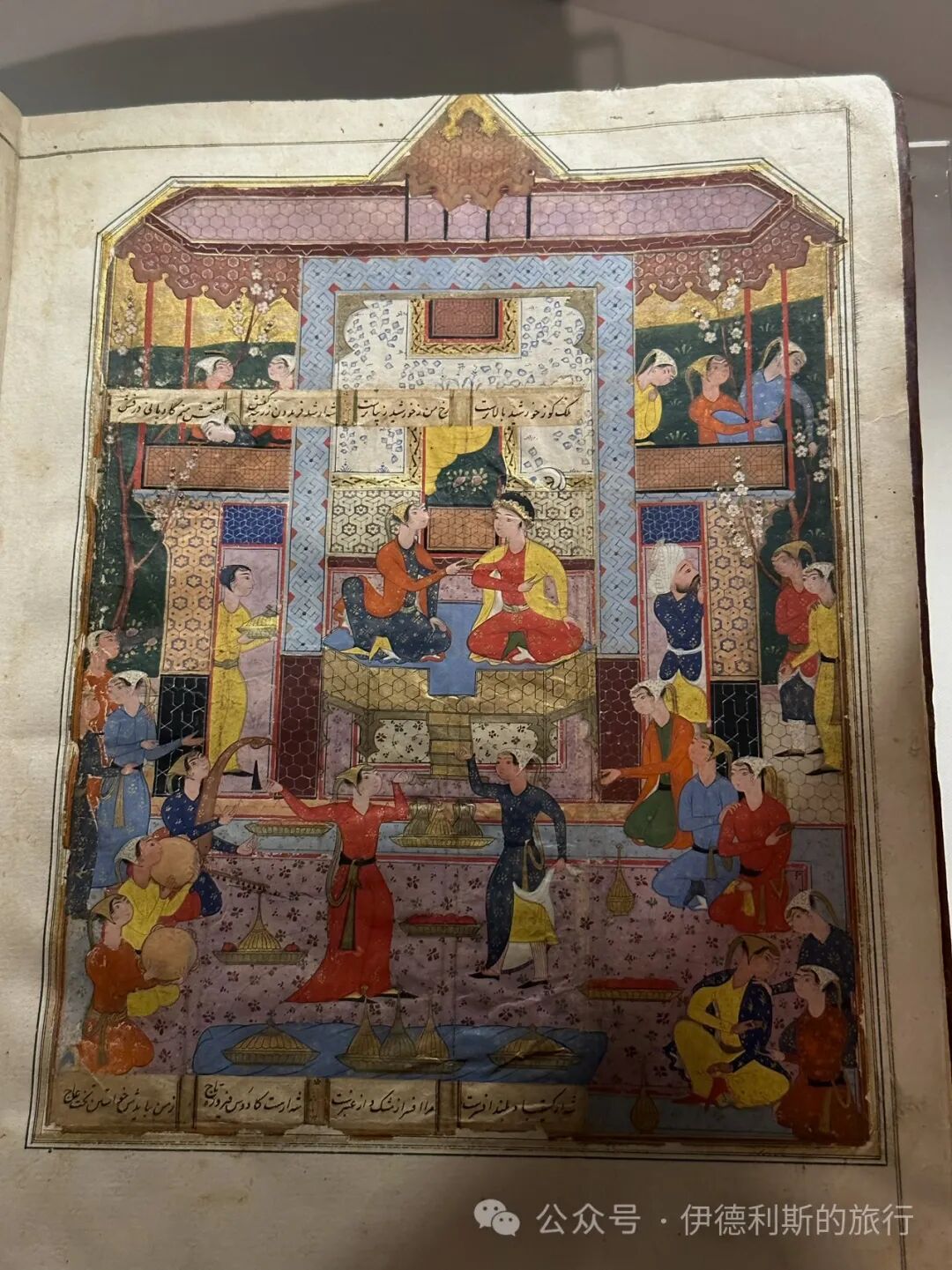
Two miniature paintings from the late 16th-century Shiraz school in Iran depict the famous Persian poet Nizami's masterpiece, the Five Poems (Khamsa).
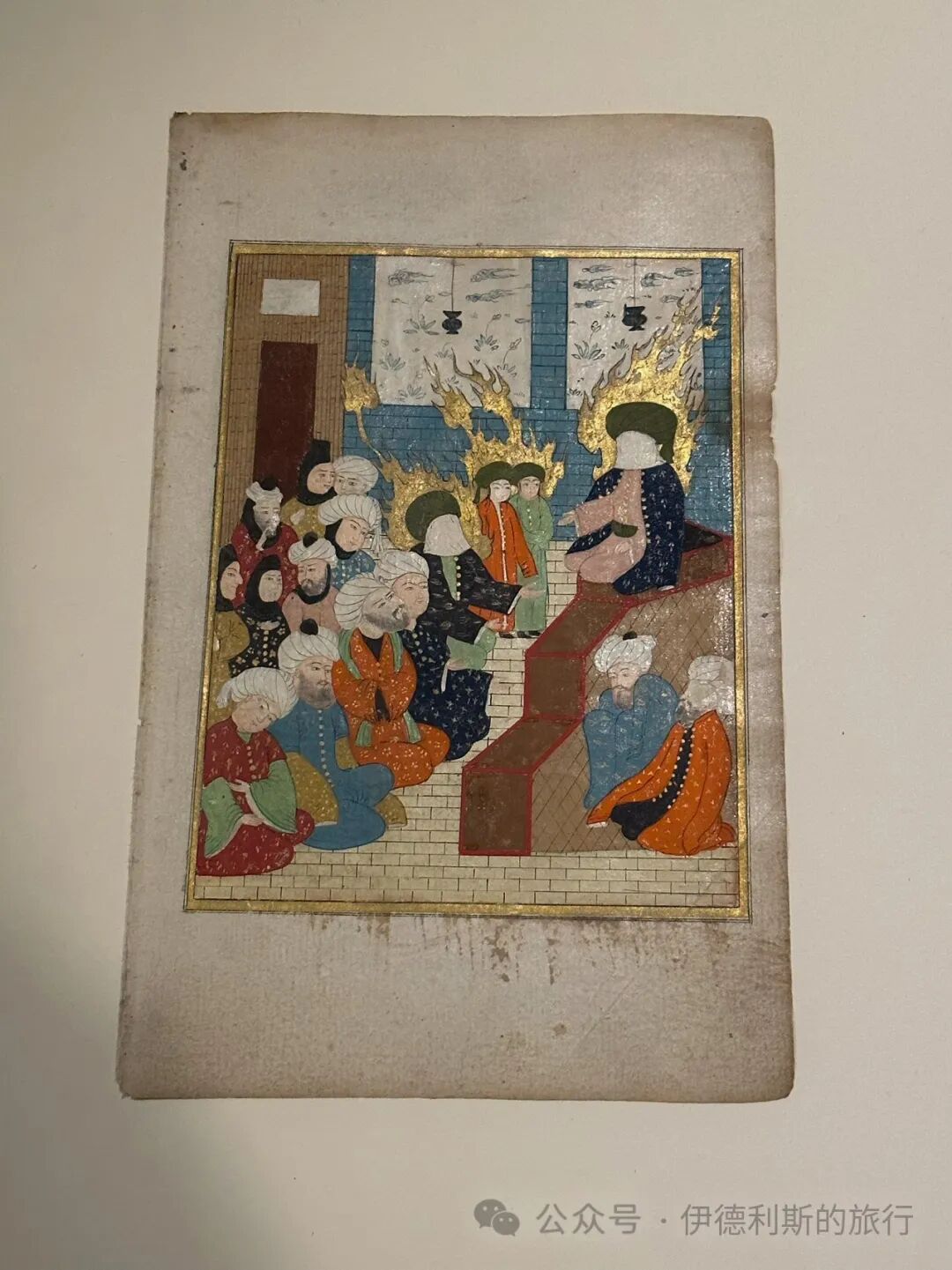
A late 16th-century Ottoman miniature illustration comes from the Garden of the Blessed (Hadigat us-Su'ada), written around 1547. This illustration shows the hardships faced by the Prophet and his family. He is giving a sermon (khutbah) from a pulpit, with Imam Ali, Husayn, Hasan, and other family members below. To show respect, golden flames burn behind the Prophet, Ali, Husayn, and Hasan, and the faces of the Prophet and Ali are covered.
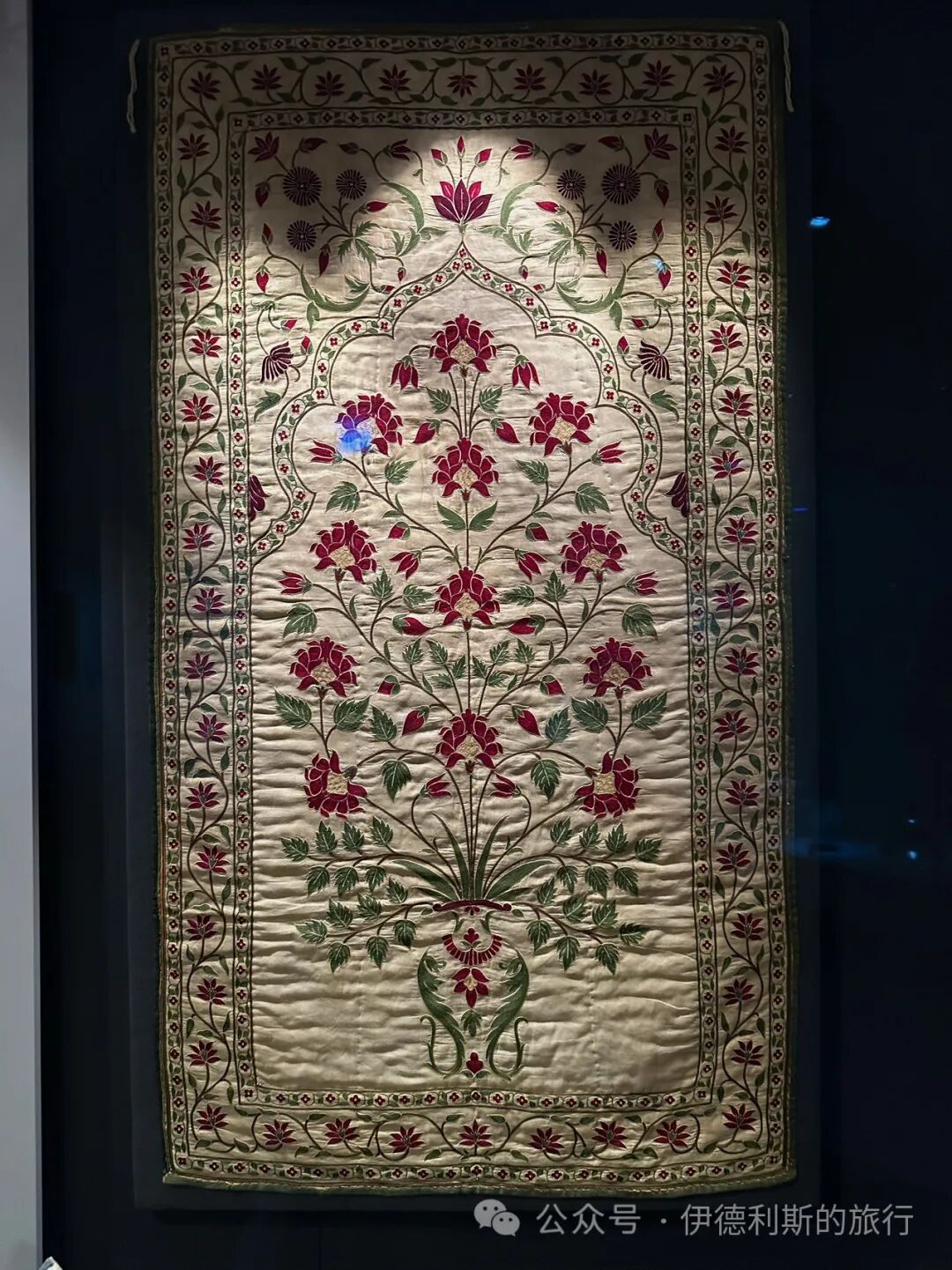
This 18th-19th century silk embroidery from Jaipur, India, was usually used for tapestries or curtains in tents or noble homes. The floral patterns in the center are classic Mughal dynasty designs, widely used in Rajasthan, where Jaipur is located.
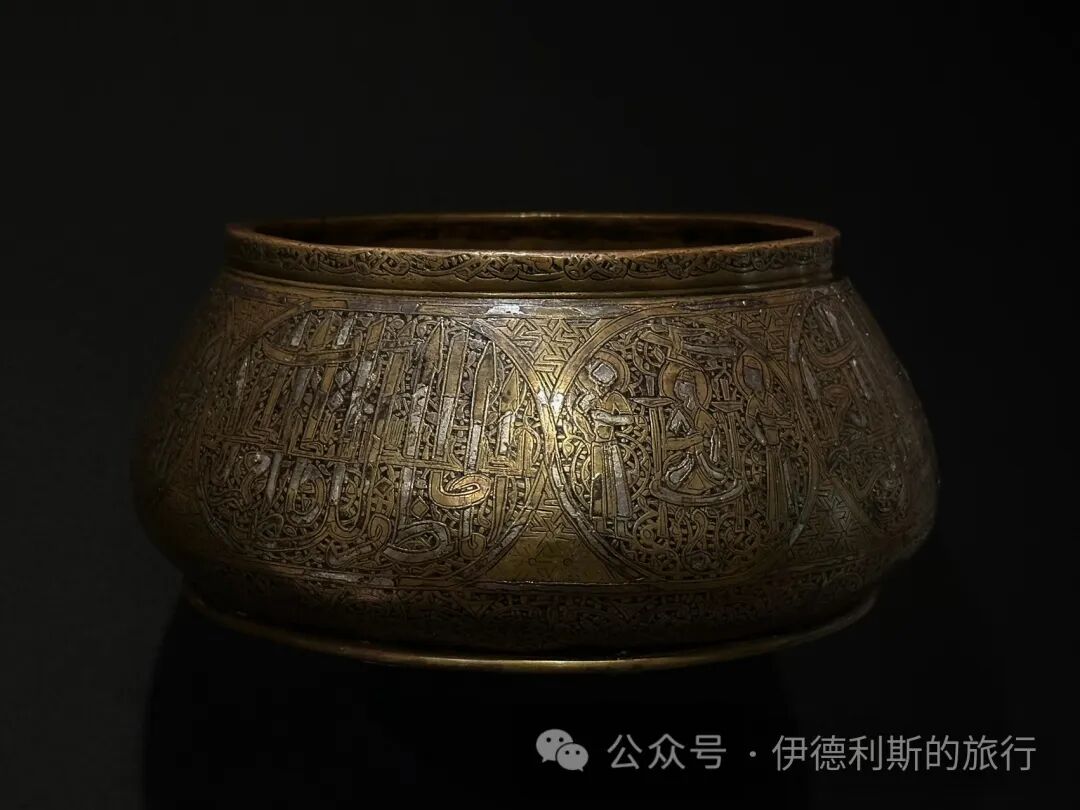
This 14th-century copper bowl with gold and silver inlay is from Fars, Iran. Fars was the center of Iran's metalworking industry in the 14th and 15th centuries, and the bowl depicts the image of the Sultan at that time.
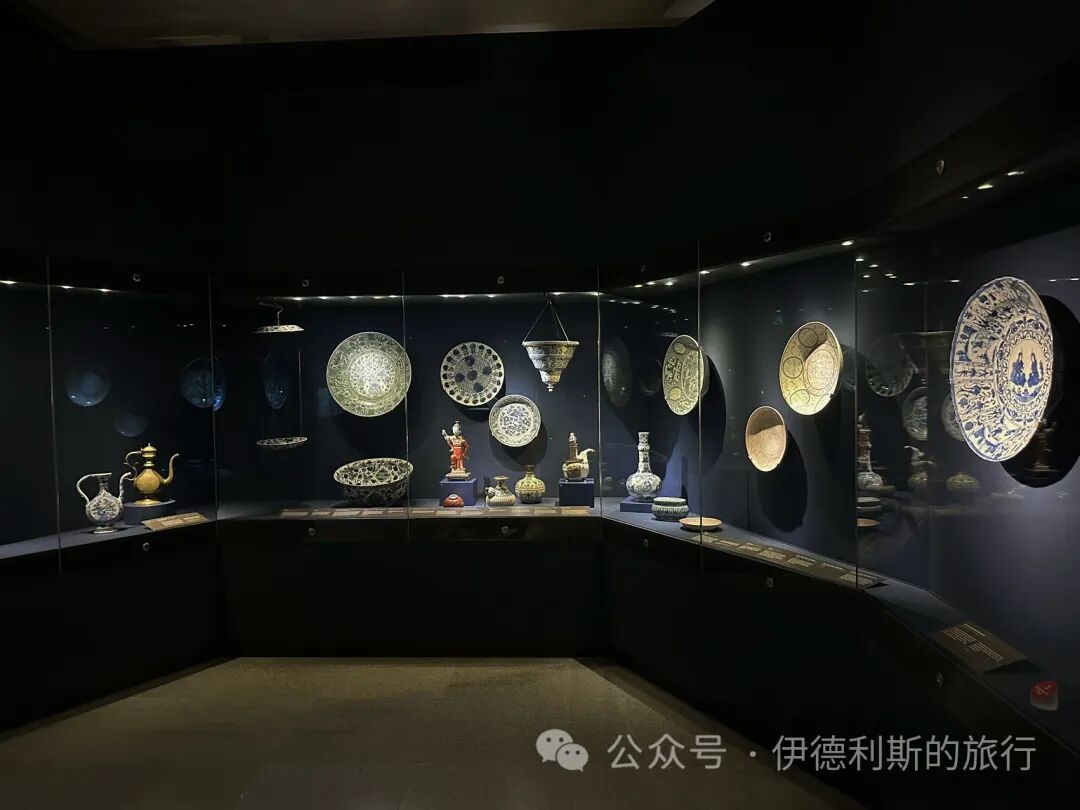
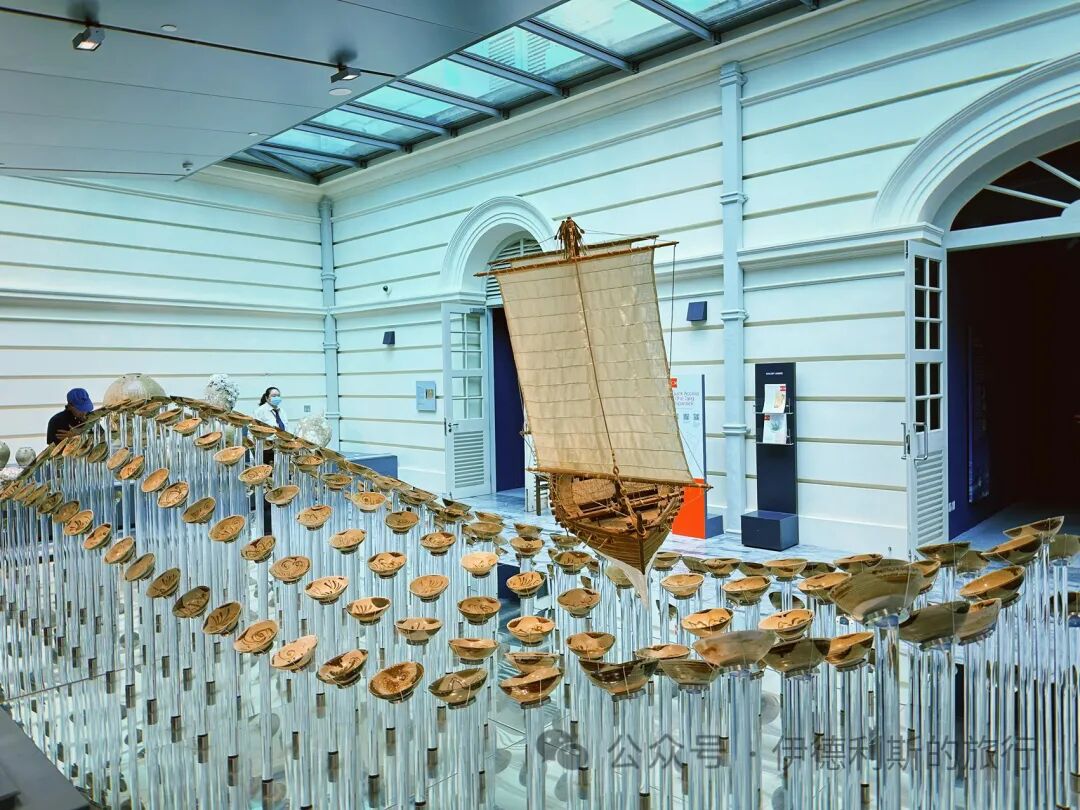
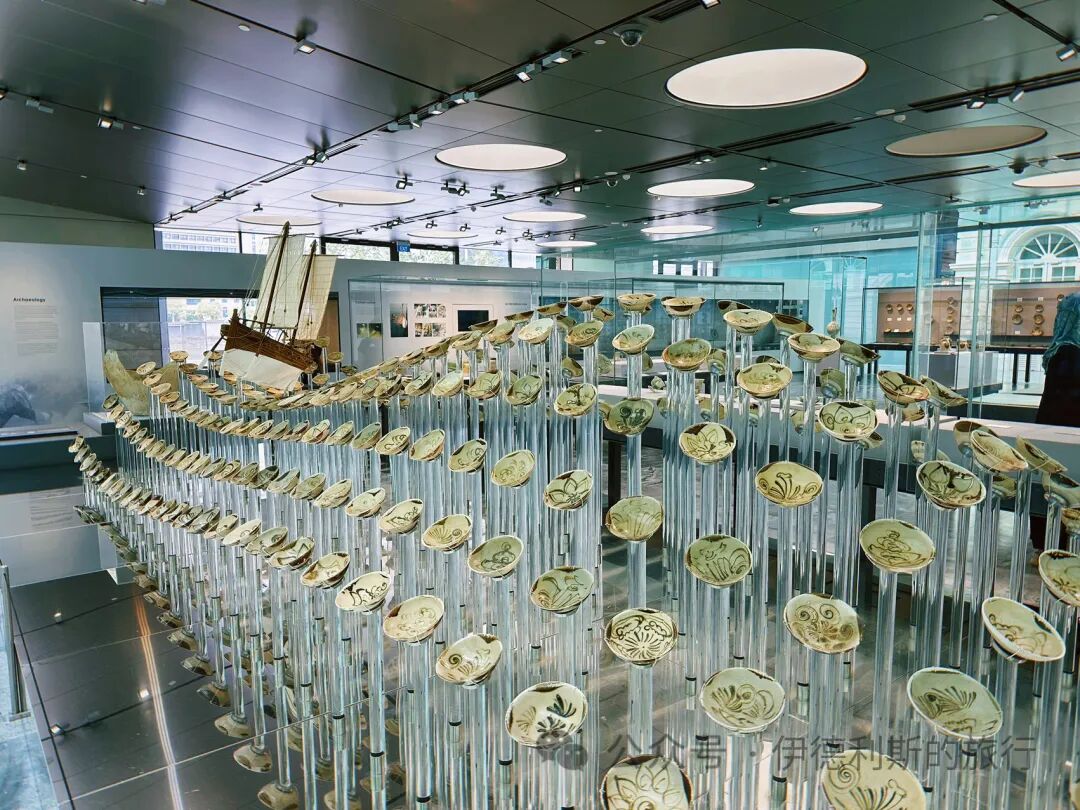
The Batu Hitam shipwreck gallery at the Asian Civilisations Museum in Singapore. 1,100 years ago, an Arab cargo ship loaded with precious goods left Guangzhou port to return to the Abbasid Caliphate. It eventually sank near the coast of Sumatra, 600 kilometers southeast of Singapore. It was not discovered until 1998 and is called the Batu Hitam (Black Rock) shipwreck because of the location where it was found. The shipwreck yielded a large number of ceramic bowls, which are the same shape as those found from the Abbasid Caliphate of the same period.
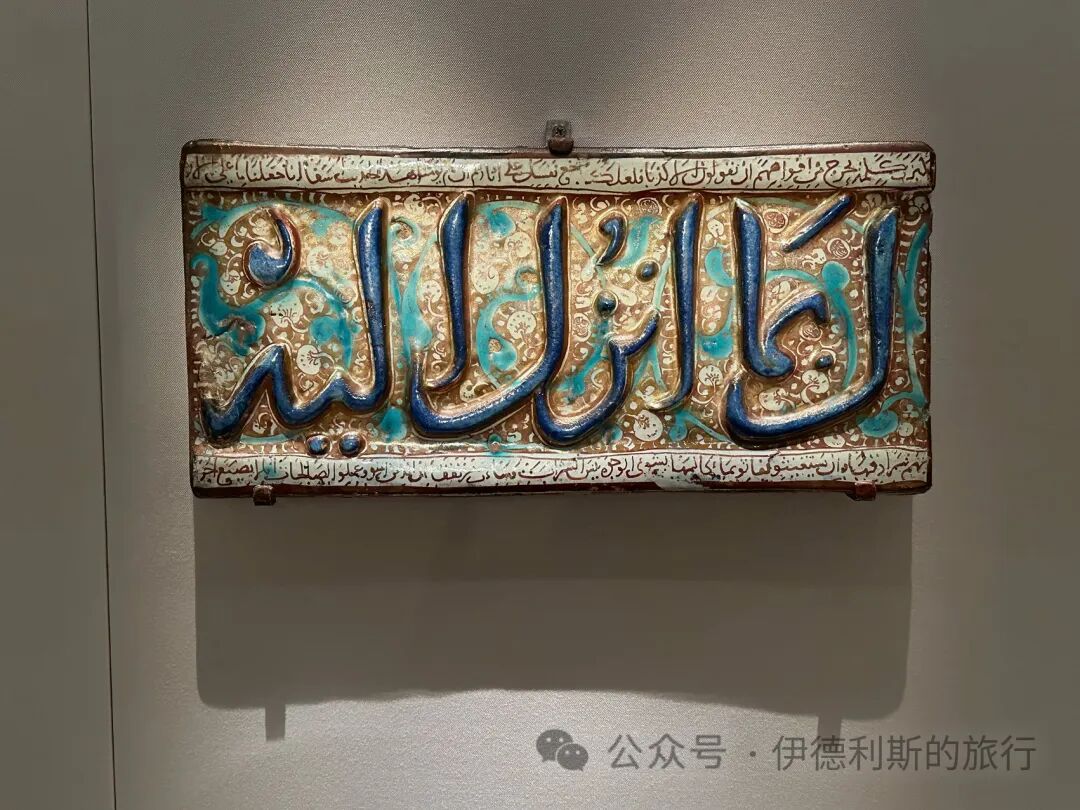
A 13th-century calligraphy fritware tile from Kashan, Iran.
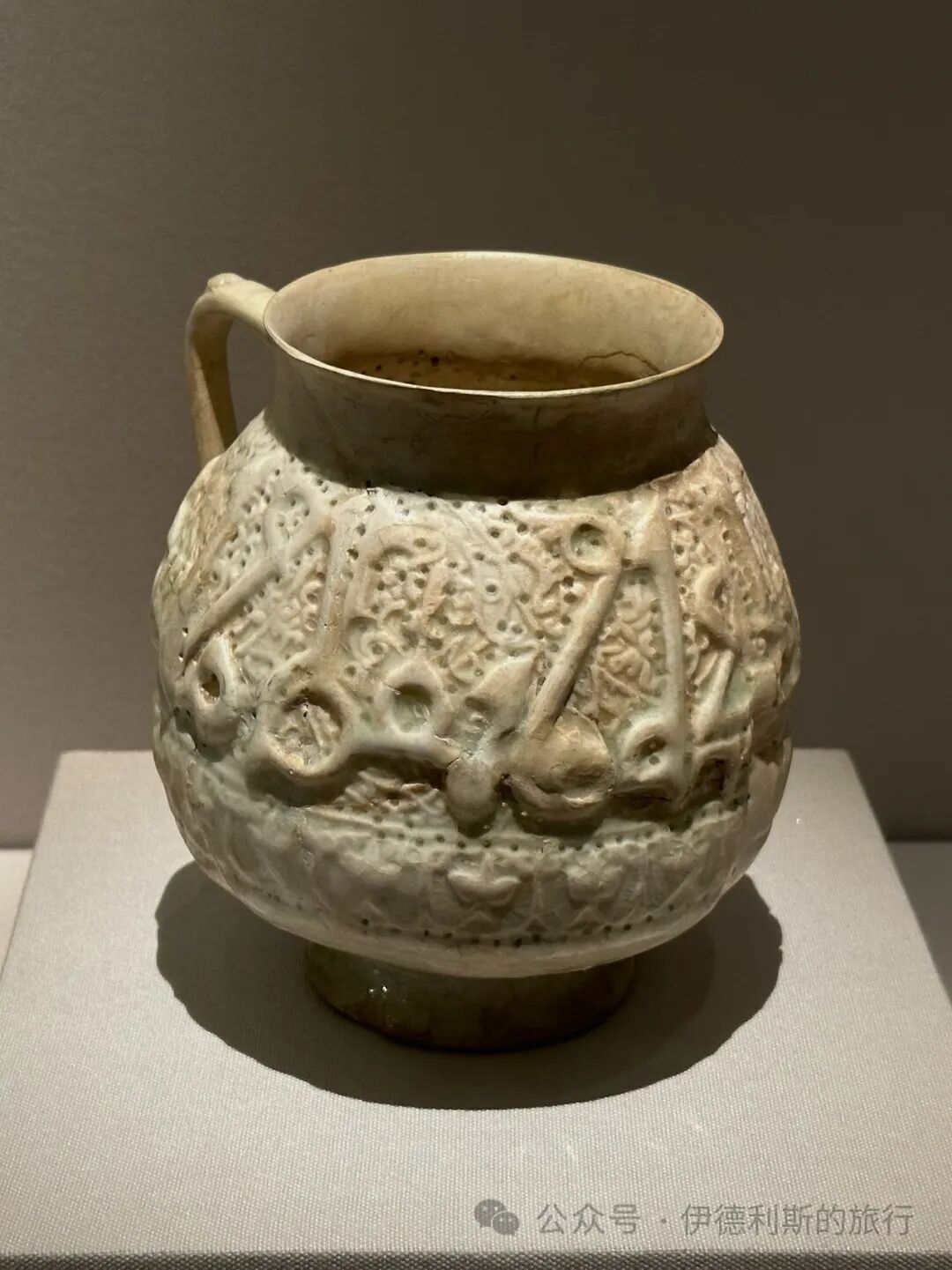
A fritware jug from the late 12th-century Seljuk dynasty in Iran. Fritware is a ceramic technique invented by Middle Eastern craftsmen in the 11th century to imitate Chinese porcelain. It developed from early Egyptian faience and is made of a mixture of clay, quartz, and glaze.
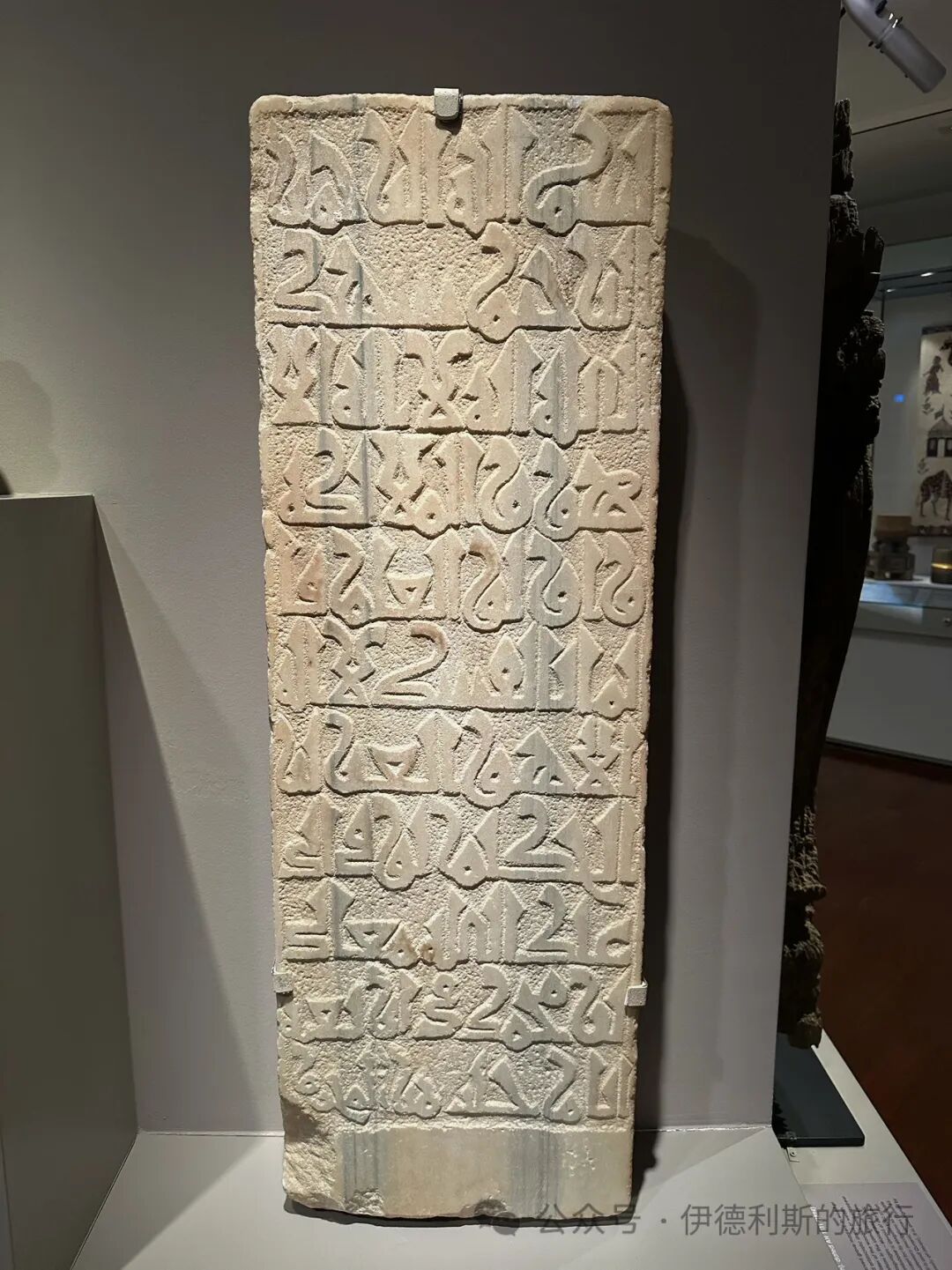
A marble tombstone from early 9th-century Syria.
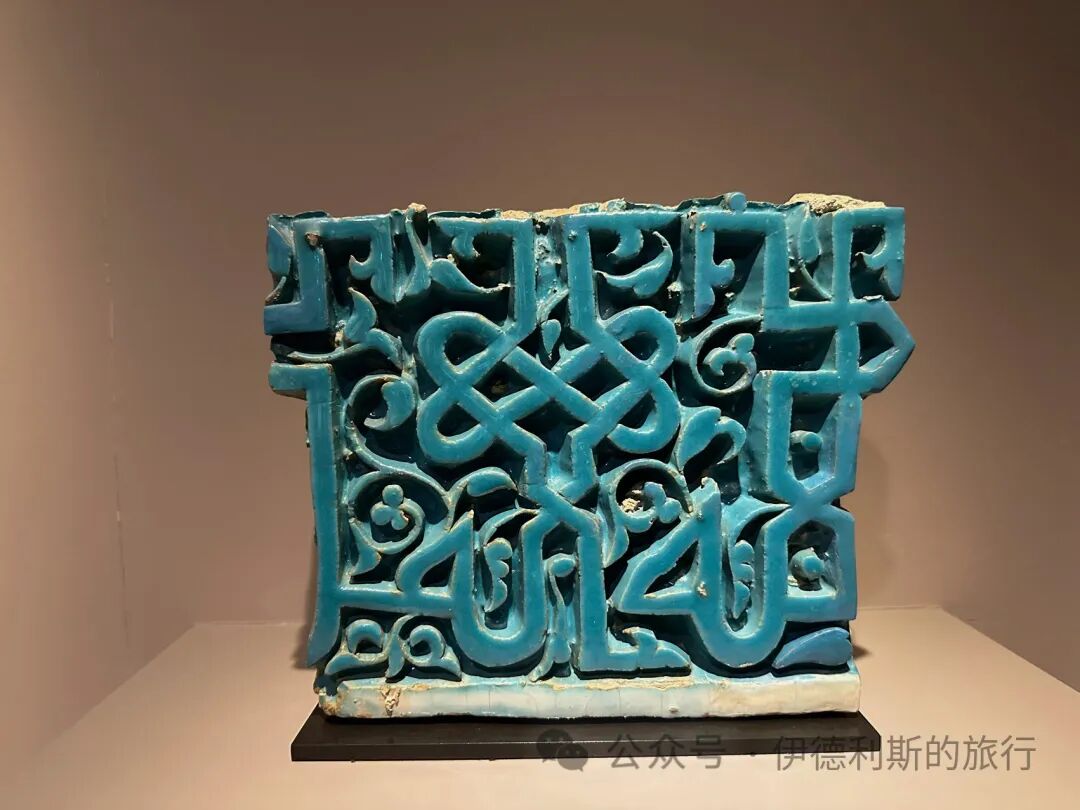
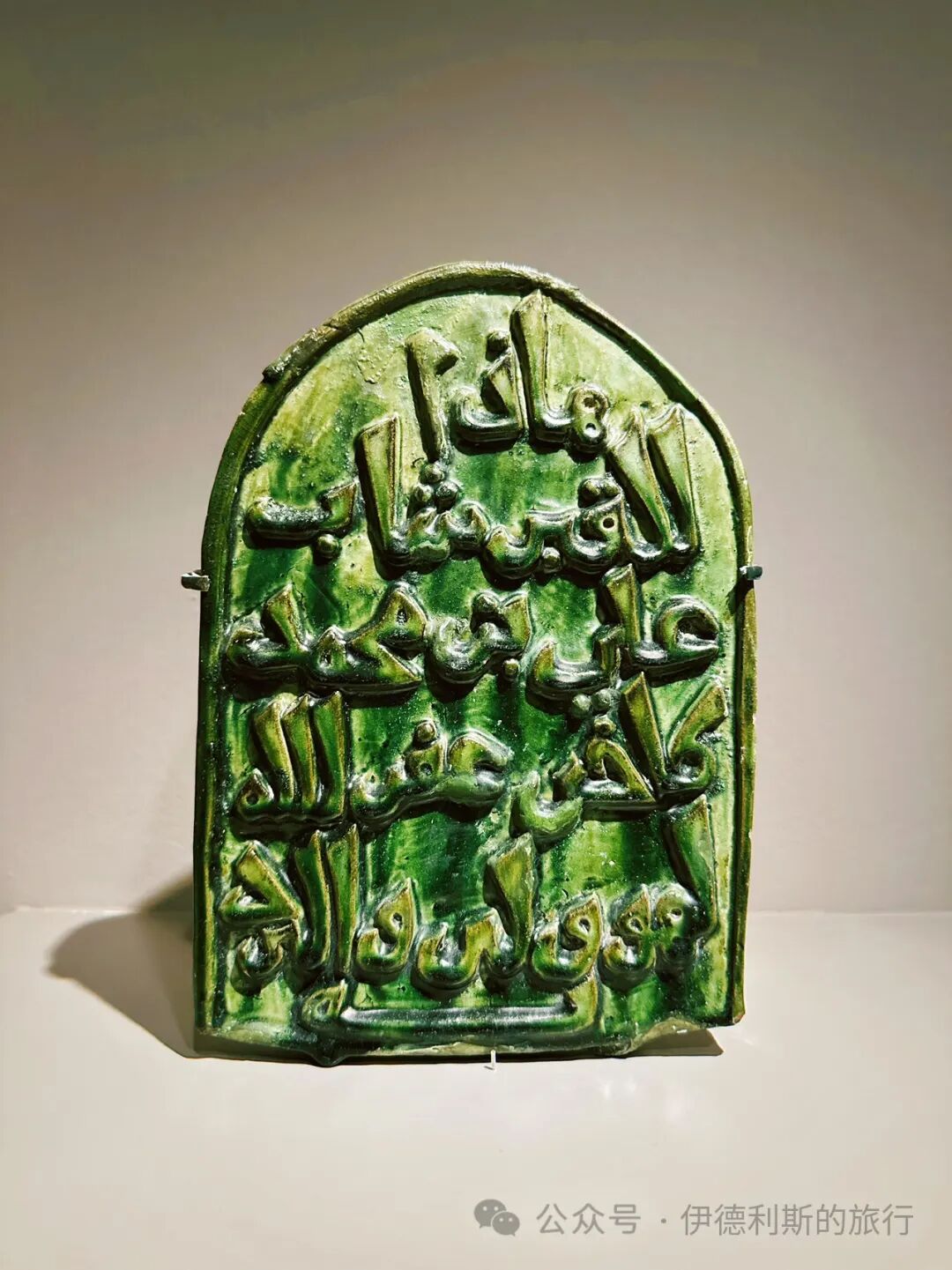
A late 14th-century Kufic script tile from the Timurid dynasty, likely from the tomb of a Timurid noble.
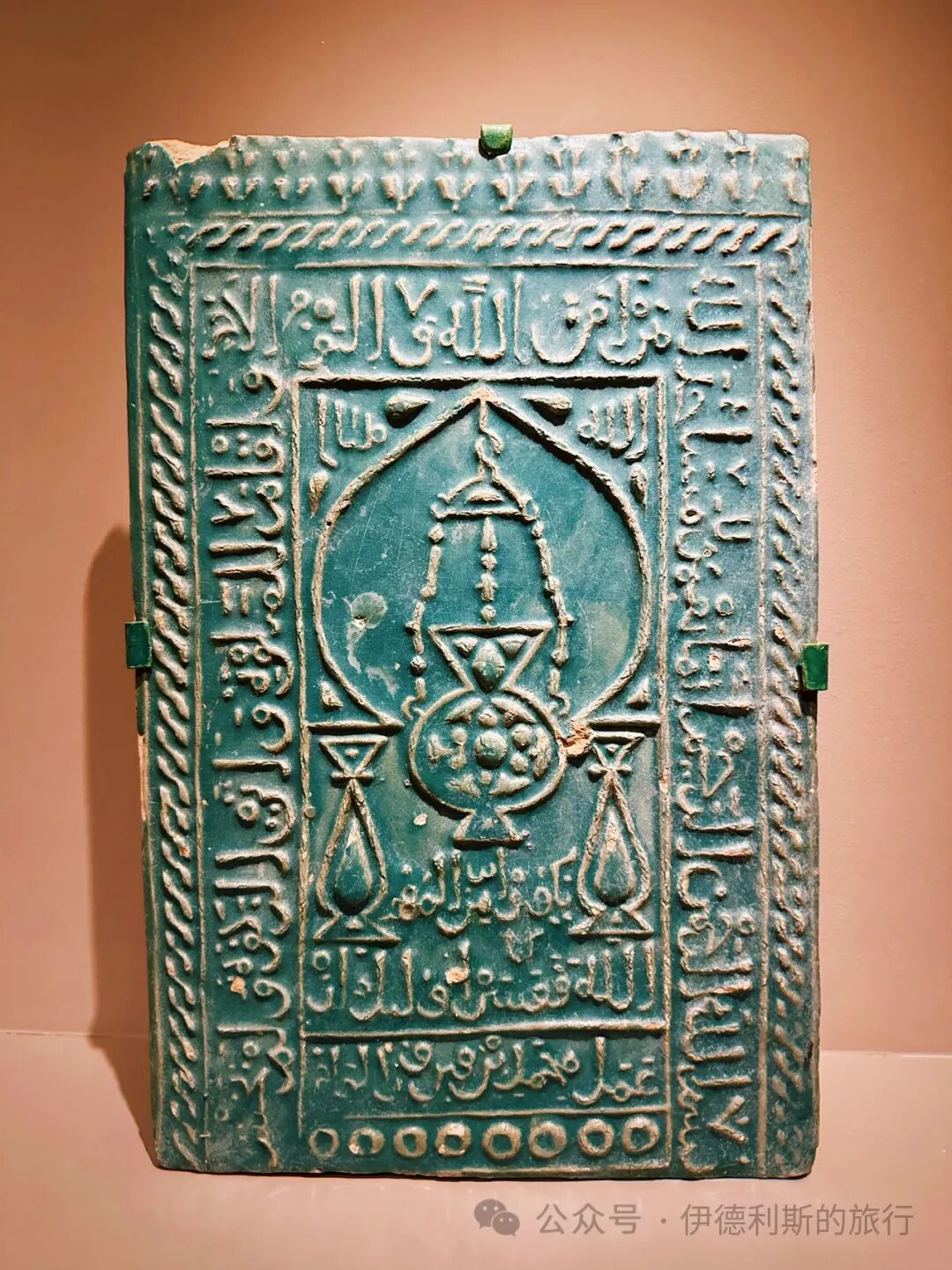
An 11th-century mihrab tile from northeastern Iran. The lamp in the center represents light (nur), symbolizing the presence of Allah.
This 11th-century tombstone tile from Afghanistan was likely embedded in the wall of a tomb.
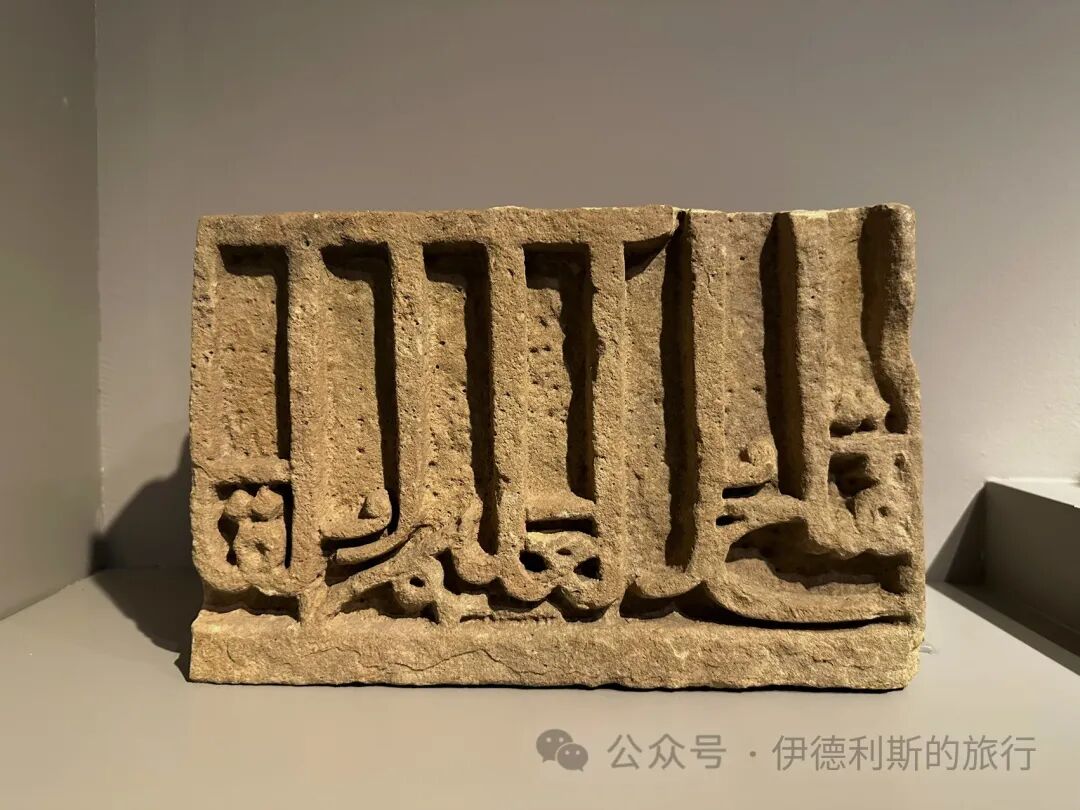
This 14th-century sandstone calligraphy carving from western India features a three-part script style that is stretched vertically.
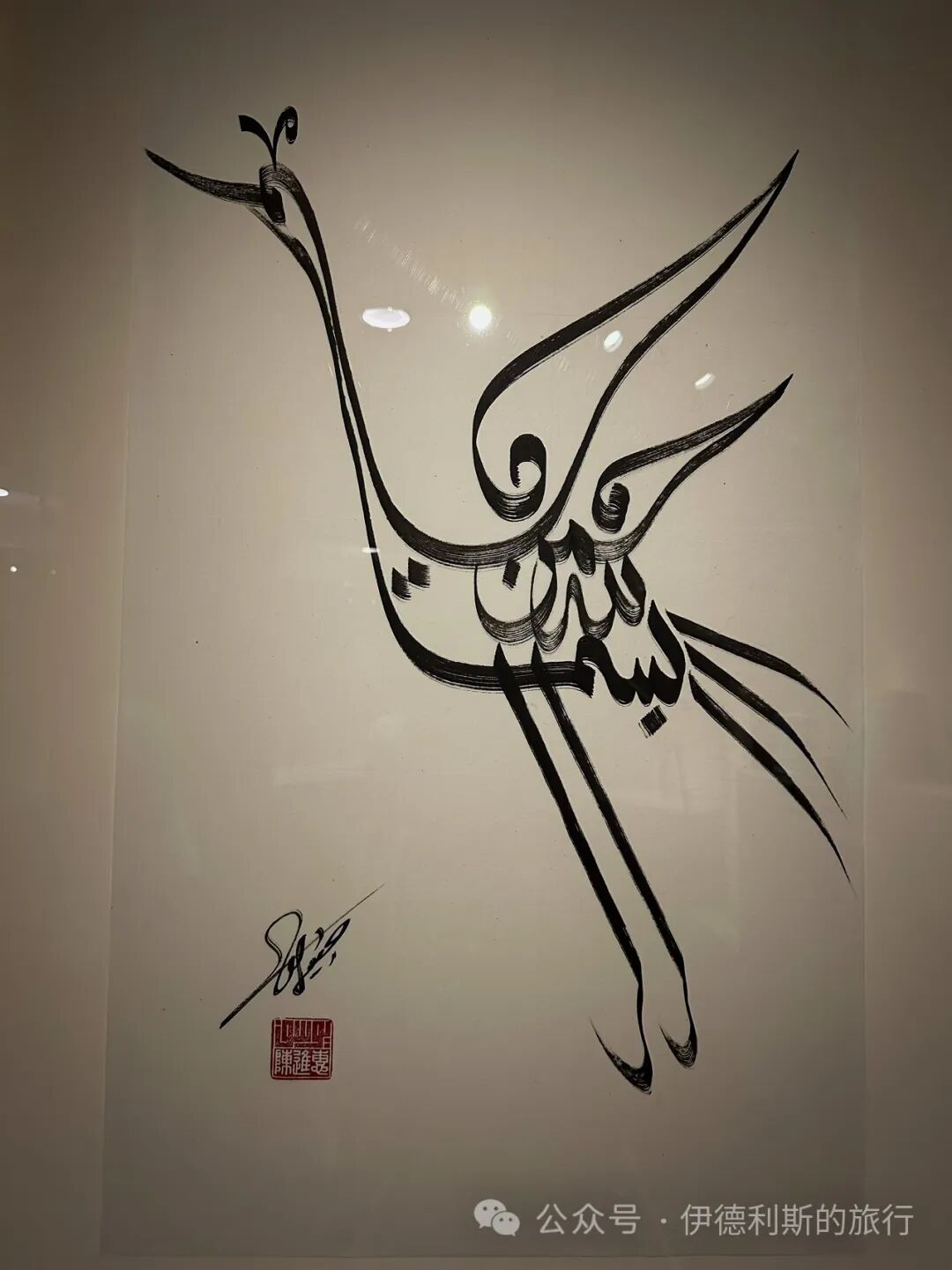
Renowned Arabic calligrapher Chen Jinhui created this piece in 1996, blending in techniques from Chinese ink wash painting.
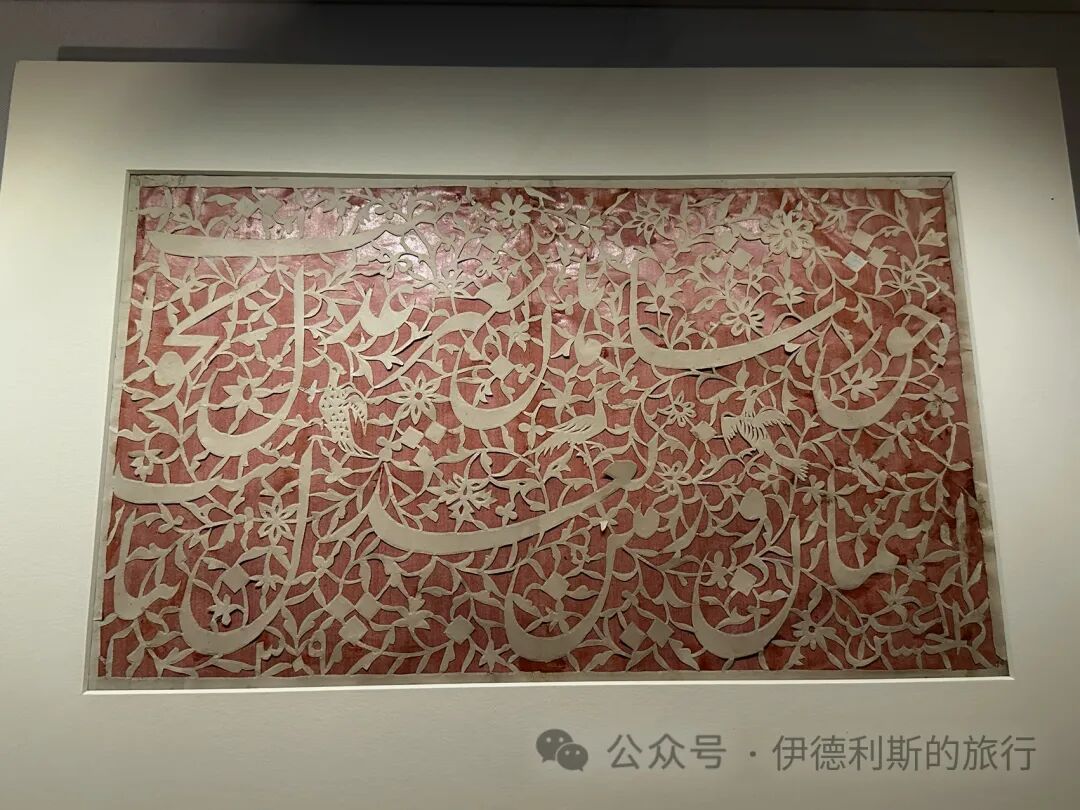
This is a Persian paper-cut from Iran, dated 1891. This art form was widely used for binding Iranian manuscripts from the 15th to 17th centuries and continued until the end of the 19th century.
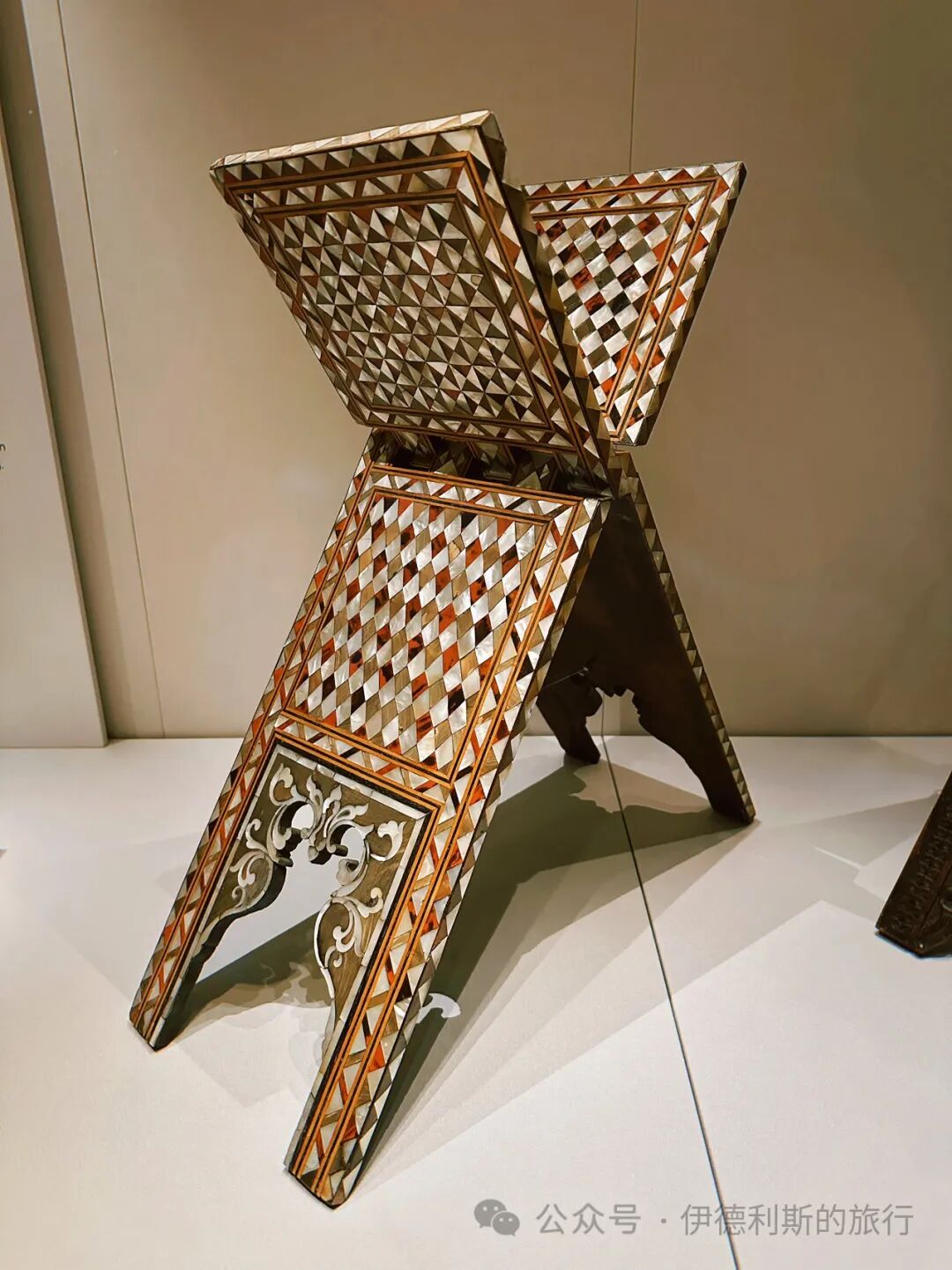
This 18th-century Ottoman Turkish book stand (rehal) is inlaid with tortoiseshell and mother-of-pearl.
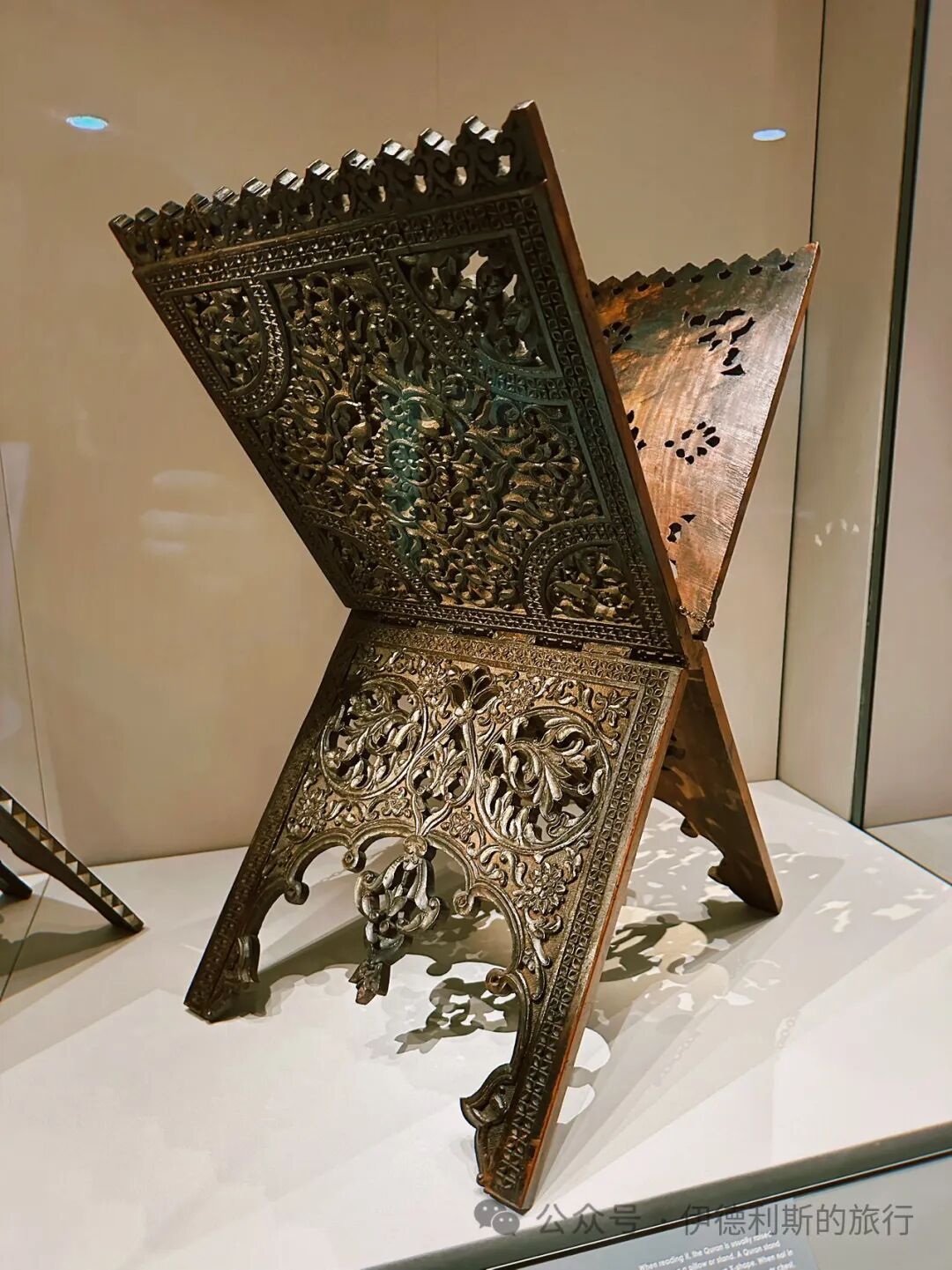
This 19th-century Iranian book stand (rehal) is carved with beautiful floral and geometric patterns.
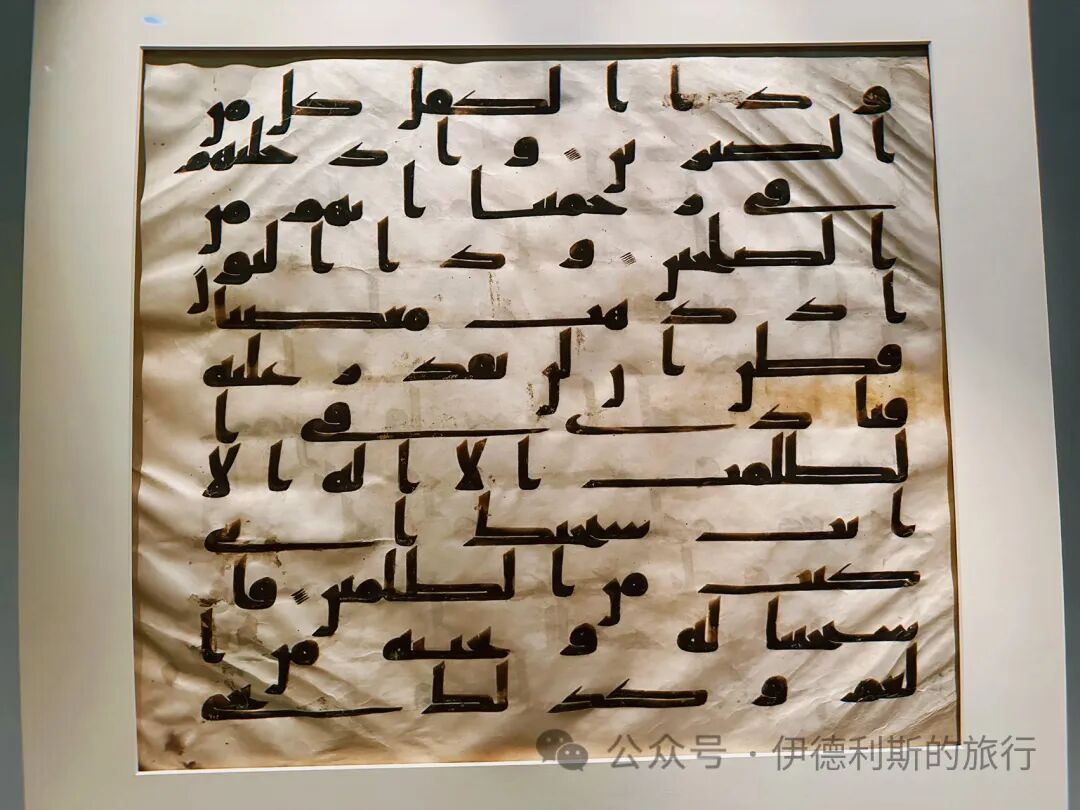
This 8th-to-9th-century parchment manuscript from Syria or North Africa is an early form of Kufic script. These parchment Kufic manuscripts are among the earliest Quran copies visible today.
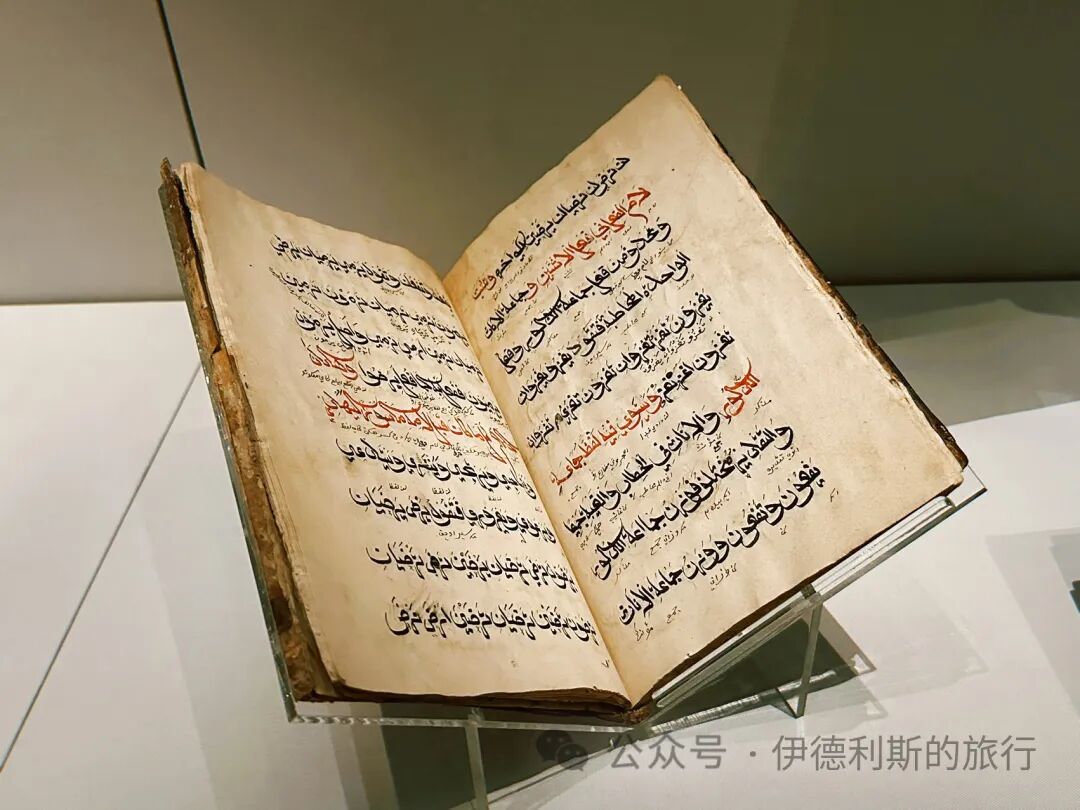
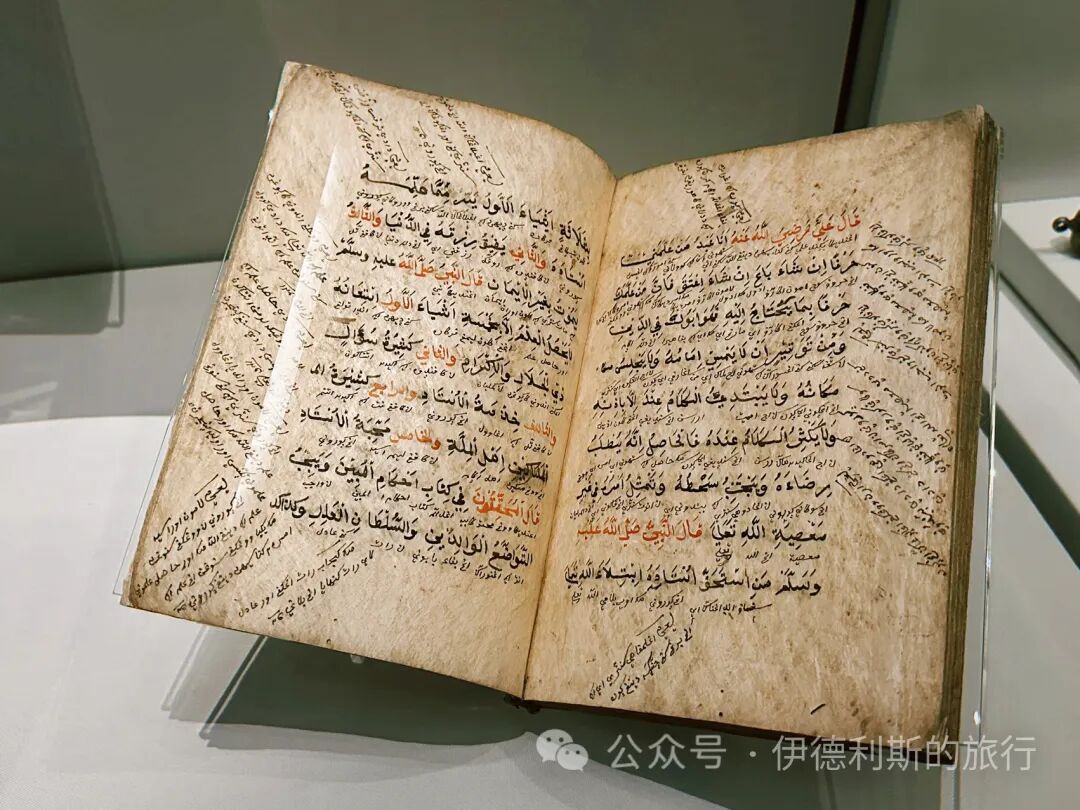
These two religious texts, written in China and Java, show how non-native Arabic speakers wrote the language, including notes in their own native tongues.
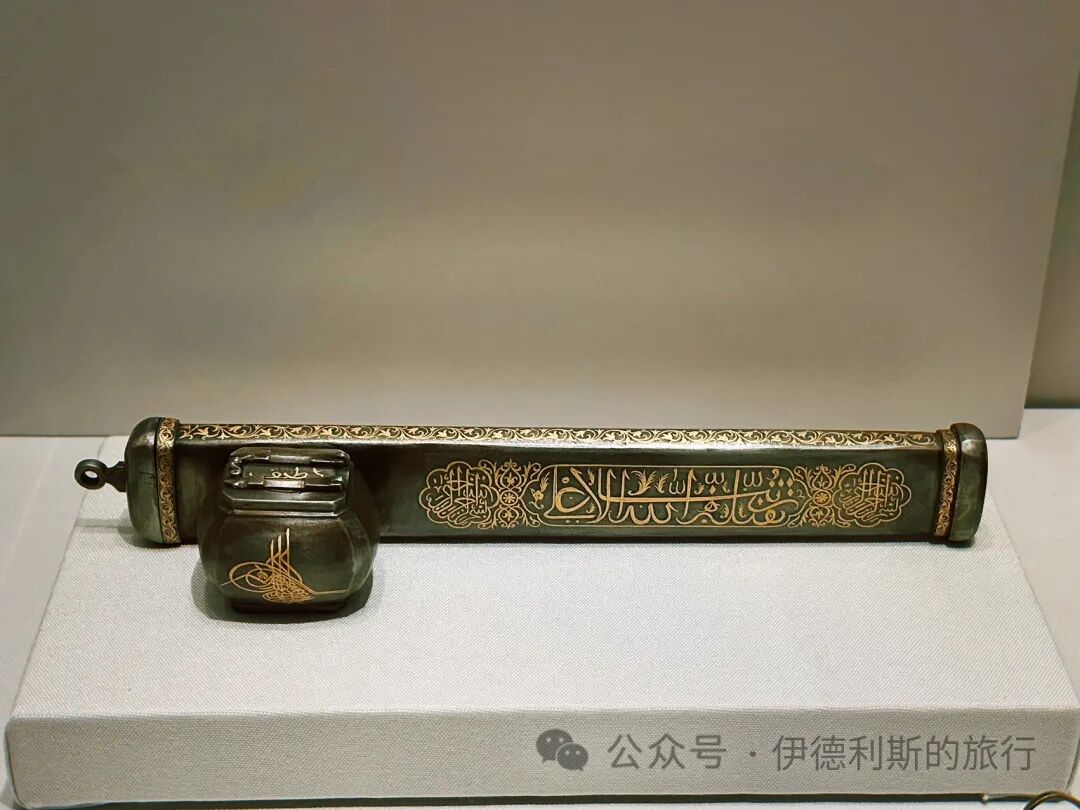
This is an 1876 Ottoman Turkish pen case with an inkwell.
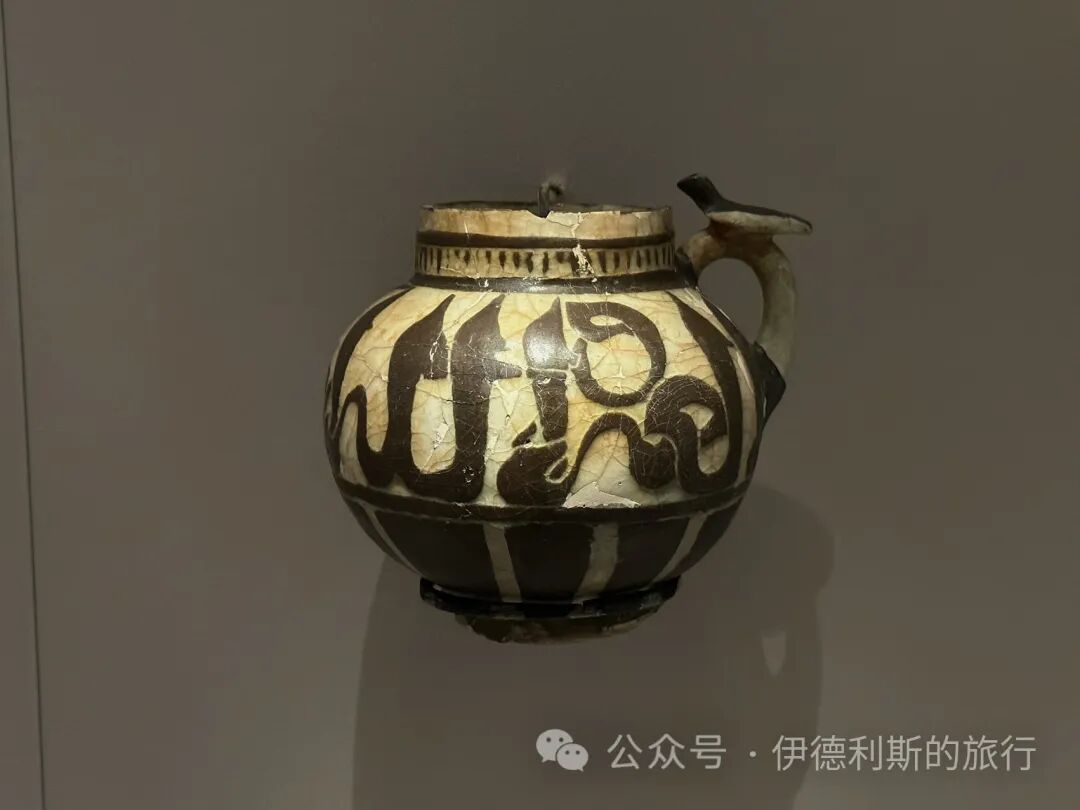
This is a pottery jug from Kashan, Iran, dating to the late 12th century.
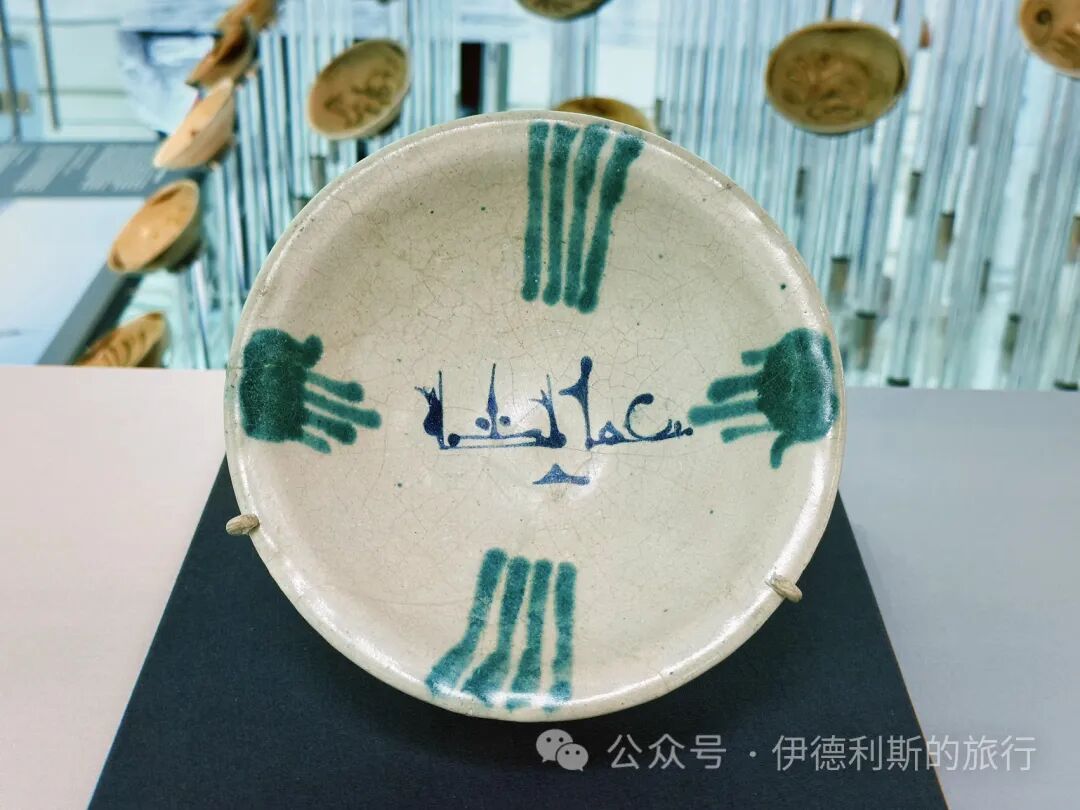
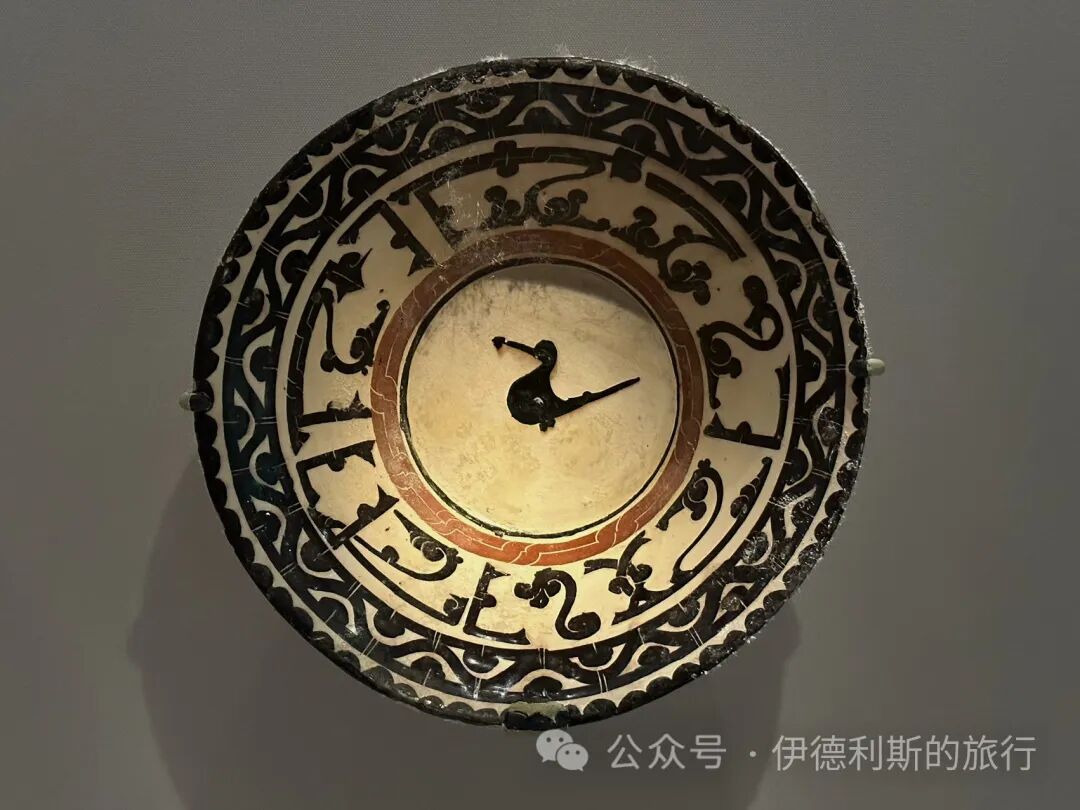
This is a 10th-century pottery bowl from Nishapur, Iran, featuring Kufic calligraphy.
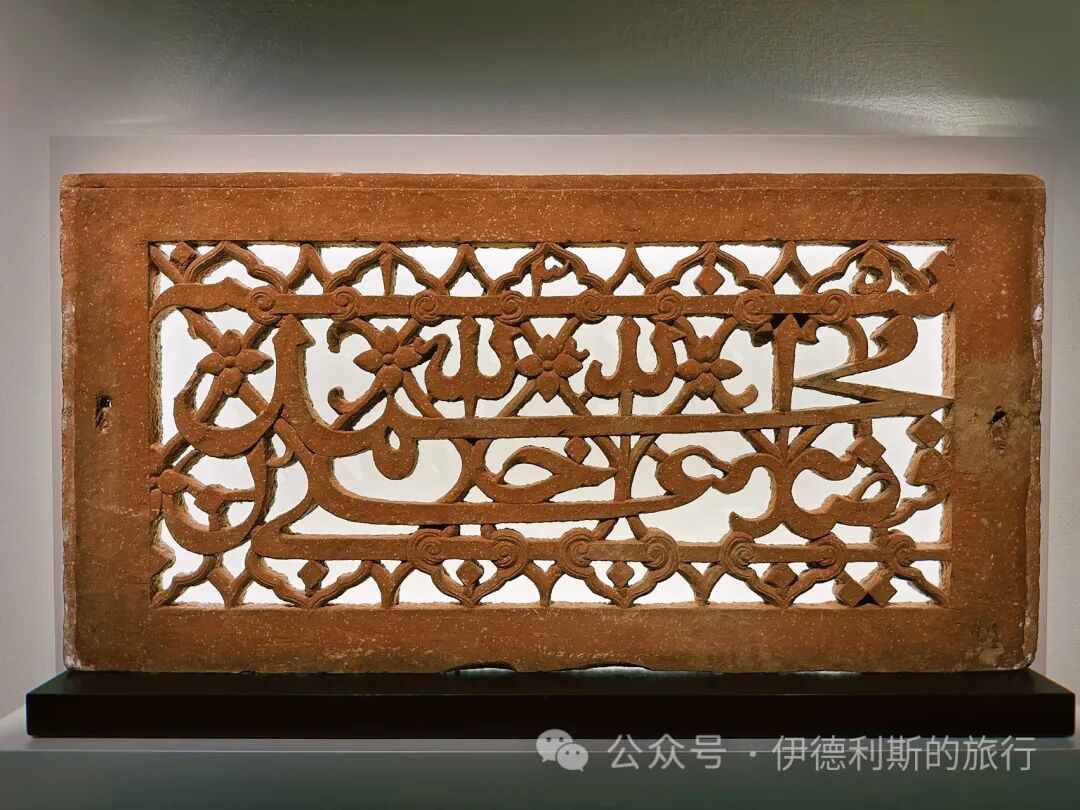
This 1887-88 sandstone screen (jali) from India was used to block the hot sun and is inscribed with praises to Allah.
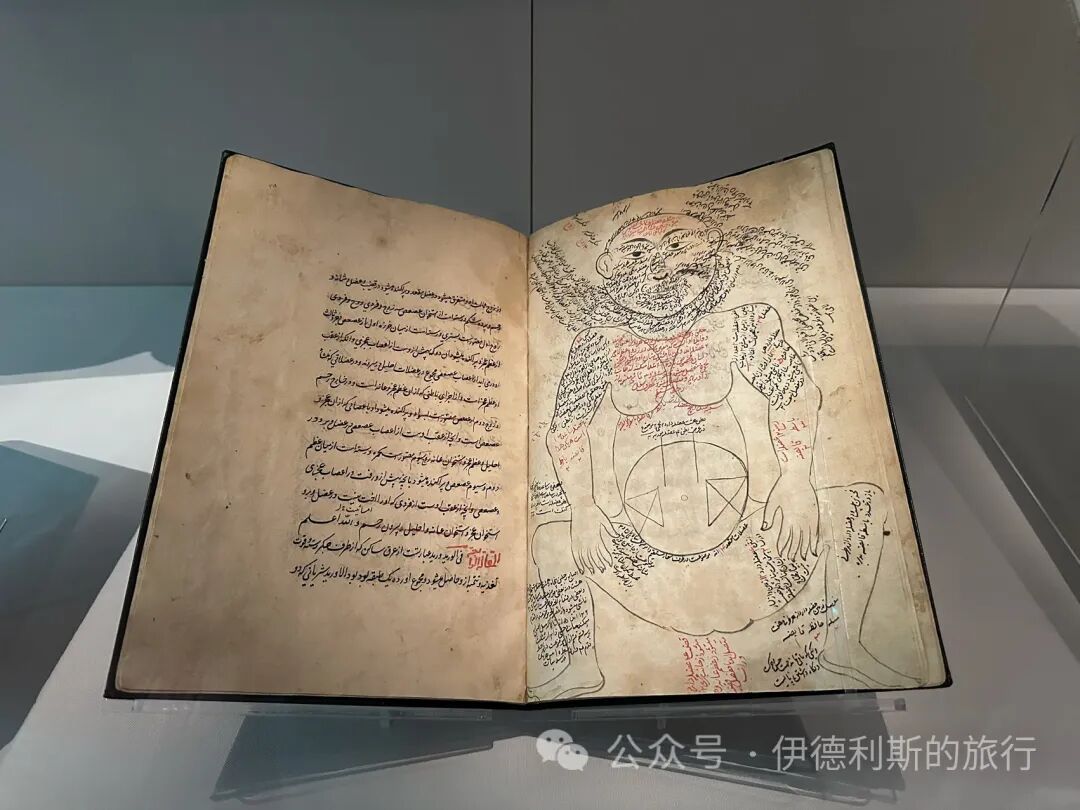
This 17th-century Iranian copy of the anatomy book Tashrih-i Mansuri was originally written in the 14th century. It studies different body systems, including bones, nerves, muscles, and arteries. The final chapter explains how human organs and fetuses form, and it includes anatomical drawings of a pregnant woman.
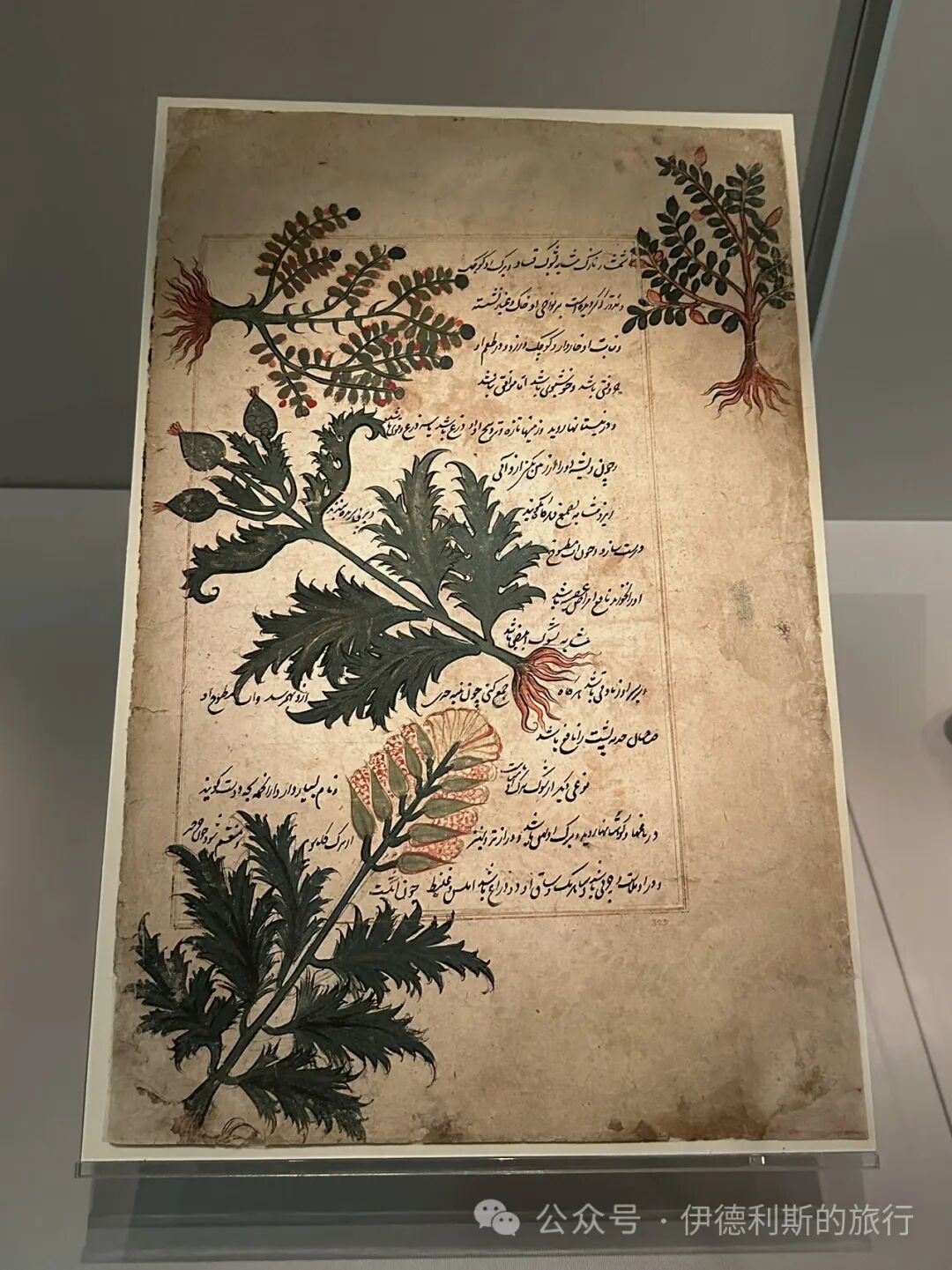
This is a Persian version of the famous ancient Roman pharmacology book De materia medica, copied in the Deccan region of India in 1595. De materia medica was written in Greek in the 1st century AD, translated into Arabic in the 9th century, and later translated into Persian, laying an important foundation for botany and pharmacology in West Asia.
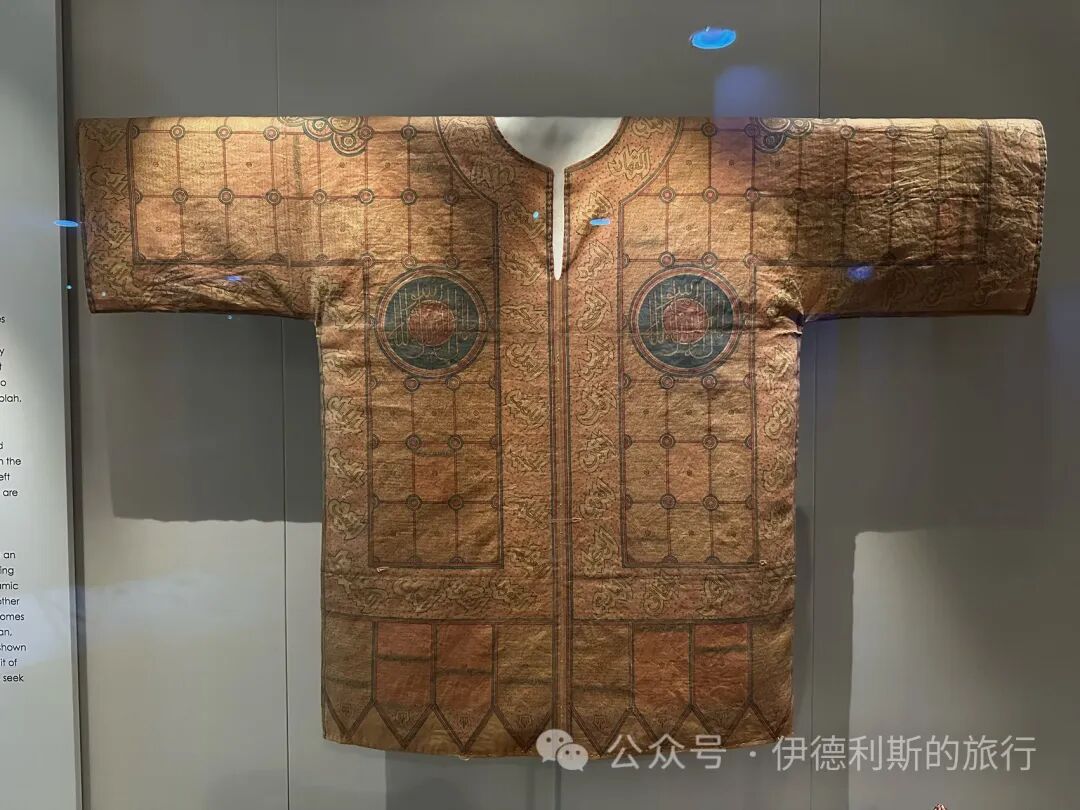
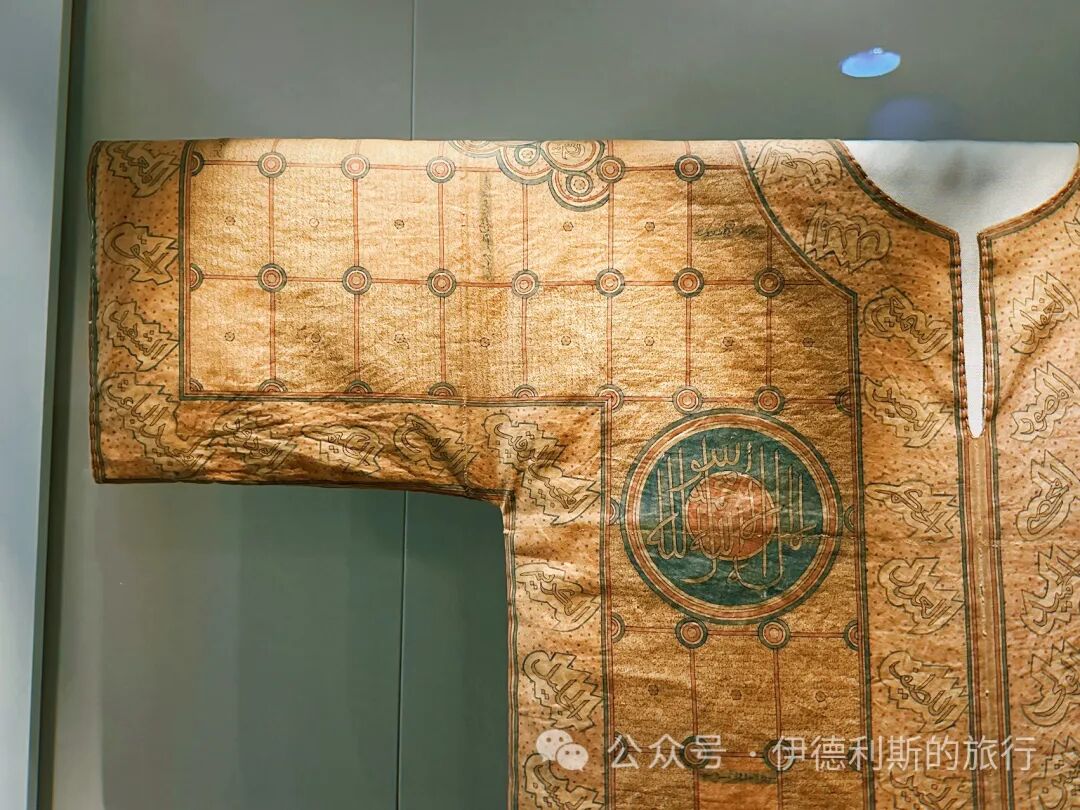
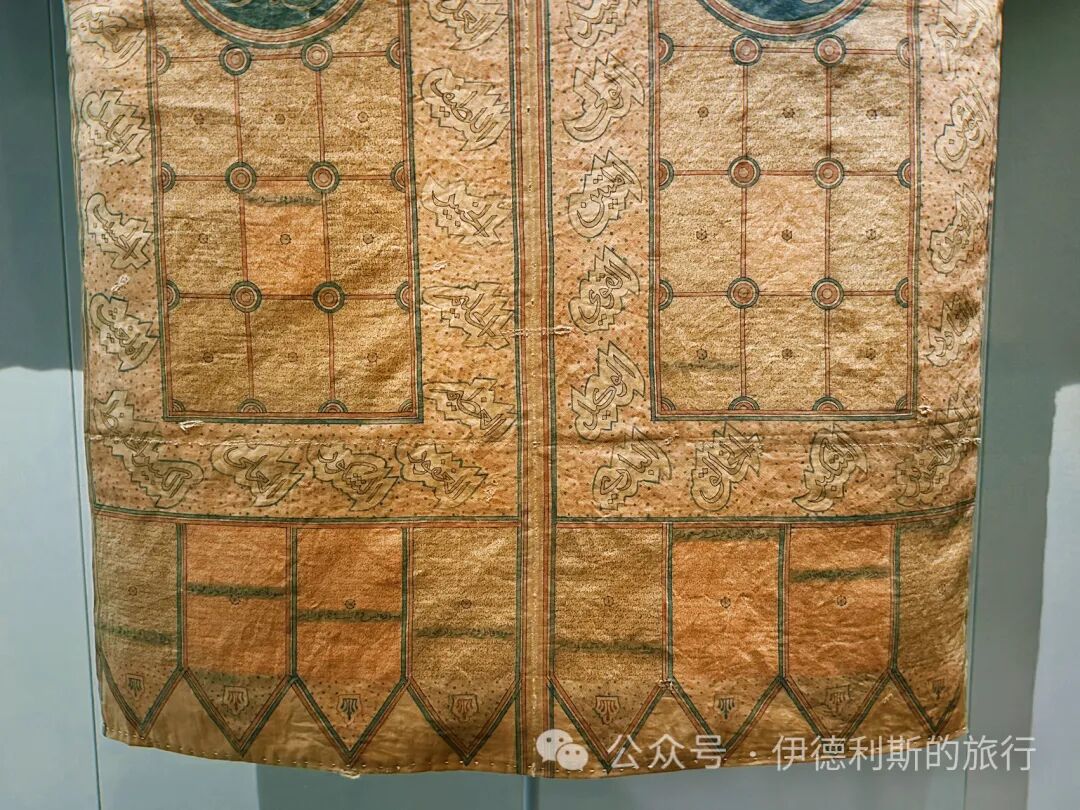
A dua shirt (dua shirt) from the Mughal Empire in India, dating from the 16th to the early 17th century. This garment is covered in scripture and the 99 names of Allah. Warriors wore it under their armor, and sick people wore it for health and safety.
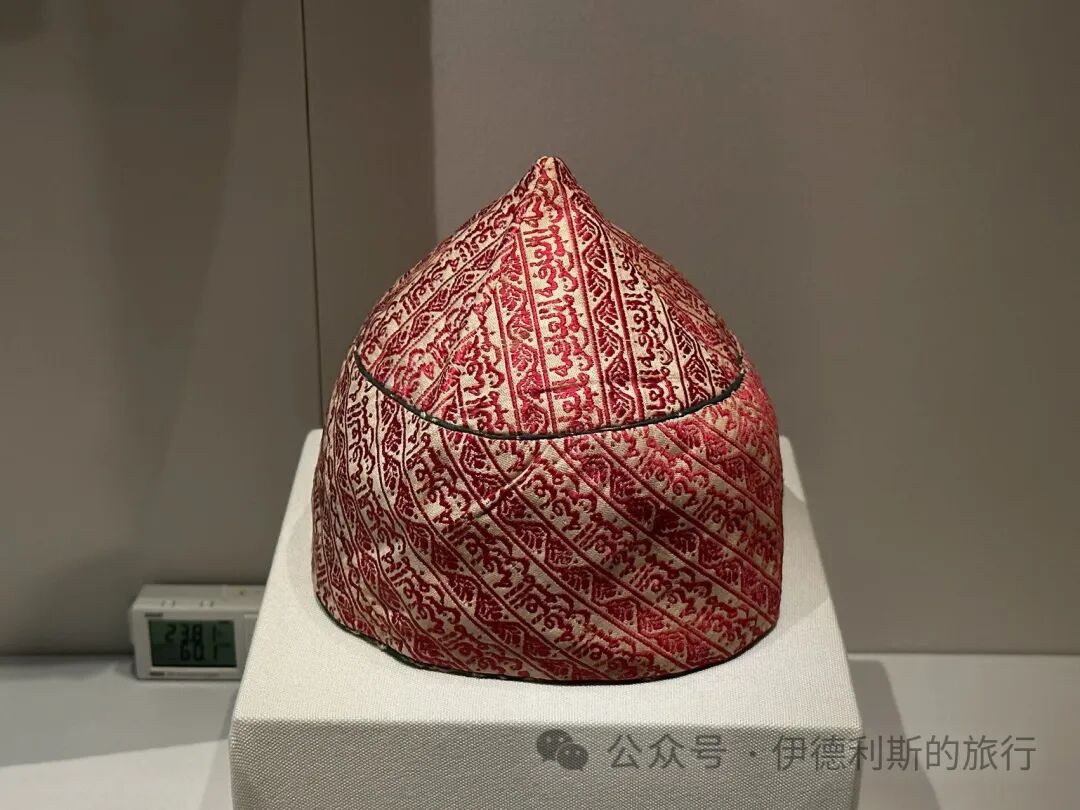
A 19th-century Indian dua hat (dua hat) inscribed with scripture.
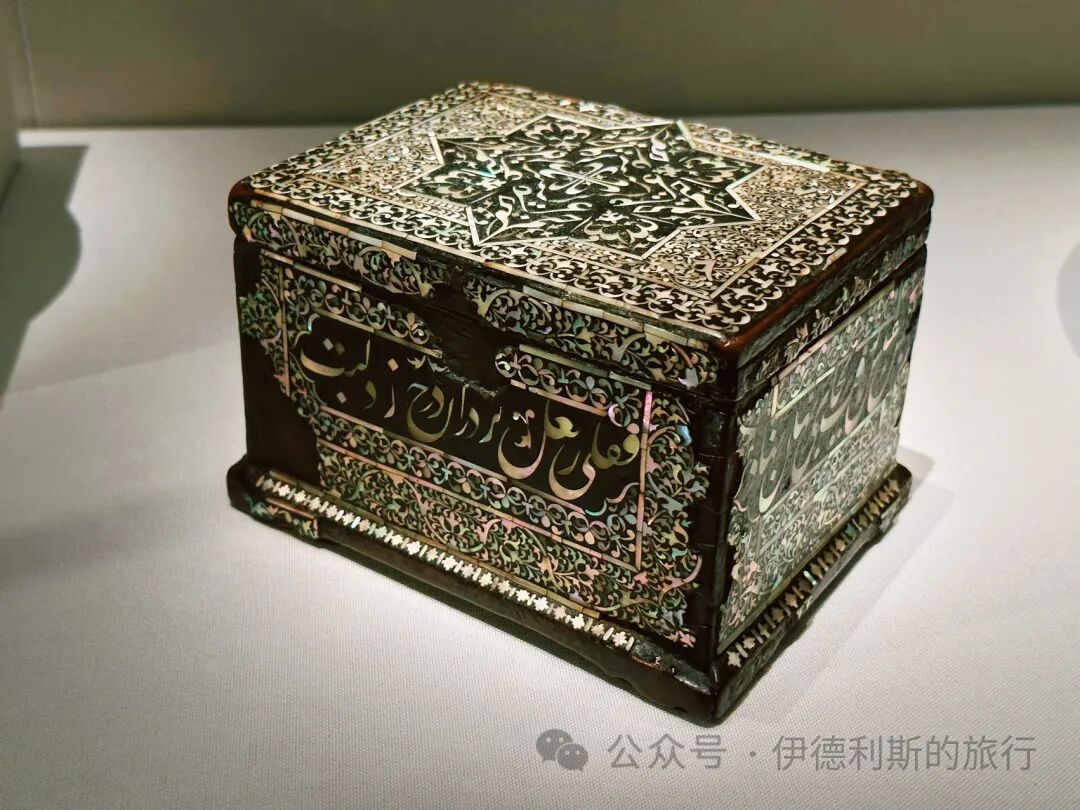
A jewelry box from Gujarat, India, made between the late 16th and 17th centuries. Muslim artisans in Gujarat crafted these fine boxes for the entire Islamic world, decorating them with finely cut mother-of-pearl.
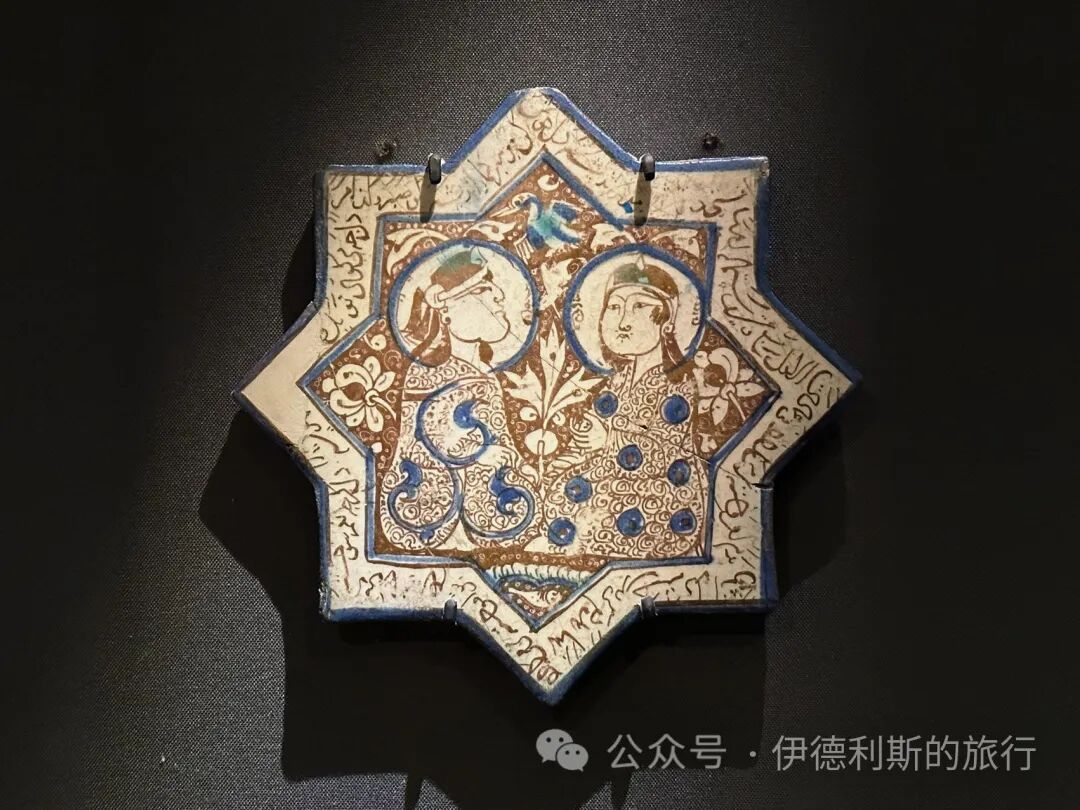
A 1230 tile from Kashan, Iran. These octagonal tiles, paired with cross-shaped tiles, covered the walls of Iranian palaces and important tombs. They often feature Persian poetry and Quranic verses.
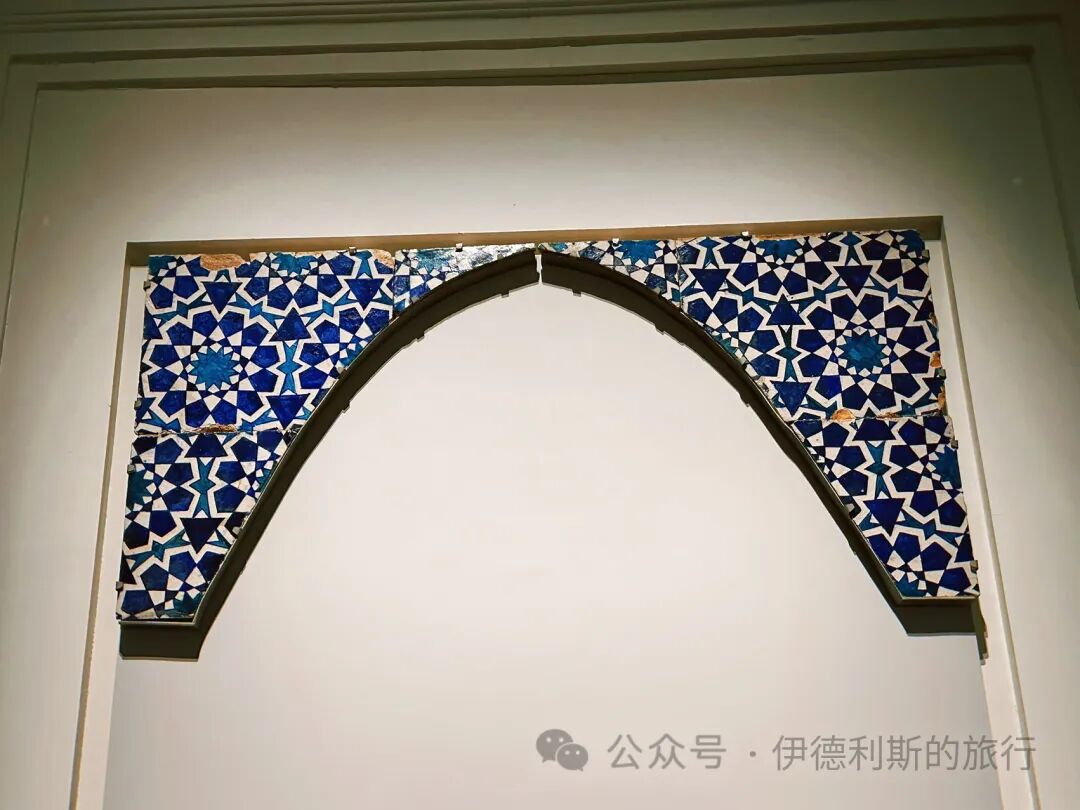
A 15th-century tile from Multan, Pakistan. Influenced by the Timurid Empire of Central Asia, it features a striking blue and green twelve-pointed star design.
Exquisite Chinese export porcelain, reflecting the economic and cultural exchange between China and the Islamic world at that time.
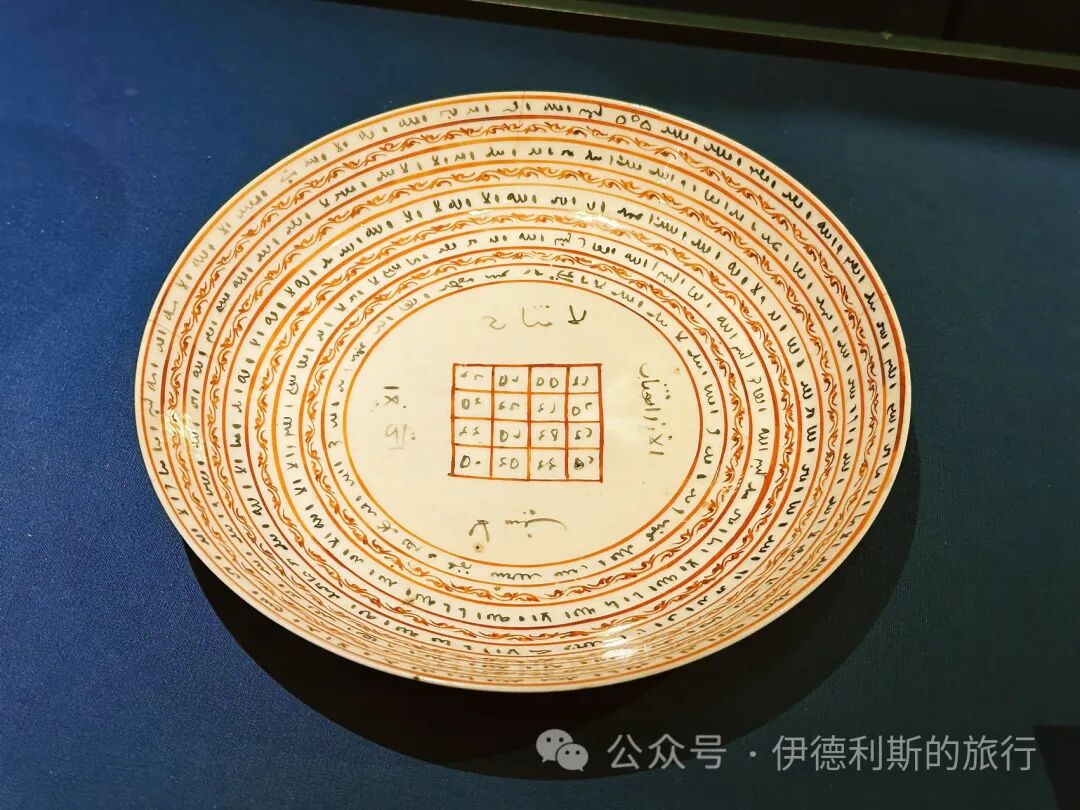
A Chinese porcelain plate from the early 17th century featuring a magic square, with black cursive scripture alternating with red scroll patterns. Magic squares were believed to help prevent disease.
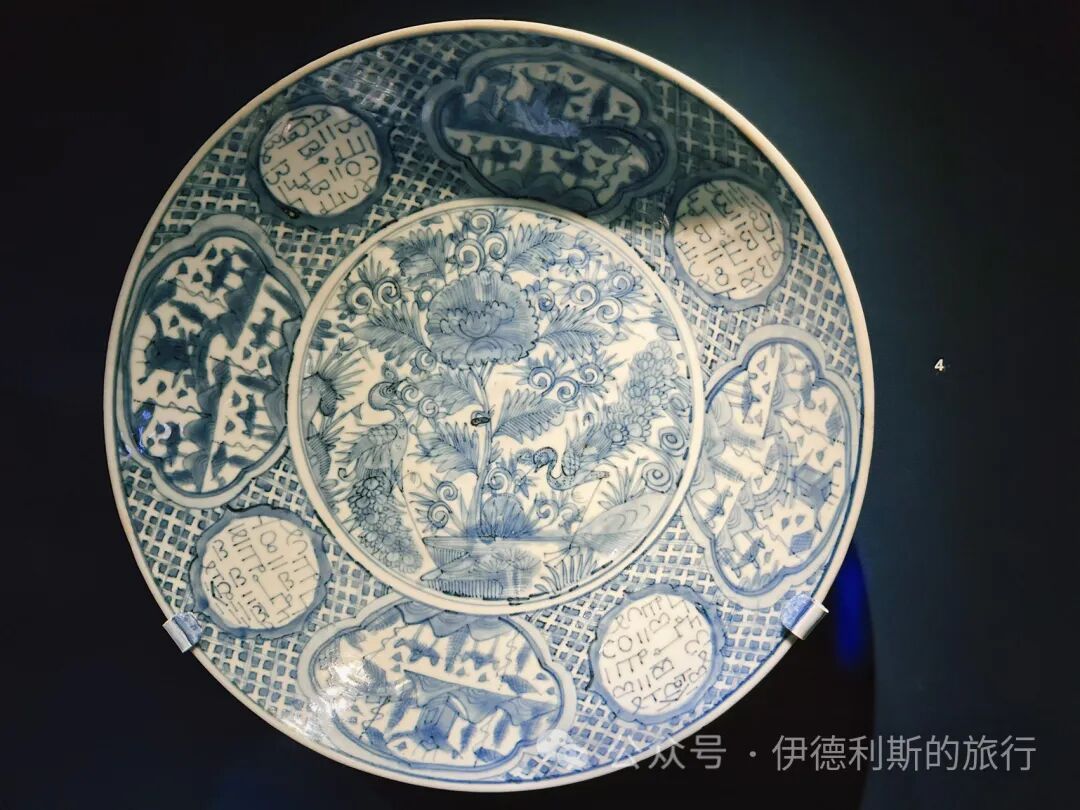
An early 17th-century export porcelain plate from the Zhangzhou kiln in Fujian. It shows two peacocks under a blooming flower, surrounded by the Shahada.
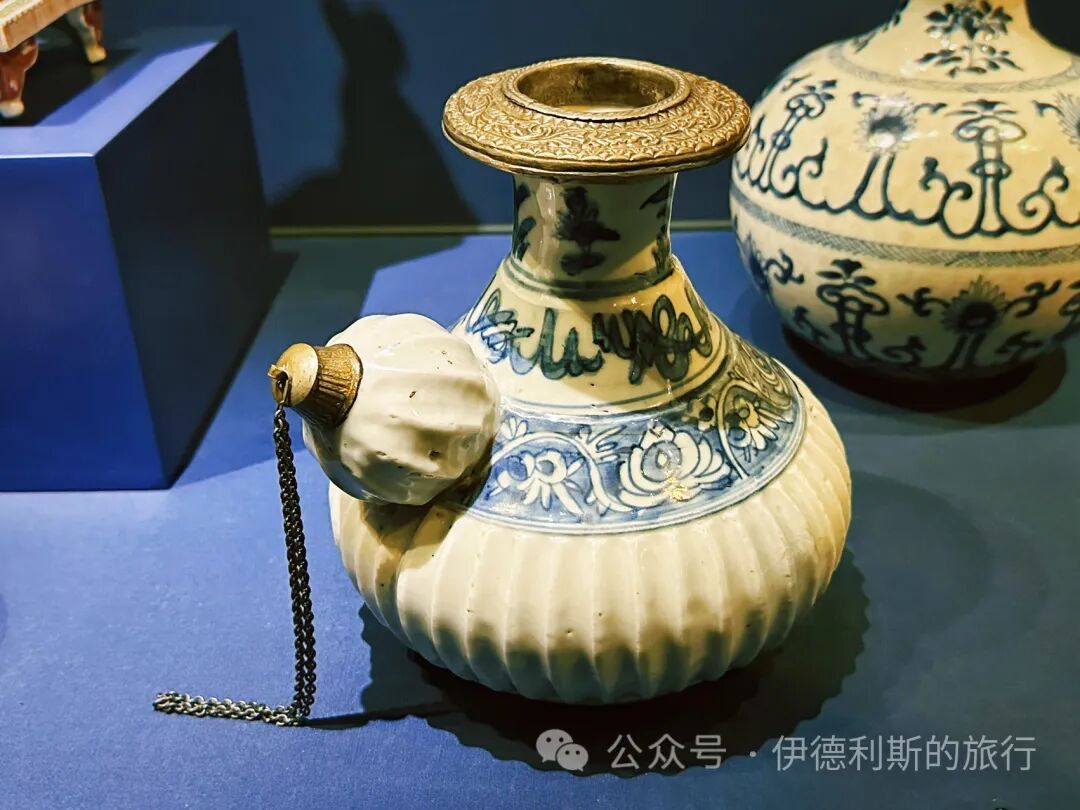
A 17th-century Qing dynasty export porcelain piece, fitted with a silver rim and spout, featuring the name of Allah.
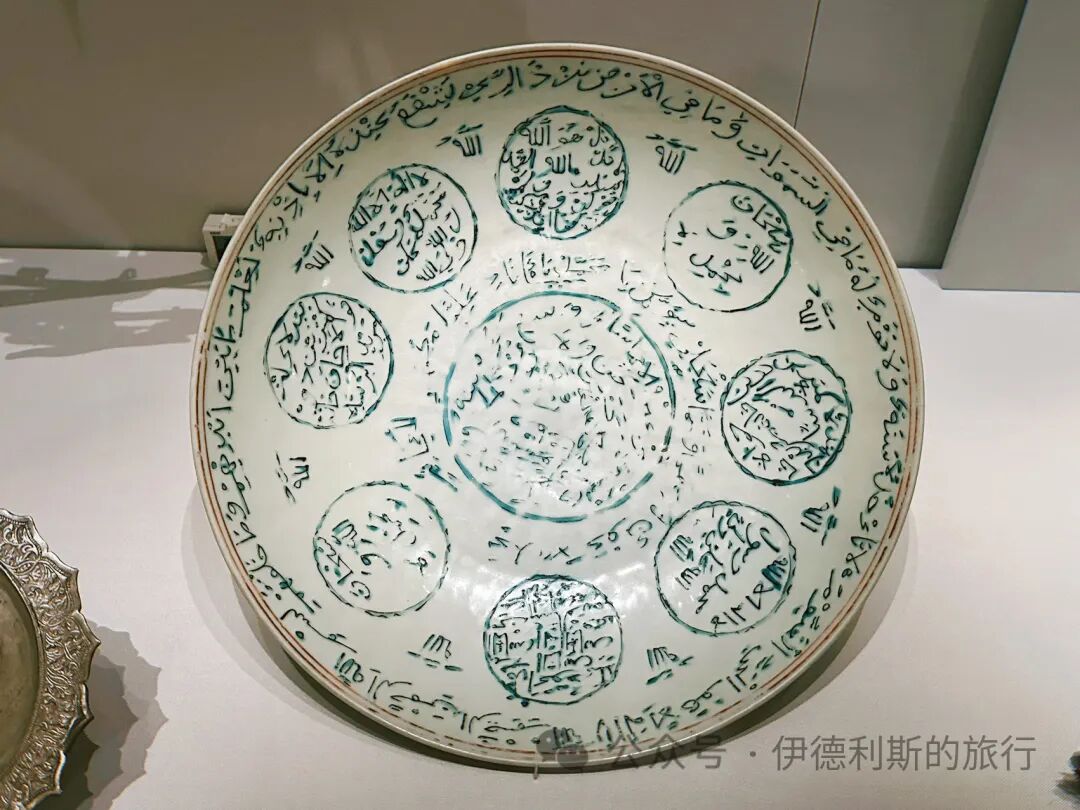
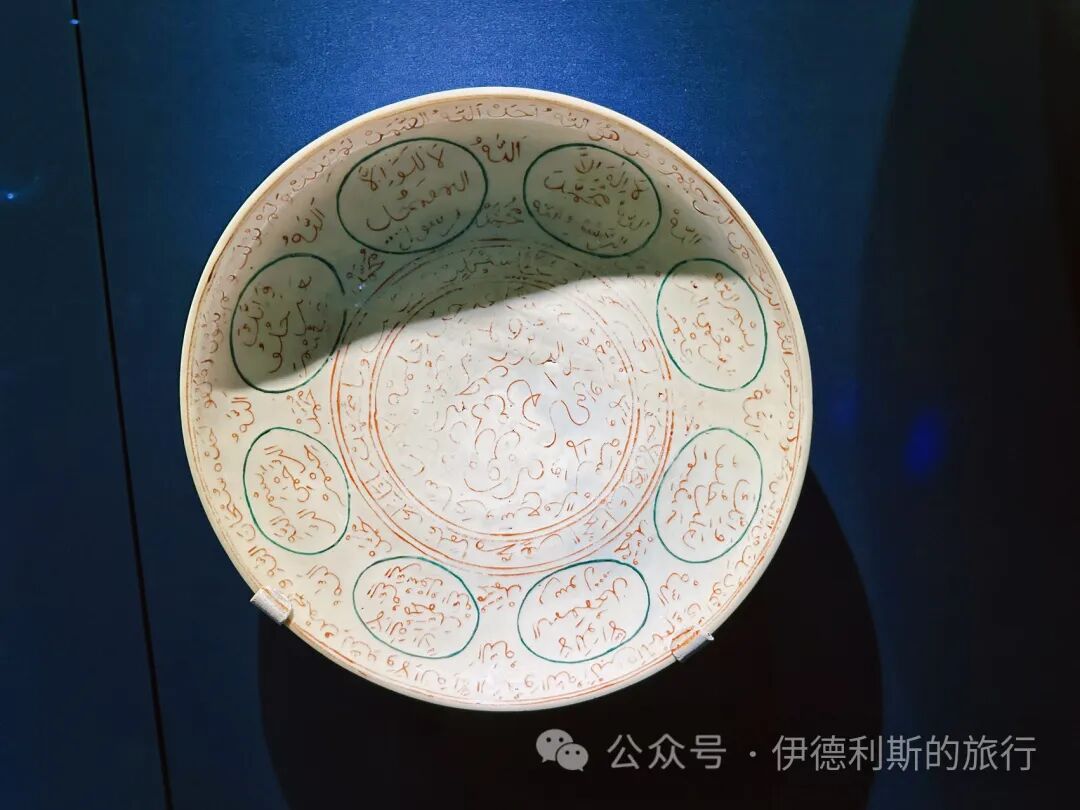
A porcelain plate from the Zhangzhou kiln in Fujian, commissioned by the Sultan of Aceh in the 17th century. The inner circle contains scripture, while the eight outer circles feature seals designed by the Sultan in imitation of the Mughal Empire. The Sultanate of Aceh (1496-1903) was located in northern Sumatra, Indonesia, and was once a major center for Islamic scholarship and trade. These plates were likely ordered during the reign of Sultan Iskandar Muda (1607-1636). Under his rule, the Sultanate of Aceh reached its peak, becoming the most powerful and wealthy state in western Indonesia and the Strait of Malacca.
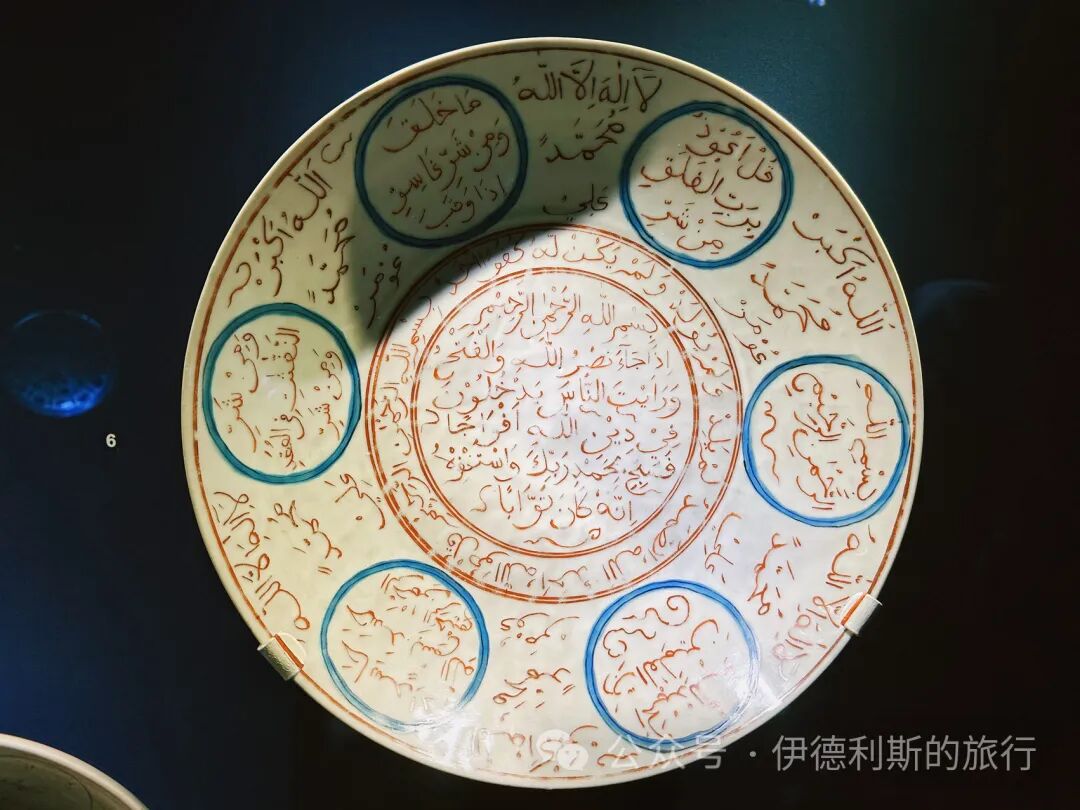
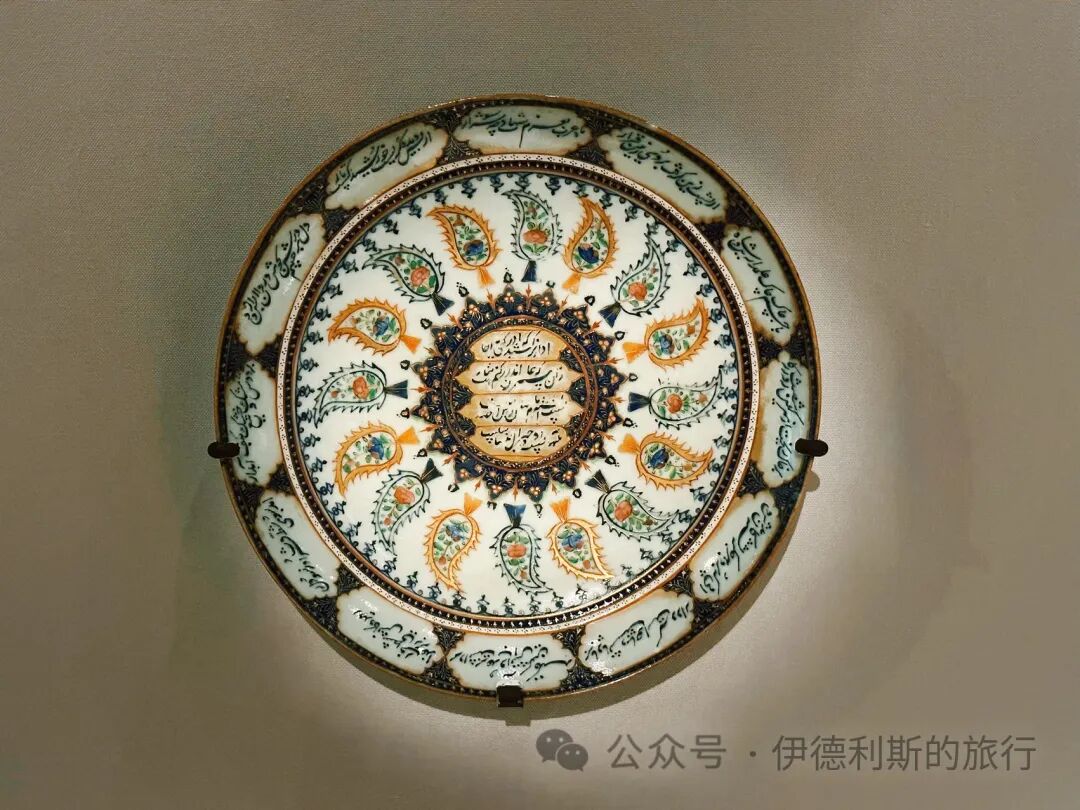
An export porcelain plate commissioned by Shia Muslims in Iran or India in 1844-45, featuring Persian poetry related to the martyrdom of Imam Hussein. The teardrop-shaped pattern used here is called a boteh design in Persian.
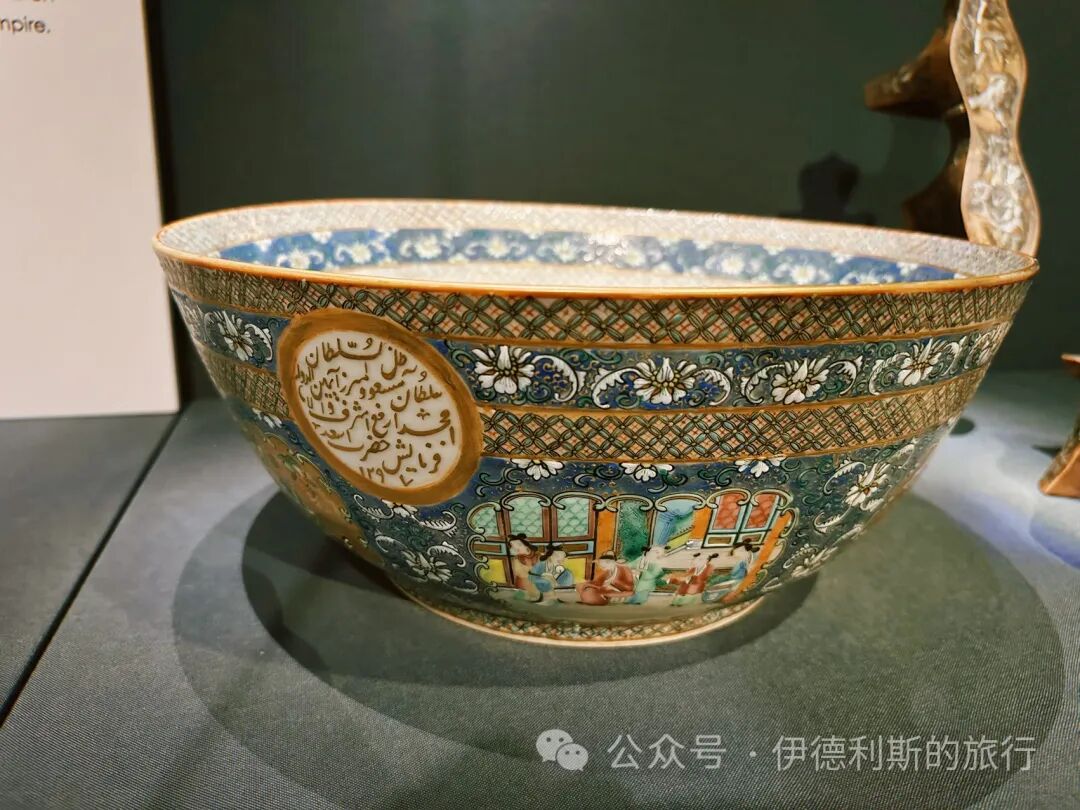
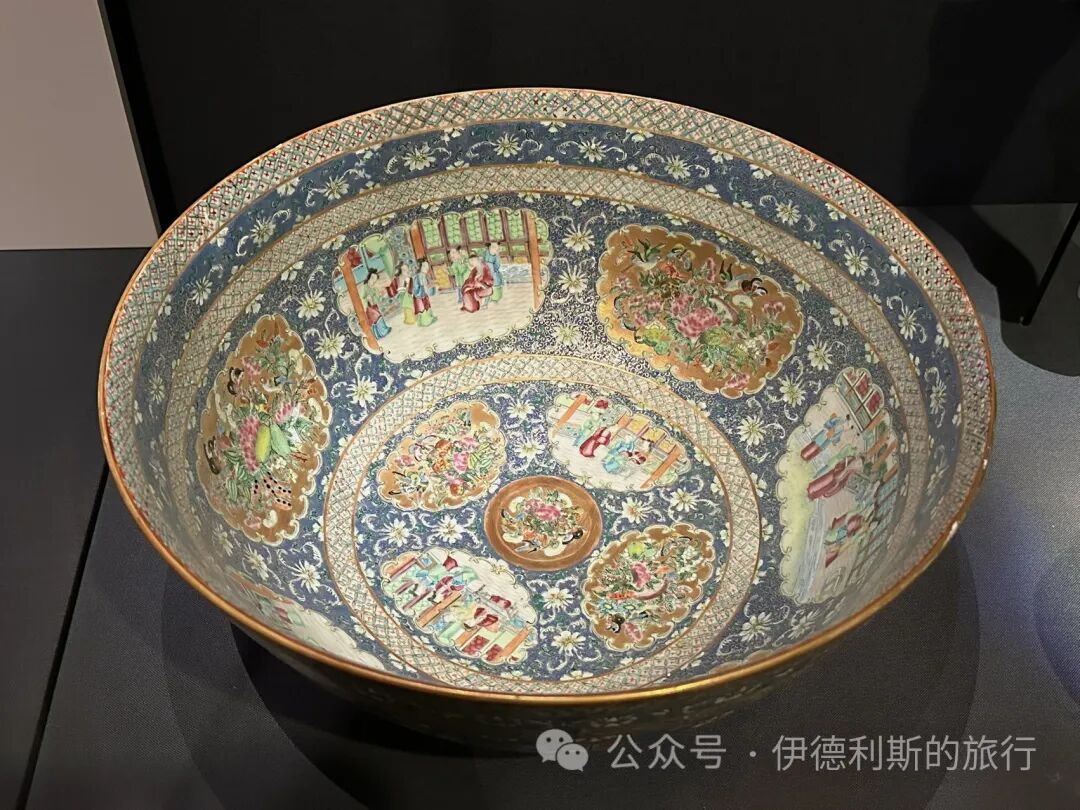
This Canton enamel porcelain bowl was ordered by the Qajar dynasty royal family in Iran between 1883 and 1884. It mentions Prince Mass'oud Mirza Zell-e Soltan, the eldest son of the Qajar King Naser al-Din Shah (who reigned from 1848 to 1896), who served as the governor of Isfahan for over 35 years. The Qajar royal family loved Canton enamel porcelain and often ordered full sets of tableware to use at banquets.
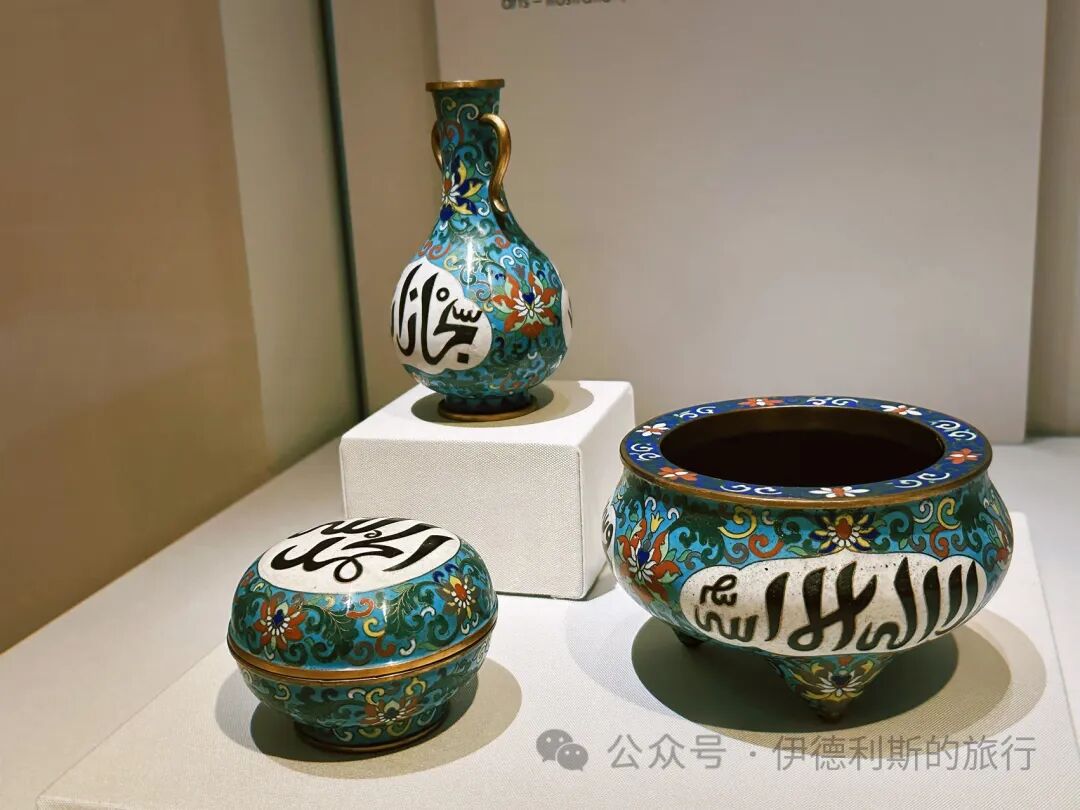
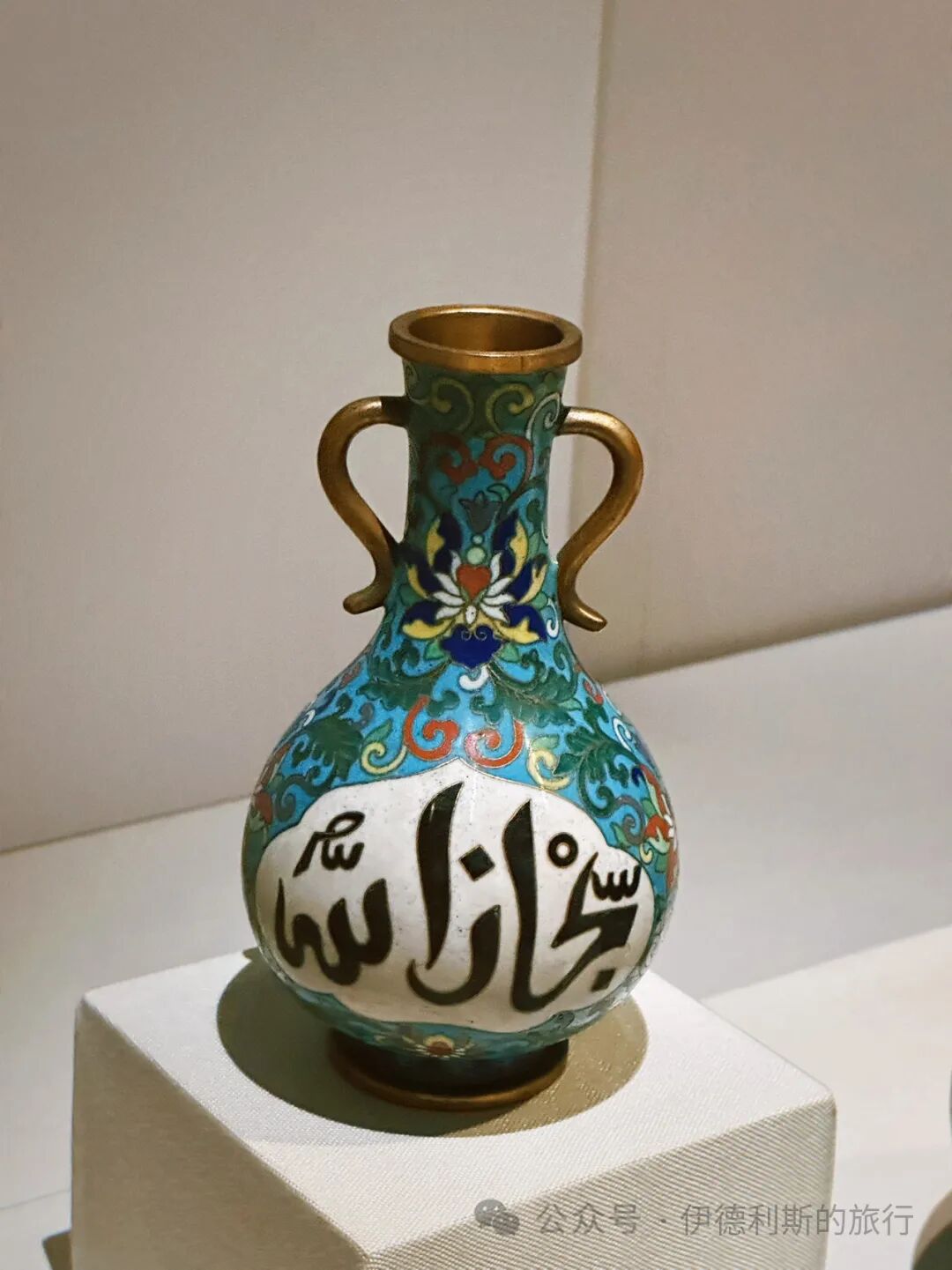
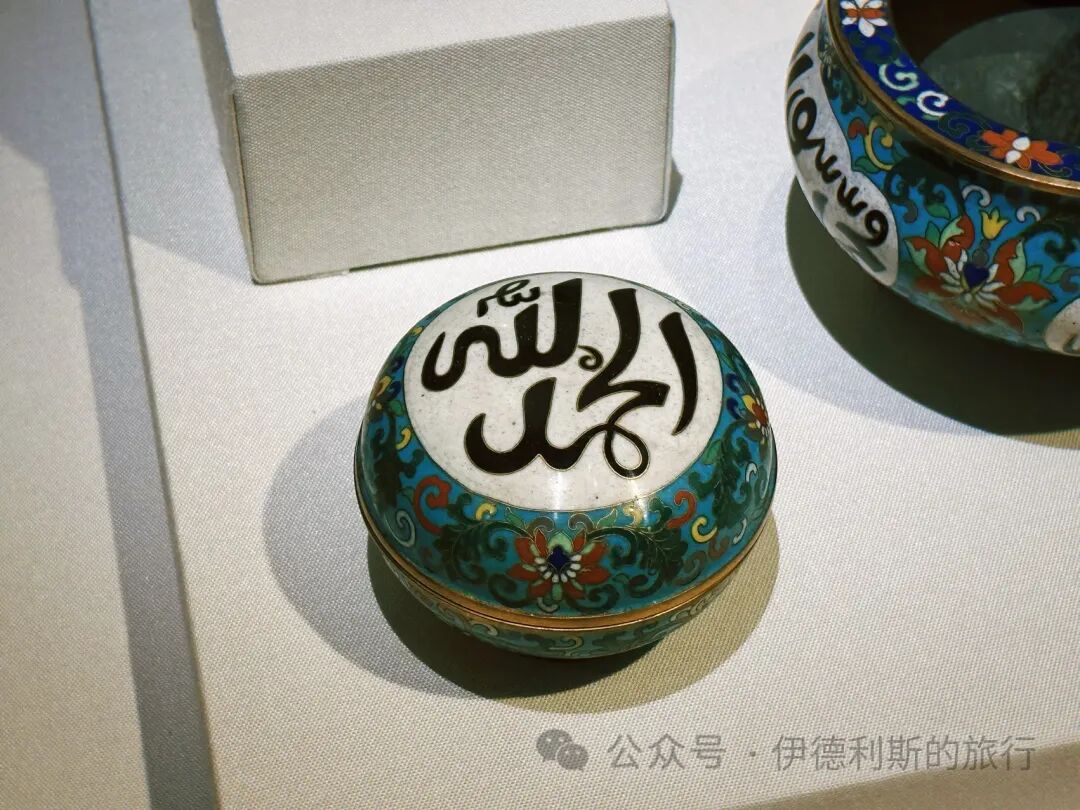
A set of traditional Qing dynasty enamel incense tools used by Hui Muslims: an incense burner, an incense box, and a vase for incense tools. In the past, Hui Muslims usually kept these in a high place at home and only used them during religious gatherings (nieti) and the Eid festivals. Later, as stick incense became popular, the three-piece incense set was gradually replaced by a single incense burner.
The spread and evolution of blue and white porcelain in the Middle East.
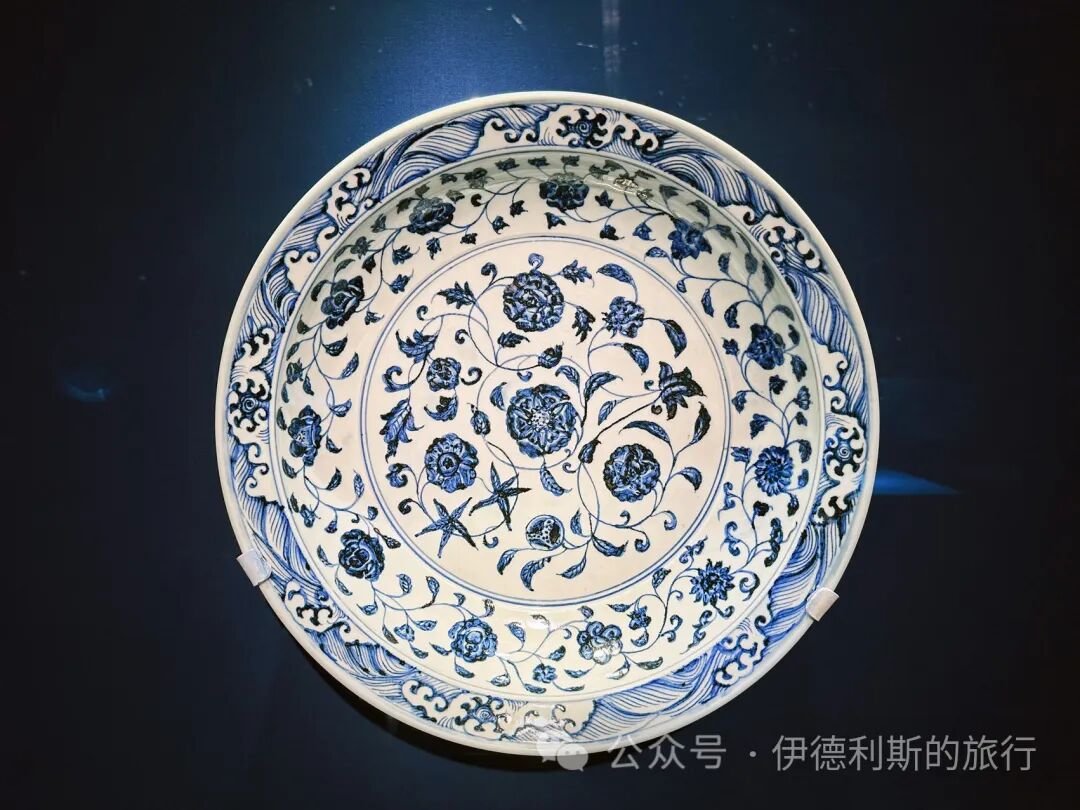
The first is a blue and white porcelain plate from Jingdezhen in the 15th century. This type of floral blue and white porcelain plate was exported in large quantities to Middle Eastern countries during the Ming dynasty, and one is kept in the tomb of the famous Sufi Sheikh Safi al-Din in Iran.
The second is blue and white porcelain produced by the Ottoman Empire in the mid-15th century, representing an early Middle Eastern attempt to learn from Jingdezhen blue and white porcelain. The floral patterns are clearly influenced by China, but the cypress tree pattern is a Turkish specialty.
The third is porcelain produced around 1600 in Iznik, Turkey, under Ottoman rule. By this period, Iznik was able to produce high-quality blue and white porcelain, and the floral patterns continued to be influenced by China.
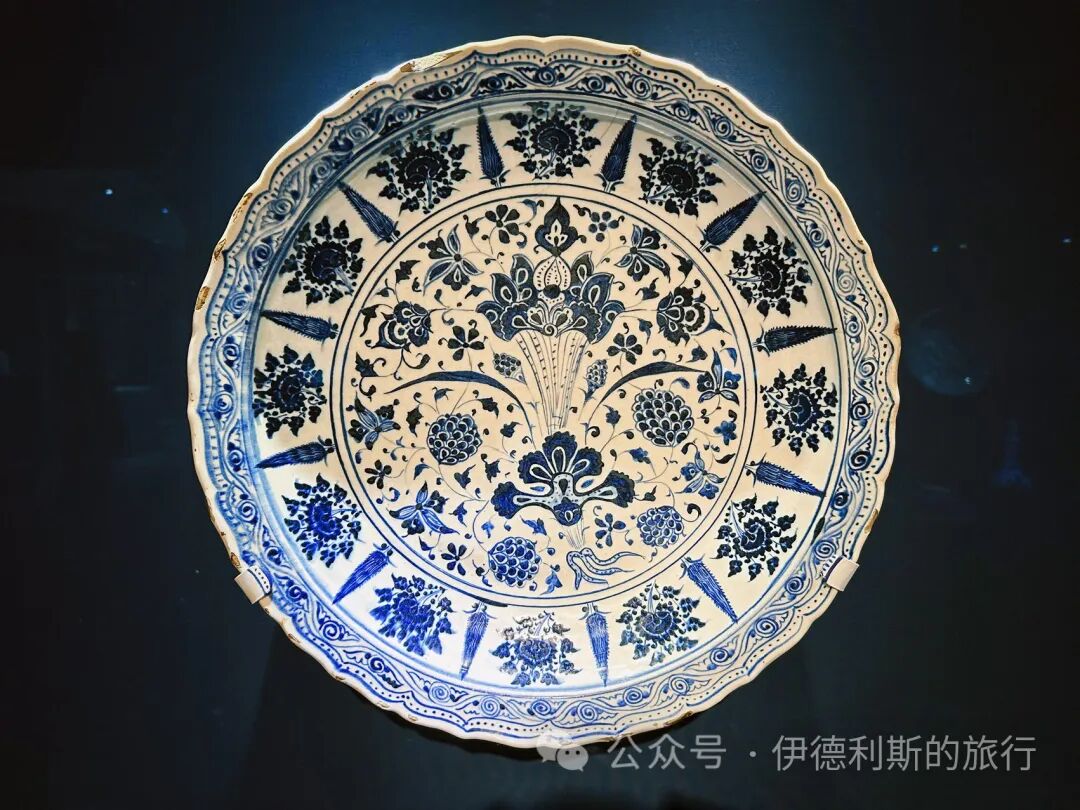
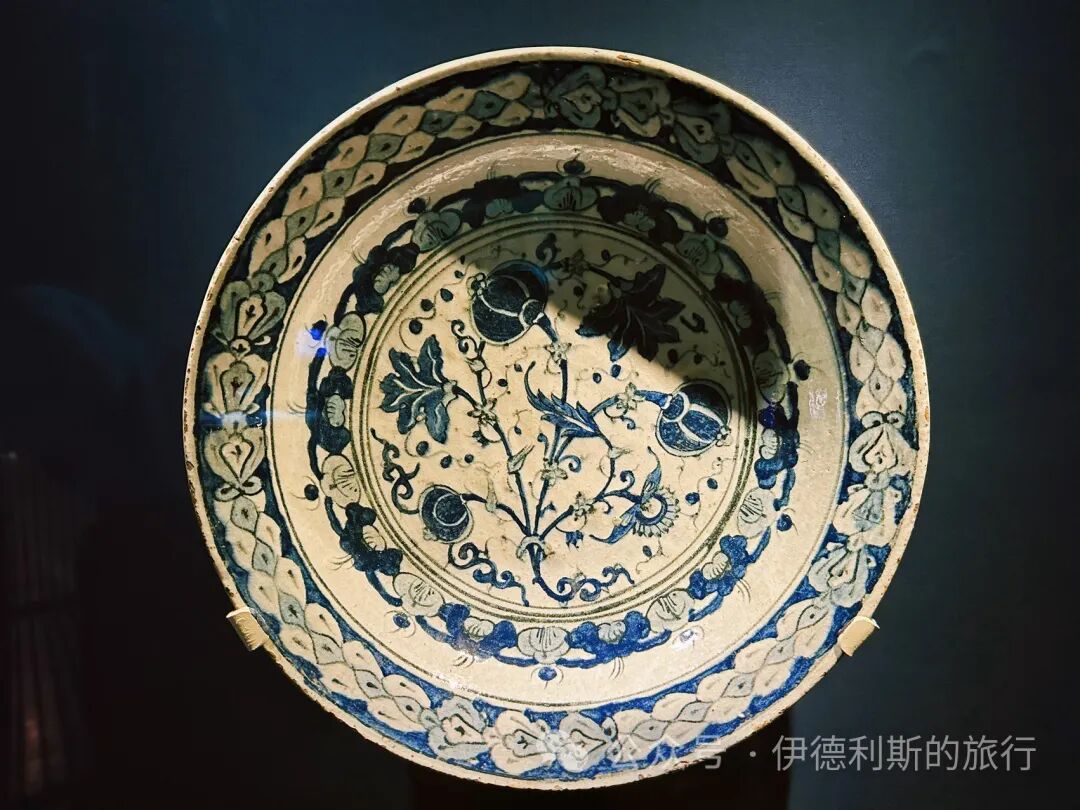
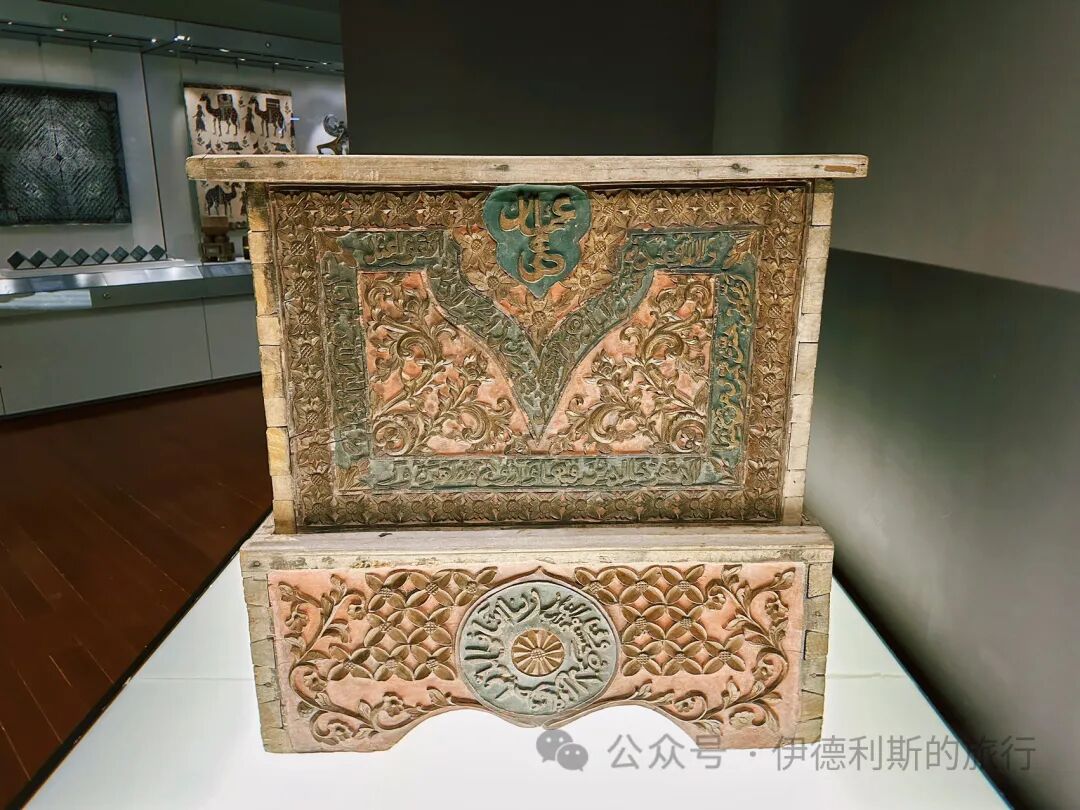
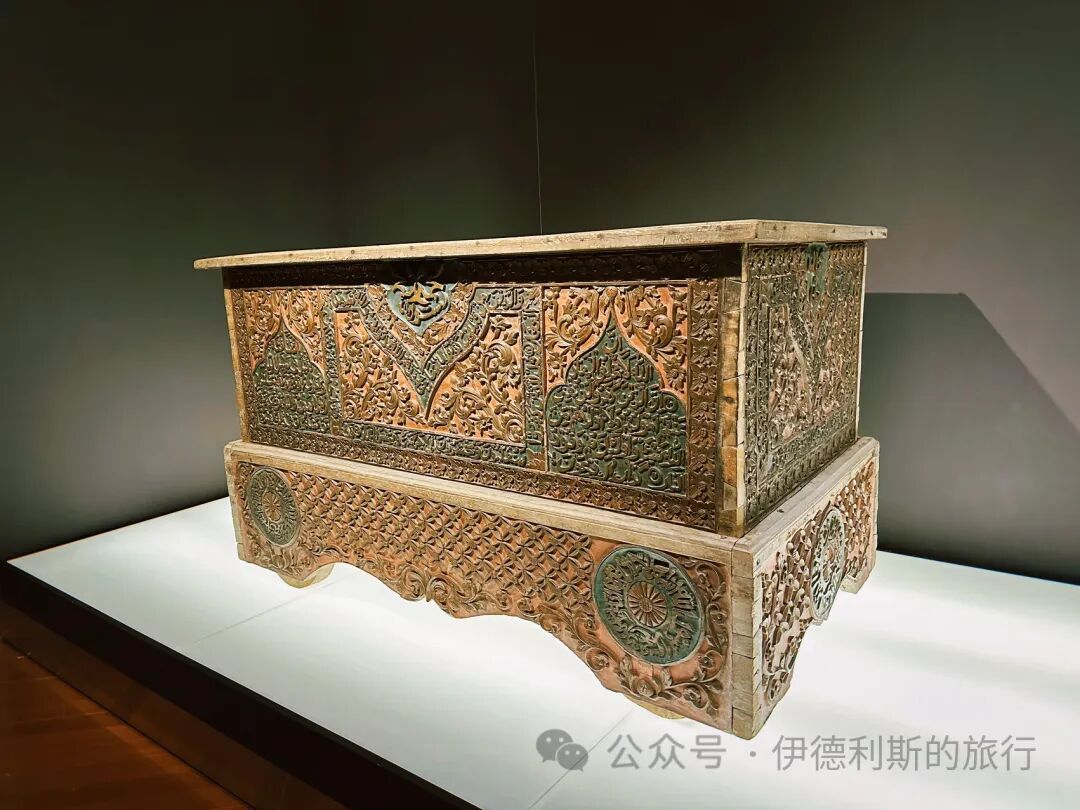
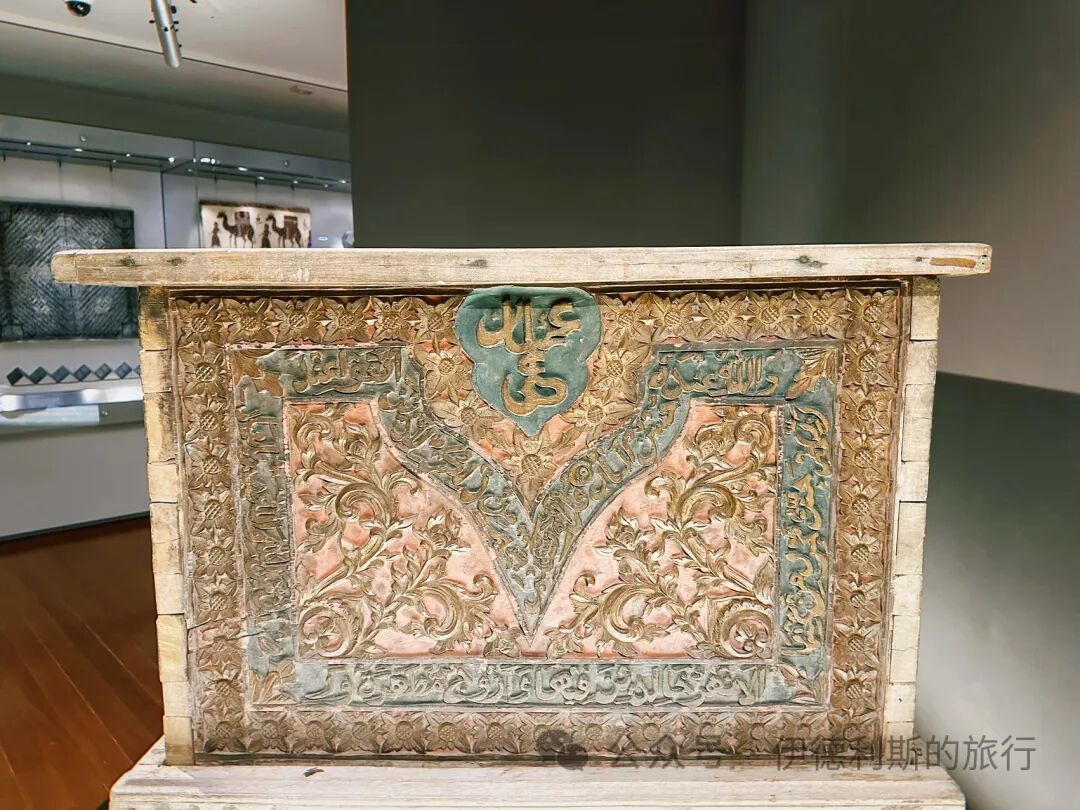
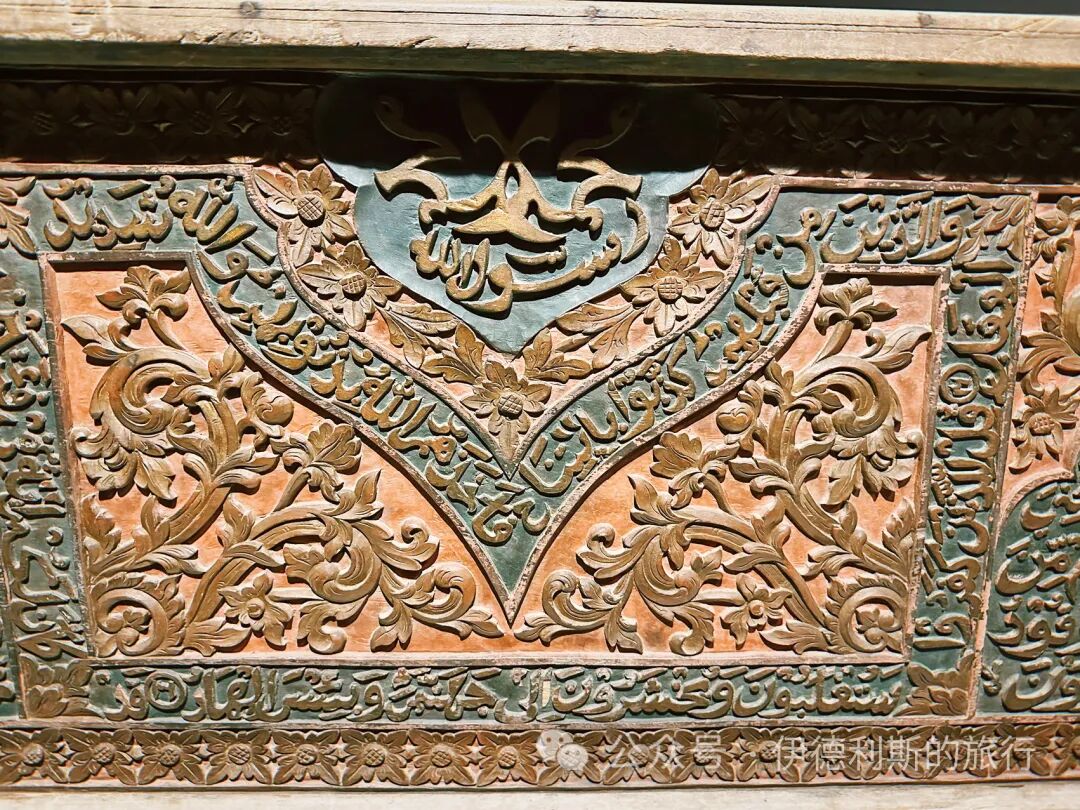
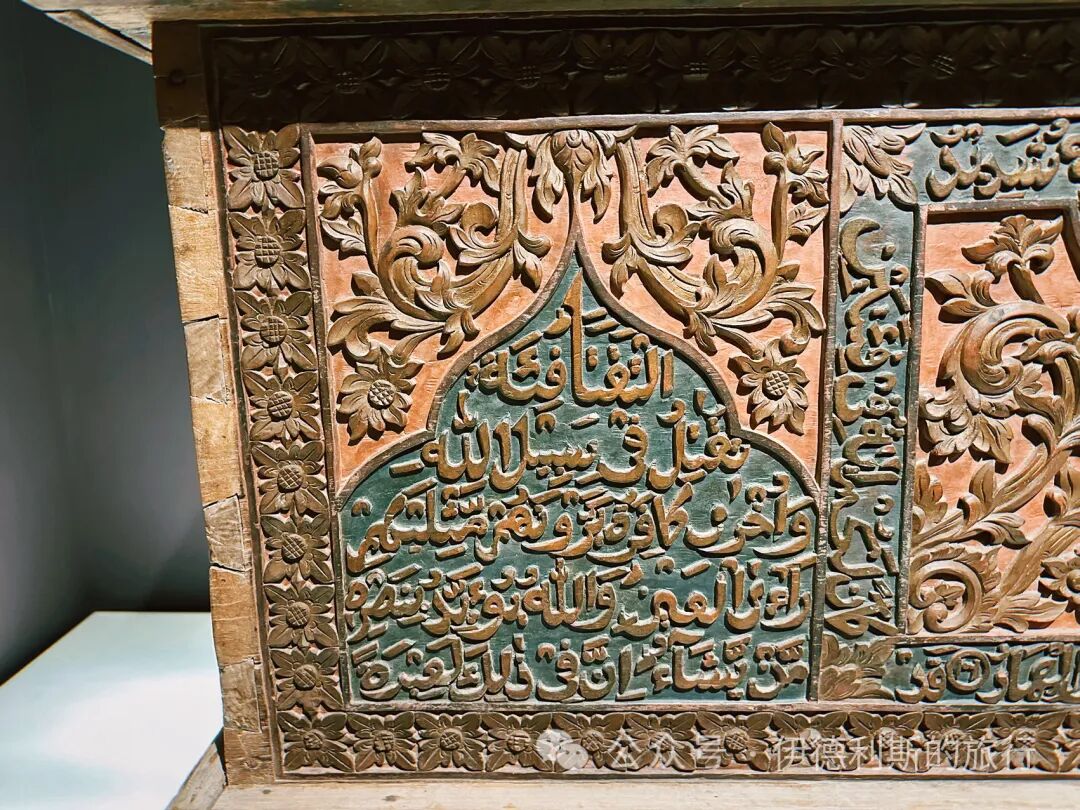
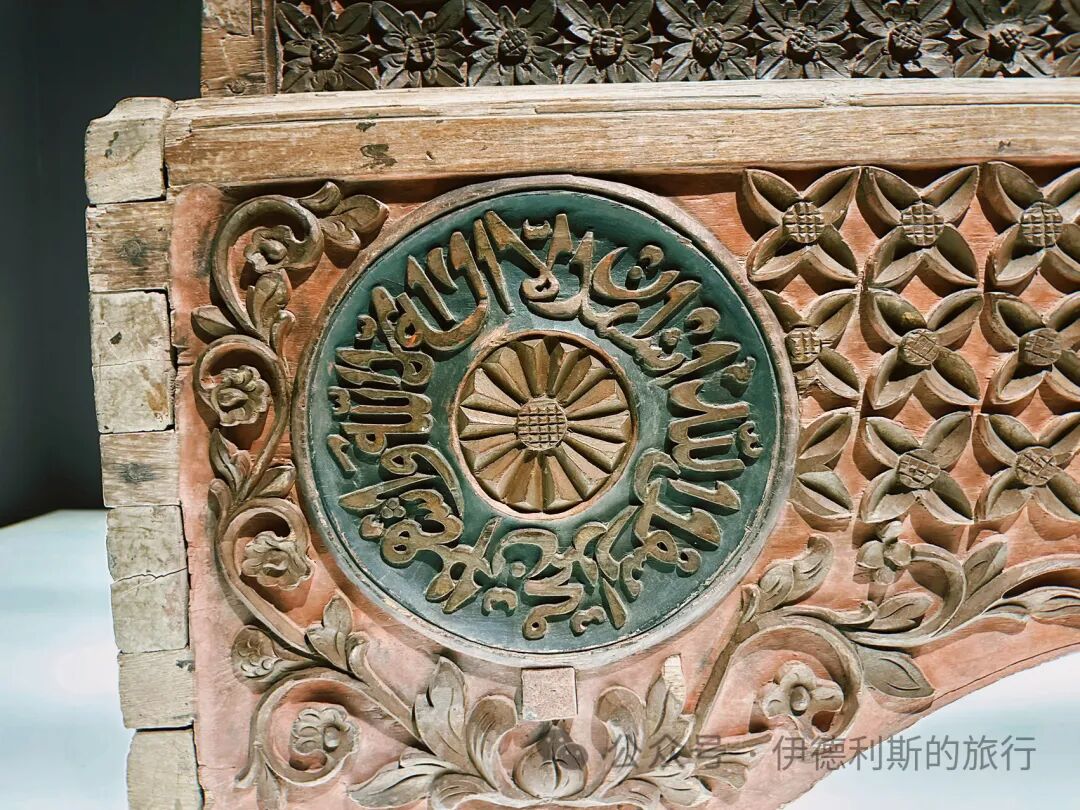
A 19th-century teak wood scripture box from northern Java. This intricately carved scripture box was generally only used in mosques and madrasas, and it features traditional Javanese-style patterns.
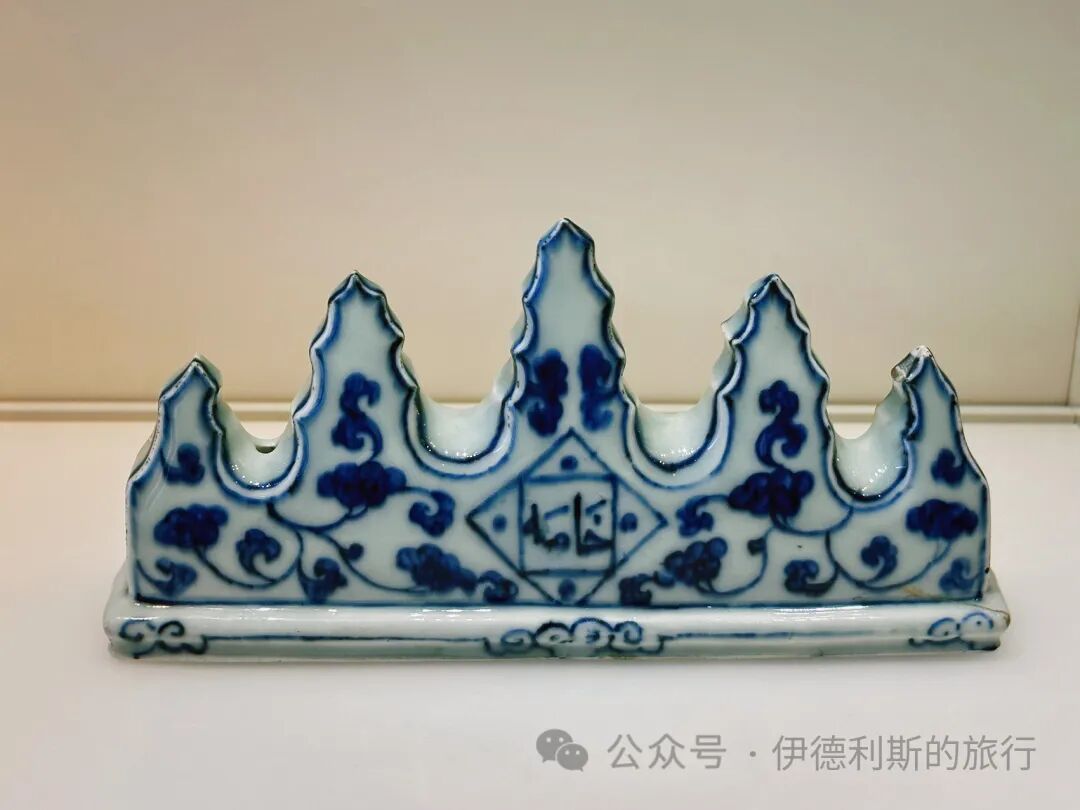
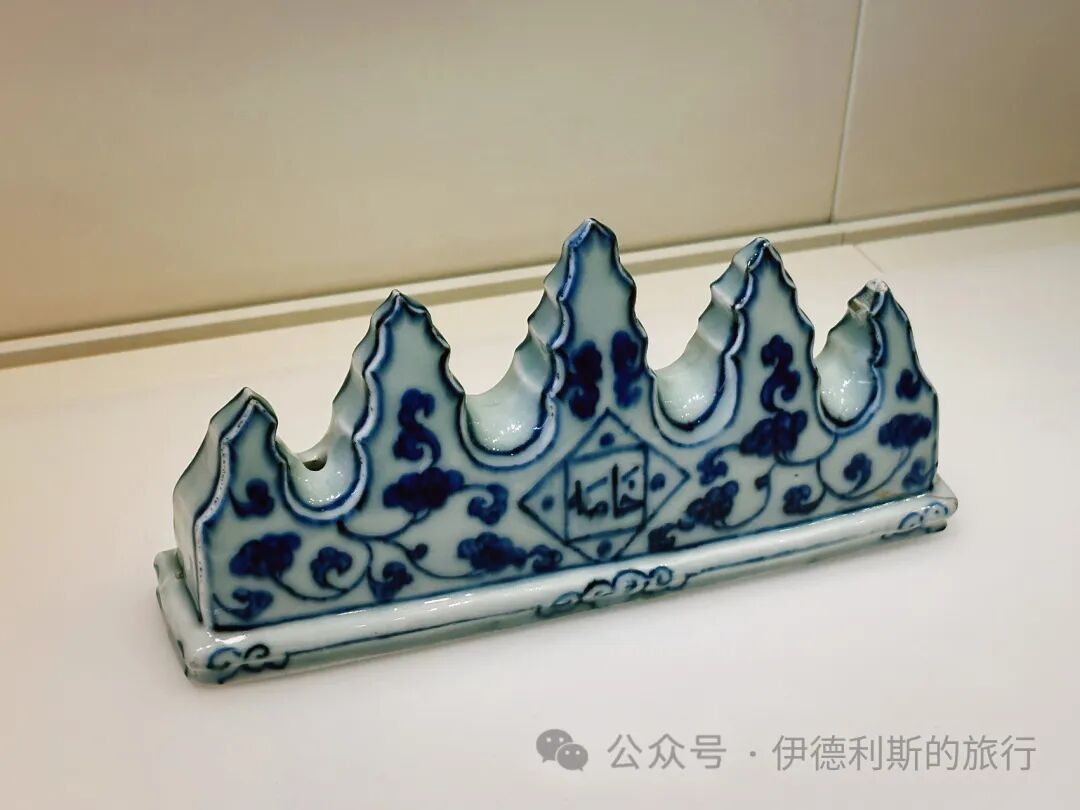
A Jingdezhen blue and white porcelain brush rest with the mark 'Made in the Zhengde reign of the Great Ming'. The front is written in Arabic as 'khamah' (pen), and the back is written in Arabic as 'dan' (rest).
The Islamic culture of Southeast Asia.
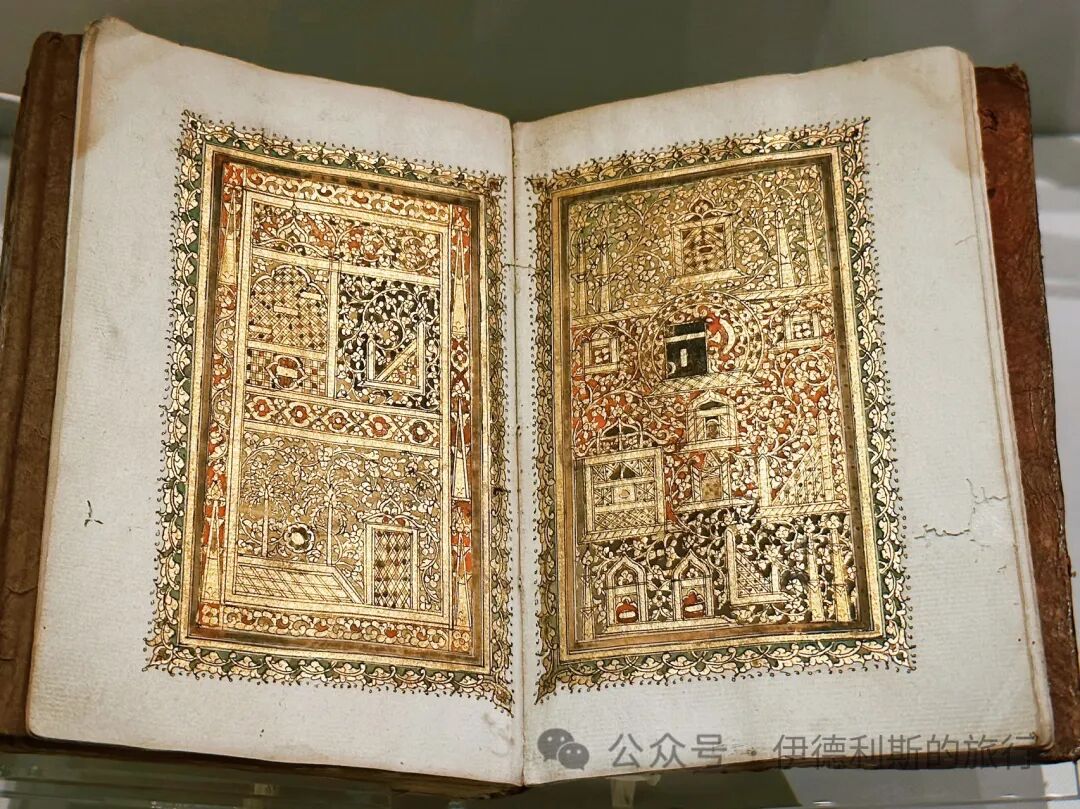
A collection of blessings for the Prophet (Dala'il al-Khayrat) copied in Terengganu on the Malay Peninsula in the 19th century. Malay people usually carried this book with them when they went on Hajj, so it includes diagrams of the Prophet's Mosque and the Sacred Mosque, marking the locations of the Prophet's tomb and the Kaaba. The two illustrations of the Kaaba use the ornate Terengganu decorative style and feature a lot of gold leaf.
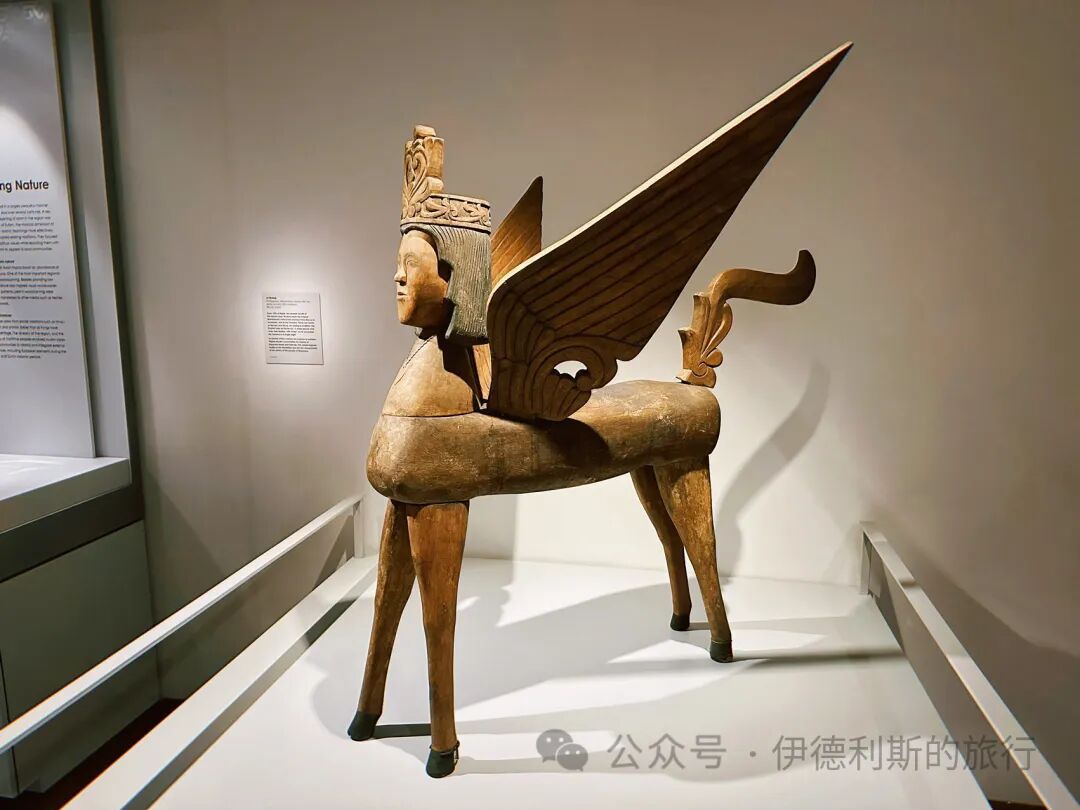
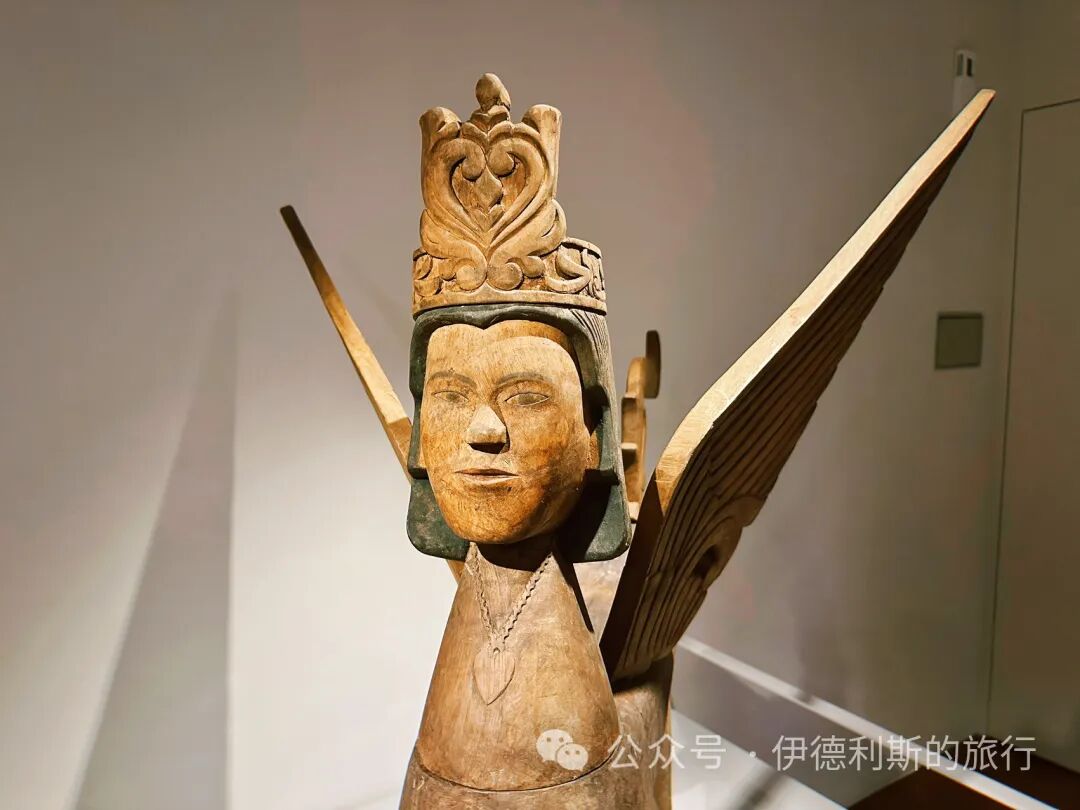
A wooden carving of Buraq from Lanao del Sur province on Mindanao island in the southern Philippines, dating to the early 20th century; this is the mount the Prophet Muhammad rode during his Night Journey. Muslims in Mindanao display the Buraq during important feasts and holidays. Although the Hadith does not describe the face of the Buraq, it mentions it has a handsome face, so it has historically been depicted with a human face; this Buraq's headpiece and tail incorporate traditional Okir patterns from the southern Philippines.
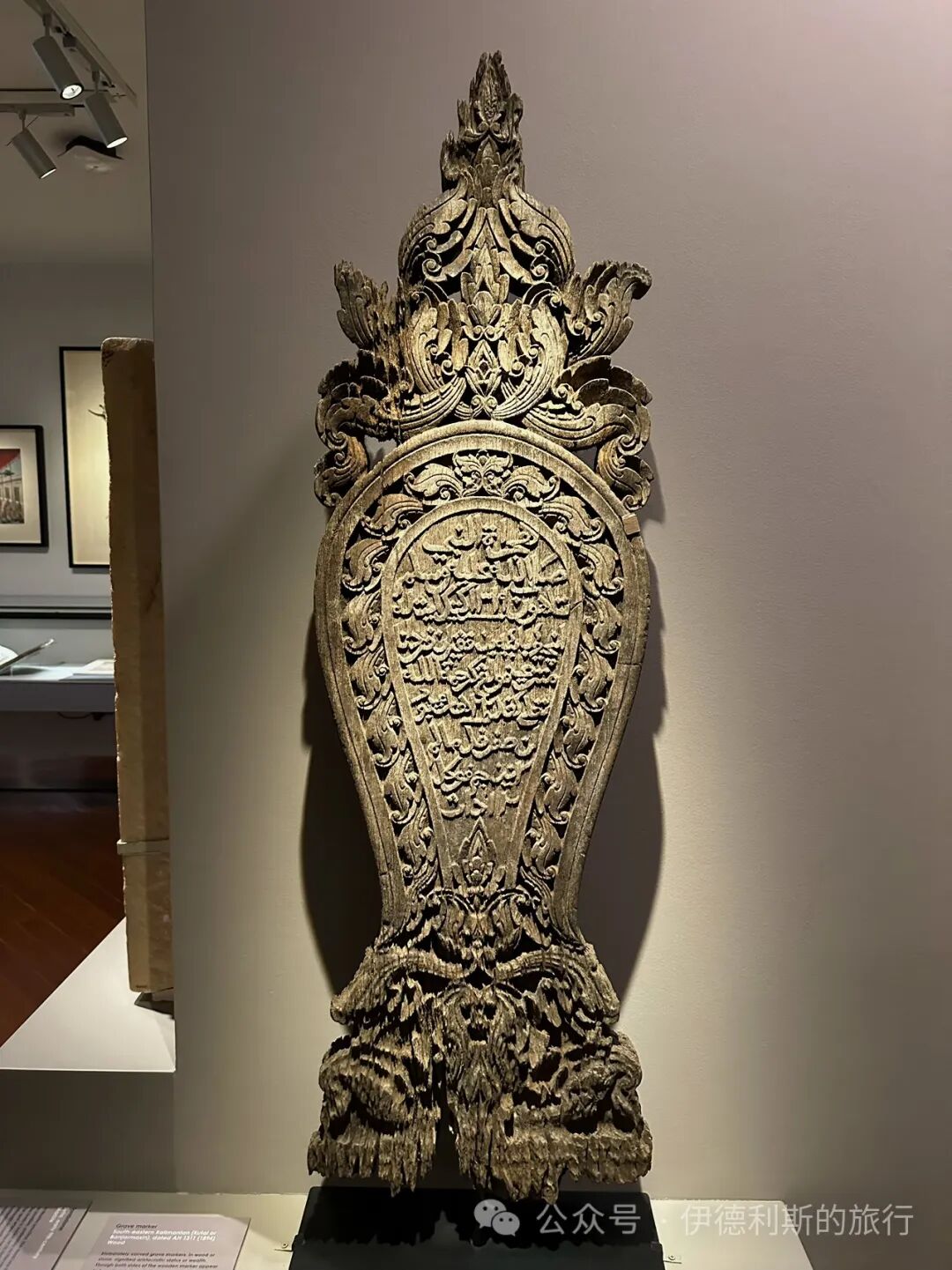
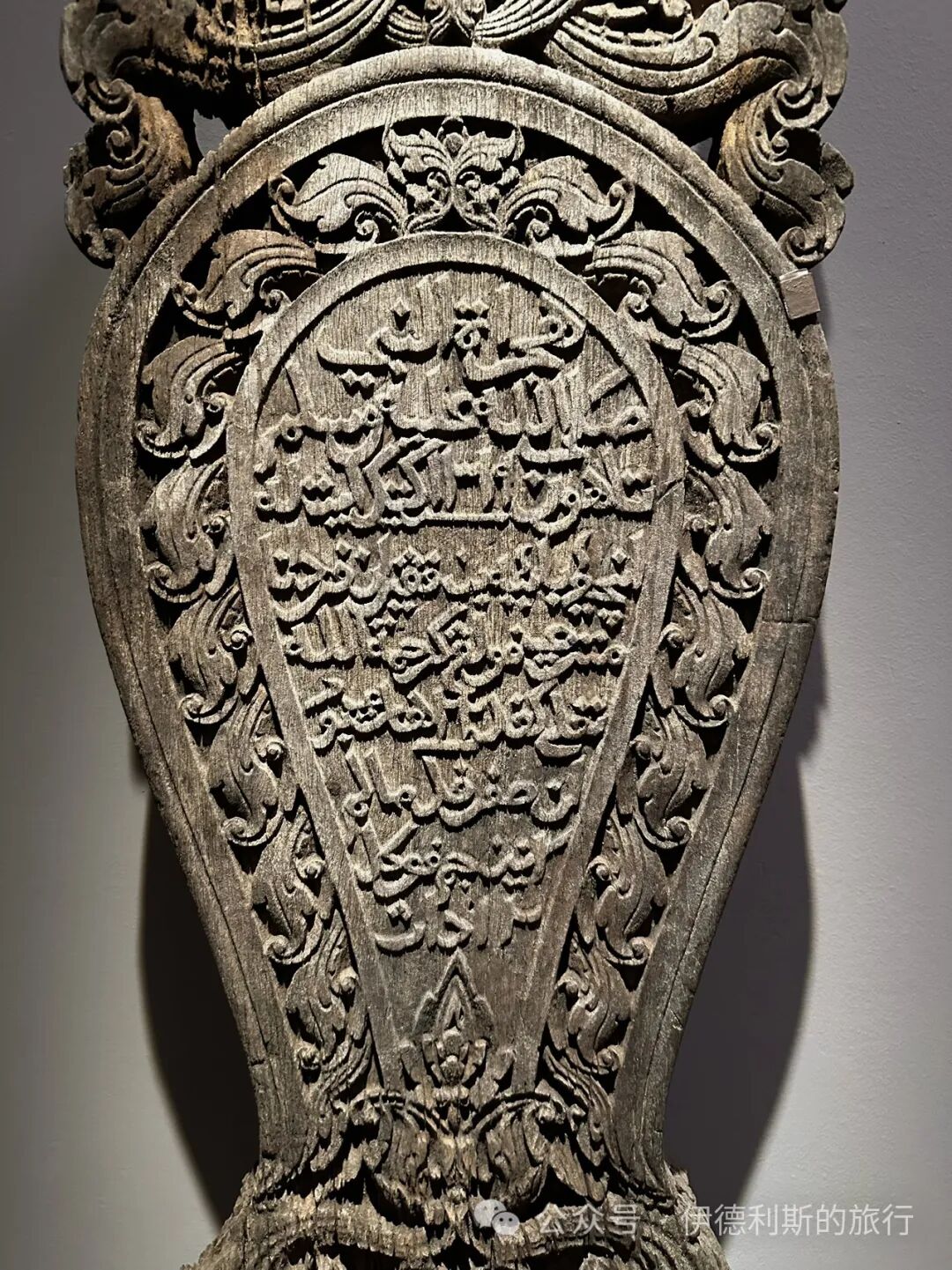
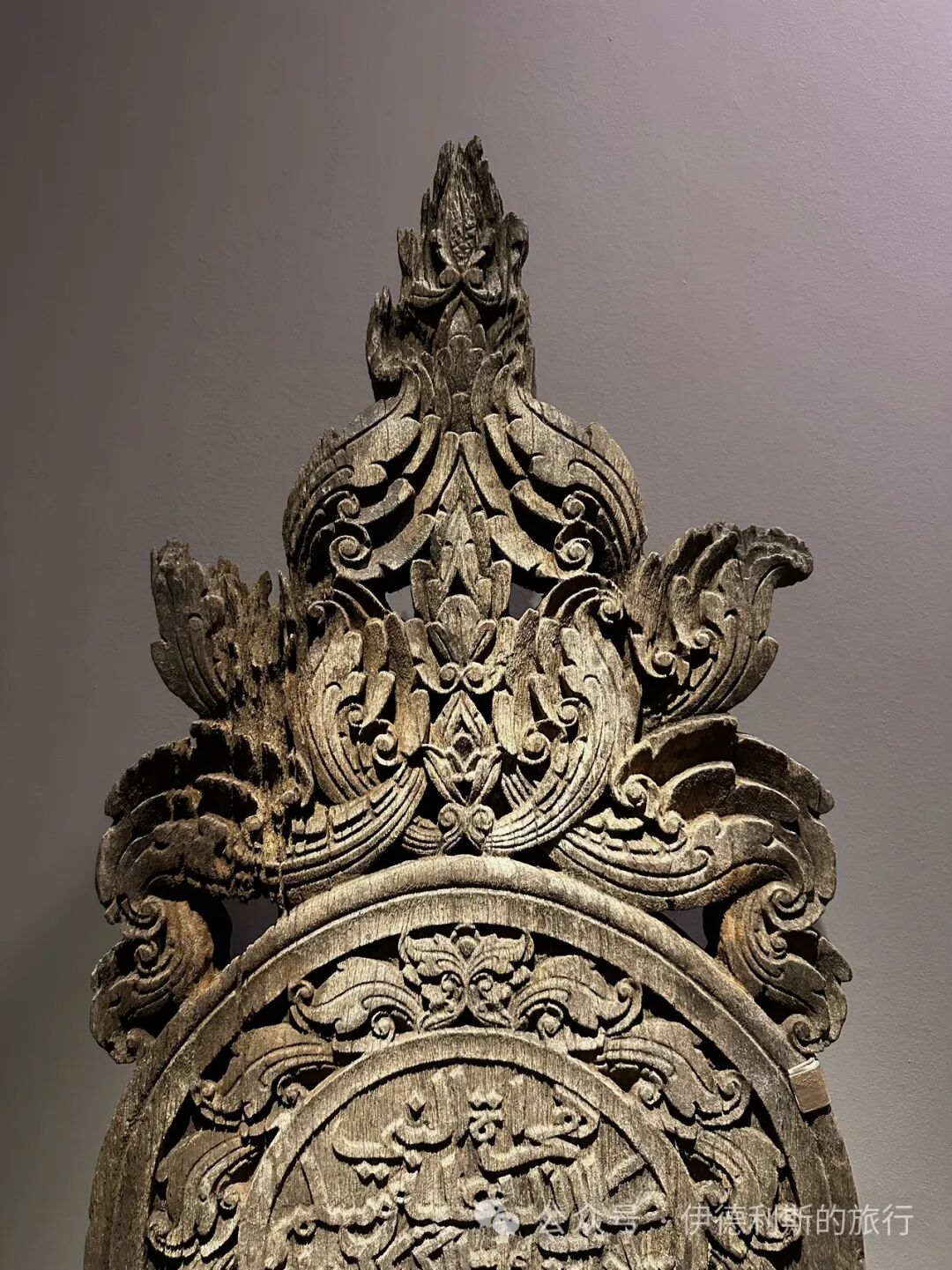
A wooden tombstone from the southeast of Kalimantan island dated 1894; the intricately carved tombstone is a symbol of noble status and wealth, featuring both Malay and Arabic.
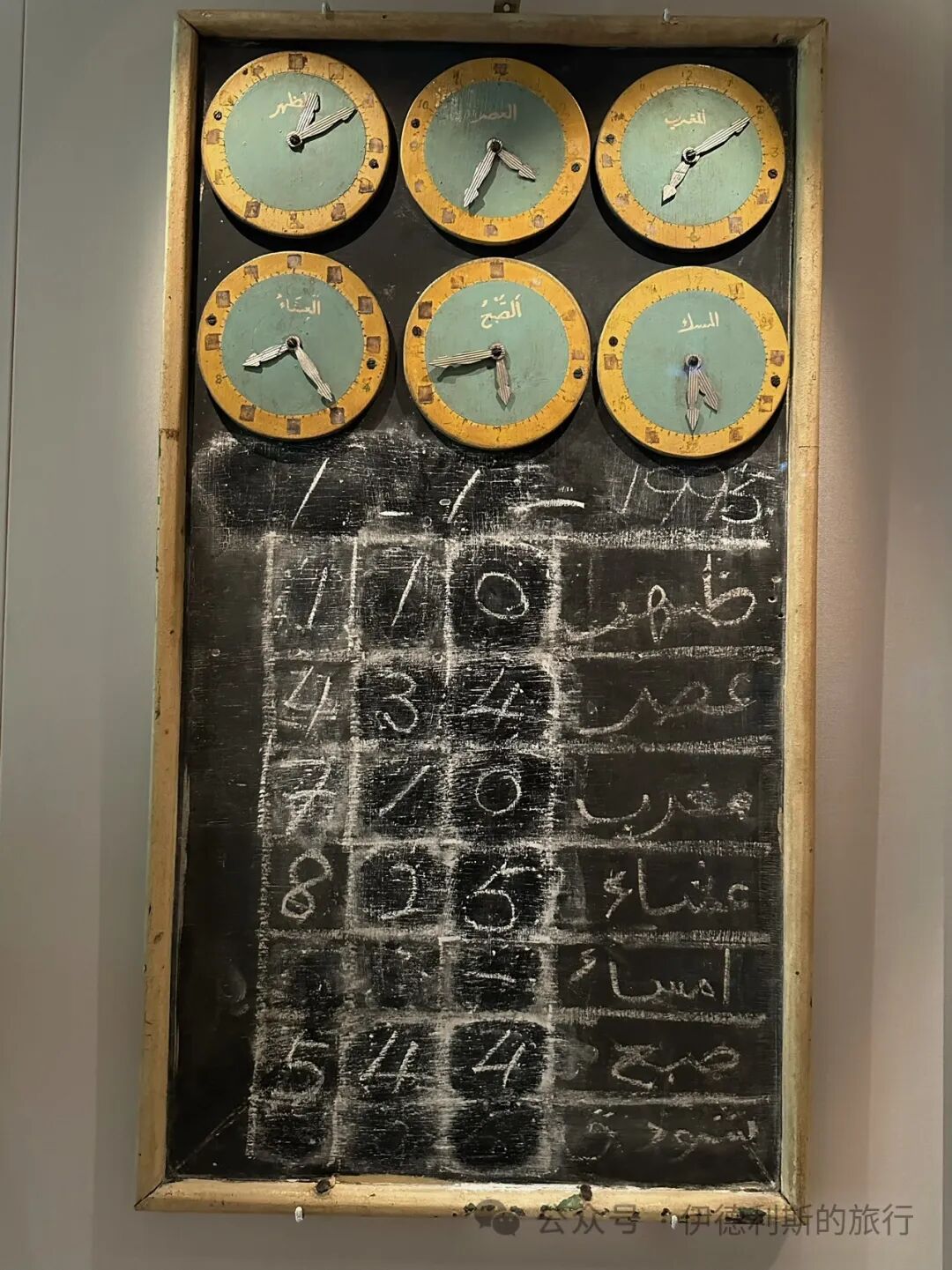
A prayer time chart from the mid-20th century at the Wak Sumang mosque in Punggol, Singapore, which was used until the mosque was demolished in 1995.
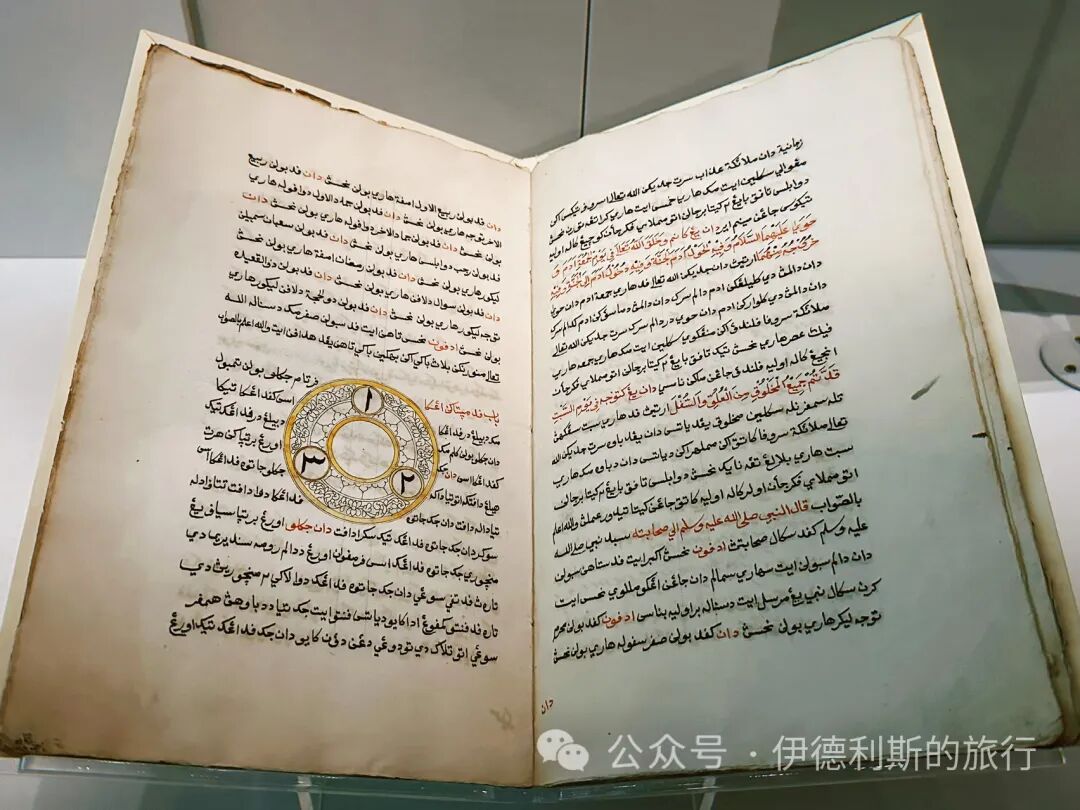
A book of divination (Primbon) from Semarang, Java, copied in 1824 in Jawi script (Arabic script used to write Malay). The book uses a combination of numerology and Quranic verses to provide guidance on decisions or auspicious dates and times for events ranging from moving house to getting married.
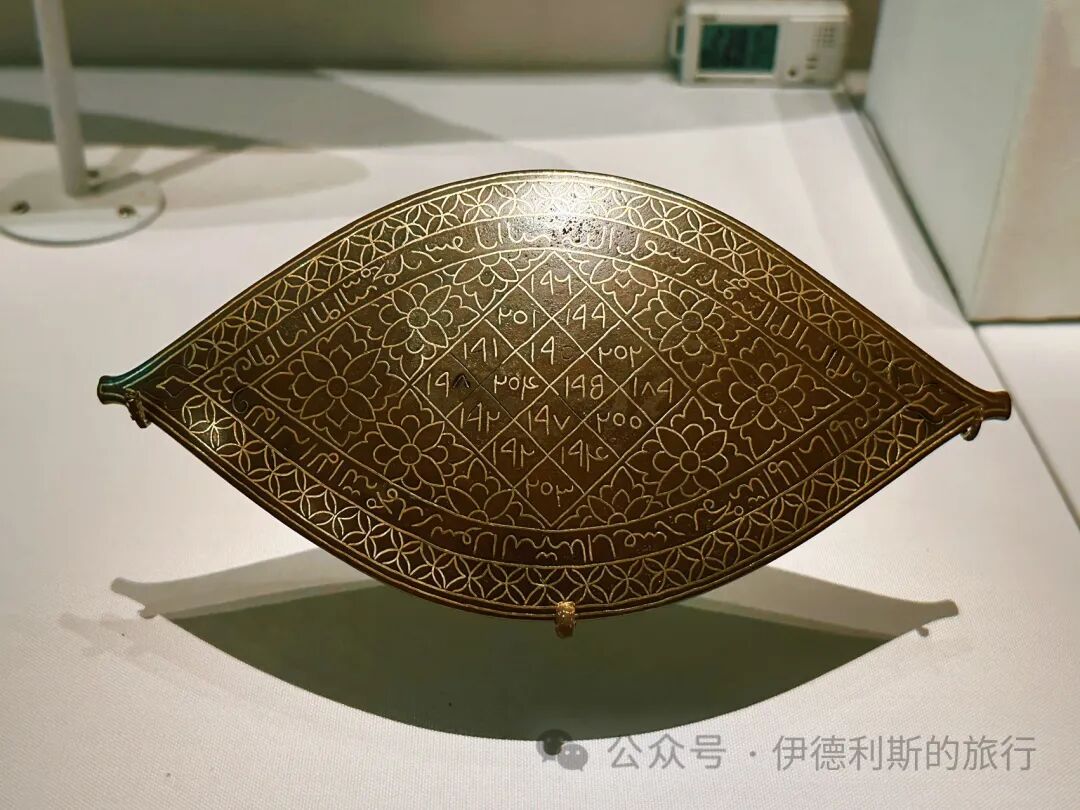
A magic square belt buckle from the late 19th to early 20th century in Kuala Kangsar, the royal city of the Sultan of Perak on the Malay Peninsula; it is inscribed with the Shahada and was part of traditional Malay attire.
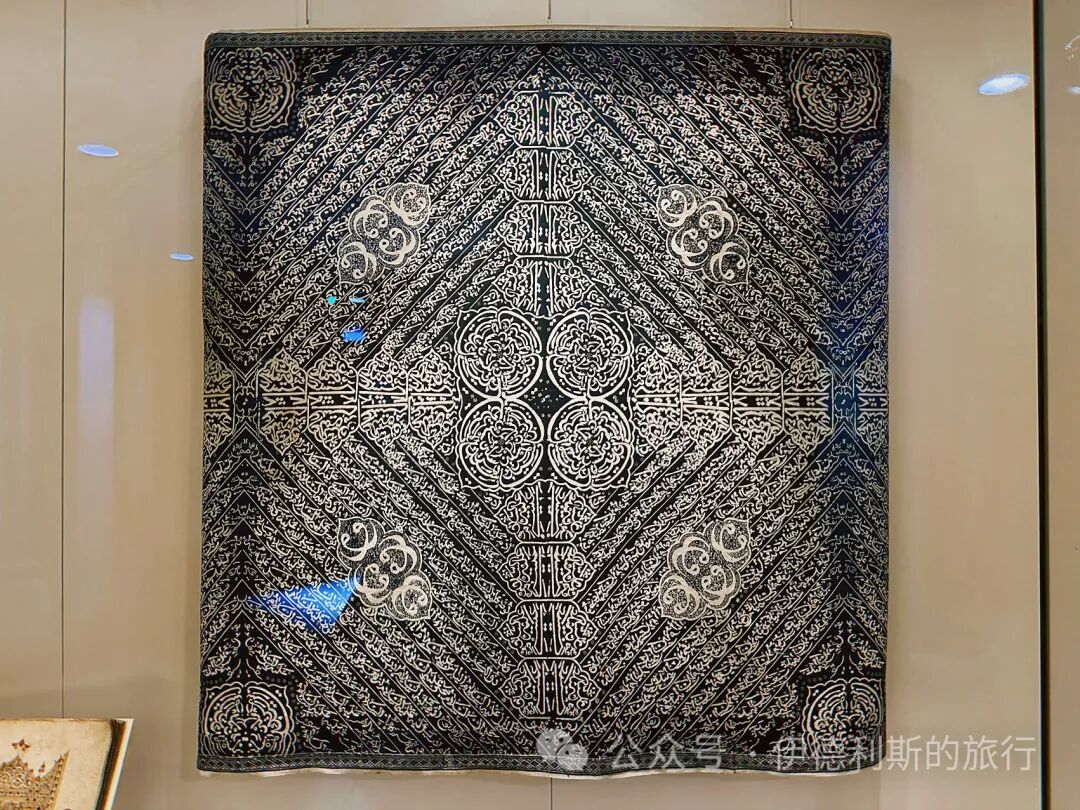
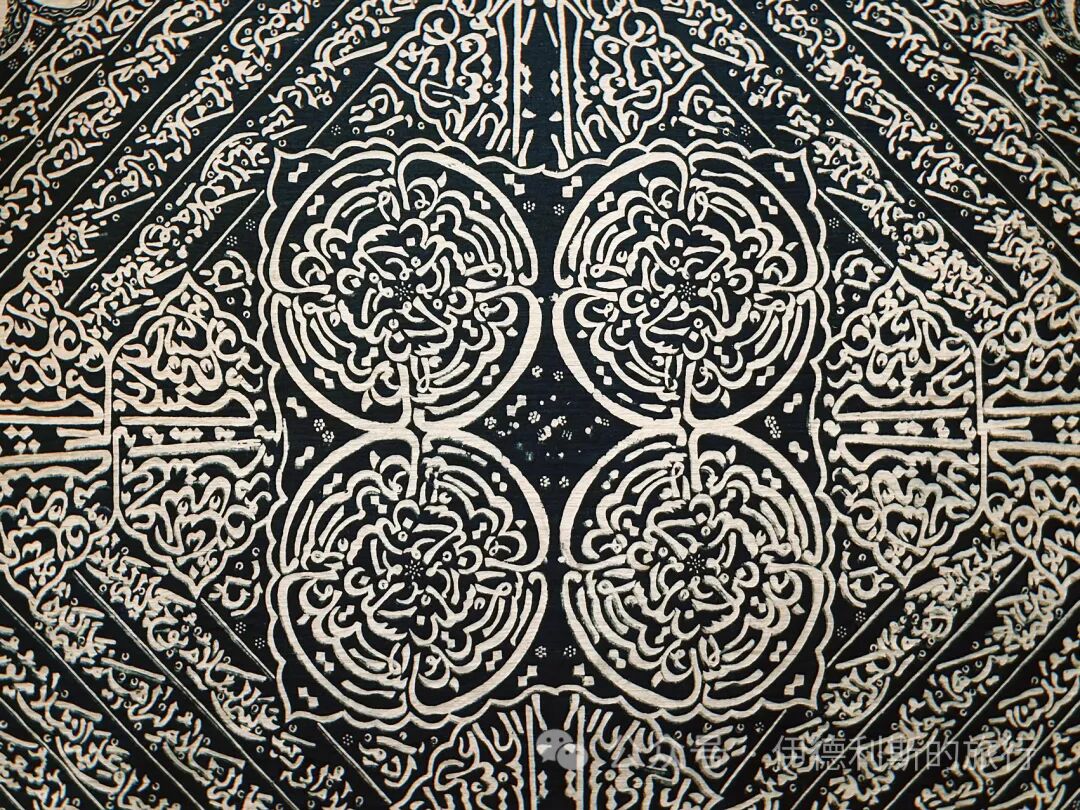
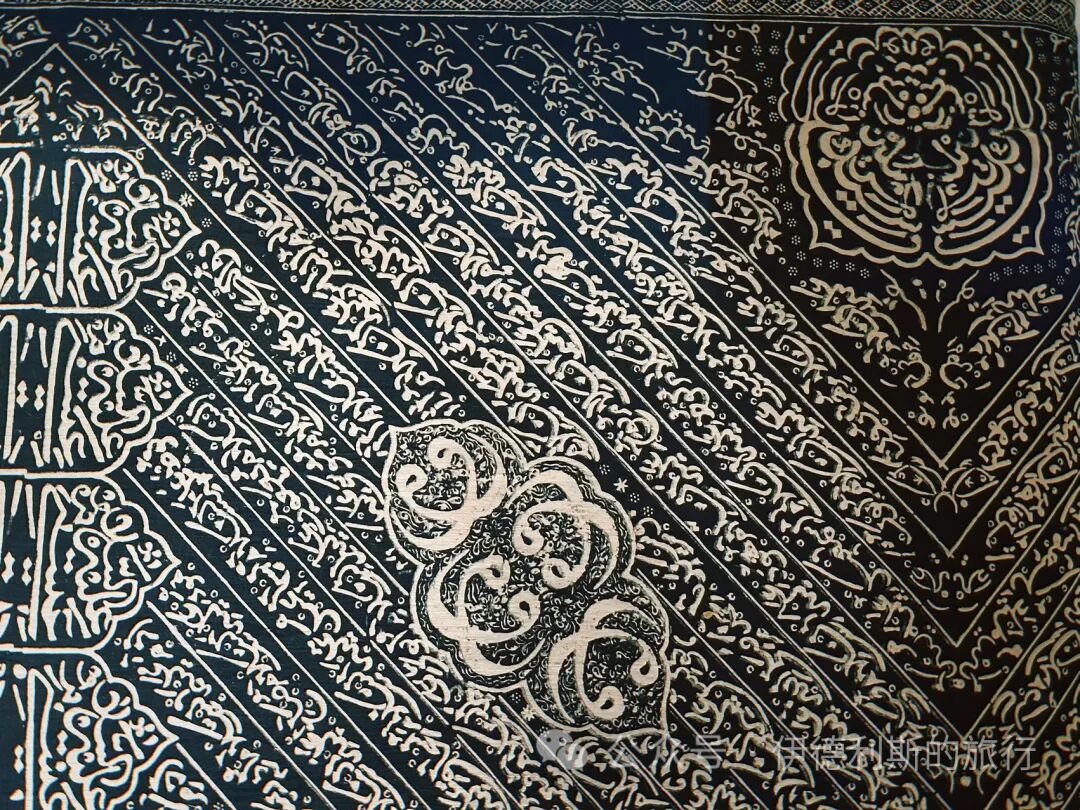
Arabic calligraphy on wax-resist dyed cloth (Batik) from the Jambi region of Sumatra in the 20th century. This overall design, with four satellite patterns surrounding a central motif, originated from the Buddhist mandala and was later used by Muslims in Sumatra as a burial shroud for coffins.
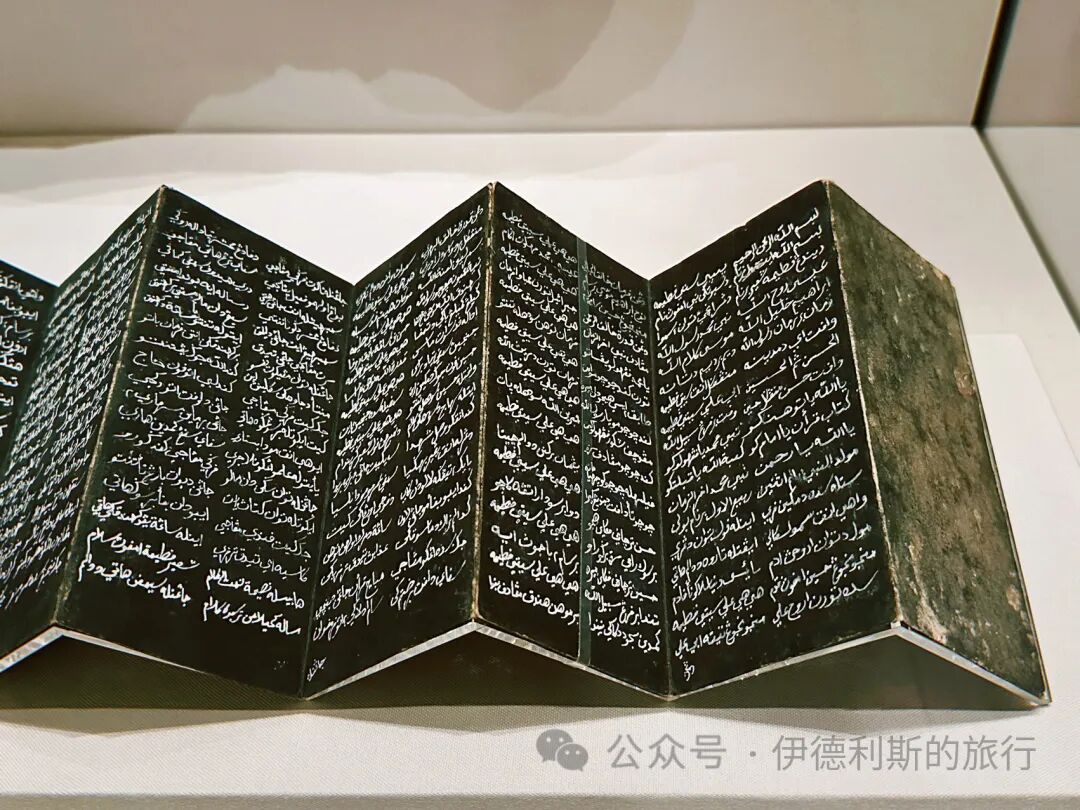
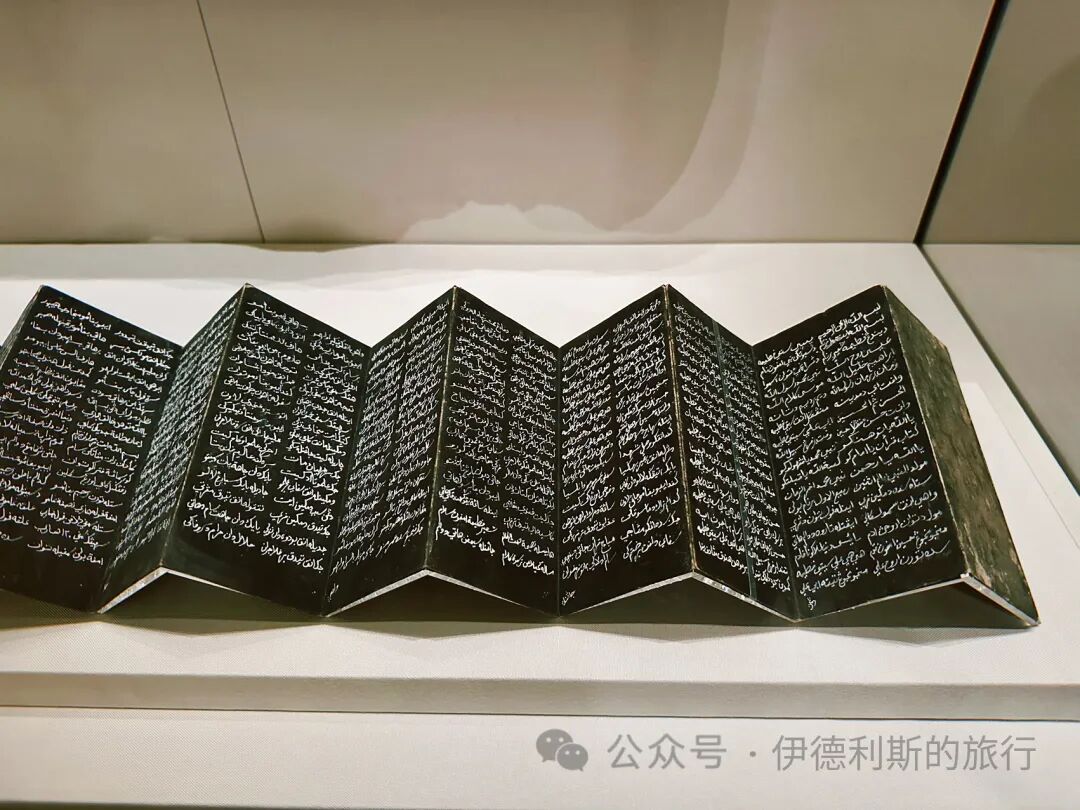
A mulberry paper manuscript from Pattani, Malay Peninsula, dated 1835. This black folding manuscript is written with white talc; it was very popular in Buddhist regions of Myanmar and was later adopted by Muslims in places like Myanmar and Malaysia. The manuscript includes advice for young people, and the Song of Fatimah (Syair Dendang Fatimah) is often chanted during ceremonies for newborns.
On the left is a 19th-century Indonesian haji cap, and on the right is a Bugis songkok cap (Songkok Recca) from southern Sulawesi dating to the 19th or 20th century. White symbolizes purity and the plain white ihram garments worn during the Hajj pilgrimage; in Indonesia, it is typically worn by a haji who has returned from the pilgrimage. The black songkok cap comes from the Ottoman fez, and the Bugis people of southern Sulawesi usually wear this cap for Friday namaz. A wider gold band indicates a closer relationship with the king.
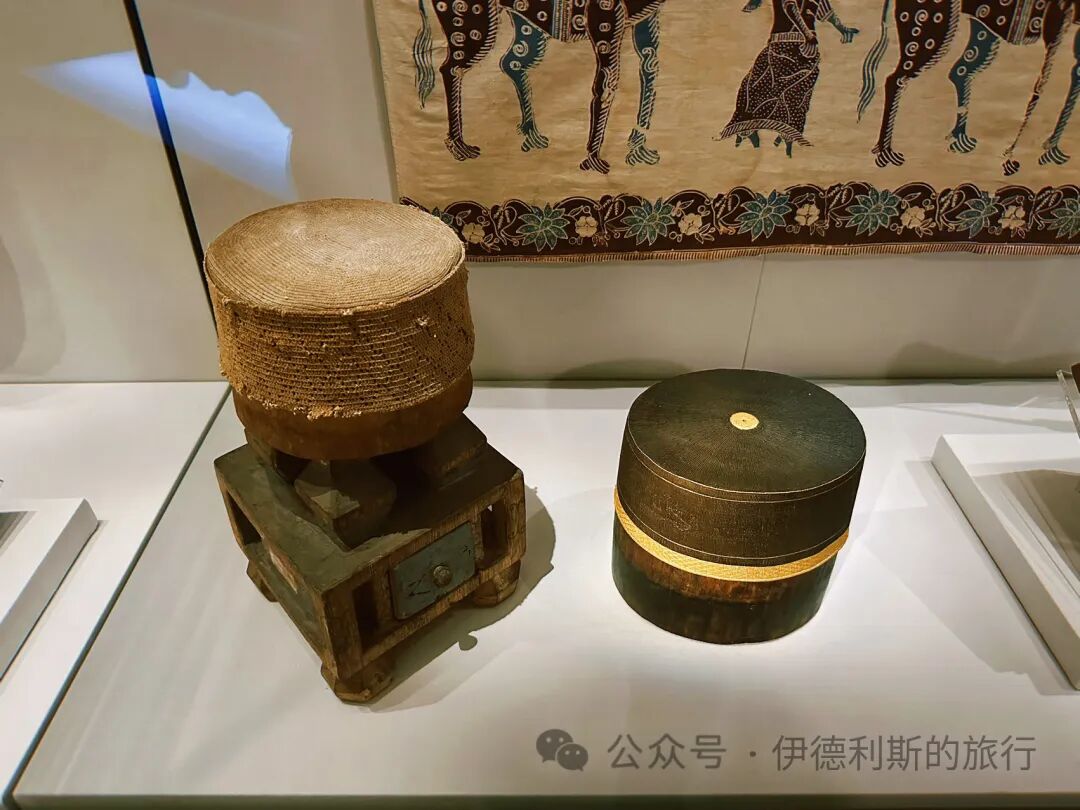
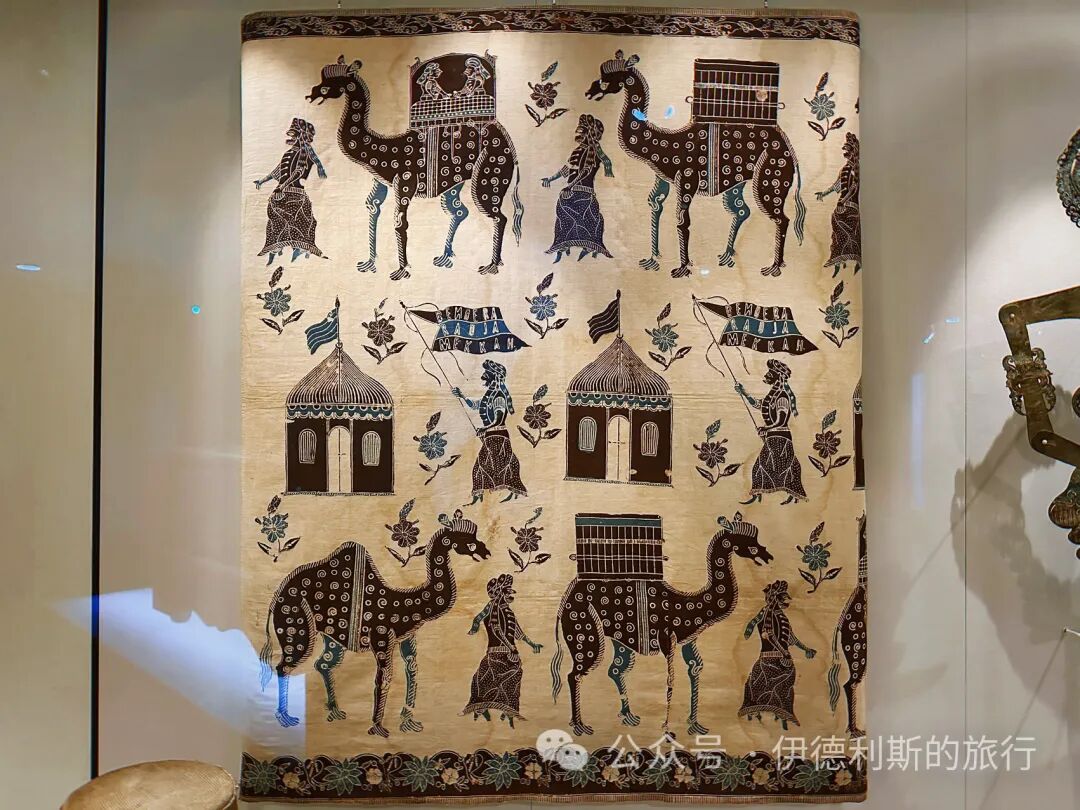
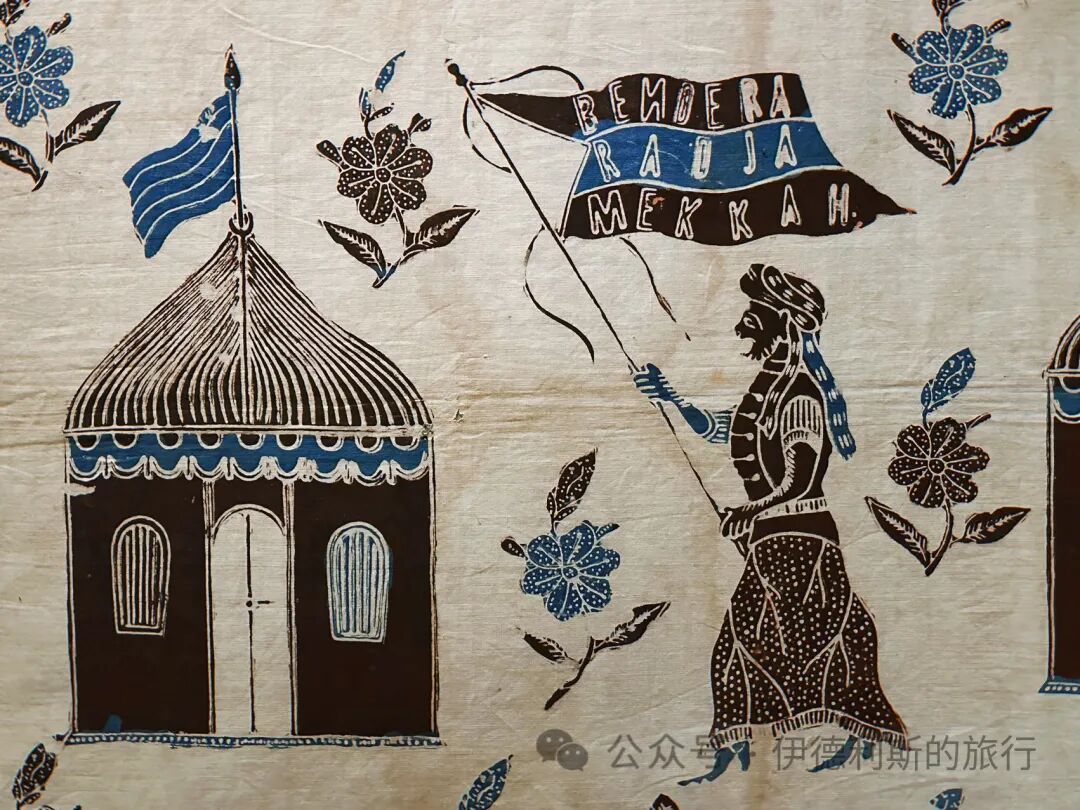
This early 20th-century batik sarong from Java depicts a Hajj pilgrimage group. The flag reads 'Bendera Radja Mekkah' (Flag of the King of Mecca), which was used during the 1916 Meccan revolt against the Ottoman Empire. The revolt was supported by the Hadharem people of Yemen. Many Arabs in Southeast Asia belong to Hadharem families, and some ran batik workshops on the north coast of Java while organizing Hajj trips for Javanese Muslims. This sarong was likely made in that context.
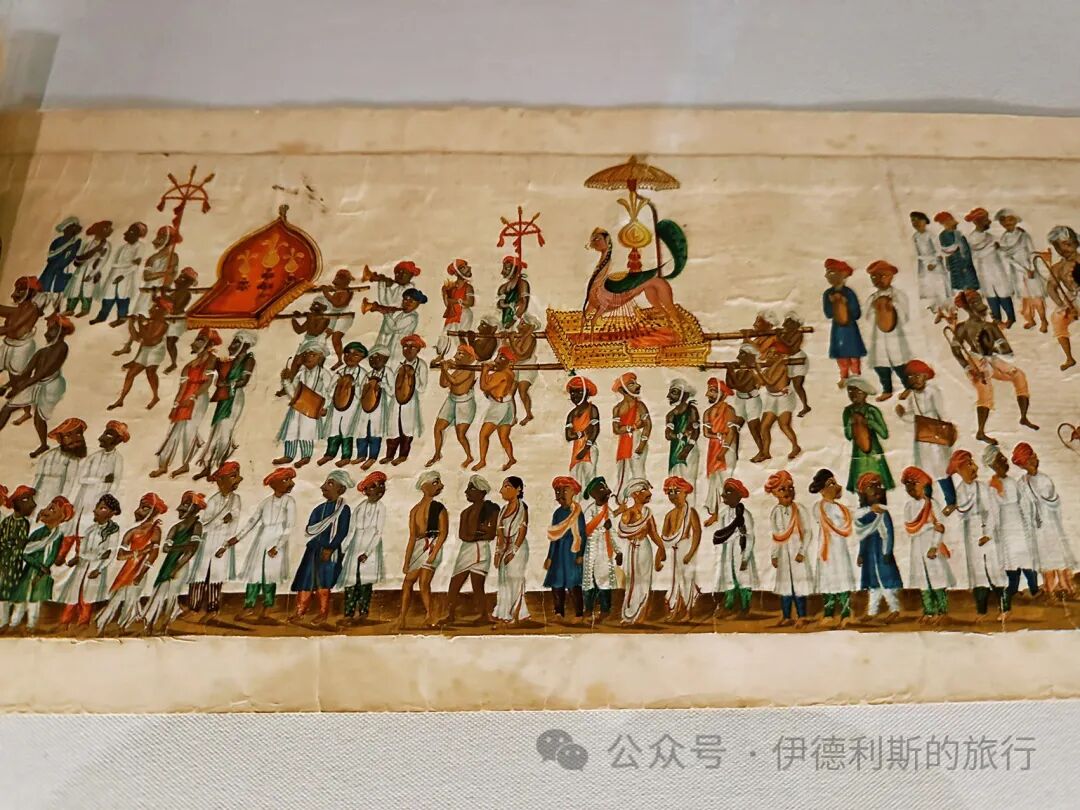
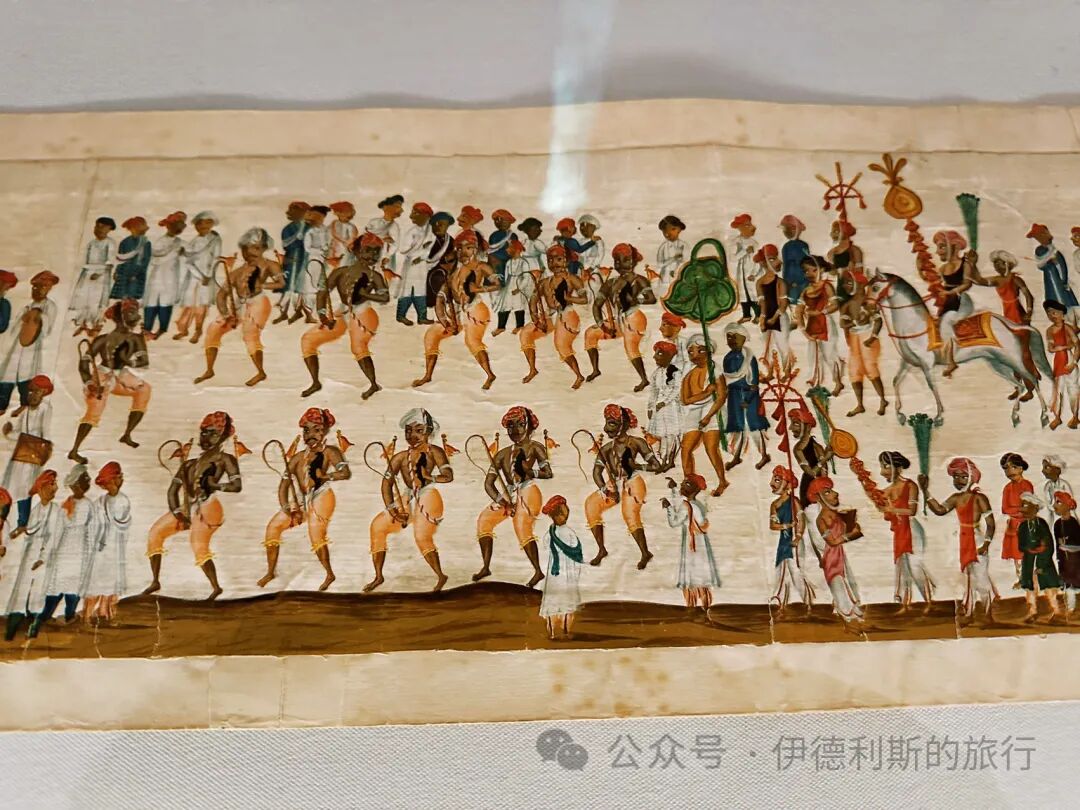
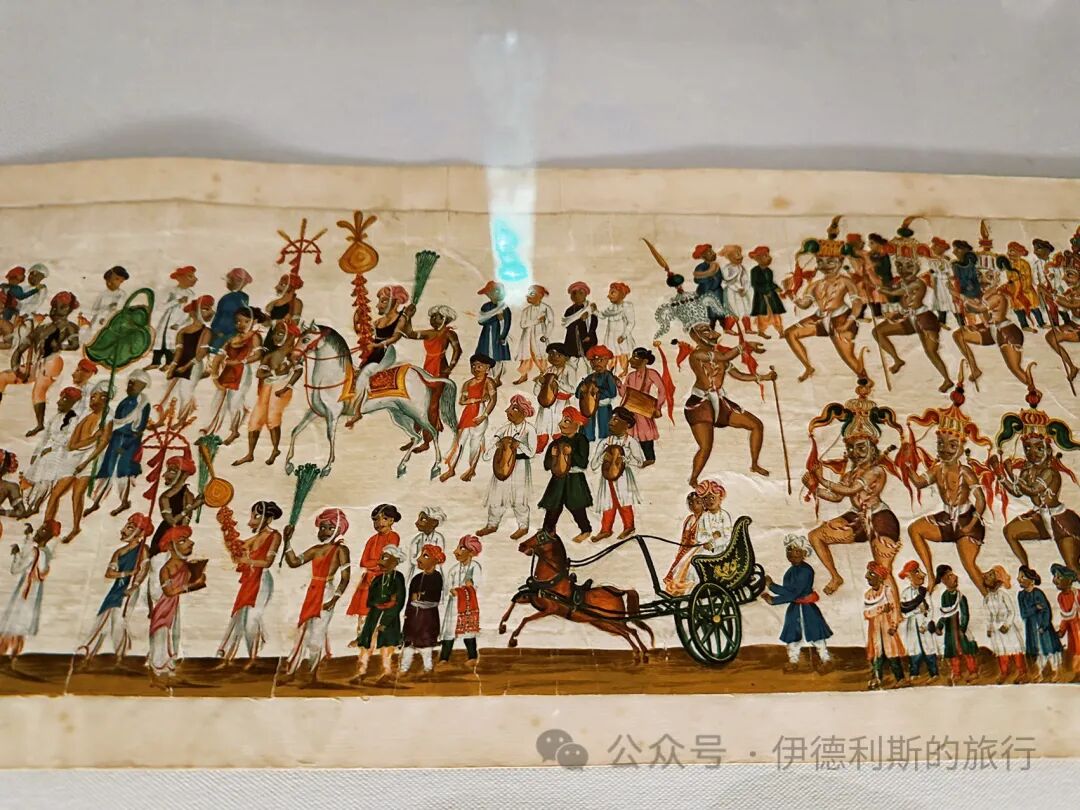
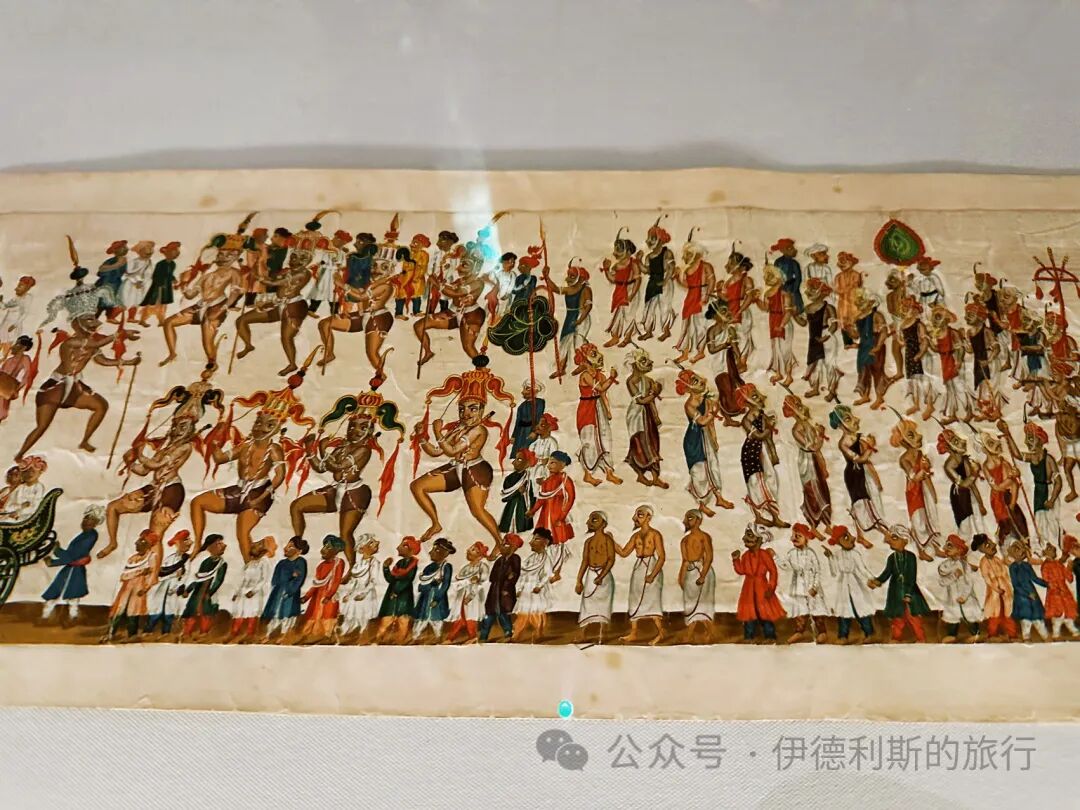
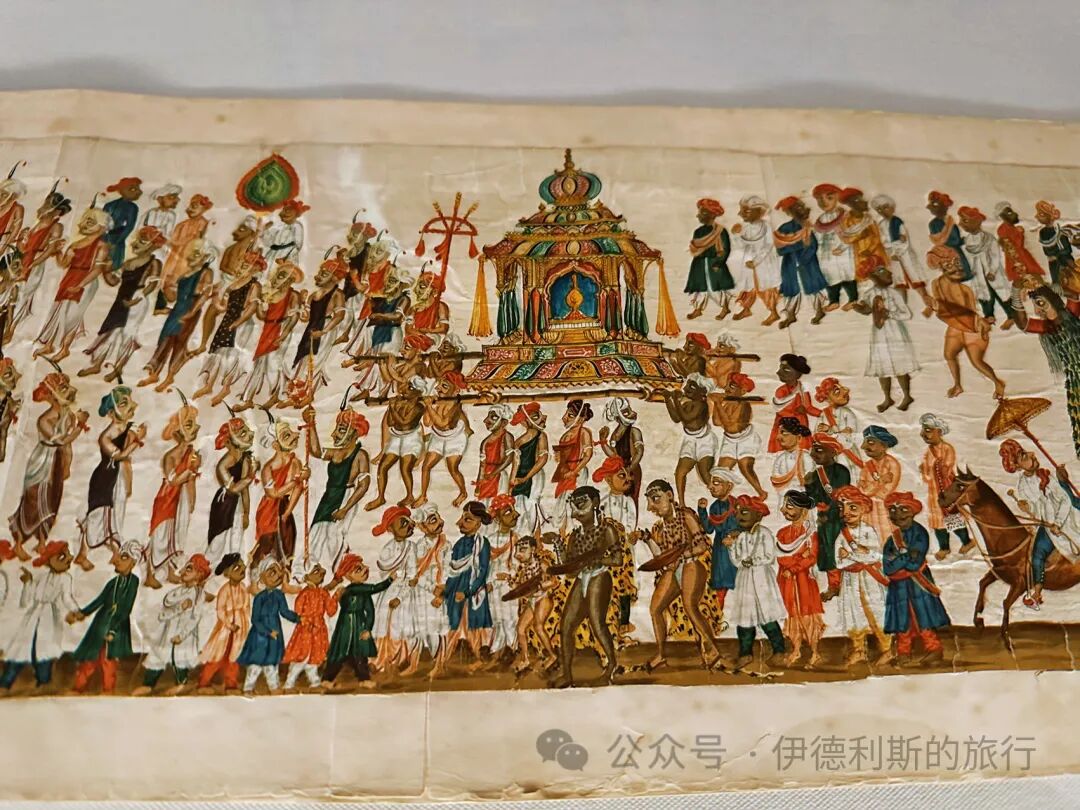
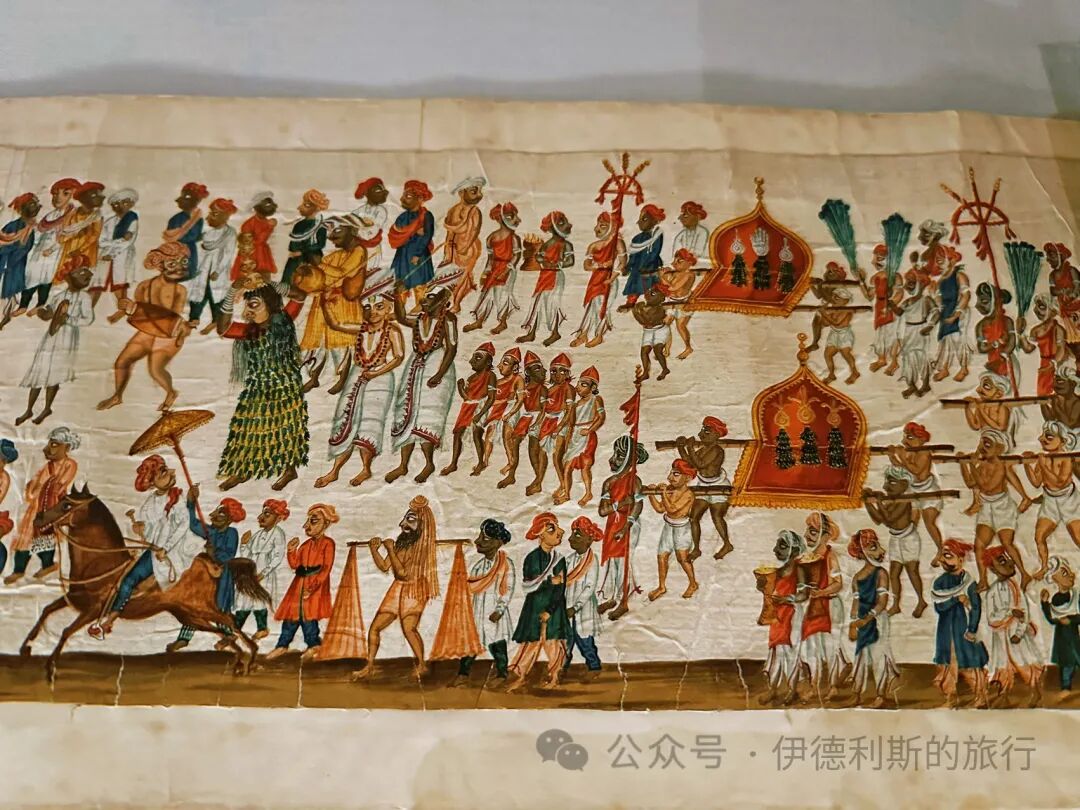
A scroll from the 1830s or 1840s showing a Shia Ashura procession in southern India, likely Chennai. The entire scroll is nearly 6 meters long. It shows a model of the tombs of Imam Hussein and Hassan (Ta'ziya), the mount of the Prophet during his night journey (Buraq), an Alam flag, the Hand of Abbas, a shield (Sipar), and a reenactment of the Battle of Karbala. You can also see the Chennai native infantry, people dressed as animals, and even elements of the Hindu Charak festival, which reflects India's multiculturalism.
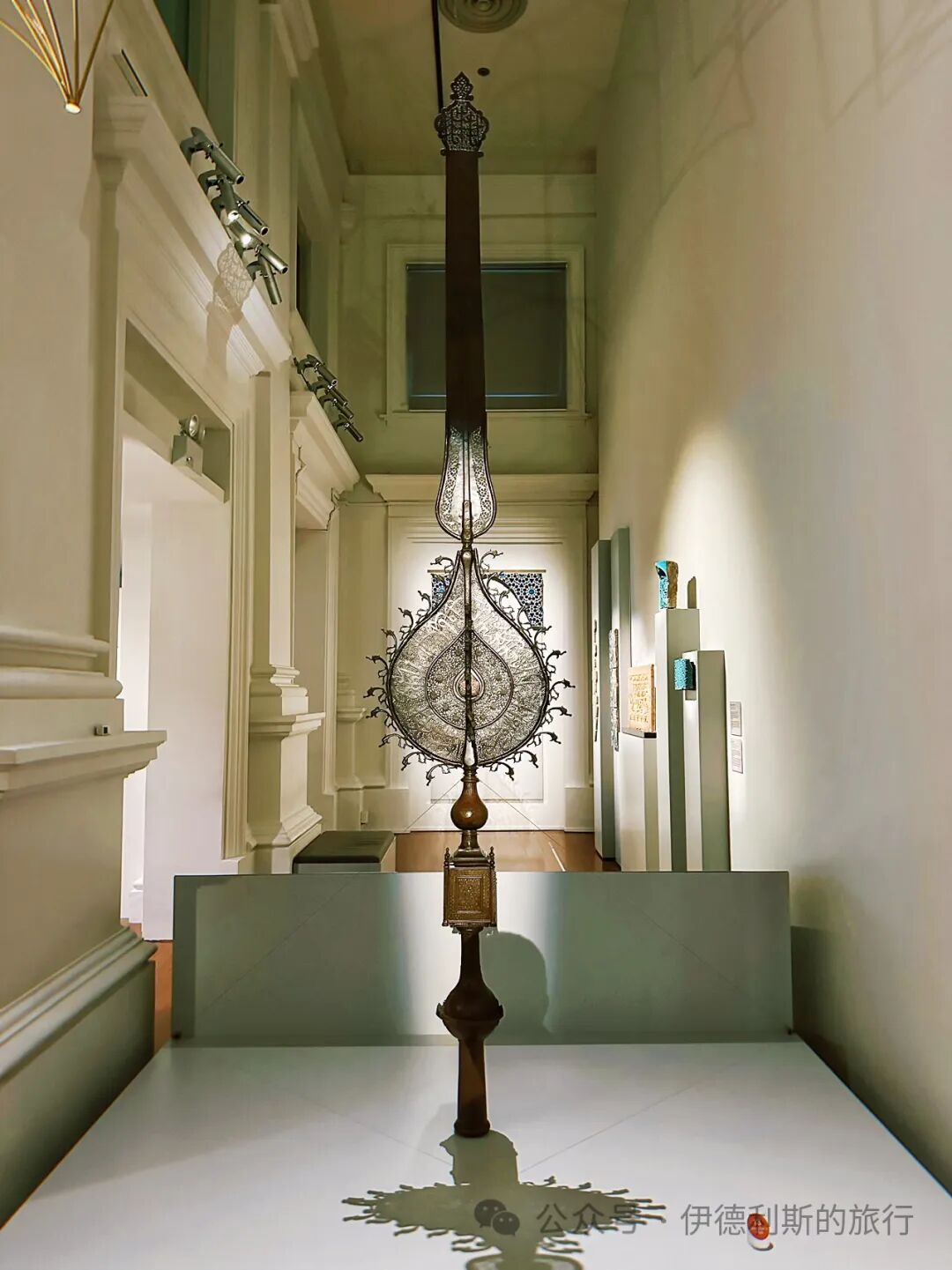
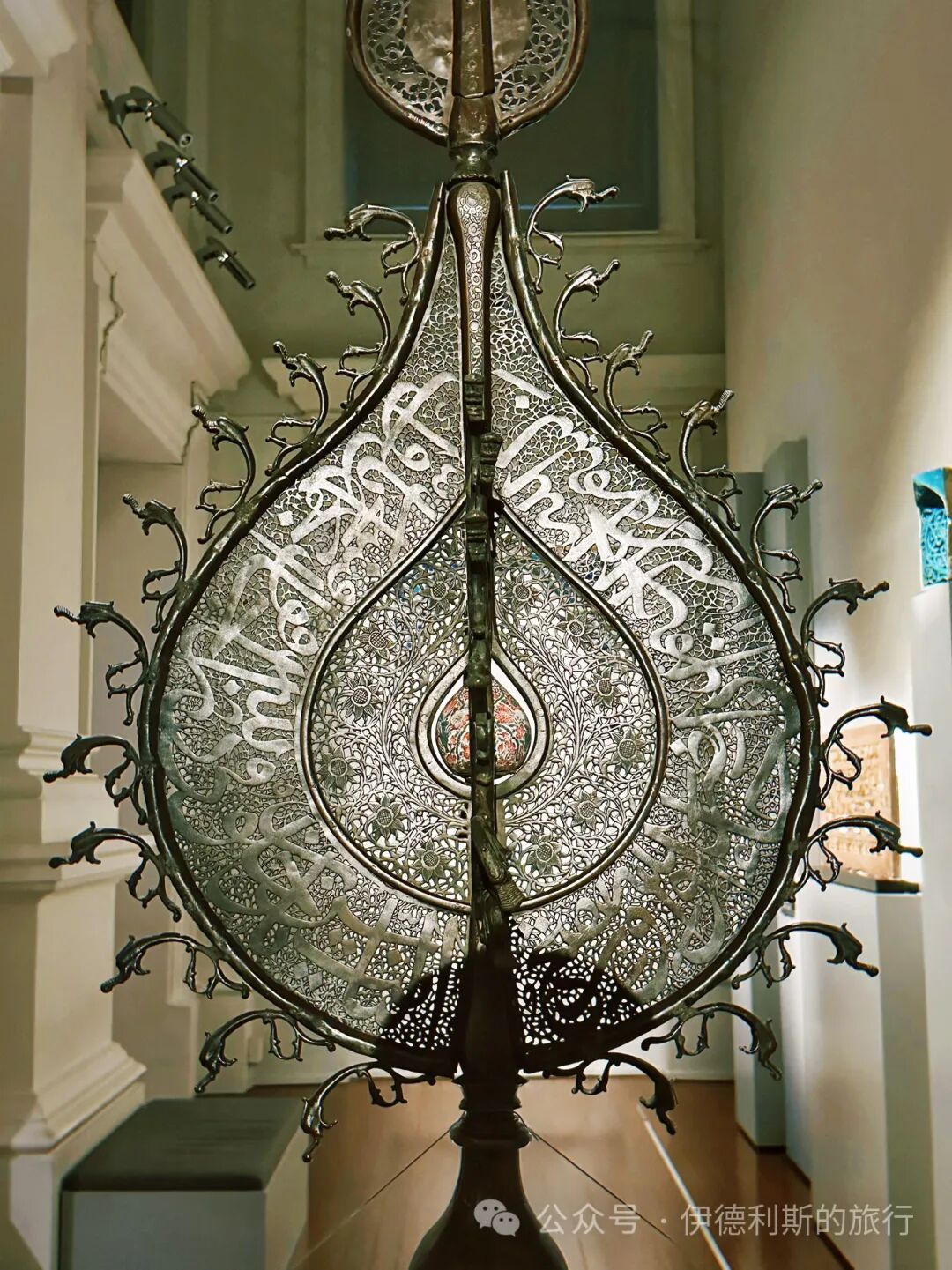
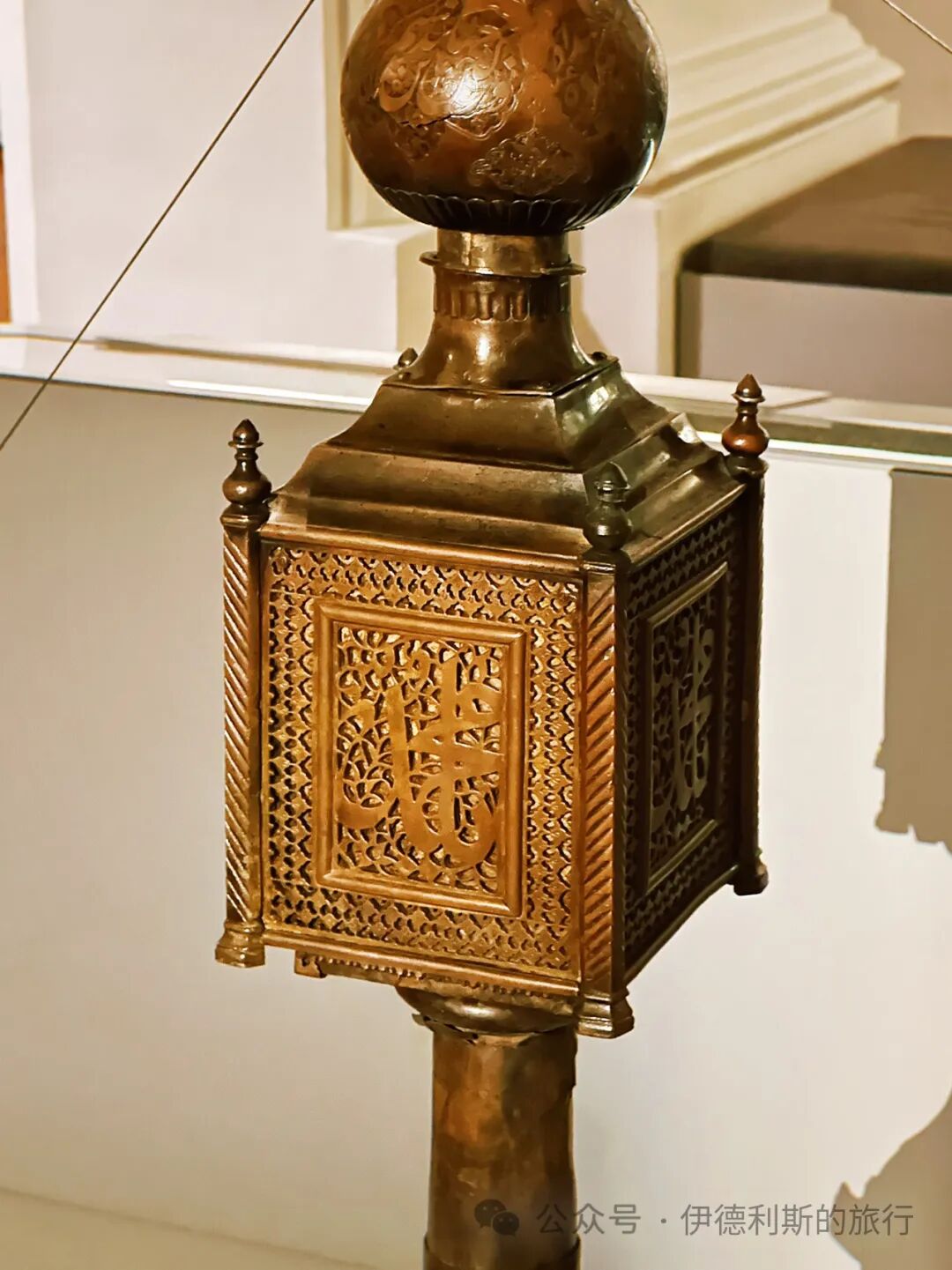
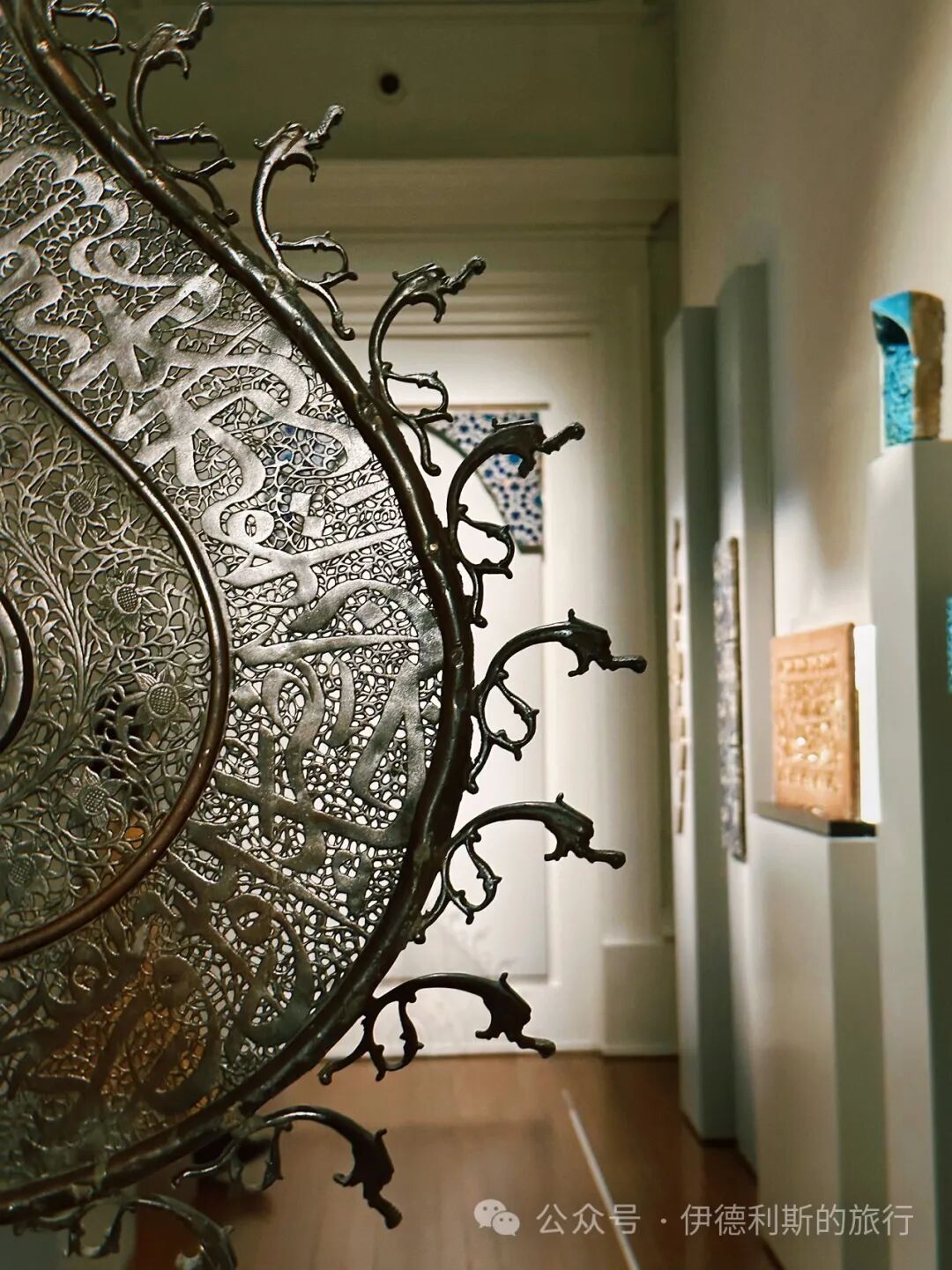
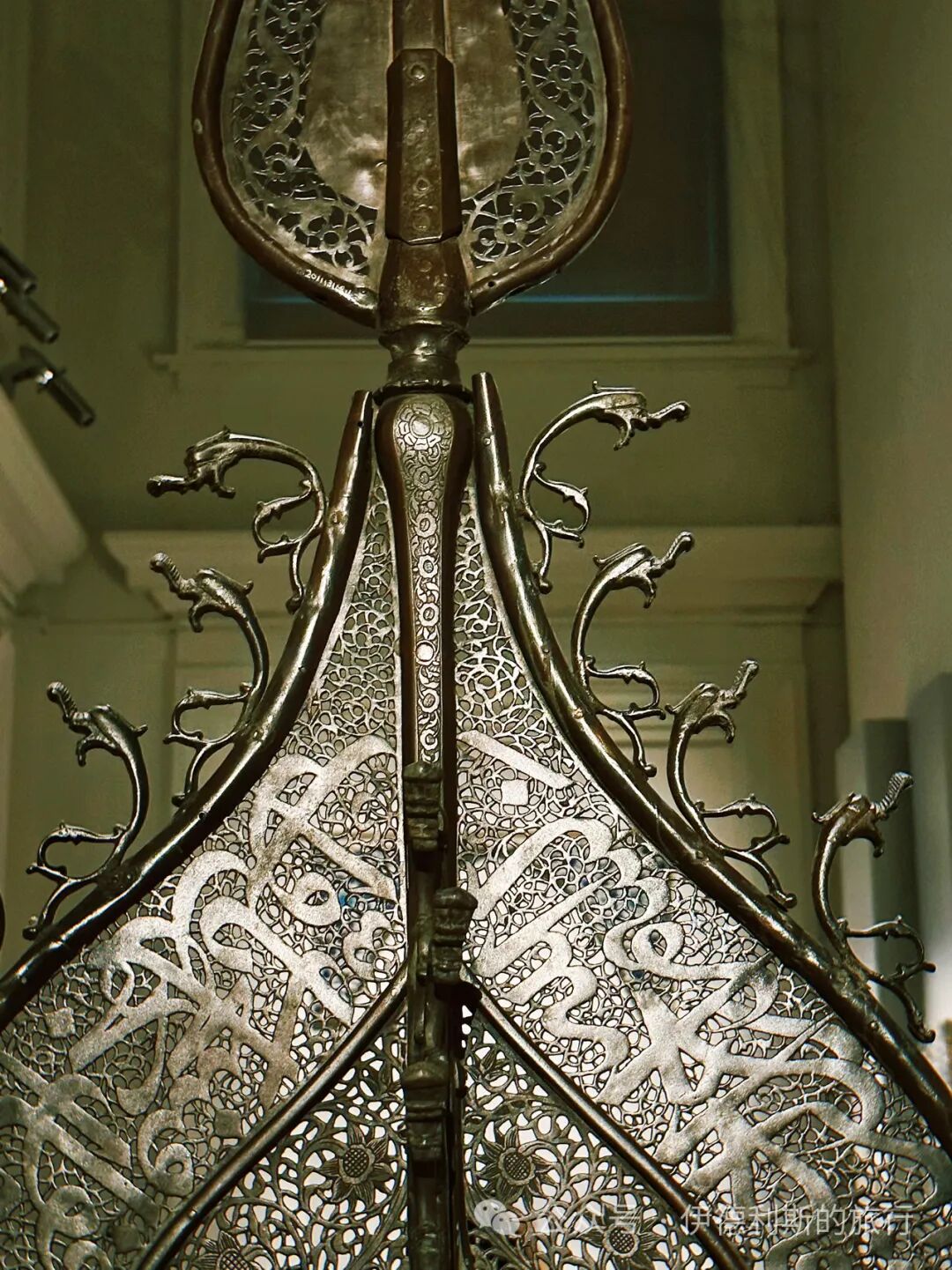
An early 18th-century copper-gilt Alam flag pole from the Safavid dynasty in Iran, engraved with Quranic verses. The Alam flag pole is used by Shia Muslims during Ashura processions and consists of three parts. At the bottom, a cube rises on a copper axis engraved with a call to the Prophet. In the middle is a pear-shaped flat surface with a dragon head, featuring an enamel ball with colorful floral patterns. The top symbolizes the sword of Ali.
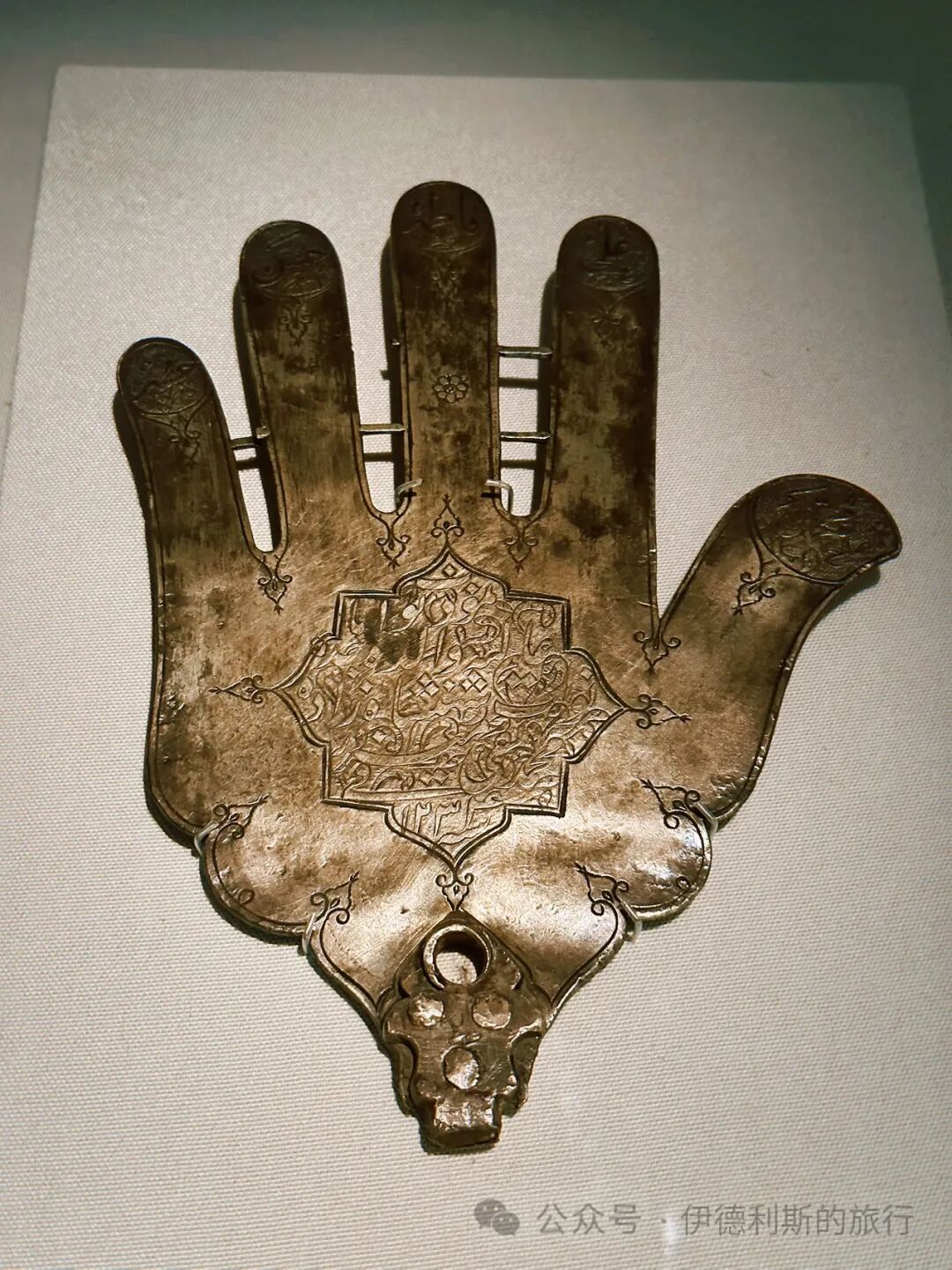
A 'Hand of Abbas' from the late 19th or early 20th century. Abbas was the son of Imam Ali. He served as the standard-bearer for his brother Imam Hussein's troops during the 680 AD Battle of Karbala against the Umayyad Caliphate. On the eve of Ashura, Abbas went to the Euphrates River to get water, but he was blocked by the enemy on his way back, his hands were cut off, and he was eventually killed. Since then, the 'Hand of Abbas' has been seen by Shia Muslims as a symbol of courage, sincerity, and self-sacrifice.
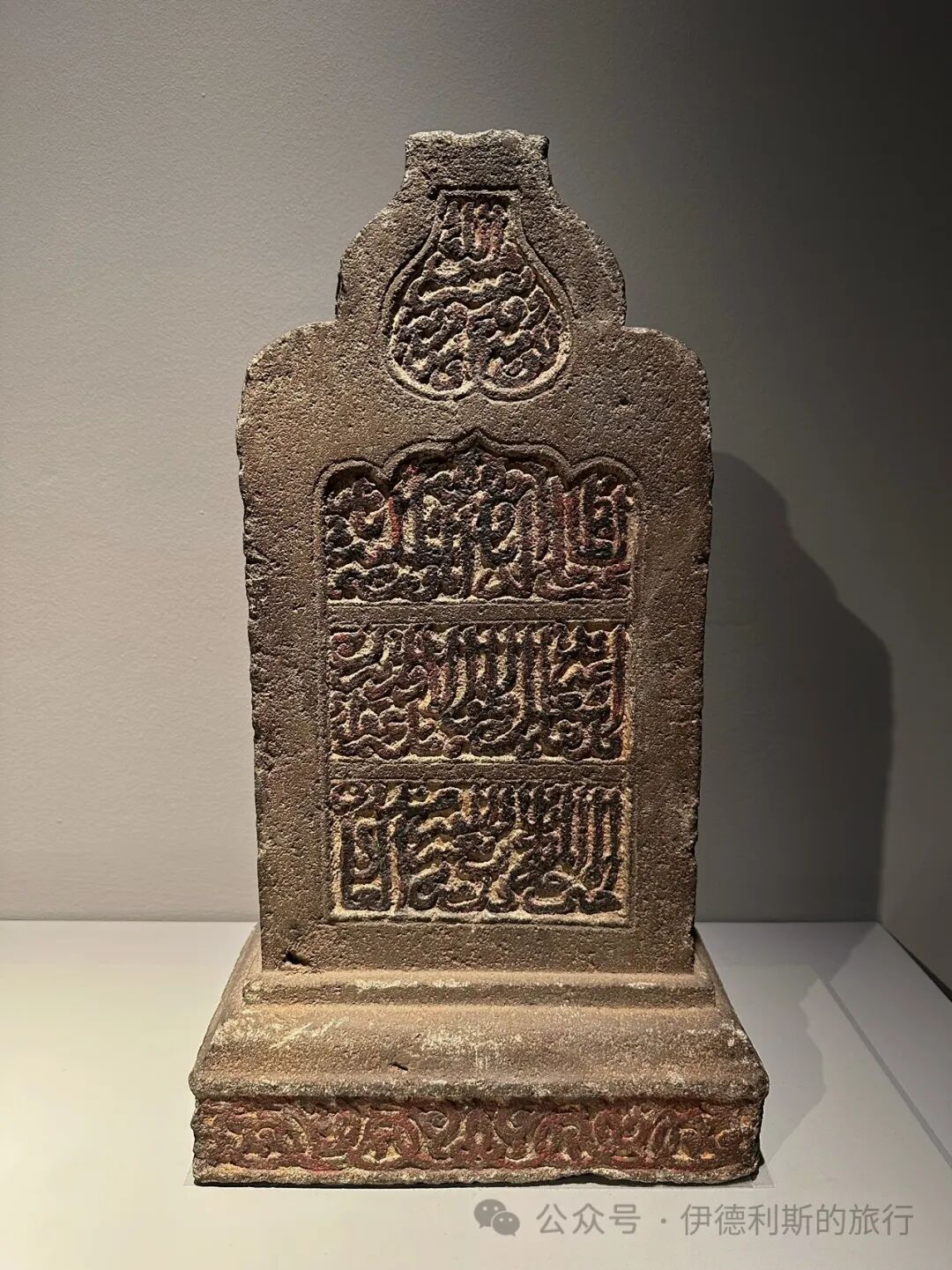
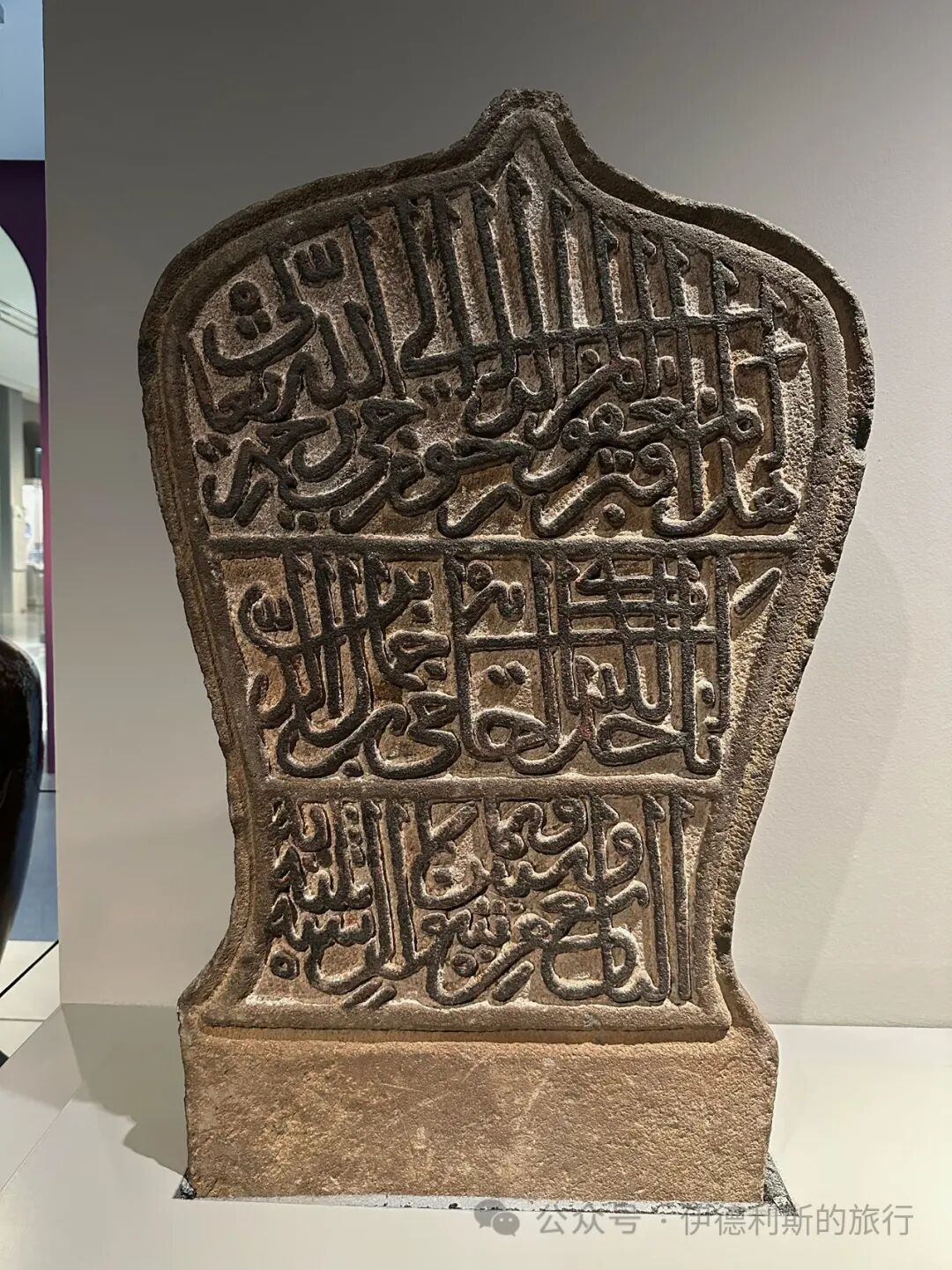
Two tombstones from the mid-15th-century Malacca Sultanate. Besides scripture, one of them is inscribed for a captain from Gujarat in western India who passed away in 1459. Muslim merchants from Gujarat played a key role in the trade of the Malacca Sultanate, where one of the four harbor masters was specifically in charge of trade with Gujarati merchants. These two tombstones were found by British engineers in the walls of the Portuguese fortress in Malacca and were among the first items collected by the Raffles Museum in Singapore, now known as the National Museum.
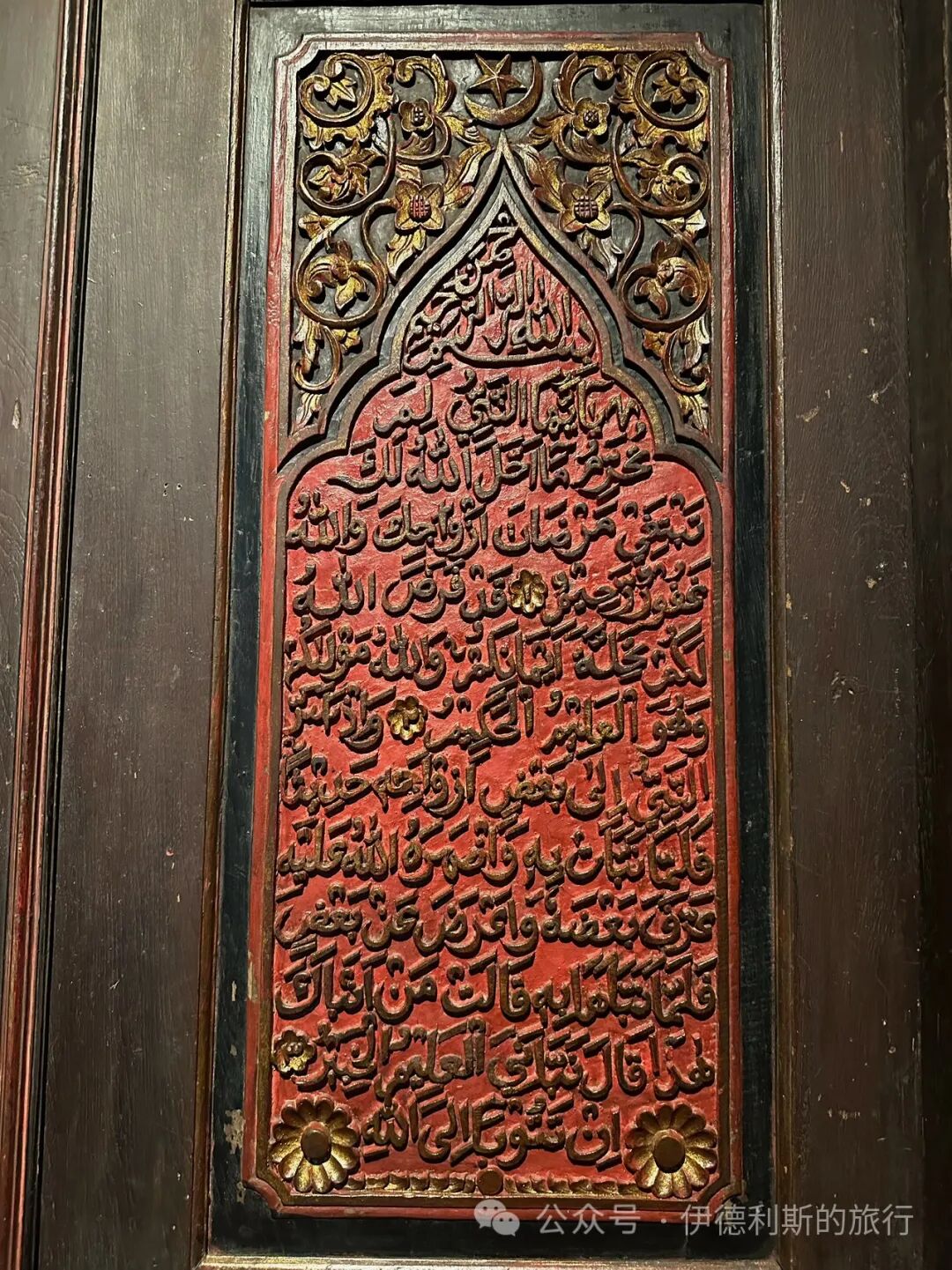
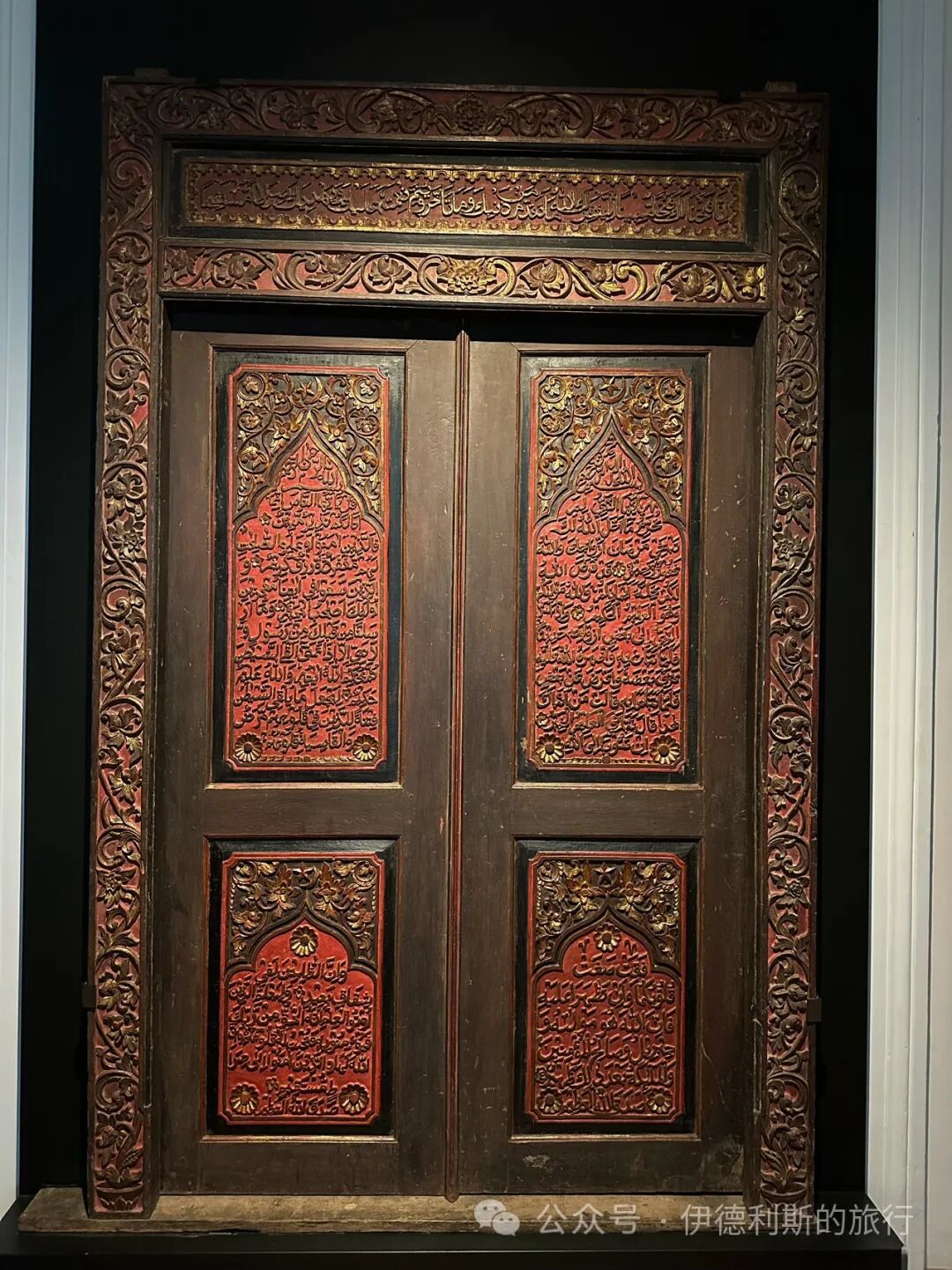
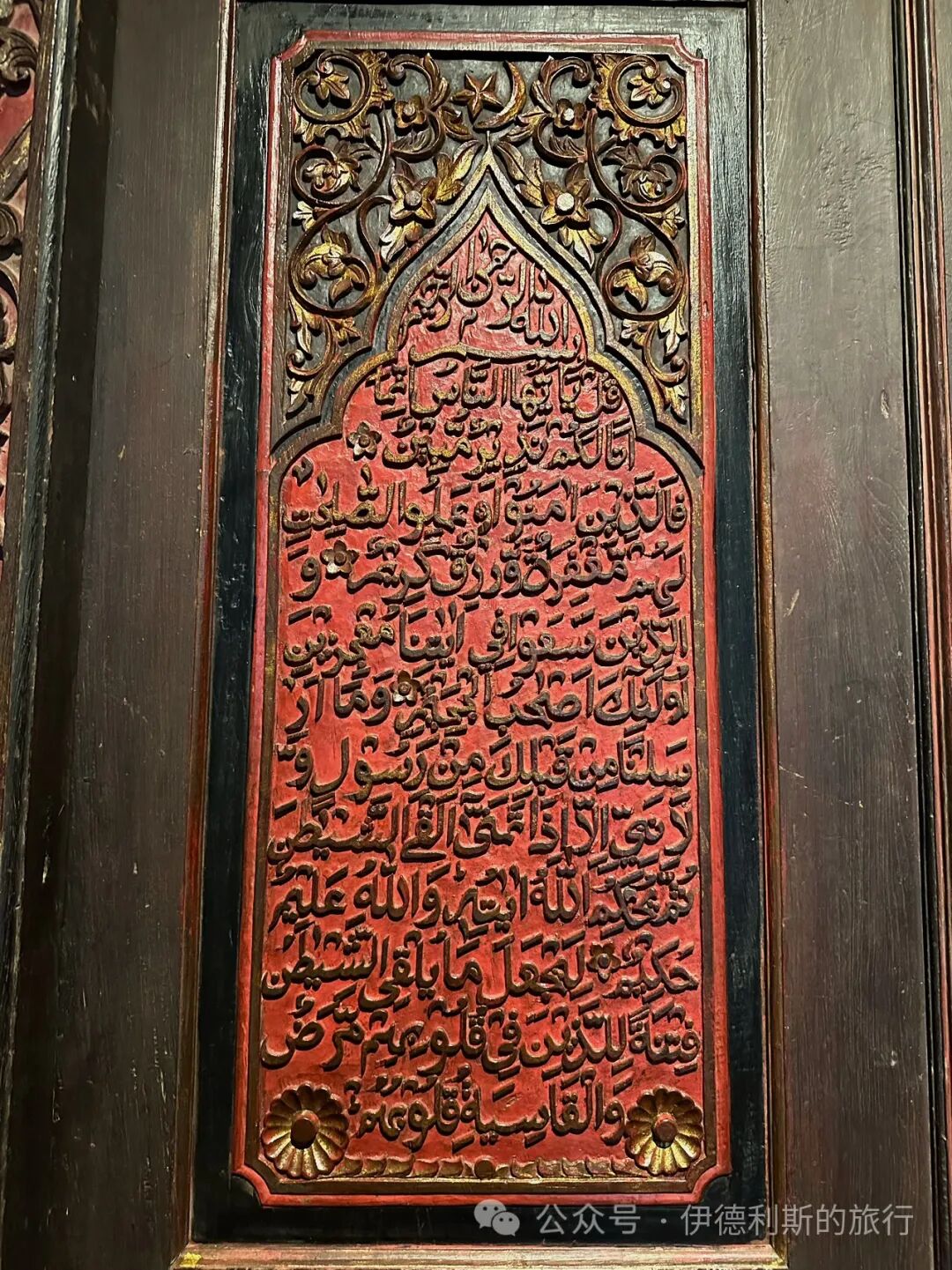
A gilded door panel from the early 20th century from Jepara or Kudus in Central Java. This traditional door panel is called Gebyog in Javanese and was used in traditional Javanese houses to separate the living room from the bedroom. Besides scripture, it features beautiful floral patterns. Lotus patterns were often used during the Hindu-Buddhist period, but these shifted to jasmine patterns after the arrival of Islam.
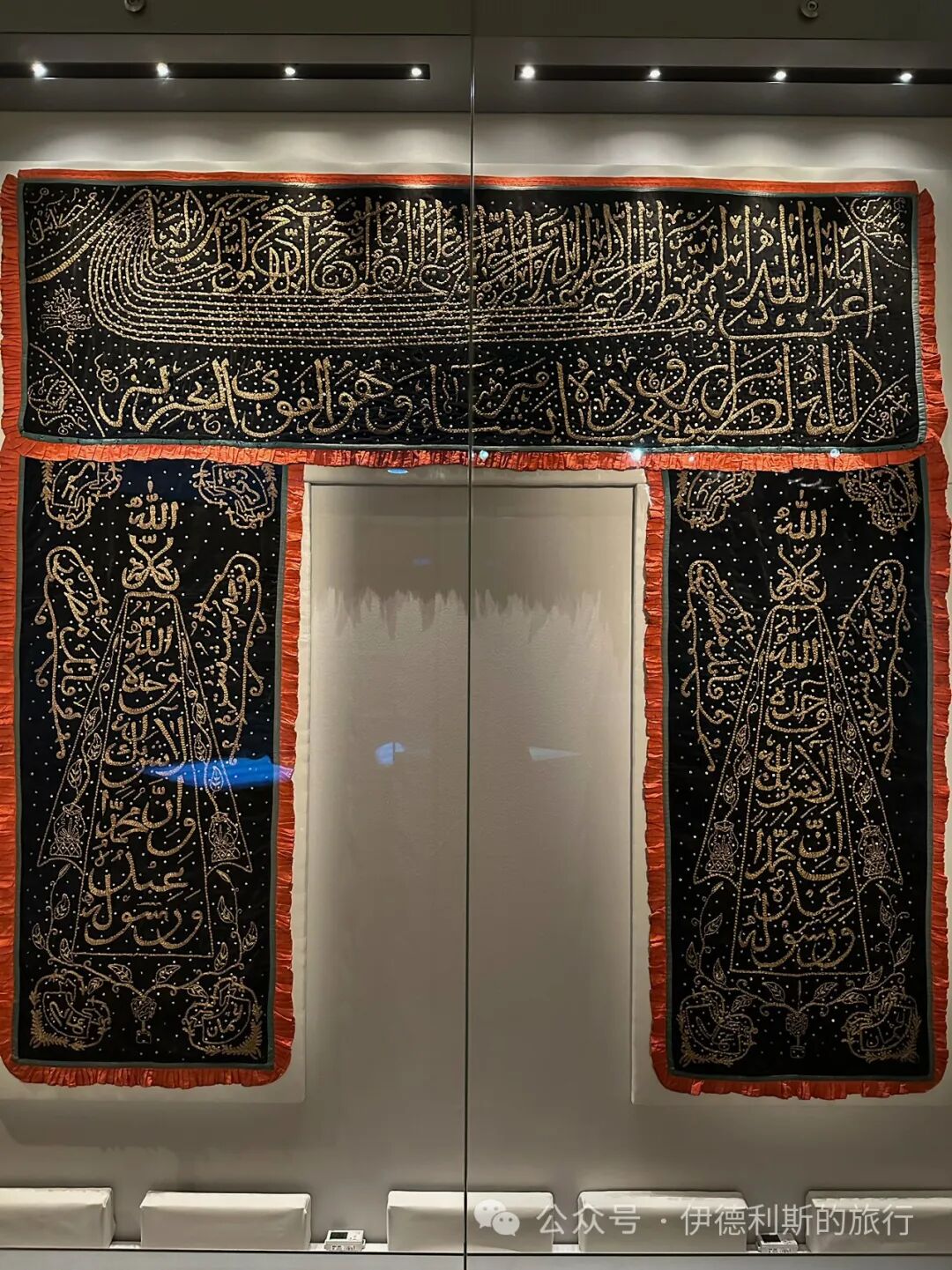
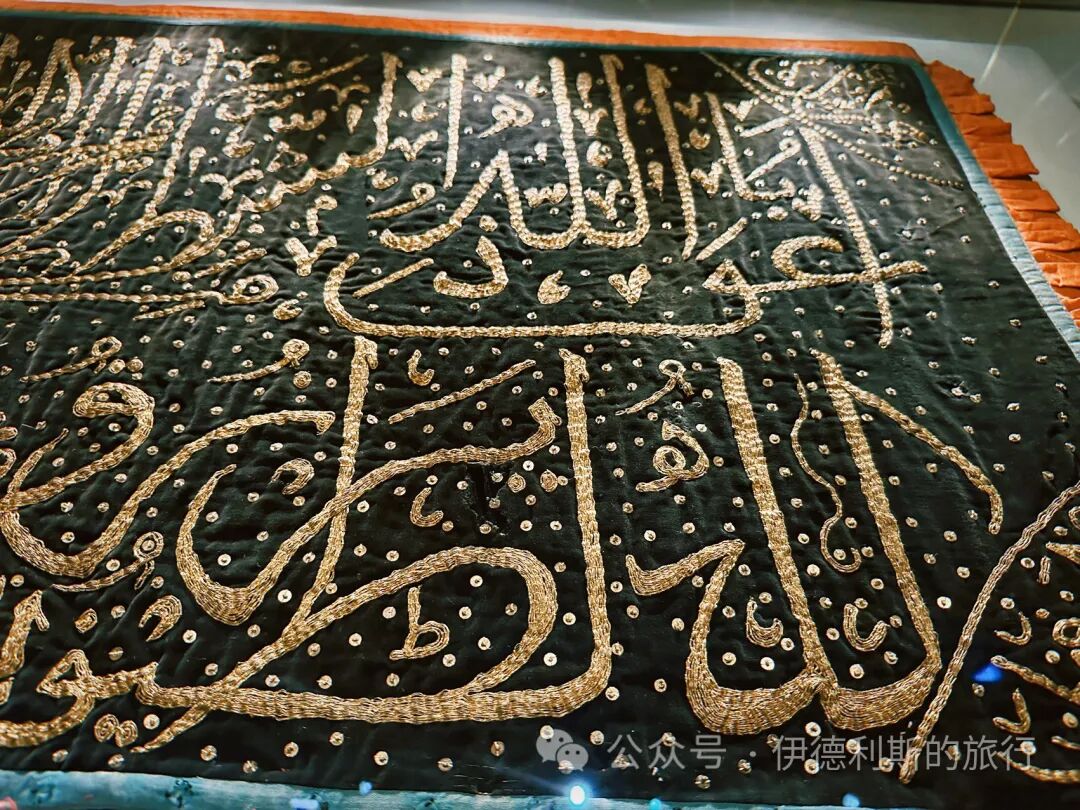
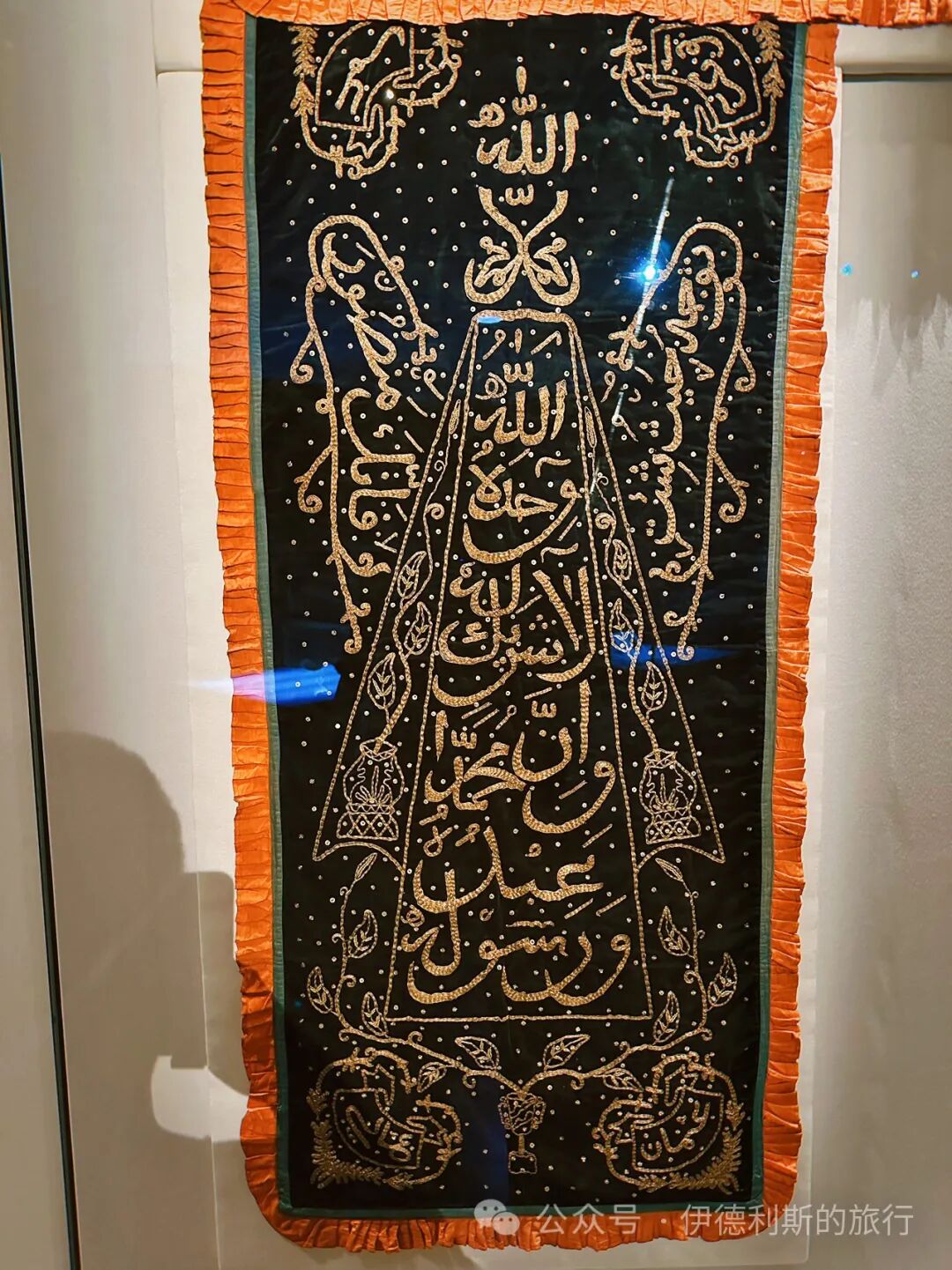
A 20th-century velvet tapestry embroidered with gold thread from Sumatra. This traditional tapestry is called Tekat. It was once used for royal clothing and buildings, but now it is mostly used at weddings or at the entrances of mosques and gongbei.
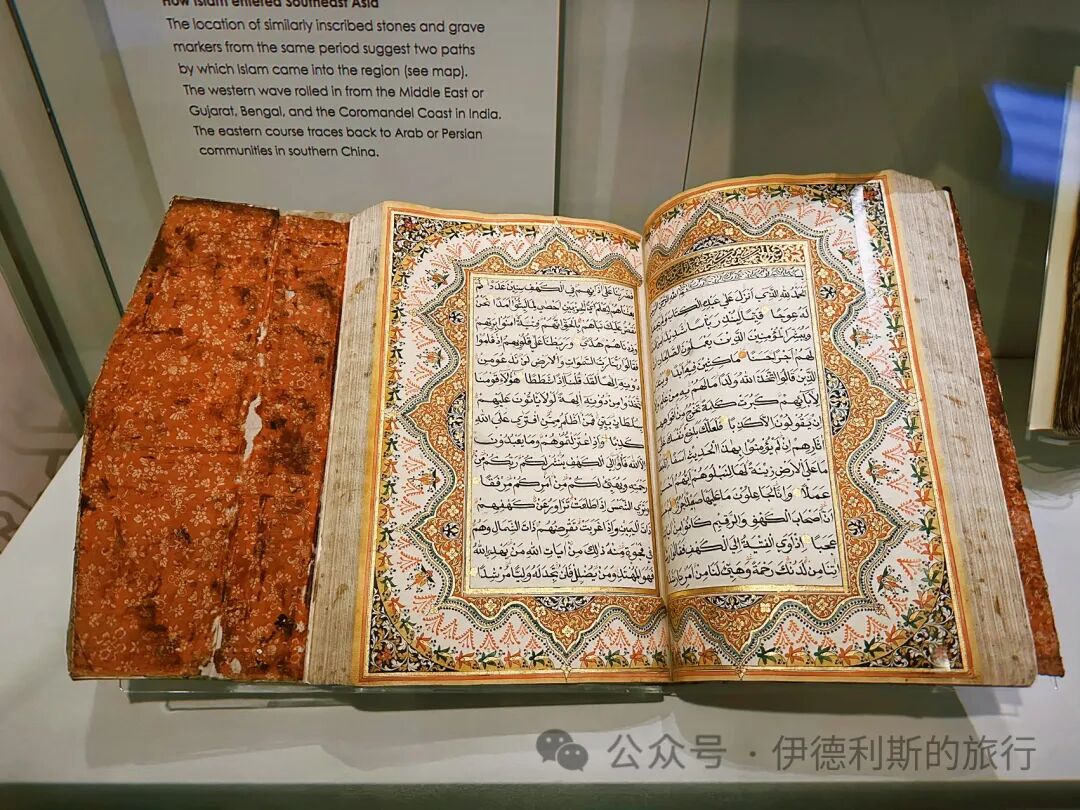
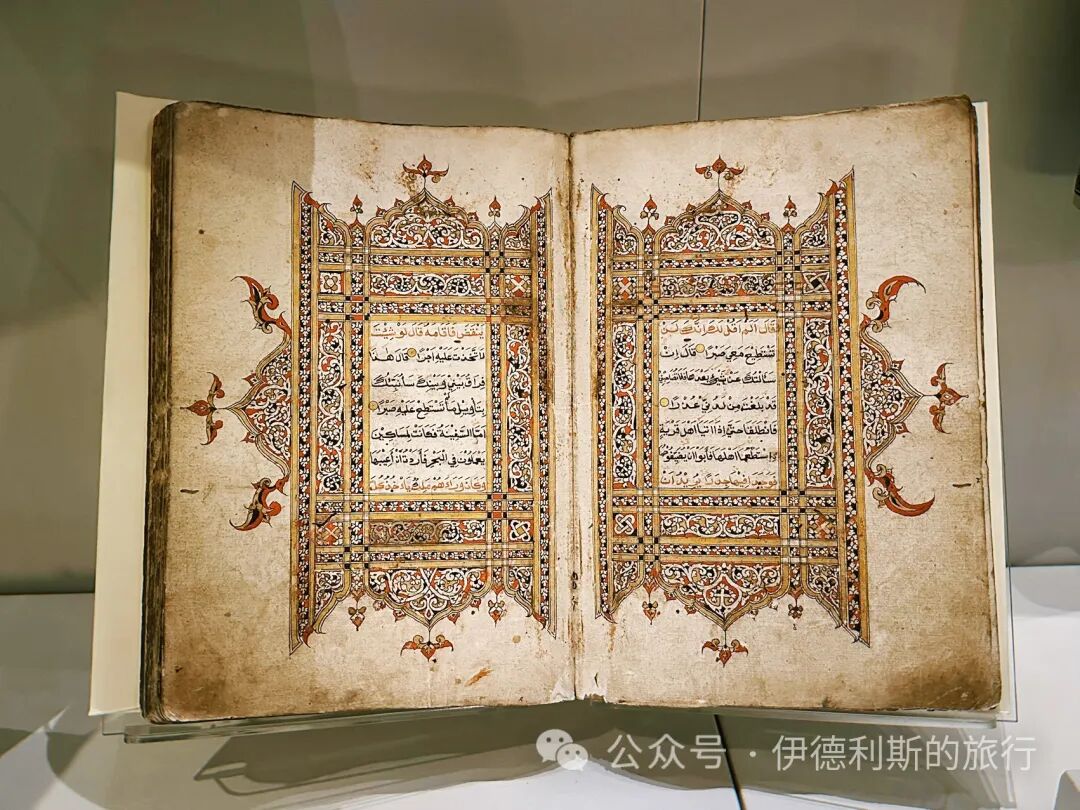
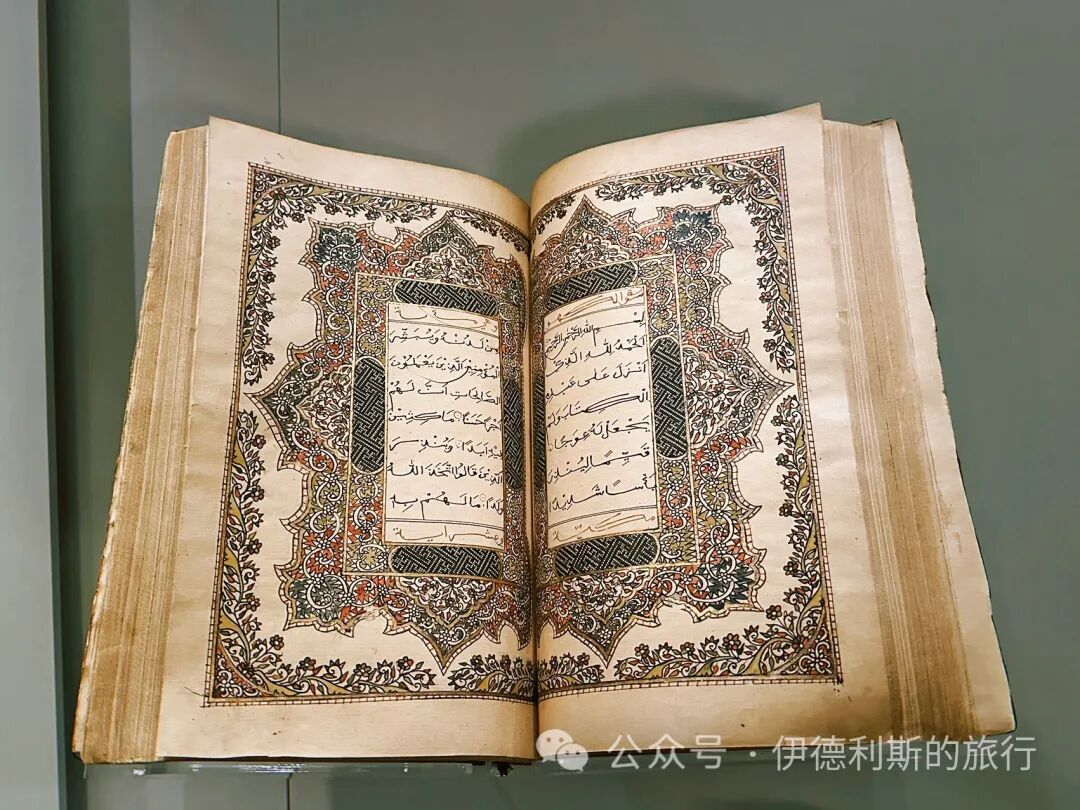
Three Southeast Asian scripture manuscripts in different styles.
A 19th-century scripture manuscript from the Terengganu region on the east coast of the Malay Peninsula. Because it uses a large amount of gold, it is believed to have been commissioned by the Sultan's court in Terengganu. This type of manuscript from the Terengganu region is dense and delicate, featuring red and gold as the main colors, followed by black and green.
A 19th-century scripture manuscript from the Aceh region of Sumatra. Like those from the Terengganu region, the Aceh manuscripts also primarily use red, gold, and black. The most unique features of the Aceh manuscripts are their triangular edges and wing-shaped patterns.
A scripture manuscript from Central Java dating to the late 19th or early 20th century. Compared to the Aceh style from Sumatra and the Terengganu style from the Malay Peninsula, Javanese-style manuscripts feature more colors and patterns. Blue is more common in Javanese manuscripts, and the swastika (wan) pattern is also unique to them.
Summary: This Singapore article visits the Asian Civilisations Museum and looks closely at Islamic art, trade history, ceramics, textiles, and cultural objects. It keeps the original museum observations, object names, and historical details for English readers.
The Asian Civilisations Museum in Singapore sits by the Singapore River in a neoclassical building from 1867. It first focused on crafts from Malay and Southeast Asian indigenous peoples. After the 1990s, it expanded its collection to include West and South Asia, becoming a museum that shows the meeting of different Asian cultures and civilizations.
Two miniature paintings from the late 16th-century Shiraz school in Iran depict the famous Persian poet Nizami's masterpiece, the Five Poems (Khamsa).
A late 16th-century Ottoman miniature illustration comes from the Garden of the Blessed (Hadigat us-Su'ada), written around 1547. This illustration shows the hardships faced by the Prophet and his family. He is giving a sermon (khutbah) from a pulpit, with Imam Ali, Husayn, Hasan, and other family members below. To show respect, golden flames burn behind the Prophet, Ali, Husayn, and Hasan, and the faces of the Prophet and Ali are covered.
This 18th-19th century silk embroidery from Jaipur, India, was usually used for tapestries or curtains in tents or noble homes. The floral patterns in the center are classic Mughal dynasty designs, widely used in Rajasthan, where Jaipur is located.
This 14th-century copper bowl with gold and silver inlay is from Fars, Iran. Fars was the center of Iran's metalworking industry in the 14th and 15th centuries, and the bowl depicts the image of the Sultan at that time.
The Batu Hitam shipwreck gallery at the Asian Civilisations Museum in Singapore. 1,100 years ago, an Arab cargo ship loaded with precious goods left Guangzhou port to return to the Abbasid Caliphate. It eventually sank near the coast of Sumatra, 600 kilometers southeast of Singapore. It was not discovered until 1998 and is called the Batu Hitam (Black Rock) shipwreck because of the location where it was found. The shipwreck yielded a large number of ceramic bowls, which are the same shape as those found from the Abbasid Caliphate of the same period.
A 13th-century calligraphy fritware tile from Kashan, Iran.
A fritware jug from the late 12th-century Seljuk dynasty in Iran. Fritware is a ceramic technique invented by Middle Eastern craftsmen in the 11th century to imitate Chinese porcelain. It developed from early Egyptian faience and is made of a mixture of clay, quartz, and glaze.
A marble tombstone from early 9th-century Syria.
A late 14th-century Kufic script tile from the Timurid dynasty, likely from the tomb of a Timurid noble.
An 11th-century mihrab tile from northeastern Iran. The lamp in the center represents light (nur), symbolizing the presence of Allah.
This 11th-century tombstone tile from Afghanistan was likely embedded in the wall of a tomb.
This 14th-century sandstone calligraphy carving from western India features a three-part script style that is stretched vertically.
Renowned Arabic calligrapher Chen Jinhui created this piece in 1996, blending in techniques from Chinese ink wash painting.
This is a Persian paper-cut from Iran, dated 1891. This art form was widely used for binding Iranian manuscripts from the 15th to 17th centuries and continued until the end of the 19th century.
This 18th-century Ottoman Turkish book stand (rehal) is inlaid with tortoiseshell and mother-of-pearl.
This 19th-century Iranian book stand (rehal) is carved with beautiful floral and geometric patterns.
This 8th-to-9th-century parchment manuscript from Syria or North Africa is an early form of Kufic script. These parchment Kufic manuscripts are among the earliest Quran copies visible today.
These two religious texts, written in China and Java, show how non-native Arabic speakers wrote the language, including notes in their own native tongues.
This is an 1876 Ottoman Turkish pen case with an inkwell.
This is a pottery jug from Kashan, Iran, dating to the late 12th century.
This is a 10th-century pottery bowl from Nishapur, Iran, featuring Kufic calligraphy.
This 1887-88 sandstone screen (jali) from India was used to block the hot sun and is inscribed with praises to Allah.
This 17th-century Iranian copy of the anatomy book Tashrih-i Mansuri was originally written in the 14th century. It studies different body systems, including bones, nerves, muscles, and arteries. The final chapter explains how human organs and fetuses form, and it includes anatomical drawings of a pregnant woman.
This is a Persian version of the famous ancient Roman pharmacology book De materia medica, copied in the Deccan region of India in 1595. De materia medica was written in Greek in the 1st century AD, translated into Arabic in the 9th century, and later translated into Persian, laying an important foundation for botany and pharmacology in West Asia.
A dua shirt (dua shirt) from the Mughal Empire in India, dating from the 16th to the early 17th century. This garment is covered in scripture and the 99 names of Allah. Warriors wore it under their armor, and sick people wore it for health and safety.
A 19th-century Indian dua hat (dua hat) inscribed with scripture.
A jewelry box from Gujarat, India, made between the late 16th and 17th centuries. Muslim artisans in Gujarat crafted these fine boxes for the entire Islamic world, decorating them with finely cut mother-of-pearl.
A 1230 tile from Kashan, Iran. These octagonal tiles, paired with cross-shaped tiles, covered the walls of Iranian palaces and important tombs. They often feature Persian poetry and Quranic verses.
A 15th-century tile from Multan, Pakistan. Influenced by the Timurid Empire of Central Asia, it features a striking blue and green twelve-pointed star design.
Exquisite Chinese export porcelain, reflecting the economic and cultural exchange between China and the Islamic world at that time.
A Chinese porcelain plate from the early 17th century featuring a magic square, with black cursive scripture alternating with red scroll patterns. Magic squares were believed to help prevent disease.
An early 17th-century export porcelain plate from the Zhangzhou kiln in Fujian. It shows two peacocks under a blooming flower, surrounded by the Shahada.
A 17th-century Qing dynasty export porcelain piece, fitted with a silver rim and spout, featuring the name of Allah.
A porcelain plate from the Zhangzhou kiln in Fujian, commissioned by the Sultan of Aceh in the 17th century. The inner circle contains scripture, while the eight outer circles feature seals designed by the Sultan in imitation of the Mughal Empire. The Sultanate of Aceh (1496-1903) was located in northern Sumatra, Indonesia, and was once a major center for Islamic scholarship and trade. These plates were likely ordered during the reign of Sultan Iskandar Muda (1607-1636). Under his rule, the Sultanate of Aceh reached its peak, becoming the most powerful and wealthy state in western Indonesia and the Strait of Malacca.
An export porcelain plate commissioned by Shia Muslims in Iran or India in 1844-45, featuring Persian poetry related to the martyrdom of Imam Hussein. The teardrop-shaped pattern used here is called a boteh design in Persian.
This Canton enamel porcelain bowl was ordered by the Qajar dynasty royal family in Iran between 1883 and 1884. It mentions Prince Mass'oud Mirza Zell-e Soltan, the eldest son of the Qajar King Naser al-Din Shah (who reigned from 1848 to 1896), who served as the governor of Isfahan for over 35 years. The Qajar royal family loved Canton enamel porcelain and often ordered full sets of tableware to use at banquets.
A set of traditional Qing dynasty enamel incense tools used by Hui Muslims: an incense burner, an incense box, and a vase for incense tools. In the past, Hui Muslims usually kept these in a high place at home and only used them during religious gatherings (nieti) and the Eid festivals. Later, as stick incense became popular, the three-piece incense set was gradually replaced by a single incense burner.
The spread and evolution of blue and white porcelain in the Middle East.
The first is a blue and white porcelain plate from Jingdezhen in the 15th century. This type of floral blue and white porcelain plate was exported in large quantities to Middle Eastern countries during the Ming dynasty, and one is kept in the tomb of the famous Sufi Sheikh Safi al-Din in Iran.
The second is blue and white porcelain produced by the Ottoman Empire in the mid-15th century, representing an early Middle Eastern attempt to learn from Jingdezhen blue and white porcelain. The floral patterns are clearly influenced by China, but the cypress tree pattern is a Turkish specialty.
The third is porcelain produced around 1600 in Iznik, Turkey, under Ottoman rule. By this period, Iznik was able to produce high-quality blue and white porcelain, and the floral patterns continued to be influenced by China.
A 19th-century teak wood scripture box from northern Java. This intricately carved scripture box was generally only used in mosques and madrasas, and it features traditional Javanese-style patterns.
A Jingdezhen blue and white porcelain brush rest with the mark 'Made in the Zhengde reign of the Great Ming'. The front is written in Arabic as 'khamah' (pen), and the back is written in Arabic as 'dan' (rest).
The Islamic culture of Southeast Asia.
A collection of blessings for the Prophet (Dala'il al-Khayrat) copied in Terengganu on the Malay Peninsula in the 19th century. Malay people usually carried this book with them when they went on Hajj, so it includes diagrams of the Prophet's Mosque and the Sacred Mosque, marking the locations of the Prophet's tomb and the Kaaba. The two illustrations of the Kaaba use the ornate Terengganu decorative style and feature a lot of gold leaf.
A wooden carving of Buraq from Lanao del Sur province on Mindanao island in the southern Philippines, dating to the early 20th century; this is the mount the Prophet Muhammad rode during his Night Journey. Muslims in Mindanao display the Buraq during important feasts and holidays. Although the Hadith does not describe the face of the Buraq, it mentions it has a handsome face, so it has historically been depicted with a human face; this Buraq's headpiece and tail incorporate traditional Okir patterns from the southern Philippines.
A wooden tombstone from the southeast of Kalimantan island dated 1894; the intricately carved tombstone is a symbol of noble status and wealth, featuring both Malay and Arabic.
A prayer time chart from the mid-20th century at the Wak Sumang mosque in Punggol, Singapore, which was used until the mosque was demolished in 1995.
A book of divination (Primbon) from Semarang, Java, copied in 1824 in Jawi script (Arabic script used to write Malay). The book uses a combination of numerology and Quranic verses to provide guidance on decisions or auspicious dates and times for events ranging from moving house to getting married.
A magic square belt buckle from the late 19th to early 20th century in Kuala Kangsar, the royal city of the Sultan of Perak on the Malay Peninsula; it is inscribed with the Shahada and was part of traditional Malay attire.
Arabic calligraphy on wax-resist dyed cloth (Batik) from the Jambi region of Sumatra in the 20th century. This overall design, with four satellite patterns surrounding a central motif, originated from the Buddhist mandala and was later used by Muslims in Sumatra as a burial shroud for coffins.
A mulberry paper manuscript from Pattani, Malay Peninsula, dated 1835. This black folding manuscript is written with white talc; it was very popular in Buddhist regions of Myanmar and was later adopted by Muslims in places like Myanmar and Malaysia. The manuscript includes advice for young people, and the Song of Fatimah (Syair Dendang Fatimah) is often chanted during ceremonies for newborns.
On the left is a 19th-century Indonesian haji cap, and on the right is a Bugis songkok cap (Songkok Recca) from southern Sulawesi dating to the 19th or 20th century. White symbolizes purity and the plain white ihram garments worn during the Hajj pilgrimage; in Indonesia, it is typically worn by a haji who has returned from the pilgrimage. The black songkok cap comes from the Ottoman fez, and the Bugis people of southern Sulawesi usually wear this cap for Friday namaz. A wider gold band indicates a closer relationship with the king.
This early 20th-century batik sarong from Java depicts a Hajj pilgrimage group. The flag reads 'Bendera Radja Mekkah' (Flag of the King of Mecca), which was used during the 1916 Meccan revolt against the Ottoman Empire. The revolt was supported by the Hadharem people of Yemen. Many Arabs in Southeast Asia belong to Hadharem families, and some ran batik workshops on the north coast of Java while organizing Hajj trips for Javanese Muslims. This sarong was likely made in that context.
A scroll from the 1830s or 1840s showing a Shia Ashura procession in southern India, likely Chennai. The entire scroll is nearly 6 meters long. It shows a model of the tombs of Imam Hussein and Hassan (Ta'ziya), the mount of the Prophet during his night journey (Buraq), an Alam flag, the Hand of Abbas, a shield (Sipar), and a reenactment of the Battle of Karbala. You can also see the Chennai native infantry, people dressed as animals, and even elements of the Hindu Charak festival, which reflects India's multiculturalism.
An early 18th-century copper-gilt Alam flag pole from the Safavid dynasty in Iran, engraved with Quranic verses. The Alam flag pole is used by Shia Muslims during Ashura processions and consists of three parts. At the bottom, a cube rises on a copper axis engraved with a call to the Prophet. In the middle is a pear-shaped flat surface with a dragon head, featuring an enamel ball with colorful floral patterns. The top symbolizes the sword of Ali.
A 'Hand of Abbas' from the late 19th or early 20th century. Abbas was the son of Imam Ali. He served as the standard-bearer for his brother Imam Hussein's troops during the 680 AD Battle of Karbala against the Umayyad Caliphate. On the eve of Ashura, Abbas went to the Euphrates River to get water, but he was blocked by the enemy on his way back, his hands were cut off, and he was eventually killed. Since then, the 'Hand of Abbas' has been seen by Shia Muslims as a symbol of courage, sincerity, and self-sacrifice.
Two tombstones from the mid-15th-century Malacca Sultanate. Besides scripture, one of them is inscribed for a captain from Gujarat in western India who passed away in 1459. Muslim merchants from Gujarat played a key role in the trade of the Malacca Sultanate, where one of the four harbor masters was specifically in charge of trade with Gujarati merchants. These two tombstones were found by British engineers in the walls of the Portuguese fortress in Malacca and were among the first items collected by the Raffles Museum in Singapore, now known as the National Museum.
A gilded door panel from the early 20th century from Jepara or Kudus in Central Java. This traditional door panel is called Gebyog in Javanese and was used in traditional Javanese houses to separate the living room from the bedroom. Besides scripture, it features beautiful floral patterns. Lotus patterns were often used during the Hindu-Buddhist period, but these shifted to jasmine patterns after the arrival of Islam.
A 20th-century velvet tapestry embroidered with gold thread from Sumatra. This traditional tapestry is called Tekat. It was once used for royal clothing and buildings, but now it is mostly used at weddings or at the entrances of mosques and gongbei.
Three Southeast Asian scripture manuscripts in different styles.
A 19th-century scripture manuscript from the Terengganu region on the east coast of the Malay Peninsula. Because it uses a large amount of gold, it is believed to have been commissioned by the Sultan's court in Terengganu. This type of manuscript from the Terengganu region is dense and delicate, featuring red and gold as the main colors, followed by black and green.
A 19th-century scripture manuscript from the Aceh region of Sumatra. Like those from the Terengganu region, the Aceh manuscripts also primarily use red, gold, and black. The most unique features of the Aceh manuscripts are their triangular edges and wing-shaped patterns.
A scripture manuscript from Central Java dating to the late 19th or early 20th century. Compared to the Aceh style from Sumatra and the Terengganu style from the Malay Peninsula, Javanese-style manuscripts feature more colors and patterns. Blue is more common in Javanese manuscripts, and the swastika (wan) pattern is also unique to them.
