
Exploring Shijiazhuang East Mosque: A Hidden Islamic Heritage Site in Hebei's Busy City Center
Join me as I head into the heart of Shijiazhuang’s Chang'an District on Heping East Road to explore the hidden site of the old Shijiazhuang East Mosque. We’re diving into the history of how the city evolved from a small village into a bustling hub where Hui Muslims settled and established their places of worship, while highlighting the importance of preserving these ethnic cultural heritage sites during modern urban development.
Standing right there by the heavy traffic on Heping East Road, I honestly felt a bit surreal—who would have guessed that tucked away in the narrow gaps of this busy city center lies the old Shijiazhuang East Mosque?
To give you the backstory, this mosque was built in 1946 after local Muslims pooled their money to buy the land. Their first Imam was Yang Baozhai, and back then, it was pretty modest, with only a dozen rooms and a lecture hall used as a prayer space. After it merged with the Qiaoxi Mosque in 1959, the site was repurposed as a food factory, a paper product plant, and even a warehouse for a motorcycle shop, essentially staying 'asleep' for decades. It wasn't until 2006 that local elders like Chu Qiulai and Imam Bai Endian donated funds for restoration, essentially 'rescuing' the courtyard from being a warehouse. Interestingly, until just a few years ago, even the people living in the high-rise apartments right next door had no idea that this quiet spiritual home for the Muslim community was hiding right under their noses.
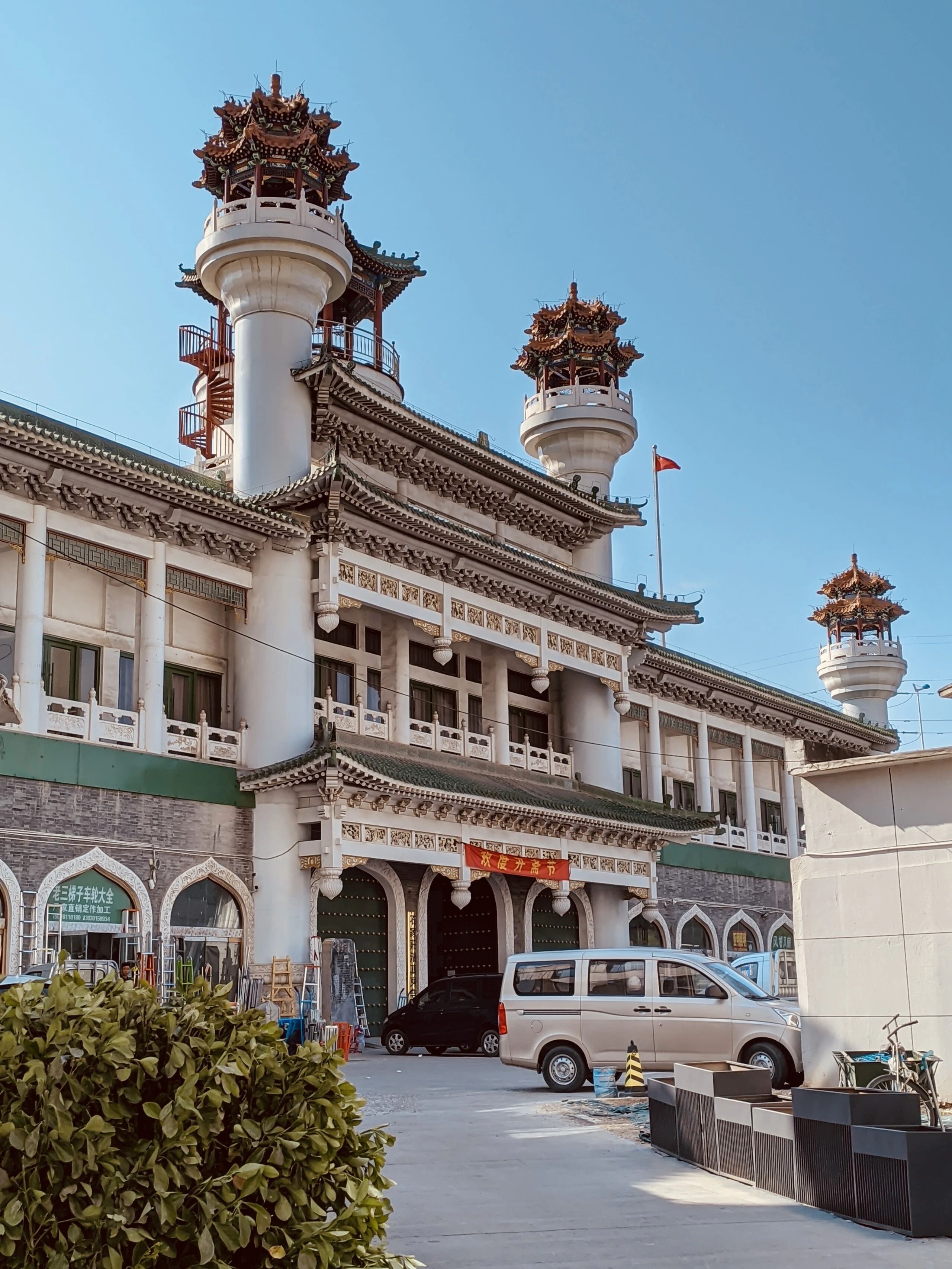
Looking at the new mosque building completed in 2015, I find it fascinating: the designer, An Changzhong, blended Islamic domes with traditional Chinese feiyan (flying eaves and brackets). The dome is perfectly rounded and carries that sense of solemnity you'd expect from Western regions, but then you look up and see the eaves lightly curving upward, with green glazed tiles shimmering softly in the sunlight. The octagonal Moon-Sighting Tower looks just like a classic Chinese pavilion, yet it clearly holds an Islamic soul. For such a small mosque that has seen so many ups and downs, it really understands what it means to be 'living history' much better than many of the more massive, grand-scale buildings out there.
Standing right there by the heavy traffic on Heping East Road, I honestly felt a bit surreal—who would have guessed that tucked away in the narrow gaps of this busy city center lies the old Shijiazhuang East Mosque?
To give you the backstory, this mosque was built in 1946 after local Muslims pooled their money to buy the land. Their first Imam was Yang Baozhai, and back then, it was pretty modest, with only a dozen rooms and a lecture hall used as a prayer space. After it merged with the Qiaoxi Mosque in 1959, the site was repurposed as a food factory, a paper product plant, and even a warehouse for a motorcycle shop, essentially staying 'asleep' for decades. It wasn't until 2006 that local elders like Chu Qiulai and Imam Bai Endian donated funds for restoration, essentially 'rescuing' the courtyard from being a warehouse. Interestingly, until just a few years ago, even the people living in the high-rise apartments right next door had no idea that this quiet spiritual home for the Muslim community was hiding right under their noses.
Looking at the new mosque building completed in 2015, I find it fascinating: the designer, An Changzhong, blended Islamic domes with traditional Chinese feiyan (flying eaves and brackets). The dome is perfectly rounded and carries that sense of solemnity you'd expect from Western regions, but then you look up and see the eaves lightly curving upward, with green glazed tiles shimmering softly in the sunlight. The octagonal Moon-Sighting Tower looks just like a classic Chinese pavilion, yet it clearly holds an Islamic soul. For such a small mosque that has seen so many ups and downs, it really understands what it means to be 'living history' much better than many of the more massive, grand-scale buildings out there.
