
Exploring Qinghai Mosques: Authentic Hui Muslim Culture, Lanzhou Ramen, and Highland Lamb in Hualong
This is the seventh installment of my documentary photography series, 'The Disappearing Arches: Watershed.' I followed the warm Yellow River Valley to visit the Qunke New District in Hualong, Bayan Town, and the North and South Mosques in the Haidong High-Speed Rail New District. Through my lens, I’ve spent eight years documenting the growth of trees, the shifting urban landscape, and the marks of time both inside and outside these mosques.

Over those eight years, the poplar trees I once ignored have grown tall, forming a barrier that stands between me and the mosque. Even the bare, leafless branches are so densely packed that my eyes can no longer pierce through them.
1
Ultimately, the Qunke New District never replaced Bayan Town as the seat of Hualong County. Bayan sits high on the cold mountain peaks, while Qunke lies in the warm Yellow River Valley. This new city, built on the north bank of the Yellow River according to master plans for a county seat, never received the official approval to move the government there, leaving it in an awkward, stranded state.
There are a few mosques on the north side of town that I remember well. I told Zhang Yi to drive, and we arrived in no time—it was an effortless trip. I told him we had arrived, but Yu Li looked blank. He didn’t know which building along the road was supposed to be the mosque. By now, he had seen dozens of them, and he could usually spot one instantly, but when I said we were there, he couldn't distinguish a mosque among the surrounding buildings. I pointed to the house on the street corner and told him that was it. If he didn't believe me, I told him to look closely at the faint arches in the windows. The square protrusion in the middle of the roof, where exposed concrete was visible, used to be a treasure crown—a rounded Arabic dome. The tops of the two corners at the back of the building were abruptly cut off; they were supposed to be tall, extending minarets.
I explained the history of this mosque as I remembered it, but they were both completely confused. The truth is, I never took photos of this mosque back when it was unfinished. Life is unpredictable; in just a few years, the mosque that held such a deep place in my memory had been demolished and 'decapitated,' to the point where it was almost unrecognizable as a house of worship.
I don't even know the name of this mosque.
We are in the hometown of lamian (hand-pulled noodles). About eighty or ninety percent of all Lanzhou lamian shops across China are opened by people from Hualong. You can even find these Muslim noodle-makers as far away as Europe and the United States. A friend of mine in Los Angeles, Da Men, often visits a Qinghai restaurant run by people from Hualong in Irvine. The shop serves lamian, kao yangrou (grilled lamb), Qinghai liangpi (cold skin noodles), and yogurt. Judging by the photos, it looks very authentic. Da Men told me that this restaurant is where he goes to miss the Northwest and to miss me. I told him that’s the best way to keep a memory alive.
In September 2019, the kids had already gone back to school, and the tourist frenzy in Qinghai had suddenly quieted down. I returned to my hometown off-season and wandered around Hualong for a few days. On September 11th, I went to the Qunke Mosque; it was Eid al-Adha. There was a light drizzle, and most of the men driving to the mosque arrived in their cars. They drove fast. Young Muslims love white cars. On the shaded country roads, the yellow willow leaves that hadn't fallen yet reflected off the bright car windows. Older men rode motorcycles. Most of these white cars were mid-range sedans with license plates from all over the country—Qinghai (Qing B), Zhejiang (Zhe B), Jiangsu (Su C), Anhui (Wan A), Fujian (Min B), Hubei (E A), Henan (Yu A), and so on. These plates revealed the cities where the noodle shop owners started their businesses and stood as a testament to their success. They had driven thousands of miles home for Islam's most important holiday. It’s a moment of pride for their families, a chance to show their village peers that they are 'doing well.' The communal prayer on Eid al-Adha is the most important social event for these men.
The Ahong (Imam) makes sure the students (mulla) clear out the parking lot early so those with Zhejiang or Jiangsu plates can park easily. Every Jumu'ah (Friday prayer) during the holidays sees this kind of turnout.
The Imam told me that once the holiday ends, the lamian bosses all leave, and there are no young people left to pray—they are all too obsessed with their phones.
'Young people, especially the girls and young wives, need to stop looking at their phones—don't look at Kuaishou, don't look at Douyin. Sigh, I yell it into the microphone every single day,' the Imam lamented. The internet helps people understand the world, but for Muslims, the realization of secular life is exactly what is being facilitated through the internet.
Lamian, gun manufacturing, and shouzhua yangrou (hand-grabbed lamb) are the three trademarks of Qunke. Lamian has bloomed all over the world, while the stories of gun manufacturing have disappeared into the legends. At one point, 'Hualong-made' black-market guns were quite famous, and they were linked to several high-profile shootings.
Various major shooting cases across the country pointed back to Hualong, Qinghai. Qunke was home to the descendants of Ma Bufang's gunsmiths from before the liberation. The investigation process was reportedly very long. The police interviewed and investigated suspects, but found no clues. Later, an observant officer checked a house and noticed that despite the family having almost nothing, their electricity meter reading was incredibly high. Following the power lines, they found a factory hidden in a cellar, seizing various machine tools and equipment for making guns. The case was cracked, and the gunsmiths' source of income was cut off for good.
Shouzhua is a livelihood for Hualong people, just like lamian. Hualong has high mountains, steep slopes, and barren land; there is no way out without doing business. Lamian is an active export sold to outsiders, while shouzhua is a signature dish in local restaurants for those who stayed behind. Honestly, shouzhua is delicious anywhere on the plateau, but it’s never quite as good once you leave.
After wandering around all morning, it was lunchtime. My two 'assistants' were clamoring for shouzhua. There are so many shouzhua places in Qunke that I couldn't decide where to go, so I followed the 'easy parking' principle and found a halal restaurant called 'Shouzhua Wang' (Hand-Grabbed King) by the side of the road. It was busy. The view into the private rooms was blocked by half-curtains, but hearty laughter spilled out. At a table by the window, four or five men sat huddled together; the shouzhua had already arrived, and everyone was digging in without reservation. At a small table against the wall, two Tibetan men in traditional robes were eating—they actually ate slowly and gracefully. Two tables against the other wall were pushed together, seemingly occupied by a large family. The owner was busy greeting customers. For every table, the shouzhua was weighed and paid for by the jin (half a kilogram). When I asked if we could pick the cuts of lamb, the owner refused flatly, telling me with quite a bit of pride that he knew how to pair the meat. He said every serving would include lamb ribs, leg, and neck. We had no choice but to grab free san paotai (a traditional tea set of three ingredients) and find an empty table by the window.
Zhang Yi said the lamb here was much more expensive than in Linxia—90 yuan per jin compared to 65 yuan in Linxia. He looked a bit bewildered. I didn't know how to answer, but I figured that because we were near the pastures, this was the kind of lamb raised on open grazing land, locally known as 'grass-fed sheep.' Usually, 'fattened sheep' fed with grains and forage in pens are cheaper because they are too fatty. Grass-fed sheep have better flavor and grow in a near-wild environment.
The lamb in Qunke is still tough and full of wild character, which wasn't very friendly to my two assistants. The meat at Shouzhua Wang was drier and chewier, and it was hard on the teeth; sometimes you really had to tear at it to get a piece into your mouth. By the time I finished, it took me five minutes to clean out my teeth with a toothpick—a painful and awkward process. Overall, the quality of the raw meat was better than in Linxia, but it wasn't simmered long enough to be tender. Perhaps the locals still hold onto the eating habits of nomadic steppe peoples. The Qunke shouzhua still has a long way to go before it becomes 'urbanized.' Thankfully, the young landlady provided some excellent purple-skinned garlic to go with it; it was fresh, juicy, and by far the best side dish we’d had on the trip.
While having tea after the meal, I opened my navigation app and searched for Shalianbao and Dehenglong. The straight-line distance was over twenty kilometers, but the route showed sharp, winding curves—that meant climbing from the Yellow River Valley where we were to mountains over 3,000 meters high. That’s the Tibetan area where Ma Laichi originally preached, and where the Tibetan nomads of Kaligang converted to Islam during the Qianlong era, later becoming known as 'Tibetan Hui.' I hadn't been there before, and after hesitating, I decided to give it a pass. We didn't have enough time, and I had planned to shoot two mosques in Ping'an County, on the north side of Qingsha Mountain, in the afternoon light.
On my phone, I still have an interview video from March 2017 at the High-Speed Rail New District Mosque. My interviewees were several elders in charge of the mosque construction—essentially the leaders of the demolished villages. The community where this mosque is located was formed by the merger of four or five nearby villages. Urbanization didn't spare this wide valley twenty kilometers east of Xining. This important grain-producing area is now the site of the Xining Airport and the Ping'an High-Speed Rail Station. Over a dozen villages scattered across the ten-kilometer-long valley were integrated into the High-Speed Rail New City. The project is a commercial real estate development, a continuous residential area stretching two or three kilometers. Five or six of those villages were Hui villages, so the integrated Hui people naturally moved in together, and the construction of the new mosque began after these farmers moved into the new complex.
'The mosque was approved. At first, the management committee and scholars of the old mosque applied for a traditional-style mosque, but we didn't want that. We restarted the process and hired someone to design the current style,' that’s the first thing said in the interview video. I’ve forgotten the old man's name. He was the first to step forward for my video interview, even though this was my third time at the construction site. Previously, while everyone was happy to boast, they all got cold feet when I actually asked for an interview.
'The scale was expanded little by little. We had never built such a large mosque before and had no experience. When the village was demolished, the mosque received eight million in compensation. It felt like a lot, but for a structure of this style and scale, it wasn't enough. Besides, some people who didn't move into this complex thought it was too far and wanted to build another one over there, taking two million away. We ran out of money. It’s all from donations from the congregation. We’ve only paid the construction team a little bit so far, and we still owe them a lot,' he said, facing my camera. Initially, he tried to organize his thoughts, using imperfect Mandarin, but I don't know where it shifted—he suddenly switched his accent to the local Qinghai dialect, the specific dialect used by Hui Muslims. In Xining, even though it’s all Qinghai dialect, there is a distinct difference between the way Han and Hui people speak it.
'It’s truly massive. Perhaps aside from the Shadian Mosque, this is the largest one I’ve ever seen,' I marveled at the grand scale and exquisite decoration of the mosque. Its exterior was even more refined, entirely clad in beige sandstone from the Mediterranean coast—an expensive, high-end building material with a rather royal feel.
'I don't think so, we are bigger than Shadian,' he seemed confident about being the largest in the country, his tone casual. 'These stones are from Egypt. We’ve already put over thirty million into this, and there’s still a funding gap of over ten million. I don't know how we’re going to pay it back.' He was just as casual about the total investment and the unsecured funding sources. In short, everything is according to Allah's will; they are merely servants executing this noble task.
2019 Qunke New District

2019 Qunke Mosque

A couple in 2019

This child is of the Salar ethnic group. Her parents went to the interior to open a lamian shop and left her with her grandparents. She had just started school. That afternoon, she didn't go to school; she was just playing by the side of the road outside the village primary school. She wouldn't go home, just sat there on the roadside, digging into the dirt with a stick. She was very quiet, barely spoke, and was hard to talk to. Before we left, I bought her a pack of instant noodles. I remembered her name, but I don't know where I wrote it down. Their village is a new village, having just moved down from the high mountains the year before.
2
During the hottest days of summer, my daughter and I had come here once. Cars could enter and exit the complex freely now because there was an automatic fee system; it wasn't like before, where security guards would stop you and demand an explanation. What was puzzling was that there wasn't a single soul in the mosque after the domes and minarets were demolished—no mulla, no worshipers. Inside the main hall, there was still a huge circular chandelier, but it hung very low. In order to partition an extra level inside this grand-looking building, the height of the prayer hall was restricted, creating a visually oppressive feeling. The circular chandelier hanging from the ceiling felt like it could be touched by hand; it was truly a shame. In 2017, when I was shooting the interior of the prayer hall alone, I needed to turn on the lights. I wanted to capture the moment this hall looked magnificent. After I focused my camera and prepared to turn on all the lights to start metering, I found the circuit breaker box hidden in the corner. I lifted the cover and saw air switches labeled for different sections. I flipped the switches that were in the off position one by one. With the snapping sound of the breakers, the downlights in the front porch, the side aisles, the side chandeliers, and the large central circular chandelier all lit up. But before I could meter and adjust the exposure, the breakers clicked and tripped, and the lights all went out automatically. I pushed them back up, but they tripped again.
The project supervised by the local elders not only had an unreasonable hall height, but even the lighting design was flawed—perhaps the load wasn't enough, causing it to trip. I remember that the photo was set up based on the few dozen seconds of effective lighting I observed, and I finished the shot in a scramble.
The scorching sun beat down on the square in front of the mosque, making it impossible to stay for long. I left in a hurry, then headed out of the complex and had lunch at a clean-looking halal restaurant to the right of the entrance. Although it was already 2:30 PM, it was lunch for my daughter and me. She liked eating mianpian (noodle flakes with soup). I ordered a bowl of dry-mixed noodles, but I wasn't full, and I felt too embarrassed to order a second serving. Rural restaurants in the 'new city' are becoming less and less honest.
I circled to the north side to where I had taken photos before, which was actually the entrance to another mosque. It was the mosque of the old school of thought in the village. There had been an independent mosque before the demolition, and after the demolition, they built this one themselves, naming it the North Mosque of the High-Speed Rail New District based on its orientation. The larger, thirty-million-yuan mosque is naturally called the South Mosque, and another mosque about a kilometer away is the West Mosque. The South Mosque looks most majestic from this position because it sits on a 30-meter-high terrace, and combined with its four towering minarets, it’s quite spectacular—though that was all in the photos from 2016. That giant building with beautiful Islamic pointed arches on all four sides.
The 'Sinicization' of the South Mosque was carried out through the crude and simplistic method of 'decapitation.' Perhaps the debts from the 30-million-yuan construction costs haven't been paid off yet, and the original construction crew had to climb onto the roof to remove the domes and towers that had such an Arabic flair. Such a community simply cannot afford the millions required to renovate the mosque again. The 'decapitation' action was a last resort, and the most economical option.
At 4 PM, I finally arrived at the High-Speed Rail New District from Qunke. After parking in the complex, Zhang Yi and Yu Li didn't want to get out to take photos with me. I wanted to go to the north side of the square, where the summer sun leaves you with nowhere to hide, to get an overhead shot of the North Mosque, and then see if I could find anyone to chat with in front of the South Mosque—just to try my luck. Many stories start with casual chats with strangers. The two assistants were already tired, or perhaps they were just bored of mosques. People who don't understand Islam or the Hui people quickly lose their initial curiosity. They were the same. They didn't understand the complex impact that the Hui people or Islam has had on me; I was there to find answers, while they were just sightseers.
There's nobody in this square. It was empty during the scorching heat of summer, and it's just as empty now in the dead of winter. Xining had a quiet little cold snap last night, so the stone-paved plaza is bone-chillingly cold right now; who would be hanging around here for a chat? As for the old men I interviewed eight years ago, I have no idea which building or apartment they live in now, and I’ve lost touch with them anyway.
Looking at the North Mosque from this angle, it usually has a commanding, high-up perspective. It should have been an easy shot, but I ran into a problem: over the past eight years, the poplar trees I once ignored have grown tall, forming a solid barrier between me and the mosque. Even the gaps between the bare, leafless branches are too dense for my camera lens to look through.
That mild cold front last night scrubbed the heavy Xining sky clean. It’s absolutely clear today, and for a photographer, the visibility is almost painfully sharp. I didn't really have the heart to take this photo; I had to shift my angle just to avoid the tree branches, and the light wasn't great either. The color temperature was beautiful and the air quality was crystal clear, but those aren't the kind of qualities I wanted for this specific shot.
I wrapped up the shoot in a hurry, telling myself I’d just have to come back another time to excuse the mediocre results. I packed up my gear and started heading back past a row of storefronts. Even the heavy curtain over the first shop couldn't hide the sign for "Halal Yogurt." I lifted the corner of the thick cotton curtain and squeezed through the heavy glass door. A Hui Muslim man in a white cap was boxing up freshly made yogurt. His containers were paper, looking like short, squat paper cups.
The yogurt was fresh off the stove and still warm, and they were 400-gram packs—perfect. Ever since I had that yogurt in Xunhua last night, I’d been hunting for more handmade stuff. I bought four and headed back to the car.
I interrupted my two assistants as they were chatting, and before the three of us dove into the yogurt, we made sure to snap some photos to send to our contact in Los Angeles.
After that, I stood in front of the North Mosque to photograph the South Mosque, which is set up high but now looks "headless." I took a shot of it in 2016 against a slight backlight, and it’s the same today. Because the building is missing its signature dome and minaret, the composition feels really strange to me.
(To be continued)

Islamic colors in 2019

Islamic colors in 2023

An elderly man in Qunke, 2018
Inside the courtyard of the High-Speed Railway New District Mosque in Haidong, August 2023
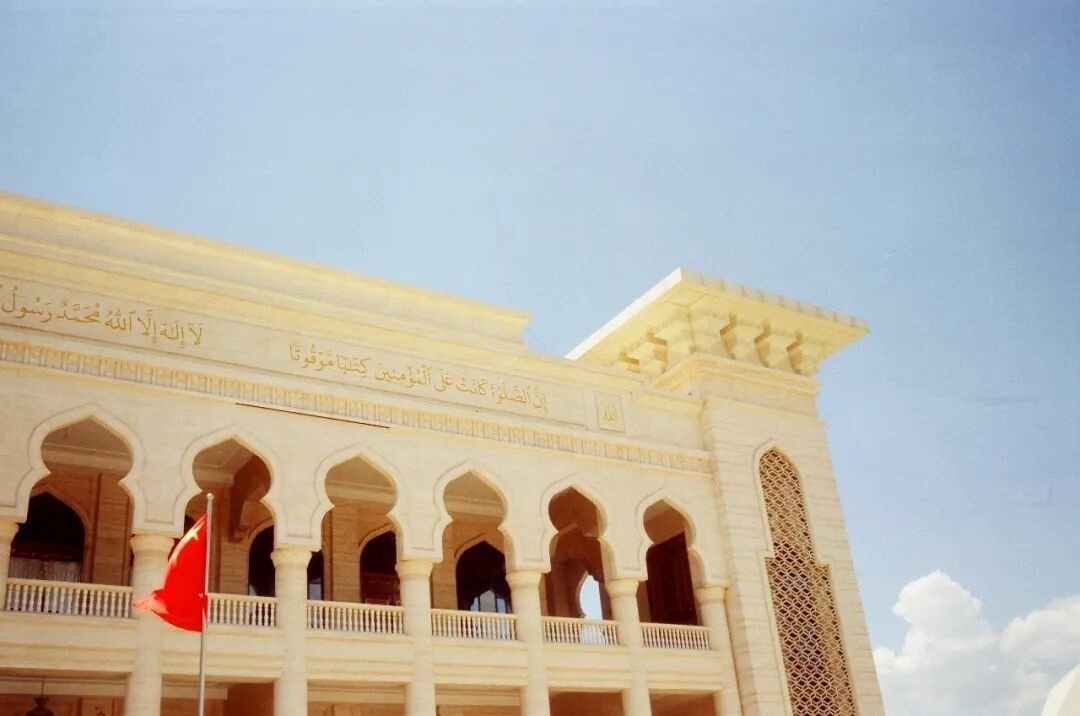
The High-Speed Railway New District Mosque in Haidong, August 2023; the minaret has already been demolished
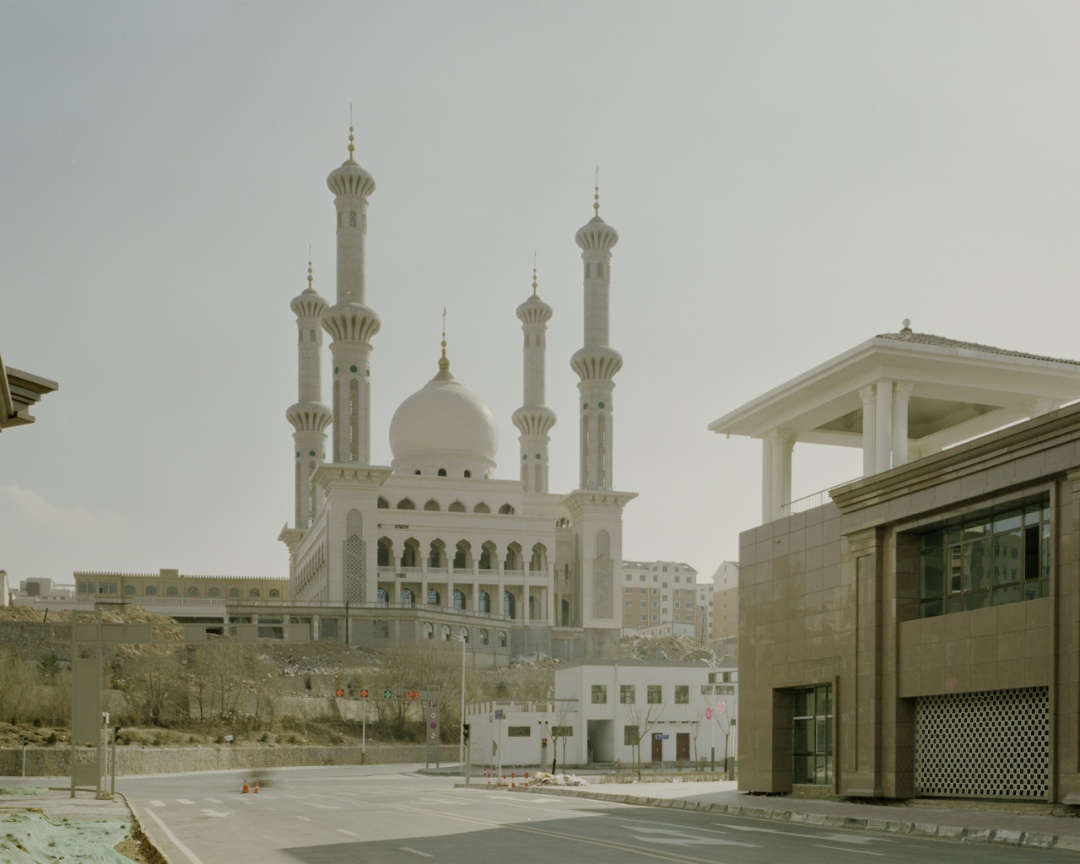
The South Mosque at the High-Speed Railway New District in Haidong, 2016
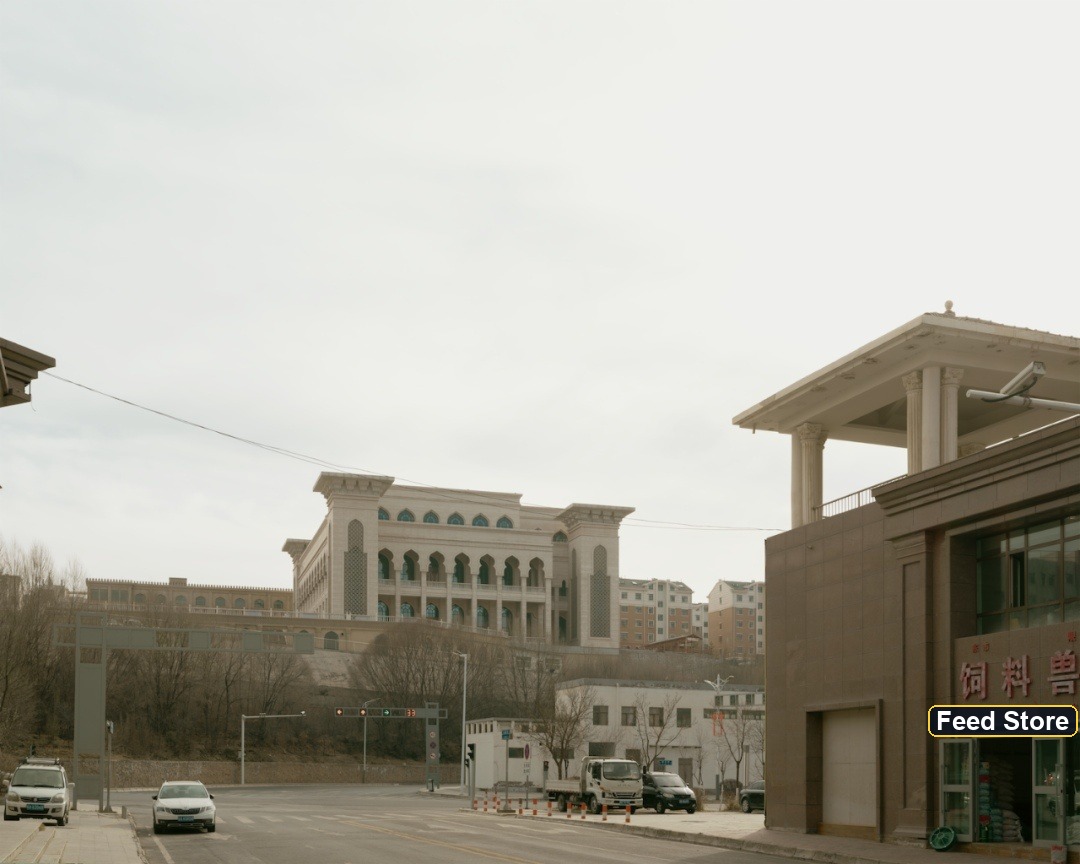
The South Mosque at the High-Speed Railway New District in Haidong, 2023
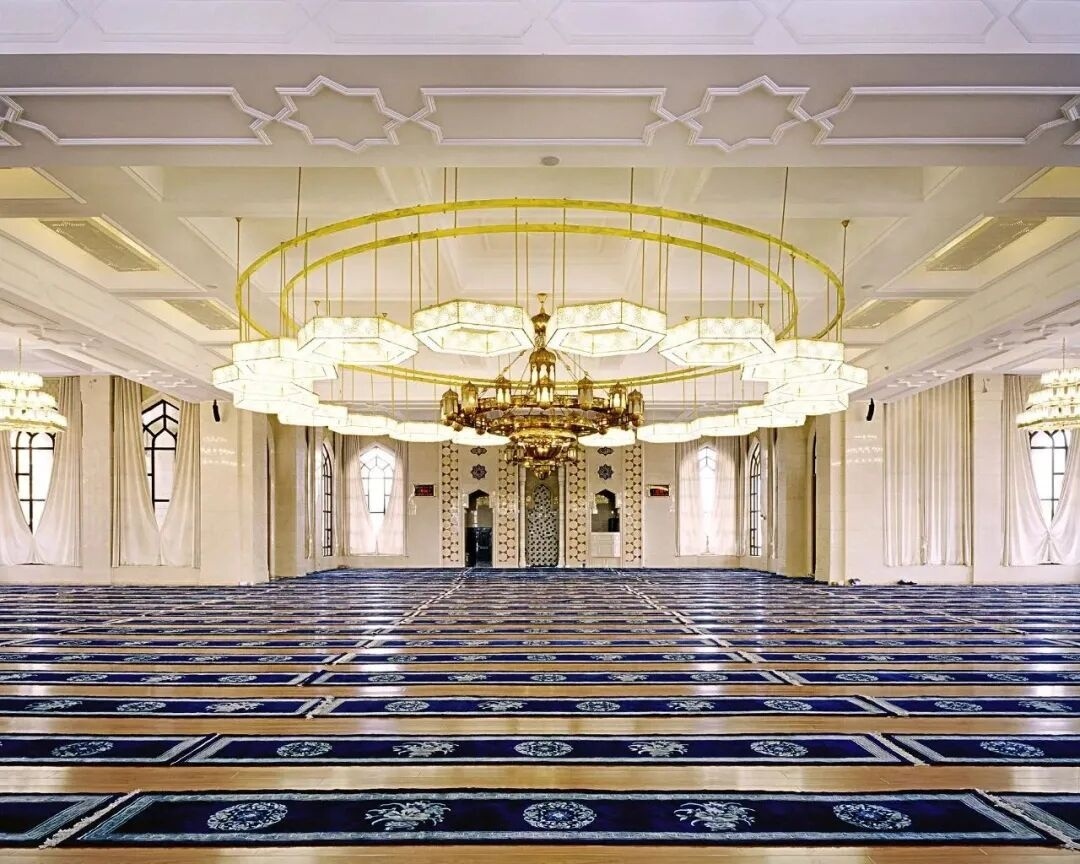
Inside the prayer hall of the South Mosque at the High-Speed Railway New District in Haidong, 2016 (the hall with the tripped circuit breaker)
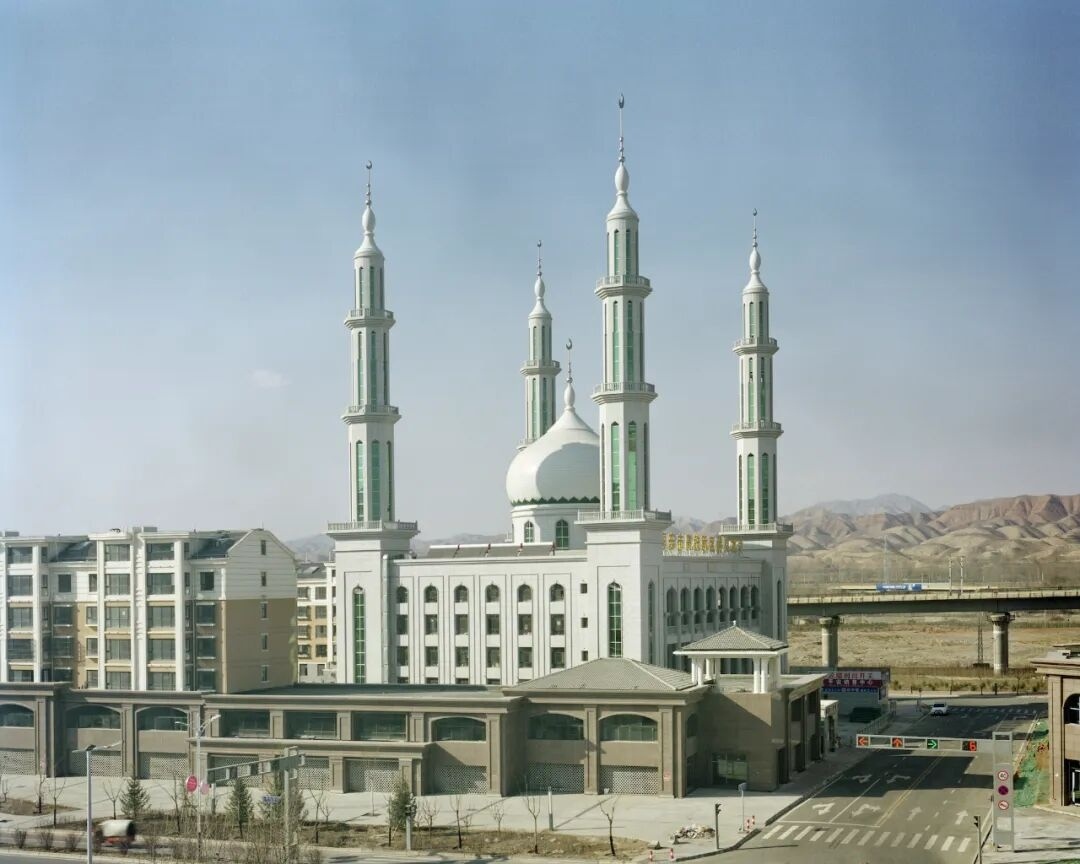
The North Mosque at the High-Speed Railway New District in Haidong, 2016; the two mosques are only 300 meters apart and belong to different sects
(The camera position is right inside the courtyard of the South Mosque)
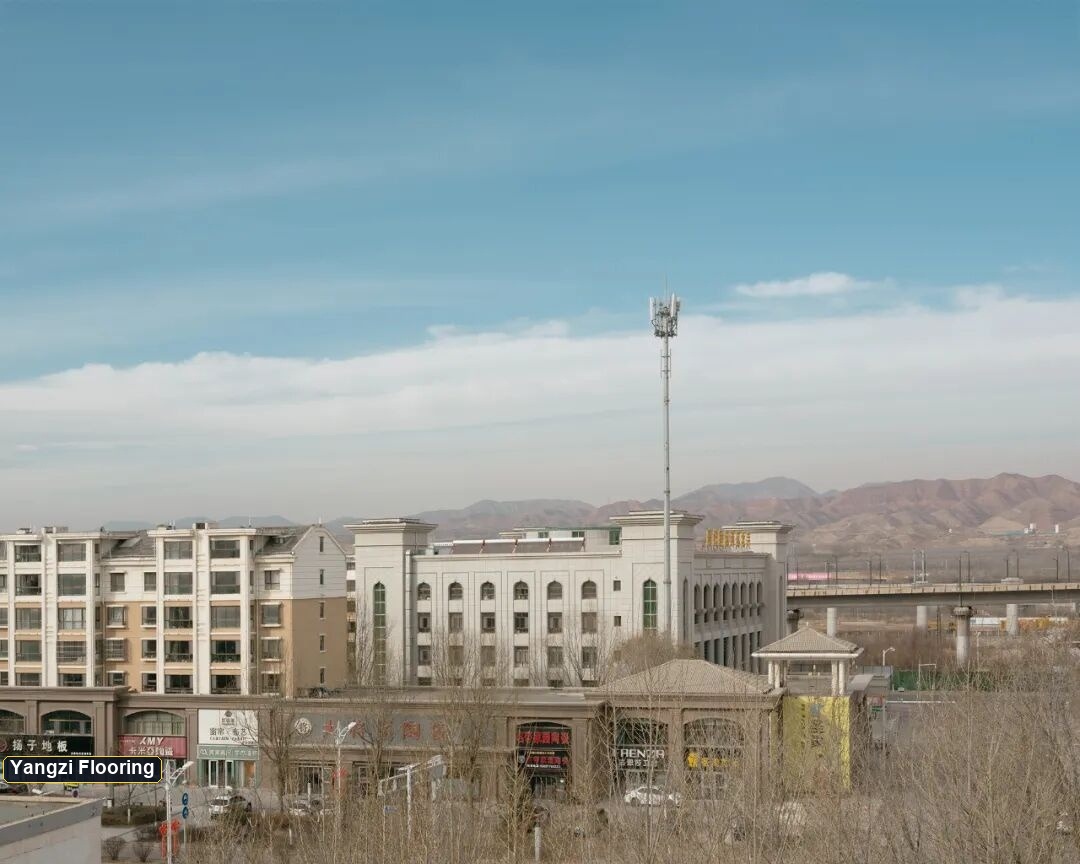
The North Mosque at the High-Speed Railway New District in Haidong, 2023
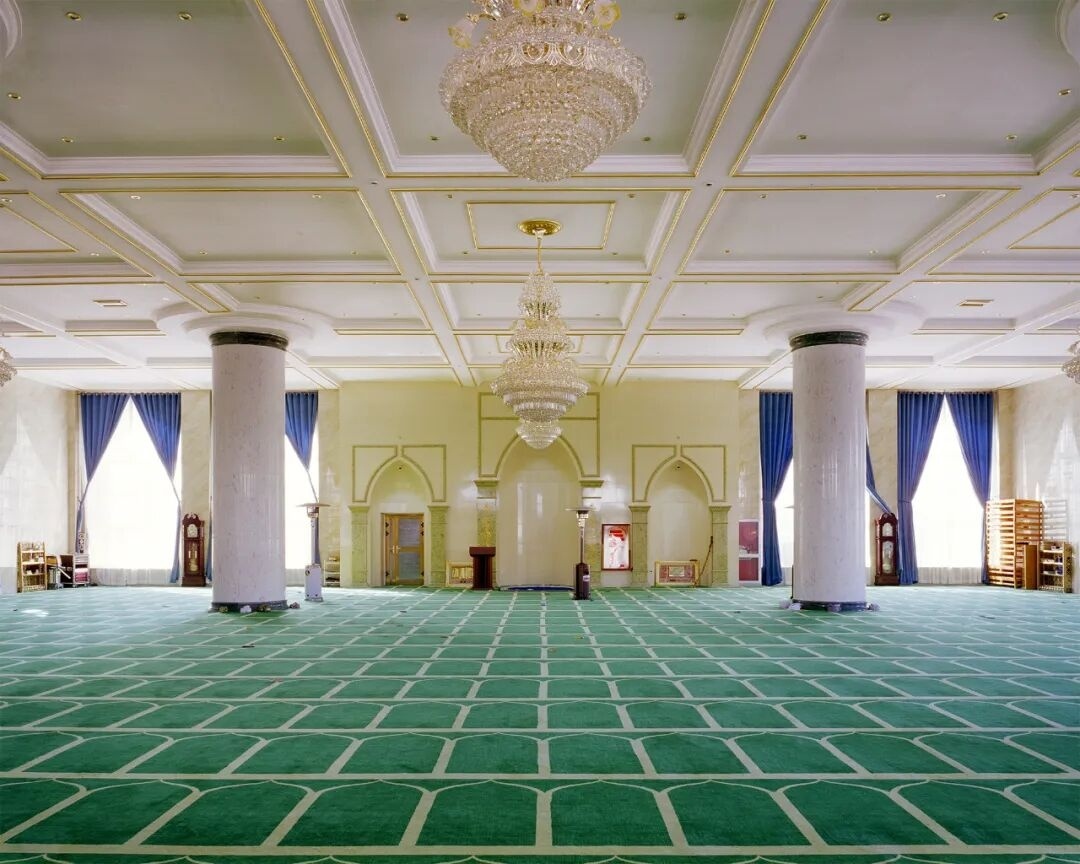
Inside the prayer hall of the North Mosque at the High-Speed Railway New District in Haidong, 2016
Over those eight years, the poplar trees I once ignored have grown tall, forming a barrier that stands between me and the mosque. Even the bare, leafless branches are so densely packed that my eyes can no longer pierce through them.
1
Ultimately, the Qunke New District never replaced Bayan Town as the seat of Hualong County. Bayan sits high on the cold mountain peaks, while Qunke lies in the warm Yellow River Valley. This new city, built on the north bank of the Yellow River according to master plans for a county seat, never received the official approval to move the government there, leaving it in an awkward, stranded state.
There are a few mosques on the north side of town that I remember well. I told Zhang Yi to drive, and we arrived in no time—it was an effortless trip. I told him we had arrived, but Yu Li looked blank. He didn’t know which building along the road was supposed to be the mosque. By now, he had seen dozens of them, and he could usually spot one instantly, but when I said we were there, he couldn't distinguish a mosque among the surrounding buildings. I pointed to the house on the street corner and told him that was it. If he didn't believe me, I told him to look closely at the faint arches in the windows. The square protrusion in the middle of the roof, where exposed concrete was visible, used to be a treasure crown—a rounded Arabic dome. The tops of the two corners at the back of the building were abruptly cut off; they were supposed to be tall, extending minarets.
I explained the history of this mosque as I remembered it, but they were both completely confused. The truth is, I never took photos of this mosque back when it was unfinished. Life is unpredictable; in just a few years, the mosque that held such a deep place in my memory had been demolished and 'decapitated,' to the point where it was almost unrecognizable as a house of worship.
I don't even know the name of this mosque.
We are in the hometown of lamian (hand-pulled noodles). About eighty or ninety percent of all Lanzhou lamian shops across China are opened by people from Hualong. You can even find these Muslim noodle-makers as far away as Europe and the United States. A friend of mine in Los Angeles, Da Men, often visits a Qinghai restaurant run by people from Hualong in Irvine. The shop serves lamian, kao yangrou (grilled lamb), Qinghai liangpi (cold skin noodles), and yogurt. Judging by the photos, it looks very authentic. Da Men told me that this restaurant is where he goes to miss the Northwest and to miss me. I told him that’s the best way to keep a memory alive.
In September 2019, the kids had already gone back to school, and the tourist frenzy in Qinghai had suddenly quieted down. I returned to my hometown off-season and wandered around Hualong for a few days. On September 11th, I went to the Qunke Mosque; it was Eid al-Adha. There was a light drizzle, and most of the men driving to the mosque arrived in their cars. They drove fast. Young Muslims love white cars. On the shaded country roads, the yellow willow leaves that hadn't fallen yet reflected off the bright car windows. Older men rode motorcycles. Most of these white cars were mid-range sedans with license plates from all over the country—Qinghai (Qing B), Zhejiang (Zhe B), Jiangsu (Su C), Anhui (Wan A), Fujian (Min B), Hubei (E A), Henan (Yu A), and so on. These plates revealed the cities where the noodle shop owners started their businesses and stood as a testament to their success. They had driven thousands of miles home for Islam's most important holiday. It’s a moment of pride for their families, a chance to show their village peers that they are 'doing well.' The communal prayer on Eid al-Adha is the most important social event for these men.
The Ahong (Imam) makes sure the students (mulla) clear out the parking lot early so those with Zhejiang or Jiangsu plates can park easily. Every Jumu'ah (Friday prayer) during the holidays sees this kind of turnout.
The Imam told me that once the holiday ends, the lamian bosses all leave, and there are no young people left to pray—they are all too obsessed with their phones.
'Young people, especially the girls and young wives, need to stop looking at their phones—don't look at Kuaishou, don't look at Douyin. Sigh, I yell it into the microphone every single day,' the Imam lamented. The internet helps people understand the world, but for Muslims, the realization of secular life is exactly what is being facilitated through the internet.
Lamian, gun manufacturing, and shouzhua yangrou (hand-grabbed lamb) are the three trademarks of Qunke. Lamian has bloomed all over the world, while the stories of gun manufacturing have disappeared into the legends. At one point, 'Hualong-made' black-market guns were quite famous, and they were linked to several high-profile shootings.
Various major shooting cases across the country pointed back to Hualong, Qinghai. Qunke was home to the descendants of Ma Bufang's gunsmiths from before the liberation. The investigation process was reportedly very long. The police interviewed and investigated suspects, but found no clues. Later, an observant officer checked a house and noticed that despite the family having almost nothing, their electricity meter reading was incredibly high. Following the power lines, they found a factory hidden in a cellar, seizing various machine tools and equipment for making guns. The case was cracked, and the gunsmiths' source of income was cut off for good.
Shouzhua is a livelihood for Hualong people, just like lamian. Hualong has high mountains, steep slopes, and barren land; there is no way out without doing business. Lamian is an active export sold to outsiders, while shouzhua is a signature dish in local restaurants for those who stayed behind. Honestly, shouzhua is delicious anywhere on the plateau, but it’s never quite as good once you leave.
After wandering around all morning, it was lunchtime. My two 'assistants' were clamoring for shouzhua. There are so many shouzhua places in Qunke that I couldn't decide where to go, so I followed the 'easy parking' principle and found a halal restaurant called 'Shouzhua Wang' (Hand-Grabbed King) by the side of the road. It was busy. The view into the private rooms was blocked by half-curtains, but hearty laughter spilled out. At a table by the window, four or five men sat huddled together; the shouzhua had already arrived, and everyone was digging in without reservation. At a small table against the wall, two Tibetan men in traditional robes were eating—they actually ate slowly and gracefully. Two tables against the other wall were pushed together, seemingly occupied by a large family. The owner was busy greeting customers. For every table, the shouzhua was weighed and paid for by the jin (half a kilogram). When I asked if we could pick the cuts of lamb, the owner refused flatly, telling me with quite a bit of pride that he knew how to pair the meat. He said every serving would include lamb ribs, leg, and neck. We had no choice but to grab free san paotai (a traditional tea set of three ingredients) and find an empty table by the window.
Zhang Yi said the lamb here was much more expensive than in Linxia—90 yuan per jin compared to 65 yuan in Linxia. He looked a bit bewildered. I didn't know how to answer, but I figured that because we were near the pastures, this was the kind of lamb raised on open grazing land, locally known as 'grass-fed sheep.' Usually, 'fattened sheep' fed with grains and forage in pens are cheaper because they are too fatty. Grass-fed sheep have better flavor and grow in a near-wild environment.
The lamb in Qunke is still tough and full of wild character, which wasn't very friendly to my two assistants. The meat at Shouzhua Wang was drier and chewier, and it was hard on the teeth; sometimes you really had to tear at it to get a piece into your mouth. By the time I finished, it took me five minutes to clean out my teeth with a toothpick—a painful and awkward process. Overall, the quality of the raw meat was better than in Linxia, but it wasn't simmered long enough to be tender. Perhaps the locals still hold onto the eating habits of nomadic steppe peoples. The Qunke shouzhua still has a long way to go before it becomes 'urbanized.' Thankfully, the young landlady provided some excellent purple-skinned garlic to go with it; it was fresh, juicy, and by far the best side dish we’d had on the trip.
While having tea after the meal, I opened my navigation app and searched for Shalianbao and Dehenglong. The straight-line distance was over twenty kilometers, but the route showed sharp, winding curves—that meant climbing from the Yellow River Valley where we were to mountains over 3,000 meters high. That’s the Tibetan area where Ma Laichi originally preached, and where the Tibetan nomads of Kaligang converted to Islam during the Qianlong era, later becoming known as 'Tibetan Hui.' I hadn't been there before, and after hesitating, I decided to give it a pass. We didn't have enough time, and I had planned to shoot two mosques in Ping'an County, on the north side of Qingsha Mountain, in the afternoon light.
On my phone, I still have an interview video from March 2017 at the High-Speed Rail New District Mosque. My interviewees were several elders in charge of the mosque construction—essentially the leaders of the demolished villages. The community where this mosque is located was formed by the merger of four or five nearby villages. Urbanization didn't spare this wide valley twenty kilometers east of Xining. This important grain-producing area is now the site of the Xining Airport and the Ping'an High-Speed Rail Station. Over a dozen villages scattered across the ten-kilometer-long valley were integrated into the High-Speed Rail New City. The project is a commercial real estate development, a continuous residential area stretching two or three kilometers. Five or six of those villages were Hui villages, so the integrated Hui people naturally moved in together, and the construction of the new mosque began after these farmers moved into the new complex.
'The mosque was approved. At first, the management committee and scholars of the old mosque applied for a traditional-style mosque, but we didn't want that. We restarted the process and hired someone to design the current style,' that’s the first thing said in the interview video. I’ve forgotten the old man's name. He was the first to step forward for my video interview, even though this was my third time at the construction site. Previously, while everyone was happy to boast, they all got cold feet when I actually asked for an interview.
'The scale was expanded little by little. We had never built such a large mosque before and had no experience. When the village was demolished, the mosque received eight million in compensation. It felt like a lot, but for a structure of this style and scale, it wasn't enough. Besides, some people who didn't move into this complex thought it was too far and wanted to build another one over there, taking two million away. We ran out of money. It’s all from donations from the congregation. We’ve only paid the construction team a little bit so far, and we still owe them a lot,' he said, facing my camera. Initially, he tried to organize his thoughts, using imperfect Mandarin, but I don't know where it shifted—he suddenly switched his accent to the local Qinghai dialect, the specific dialect used by Hui Muslims. In Xining, even though it’s all Qinghai dialect, there is a distinct difference between the way Han and Hui people speak it.
'It’s truly massive. Perhaps aside from the Shadian Mosque, this is the largest one I’ve ever seen,' I marveled at the grand scale and exquisite decoration of the mosque. Its exterior was even more refined, entirely clad in beige sandstone from the Mediterranean coast—an expensive, high-end building material with a rather royal feel.
'I don't think so, we are bigger than Shadian,' he seemed confident about being the largest in the country, his tone casual. 'These stones are from Egypt. We’ve already put over thirty million into this, and there’s still a funding gap of over ten million. I don't know how we’re going to pay it back.' He was just as casual about the total investment and the unsecured funding sources. In short, everything is according to Allah's will; they are merely servants executing this noble task.
2019 Qunke New District
2019 Qunke Mosque
A couple in 2019
This child is of the Salar ethnic group. Her parents went to the interior to open a lamian shop and left her with her grandparents. She had just started school. That afternoon, she didn't go to school; she was just playing by the side of the road outside the village primary school. She wouldn't go home, just sat there on the roadside, digging into the dirt with a stick. She was very quiet, barely spoke, and was hard to talk to. Before we left, I bought her a pack of instant noodles. I remembered her name, but I don't know where I wrote it down. Their village is a new village, having just moved down from the high mountains the year before.
2
During the hottest days of summer, my daughter and I had come here once. Cars could enter and exit the complex freely now because there was an automatic fee system; it wasn't like before, where security guards would stop you and demand an explanation. What was puzzling was that there wasn't a single soul in the mosque after the domes and minarets were demolished—no mulla, no worshipers. Inside the main hall, there was still a huge circular chandelier, but it hung very low. In order to partition an extra level inside this grand-looking building, the height of the prayer hall was restricted, creating a visually oppressive feeling. The circular chandelier hanging from the ceiling felt like it could be touched by hand; it was truly a shame. In 2017, when I was shooting the interior of the prayer hall alone, I needed to turn on the lights. I wanted to capture the moment this hall looked magnificent. After I focused my camera and prepared to turn on all the lights to start metering, I found the circuit breaker box hidden in the corner. I lifted the cover and saw air switches labeled for different sections. I flipped the switches that were in the off position one by one. With the snapping sound of the breakers, the downlights in the front porch, the side aisles, the side chandeliers, and the large central circular chandelier all lit up. But before I could meter and adjust the exposure, the breakers clicked and tripped, and the lights all went out automatically. I pushed them back up, but they tripped again.
The project supervised by the local elders not only had an unreasonable hall height, but even the lighting design was flawed—perhaps the load wasn't enough, causing it to trip. I remember that the photo was set up based on the few dozen seconds of effective lighting I observed, and I finished the shot in a scramble.
The scorching sun beat down on the square in front of the mosque, making it impossible to stay for long. I left in a hurry, then headed out of the complex and had lunch at a clean-looking halal restaurant to the right of the entrance. Although it was already 2:30 PM, it was lunch for my daughter and me. She liked eating mianpian (noodle flakes with soup). I ordered a bowl of dry-mixed noodles, but I wasn't full, and I felt too embarrassed to order a second serving. Rural restaurants in the 'new city' are becoming less and less honest.
I circled to the north side to where I had taken photos before, which was actually the entrance to another mosque. It was the mosque of the old school of thought in the village. There had been an independent mosque before the demolition, and after the demolition, they built this one themselves, naming it the North Mosque of the High-Speed Rail New District based on its orientation. The larger, thirty-million-yuan mosque is naturally called the South Mosque, and another mosque about a kilometer away is the West Mosque. The South Mosque looks most majestic from this position because it sits on a 30-meter-high terrace, and combined with its four towering minarets, it’s quite spectacular—though that was all in the photos from 2016. That giant building with beautiful Islamic pointed arches on all four sides.
The 'Sinicization' of the South Mosque was carried out through the crude and simplistic method of 'decapitation.' Perhaps the debts from the 30-million-yuan construction costs haven't been paid off yet, and the original construction crew had to climb onto the roof to remove the domes and towers that had such an Arabic flair. Such a community simply cannot afford the millions required to renovate the mosque again. The 'decapitation' action was a last resort, and the most economical option.
At 4 PM, I finally arrived at the High-Speed Rail New District from Qunke. After parking in the complex, Zhang Yi and Yu Li didn't want to get out to take photos with me. I wanted to go to the north side of the square, where the summer sun leaves you with nowhere to hide, to get an overhead shot of the North Mosque, and then see if I could find anyone to chat with in front of the South Mosque—just to try my luck. Many stories start with casual chats with strangers. The two assistants were already tired, or perhaps they were just bored of mosques. People who don't understand Islam or the Hui people quickly lose their initial curiosity. They were the same. They didn't understand the complex impact that the Hui people or Islam has had on me; I was there to find answers, while they were just sightseers.
There's nobody in this square. It was empty during the scorching heat of summer, and it's just as empty now in the dead of winter. Xining had a quiet little cold snap last night, so the stone-paved plaza is bone-chillingly cold right now; who would be hanging around here for a chat? As for the old men I interviewed eight years ago, I have no idea which building or apartment they live in now, and I’ve lost touch with them anyway.
Looking at the North Mosque from this angle, it usually has a commanding, high-up perspective. It should have been an easy shot, but I ran into a problem: over the past eight years, the poplar trees I once ignored have grown tall, forming a solid barrier between me and the mosque. Even the gaps between the bare, leafless branches are too dense for my camera lens to look through.
That mild cold front last night scrubbed the heavy Xining sky clean. It’s absolutely clear today, and for a photographer, the visibility is almost painfully sharp. I didn't really have the heart to take this photo; I had to shift my angle just to avoid the tree branches, and the light wasn't great either. The color temperature was beautiful and the air quality was crystal clear, but those aren't the kind of qualities I wanted for this specific shot.
I wrapped up the shoot in a hurry, telling myself I’d just have to come back another time to excuse the mediocre results. I packed up my gear and started heading back past a row of storefronts. Even the heavy curtain over the first shop couldn't hide the sign for "Halal Yogurt." I lifted the corner of the thick cotton curtain and squeezed through the heavy glass door. A Hui Muslim man in a white cap was boxing up freshly made yogurt. His containers were paper, looking like short, squat paper cups.
The yogurt was fresh off the stove and still warm, and they were 400-gram packs—perfect. Ever since I had that yogurt in Xunhua last night, I’d been hunting for more handmade stuff. I bought four and headed back to the car.
I interrupted my two assistants as they were chatting, and before the three of us dove into the yogurt, we made sure to snap some photos to send to our contact in Los Angeles.
After that, I stood in front of the North Mosque to photograph the South Mosque, which is set up high but now looks "headless." I took a shot of it in 2016 against a slight backlight, and it’s the same today. Because the building is missing its signature dome and minaret, the composition feels really strange to me.
(To be continued)
Islamic colors in 2019
Islamic colors in 2023
An elderly man in Qunke, 2018
Inside the courtyard of the High-Speed Railway New District Mosque in Haidong, August 2023
The High-Speed Railway New District Mosque in Haidong, August 2023; the minaret has already been demolished
The South Mosque at the High-Speed Railway New District in Haidong, 2016
The South Mosque at the High-Speed Railway New District in Haidong, 2023
Inside the prayer hall of the South Mosque at the High-Speed Railway New District in Haidong, 2016 (the hall with the tripped circuit breaker)
The North Mosque at the High-Speed Railway New District in Haidong, 2016; the two mosques are only 300 meters apart and belong to different sects
(The camera position is right inside the courtyard of the South Mosque)
The North Mosque at the High-Speed Railway New District in Haidong, 2023
Inside the prayer hall of the North Mosque at the High-Speed Railway New District in Haidong, 2016
