

Iran Muslim Travel
Muslim Travel Guide Iran Tehran: Imam Khomeini Mosque, Grand Bazaar Food and Wudu Courtyard
Articles • Hasan09 posted the article • 0 comments • 327 views • 2026-05-24 01:59
Summary: This Muslim travel guide follows the Tehran bazaar near Golestan Palace and Imam Khomeini Mosque. It preserves the Friday closure scene, bazaar food, mosque courtyard, wudu area, library, and the author's on-site notes.
There are many bazaars near Golestan Palace. Friday is a public holiday in Iran, so only one mosque in Tehran stays open, while the rest are closed. Only a few shops inside the bazaar are open.
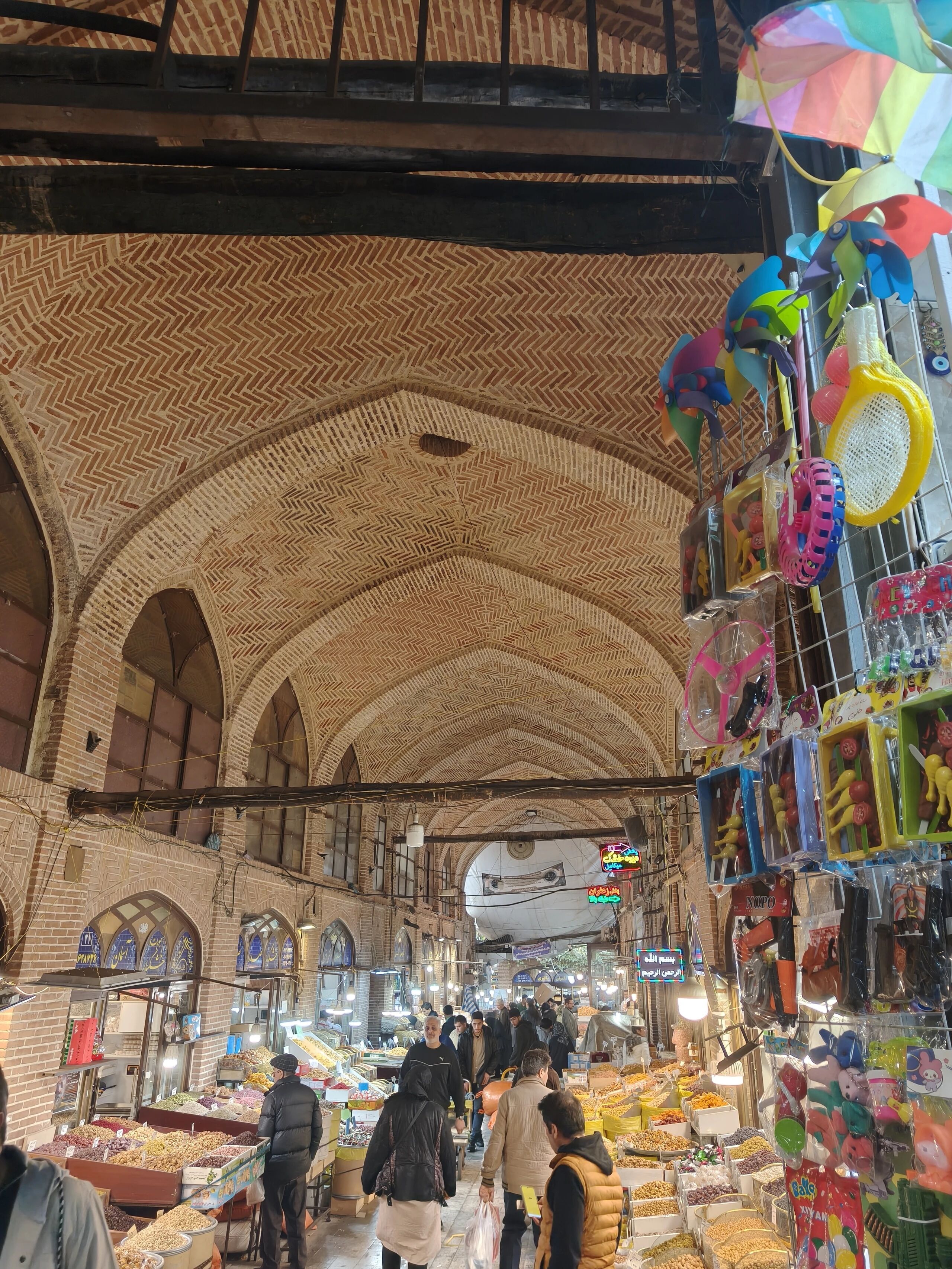
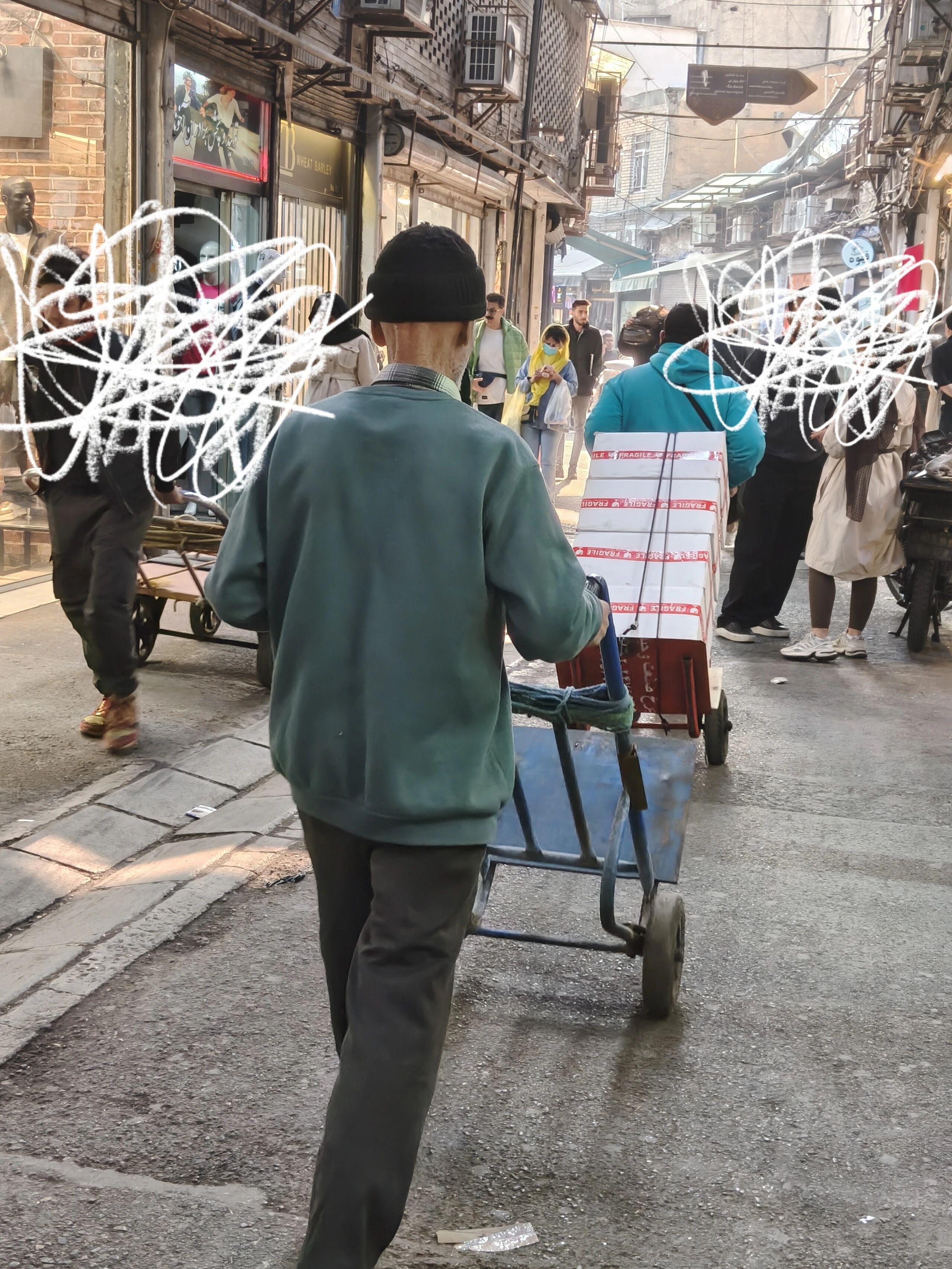
The market feels like a ghost town on Friday, but as soon as Friday passes, it quickly becomes lively, crowded with pedestrians and porters shoulder to shoulder.
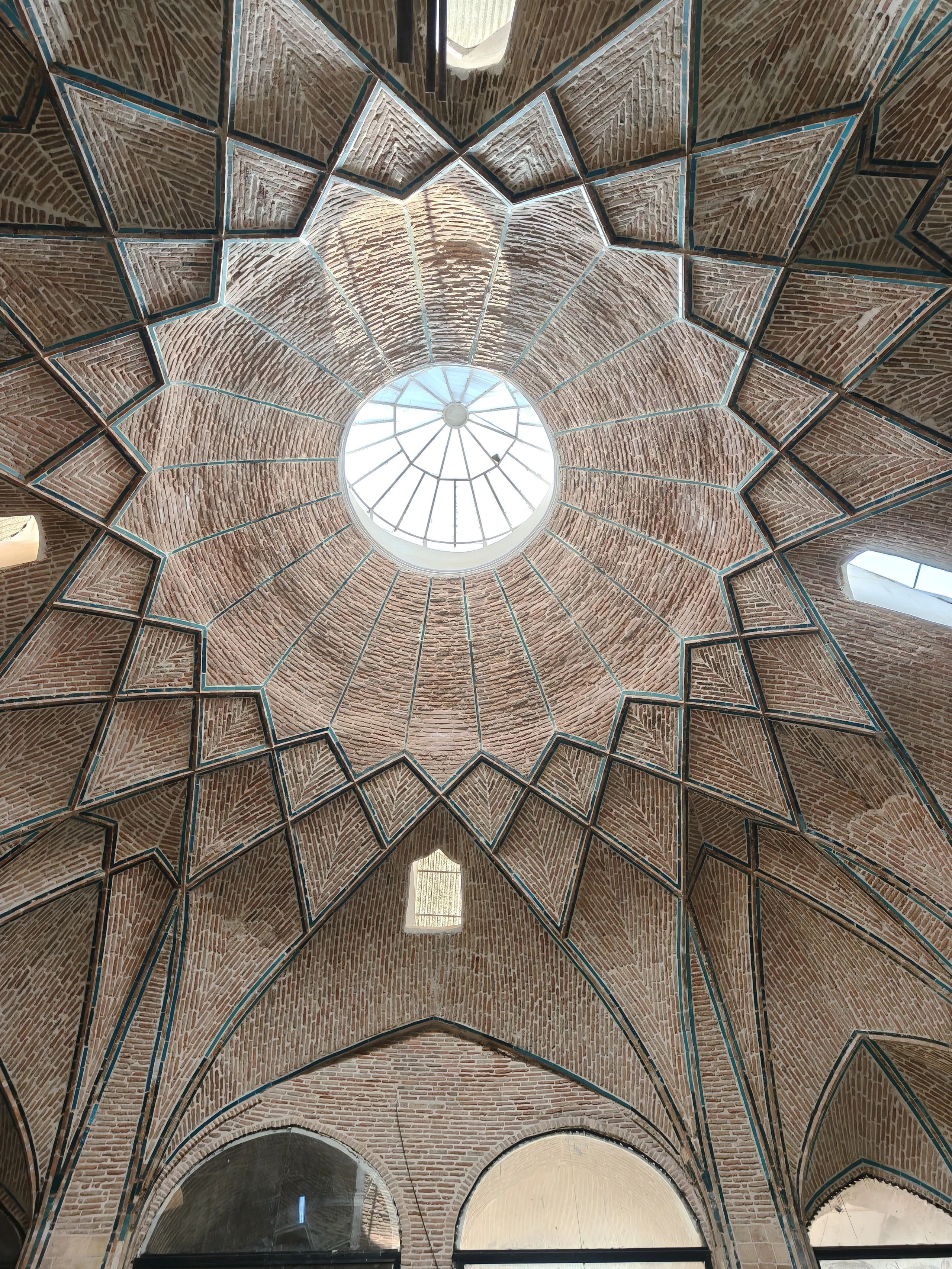
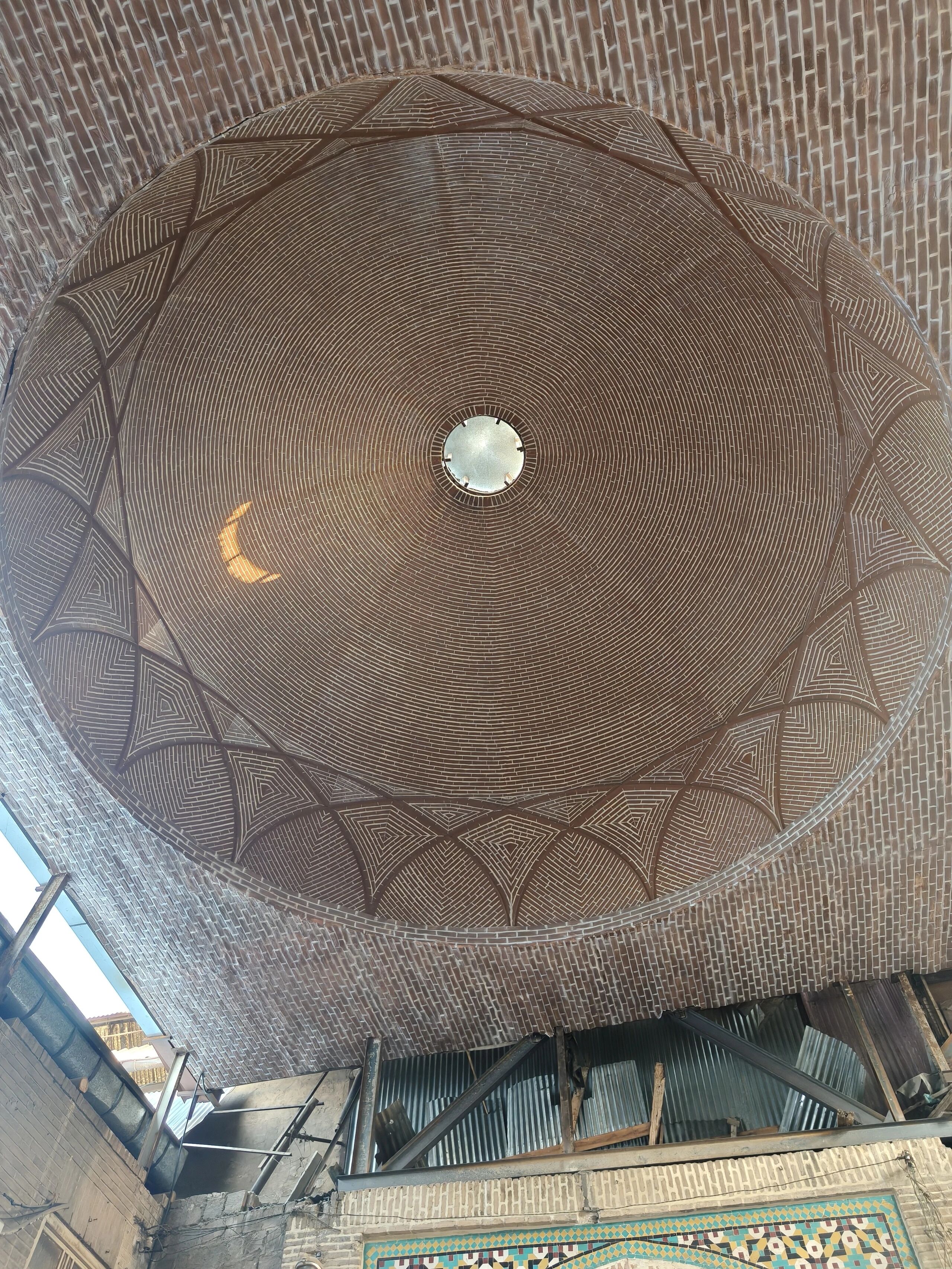
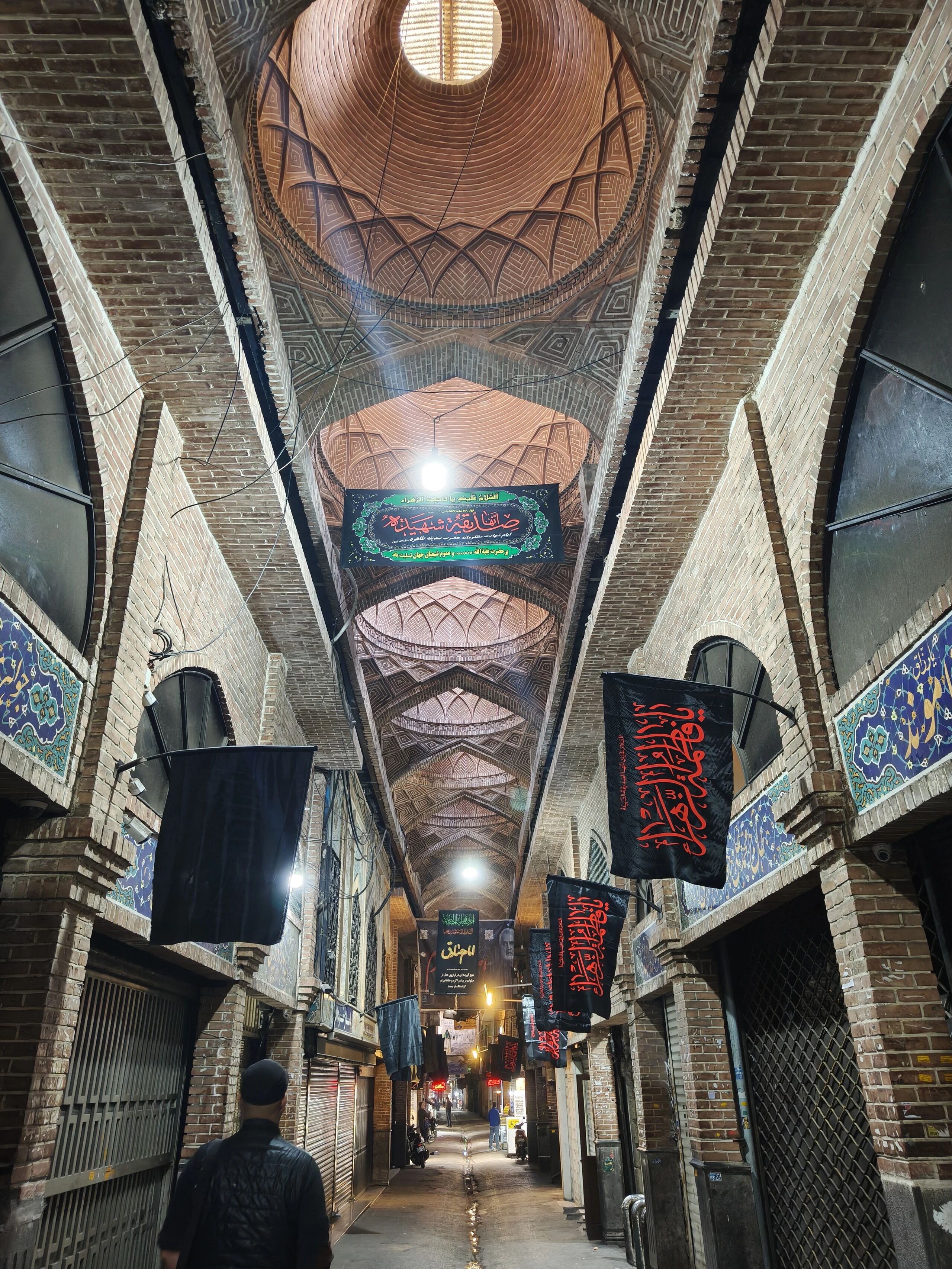
Bazaars almost always have domes, and you can enjoy their orderly beauty just by looking up. (Photo 1)
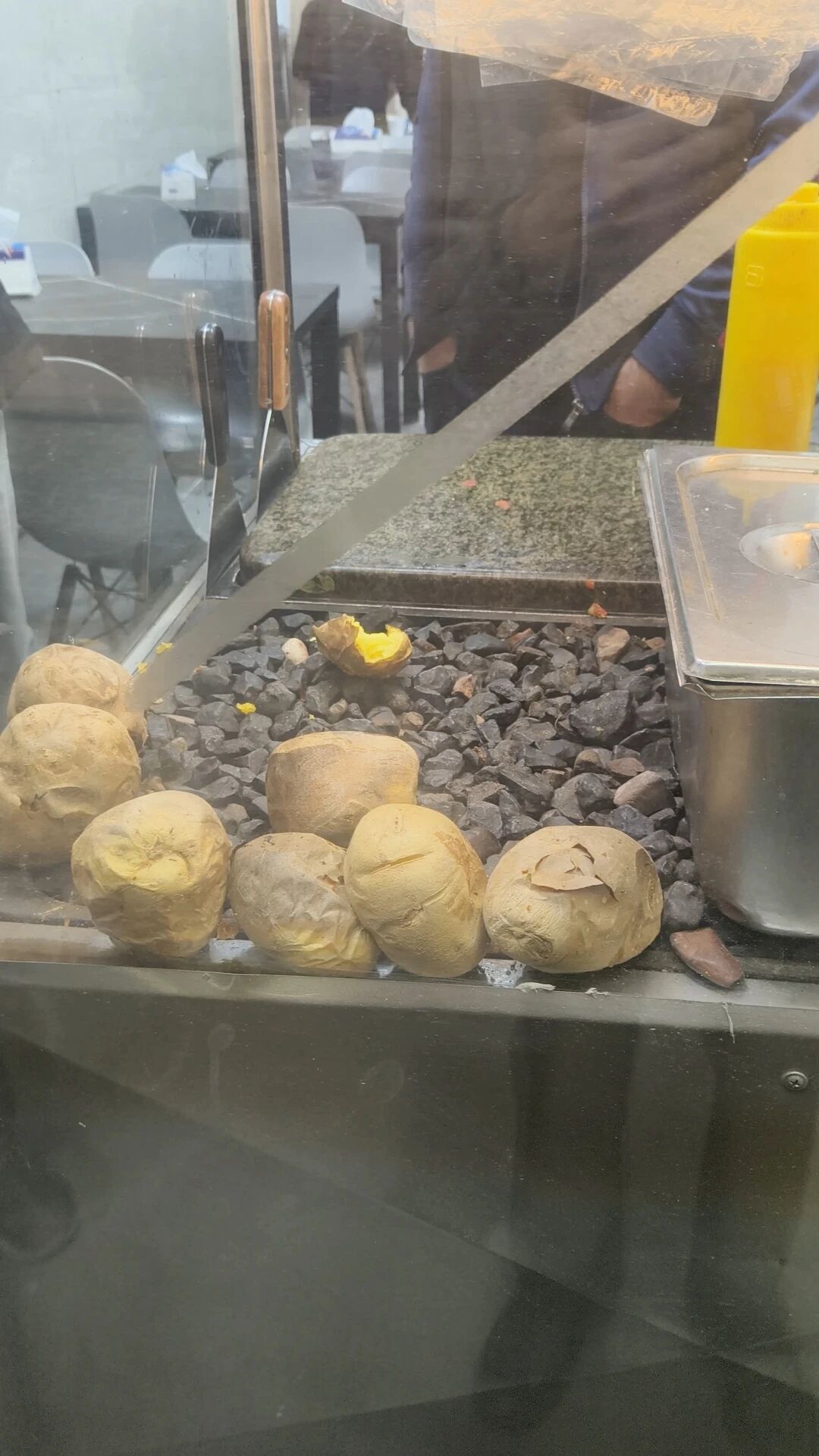
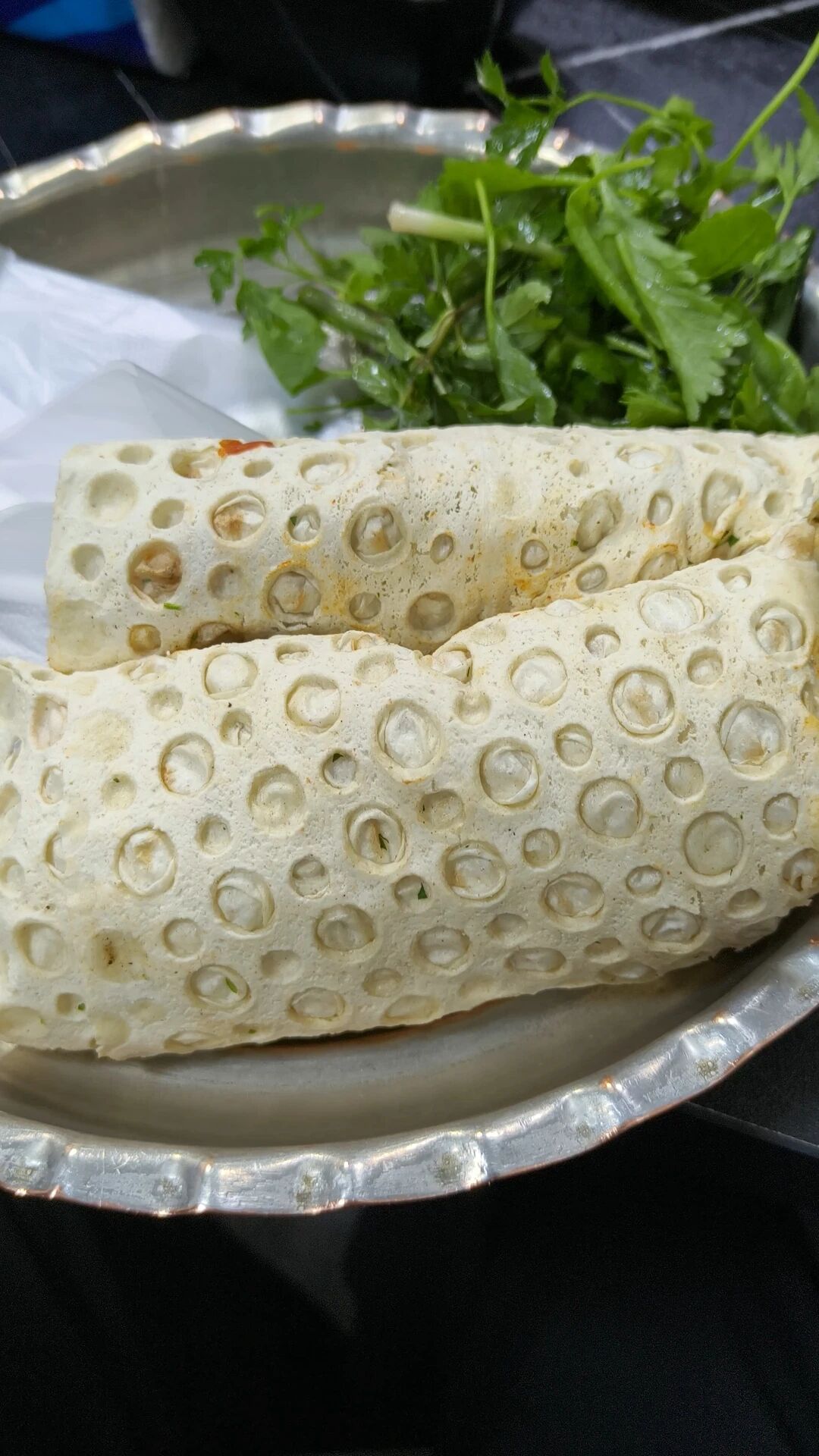
After walking for a while, my guide told me he knew a good place that mainly sells wraps with potato, chicken, or beef fillings. I like potatoes, so of course I chose the potato one. The guide chose the beef one. The wrap included mashed boiled eggs, and the potatoes were very tasty.
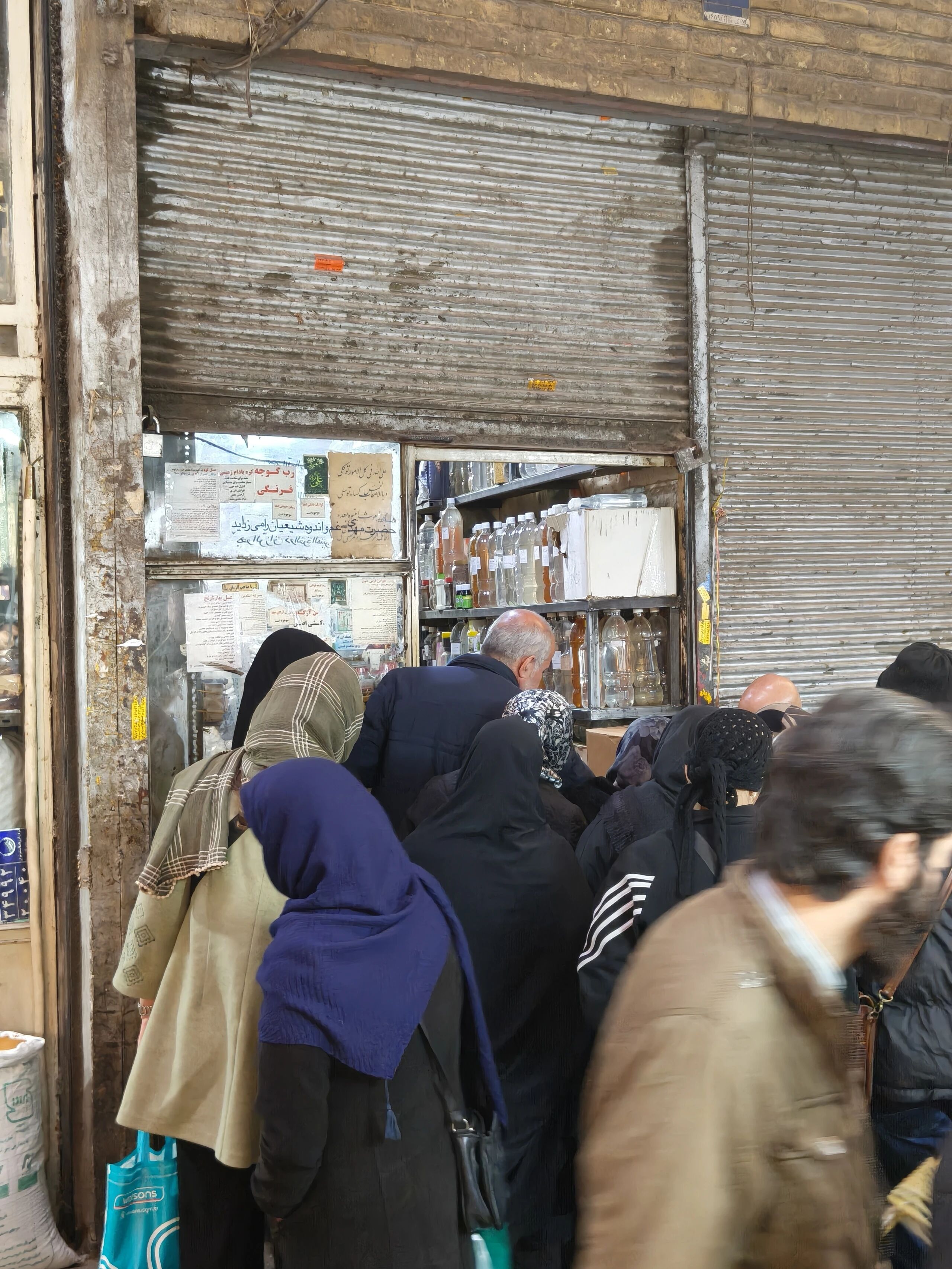
The shop is very narrow and crowded. (Photo 5, Photo 6)
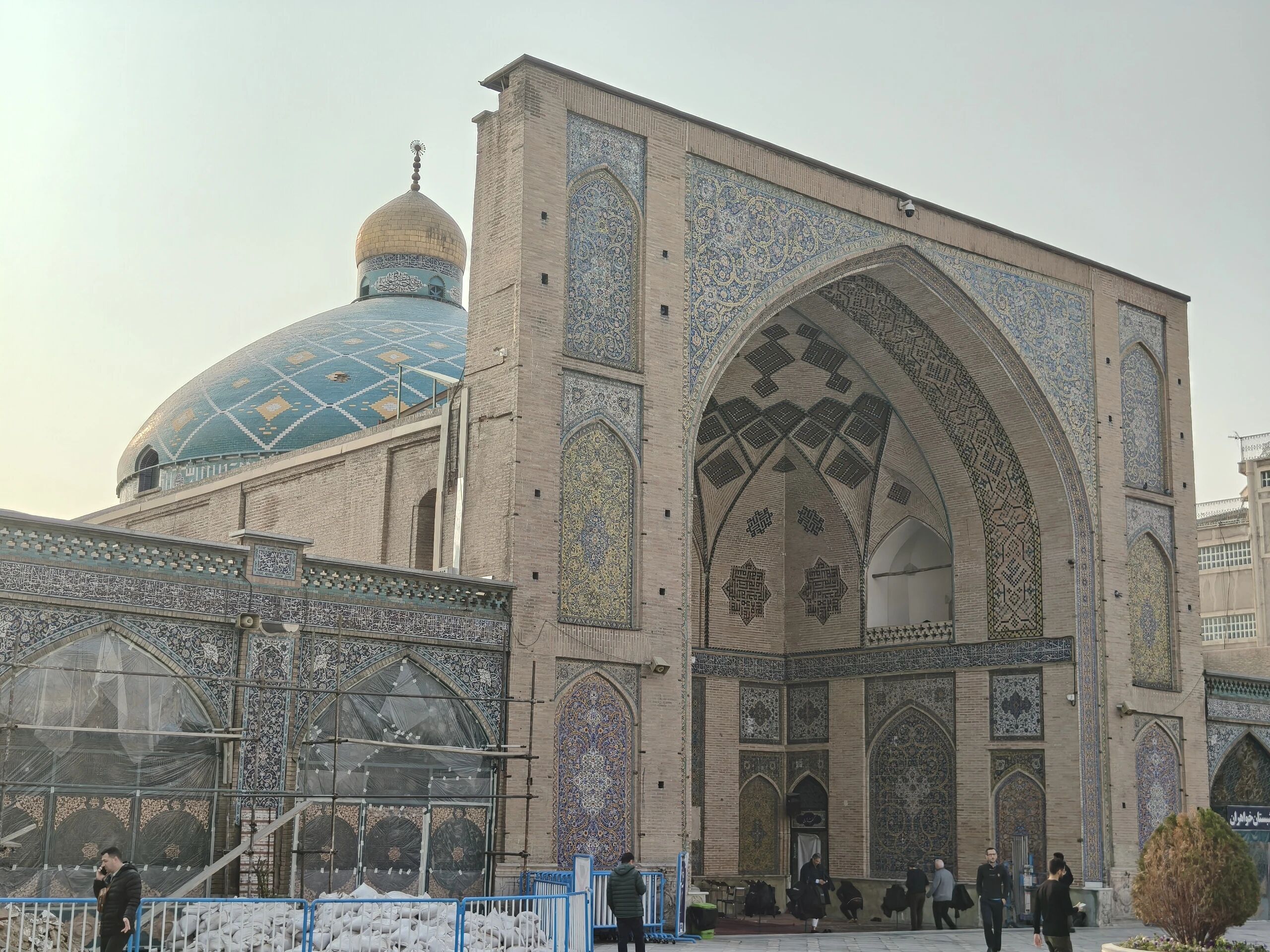
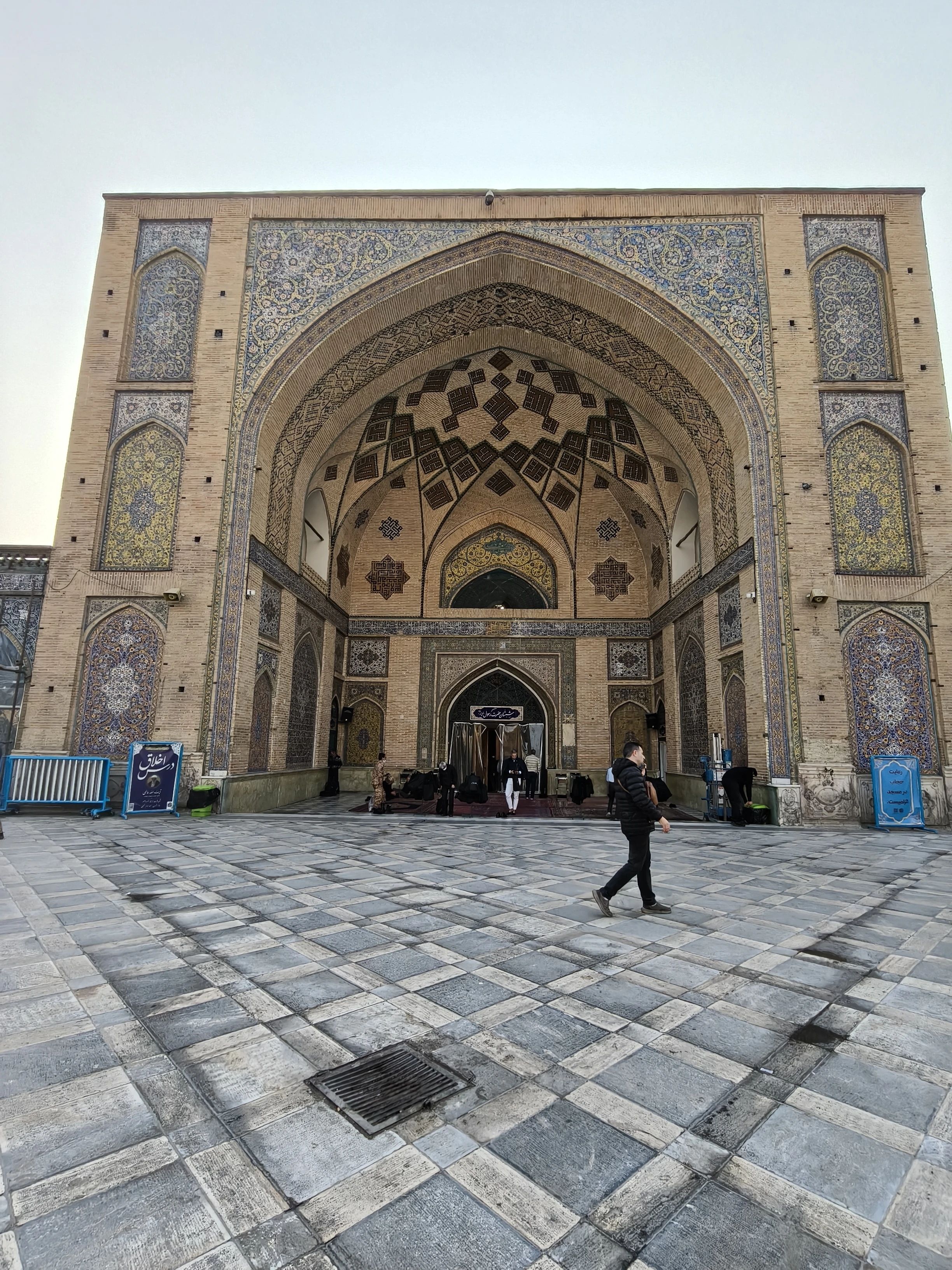
Then, I am not sure how we got there, but we walked into a mosque. The area outside was cramped and narrow, and I really did not expect such a large mosque square in the middle.
This is the Imam Khomeini Mosque. The main hall (Image 7) looks like a larger version of the Id Kah Mosque in Xinjiang, as if they were built from the same blueprint. There is a water basin in the middle of the mosque square with taps along the edge for performing wudu. (Image 9)
At the other end of the square are two minarets with a clock tower in the middle. (Image 10)
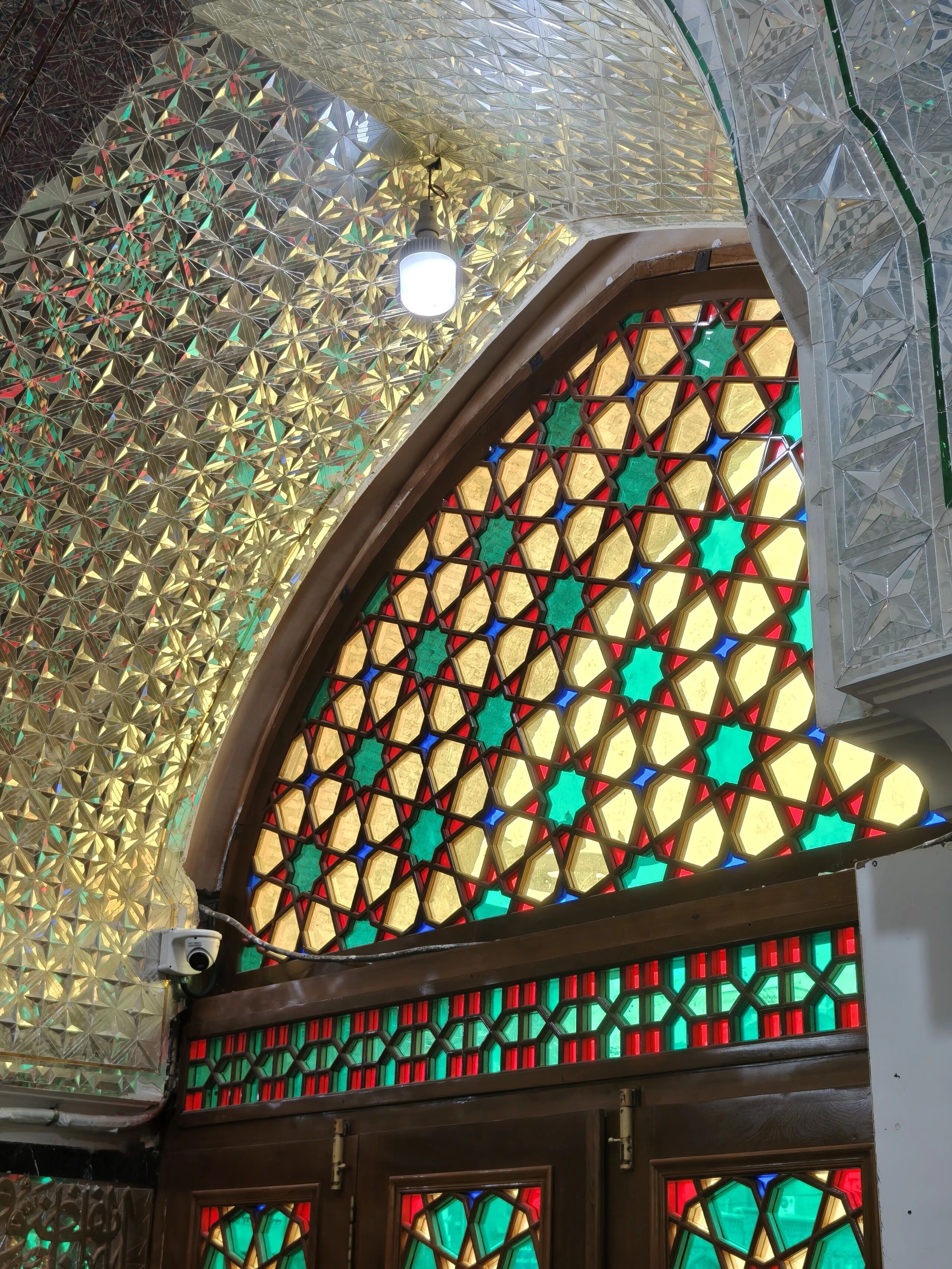
On one side of the square, there is a library covered in many mirrors that shine brightly. (Image 11, Image 12) It looks just like the Tomb of the King of Lights in Iraq that I saw online.
The library also holds copies of the Quran (Image 13) in other languages, including French, English, Russian, and Armenian. There were a few staff members inside. When my guide told them I was from China, they gave me a tile ornament and a copy of the Quran.
The staff said they were happy to meet me and welcomed me to Iran. To be polite, I also told them they were welcome to visit China. The staff also asked if China accepts international students from countries like Iran, Iraq, and Afghanistan, and which university majors in China are the best.
I am answering based on the information I have encountered within the country. It seems like many foreigners come here to study medicine, and I actually know international students from Pakistan, Turkey, and Yemen who are studying in Lanzhou and Chengdu.
After leaving the mosque, I returned to the bazaar. I looked up and saw the sunlight hitting the dome at an angle, perfectly revealing the shape of a crescent moon. view all
Summary: This Muslim travel guide follows the Tehran bazaar near Golestan Palace and Imam Khomeini Mosque. It preserves the Friday closure scene, bazaar food, mosque courtyard, wudu area, library, and the author's on-site notes.
There are many bazaars near Golestan Palace. Friday is a public holiday in Iran, so only one mosque in Tehran stays open, while the rest are closed. Only a few shops inside the bazaar are open.
The market feels like a ghost town on Friday, but as soon as Friday passes, it quickly becomes lively, crowded with pedestrians and porters shoulder to shoulder.
Bazaars almost always have domes, and you can enjoy their orderly beauty just by looking up. (Photo 1)
After walking for a while, my guide told me he knew a good place that mainly sells wraps with potato, chicken, or beef fillings. I like potatoes, so of course I chose the potato one. The guide chose the beef one. The wrap included mashed boiled eggs, and the potatoes were very tasty.
The shop is very narrow and crowded. (Photo 5, Photo 6)
Then, I am not sure how we got there, but we walked into a mosque. The area outside was cramped and narrow, and I really did not expect such a large mosque square in the middle.
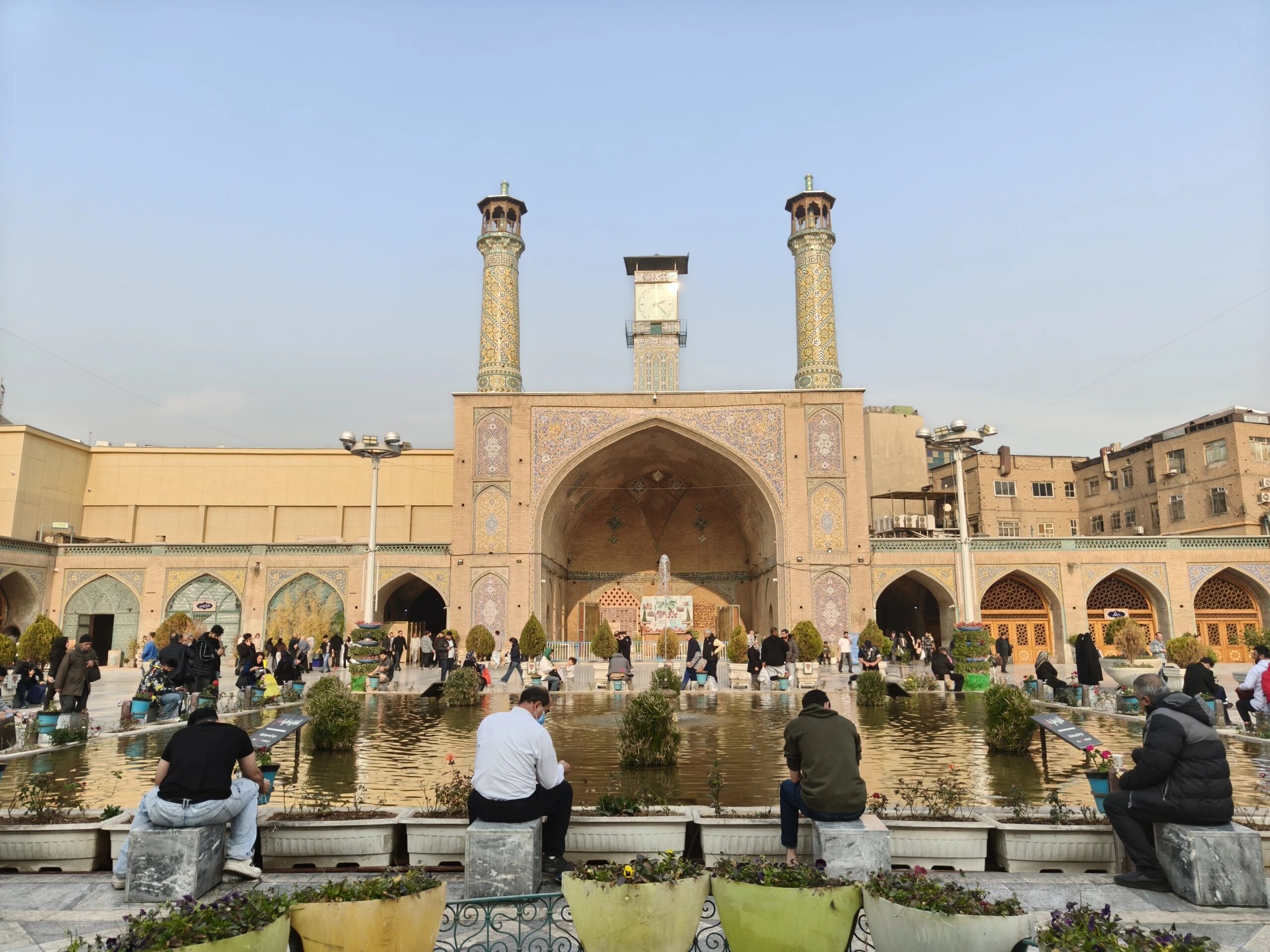
This is the Imam Khomeini Mosque. The main hall (Image 7) looks like a larger version of the Id Kah Mosque in Xinjiang, as if they were built from the same blueprint. There is a water basin in the middle of the mosque square with taps along the edge for performing wudu. (Image 9)
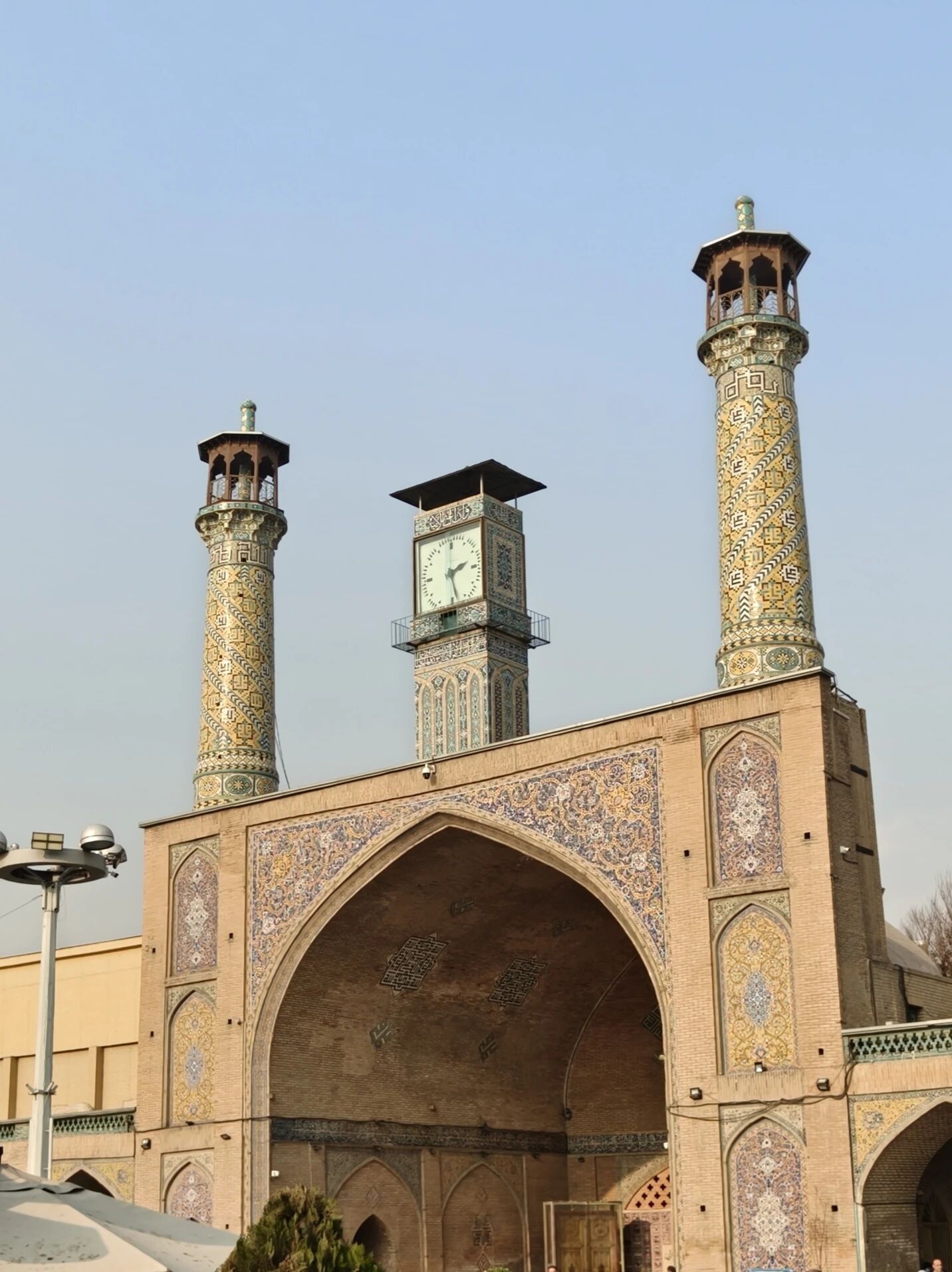
At the other end of the square are two minarets with a clock tower in the middle. (Image 10)
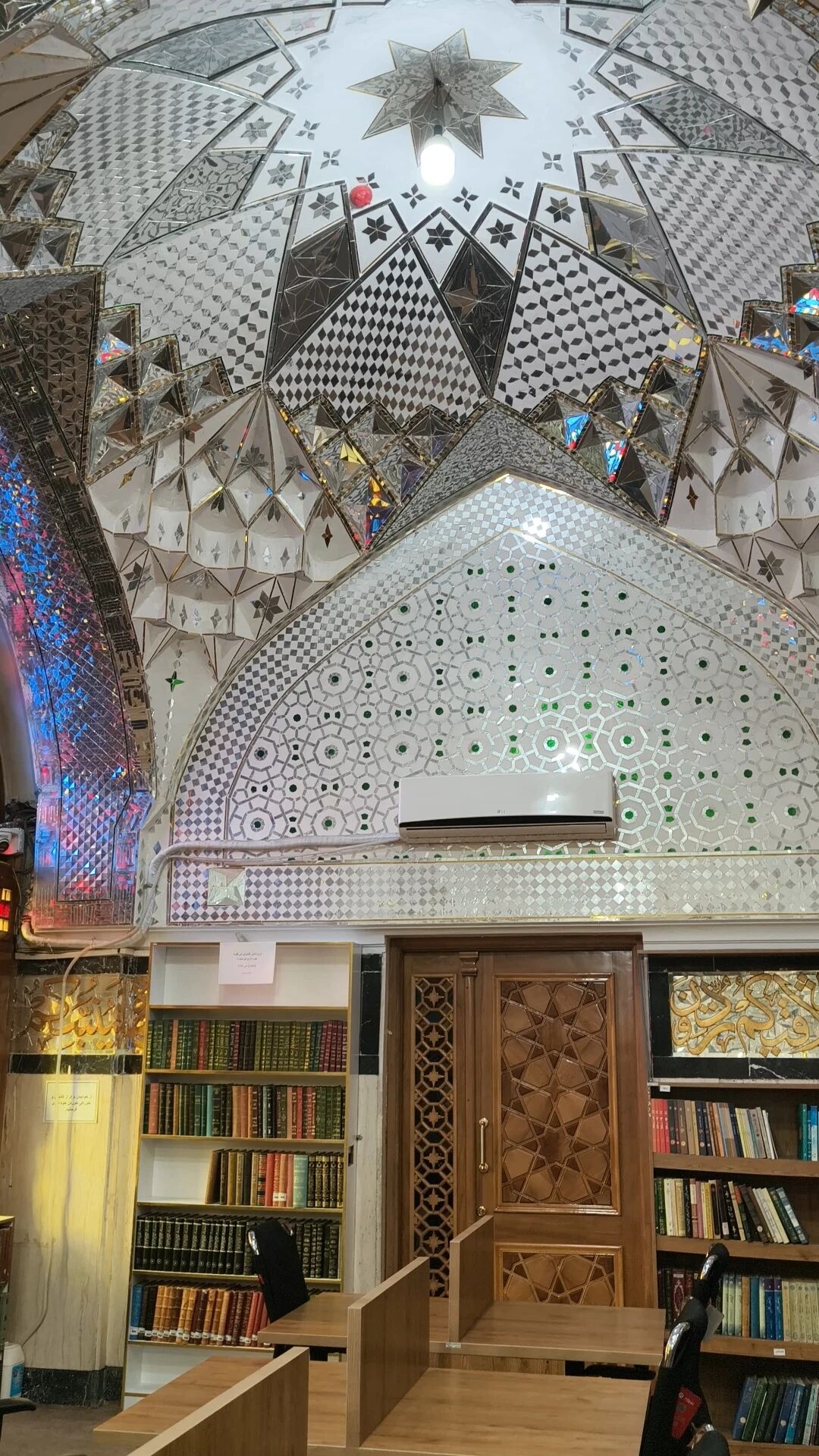
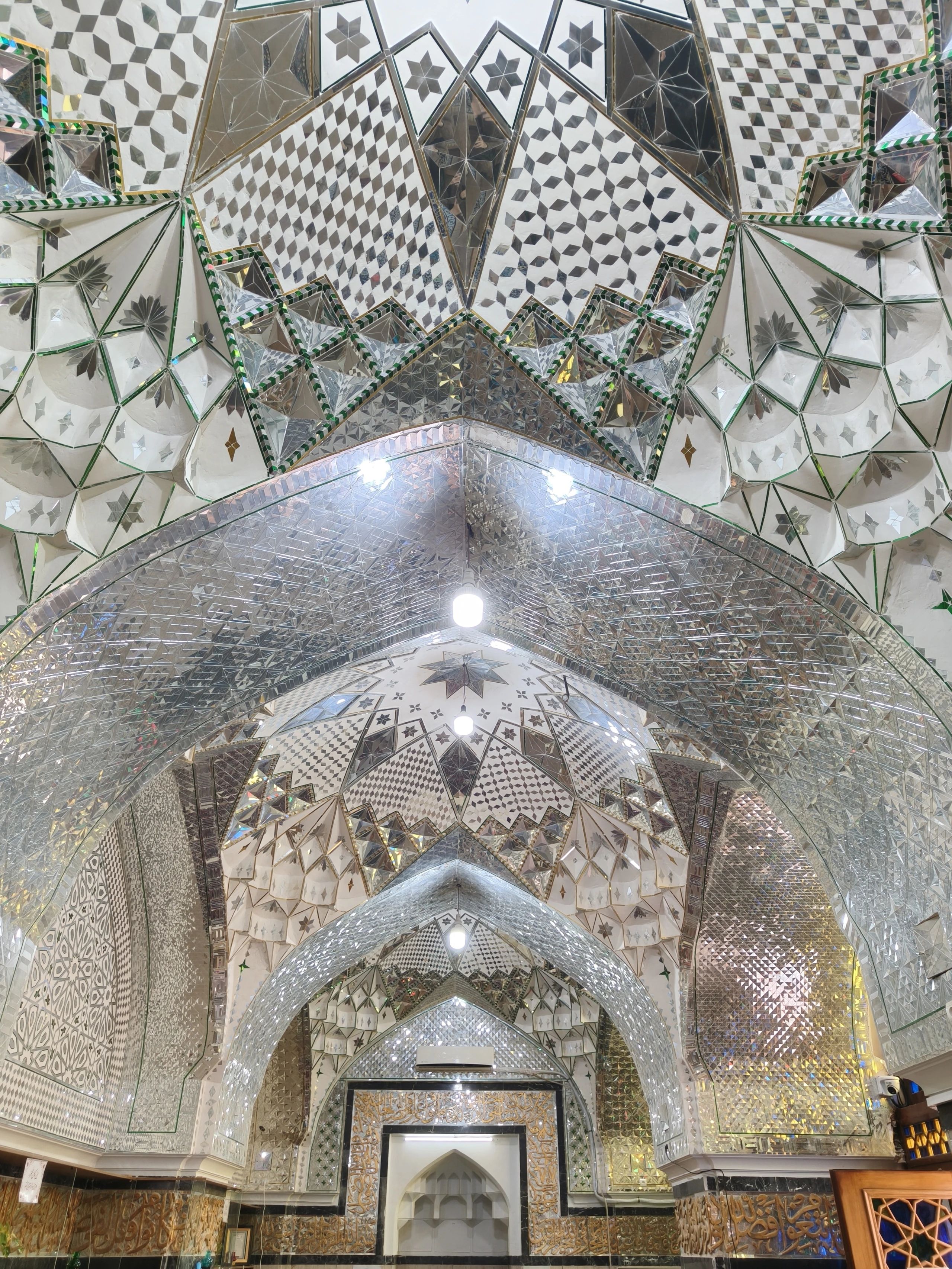
On one side of the square, there is a library covered in many mirrors that shine brightly. (Image 11, Image 12) It looks just like the Tomb of the King of Lights in Iraq that I saw online.
The library also holds copies of the Quran (Image 13) in other languages, including French, English, Russian, and Armenian. There were a few staff members inside. When my guide told them I was from China, they gave me a tile ornament and a copy of the Quran.
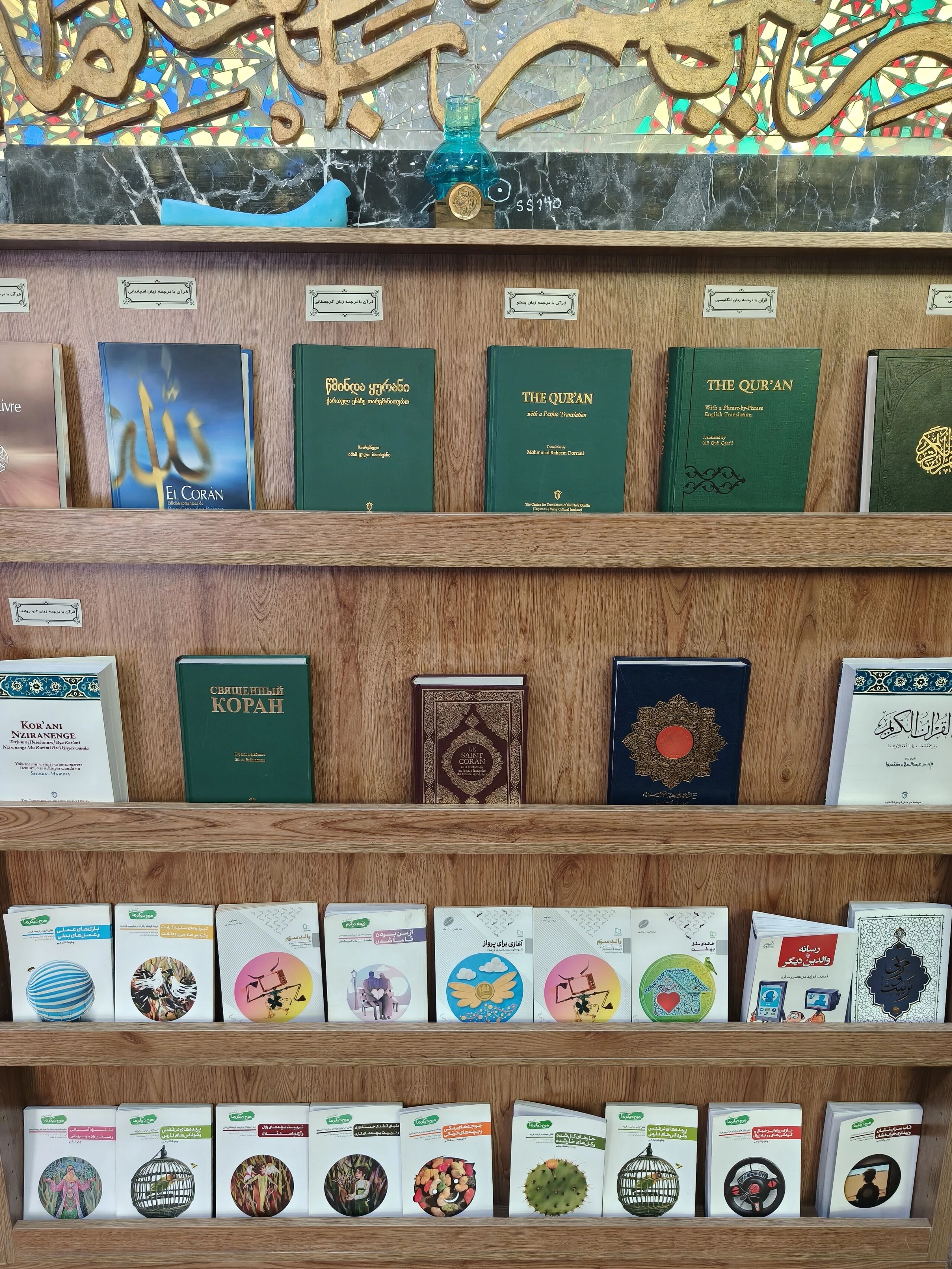
The staff said they were happy to meet me and welcomed me to Iran. To be polite, I also told them they were welcome to visit China. The staff also asked if China accepts international students from countries like Iran, Iraq, and Afghanistan, and which university majors in China are the best.
I am answering based on the information I have encountered within the country. It seems like many foreigners come here to study medicine, and I actually know international students from Pakistan, Turkey, and Yemen who are studying in Lanzhou and Chengdu.
After leaving the mosque, I returned to the bazaar. I looked up and saw the sunlight hitting the dome at an angle, perfectly revealing the shape of a crescent moon.
Muslim Travel Guide Iran Tehran and Qom: Local Muslim Life, Mosques and Travel Notes
Articles • Hasan09 posted the article • 0 comments • 332 views • 2026-05-24 01:48
Summary: This Iran Muslim travel guide records the author's real travel experiences in Tehran and Qom. It preserves the local interactions, mosque-related context, street observations, and the peaceful moments before later gunfire described in the source.
Friends who follow me probably know that I went to Iran at the beginning of December last year, where I interacted with the local people. With the current outbreak of war in Iran, I am reminded of those things I saw and experienced.
1. Iranian taxi drivers
After landing at Imam Khomeini International Airport in Iran, I got into Uncle Hosseini's taxi and started my journey to downtown Tehran. The international airport is quite far from downtown Tehran, and the trip took us a full hour and a half. Along the way, Uncle Hosseini and I kept chatting using a translation app. Communicating with a translation app is actually a bit troublesome, but the uncle was very enthusiastic and didn't mind me talking so much, so we chatted the whole way.
It is strange to say, but the first person I had a deep conversation with in Iran turned out to be a staunch patriot. After entering the city, although the exterior walls of the buildings looked poorly maintained, the streets were brightly lit and full of life. The uncle asked me if it was my first time in Iran, and if I realized after arriving that it was nothing like what the outside world portrays. I guess the uncle meant that the outside world always claims Iran's economy is stagnant and people's livelihoods are depressed, but looking at the street scene before me, Tehran is not as bad as people say. Actually, in my opinion, Tehran, including the international airport I just left, looks quite old and is not much better than how it is described by the outside world. But from the uncle's words, it is easy to see that he sincerely loves his country.
He then talked about international relations. He said he really dislikes Israel and Western countries, and he believes China and Russia are good friends to Iran. I saw this for myself later on. My Iranian tour guide pointed at a bus on the road and told me that Iran imported a batch of buses from China. I also saw a large Xiaomi store (Xiaomi Zhijia) in a modern shopping mall in Iran. I occasionally saw our domestic new energy vehicles on the road too. The guide showed me photos on his phone of himself with some Chinese trade representatives, which shows that our country and Iran have a decent relationship, at least in terms of trade.
I later asked him if Iran was really going to move its capital. He said every government talks about moving the capital, but it involves too many people, so it is impossible to actually move. We reached the destination, and I said goodbye to the uncle.
(A view of Tehran streets taken through the window of Uncle Hosseini's taxi. In front is a poster of an Iranian athlete winning a championship, and behind it is an anti-Israel propaganda poster.)
2. My tour guide is a conservative liberal.
Unlike the driver, Uncle Hosseini, my local Iranian tour guide is quite against the current system. On the first day I met him, we passed a government building. He looked at the well-dressed people going in and out and said to me, 'Look at these people. They sit in their offices all day, nice and warm, drinking coffee, and they finish work without doing a single thing.'
That night, he complained to me that the government was truly incompetent, as the price of a pair of shoes had gone up ten times over the years. I was a bit puzzled at the time. But thinking about it now, could it be that U. S. blockades and sanctions are why Iran cannot buy cheap raw materials, and therefore cannot make cheap shoes?
Even this tour guide, who hates the current situation, told me he was scared. He is afraid that the U. S. might actually attack. He said he is not afraid of Israel, but he is truly afraid of U. S. military power.
His fear is actually quite normal, because missiles only identify thermal imaging, and U. S. missiles cannot tell which Iranians support the regime and which ones support overthrowing the government. So when war comes, the fear of a foreign enemy will likely push conservative liberals like the tour guide into the arms of the Iranian authoritarian government.
(The tour guide is using his Samsung phone to check the exchange rate between the Chinese yuan and the Iranian rial for me, worried that I might lose money if I exchange too little.)
(The tour guide is using his Samsung phone to check the exchange rate between the Chinese yuan and the Iranian rial for me, worried that I might lose money if I exchange too little.)
3. Enthusiastic people
I actually stand out quite a bit walking on the streets of Iran. I have the typical look of a yellow-skinned person, with single eyelids and straight black hair. Maybe it is because things are valued when they are rare, but the people here are especially warm to me and take the initiative to greet me. More than once on the road, people came up to me and said, "Welcome to Iran."
Once, while I was visiting a mosque, I suddenly became the center of attention. Namaz had just ended, and they started sharing hot black tea in the mosque. I got a cup too. One person called his family or friends right there, excitedly telling them he had met a Chinese person today. Everyone gathered around and curiously asked me all sorts of questions. One young man spoke good English and said he had studied in the United States. He even offered to be my tour guide. But I was leaving Tehran for Qom soon, so I politely declined his kind offer.
(After namaz, the mosque started handing out hot black tea with sugar cubes. It tasted pretty good.)
4. The kind ticket agent
Iran is currently under sanctions and cannot use bank cards from other countries, so tourists like us have to bring US dollar cash in advance and exchange it locally in Iran. For those few days, I was always walking around with big bundles of cash on me. Once, when I went to the manual ticket booth at the subway station, the ticket agent saw that my bag zipper was open and a stack of cash was clearly visible on top. She was so worried that she quickly reached over and shoved the stack of cash to the very bottom of my bag under some other items.
She was reminding me to watch out for pickpockets in the train car. She was truly very kind. I have remembered this kind gesture ever since.
(For Iranian subway tickets, you scan a code to enter through the gate, but there are no gates when you leave, so you just walk out.)
5. Free french fries
Years ago, I saw an avant-garde building in Iran on the 'Youth Architecture' WeChat architecture post, and it happened to be in Tehran. I decided to go see it, but after searching for it by name, I realized I had gone to the wrong place. It was lunchtime, so I went to a nearby restaurant and ordered some french fries. I saw another diner nearby and thought he must know where the building was. I felt a bit shy about just asking him directly, so I grabbed a can of Coca-Cola from the restaurant's drink cooler and handed it to him. After thanking me, he stared at the picture I showed him for a long time, trying to sound out the words on the building, but he couldn't find the answer in the end. He left after he finished his meal, and I was just about done with mine too. When I went to pay, the clerk told me that the person who drank my cola had already paid my bill. I guess I got a free meal of french fries out of it too.
(An ordinary street scene in Tehran)
6. The Rose Bread Uncle
I met this uncle who sells rose-filled bread after I finished visiting Azadi Tower. Azadi Tower is surrounded by a large roundabout with an incredible amount of traffic, making it hard to cross the street and just as hard to get back. I was stuck on the side of the road for a long time, and it felt just like being back in Vietnam.
An old man carrying a large rose-filled flatbread (rose bing) saw me, and since he was heading across the street too, he waved for me to join him. He grabbed my arm and led me with long strides right into the traffic, and before I knew it, I was on the other side of the road. I really admire these locals from the bottom of my heart.
The uncle then asked if I was going to the subway station. I was indeed planning to take the subway to a bus station in Tehran to catch a bus to Qom. So, I walked with him toward the subway station. He handed me the rose-filled flatbread (bing) he was holding so I would have something to eat on the road. Along the way, he showed me his contacts on his phone. I think I saw a photo of him with former Iranian President Rouhani, along with many others who looked like high-ranking officials or people in military uniforms. Who exactly is this man?
Regardless of his background, I decided to ask him for directions to the bus station. When he heard me ask about the bus station, he patted my shoulder and then his own chest, using body language to tell me not to worry. He then stayed with me on the bus until we were a few stops away from the station. Before getting off, he made sure to point out which stop I was at and exactly where I needed to get off. He was truly very kind, much like the other Iranians I had met before. My impression of Iranian people was set right then.
(A standard ID photo of Azadi Tower.) Actually, there is an underground passage to Azadi Square from other places, but it was already closed when I went, probably because it was too late.
7. I lost my phone, and my feelings are complicated.
It was the day I left Qom, and the hotel front desk helped me call a taxi using a ride-hailing app. Once I got in, I felt something was wrong. The driver had a shifty look in his eyes that made me feel very uncomfortable. After I got out of the car, I suddenly realized my spare phone was missing. I remembered then that when I was getting out, the driver deliberately threw his bag onto the passenger seat. I was wondering at the time why he had to throw his bag on the passenger seat instead of putting it somewhere else. Looking back, he must have been using the bag to cover my phone, which had slid onto the seat. I tried to look for him, but he was long gone with my phone without a trace.
I had no choice but to take another car to the airport with a heavy heart, and there were other passengers in the car. I was the only Asian person in the car, and the other passengers and the driver started to get curious about me. They asked if I liked Iran. I said I liked it, but because I had just lost my phone, I really could not bring myself to like Iran at that moment. Still, I decided to give it a try and used a translation app to ask the driver and other passengers for help. The moment they received my request for help, they immediately took action and started calling the hotel where I stayed to see if they could find that taxi driver through the front desk. I did not know whether to laugh or cry, and my feelings were a mess. On one hand, I was very upset because my backup phone was stolen, and it had very important things on it. On the other hand, I felt a bit comforted because these strangers were so eager to help me.
(A street in Qom, where I lost my phone.)
Postscript: In the end, I never got that phone back. I have been back home for two or three months now. After I returned, large-scale protests broke out there, and later Iran got caught up in conflict with the United States and Israel. If I wanted to go back to Iran now, it would probably be impossible. I wonder if those kind-hearted Iranians are doing well today and if they are still living in peace. view all
Summary: This Iran Muslim travel guide records the author's real travel experiences in Tehran and Qom. It preserves the local interactions, mosque-related context, street observations, and the peaceful moments before later gunfire described in the source.
Friends who follow me probably know that I went to Iran at the beginning of December last year, where I interacted with the local people. With the current outbreak of war in Iran, I am reminded of those things I saw and experienced.
1. Iranian taxi drivers
After landing at Imam Khomeini International Airport in Iran, I got into Uncle Hosseini's taxi and started my journey to downtown Tehran. The international airport is quite far from downtown Tehran, and the trip took us a full hour and a half. Along the way, Uncle Hosseini and I kept chatting using a translation app. Communicating with a translation app is actually a bit troublesome, but the uncle was very enthusiastic and didn't mind me talking so much, so we chatted the whole way.
It is strange to say, but the first person I had a deep conversation with in Iran turned out to be a staunch patriot. After entering the city, although the exterior walls of the buildings looked poorly maintained, the streets were brightly lit and full of life. The uncle asked me if it was my first time in Iran, and if I realized after arriving that it was nothing like what the outside world portrays. I guess the uncle meant that the outside world always claims Iran's economy is stagnant and people's livelihoods are depressed, but looking at the street scene before me, Tehran is not as bad as people say. Actually, in my opinion, Tehran, including the international airport I just left, looks quite old and is not much better than how it is described by the outside world. But from the uncle's words, it is easy to see that he sincerely loves his country.
He then talked about international relations. He said he really dislikes Israel and Western countries, and he believes China and Russia are good friends to Iran. I saw this for myself later on. My Iranian tour guide pointed at a bus on the road and told me that Iran imported a batch of buses from China. I also saw a large Xiaomi store (Xiaomi Zhijia) in a modern shopping mall in Iran. I occasionally saw our domestic new energy vehicles on the road too. The guide showed me photos on his phone of himself with some Chinese trade representatives, which shows that our country and Iran have a decent relationship, at least in terms of trade.
I later asked him if Iran was really going to move its capital. He said every government talks about moving the capital, but it involves too many people, so it is impossible to actually move. We reached the destination, and I said goodbye to the uncle.
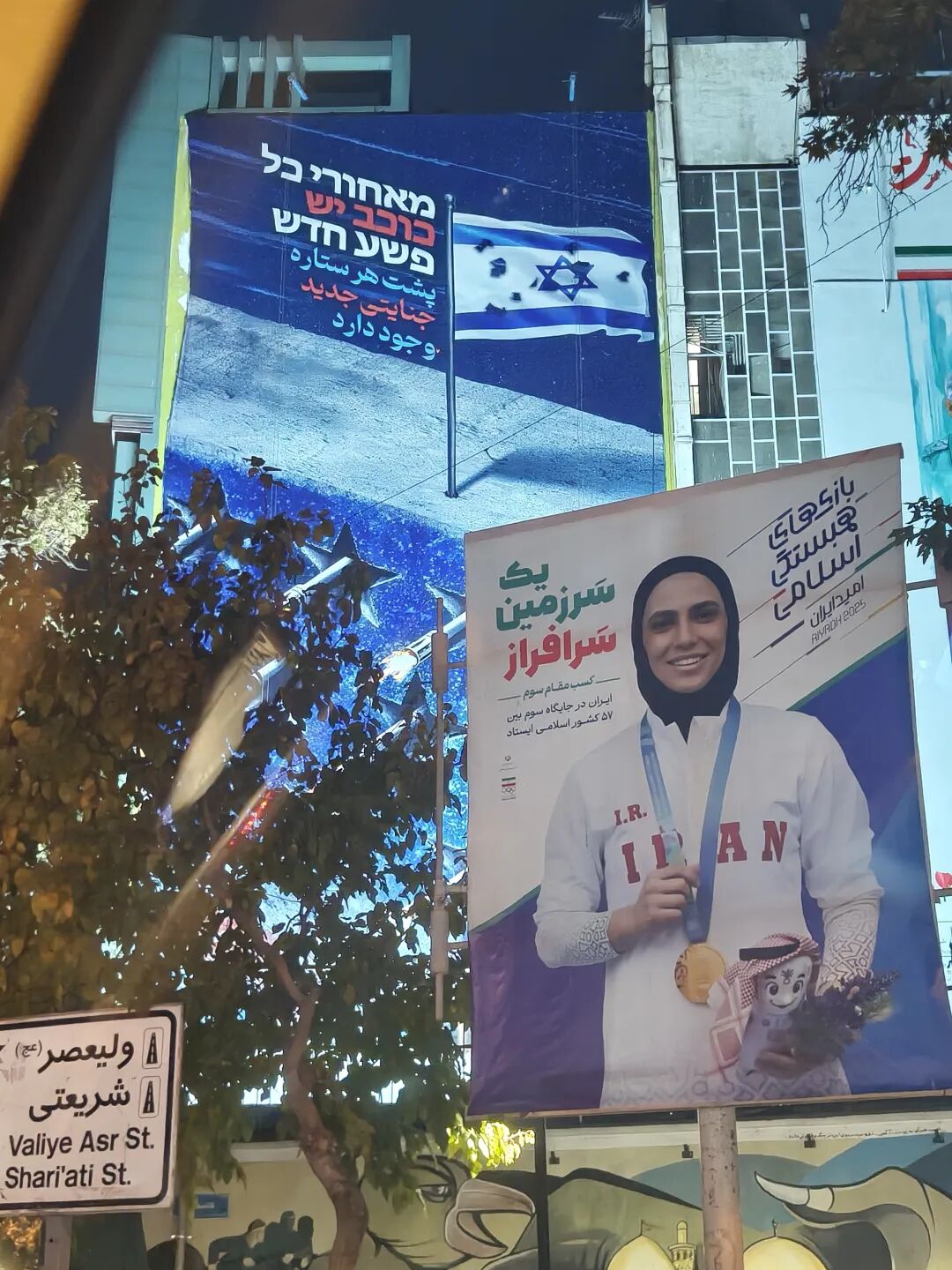
(A view of Tehran streets taken through the window of Uncle Hosseini's taxi. In front is a poster of an Iranian athlete winning a championship, and behind it is an anti-Israel propaganda poster.)
2. My tour guide is a conservative liberal.
Unlike the driver, Uncle Hosseini, my local Iranian tour guide is quite against the current system. On the first day I met him, we passed a government building. He looked at the well-dressed people going in and out and said to me, 'Look at these people. They sit in their offices all day, nice and warm, drinking coffee, and they finish work without doing a single thing.'
That night, he complained to me that the government was truly incompetent, as the price of a pair of shoes had gone up ten times over the years. I was a bit puzzled at the time. But thinking about it now, could it be that U. S. blockades and sanctions are why Iran cannot buy cheap raw materials, and therefore cannot make cheap shoes?
Even this tour guide, who hates the current situation, told me he was scared. He is afraid that the U. S. might actually attack. He said he is not afraid of Israel, but he is truly afraid of U. S. military power.
His fear is actually quite normal, because missiles only identify thermal imaging, and U. S. missiles cannot tell which Iranians support the regime and which ones support overthrowing the government. So when war comes, the fear of a foreign enemy will likely push conservative liberals like the tour guide into the arms of the Iranian authoritarian government.
(The tour guide is using his Samsung phone to check the exchange rate between the Chinese yuan and the Iranian rial for me, worried that I might lose money if I exchange too little.)
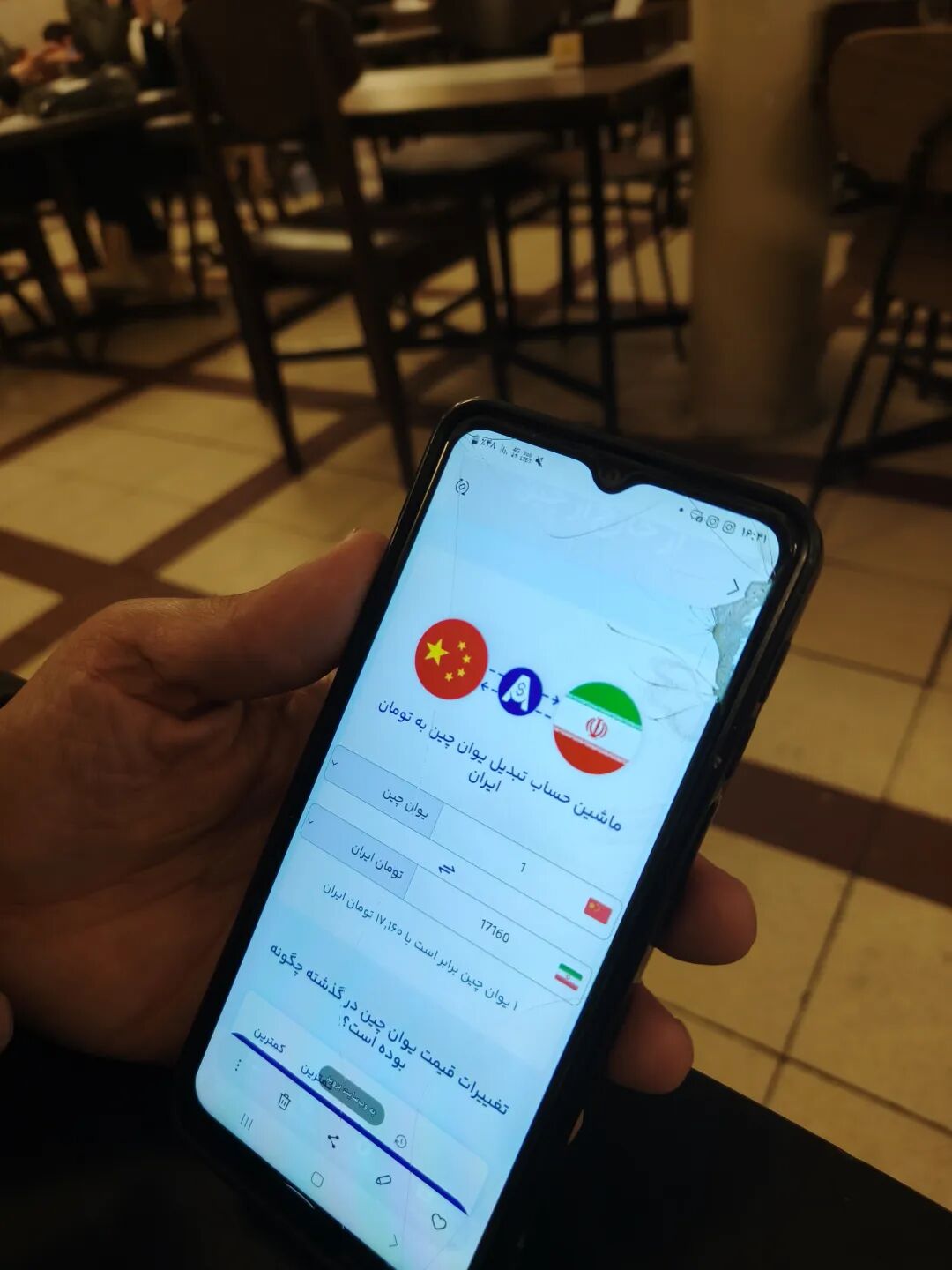
(The tour guide is using his Samsung phone to check the exchange rate between the Chinese yuan and the Iranian rial for me, worried that I might lose money if I exchange too little.)
3. Enthusiastic people
I actually stand out quite a bit walking on the streets of Iran. I have the typical look of a yellow-skinned person, with single eyelids and straight black hair. Maybe it is because things are valued when they are rare, but the people here are especially warm to me and take the initiative to greet me. More than once on the road, people came up to me and said, "Welcome to Iran."
Once, while I was visiting a mosque, I suddenly became the center of attention. Namaz had just ended, and they started sharing hot black tea in the mosque. I got a cup too. One person called his family or friends right there, excitedly telling them he had met a Chinese person today. Everyone gathered around and curiously asked me all sorts of questions. One young man spoke good English and said he had studied in the United States. He even offered to be my tour guide. But I was leaving Tehran for Qom soon, so I politely declined his kind offer.
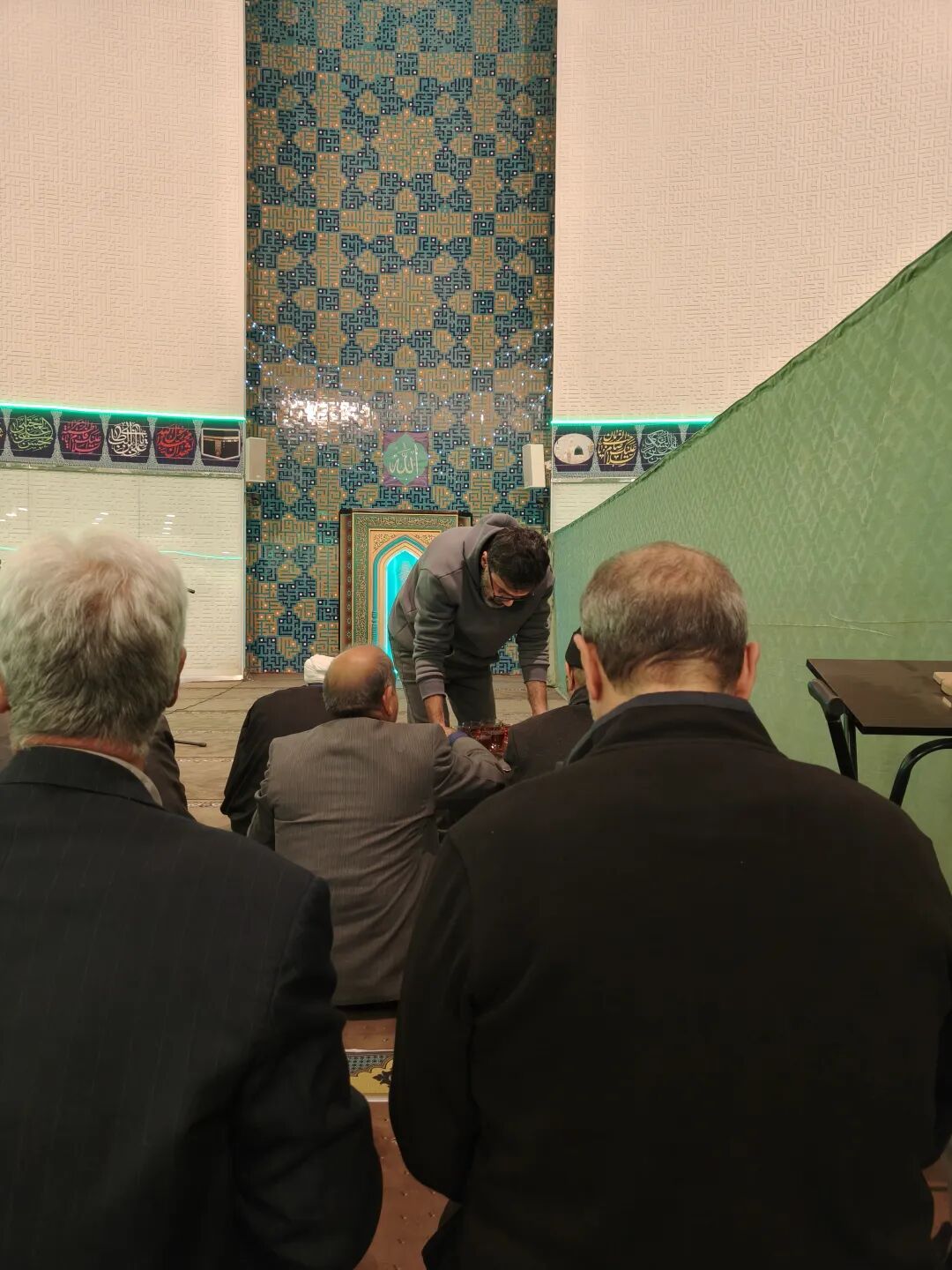
(After namaz, the mosque started handing out hot black tea with sugar cubes. It tasted pretty good.)
4. The kind ticket agent
Iran is currently under sanctions and cannot use bank cards from other countries, so tourists like us have to bring US dollar cash in advance and exchange it locally in Iran. For those few days, I was always walking around with big bundles of cash on me. Once, when I went to the manual ticket booth at the subway station, the ticket agent saw that my bag zipper was open and a stack of cash was clearly visible on top. She was so worried that she quickly reached over and shoved the stack of cash to the very bottom of my bag under some other items.
She was reminding me to watch out for pickpockets in the train car. She was truly very kind. I have remembered this kind gesture ever since.
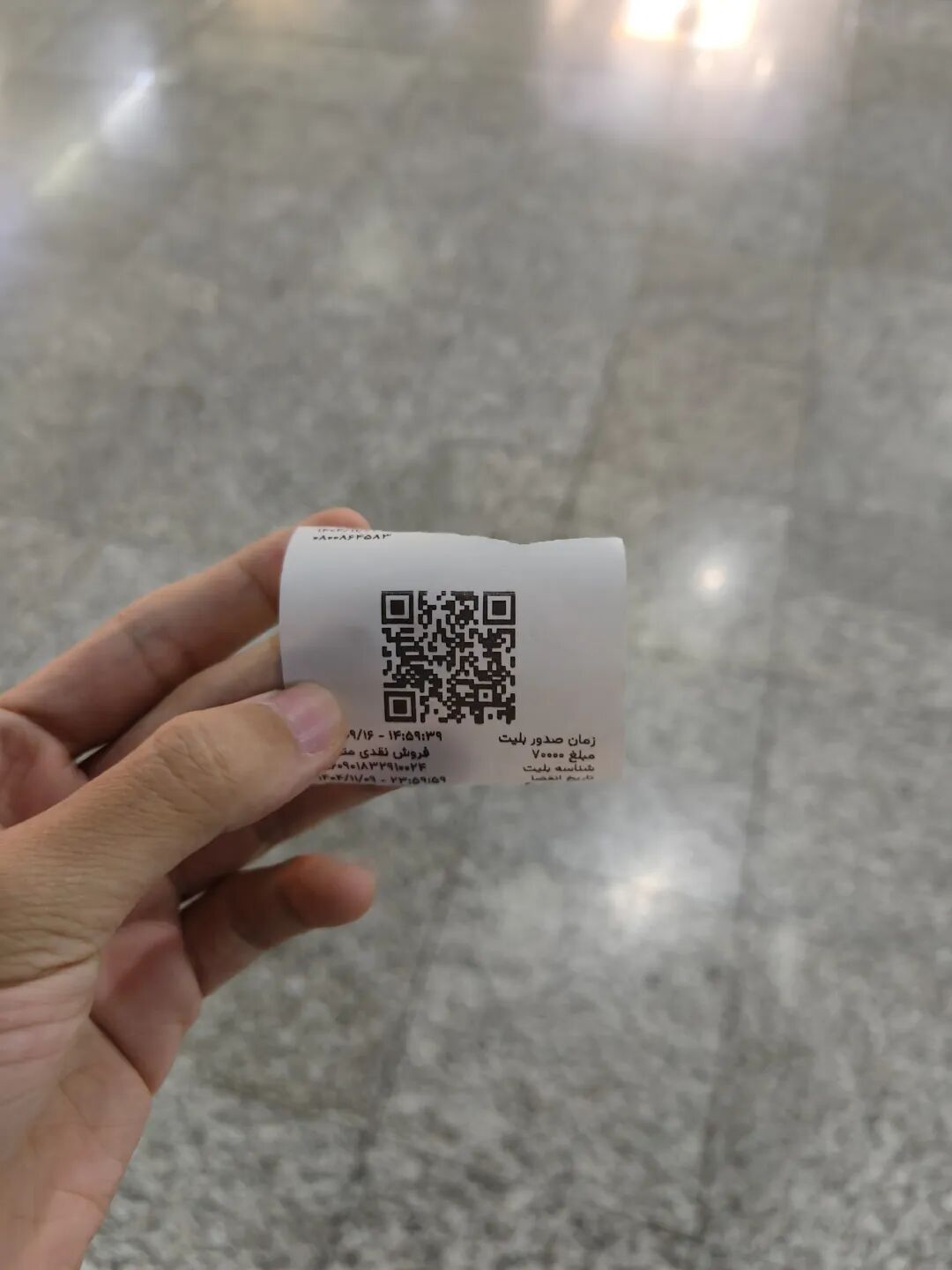
(For Iranian subway tickets, you scan a code to enter through the gate, but there are no gates when you leave, so you just walk out.)
5. Free french fries
Years ago, I saw an avant-garde building in Iran on the 'Youth Architecture' WeChat architecture post, and it happened to be in Tehran. I decided to go see it, but after searching for it by name, I realized I had gone to the wrong place. It was lunchtime, so I went to a nearby restaurant and ordered some french fries. I saw another diner nearby and thought he must know where the building was. I felt a bit shy about just asking him directly, so I grabbed a can of Coca-Cola from the restaurant's drink cooler and handed it to him. After thanking me, he stared at the picture I showed him for a long time, trying to sound out the words on the building, but he couldn't find the answer in the end. He left after he finished his meal, and I was just about done with mine too. When I went to pay, the clerk told me that the person who drank my cola had already paid my bill. I guess I got a free meal of french fries out of it too.
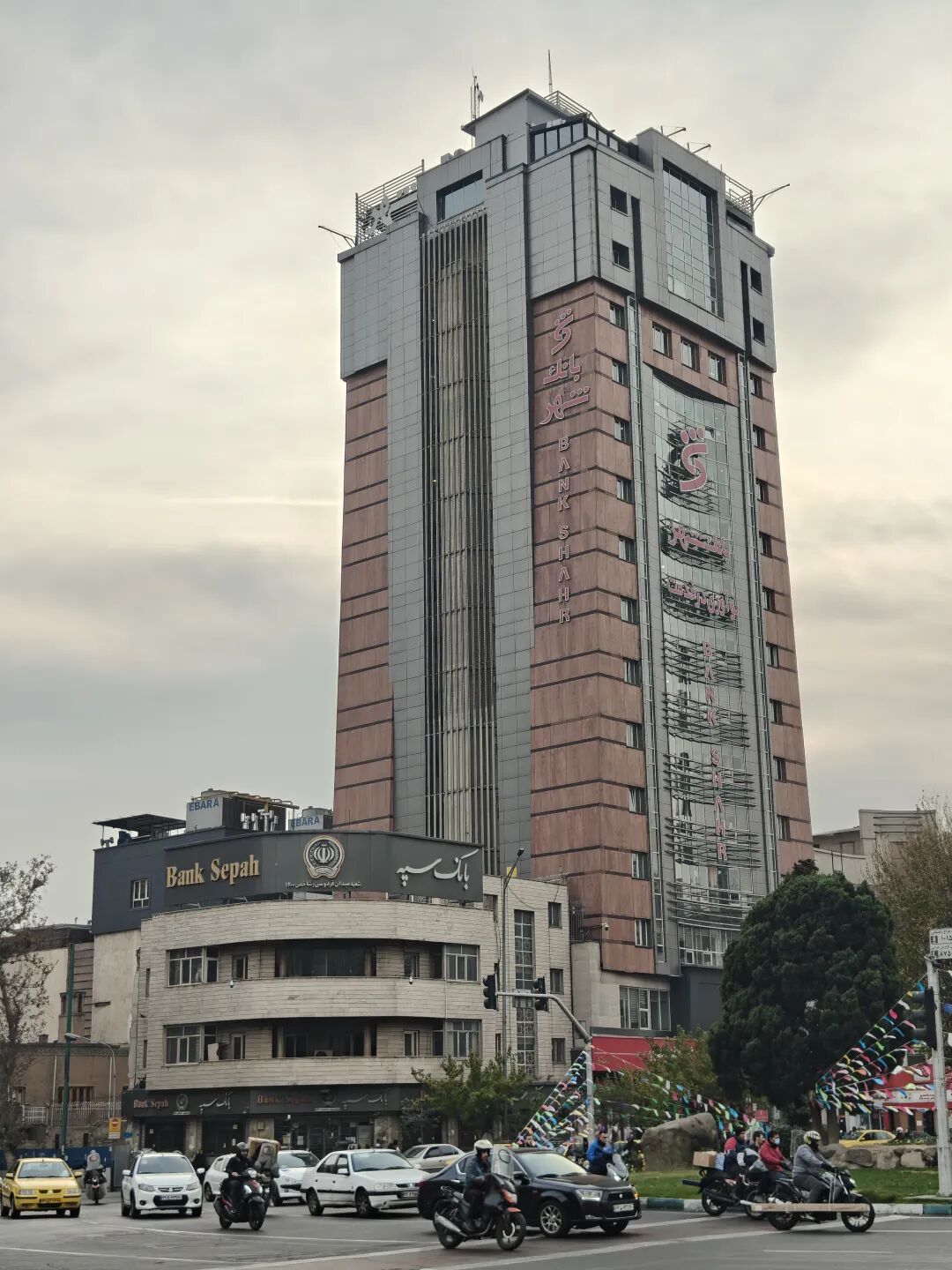
(An ordinary street scene in Tehran)
6. The Rose Bread Uncle
I met this uncle who sells rose-filled bread after I finished visiting Azadi Tower. Azadi Tower is surrounded by a large roundabout with an incredible amount of traffic, making it hard to cross the street and just as hard to get back. I was stuck on the side of the road for a long time, and it felt just like being back in Vietnam.
An old man carrying a large rose-filled flatbread (rose bing) saw me, and since he was heading across the street too, he waved for me to join him. He grabbed my arm and led me with long strides right into the traffic, and before I knew it, I was on the other side of the road. I really admire these locals from the bottom of my heart.
The uncle then asked if I was going to the subway station. I was indeed planning to take the subway to a bus station in Tehran to catch a bus to Qom. So, I walked with him toward the subway station. He handed me the rose-filled flatbread (bing) he was holding so I would have something to eat on the road. Along the way, he showed me his contacts on his phone. I think I saw a photo of him with former Iranian President Rouhani, along with many others who looked like high-ranking officials or people in military uniforms. Who exactly is this man?
Regardless of his background, I decided to ask him for directions to the bus station. When he heard me ask about the bus station, he patted my shoulder and then his own chest, using body language to tell me not to worry. He then stayed with me on the bus until we were a few stops away from the station. Before getting off, he made sure to point out which stop I was at and exactly where I needed to get off. He was truly very kind, much like the other Iranians I had met before. My impression of Iranian people was set right then.
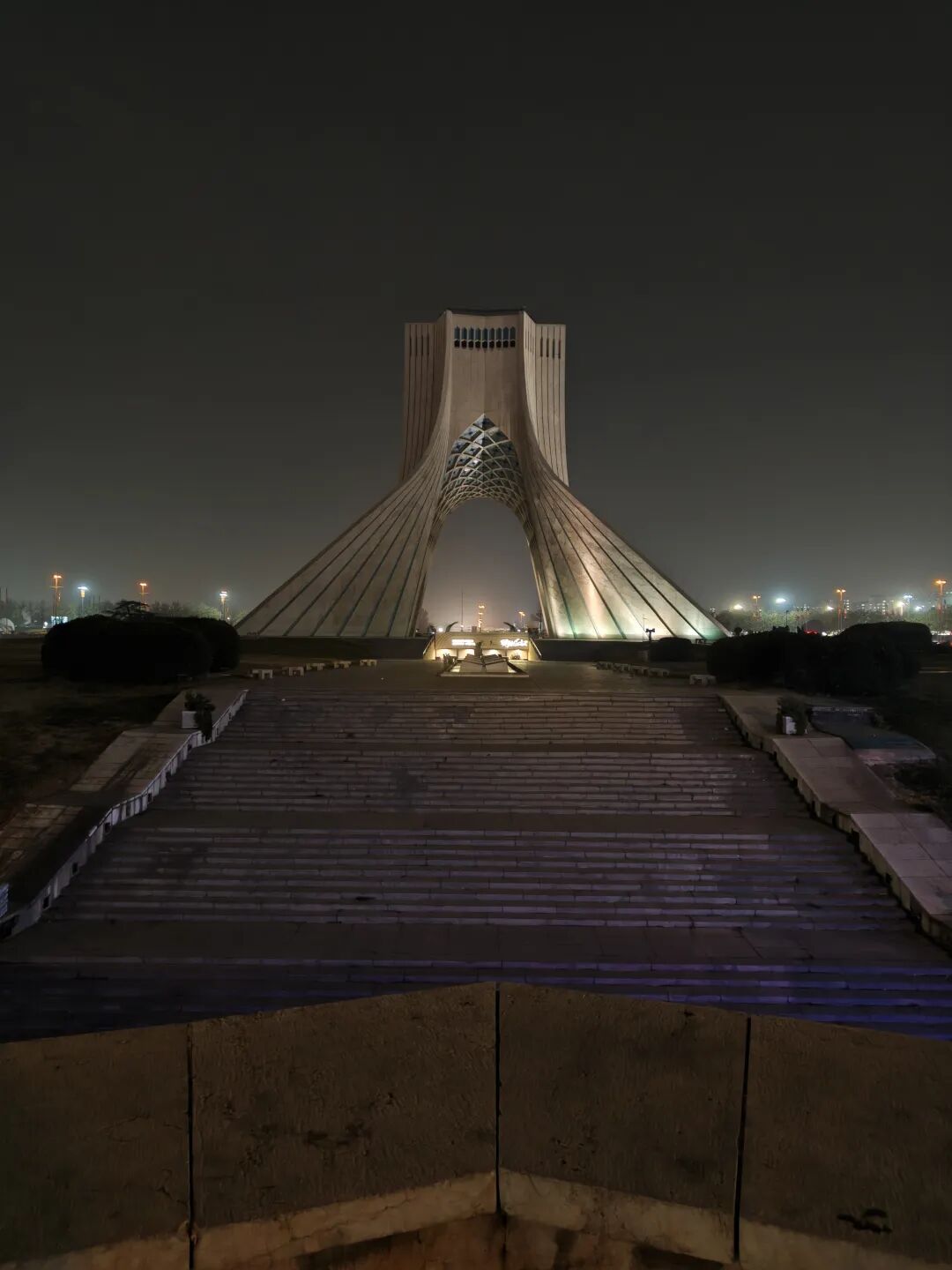
(A standard ID photo of Azadi Tower.) Actually, there is an underground passage to Azadi Square from other places, but it was already closed when I went, probably because it was too late.
7. I lost my phone, and my feelings are complicated.
It was the day I left Qom, and the hotel front desk helped me call a taxi using a ride-hailing app. Once I got in, I felt something was wrong. The driver had a shifty look in his eyes that made me feel very uncomfortable. After I got out of the car, I suddenly realized my spare phone was missing. I remembered then that when I was getting out, the driver deliberately threw his bag onto the passenger seat. I was wondering at the time why he had to throw his bag on the passenger seat instead of putting it somewhere else. Looking back, he must have been using the bag to cover my phone, which had slid onto the seat. I tried to look for him, but he was long gone with my phone without a trace.
I had no choice but to take another car to the airport with a heavy heart, and there were other passengers in the car. I was the only Asian person in the car, and the other passengers and the driver started to get curious about me. They asked if I liked Iran. I said I liked it, but because I had just lost my phone, I really could not bring myself to like Iran at that moment. Still, I decided to give it a try and used a translation app to ask the driver and other passengers for help. The moment they received my request for help, they immediately took action and started calling the hotel where I stayed to see if they could find that taxi driver through the front desk. I did not know whether to laugh or cry, and my feelings were a mess. On one hand, I was very upset because my backup phone was stolen, and it had very important things on it. On the other hand, I felt a bit comforted because these strangers were so eager to help me.
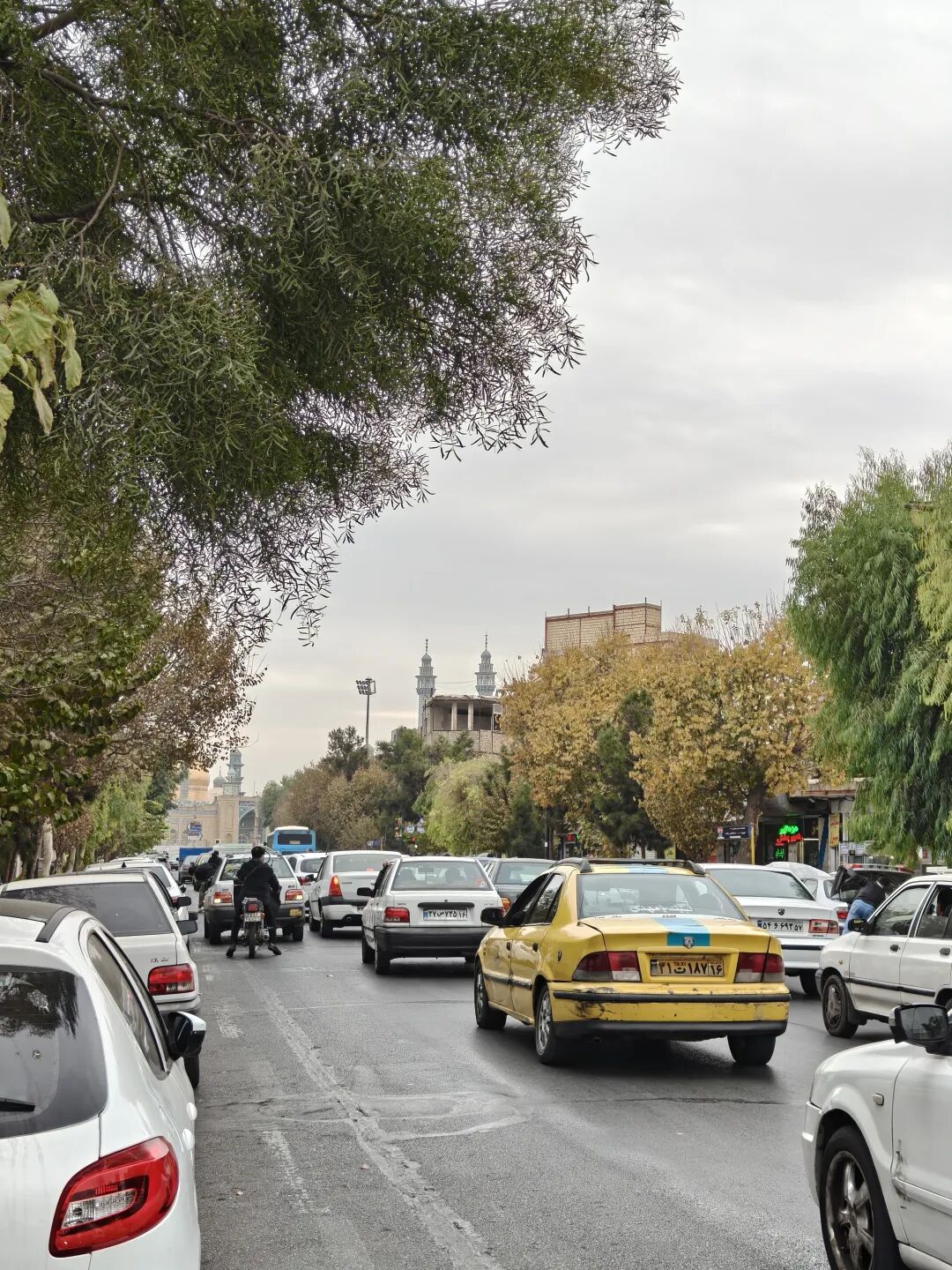
(A street in Qom, where I lost my phone.)
Postscript: In the end, I never got that phone back. I have been back home for two or three months now. After I returned, large-scale protests broke out there, and later Iran got caught up in conflict with the United States and Israel. If I wanted to go back to Iran now, it would probably be impossible. I wonder if those kind-hearted Iranians are doing well today and if they are still living in peace.
Prayer Room Iran Tehran Airport: Imam Khomeini Airport Second-Floor Musalla and Wudu Notes
Articles • Hasan09 posted the article • 0 comments • 165 views • 2026-05-24 01:45
Summary: This prayer room guide covers the second-floor Muslim prayer space at Imam Khomeini Airport in Iran. It keeps the airport route, earlier first-floor mosque reference, wudu notes, and travel details in the same order as the source.
I showed you the mosque on the first floor of this airport last time, when I first landed in Iran. Leaving Iran this time, I had the chance to see the mosque on the second floor. But getting here was not easy.
Let me tell you the story of what happened before I reached the second-floor mosque.
That morning, I took a taxi from Qom to the bus station to catch a ride back to Tehran. My next plan was to go to Turkey. Turkey did not have visa-free entry then, so I spent a few hundred yuan to get an e-visa. I also bought my round-trip flight tickets.
Unexpectedly, I left my phone in the taxi. I tried to find it, but it was gone. Without my phone, I could not show my flight details or visa documents. Not only could I not go to Turkey, but even getting back home became difficult.
My backup phone was not linked to any payment methods, so I could not buy another ticket. I had my credit cards with me, but because of sanctions on Iran, I could not use any credit cards or bank cards from outside the country. What about cash? I had already spent all my Iranian rials.
Luckily, I still had about 1,000 yuan in cash in my small bag, which I got by exchanging the leftover Vietnamese dong I had when I left Vietnam. Otherwise, I would have really been stuck in Iran.
I used that yuan to exchange for some rials, then used the rials at a manual counter to buy a plane ticket to Oman, because Oman is visa-free and I had been there before, so I knew exactly what the entry process was like.
Once I successfully left Iran and reached Oman, everything would be easy because I had my cards with me and could withdraw money there to buy tickets much more conveniently.
Thankfully, everything went as I hoped. I slept one night in the airport terminal, and while I was there, I met a young Kurdish man in the prayer room who was heading to Turkey and then flying to the UK. His family was already waiting for him there. He asked me if Chinese people really eat dog meat.
I told him it is true, but only a very small number of people eat it. It seems foreigners really care about whether Chinese people eat dog meat.
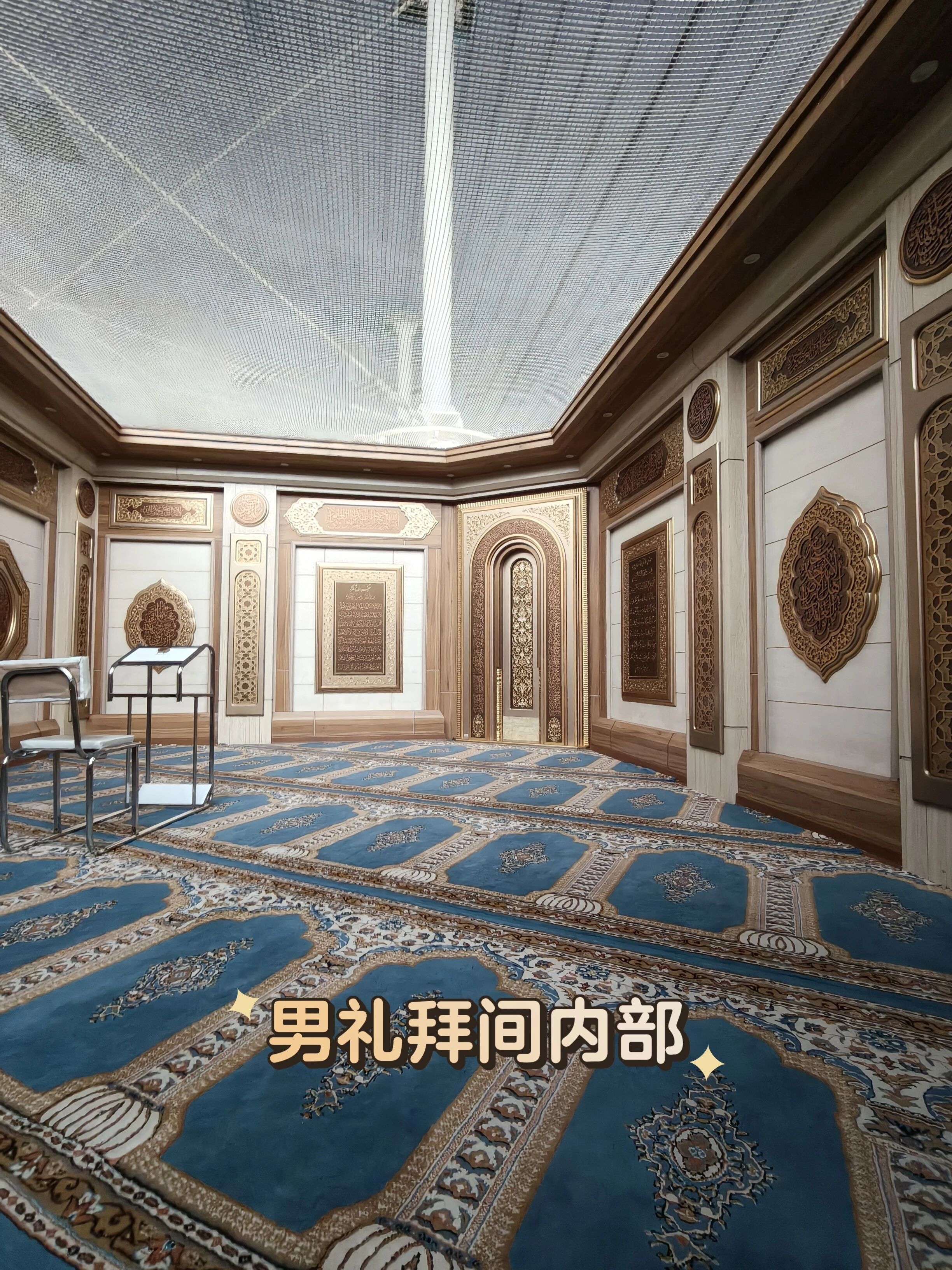
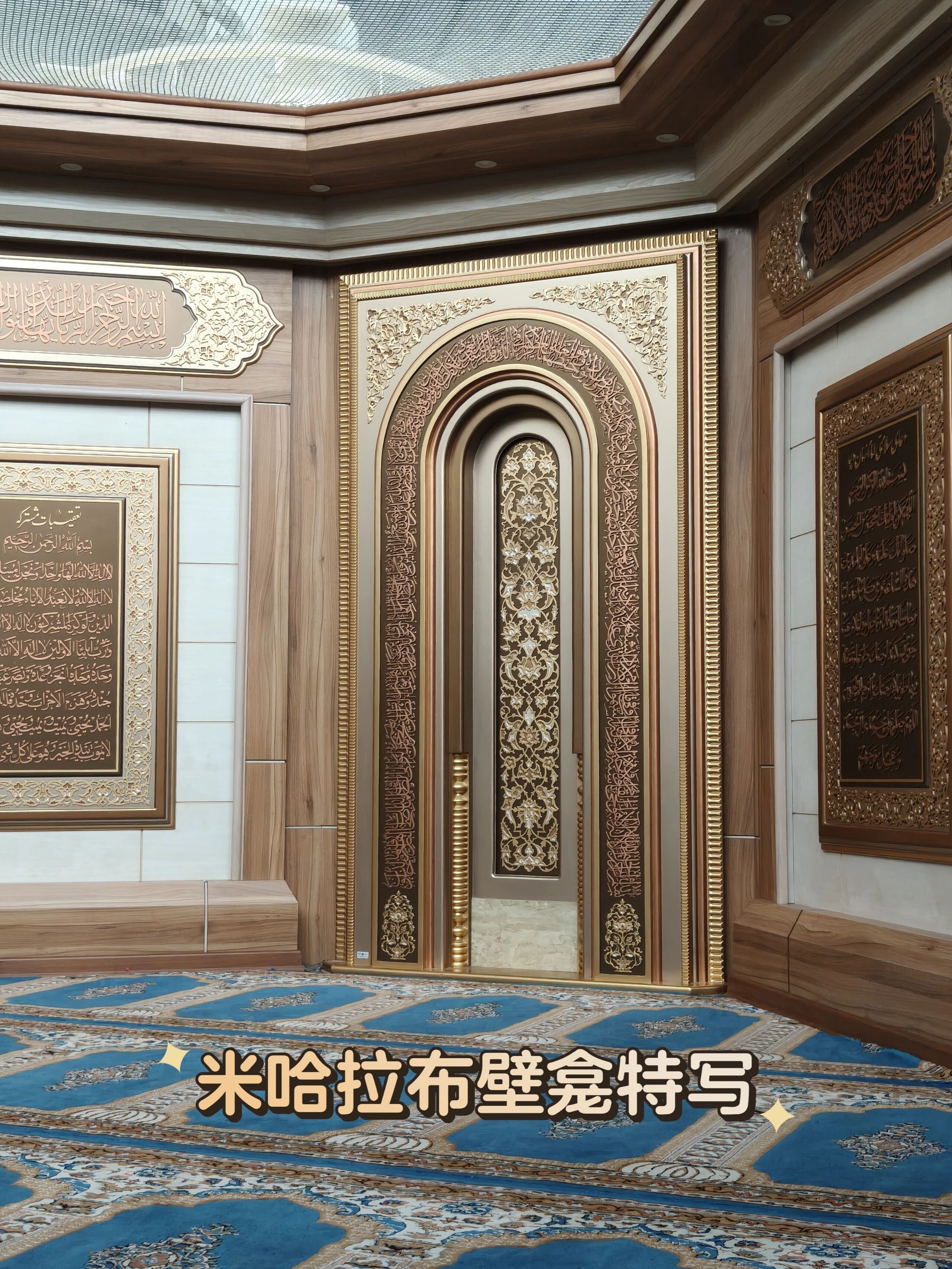
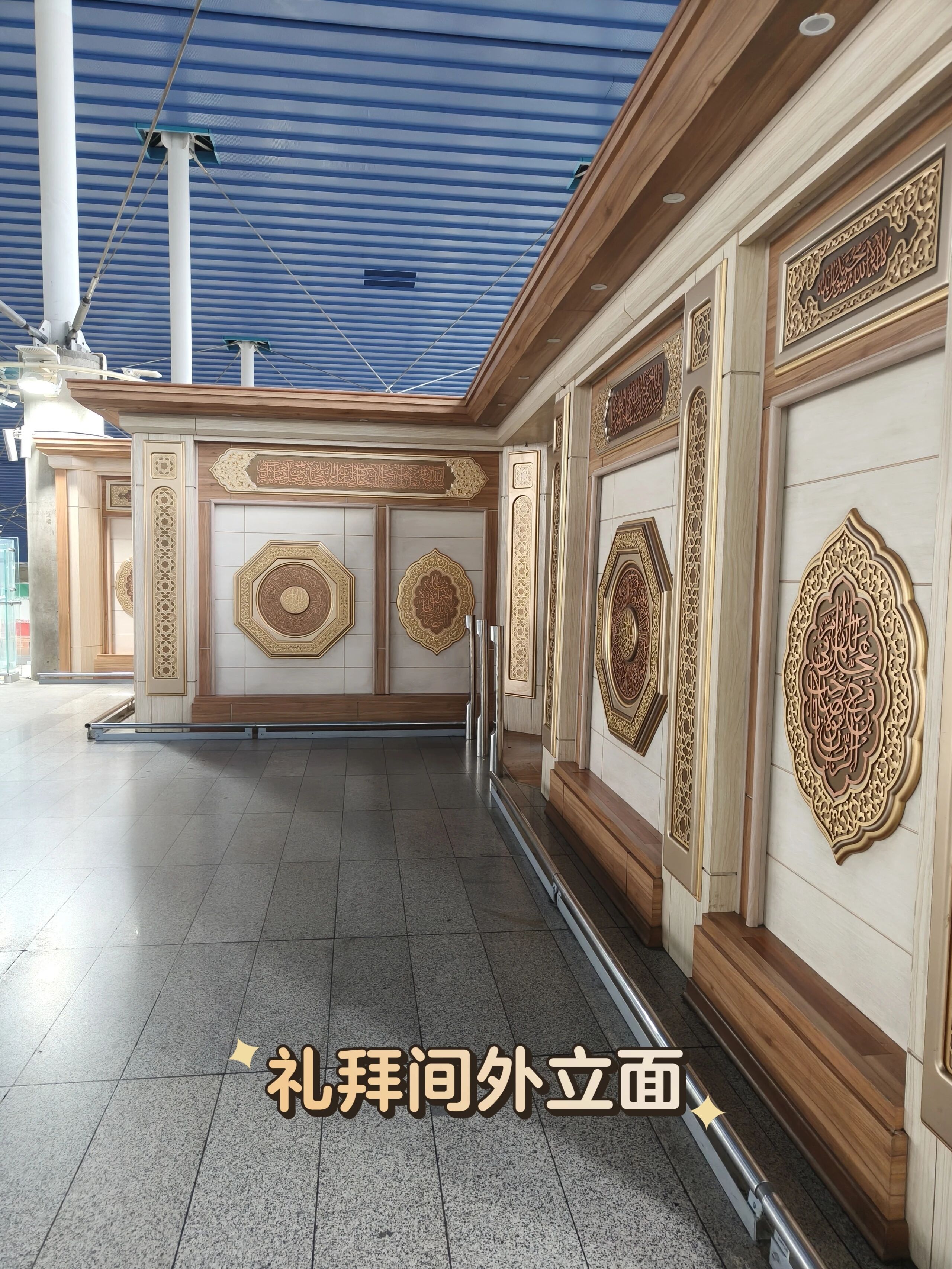
Finally, let me show you the prayer room on the second floor. The prayer rooms in Iran are the most elaborately decorated ones I have ever seen. A staff member inside was holding a plastic box of food and asked if I wanted to eat.
I left the prayer room and headed to the security checkpoint. I passed through easily, and after a short flight, I arrived in Oman. That led to the two posts I wrote about mosques in Oman. view all
Summary: This prayer room guide covers the second-floor Muslim prayer space at Imam Khomeini Airport in Iran. It keeps the airport route, earlier first-floor mosque reference, wudu notes, and travel details in the same order as the source.
I showed you the mosque on the first floor of this airport last time, when I first landed in Iran. Leaving Iran this time, I had the chance to see the mosque on the second floor. But getting here was not easy.
Let me tell you the story of what happened before I reached the second-floor mosque.
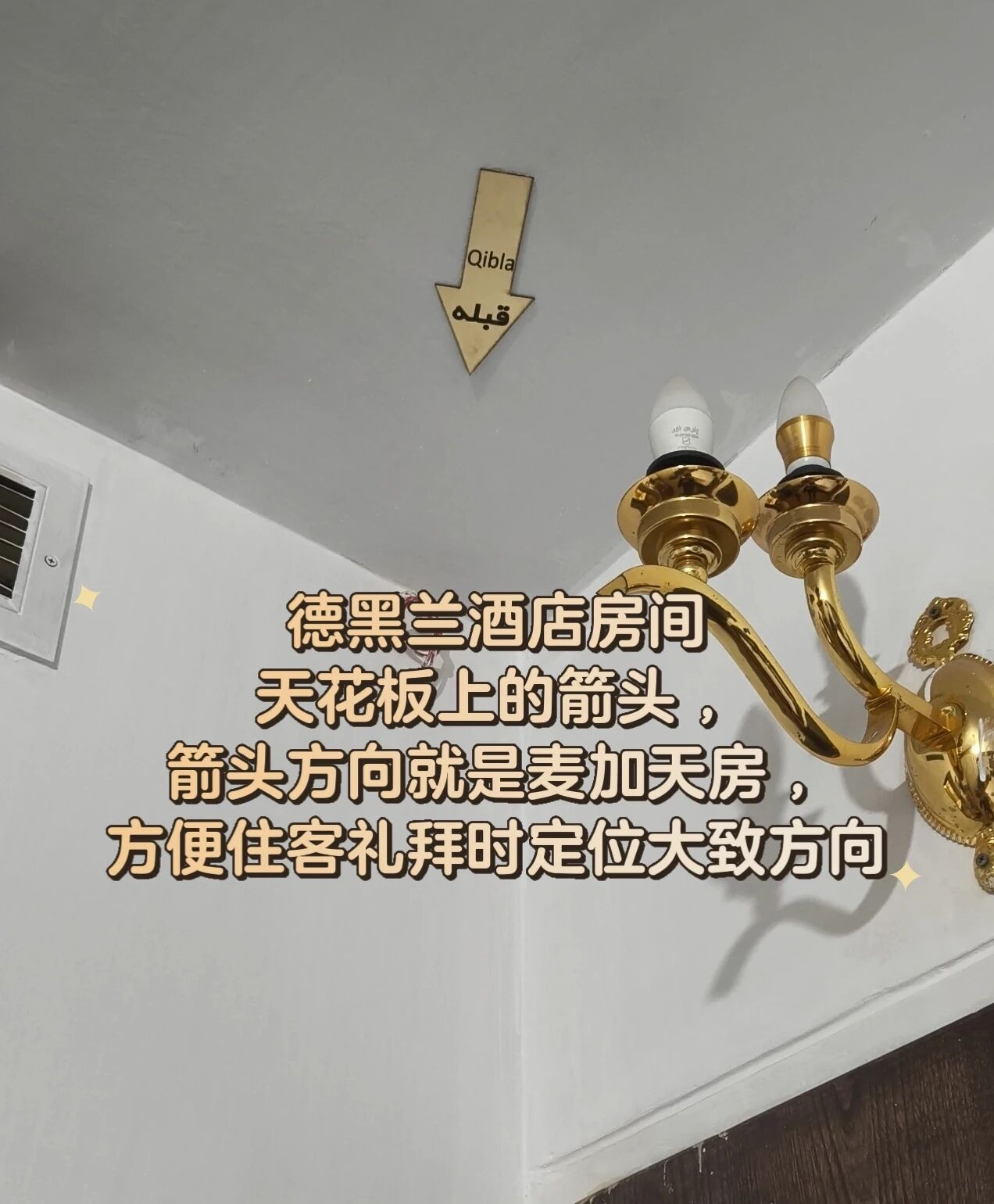
That morning, I took a taxi from Qom to the bus station to catch a ride back to Tehran. My next plan was to go to Turkey. Turkey did not have visa-free entry then, so I spent a few hundred yuan to get an e-visa. I also bought my round-trip flight tickets.
Unexpectedly, I left my phone in the taxi. I tried to find it, but it was gone. Without my phone, I could not show my flight details or visa documents. Not only could I not go to Turkey, but even getting back home became difficult.
My backup phone was not linked to any payment methods, so I could not buy another ticket. I had my credit cards with me, but because of sanctions on Iran, I could not use any credit cards or bank cards from outside the country. What about cash? I had already spent all my Iranian rials.
Luckily, I still had about 1,000 yuan in cash in my small bag, which I got by exchanging the leftover Vietnamese dong I had when I left Vietnam. Otherwise, I would have really been stuck in Iran.
I used that yuan to exchange for some rials, then used the rials at a manual counter to buy a plane ticket to Oman, because Oman is visa-free and I had been there before, so I knew exactly what the entry process was like.
Once I successfully left Iran and reached Oman, everything would be easy because I had my cards with me and could withdraw money there to buy tickets much more conveniently.
Thankfully, everything went as I hoped. I slept one night in the airport terminal, and while I was there, I met a young Kurdish man in the prayer room who was heading to Turkey and then flying to the UK. His family was already waiting for him there. He asked me if Chinese people really eat dog meat.
I told him it is true, but only a very small number of people eat it. It seems foreigners really care about whether Chinese people eat dog meat.
Finally, let me show you the prayer room on the second floor. The prayer rooms in Iran are the most elaborately decorated ones I have ever seen. A staff member inside was holding a plastic box of food and asked if I wanted to eat.
I left the prayer room and headed to the security checkpoint. I passed through easily, and after a short flight, I arrived in Oman. That led to the two posts I wrote about mosques in Oman.
Muslim Travel Guide Iran Tehran: Imam Khomeini Mosque, Grand Bazaar Food and Wudu Courtyard
Articles • yusuf908 posted the article • 0 comments • 176 views • 2026-05-23 22:48
Summary: This Iran Muslim travel guide walks through the Tehran bazaar near Golestan Palace, with potato and beef wraps, crowded lanes, Imam Khomeini Mosque, its wudu courtyard, clock tower, mirror-covered library, Qur'an translations, friendly staff, and a crescent-shaped light moment in the bazaar dome.
There are many bazaars near Golestan Palace. Friday is a public holiday in Iran, and only one mosque in Tehran stays open while the rest are closed. Only a few shops inside the bazaar are open.
The market feels like a ghost town on Friday, but as soon as Friday passes, it quickly becomes lively, crowded with pedestrians and porters shoulder to shoulder.
Bazaars almost always have domes, and you can enjoy their orderly beauty just by looking up. (Photo 1)
After walking for a while, my guide told me he knew a good place that mainly sells wraps with potato, chicken, or beef fillings. I like potatoes, so of course I chose the potato one. The guide chose the beef one. The wrap included mashed boiled eggs, and the potatoes were very tasty.
The shop is very narrow and crowded. (Photo 5, Photo 6)
Then, I am not sure how we got there, but we walked into a mosque. The area outside was cramped and narrow, and I really did not expect such a large mosque square in the middle.
This is the Imam Khomeini Mosque. The main hall (Photo 7) looks like a larger version of the Id Kah Mosque in Xinjiang, as if they were built from the same blueprint. There is a water basin in the middle of the mosque square with taps along the edge for performing wudu. (Photo 9)
At the other end of the square stand two minarets with a clock tower in between. (Photo 10)
On one side of the square is a library covered in many mirrors that sparkle. (Photo 11, Photo 12) It looks just like the Tomb of the King of Lights in Iraq that I saw online.
The library also holds copies of the Qur'an (Photo 13) in other languages, including French, English, Russian, and Armenian. There were a few staff members inside. When the tour guide told them I was from China, they gave me a tile ornament and a copy of the Qur'an.
The staff said they were happy to meet me and welcomed me to Iran. To be polite, I told them they were welcome to visit China as well. The staff also asked if China accepts international students from countries like Iran, Iraq, and Afghanistan, and which university majors in China are the best.
I answered based on what I had seen in China. It seems like many foreigners come here to study medicine, and I actually know international students from Pakistan, Turkey, and Yemen who are studying in Lanzhou and Chengdu.
After leaving the mosque, I returned to the bazaar. I looked up and saw the sunlight hitting the dome at an angle, perfectly revealing the shape of a crescent moon. view all
Summary: This Iran Muslim travel guide walks through the Tehran bazaar near Golestan Palace, with potato and beef wraps, crowded lanes, Imam Khomeini Mosque, its wudu courtyard, clock tower, mirror-covered library, Qur'an translations, friendly staff, and a crescent-shaped light moment in the bazaar dome.
There are many bazaars near Golestan Palace. Friday is a public holiday in Iran, and only one mosque in Tehran stays open while the rest are closed. Only a few shops inside the bazaar are open.
The market feels like a ghost town on Friday, but as soon as Friday passes, it quickly becomes lively, crowded with pedestrians and porters shoulder to shoulder.
Bazaars almost always have domes, and you can enjoy their orderly beauty just by looking up. (Photo 1)
After walking for a while, my guide told me he knew a good place that mainly sells wraps with potato, chicken, or beef fillings. I like potatoes, so of course I chose the potato one. The guide chose the beef one. The wrap included mashed boiled eggs, and the potatoes were very tasty.
The shop is very narrow and crowded. (Photo 5, Photo 6)
Then, I am not sure how we got there, but we walked into a mosque. The area outside was cramped and narrow, and I really did not expect such a large mosque square in the middle.
This is the Imam Khomeini Mosque. The main hall (Photo 7) looks like a larger version of the Id Kah Mosque in Xinjiang, as if they were built from the same blueprint. There is a water basin in the middle of the mosque square with taps along the edge for performing wudu. (Photo 9)
At the other end of the square stand two minarets with a clock tower in between. (Photo 10)
On one side of the square is a library covered in many mirrors that sparkle. (Photo 11, Photo 12) It looks just like the Tomb of the King of Lights in Iraq that I saw online.
The library also holds copies of the Qur'an (Photo 13) in other languages, including French, English, Russian, and Armenian. There were a few staff members inside. When the tour guide told them I was from China, they gave me a tile ornament and a copy of the Qur'an.
The staff said they were happy to meet me and welcomed me to Iran. To be polite, I told them they were welcome to visit China as well. The staff also asked if China accepts international students from countries like Iran, Iraq, and Afghanistan, and which university majors in China are the best.
I answered based on what I had seen in China. It seems like many foreigners come here to study medicine, and I actually know international students from Pakistan, Turkey, and Yemen who are studying in Lanzhou and Chengdu.
After leaving the mosque, I returned to the bazaar. I looked up and saw the sunlight hitting the dome at an angle, perfectly revealing the shape of a crescent moon.
Muslim Travel Guide Iran Tehran: Friday Prayer, Closed Mosques and Flower-Bird Embroidery
Articles • yusuf908 posted the article • 0 comments • 168 views • 2026-05-23 22:47
Summary: This Iran Muslim travel guide follows a Friday in Tehran, when nearby mosques and the bazaar were closed, then returns after Jumu'ah day to see a small mosque, flower-and-bird embroidery, a Shia-themed image, and the practical challenge of carrying cash in Iran.
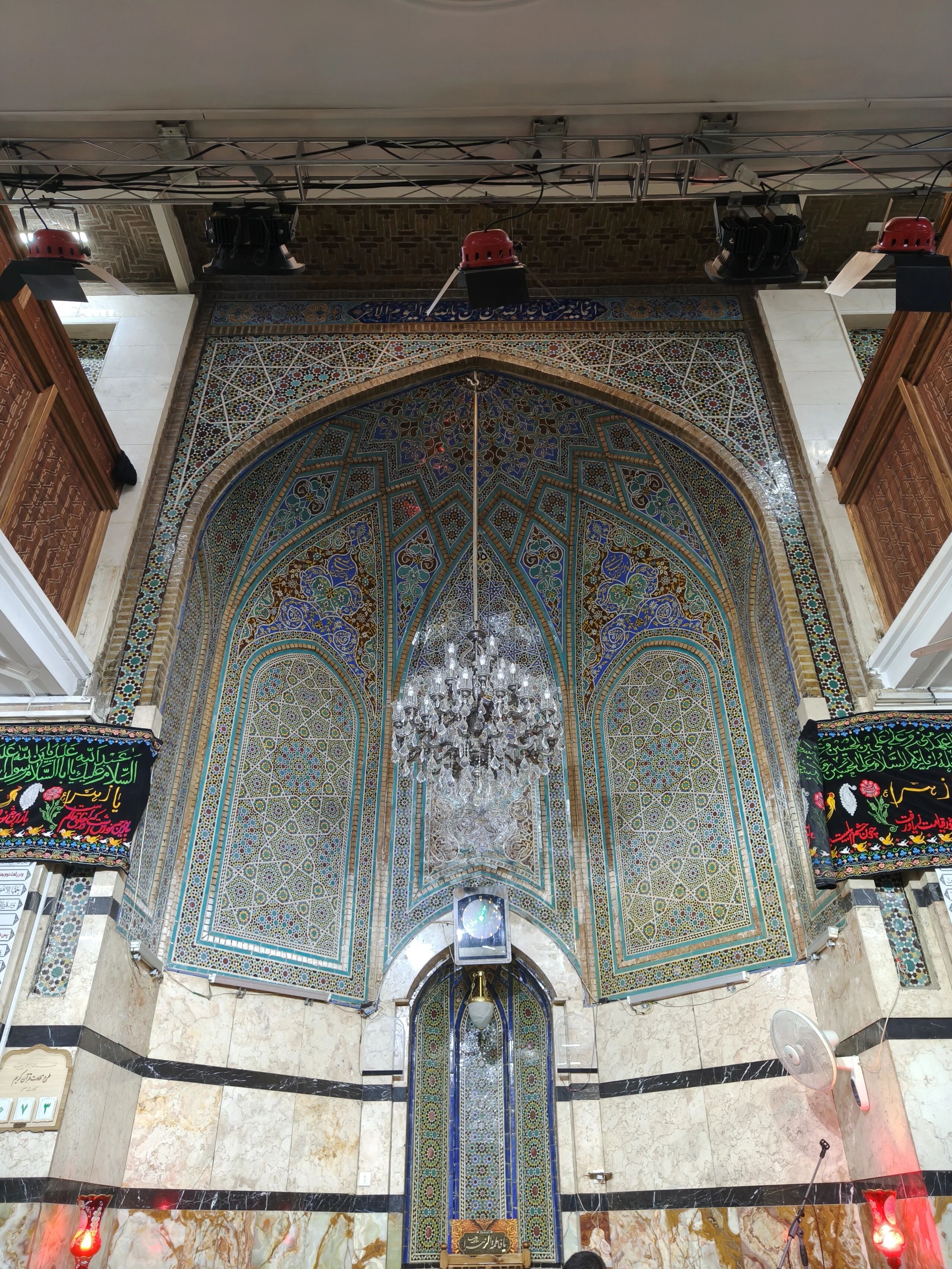
I landed in Tehran, Iran, on a Thursday night and woke up the next morning on Friday, which is the Jumu'ah day. However, I found the doors of the mosque near where I was staying were locked tight.
(Photo 1) Not only that, but a large mosque the motorcycle taxi driver took me to, Imam Khamenei Mosque, was also closed. I ran to all the nearby mosques, but not a single one was open. I noticed that only a few shops at the entrance of the bazaar were open, while everything inside was completely shut.
I was totally confused as to why the mosques were all closed on the day of congregational prayer, so I just walked around until I reached the area near Golestan Palace. I met a guy who spoke English and later found out he was a tour guide. He told me that only one mosque in Tehran stays open on Fridays, while all the others are closed.
This way, everyone can gather together in one place for prayer. So that was it. Actually, I had heard of similar things before, where some small mosques do not hold the noon Jumu'ah prayer on Fridays. The worshippers from those mosques then have to go to a larger mosque further away to attend the congregational prayer.
But I still cannot understand why a place like Tehran, with its huge population and large city area, only keeps one mosque open on Fridays.
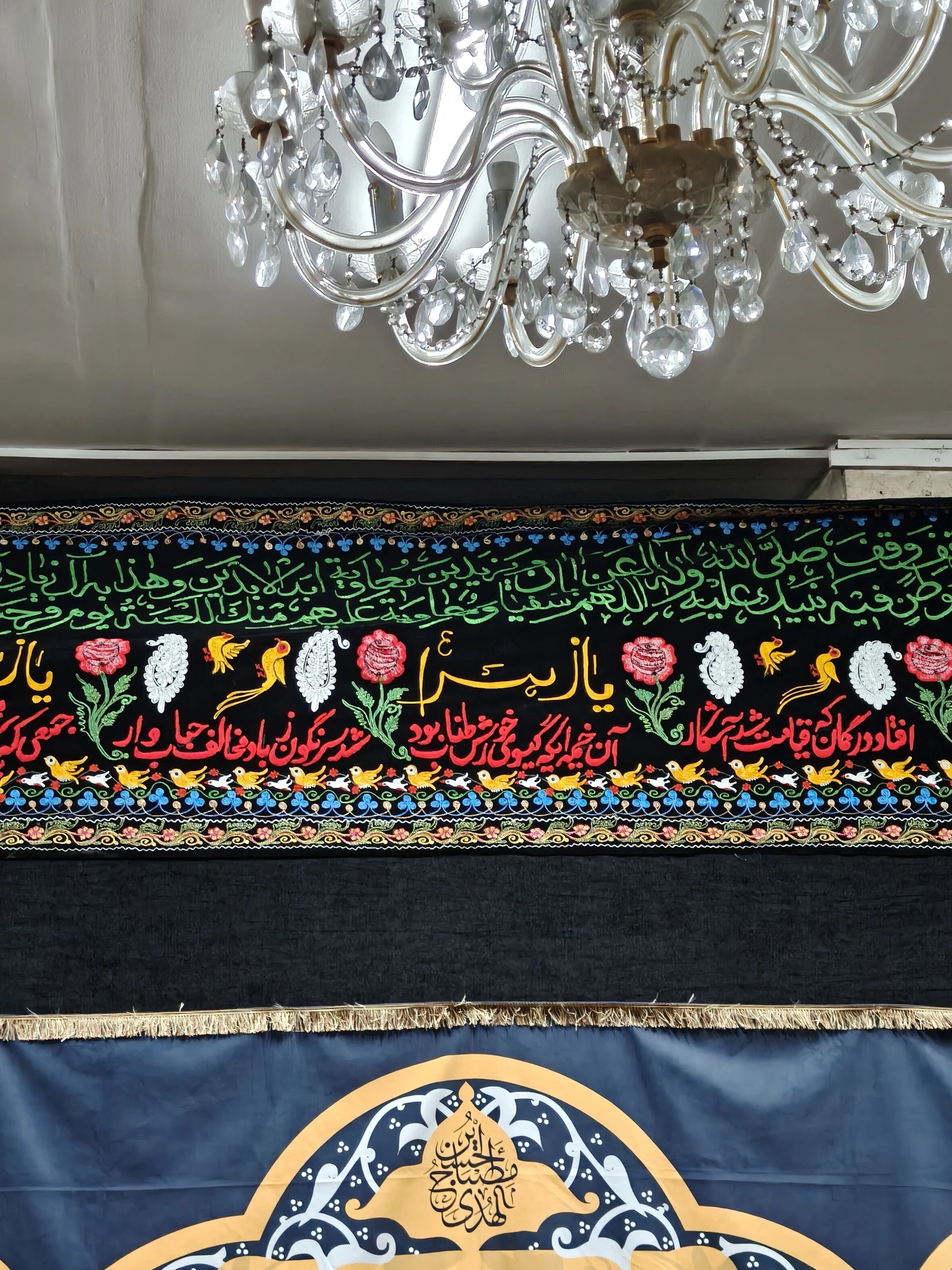
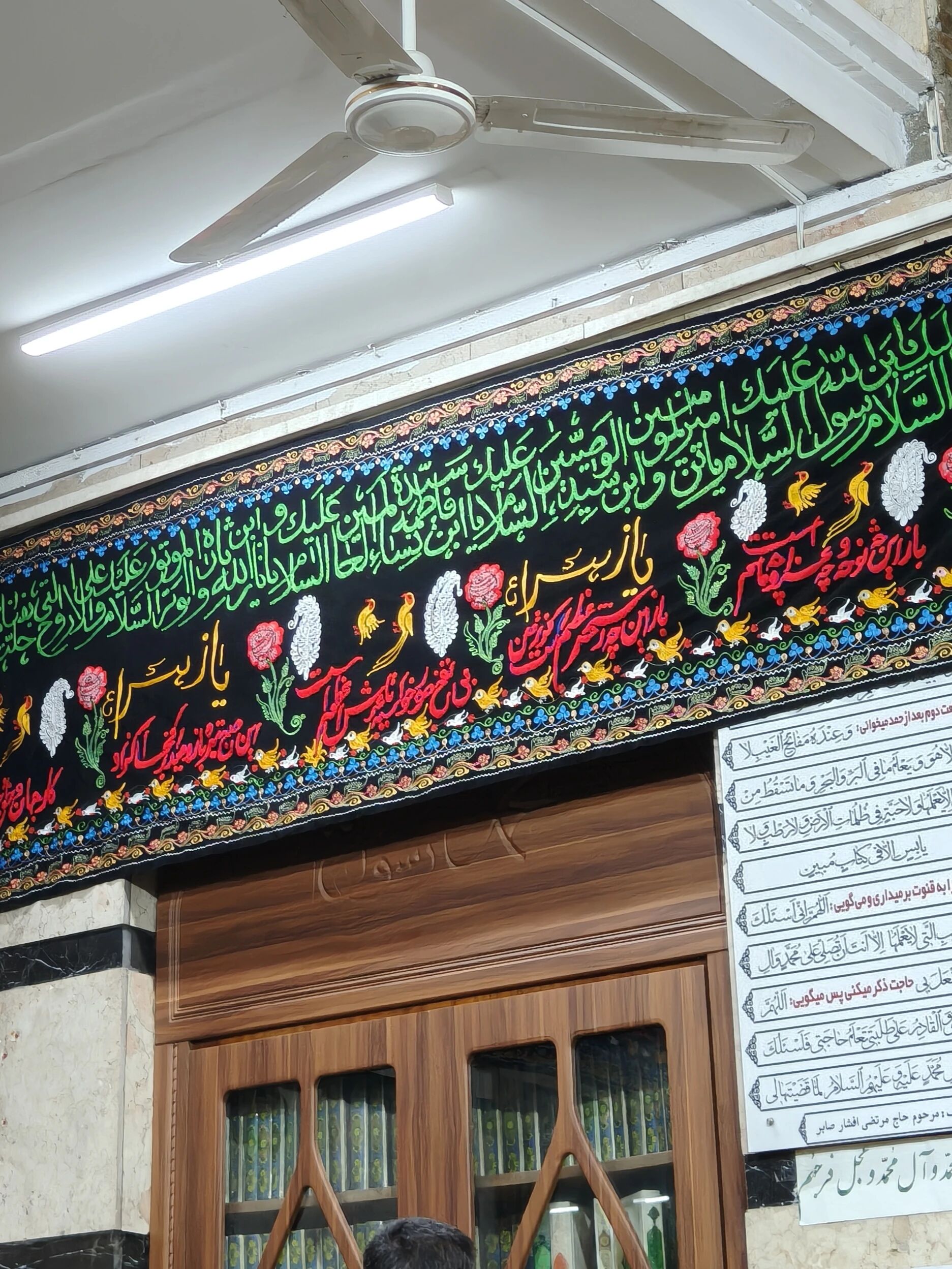
I went back after Friday, and the mosque was indeed open, and the bazaar was packed with people. I went to the small mosque near where I was staying again. I found some banners hanging inside, decorated with flowers and birds.
(Photos 5 and 6) A long-tailed bird and a small bird are tucked between the calligraphy.
Generally speaking, animal images are not allowed inside a mosque, but in real life, you can still see some decorative animal figures.
For example, some ancient mosques in China still have roof beasts on their ridges, and there is a madrasa in Central Asia with a lion carrying the sun on its gate.
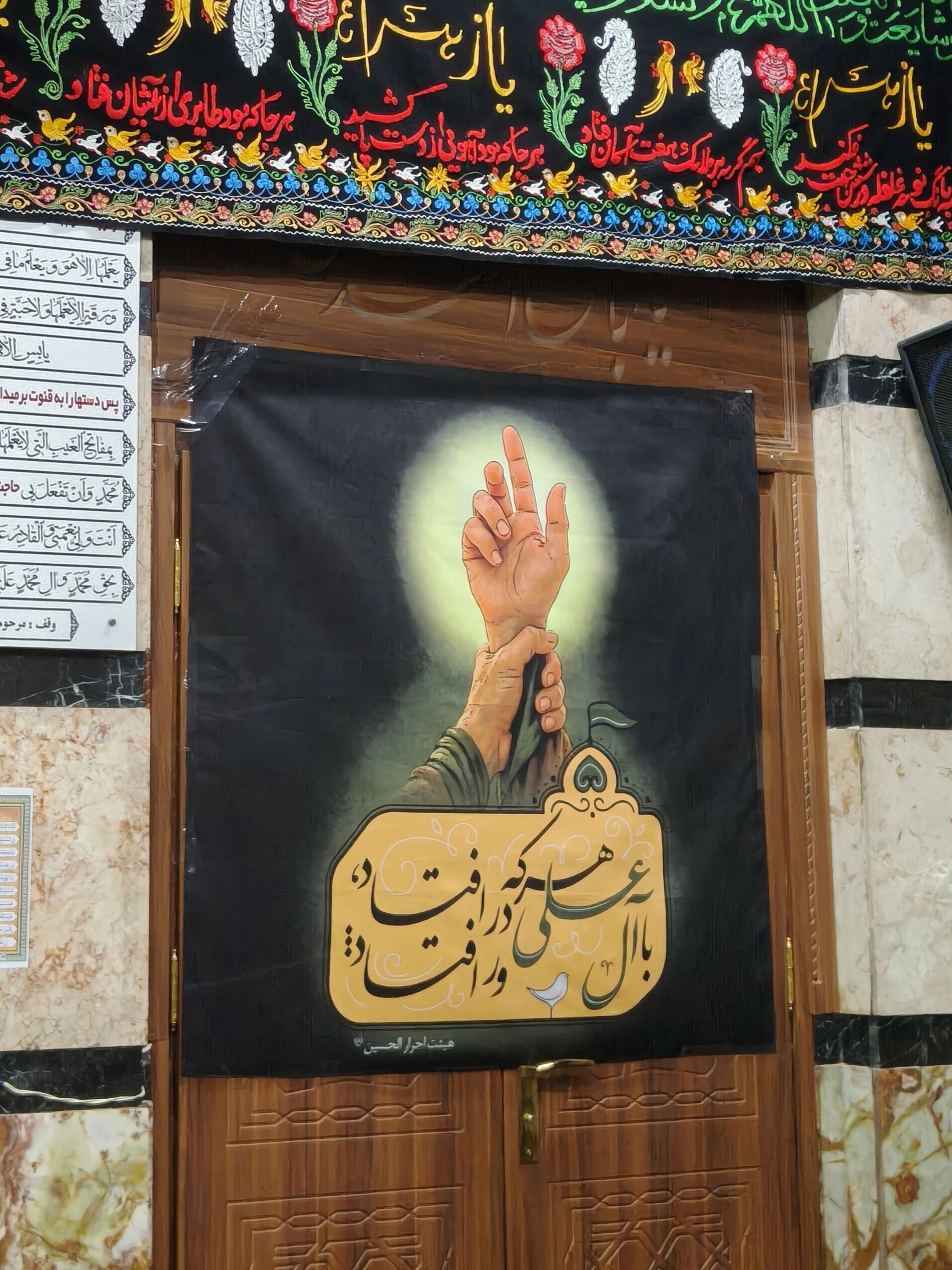
Besides the embroidery, I also saw a hanging painting like the one in photo 7 inside the main hall. The painting shows one hand grabbing another hand by the wrist and raising it up. This likely shows the scene where the Prophet Muhammad raised his cousin Ali as his successor.
After finishing my namaz, I went near the British Embassy to exchange money, though money does not last long here. I exchanged 240 US dollars, and it was gone in two days without me spending much. ATM machines in Iran do not accept Visa cards, UnionPay, or WeChat Pay.
As foreigners, we have to bring enough US dollars in cash to exchange there, then carry several bundles of cash around in our bags. It is still very inconvenient. view all
Summary: This Iran Muslim travel guide follows a Friday in Tehran, when nearby mosques and the bazaar were closed, then returns after Jumu'ah day to see a small mosque, flower-and-bird embroidery, a Shia-themed image, and the practical challenge of carrying cash in Iran.
I landed in Tehran, Iran, on a Thursday night and woke up the next morning on Friday, which is the Jumu'ah day. However, I found the doors of the mosque near where I was staying were locked tight.
(Photo 1) Not only that, but a large mosque the motorcycle taxi driver took me to, Imam Khamenei Mosque, was also closed. I ran to all the nearby mosques, but not a single one was open. I noticed that only a few shops at the entrance of the bazaar were open, while everything inside was completely shut.
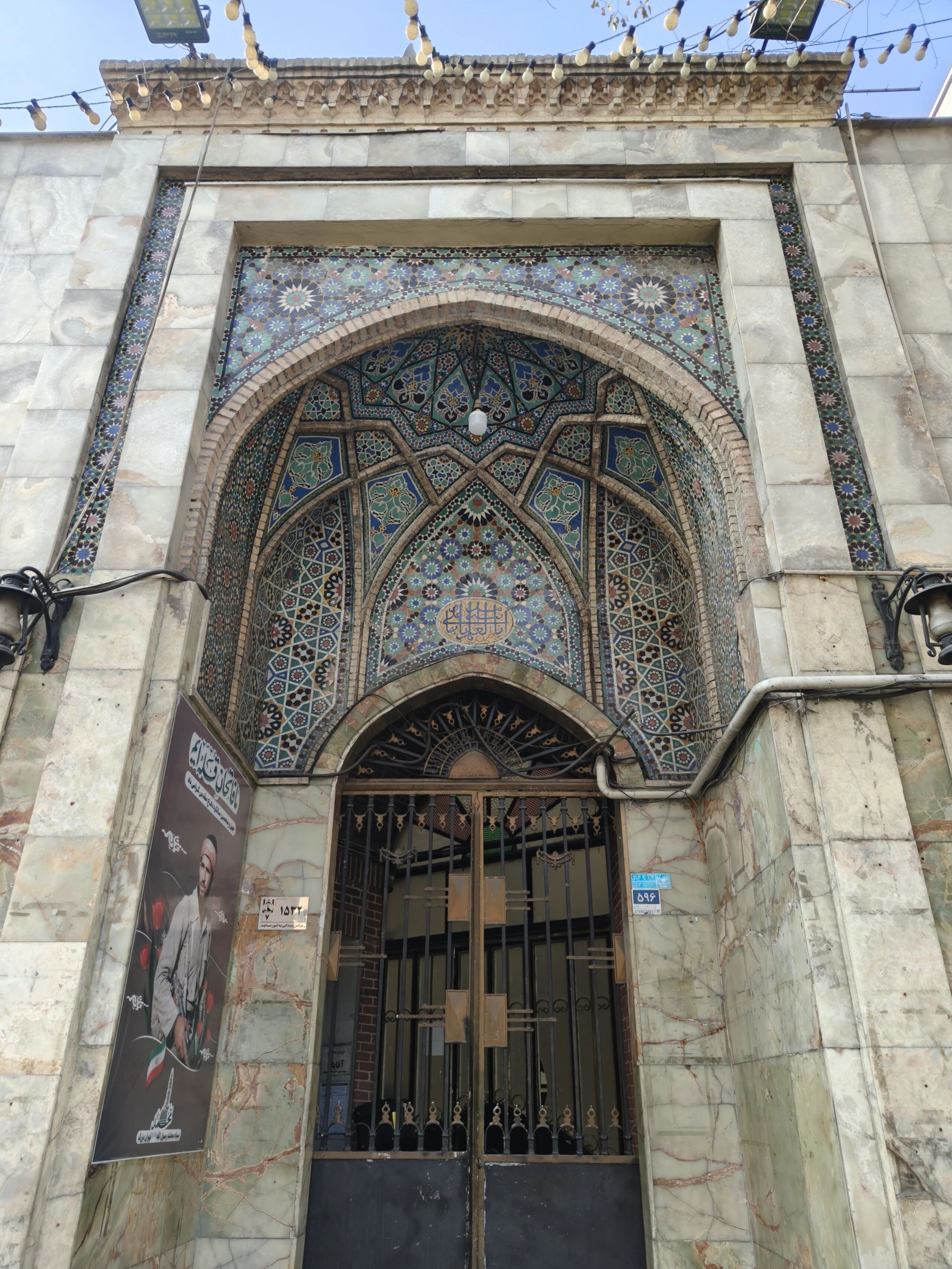
I was totally confused as to why the mosques were all closed on the day of congregational prayer, so I just walked around until I reached the area near Golestan Palace. I met a guy who spoke English and later found out he was a tour guide. He told me that only one mosque in Tehran stays open on Fridays, while all the others are closed.
This way, everyone can gather together in one place for prayer. So that was it. Actually, I had heard of similar things before, where some small mosques do not hold the noon Jumu'ah prayer on Fridays. The worshippers from those mosques then have to go to a larger mosque further away to attend the congregational prayer.
But I still cannot understand why a place like Tehran, with its huge population and large city area, only keeps one mosque open on Fridays.
I went back after Friday, and the mosque was indeed open, and the bazaar was packed with people. I went to the small mosque near where I was staying again. I found some banners hanging inside, decorated with flowers and birds.
(Photos 5 and 6) A long-tailed bird and a small bird are tucked between the calligraphy.
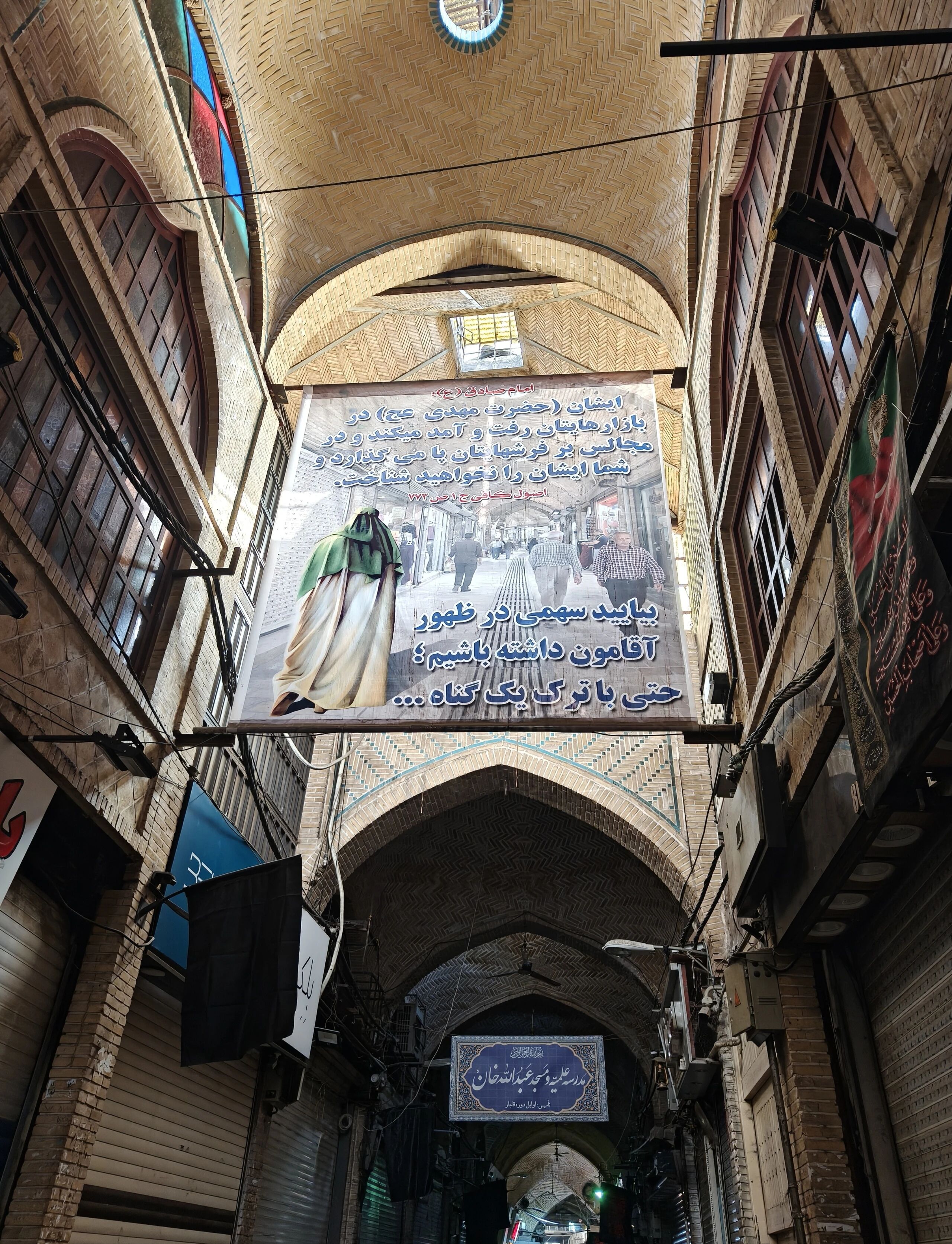
Generally speaking, animal images are not allowed inside a mosque, but in real life, you can still see some decorative animal figures.
For example, some ancient mosques in China still have roof beasts on their ridges, and there is a madrasa in Central Asia with a lion carrying the sun on its gate.
Besides the embroidery, I also saw a hanging painting like the one in photo 7 inside the main hall. The painting shows one hand grabbing another hand by the wrist and raising it up. This likely shows the scene where the Prophet Muhammad raised his cousin Ali as his successor.
After finishing my namaz, I went near the British Embassy to exchange money, though money does not last long here. I exchanged 240 US dollars, and it was gone in two days without me spending much. ATM machines in Iran do not accept Visa cards, UnionPay, or WeChat Pay.
As foreigners, we have to bring enough US dollars in cash to exchange there, then carry several bundles of cash around in our bags. It is still very inconvenient.
Muslim Travel Guide Iran Tehran: Imam Khomeini Airport Prayer Room, Wudu Area and Shia Travel Notes
Articles • yusuf908 posted the article • 0 comments • 181 views • 2026-05-23 22:47
Summary: This Iran Muslim travel guide starts at Imam Khomeini International Airport in Tehran, covering the author's Oman transfer, airport money exchange, the first-floor prayer room, shoe area, Shia-style decoration, mohr prayer stones, Qur'an copies with Persian translation, and the first impression of Iran.
Since visiting a Shia mosque in Singapore last time, my interest in Shia Islam has grown, and I even thought about exploring a Shia country.
So, I stopped over in Oman (Oman has a minority sect independent of Sunni Islam called Ibadi Islam; I will share what I saw and heard in Oman later) and landed at Imam Khomeini International Airport in the capital of Iran.
I do not understand why they chose different characters for the transliteration; isn't Imam Khomeini just Imam Khomeini?
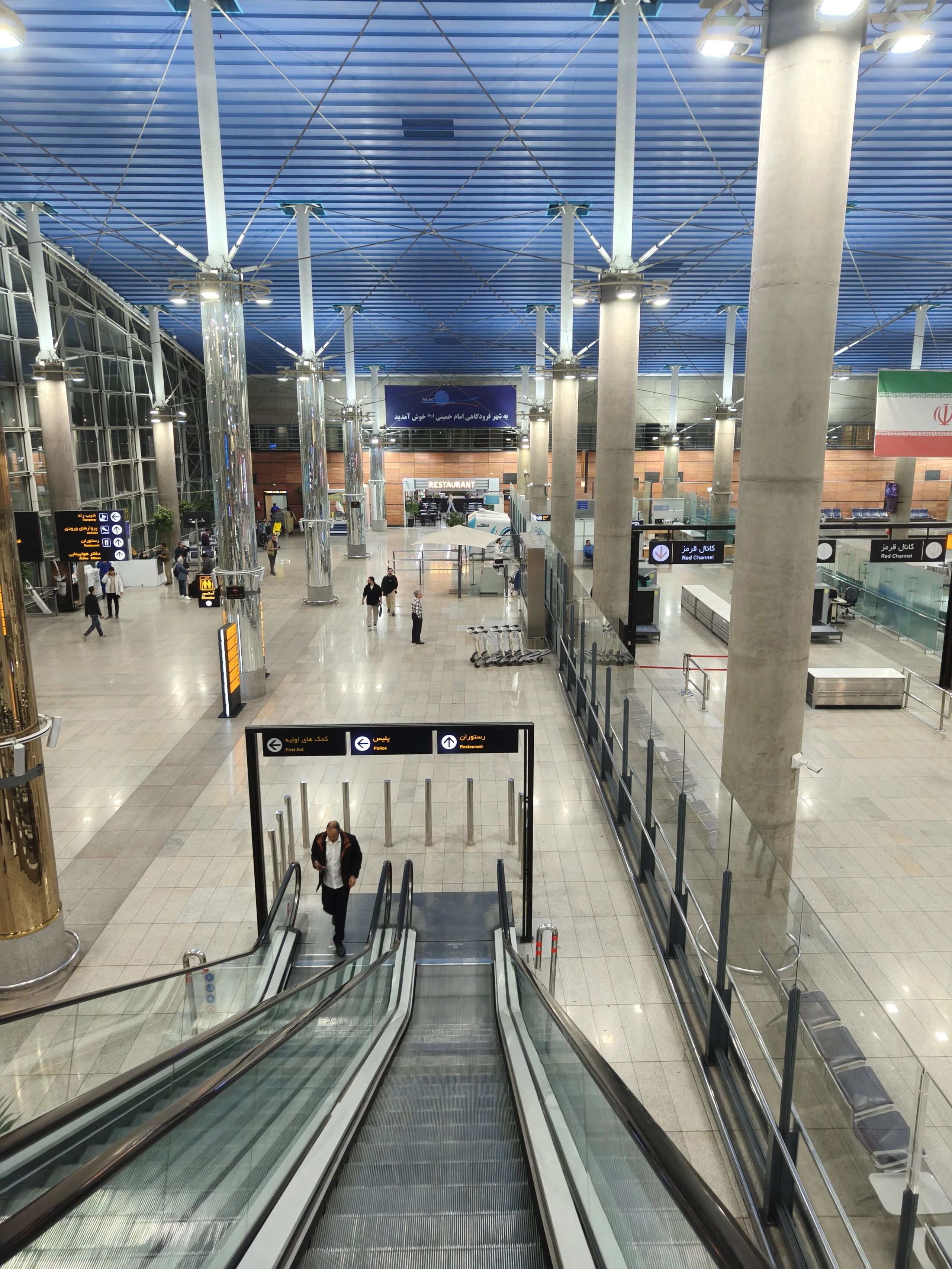
This airport looks a bit old. I had just flown from the new terminal at Lanzhou Zhongchuan Airport to Beijing Capital Airport, then from Daxing Airport to Muscat Airport in Oman for my layover. So for me, the contrast was very obvious.
Back to the point, the first thing to do after landing is to exchange money. I suggest you only exchange enough for your taxi fare at the airport. You should exchange the bulk of your money in the city. The exchange rate in the city is very different from the airport; for the same amount of money, you can get 1.2 million in the city, but the airport will only give you 750,000.
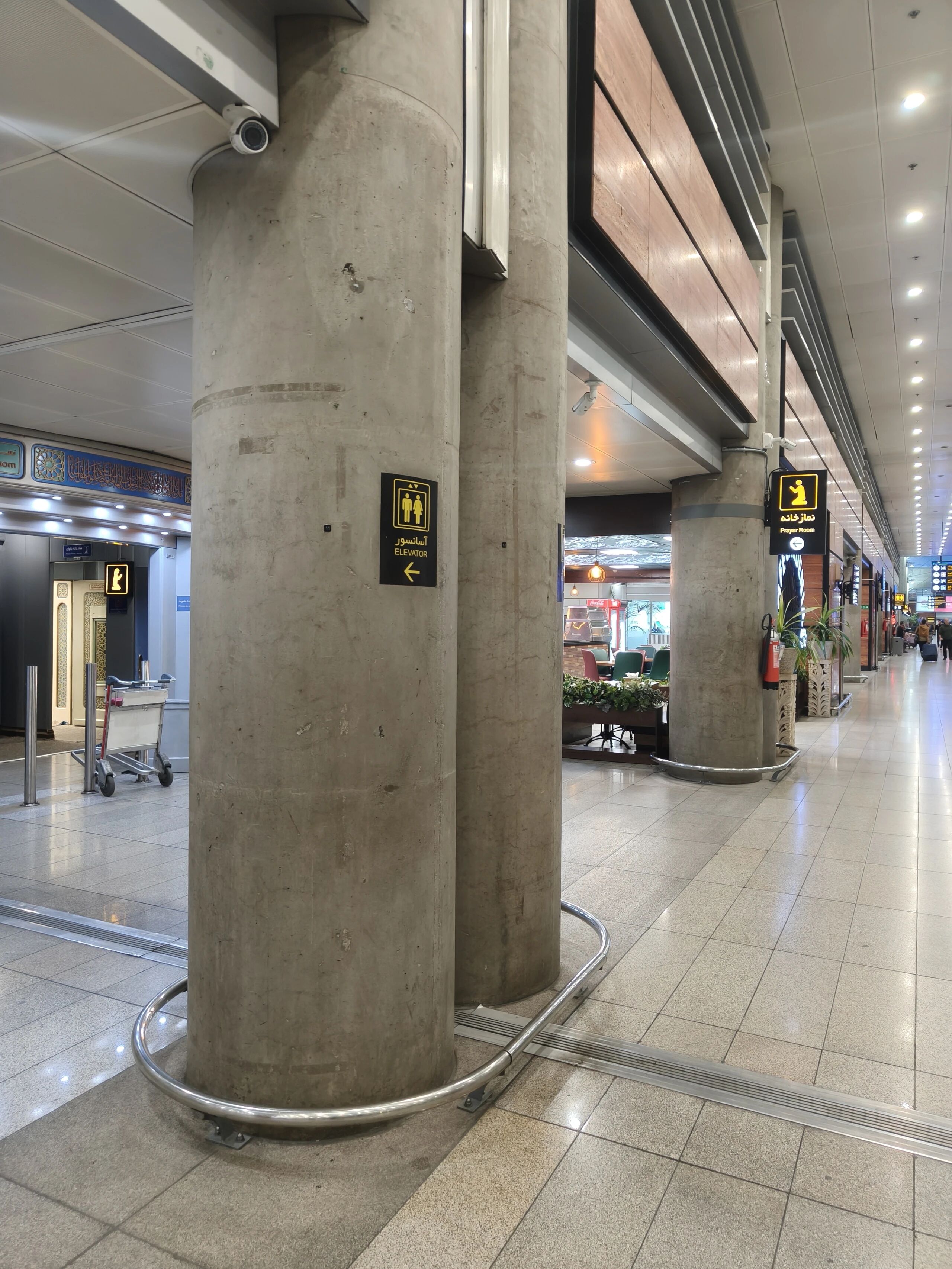
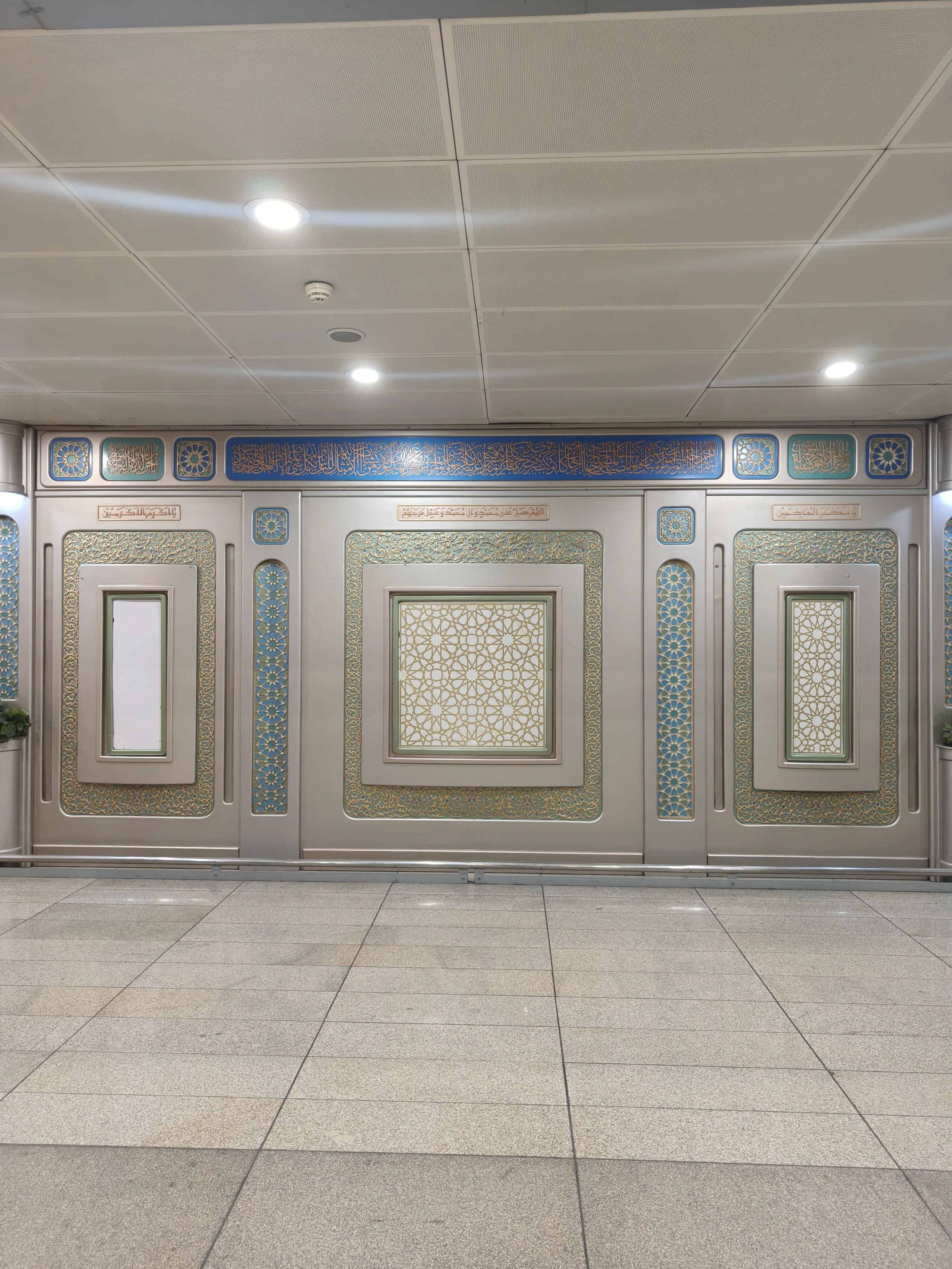
This gap is quite large. (Airport currency exchange counters are often like this, but the one at the Iranian airport felt especially harsh.) After exchanging money, I went to the first floor and noticed the prayer room (Photos 3 and 4). Its decoration style is different from the simple style in Malaysia, Oman, and Singapore.
It happened to be time for namaz, so I stepped into the prayer space in Iran.
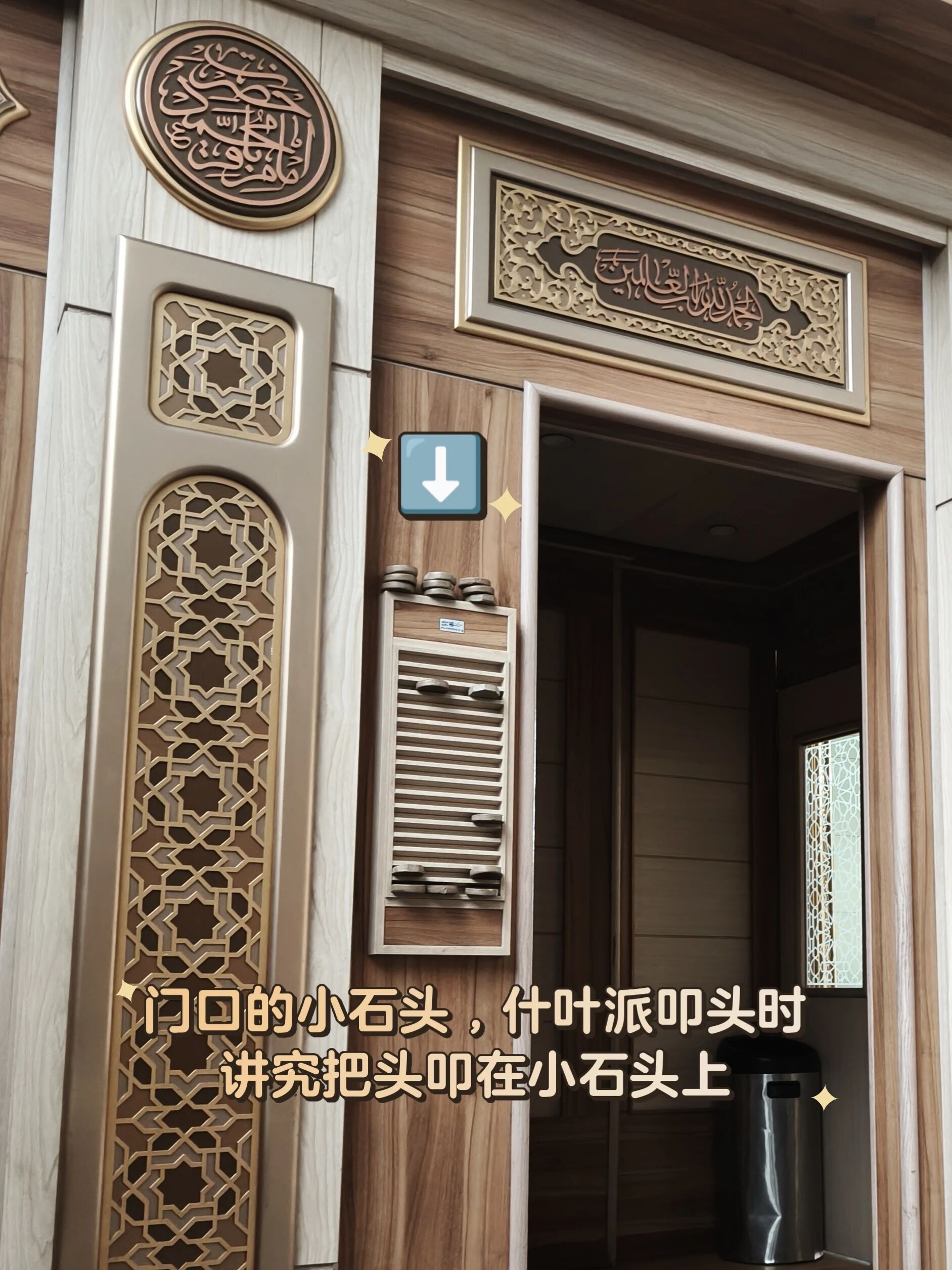
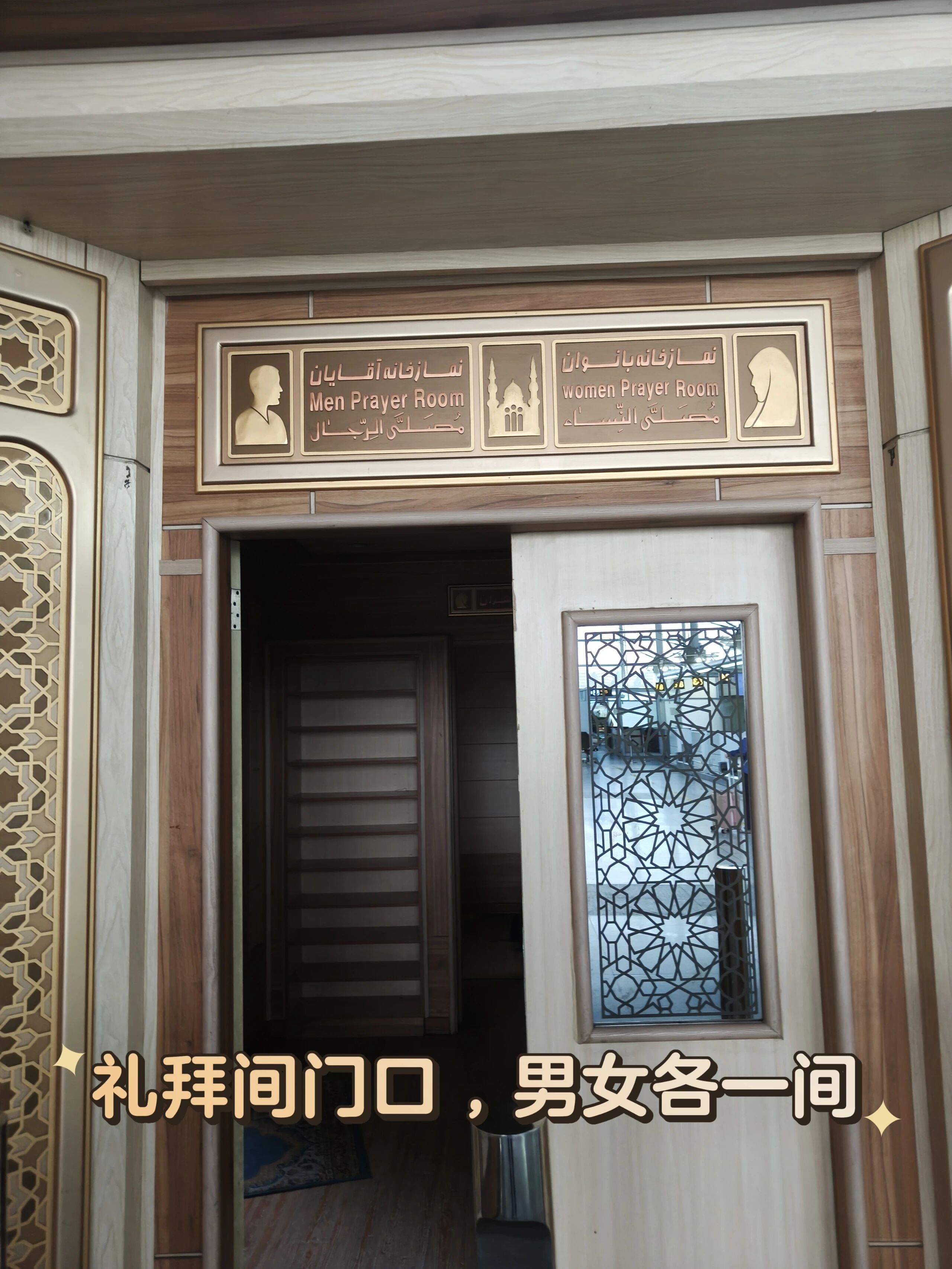
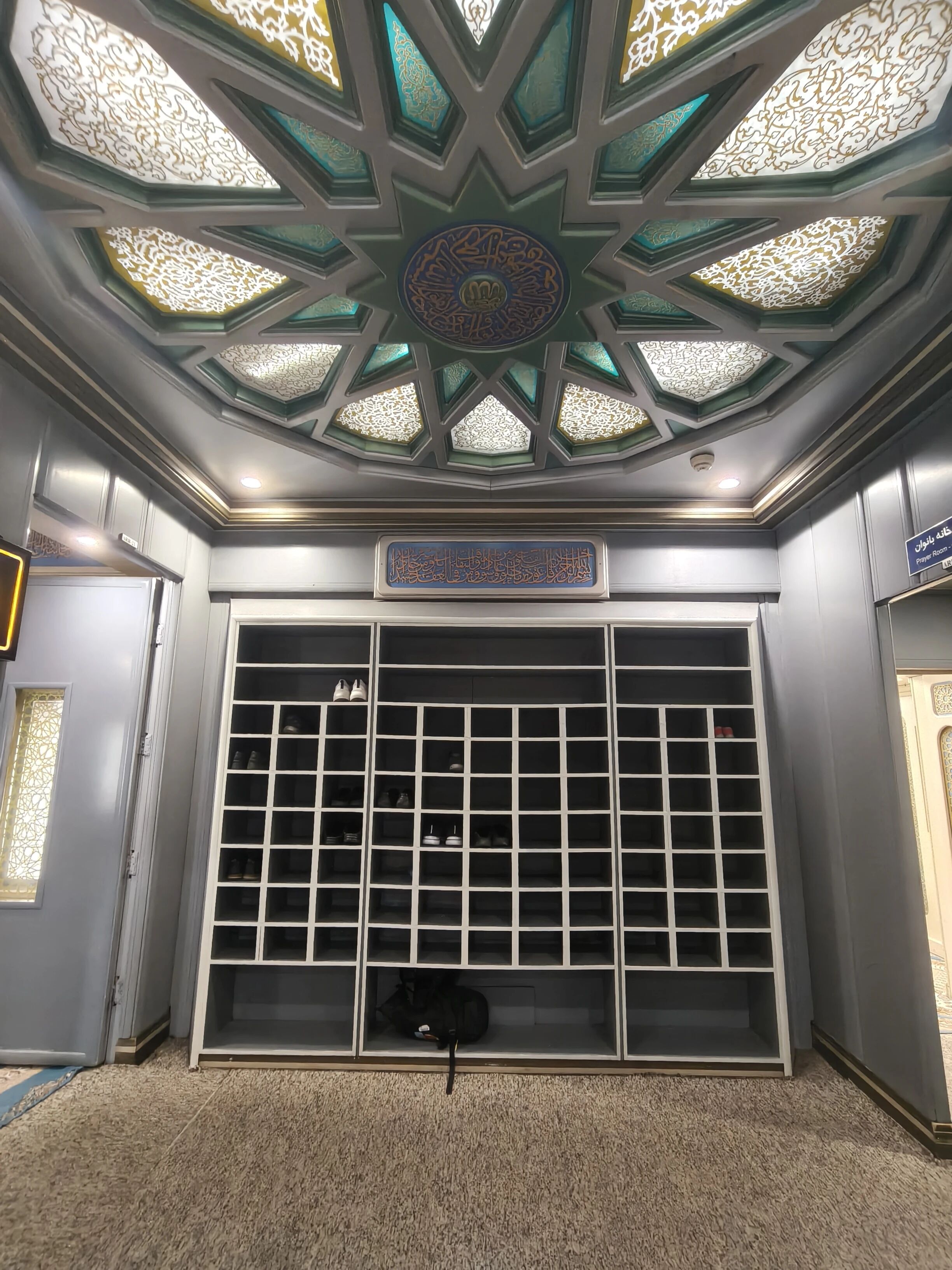
Photo 5 shows the entryway, where you must put your shoes in the cubbies. On the left is the men's prayer room, and on the right is the women's prayer room. As soon as I walked in, I noticed something I had never seen in any other mosque or prayer room I had visited before: small stone tablets.
(Photo 6) Even the Shia mosque I visited in Singapore earlier did not have these.
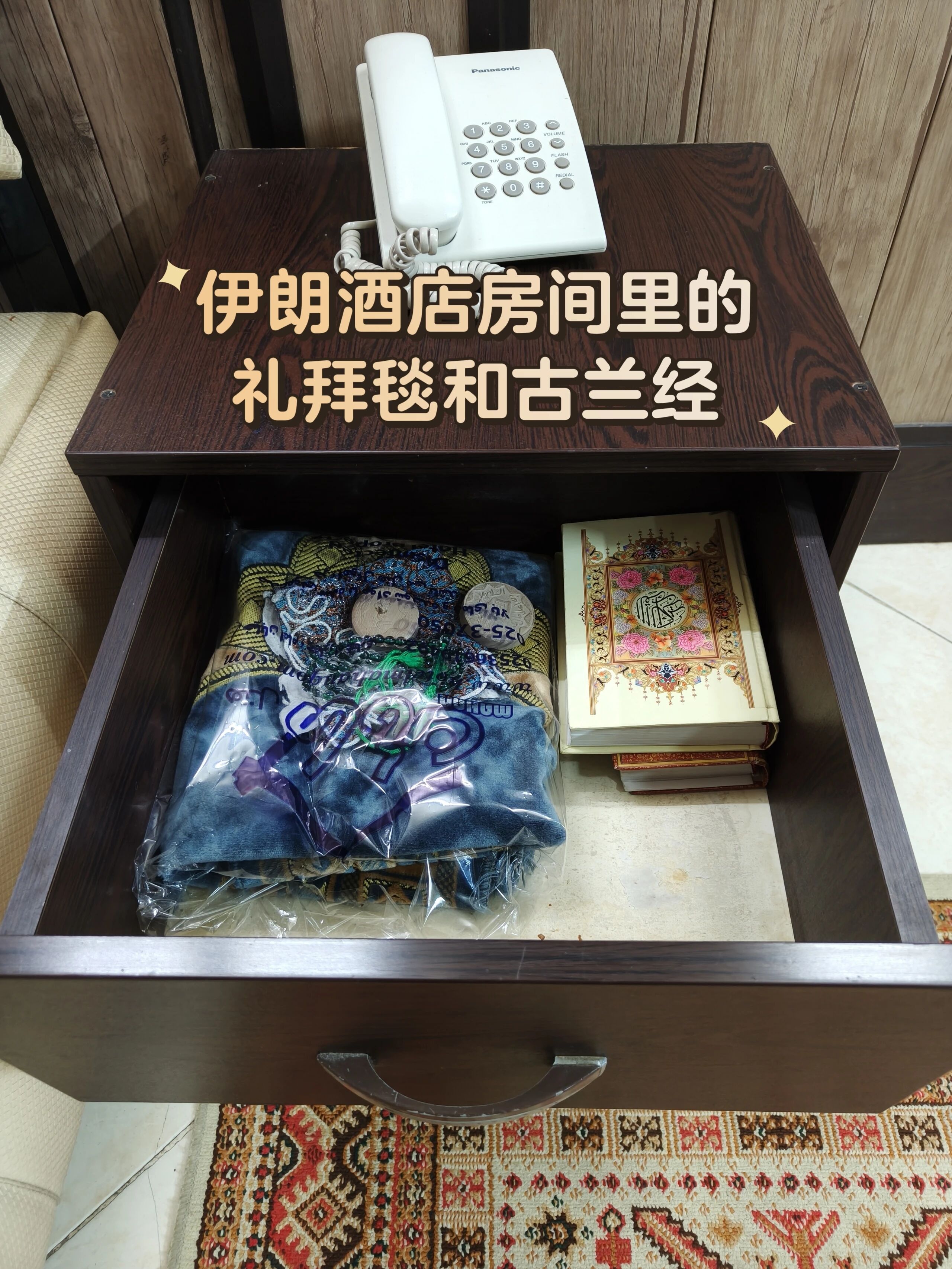
During namaz, I noticed that everyone here had one, placing it exactly where their forehead would touch the ground. (Photo 7, Photo 8) I picked one up too. It was about the size of a chess piece, felt like brick, and had a smooth surface that did not crumble. It had the words "Ya (a call) Husayn" written on it.
This must be a way to express grief for the Prophet's grandson who died at the hands of his enemies.
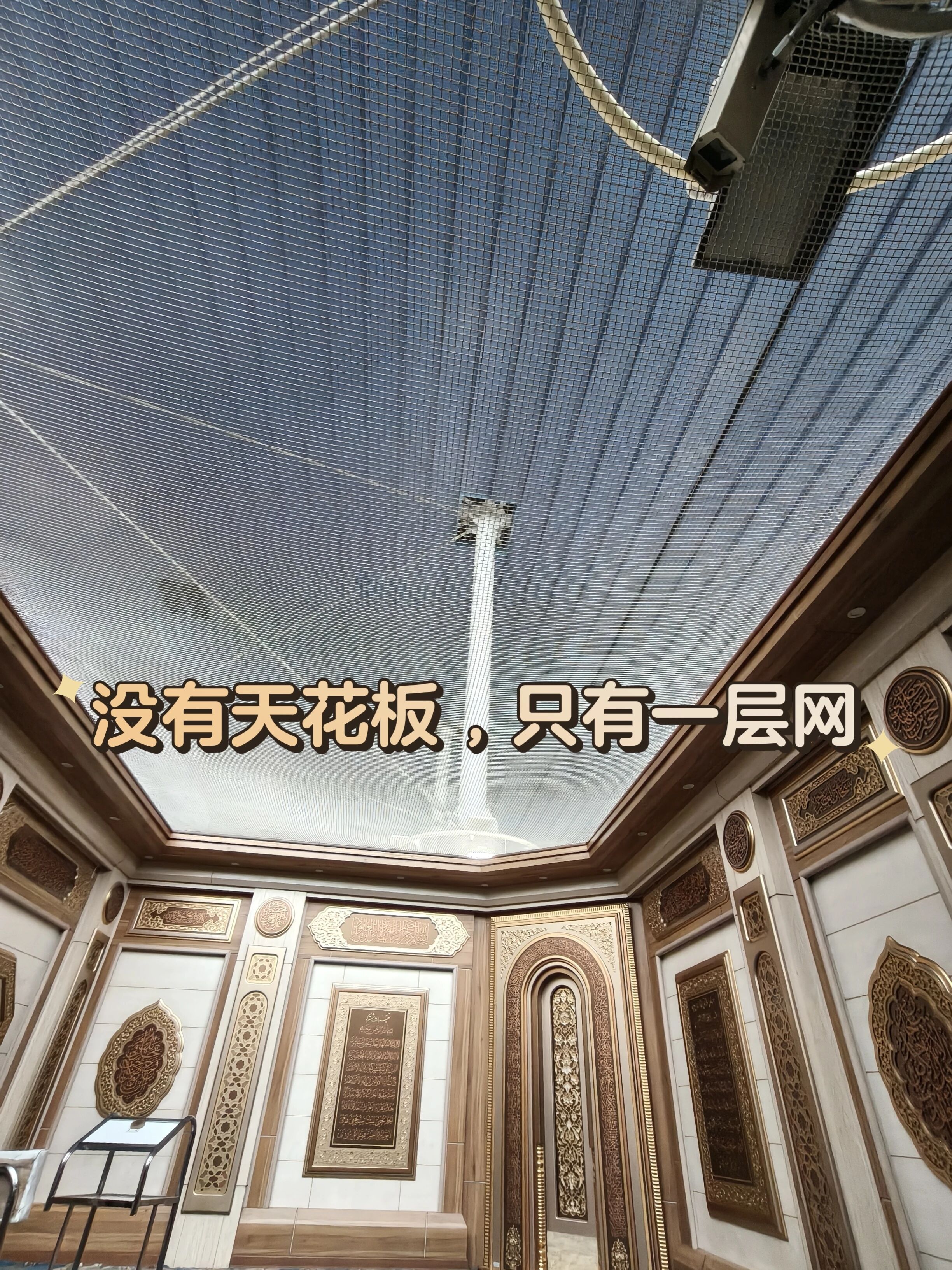
After namaz, I took a panoramic shot of the room. It is quite large, and the ceiling and walls are decorated.
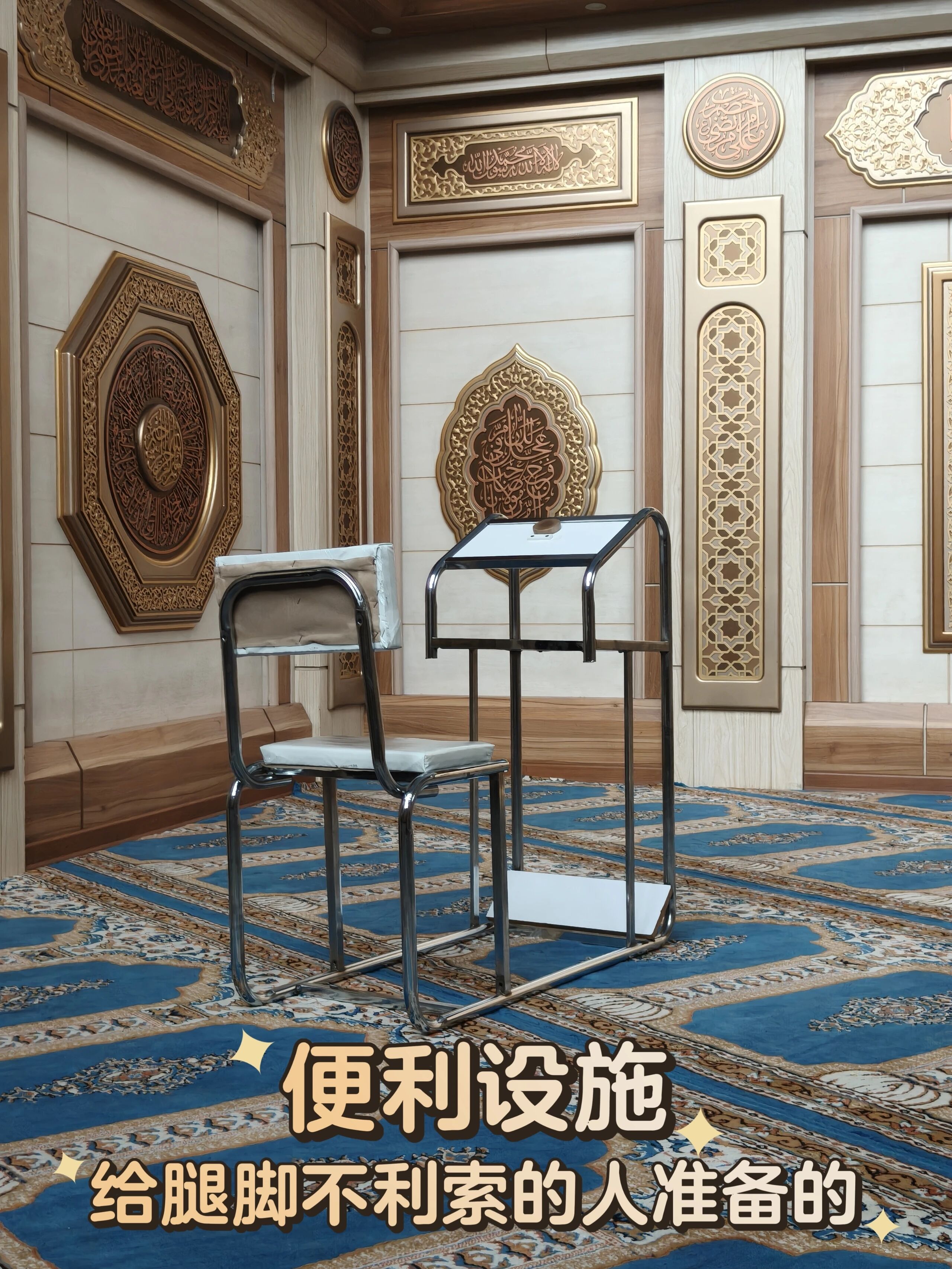
You might notice a row of chairs with small desks on the right side of the prayer hall (Photo 11). What are these for? These are for Muslims who have trouble walking or have back problems.
Because of their physical condition, they cannot stand, bow, or prostrate during namaz, so they must pray while sitting in these chairs. These small chairs are not rare; you can find them in almost every mosque, and they are not unique to the Shia sect.
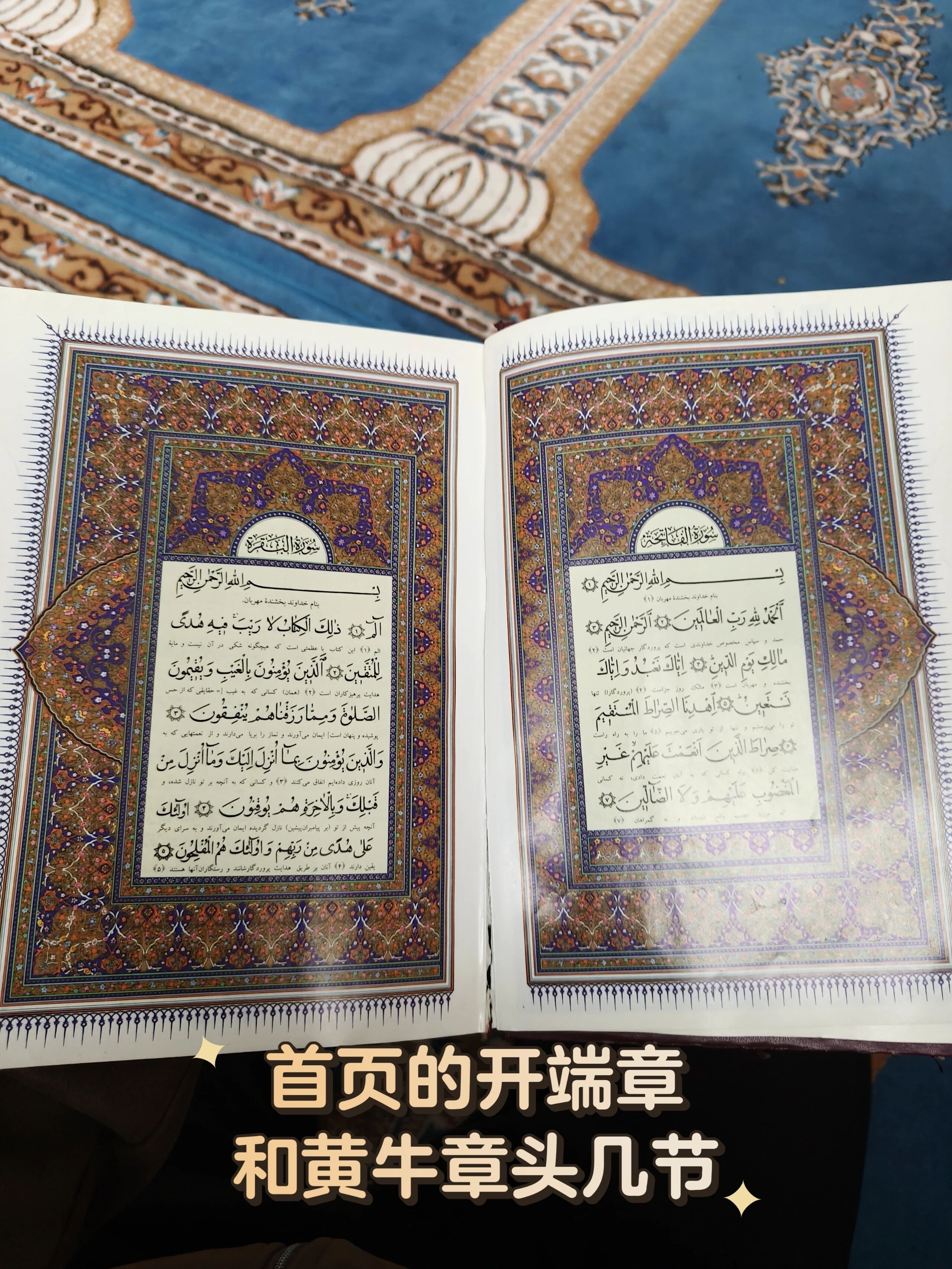
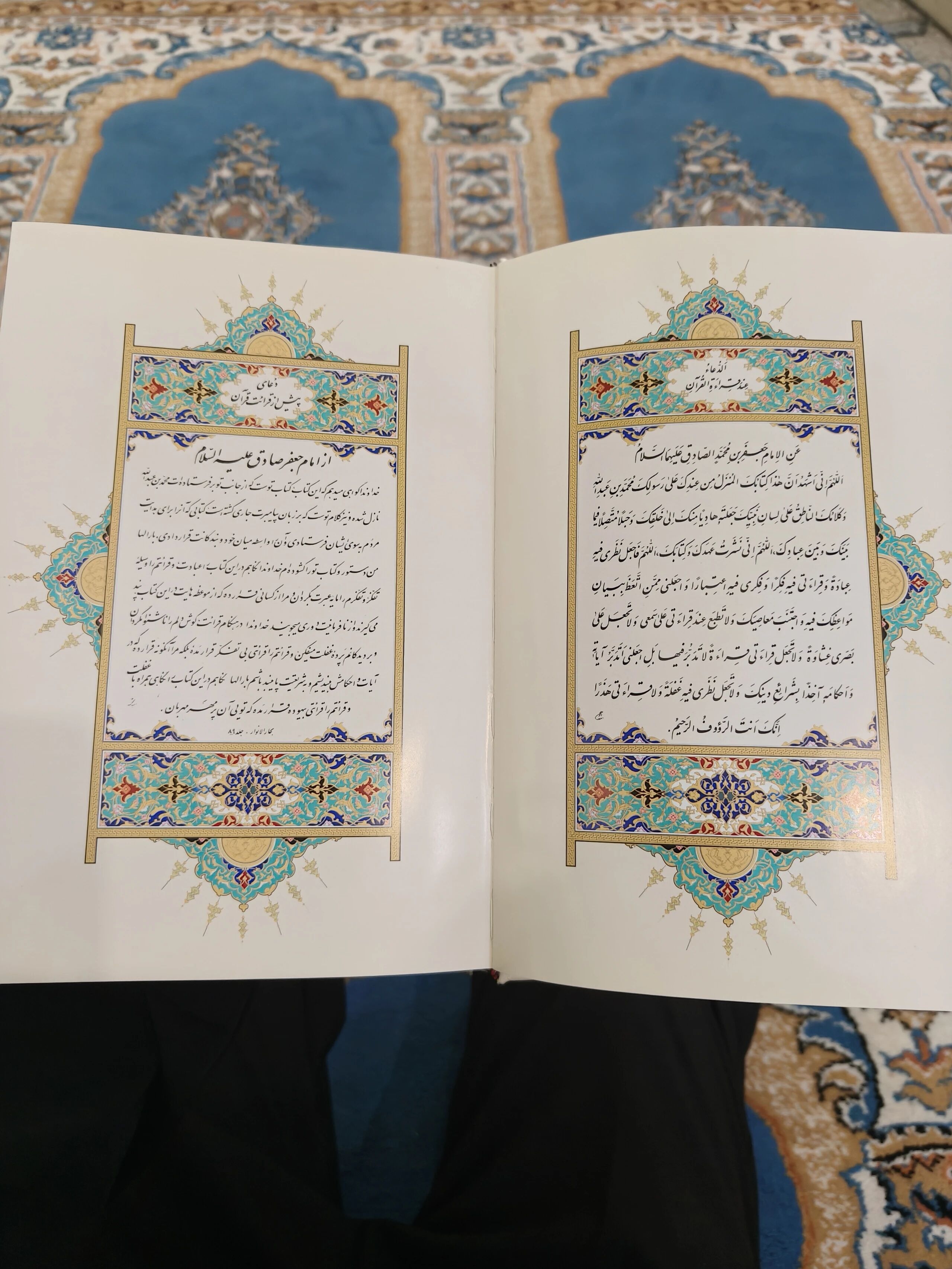
Behind this prayer room, there is a place for storing calligraphy (Photo 13). I picked up a Qur'an, and since I was in Iran, the cover naturally featured elegant Persian calligraphy (Photo 14). The preface on the first page was also written in Persian calligraphy.
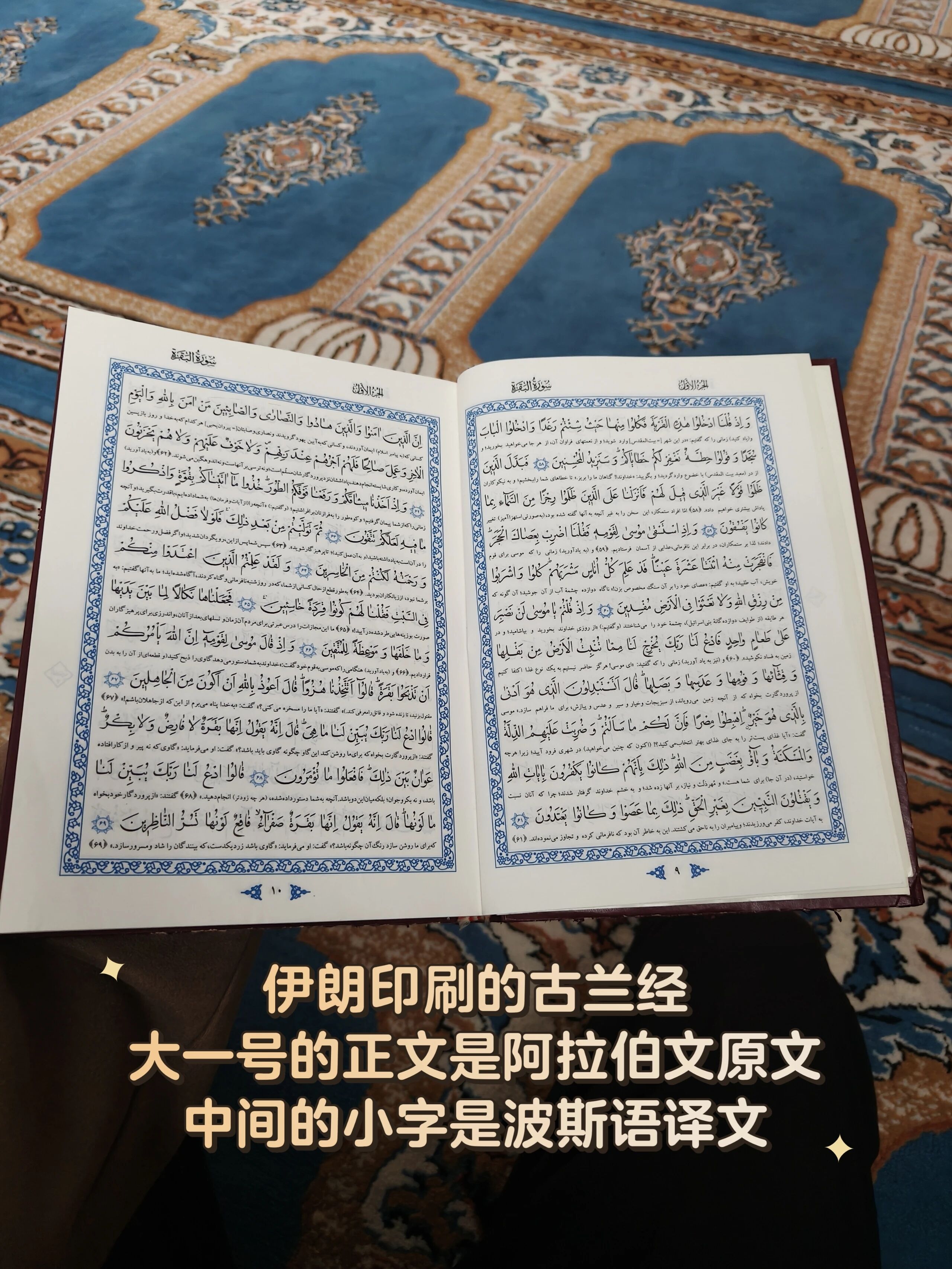
I opened the main text of the Qur'an and noticed a line of small print underneath the verses (Photo 16), which was a Persian translation.
After that, I left the prayer room and got into a taxi heading to downtown Tehran. What kind of experiences will I have in Iran ahead? The next part will be updated soon. view all
Summary: This Iran Muslim travel guide starts at Imam Khomeini International Airport in Tehran, covering the author's Oman transfer, airport money exchange, the first-floor prayer room, shoe area, Shia-style decoration, mohr prayer stones, Qur'an copies with Persian translation, and the first impression of Iran.
Since visiting a Shia mosque in Singapore last time, my interest in Shia Islam has grown, and I even thought about exploring a Shia country.
So, I stopped over in Oman (Oman has a minority sect independent of Sunni Islam called Ibadi Islam; I will share what I saw and heard in Oman later) and landed at Imam Khomeini International Airport in the capital of Iran.
I do not understand why they chose different characters for the transliteration; isn't Imam Khomeini just Imam Khomeini?
This airport looks a bit old. I had just flown from the new terminal at Lanzhou Zhongchuan Airport to Beijing Capital Airport, then from Daxing Airport to Muscat Airport in Oman for my layover. So for me, the contrast was very obvious.
Back to the point, the first thing to do after landing is to exchange money. I suggest you only exchange enough for your taxi fare at the airport. You should exchange the bulk of your money in the city. The exchange rate in the city is very different from the airport; for the same amount of money, you can get 1.2 million in the city, but the airport will only give you 750,000.
This gap is quite large. (Airport currency exchange counters are often like this, but the one at the Iranian airport felt especially harsh.) After exchanging money, I went to the first floor and noticed the prayer room (Photos 3 and 4). Its decoration style is different from the simple style in Malaysia, Oman, and Singapore.
It happened to be time for namaz, so I stepped into the prayer space in Iran.
Photo 5 shows the entryway, where you must put your shoes in the cubbies. On the left is the men's prayer room, and on the right is the women's prayer room. As soon as I walked in, I noticed something I had never seen in any other mosque or prayer room I had visited before: small stone tablets.
(Photo 6) Even the Shia mosque I visited in Singapore earlier did not have these.
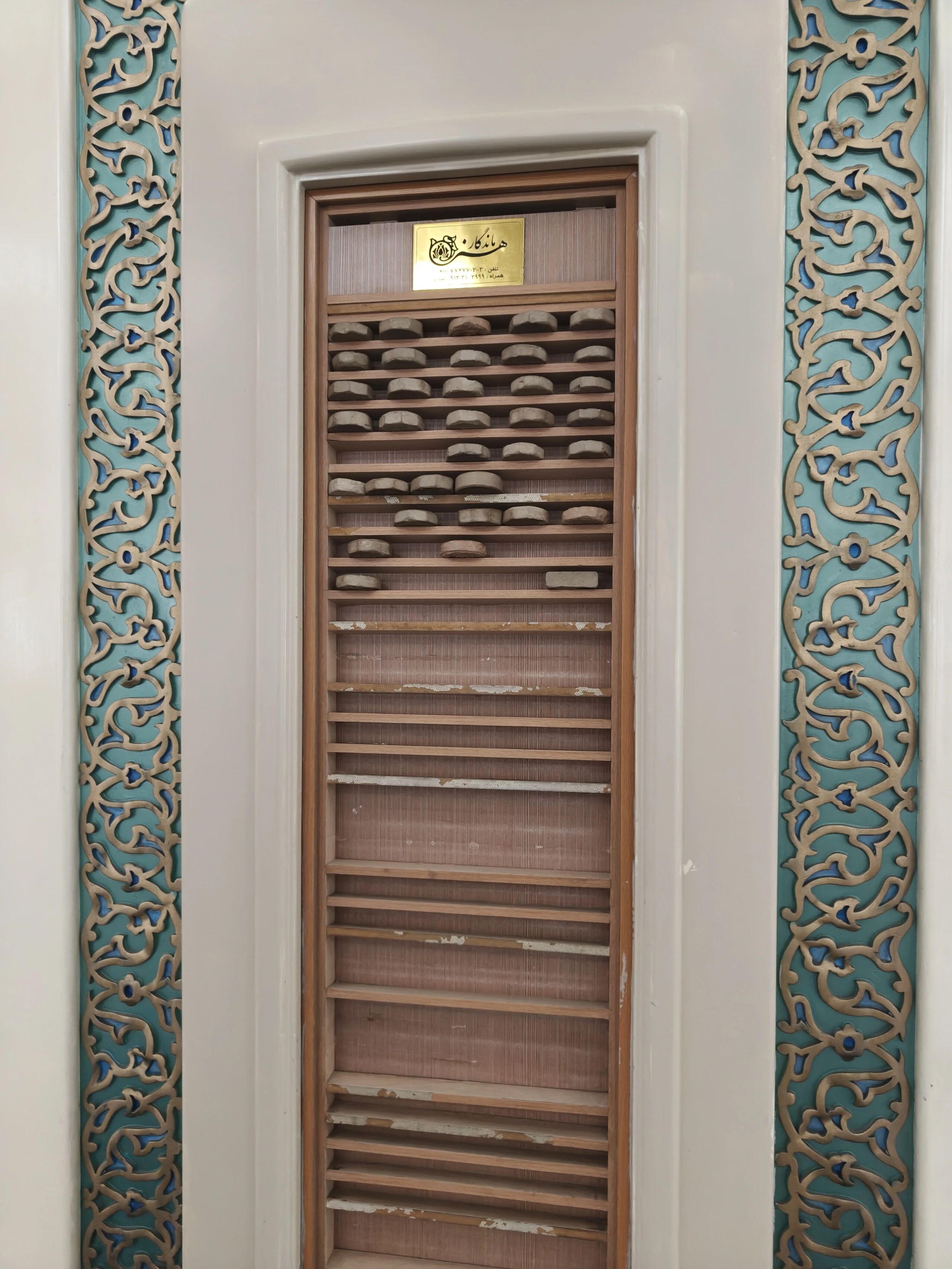
During namaz, I noticed that everyone here had one, placing it exactly where their forehead would touch the ground. (Photo 7, Photo 8) I picked one up too. It was about the size of a chess piece, felt like brick, and had a smooth surface that did not crumble. It had the words "Ya (a call) Husayn" written on it.
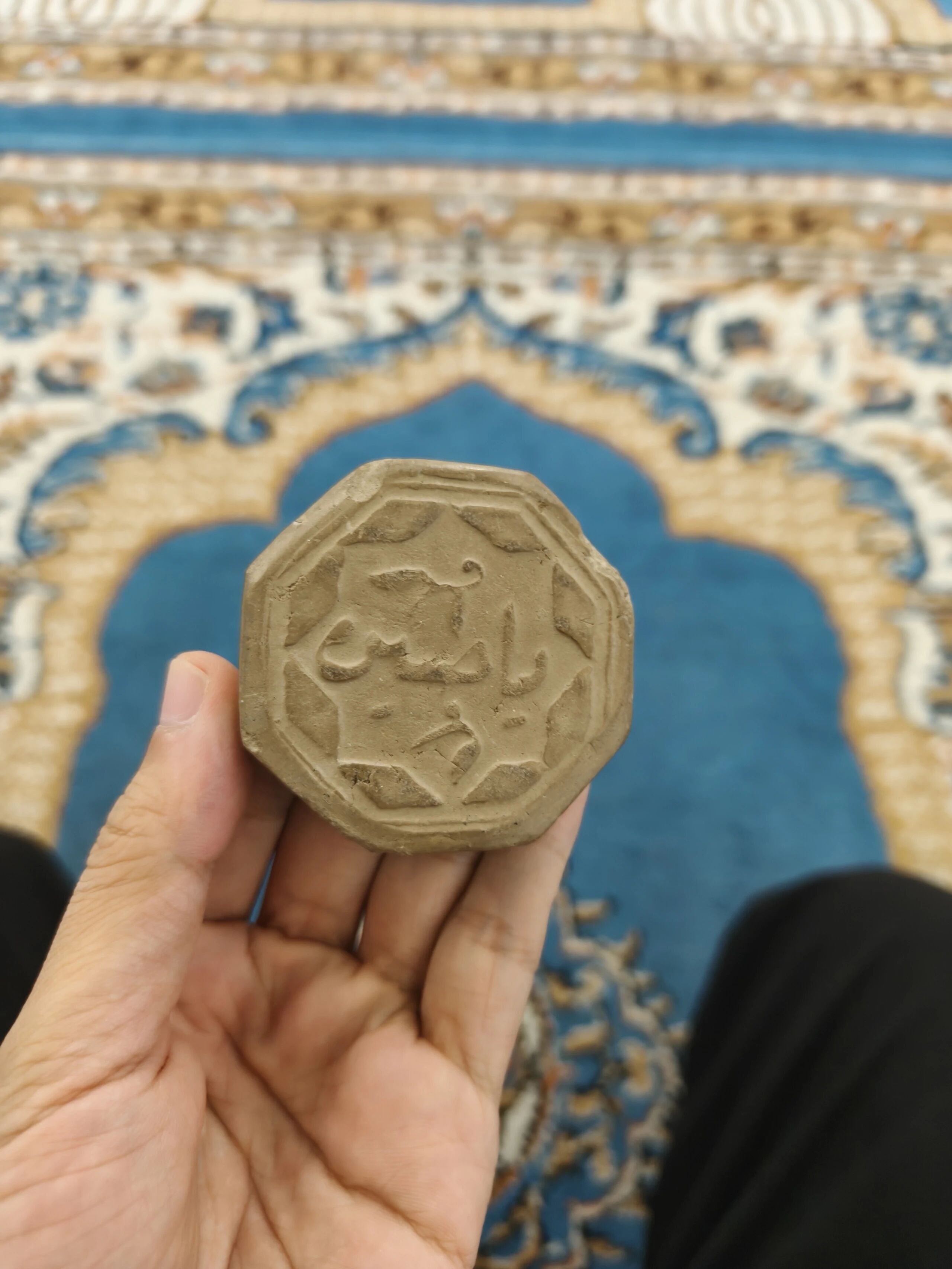
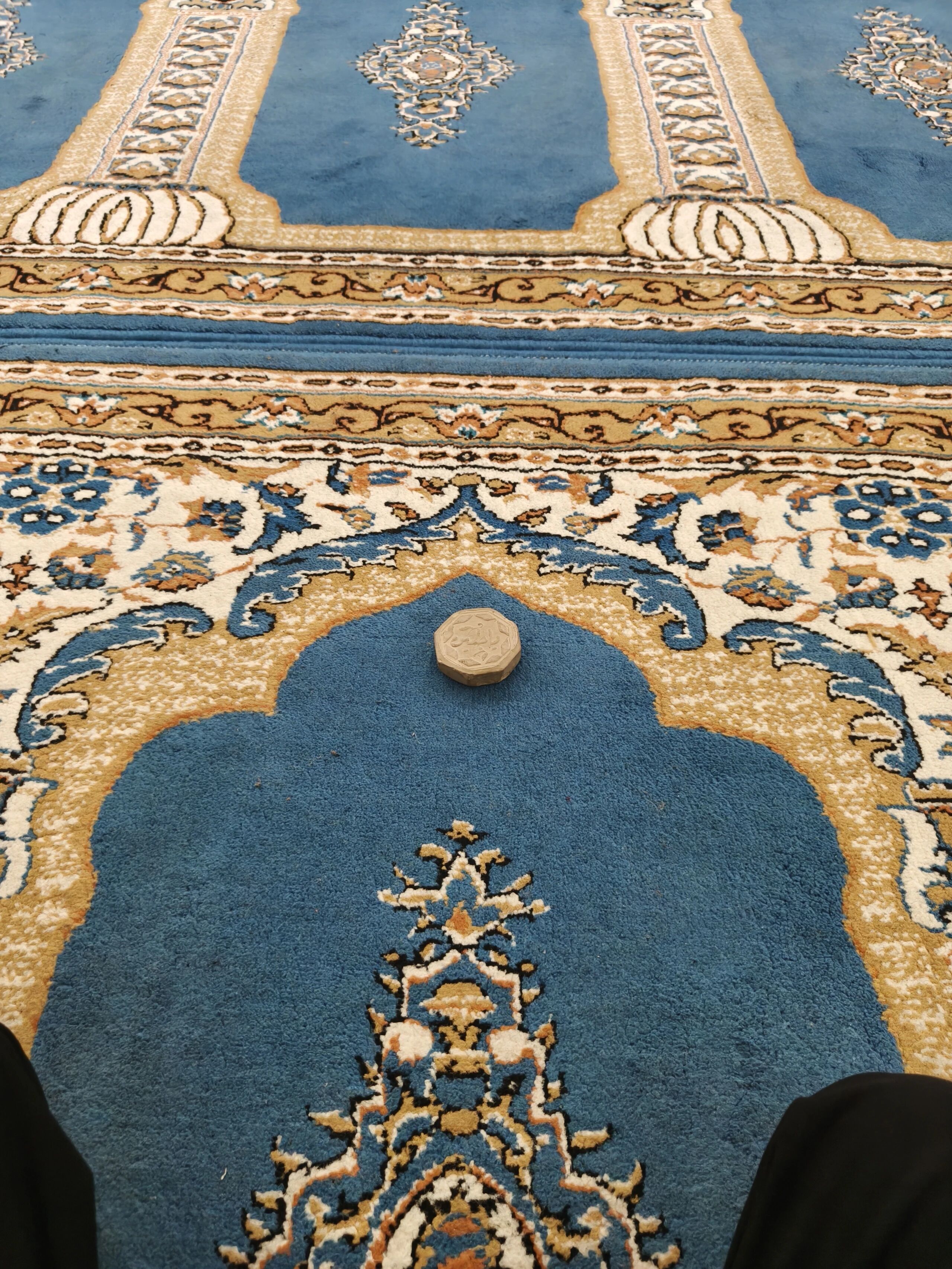
This must be a way to express grief for the Prophet's grandson who died at the hands of his enemies.
After namaz, I took a panoramic shot of the room. It is quite large, and the ceiling and walls are decorated.
You might notice a row of chairs with small desks on the right side of the prayer hall (Photo 11). What are these for? These are for Muslims who have trouble walking or have back problems.
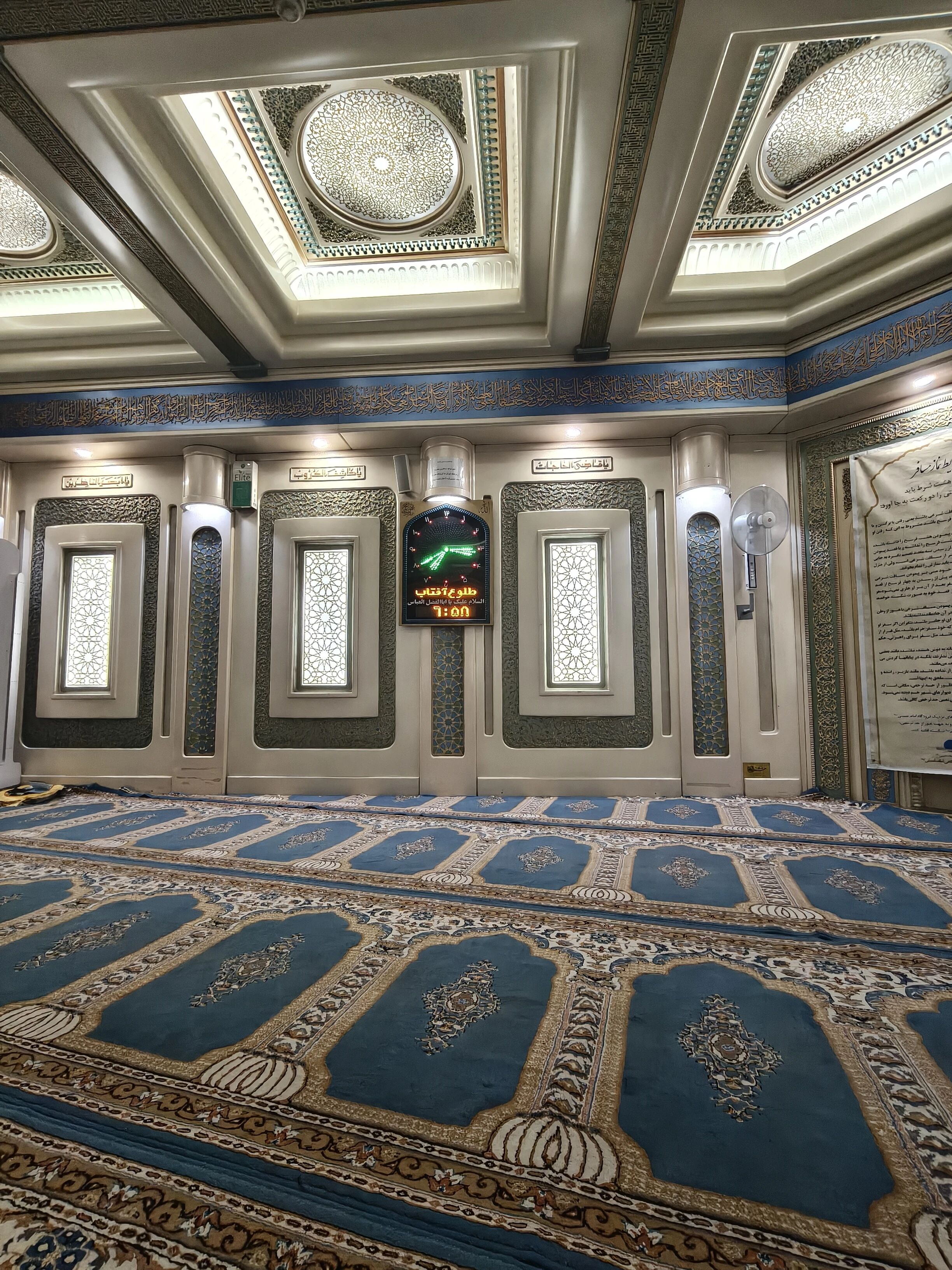
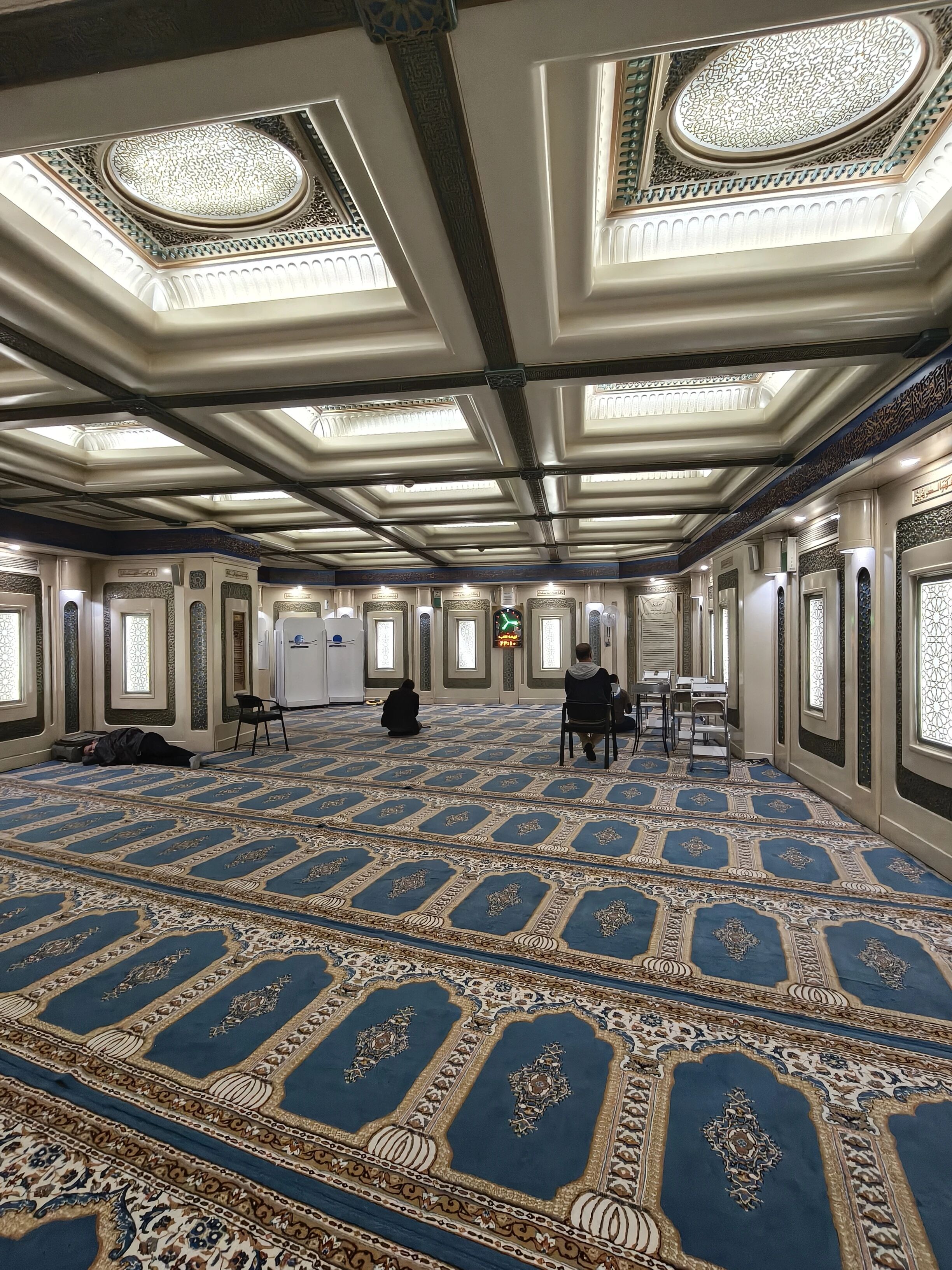
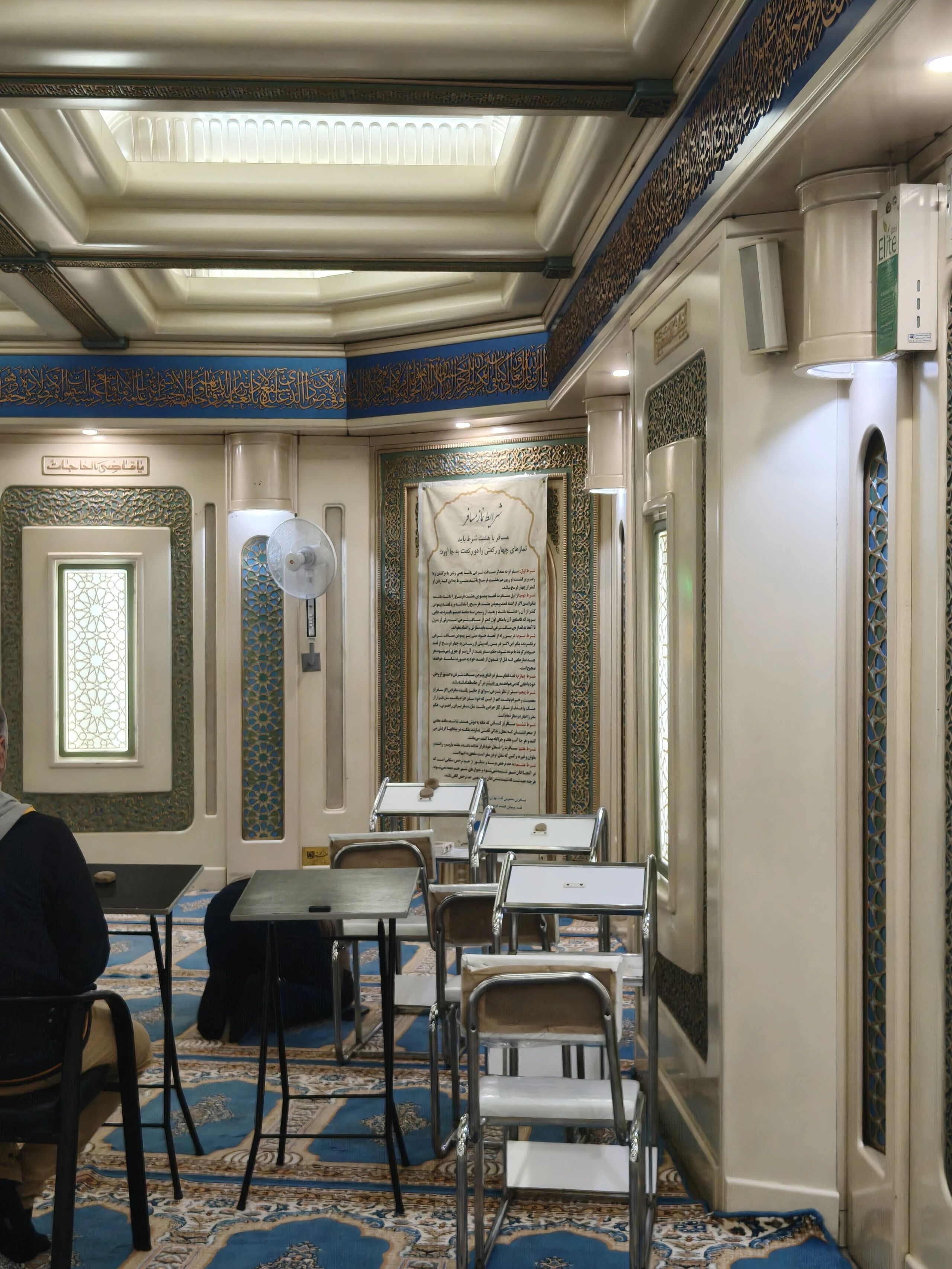
Because of their physical condition, they cannot stand, bow, or prostrate during namaz, so they must pray while sitting in these chairs. These small chairs are not rare; you can find them in almost every mosque, and they are not unique to the Shia sect.
Behind this prayer room, there is a place for storing calligraphy (Photo 13). I picked up a Qur'an, and since I was in Iran, the cover naturally featured elegant Persian calligraphy (Photo 14). The preface on the first page was also written in Persian calligraphy.
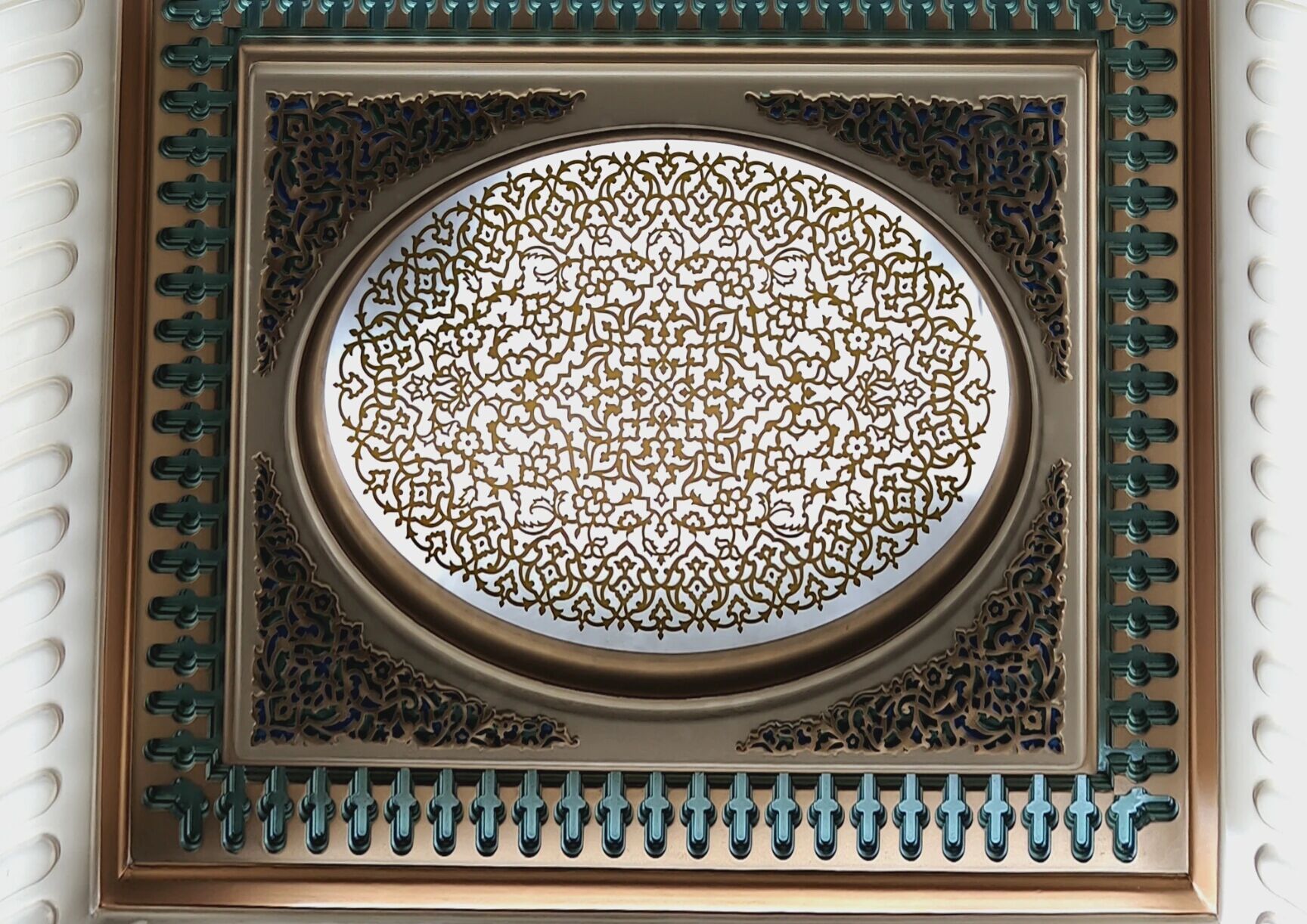
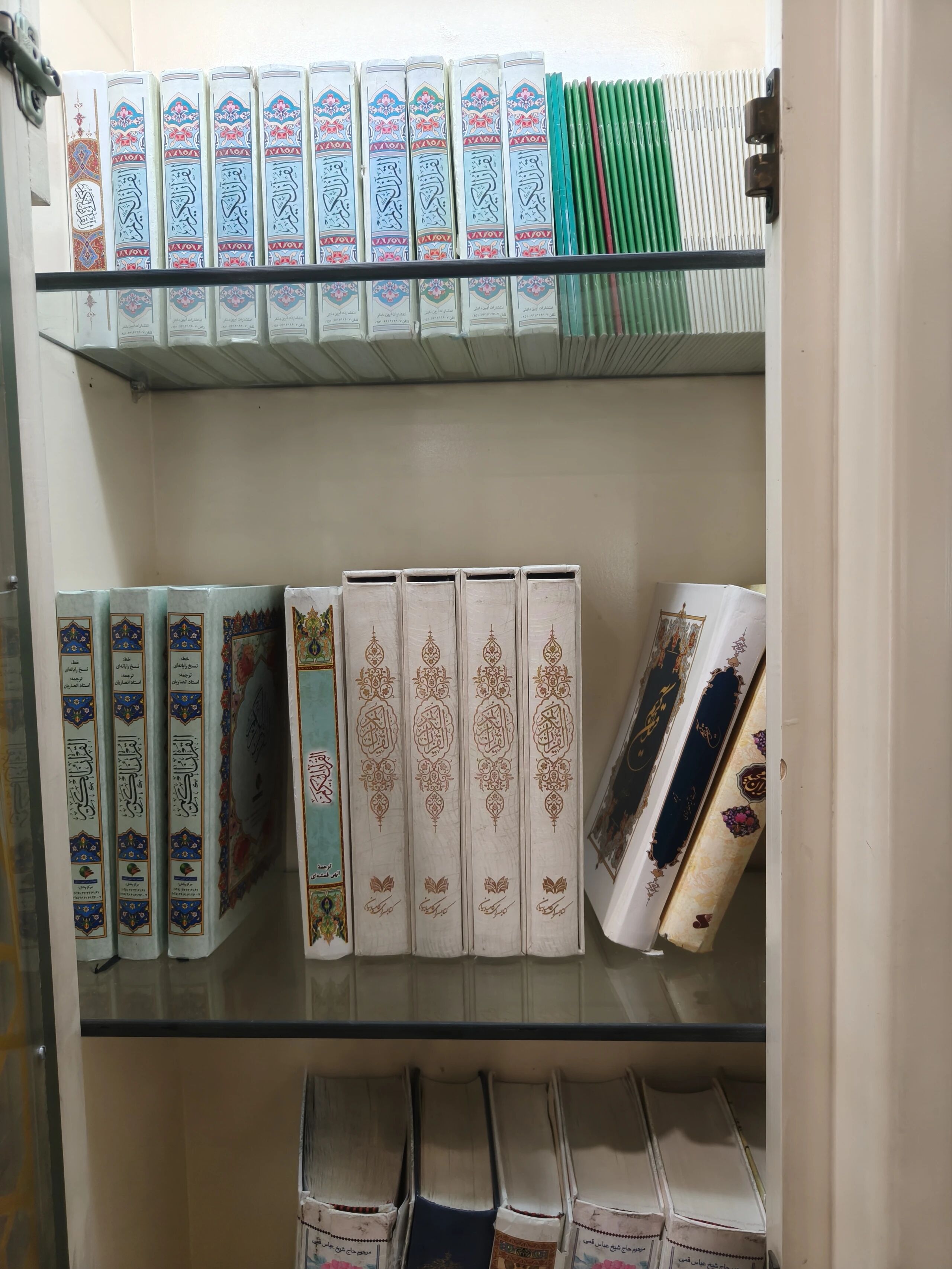
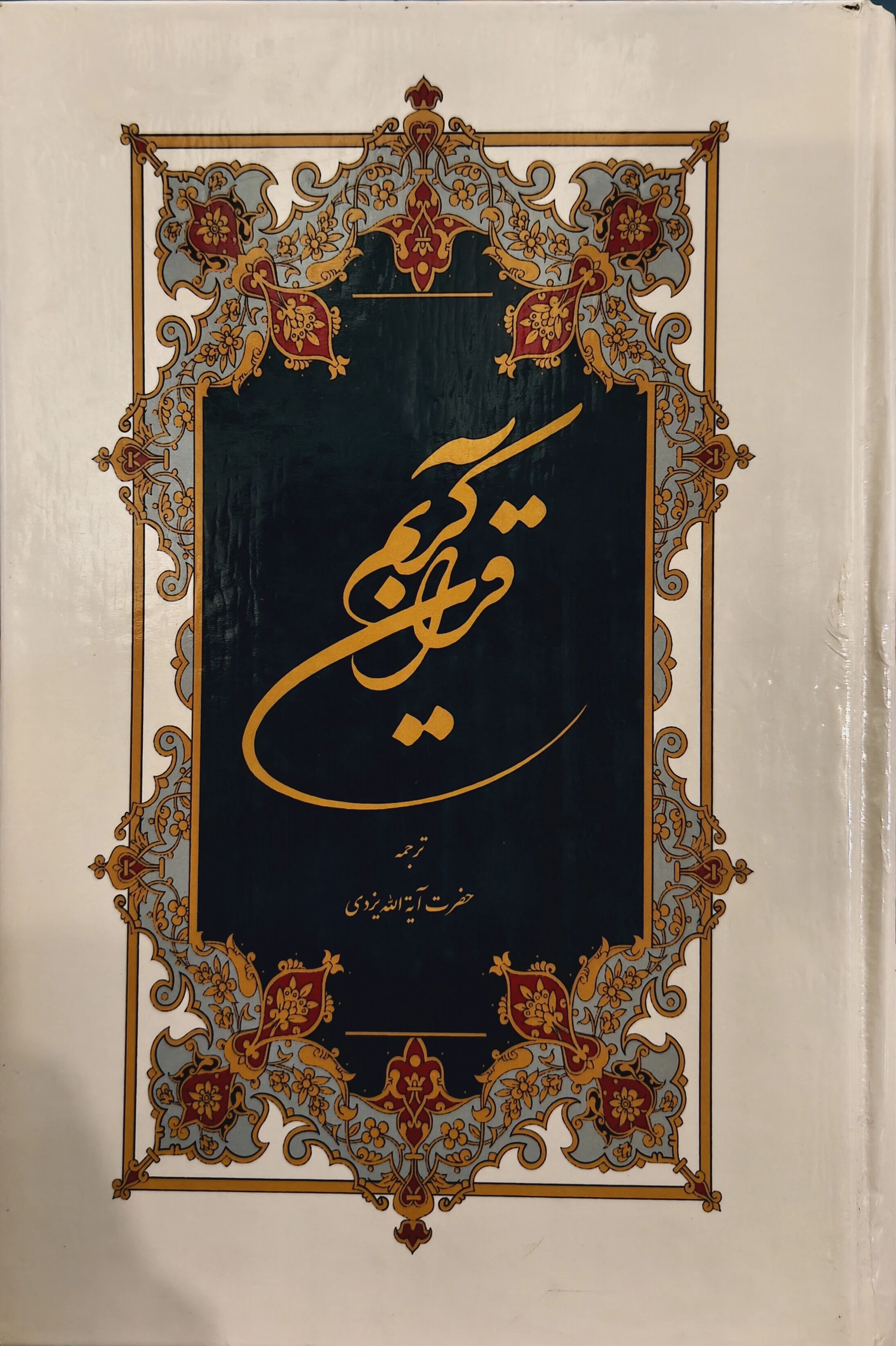
I opened the main text of the Qur'an and noticed a line of small print underneath the verses (Photo 16), which was a Persian translation.
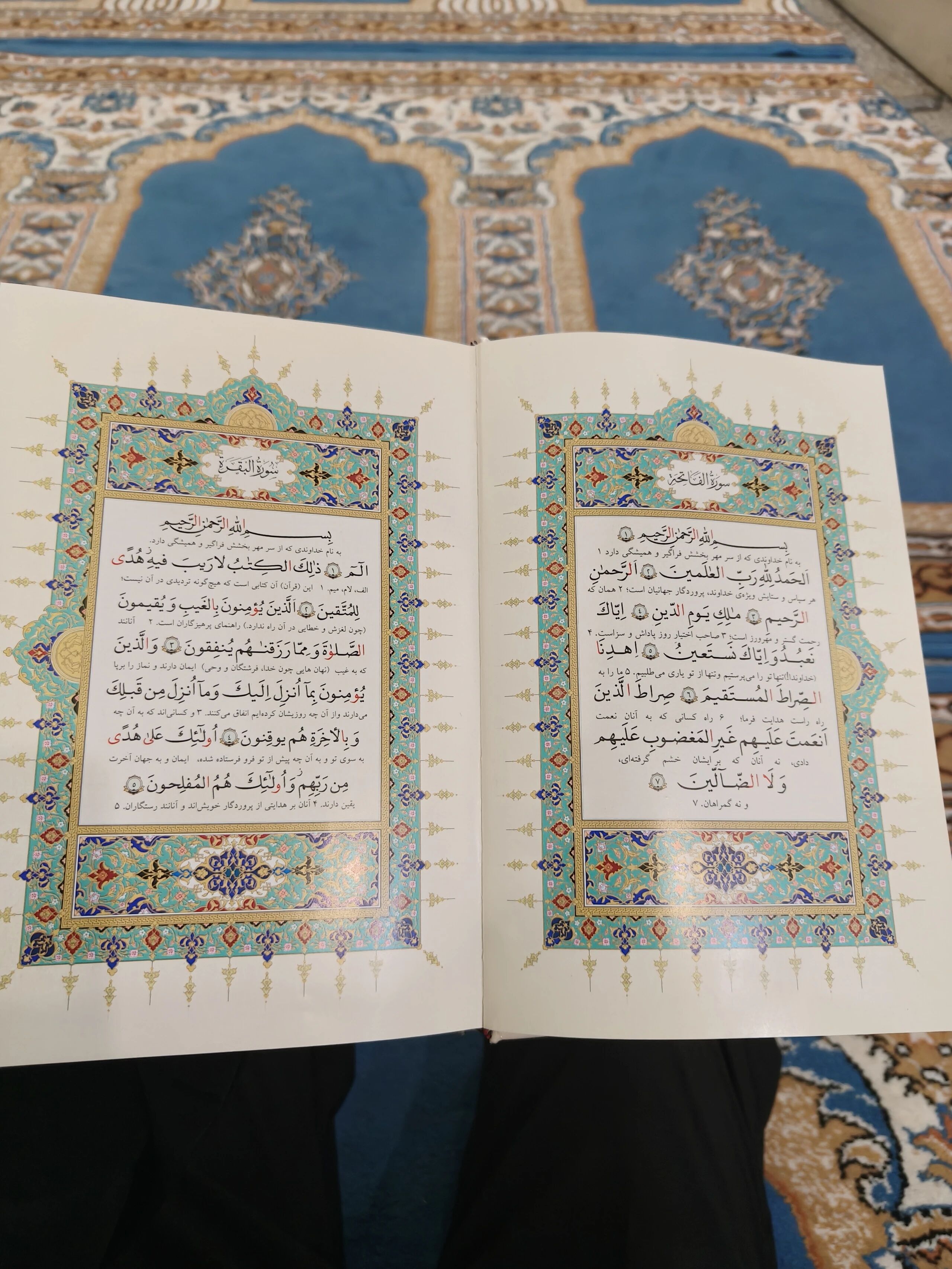
After that, I left the prayer room and got into a taxi heading to downtown Tehran. What kind of experiences will I have in Iran ahead? The next part will be updated soon.
Muslim Travel Guide Iran Tehran: Imam Khomeini Mosque, Grand Bazaar Food and Wudu Courtyard
Articles • Hasan09 posted the article • 0 comments • 327 views • 2026-05-24 01:59
Summary: This Muslim travel guide follows the Tehran bazaar near Golestan Palace and Imam Khomeini Mosque. It preserves the Friday closure scene, bazaar food, mosque courtyard, wudu area, library, and the author's on-site notes.
There are many bazaars near Golestan Palace. Friday is a public holiday in Iran, so only one mosque in Tehran stays open, while the rest are closed. Only a few shops inside the bazaar are open.
The market feels like a ghost town on Friday, but as soon as Friday passes, it quickly becomes lively, crowded with pedestrians and porters shoulder to shoulder.
Bazaars almost always have domes, and you can enjoy their orderly beauty just by looking up. (Photo 1)
After walking for a while, my guide told me he knew a good place that mainly sells wraps with potato, chicken, or beef fillings. I like potatoes, so of course I chose the potato one. The guide chose the beef one. The wrap included mashed boiled eggs, and the potatoes were very tasty.
The shop is very narrow and crowded. (Photo 5, Photo 6)
Then, I am not sure how we got there, but we walked into a mosque. The area outside was cramped and narrow, and I really did not expect such a large mosque square in the middle.
This is the Imam Khomeini Mosque. The main hall (Image 7) looks like a larger version of the Id Kah Mosque in Xinjiang, as if they were built from the same blueprint. There is a water basin in the middle of the mosque square with taps along the edge for performing wudu. (Image 9)
At the other end of the square are two minarets with a clock tower in the middle. (Image 10)
On one side of the square, there is a library covered in many mirrors that shine brightly. (Image 11, Image 12) It looks just like the Tomb of the King of Lights in Iraq that I saw online.
The library also holds copies of the Quran (Image 13) in other languages, including French, English, Russian, and Armenian. There were a few staff members inside. When my guide told them I was from China, they gave me a tile ornament and a copy of the Quran.
The staff said they were happy to meet me and welcomed me to Iran. To be polite, I also told them they were welcome to visit China. The staff also asked if China accepts international students from countries like Iran, Iraq, and Afghanistan, and which university majors in China are the best.
I am answering based on the information I have encountered within the country. It seems like many foreigners come here to study medicine, and I actually know international students from Pakistan, Turkey, and Yemen who are studying in Lanzhou and Chengdu.
After leaving the mosque, I returned to the bazaar. I looked up and saw the sunlight hitting the dome at an angle, perfectly revealing the shape of a crescent moon. view all
Summary: This Muslim travel guide follows the Tehran bazaar near Golestan Palace and Imam Khomeini Mosque. It preserves the Friday closure scene, bazaar food, mosque courtyard, wudu area, library, and the author's on-site notes.
There are many bazaars near Golestan Palace. Friday is a public holiday in Iran, so only one mosque in Tehran stays open, while the rest are closed. Only a few shops inside the bazaar are open.
The market feels like a ghost town on Friday, but as soon as Friday passes, it quickly becomes lively, crowded with pedestrians and porters shoulder to shoulder.
Bazaars almost always have domes, and you can enjoy their orderly beauty just by looking up. (Photo 1)
After walking for a while, my guide told me he knew a good place that mainly sells wraps with potato, chicken, or beef fillings. I like potatoes, so of course I chose the potato one. The guide chose the beef one. The wrap included mashed boiled eggs, and the potatoes were very tasty.
The shop is very narrow and crowded. (Photo 5, Photo 6)
Then, I am not sure how we got there, but we walked into a mosque. The area outside was cramped and narrow, and I really did not expect such a large mosque square in the middle.
This is the Imam Khomeini Mosque. The main hall (Image 7) looks like a larger version of the Id Kah Mosque in Xinjiang, as if they were built from the same blueprint. There is a water basin in the middle of the mosque square with taps along the edge for performing wudu. (Image 9)
At the other end of the square are two minarets with a clock tower in the middle. (Image 10)
On one side of the square, there is a library covered in many mirrors that shine brightly. (Image 11, Image 12) It looks just like the Tomb of the King of Lights in Iraq that I saw online.
The library also holds copies of the Quran (Image 13) in other languages, including French, English, Russian, and Armenian. There were a few staff members inside. When my guide told them I was from China, they gave me a tile ornament and a copy of the Quran.
The staff said they were happy to meet me and welcomed me to Iran. To be polite, I also told them they were welcome to visit China. The staff also asked if China accepts international students from countries like Iran, Iraq, and Afghanistan, and which university majors in China are the best.
I am answering based on the information I have encountered within the country. It seems like many foreigners come here to study medicine, and I actually know international students from Pakistan, Turkey, and Yemen who are studying in Lanzhou and Chengdu.
After leaving the mosque, I returned to the bazaar. I looked up and saw the sunlight hitting the dome at an angle, perfectly revealing the shape of a crescent moon.
Muslim Travel Guide Iran Tehran and Qom: Local Muslim Life, Mosques and Travel Notes
Articles • Hasan09 posted the article • 0 comments • 332 views • 2026-05-24 01:48
Summary: This Iran Muslim travel guide records the author's real travel experiences in Tehran and Qom. It preserves the local interactions, mosque-related context, street observations, and the peaceful moments before later gunfire described in the source.
Friends who follow me probably know that I went to Iran at the beginning of December last year, where I interacted with the local people. With the current outbreak of war in Iran, I am reminded of those things I saw and experienced.
1. Iranian taxi drivers
After landing at Imam Khomeini International Airport in Iran, I got into Uncle Hosseini's taxi and started my journey to downtown Tehran. The international airport is quite far from downtown Tehran, and the trip took us a full hour and a half. Along the way, Uncle Hosseini and I kept chatting using a translation app. Communicating with a translation app is actually a bit troublesome, but the uncle was very enthusiastic and didn't mind me talking so much, so we chatted the whole way.
It is strange to say, but the first person I had a deep conversation with in Iran turned out to be a staunch patriot. After entering the city, although the exterior walls of the buildings looked poorly maintained, the streets were brightly lit and full of life. The uncle asked me if it was my first time in Iran, and if I realized after arriving that it was nothing like what the outside world portrays. I guess the uncle meant that the outside world always claims Iran's economy is stagnant and people's livelihoods are depressed, but looking at the street scene before me, Tehran is not as bad as people say. Actually, in my opinion, Tehran, including the international airport I just left, looks quite old and is not much better than how it is described by the outside world. But from the uncle's words, it is easy to see that he sincerely loves his country.
He then talked about international relations. He said he really dislikes Israel and Western countries, and he believes China and Russia are good friends to Iran. I saw this for myself later on. My Iranian tour guide pointed at a bus on the road and told me that Iran imported a batch of buses from China. I also saw a large Xiaomi store (Xiaomi Zhijia) in a modern shopping mall in Iran. I occasionally saw our domestic new energy vehicles on the road too. The guide showed me photos on his phone of himself with some Chinese trade representatives, which shows that our country and Iran have a decent relationship, at least in terms of trade.
I later asked him if Iran was really going to move its capital. He said every government talks about moving the capital, but it involves too many people, so it is impossible to actually move. We reached the destination, and I said goodbye to the uncle.
(A view of Tehran streets taken through the window of Uncle Hosseini's taxi. In front is a poster of an Iranian athlete winning a championship, and behind it is an anti-Israel propaganda poster.)
2. My tour guide is a conservative liberal.
Unlike the driver, Uncle Hosseini, my local Iranian tour guide is quite against the current system. On the first day I met him, we passed a government building. He looked at the well-dressed people going in and out and said to me, 'Look at these people. They sit in their offices all day, nice and warm, drinking coffee, and they finish work without doing a single thing.'
That night, he complained to me that the government was truly incompetent, as the price of a pair of shoes had gone up ten times over the years. I was a bit puzzled at the time. But thinking about it now, could it be that U. S. blockades and sanctions are why Iran cannot buy cheap raw materials, and therefore cannot make cheap shoes?
Even this tour guide, who hates the current situation, told me he was scared. He is afraid that the U. S. might actually attack. He said he is not afraid of Israel, but he is truly afraid of U. S. military power.
His fear is actually quite normal, because missiles only identify thermal imaging, and U. S. missiles cannot tell which Iranians support the regime and which ones support overthrowing the government. So when war comes, the fear of a foreign enemy will likely push conservative liberals like the tour guide into the arms of the Iranian authoritarian government.
(The tour guide is using his Samsung phone to check the exchange rate between the Chinese yuan and the Iranian rial for me, worried that I might lose money if I exchange too little.)
(The tour guide is using his Samsung phone to check the exchange rate between the Chinese yuan and the Iranian rial for me, worried that I might lose money if I exchange too little.)
3. Enthusiastic people
I actually stand out quite a bit walking on the streets of Iran. I have the typical look of a yellow-skinned person, with single eyelids and straight black hair. Maybe it is because things are valued when they are rare, but the people here are especially warm to me and take the initiative to greet me. More than once on the road, people came up to me and said, "Welcome to Iran."
Once, while I was visiting a mosque, I suddenly became the center of attention. Namaz had just ended, and they started sharing hot black tea in the mosque. I got a cup too. One person called his family or friends right there, excitedly telling them he had met a Chinese person today. Everyone gathered around and curiously asked me all sorts of questions. One young man spoke good English and said he had studied in the United States. He even offered to be my tour guide. But I was leaving Tehran for Qom soon, so I politely declined his kind offer.
(After namaz, the mosque started handing out hot black tea with sugar cubes. It tasted pretty good.)
4. The kind ticket agent
Iran is currently under sanctions and cannot use bank cards from other countries, so tourists like us have to bring US dollar cash in advance and exchange it locally in Iran. For those few days, I was always walking around with big bundles of cash on me. Once, when I went to the manual ticket booth at the subway station, the ticket agent saw that my bag zipper was open and a stack of cash was clearly visible on top. She was so worried that she quickly reached over and shoved the stack of cash to the very bottom of my bag under some other items.
She was reminding me to watch out for pickpockets in the train car. She was truly very kind. I have remembered this kind gesture ever since.
(For Iranian subway tickets, you scan a code to enter through the gate, but there are no gates when you leave, so you just walk out.)
5. Free french fries
Years ago, I saw an avant-garde building in Iran on the 'Youth Architecture' WeChat architecture post, and it happened to be in Tehran. I decided to go see it, but after searching for it by name, I realized I had gone to the wrong place. It was lunchtime, so I went to a nearby restaurant and ordered some french fries. I saw another diner nearby and thought he must know where the building was. I felt a bit shy about just asking him directly, so I grabbed a can of Coca-Cola from the restaurant's drink cooler and handed it to him. After thanking me, he stared at the picture I showed him for a long time, trying to sound out the words on the building, but he couldn't find the answer in the end. He left after he finished his meal, and I was just about done with mine too. When I went to pay, the clerk told me that the person who drank my cola had already paid my bill. I guess I got a free meal of french fries out of it too.
(An ordinary street scene in Tehran)
6. The Rose Bread Uncle
I met this uncle who sells rose-filled bread after I finished visiting Azadi Tower. Azadi Tower is surrounded by a large roundabout with an incredible amount of traffic, making it hard to cross the street and just as hard to get back. I was stuck on the side of the road for a long time, and it felt just like being back in Vietnam.
An old man carrying a large rose-filled flatbread (rose bing) saw me, and since he was heading across the street too, he waved for me to join him. He grabbed my arm and led me with long strides right into the traffic, and before I knew it, I was on the other side of the road. I really admire these locals from the bottom of my heart.
The uncle then asked if I was going to the subway station. I was indeed planning to take the subway to a bus station in Tehran to catch a bus to Qom. So, I walked with him toward the subway station. He handed me the rose-filled flatbread (bing) he was holding so I would have something to eat on the road. Along the way, he showed me his contacts on his phone. I think I saw a photo of him with former Iranian President Rouhani, along with many others who looked like high-ranking officials or people in military uniforms. Who exactly is this man?
Regardless of his background, I decided to ask him for directions to the bus station. When he heard me ask about the bus station, he patted my shoulder and then his own chest, using body language to tell me not to worry. He then stayed with me on the bus until we were a few stops away from the station. Before getting off, he made sure to point out which stop I was at and exactly where I needed to get off. He was truly very kind, much like the other Iranians I had met before. My impression of Iranian people was set right then.
(A standard ID photo of Azadi Tower.) Actually, there is an underground passage to Azadi Square from other places, but it was already closed when I went, probably because it was too late.
7. I lost my phone, and my feelings are complicated.
It was the day I left Qom, and the hotel front desk helped me call a taxi using a ride-hailing app. Once I got in, I felt something was wrong. The driver had a shifty look in his eyes that made me feel very uncomfortable. After I got out of the car, I suddenly realized my spare phone was missing. I remembered then that when I was getting out, the driver deliberately threw his bag onto the passenger seat. I was wondering at the time why he had to throw his bag on the passenger seat instead of putting it somewhere else. Looking back, he must have been using the bag to cover my phone, which had slid onto the seat. I tried to look for him, but he was long gone with my phone without a trace.
I had no choice but to take another car to the airport with a heavy heart, and there were other passengers in the car. I was the only Asian person in the car, and the other passengers and the driver started to get curious about me. They asked if I liked Iran. I said I liked it, but because I had just lost my phone, I really could not bring myself to like Iran at that moment. Still, I decided to give it a try and used a translation app to ask the driver and other passengers for help. The moment they received my request for help, they immediately took action and started calling the hotel where I stayed to see if they could find that taxi driver through the front desk. I did not know whether to laugh or cry, and my feelings were a mess. On one hand, I was very upset because my backup phone was stolen, and it had very important things on it. On the other hand, I felt a bit comforted because these strangers were so eager to help me.
(A street in Qom, where I lost my phone.)
Postscript: In the end, I never got that phone back. I have been back home for two or three months now. After I returned, large-scale protests broke out there, and later Iran got caught up in conflict with the United States and Israel. If I wanted to go back to Iran now, it would probably be impossible. I wonder if those kind-hearted Iranians are doing well today and if they are still living in peace. view all
Summary: This Iran Muslim travel guide records the author's real travel experiences in Tehran and Qom. It preserves the local interactions, mosque-related context, street observations, and the peaceful moments before later gunfire described in the source.
Friends who follow me probably know that I went to Iran at the beginning of December last year, where I interacted with the local people. With the current outbreak of war in Iran, I am reminded of those things I saw and experienced.
1. Iranian taxi drivers
After landing at Imam Khomeini International Airport in Iran, I got into Uncle Hosseini's taxi and started my journey to downtown Tehran. The international airport is quite far from downtown Tehran, and the trip took us a full hour and a half. Along the way, Uncle Hosseini and I kept chatting using a translation app. Communicating with a translation app is actually a bit troublesome, but the uncle was very enthusiastic and didn't mind me talking so much, so we chatted the whole way.
It is strange to say, but the first person I had a deep conversation with in Iran turned out to be a staunch patriot. After entering the city, although the exterior walls of the buildings looked poorly maintained, the streets were brightly lit and full of life. The uncle asked me if it was my first time in Iran, and if I realized after arriving that it was nothing like what the outside world portrays. I guess the uncle meant that the outside world always claims Iran's economy is stagnant and people's livelihoods are depressed, but looking at the street scene before me, Tehran is not as bad as people say. Actually, in my opinion, Tehran, including the international airport I just left, looks quite old and is not much better than how it is described by the outside world. But from the uncle's words, it is easy to see that he sincerely loves his country.
He then talked about international relations. He said he really dislikes Israel and Western countries, and he believes China and Russia are good friends to Iran. I saw this for myself later on. My Iranian tour guide pointed at a bus on the road and told me that Iran imported a batch of buses from China. I also saw a large Xiaomi store (Xiaomi Zhijia) in a modern shopping mall in Iran. I occasionally saw our domestic new energy vehicles on the road too. The guide showed me photos on his phone of himself with some Chinese trade representatives, which shows that our country and Iran have a decent relationship, at least in terms of trade.
I later asked him if Iran was really going to move its capital. He said every government talks about moving the capital, but it involves too many people, so it is impossible to actually move. We reached the destination, and I said goodbye to the uncle.
(A view of Tehran streets taken through the window of Uncle Hosseini's taxi. In front is a poster of an Iranian athlete winning a championship, and behind it is an anti-Israel propaganda poster.)
2. My tour guide is a conservative liberal.
Unlike the driver, Uncle Hosseini, my local Iranian tour guide is quite against the current system. On the first day I met him, we passed a government building. He looked at the well-dressed people going in and out and said to me, 'Look at these people. They sit in their offices all day, nice and warm, drinking coffee, and they finish work without doing a single thing.'
That night, he complained to me that the government was truly incompetent, as the price of a pair of shoes had gone up ten times over the years. I was a bit puzzled at the time. But thinking about it now, could it be that U. S. blockades and sanctions are why Iran cannot buy cheap raw materials, and therefore cannot make cheap shoes?
Even this tour guide, who hates the current situation, told me he was scared. He is afraid that the U. S. might actually attack. He said he is not afraid of Israel, but he is truly afraid of U. S. military power.
His fear is actually quite normal, because missiles only identify thermal imaging, and U. S. missiles cannot tell which Iranians support the regime and which ones support overthrowing the government. So when war comes, the fear of a foreign enemy will likely push conservative liberals like the tour guide into the arms of the Iranian authoritarian government.
(The tour guide is using his Samsung phone to check the exchange rate between the Chinese yuan and the Iranian rial for me, worried that I might lose money if I exchange too little.)
(The tour guide is using his Samsung phone to check the exchange rate between the Chinese yuan and the Iranian rial for me, worried that I might lose money if I exchange too little.)
3. Enthusiastic people
I actually stand out quite a bit walking on the streets of Iran. I have the typical look of a yellow-skinned person, with single eyelids and straight black hair. Maybe it is because things are valued when they are rare, but the people here are especially warm to me and take the initiative to greet me. More than once on the road, people came up to me and said, "Welcome to Iran."
Once, while I was visiting a mosque, I suddenly became the center of attention. Namaz had just ended, and they started sharing hot black tea in the mosque. I got a cup too. One person called his family or friends right there, excitedly telling them he had met a Chinese person today. Everyone gathered around and curiously asked me all sorts of questions. One young man spoke good English and said he had studied in the United States. He even offered to be my tour guide. But I was leaving Tehran for Qom soon, so I politely declined his kind offer.
(After namaz, the mosque started handing out hot black tea with sugar cubes. It tasted pretty good.)
4. The kind ticket agent
Iran is currently under sanctions and cannot use bank cards from other countries, so tourists like us have to bring US dollar cash in advance and exchange it locally in Iran. For those few days, I was always walking around with big bundles of cash on me. Once, when I went to the manual ticket booth at the subway station, the ticket agent saw that my bag zipper was open and a stack of cash was clearly visible on top. She was so worried that she quickly reached over and shoved the stack of cash to the very bottom of my bag under some other items.
She was reminding me to watch out for pickpockets in the train car. She was truly very kind. I have remembered this kind gesture ever since.
(For Iranian subway tickets, you scan a code to enter through the gate, but there are no gates when you leave, so you just walk out.)
5. Free french fries
Years ago, I saw an avant-garde building in Iran on the 'Youth Architecture' WeChat architecture post, and it happened to be in Tehran. I decided to go see it, but after searching for it by name, I realized I had gone to the wrong place. It was lunchtime, so I went to a nearby restaurant and ordered some french fries. I saw another diner nearby and thought he must know where the building was. I felt a bit shy about just asking him directly, so I grabbed a can of Coca-Cola from the restaurant's drink cooler and handed it to him. After thanking me, he stared at the picture I showed him for a long time, trying to sound out the words on the building, but he couldn't find the answer in the end. He left after he finished his meal, and I was just about done with mine too. When I went to pay, the clerk told me that the person who drank my cola had already paid my bill. I guess I got a free meal of french fries out of it too.
(An ordinary street scene in Tehran)
6. The Rose Bread Uncle
I met this uncle who sells rose-filled bread after I finished visiting Azadi Tower. Azadi Tower is surrounded by a large roundabout with an incredible amount of traffic, making it hard to cross the street and just as hard to get back. I was stuck on the side of the road for a long time, and it felt just like being back in Vietnam.
An old man carrying a large rose-filled flatbread (rose bing) saw me, and since he was heading across the street too, he waved for me to join him. He grabbed my arm and led me with long strides right into the traffic, and before I knew it, I was on the other side of the road. I really admire these locals from the bottom of my heart.
The uncle then asked if I was going to the subway station. I was indeed planning to take the subway to a bus station in Tehran to catch a bus to Qom. So, I walked with him toward the subway station. He handed me the rose-filled flatbread (bing) he was holding so I would have something to eat on the road. Along the way, he showed me his contacts on his phone. I think I saw a photo of him with former Iranian President Rouhani, along with many others who looked like high-ranking officials or people in military uniforms. Who exactly is this man?
Regardless of his background, I decided to ask him for directions to the bus station. When he heard me ask about the bus station, he patted my shoulder and then his own chest, using body language to tell me not to worry. He then stayed with me on the bus until we were a few stops away from the station. Before getting off, he made sure to point out which stop I was at and exactly where I needed to get off. He was truly very kind, much like the other Iranians I had met before. My impression of Iranian people was set right then.
(A standard ID photo of Azadi Tower.) Actually, there is an underground passage to Azadi Square from other places, but it was already closed when I went, probably because it was too late.
7. I lost my phone, and my feelings are complicated.
It was the day I left Qom, and the hotel front desk helped me call a taxi using a ride-hailing app. Once I got in, I felt something was wrong. The driver had a shifty look in his eyes that made me feel very uncomfortable. After I got out of the car, I suddenly realized my spare phone was missing. I remembered then that when I was getting out, the driver deliberately threw his bag onto the passenger seat. I was wondering at the time why he had to throw his bag on the passenger seat instead of putting it somewhere else. Looking back, he must have been using the bag to cover my phone, which had slid onto the seat. I tried to look for him, but he was long gone with my phone without a trace.
I had no choice but to take another car to the airport with a heavy heart, and there were other passengers in the car. I was the only Asian person in the car, and the other passengers and the driver started to get curious about me. They asked if I liked Iran. I said I liked it, but because I had just lost my phone, I really could not bring myself to like Iran at that moment. Still, I decided to give it a try and used a translation app to ask the driver and other passengers for help. The moment they received my request for help, they immediately took action and started calling the hotel where I stayed to see if they could find that taxi driver through the front desk. I did not know whether to laugh or cry, and my feelings were a mess. On one hand, I was very upset because my backup phone was stolen, and it had very important things on it. On the other hand, I felt a bit comforted because these strangers were so eager to help me.
(A street in Qom, where I lost my phone.)
Postscript: In the end, I never got that phone back. I have been back home for two or three months now. After I returned, large-scale protests broke out there, and later Iran got caught up in conflict with the United States and Israel. If I wanted to go back to Iran now, it would probably be impossible. I wonder if those kind-hearted Iranians are doing well today and if they are still living in peace.
Prayer Room Iran Tehran Airport: Imam Khomeini Airport Second-Floor Musalla and Wudu Notes
Articles • Hasan09 posted the article • 0 comments • 165 views • 2026-05-24 01:45
Summary: This prayer room guide covers the second-floor Muslim prayer space at Imam Khomeini Airport in Iran. It keeps the airport route, earlier first-floor mosque reference, wudu notes, and travel details in the same order as the source.
I showed you the mosque on the first floor of this airport last time, when I first landed in Iran. Leaving Iran this time, I had the chance to see the mosque on the second floor. But getting here was not easy.
Let me tell you the story of what happened before I reached the second-floor mosque.
That morning, I took a taxi from Qom to the bus station to catch a ride back to Tehran. My next plan was to go to Turkey. Turkey did not have visa-free entry then, so I spent a few hundred yuan to get an e-visa. I also bought my round-trip flight tickets.
Unexpectedly, I left my phone in the taxi. I tried to find it, but it was gone. Without my phone, I could not show my flight details or visa documents. Not only could I not go to Turkey, but even getting back home became difficult.
My backup phone was not linked to any payment methods, so I could not buy another ticket. I had my credit cards with me, but because of sanctions on Iran, I could not use any credit cards or bank cards from outside the country. What about cash? I had already spent all my Iranian rials.
Luckily, I still had about 1,000 yuan in cash in my small bag, which I got by exchanging the leftover Vietnamese dong I had when I left Vietnam. Otherwise, I would have really been stuck in Iran.
I used that yuan to exchange for some rials, then used the rials at a manual counter to buy a plane ticket to Oman, because Oman is visa-free and I had been there before, so I knew exactly what the entry process was like.
Once I successfully left Iran and reached Oman, everything would be easy because I had my cards with me and could withdraw money there to buy tickets much more conveniently.
Thankfully, everything went as I hoped. I slept one night in the airport terminal, and while I was there, I met a young Kurdish man in the prayer room who was heading to Turkey and then flying to the UK. His family was already waiting for him there. He asked me if Chinese people really eat dog meat.
I told him it is true, but only a very small number of people eat it. It seems foreigners really care about whether Chinese people eat dog meat.
Finally, let me show you the prayer room on the second floor. The prayer rooms in Iran are the most elaborately decorated ones I have ever seen. A staff member inside was holding a plastic box of food and asked if I wanted to eat.
I left the prayer room and headed to the security checkpoint. I passed through easily, and after a short flight, I arrived in Oman. That led to the two posts I wrote about mosques in Oman. view all
Summary: This prayer room guide covers the second-floor Muslim prayer space at Imam Khomeini Airport in Iran. It keeps the airport route, earlier first-floor mosque reference, wudu notes, and travel details in the same order as the source.
I showed you the mosque on the first floor of this airport last time, when I first landed in Iran. Leaving Iran this time, I had the chance to see the mosque on the second floor. But getting here was not easy.
Let me tell you the story of what happened before I reached the second-floor mosque.
That morning, I took a taxi from Qom to the bus station to catch a ride back to Tehran. My next plan was to go to Turkey. Turkey did not have visa-free entry then, so I spent a few hundred yuan to get an e-visa. I also bought my round-trip flight tickets.
Unexpectedly, I left my phone in the taxi. I tried to find it, but it was gone. Without my phone, I could not show my flight details or visa documents. Not only could I not go to Turkey, but even getting back home became difficult.
My backup phone was not linked to any payment methods, so I could not buy another ticket. I had my credit cards with me, but because of sanctions on Iran, I could not use any credit cards or bank cards from outside the country. What about cash? I had already spent all my Iranian rials.
Luckily, I still had about 1,000 yuan in cash in my small bag, which I got by exchanging the leftover Vietnamese dong I had when I left Vietnam. Otherwise, I would have really been stuck in Iran.
I used that yuan to exchange for some rials, then used the rials at a manual counter to buy a plane ticket to Oman, because Oman is visa-free and I had been there before, so I knew exactly what the entry process was like.
Once I successfully left Iran and reached Oman, everything would be easy because I had my cards with me and could withdraw money there to buy tickets much more conveniently.
Thankfully, everything went as I hoped. I slept one night in the airport terminal, and while I was there, I met a young Kurdish man in the prayer room who was heading to Turkey and then flying to the UK. His family was already waiting for him there. He asked me if Chinese people really eat dog meat.
I told him it is true, but only a very small number of people eat it. It seems foreigners really care about whether Chinese people eat dog meat.
Finally, let me show you the prayer room on the second floor. The prayer rooms in Iran are the most elaborately decorated ones I have ever seen. A staff member inside was holding a plastic box of food and asked if I wanted to eat.
I left the prayer room and headed to the security checkpoint. I passed through easily, and after a short flight, I arrived in Oman. That led to the two posts I wrote about mosques in Oman.
Muslim Travel Guide Iran Tehran: Imam Khomeini Mosque, Grand Bazaar Food and Wudu Courtyard
Articles • yusuf908 posted the article • 0 comments • 176 views • 2026-05-23 22:48
Summary: This Iran Muslim travel guide walks through the Tehran bazaar near Golestan Palace, with potato and beef wraps, crowded lanes, Imam Khomeini Mosque, its wudu courtyard, clock tower, mirror-covered library, Qur'an translations, friendly staff, and a crescent-shaped light moment in the bazaar dome.
There are many bazaars near Golestan Palace. Friday is a public holiday in Iran, and only one mosque in Tehran stays open while the rest are closed. Only a few shops inside the bazaar are open.
The market feels like a ghost town on Friday, but as soon as Friday passes, it quickly becomes lively, crowded with pedestrians and porters shoulder to shoulder.
Bazaars almost always have domes, and you can enjoy their orderly beauty just by looking up. (Photo 1)
After walking for a while, my guide told me he knew a good place that mainly sells wraps with potato, chicken, or beef fillings. I like potatoes, so of course I chose the potato one. The guide chose the beef one. The wrap included mashed boiled eggs, and the potatoes were very tasty.
The shop is very narrow and crowded. (Photo 5, Photo 6)
Then, I am not sure how we got there, but we walked into a mosque. The area outside was cramped and narrow, and I really did not expect such a large mosque square in the middle.
This is the Imam Khomeini Mosque. The main hall (Photo 7) looks like a larger version of the Id Kah Mosque in Xinjiang, as if they were built from the same blueprint. There is a water basin in the middle of the mosque square with taps along the edge for performing wudu. (Photo 9)
At the other end of the square stand two minarets with a clock tower in between. (Photo 10)
On one side of the square is a library covered in many mirrors that sparkle. (Photo 11, Photo 12) It looks just like the Tomb of the King of Lights in Iraq that I saw online.
The library also holds copies of the Qur'an (Photo 13) in other languages, including French, English, Russian, and Armenian. There were a few staff members inside. When the tour guide told them I was from China, they gave me a tile ornament and a copy of the Qur'an.
The staff said they were happy to meet me and welcomed me to Iran. To be polite, I told them they were welcome to visit China as well. The staff also asked if China accepts international students from countries like Iran, Iraq, and Afghanistan, and which university majors in China are the best.
I answered based on what I had seen in China. It seems like many foreigners come here to study medicine, and I actually know international students from Pakistan, Turkey, and Yemen who are studying in Lanzhou and Chengdu.
After leaving the mosque, I returned to the bazaar. I looked up and saw the sunlight hitting the dome at an angle, perfectly revealing the shape of a crescent moon. view all
Summary: This Iran Muslim travel guide walks through the Tehran bazaar near Golestan Palace, with potato and beef wraps, crowded lanes, Imam Khomeini Mosque, its wudu courtyard, clock tower, mirror-covered library, Qur'an translations, friendly staff, and a crescent-shaped light moment in the bazaar dome.
There are many bazaars near Golestan Palace. Friday is a public holiday in Iran, and only one mosque in Tehran stays open while the rest are closed. Only a few shops inside the bazaar are open.
The market feels like a ghost town on Friday, but as soon as Friday passes, it quickly becomes lively, crowded with pedestrians and porters shoulder to shoulder.
Bazaars almost always have domes, and you can enjoy their orderly beauty just by looking up. (Photo 1)
After walking for a while, my guide told me he knew a good place that mainly sells wraps with potato, chicken, or beef fillings. I like potatoes, so of course I chose the potato one. The guide chose the beef one. The wrap included mashed boiled eggs, and the potatoes were very tasty.
The shop is very narrow and crowded. (Photo 5, Photo 6)
Then, I am not sure how we got there, but we walked into a mosque. The area outside was cramped and narrow, and I really did not expect such a large mosque square in the middle.
This is the Imam Khomeini Mosque. The main hall (Photo 7) looks like a larger version of the Id Kah Mosque in Xinjiang, as if they were built from the same blueprint. There is a water basin in the middle of the mosque square with taps along the edge for performing wudu. (Photo 9)
At the other end of the square stand two minarets with a clock tower in between. (Photo 10)
On one side of the square is a library covered in many mirrors that sparkle. (Photo 11, Photo 12) It looks just like the Tomb of the King of Lights in Iraq that I saw online.
The library also holds copies of the Qur'an (Photo 13) in other languages, including French, English, Russian, and Armenian. There were a few staff members inside. When the tour guide told them I was from China, they gave me a tile ornament and a copy of the Qur'an.
The staff said they were happy to meet me and welcomed me to Iran. To be polite, I told them they were welcome to visit China as well. The staff also asked if China accepts international students from countries like Iran, Iraq, and Afghanistan, and which university majors in China are the best.
I answered based on what I had seen in China. It seems like many foreigners come here to study medicine, and I actually know international students from Pakistan, Turkey, and Yemen who are studying in Lanzhou and Chengdu.
After leaving the mosque, I returned to the bazaar. I looked up and saw the sunlight hitting the dome at an angle, perfectly revealing the shape of a crescent moon.
Muslim Travel Guide Iran Tehran: Friday Prayer, Closed Mosques and Flower-Bird Embroidery
Articles • yusuf908 posted the article • 0 comments • 168 views • 2026-05-23 22:47
Summary: This Iran Muslim travel guide follows a Friday in Tehran, when nearby mosques and the bazaar were closed, then returns after Jumu'ah day to see a small mosque, flower-and-bird embroidery, a Shia-themed image, and the practical challenge of carrying cash in Iran.
I landed in Tehran, Iran, on a Thursday night and woke up the next morning on Friday, which is the Jumu'ah day. However, I found the doors of the mosque near where I was staying were locked tight.
(Photo 1) Not only that, but a large mosque the motorcycle taxi driver took me to, Imam Khamenei Mosque, was also closed. I ran to all the nearby mosques, but not a single one was open. I noticed that only a few shops at the entrance of the bazaar were open, while everything inside was completely shut.
I was totally confused as to why the mosques were all closed on the day of congregational prayer, so I just walked around until I reached the area near Golestan Palace. I met a guy who spoke English and later found out he was a tour guide. He told me that only one mosque in Tehran stays open on Fridays, while all the others are closed.
This way, everyone can gather together in one place for prayer. So that was it. Actually, I had heard of similar things before, where some small mosques do not hold the noon Jumu'ah prayer on Fridays. The worshippers from those mosques then have to go to a larger mosque further away to attend the congregational prayer.
But I still cannot understand why a place like Tehran, with its huge population and large city area, only keeps one mosque open on Fridays.
I went back after Friday, and the mosque was indeed open, and the bazaar was packed with people. I went to the small mosque near where I was staying again. I found some banners hanging inside, decorated with flowers and birds.
(Photos 5 and 6) A long-tailed bird and a small bird are tucked between the calligraphy.
Generally speaking, animal images are not allowed inside a mosque, but in real life, you can still see some decorative animal figures.
For example, some ancient mosques in China still have roof beasts on their ridges, and there is a madrasa in Central Asia with a lion carrying the sun on its gate.
Besides the embroidery, I also saw a hanging painting like the one in photo 7 inside the main hall. The painting shows one hand grabbing another hand by the wrist and raising it up. This likely shows the scene where the Prophet Muhammad raised his cousin Ali as his successor.
After finishing my namaz, I went near the British Embassy to exchange money, though money does not last long here. I exchanged 240 US dollars, and it was gone in two days without me spending much. ATM machines in Iran do not accept Visa cards, UnionPay, or WeChat Pay.
As foreigners, we have to bring enough US dollars in cash to exchange there, then carry several bundles of cash around in our bags. It is still very inconvenient. view all
Summary: This Iran Muslim travel guide follows a Friday in Tehran, when nearby mosques and the bazaar were closed, then returns after Jumu'ah day to see a small mosque, flower-and-bird embroidery, a Shia-themed image, and the practical challenge of carrying cash in Iran.
I landed in Tehran, Iran, on a Thursday night and woke up the next morning on Friday, which is the Jumu'ah day. However, I found the doors of the mosque near where I was staying were locked tight.
(Photo 1) Not only that, but a large mosque the motorcycle taxi driver took me to, Imam Khamenei Mosque, was also closed. I ran to all the nearby mosques, but not a single one was open. I noticed that only a few shops at the entrance of the bazaar were open, while everything inside was completely shut.
I was totally confused as to why the mosques were all closed on the day of congregational prayer, so I just walked around until I reached the area near Golestan Palace. I met a guy who spoke English and later found out he was a tour guide. He told me that only one mosque in Tehran stays open on Fridays, while all the others are closed.
This way, everyone can gather together in one place for prayer. So that was it. Actually, I had heard of similar things before, where some small mosques do not hold the noon Jumu'ah prayer on Fridays. The worshippers from those mosques then have to go to a larger mosque further away to attend the congregational prayer.
But I still cannot understand why a place like Tehran, with its huge population and large city area, only keeps one mosque open on Fridays.
I went back after Friday, and the mosque was indeed open, and the bazaar was packed with people. I went to the small mosque near where I was staying again. I found some banners hanging inside, decorated with flowers and birds.
(Photos 5 and 6) A long-tailed bird and a small bird are tucked between the calligraphy.
Generally speaking, animal images are not allowed inside a mosque, but in real life, you can still see some decorative animal figures.
For example, some ancient mosques in China still have roof beasts on their ridges, and there is a madrasa in Central Asia with a lion carrying the sun on its gate.
Besides the embroidery, I also saw a hanging painting like the one in photo 7 inside the main hall. The painting shows one hand grabbing another hand by the wrist and raising it up. This likely shows the scene where the Prophet Muhammad raised his cousin Ali as his successor.
After finishing my namaz, I went near the British Embassy to exchange money, though money does not last long here. I exchanged 240 US dollars, and it was gone in two days without me spending much. ATM machines in Iran do not accept Visa cards, UnionPay, or WeChat Pay.
As foreigners, we have to bring enough US dollars in cash to exchange there, then carry several bundles of cash around in our bags. It is still very inconvenient.
Muslim Travel Guide Iran Tehran: Imam Khomeini Airport Prayer Room, Wudu Area and Shia Travel Notes
Articles • yusuf908 posted the article • 0 comments • 181 views • 2026-05-23 22:47
Summary: This Iran Muslim travel guide starts at Imam Khomeini International Airport in Tehran, covering the author's Oman transfer, airport money exchange, the first-floor prayer room, shoe area, Shia-style decoration, mohr prayer stones, Qur'an copies with Persian translation, and the first impression of Iran.
Since visiting a Shia mosque in Singapore last time, my interest in Shia Islam has grown, and I even thought about exploring a Shia country.
So, I stopped over in Oman (Oman has a minority sect independent of Sunni Islam called Ibadi Islam; I will share what I saw and heard in Oman later) and landed at Imam Khomeini International Airport in the capital of Iran.
I do not understand why they chose different characters for the transliteration; isn't Imam Khomeini just Imam Khomeini?
This airport looks a bit old. I had just flown from the new terminal at Lanzhou Zhongchuan Airport to Beijing Capital Airport, then from Daxing Airport to Muscat Airport in Oman for my layover. So for me, the contrast was very obvious.
Back to the point, the first thing to do after landing is to exchange money. I suggest you only exchange enough for your taxi fare at the airport. You should exchange the bulk of your money in the city. The exchange rate in the city is very different from the airport; for the same amount of money, you can get 1.2 million in the city, but the airport will only give you 750,000.
This gap is quite large. (Airport currency exchange counters are often like this, but the one at the Iranian airport felt especially harsh.) After exchanging money, I went to the first floor and noticed the prayer room (Photos 3 and 4). Its decoration style is different from the simple style in Malaysia, Oman, and Singapore.
It happened to be time for namaz, so I stepped into the prayer space in Iran.
Photo 5 shows the entryway, where you must put your shoes in the cubbies. On the left is the men's prayer room, and on the right is the women's prayer room. As soon as I walked in, I noticed something I had never seen in any other mosque or prayer room I had visited before: small stone tablets.
(Photo 6) Even the Shia mosque I visited in Singapore earlier did not have these.
During namaz, I noticed that everyone here had one, placing it exactly where their forehead would touch the ground. (Photo 7, Photo 8) I picked one up too. It was about the size of a chess piece, felt like brick, and had a smooth surface that did not crumble. It had the words "Ya (a call) Husayn" written on it.
This must be a way to express grief for the Prophet's grandson who died at the hands of his enemies.
After namaz, I took a panoramic shot of the room. It is quite large, and the ceiling and walls are decorated.
You might notice a row of chairs with small desks on the right side of the prayer hall (Photo 11). What are these for? These are for Muslims who have trouble walking or have back problems.
Because of their physical condition, they cannot stand, bow, or prostrate during namaz, so they must pray while sitting in these chairs. These small chairs are not rare; you can find them in almost every mosque, and they are not unique to the Shia sect.
Behind this prayer room, there is a place for storing calligraphy (Photo 13). I picked up a Qur'an, and since I was in Iran, the cover naturally featured elegant Persian calligraphy (Photo 14). The preface on the first page was also written in Persian calligraphy.
I opened the main text of the Qur'an and noticed a line of small print underneath the verses (Photo 16), which was a Persian translation.
After that, I left the prayer room and got into a taxi heading to downtown Tehran. What kind of experiences will I have in Iran ahead? The next part will be updated soon. view all
Summary: This Iran Muslim travel guide starts at Imam Khomeini International Airport in Tehran, covering the author's Oman transfer, airport money exchange, the first-floor prayer room, shoe area, Shia-style decoration, mohr prayer stones, Qur'an copies with Persian translation, and the first impression of Iran.
Since visiting a Shia mosque in Singapore last time, my interest in Shia Islam has grown, and I even thought about exploring a Shia country.
So, I stopped over in Oman (Oman has a minority sect independent of Sunni Islam called Ibadi Islam; I will share what I saw and heard in Oman later) and landed at Imam Khomeini International Airport in the capital of Iran.
I do not understand why they chose different characters for the transliteration; isn't Imam Khomeini just Imam Khomeini?
This airport looks a bit old. I had just flown from the new terminal at Lanzhou Zhongchuan Airport to Beijing Capital Airport, then from Daxing Airport to Muscat Airport in Oman for my layover. So for me, the contrast was very obvious.
Back to the point, the first thing to do after landing is to exchange money. I suggest you only exchange enough for your taxi fare at the airport. You should exchange the bulk of your money in the city. The exchange rate in the city is very different from the airport; for the same amount of money, you can get 1.2 million in the city, but the airport will only give you 750,000.
This gap is quite large. (Airport currency exchange counters are often like this, but the one at the Iranian airport felt especially harsh.) After exchanging money, I went to the first floor and noticed the prayer room (Photos 3 and 4). Its decoration style is different from the simple style in Malaysia, Oman, and Singapore.
It happened to be time for namaz, so I stepped into the prayer space in Iran.
Photo 5 shows the entryway, where you must put your shoes in the cubbies. On the left is the men's prayer room, and on the right is the women's prayer room. As soon as I walked in, I noticed something I had never seen in any other mosque or prayer room I had visited before: small stone tablets.
(Photo 6) Even the Shia mosque I visited in Singapore earlier did not have these.
During namaz, I noticed that everyone here had one, placing it exactly where their forehead would touch the ground. (Photo 7, Photo 8) I picked one up too. It was about the size of a chess piece, felt like brick, and had a smooth surface that did not crumble. It had the words "Ya (a call) Husayn" written on it.
This must be a way to express grief for the Prophet's grandson who died at the hands of his enemies.
After namaz, I took a panoramic shot of the room. It is quite large, and the ceiling and walls are decorated.
You might notice a row of chairs with small desks on the right side of the prayer hall (Photo 11). What are these for? These are for Muslims who have trouble walking or have back problems.
Because of their physical condition, they cannot stand, bow, or prostrate during namaz, so they must pray while sitting in these chairs. These small chairs are not rare; you can find them in almost every mosque, and they are not unique to the Shia sect.
Behind this prayer room, there is a place for storing calligraphy (Photo 13). I picked up a Qur'an, and since I was in Iran, the cover naturally featured elegant Persian calligraphy (Photo 14). The preface on the first page was also written in Persian calligraphy.
I opened the main text of the Qur'an and noticed a line of small print underneath the verses (Photo 16), which was a Persian translation.
After that, I left the prayer room and got into a taxi heading to downtown Tehran. What kind of experiences will I have in Iran ahead? The next part will be updated soon.