
Guide to Hadith Transmission History: From Oral Tradition and Early Writing to Authentic Isnad Networks in Islamic Heritage
[Internet Repost]
Based on the classic research by contemporary prominent hadith scholar Professor Muhammad Mustafa al-Azmi, this guide breaks down the early written records of hadiths from the time of the Prophet, the teaching networks of the Companions, and the rigorous cross-regional verification mechanisms used during traveling scholarship.
Professor Muhammad Mustafa al-Azmi was a renowned contemporary orthodox apologetic scholar from India. Fluent in English, Arabic, and multiple other languages, he spent years teaching in Saudi Arabia, where he also passed away. I've learned a ton from his work, and this article is basically my summary of his major book on hadith studies mentioned below.
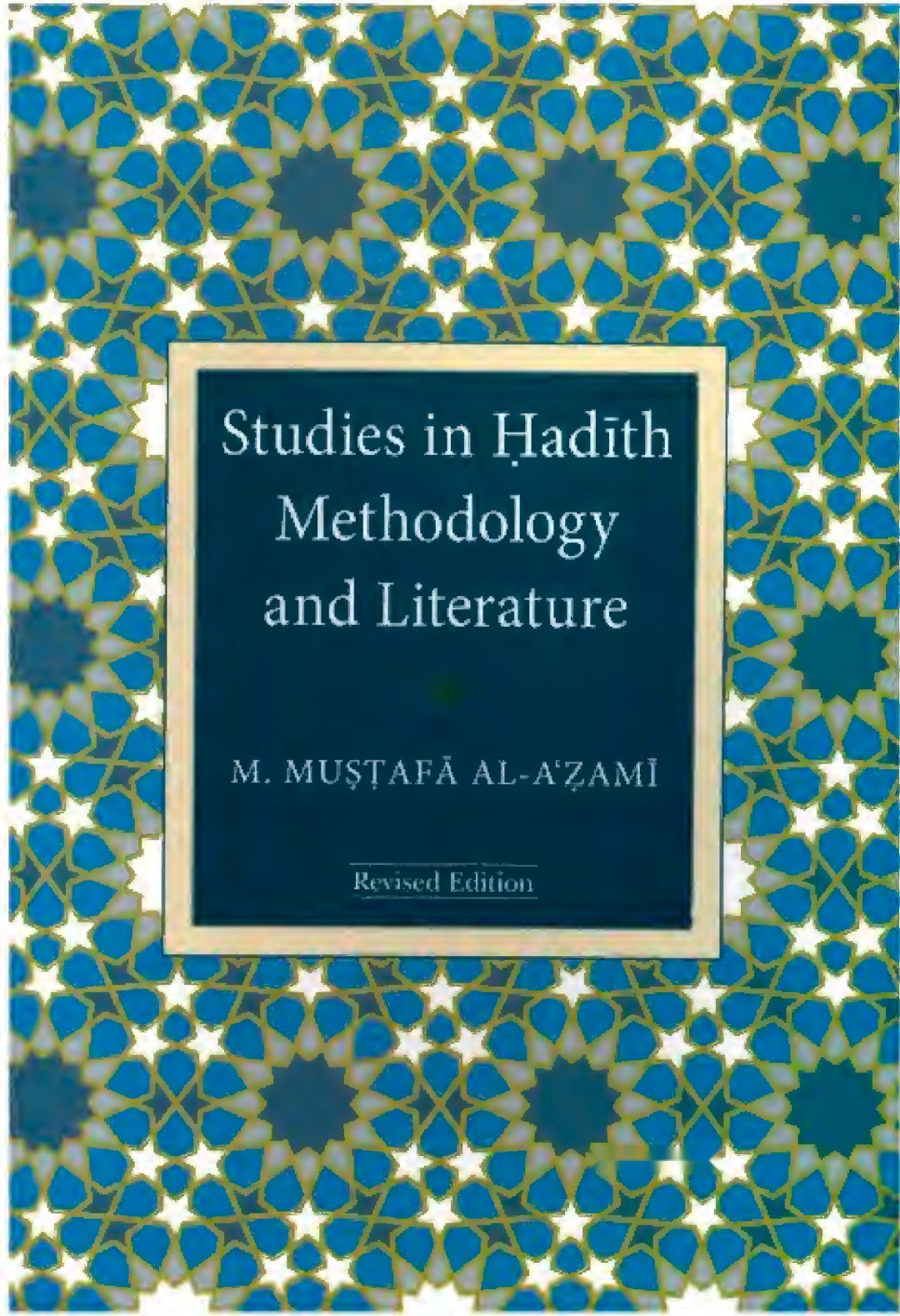
He felt that the English-speaking world lacked high-quality books on hadith studies, so he wanted to write one in English to make it easier for college students and everyday educated readers who don't know Arabic to understand hadith, while also pushing back against various misconceptions spread by Orientalists.
However, al-Azmi also made it clear that just reading this one book isn't enough to judge whether a specific hadith is authentic or not.
Originally, the word hadith meant a narrative, story, or conversation, and it could refer to religious, secular, historical, or recent events, with the adjective form meaning "new." It appears 23 times in classic texts. Back during the time of the Prophet, the term almost exclusively referred to accounts about the Prophet—including his sayings, actions, tacit approvals, and physical descriptions—though in a broader sense it could also refer to the statements of the Companions and Successors.
Sunnah originally meant a behavioral model or way of walking a path, but later it came to specifically refer to the normative behavior of the Prophet. Hadiths are the texts that record the Sunnah, and the two terms are often used interchangeably.
The Prophet taught hadiths through three main methods: 1. Oral transmission, where important points were repeated three times, followed by a test for the Companions; 2. Written records, where scribes wrote down what was dictated; and 3. Practical demonstrations, like prayer and pilgrimage, where everyone could watch and copy hands-on.
The Prophet taught hadiths by setting up learning spaces in Medina and sending his followers out everywhere to deliver instructions, telling those present to pass the knowledge on to those who were absent. After listening to a lecture, the Companions would get together to review and recall what was said, taking turns attending classes so that anyone who missed a session could learn from someone who was there, and some of the Companions even wrote hadiths down.
After the Prophet passed away, the Companions spread out across different regions, carrying hadiths everywhere, and that's when eight distinct methods for transmitting hadiths emerged:
1. The teacher reads to the students—this includes reciting from memory, reading straight from a book, Q&A, and dictation. Later on, professional repeaters emerged who would speak loudly to massive audiences, and after copying down the texts, students would proofread them, with early records mostly kept on wooden tablets.
2. Students read texts back to the teacher for verification. After the 2nd century AH, this became the standard method. Students would mark up their manuscripts to prove they had read them to the teacher, and without going through this process, even if you bought a handwritten copy, you weren't allowed to transmit it on your own.
3. The teacher gives a student permission to transmit a certain book without forcing the student to read the entire work cover-to-cover. This method became widely used after the 3rd century AH, though scholars have mixed views on how legally binding it is.
4. The teacher hands a handwritten manuscript directly to a student and grants them the rights to transmit it.
5. Sending hadith texts across distances via letters for remote learning.
6. Informing someone that they have the clearance to transmit, which has always been a bit controversial.
7. Bestowing books through a will, where a scholar hands over their manuscripts right before passing away and gives someone permission to transmit them.
8. Finding an old manuscript on your own without having official transmission credentials, meaning you can only cite it by noting "found in such-and-such manuscript."
Successors usually started systematically studying hadiths in their early twenties, and finishing their studies meant getting a certificate. Kids aged five and older were counted as official students, while anyone under five was just marked down as present. Later on, it became a thing for very young kids to get certificates, but the point of these certificates was to protect the purity of the text, not to prove that a kid actually understood the hadith. Plus, most of this education didn't cost a dime.
Hadiths were already being written down during the time of the Prophet, and the book lists a bunch of Companions—like Abu Hurayrah, Ibn Umar, Aisha, Ibn Abbas, and Abdullah ibn Amr—who all had their own handwritten hadith collections. The author concludes that the vast majority of the Prophet's hadiths were actually written down while the Companions were still alive.
As for the circulating hadith that says, "Only record the Quran, do not write down any other hadiths," most of the chains of narration for that prohibition have weak or broken links. The original point of that ban was to keep hadith text from being written on the exact same pages as the scripture so people wouldn't mix up the Quran with anything else—it wasn't a permanent ban on writing hadiths. Some scholars discouraged writing things down purely out of personal preference, not because of a religious command, and they would still secretly make copies for themselves. A lot of scholars were just worried that people would lean too heavily on books and totally ruin their memory skills.
The hadith isnad (chain of transmission) system kicked off during the civil wars and is linked to pre-Islamic poetry chains. Once the civil wars broke out, scholars strictly demanded that narrators be named so they could tell different factions apart. By the end of the 1st century AH, this whole system was already locked down and fully mature.
Hadiths are classified based on their isnads (chains of transmission) into specific categories:
1. Mutawatir (mass-transmitted) hadiths: Every single generation has a huge crowd of narrators, making it impossible for everyone to have conspired to lie. These are split into verbal mutawatir (where the exact wording is identical, which is rare) and conceptual mutawatir (where the underlying meaning is the same, but the wording differs, which is very common).
2. Ahad (isolated) hadiths: These don't hit the threshold for mass transmission. They're broken down further based on whether there are at least 3, 2, or 1 narrator per generation. Depending on whether the chain is unbroken and traces all the way back to the Prophet, the Companions, or the Successors—or if a Successor skips the Companion straight to the Prophet, or if there's a missing link in the chain—they get categorized accordingly.
After the civil wars broke out and forged hadiths started showing up, hadith criticism also emerged. Back in the era of the Companions, they used to cross-check each other. By the 1st century AH, Successors in the Medina and Iraq schools were already running systematic critiques. Fast forward to the 2nd and 3rd centuries AH when traveling for scholarship blew up, and scholars started comparing transmissions across different regions. That era gave birth to a massive wave of hadith masters, including figures like Ahmad ibn Hanbal and al-Bukhari.
By cross-checking reports from multiple students of the same teacher, scholars could figure out whether a mistake came from the teacher himself or just a memory slip by a student during note-taking. They also compared accounts by the same scholar from different time periods and double-checked oral reports against written manuscripts.
Human reason alone can't really judge whether a historical narration is true or false, so scholars only reject a hadith text if it totally contradicts basic, common-sense rationality.
A qualified narrator needs to meet two strict requirements: rock-solid moral character and an accurate memory. The character of the Sahabah (companions of the Prophet) is vouched for by Allah and the Prophet, while other narrators have to go through extra investigation.
Narrator tiers (Ibn Hajar's 12 levels) range from the top: Sahabah (companions of the Prophet) -> Thiqa (reliable) -> Saduq (honest) -> Saduq yahim (honest but frequently makes mistakes) -> Maqbul (acceptable) -> Majhul al-hal (status unknown) -> Da'if (weak) -> all the way down to Kadhdhab (liar, fabricator). Throughout the entire chain of narration (isnad), if even a single narrator is classified as 'weak' (da'if), that specific hadith is deemed weak.
Azami points out: why did most early handwritten manuscripts disappear? Because once everything was thoroughly compiled and bound into standardized books later on, keeping the rough drafts just wasn't necessary anymore.
Major hadith scholars and their works include:
1. Malik's Al-Muwatta (AH 93–179): This isn't a pure hadith collection; it also includes legal rulings from the Medina school of thought. It exists in over eighty different versions. Malik actually turned down the Caliph's request to make this book the official nationwide law, arguing that different regions needed to follow their own localized legal practices.
2. Ahmad ibn Hanbal's Musnad (AH 164–241): This massive work organizes hadiths by the names of the Sahabah rather than by legal topics. It includes roughly 30,000 to 40,000 hadiths, which makes searching through it pretty tough. Ibn Hanbal faced heavy persecution from the Mu'tazilites but refused to back down or compromise.
3. Al-Bukhari's Sahih al-Bukhari (AH 194–256): Compiled over a span of 16 years using insanely strict criteria. Bukhari insisted on having concrete, verifiable proof that two consecutive narrators had actually met each other face-to-face and studied together.
4. Muslim's Sahih Muslim (AH 204–261): Just as famous as Bukhari's collection. Muslim took a slightly different approach, believing that if two narrators lived during the same era in the same region, they had the opportunity to connect, so ironclad proof of a physical meeting wasn't strictly required. He only included sound (sahih) hadiths agreed upon by consensus. Both his work and Bukhari's are widely considered by scholars to contain entirely sound hadiths.
5. An-Nasa'i's Al-Sunan al-Kubra and Al-Mujtaba (AH 215–303): Available in both a large comprehensive collection and a smaller selected edition, this work is super critical. It includes weak hadiths alongside the strong ones while actively pointing out their flaws.
6. Abu Dawud's Sunan Abu Dawud (AH 202–275): Focuses heavily on law-related hadiths. The author believed that a weak hadith is still better than a scholar's personal opinion, so the book includes some weak hadiths while clearly marking their defects.
7. Al-Tirmidhi's Sunan al-Tirmidhi (AH 209–279): The standout feature here is that after every single hadith, the author evaluates its grading and lists the differing views of various jurists on the issue.
8. Ibn Majah's Sunan ibn Majah (AH 209–273): This is rated the lowest among the Six Major Hadith Books (Kutub al-Sittah). It contains 1,339 hadiths not found in the other five books, but it mixes sound, good, weak, and even terrible isolated (mufrad) hadiths together, and the author rarely pointed out their defects. It ended up in the Kutub al-Sittah purely due to the editing habits of later scholars—ancient traditions didn't have a fixed concept of 'six books,' and inclusion doesn't mean every single hadith in it is sound.
9. Al-Tabari's trilogy: Al-Mu'jam al-Kabir, Al-Mu'jam al-Awsat, and Al-Mu'jam as-Saghir (AH 260–360), which are packed with a massive amount of hadiths and historical source materials.
10. Ibn al-Athir's Jami' al-Usul (AH 554–606): This book extracts hadiths from the six canonical collections and reorganizes them for easier searching, though researchers still need to go back to the original source books to double-check citations.
11. Al-Haythami's Majma' az-Zawa'id (AH 735–807): A massive reference tool specifically put together to collect hadiths not found in the six authentic collections, with the chains of narration stripped away and the strength of each hadith clearly noted.
12. As-Suyuti's Jam' al-Jawami' (AH 849–911): He tried to compile every single hadith in existence, but he never finished it, and his methodology for grading hadiths faced a lot of criticism from later scholars.
That sums up my breakdown of Professor Azami's work. However, even after diving deep into these research methods of hadith studies, I still have a few burning questions that my original video post didn't answer. Let me run through them again here:
1. How do we verify the real-world context in which a hadith text first emerged? Even if the content is totally authentic and reliable, was its scope meant only for the people physically standing there at the time, or does it apply to all believers across future generations?
2. If an isolated hadith (hadith ahad) can't be cross-verified through multiple independent chains, how can we truly judge whether its text is trustworthy? And if the message was super important, why did it end up as an isolated report instead of being passed down by massive crowds (mutawatir)?
3. Were the character and integrity of the Sahabah really completely flawless and beyond any doubt? If the things they narrated were totally unquestionable, how do we explain the civil war that broke out between Ali and Aisha?
Based on the classic research by contemporary prominent hadith scholar Professor Muhammad Mustafa al-Azmi, this guide breaks down the early written records of hadiths from the time of the Prophet, the teaching networks of the Companions, and the rigorous cross-regional verification mechanisms used during traveling scholarship.
Professor Muhammad Mustafa al-Azmi was a renowned contemporary orthodox apologetic scholar from India. Fluent in English, Arabic, and multiple other languages, he spent years teaching in Saudi Arabia, where he also passed away. I've learned a ton from his work, and this article is basically my summary of his major book on hadith studies mentioned below.
He felt that the English-speaking world lacked high-quality books on hadith studies, so he wanted to write one in English to make it easier for college students and everyday educated readers who don't know Arabic to understand hadith, while also pushing back against various misconceptions spread by Orientalists.
However, al-Azmi also made it clear that just reading this one book isn't enough to judge whether a specific hadith is authentic or not.
Originally, the word hadith meant a narrative, story, or conversation, and it could refer to religious, secular, historical, or recent events, with the adjective form meaning "new." It appears 23 times in classic texts. Back during the time of the Prophet, the term almost exclusively referred to accounts about the Prophet—including his sayings, actions, tacit approvals, and physical descriptions—though in a broader sense it could also refer to the statements of the Companions and Successors.
Sunnah originally meant a behavioral model or way of walking a path, but later it came to specifically refer to the normative behavior of the Prophet. Hadiths are the texts that record the Sunnah, and the two terms are often used interchangeably.
The Prophet taught hadiths through three main methods: 1. Oral transmission, where important points were repeated three times, followed by a test for the Companions; 2. Written records, where scribes wrote down what was dictated; and 3. Practical demonstrations, like prayer and pilgrimage, where everyone could watch and copy hands-on.
The Prophet taught hadiths by setting up learning spaces in Medina and sending his followers out everywhere to deliver instructions, telling those present to pass the knowledge on to those who were absent. After listening to a lecture, the Companions would get together to review and recall what was said, taking turns attending classes so that anyone who missed a session could learn from someone who was there, and some of the Companions even wrote hadiths down.
After the Prophet passed away, the Companions spread out across different regions, carrying hadiths everywhere, and that's when eight distinct methods for transmitting hadiths emerged:
1. The teacher reads to the students—this includes reciting from memory, reading straight from a book, Q&A, and dictation. Later on, professional repeaters emerged who would speak loudly to massive audiences, and after copying down the texts, students would proofread them, with early records mostly kept on wooden tablets.
2. Students read texts back to the teacher for verification. After the 2nd century AH, this became the standard method. Students would mark up their manuscripts to prove they had read them to the teacher, and without going through this process, even if you bought a handwritten copy, you weren't allowed to transmit it on your own.
3. The teacher gives a student permission to transmit a certain book without forcing the student to read the entire work cover-to-cover. This method became widely used after the 3rd century AH, though scholars have mixed views on how legally binding it is.
4. The teacher hands a handwritten manuscript directly to a student and grants them the rights to transmit it.
5. Sending hadith texts across distances via letters for remote learning.
6. Informing someone that they have the clearance to transmit, which has always been a bit controversial.
7. Bestowing books through a will, where a scholar hands over their manuscripts right before passing away and gives someone permission to transmit them.
8. Finding an old manuscript on your own without having official transmission credentials, meaning you can only cite it by noting "found in such-and-such manuscript."
Successors usually started systematically studying hadiths in their early twenties, and finishing their studies meant getting a certificate. Kids aged five and older were counted as official students, while anyone under five was just marked down as present. Later on, it became a thing for very young kids to get certificates, but the point of these certificates was to protect the purity of the text, not to prove that a kid actually understood the hadith. Plus, most of this education didn't cost a dime.
Hadiths were already being written down during the time of the Prophet, and the book lists a bunch of Companions—like Abu Hurayrah, Ibn Umar, Aisha, Ibn Abbas, and Abdullah ibn Amr—who all had their own handwritten hadith collections. The author concludes that the vast majority of the Prophet's hadiths were actually written down while the Companions were still alive.
As for the circulating hadith that says, "Only record the Quran, do not write down any other hadiths," most of the chains of narration for that prohibition have weak or broken links. The original point of that ban was to keep hadith text from being written on the exact same pages as the scripture so people wouldn't mix up the Quran with anything else—it wasn't a permanent ban on writing hadiths. Some scholars discouraged writing things down purely out of personal preference, not because of a religious command, and they would still secretly make copies for themselves. A lot of scholars were just worried that people would lean too heavily on books and totally ruin their memory skills.
The hadith isnad (chain of transmission) system kicked off during the civil wars and is linked to pre-Islamic poetry chains. Once the civil wars broke out, scholars strictly demanded that narrators be named so they could tell different factions apart. By the end of the 1st century AH, this whole system was already locked down and fully mature.
Hadiths are classified based on their isnads (chains of transmission) into specific categories:
1. Mutawatir (mass-transmitted) hadiths: Every single generation has a huge crowd of narrators, making it impossible for everyone to have conspired to lie. These are split into verbal mutawatir (where the exact wording is identical, which is rare) and conceptual mutawatir (where the underlying meaning is the same, but the wording differs, which is very common).
2. Ahad (isolated) hadiths: These don't hit the threshold for mass transmission. They're broken down further based on whether there are at least 3, 2, or 1 narrator per generation. Depending on whether the chain is unbroken and traces all the way back to the Prophet, the Companions, or the Successors—or if a Successor skips the Companion straight to the Prophet, or if there's a missing link in the chain—they get categorized accordingly.
After the civil wars broke out and forged hadiths started showing up, hadith criticism also emerged. Back in the era of the Companions, they used to cross-check each other. By the 1st century AH, Successors in the Medina and Iraq schools were already running systematic critiques. Fast forward to the 2nd and 3rd centuries AH when traveling for scholarship blew up, and scholars started comparing transmissions across different regions. That era gave birth to a massive wave of hadith masters, including figures like Ahmad ibn Hanbal and al-Bukhari.
By cross-checking reports from multiple students of the same teacher, scholars could figure out whether a mistake came from the teacher himself or just a memory slip by a student during note-taking. They also compared accounts by the same scholar from different time periods and double-checked oral reports against written manuscripts.
Human reason alone can't really judge whether a historical narration is true or false, so scholars only reject a hadith text if it totally contradicts basic, common-sense rationality.
A qualified narrator needs to meet two strict requirements: rock-solid moral character and an accurate memory. The character of the Sahabah (companions of the Prophet) is vouched for by Allah and the Prophet, while other narrators have to go through extra investigation.
Narrator tiers (Ibn Hajar's 12 levels) range from the top: Sahabah (companions of the Prophet) -> Thiqa (reliable) -> Saduq (honest) -> Saduq yahim (honest but frequently makes mistakes) -> Maqbul (acceptable) -> Majhul al-hal (status unknown) -> Da'if (weak) -> all the way down to Kadhdhab (liar, fabricator). Throughout the entire chain of narration (isnad), if even a single narrator is classified as 'weak' (da'if), that specific hadith is deemed weak.
Azami points out: why did most early handwritten manuscripts disappear? Because once everything was thoroughly compiled and bound into standardized books later on, keeping the rough drafts just wasn't necessary anymore.
Major hadith scholars and their works include:
1. Malik's Al-Muwatta (AH 93–179): This isn't a pure hadith collection; it also includes legal rulings from the Medina school of thought. It exists in over eighty different versions. Malik actually turned down the Caliph's request to make this book the official nationwide law, arguing that different regions needed to follow their own localized legal practices.
2. Ahmad ibn Hanbal's Musnad (AH 164–241): This massive work organizes hadiths by the names of the Sahabah rather than by legal topics. It includes roughly 30,000 to 40,000 hadiths, which makes searching through it pretty tough. Ibn Hanbal faced heavy persecution from the Mu'tazilites but refused to back down or compromise.
3. Al-Bukhari's Sahih al-Bukhari (AH 194–256): Compiled over a span of 16 years using insanely strict criteria. Bukhari insisted on having concrete, verifiable proof that two consecutive narrators had actually met each other face-to-face and studied together.
4. Muslim's Sahih Muslim (AH 204–261): Just as famous as Bukhari's collection. Muslim took a slightly different approach, believing that if two narrators lived during the same era in the same region, they had the opportunity to connect, so ironclad proof of a physical meeting wasn't strictly required. He only included sound (sahih) hadiths agreed upon by consensus. Both his work and Bukhari's are widely considered by scholars to contain entirely sound hadiths.
5. An-Nasa'i's Al-Sunan al-Kubra and Al-Mujtaba (AH 215–303): Available in both a large comprehensive collection and a smaller selected edition, this work is super critical. It includes weak hadiths alongside the strong ones while actively pointing out their flaws.
6. Abu Dawud's Sunan Abu Dawud (AH 202–275): Focuses heavily on law-related hadiths. The author believed that a weak hadith is still better than a scholar's personal opinion, so the book includes some weak hadiths while clearly marking their defects.
7. Al-Tirmidhi's Sunan al-Tirmidhi (AH 209–279): The standout feature here is that after every single hadith, the author evaluates its grading and lists the differing views of various jurists on the issue.
8. Ibn Majah's Sunan ibn Majah (AH 209–273): This is rated the lowest among the Six Major Hadith Books (Kutub al-Sittah). It contains 1,339 hadiths not found in the other five books, but it mixes sound, good, weak, and even terrible isolated (mufrad) hadiths together, and the author rarely pointed out their defects. It ended up in the Kutub al-Sittah purely due to the editing habits of later scholars—ancient traditions didn't have a fixed concept of 'six books,' and inclusion doesn't mean every single hadith in it is sound.
9. Al-Tabari's trilogy: Al-Mu'jam al-Kabir, Al-Mu'jam al-Awsat, and Al-Mu'jam as-Saghir (AH 260–360), which are packed with a massive amount of hadiths and historical source materials.
10. Ibn al-Athir's Jami' al-Usul (AH 554–606): This book extracts hadiths from the six canonical collections and reorganizes them for easier searching, though researchers still need to go back to the original source books to double-check citations.
11. Al-Haythami's Majma' az-Zawa'id (AH 735–807): A massive reference tool specifically put together to collect hadiths not found in the six authentic collections, with the chains of narration stripped away and the strength of each hadith clearly noted.
12. As-Suyuti's Jam' al-Jawami' (AH 849–911): He tried to compile every single hadith in existence, but he never finished it, and his methodology for grading hadiths faced a lot of criticism from later scholars.
That sums up my breakdown of Professor Azami's work. However, even after diving deep into these research methods of hadith studies, I still have a few burning questions that my original video post didn't answer. Let me run through them again here:
1. How do we verify the real-world context in which a hadith text first emerged? Even if the content is totally authentic and reliable, was its scope meant only for the people physically standing there at the time, or does it apply to all believers across future generations?
2. If an isolated hadith (hadith ahad) can't be cross-verified through multiple independent chains, how can we truly judge whether its text is trustworthy? And if the message was super important, why did it end up as an isolated report instead of being passed down by massive crowds (mutawatir)?
3. Were the character and integrity of the Sahabah really completely flawless and beyond any doubt? If the things they narrated were totally unquestionable, how do we explain the civil war that broke out between Ali and Aisha?
