

Dua
Muslim Knowledge Guide in the Muslim World: Qunut Nazilah Dua for Oppressed Muslims in War
Articles • yusuf908 posted the article • 0 comments • 218 views • 2026-05-22 10:11
Summary: Muslim Knowledge Guide in the Muslim World: Qunut Nazilah dua for Oppressed Muslims in War is presented here as a clear English Islamic knowledge article for Muslim readers, starting with this scene: Abu Dawud reported from Sahl b. Sa'd that the Prophet said, "Two times for dua are never or seldom turned down: at the time of the call to prayer and at the time of fighting when people are locked in battle." In another version of the. It keeps the original names, Quran and hadith references, dua, photographs, and religious context while focusing on Qunut Nazilah, dua, Muslim World.
Abu Dawud reported from Sahl b. Sa'd that the Prophet said, "Two times for dua are never or seldom turned down: at the time of the call to prayer and at the time of fighting when people are locked in battle." In another version of the hadith from the same companion, "Two times the gates of heaven open and the dua of someone is rarely rejected: when the call to prayer sounds and when standing in battle ranks for the cause of Allah." While Muslims must exert every worldly effort to reach their goals and support their causes, they also hold deep faith in the spiritual power of dua and constant reliance on Allah's support. This spiritual strength shows clearly during moments of conflict and fear. Part of our belief in the unseen is the concept of the "soldiers of Allah," a Quranic term that shows how Allah helps believers through angels or natural events.
Belief and sincerity help bring about divine support that can lead to miracles. When the soldiers of Talut (King Saul) faced the threat of Goliath and his huge army, they had already passed a test where they were told not to drink from a river despite their thirst. Talut reminded them of Allah's universal rule (sunna): "How often has a small force, with Allah's permission, defeated a larger army!" Allah is with those who are steadfast." Talut did not say this while relying only on mystical feelings; instead, his reliance on Allah was based on careful planning and thought. He spoke these words after leading his army into action and testing his soldiers' commitment and discipline. In the critical moment of battle, all that remained for him was dua.
In this moment, Talut and his soldiers earnestly asked for Allah's support: "Our Lord, pour patience on us, make us stand firm, and help us against the disbelievers." Seeing the sincerity of Talut's small army after they endured many challenges, Allah gave them victory. The Quran emphasizes that this triumph happened only "with Allah's permission." After telling this story, Allah reminds us of another universal sunna: "If Allah did not drive some back by means of others, the earth would be completely corrupt, but Allah is gracious to all."
The sunna of Allah continues throughout history. Centuries later, Prophet Muhammad and his companions were in a similar situation during the Battle of Badr. They had just over 300 men, were poorly armed, and faced an army of 1,000. Even though the Prophet had the heavy responsibility of leading the army and overseeing the battle, many reports highlight his intense dua during the conflict. Witnesses saw him face the direction to prayer (qibla), hands outstretched, wearing his upper and lower garments, and imploring:
O Allah, accomplish for me what You have promised to me. O Allah, fulfill what You have promised! O Allah, if this small band of Muslims is defeated, Your worship will cease on earth.
The Prophet fervently asked Allah, continuing his dua until his upper garment slipped from his shoulders. Abu Bakr al-Siddiq, may Allah be pleased with him, came to him, picked up the garment, and put it back on him. Hugging him from behind, Abu Bakr reassured him: "O Prophet of Allah, your prayer to your Lord is enough, for He will fulfill what He has promised you." Then Allah revealed these words: "When you implored your Lord for assistance, He answered, 'I will reinforce you with a thousand angels in succession.' Allah made this a message of hope to reassure your hearts: help comes only from Allah, He is Almighty and All-Wise."
In the version of this event by al-Bukhari, the Prophet is reported to have said,
O Allah! I ask You for the fulfillment of Your covenant and promise. O Allah! If You will for the believers to be destroyed, You will never be worshiped after today.
Abu Bakr caught him by the hand and said, "This is enough, O Messenger of Allah! You have asked Allah intensely." The Prophet was wearing his armor at that time. He went out, saying: "Their forces will be routed and they will turn tail and flee. But the Hour is their appointed time-the Hour is more severe and bitter."
The Prophet was also heard saying,
O Allah, this is the Quraysh, who have come with their arrogance and pride, opposing and denying Your Messenger. O Allah, grant me the victory You promised. O Allah, make them perish this morning.
Concerned for his companions, he was also heard saying, "O Allah, they are on foot, provide mounts for them; O Allah, they are naked, clothe them; O Allah, they are hungry, provide food for them."
ʿAlī ibn Abī Ṭālib, may Allah be pleased with him, said,
On the day of Badr, I fought for a while, then I hurried to see how the Messenger of Allah was doing. I found him in prostration, saying, "O Ever-Living, O Sustainer!" He repeated these words (yā Ḥayy yā Qayyūm) and said nothing more. I returned to the battle, then came back, and he was still in prostration, saying the same words. I went back to fight, then returned, and he was still saying that. Then Allah granted him victory.
Scholars have thought a lot about the reactions of the Prophet and Abū Bakr during this critical moment. Some emphasize the Prophet's fear (khawf) at that time, while Abū Bakr showed hope (rajāʾ). Both are good, but Abū Bakr's response does not mean he had more confidence in Allah's promise than the Prophet. The Prophet was deeply concerned about his companions, especially as they faced their first big fight against enemies, and he worried about the future of the entire ummah. This concern shows in his dua: "If You will to destroy the believers, You will never be worshiped after today." The Prophet also made extensive dua, not just to express his concerns but to give confidence to his companions. Seeing the Prophet's fervent dua likely reassured them, as they knew his dua holds great weight with Allah.
Abū Bakr's reaction was also a response to the Prophet's visible exhaustion, showing he understood the Prophet's deep concern. A report says the Prophet spent the entire night before the battle in fervent dua, which shows how serious the moment was.
At the same time, the Prophet was known for his great courage. ʿAlī b. Abī Ṭālib (rA) said they used to seek shelter by staying close to the Prophet during the Battle of Badr, as he stood closest to the enemy. That day, the Prophet was one of the most formidable people. Abū al-Qāsim al-Suhaylī (d. 581/1185) described the balance of working hard while relying on Allah.
The Prophet saw the angels fighting steadily, with Gabriel (Jibrīl) covered in dust. The allies of Allah (anṣār Allah) fought without fear of death. Jihad has two forms: physical jihad with the sword and spiritual jihad through dua. It is a sunna for the imam to stay behind the army, not fighting with them. Everyone worked hard, and no one rested from the two struggles. The allies of Allah and His angels worked intensely without resting. The party of Allah and their enemies both stayed firm.
Hadith compilers included chapters on dua against enemies to be defeated and shaken. During the Battle of the Confederates (aḥzāb), when Arab tribes surrounded Medina to destroy the Muslim community, the Prophet prayed, "O Allah, Revealer of the Book, Swift to account, defeat the Confederates. O Allah, defeat them and shake them."
Even though they were outnumbered and faced betrayal from neighbors, the Prophet and his companions won a great victory from Allah without a full-scale battle. It was still called a battle to remember Allah's soldiers, including the angels, the wind, and the sincerity, hard work, and dua of the believers.
The Legislation of the dua of Calamities in Prayer (Qunūt al-Nawāzil)
In 4/625, a few months after 70 companions died in the battle of Uḥud, about 80 other companions known as the qurrāʾ (master Qur'an memorizers and reciters) were killed by trickery in two expeditions: al-Rajīʿ (a well eight miles from Asfan) and Biʾr Maʿūna (a well in Hijaz whose exact location is not clear). The Prophet sent these 80 companions after some non-Muslim tribes asked for people to teach them the Qur'an and the basics of Islam.
Al-Rajīʿ is the story of a plot by the ʿAḍal and Qārra tribes, who killed eight of the Prophet's ten envoys and gave the other two to Quraysh, who killed them for revenge. Before hearing about al-Rajīʿ, the Prophet sent 70 companions to the Arab leader Mālik b. ʿĀmir, who asked for qurrāʾ to teach his people. Mālik did not become Muslim but wanted to learn more about Islam. The Prophet was hesitant to send so many companions to Najd, where he had many enemies, but he honored the protection (jiwār) promised by Mālik. Mālik's nephew, ʿĀmir b. al-Ṭufayl, dishonorably called his allies to kill the group while they camped at the well of Maʿūna. Sixty-nine of them were killed. Only one injured survivor made it back to Medina, where he died a couple of years later.
Many supernatural wonders (karāmāt) that these companions experienced are documented in prophetic biography (sīra) literature. Their deaths saddened the Prophet. Anas, may Allah be pleased with him, said,
I never saw the Messenger of Allah in so much grief for a small army as I saw him for those 70 men called qurrāʾ who were killed at the well of Maʿūna. He invoked curses for a full month upon their murderers.
The Prophet made dua against the people who plotted the tragedy at the well of Maʿūna by name. He made dua against ʿĀmr ibn al-Ṭufayl, who threatened the Prophet, for thirty days, saying, "O Allah, protect me from ʿĀmr ibn al-Ṭufayl as You will, and send upon him a punishment that will destroy him."
In another version, the Prophet said, "O Allah, protect me from ʿĀmr ibn al-Ṭufayl and guide his people." Allah then sent a plague to ʿĀmr that killed him.
Many other hadiths record the Prophet's sorrow and his dua against those tribes. His companion Khufāf b. Īmāʾ narrated,
The Prophet of Allah bowed down (performed rukūʿ) and, after raising his head, said: "The tribe of Ghifār, Allah has forgiven them. The tribe of Aslam, Allah has granted them safety. The tribe of ʿUsayya has disobeyed Allah and His Messenger. O Allah, invoke your curse upon the tribes of Liḥyān, Riʿl, and Dhakwan." Then, he prostrated.
The Prophet's prayer lasted for a month. Anas reported: "The Prophet performed the supplication of devotion (qunūt) for one month after rising from the bowing position (rukūʿ). He prayed against some Arab tribes, then he stopped."
The Prophet also performed qunūt during other disasters. When the Quraysh tribe stopped a group of companions from moving to Medina and tortured them, the Prophet felt their pain deeply. He could not help them directly, so he turned to Allah. He said their names, prayed for their release, and asked for divine justice against the Quraysh. Abū Hurayra reported,
When the Prophet raised his head from the final unit of prayer (rakʿah) of the dawn prayer (Fajr), he said: "O Allah, protect al-Walīd ibn al-Walīd, Salama ibn Hishām, ʿAyyāsh b. Abī Rabīʿa, and all those oppressed in Mecca. O Allah, tighten Your grip on the tribe of Muḍar, and give them years like the years of Prophet Joseph (Yūsuf)."
The Prophet's qunūt showed his deep sadness for his companions, not a lack of faith. As the Shāfiʿī legal expert al-Isnawī (died 772/1370) explained, the Prophet performed qunūt to stop the killers and help the Muslims by asking for replacements for those brave Quran reciters (qurrāʾ) who died. Scholars also say that performing qunūt during disasters (qunūt al-nawāzil) does not go against seeking martyrdom (shahāda). It is a way to ask Allah for help against oppression.
It is important to know that while the Prophet prayed against the Quraysh at times, he also prayed for them at other times. He changed his prayers based on the situation. The famous hadith master Imam al-Bukhārī (died 256/870) had a chapter on praying against polytheists, but he also had a chapter on praying for them to find guidance. The scholar Ibn Ḥajar al-ʿAsqalānī (died 852/1449) noted that al-Bukhārī was very careful. The Prophet prayed against enemies when they were very harmful, but he prayed for them when there was hope they might change.
How to Perform Qunūt al-Nawāzil
We have already looked at the power of dua through the Prophet's life and the Quran, especially during hard times. Now we will explain how to perform qunūt al-nawāzil and look at the different legal views.
In Arabic, qunūt means praise, dua (praying for or against someone), obedience, and humility. In Islamic law, it means a specific prayer (dhikr) where you praise Allah and make dua during namaz. Scholars have different opinions on when to do it, but it is generally recommended or allowed in the dawn (fajr) and odd-numbered (witr) prayers, and during any prayer when a disaster hits the Muslims.
Jurists have different views on qunūt al-nawāzil. The Mālikī school does not see it as a sunna, but the Ḥanafī, Shāfiʾī, and Ḥanbalī schools allow or recommend it. They disagree on which prayers to use it in, whether to say it out loud or quietly, and whether to do it before or after bowing (rukūʿ). The Shāfiʿī school is the most flexible, and their rules are as follows.
The Shāfiʿī school recommends qunūt al-nawāzil in all required prayers. The scholar Imam al-Nawawī (died 766/1277) said: "When a disaster like an enemy attack, drought, sickness, or other harm hits the Muslims, they should perform qunūt in all required prayers." This includes the Friday prayer. It is allowed but not recommended in extra (sunna) prayers, and it is disliked (makrūh) in funeral prayers.
Shāfiʿī scholars did not say a 'disaster' must affect all Muslims. They said it is a sunnah even if it affects just one Muslim, as long as that person is important to the whole community, like a scholar or a brave leader. Also, you do not have to be the one affected to perform it; Muslims everywhere should do it to show they care and to help each other. You can also perform qunūt al-nawāzil if there is a threat from an enemy, even if that enemy is Muslim. You do not need permission from leaders to do this sunna.
In the Shāfiʿī school, you perform qunūt after rising from bowing (rukūʿ). You can do it alone or in a group. There is no specific prayer text for qunūt al-nawāzil. You should follow the Prophet's example by asking Allah to end the disaster, help the oppressed, and stop the oppressors. If you are in a group, the dua should be a reasonable length so people do not get tired. If the group agrees, you can make it longer.
Like all dua, how you hold your hands depends on what you are asking for. If you want to remove a disaster, turn the backs of your hands toward the sky. If you are asking for something to be given to you, hold your palms up toward the sky. Because of the seriousness of the disaster, it is recommended to say the dua out loud, whether you are praying alone or in a group, and whether the prayer is usually said out loud or silently.
Performing qunūt al-nawāzil in a group shows that Muslims care for each other. The Prophet said: "The believers in their mutual kindness, compassion, and sympathy are like one body. When one of the limbs suffers, the whole body responds to it with wakefulness and fever." Prostration (sujūd) is the best time for dua, but qunūt is done after bowing (rukūʿ). Ibn Ḥajar al-ʿAsqalānī says this is because qunūt is a group act. Even if the followers (maʾmūm) just say "āmīn" to the imam's dua, the group prayer helps the dua be accepted. Muslims today still use qunūt al-nawāzil to show they care for oppressed Muslims everywhere.
Some Examples of dua in Qunūt al-Nawāzil:
O Allah, we ask for Your help and guidance. We ask for Your forgiveness and turn to You in repentance. We believe in You and trust You completely. We praise You for all Your goodness. We are grateful and try not to be ungrateful for Your blessings. We turn away from those who reject You.
O Allah, we worship only You, and to You we pray and prostrate. We work for You and strive in Your worship. We hope for Your mercy and fear Your punishment, for Your punishment surely hits the disbelievers.
O Allah, protect us, show us mercy, give us victory, and take away our distress and the distress of all Muslims. Protect us and all Muslims from the evils of disasters in this life and in our religion. Guide us to what is right, and guide those whose guidance brings good to the Muslims. Save us from destruction, and let those whose removal brings benefit to the Muslims face it. O Allah, shower us with Your mercy, kindness, health, and blessings, and do not keep Your favors from us.
O Allah, take away from us and from the Muslims all harm, disasters, oppression, injustice, and all kinds of sickness, bad paths, and ignorance, whether we see them or not. O Allah, save the weak, the distressed, and the oppressed among the Muslims. Provide for them, protect them, support them, care for them, guide them, and help them succeed in what You love.
O Allah, grant us and them success in what is ordained, and turn away from us and them the evil of tyrants, oppressors, corruptors, and those who help them. O Allah, act quickly, without delay, in well-being and safety through Your mercy, O Most Merciful of the merciful. view all
Summary: Muslim Knowledge Guide in the Muslim World: Qunut Nazilah dua for Oppressed Muslims in War is presented here as a clear English Islamic knowledge article for Muslim readers, starting with this scene: Abu Dawud reported from Sahl b. Sa'd that the Prophet said, "Two times for dua are never or seldom turned down: at the time of the call to prayer and at the time of fighting when people are locked in battle." In another version of the. It keeps the original names, Quran and hadith references, dua, photographs, and religious context while focusing on Qunut Nazilah, dua, Muslim World.
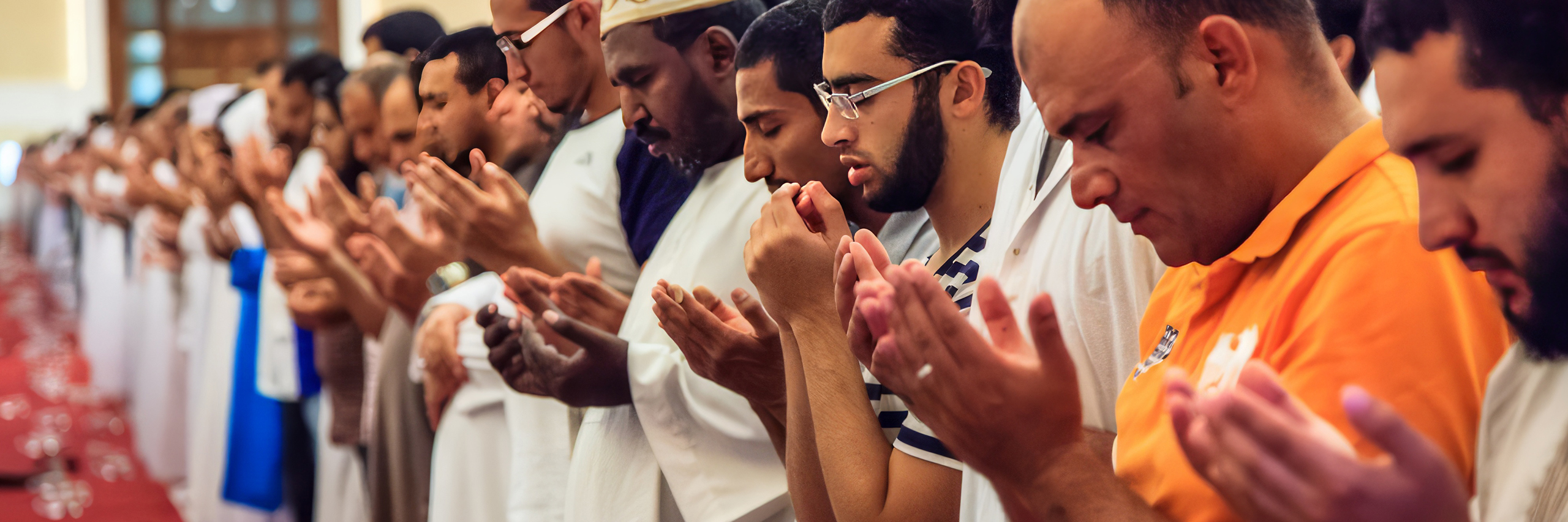
Abu Dawud reported from Sahl b. Sa'd that the Prophet said, "Two times for dua are never or seldom turned down: at the time of the call to prayer and at the time of fighting when people are locked in battle." In another version of the hadith from the same companion, "Two times the gates of heaven open and the dua of someone is rarely rejected: when the call to prayer sounds and when standing in battle ranks for the cause of Allah." While Muslims must exert every worldly effort to reach their goals and support their causes, they also hold deep faith in the spiritual power of dua and constant reliance on Allah's support. This spiritual strength shows clearly during moments of conflict and fear. Part of our belief in the unseen is the concept of the "soldiers of Allah," a Quranic term that shows how Allah helps believers through angels or natural events.
Belief and sincerity help bring about divine support that can lead to miracles. When the soldiers of Talut (King Saul) faced the threat of Goliath and his huge army, they had already passed a test where they were told not to drink from a river despite their thirst. Talut reminded them of Allah's universal rule (sunna): "How often has a small force, with Allah's permission, defeated a larger army!" Allah is with those who are steadfast." Talut did not say this while relying only on mystical feelings; instead, his reliance on Allah was based on careful planning and thought. He spoke these words after leading his army into action and testing his soldiers' commitment and discipline. In the critical moment of battle, all that remained for him was dua.
In this moment, Talut and his soldiers earnestly asked for Allah's support: "Our Lord, pour patience on us, make us stand firm, and help us against the disbelievers." Seeing the sincerity of Talut's small army after they endured many challenges, Allah gave them victory. The Quran emphasizes that this triumph happened only "with Allah's permission." After telling this story, Allah reminds us of another universal sunna: "If Allah did not drive some back by means of others, the earth would be completely corrupt, but Allah is gracious to all."
The sunna of Allah continues throughout history. Centuries later, Prophet Muhammad and his companions were in a similar situation during the Battle of Badr. They had just over 300 men, were poorly armed, and faced an army of 1,000. Even though the Prophet had the heavy responsibility of leading the army and overseeing the battle, many reports highlight his intense dua during the conflict. Witnesses saw him face the direction to prayer (qibla), hands outstretched, wearing his upper and lower garments, and imploring:
O Allah, accomplish for me what You have promised to me. O Allah, fulfill what You have promised! O Allah, if this small band of Muslims is defeated, Your worship will cease on earth.
The Prophet fervently asked Allah, continuing his dua until his upper garment slipped from his shoulders. Abu Bakr al-Siddiq, may Allah be pleased with him, came to him, picked up the garment, and put it back on him. Hugging him from behind, Abu Bakr reassured him: "O Prophet of Allah, your prayer to your Lord is enough, for He will fulfill what He has promised you." Then Allah revealed these words: "When you implored your Lord for assistance, He answered, 'I will reinforce you with a thousand angels in succession.' Allah made this a message of hope to reassure your hearts: help comes only from Allah, He is Almighty and All-Wise."
In the version of this event by al-Bukhari, the Prophet is reported to have said,
O Allah! I ask You for the fulfillment of Your covenant and promise. O Allah! If You will for the believers to be destroyed, You will never be worshiped after today.
Abu Bakr caught him by the hand and said, "This is enough, O Messenger of Allah! You have asked Allah intensely." The Prophet was wearing his armor at that time. He went out, saying: "Their forces will be routed and they will turn tail and flee. But the Hour is their appointed time-the Hour is more severe and bitter."
The Prophet was also heard saying,
O Allah, this is the Quraysh, who have come with their arrogance and pride, opposing and denying Your Messenger. O Allah, grant me the victory You promised. O Allah, make them perish this morning.
Concerned for his companions, he was also heard saying, "O Allah, they are on foot, provide mounts for them; O Allah, they are naked, clothe them; O Allah, they are hungry, provide food for them."
ʿAlī ibn Abī Ṭālib, may Allah be pleased with him, said,
On the day of Badr, I fought for a while, then I hurried to see how the Messenger of Allah was doing. I found him in prostration, saying, "O Ever-Living, O Sustainer!" He repeated these words (yā Ḥayy yā Qayyūm) and said nothing more. I returned to the battle, then came back, and he was still in prostration, saying the same words. I went back to fight, then returned, and he was still saying that. Then Allah granted him victory.
Scholars have thought a lot about the reactions of the Prophet and Abū Bakr during this critical moment. Some emphasize the Prophet's fear (khawf) at that time, while Abū Bakr showed hope (rajāʾ). Both are good, but Abū Bakr's response does not mean he had more confidence in Allah's promise than the Prophet. The Prophet was deeply concerned about his companions, especially as they faced their first big fight against enemies, and he worried about the future of the entire ummah. This concern shows in his dua: "If You will to destroy the believers, You will never be worshiped after today." The Prophet also made extensive dua, not just to express his concerns but to give confidence to his companions. Seeing the Prophet's fervent dua likely reassured them, as they knew his dua holds great weight with Allah.
Abū Bakr's reaction was also a response to the Prophet's visible exhaustion, showing he understood the Prophet's deep concern. A report says the Prophet spent the entire night before the battle in fervent dua, which shows how serious the moment was.
At the same time, the Prophet was known for his great courage. ʿAlī b. Abī Ṭālib (rA) said they used to seek shelter by staying close to the Prophet during the Battle of Badr, as he stood closest to the enemy. That day, the Prophet was one of the most formidable people. Abū al-Qāsim al-Suhaylī (d. 581/1185) described the balance of working hard while relying on Allah.
The Prophet saw the angels fighting steadily, with Gabriel (Jibrīl) covered in dust. The allies of Allah (anṣār Allah) fought without fear of death. Jihad has two forms: physical jihad with the sword and spiritual jihad through dua. It is a sunna for the imam to stay behind the army, not fighting with them. Everyone worked hard, and no one rested from the two struggles. The allies of Allah and His angels worked intensely without resting. The party of Allah and their enemies both stayed firm.
Hadith compilers included chapters on dua against enemies to be defeated and shaken. During the Battle of the Confederates (aḥzāb), when Arab tribes surrounded Medina to destroy the Muslim community, the Prophet prayed, "O Allah, Revealer of the Book, Swift to account, defeat the Confederates. O Allah, defeat them and shake them."
Even though they were outnumbered and faced betrayal from neighbors, the Prophet and his companions won a great victory from Allah without a full-scale battle. It was still called a battle to remember Allah's soldiers, including the angels, the wind, and the sincerity, hard work, and dua of the believers.
The Legislation of the dua of Calamities in Prayer (Qunūt al-Nawāzil)
In 4/625, a few months after 70 companions died in the battle of Uḥud, about 80 other companions known as the qurrāʾ (master Qur'an memorizers and reciters) were killed by trickery in two expeditions: al-Rajīʿ (a well eight miles from Asfan) and Biʾr Maʿūna (a well in Hijaz whose exact location is not clear). The Prophet sent these 80 companions after some non-Muslim tribes asked for people to teach them the Qur'an and the basics of Islam.
Al-Rajīʿ is the story of a plot by the ʿAḍal and Qārra tribes, who killed eight of the Prophet's ten envoys and gave the other two to Quraysh, who killed them for revenge. Before hearing about al-Rajīʿ, the Prophet sent 70 companions to the Arab leader Mālik b. ʿĀmir, who asked for qurrāʾ to teach his people. Mālik did not become Muslim but wanted to learn more about Islam. The Prophet was hesitant to send so many companions to Najd, where he had many enemies, but he honored the protection (jiwār) promised by Mālik. Mālik's nephew, ʿĀmir b. al-Ṭufayl, dishonorably called his allies to kill the group while they camped at the well of Maʿūna. Sixty-nine of them were killed. Only one injured survivor made it back to Medina, where he died a couple of years later.
Many supernatural wonders (karāmāt) that these companions experienced are documented in prophetic biography (sīra) literature. Their deaths saddened the Prophet. Anas, may Allah be pleased with him, said,
I never saw the Messenger of Allah in so much grief for a small army as I saw him for those 70 men called qurrāʾ who were killed at the well of Maʿūna. He invoked curses for a full month upon their murderers.
The Prophet made dua against the people who plotted the tragedy at the well of Maʿūna by name. He made dua against ʿĀmr ibn al-Ṭufayl, who threatened the Prophet, for thirty days, saying, "O Allah, protect me from ʿĀmr ibn al-Ṭufayl as You will, and send upon him a punishment that will destroy him."
In another version, the Prophet said, "O Allah, protect me from ʿĀmr ibn al-Ṭufayl and guide his people." Allah then sent a plague to ʿĀmr that killed him.
Many other hadiths record the Prophet's sorrow and his dua against those tribes. His companion Khufāf b. Īmāʾ narrated,
The Prophet of Allah bowed down (performed rukūʿ) and, after raising his head, said: "The tribe of Ghifār, Allah has forgiven them. The tribe of Aslam, Allah has granted them safety. The tribe of ʿUsayya has disobeyed Allah and His Messenger. O Allah, invoke your curse upon the tribes of Liḥyān, Riʿl, and Dhakwan." Then, he prostrated.
The Prophet's prayer lasted for a month. Anas reported: "The Prophet performed the supplication of devotion (qunūt) for one month after rising from the bowing position (rukūʿ). He prayed against some Arab tribes, then he stopped."
The Prophet also performed qunūt during other disasters. When the Quraysh tribe stopped a group of companions from moving to Medina and tortured them, the Prophet felt their pain deeply. He could not help them directly, so he turned to Allah. He said their names, prayed for their release, and asked for divine justice against the Quraysh. Abū Hurayra reported,
When the Prophet raised his head from the final unit of prayer (rakʿah) of the dawn prayer (Fajr), he said: "O Allah, protect al-Walīd ibn al-Walīd, Salama ibn Hishām, ʿAyyāsh b. Abī Rabīʿa, and all those oppressed in Mecca. O Allah, tighten Your grip on the tribe of Muḍar, and give them years like the years of Prophet Joseph (Yūsuf)."
The Prophet's qunūt showed his deep sadness for his companions, not a lack of faith. As the Shāfiʿī legal expert al-Isnawī (died 772/1370) explained, the Prophet performed qunūt to stop the killers and help the Muslims by asking for replacements for those brave Quran reciters (qurrāʾ) who died. Scholars also say that performing qunūt during disasters (qunūt al-nawāzil) does not go against seeking martyrdom (shahāda). It is a way to ask Allah for help against oppression.
It is important to know that while the Prophet prayed against the Quraysh at times, he also prayed for them at other times. He changed his prayers based on the situation. The famous hadith master Imam al-Bukhārī (died 256/870) had a chapter on praying against polytheists, but he also had a chapter on praying for them to find guidance. The scholar Ibn Ḥajar al-ʿAsqalānī (died 852/1449) noted that al-Bukhārī was very careful. The Prophet prayed against enemies when they were very harmful, but he prayed for them when there was hope they might change.
How to Perform Qunūt al-Nawāzil
We have already looked at the power of dua through the Prophet's life and the Quran, especially during hard times. Now we will explain how to perform qunūt al-nawāzil and look at the different legal views.
In Arabic, qunūt means praise, dua (praying for or against someone), obedience, and humility. In Islamic law, it means a specific prayer (dhikr) where you praise Allah and make dua during namaz. Scholars have different opinions on when to do it, but it is generally recommended or allowed in the dawn (fajr) and odd-numbered (witr) prayers, and during any prayer when a disaster hits the Muslims.
Jurists have different views on qunūt al-nawāzil. The Mālikī school does not see it as a sunna, but the Ḥanafī, Shāfiʾī, and Ḥanbalī schools allow or recommend it. They disagree on which prayers to use it in, whether to say it out loud or quietly, and whether to do it before or after bowing (rukūʿ). The Shāfiʿī school is the most flexible, and their rules are as follows.
The Shāfiʿī school recommends qunūt al-nawāzil in all required prayers. The scholar Imam al-Nawawī (died 766/1277) said: "When a disaster like an enemy attack, drought, sickness, or other harm hits the Muslims, they should perform qunūt in all required prayers." This includes the Friday prayer. It is allowed but not recommended in extra (sunna) prayers, and it is disliked (makrūh) in funeral prayers.
Shāfiʿī scholars did not say a 'disaster' must affect all Muslims. They said it is a sunnah even if it affects just one Muslim, as long as that person is important to the whole community, like a scholar or a brave leader. Also, you do not have to be the one affected to perform it; Muslims everywhere should do it to show they care and to help each other. You can also perform qunūt al-nawāzil if there is a threat from an enemy, even if that enemy is Muslim. You do not need permission from leaders to do this sunna.
In the Shāfiʿī school, you perform qunūt after rising from bowing (rukūʿ). You can do it alone or in a group. There is no specific prayer text for qunūt al-nawāzil. You should follow the Prophet's example by asking Allah to end the disaster, help the oppressed, and stop the oppressors. If you are in a group, the dua should be a reasonable length so people do not get tired. If the group agrees, you can make it longer.
Like all dua, how you hold your hands depends on what you are asking for. If you want to remove a disaster, turn the backs of your hands toward the sky. If you are asking for something to be given to you, hold your palms up toward the sky. Because of the seriousness of the disaster, it is recommended to say the dua out loud, whether you are praying alone or in a group, and whether the prayer is usually said out loud or silently.
Performing qunūt al-nawāzil in a group shows that Muslims care for each other. The Prophet said: "The believers in their mutual kindness, compassion, and sympathy are like one body. When one of the limbs suffers, the whole body responds to it with wakefulness and fever." Prostration (sujūd) is the best time for dua, but qunūt is done after bowing (rukūʿ). Ibn Ḥajar al-ʿAsqalānī says this is because qunūt is a group act. Even if the followers (maʾmūm) just say "āmīn" to the imam's dua, the group prayer helps the dua be accepted. Muslims today still use qunūt al-nawāzil to show they care for oppressed Muslims everywhere.
Some Examples of dua in Qunūt al-Nawāzil:
O Allah, we ask for Your help and guidance. We ask for Your forgiveness and turn to You in repentance. We believe in You and trust You completely. We praise You for all Your goodness. We are grateful and try not to be ungrateful for Your blessings. We turn away from those who reject You.
O Allah, we worship only You, and to You we pray and prostrate. We work for You and strive in Your worship. We hope for Your mercy and fear Your punishment, for Your punishment surely hits the disbelievers.
O Allah, protect us, show us mercy, give us victory, and take away our distress and the distress of all Muslims. Protect us and all Muslims from the evils of disasters in this life and in our religion. Guide us to what is right, and guide those whose guidance brings good to the Muslims. Save us from destruction, and let those whose removal brings benefit to the Muslims face it. O Allah, shower us with Your mercy, kindness, health, and blessings, and do not keep Your favors from us.
O Allah, take away from us and from the Muslims all harm, disasters, oppression, injustice, and all kinds of sickness, bad paths, and ignorance, whether we see them or not. O Allah, save the weak, the distressed, and the oppressed among the Muslims. Provide for them, protect them, support them, care for them, guide them, and help them succeed in what You love.
O Allah, grant us and them success in what is ordained, and turn away from us and them the evil of tyrants, oppressors, corruptors, and those who help them. O Allah, act quickly, without delay, in well-being and safety through Your mercy, O Most Merciful of the merciful.
Local Muslim Life Guide in the Muslim World: Day of Arafah Dua, Dhikr and Worship Plan
Articles • yusuf908 posted the article • 0 comments • 235 views • 2026-05-22 10:09
Summary: Local Muslim Life Guide in the Muslim World: Day of Arafah dua, Dhikr and Worship Plan is presented here as a clear English Islamic knowledge article for Muslim readers, starting with this scene: Fatimah sat by the window, counting on her fingers as she whispered dhikr. Outside, the world was busy with honking cars and children walking home from school. It keeps the original names, Quran and hadith references, dua, photographs, and religious context while focusing on Day of Arafah, dua, Dhikr.
Fatimah sat by the window, counting on her fingers as she whispered dhikr. Outside, the world was busy with honking cars and children walking home from school. Inside, the TV showed a live stream of the sea of pilgrims in the sacred valley, calling out to Allah.
It was the Day of ʿArafah.
Fatimah was not on Hajj, but her heart ached to be there. Somehow, the Day of ʿArafah felt very far away from where she sat.
As a child, she once asked her grandfather why people cried so much on ʿArafah. He smiled gently and said, "Because it is the day we all come home to Allah."
She did not understand it then. But today, after months of feeling spiritually lost and with a heart heavy with guilt, it made sense.
ʿArafah: Not just for the pilgrims
The Prophet ﷺ said: "Hajj is ʿArafah, Hajj is ʿArafah, Hajj is ʿArafah."
The Day of ʿArafah is the peak of Hajj and the heart of the pilgrimage. Hajj is not complete without it. It falls on the 9th day of Dhul Hijjah and is one of the most virtuous days in the Islamic calendar. On this day, pilgrims stand or sit to remember Allah and pray to Him intensely from the Dhuhr prayer until after sunset.
For those of us not on the plains of ʿArafah, it offers something very personal: a chance to stand before Allah, repent, call out to Him in total need, and seek salvation. The Prophet ﷺ said: "There is no day on which Allah frees more people from the Fire than the Day of ʿArafah." This day is not just a ritual for pilgrims on Hajj, but a chance for salvation for the entire ummah.
The Day of ʿArafah is unique, offering a special chance for forgiveness, mercy, and spiritual renewal. It is important because it is the day Allah revealed the completion of the religion: "This day I have perfected for you your religion and completed My favor upon you and have approved for you Islam as your religion" (Qur'an 5:3). It is also the day the covenant between Allah and every soul took place: "And [mention] when your Lord took from the children of Adam-from their loins-their descendants and made them testify of themselves, [saying to them], 'Am I not your Lord?'" ' They said, 'Yes, we have testified.' [This]-lest you should say on the day of Resurrection, 'Indeed, we were of this unaware.'" (Qur'an 7:172)
Here are a few practical ways to make the most of this blessed day and its virtues:
1. Engage in continuous dua and dhikr
The Prophet ﷺ said, "The best supplication is the supplication on the Day of ʿArafah. The best of what I and the prophets before me have said is: 'There is no deity but Allah alone, He has no partner. To Him belongs all sovereignty and praise, and He has power over all things.'"
Take this chance to seek Allah's help with a heart full of longing. Spend the day in constant dua (supplication) and dhikr (remembrance), affirming Allah's oneness and thanking Him for His blessings.
2. Fast on the Day of ʿArafah
Fasting on the Day of ʿArafah is highly recommended for those not performing Hajj, as it offers rewards like no other day of the year. The Prophet ﷺ said that fasting on this day "expiates the sins of the previous year and the coming year." While fasting, be careful about what you watch and listen to, and how you treat others.
3. Honor the sunnah prayers
Plan your day to include all the sunnah prayers, and focus on your khushuʿ (presence of heart). Prepare yourself by learning about the power of prayer. The intention to gain more spiritual rewards on this special day is a form of worship itself.
4. Take heed of the Prophet ﷺ's final sermon
On this fateful day, as the ummah was spread out across ʿArafah, the Prophet ﷺ delivered his final sermon.
This moment marked the time Islam was perfected and completed, and it held a message for all of humanity. His last sermon was a summary of his message and guidance for the ummah. He ﷺ forbade usury, reminded us to treat women well, to uphold racial equality, and to hold firm to the Qur'an and Sunnah.
Reflecting on this sermon helps us reconnect with the core values of our faith.
5. Reflect on and renew your covenant with Allah
The Day of ʿArafah is a time to remember the covenant we made with Allah. As mentioned in the Qur'an, Allah asked, "Am I not your Lord? " and we all responded, "Yes, we bear witness" (Qur'an 7:172). Reflect on this moment and renew your commitment to Allah. Acknowledge your past shortcomings, seek His forgiveness, and aim to strengthen your relationship with your Creator.
Use this blessed day to make a personal commitment to improve your spiritual life. Identify one major change you can make to better follow Islamic teachings. Write it down as a personal promise to Allah, and ask Him for guidance and strength to see it through. As you renew your covenant with Allah, let this day mark a turning point in your spiritual journey.
The Day of ʿArafah is a gift from Allah—a chance to wipe away past sins, renew our faith, and draw closer to Him. May Allah grant us the ability to observe this day with sincerity and devotion, and may He accept our efforts and forgive our shortcomings. Ameen. view all
Summary: Local Muslim Life Guide in the Muslim World: Day of Arafah dua, Dhikr and Worship Plan is presented here as a clear English Islamic knowledge article for Muslim readers, starting with this scene: Fatimah sat by the window, counting on her fingers as she whispered dhikr. Outside, the world was busy with honking cars and children walking home from school. It keeps the original names, Quran and hadith references, dua, photographs, and religious context while focusing on Day of Arafah, dua, Dhikr.
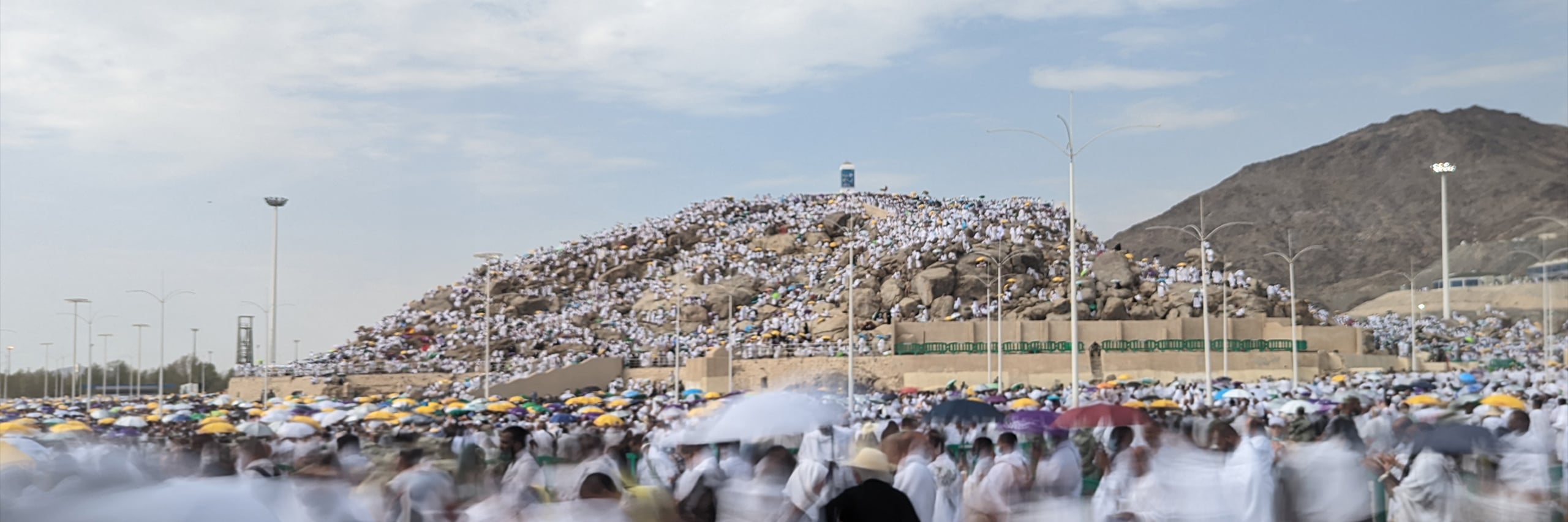
Fatimah sat by the window, counting on her fingers as she whispered dhikr. Outside, the world was busy with honking cars and children walking home from school. Inside, the TV showed a live stream of the sea of pilgrims in the sacred valley, calling out to Allah.
It was the Day of ʿArafah.
Fatimah was not on Hajj, but her heart ached to be there. Somehow, the Day of ʿArafah felt very far away from where she sat.
As a child, she once asked her grandfather why people cried so much on ʿArafah. He smiled gently and said, "Because it is the day we all come home to Allah."
She did not understand it then. But today, after months of feeling spiritually lost and with a heart heavy with guilt, it made sense.
ʿArafah: Not just for the pilgrims
The Prophet ﷺ said: "Hajj is ʿArafah, Hajj is ʿArafah, Hajj is ʿArafah."
The Day of ʿArafah is the peak of Hajj and the heart of the pilgrimage. Hajj is not complete without it. It falls on the 9th day of Dhul Hijjah and is one of the most virtuous days in the Islamic calendar. On this day, pilgrims stand or sit to remember Allah and pray to Him intensely from the Dhuhr prayer until after sunset.
For those of us not on the plains of ʿArafah, it offers something very personal: a chance to stand before Allah, repent, call out to Him in total need, and seek salvation. The Prophet ﷺ said: "There is no day on which Allah frees more people from the Fire than the Day of ʿArafah." This day is not just a ritual for pilgrims on Hajj, but a chance for salvation for the entire ummah.
The Day of ʿArafah is unique, offering a special chance for forgiveness, mercy, and spiritual renewal. It is important because it is the day Allah revealed the completion of the religion: "This day I have perfected for you your religion and completed My favor upon you and have approved for you Islam as your religion" (Qur'an 5:3). It is also the day the covenant between Allah and every soul took place: "And [mention] when your Lord took from the children of Adam-from their loins-their descendants and made them testify of themselves, [saying to them], 'Am I not your Lord?'" ' They said, 'Yes, we have testified.' [This]-lest you should say on the day of Resurrection, 'Indeed, we were of this unaware.'" (Qur'an 7:172)
Here are a few practical ways to make the most of this blessed day and its virtues:
1. Engage in continuous dua and dhikr
The Prophet ﷺ said, "The best supplication is the supplication on the Day of ʿArafah. The best of what I and the prophets before me have said is: 'There is no deity but Allah alone, He has no partner. To Him belongs all sovereignty and praise, and He has power over all things.'"
Take this chance to seek Allah's help with a heart full of longing. Spend the day in constant dua (supplication) and dhikr (remembrance), affirming Allah's oneness and thanking Him for His blessings.
2. Fast on the Day of ʿArafah
Fasting on the Day of ʿArafah is highly recommended for those not performing Hajj, as it offers rewards like no other day of the year. The Prophet ﷺ said that fasting on this day "expiates the sins of the previous year and the coming year." While fasting, be careful about what you watch and listen to, and how you treat others.
3. Honor the sunnah prayers
Plan your day to include all the sunnah prayers, and focus on your khushuʿ (presence of heart). Prepare yourself by learning about the power of prayer. The intention to gain more spiritual rewards on this special day is a form of worship itself.
4. Take heed of the Prophet ﷺ's final sermon
On this fateful day, as the ummah was spread out across ʿArafah, the Prophet ﷺ delivered his final sermon.
This moment marked the time Islam was perfected and completed, and it held a message for all of humanity. His last sermon was a summary of his message and guidance for the ummah. He ﷺ forbade usury, reminded us to treat women well, to uphold racial equality, and to hold firm to the Qur'an and Sunnah.
Reflecting on this sermon helps us reconnect with the core values of our faith.
5. Reflect on and renew your covenant with Allah
The Day of ʿArafah is a time to remember the covenant we made with Allah. As mentioned in the Qur'an, Allah asked, "Am I not your Lord? " and we all responded, "Yes, we bear witness" (Qur'an 7:172). Reflect on this moment and renew your commitment to Allah. Acknowledge your past shortcomings, seek His forgiveness, and aim to strengthen your relationship with your Creator.
Use this blessed day to make a personal commitment to improve your spiritual life. Identify one major change you can make to better follow Islamic teachings. Write it down as a personal promise to Allah, and ask Him for guidance and strength to see it through. As you renew your covenant with Allah, let this day mark a turning point in your spiritual journey.
The Day of ʿArafah is a gift from Allah—a chance to wipe away past sins, renew our faith, and draw closer to Him. May Allah grant us the ability to observe this day with sincerity and devotion, and may He accept our efforts and forgive our shortcomings. Ameen.
Muslim Life Guide in the Muslim World: Last Ten Nights, Menstruation, Dua and Ramadan Worship
Articles • yusuf908 posted the article • 0 comments • 227 views • 2026-05-22 10:09
Summary: Muslim Life Guide in the Muslim World: Last Ten Nights, Menstruation, dua and Ramadan Worship is presented here as a clear English Islamic knowledge article for Muslim readers, starting with this scene: Aisha (rA) reported that when the last ten nights of Ramadan arrived, the Prophet ﷺ would tighten his belt, spend the night in worship, and awaken his family (agreed upon). It keeps the original names, Quran and hadith references, dua, photographs, and religious context while focusing on Ramadan Worship, Muslim Women, dua.
Aisha (rA) reported that when the last ten nights of Ramadan arrived, the Prophet ﷺ would tighten his belt, spend the night in worship, and awaken his family (agreed upon). This is the time that, as Muslims, we put in the most effort, praying for longer and later in the night, hoping for Laylat al-Qadr, asking to be accepted by Allah.
For women though, there is always disappointment and sadness if menstruation starts during the last ten nights of Ramadan. All the blessings seem to be out of reach, and it feels like we are excluded from the immense rewards.
Aisha (rA) went through something similar. She had intended Hajj, but began menstruating. The feelings of frustration, sorrow, and even rejection are feelings that many women know all too well. The Prophet ﷺ walked in on her as she was weeping, and he immediately knew. "What is the matter? Are you menstruating? " he asked. She responded in the affirmative. The Prophet comforted her. "This is a matter that Allah has decreed for the daughters of Adam," he said, "so complete the rites of Hajj pilgrimage as other pilgrims do, but do not circle around the House" (agreed upon).
Many women worry that getting their menstruation during a blessed time could be a sign of Allah's displeasure. We equate it with exclusion-when people exclude, it is because they do not like you or they see you as unworthy, so we subconsciously project that onto Allah, believing that He might not like us and deems us unworthy. But the Prophet ﷺ comforted Aisha (rA) and all of us by banishing the thought-your natural cycle, that Allah gave you as a blessing and for a wisdom, is simply something that Allah decreed. When you start your period has nothing to do with Allah's pleasure with you.
He then taught Aisha (rA) what she should do. Out of mercy, Allah decreed that women should not do the prayer or fast during menstruation. We are rewarded for submitting to and obeying Him, so not fasting becomes an act of obedience, as does not praying during this time. We are in a state of submission because we fast and pray when He tells us to and we refrain from doing so when He forbids us. The state of the heart is the same: loving submission to the commands of our Merciful Lord.
But what about connection? We might miss those actions. We might want to pray for long hours during the night, or join the congregation in the mosque. Yet menstruation does not mean you are cut off from Allah. In fact, just like the Prophet ﷺ taught Aisha (rA) that there were things she should be doing to worship Allah, we have so many avenues to worship Him and come closer to Him during these last ten nights. Indeed, it teaches us how to turn to Him no matter our state.
1- Reciting Qur'an
If you take the opinion that reciting Qur'an is permissible, then continue to recite and reflect upon it, or simply listen to its recitation, as well as delving into digestible tafsir (exegesis). The Qur'an is a blessing not simply when we recite it, but when we implement its teachings and practice it. When Aisha (rA) was asked about the character of the Prophet ﷺ, she said that his character was the Qur'an (Sahih Muslim, no. 746). The Prophet was described as being the most generous of people, and he was even more generous during Ramadan, when Jibril would revise the Qur'an with him (agreed upon). This shows us that the Qur'an impacted him even more during Ramadan.
So connect with the Qur'an during this time. Connect with Allah's words-nothing soothes the soul more than His own words to us. Allah says,
"We send down the Qur'an as a healing and mercy for the believers..." (Qur'an 17:82).
2- Remembrance
Allah says,
"Remember Me; I will remember you. And thank Me, and never be ungrateful" (Qur'an 2:152).
The Prophet ﷺ said, "Allah said, 'I am with him [My servant] if he remembers Me'" (Sahih al-Bukhari, no. 7405).
If we are feeling alone, or far from Allah, then the antidote is simply to remember Him. To talk to Him. Allah tells us that He is with us when we do. And the Prophet ﷺ taught us profound words of remembrance and praise. For example, he taught that "Alhamdulillah (all praise and gratitude is for Allah alone) fills the scale" (Sahih Muslim, no. 223). Take the time to just sit down, contemplate your blessings, and even the tests that you are growing through, and praise Allah for them. The Prophet ﷺ also taught, "Whoever declares the glory of Allah and His praises (subhanAllah wa bihamdihi) one hundred times every day, his sins will be diminished even if they are like the foam of the sea" (agreed upon). Reflect upon what these remembrances mean and increase in your hope, love, and closeness to Allah.
The Prophet ﷺ also said, "Those in solitude have raced ahead." They said, "O Messenger of Allah, who are those in solitude? The Prophet said, "They are men and women who remember Allah often" (Sahih Muslim, no. 2676).
3- dua
"When My servants ask you [O Prophet] about Me: I am truly near. I respond to one's prayer when they call upon Me" (Qur'an 2:186).
dua is always open to us. You can wake up before Fajr if you want, and spend the last third of the night pouring your heart out to Him and asking. Keep seeking the blessings of the Night of Decree (Laylat al-Qadr). The Prophet ﷺ said, "Verily, Allah is abundant in grace and generous. He would be shy, when a person raises his hands to Him, to turn them away empty and disappointed" (Sunan al-Tirmidhi, no. 3556).
When Aisha (rA) asked the Prophet ﷺ what she should say if she knew which night Laylat al-Qadr was, he said, "Say: O Allah, You are pardoning. You love to pardon, so pardon me" (Sunan al-Tirmidhi, no. 3513).
Allah is al-Sami al-Mujib—He hears you and answers in the best way. Keep asking.
4- Use your energy to help those fasting
Since you are not fasting, use your extra energy to serve those who are fasting or in need. Once, the companions were on a journey with the Prophet ﷺ. Some were fasting and some were not. It was a hot day and they stopped to rest. The fasting ones fell to the ground, but those not fasting got up to pitch the tents and water the animals. The Prophet ﷺ said,
"Those who were not fasting today have taken all the reward" (Sahih al-Bukhari, no. 2890).
You can also get great rewards by helping others while not fasting. The Prophet ﷺ taught us that "Whoever feeds a fasting person, he will have the same reward as him" (Sunan al-Tirmidhi, no. 807). The Prophet ﷺ also reminded us, "Whoever would love to be shaded in the shade of Allah, let him help someone in hardship or waive a loan" (Musnad Ahmad, no. 15520).
There is so much good we can do for others, like helping them worship, that Allah rewards us for.
5- Charity
Allah says in the Qur'an,
"Those who spend their wealth in charity day and night, secretly and openly-their reward is with their Lord, and there will be no fear for them, nor will they grieve." (2:274)
Whatever little you can do, Allah is al-Shakur (the Most Appreciative). Out of His generosity, He rewards the little we give with huge blessings.
The Prophet ﷺ was the most generous of people, and he was even more generous during Ramadan when Jibril would revise the Qur'an with him (agreed upon). This is a time to give! Let reflecting on the Qur'an make you even more giving, following the sunnah of the beloved ﷺ.
6- The worship of the heart
We often focus on outward actions instead of our hearts. The Prophet ﷺ once pointed out a man to the companions, saying he was from the people of Paradise. Abdullah ibn Amr (rA) wanted to know what was special about him and expected something extraordinary. He spent three nights with him, but saw nothing unusual. Finally, he asked him. The man replied, "It is not but as you see, except that I find no malice within myself towards the Muslims, nor do I envy anyone for the good that Allah has given them." Abdullah said, "It is these virtues that have elevated you to this status, and these are the same qualities that we have not been able to maintain" (Musnad Ahmad, no. 12697). Spending these nights working on our hearts—our hope in Allah, our contentment with His decree, and self-examination (muhasabah)—is worship He loves.
There are many ways to worship Allah and connect to Him. Allah's door is never closed, especially to those who seek Him and want closeness. If you cannot do one or two acts of worship, be happy that you can do so many others.
May Allah accept it.
For more ways to worship during your period, look at 10 Acts of Worship When You Can't Pray | Blog | Yaqeen Institute for Islamic Research. view all
Summary: Muslim Life Guide in the Muslim World: Last Ten Nights, Menstruation, dua and Ramadan Worship is presented here as a clear English Islamic knowledge article for Muslim readers, starting with this scene: Aisha (rA) reported that when the last ten nights of Ramadan arrived, the Prophet ﷺ would tighten his belt, spend the night in worship, and awaken his family (agreed upon). It keeps the original names, Quran and hadith references, dua, photographs, and religious context while focusing on Ramadan Worship, Muslim Women, dua.
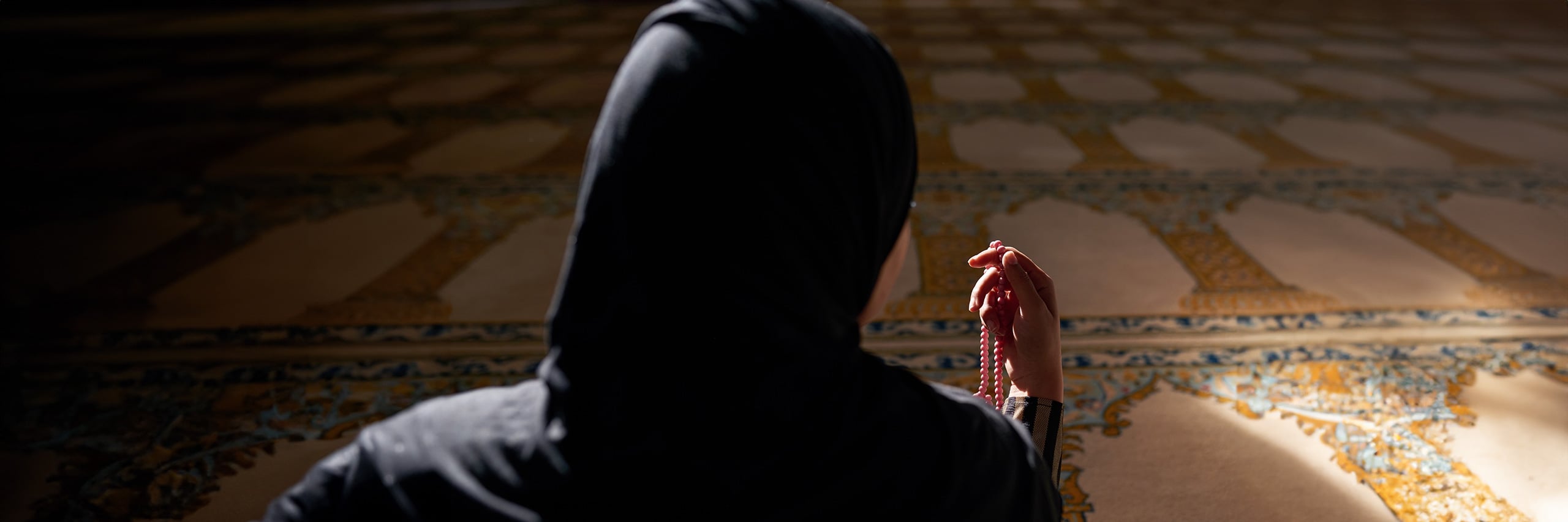
Aisha (rA) reported that when the last ten nights of Ramadan arrived, the Prophet ﷺ would tighten his belt, spend the night in worship, and awaken his family (agreed upon). This is the time that, as Muslims, we put in the most effort, praying for longer and later in the night, hoping for Laylat al-Qadr, asking to be accepted by Allah.
For women though, there is always disappointment and sadness if menstruation starts during the last ten nights of Ramadan. All the blessings seem to be out of reach, and it feels like we are excluded from the immense rewards.
Aisha (rA) went through something similar. She had intended Hajj, but began menstruating. The feelings of frustration, sorrow, and even rejection are feelings that many women know all too well. The Prophet ﷺ walked in on her as she was weeping, and he immediately knew. "What is the matter? Are you menstruating? " he asked. She responded in the affirmative. The Prophet comforted her. "This is a matter that Allah has decreed for the daughters of Adam," he said, "so complete the rites of Hajj pilgrimage as other pilgrims do, but do not circle around the House" (agreed upon).
Many women worry that getting their menstruation during a blessed time could be a sign of Allah's displeasure. We equate it with exclusion-when people exclude, it is because they do not like you or they see you as unworthy, so we subconsciously project that onto Allah, believing that He might not like us and deems us unworthy. But the Prophet ﷺ comforted Aisha (rA) and all of us by banishing the thought-your natural cycle, that Allah gave you as a blessing and for a wisdom, is simply something that Allah decreed. When you start your period has nothing to do with Allah's pleasure with you.
He then taught Aisha (rA) what she should do. Out of mercy, Allah decreed that women should not do the prayer or fast during menstruation. We are rewarded for submitting to and obeying Him, so not fasting becomes an act of obedience, as does not praying during this time. We are in a state of submission because we fast and pray when He tells us to and we refrain from doing so when He forbids us. The state of the heart is the same: loving submission to the commands of our Merciful Lord.
But what about connection? We might miss those actions. We might want to pray for long hours during the night, or join the congregation in the mosque. Yet menstruation does not mean you are cut off from Allah. In fact, just like the Prophet ﷺ taught Aisha (rA) that there were things she should be doing to worship Allah, we have so many avenues to worship Him and come closer to Him during these last ten nights. Indeed, it teaches us how to turn to Him no matter our state.
1- Reciting Qur'an
If you take the opinion that reciting Qur'an is permissible, then continue to recite and reflect upon it, or simply listen to its recitation, as well as delving into digestible tafsir (exegesis). The Qur'an is a blessing not simply when we recite it, but when we implement its teachings and practice it. When Aisha (rA) was asked about the character of the Prophet ﷺ, she said that his character was the Qur'an (Sahih Muslim, no. 746). The Prophet was described as being the most generous of people, and he was even more generous during Ramadan, when Jibril would revise the Qur'an with him (agreed upon). This shows us that the Qur'an impacted him even more during Ramadan.
So connect with the Qur'an during this time. Connect with Allah's words-nothing soothes the soul more than His own words to us. Allah says,
"We send down the Qur'an as a healing and mercy for the believers..." (Qur'an 17:82).
2- Remembrance
Allah says,
"Remember Me; I will remember you. And thank Me, and never be ungrateful" (Qur'an 2:152).
The Prophet ﷺ said, "Allah said, 'I am with him [My servant] if he remembers Me'" (Sahih al-Bukhari, no. 7405).
If we are feeling alone, or far from Allah, then the antidote is simply to remember Him. To talk to Him. Allah tells us that He is with us when we do. And the Prophet ﷺ taught us profound words of remembrance and praise. For example, he taught that "Alhamdulillah (all praise and gratitude is for Allah alone) fills the scale" (Sahih Muslim, no. 223). Take the time to just sit down, contemplate your blessings, and even the tests that you are growing through, and praise Allah for them. The Prophet ﷺ also taught, "Whoever declares the glory of Allah and His praises (subhanAllah wa bihamdihi) one hundred times every day, his sins will be diminished even if they are like the foam of the sea" (agreed upon). Reflect upon what these remembrances mean and increase in your hope, love, and closeness to Allah.
The Prophet ﷺ also said, "Those in solitude have raced ahead." They said, "O Messenger of Allah, who are those in solitude? The Prophet said, "They are men and women who remember Allah often" (Sahih Muslim, no. 2676).
3- dua
"When My servants ask you [O Prophet] about Me: I am truly near. I respond to one's prayer when they call upon Me" (Qur'an 2:186).
dua is always open to us. You can wake up before Fajr if you want, and spend the last third of the night pouring your heart out to Him and asking. Keep seeking the blessings of the Night of Decree (Laylat al-Qadr). The Prophet ﷺ said, "Verily, Allah is abundant in grace and generous. He would be shy, when a person raises his hands to Him, to turn them away empty and disappointed" (Sunan al-Tirmidhi, no. 3556).
When Aisha (rA) asked the Prophet ﷺ what she should say if she knew which night Laylat al-Qadr was, he said, "Say: O Allah, You are pardoning. You love to pardon, so pardon me" (Sunan al-Tirmidhi, no. 3513).
Allah is al-Sami al-Mujib—He hears you and answers in the best way. Keep asking.
4- Use your energy to help those fasting
Since you are not fasting, use your extra energy to serve those who are fasting or in need. Once, the companions were on a journey with the Prophet ﷺ. Some were fasting and some were not. It was a hot day and they stopped to rest. The fasting ones fell to the ground, but those not fasting got up to pitch the tents and water the animals. The Prophet ﷺ said,
"Those who were not fasting today have taken all the reward" (Sahih al-Bukhari, no. 2890).
You can also get great rewards by helping others while not fasting. The Prophet ﷺ taught us that "Whoever feeds a fasting person, he will have the same reward as him" (Sunan al-Tirmidhi, no. 807). The Prophet ﷺ also reminded us, "Whoever would love to be shaded in the shade of Allah, let him help someone in hardship or waive a loan" (Musnad Ahmad, no. 15520).
There is so much good we can do for others, like helping them worship, that Allah rewards us for.
5- Charity
Allah says in the Qur'an,
"Those who spend their wealth in charity day and night, secretly and openly-their reward is with their Lord, and there will be no fear for them, nor will they grieve." (2:274)
Whatever little you can do, Allah is al-Shakur (the Most Appreciative). Out of His generosity, He rewards the little we give with huge blessings.
The Prophet ﷺ was the most generous of people, and he was even more generous during Ramadan when Jibril would revise the Qur'an with him (agreed upon). This is a time to give! Let reflecting on the Qur'an make you even more giving, following the sunnah of the beloved ﷺ.
6- The worship of the heart
We often focus on outward actions instead of our hearts. The Prophet ﷺ once pointed out a man to the companions, saying he was from the people of Paradise. Abdullah ibn Amr (rA) wanted to know what was special about him and expected something extraordinary. He spent three nights with him, but saw nothing unusual. Finally, he asked him. The man replied, "It is not but as you see, except that I find no malice within myself towards the Muslims, nor do I envy anyone for the good that Allah has given them." Abdullah said, "It is these virtues that have elevated you to this status, and these are the same qualities that we have not been able to maintain" (Musnad Ahmad, no. 12697). Spending these nights working on our hearts—our hope in Allah, our contentment with His decree, and self-examination (muhasabah)—is worship He loves.
There are many ways to worship Allah and connect to Him. Allah's door is never closed, especially to those who seek Him and want closeness. If you cannot do one or two acts of worship, be happy that you can do so many others.
May Allah accept it.
For more ways to worship during your period, look at 10 Acts of Worship When You Can't Pray | Blog | Yaqeen Institute for Islamic Research.
Islamic Guide: Dua for the Departed - Hope, Mercy and Peace
Articles • ali2007fr posted the article • 0 comments • 239 views • 2026-05-20 22:08
Summary: This article explains how Muslims can make dua for loved ones who have passed away, with Quranic and prophetic guidance on mercy, forgiveness, and hope. It keeps the focus on grief, sadaqah jariyah, righteous descendants, and sincere prayer for the deceased.
Hi, everyone. I know that losing someone you love hurts deeply, like the world is falling apart. Feeling sad and hopeless is completely normal, and even our Prophet went through it. But I want to share a warm secret: even though they have left us for another world, our love and longing for them are not in vain! The dua we make for them, these calls from our hearts, actually help them directly and improve their status there. And there is more! They will even know that this is happening because we are praying for them. So, our love and care cross the boundary of life and death, keeping us connected to them and sending them warmth and help. One of the hardest challenges any of us can face is the death of a loved one. After a loved one passes, it is natural to be overwhelmed by grief, and for some, it can even lead to a sense of hopelessness and helplessness. Even though we acknowledge our grief, just as our beloved Prophet Muhammad (peace be upon him) did—he lost his uncle Abu Talib, his beloved wife Khadija, and all his children except Fatima (may Allah be pleased with her)—we can find comfort in the duty of praying for our loved ones. In fact, the duas we make for them after they pass can directly affect their status in the afterlife. Abu Hurairah (may Allah be pleased with him) narrated that the Messenger of Allah (peace be upon him) said: 'Indeed, Allah, the Exalted, will raise the rank of His righteous servant in Paradise, and he will ask: "O Lord, what is this?"' 'Allah will say: "This is because your child sought forgiveness for you."' (Musnad Ahmad, No. 10610). Therefore, our connection with our loved ones is so deep that even after they start their journey to the afterlife, we can still help raise their status. More importantly, we not only raise their rank, but they are also told that this elevation is due to the duas you made for them. This makes your dua not just a comfort for yourself, but a help to them and a way to keep communicating with your loved one. Interestingly, in this narration, the son did not ask to raise his father's rank, but only asked for forgiveness for him. This suggests the special power of seeking forgiveness (istighfar). The link between seeking forgiveness and raising one's rank is that seeking forgiveness is not just for the sins we can remember. This can also be seen in the tradition of the Prophet (peace be upon him), who would say "astaghfirullah" (I seek forgiveness from Allah) three times after every namaz. In fact, seeking forgiveness is so important that almost every dua we cover here starts with seeking forgiveness. It is easy to assume our loved ones are perfect and sinless, especially when we respect them so much. However, it is crucial to always seek forgiveness even for sins we are not aware of, as the truth is we can never know all the faults of others. Generally, we should never judge a servant's status with Allah, but instead accept the fact that "every descendant of Adam is a sinner" (Jami` at-Tirmidhi, No. 2499). Yet, this must be balanced with maintaining a good opinion (husn al-dhann) of Allah, who "is indeed the Most Merciful, the Most Compassionate" (Quran 49:5). In his Sahih al-Bukhari, Imam Bukhari begins the "Book of Funerals" by citing a report from Abu Dharr (may Allah be pleased with him) that the Prophet ﷺ said: "Whoever says 'There is no god but Allah' (La ilaha illa Allah) will enter Paradise." Abu Dharr asked: "Even if he commits adultery and theft?" The Prophet ﷺ replied: "Even if he commits adultery and theft." (Sahih al-Bukhari, No. 1237). Here, Imam Bukhari shows his wisdom by opening the chapter with a report that reminds us to maintain a positive opinion (husn al-dhann) of Allah. This is not meant to downplay the sins of adultery and theft, but to emphasize our firm belief in the power of sincere dua and the promise that Allah will always treat us with love and forgiveness. Dua for deceased parents: Abu Usaid said: "While we were with the Messenger of Allah ﷺ, a man asked: 'Messenger of Allah, is there any act of kindness I can still do for my parents after they die?' He replied: 'Yes, there are four things: pray for them, ask for their forgiveness, fulfill their promises, and be kind to their friends.' You only have kinship through your parents.' (Al-Adab al-Mufrad, No. 35, weak hadith). According to the dua Prophet Nuh made to Allah (71:28), you can say: 'My Lord, forgive me and my parents.' رَّبِّ ٱغْفِرْ لِي وَلِوَٰلِدَىَّ However, this can also be combined with another dua from the Quran. After commanding us to honor our parents and never say "uff" to them, Allah commands us to pray for them in this form: وَٱخْفِضْ لَهُمَا جَنَاحَ ٱلذُّلِّ مِنَ ٱلرَّحْمَةِ وَقُل رَّبِّ ٱرْحَمْهُمَا كَمَا رَبَّيَانِى صَغِيرًۭا "And lower to them the wing of humility out of mercy and say, 'My Lord!' Have mercy upon them as they brought me up when I was small.'" (Quran 17:24) Therefore, to pray for our deceased parents and help them enter Paradise, if Allah wills, we can say: رَّبِّ ٱغْفِرْ لِي وَلِوَٰلِدَىَّ وارْحَمْهُمَا كَمَا رَبَّيَانِى صَغِيرا Rabbi ighfir li wa li-walidayya wa-irhamhuma kama rabbayani saghira My Lord! Forgive me and my parents, and have mercy on them as they raised me when I was small. To change the dua to pray only for your father, you can say: Rabbi ighfir li wa li-waalidi wa-irhamhu kama rabbani saghira رَّبِّ ٱغْفِرْ لِي وَلِوَالِدي وارْحَمْهُ كَمَا رَبَّنِي صَغِيرًۭا And to pray only for your mother, you can say: Rabbi ighfir li wa li-waalidati wa-irhamha kama rabbatni saghira رَّبِّ ٱغْفِرْ لِي وَلِوَالِدتي وارْحَمْهُا كَمَا رَبَّتنِي صَغِيرًۭا Dua for deceased Muslims: The following supplication is one of the most famous duas for the deceased, and it is the one you are most likely to hear at a graveyard. You can recite it during the funeral prayer (janaza) after the third takbir, or at the graveyard, and you can continue to repeat it afterward, especially in the period immediately following their passing. Awf ibn Malik (may Allah be pleased with him) reported: I heard the Prophet ﷺ say at the funeral of a companion: اللَّهُمَّ أغْفِر لَهُ وَارْحَمْهُ وعَافِهِ وَاعْفُ عَنْهُ وَأَكْرِم نُزُلَهُ وَوَسَّعْ مُدْخَلَهُ وَاغْسِلْهُ بِالماءِ والثَلْجِ والبَرَدِ ونقِّهِ من الخَطايا كما يُنَقّى الثوبُ الأَبْيَضُ من الدَّنَسِ Allahumma-ghfir lahu warhamhu wa'afih wa'fu 'anhu wa akrim nuzulahu wa wasi' mudkhalaahu wa 'ghsilhu bil-ma'i wath-thalji wal-baradi wa naqqihi min al-khataya kama yunaqqa al-thawbu al-abyadu min al-danas. My Lord! Forgive him, have mercy on him, grant him peace, and pardon him; honor his reception, expand his grave, wash him with water, ice, and snow, and cleanse him of sins just as a white garment is cleaned of dirt. (Sahih Muslim, No. 963) In some of the Prophet's ﷺ other duas, we see him directly mention and ask for the supreme mercy of Allah. In our dua, we should mention the attributes of Allah as much as possible, because the Almighty has instructed us to do so. He (ﷻ) says: "The most beautiful names belong to Allah, so call upon Him by them..." (Quran 7:180). A beautiful dua to recite by a grave to directly ask for Allah's mercy is: Allahumma 'abduka wa ibnu amatika ihtaja ila rahmatika wa anta ghaniyyun 'an 'adhabih. 'In kana muhsinan fazid fi hasanatih. Wa 'in kana musi'an fatajaawaz 'anhu. O Allah! Your servant and the child of Your female servant (referring to the deceased) now needs Your mercy, and You have no need to punish him. If he was a doer of good, please increase his good deeds; If he was a wrongdoer, please overlook his faults (Hisn al-Muslim, paragraph 159). Another dua that is beneficial for both the deceased and the living is: Allahumma-ghfir lihayyina wa mayyitina wa shahidina, wa gha'ibina, wa saghirina wa kabirina, wa dhakarina wa unthana. Allahumma man ahyaytahu minna fa ahyihi 'ala al-Islam, wa man tawaffaytahu minna fatawaffahu 'ala al-iman. Allahumma la tahrimna ajrahu, wa la tudillana ba'dahu. O Allah! Forgive our living and our dead, those who are present and those who are absent, our young and our old, our males and our females. O Allah! Let those among us whom You keep alive live in Islam, and let those among us whom You take in death die in faith (imani). O Allah! Do not deprive us of their reward, and do not let us go astray after them (Sunan Ibn Majah, paragraph 1498). One of the most famous duas for the deceased was made after the companion Abu Salamah (may Allah be pleased with him) passed away. At that time, the Prophet ﷺ visited his beloved companion (may Allah be pleased with him) as he was dying. When he ﷺ saw Abu Salamah's eyes fixed in one direction, showing that his soul had left his body, the Prophet ﷺ followed the Sunnah and closed Abu Salamah's eyes. At this moment, some of Abu Salamah's family began to wail and cry. The Prophet ﷺ immediately warned them about the importance of making good duas for themselves and their loved ones, saying: Do not pray for anything bad for yourselves, because the angels will say "Ameen" to everything you say. He ﷺ then made a beautiful dua for Abu Salamah, which you can also repeat for your own loved ones: Allahumma-ghfir li (insert name) wa arfa' darajatahu fi l-mahdiyyiin, wa afsah lahu fi qabrihi wa nawwir lahu fihi wa akhlufhu fi 'aqibihi fi l-ghabirin. O Allah! Forgive (insert name) and raise his rank among those who are guided. Expand his grave for him, grant him light within it, and leave behind a successor for him among his descendants (Sahih Muslim, paragraph 920). In this dua, we can see a carefully arranged order. First, we pray for the final destination of the deceased by saying "raise his rank among those who are guided." After recognizing that Barzakh (the state where the soul resides before resurrection) is a transitional stage toward the final destination, we then ask Allah to expand their grave and grant them light. Finally, we end the dua by asking for the continued guidance and piety of the deceased's descendants, which is both their lasting legacy in this world and a source of reward for the deceased in the afterlife. While we provide a series of carefully arranged dua sequences here, remember that praying for loved ones does not always need to follow a rigid structure. Beyond the prescribed duas we offer here, you are free to speak directly to Allah, the All-Hearing, and pour out your heart. Use your own language and sincere heart to offer your most earnest dua, as if you are in a state of desperation and in urgent need of the intervention of Allah. May Allah grant all our deceased infinite mercy and forgive all our mistakes and theirs. view all
Summary: This article explains how Muslims can make dua for loved ones who have passed away, with Quranic and prophetic guidance on mercy, forgiveness, and hope. It keeps the focus on grief, sadaqah jariyah, righteous descendants, and sincere prayer for the deceased.
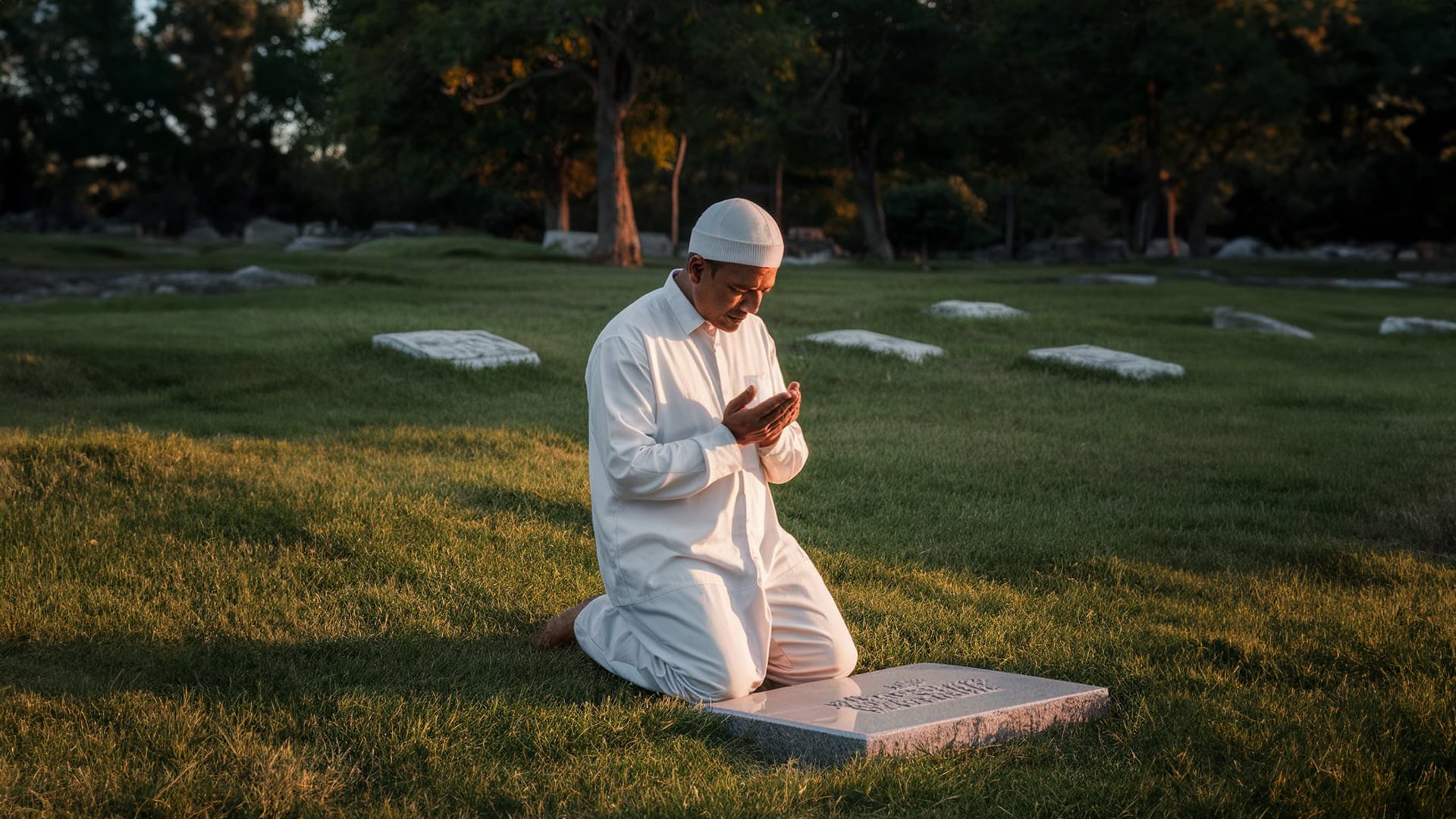
Hi, everyone. I know that losing someone you love hurts deeply, like the world is falling apart. Feeling sad and hopeless is completely normal, and even our Prophet went through it. But I want to share a warm secret: even though they have left us for another world, our love and longing for them are not in vain! The dua we make for them, these calls from our hearts, actually help them directly and improve their status there. And there is more! They will even know that this is happening because we are praying for them. So, our love and care cross the boundary of life and death, keeping us connected to them and sending them warmth and help. One of the hardest challenges any of us can face is the death of a loved one. After a loved one passes, it is natural to be overwhelmed by grief, and for some, it can even lead to a sense of hopelessness and helplessness. Even though we acknowledge our grief, just as our beloved Prophet Muhammad (peace be upon him) did—he lost his uncle Abu Talib, his beloved wife Khadija, and all his children except Fatima (may Allah be pleased with her)—we can find comfort in the duty of praying for our loved ones. In fact, the duas we make for them after they pass can directly affect their status in the afterlife. Abu Hurairah (may Allah be pleased with him) narrated that the Messenger of Allah (peace be upon him) said: 'Indeed, Allah, the Exalted, will raise the rank of His righteous servant in Paradise, and he will ask: "O Lord, what is this?"' 'Allah will say: "This is because your child sought forgiveness for you."' (Musnad Ahmad, No. 10610). Therefore, our connection with our loved ones is so deep that even after they start their journey to the afterlife, we can still help raise their status. More importantly, we not only raise their rank, but they are also told that this elevation is due to the duas you made for them. This makes your dua not just a comfort for yourself, but a help to them and a way to keep communicating with your loved one. Interestingly, in this narration, the son did not ask to raise his father's rank, but only asked for forgiveness for him. This suggests the special power of seeking forgiveness (istighfar). The link between seeking forgiveness and raising one's rank is that seeking forgiveness is not just for the sins we can remember. This can also be seen in the tradition of the Prophet (peace be upon him), who would say "astaghfirullah" (I seek forgiveness from Allah) three times after every namaz. In fact, seeking forgiveness is so important that almost every dua we cover here starts with seeking forgiveness. It is easy to assume our loved ones are perfect and sinless, especially when we respect them so much. However, it is crucial to always seek forgiveness even for sins we are not aware of, as the truth is we can never know all the faults of others. Generally, we should never judge a servant's status with Allah, but instead accept the fact that "every descendant of Adam is a sinner" (Jami` at-Tirmidhi, No. 2499). Yet, this must be balanced with maintaining a good opinion (husn al-dhann) of Allah, who "is indeed the Most Merciful, the Most Compassionate" (Quran 49:5). In his Sahih al-Bukhari, Imam Bukhari begins the "Book of Funerals" by citing a report from Abu Dharr (may Allah be pleased with him) that the Prophet ﷺ said: "Whoever says 'There is no god but Allah' (La ilaha illa Allah) will enter Paradise." Abu Dharr asked: "Even if he commits adultery and theft?" The Prophet ﷺ replied: "Even if he commits adultery and theft." (Sahih al-Bukhari, No. 1237). Here, Imam Bukhari shows his wisdom by opening the chapter with a report that reminds us to maintain a positive opinion (husn al-dhann) of Allah. This is not meant to downplay the sins of adultery and theft, but to emphasize our firm belief in the power of sincere dua and the promise that Allah will always treat us with love and forgiveness. Dua for deceased parents: Abu Usaid said: "While we were with the Messenger of Allah ﷺ, a man asked: 'Messenger of Allah, is there any act of kindness I can still do for my parents after they die?' He replied: 'Yes, there are four things: pray for them, ask for their forgiveness, fulfill their promises, and be kind to their friends.' You only have kinship through your parents.' (Al-Adab al-Mufrad, No. 35, weak hadith). According to the dua Prophet Nuh made to Allah (71:28), you can say: 'My Lord, forgive me and my parents.' رَّبِّ ٱغْفِرْ لِي وَلِوَٰلِدَىَّ However, this can also be combined with another dua from the Quran. After commanding us to honor our parents and never say "uff" to them, Allah commands us to pray for them in this form: وَٱخْفِضْ لَهُمَا جَنَاحَ ٱلذُّلِّ مِنَ ٱلرَّحْمَةِ وَقُل رَّبِّ ٱرْحَمْهُمَا كَمَا رَبَّيَانِى صَغِيرًۭا "And lower to them the wing of humility out of mercy and say, 'My Lord!' Have mercy upon them as they brought me up when I was small.'" (Quran 17:24) Therefore, to pray for our deceased parents and help them enter Paradise, if Allah wills, we can say: رَّبِّ ٱغْفِرْ لِي وَلِوَٰلِدَىَّ وارْحَمْهُمَا كَمَا رَبَّيَانِى صَغِيرا Rabbi ighfir li wa li-walidayya wa-irhamhuma kama rabbayani saghira My Lord! Forgive me and my parents, and have mercy on them as they raised me when I was small. To change the dua to pray only for your father, you can say: Rabbi ighfir li wa li-waalidi wa-irhamhu kama rabbani saghira رَّبِّ ٱغْفِرْ لِي وَلِوَالِدي وارْحَمْهُ كَمَا رَبَّنِي صَغِيرًۭا And to pray only for your mother, you can say: Rabbi ighfir li wa li-waalidati wa-irhamha kama rabbatni saghira رَّبِّ ٱغْفِرْ لِي وَلِوَالِدتي وارْحَمْهُا كَمَا رَبَّتنِي صَغِيرًۭا Dua for deceased Muslims: The following supplication is one of the most famous duas for the deceased, and it is the one you are most likely to hear at a graveyard. You can recite it during the funeral prayer (janaza) after the third takbir, or at the graveyard, and you can continue to repeat it afterward, especially in the period immediately following their passing. Awf ibn Malik (may Allah be pleased with him) reported: I heard the Prophet ﷺ say at the funeral of a companion: اللَّهُمَّ أغْفِر لَهُ وَارْحَمْهُ وعَافِهِ وَاعْفُ عَنْهُ وَأَكْرِم نُزُلَهُ وَوَسَّعْ مُدْخَلَهُ وَاغْسِلْهُ بِالماءِ والثَلْجِ والبَرَدِ ونقِّهِ من الخَطايا كما يُنَقّى الثوبُ الأَبْيَضُ من الدَّنَسِ Allahumma-ghfir lahu warhamhu wa'afih wa'fu 'anhu wa akrim nuzulahu wa wasi' mudkhalaahu wa 'ghsilhu bil-ma'i wath-thalji wal-baradi wa naqqihi min al-khataya kama yunaqqa al-thawbu al-abyadu min al-danas. My Lord! Forgive him, have mercy on him, grant him peace, and pardon him; honor his reception, expand his grave, wash him with water, ice, and snow, and cleanse him of sins just as a white garment is cleaned of dirt. (Sahih Muslim, No. 963) In some of the Prophet's ﷺ other duas, we see him directly mention and ask for the supreme mercy of Allah. In our dua, we should mention the attributes of Allah as much as possible, because the Almighty has instructed us to do so. He (ﷻ) says: "The most beautiful names belong to Allah, so call upon Him by them..." (Quran 7:180). A beautiful dua to recite by a grave to directly ask for Allah's mercy is: Allahumma 'abduka wa ibnu amatika ihtaja ila rahmatika wa anta ghaniyyun 'an 'adhabih. 'In kana muhsinan fazid fi hasanatih. Wa 'in kana musi'an fatajaawaz 'anhu. O Allah! Your servant and the child of Your female servant (referring to the deceased) now needs Your mercy, and You have no need to punish him. If he was a doer of good, please increase his good deeds; If he was a wrongdoer, please overlook his faults (Hisn al-Muslim, paragraph 159). Another dua that is beneficial for both the deceased and the living is: Allahumma-ghfir lihayyina wa mayyitina wa shahidina, wa gha'ibina, wa saghirina wa kabirina, wa dhakarina wa unthana. Allahumma man ahyaytahu minna fa ahyihi 'ala al-Islam, wa man tawaffaytahu minna fatawaffahu 'ala al-iman. Allahumma la tahrimna ajrahu, wa la tudillana ba'dahu. O Allah! Forgive our living and our dead, those who are present and those who are absent, our young and our old, our males and our females. O Allah! Let those among us whom You keep alive live in Islam, and let those among us whom You take in death die in faith (imani). O Allah! Do not deprive us of their reward, and do not let us go astray after them (Sunan Ibn Majah, paragraph 1498). One of the most famous duas for the deceased was made after the companion Abu Salamah (may Allah be pleased with him) passed away. At that time, the Prophet ﷺ visited his beloved companion (may Allah be pleased with him) as he was dying. When he ﷺ saw Abu Salamah's eyes fixed in one direction, showing that his soul had left his body, the Prophet ﷺ followed the Sunnah and closed Abu Salamah's eyes. At this moment, some of Abu Salamah's family began to wail and cry. The Prophet ﷺ immediately warned them about the importance of making good duas for themselves and their loved ones, saying: Do not pray for anything bad for yourselves, because the angels will say "Ameen" to everything you say. He ﷺ then made a beautiful dua for Abu Salamah, which you can also repeat for your own loved ones: Allahumma-ghfir li (insert name) wa arfa' darajatahu fi l-mahdiyyiin, wa afsah lahu fi qabrihi wa nawwir lahu fihi wa akhlufhu fi 'aqibihi fi l-ghabirin. O Allah! Forgive (insert name) and raise his rank among those who are guided. Expand his grave for him, grant him light within it, and leave behind a successor for him among his descendants (Sahih Muslim, paragraph 920). In this dua, we can see a carefully arranged order. First, we pray for the final destination of the deceased by saying "raise his rank among those who are guided." After recognizing that Barzakh (the state where the soul resides before resurrection) is a transitional stage toward the final destination, we then ask Allah to expand their grave and grant them light. Finally, we end the dua by asking for the continued guidance and piety of the deceased's descendants, which is both their lasting legacy in this world and a source of reward for the deceased in the afterlife. While we provide a series of carefully arranged dua sequences here, remember that praying for loved ones does not always need to follow a rigid structure. Beyond the prescribed duas we offer here, you are free to speak directly to Allah, the All-Hearing, and pour out your heart. Use your own language and sincere heart to offer your most earnest dua, as if you are in a state of desperation and in urgent need of the intervention of Allah. May Allah grant all our deceased infinite mercy and forgive all our mistakes and theirs.
Islamic Guide: Ten Powerful Dua for Parents Praying for Children
Articles • ali2007fr posted the article • 0 comments • 249 views • 2026-05-20 22:08
Summary: This article gathers Quranic dua and prophetic guidance for parents asking Allah to bless, protect, guide, and strengthen their children. It covers dua for righteous offspring, pregnancy and childbirth, protection, guidance, gratitude, and forgiveness.
As parents, who doesn't want their children to be healthy, sensible, and well-behaved, becoming our pride and joy? Actually, making dua to Allah is the most powerful and direct secret weapon we have in our hands! You don't have to say it out loud; Allah knows everything we think and ask for in our hearts. He has promised that as long as we ask with a sincere heart, He will definitely respond. This article teaches us step-by-step how to pray sincerely for our children, helping them become the light of our eyes—those treasures who bring us endless joy and peace just by looking at them. Start learning now and pray well for your children! How to pray for children: Dua is the most powerful tool we have, a direct plea to Allah to use His almighty power on our behalf. Dua does not even need to be spoken aloud, because Allah sees the silent longings in our hearts. He promised to answer the duas of those who call upon Him (Quran 2:186) and assures us of His closeness. We are closest to Allah during prostration (sujood), and He descends to the lowest heaven when we perform the night dua (tahajjud) in the quiet of the night. But dua can be made at any time and in any place. The best dua is the most sincere one, coming from the deepest part of our hearts, where we admit our own weakness and plead to the All-Powerful. A comprehensive dua for children: Rabbana hab lana min azwajina wa dhurriyatina qurrata aʿyunin wa-jʿalna lil-muttaqina imama. Our Lord! Grant us from our wives and offspring comfort to our eyes and make us an example for the righteous. (Quran 25:74) This dua is for those who ask for the gift of children, wishing them to be the comfort and peace of our eyes (qurrata a’yun). This phrase means something fascinating and delightful, bringing deep peace and satisfaction. This phrase was used by Asiya (may Allah be pleased with her) to describe Musa (peace be upon him) to convince Pharaoh to adopt him: 'This baby is a comfort to my eyes and yours.' (Quran 28:9). When Allah mentioned returning the infant Musa (peace be upon him) to his mother for nursing, He used a similar phrase: 'So We returned you to your mother so that her eyes might be comforted and she would not grieve' (Quran 20:40). Allah includes 'and make us an example for the righteous' because we should hope our children become leaders in the Muslim community (ummah) through their worship and service. When we see our children performing pious deeds and showing excellent integrity, it brings a unique joy and comfort to our eyes. Whether they are the children we have now or the ones we hope to have, this is the most heartfelt prayer for righteous descendants. Praying for our children's success means wishing them the best outcome in the afterlife (akhira), and the conclusion of this prayer includes that wish. Dua for pregnancy and childbirth: In the Quran, we find a profound narrative about Maryam (peace be upon her) and Zakariya (peace be upon him). Maryam received blessings, and her provision went beyond any worldly explanation. She revealed to Zakariya (peace be upon him) that it was Allah who provided for her. Seeing this divine provision, Zakariya (peace be upon him), though advanced in age, felt inspired to make this dua for offspring: Rabbi hab li min ladunka dhurriyyatan tayyibatan innaka samee’u du’a. My Lord, grant me from Yourself a good descendant. You are indeed the Hearer of dua. (Quran 3:38) Zakariya (peace be upon him) and his wife were both past the age of childbearing. Even though it seemed impossible by biological standards, he left the 'how' and 'when' entirely to Allah. His prayer was answered, and his son Yahya (peace be upon him) was born. Allah later reminds us in the Quran: When Zakariya called to his Lord, 'My Lord!' Do not leave me childless, for You are the best of inheritors. So We answered his dua, granted him Yahya (peace be upon him), and enabled his wife to conceive. They truly raced to do good deeds, prayed to Us with hope and fear, and were humble before Us. (Quran 21:89) Rabbi laa tadharnee fardaan wa-anta khayru al-waaritheen. My Lord! Do not leave me childless, though You are the Best of Successors. Allah enabled Zakariya’s wife to conceive, showing that His power is beyond all natural laws. If Allah can make humans from a tiny drop of fluid (Quran 16:4), and all Allah needs to say is 'Be,' and it is (Quran 2:117), then such duas will surely be answered, and miracles will come to those who ask. Many of our prophets struggled with having children. Ibrahim (peace be upon him), the friend of Allah (Wali), was married for many years before having children. Ibrahim’s (peace be upon him) dua for offspring: Rabbi hab li min as-saaliheen. My Lord, grant me a righteous child. (Quran 37:100) Allah answered Ibrahim’s (peace be upon him) dua beautifully, granting him a descendant who would carry on the message of the One Creator. From his lineage came our beloved Prophet Muhammad (peace be upon him), the best of all humanity. We are his spiritual descendants, and our righteous actions are proof of the power of his dua. Dua to protect our children. Many things can harm our children. These include natural accidents like falling, human malice in the form of abuse or neglect, and even supernatural harm. The Prophet (peace be upon him) said: 'Recite the Chapter of Sincerity (Al-Ikhlas) and the two chapters of seeking refuge (Al-Falaq and An-Nas) three times in the morning and three times in the evening, and they will be enough to protect you from all harm.' (Jami` at-Tirmidhi, Hadith 3575). The Chapter of Sincerity (Surah al-Ikhlas) reaffirms the oneness of Allah, which is the foundation of firm faith. The Chapter of the Daybreak (Surah al-Falaq) asks for protection from external evils we cannot control—darkness, evil creatures, and harmful people. The Chapter of Mankind (Surah an-Nas) seeks refuge from internal threats, such as the insidious whispers of the devil (shaytan). Reading these chapters, along with the Opening Chapter (Surah al-Fatiha) and the Throne Verse (Ayat al-Kursi), with our children will form a divine barrier around them, if Allah wills. It is our duty to instill the habit of morning and evening remembrance of Allah (dhikr) in our children. These practices are more than just protective rituals. They are a legacy of faith and resilience that our children will carry into adulthood, strengthening their ability to resist the dangers of the world. Dua to protect our homes from evil and the devil (shaytan). The Prophet ﷺ said: "Do not turn your houses into graves. Indeed, the devil flees from a house where the Chapter of the Cow (Surah al-Baqarah) is recited. " (Sahih Muslim #780). He emphasized: "Whoever recites the last two verses of the Chapter of the Cow at night, that will be enough for him. " (Sahih al-Bukhari #5051). The Messenger (ﷺ) believes in what has been revealed to him from his Lord, and so do the believers. Amana ar-rasoolu bimaa unzila ilayhi min rabbihi wa-al-mu'minoon kullun aamana bi-llahi wa-mala'ikatihi wa-kutubihi wa-rusulihi laa nufarriqu bayna ahadin min rusulihi wa-qaloo sami'naa wa-ata'naa ghufraanaka rabbanaa wa-ilayka al-maseer. Laa yukallif Allahu nafsan illaa wus'ahaa lahaa maa kasabat 'alayhaa maa iktasabet rabbanaa laa tu'aakhidnaa in nasinaa aw akhta'naa rabbanaa wa-laa tahmil 'alaynaa isran kamaa hamaltahu 'alaa alladheena min qablinaa rabbanaa wa-laa tuhammilnaa maa laa ṭaaqata lanaa bihi wa'fu 'annaa wa-aghfir lanaa wa-arḥamnaa anta mawlanaa fa-ansurnaa 'alaa al-qawmi al-kaafireen. They all believe in Allah, His angels, His books, and His messengers. (They say): "We do not distinguish between any of His messengers." They say: "We hear and we obey." Our Lord! Grant us Your forgiveness! To You is the final destination. " Allah does not burden any soul beyond what it can bear. It will have the reward for what it has earned, and it will bear the consequence for what it has committed. (The believers pray): "Our Lord! Do not punish us if we forget or make a mistake. Our Lord! Do not lay upon us a burden like that which You laid upon those before us. Our Lord! Do not burden us with more than we can bear. Pardon us, forgive us, and have mercy on us. You are our only Protector. Help us against the disbelieving people. (Quran 2:285-286) Our homes are our shelters, and we should work to protect and nurture them so they become places of worship and salvation. Protecting our homes is essentially protecting our children. Imagine a home where parents often recite the Quran, filling the rooms with sacred verses instead of the noise of the television. Imagine copies of the Quran that are often touched, opened, and read, rather than gathering dust. Look forward to the angels visiting and inviting other angels to join our home study circles, creating an atmosphere familiar with the recitation and practice of the Quran. Dua for a sick child: The entire Quran is a form of healing, a shifaa. "We send down the Quran as a healing and mercy for the believers" (Quran 17:82). As parents and caregivers, we can recite any part of the Quran with sincere hope and intention, praying for Allah to heal our children. Reciting the Quran over a person is an essential part of ruqya, a practice used to treat jealousy, the evil eye, black magic, and physical illness. The Prophet ﷺ even allowed a companion (sahabi) to recite Surah Al-Fatiha over a non-Muslim chief to heal his physical illness (Sahih al-Bukhari #5007). While we should trust in the healing power of Allah's words, we must also recognize the importance of medical treatment. When we make dua for children with physical or intellectual disabilities, we must remember that their condition is divinely ordained, and this qadar is part of Allah's wisdom. Allah has chosen them to face this unique test, and has likewise chosen us to practice patience and unwavering support. To seek strength and comfort, let us recite this dua with our children: Allaahumma ‘aafinee fee badanee, Allaahumma ‘aafinee fee sam‘ee, Allaahumma ‘aafinee fee basaree, laa ilaaha illaa anta. Allaahumma innee a‘oodhu bika mina al-kufr wa-al-faqr, Allaahumma innee a‘oodhu bika min ‘adhaabi al-qabr, laa ilaaha illaa anta. O Allah! Grant me health in my body. O Allah! Grant me health in my hearing. O Allah! Grant me health in my sight. There is no god worthy of worship but You. O Allah! I seek refuge in You from disbelief and poverty. O Allah! I seek refuge in You from the punishment of the grave. There is no god worthy of worship but You. (Sunan Abi Dawud 5090) By teaching children how to worship and helping them grow their love for Allah, we nourish their hearts and enrich our own souls. Dua for children. The first dua mentioned in this article is comprehensive, including a dua for righteous children who pray devoutly. Also, Allah teaches in the Quran: Rabbanaa wa-aj‘alnaa muslimayn laka wa-min dhurriyyatinaa ummatan muslimatan laka wa-arinaa manaasikanaa wa-tub ‘alaynaa innaka anta at-tawwaab ar-raheem. Our Lord! Make us both fully submissive to You, and make from our descendants a nation submissive to You. Show us our rites of pilgrimage, and accept our repentance. Show us our rites of pilgrimage, and accept our repentance. You are the Ever-Relenting, the Most Merciful. (Quran 2:128) The best time to build a habit of prayer (salah) in children is when they are young. When you perform prayer (salah), let them play near you and take them to the mosque often, even if they do not know how to pray yet. Action must go hand in hand with dua. If our children are to love prayer, they must see that their parents value it. If we pray in a rush, dressed poorly, or with our minds elsewhere, they will copy that neglect. However, if we treat prayer with reverence and dignity, they will naturally copy that love and devotion. We must practice the behavior we want our children to adopt. We are their first role models, and they watch all our strengths and weaknesses. It is vital to read and love the Quran around them, perform our voluntary prayers (rakat), and enjoy family night prayers (qiyaam) together. Dua for children to seek wisdom. Teaching our children the importance and power of dua will inspire them to seek help from Allah themselves. Even Prophet Muhammad ﷺ was commanded by Allah to make this dua for his own wisdom and memory: Rabbi zidnee ‘ilmaa. My Lord! Increase me in knowledge. (Quran 20:114) We can sit with our children and recite this dua until it becomes their own. Teach them to make this specific dua before they start any learning, whether it is Islamic knowledge or academic studies. Instead of wishing them good luck on their exams, remind them of this dua and encourage them to recite it before they start. As they grow, this habit will become second nature, and there is no better dua for learning and seeking knowledge than those found in the Quran itself. Dua for a deceased child: According to most scholars, if a child passes away before reaching adulthood, they are granted paradise (jannah) because they are pure and without sin. There is no specific dua taught for such a child, as they have not accumulated any sins. Instead, we say: Allaahumma aj‘alhu lanaa faratan wa-salafan wa-ajran. O Allah! Make him a forerunner, a predecessor, and a reward for us. (Fortress of the Muslim #161) The best dua for the deceased and other duas can be found in the series 'For Those Left Behind': Allaahumma aghfir lahu wa-arḥamhu wa-‘aafihi wa-‘fu ‘anhu wa-akrim nuzulahu wa-wassi‘ mudkhalahu wa-aghhsilhu bil-maa’i wa-ath-thalji wa-al-barad wa-naqqihi mina al-khaṭaayaa kamaa naqqayta ath-thawba al-abyada mina ad-danas wa-abdilhu daaran khayran min daarihi wa-‘ahlan khayran min ahlihi wa-zawjan khayran min zawjihi wa-adkhilhu al-jannata wa-a‘idhhu min ‘adhaabi al-qabr aw min ‘adhaabi an-naar. O Allah! Forgive him, have mercy on him, grant him well-being, and pardon him. Honor his reception and widen his entrance. Wash him with water, snow, and hail. Cleanse him of his sins just as You cleanse a white garment of filth. Replace his home with a better home, his family with a better family, and his spouse with a better spouse. Admit him into paradise and protect him from the punishment of the grave and the punishment of the fire. (Sahih Muslim #963) Teaching our children to make dua: The power of dua is unmatched; it is a direct path to the infinite mercy and wisdom of Allah. By building the habit of making dua, we not only seek the help of Allah but also confirm our dependence on Him, strengthening our worship and solidifying the principle of monotheism (tawhid). In our dua, we find not only comfort but also strength. By teaching our children to make dua, we pass on the greatest legacy: a connection with their Creator, which will support them in this life and guide them toward the hereafter. view all
Summary: This article gathers Quranic dua and prophetic guidance for parents asking Allah to bless, protect, guide, and strengthen their children. It covers dua for righteous offspring, pregnancy and childbirth, protection, guidance, gratitude, and forgiveness.
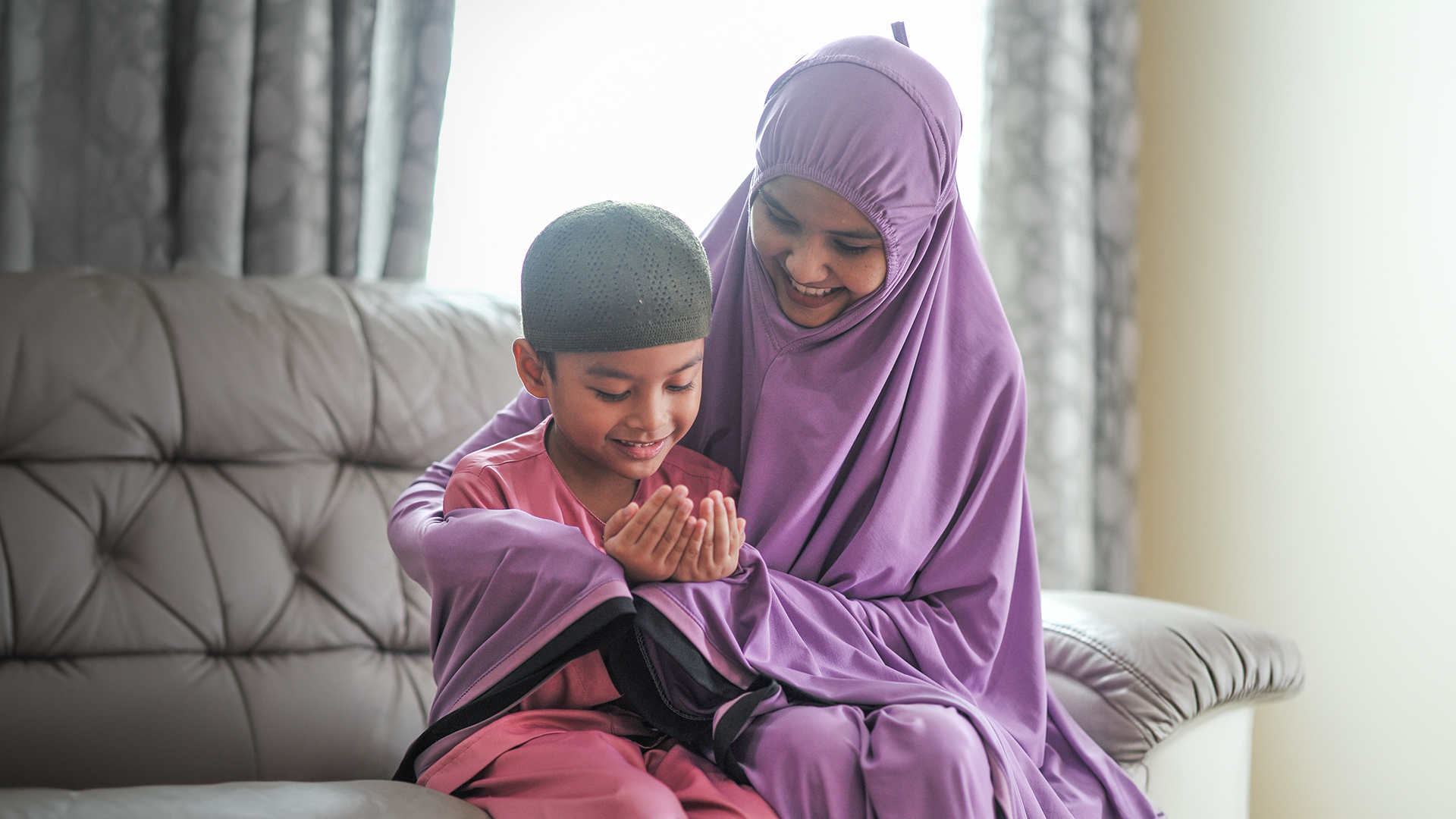
As parents, who doesn't want their children to be healthy, sensible, and well-behaved, becoming our pride and joy? Actually, making dua to Allah is the most powerful and direct secret weapon we have in our hands! You don't have to say it out loud; Allah knows everything we think and ask for in our hearts. He has promised that as long as we ask with a sincere heart, He will definitely respond. This article teaches us step-by-step how to pray sincerely for our children, helping them become the light of our eyes—those treasures who bring us endless joy and peace just by looking at them. Start learning now and pray well for your children! How to pray for children: Dua is the most powerful tool we have, a direct plea to Allah to use His almighty power on our behalf. Dua does not even need to be spoken aloud, because Allah sees the silent longings in our hearts. He promised to answer the duas of those who call upon Him (Quran 2:186) and assures us of His closeness. We are closest to Allah during prostration (sujood), and He descends to the lowest heaven when we perform the night dua (tahajjud) in the quiet of the night. But dua can be made at any time and in any place. The best dua is the most sincere one, coming from the deepest part of our hearts, where we admit our own weakness and plead to the All-Powerful. A comprehensive dua for children: Rabbana hab lana min azwajina wa dhurriyatina qurrata aʿyunin wa-jʿalna lil-muttaqina imama. Our Lord! Grant us from our wives and offspring comfort to our eyes and make us an example for the righteous. (Quran 25:74) This dua is for those who ask for the gift of children, wishing them to be the comfort and peace of our eyes (qurrata a’yun). This phrase means something fascinating and delightful, bringing deep peace and satisfaction. This phrase was used by Asiya (may Allah be pleased with her) to describe Musa (peace be upon him) to convince Pharaoh to adopt him: 'This baby is a comfort to my eyes and yours.' (Quran 28:9). When Allah mentioned returning the infant Musa (peace be upon him) to his mother for nursing, He used a similar phrase: 'So We returned you to your mother so that her eyes might be comforted and she would not grieve' (Quran 20:40). Allah includes 'and make us an example for the righteous' because we should hope our children become leaders in the Muslim community (ummah) through their worship and service. When we see our children performing pious deeds and showing excellent integrity, it brings a unique joy and comfort to our eyes. Whether they are the children we have now or the ones we hope to have, this is the most heartfelt prayer for righteous descendants. Praying for our children's success means wishing them the best outcome in the afterlife (akhira), and the conclusion of this prayer includes that wish. Dua for pregnancy and childbirth: In the Quran, we find a profound narrative about Maryam (peace be upon her) and Zakariya (peace be upon him). Maryam received blessings, and her provision went beyond any worldly explanation. She revealed to Zakariya (peace be upon him) that it was Allah who provided for her. Seeing this divine provision, Zakariya (peace be upon him), though advanced in age, felt inspired to make this dua for offspring: Rabbi hab li min ladunka dhurriyyatan tayyibatan innaka samee’u du’a. My Lord, grant me from Yourself a good descendant. You are indeed the Hearer of dua. (Quran 3:38) Zakariya (peace be upon him) and his wife were both past the age of childbearing. Even though it seemed impossible by biological standards, he left the 'how' and 'when' entirely to Allah. His prayer was answered, and his son Yahya (peace be upon him) was born. Allah later reminds us in the Quran: When Zakariya called to his Lord, 'My Lord!' Do not leave me childless, for You are the best of inheritors. So We answered his dua, granted him Yahya (peace be upon him), and enabled his wife to conceive. They truly raced to do good deeds, prayed to Us with hope and fear, and were humble before Us. (Quran 21:89) Rabbi laa tadharnee fardaan wa-anta khayru al-waaritheen. My Lord! Do not leave me childless, though You are the Best of Successors. Allah enabled Zakariya’s wife to conceive, showing that His power is beyond all natural laws. If Allah can make humans from a tiny drop of fluid (Quran 16:4), and all Allah needs to say is 'Be,' and it is (Quran 2:117), then such duas will surely be answered, and miracles will come to those who ask. Many of our prophets struggled with having children. Ibrahim (peace be upon him), the friend of Allah (Wali), was married for many years before having children. Ibrahim’s (peace be upon him) dua for offspring: Rabbi hab li min as-saaliheen. My Lord, grant me a righteous child. (Quran 37:100) Allah answered Ibrahim’s (peace be upon him) dua beautifully, granting him a descendant who would carry on the message of the One Creator. From his lineage came our beloved Prophet Muhammad (peace be upon him), the best of all humanity. We are his spiritual descendants, and our righteous actions are proof of the power of his dua. Dua to protect our children. Many things can harm our children. These include natural accidents like falling, human malice in the form of abuse or neglect, and even supernatural harm. The Prophet (peace be upon him) said: 'Recite the Chapter of Sincerity (Al-Ikhlas) and the two chapters of seeking refuge (Al-Falaq and An-Nas) three times in the morning and three times in the evening, and they will be enough to protect you from all harm.' (Jami` at-Tirmidhi, Hadith 3575). The Chapter of Sincerity (Surah al-Ikhlas) reaffirms the oneness of Allah, which is the foundation of firm faith. The Chapter of the Daybreak (Surah al-Falaq) asks for protection from external evils we cannot control—darkness, evil creatures, and harmful people. The Chapter of Mankind (Surah an-Nas) seeks refuge from internal threats, such as the insidious whispers of the devil (shaytan). Reading these chapters, along with the Opening Chapter (Surah al-Fatiha) and the Throne Verse (Ayat al-Kursi), with our children will form a divine barrier around them, if Allah wills. It is our duty to instill the habit of morning and evening remembrance of Allah (dhikr) in our children. These practices are more than just protective rituals. They are a legacy of faith and resilience that our children will carry into adulthood, strengthening their ability to resist the dangers of the world. Dua to protect our homes from evil and the devil (shaytan). The Prophet ﷺ said: "Do not turn your houses into graves. Indeed, the devil flees from a house where the Chapter of the Cow (Surah al-Baqarah) is recited. " (Sahih Muslim #780). He emphasized: "Whoever recites the last two verses of the Chapter of the Cow at night, that will be enough for him. " (Sahih al-Bukhari #5051). The Messenger (ﷺ) believes in what has been revealed to him from his Lord, and so do the believers. Amana ar-rasoolu bimaa unzila ilayhi min rabbihi wa-al-mu'minoon kullun aamana bi-llahi wa-mala'ikatihi wa-kutubihi wa-rusulihi laa nufarriqu bayna ahadin min rusulihi wa-qaloo sami'naa wa-ata'naa ghufraanaka rabbanaa wa-ilayka al-maseer. Laa yukallif Allahu nafsan illaa wus'ahaa lahaa maa kasabat 'alayhaa maa iktasabet rabbanaa laa tu'aakhidnaa in nasinaa aw akhta'naa rabbanaa wa-laa tahmil 'alaynaa isran kamaa hamaltahu 'alaa alladheena min qablinaa rabbanaa wa-laa tuhammilnaa maa laa ṭaaqata lanaa bihi wa'fu 'annaa wa-aghfir lanaa wa-arḥamnaa anta mawlanaa fa-ansurnaa 'alaa al-qawmi al-kaafireen. They all believe in Allah, His angels, His books, and His messengers. (They say): "We do not distinguish between any of His messengers." They say: "We hear and we obey." Our Lord! Grant us Your forgiveness! To You is the final destination. " Allah does not burden any soul beyond what it can bear. It will have the reward for what it has earned, and it will bear the consequence for what it has committed. (The believers pray): "Our Lord! Do not punish us if we forget or make a mistake. Our Lord! Do not lay upon us a burden like that which You laid upon those before us. Our Lord! Do not burden us with more than we can bear. Pardon us, forgive us, and have mercy on us. You are our only Protector. Help us against the disbelieving people. (Quran 2:285-286) Our homes are our shelters, and we should work to protect and nurture them so they become places of worship and salvation. Protecting our homes is essentially protecting our children. Imagine a home where parents often recite the Quran, filling the rooms with sacred verses instead of the noise of the television. Imagine copies of the Quran that are often touched, opened, and read, rather than gathering dust. Look forward to the angels visiting and inviting other angels to join our home study circles, creating an atmosphere familiar with the recitation and practice of the Quran. Dua for a sick child: The entire Quran is a form of healing, a shifaa. "We send down the Quran as a healing and mercy for the believers" (Quran 17:82). As parents and caregivers, we can recite any part of the Quran with sincere hope and intention, praying for Allah to heal our children. Reciting the Quran over a person is an essential part of ruqya, a practice used to treat jealousy, the evil eye, black magic, and physical illness. The Prophet ﷺ even allowed a companion (sahabi) to recite Surah Al-Fatiha over a non-Muslim chief to heal his physical illness (Sahih al-Bukhari #5007). While we should trust in the healing power of Allah's words, we must also recognize the importance of medical treatment. When we make dua for children with physical or intellectual disabilities, we must remember that their condition is divinely ordained, and this qadar is part of Allah's wisdom. Allah has chosen them to face this unique test, and has likewise chosen us to practice patience and unwavering support. To seek strength and comfort, let us recite this dua with our children: Allaahumma ‘aafinee fee badanee, Allaahumma ‘aafinee fee sam‘ee, Allaahumma ‘aafinee fee basaree, laa ilaaha illaa anta. Allaahumma innee a‘oodhu bika mina al-kufr wa-al-faqr, Allaahumma innee a‘oodhu bika min ‘adhaabi al-qabr, laa ilaaha illaa anta. O Allah! Grant me health in my body. O Allah! Grant me health in my hearing. O Allah! Grant me health in my sight. There is no god worthy of worship but You. O Allah! I seek refuge in You from disbelief and poverty. O Allah! I seek refuge in You from the punishment of the grave. There is no god worthy of worship but You. (Sunan Abi Dawud 5090) By teaching children how to worship and helping them grow their love for Allah, we nourish their hearts and enrich our own souls. Dua for children. The first dua mentioned in this article is comprehensive, including a dua for righteous children who pray devoutly. Also, Allah teaches in the Quran: Rabbanaa wa-aj‘alnaa muslimayn laka wa-min dhurriyyatinaa ummatan muslimatan laka wa-arinaa manaasikanaa wa-tub ‘alaynaa innaka anta at-tawwaab ar-raheem. Our Lord! Make us both fully submissive to You, and make from our descendants a nation submissive to You. Show us our rites of pilgrimage, and accept our repentance. Show us our rites of pilgrimage, and accept our repentance. You are the Ever-Relenting, the Most Merciful. (Quran 2:128) The best time to build a habit of prayer (salah) in children is when they are young. When you perform prayer (salah), let them play near you and take them to the mosque often, even if they do not know how to pray yet. Action must go hand in hand with dua. If our children are to love prayer, they must see that their parents value it. If we pray in a rush, dressed poorly, or with our minds elsewhere, they will copy that neglect. However, if we treat prayer with reverence and dignity, they will naturally copy that love and devotion. We must practice the behavior we want our children to adopt. We are their first role models, and they watch all our strengths and weaknesses. It is vital to read and love the Quran around them, perform our voluntary prayers (rakat), and enjoy family night prayers (qiyaam) together. Dua for children to seek wisdom. Teaching our children the importance and power of dua will inspire them to seek help from Allah themselves. Even Prophet Muhammad ﷺ was commanded by Allah to make this dua for his own wisdom and memory: Rabbi zidnee ‘ilmaa. My Lord! Increase me in knowledge. (Quran 20:114) We can sit with our children and recite this dua until it becomes their own. Teach them to make this specific dua before they start any learning, whether it is Islamic knowledge or academic studies. Instead of wishing them good luck on their exams, remind them of this dua and encourage them to recite it before they start. As they grow, this habit will become second nature, and there is no better dua for learning and seeking knowledge than those found in the Quran itself. Dua for a deceased child: According to most scholars, if a child passes away before reaching adulthood, they are granted paradise (jannah) because they are pure and without sin. There is no specific dua taught for such a child, as they have not accumulated any sins. Instead, we say: Allaahumma aj‘alhu lanaa faratan wa-salafan wa-ajran. O Allah! Make him a forerunner, a predecessor, and a reward for us. (Fortress of the Muslim #161) The best dua for the deceased and other duas can be found in the series 'For Those Left Behind': Allaahumma aghfir lahu wa-arḥamhu wa-‘aafihi wa-‘fu ‘anhu wa-akrim nuzulahu wa-wassi‘ mudkhalahu wa-aghhsilhu bil-maa’i wa-ath-thalji wa-al-barad wa-naqqihi mina al-khaṭaayaa kamaa naqqayta ath-thawba al-abyada mina ad-danas wa-abdilhu daaran khayran min daarihi wa-‘ahlan khayran min ahlihi wa-zawjan khayran min zawjihi wa-adkhilhu al-jannata wa-a‘idhhu min ‘adhaabi al-qabr aw min ‘adhaabi an-naar. O Allah! Forgive him, have mercy on him, grant him well-being, and pardon him. Honor his reception and widen his entrance. Wash him with water, snow, and hail. Cleanse him of his sins just as You cleanse a white garment of filth. Replace his home with a better home, his family with a better family, and his spouse with a better spouse. Admit him into paradise and protect him from the punishment of the grave and the punishment of the fire. (Sahih Muslim #963) Teaching our children to make dua: The power of dua is unmatched; it is a direct path to the infinite mercy and wisdom of Allah. By building the habit of making dua, we not only seek the help of Allah but also confirm our dependence on Him, strengthening our worship and solidifying the principle of monotheism (tawhid). In our dua, we find not only comfort but also strength. By teaching our children to make dua, we pass on the greatest legacy: a connection with their Creator, which will support them in this life and guide them toward the hereafter.
Islamic Guide: Istikhara - The Prayer for Guidance
Articles • ali2007fr posted the article • 0 comments • 235 views • 2026-05-20 21:34
Summary: This article introduces Istikhara as the prayer for guidance and explains that early Muslims sought Allah's help in many kinds of decisions. It keeps the source metadata, publication dates, and central description while removing page navigation and disclaimer text.
While people often perform Istikhara for big decisions, early generations sought Allah’s guidance for many different matters. Explore a full blog on Istikhara, the prayer for guidance. Authored by Yaqeen Institute. Published: June 24, 2024, Dhul Hijjah 18, 1445. Updated: April 13, 2026, Shawwal 25, 1447. Read time: 9 minutes. view all
Summary: This article introduces Istikhara as the prayer for guidance and explains that early Muslims sought Allah's help in many kinds of decisions. It keeps the source metadata, publication dates, and central description while removing page navigation and disclaimer text.
While people often perform Istikhara for big decisions, early generations sought Allah’s guidance for many different matters. Explore a full blog on Istikhara, the prayer for guidance. Authored by Yaqeen Institute. Published: June 24, 2024, Dhul Hijjah 18, 1445. Updated: April 13, 2026, Shawwal 25, 1447. Read time: 9 minutes.
Islamic Guide: Ten Powerful Dua for Parents Praying for Children
Articles • ali2007fr posted the article • 0 comments • 245 views • 2026-05-20 21:34
Summary: This article gathers Quranic dua and prophetic guidance for parents asking Allah to bless, protect, guide, and strengthen their children. It covers dua for righteous offspring, pregnancy and childbirth, protection, guidance, gratitude, and forgiveness.
As parents, who doesn't want their children to be healthy, sensible, and well-behaved, becoming our pride and joy? Actually, making dua to Allah is the most powerful and direct secret weapon we have in our hands! You don't have to say it out loud; Allah knows everything we think and ask for in our hearts. He has promised that as long as we ask with a sincere heart, He will definitely respond. This article teaches us step-by-step how to pray sincerely for our children, helping them become the light of our eyes—those treasures who bring us endless joy and peace just by looking at them. Start learning now and pray well for your children! How to pray for children: Dua is the most powerful tool we have, a direct plea to Allah to use His almighty power on our behalf. Dua does not even need to be spoken aloud, because Allah sees the silent longings in our hearts. He promised to answer the duas of those who call upon Him (Quran 2:186) and assures us of His closeness. We are closest to Allah during prostration (sujood), and He descends to the lowest heaven when we perform the night dua (tahajjud) in the quiet of the night. But dua can be made at any time and in any place. The best dua is the most sincere one, coming from the deepest part of our hearts, where we admit our own weakness and plead to the All-Powerful. A comprehensive dua for children: Rabbana hab lana min azwajina wa dhurriyatina qurrata aʿyunin wa-jʿalna lil-muttaqina imama. Our Lord! Grant us from our wives and offspring comfort to our eyes and make us an example for the righteous. (Quran 25:74) This dua is for those who ask for the gift of children, wishing them to be the comfort and peace of our eyes (qurrata a’yun). This phrase means something fascinating and delightful, bringing deep peace and satisfaction. This phrase was used by Asiya (may Allah be pleased with her) to describe Musa (peace be upon him) to convince Pharaoh to adopt him: 'This baby is a comfort to my eyes and yours.' (Quran 28:9). When Allah mentioned returning the infant Musa (peace be upon him) to his mother for nursing, He used a similar phrase: 'So We returned you to your mother so that her eyes might be comforted and she would not grieve' (Quran 20:40). Allah includes 'and make us an example for the righteous' because we should hope our children become leaders in the Muslim community (ummah) through their worship and service. When we see our children performing pious deeds and showing excellent integrity, it brings a unique joy and comfort to our eyes. Whether they are the children we have now or the ones we hope to have, this is the most heartfelt prayer for righteous descendants. Praying for our children's success means wishing them the best outcome in the afterlife (akhira), and the conclusion of this prayer includes that wish. Dua for pregnancy and childbirth: In the Quran, we find a profound narrative about Maryam (peace be upon her) and Zakariya (peace be upon him). Maryam received blessings, and her provision went beyond any worldly explanation. She revealed to Zakariya (peace be upon him) that it was Allah who provided for her. Seeing this divine provision, Zakariya (peace be upon him), though advanced in age, felt inspired to make this dua for offspring: Rabbi hab li min ladunka dhurriyyatan tayyibatan innaka samee’u du’a. My Lord, grant me from Yourself a good descendant. You are indeed the Hearer of dua. (Quran 3:38) Zakariya (peace be upon him) and his wife were both past the age of childbearing. Even though it seemed impossible by biological standards, he left the 'how' and 'when' entirely to Allah. His prayer was answered, and his son Yahya (peace be upon him) was born. Allah later reminds us in the Quran: When Zakariya called to his Lord, 'My Lord!' Do not leave me childless, for You are the best of inheritors. So We answered his dua, granted him Yahya (peace be upon him), and enabled his wife to conceive. They truly raced to do good deeds, prayed to Us with hope and fear, and were humble before Us. (Quran 21:89) Rabbi laa tadharnee fardaan wa-anta khayru al-waaritheen. My Lord! Do not leave me childless, though You are the Best of Successors. Allah enabled Zakariya’s wife to conceive, showing that His power is beyond all natural laws. If Allah can make humans from a tiny drop of fluid (Quran 16:4), and all Allah needs to say is 'Be,' and it is (Quran 2:117), then such duas will surely be answered, and miracles will come to those who ask. Many of our prophets struggled with having children. Ibrahim (peace be upon him), the friend of Allah (Wali), was married for many years before having children. Ibrahim’s (peace be upon him) dua for offspring: Rabbi hab li min as-saaliheen. My Lord, grant me a righteous child. (Quran 37:100) Allah answered Ibrahim’s (peace be upon him) dua beautifully, granting him a descendant who would carry on the message of the One Creator. From his lineage came our beloved Prophet Muhammad (peace be upon him), the best of all humanity. We are his spiritual descendants, and our righteous actions are proof of the power of his dua. Dua to protect our children. Many things can harm our children. These include natural accidents like falling, human malice in the form of abuse or neglect, and even supernatural harm. The Prophet (peace be upon him) said: 'Recite the Chapter of Sincerity (Al-Ikhlas) and the two chapters of seeking refuge (Al-Falaq and An-Nas) three times in the morning and three times in the evening, and they will be enough to protect you from all harm.' (Jami` at-Tirmidhi, Hadith 3575). The Chapter of Sincerity (Surah al-Ikhlas) reaffirms the oneness of Allah, which is the foundation of firm faith. The Chapter of the Daybreak (Surah al-Falaq) asks for protection from external evils we cannot control—darkness, evil creatures, and harmful people. The Chapter of Mankind (Surah an-Nas) seeks refuge from internal threats, such as the insidious whispers of the devil (shaytan). Reading these chapters, along with the Opening Chapter (Surah al-Fatiha) and the Throne Verse (Ayat al-Kursi), with our children will form a divine barrier around them, if Allah wills. It is our duty to instill the habit of morning and evening remembrance of Allah (dhikr) in our children. These practices are more than just protective rituals. They are a legacy of faith and resilience that our children will carry into adulthood, strengthening their ability to resist the dangers of the world. Dua to protect our homes from evil and the devil (shaytan). The Prophet ﷺ said: "Do not turn your houses into graves. Indeed, the devil flees from a house where the Chapter of the Cow (Surah al-Baqarah) is recited. " (Sahih Muslim #780). He emphasized: "Whoever recites the last two verses of the Chapter of the Cow at night, that will be enough for him. " (Sahih al-Bukhari #5051). The Messenger (ﷺ) believes in what has been revealed to him from his Lord, and so do the believers. Amana ar-rasoolu bimaa unzila ilayhi min rabbihi wa-al-mu'minoon kullun aamana bi-llahi wa-mala'ikatihi wa-kutubihi wa-rusulihi laa nufarriqu bayna ahadin min rusulihi wa-qaloo sami'naa wa-ata'naa ghufraanaka rabbanaa wa-ilayka al-maseer. Laa yukallif Allahu nafsan illaa wus'ahaa lahaa maa kasabat 'alayhaa maa iktasabet rabbanaa laa tu'aakhidnaa in nasinaa aw akhta'naa rabbanaa wa-laa tahmil 'alaynaa isran kamaa hamaltahu 'alaa alladheena min qablinaa rabbanaa wa-laa tuhammilnaa maa laa ṭaaqata lanaa bihi wa'fu 'annaa wa-aghfir lanaa wa-arḥamnaa anta mawlanaa fa-ansurnaa 'alaa al-qawmi al-kaafireen. They all believe in Allah, His angels, His books, and His messengers. (They say): "We do not distinguish between any of His messengers." They say: "We hear and we obey." Our Lord! Grant us Your forgiveness! To You is the final destination. " Allah does not burden any soul beyond what it can bear. It will have the reward for what it has earned, and it will bear the consequence for what it has committed. (The believers pray): "Our Lord! Do not punish us if we forget or make a mistake. Our Lord! Do not lay upon us a burden like that which You laid upon those before us. Our Lord! Do not burden us with more than we can bear. Pardon us, forgive us, and have mercy on us. You are our only Protector. Help us against the disbelieving people. (Quran 2:285-286) Our homes are our shelters, and we should work to protect and nurture them so they become places of worship and salvation. Protecting our homes is essentially protecting our children. Imagine a home where parents often recite the Quran, filling the rooms with sacred verses instead of the noise of the television. Imagine copies of the Quran that are often touched, opened, and read, rather than gathering dust. Look forward to the angels visiting and inviting other angels to join our home study circles, creating an atmosphere familiar with the recitation and practice of the Quran. Dua for a sick child: The entire Quran is a form of healing, a shifaa. "We send down the Quran as a healing and mercy for the believers" (Quran 17:82). As parents and caregivers, we can recite any part of the Quran with sincere hope and intention, praying for Allah to heal our children. Reciting the Quran over a person is an essential part of ruqya, a practice used to treat jealousy, the evil eye, black magic, and physical illness. The Prophet ﷺ even allowed a companion (sahabi) to recite Surah Al-Fatiha over a non-Muslim chief to heal his physical illness (Sahih al-Bukhari #5007). While we should trust in the healing power of Allah's words, we must also recognize the importance of medical treatment. When we make dua for children with physical or intellectual disabilities, we must remember that their condition is divinely ordained, and this qadar is part of Allah's wisdom. Allah has chosen them to face this unique test, and has likewise chosen us to practice patience and unwavering support. To seek strength and comfort, let us recite this dua with our children: Allaahumma ‘aafinee fee badanee, Allaahumma ‘aafinee fee sam‘ee, Allaahumma ‘aafinee fee basaree, laa ilaaha illaa anta. Allaahumma innee a‘oodhu bika mina al-kufr wa-al-faqr, Allaahumma innee a‘oodhu bika min ‘adhaabi al-qabr, laa ilaaha illaa anta. O Allah! Grant me health in my body. O Allah! Grant me health in my hearing. O Allah! Grant me health in my sight. There is no god worthy of worship but You. O Allah! I seek refuge in You from disbelief and poverty. O Allah! I seek refuge in You from the punishment of the grave. There is no god worthy of worship but You. (Sunan Abi Dawud 5090) By teaching children how to worship and helping them grow their love for Allah, we nourish their hearts and enrich our own souls. Dua for children. The first dua mentioned in this article is comprehensive, including a dua for righteous children who pray devoutly. Also, Allah teaches in the Quran: Rabbanaa wa-aj‘alnaa muslimayn laka wa-min dhurriyyatinaa ummatan muslimatan laka wa-arinaa manaasikanaa wa-tub ‘alaynaa innaka anta at-tawwaab ar-raheem. Our Lord! Make us both fully submissive to You, and make from our descendants a nation submissive to You. Show us our rites of pilgrimage, and accept our repentance. Show us our rites of pilgrimage, and accept our repentance. You are the Ever-Relenting, the Most Merciful. (Quran 2:128) The best time to build a habit of prayer (salah) in children is when they are young. When you perform prayer (salah), let them play near you and take them to the mosque often, even if they do not know how to pray yet. Action must go hand in hand with dua. If our children are to love prayer, they must see that their parents value it. If we pray in a rush, dressed poorly, or with our minds elsewhere, they will copy that neglect. However, if we treat prayer with reverence and dignity, they will naturally copy that love and devotion. We must practice the behavior we want our children to adopt. We are their first role models, and they watch all our strengths and weaknesses. It is vital to read and love the Quran around them, perform our voluntary prayers (rakat), and enjoy family night prayers (qiyaam) together. Dua for children to seek wisdom. Teaching our children the importance and power of dua will inspire them to seek help from Allah themselves. Even Prophet Muhammad ﷺ was commanded by Allah to make this dua for his own wisdom and memory: Rabbi zidnee ‘ilmaa. My Lord! Increase me in knowledge. (Quran 20:114) We can sit with our children and recite this dua until it becomes their own. Teach them to make this specific dua before they start any learning, whether it is Islamic knowledge or academic studies. Instead of wishing them good luck on their exams, remind them of this dua and encourage them to recite it before they start. As they grow, this habit will become second nature, and there is no better dua for learning and seeking knowledge than those found in the Quran itself. Dua for a deceased child: According to most scholars, if a child passes away before reaching adulthood, they are granted paradise (jannah) because they are pure and without sin. There is no specific dua taught for such a child, as they have not accumulated any sins. Instead, we say: Allaahumma aj‘alhu lanaa faratan wa-salafan wa-ajran. O Allah! Make him a forerunner, a predecessor, and a reward for us. (Fortress of the Muslim #161) The best dua for the deceased and other duas can be found in the series 'For Those Left Behind': Allaahumma aghfir lahu wa-arḥamhu wa-‘aafihi wa-‘fu ‘anhu wa-akrim nuzulahu wa-wassi‘ mudkhalahu wa-aghhsilhu bil-maa’i wa-ath-thalji wa-al-barad wa-naqqihi mina al-khaṭaayaa kamaa naqqayta ath-thawba al-abyada mina ad-danas wa-abdilhu daaran khayran min daarihi wa-‘ahlan khayran min ahlihi wa-zawjan khayran min zawjihi wa-adkhilhu al-jannata wa-a‘idhhu min ‘adhaabi al-qabr aw min ‘adhaabi an-naar. O Allah! Forgive him, have mercy on him, grant him well-being, and pardon him. Honor his reception and widen his entrance. Wash him with water, snow, and hail. Cleanse him of his sins just as You cleanse a white garment of filth. Replace his home with a better home, his family with a better family, and his spouse with a better spouse. Admit him into paradise and protect him from the punishment of the grave and the punishment of the fire. (Sahih Muslim #963) Teaching our children to make dua: The power of dua is unmatched; it is a direct path to the infinite mercy and wisdom of Allah. By building the habit of making dua, we not only seek the help of Allah but also confirm our dependence on Him, strengthening our worship and solidifying the principle of monotheism (tawhid). In our dua, we find not only comfort but also strength. By teaching our children to make dua, we pass on the greatest legacy: a connection with their Creator, which will support them in this life and guide them toward the hereafter. This article is adapted from: Coolness of My Eyes | Taraweeh Reflections | Dr. Omar Suleiman [a] How to Raise Muslim Children | Webinar Hadith 35 - Rights of People with Disabilities | 40 Hadith on Social Justice [c] Episode 3: The Best Dua for the Deceased | For Those Left Behind - Prophetic Duas for Relief and Protection - For more articles on parenting, please click here. view all
Summary: This article gathers Quranic dua and prophetic guidance for parents asking Allah to bless, protect, guide, and strengthen their children. It covers dua for righteous offspring, pregnancy and childbirth, protection, guidance, gratitude, and forgiveness.
As parents, who doesn't want their children to be healthy, sensible, and well-behaved, becoming our pride and joy? Actually, making dua to Allah is the most powerful and direct secret weapon we have in our hands! You don't have to say it out loud; Allah knows everything we think and ask for in our hearts. He has promised that as long as we ask with a sincere heart, He will definitely respond. This article teaches us step-by-step how to pray sincerely for our children, helping them become the light of our eyes—those treasures who bring us endless joy and peace just by looking at them. Start learning now and pray well for your children! How to pray for children: Dua is the most powerful tool we have, a direct plea to Allah to use His almighty power on our behalf. Dua does not even need to be spoken aloud, because Allah sees the silent longings in our hearts. He promised to answer the duas of those who call upon Him (Quran 2:186) and assures us of His closeness. We are closest to Allah during prostration (sujood), and He descends to the lowest heaven when we perform the night dua (tahajjud) in the quiet of the night. But dua can be made at any time and in any place. The best dua is the most sincere one, coming from the deepest part of our hearts, where we admit our own weakness and plead to the All-Powerful. A comprehensive dua for children: Rabbana hab lana min azwajina wa dhurriyatina qurrata aʿyunin wa-jʿalna lil-muttaqina imama. Our Lord! Grant us from our wives and offspring comfort to our eyes and make us an example for the righteous. (Quran 25:74) This dua is for those who ask for the gift of children, wishing them to be the comfort and peace of our eyes (qurrata a’yun). This phrase means something fascinating and delightful, bringing deep peace and satisfaction. This phrase was used by Asiya (may Allah be pleased with her) to describe Musa (peace be upon him) to convince Pharaoh to adopt him: 'This baby is a comfort to my eyes and yours.' (Quran 28:9). When Allah mentioned returning the infant Musa (peace be upon him) to his mother for nursing, He used a similar phrase: 'So We returned you to your mother so that her eyes might be comforted and she would not grieve' (Quran 20:40). Allah includes 'and make us an example for the righteous' because we should hope our children become leaders in the Muslim community (ummah) through their worship and service. When we see our children performing pious deeds and showing excellent integrity, it brings a unique joy and comfort to our eyes. Whether they are the children we have now or the ones we hope to have, this is the most heartfelt prayer for righteous descendants. Praying for our children's success means wishing them the best outcome in the afterlife (akhira), and the conclusion of this prayer includes that wish. Dua for pregnancy and childbirth: In the Quran, we find a profound narrative about Maryam (peace be upon her) and Zakariya (peace be upon him). Maryam received blessings, and her provision went beyond any worldly explanation. She revealed to Zakariya (peace be upon him) that it was Allah who provided for her. Seeing this divine provision, Zakariya (peace be upon him), though advanced in age, felt inspired to make this dua for offspring: Rabbi hab li min ladunka dhurriyyatan tayyibatan innaka samee’u du’a. My Lord, grant me from Yourself a good descendant. You are indeed the Hearer of dua. (Quran 3:38) Zakariya (peace be upon him) and his wife were both past the age of childbearing. Even though it seemed impossible by biological standards, he left the 'how' and 'when' entirely to Allah. His prayer was answered, and his son Yahya (peace be upon him) was born. Allah later reminds us in the Quran: When Zakariya called to his Lord, 'My Lord!' Do not leave me childless, for You are the best of inheritors. So We answered his dua, granted him Yahya (peace be upon him), and enabled his wife to conceive. They truly raced to do good deeds, prayed to Us with hope and fear, and were humble before Us. (Quran 21:89) Rabbi laa tadharnee fardaan wa-anta khayru al-waaritheen. My Lord! Do not leave me childless, though You are the Best of Successors. Allah enabled Zakariya’s wife to conceive, showing that His power is beyond all natural laws. If Allah can make humans from a tiny drop of fluid (Quran 16:4), and all Allah needs to say is 'Be,' and it is (Quran 2:117), then such duas will surely be answered, and miracles will come to those who ask. Many of our prophets struggled with having children. Ibrahim (peace be upon him), the friend of Allah (Wali), was married for many years before having children. Ibrahim’s (peace be upon him) dua for offspring: Rabbi hab li min as-saaliheen. My Lord, grant me a righteous child. (Quran 37:100) Allah answered Ibrahim’s (peace be upon him) dua beautifully, granting him a descendant who would carry on the message of the One Creator. From his lineage came our beloved Prophet Muhammad (peace be upon him), the best of all humanity. We are his spiritual descendants, and our righteous actions are proof of the power of his dua. Dua to protect our children. Many things can harm our children. These include natural accidents like falling, human malice in the form of abuse or neglect, and even supernatural harm. The Prophet (peace be upon him) said: 'Recite the Chapter of Sincerity (Al-Ikhlas) and the two chapters of seeking refuge (Al-Falaq and An-Nas) three times in the morning and three times in the evening, and they will be enough to protect you from all harm.' (Jami` at-Tirmidhi, Hadith 3575). The Chapter of Sincerity (Surah al-Ikhlas) reaffirms the oneness of Allah, which is the foundation of firm faith. The Chapter of the Daybreak (Surah al-Falaq) asks for protection from external evils we cannot control—darkness, evil creatures, and harmful people. The Chapter of Mankind (Surah an-Nas) seeks refuge from internal threats, such as the insidious whispers of the devil (shaytan). Reading these chapters, along with the Opening Chapter (Surah al-Fatiha) and the Throne Verse (Ayat al-Kursi), with our children will form a divine barrier around them, if Allah wills. It is our duty to instill the habit of morning and evening remembrance of Allah (dhikr) in our children. These practices are more than just protective rituals. They are a legacy of faith and resilience that our children will carry into adulthood, strengthening their ability to resist the dangers of the world. Dua to protect our homes from evil and the devil (shaytan). The Prophet ﷺ said: "Do not turn your houses into graves. Indeed, the devil flees from a house where the Chapter of the Cow (Surah al-Baqarah) is recited. " (Sahih Muslim #780). He emphasized: "Whoever recites the last two verses of the Chapter of the Cow at night, that will be enough for him. " (Sahih al-Bukhari #5051). The Messenger (ﷺ) believes in what has been revealed to him from his Lord, and so do the believers. Amana ar-rasoolu bimaa unzila ilayhi min rabbihi wa-al-mu'minoon kullun aamana bi-llahi wa-mala'ikatihi wa-kutubihi wa-rusulihi laa nufarriqu bayna ahadin min rusulihi wa-qaloo sami'naa wa-ata'naa ghufraanaka rabbanaa wa-ilayka al-maseer. Laa yukallif Allahu nafsan illaa wus'ahaa lahaa maa kasabat 'alayhaa maa iktasabet rabbanaa laa tu'aakhidnaa in nasinaa aw akhta'naa rabbanaa wa-laa tahmil 'alaynaa isran kamaa hamaltahu 'alaa alladheena min qablinaa rabbanaa wa-laa tuhammilnaa maa laa ṭaaqata lanaa bihi wa'fu 'annaa wa-aghfir lanaa wa-arḥamnaa anta mawlanaa fa-ansurnaa 'alaa al-qawmi al-kaafireen. They all believe in Allah, His angels, His books, and His messengers. (They say): "We do not distinguish between any of His messengers." They say: "We hear and we obey." Our Lord! Grant us Your forgiveness! To You is the final destination. " Allah does not burden any soul beyond what it can bear. It will have the reward for what it has earned, and it will bear the consequence for what it has committed. (The believers pray): "Our Lord! Do not punish us if we forget or make a mistake. Our Lord! Do not lay upon us a burden like that which You laid upon those before us. Our Lord! Do not burden us with more than we can bear. Pardon us, forgive us, and have mercy on us. You are our only Protector. Help us against the disbelieving people. (Quran 2:285-286) Our homes are our shelters, and we should work to protect and nurture them so they become places of worship and salvation. Protecting our homes is essentially protecting our children. Imagine a home where parents often recite the Quran, filling the rooms with sacred verses instead of the noise of the television. Imagine copies of the Quran that are often touched, opened, and read, rather than gathering dust. Look forward to the angels visiting and inviting other angels to join our home study circles, creating an atmosphere familiar with the recitation and practice of the Quran. Dua for a sick child: The entire Quran is a form of healing, a shifaa. "We send down the Quran as a healing and mercy for the believers" (Quran 17:82). As parents and caregivers, we can recite any part of the Quran with sincere hope and intention, praying for Allah to heal our children. Reciting the Quran over a person is an essential part of ruqya, a practice used to treat jealousy, the evil eye, black magic, and physical illness. The Prophet ﷺ even allowed a companion (sahabi) to recite Surah Al-Fatiha over a non-Muslim chief to heal his physical illness (Sahih al-Bukhari #5007). While we should trust in the healing power of Allah's words, we must also recognize the importance of medical treatment. When we make dua for children with physical or intellectual disabilities, we must remember that their condition is divinely ordained, and this qadar is part of Allah's wisdom. Allah has chosen them to face this unique test, and has likewise chosen us to practice patience and unwavering support. To seek strength and comfort, let us recite this dua with our children: Allaahumma ‘aafinee fee badanee, Allaahumma ‘aafinee fee sam‘ee, Allaahumma ‘aafinee fee basaree, laa ilaaha illaa anta. Allaahumma innee a‘oodhu bika mina al-kufr wa-al-faqr, Allaahumma innee a‘oodhu bika min ‘adhaabi al-qabr, laa ilaaha illaa anta. O Allah! Grant me health in my body. O Allah! Grant me health in my hearing. O Allah! Grant me health in my sight. There is no god worthy of worship but You. O Allah! I seek refuge in You from disbelief and poverty. O Allah! I seek refuge in You from the punishment of the grave. There is no god worthy of worship but You. (Sunan Abi Dawud 5090) By teaching children how to worship and helping them grow their love for Allah, we nourish their hearts and enrich our own souls. Dua for children. The first dua mentioned in this article is comprehensive, including a dua for righteous children who pray devoutly. Also, Allah teaches in the Quran: Rabbanaa wa-aj‘alnaa muslimayn laka wa-min dhurriyyatinaa ummatan muslimatan laka wa-arinaa manaasikanaa wa-tub ‘alaynaa innaka anta at-tawwaab ar-raheem. Our Lord! Make us both fully submissive to You, and make from our descendants a nation submissive to You. Show us our rites of pilgrimage, and accept our repentance. Show us our rites of pilgrimage, and accept our repentance. You are the Ever-Relenting, the Most Merciful. (Quran 2:128) The best time to build a habit of prayer (salah) in children is when they are young. When you perform prayer (salah), let them play near you and take them to the mosque often, even if they do not know how to pray yet. Action must go hand in hand with dua. If our children are to love prayer, they must see that their parents value it. If we pray in a rush, dressed poorly, or with our minds elsewhere, they will copy that neglect. However, if we treat prayer with reverence and dignity, they will naturally copy that love and devotion. We must practice the behavior we want our children to adopt. We are their first role models, and they watch all our strengths and weaknesses. It is vital to read and love the Quran around them, perform our voluntary prayers (rakat), and enjoy family night prayers (qiyaam) together. Dua for children to seek wisdom. Teaching our children the importance and power of dua will inspire them to seek help from Allah themselves. Even Prophet Muhammad ﷺ was commanded by Allah to make this dua for his own wisdom and memory: Rabbi zidnee ‘ilmaa. My Lord! Increase me in knowledge. (Quran 20:114) We can sit with our children and recite this dua until it becomes their own. Teach them to make this specific dua before they start any learning, whether it is Islamic knowledge or academic studies. Instead of wishing them good luck on their exams, remind them of this dua and encourage them to recite it before they start. As they grow, this habit will become second nature, and there is no better dua for learning and seeking knowledge than those found in the Quran itself. Dua for a deceased child: According to most scholars, if a child passes away before reaching adulthood, they are granted paradise (jannah) because they are pure and without sin. There is no specific dua taught for such a child, as they have not accumulated any sins. Instead, we say: Allaahumma aj‘alhu lanaa faratan wa-salafan wa-ajran. O Allah! Make him a forerunner, a predecessor, and a reward for us. (Fortress of the Muslim #161) The best dua for the deceased and other duas can be found in the series 'For Those Left Behind': Allaahumma aghfir lahu wa-arḥamhu wa-‘aafihi wa-‘fu ‘anhu wa-akrim nuzulahu wa-wassi‘ mudkhalahu wa-aghhsilhu bil-maa’i wa-ath-thalji wa-al-barad wa-naqqihi mina al-khaṭaayaa kamaa naqqayta ath-thawba al-abyada mina ad-danas wa-abdilhu daaran khayran min daarihi wa-‘ahlan khayran min ahlihi wa-zawjan khayran min zawjihi wa-adkhilhu al-jannata wa-a‘idhhu min ‘adhaabi al-qabr aw min ‘adhaabi an-naar. O Allah! Forgive him, have mercy on him, grant him well-being, and pardon him. Honor his reception and widen his entrance. Wash him with water, snow, and hail. Cleanse him of his sins just as You cleanse a white garment of filth. Replace his home with a better home, his family with a better family, and his spouse with a better spouse. Admit him into paradise and protect him from the punishment of the grave and the punishment of the fire. (Sahih Muslim #963) Teaching our children to make dua: The power of dua is unmatched; it is a direct path to the infinite mercy and wisdom of Allah. By building the habit of making dua, we not only seek the help of Allah but also confirm our dependence on Him, strengthening our worship and solidifying the principle of monotheism (tawhid). In our dua, we find not only comfort but also strength. By teaching our children to make dua, we pass on the greatest legacy: a connection with their Creator, which will support them in this life and guide them toward the hereafter. This article is adapted from: Coolness of My Eyes | Taraweeh Reflections | Dr. Omar Suleiman [a] How to Raise Muslim Children | Webinar Hadith 35 - Rights of People with Disabilities | 40 Hadith on Social Justice [c] Episode 3: The Best Dua for the Deceased | For Those Left Behind - Prophetic Duas for Relief and Protection - For more articles on parenting, please click here.
Muslim Travel Journal: Celebrating Eid al-Adha with Food, Family and Dua
Articles • ali2007fr posted the article • 0 comments • 249 views • 2026-05-19 09:31
Summary: Muslim Travel Journal: Celebrating Eid al-Adha with Food, Family and Dua is presented here as a firsthand travel account in clear, natural English. The account focuses on Eid al-Adha, Dua, Muslim Life while preserving the names, places, food, photos, and historical details from the Chinese source.
It is Eid al-Adha again. The night before, we stayed in Xiguanshi Village, known as the first Hui Muslim village north of Beijing. Early in the morning, I performed the major ritual washing (ghusl), brushed my teeth, applied perfume, and recited the takbir. Then, I walked from the hotel to Xiguanshi Mosque to join the congregational prayer.
Xiguanshi Mosque was first built in the seventh year of the Hongzhi reign of the Ming Dynasty. The main prayer hall was rebuilt in the forty-eighth year of the Kangxi reign, and the rear hall was rebuilt during the Qianlong reign. In 1900, when Empress Dowager Cixi fled Beijing, she spent her first night in the main hall of Xiguanshi Mosque, while Emperor Guangxu stayed in the side rooms. Two years later, when Cixi returned to Beijing, she donated silver to renovate Xiguanshi Mosque and sent glazed tiles, a treasure top, and roof ornaments fired at the imperial kilns in Liulihe.
The plaques inscribed by Cixi, Guangxu, Prince Su, and Prince Qing for Xiguanshi Mosque were all destroyed in the last century. The ones currently in the mosque are replicas.
After the congregational prayer, we went to Jingyi Farmhouse at the foot of the Western Hills to perform the sacrifice (qurbani). This year, we chose a 110-pound sheep. It was raised on grass in the mountains, which is usually hard to find. Then we had the holiday noodle soup (fentang) made by my sister-in-law, and Zainab drank three bowls in one go!
The apricots at the farmhouse were ripe, so we ate some fresh ones.
Steamed buns with bitter bean powder (kudoufen momo) brought by our friends (dost) from Qinghai.
In the afternoon, Zainab made hand-grabbed lamb neck (shouzhuayangbozi), and our family ate the lamb from the Qurbani sacrifice. This was also the first time Suleiman ate meat from the Qurbani sacrifice, and he really loved it. view all
Summary: Muslim Travel Journal: Celebrating Eid al-Adha with Food, Family and Dua is presented here as a firsthand travel account in clear, natural English. The account focuses on Eid al-Adha, Dua, Muslim Life while preserving the names, places, food, photos, and historical details from the Chinese source.
It is Eid al-Adha again. The night before, we stayed in Xiguanshi Village, known as the first Hui Muslim village north of Beijing. Early in the morning, I performed the major ritual washing (ghusl), brushed my teeth, applied perfume, and recited the takbir. Then, I walked from the hotel to Xiguanshi Mosque to join the congregational prayer.
Xiguanshi Mosque was first built in the seventh year of the Hongzhi reign of the Ming Dynasty. The main prayer hall was rebuilt in the forty-eighth year of the Kangxi reign, and the rear hall was rebuilt during the Qianlong reign. In 1900, when Empress Dowager Cixi fled Beijing, she spent her first night in the main hall of Xiguanshi Mosque, while Emperor Guangxu stayed in the side rooms. Two years later, when Cixi returned to Beijing, she donated silver to renovate Xiguanshi Mosque and sent glazed tiles, a treasure top, and roof ornaments fired at the imperial kilns in Liulihe.


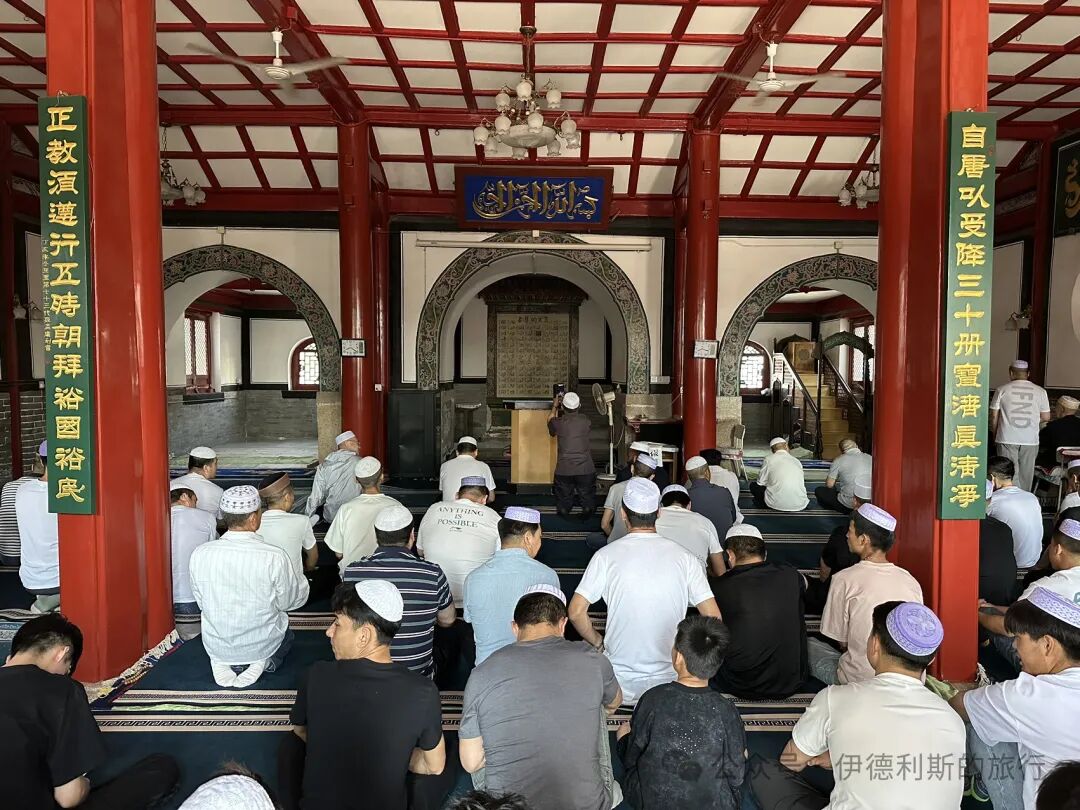
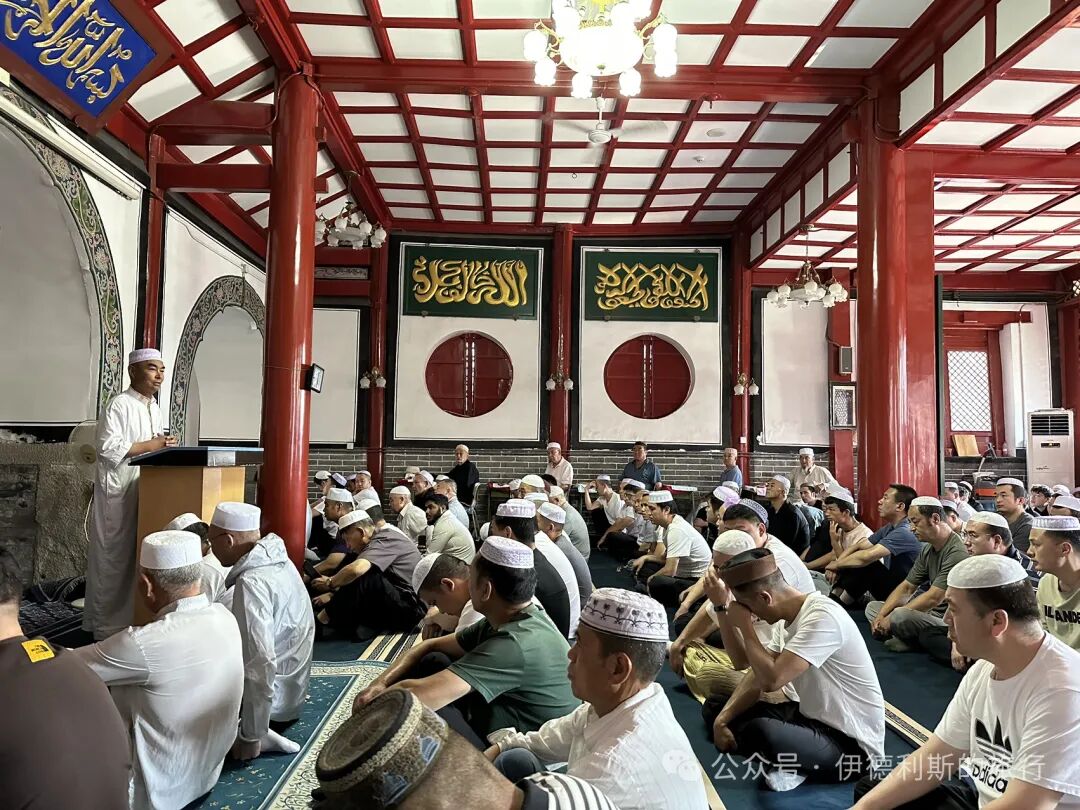
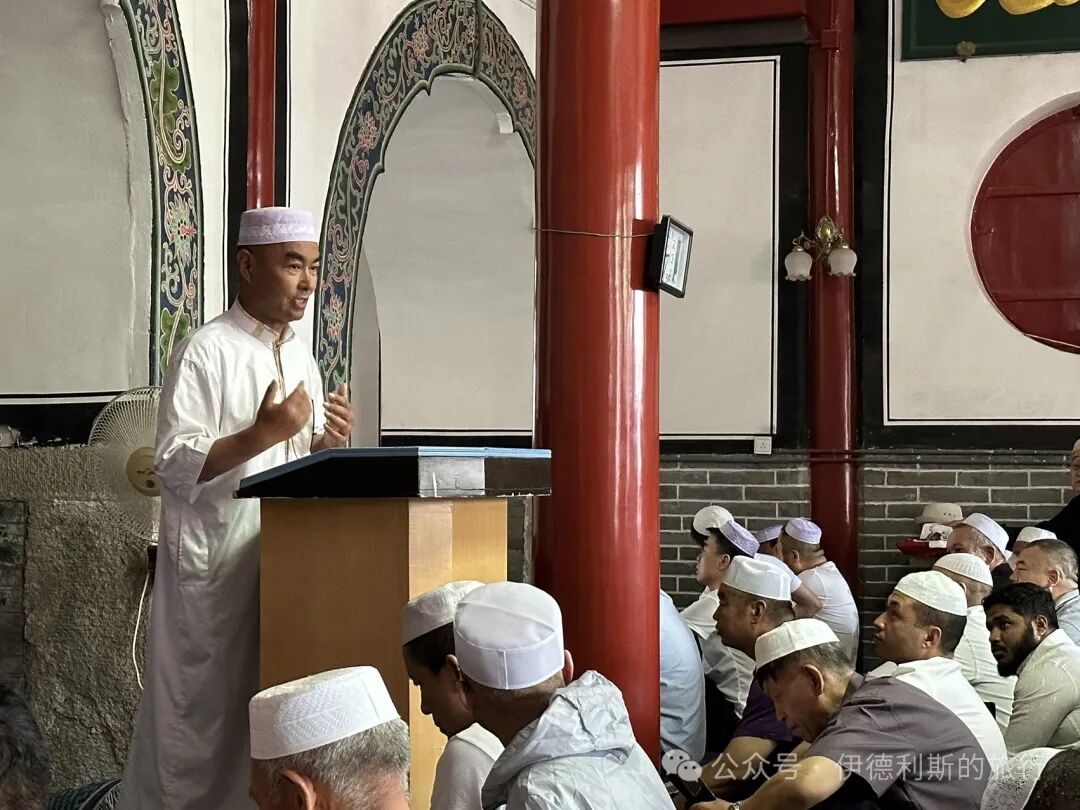
The plaques inscribed by Cixi, Guangxu, Prince Su, and Prince Qing for Xiguanshi Mosque were all destroyed in the last century. The ones currently in the mosque are replicas.




After the congregational prayer, we went to Jingyi Farmhouse at the foot of the Western Hills to perform the sacrifice (qurbani). This year, we chose a 110-pound sheep. It was raised on grass in the mountains, which is usually hard to find. Then we had the holiday noodle soup (fentang) made by my sister-in-law, and Zainab drank three bowls in one go!
The apricots at the farmhouse were ripe, so we ate some fresh ones.

Steamed buns with bitter bean powder (kudoufen momo) brought by our friends (dost) from Qinghai.
In the afternoon, Zainab made hand-grabbed lamb neck (shouzhuayangbozi), and our family ate the lamb from the Qurbani sacrifice. This was also the first time Suleiman ate meat from the Qurbani sacrifice, and he really loved it.
Halal Travel Guide: Medina - Prophet Mosque, Dua and Sacred Travel (Part 1)
Articles • ali2007fr posted the article • 0 comments • 171 views • 2026-05-19 06:55
After finishing the Umrah in Makkah, we took a train to Madinah and caught an Uber straight from the station to the Prophet's Mosque.
The Prophet's Mosque (al-Masjid an-Nabawī) is the mosque the Prophet built next to his home after arriving in Madinah in 622 AD. It is the second holiest site in the faith, right after the Sacred Mosque. The mosque has been expanded many times throughout history. The central core was built during the Ottoman era, while the surrounding areas were added by the Kingdom of Saudi Arabia after the 20th century.
The most important area of the mosque is called the Rawdah (Garden), which is where the Prophet used to pray. According to a Hadith, 'Between my house and my minbar (pulpit) is one of the gardens of Paradise,' which is why it is also known as the Garden of Paradise.
You need to book a slot on the Nusuk app to enter the Garden of Paradise, with separate times for men and women. My appointment was for 6:30 PM. After finishing the Maghrib prayer on the west side of the mosque, I walked a long way around to the east side to line up. After a while, those with a Nusuk booking were directed to wait on the carpets outside Gate 39. Staff handed out plastic bags for our shoes, and after waiting a bit longer, I finally entered the Garden of Paradise.
I first performed two rak'ahs of prayer inside the Garden of Paradise, then pushed through the crowd to see the layout. The minbar used by the Prophet was originally made of date palm wood, later changed to tamarisk, and had ebony steps added. The minbar you see today was rebuilt in 1590 by the Ottoman Sultan Murad III using marble. I also saw an imam resting to the right of the minbar. There are six pillars inside the Garden of Paradise that mark the spots where the Prophet used date palm trunks to support the original structure. Each pillar has a special meaning.
Inside the Garden of Paradise, there are two mihrabs (prayer niches). One was originally built by the Prophet, and the other was built by Caliph Uthman. A walkway separates the two mihrabs.
Next to the prayer area is the burial site of the Prophet and the first two caliphs, Abu Bakr and Umar. This was originally the home of the Prophet and his wife, Aisha, and the Prophet passed away here in 632 AD. After a fire at the Prophet's Mosque in 1481, the Egyptian Mamluk Sultan Qaitbay rebuilt the tomb from a wooden structure into a brick one and added metal railings. No one has entered the interior of the tomb in the more than 500 years since. Directly above the tomb is the Green Dome, built in 1817 by the Ottoman Sultan Mahmud II. It got its name after being painted green in 1837.
I did not stay in the Garden of Paradise (Rawdah) for long before security guided me to the east side of the tomb, known as the Mawajaha (sacred meeting point). Here, you can offer salaam to the Prophet and the two Caliphs through three circular holes. Between the circular holes is the closed Gate of Aisha, which features a silver plaque added by the Ottoman Sultan Ahmed I in 1617.
I wanted to pray two rak'ahs in the Garden of Paradise, but because of the crowds and entry limits, I had to follow security out of the mosque. I regret not seeing the imam lead the prayer in person.
This time in Medina, I stayed at the MIAS HOTEL on the west side of the mosque, so I usually entered through the gates on the west side for prayers. After the Kingdom of Saudi Arabia was established in 1932, the mosque underwent three major expansions: the first from 1951 to 1956, the second from 1985 to 1994, and the third from 2012 to the present. The expanded sections surround the Ottoman-era core from the east, north, and west. They use reinforced concrete, marble, granite, and artificial stone, making them taller and more spacious than the Ottoman area. In 2010, German Muslim architect Mahmoud Bodo Rasch added retractable umbrella-like canopies around the mosque. They open between the Fajr and Maghrib prayers and can spray a cooling mist.
I prayed Maghrib at the mosque, but it was so crowded that the core area was full and closed off half an hour before the adhan. I barely found a spot in a small courtyard on the north side of the core area. The sunshades were open there during the day, so I was not in the sun. From here, you can clearly see the difference between the Ottoman core and the Saudi expansion. The Ottoman area is lower with painted domes on top, while the Saudi area is taller with a flat roof.
I was very grateful to receive water, dates, and yogurt handed out in the mosque. You can really find dates everywhere here.
On the square on the west side of the mosque is the site of the famous Saqifa event. After the Prophet passed away in 632 AD, some of his companions gathered at the Saqifa (a covered meeting place) of the Bani Sa'idah tribe. They pledged allegiance to Abu Bakr, making him the successor to the Prophet and the first Caliph.
There is almost no record of the later history of the Saqifa, only that a man named Ali Pasha built a structure there during the Ottoman period in 1620. In the 20th century, this was a park, but by the time I visited, the park had been demolished and reconstruction work was underway.
Banda later went to the Al-Baqi cemetery on the east side of the Prophet's Mosque to visit the graves of the Prophet's family and friends. When the Prophet arrived in Medina in 622 AD, this land was covered in Arabian boxthorn (gharqad). The Prophet led everyone to clear the thorns and opened this place as a Muslim cemetery.
The Prophet's family members buried in the cemetery include his wet nurse, most of his wives, his cousin, his children, his uncle, and the wife and descendants of Caliph Ali. Because four Shia Imams are buried here, it has become a famous holy site for Shia Muslims.
Historically, the Al-Baqi cemetery had many domed structures (gongbei), but they were demolished twice by the Wahhabis in 1806 and 1926. Because the Wahhabis consider marking graves to be heresy, even the tombstones with writing on them in the cemetery were completely destroyed. The demolition of Al-Baqi cemetery drew criticism and protests from both Sunni and Shia Muslims. Many Shia Muslims consider the day of the demolition, the 11th of Shawwal in 1926, a 'Day of Sorrow' and hold memorial events every year. To this day, the Saudi authorities ignore all criticism and have blocked many paths in the cemetery, making it difficult for people to visit the graves.
The area with the blue boards in the distance is the grave of Caliph Uthman, and the path leading to it has been blocked. On June 17, 656 AD, Caliph Uthman was assassinated by rebels in his home. Because the rebels would not allow Uthman to be buried in Al-Baqi cemetery, he had to be buried in the Jewish cemetery right next to it on the north side. Decades later, the rulers of the Umayyad Caliphate tore down the walls between the two cemeteries and included Uthman's grave within Al-Baqi cemetery.
In the distance are the graves of the Prophet's wet nurse Halima, and two companions of the Prophet born in Medina, Sa'd ibn Mu'adh and Saʽid al-Khudri, which are also impossible to approach. Sa'd was the leader of the Banu Aws tribe. He was seriously wounded in the Battle of the Trench in 627 and passed away shortly after returning to Medina. Sa'd was a noble companion recognized for his close relationship with the Prophet, and the Prophet continued to praise him after he passed away.
Abu Sa'id al-Khudri lived his whole life in Medina and reportedly fought in the Battle of al-Harra in 683, where the people of Medina stood against the Umayyad Caliphate. Abu Sa'id narrated 1,170 hadiths, making him the seventh most prolific narrator among the companions of the Prophet.
The tomb of the Martyrs of al-Harra. The people of Medina opposed the hereditary rule and policies of the Umayyad Caliphate, so they started a war on August 26, 683. They were quickly defeated, and the Umayyad army looted the city of Medina.
The grave of Ibrahim ibn Muhammad, the young son of the Prophet. Ibrahim died of illness at only two years old, and the Prophet was deeply saddened. The Prophet led Ibrahim's funeral prayer and buried him in the Baqi cemetery. He filled the grave with sand, sprinkled some water on it, and placed a marker.
The graves of the 8th-century jurist Malik ibn Anas (711-795) and the Quran reciter Nafiʽ al-Madani (689-785). Imam Malik founded the Maliki school, one of the four major Sunni schools of Islamic law. The Maliki school places great importance on hadiths and is currently found mostly in North Africa, outside of Egypt. After Malik passed away in Medina in 795, the Abbasid governor of Mecca led his funeral prayer.
Nafiʽ al-Madani was originally from Isfahan, but he was born and passed away in Medina. His method of reciting the Quran is the most common style used in North and West Africa today.
The two nearby graves belong to the Prophet's cousin Aqil ibn Abi Talib and his nephew Abd Allah ibn Ja'far. Aqil was the older brother of Caliph Ali. He fought against the Prophet in the early days but converted to Islam a few years before the Prophet passed away, and he appears in many hadiths.
Abd Allah settled in Medina with his family in 628, and the Prophet once said that his appearance and character were similar to his own. Abdullah Allah was one of the wealthiest men in Medina at the time and a famous philanthropist.
In the distance are the graves of several of the Prophet's wives, including Sawda, Aisha, Hafsa, Zaynab, Umm Salama, Safiyya, Umm Habiba, and Maria. Security guards watch over the graves of the Prophet's wives and do not allow anyone to get close or linger.
Behind the iron fence in the distance are the graves of several of the Prophet's daughters, and further away are the graves of his daughter Fatima (though this is disputed), his uncle Abbas, and four Shia imams: Hasan, Ali Zayn al-Abidin, Muhammad al-Baqir, and Jafar al-Sadiq. A tall dome (gongbei) once stood over the graves of the four Shia imams, serving as the most prominent landmark in the entire Baqi cemetery, but it was destroyed by the Wahhabis twice, in 1806 and 1926.
Al-Ghamama Mosque is located southwest of the Prophet's Mosque, on the site where the Prophet led the Eid al-Fitr prayer in 631. Ghamama means cloud. People say the Prophet once performed a prayer for rain here, and then clouds covered the entire city. Al-Ghamama Mosque was first built during the reign of the eighth Umayyad Caliph, Umar ibn Abd al-Aziz (reigned 717-720). It was renovated in 1340 and 1622, and in 1859, Ottoman Sultan Abdulmejid I (reigned 1839-1861) rebuilt it into the black volcanic basalt structure seen today. It is currently one of the very few mosques in Medina that retains its Ottoman-era appearance.
Abu Bakr As-Siddiq Mosque is located next to Al-Ghamama Mosque, also on the site where the Prophet led the Eid al-Fitr prayer in 631. It is named after Caliph Abu Bakr, who continued to lead the Eid al-Fitr prayer there. The current mosque was built in 1838 as a black volcanic basalt structure by order of Ottoman Sultan Mahmud II (reigned 1808-1839), and the Sultan's tughra (calligraphic emblem) is still at the entrance. Because it is small and very close to the Prophet's Mosque, Friday prayers (Jumu'ah) are not held here.
The Medina Hejaz Railway Station was built in 1908 and is an important historical site of the Hejaz Railway constructed by the Ottoman Empire. For thousands of years, the Hejaz region, where Mecca and Medina are located, relied on camel caravans for transport, which had a high mortality rate when crossing difficult mountainous terrain. After the 1860s, a railway construction boom began, and the Ottoman Empire started studying a rail line to connect Damascus with the two holy cities. This line was not only meant to make the Hajj pilgrimage more convenient but also held significant strategic importance. In 1900, the Ziraat Bankasi (Ottoman Agricultural Bank) provided the first loan of 100,000 liras, and construction of the Hejaz Railway officially began.
The construction of the Hejaz Railway faced many difficulties, including labor and resource issues while passing through uninhabited areas, bridge construction in desert terrain, and attacks by Arab tribes along the route. Fearing that the railway construction would ruin their livelihood based on pack animal transport, local Arab tribes organized in 1907 to threaten a work stoppage. The Ottoman Sultan eventually decided to end the railway at Medina. Under the supervision of chief engineer Mouktar Bey, the Hejaz Railway officially reached Medina on September 1, 1908, covering a total length of 1,300 kilometers.
However, less than 10 years after it began operating, the Ottoman Empire collapsed during World War I. The Hejaz Railway was officially abandoned in 1920 due to a lack of maintenance. People say the wreckage of trains destroyed during the Arab Revolt of 1916-1918 still rests where they fell a century ago.
In 2005, Saudi Arabia restored the tracks and sheds of the Medina station of the Hejaz Railway, and in 2006, it opened as the Hejaz Railway Museum. However, it is now closed again, and you can only view the exterior of the Medina station.
Near the Medina station of the Hejaz Railway are two black volcanic basalt mosques from the Ottoman period. Enclosed within the train station and inaccessible is the As-Saqiya Mosque. It is located where the Prophet inspected his troops before participating in the Battle of Badr in 624. It is said to be the place where the eighth chapter, seventh verse of the Quran was revealed, which is also the first chapter of the Quran revealed in Medina.
The Anbariya Mosque is a mosque built in 1908 by Ottoman Sultan Abdul Hamid II (reigned 1876-1909) for the Medina station of the Hejaz Railway. The architectural style follows the traditional Ottoman design, but it uses local hard basalt stone. There is no pulpit (minbar) in the main hall because Friday prayers (Jumu'ah) are not held here.
Quba Mosque is located in the southern suburbs of Medina. It was built by the Prophet after he migrated from Mecca to Medina in 622 and is the first mosque in the history of the faith. The Prophet often went to Quba Mosque to perform namaz during his lifetime, which is frequently mentioned in the Hadith. Sahl ibn Hunayf narrated that the Prophet said: 'Whoever leaves his house and comes to Quba Mosque and performs prayer in it, it is equal to performing an Umrah.' This makes it a place that Muslims from all over the world visit when they come to Medina.
Quba Mosque was originally just a circle of walls. It was expanded several times and rebuilt into its current structure in 1986. Today, Quba Mosque is surrounded by date palm orchards. Beside the mosque, there are people offering dates and black tea (hongcha) as a gesture of hospitality (dawa), and you can drink Zamzam water inside the mosque. It is a great place to rest while following the footsteps of the noble Prophet.
Musabbih Mosque is located southwest of Quba Mosque, and you have to cross a dusty parking lot to reach it. Legend says the Prophet Muhammad prayed namaz here when he first migrated to Medina in 622 AD. The old mosque still keeps its black volcanic basalt walls and contains the remains of a mihrab. The small courtyard is quiet, filled with blooming flowers and a friend (dosti) cleaning the area, which contrasts sharply with the crowded Quba Mosque nearby.
North of Medina is the site of the Battle of Uhud, fought in 624 between the Muslim army led by the Prophet and the Quraish tribe alliance from Mecca. The Muslim army suffered heavy losses, but the Meccans failed to capture Medina.
At the center of the Uhud battlefield is a small hill. Muslim archers stationed there left their posts to collect war spoils, which turned the tide of the battle and led to the Muslim army being surrounded.
On the north side of the hill is the cemetery for the martyrs of the Battle of Uhud, which is now blocked off by wire mesh and fences. The cemetery holds many of the Prophet's companions and relatives, most importantly his uncle Hamza ibn Abd al-Muttalib. The Prophet once said, 'My best brother is Ali, and my best uncle is Hamza. May Allah be pleased with them.' Buried next to Hamza is the Prophet's cousin, Abd Allah ibn Jahsh.
On the east side of the cemetery stands the Sayyid al-Shuhada Mosque, built in 2017 and named after the title the Prophet gave to Hamza.
On the west side of the cemetery is a shed where water and bread are given out as charity, and you can rest there.
The Battle of the Trench was a conflict in 627 AD where the Muslim army led by the Prophet defended the northwest of Medina against an alliance of the Quraish and Bedouin tribes. The Prophet followed the advice of Salman the Persian to dig a trench, which eventually helped them defeat the enemy. This event is recorded in detail in the Quran and Sunnah.
Historically, seven mosques were built on the battlefield of the Trench. Five remain today, all built during the reign of the Umayyad Caliph Umar II (who ruled from 717 to 720) and renovated at different times.
The mosque on the northern hillside is called Al-Fath Mosque, and 'Fath' means 'conquest'. This is said to be the place where the Prophet performed namaz during the Battle of the Trench.
South of the Al-Fath Mosque is the Salman Al-Farsi Mosque, named after the Prophet's companion, Salman the Persian. Salman was originally a Zoroastrian from the Sassanid Empire. He later traveled through the Middle East with a Nestorian group and converted to Islam after meeting the Prophet in Medina. He used the military skills he learned in the Sassanid Empire to dig the trench, which helped the Prophet win the Battle of the Trench.
After the Prophet passed away, Salman took part in the Arab Empire's conquest of the Sassanid Empire and became the first governor of Ctesiphon, the Sassanid capital. He was also the first person to translate the Quran into a foreign language, which was Persian. Salman holds a high status among both Shia and Sufi Muslims. He is honored as the most noble of the four great companions of the Prophet in Shia tradition, and he is even respected in the Druze and Baháʼí faiths.
South of the Salman Al-Farsi Mosque is the Abu Bakr Al-Siddiq Mosque, named after Caliph Abu Bakr. In recent years, Saudi Arabia rebuilt this site into a large mosque with a washroom and a courtyard, and the main hall provides bottled ice water.
South of the Abu Bakr Al-Siddiq Mosque is the Umar bin Khattab Mosque, named after Caliph Umar.
South of the Umar bin Khattab Mosque is the Ali bin Abu Talib Mosque. It sits on a hillside in the south and is named after Caliph Ali, who is said to have joined the Battle of the Trench here.
West of the Ali bin Abu Talib Mosque is the Fatimah Az-Zahra Mosque, named after the Prophet's daughter Fatimah. It is a small mosque attached to the other mosques. This mosque was built during the reign of Ottoman Sultan Abdulmejid I (who ruled from 1839 to 1861), and today only the foundation walls remain. view all
After finishing the Umrah in Makkah, we took a train to Madinah and caught an Uber straight from the station to the Prophet's Mosque.
The Prophet's Mosque (al-Masjid an-Nabawī) is the mosque the Prophet built next to his home after arriving in Madinah in 622 AD. It is the second holiest site in the faith, right after the Sacred Mosque. The mosque has been expanded many times throughout history. The central core was built during the Ottoman era, while the surrounding areas were added by the Kingdom of Saudi Arabia after the 20th century.
The most important area of the mosque is called the Rawdah (Garden), which is where the Prophet used to pray. According to a Hadith, 'Between my house and my minbar (pulpit) is one of the gardens of Paradise,' which is why it is also known as the Garden of Paradise.
You need to book a slot on the Nusuk app to enter the Garden of Paradise, with separate times for men and women. My appointment was for 6:30 PM. After finishing the Maghrib prayer on the west side of the mosque, I walked a long way around to the east side to line up. After a while, those with a Nusuk booking were directed to wait on the carpets outside Gate 39. Staff handed out plastic bags for our shoes, and after waiting a bit longer, I finally entered the Garden of Paradise.
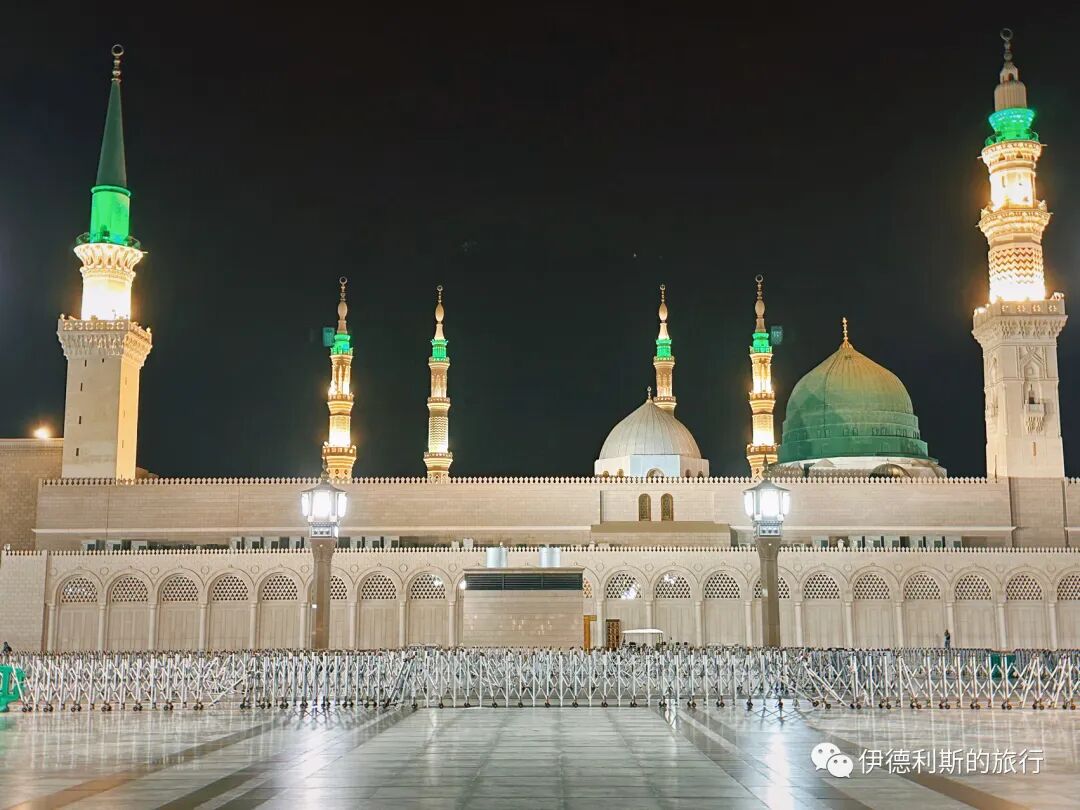
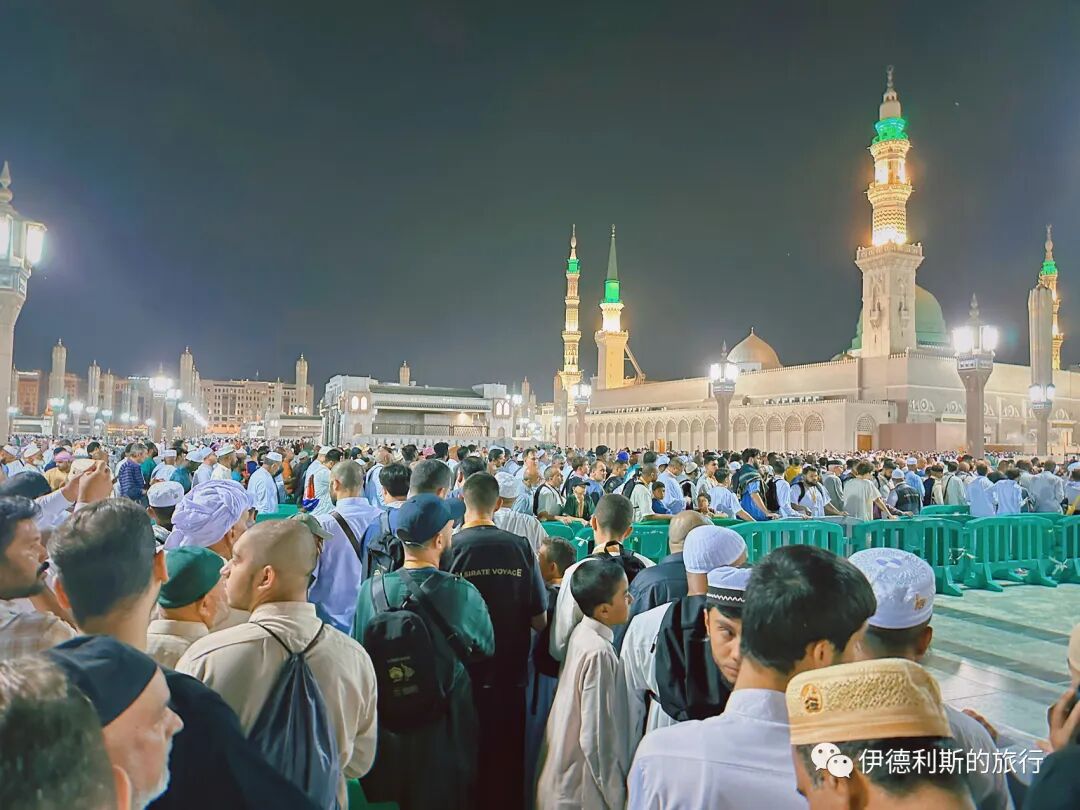
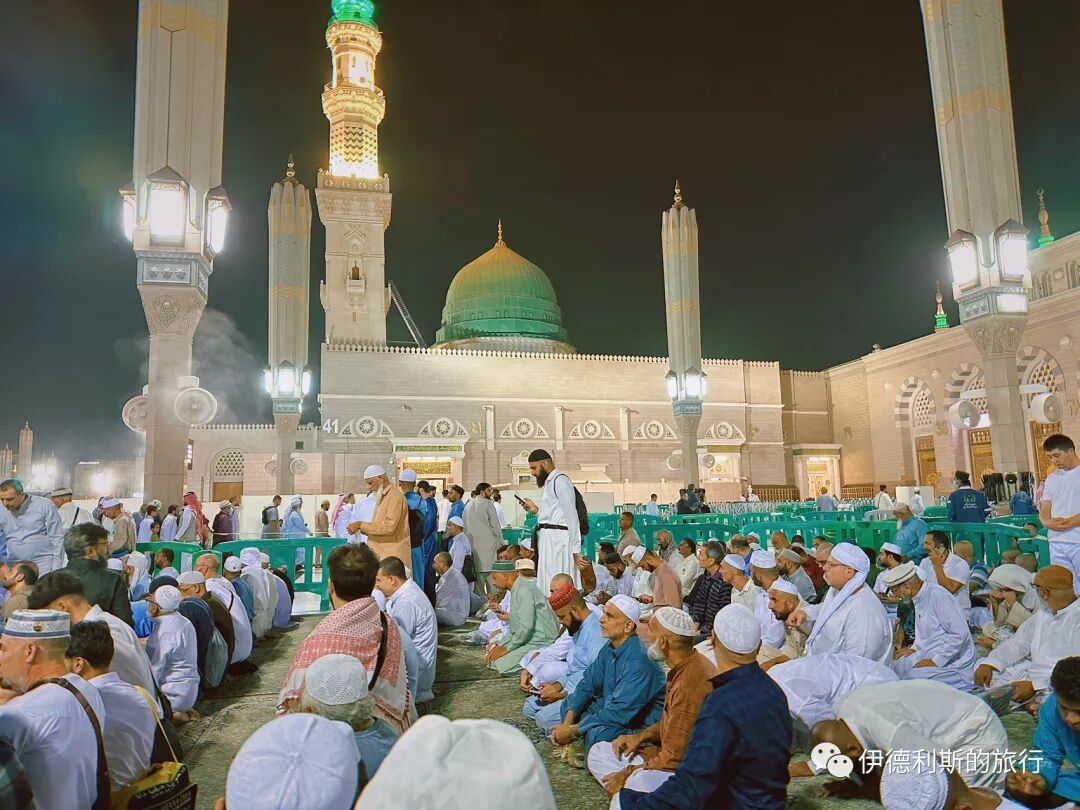
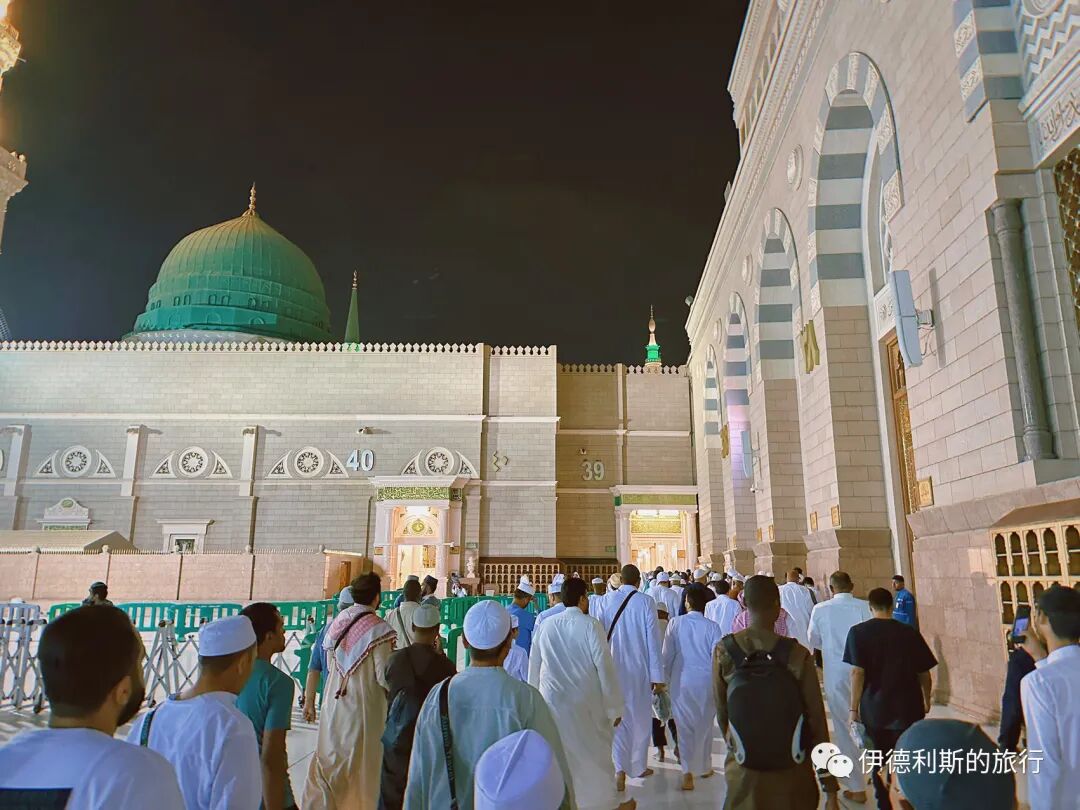
I first performed two rak'ahs of prayer inside the Garden of Paradise, then pushed through the crowd to see the layout. The minbar used by the Prophet was originally made of date palm wood, later changed to tamarisk, and had ebony steps added. The minbar you see today was rebuilt in 1590 by the Ottoman Sultan Murad III using marble. I also saw an imam resting to the right of the minbar. There are six pillars inside the Garden of Paradise that mark the spots where the Prophet used date palm trunks to support the original structure. Each pillar has a special meaning.
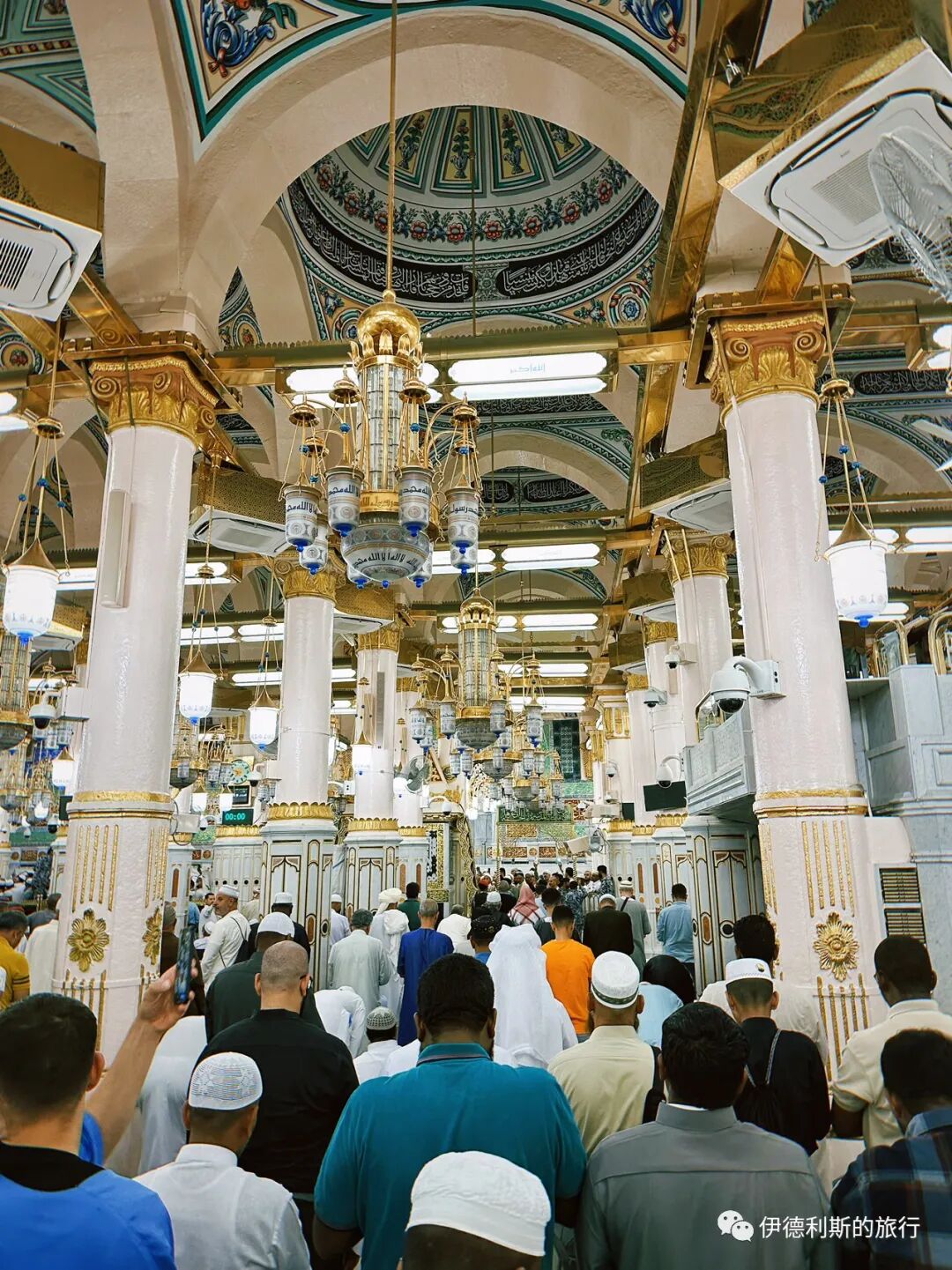
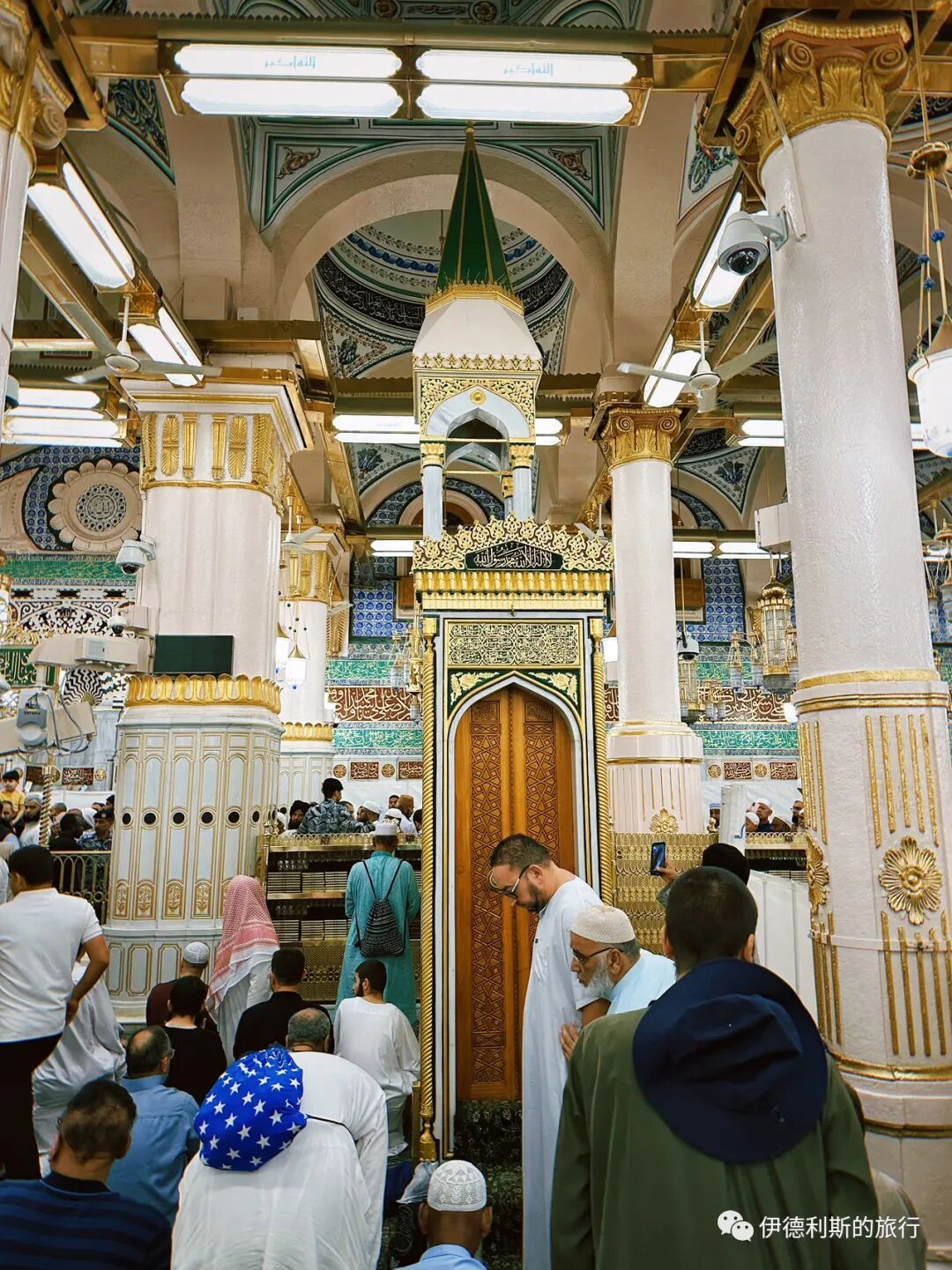
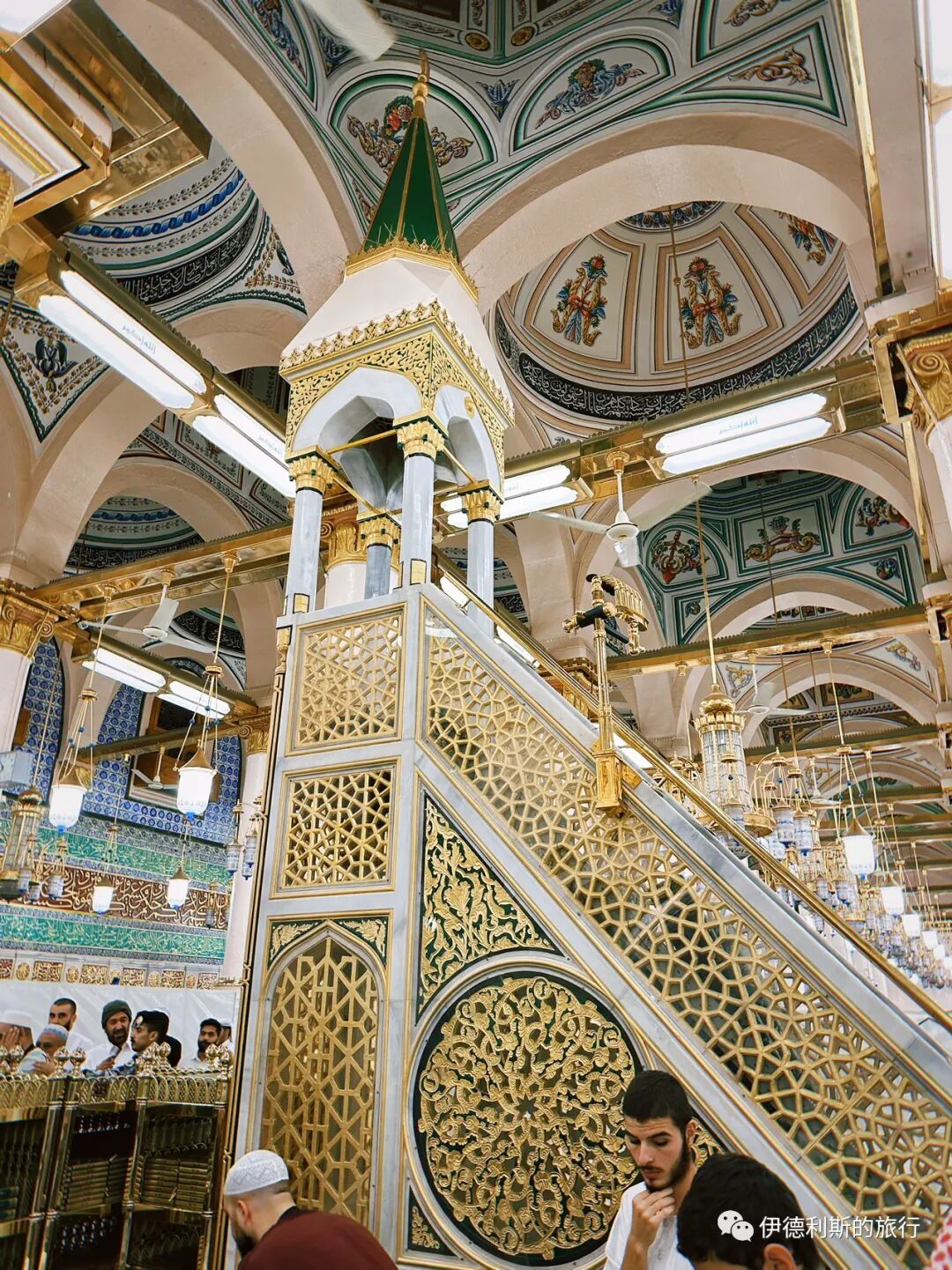
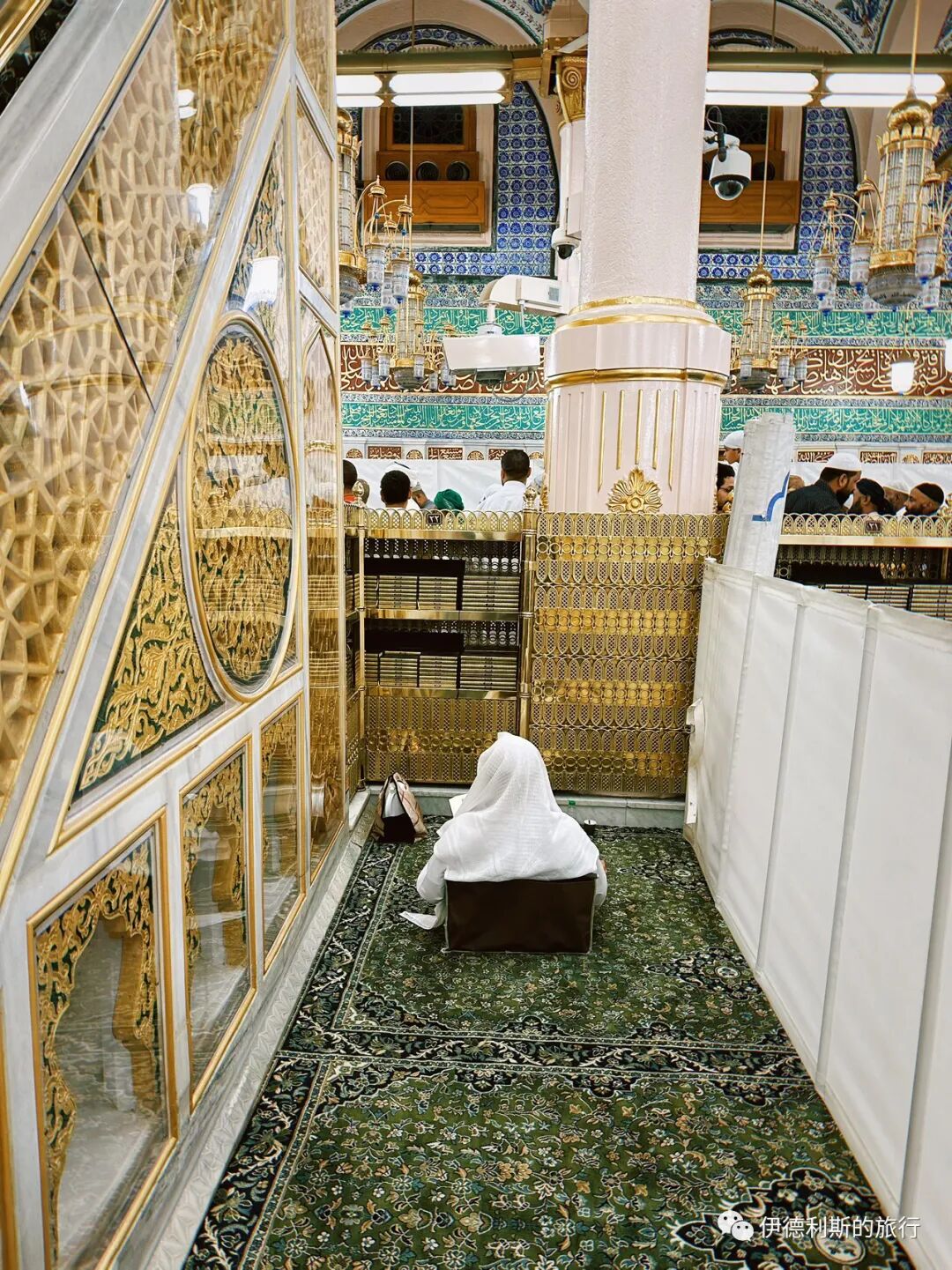
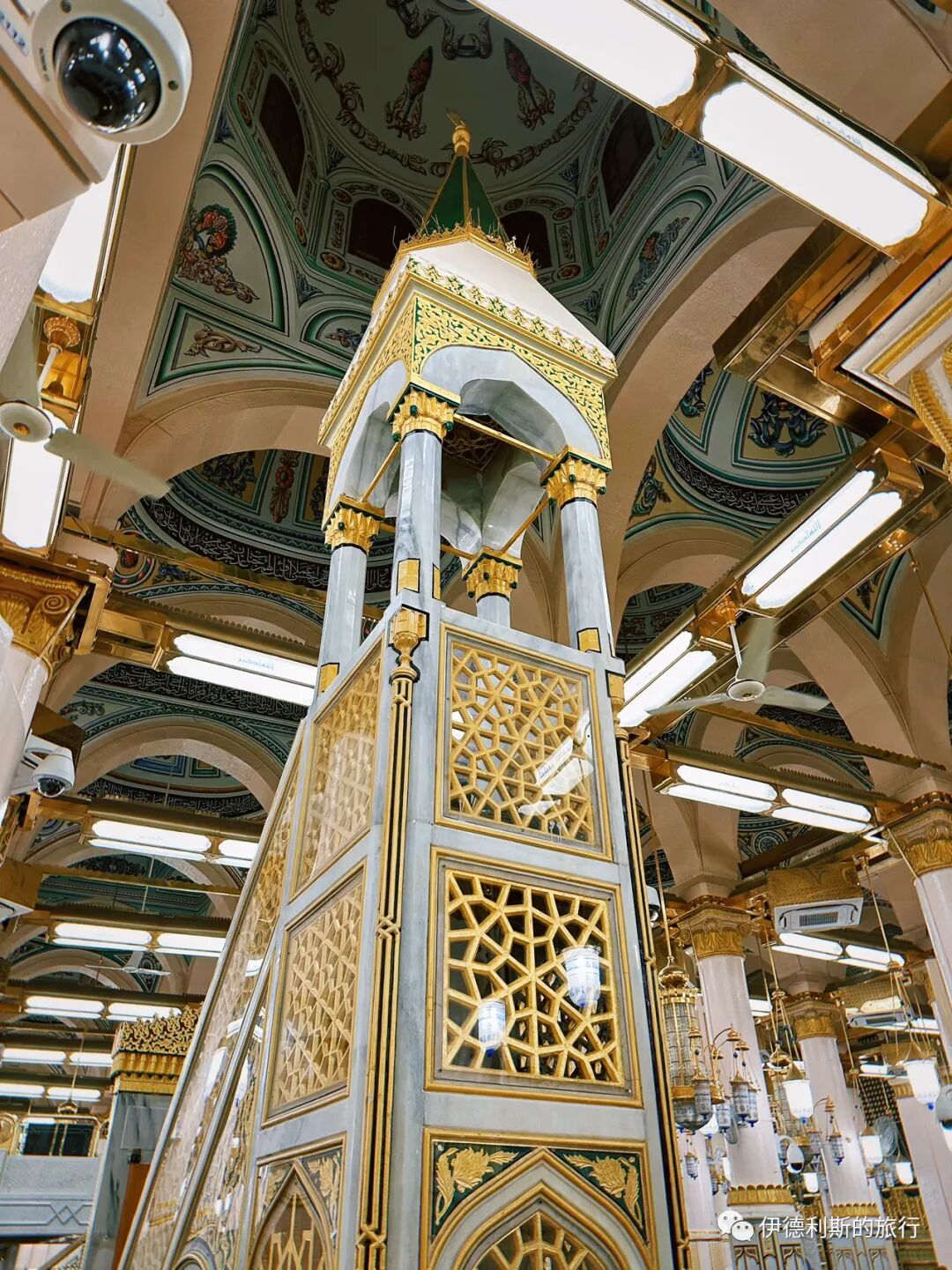
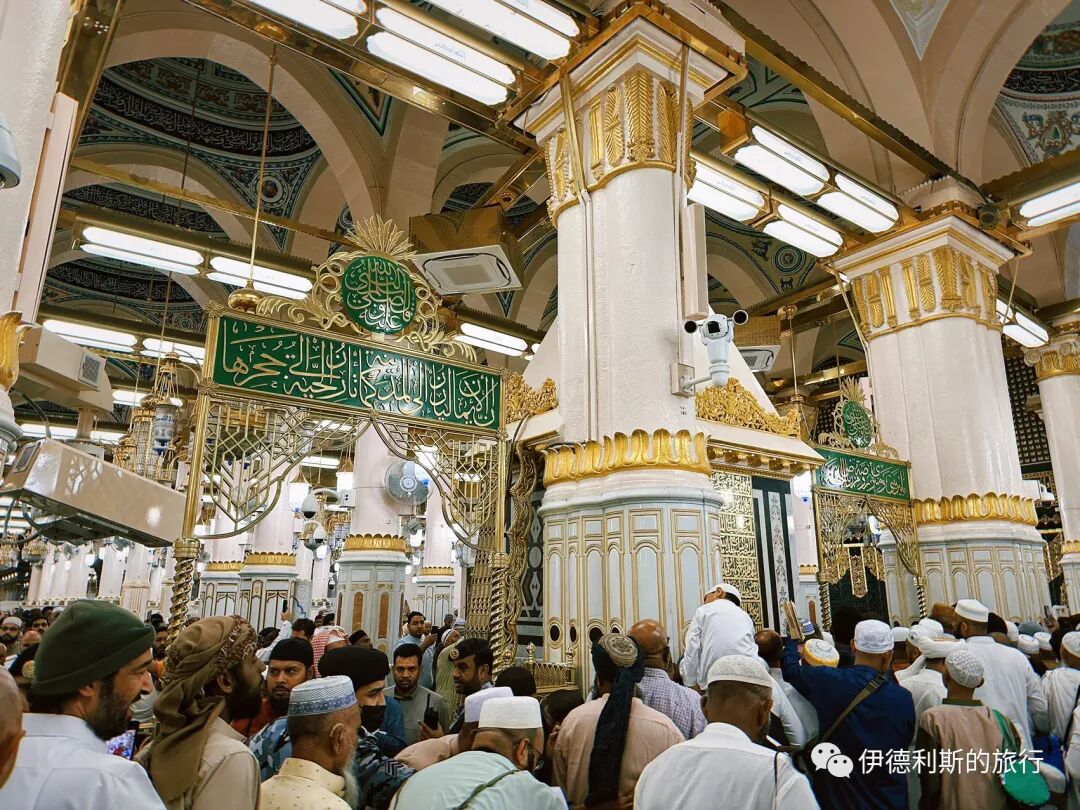
Inside the Garden of Paradise, there are two mihrabs (prayer niches). One was originally built by the Prophet, and the other was built by Caliph Uthman. A walkway separates the two mihrabs.
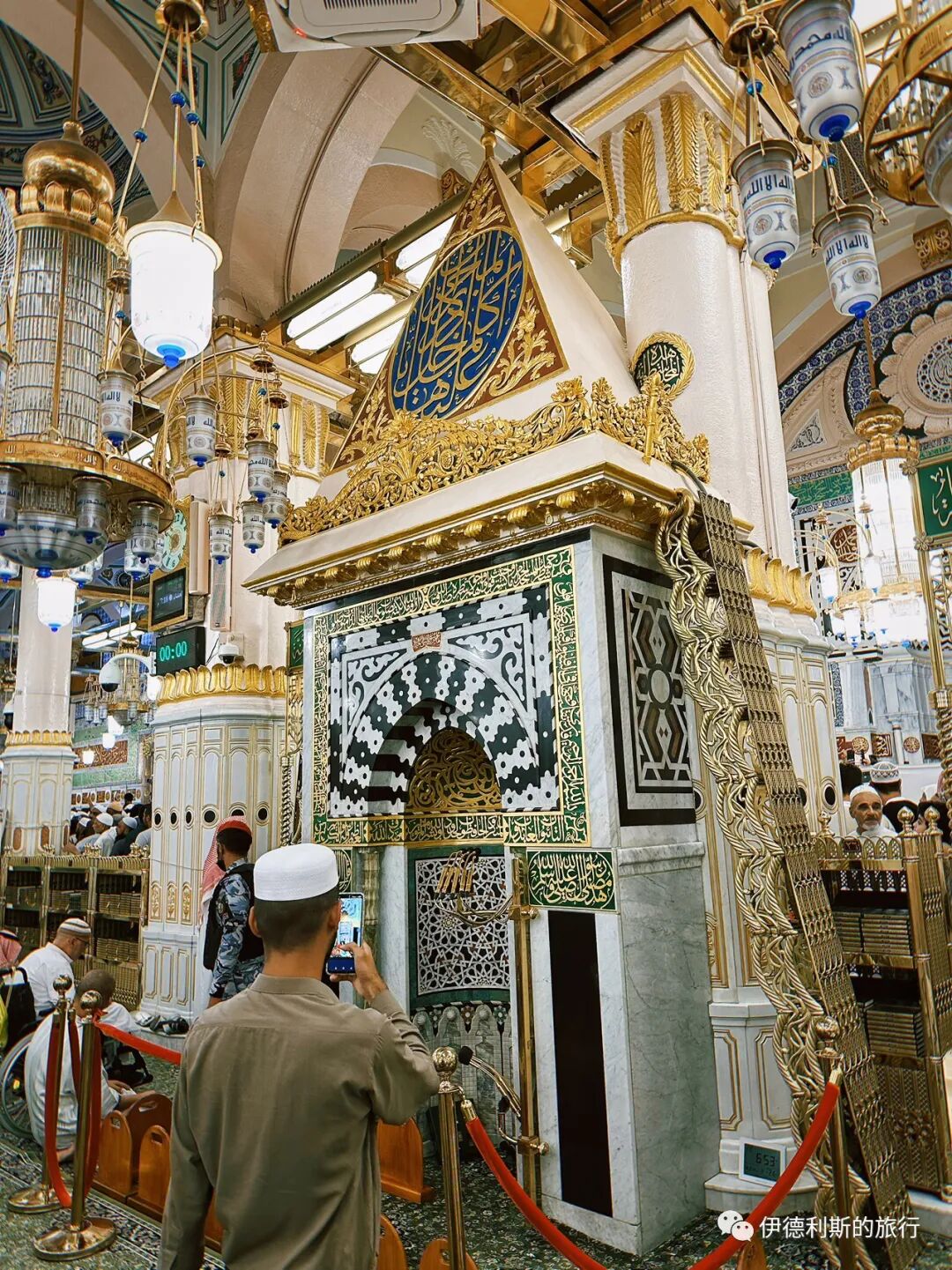
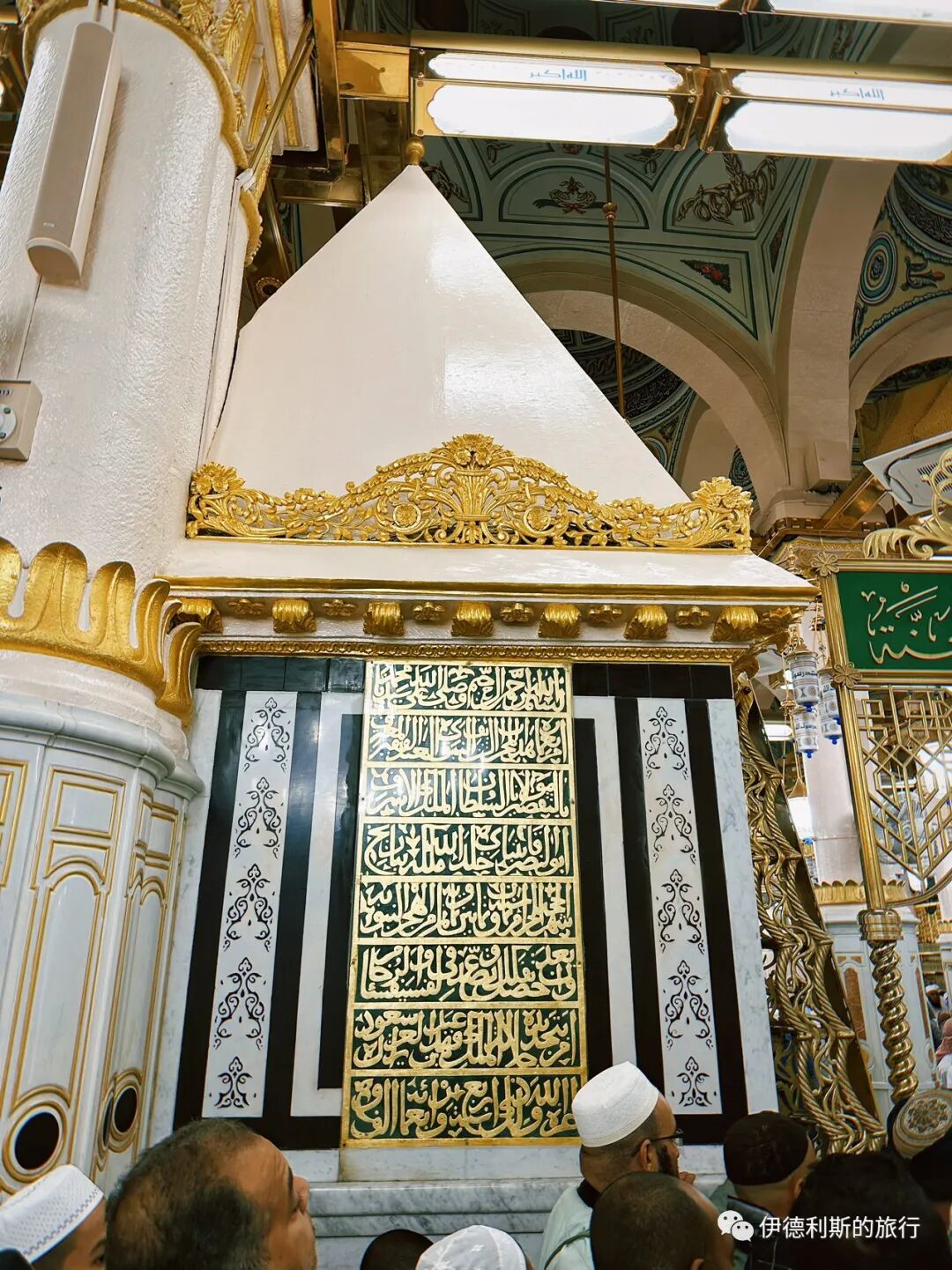
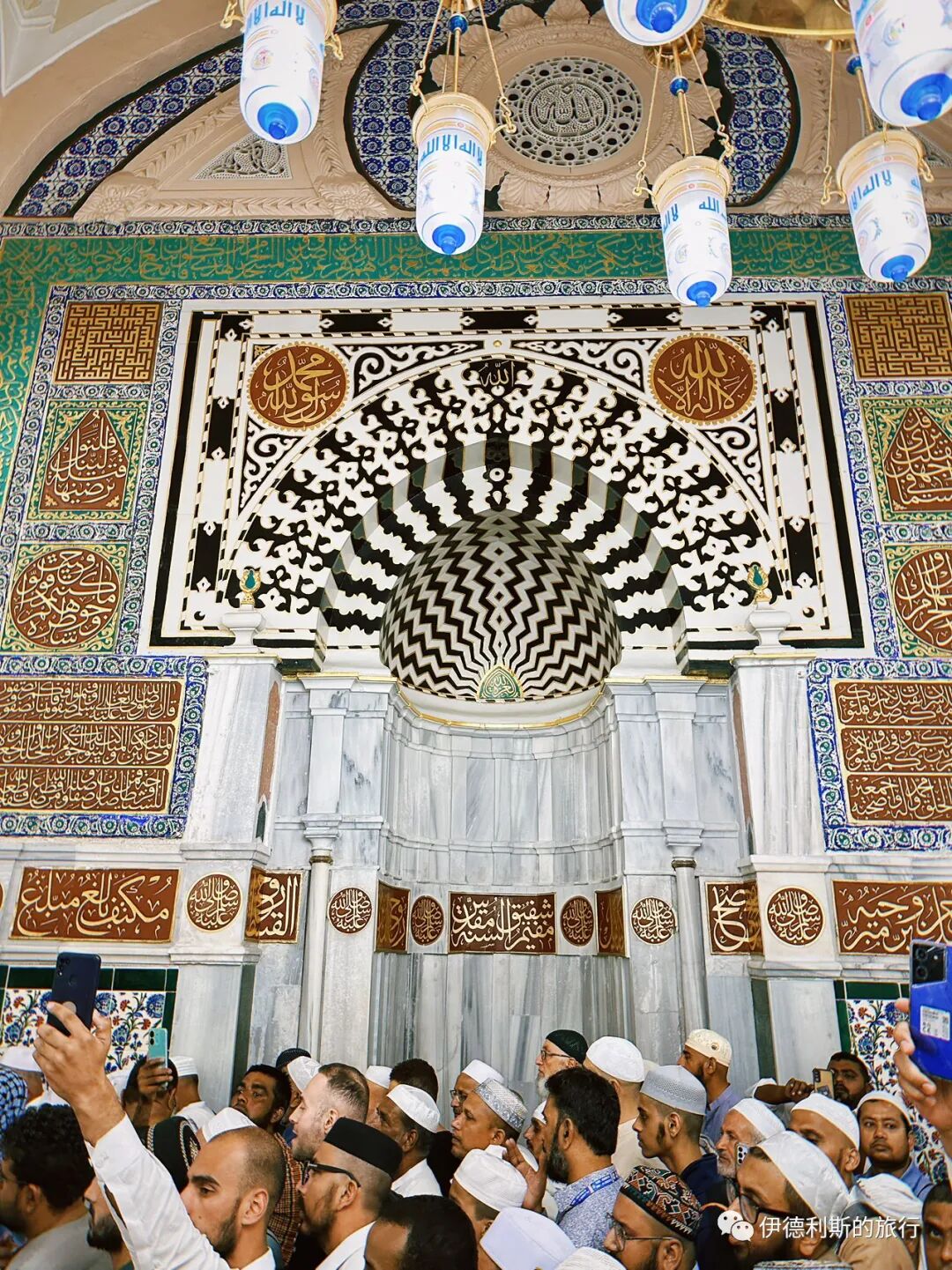
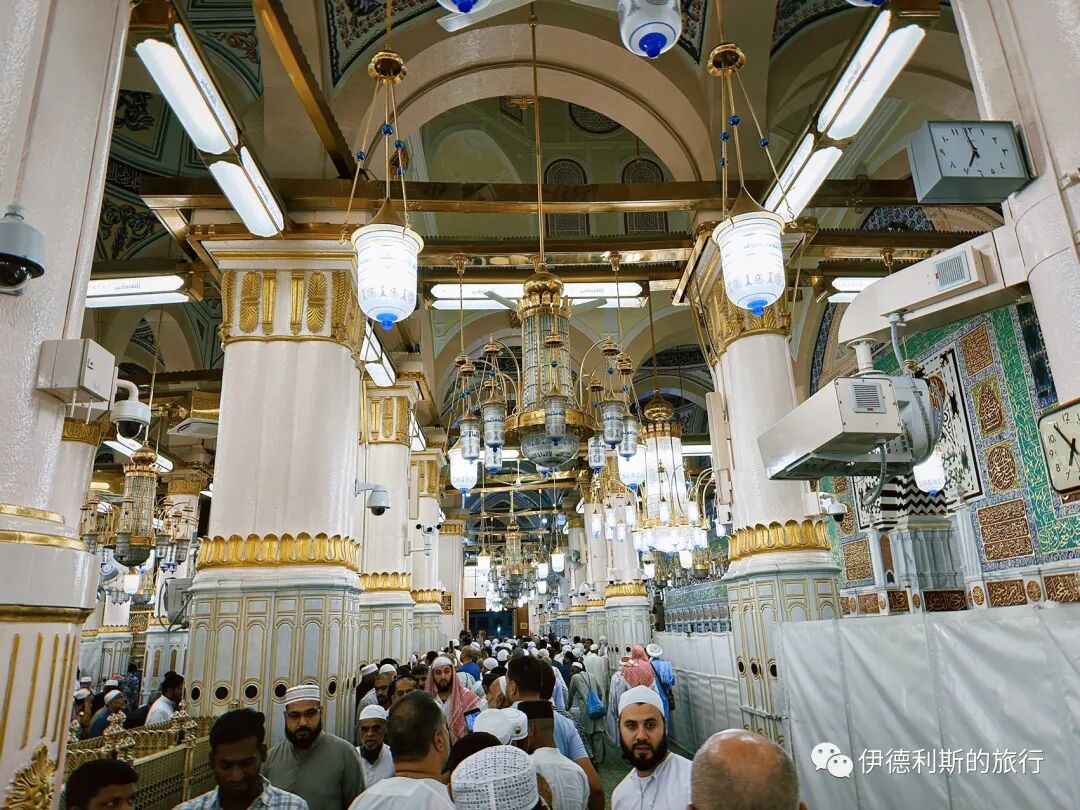
Next to the prayer area is the burial site of the Prophet and the first two caliphs, Abu Bakr and Umar. This was originally the home of the Prophet and his wife, Aisha, and the Prophet passed away here in 632 AD. After a fire at the Prophet's Mosque in 1481, the Egyptian Mamluk Sultan Qaitbay rebuilt the tomb from a wooden structure into a brick one and added metal railings. No one has entered the interior of the tomb in the more than 500 years since. Directly above the tomb is the Green Dome, built in 1817 by the Ottoman Sultan Mahmud II. It got its name after being painted green in 1837.
I did not stay in the Garden of Paradise (Rawdah) for long before security guided me to the east side of the tomb, known as the Mawajaha (sacred meeting point). Here, you can offer salaam to the Prophet and the two Caliphs through three circular holes. Between the circular holes is the closed Gate of Aisha, which features a silver plaque added by the Ottoman Sultan Ahmed I in 1617.
I wanted to pray two rak'ahs in the Garden of Paradise, but because of the crowds and entry limits, I had to follow security out of the mosque. I regret not seeing the imam lead the prayer in person.
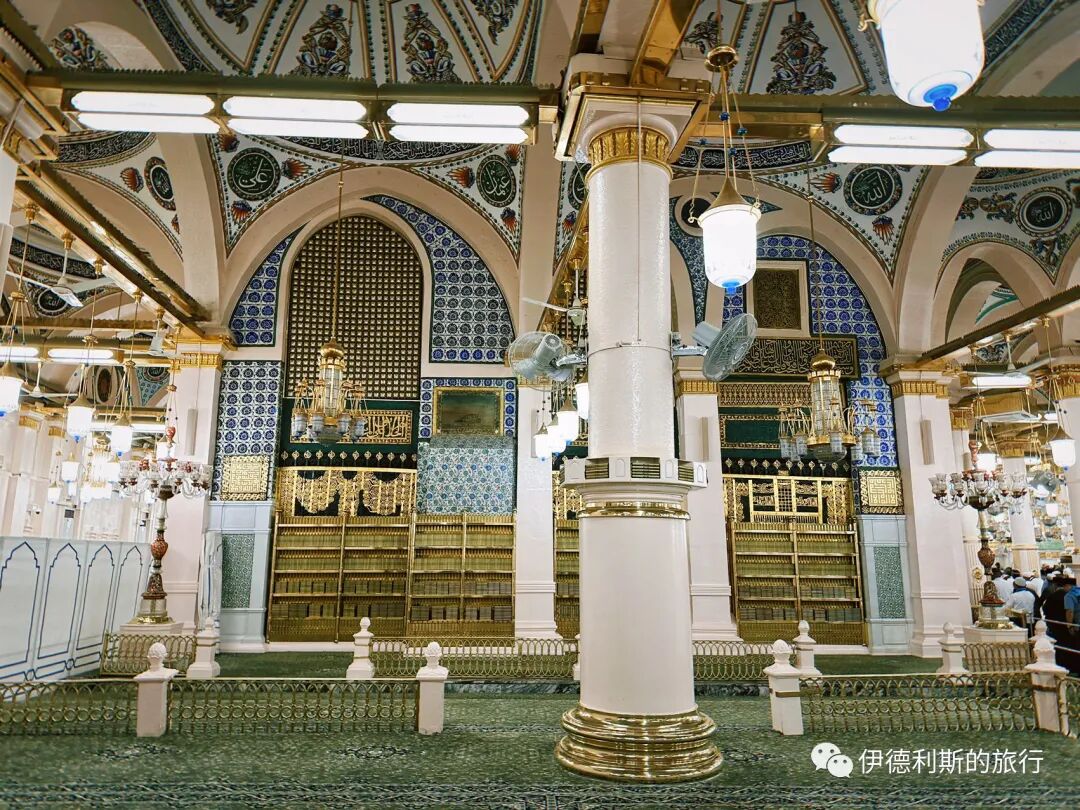
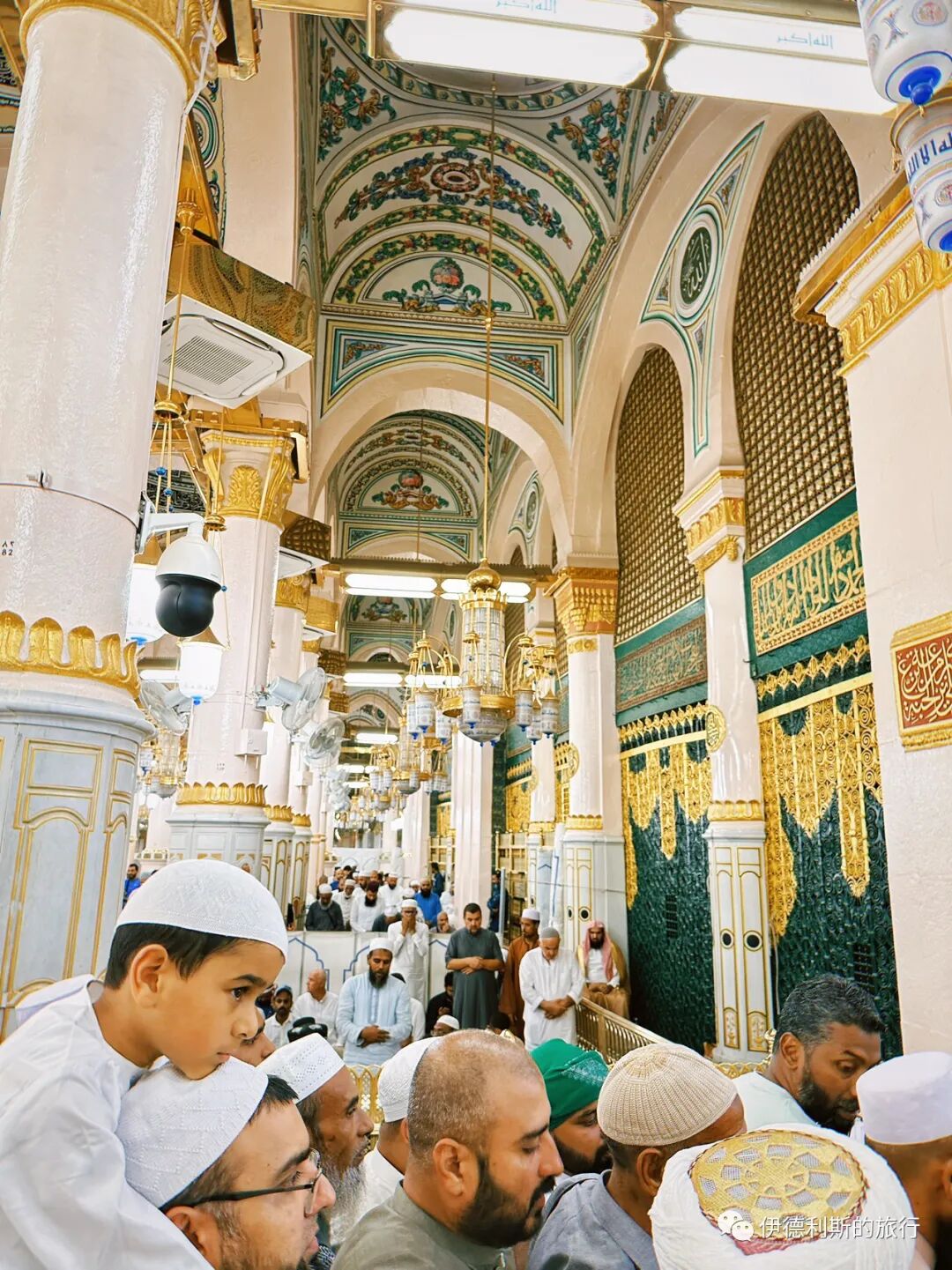
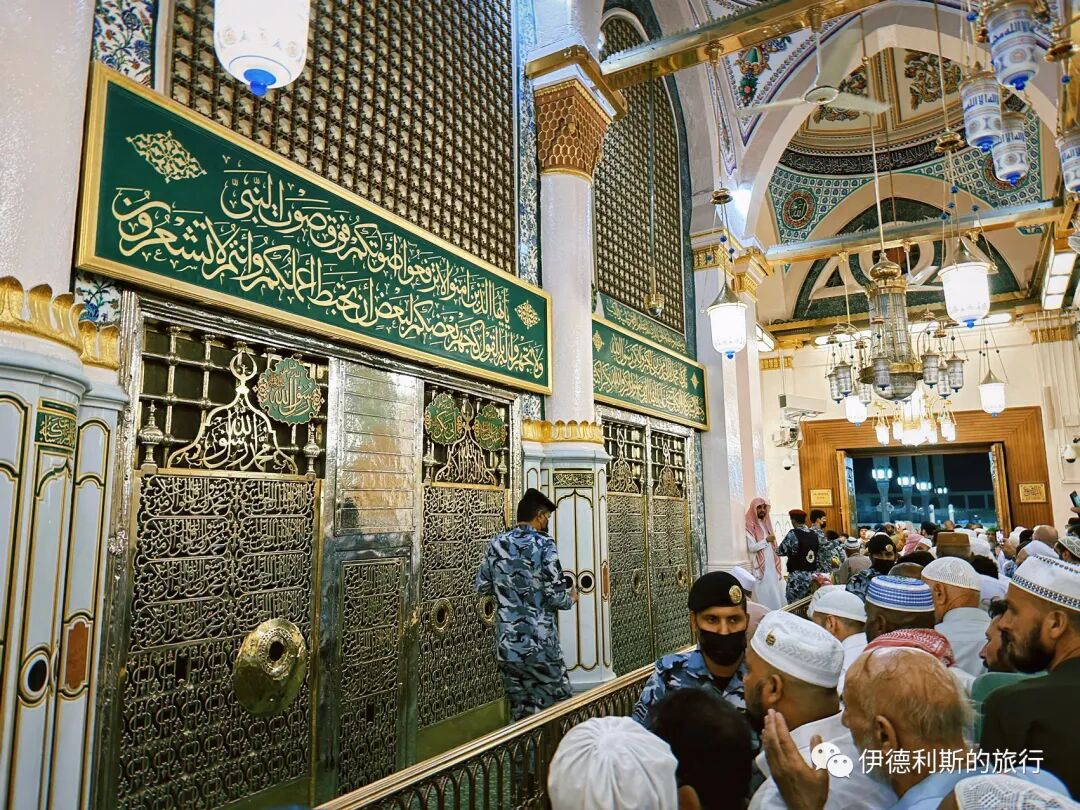
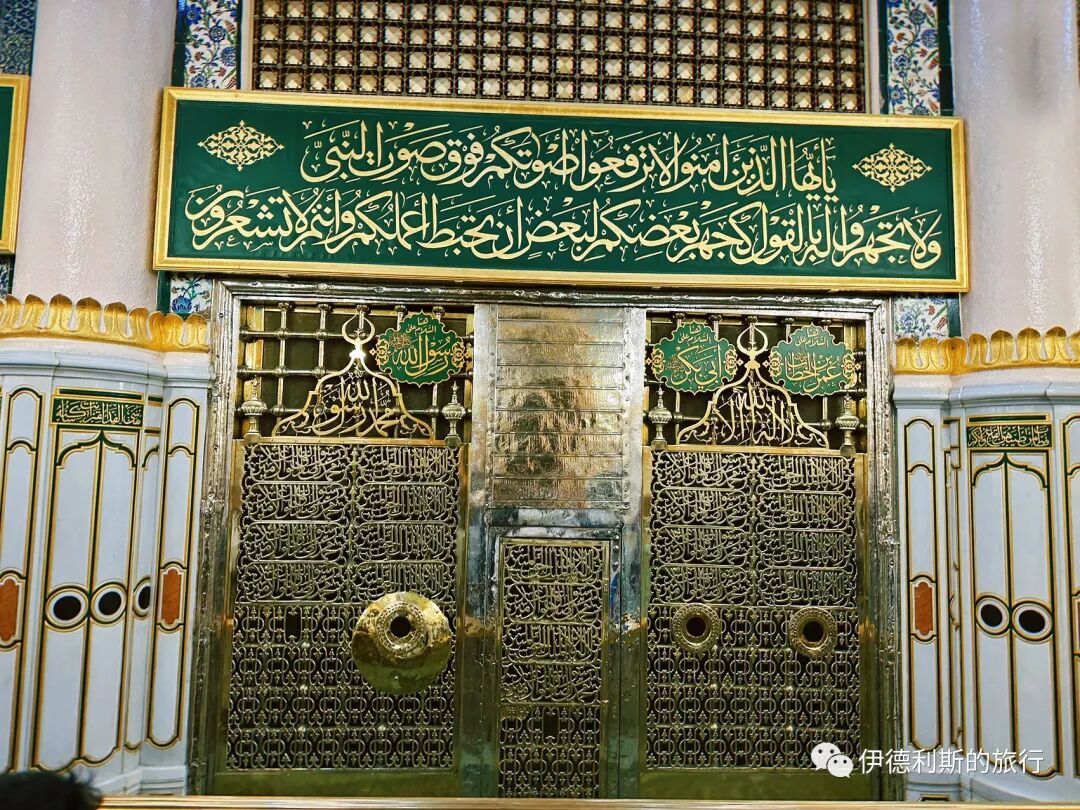
This time in Medina, I stayed at the MIAS HOTEL on the west side of the mosque, so I usually entered through the gates on the west side for prayers. After the Kingdom of Saudi Arabia was established in 1932, the mosque underwent three major expansions: the first from 1951 to 1956, the second from 1985 to 1994, and the third from 2012 to the present. The expanded sections surround the Ottoman-era core from the east, north, and west. They use reinforced concrete, marble, granite, and artificial stone, making them taller and more spacious than the Ottoman area. In 2010, German Muslim architect Mahmoud Bodo Rasch added retractable umbrella-like canopies around the mosque. They open between the Fajr and Maghrib prayers and can spray a cooling mist.
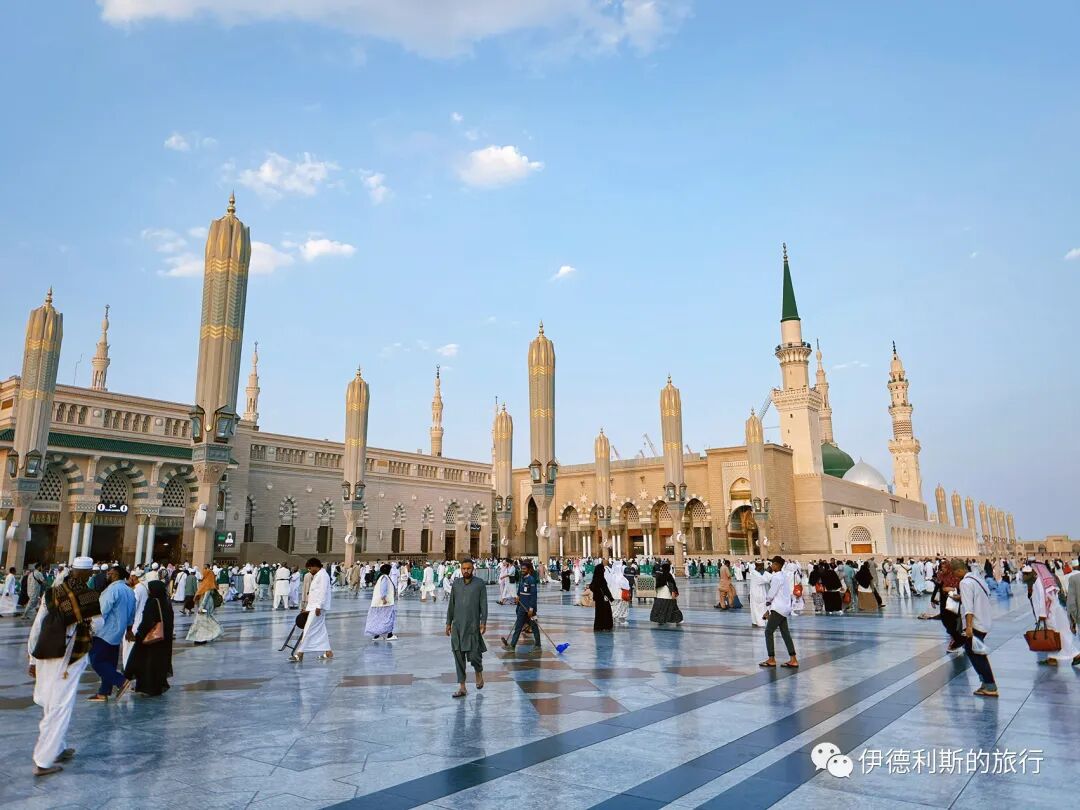
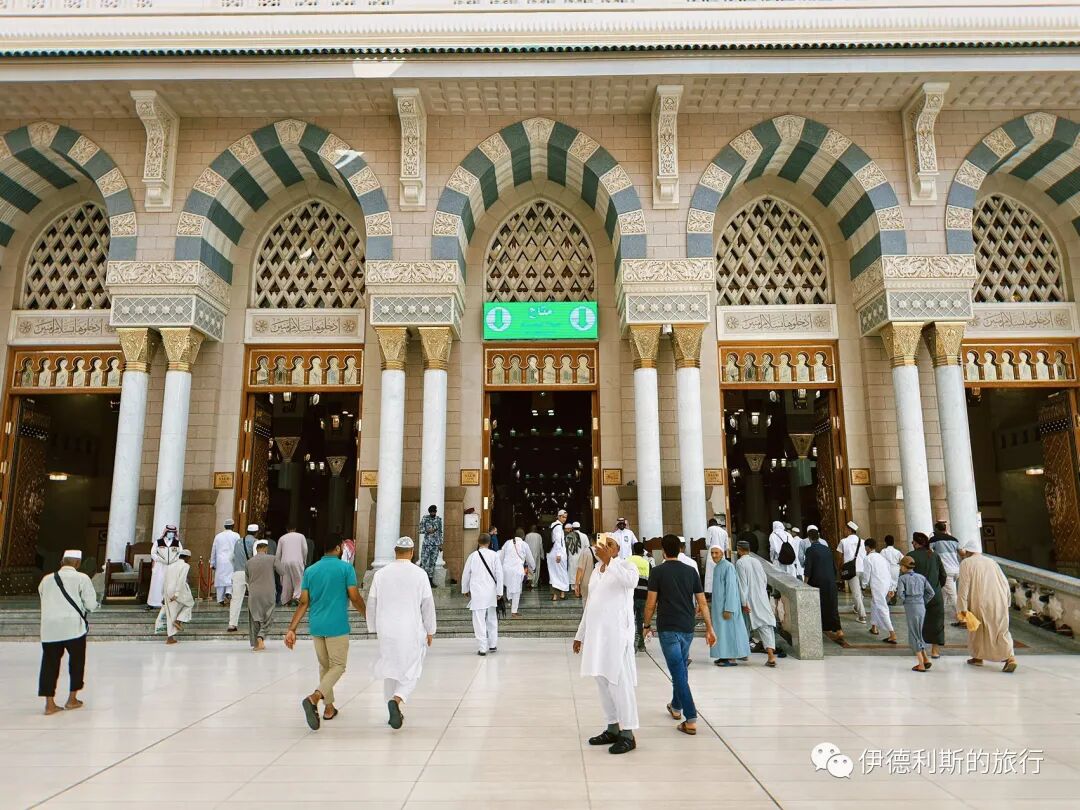
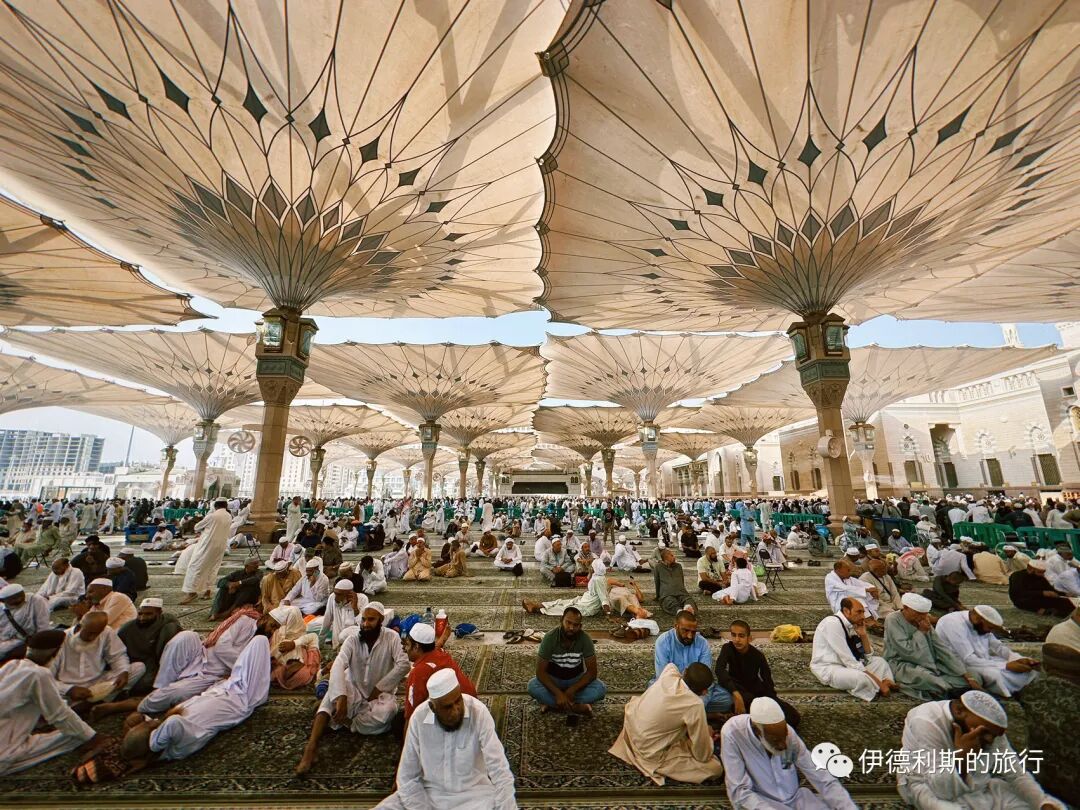
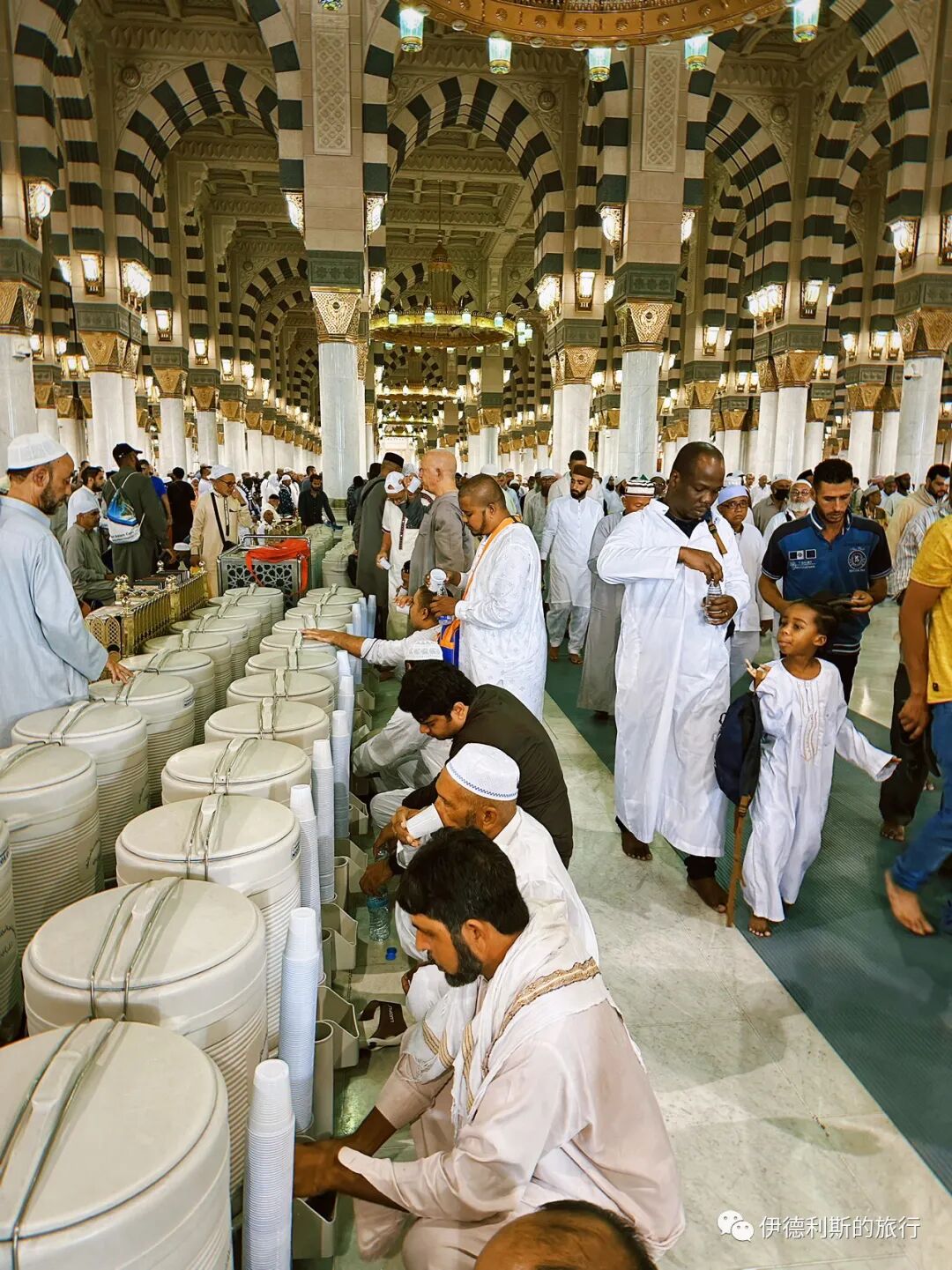
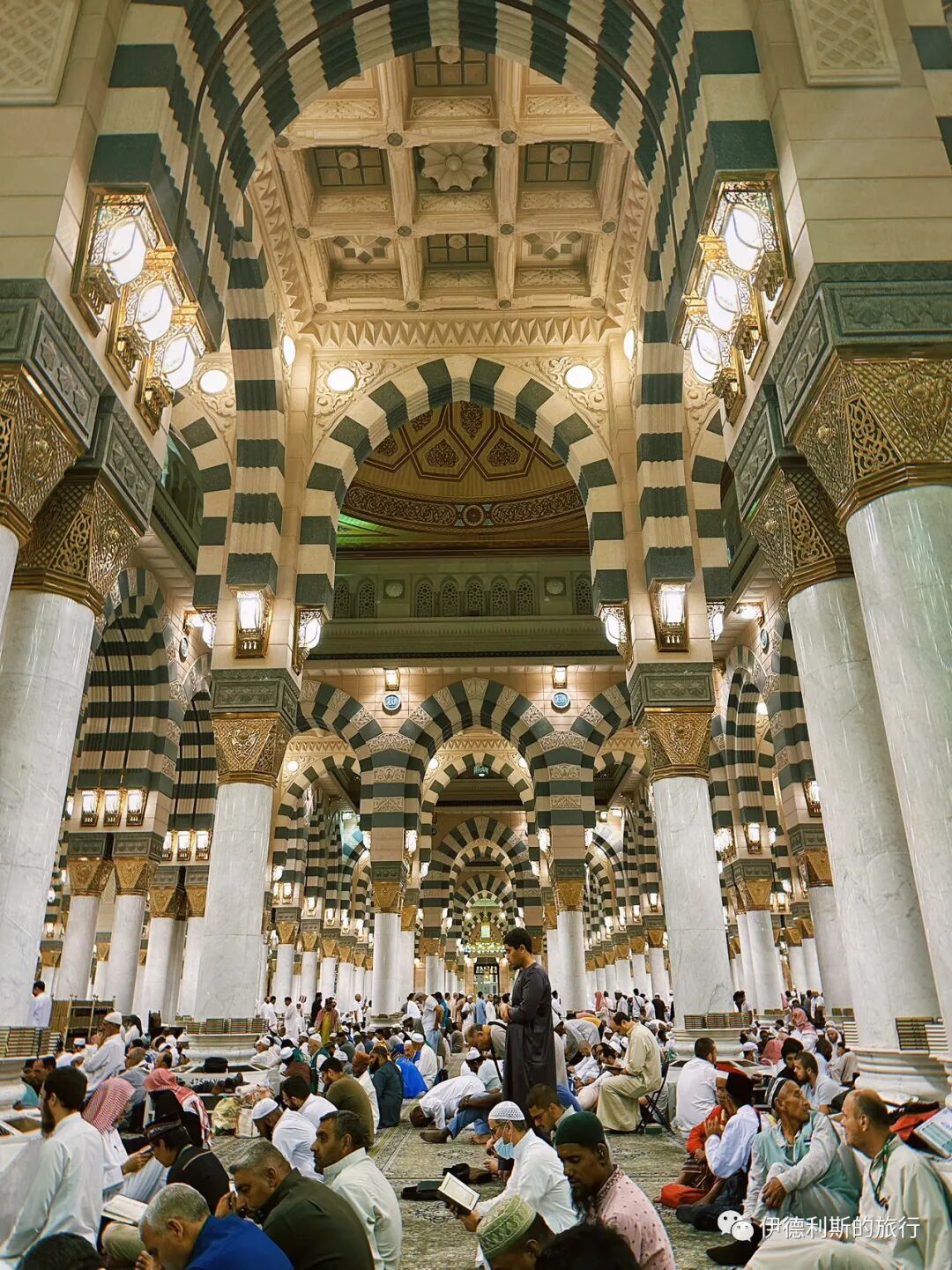
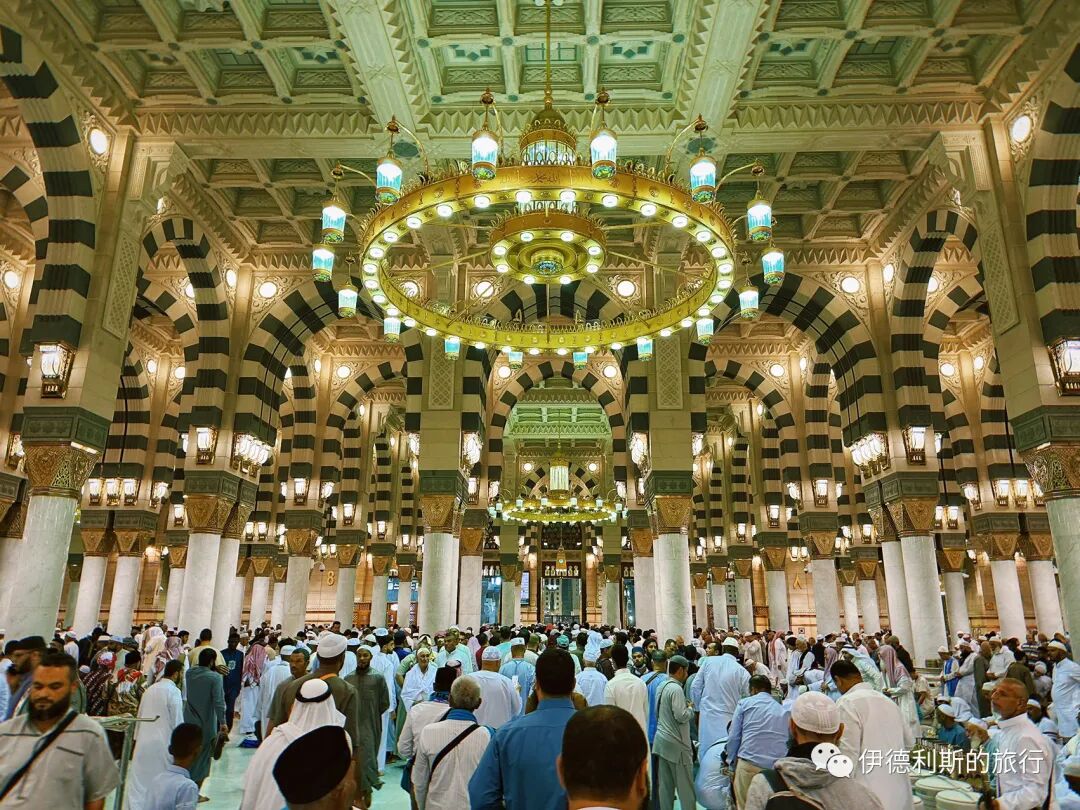
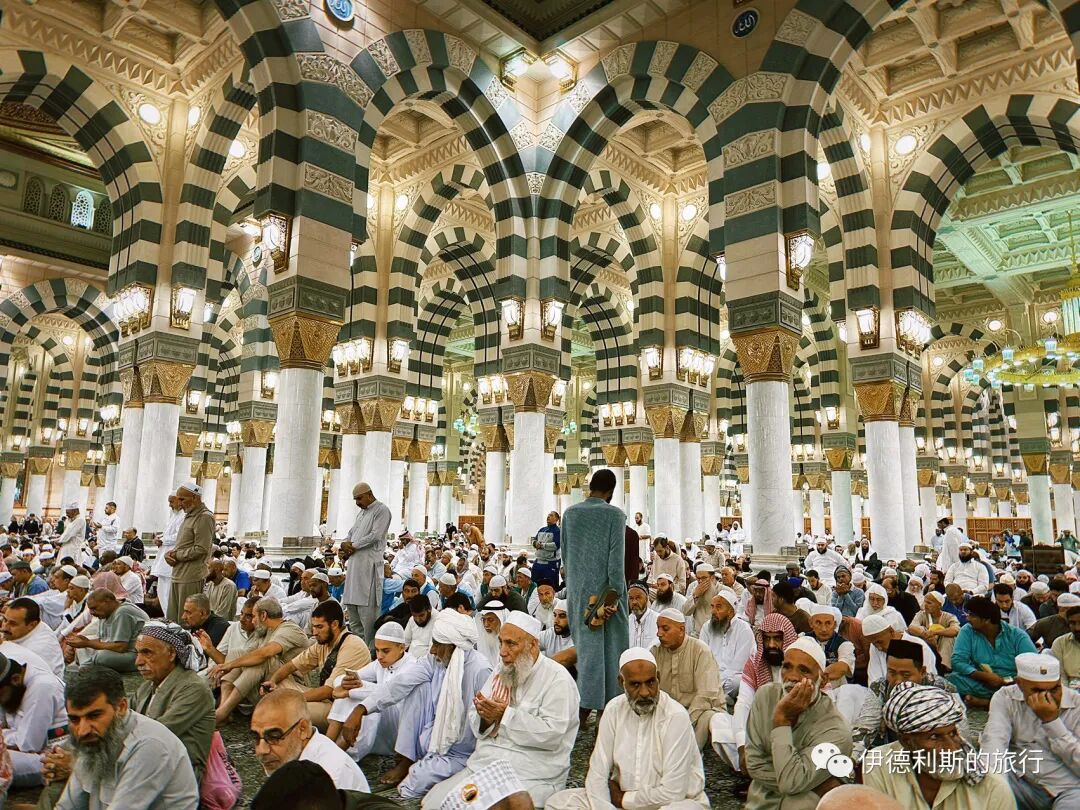
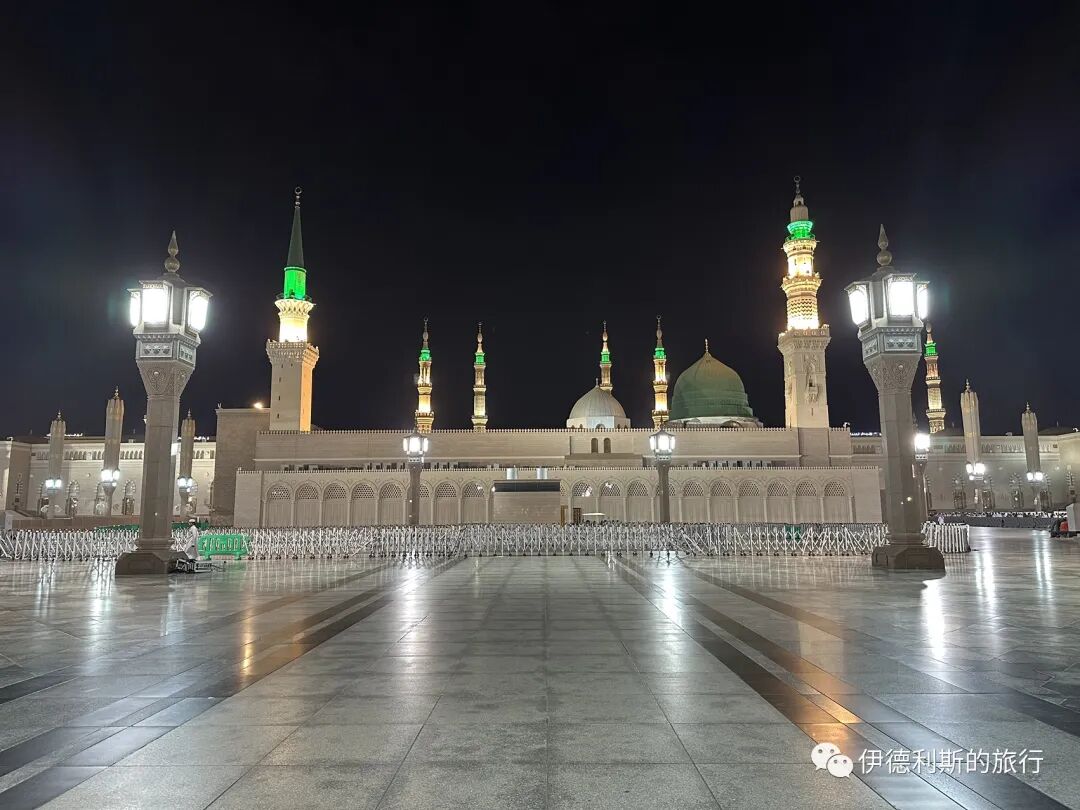
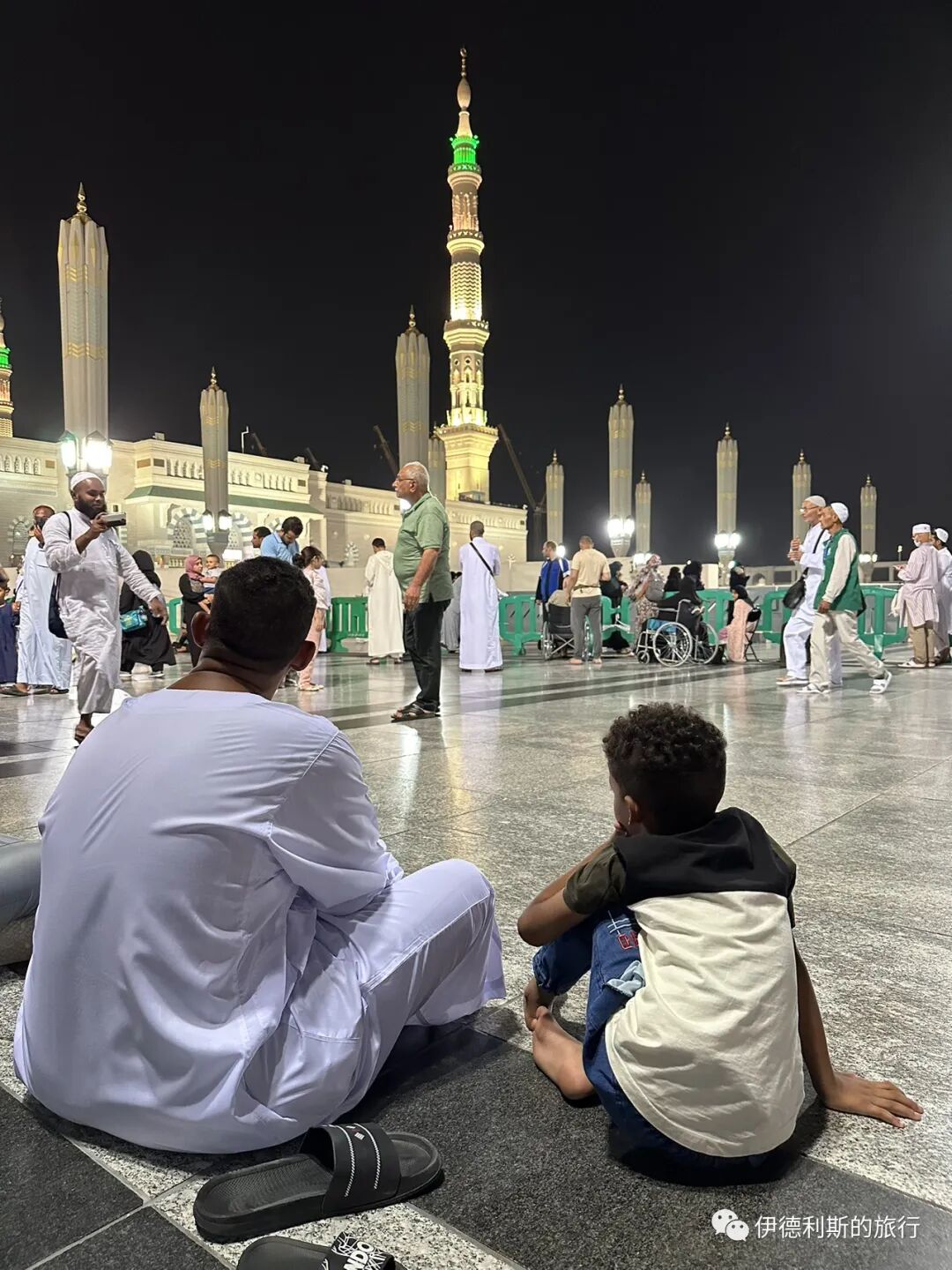
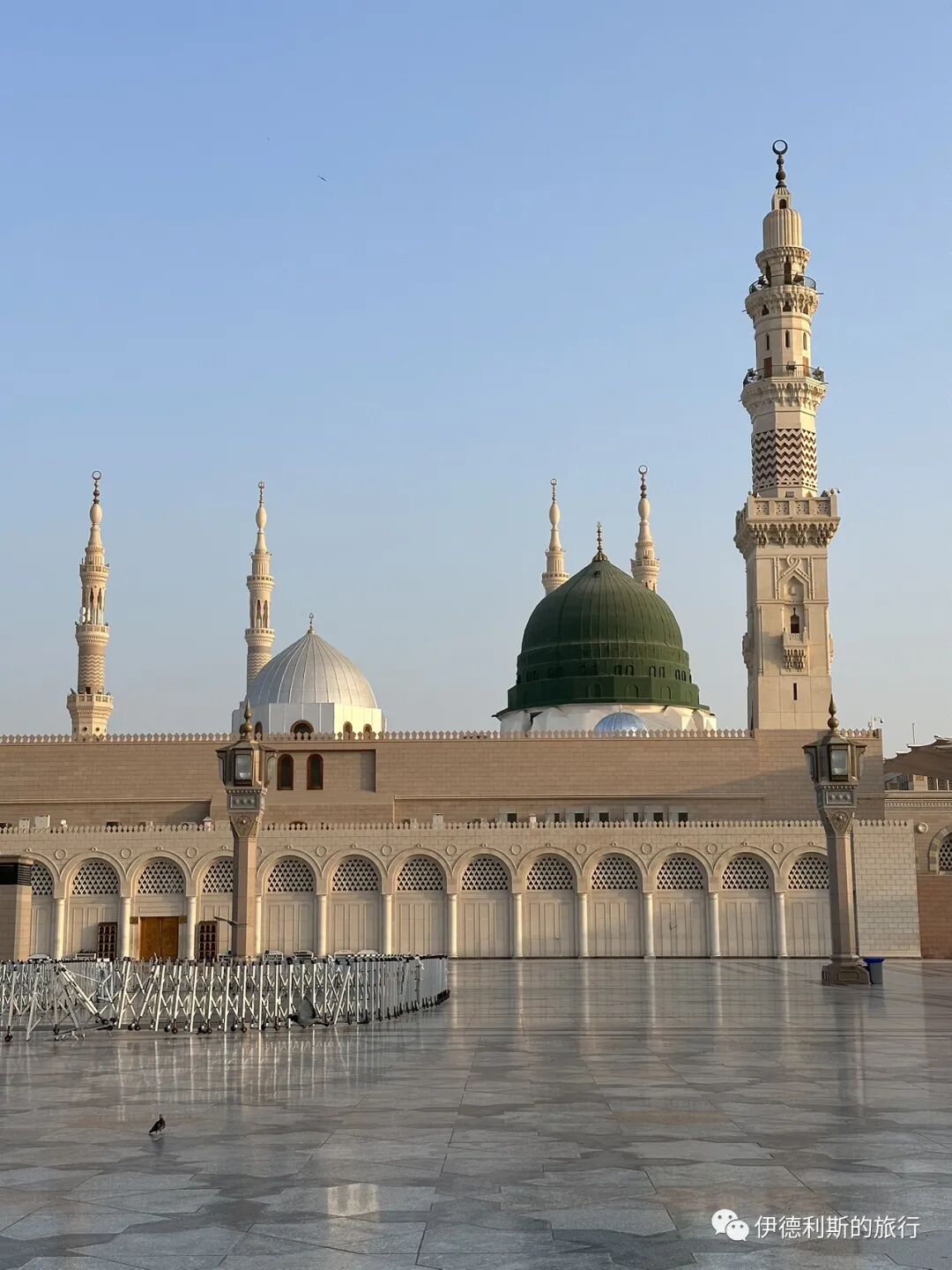
I prayed Maghrib at the mosque, but it was so crowded that the core area was full and closed off half an hour before the adhan. I barely found a spot in a small courtyard on the north side of the core area. The sunshades were open there during the day, so I was not in the sun. From here, you can clearly see the difference between the Ottoman core and the Saudi expansion. The Ottoman area is lower with painted domes on top, while the Saudi area is taller with a flat roof.
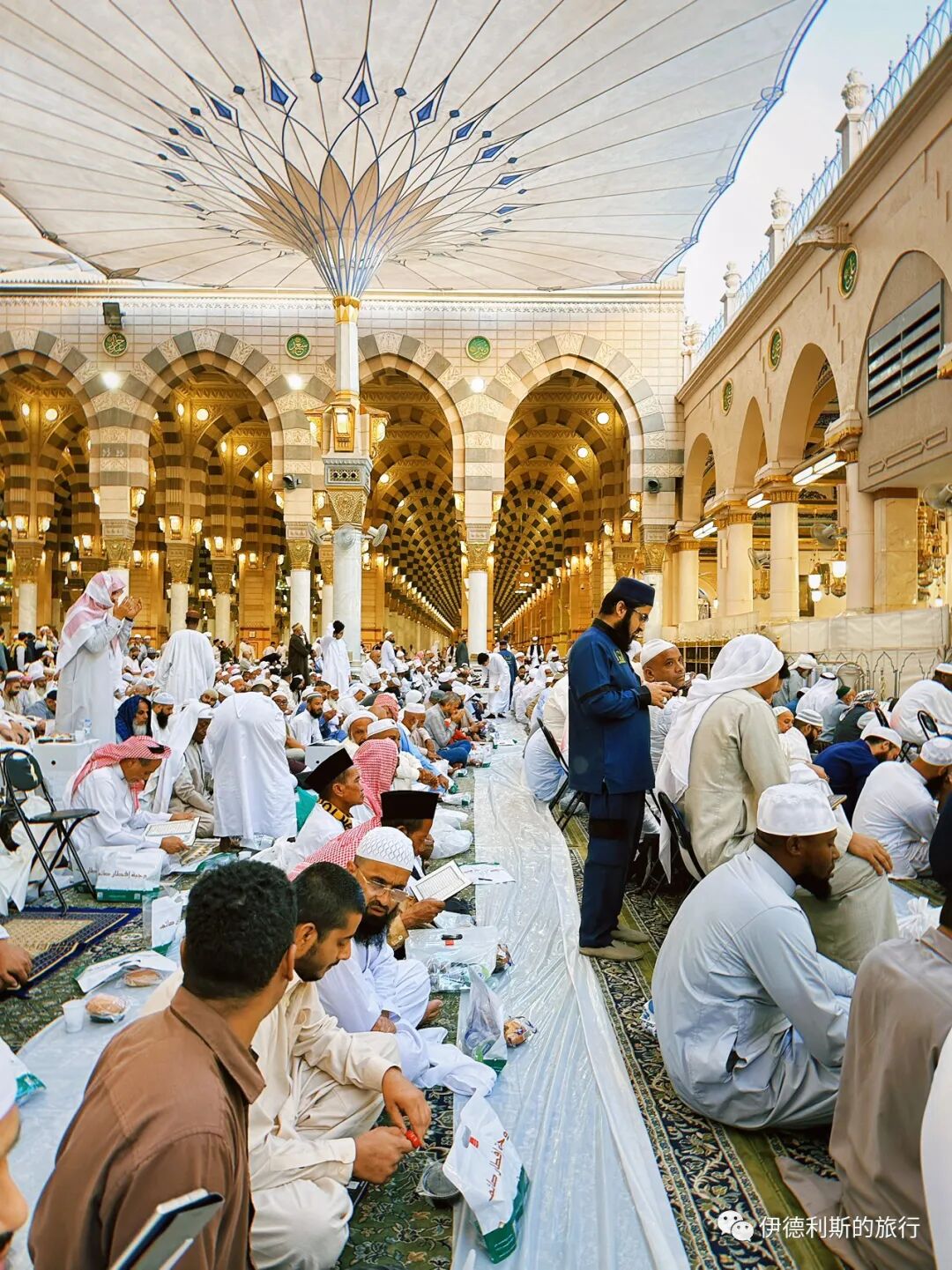
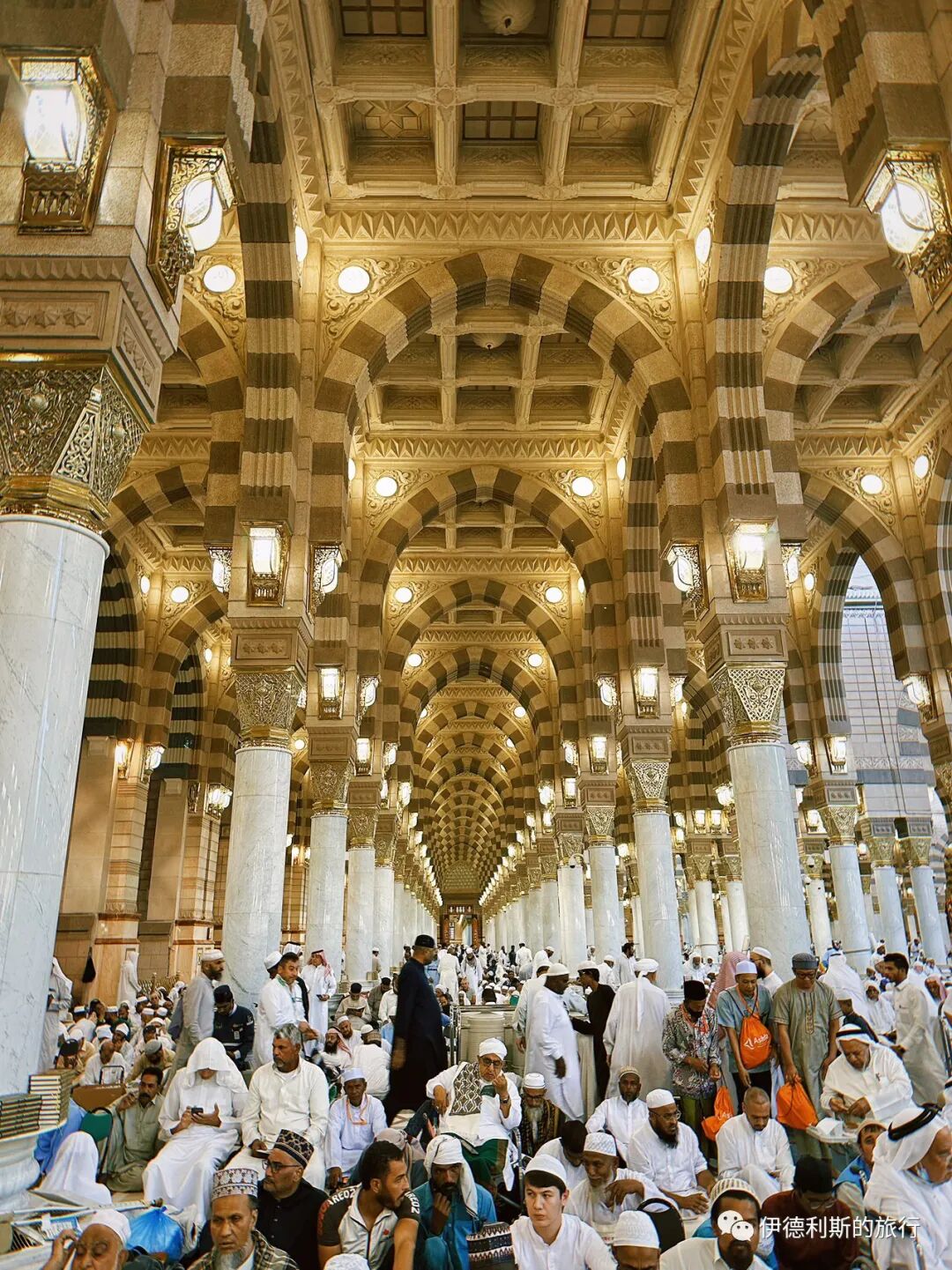
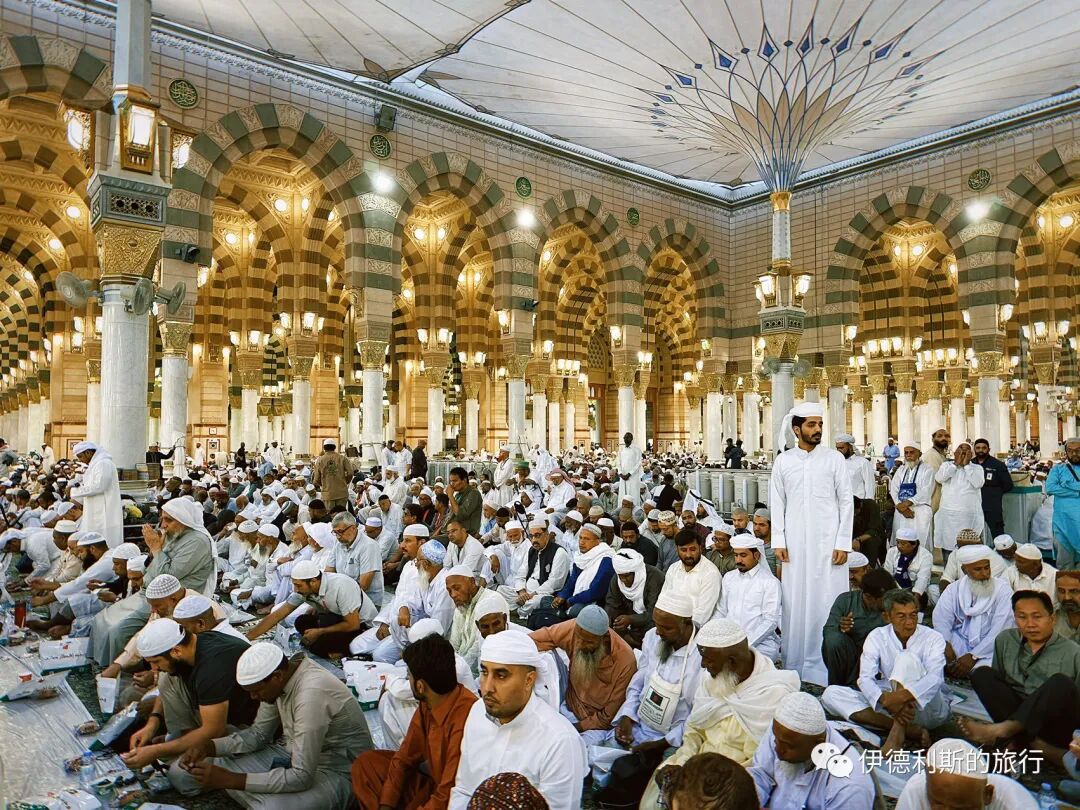
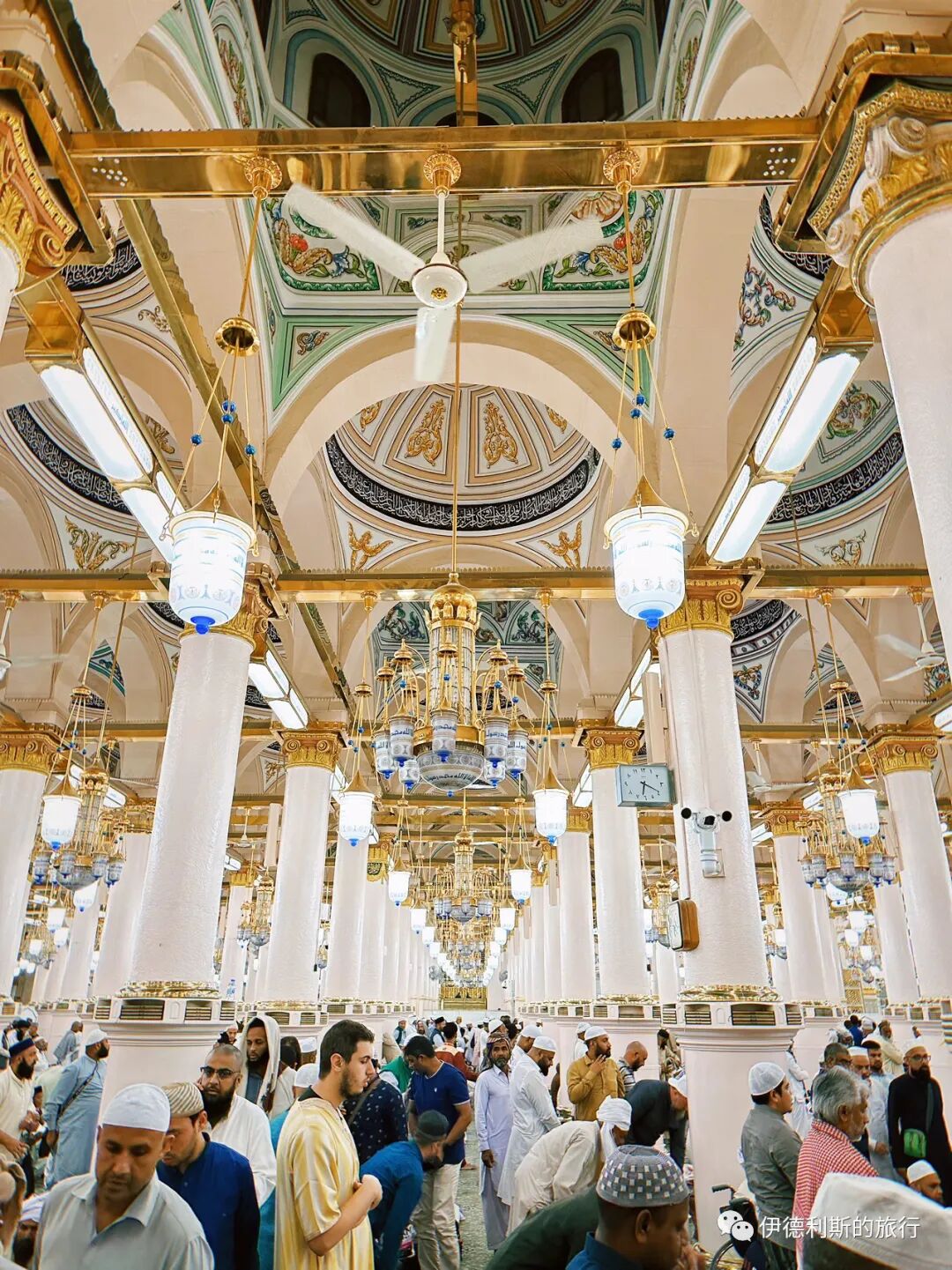
I was very grateful to receive water, dates, and yogurt handed out in the mosque. You can really find dates everywhere here.
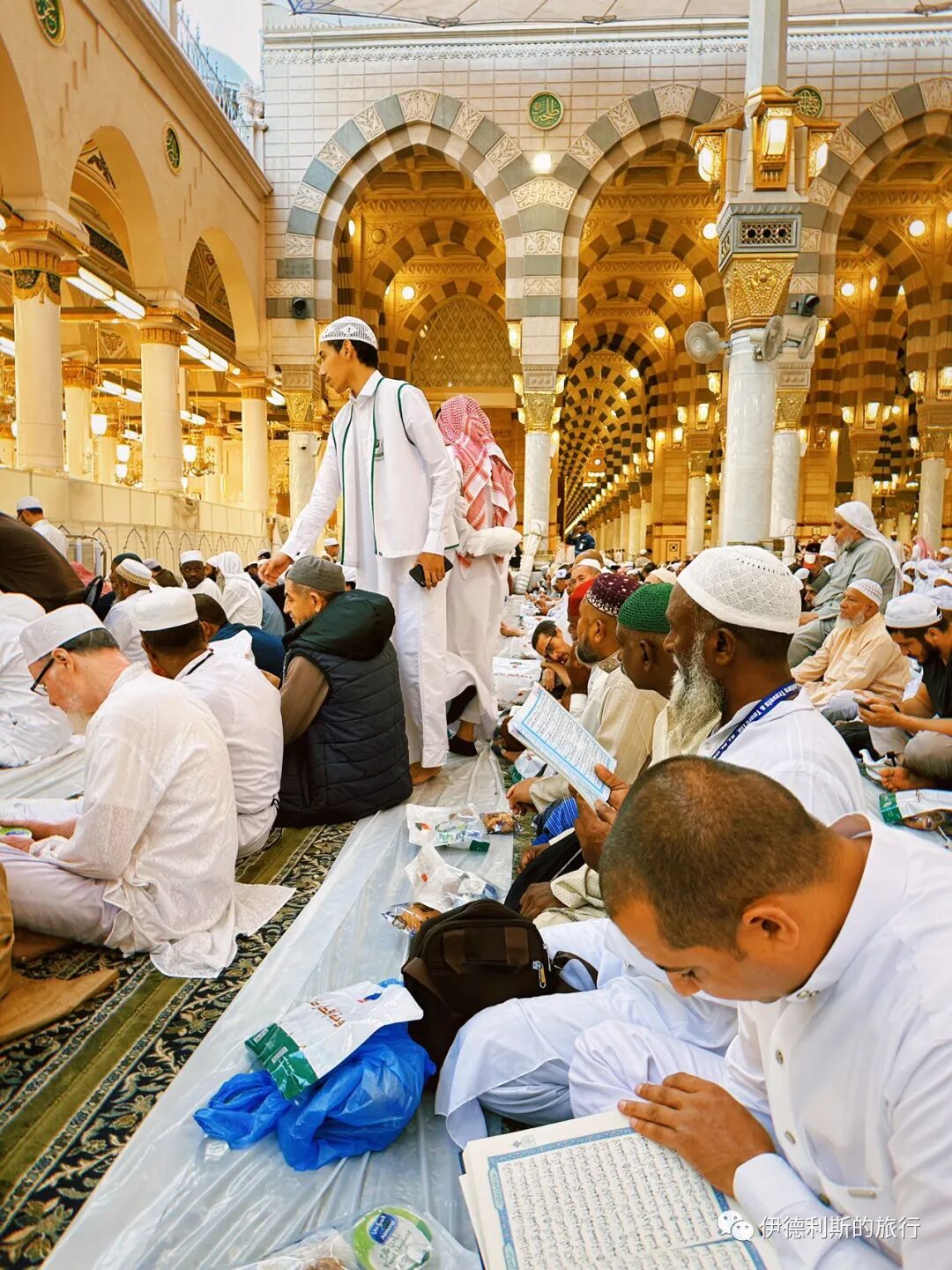
On the square on the west side of the mosque is the site of the famous Saqifa event. After the Prophet passed away in 632 AD, some of his companions gathered at the Saqifa (a covered meeting place) of the Bani Sa'idah tribe. They pledged allegiance to Abu Bakr, making him the successor to the Prophet and the first Caliph.
There is almost no record of the later history of the Saqifa, only that a man named Ali Pasha built a structure there during the Ottoman period in 1620. In the 20th century, this was a park, but by the time I visited, the park had been demolished and reconstruction work was underway.
Banda later went to the Al-Baqi cemetery on the east side of the Prophet's Mosque to visit the graves of the Prophet's family and friends. When the Prophet arrived in Medina in 622 AD, this land was covered in Arabian boxthorn (gharqad). The Prophet led everyone to clear the thorns and opened this place as a Muslim cemetery.
The Prophet's family members buried in the cemetery include his wet nurse, most of his wives, his cousin, his children, his uncle, and the wife and descendants of Caliph Ali. Because four Shia Imams are buried here, it has become a famous holy site for Shia Muslims.
Historically, the Al-Baqi cemetery had many domed structures (gongbei), but they were demolished twice by the Wahhabis in 1806 and 1926. Because the Wahhabis consider marking graves to be heresy, even the tombstones with writing on them in the cemetery were completely destroyed. The demolition of Al-Baqi cemetery drew criticism and protests from both Sunni and Shia Muslims. Many Shia Muslims consider the day of the demolition, the 11th of Shawwal in 1926, a 'Day of Sorrow' and hold memorial events every year. To this day, the Saudi authorities ignore all criticism and have blocked many paths in the cemetery, making it difficult for people to visit the graves.
The area with the blue boards in the distance is the grave of Caliph Uthman, and the path leading to it has been blocked. On June 17, 656 AD, Caliph Uthman was assassinated by rebels in his home. Because the rebels would not allow Uthman to be buried in Al-Baqi cemetery, he had to be buried in the Jewish cemetery right next to it on the north side. Decades later, the rulers of the Umayyad Caliphate tore down the walls between the two cemeteries and included Uthman's grave within Al-Baqi cemetery.
In the distance are the graves of the Prophet's wet nurse Halima, and two companions of the Prophet born in Medina, Sa'd ibn Mu'adh and Saʽid al-Khudri, which are also impossible to approach. Sa'd was the leader of the Banu Aws tribe. He was seriously wounded in the Battle of the Trench in 627 and passed away shortly after returning to Medina. Sa'd was a noble companion recognized for his close relationship with the Prophet, and the Prophet continued to praise him after he passed away.
Abu Sa'id al-Khudri lived his whole life in Medina and reportedly fought in the Battle of al-Harra in 683, where the people of Medina stood against the Umayyad Caliphate. Abu Sa'id narrated 1,170 hadiths, making him the seventh most prolific narrator among the companions of the Prophet.
The tomb of the Martyrs of al-Harra. The people of Medina opposed the hereditary rule and policies of the Umayyad Caliphate, so they started a war on August 26, 683. They were quickly defeated, and the Umayyad army looted the city of Medina.
The grave of Ibrahim ibn Muhammad, the young son of the Prophet. Ibrahim died of illness at only two years old, and the Prophet was deeply saddened. The Prophet led Ibrahim's funeral prayer and buried him in the Baqi cemetery. He filled the grave with sand, sprinkled some water on it, and placed a marker.
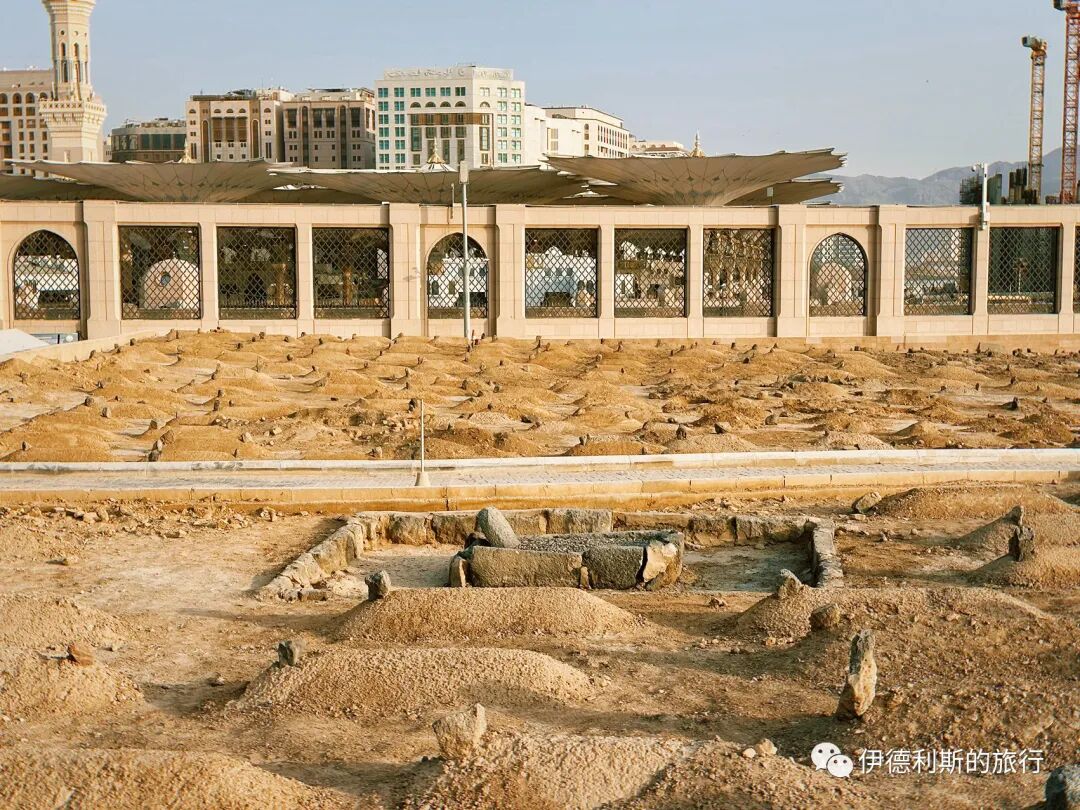
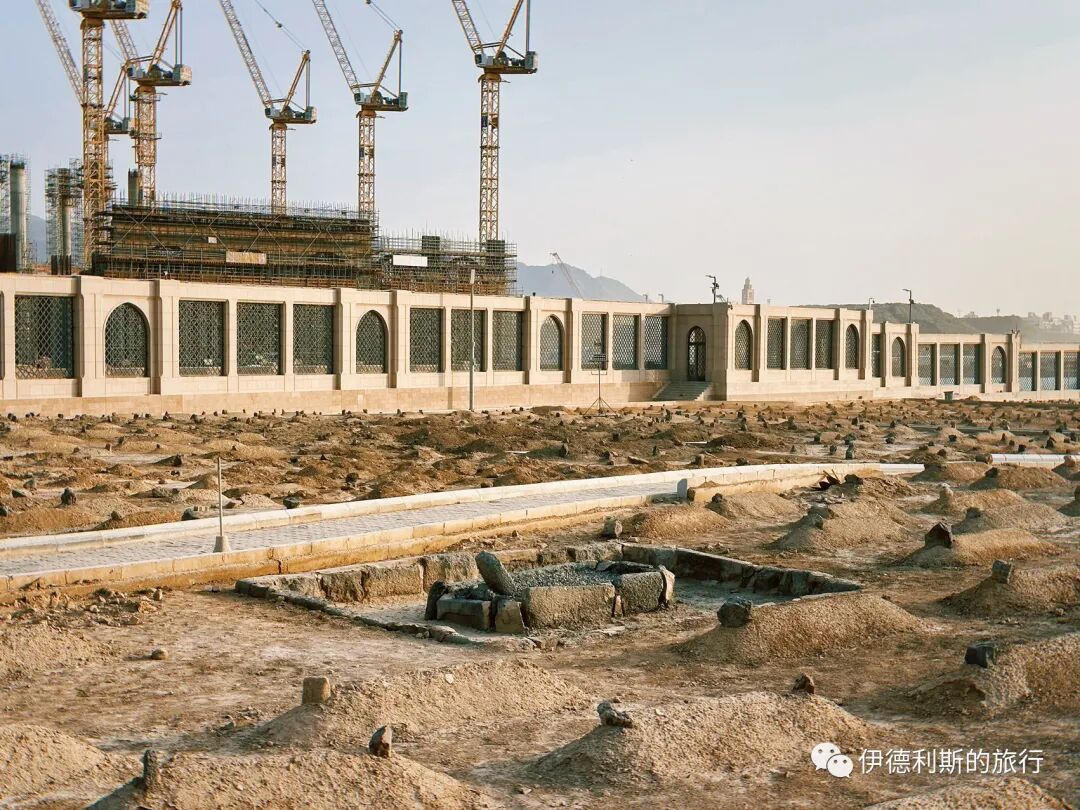
The graves of the 8th-century jurist Malik ibn Anas (711-795) and the Quran reciter Nafiʽ al-Madani (689-785). Imam Malik founded the Maliki school, one of the four major Sunni schools of Islamic law. The Maliki school places great importance on hadiths and is currently found mostly in North Africa, outside of Egypt. After Malik passed away in Medina in 795, the Abbasid governor of Mecca led his funeral prayer.
Nafiʽ al-Madani was originally from Isfahan, but he was born and passed away in Medina. His method of reciting the Quran is the most common style used in North and West Africa today.
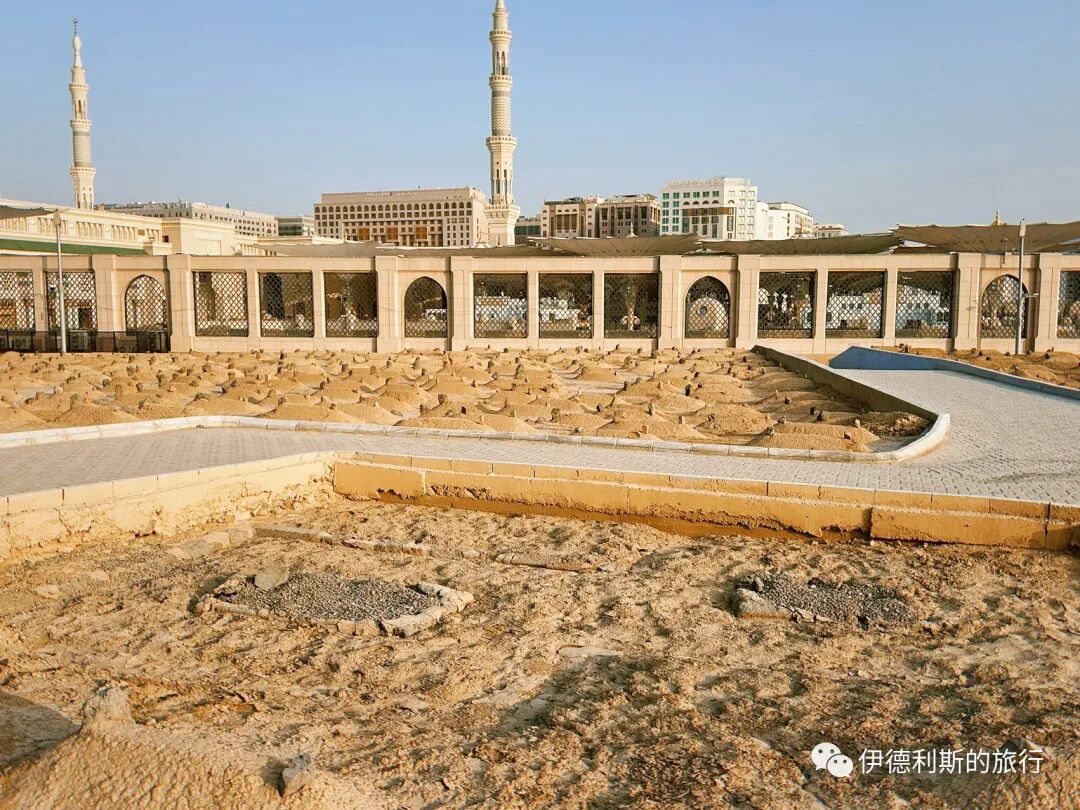
The two nearby graves belong to the Prophet's cousin Aqil ibn Abi Talib and his nephew Abd Allah ibn Ja'far. Aqil was the older brother of Caliph Ali. He fought against the Prophet in the early days but converted to Islam a few years before the Prophet passed away, and he appears in many hadiths.
Abd Allah settled in Medina with his family in 628, and the Prophet once said that his appearance and character were similar to his own. Abdullah Allah was one of the wealthiest men in Medina at the time and a famous philanthropist.
In the distance are the graves of several of the Prophet's wives, including Sawda, Aisha, Hafsa, Zaynab, Umm Salama, Safiyya, Umm Habiba, and Maria. Security guards watch over the graves of the Prophet's wives and do not allow anyone to get close or linger.
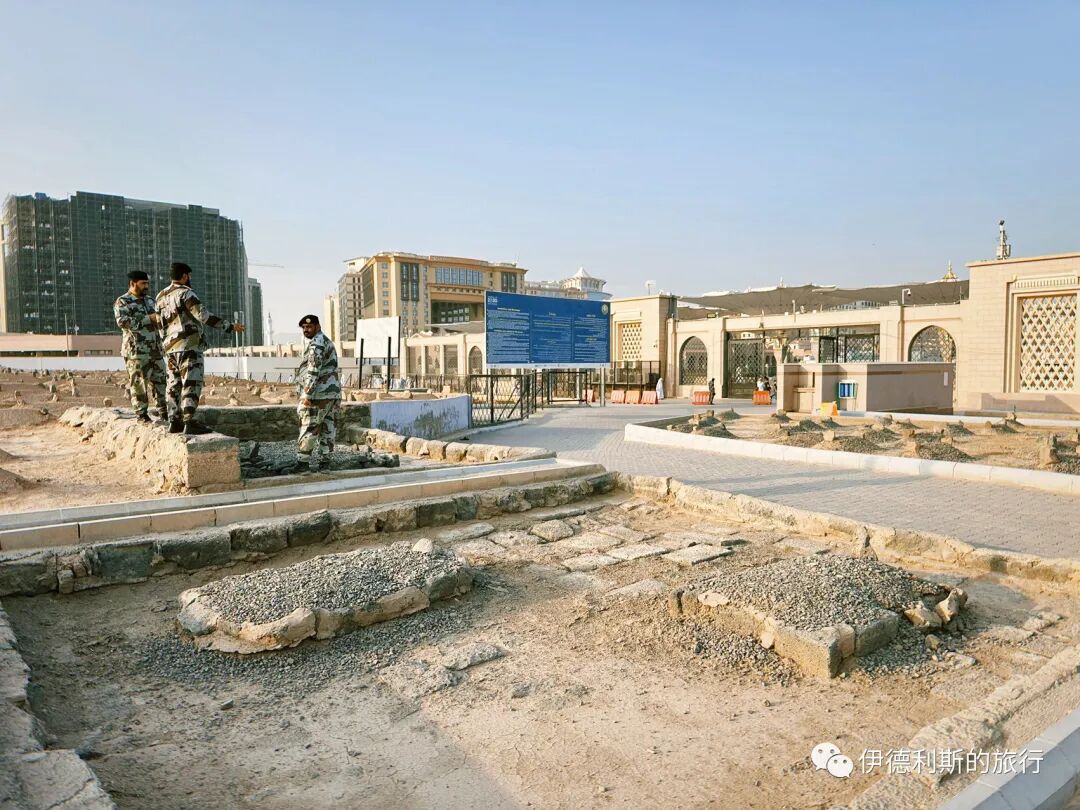
Behind the iron fence in the distance are the graves of several of the Prophet's daughters, and further away are the graves of his daughter Fatima (though this is disputed), his uncle Abbas, and four Shia imams: Hasan, Ali Zayn al-Abidin, Muhammad al-Baqir, and Jafar al-Sadiq. A tall dome (gongbei) once stood over the graves of the four Shia imams, serving as the most prominent landmark in the entire Baqi cemetery, but it was destroyed by the Wahhabis twice, in 1806 and 1926.
Al-Ghamama Mosque is located southwest of the Prophet's Mosque, on the site where the Prophet led the Eid al-Fitr prayer in 631. Ghamama means cloud. People say the Prophet once performed a prayer for rain here, and then clouds covered the entire city. Al-Ghamama Mosque was first built during the reign of the eighth Umayyad Caliph, Umar ibn Abd al-Aziz (reigned 717-720). It was renovated in 1340 and 1622, and in 1859, Ottoman Sultan Abdulmejid I (reigned 1839-1861) rebuilt it into the black volcanic basalt structure seen today. It is currently one of the very few mosques in Medina that retains its Ottoman-era appearance.
Abu Bakr As-Siddiq Mosque is located next to Al-Ghamama Mosque, also on the site where the Prophet led the Eid al-Fitr prayer in 631. It is named after Caliph Abu Bakr, who continued to lead the Eid al-Fitr prayer there. The current mosque was built in 1838 as a black volcanic basalt structure by order of Ottoman Sultan Mahmud II (reigned 1808-1839), and the Sultan's tughra (calligraphic emblem) is still at the entrance. Because it is small and very close to the Prophet's Mosque, Friday prayers (Jumu'ah) are not held here.
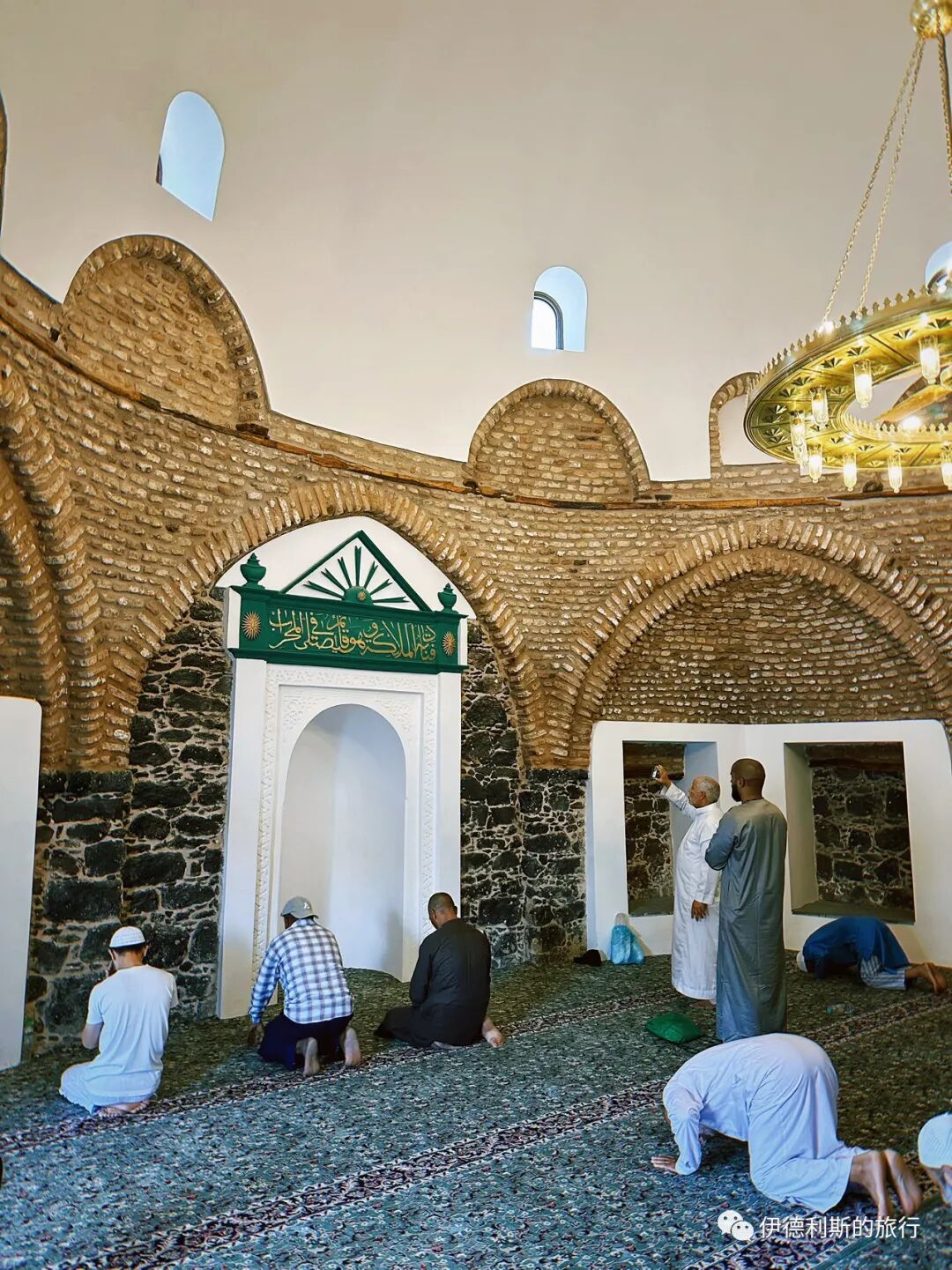
The Medina Hejaz Railway Station was built in 1908 and is an important historical site of the Hejaz Railway constructed by the Ottoman Empire. For thousands of years, the Hejaz region, where Mecca and Medina are located, relied on camel caravans for transport, which had a high mortality rate when crossing difficult mountainous terrain. After the 1860s, a railway construction boom began, and the Ottoman Empire started studying a rail line to connect Damascus with the two holy cities. This line was not only meant to make the Hajj pilgrimage more convenient but also held significant strategic importance. In 1900, the Ziraat Bankasi (Ottoman Agricultural Bank) provided the first loan of 100,000 liras, and construction of the Hejaz Railway officially began.
The construction of the Hejaz Railway faced many difficulties, including labor and resource issues while passing through uninhabited areas, bridge construction in desert terrain, and attacks by Arab tribes along the route. Fearing that the railway construction would ruin their livelihood based on pack animal transport, local Arab tribes organized in 1907 to threaten a work stoppage. The Ottoman Sultan eventually decided to end the railway at Medina. Under the supervision of chief engineer Mouktar Bey, the Hejaz Railway officially reached Medina on September 1, 1908, covering a total length of 1,300 kilometers.
However, less than 10 years after it began operating, the Ottoman Empire collapsed during World War I. The Hejaz Railway was officially abandoned in 1920 due to a lack of maintenance. People say the wreckage of trains destroyed during the Arab Revolt of 1916-1918 still rests where they fell a century ago.
In 2005, Saudi Arabia restored the tracks and sheds of the Medina station of the Hejaz Railway, and in 2006, it opened as the Hejaz Railway Museum. However, it is now closed again, and you can only view the exterior of the Medina station.
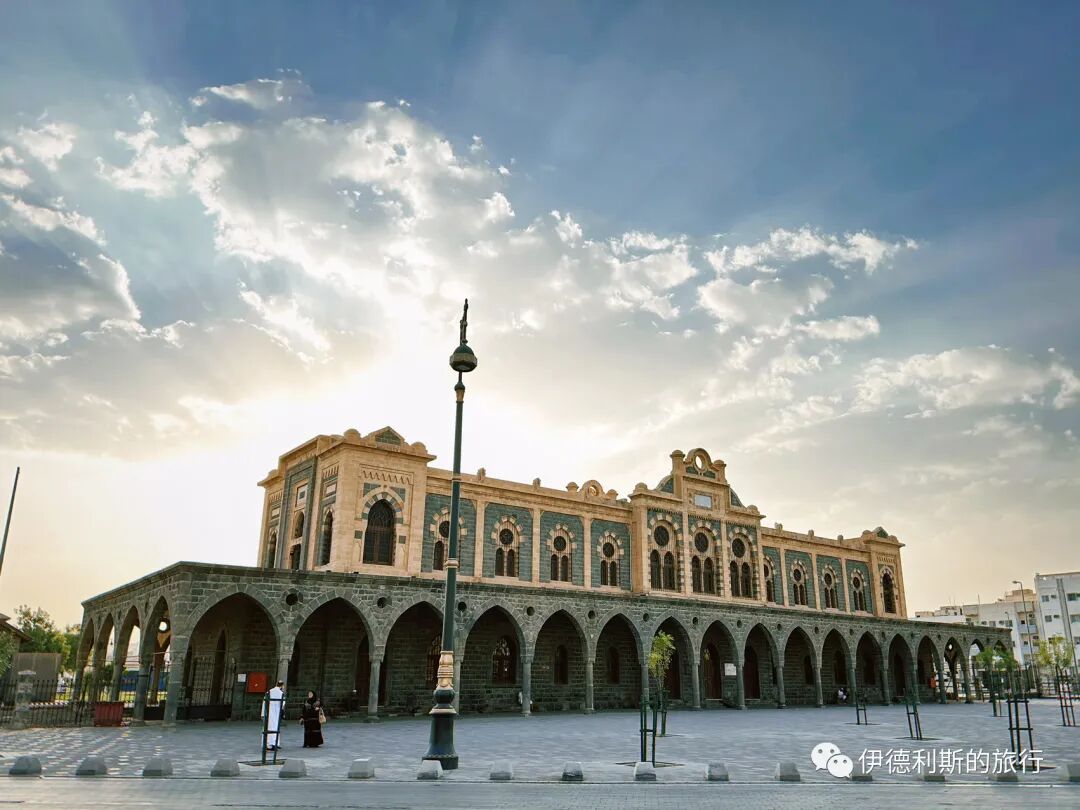
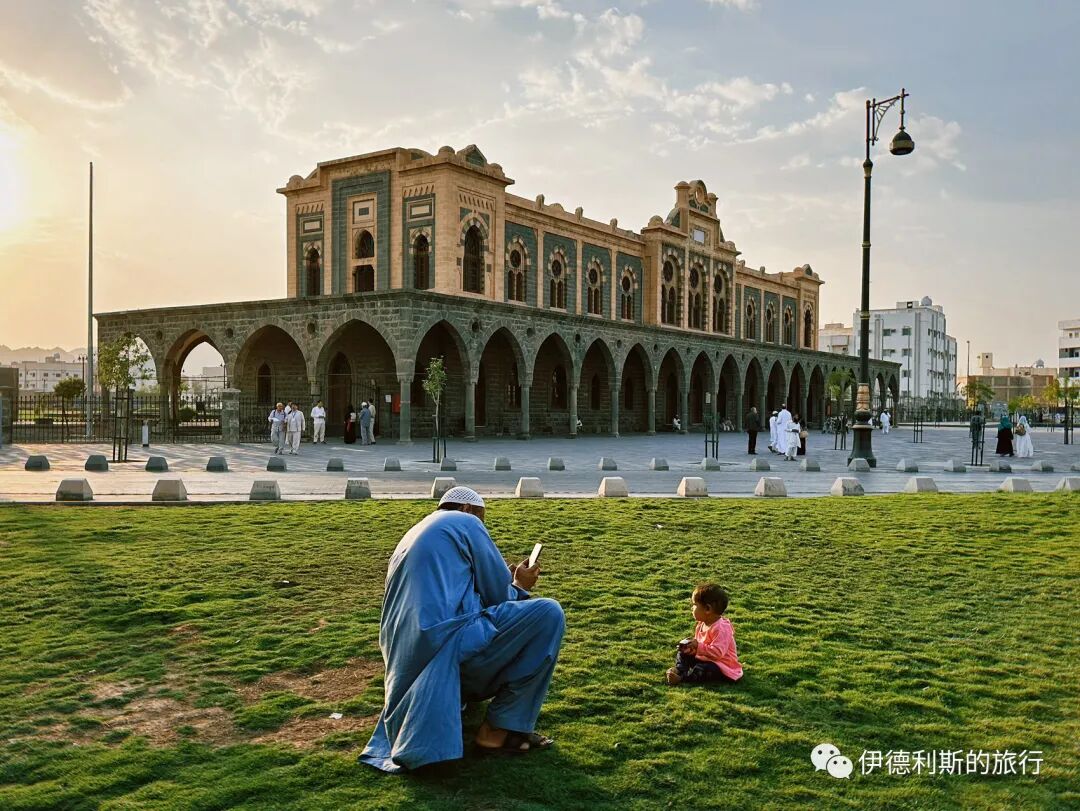
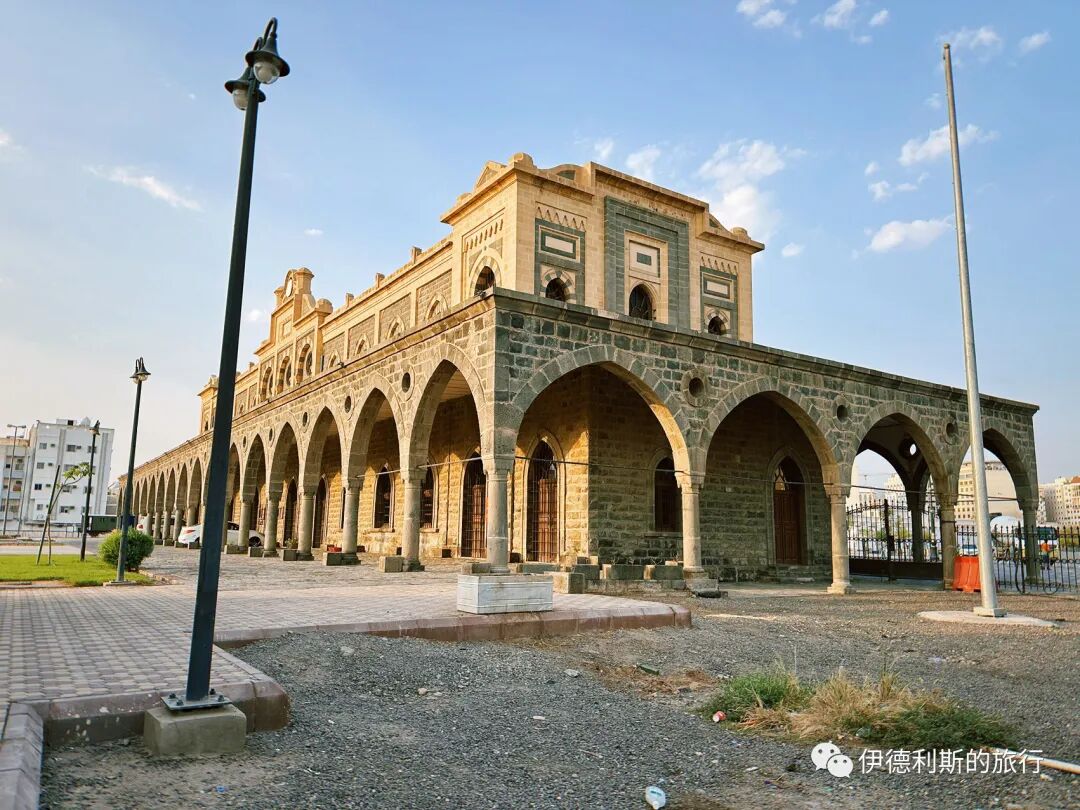
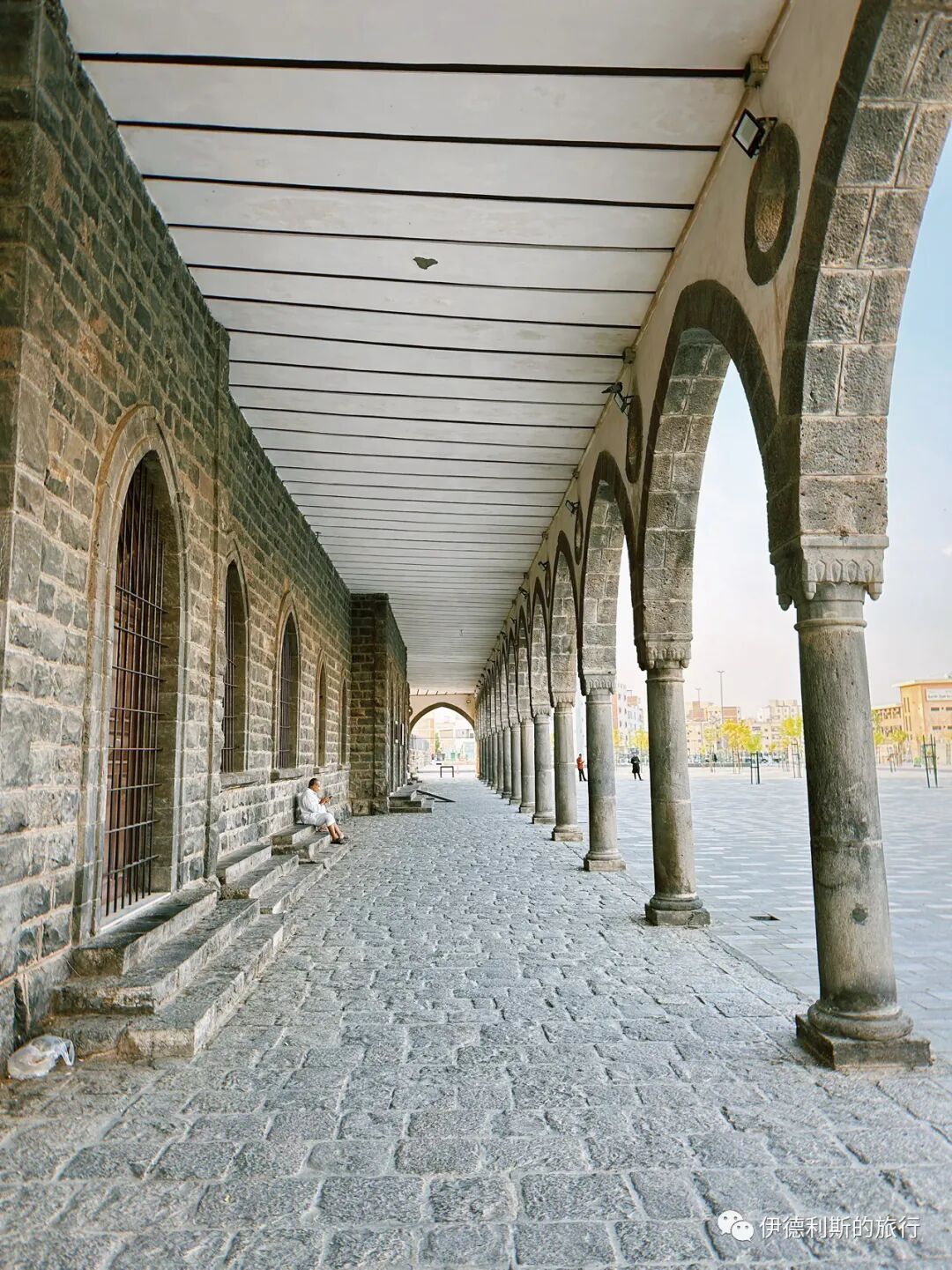
Near the Medina station of the Hejaz Railway are two black volcanic basalt mosques from the Ottoman period. Enclosed within the train station and inaccessible is the As-Saqiya Mosque. It is located where the Prophet inspected his troops before participating in the Battle of Badr in 624. It is said to be the place where the eighth chapter, seventh verse of the Quran was revealed, which is also the first chapter of the Quran revealed in Medina.
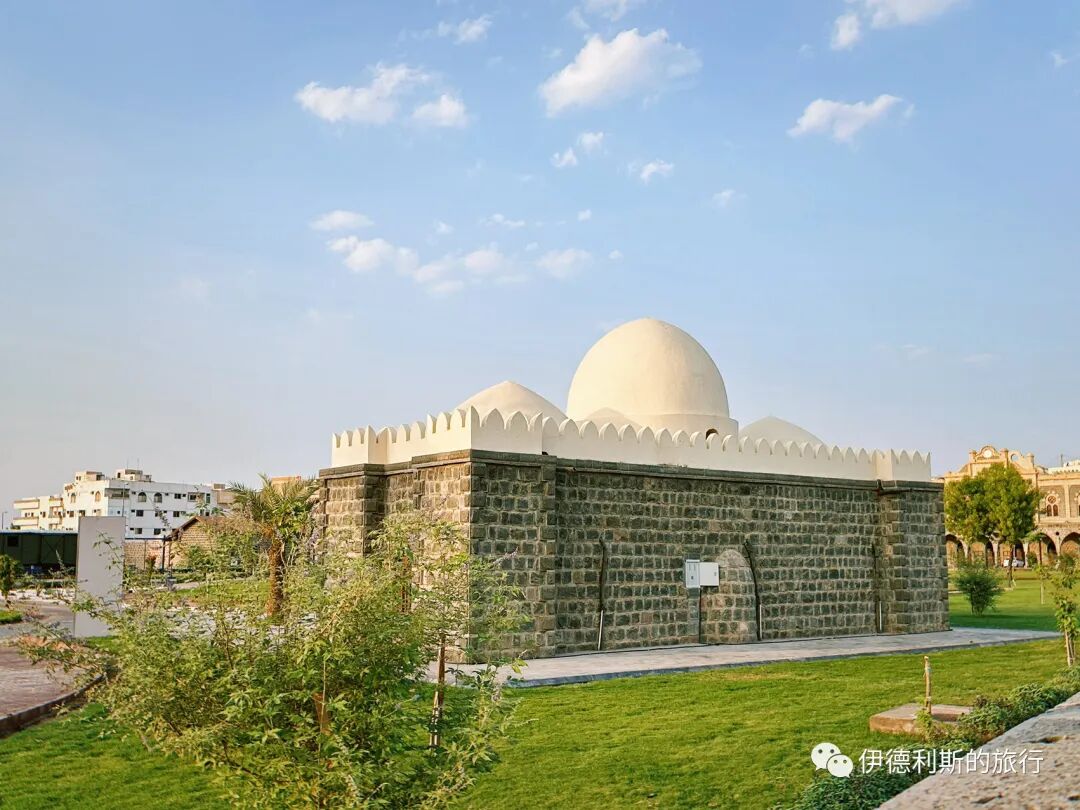
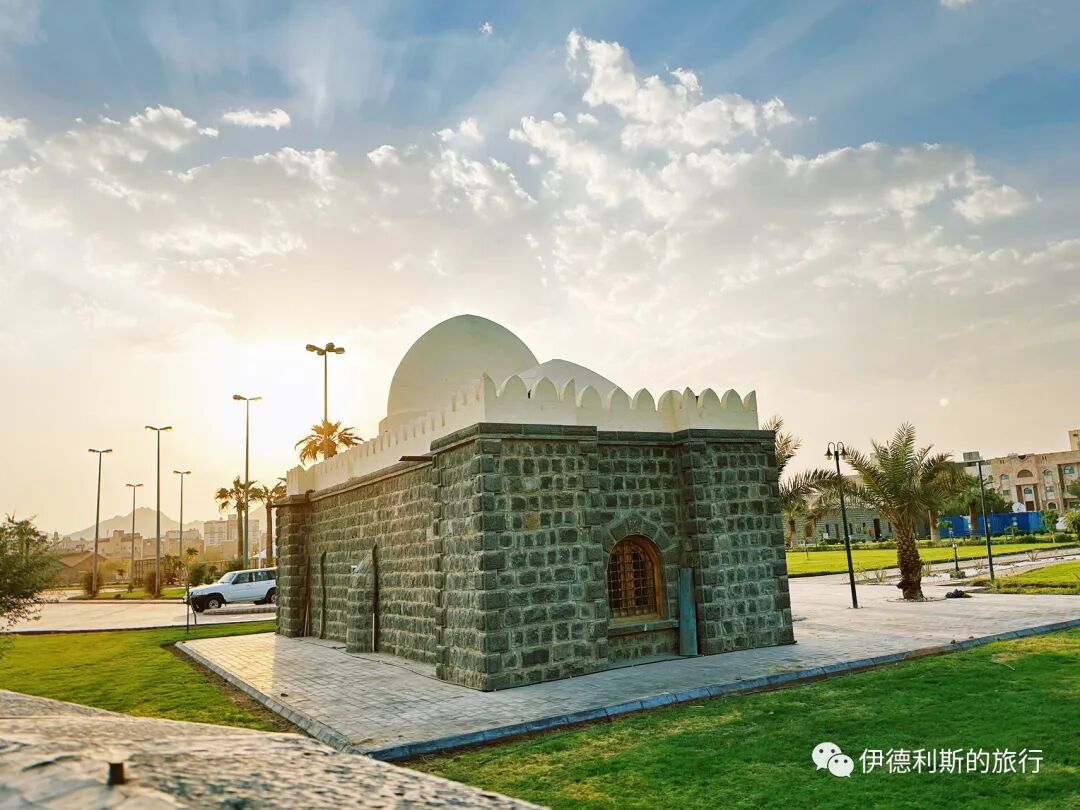
The Anbariya Mosque is a mosque built in 1908 by Ottoman Sultan Abdul Hamid II (reigned 1876-1909) for the Medina station of the Hejaz Railway. The architectural style follows the traditional Ottoman design, but it uses local hard basalt stone. There is no pulpit (minbar) in the main hall because Friday prayers (Jumu'ah) are not held here.
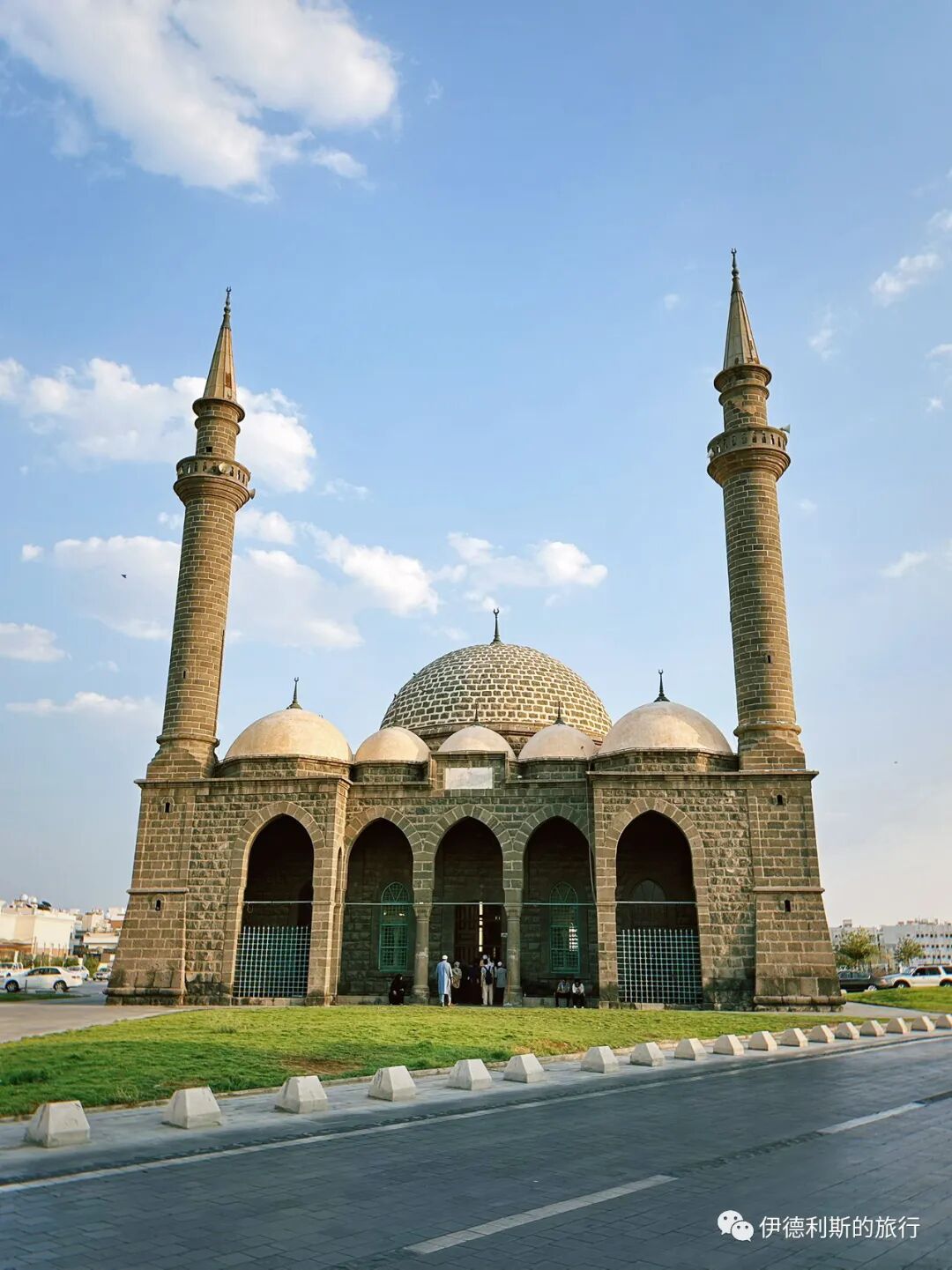
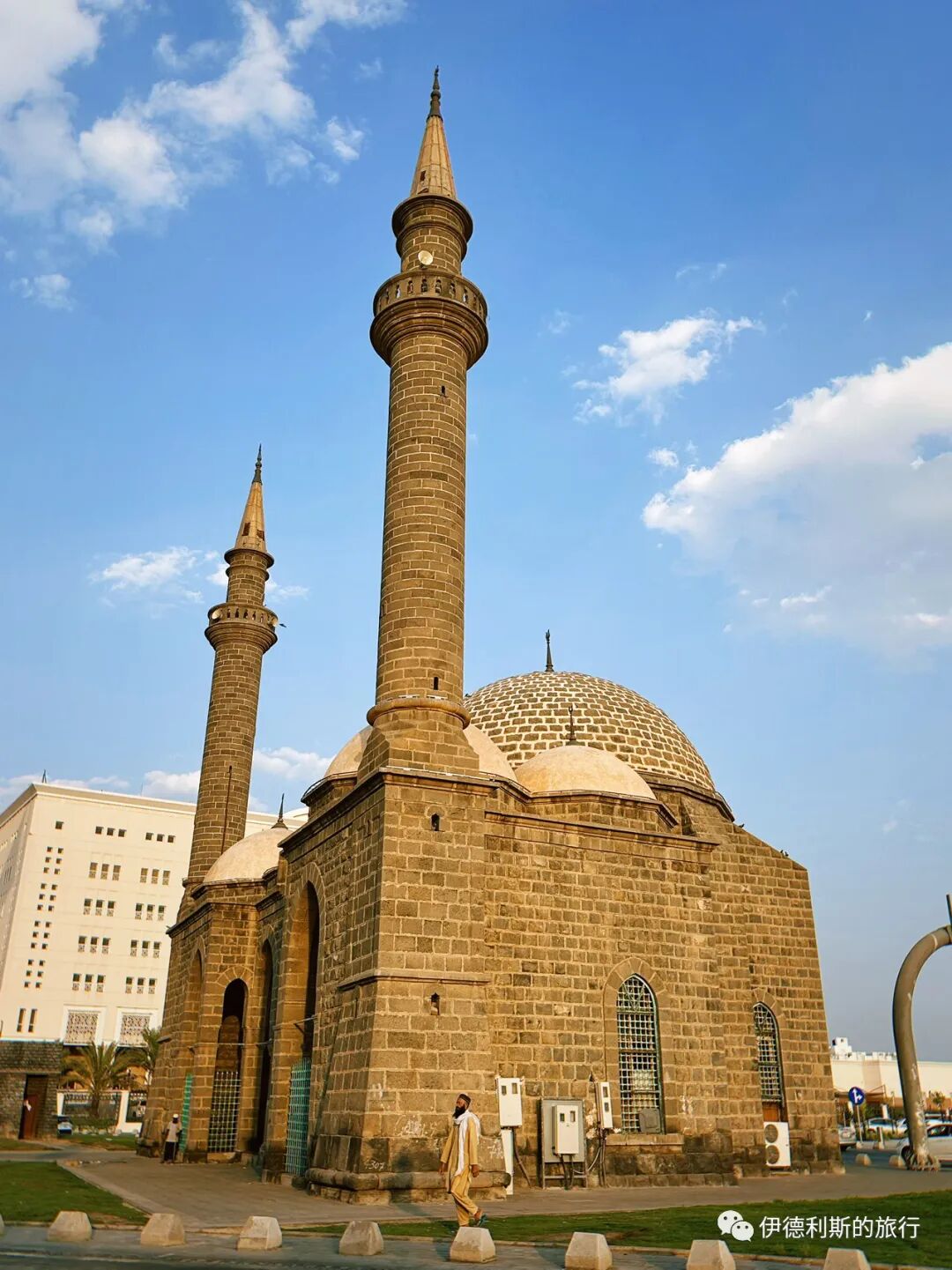
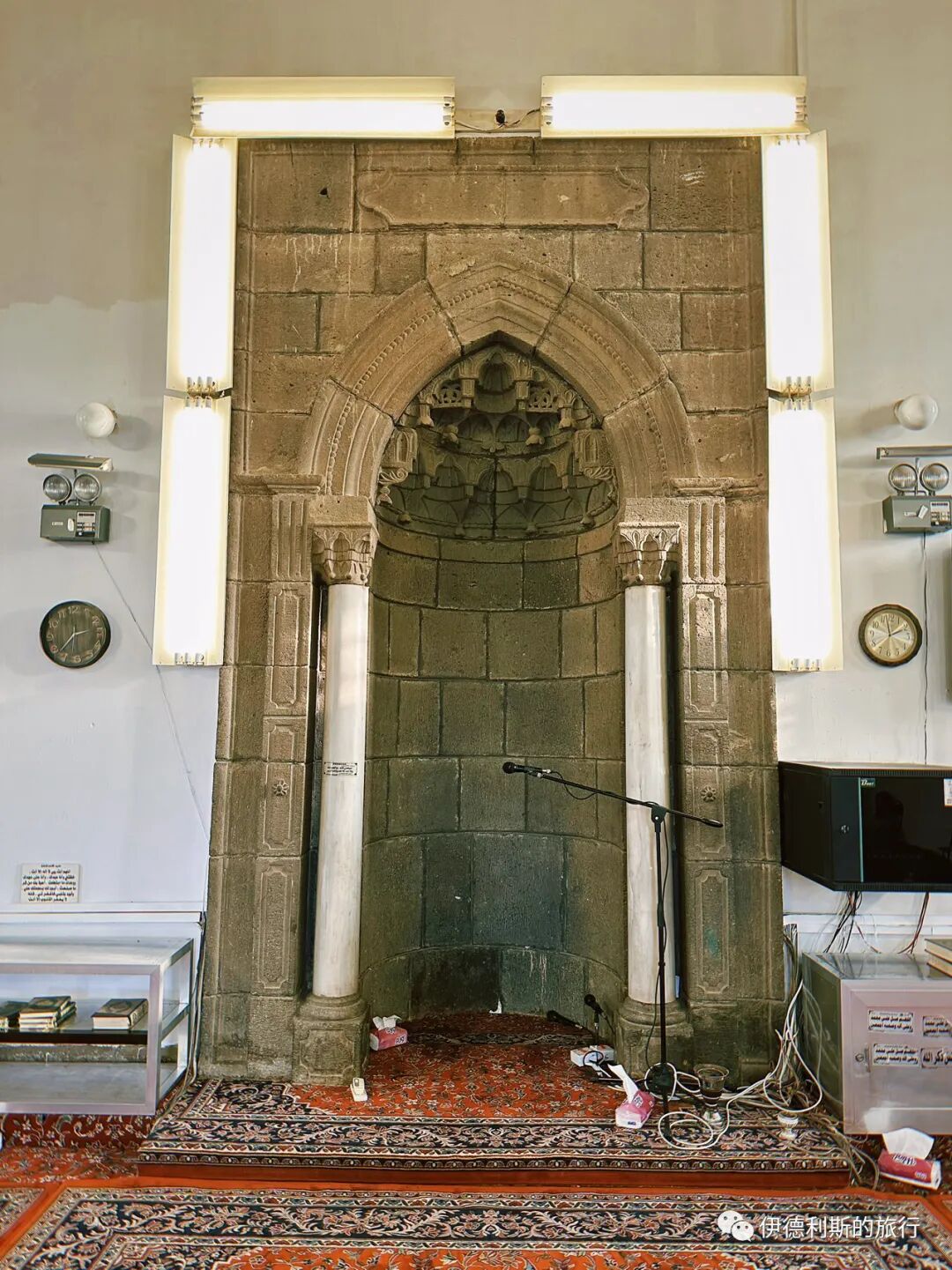
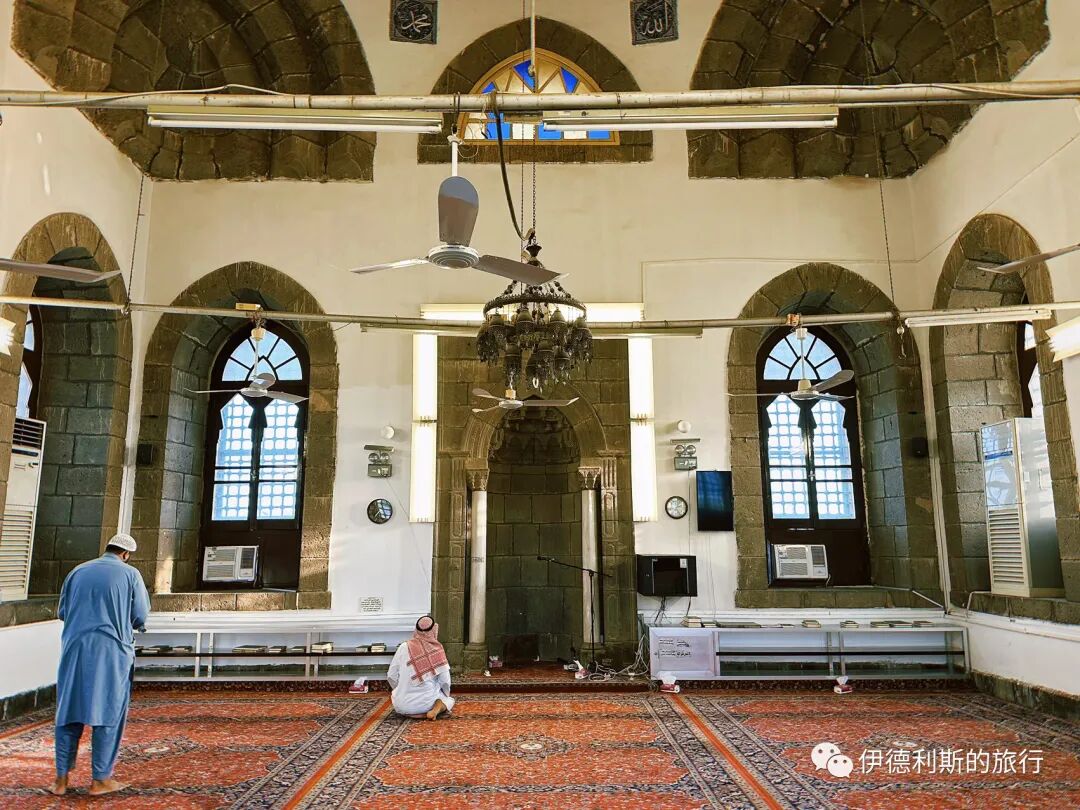
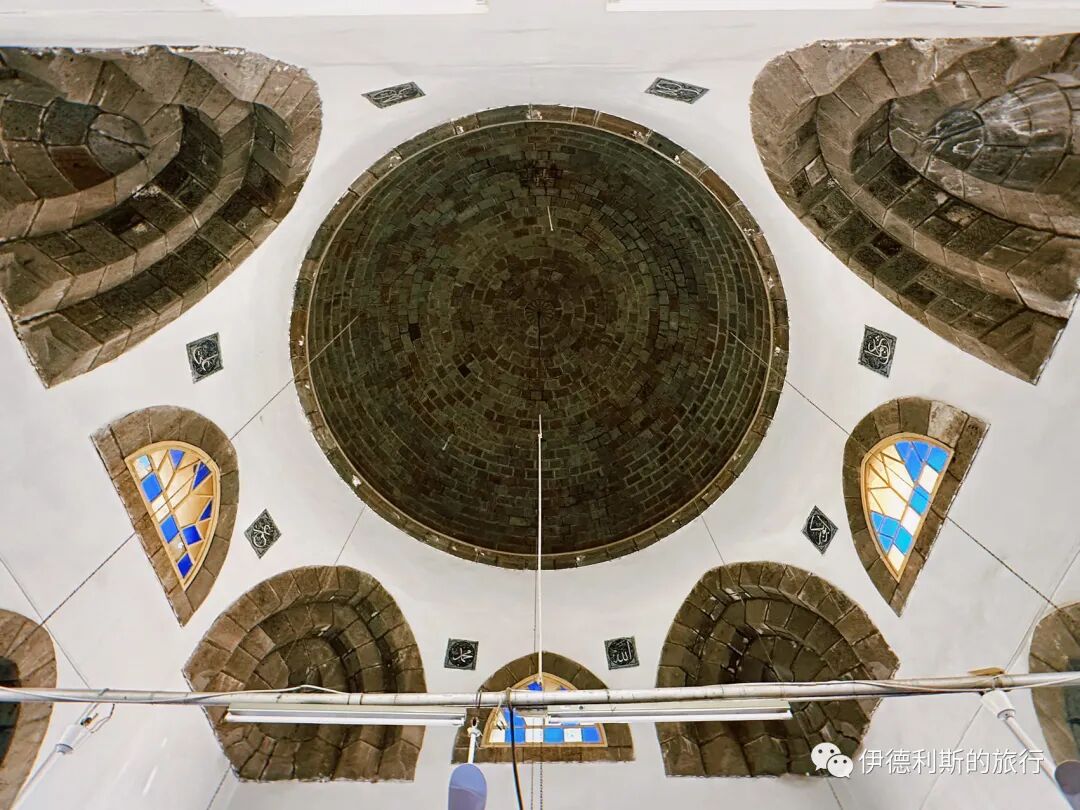
Quba Mosque is located in the southern suburbs of Medina. It was built by the Prophet after he migrated from Mecca to Medina in 622 and is the first mosque in the history of the faith. The Prophet often went to Quba Mosque to perform namaz during his lifetime, which is frequently mentioned in the Hadith. Sahl ibn Hunayf narrated that the Prophet said: 'Whoever leaves his house and comes to Quba Mosque and performs prayer in it, it is equal to performing an Umrah.' This makes it a place that Muslims from all over the world visit when they come to Medina.
Quba Mosque was originally just a circle of walls. It was expanded several times and rebuilt into its current structure in 1986. Today, Quba Mosque is surrounded by date palm orchards. Beside the mosque, there are people offering dates and black tea (hongcha) as a gesture of hospitality (dawa), and you can drink Zamzam water inside the mosque. It is a great place to rest while following the footsteps of the noble Prophet.
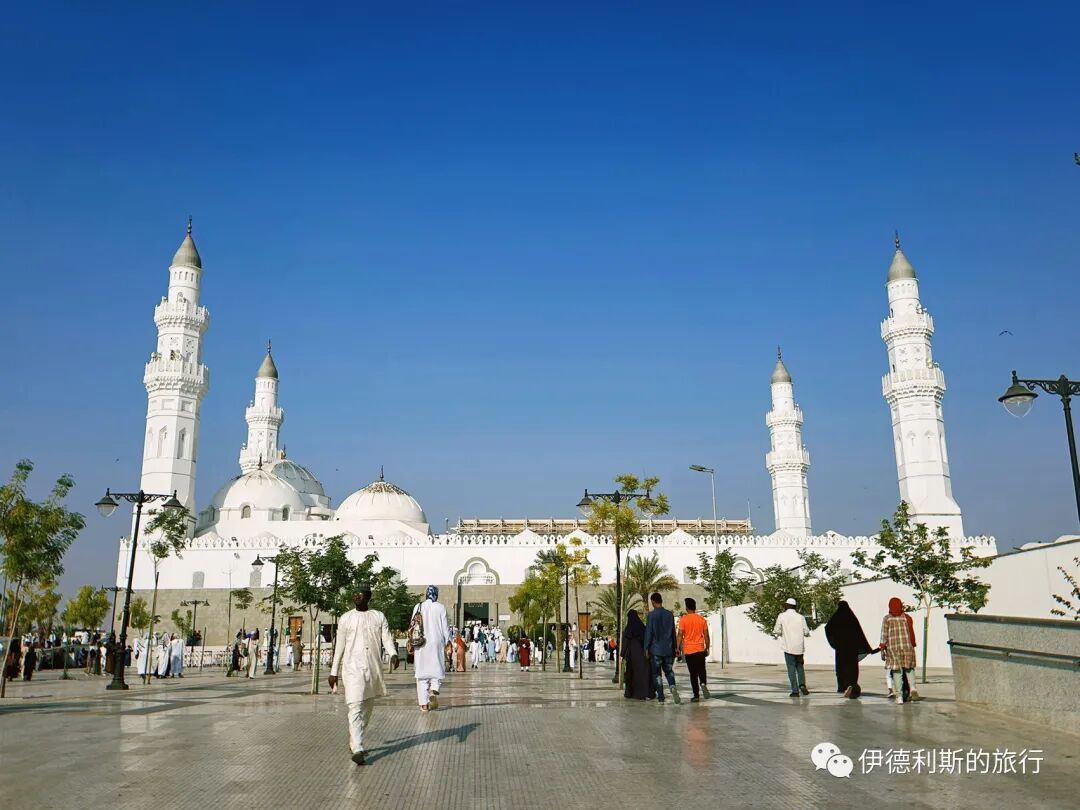
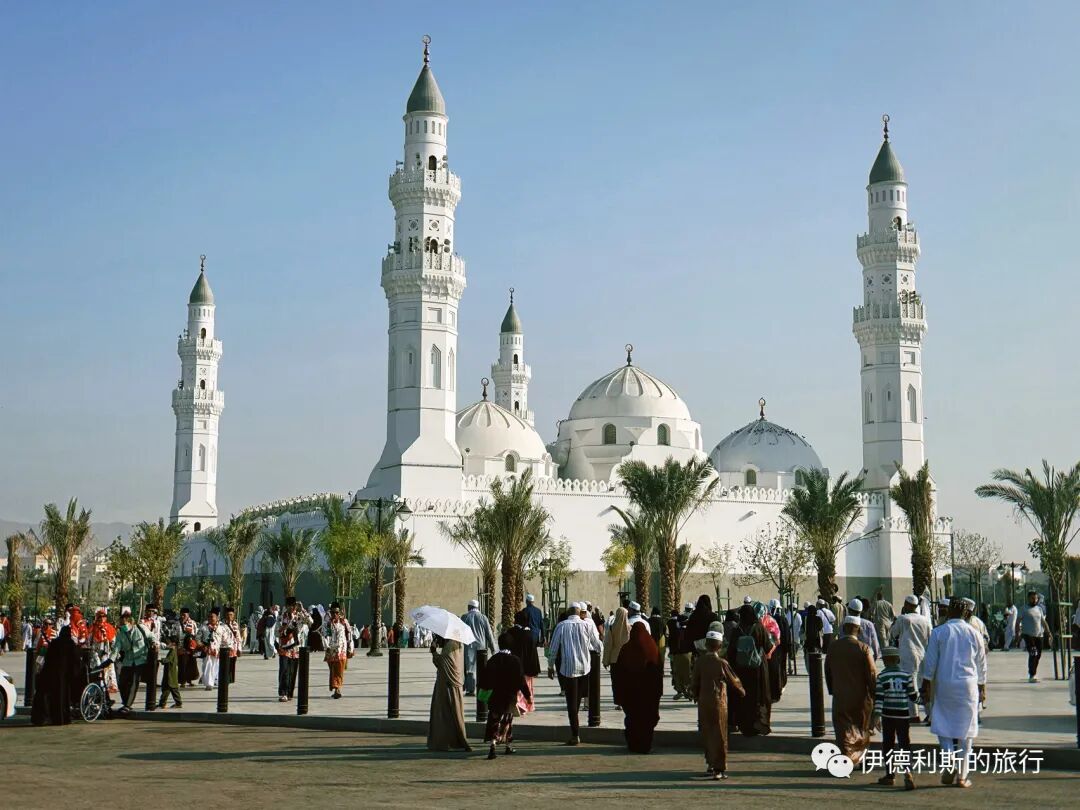
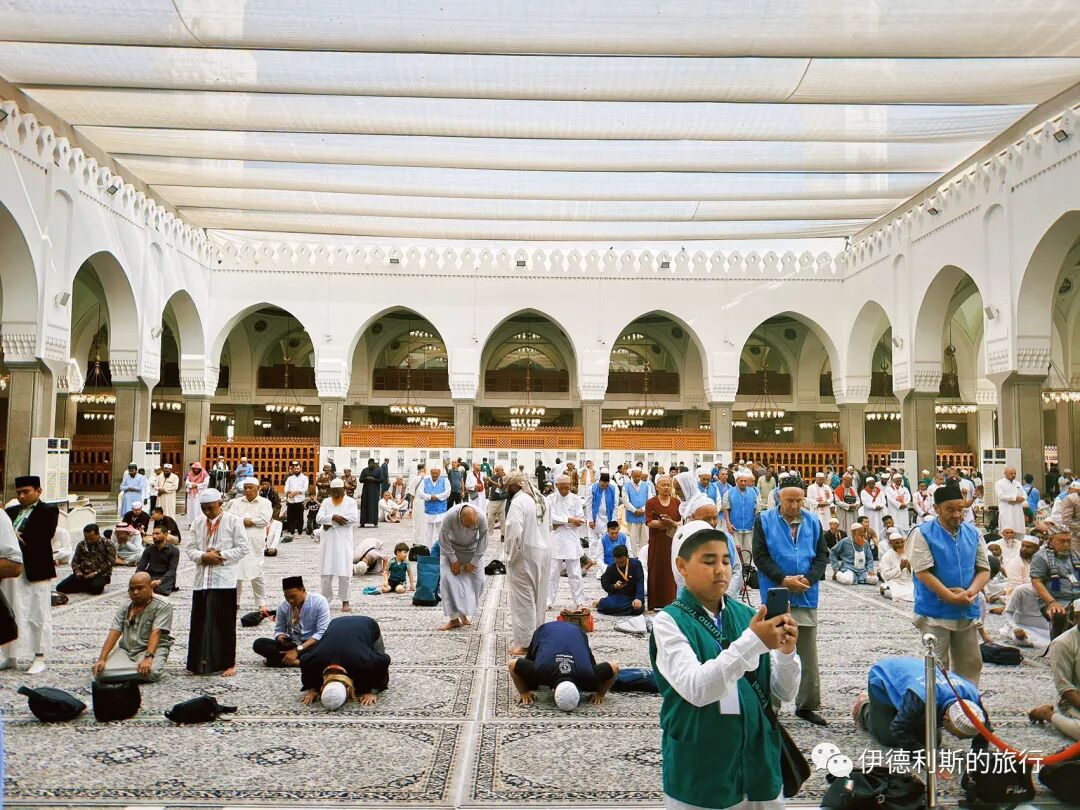
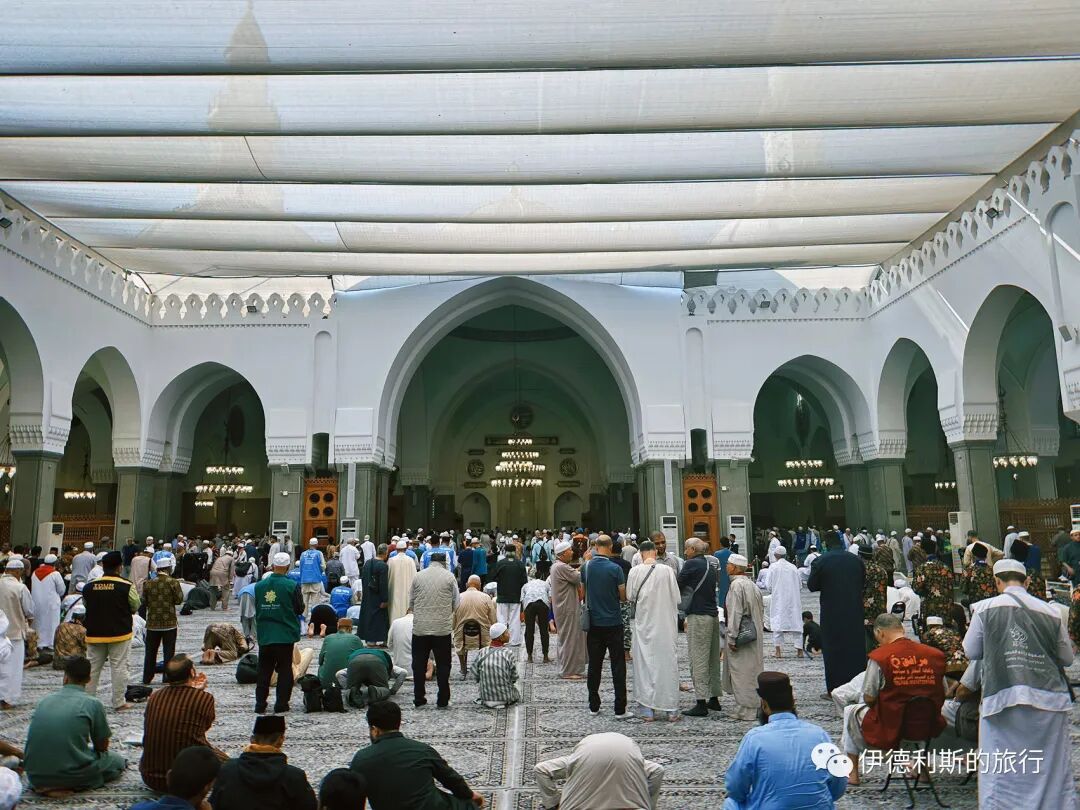
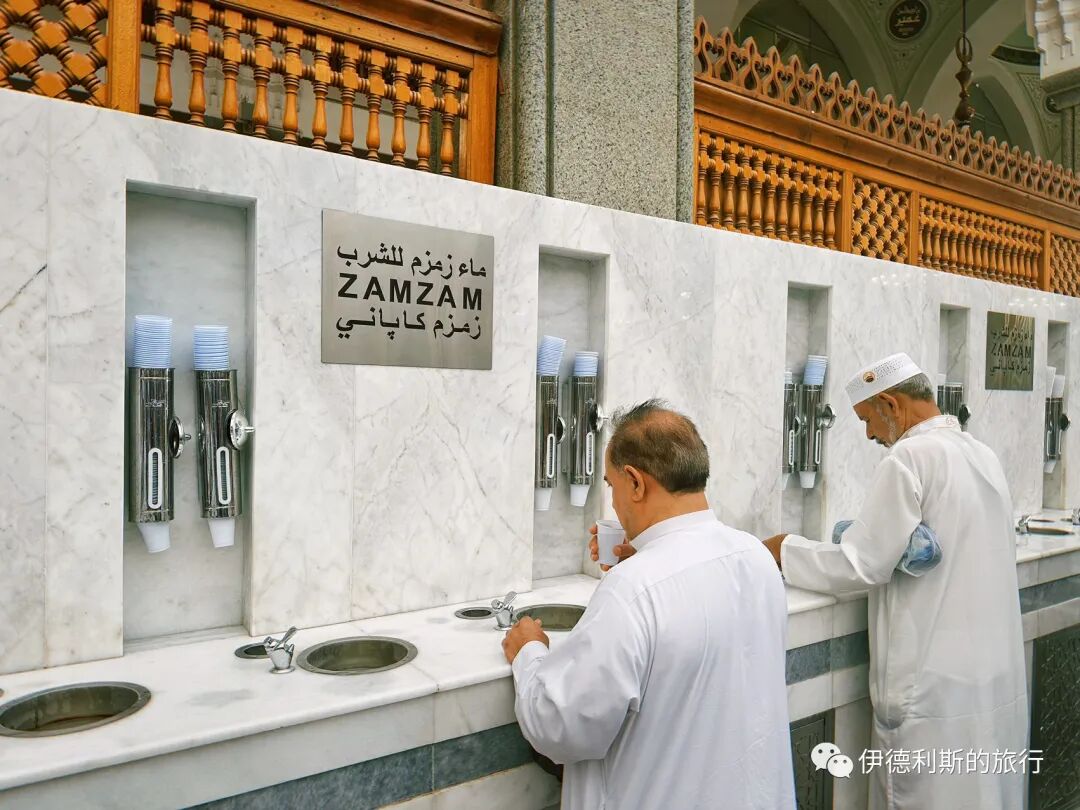
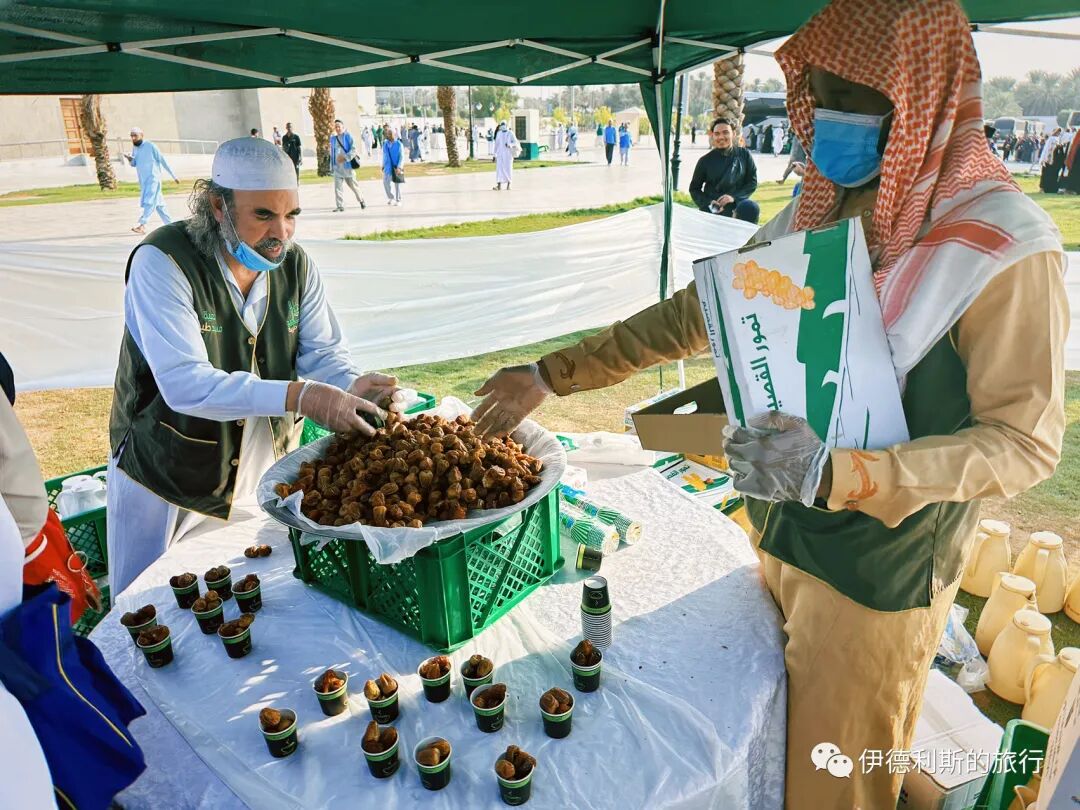

Musabbih Mosque is located southwest of Quba Mosque, and you have to cross a dusty parking lot to reach it. Legend says the Prophet Muhammad prayed namaz here when he first migrated to Medina in 622 AD. The old mosque still keeps its black volcanic basalt walls and contains the remains of a mihrab. The small courtyard is quiet, filled with blooming flowers and a friend (dosti) cleaning the area, which contrasts sharply with the crowded Quba Mosque nearby.
North of Medina is the site of the Battle of Uhud, fought in 624 between the Muslim army led by the Prophet and the Quraish tribe alliance from Mecca. The Muslim army suffered heavy losses, but the Meccans failed to capture Medina.
At the center of the Uhud battlefield is a small hill. Muslim archers stationed there left their posts to collect war spoils, which turned the tide of the battle and led to the Muslim army being surrounded.
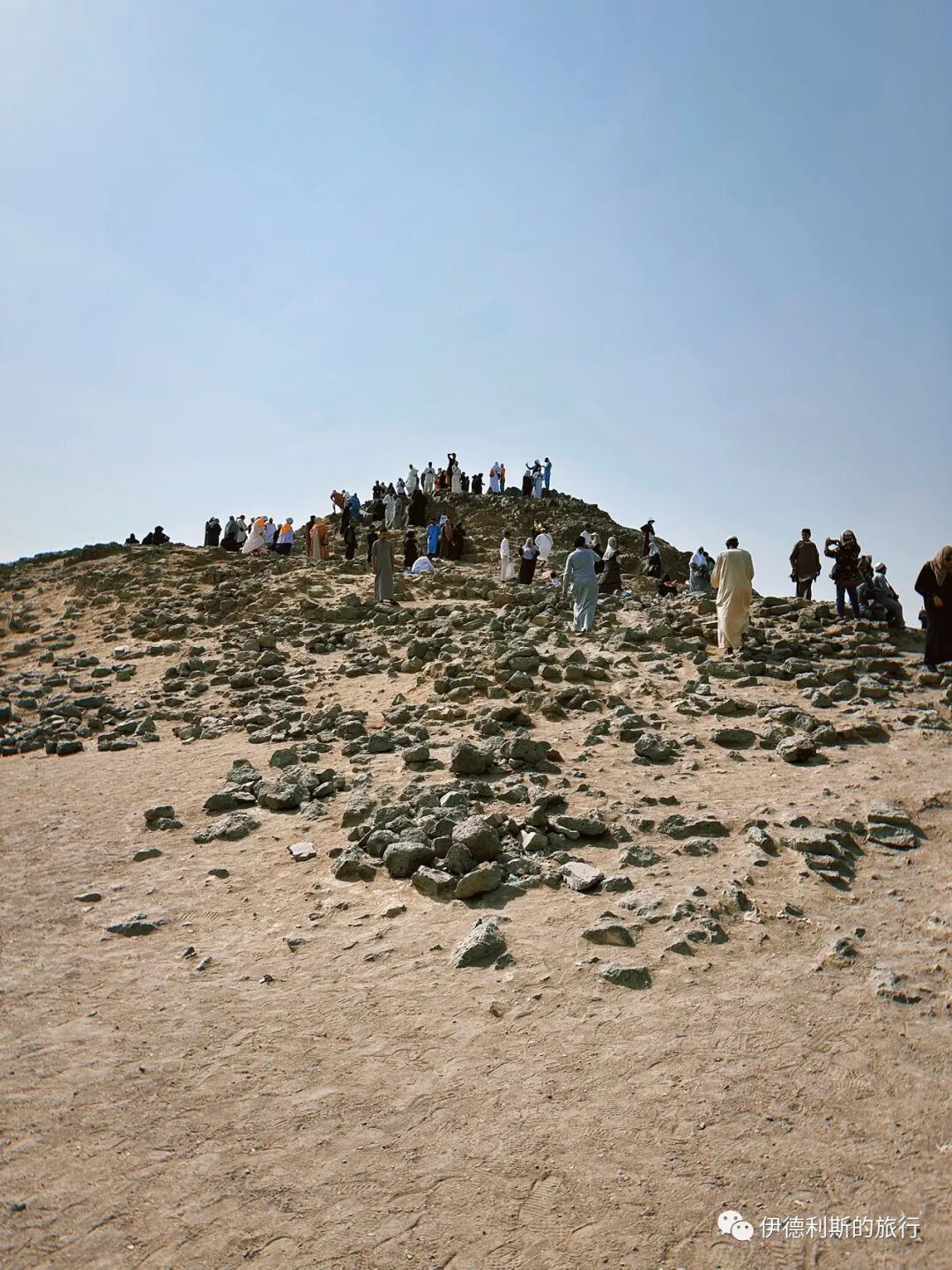
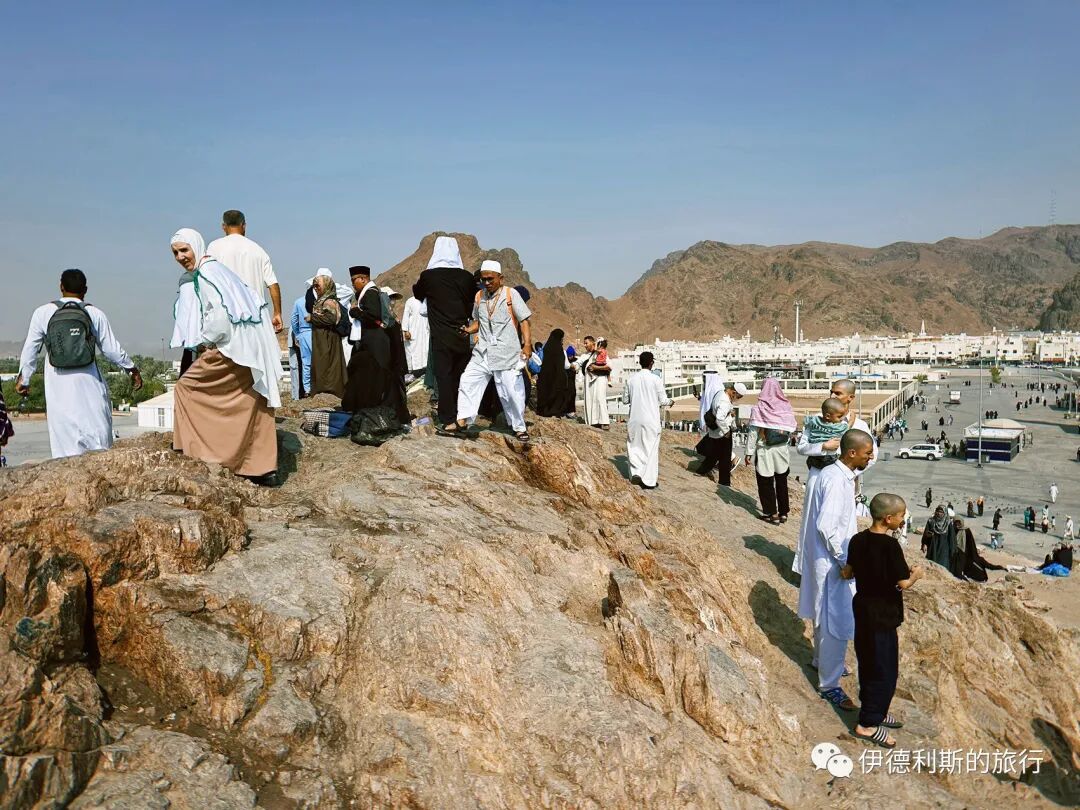
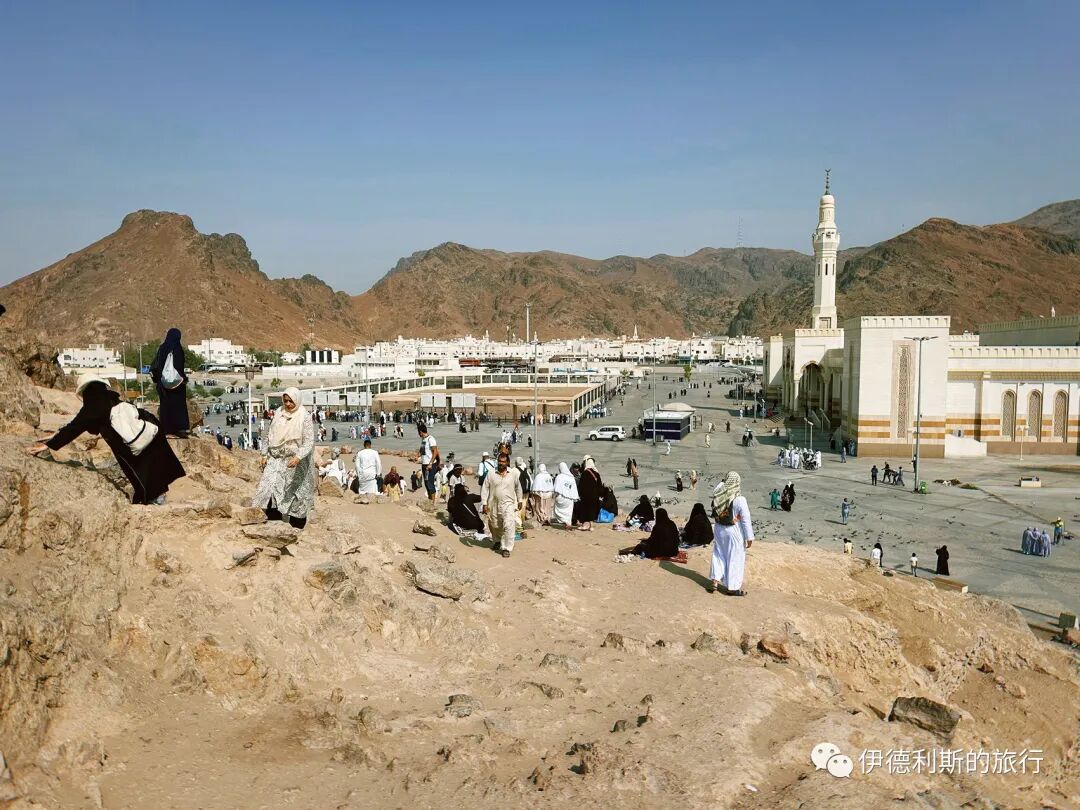
On the north side of the hill is the cemetery for the martyrs of the Battle of Uhud, which is now blocked off by wire mesh and fences. The cemetery holds many of the Prophet's companions and relatives, most importantly his uncle Hamza ibn Abd al-Muttalib. The Prophet once said, 'My best brother is Ali, and my best uncle is Hamza. May Allah be pleased with them.' Buried next to Hamza is the Prophet's cousin, Abd Allah ibn Jahsh.
On the east side of the cemetery stands the Sayyid al-Shuhada Mosque, built in 2017 and named after the title the Prophet gave to Hamza.
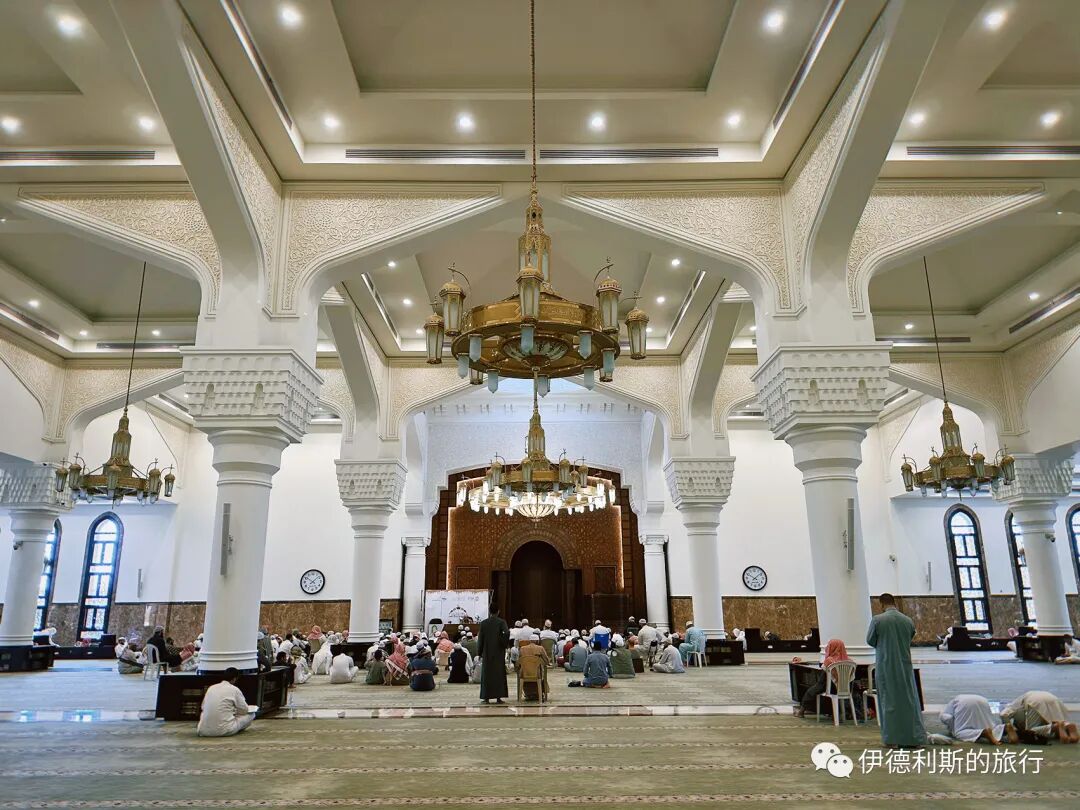
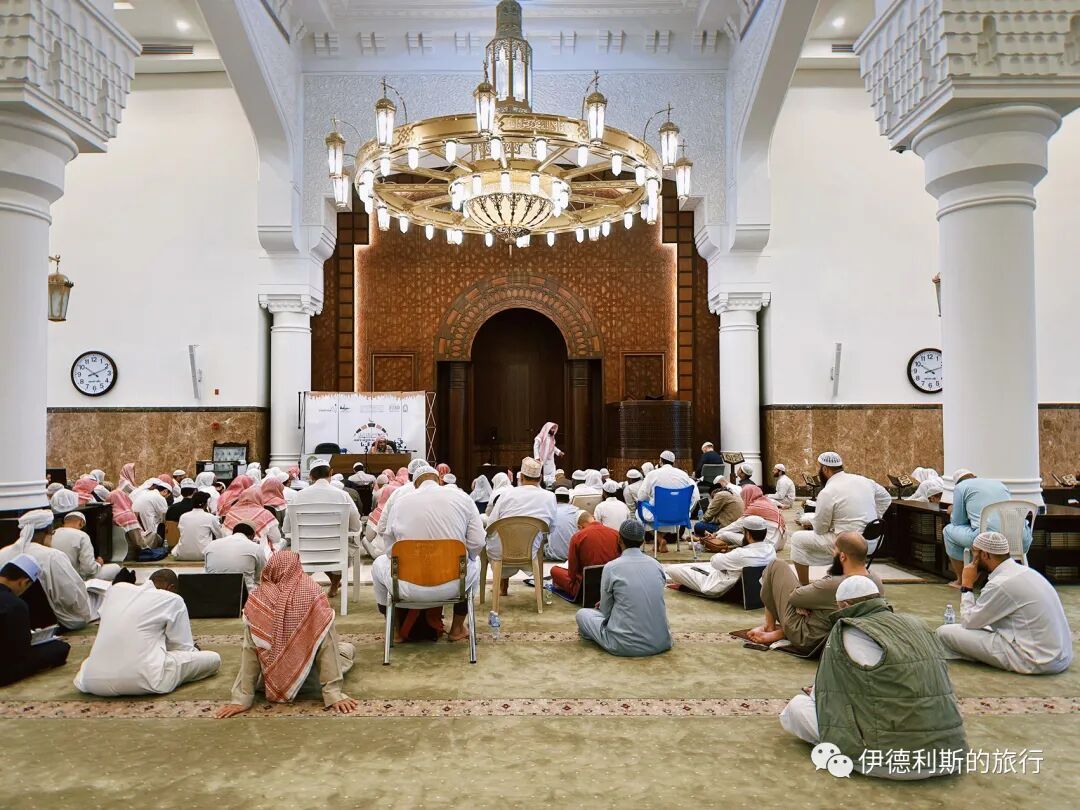
On the west side of the cemetery is a shed where water and bread are given out as charity, and you can rest there.
The Battle of the Trench was a conflict in 627 AD where the Muslim army led by the Prophet defended the northwest of Medina against an alliance of the Quraish and Bedouin tribes. The Prophet followed the advice of Salman the Persian to dig a trench, which eventually helped them defeat the enemy. This event is recorded in detail in the Quran and Sunnah.
Historically, seven mosques were built on the battlefield of the Trench. Five remain today, all built during the reign of the Umayyad Caliph Umar II (who ruled from 717 to 720) and renovated at different times.
The mosque on the northern hillside is called Al-Fath Mosque, and 'Fath' means 'conquest'. This is said to be the place where the Prophet performed namaz during the Battle of the Trench.
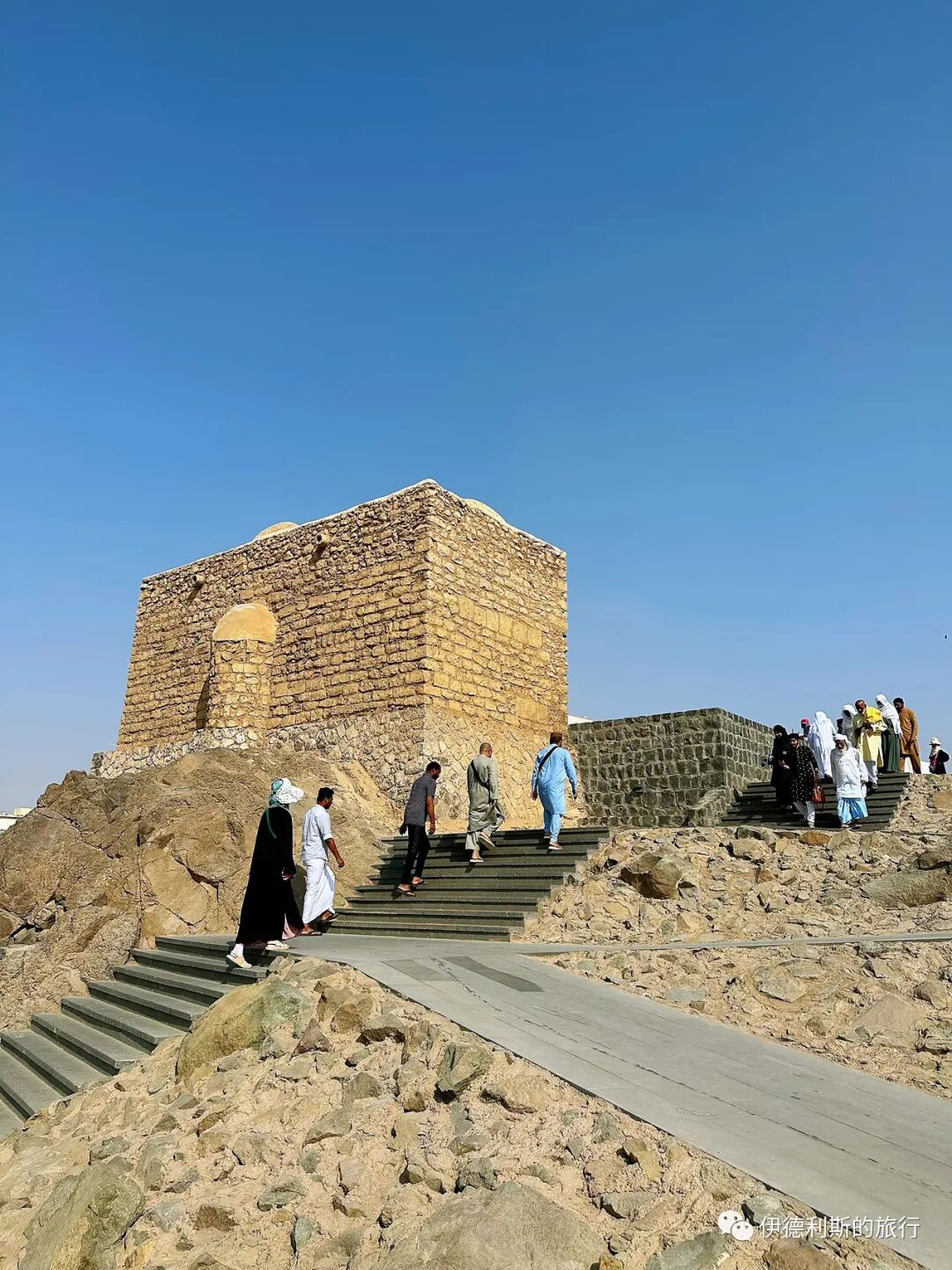
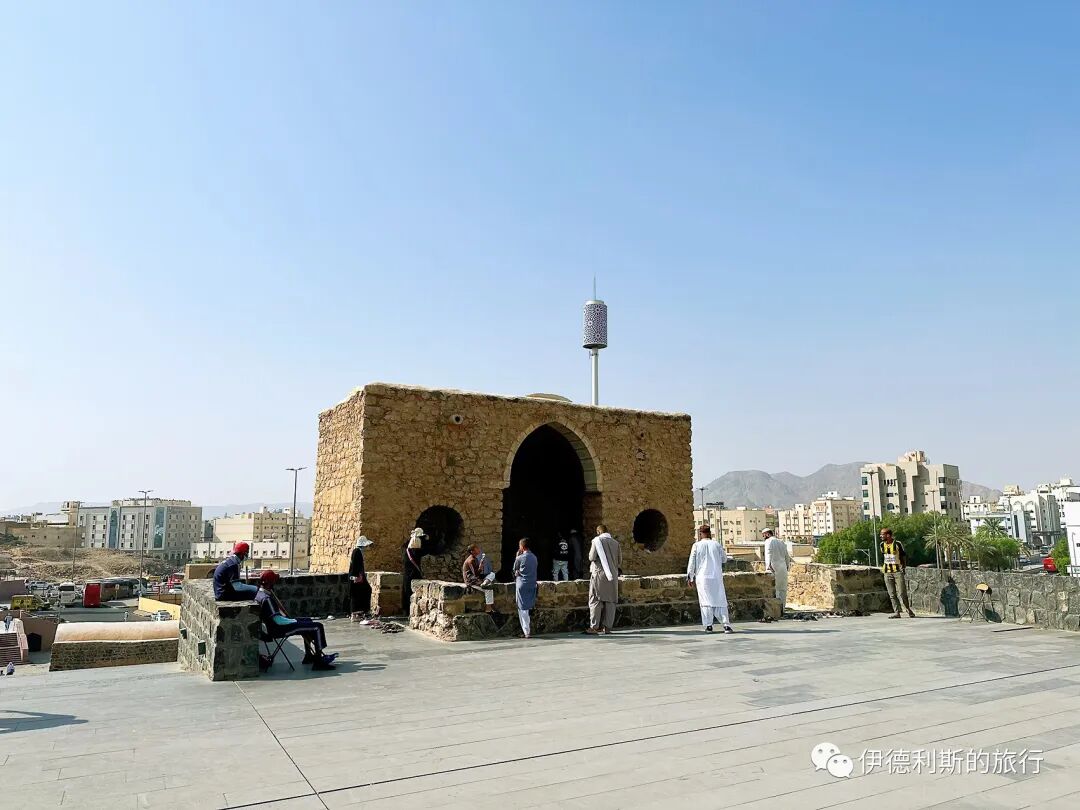
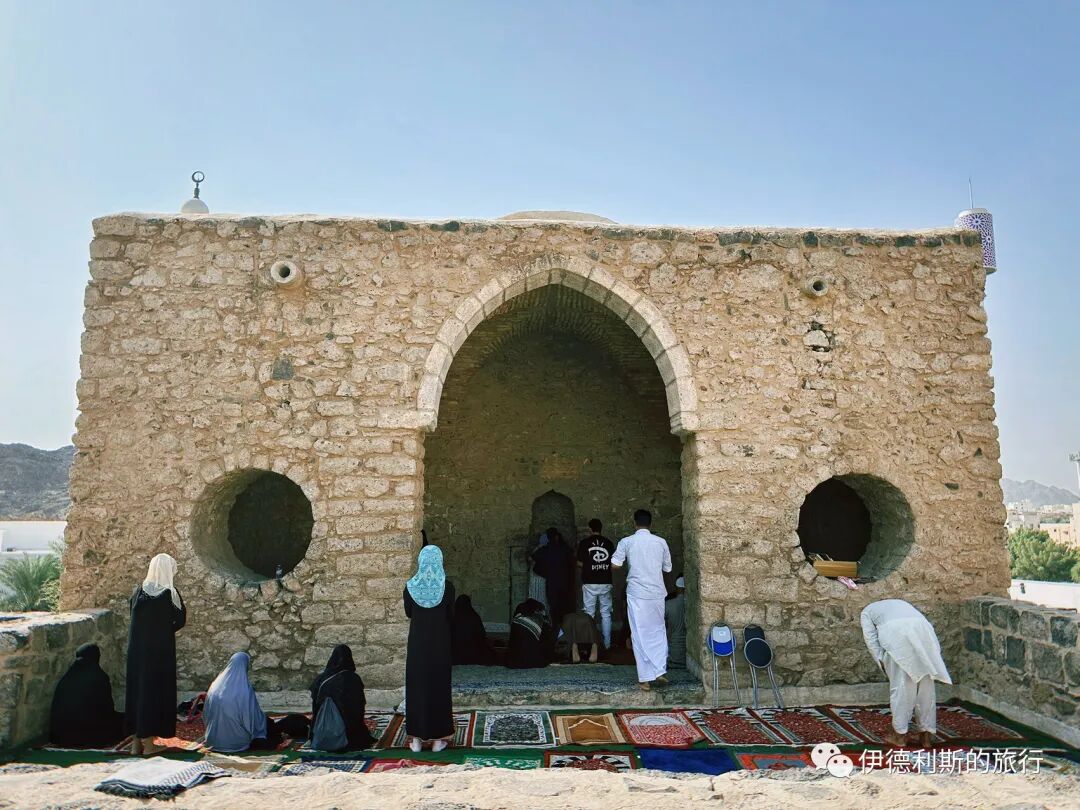
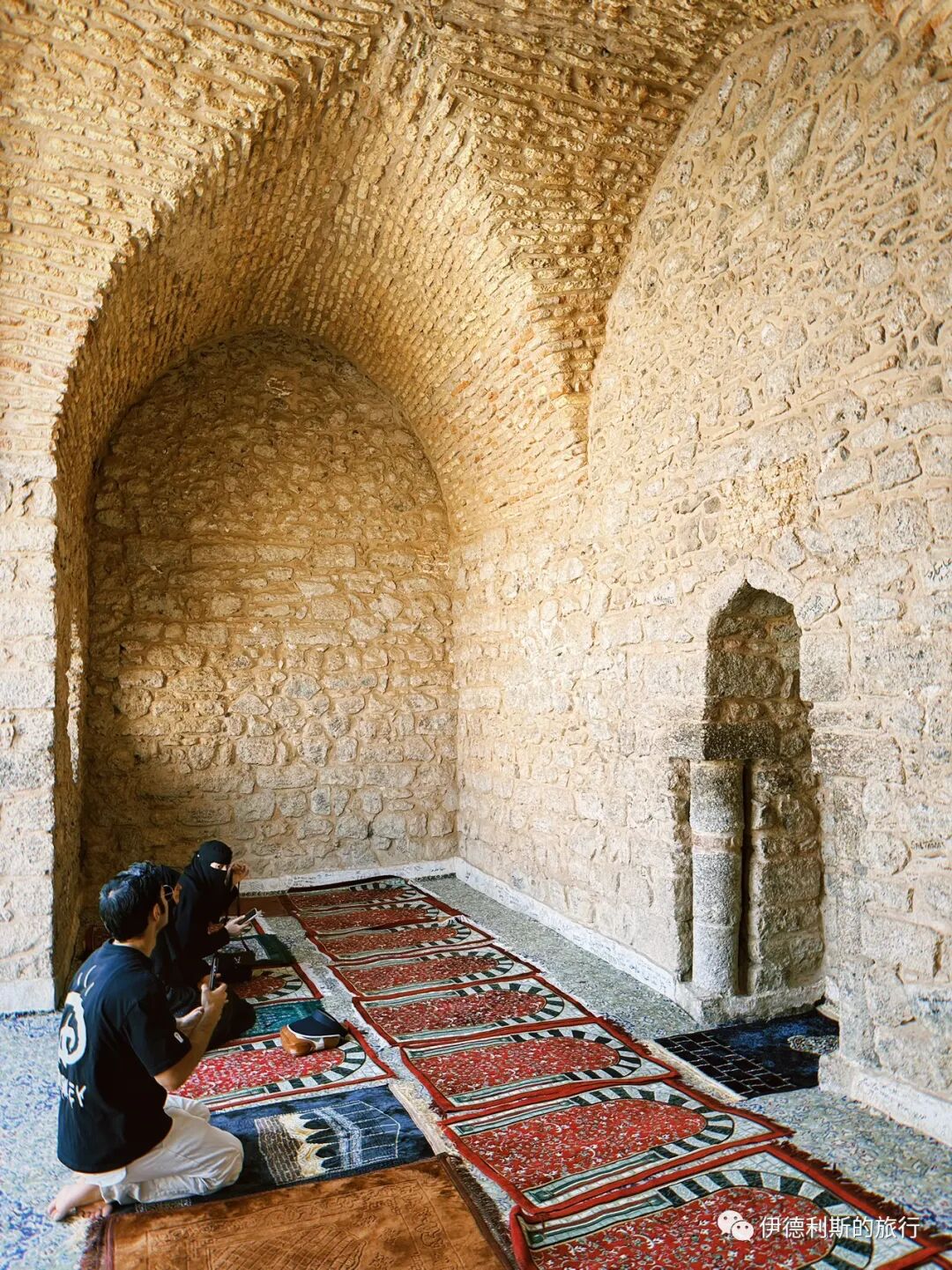
South of the Al-Fath Mosque is the Salman Al-Farsi Mosque, named after the Prophet's companion, Salman the Persian. Salman was originally a Zoroastrian from the Sassanid Empire. He later traveled through the Middle East with a Nestorian group and converted to Islam after meeting the Prophet in Medina. He used the military skills he learned in the Sassanid Empire to dig the trench, which helped the Prophet win the Battle of the Trench.
After the Prophet passed away, Salman took part in the Arab Empire's conquest of the Sassanid Empire and became the first governor of Ctesiphon, the Sassanid capital. He was also the first person to translate the Quran into a foreign language, which was Persian. Salman holds a high status among both Shia and Sufi Muslims. He is honored as the most noble of the four great companions of the Prophet in Shia tradition, and he is even respected in the Druze and Baháʼí faiths.
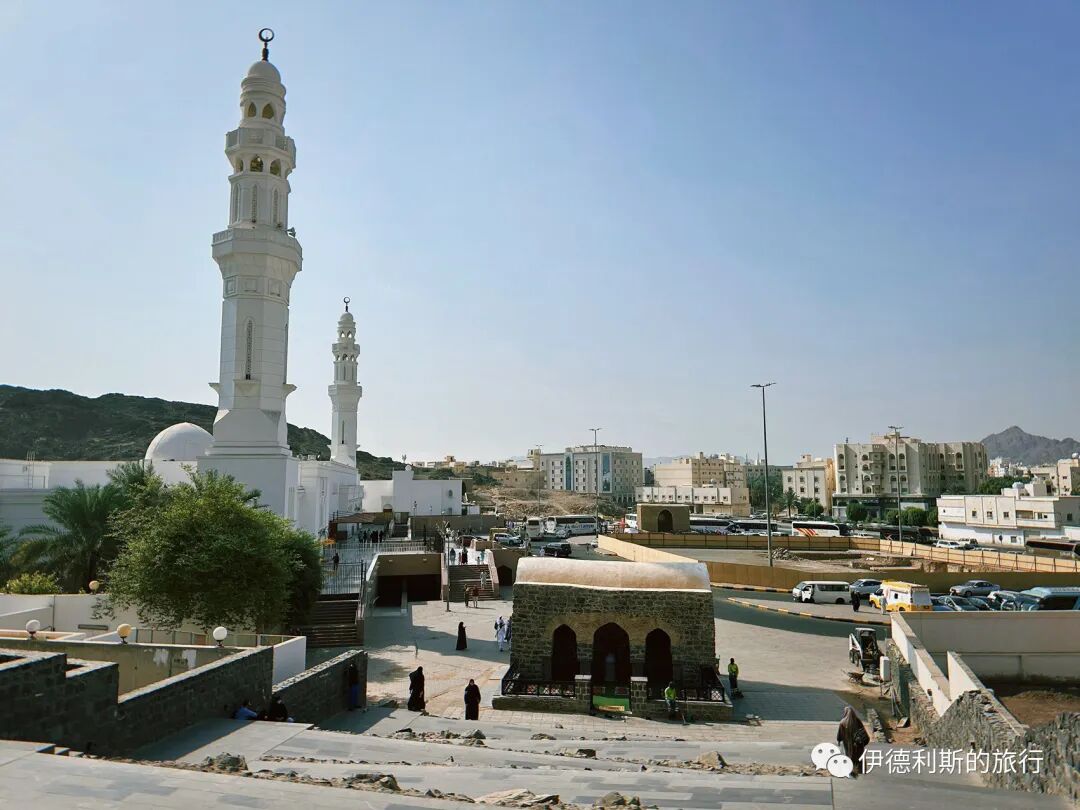
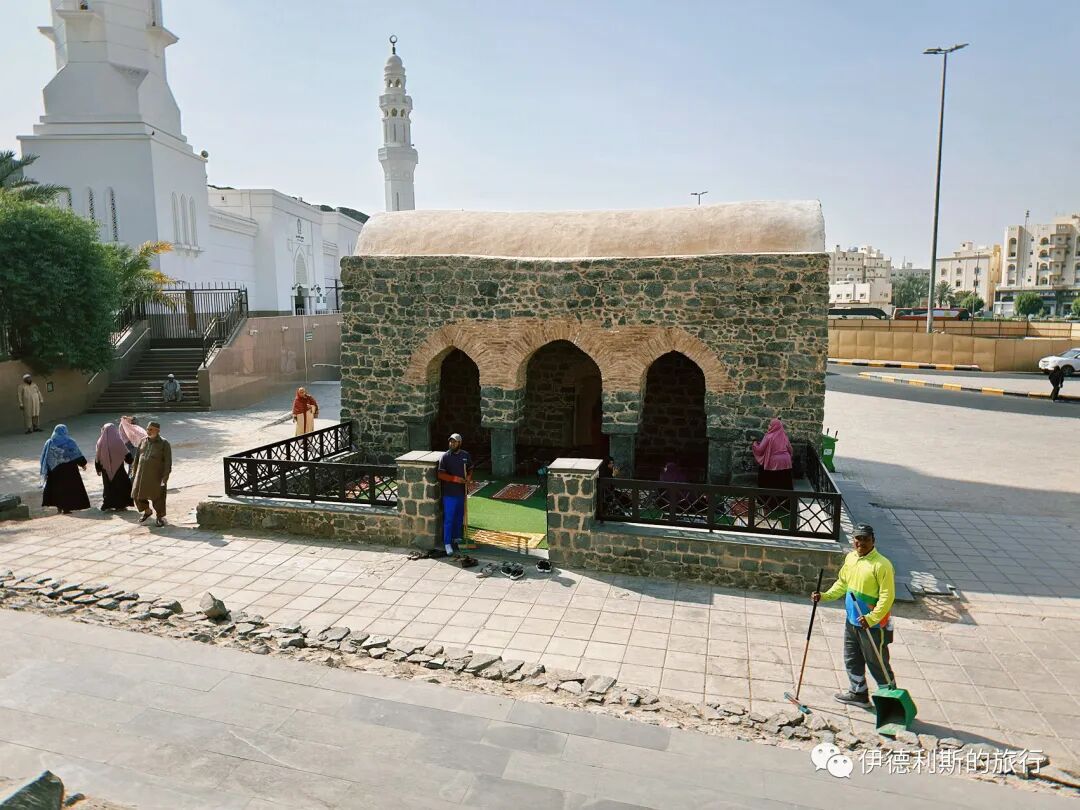
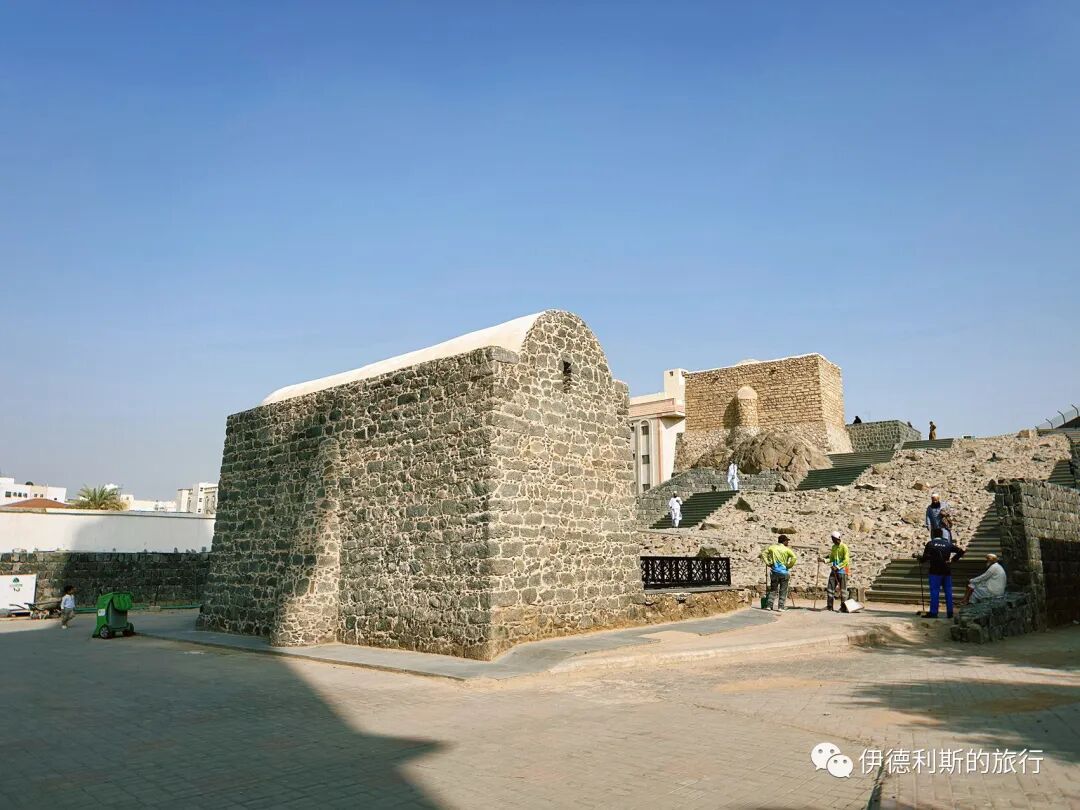
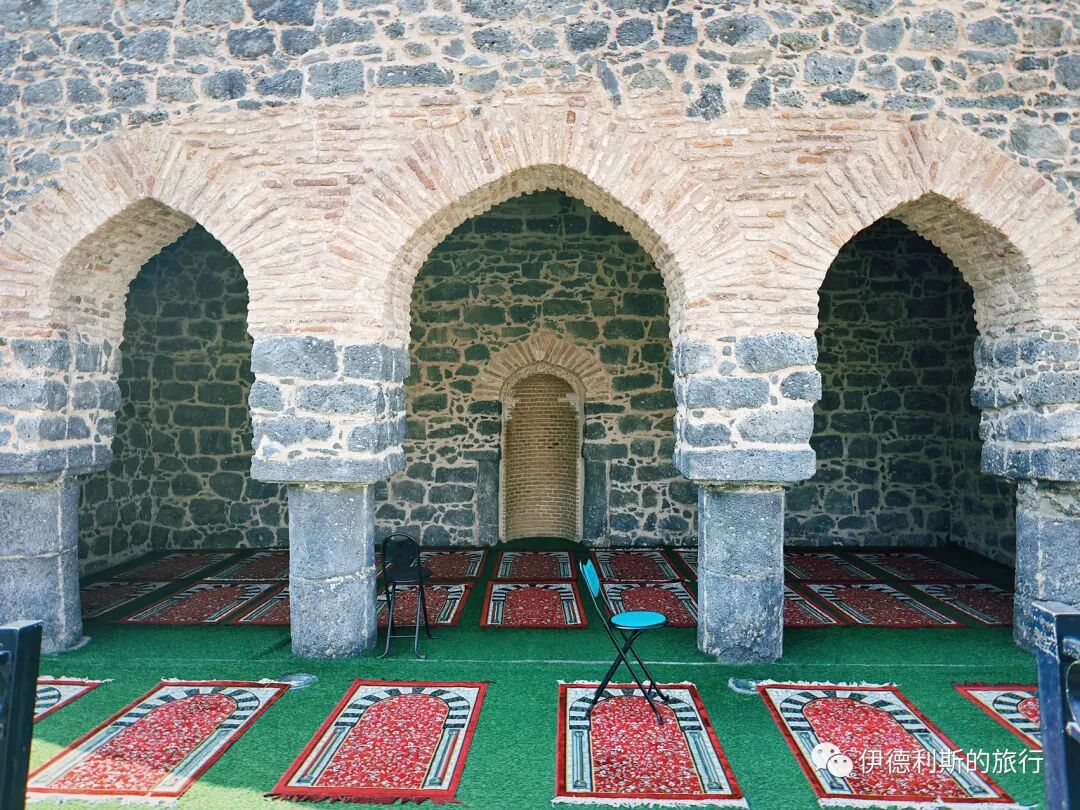
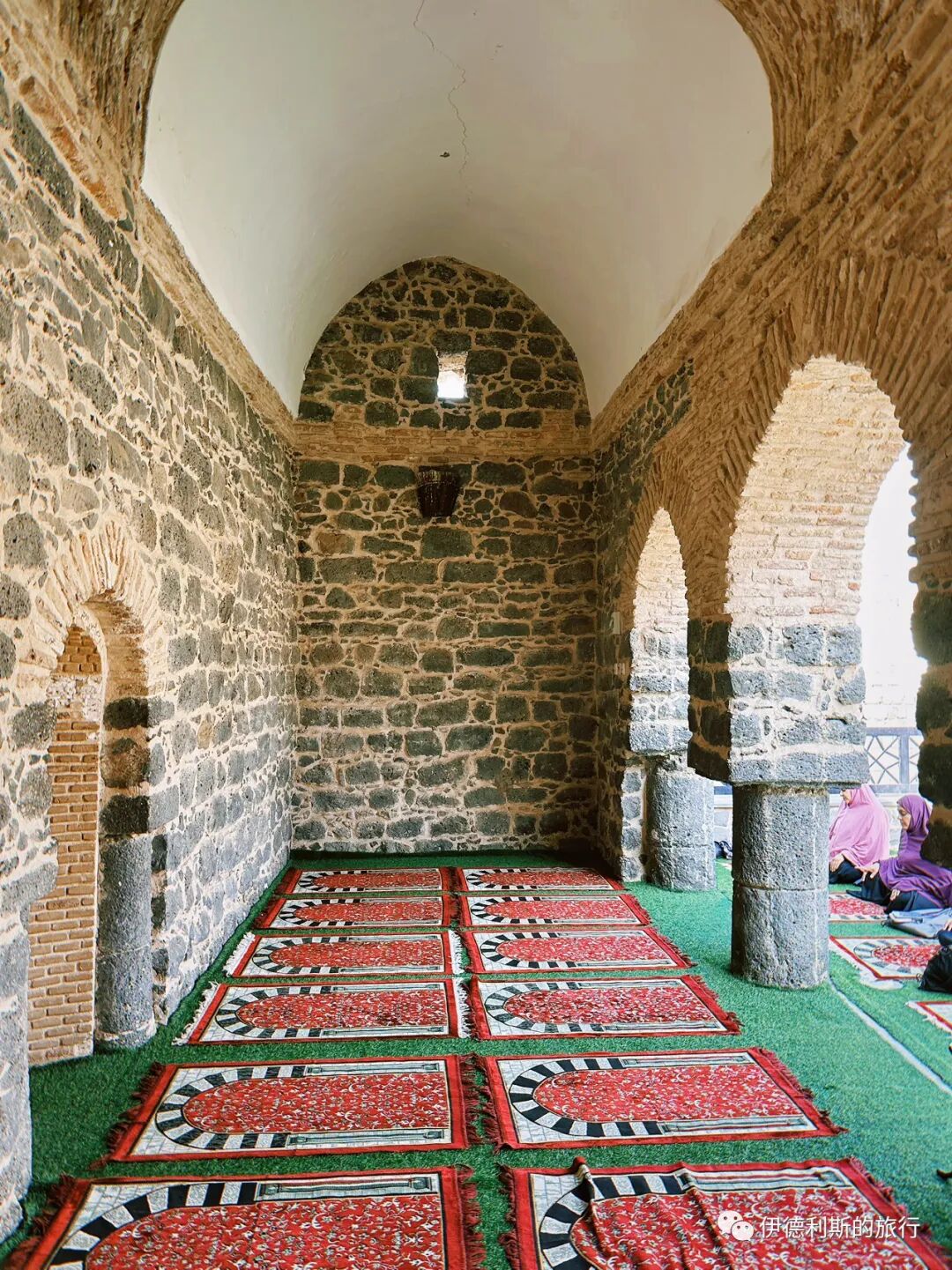
South of the Salman Al-Farsi Mosque is the Abu Bakr Al-Siddiq Mosque, named after Caliph Abu Bakr. In recent years, Saudi Arabia rebuilt this site into a large mosque with a washroom and a courtyard, and the main hall provides bottled ice water.
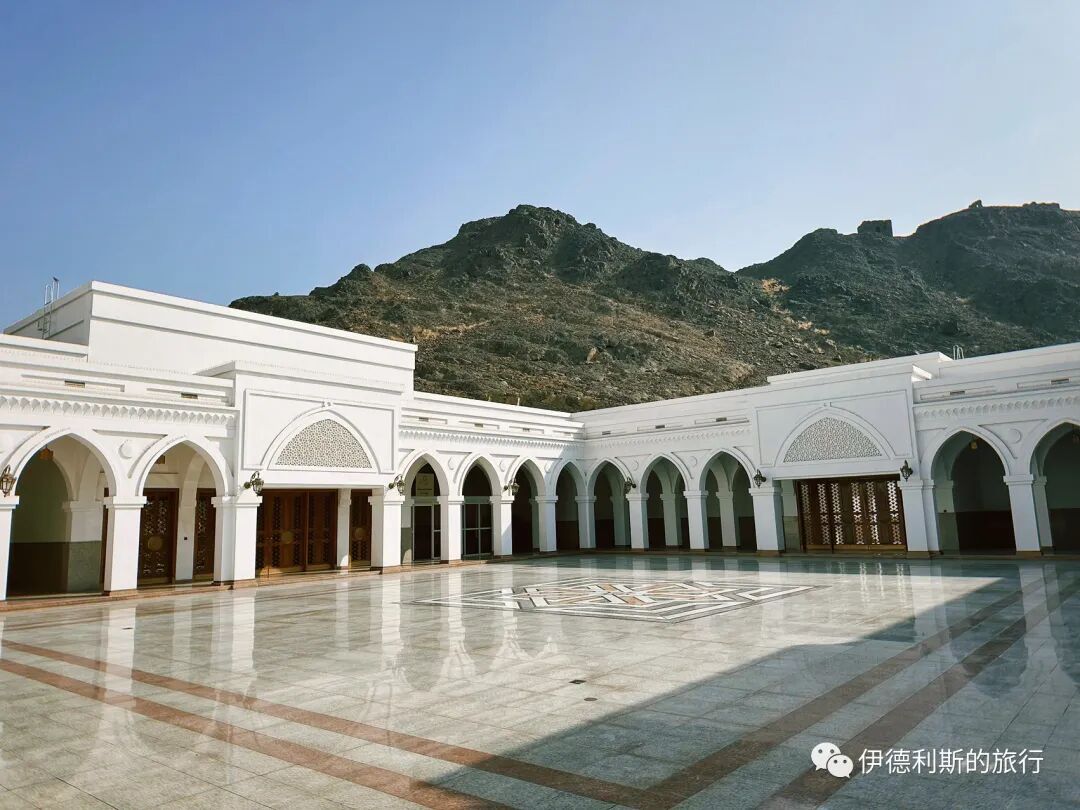
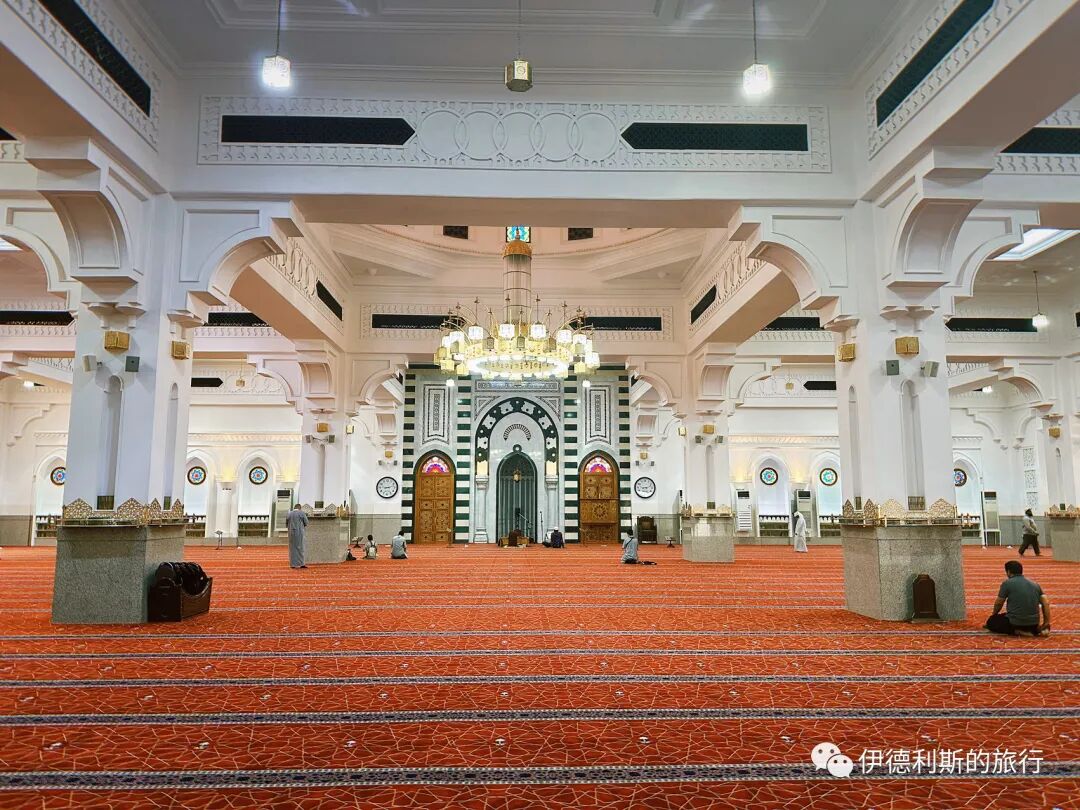
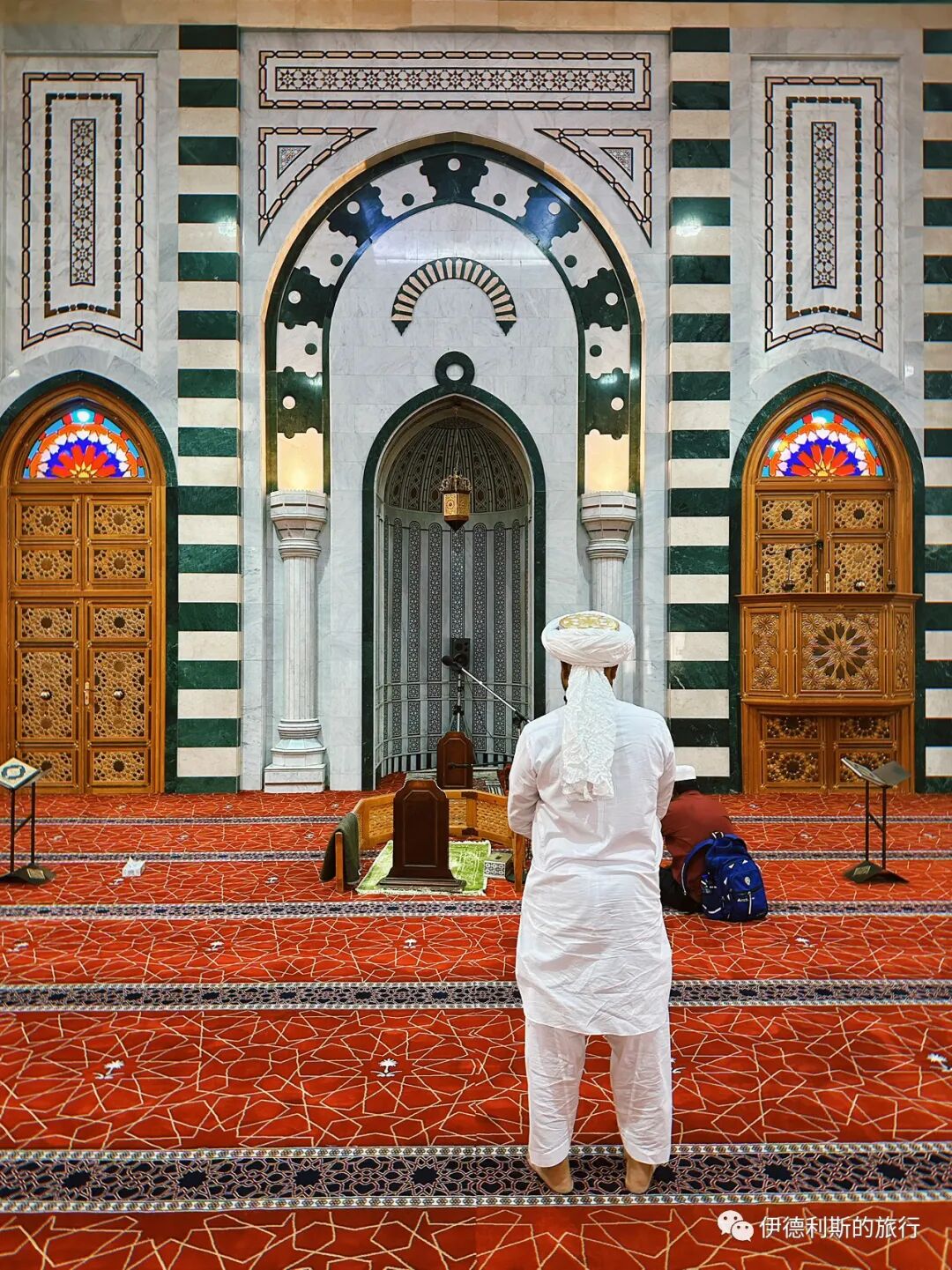
South of the Abu Bakr Al-Siddiq Mosque is the Umar bin Khattab Mosque, named after Caliph Umar.
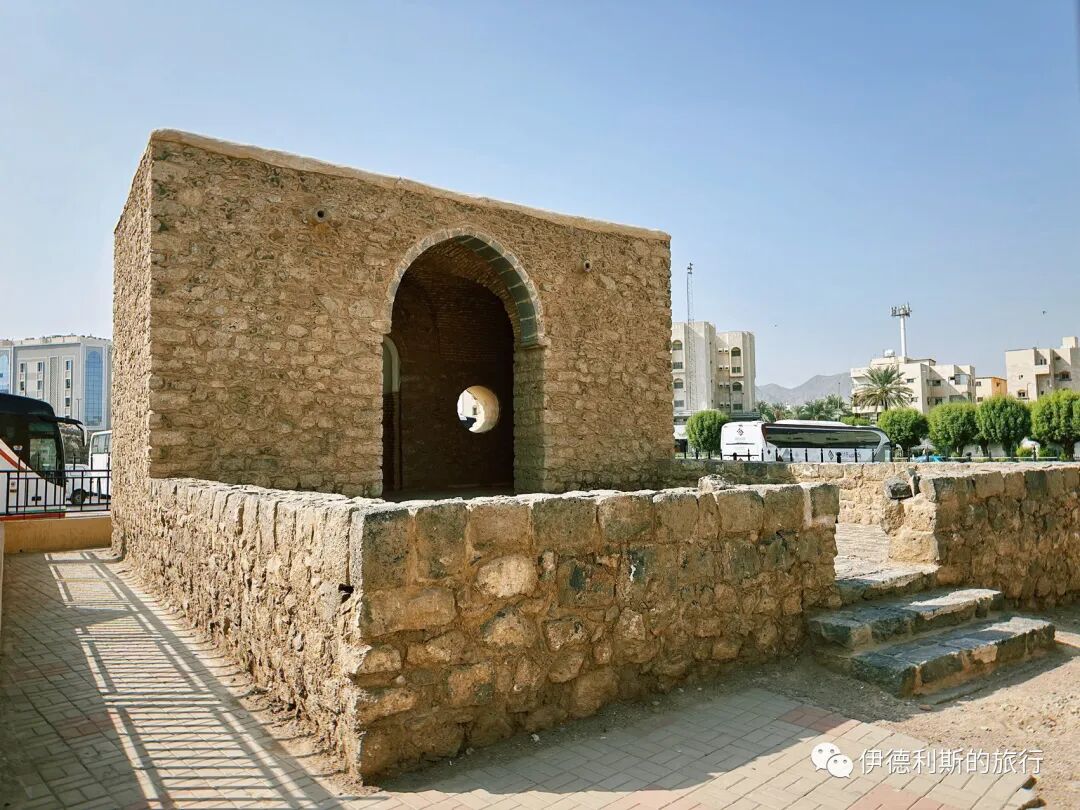
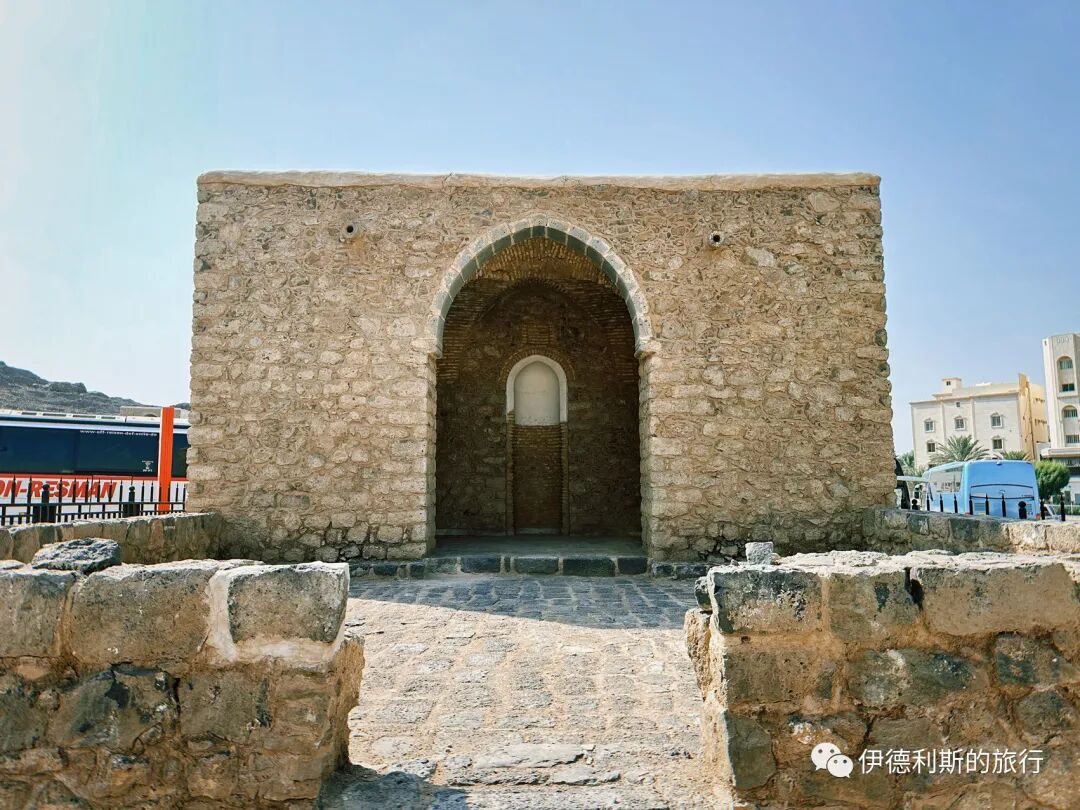
South of the Umar bin Khattab Mosque is the Ali bin Abu Talib Mosque. It sits on a hillside in the south and is named after Caliph Ali, who is said to have joined the Battle of the Trench here.
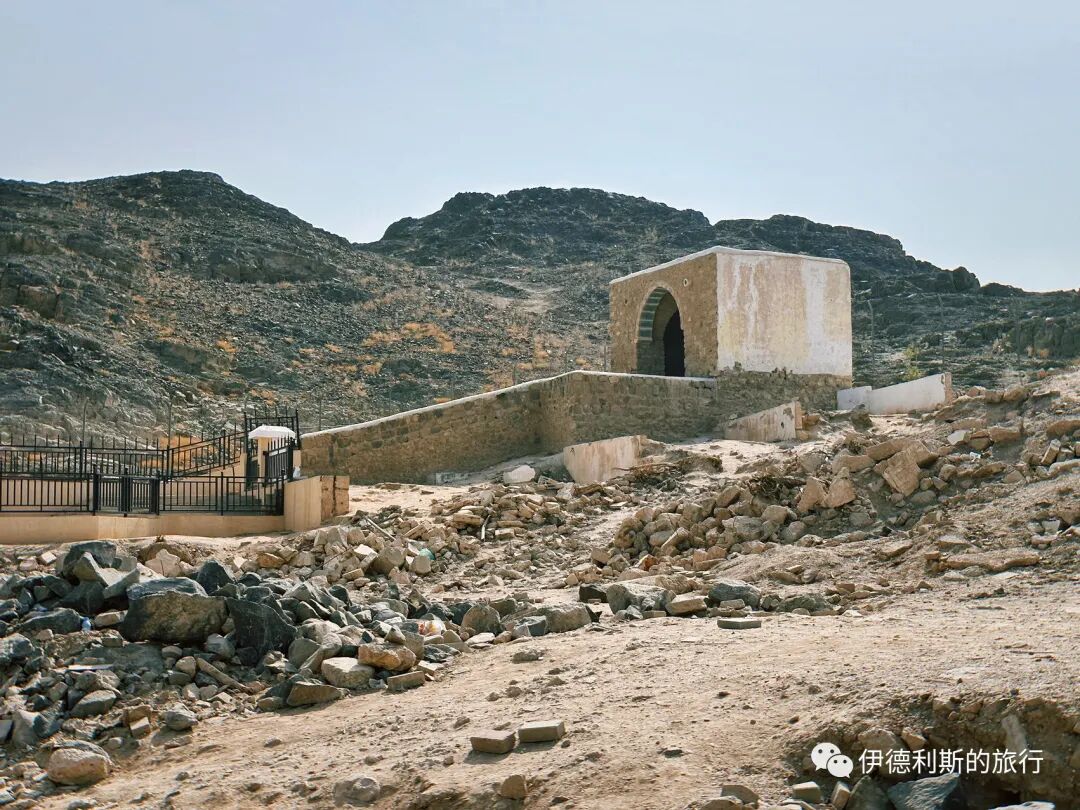
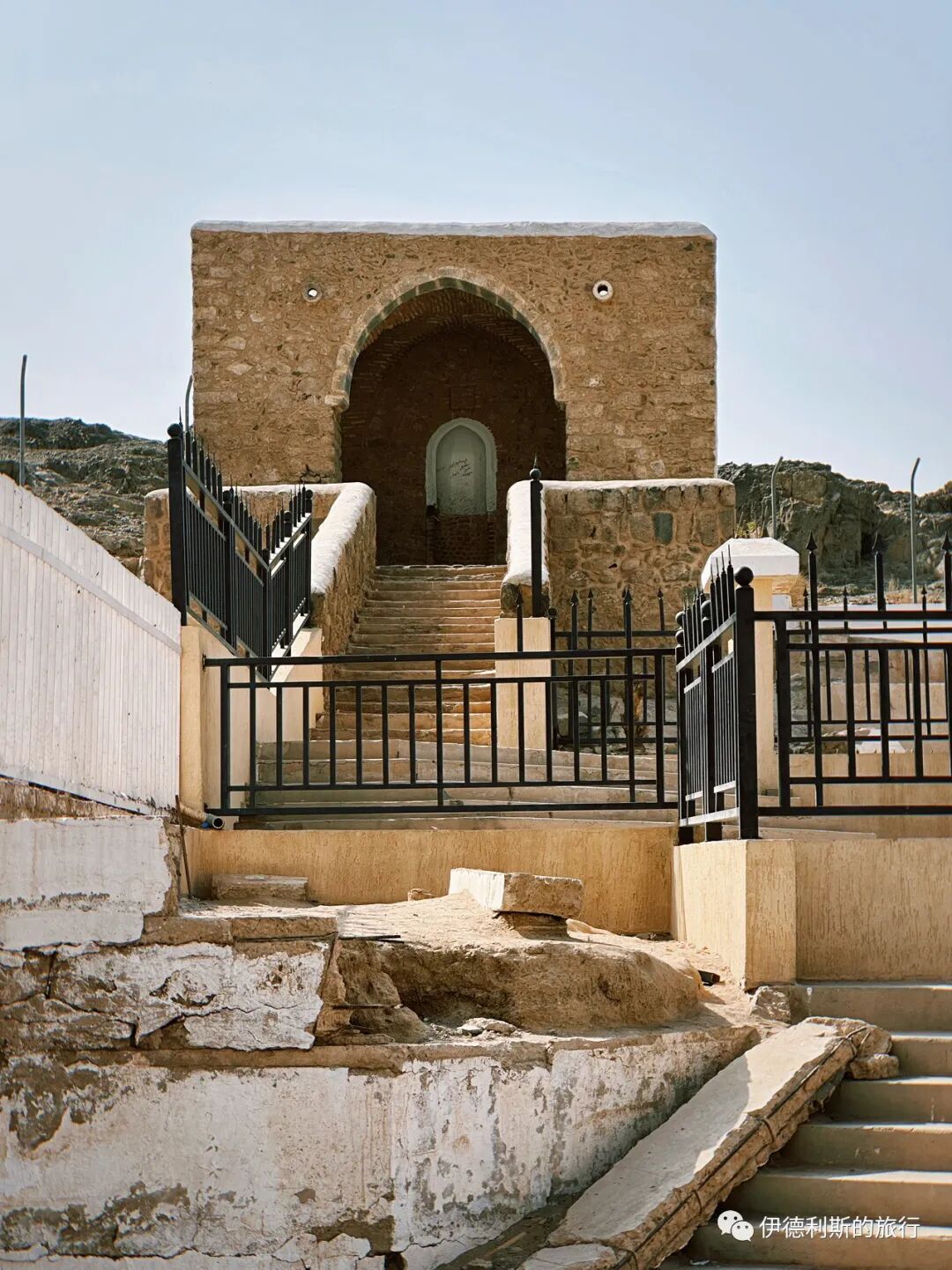
West of the Ali bin Abu Talib Mosque is the Fatimah Az-Zahra Mosque, named after the Prophet's daughter Fatimah. It is a small mosque attached to the other mosques. This mosque was built during the reign of Ottoman Sultan Abdulmejid I (who ruled from 1839 to 1861), and today only the foundation walls remain.
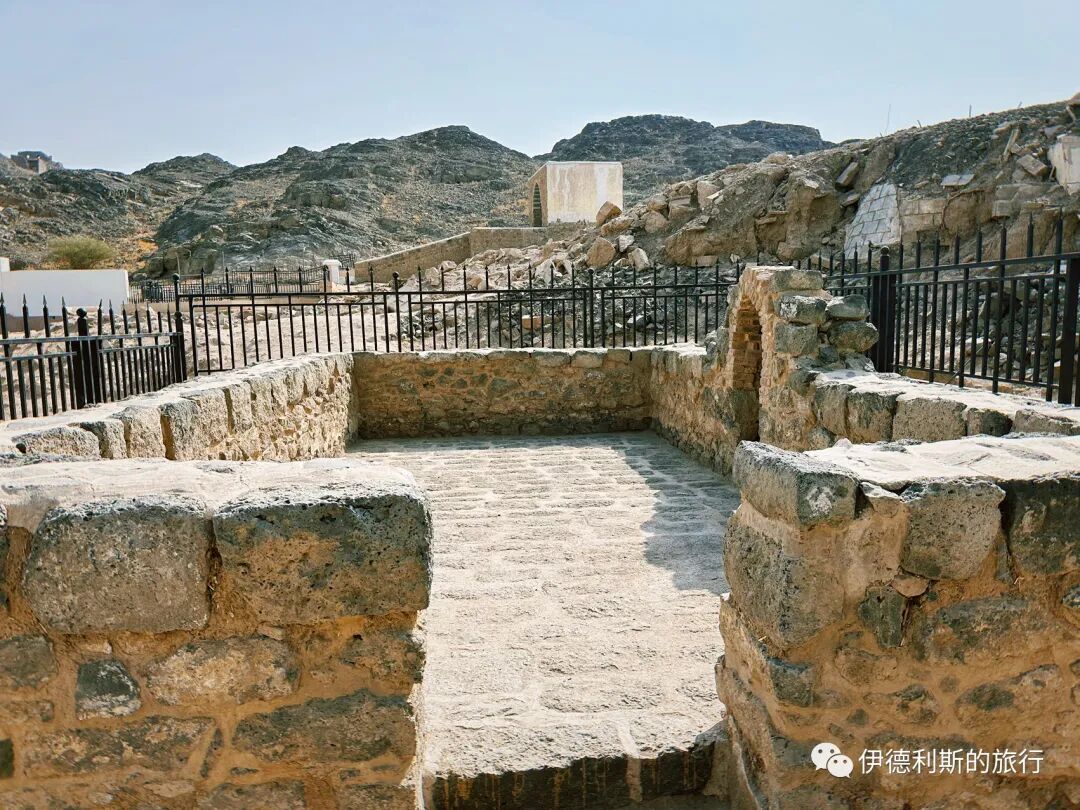
One of the best duas any believer can recite. It asks for good in this world while not forgetting to ask about good in the akhira (afterlife).
Quran • napio posted the article • 0 comments • 1535 views • 2023-11-30 01:54
Rabbana atina fid dunyaa hasanatanw wa fil aakhirati hasanatanw wa qinaa azaaban Naar
“Our Lord, give us in this world [that which is] good and in the Hereafter [that which is] good and protect us from the punishment of the Fire.”
– 2:201 –
Recommended use:
One of the best duas any believer can recite. It asks for good in this world while not forgetting to ask about good in the akhira (afterlife). “So remember Me; I will remember you. And be grateful to Me and do not deny Me.” (2:152) view all
رَبَّنَآ ءَاتِنَا فِي ٱلدُّنۡيَا حَسَنَةٗ وَفِي ٱلۡأٓخِرَةِ حَسَنَةٗ وَقِنَا عَذَابَ ٱلنَّارِ
Rabbana atina fid dunyaa hasanatanw wa fil aakhirati hasanatanw wa qinaa azaaban Naar
“Our Lord, give us in this world [that which is] good and in the Hereafter [that which is] good and protect us from the punishment of the Fire.”
– 2:201 –
Recommended use:
One of the best duas any believer can recite. It asks for good in this world while not forgetting to ask about good in the akhira (afterlife). “So remember Me; I will remember you. And be grateful to Me and do not deny Me.” (2:152)
Cutest Dua from the young boy
Muslim Education • Yosef posted the article • 0 comments • 1455 views • 2023-04-27 10:47

Muslim Knowledge Guide in the Muslim World: Qunut Nazilah Dua for Oppressed Muslims in War
Articles • yusuf908 posted the article • 0 comments • 218 views • 2026-05-22 10:11
Summary: Muslim Knowledge Guide in the Muslim World: Qunut Nazilah dua for Oppressed Muslims in War is presented here as a clear English Islamic knowledge article for Muslim readers, starting with this scene: Abu Dawud reported from Sahl b. Sa'd that the Prophet said, "Two times for dua are never or seldom turned down: at the time of the call to prayer and at the time of fighting when people are locked in battle." In another version of the. It keeps the original names, Quran and hadith references, dua, photographs, and religious context while focusing on Qunut Nazilah, dua, Muslim World.
Abu Dawud reported from Sahl b. Sa'd that the Prophet said, "Two times for dua are never or seldom turned down: at the time of the call to prayer and at the time of fighting when people are locked in battle." In another version of the hadith from the same companion, "Two times the gates of heaven open and the dua of someone is rarely rejected: when the call to prayer sounds and when standing in battle ranks for the cause of Allah." While Muslims must exert every worldly effort to reach their goals and support their causes, they also hold deep faith in the spiritual power of dua and constant reliance on Allah's support. This spiritual strength shows clearly during moments of conflict and fear. Part of our belief in the unseen is the concept of the "soldiers of Allah," a Quranic term that shows how Allah helps believers through angels or natural events.
Belief and sincerity help bring about divine support that can lead to miracles. When the soldiers of Talut (King Saul) faced the threat of Goliath and his huge army, they had already passed a test where they were told not to drink from a river despite their thirst. Talut reminded them of Allah's universal rule (sunna): "How often has a small force, with Allah's permission, defeated a larger army!" Allah is with those who are steadfast." Talut did not say this while relying only on mystical feelings; instead, his reliance on Allah was based on careful planning and thought. He spoke these words after leading his army into action and testing his soldiers' commitment and discipline. In the critical moment of battle, all that remained for him was dua.
In this moment, Talut and his soldiers earnestly asked for Allah's support: "Our Lord, pour patience on us, make us stand firm, and help us against the disbelievers." Seeing the sincerity of Talut's small army after they endured many challenges, Allah gave them victory. The Quran emphasizes that this triumph happened only "with Allah's permission." After telling this story, Allah reminds us of another universal sunna: "If Allah did not drive some back by means of others, the earth would be completely corrupt, but Allah is gracious to all."
The sunna of Allah continues throughout history. Centuries later, Prophet Muhammad and his companions were in a similar situation during the Battle of Badr. They had just over 300 men, were poorly armed, and faced an army of 1,000. Even though the Prophet had the heavy responsibility of leading the army and overseeing the battle, many reports highlight his intense dua during the conflict. Witnesses saw him face the direction to prayer (qibla), hands outstretched, wearing his upper and lower garments, and imploring:
O Allah, accomplish for me what You have promised to me. O Allah, fulfill what You have promised! O Allah, if this small band of Muslims is defeated, Your worship will cease on earth.
The Prophet fervently asked Allah, continuing his dua until his upper garment slipped from his shoulders. Abu Bakr al-Siddiq, may Allah be pleased with him, came to him, picked up the garment, and put it back on him. Hugging him from behind, Abu Bakr reassured him: "O Prophet of Allah, your prayer to your Lord is enough, for He will fulfill what He has promised you." Then Allah revealed these words: "When you implored your Lord for assistance, He answered, 'I will reinforce you with a thousand angels in succession.' Allah made this a message of hope to reassure your hearts: help comes only from Allah, He is Almighty and All-Wise."
In the version of this event by al-Bukhari, the Prophet is reported to have said,
O Allah! I ask You for the fulfillment of Your covenant and promise. O Allah! If You will for the believers to be destroyed, You will never be worshiped after today.
Abu Bakr caught him by the hand and said, "This is enough, O Messenger of Allah! You have asked Allah intensely." The Prophet was wearing his armor at that time. He went out, saying: "Their forces will be routed and they will turn tail and flee. But the Hour is their appointed time-the Hour is more severe and bitter."
The Prophet was also heard saying,
O Allah, this is the Quraysh, who have come with their arrogance and pride, opposing and denying Your Messenger. O Allah, grant me the victory You promised. O Allah, make them perish this morning.
Concerned for his companions, he was also heard saying, "O Allah, they are on foot, provide mounts for them; O Allah, they are naked, clothe them; O Allah, they are hungry, provide food for them."
ʿAlī ibn Abī Ṭālib, may Allah be pleased with him, said,
On the day of Badr, I fought for a while, then I hurried to see how the Messenger of Allah was doing. I found him in prostration, saying, "O Ever-Living, O Sustainer!" He repeated these words (yā Ḥayy yā Qayyūm) and said nothing more. I returned to the battle, then came back, and he was still in prostration, saying the same words. I went back to fight, then returned, and he was still saying that. Then Allah granted him victory.
Scholars have thought a lot about the reactions of the Prophet and Abū Bakr during this critical moment. Some emphasize the Prophet's fear (khawf) at that time, while Abū Bakr showed hope (rajāʾ). Both are good, but Abū Bakr's response does not mean he had more confidence in Allah's promise than the Prophet. The Prophet was deeply concerned about his companions, especially as they faced their first big fight against enemies, and he worried about the future of the entire ummah. This concern shows in his dua: "If You will to destroy the believers, You will never be worshiped after today." The Prophet also made extensive dua, not just to express his concerns but to give confidence to his companions. Seeing the Prophet's fervent dua likely reassured them, as they knew his dua holds great weight with Allah.
Abū Bakr's reaction was also a response to the Prophet's visible exhaustion, showing he understood the Prophet's deep concern. A report says the Prophet spent the entire night before the battle in fervent dua, which shows how serious the moment was.
At the same time, the Prophet was known for his great courage. ʿAlī b. Abī Ṭālib (rA) said they used to seek shelter by staying close to the Prophet during the Battle of Badr, as he stood closest to the enemy. That day, the Prophet was one of the most formidable people. Abū al-Qāsim al-Suhaylī (d. 581/1185) described the balance of working hard while relying on Allah.
The Prophet saw the angels fighting steadily, with Gabriel (Jibrīl) covered in dust. The allies of Allah (anṣār Allah) fought without fear of death. Jihad has two forms: physical jihad with the sword and spiritual jihad through dua. It is a sunna for the imam to stay behind the army, not fighting with them. Everyone worked hard, and no one rested from the two struggles. The allies of Allah and His angels worked intensely without resting. The party of Allah and their enemies both stayed firm.
Hadith compilers included chapters on dua against enemies to be defeated and shaken. During the Battle of the Confederates (aḥzāb), when Arab tribes surrounded Medina to destroy the Muslim community, the Prophet prayed, "O Allah, Revealer of the Book, Swift to account, defeat the Confederates. O Allah, defeat them and shake them."
Even though they were outnumbered and faced betrayal from neighbors, the Prophet and his companions won a great victory from Allah without a full-scale battle. It was still called a battle to remember Allah's soldiers, including the angels, the wind, and the sincerity, hard work, and dua of the believers.
The Legislation of the dua of Calamities in Prayer (Qunūt al-Nawāzil)
In 4/625, a few months after 70 companions died in the battle of Uḥud, about 80 other companions known as the qurrāʾ (master Qur'an memorizers and reciters) were killed by trickery in two expeditions: al-Rajīʿ (a well eight miles from Asfan) and Biʾr Maʿūna (a well in Hijaz whose exact location is not clear). The Prophet sent these 80 companions after some non-Muslim tribes asked for people to teach them the Qur'an and the basics of Islam.
Al-Rajīʿ is the story of a plot by the ʿAḍal and Qārra tribes, who killed eight of the Prophet's ten envoys and gave the other two to Quraysh, who killed them for revenge. Before hearing about al-Rajīʿ, the Prophet sent 70 companions to the Arab leader Mālik b. ʿĀmir, who asked for qurrāʾ to teach his people. Mālik did not become Muslim but wanted to learn more about Islam. The Prophet was hesitant to send so many companions to Najd, where he had many enemies, but he honored the protection (jiwār) promised by Mālik. Mālik's nephew, ʿĀmir b. al-Ṭufayl, dishonorably called his allies to kill the group while they camped at the well of Maʿūna. Sixty-nine of them were killed. Only one injured survivor made it back to Medina, where he died a couple of years later.
Many supernatural wonders (karāmāt) that these companions experienced are documented in prophetic biography (sīra) literature. Their deaths saddened the Prophet. Anas, may Allah be pleased with him, said,
I never saw the Messenger of Allah in so much grief for a small army as I saw him for those 70 men called qurrāʾ who were killed at the well of Maʿūna. He invoked curses for a full month upon their murderers.
The Prophet made dua against the people who plotted the tragedy at the well of Maʿūna by name. He made dua against ʿĀmr ibn al-Ṭufayl, who threatened the Prophet, for thirty days, saying, "O Allah, protect me from ʿĀmr ibn al-Ṭufayl as You will, and send upon him a punishment that will destroy him."
In another version, the Prophet said, "O Allah, protect me from ʿĀmr ibn al-Ṭufayl and guide his people." Allah then sent a plague to ʿĀmr that killed him.
Many other hadiths record the Prophet's sorrow and his dua against those tribes. His companion Khufāf b. Īmāʾ narrated,
The Prophet of Allah bowed down (performed rukūʿ) and, after raising his head, said: "The tribe of Ghifār, Allah has forgiven them. The tribe of Aslam, Allah has granted them safety. The tribe of ʿUsayya has disobeyed Allah and His Messenger. O Allah, invoke your curse upon the tribes of Liḥyān, Riʿl, and Dhakwan." Then, he prostrated.
The Prophet's prayer lasted for a month. Anas reported: "The Prophet performed the supplication of devotion (qunūt) for one month after rising from the bowing position (rukūʿ). He prayed against some Arab tribes, then he stopped."
The Prophet also performed qunūt during other disasters. When the Quraysh tribe stopped a group of companions from moving to Medina and tortured them, the Prophet felt their pain deeply. He could not help them directly, so he turned to Allah. He said their names, prayed for their release, and asked for divine justice against the Quraysh. Abū Hurayra reported,
When the Prophet raised his head from the final unit of prayer (rakʿah) of the dawn prayer (Fajr), he said: "O Allah, protect al-Walīd ibn al-Walīd, Salama ibn Hishām, ʿAyyāsh b. Abī Rabīʿa, and all those oppressed in Mecca. O Allah, tighten Your grip on the tribe of Muḍar, and give them years like the years of Prophet Joseph (Yūsuf)."
The Prophet's qunūt showed his deep sadness for his companions, not a lack of faith. As the Shāfiʿī legal expert al-Isnawī (died 772/1370) explained, the Prophet performed qunūt to stop the killers and help the Muslims by asking for replacements for those brave Quran reciters (qurrāʾ) who died. Scholars also say that performing qunūt during disasters (qunūt al-nawāzil) does not go against seeking martyrdom (shahāda). It is a way to ask Allah for help against oppression.
It is important to know that while the Prophet prayed against the Quraysh at times, he also prayed for them at other times. He changed his prayers based on the situation. The famous hadith master Imam al-Bukhārī (died 256/870) had a chapter on praying against polytheists, but he also had a chapter on praying for them to find guidance. The scholar Ibn Ḥajar al-ʿAsqalānī (died 852/1449) noted that al-Bukhārī was very careful. The Prophet prayed against enemies when they were very harmful, but he prayed for them when there was hope they might change.
How to Perform Qunūt al-Nawāzil
We have already looked at the power of dua through the Prophet's life and the Quran, especially during hard times. Now we will explain how to perform qunūt al-nawāzil and look at the different legal views.
In Arabic, qunūt means praise, dua (praying for or against someone), obedience, and humility. In Islamic law, it means a specific prayer (dhikr) where you praise Allah and make dua during namaz. Scholars have different opinions on when to do it, but it is generally recommended or allowed in the dawn (fajr) and odd-numbered (witr) prayers, and during any prayer when a disaster hits the Muslims.
Jurists have different views on qunūt al-nawāzil. The Mālikī school does not see it as a sunna, but the Ḥanafī, Shāfiʾī, and Ḥanbalī schools allow or recommend it. They disagree on which prayers to use it in, whether to say it out loud or quietly, and whether to do it before or after bowing (rukūʿ). The Shāfiʿī school is the most flexible, and their rules are as follows.
The Shāfiʿī school recommends qunūt al-nawāzil in all required prayers. The scholar Imam al-Nawawī (died 766/1277) said: "When a disaster like an enemy attack, drought, sickness, or other harm hits the Muslims, they should perform qunūt in all required prayers." This includes the Friday prayer. It is allowed but not recommended in extra (sunna) prayers, and it is disliked (makrūh) in funeral prayers.
Shāfiʿī scholars did not say a 'disaster' must affect all Muslims. They said it is a sunnah even if it affects just one Muslim, as long as that person is important to the whole community, like a scholar or a brave leader. Also, you do not have to be the one affected to perform it; Muslims everywhere should do it to show they care and to help each other. You can also perform qunūt al-nawāzil if there is a threat from an enemy, even if that enemy is Muslim. You do not need permission from leaders to do this sunna.
In the Shāfiʿī school, you perform qunūt after rising from bowing (rukūʿ). You can do it alone or in a group. There is no specific prayer text for qunūt al-nawāzil. You should follow the Prophet's example by asking Allah to end the disaster, help the oppressed, and stop the oppressors. If you are in a group, the dua should be a reasonable length so people do not get tired. If the group agrees, you can make it longer.
Like all dua, how you hold your hands depends on what you are asking for. If you want to remove a disaster, turn the backs of your hands toward the sky. If you are asking for something to be given to you, hold your palms up toward the sky. Because of the seriousness of the disaster, it is recommended to say the dua out loud, whether you are praying alone or in a group, and whether the prayer is usually said out loud or silently.
Performing qunūt al-nawāzil in a group shows that Muslims care for each other. The Prophet said: "The believers in their mutual kindness, compassion, and sympathy are like one body. When one of the limbs suffers, the whole body responds to it with wakefulness and fever." Prostration (sujūd) is the best time for dua, but qunūt is done after bowing (rukūʿ). Ibn Ḥajar al-ʿAsqalānī says this is because qunūt is a group act. Even if the followers (maʾmūm) just say "āmīn" to the imam's dua, the group prayer helps the dua be accepted. Muslims today still use qunūt al-nawāzil to show they care for oppressed Muslims everywhere.
Some Examples of dua in Qunūt al-Nawāzil:
O Allah, we ask for Your help and guidance. We ask for Your forgiveness and turn to You in repentance. We believe in You and trust You completely. We praise You for all Your goodness. We are grateful and try not to be ungrateful for Your blessings. We turn away from those who reject You.
O Allah, we worship only You, and to You we pray and prostrate. We work for You and strive in Your worship. We hope for Your mercy and fear Your punishment, for Your punishment surely hits the disbelievers.
O Allah, protect us, show us mercy, give us victory, and take away our distress and the distress of all Muslims. Protect us and all Muslims from the evils of disasters in this life and in our religion. Guide us to what is right, and guide those whose guidance brings good to the Muslims. Save us from destruction, and let those whose removal brings benefit to the Muslims face it. O Allah, shower us with Your mercy, kindness, health, and blessings, and do not keep Your favors from us.
O Allah, take away from us and from the Muslims all harm, disasters, oppression, injustice, and all kinds of sickness, bad paths, and ignorance, whether we see them or not. O Allah, save the weak, the distressed, and the oppressed among the Muslims. Provide for them, protect them, support them, care for them, guide them, and help them succeed in what You love.
O Allah, grant us and them success in what is ordained, and turn away from us and them the evil of tyrants, oppressors, corruptors, and those who help them. O Allah, act quickly, without delay, in well-being and safety through Your mercy, O Most Merciful of the merciful. view all
Summary: Muslim Knowledge Guide in the Muslim World: Qunut Nazilah dua for Oppressed Muslims in War is presented here as a clear English Islamic knowledge article for Muslim readers, starting with this scene: Abu Dawud reported from Sahl b. Sa'd that the Prophet said, "Two times for dua are never or seldom turned down: at the time of the call to prayer and at the time of fighting when people are locked in battle." In another version of the. It keeps the original names, Quran and hadith references, dua, photographs, and religious context while focusing on Qunut Nazilah, dua, Muslim World.
Abu Dawud reported from Sahl b. Sa'd that the Prophet said, "Two times for dua are never or seldom turned down: at the time of the call to prayer and at the time of fighting when people are locked in battle." In another version of the hadith from the same companion, "Two times the gates of heaven open and the dua of someone is rarely rejected: when the call to prayer sounds and when standing in battle ranks for the cause of Allah." While Muslims must exert every worldly effort to reach their goals and support their causes, they also hold deep faith in the spiritual power of dua and constant reliance on Allah's support. This spiritual strength shows clearly during moments of conflict and fear. Part of our belief in the unseen is the concept of the "soldiers of Allah," a Quranic term that shows how Allah helps believers through angels or natural events.
Belief and sincerity help bring about divine support that can lead to miracles. When the soldiers of Talut (King Saul) faced the threat of Goliath and his huge army, they had already passed a test where they were told not to drink from a river despite their thirst. Talut reminded them of Allah's universal rule (sunna): "How often has a small force, with Allah's permission, defeated a larger army!" Allah is with those who are steadfast." Talut did not say this while relying only on mystical feelings; instead, his reliance on Allah was based on careful planning and thought. He spoke these words after leading his army into action and testing his soldiers' commitment and discipline. In the critical moment of battle, all that remained for him was dua.
In this moment, Talut and his soldiers earnestly asked for Allah's support: "Our Lord, pour patience on us, make us stand firm, and help us against the disbelievers." Seeing the sincerity of Talut's small army after they endured many challenges, Allah gave them victory. The Quran emphasizes that this triumph happened only "with Allah's permission." After telling this story, Allah reminds us of another universal sunna: "If Allah did not drive some back by means of others, the earth would be completely corrupt, but Allah is gracious to all."
The sunna of Allah continues throughout history. Centuries later, Prophet Muhammad and his companions were in a similar situation during the Battle of Badr. They had just over 300 men, were poorly armed, and faced an army of 1,000. Even though the Prophet had the heavy responsibility of leading the army and overseeing the battle, many reports highlight his intense dua during the conflict. Witnesses saw him face the direction to prayer (qibla), hands outstretched, wearing his upper and lower garments, and imploring:
O Allah, accomplish for me what You have promised to me. O Allah, fulfill what You have promised! O Allah, if this small band of Muslims is defeated, Your worship will cease on earth.
The Prophet fervently asked Allah, continuing his dua until his upper garment slipped from his shoulders. Abu Bakr al-Siddiq, may Allah be pleased with him, came to him, picked up the garment, and put it back on him. Hugging him from behind, Abu Bakr reassured him: "O Prophet of Allah, your prayer to your Lord is enough, for He will fulfill what He has promised you." Then Allah revealed these words: "When you implored your Lord for assistance, He answered, 'I will reinforce you with a thousand angels in succession.' Allah made this a message of hope to reassure your hearts: help comes only from Allah, He is Almighty and All-Wise."
In the version of this event by al-Bukhari, the Prophet is reported to have said,
O Allah! I ask You for the fulfillment of Your covenant and promise. O Allah! If You will for the believers to be destroyed, You will never be worshiped after today.
Abu Bakr caught him by the hand and said, "This is enough, O Messenger of Allah! You have asked Allah intensely." The Prophet was wearing his armor at that time. He went out, saying: "Their forces will be routed and they will turn tail and flee. But the Hour is their appointed time-the Hour is more severe and bitter."
The Prophet was also heard saying,
O Allah, this is the Quraysh, who have come with their arrogance and pride, opposing and denying Your Messenger. O Allah, grant me the victory You promised. O Allah, make them perish this morning.
Concerned for his companions, he was also heard saying, "O Allah, they are on foot, provide mounts for them; O Allah, they are naked, clothe them; O Allah, they are hungry, provide food for them."
ʿAlī ibn Abī Ṭālib, may Allah be pleased with him, said,
On the day of Badr, I fought for a while, then I hurried to see how the Messenger of Allah was doing. I found him in prostration, saying, "O Ever-Living, O Sustainer!" He repeated these words (yā Ḥayy yā Qayyūm) and said nothing more. I returned to the battle, then came back, and he was still in prostration, saying the same words. I went back to fight, then returned, and he was still saying that. Then Allah granted him victory.
Scholars have thought a lot about the reactions of the Prophet and Abū Bakr during this critical moment. Some emphasize the Prophet's fear (khawf) at that time, while Abū Bakr showed hope (rajāʾ). Both are good, but Abū Bakr's response does not mean he had more confidence in Allah's promise than the Prophet. The Prophet was deeply concerned about his companions, especially as they faced their first big fight against enemies, and he worried about the future of the entire ummah. This concern shows in his dua: "If You will to destroy the believers, You will never be worshiped after today." The Prophet also made extensive dua, not just to express his concerns but to give confidence to his companions. Seeing the Prophet's fervent dua likely reassured them, as they knew his dua holds great weight with Allah.
Abū Bakr's reaction was also a response to the Prophet's visible exhaustion, showing he understood the Prophet's deep concern. A report says the Prophet spent the entire night before the battle in fervent dua, which shows how serious the moment was.
At the same time, the Prophet was known for his great courage. ʿAlī b. Abī Ṭālib (rA) said they used to seek shelter by staying close to the Prophet during the Battle of Badr, as he stood closest to the enemy. That day, the Prophet was one of the most formidable people. Abū al-Qāsim al-Suhaylī (d. 581/1185) described the balance of working hard while relying on Allah.
The Prophet saw the angels fighting steadily, with Gabriel (Jibrīl) covered in dust. The allies of Allah (anṣār Allah) fought without fear of death. Jihad has two forms: physical jihad with the sword and spiritual jihad through dua. It is a sunna for the imam to stay behind the army, not fighting with them. Everyone worked hard, and no one rested from the two struggles. The allies of Allah and His angels worked intensely without resting. The party of Allah and their enemies both stayed firm.
Hadith compilers included chapters on dua against enemies to be defeated and shaken. During the Battle of the Confederates (aḥzāb), when Arab tribes surrounded Medina to destroy the Muslim community, the Prophet prayed, "O Allah, Revealer of the Book, Swift to account, defeat the Confederates. O Allah, defeat them and shake them."
Even though they were outnumbered and faced betrayal from neighbors, the Prophet and his companions won a great victory from Allah without a full-scale battle. It was still called a battle to remember Allah's soldiers, including the angels, the wind, and the sincerity, hard work, and dua of the believers.
The Legislation of the dua of Calamities in Prayer (Qunūt al-Nawāzil)
In 4/625, a few months after 70 companions died in the battle of Uḥud, about 80 other companions known as the qurrāʾ (master Qur'an memorizers and reciters) were killed by trickery in two expeditions: al-Rajīʿ (a well eight miles from Asfan) and Biʾr Maʿūna (a well in Hijaz whose exact location is not clear). The Prophet sent these 80 companions after some non-Muslim tribes asked for people to teach them the Qur'an and the basics of Islam.
Al-Rajīʿ is the story of a plot by the ʿAḍal and Qārra tribes, who killed eight of the Prophet's ten envoys and gave the other two to Quraysh, who killed them for revenge. Before hearing about al-Rajīʿ, the Prophet sent 70 companions to the Arab leader Mālik b. ʿĀmir, who asked for qurrāʾ to teach his people. Mālik did not become Muslim but wanted to learn more about Islam. The Prophet was hesitant to send so many companions to Najd, where he had many enemies, but he honored the protection (jiwār) promised by Mālik. Mālik's nephew, ʿĀmir b. al-Ṭufayl, dishonorably called his allies to kill the group while they camped at the well of Maʿūna. Sixty-nine of them were killed. Only one injured survivor made it back to Medina, where he died a couple of years later.
Many supernatural wonders (karāmāt) that these companions experienced are documented in prophetic biography (sīra) literature. Their deaths saddened the Prophet. Anas, may Allah be pleased with him, said,
I never saw the Messenger of Allah in so much grief for a small army as I saw him for those 70 men called qurrāʾ who were killed at the well of Maʿūna. He invoked curses for a full month upon their murderers.
The Prophet made dua against the people who plotted the tragedy at the well of Maʿūna by name. He made dua against ʿĀmr ibn al-Ṭufayl, who threatened the Prophet, for thirty days, saying, "O Allah, protect me from ʿĀmr ibn al-Ṭufayl as You will, and send upon him a punishment that will destroy him."
In another version, the Prophet said, "O Allah, protect me from ʿĀmr ibn al-Ṭufayl and guide his people." Allah then sent a plague to ʿĀmr that killed him.
Many other hadiths record the Prophet's sorrow and his dua against those tribes. His companion Khufāf b. Īmāʾ narrated,
The Prophet of Allah bowed down (performed rukūʿ) and, after raising his head, said: "The tribe of Ghifār, Allah has forgiven them. The tribe of Aslam, Allah has granted them safety. The tribe of ʿUsayya has disobeyed Allah and His Messenger. O Allah, invoke your curse upon the tribes of Liḥyān, Riʿl, and Dhakwan." Then, he prostrated.
The Prophet's prayer lasted for a month. Anas reported: "The Prophet performed the supplication of devotion (qunūt) for one month after rising from the bowing position (rukūʿ). He prayed against some Arab tribes, then he stopped."
The Prophet also performed qunūt during other disasters. When the Quraysh tribe stopped a group of companions from moving to Medina and tortured them, the Prophet felt their pain deeply. He could not help them directly, so he turned to Allah. He said their names, prayed for their release, and asked for divine justice against the Quraysh. Abū Hurayra reported,
When the Prophet raised his head from the final unit of prayer (rakʿah) of the dawn prayer (Fajr), he said: "O Allah, protect al-Walīd ibn al-Walīd, Salama ibn Hishām, ʿAyyāsh b. Abī Rabīʿa, and all those oppressed in Mecca. O Allah, tighten Your grip on the tribe of Muḍar, and give them years like the years of Prophet Joseph (Yūsuf)."
The Prophet's qunūt showed his deep sadness for his companions, not a lack of faith. As the Shāfiʿī legal expert al-Isnawī (died 772/1370) explained, the Prophet performed qunūt to stop the killers and help the Muslims by asking for replacements for those brave Quran reciters (qurrāʾ) who died. Scholars also say that performing qunūt during disasters (qunūt al-nawāzil) does not go against seeking martyrdom (shahāda). It is a way to ask Allah for help against oppression.
It is important to know that while the Prophet prayed against the Quraysh at times, he also prayed for them at other times. He changed his prayers based on the situation. The famous hadith master Imam al-Bukhārī (died 256/870) had a chapter on praying against polytheists, but he also had a chapter on praying for them to find guidance. The scholar Ibn Ḥajar al-ʿAsqalānī (died 852/1449) noted that al-Bukhārī was very careful. The Prophet prayed against enemies when they were very harmful, but he prayed for them when there was hope they might change.
How to Perform Qunūt al-Nawāzil
We have already looked at the power of dua through the Prophet's life and the Quran, especially during hard times. Now we will explain how to perform qunūt al-nawāzil and look at the different legal views.
In Arabic, qunūt means praise, dua (praying for or against someone), obedience, and humility. In Islamic law, it means a specific prayer (dhikr) where you praise Allah and make dua during namaz. Scholars have different opinions on when to do it, but it is generally recommended or allowed in the dawn (fajr) and odd-numbered (witr) prayers, and during any prayer when a disaster hits the Muslims.
Jurists have different views on qunūt al-nawāzil. The Mālikī school does not see it as a sunna, but the Ḥanafī, Shāfiʾī, and Ḥanbalī schools allow or recommend it. They disagree on which prayers to use it in, whether to say it out loud or quietly, and whether to do it before or after bowing (rukūʿ). The Shāfiʿī school is the most flexible, and their rules are as follows.
The Shāfiʿī school recommends qunūt al-nawāzil in all required prayers. The scholar Imam al-Nawawī (died 766/1277) said: "When a disaster like an enemy attack, drought, sickness, or other harm hits the Muslims, they should perform qunūt in all required prayers." This includes the Friday prayer. It is allowed but not recommended in extra (sunna) prayers, and it is disliked (makrūh) in funeral prayers.
Shāfiʿī scholars did not say a 'disaster' must affect all Muslims. They said it is a sunnah even if it affects just one Muslim, as long as that person is important to the whole community, like a scholar or a brave leader. Also, you do not have to be the one affected to perform it; Muslims everywhere should do it to show they care and to help each other. You can also perform qunūt al-nawāzil if there is a threat from an enemy, even if that enemy is Muslim. You do not need permission from leaders to do this sunna.
In the Shāfiʿī school, you perform qunūt after rising from bowing (rukūʿ). You can do it alone or in a group. There is no specific prayer text for qunūt al-nawāzil. You should follow the Prophet's example by asking Allah to end the disaster, help the oppressed, and stop the oppressors. If you are in a group, the dua should be a reasonable length so people do not get tired. If the group agrees, you can make it longer.
Like all dua, how you hold your hands depends on what you are asking for. If you want to remove a disaster, turn the backs of your hands toward the sky. If you are asking for something to be given to you, hold your palms up toward the sky. Because of the seriousness of the disaster, it is recommended to say the dua out loud, whether you are praying alone or in a group, and whether the prayer is usually said out loud or silently.
Performing qunūt al-nawāzil in a group shows that Muslims care for each other. The Prophet said: "The believers in their mutual kindness, compassion, and sympathy are like one body. When one of the limbs suffers, the whole body responds to it with wakefulness and fever." Prostration (sujūd) is the best time for dua, but qunūt is done after bowing (rukūʿ). Ibn Ḥajar al-ʿAsqalānī says this is because qunūt is a group act. Even if the followers (maʾmūm) just say "āmīn" to the imam's dua, the group prayer helps the dua be accepted. Muslims today still use qunūt al-nawāzil to show they care for oppressed Muslims everywhere.
Some Examples of dua in Qunūt al-Nawāzil:
O Allah, we ask for Your help and guidance. We ask for Your forgiveness and turn to You in repentance. We believe in You and trust You completely. We praise You for all Your goodness. We are grateful and try not to be ungrateful for Your blessings. We turn away from those who reject You.
O Allah, we worship only You, and to You we pray and prostrate. We work for You and strive in Your worship. We hope for Your mercy and fear Your punishment, for Your punishment surely hits the disbelievers.
O Allah, protect us, show us mercy, give us victory, and take away our distress and the distress of all Muslims. Protect us and all Muslims from the evils of disasters in this life and in our religion. Guide us to what is right, and guide those whose guidance brings good to the Muslims. Save us from destruction, and let those whose removal brings benefit to the Muslims face it. O Allah, shower us with Your mercy, kindness, health, and blessings, and do not keep Your favors from us.
O Allah, take away from us and from the Muslims all harm, disasters, oppression, injustice, and all kinds of sickness, bad paths, and ignorance, whether we see them or not. O Allah, save the weak, the distressed, and the oppressed among the Muslims. Provide for them, protect them, support them, care for them, guide them, and help them succeed in what You love.
O Allah, grant us and them success in what is ordained, and turn away from us and them the evil of tyrants, oppressors, corruptors, and those who help them. O Allah, act quickly, without delay, in well-being and safety through Your mercy, O Most Merciful of the merciful.
Local Muslim Life Guide in the Muslim World: Day of Arafah Dua, Dhikr and Worship Plan
Articles • yusuf908 posted the article • 0 comments • 235 views • 2026-05-22 10:09
Summary: Local Muslim Life Guide in the Muslim World: Day of Arafah dua, Dhikr and Worship Plan is presented here as a clear English Islamic knowledge article for Muslim readers, starting with this scene: Fatimah sat by the window, counting on her fingers as she whispered dhikr. Outside, the world was busy with honking cars and children walking home from school. It keeps the original names, Quran and hadith references, dua, photographs, and religious context while focusing on Day of Arafah, dua, Dhikr.
Fatimah sat by the window, counting on her fingers as she whispered dhikr. Outside, the world was busy with honking cars and children walking home from school. Inside, the TV showed a live stream of the sea of pilgrims in the sacred valley, calling out to Allah.
It was the Day of ʿArafah.
Fatimah was not on Hajj, but her heart ached to be there. Somehow, the Day of ʿArafah felt very far away from where she sat.
As a child, she once asked her grandfather why people cried so much on ʿArafah. He smiled gently and said, "Because it is the day we all come home to Allah."
She did not understand it then. But today, after months of feeling spiritually lost and with a heart heavy with guilt, it made sense.
ʿArafah: Not just for the pilgrims
The Prophet ﷺ said: "Hajj is ʿArafah, Hajj is ʿArafah, Hajj is ʿArafah."
The Day of ʿArafah is the peak of Hajj and the heart of the pilgrimage. Hajj is not complete without it. It falls on the 9th day of Dhul Hijjah and is one of the most virtuous days in the Islamic calendar. On this day, pilgrims stand or sit to remember Allah and pray to Him intensely from the Dhuhr prayer until after sunset.
For those of us not on the plains of ʿArafah, it offers something very personal: a chance to stand before Allah, repent, call out to Him in total need, and seek salvation. The Prophet ﷺ said: "There is no day on which Allah frees more people from the Fire than the Day of ʿArafah." This day is not just a ritual for pilgrims on Hajj, but a chance for salvation for the entire ummah.
The Day of ʿArafah is unique, offering a special chance for forgiveness, mercy, and spiritual renewal. It is important because it is the day Allah revealed the completion of the religion: "This day I have perfected for you your religion and completed My favor upon you and have approved for you Islam as your religion" (Qur'an 5:3). It is also the day the covenant between Allah and every soul took place: "And [mention] when your Lord took from the children of Adam-from their loins-their descendants and made them testify of themselves, [saying to them], 'Am I not your Lord?'" ' They said, 'Yes, we have testified.' [This]-lest you should say on the day of Resurrection, 'Indeed, we were of this unaware.'" (Qur'an 7:172)
Here are a few practical ways to make the most of this blessed day and its virtues:
1. Engage in continuous dua and dhikr
The Prophet ﷺ said, "The best supplication is the supplication on the Day of ʿArafah. The best of what I and the prophets before me have said is: 'There is no deity but Allah alone, He has no partner. To Him belongs all sovereignty and praise, and He has power over all things.'"
Take this chance to seek Allah's help with a heart full of longing. Spend the day in constant dua (supplication) and dhikr (remembrance), affirming Allah's oneness and thanking Him for His blessings.
2. Fast on the Day of ʿArafah
Fasting on the Day of ʿArafah is highly recommended for those not performing Hajj, as it offers rewards like no other day of the year. The Prophet ﷺ said that fasting on this day "expiates the sins of the previous year and the coming year." While fasting, be careful about what you watch and listen to, and how you treat others.
3. Honor the sunnah prayers
Plan your day to include all the sunnah prayers, and focus on your khushuʿ (presence of heart). Prepare yourself by learning about the power of prayer. The intention to gain more spiritual rewards on this special day is a form of worship itself.
4. Take heed of the Prophet ﷺ's final sermon
On this fateful day, as the ummah was spread out across ʿArafah, the Prophet ﷺ delivered his final sermon.
This moment marked the time Islam was perfected and completed, and it held a message for all of humanity. His last sermon was a summary of his message and guidance for the ummah. He ﷺ forbade usury, reminded us to treat women well, to uphold racial equality, and to hold firm to the Qur'an and Sunnah.
Reflecting on this sermon helps us reconnect with the core values of our faith.
5. Reflect on and renew your covenant with Allah
The Day of ʿArafah is a time to remember the covenant we made with Allah. As mentioned in the Qur'an, Allah asked, "Am I not your Lord? " and we all responded, "Yes, we bear witness" (Qur'an 7:172). Reflect on this moment and renew your commitment to Allah. Acknowledge your past shortcomings, seek His forgiveness, and aim to strengthen your relationship with your Creator.
Use this blessed day to make a personal commitment to improve your spiritual life. Identify one major change you can make to better follow Islamic teachings. Write it down as a personal promise to Allah, and ask Him for guidance and strength to see it through. As you renew your covenant with Allah, let this day mark a turning point in your spiritual journey.
The Day of ʿArafah is a gift from Allah—a chance to wipe away past sins, renew our faith, and draw closer to Him. May Allah grant us the ability to observe this day with sincerity and devotion, and may He accept our efforts and forgive our shortcomings. Ameen. view all
Summary: Local Muslim Life Guide in the Muslim World: Day of Arafah dua, Dhikr and Worship Plan is presented here as a clear English Islamic knowledge article for Muslim readers, starting with this scene: Fatimah sat by the window, counting on her fingers as she whispered dhikr. Outside, the world was busy with honking cars and children walking home from school. It keeps the original names, Quran and hadith references, dua, photographs, and religious context while focusing on Day of Arafah, dua, Dhikr.
Fatimah sat by the window, counting on her fingers as she whispered dhikr. Outside, the world was busy with honking cars and children walking home from school. Inside, the TV showed a live stream of the sea of pilgrims in the sacred valley, calling out to Allah.
It was the Day of ʿArafah.
Fatimah was not on Hajj, but her heart ached to be there. Somehow, the Day of ʿArafah felt very far away from where she sat.
As a child, she once asked her grandfather why people cried so much on ʿArafah. He smiled gently and said, "Because it is the day we all come home to Allah."
She did not understand it then. But today, after months of feeling spiritually lost and with a heart heavy with guilt, it made sense.
ʿArafah: Not just for the pilgrims
The Prophet ﷺ said: "Hajj is ʿArafah, Hajj is ʿArafah, Hajj is ʿArafah."
The Day of ʿArafah is the peak of Hajj and the heart of the pilgrimage. Hajj is not complete without it. It falls on the 9th day of Dhul Hijjah and is one of the most virtuous days in the Islamic calendar. On this day, pilgrims stand or sit to remember Allah and pray to Him intensely from the Dhuhr prayer until after sunset.
For those of us not on the plains of ʿArafah, it offers something very personal: a chance to stand before Allah, repent, call out to Him in total need, and seek salvation. The Prophet ﷺ said: "There is no day on which Allah frees more people from the Fire than the Day of ʿArafah." This day is not just a ritual for pilgrims on Hajj, but a chance for salvation for the entire ummah.
The Day of ʿArafah is unique, offering a special chance for forgiveness, mercy, and spiritual renewal. It is important because it is the day Allah revealed the completion of the religion: "This day I have perfected for you your religion and completed My favor upon you and have approved for you Islam as your religion" (Qur'an 5:3). It is also the day the covenant between Allah and every soul took place: "And [mention] when your Lord took from the children of Adam-from their loins-their descendants and made them testify of themselves, [saying to them], 'Am I not your Lord?'" ' They said, 'Yes, we have testified.' [This]-lest you should say on the day of Resurrection, 'Indeed, we were of this unaware.'" (Qur'an 7:172)
Here are a few practical ways to make the most of this blessed day and its virtues:
1. Engage in continuous dua and dhikr
The Prophet ﷺ said, "The best supplication is the supplication on the Day of ʿArafah. The best of what I and the prophets before me have said is: 'There is no deity but Allah alone, He has no partner. To Him belongs all sovereignty and praise, and He has power over all things.'"
Take this chance to seek Allah's help with a heart full of longing. Spend the day in constant dua (supplication) and dhikr (remembrance), affirming Allah's oneness and thanking Him for His blessings.
2. Fast on the Day of ʿArafah
Fasting on the Day of ʿArafah is highly recommended for those not performing Hajj, as it offers rewards like no other day of the year. The Prophet ﷺ said that fasting on this day "expiates the sins of the previous year and the coming year." While fasting, be careful about what you watch and listen to, and how you treat others.
3. Honor the sunnah prayers
Plan your day to include all the sunnah prayers, and focus on your khushuʿ (presence of heart). Prepare yourself by learning about the power of prayer. The intention to gain more spiritual rewards on this special day is a form of worship itself.
4. Take heed of the Prophet ﷺ's final sermon
On this fateful day, as the ummah was spread out across ʿArafah, the Prophet ﷺ delivered his final sermon.
This moment marked the time Islam was perfected and completed, and it held a message for all of humanity. His last sermon was a summary of his message and guidance for the ummah. He ﷺ forbade usury, reminded us to treat women well, to uphold racial equality, and to hold firm to the Qur'an and Sunnah.
Reflecting on this sermon helps us reconnect with the core values of our faith.
5. Reflect on and renew your covenant with Allah
The Day of ʿArafah is a time to remember the covenant we made with Allah. As mentioned in the Qur'an, Allah asked, "Am I not your Lord? " and we all responded, "Yes, we bear witness" (Qur'an 7:172). Reflect on this moment and renew your commitment to Allah. Acknowledge your past shortcomings, seek His forgiveness, and aim to strengthen your relationship with your Creator.
Use this blessed day to make a personal commitment to improve your spiritual life. Identify one major change you can make to better follow Islamic teachings. Write it down as a personal promise to Allah, and ask Him for guidance and strength to see it through. As you renew your covenant with Allah, let this day mark a turning point in your spiritual journey.
The Day of ʿArafah is a gift from Allah—a chance to wipe away past sins, renew our faith, and draw closer to Him. May Allah grant us the ability to observe this day with sincerity and devotion, and may He accept our efforts and forgive our shortcomings. Ameen.
Muslim Life Guide in the Muslim World: Last Ten Nights, Menstruation, Dua and Ramadan Worship
Articles • yusuf908 posted the article • 0 comments • 227 views • 2026-05-22 10:09
Summary: Muslim Life Guide in the Muslim World: Last Ten Nights, Menstruation, dua and Ramadan Worship is presented here as a clear English Islamic knowledge article for Muslim readers, starting with this scene: Aisha (rA) reported that when the last ten nights of Ramadan arrived, the Prophet ﷺ would tighten his belt, spend the night in worship, and awaken his family (agreed upon). It keeps the original names, Quran and hadith references, dua, photographs, and religious context while focusing on Ramadan Worship, Muslim Women, dua.
Aisha (rA) reported that when the last ten nights of Ramadan arrived, the Prophet ﷺ would tighten his belt, spend the night in worship, and awaken his family (agreed upon). This is the time that, as Muslims, we put in the most effort, praying for longer and later in the night, hoping for Laylat al-Qadr, asking to be accepted by Allah.
For women though, there is always disappointment and sadness if menstruation starts during the last ten nights of Ramadan. All the blessings seem to be out of reach, and it feels like we are excluded from the immense rewards.
Aisha (rA) went through something similar. She had intended Hajj, but began menstruating. The feelings of frustration, sorrow, and even rejection are feelings that many women know all too well. The Prophet ﷺ walked in on her as she was weeping, and he immediately knew. "What is the matter? Are you menstruating? " he asked. She responded in the affirmative. The Prophet comforted her. "This is a matter that Allah has decreed for the daughters of Adam," he said, "so complete the rites of Hajj pilgrimage as other pilgrims do, but do not circle around the House" (agreed upon).
Many women worry that getting their menstruation during a blessed time could be a sign of Allah's displeasure. We equate it with exclusion-when people exclude, it is because they do not like you or they see you as unworthy, so we subconsciously project that onto Allah, believing that He might not like us and deems us unworthy. But the Prophet ﷺ comforted Aisha (rA) and all of us by banishing the thought-your natural cycle, that Allah gave you as a blessing and for a wisdom, is simply something that Allah decreed. When you start your period has nothing to do with Allah's pleasure with you.
He then taught Aisha (rA) what she should do. Out of mercy, Allah decreed that women should not do the prayer or fast during menstruation. We are rewarded for submitting to and obeying Him, so not fasting becomes an act of obedience, as does not praying during this time. We are in a state of submission because we fast and pray when He tells us to and we refrain from doing so when He forbids us. The state of the heart is the same: loving submission to the commands of our Merciful Lord.
But what about connection? We might miss those actions. We might want to pray for long hours during the night, or join the congregation in the mosque. Yet menstruation does not mean you are cut off from Allah. In fact, just like the Prophet ﷺ taught Aisha (rA) that there were things she should be doing to worship Allah, we have so many avenues to worship Him and come closer to Him during these last ten nights. Indeed, it teaches us how to turn to Him no matter our state.
1- Reciting Qur'an
If you take the opinion that reciting Qur'an is permissible, then continue to recite and reflect upon it, or simply listen to its recitation, as well as delving into digestible tafsir (exegesis). The Qur'an is a blessing not simply when we recite it, but when we implement its teachings and practice it. When Aisha (rA) was asked about the character of the Prophet ﷺ, she said that his character was the Qur'an (Sahih Muslim, no. 746). The Prophet was described as being the most generous of people, and he was even more generous during Ramadan, when Jibril would revise the Qur'an with him (agreed upon). This shows us that the Qur'an impacted him even more during Ramadan.
So connect with the Qur'an during this time. Connect with Allah's words-nothing soothes the soul more than His own words to us. Allah says,
"We send down the Qur'an as a healing and mercy for the believers..." (Qur'an 17:82).
2- Remembrance
Allah says,
"Remember Me; I will remember you. And thank Me, and never be ungrateful" (Qur'an 2:152).
The Prophet ﷺ said, "Allah said, 'I am with him [My servant] if he remembers Me'" (Sahih al-Bukhari, no. 7405).
If we are feeling alone, or far from Allah, then the antidote is simply to remember Him. To talk to Him. Allah tells us that He is with us when we do. And the Prophet ﷺ taught us profound words of remembrance and praise. For example, he taught that "Alhamdulillah (all praise and gratitude is for Allah alone) fills the scale" (Sahih Muslim, no. 223). Take the time to just sit down, contemplate your blessings, and even the tests that you are growing through, and praise Allah for them. The Prophet ﷺ also taught, "Whoever declares the glory of Allah and His praises (subhanAllah wa bihamdihi) one hundred times every day, his sins will be diminished even if they are like the foam of the sea" (agreed upon). Reflect upon what these remembrances mean and increase in your hope, love, and closeness to Allah.
The Prophet ﷺ also said, "Those in solitude have raced ahead." They said, "O Messenger of Allah, who are those in solitude? The Prophet said, "They are men and women who remember Allah often" (Sahih Muslim, no. 2676).
3- dua
"When My servants ask you [O Prophet] about Me: I am truly near. I respond to one's prayer when they call upon Me" (Qur'an 2:186).
dua is always open to us. You can wake up before Fajr if you want, and spend the last third of the night pouring your heart out to Him and asking. Keep seeking the blessings of the Night of Decree (Laylat al-Qadr). The Prophet ﷺ said, "Verily, Allah is abundant in grace and generous. He would be shy, when a person raises his hands to Him, to turn them away empty and disappointed" (Sunan al-Tirmidhi, no. 3556).
When Aisha (rA) asked the Prophet ﷺ what she should say if she knew which night Laylat al-Qadr was, he said, "Say: O Allah, You are pardoning. You love to pardon, so pardon me" (Sunan al-Tirmidhi, no. 3513).
Allah is al-Sami al-Mujib—He hears you and answers in the best way. Keep asking.
4- Use your energy to help those fasting
Since you are not fasting, use your extra energy to serve those who are fasting or in need. Once, the companions were on a journey with the Prophet ﷺ. Some were fasting and some were not. It was a hot day and they stopped to rest. The fasting ones fell to the ground, but those not fasting got up to pitch the tents and water the animals. The Prophet ﷺ said,
"Those who were not fasting today have taken all the reward" (Sahih al-Bukhari, no. 2890).
You can also get great rewards by helping others while not fasting. The Prophet ﷺ taught us that "Whoever feeds a fasting person, he will have the same reward as him" (Sunan al-Tirmidhi, no. 807). The Prophet ﷺ also reminded us, "Whoever would love to be shaded in the shade of Allah, let him help someone in hardship or waive a loan" (Musnad Ahmad, no. 15520).
There is so much good we can do for others, like helping them worship, that Allah rewards us for.
5- Charity
Allah says in the Qur'an,
"Those who spend their wealth in charity day and night, secretly and openly-their reward is with their Lord, and there will be no fear for them, nor will they grieve." (2:274)
Whatever little you can do, Allah is al-Shakur (the Most Appreciative). Out of His generosity, He rewards the little we give with huge blessings.
The Prophet ﷺ was the most generous of people, and he was even more generous during Ramadan when Jibril would revise the Qur'an with him (agreed upon). This is a time to give! Let reflecting on the Qur'an make you even more giving, following the sunnah of the beloved ﷺ.
6- The worship of the heart
We often focus on outward actions instead of our hearts. The Prophet ﷺ once pointed out a man to the companions, saying he was from the people of Paradise. Abdullah ibn Amr (rA) wanted to know what was special about him and expected something extraordinary. He spent three nights with him, but saw nothing unusual. Finally, he asked him. The man replied, "It is not but as you see, except that I find no malice within myself towards the Muslims, nor do I envy anyone for the good that Allah has given them." Abdullah said, "It is these virtues that have elevated you to this status, and these are the same qualities that we have not been able to maintain" (Musnad Ahmad, no. 12697). Spending these nights working on our hearts—our hope in Allah, our contentment with His decree, and self-examination (muhasabah)—is worship He loves.
There are many ways to worship Allah and connect to Him. Allah's door is never closed, especially to those who seek Him and want closeness. If you cannot do one or two acts of worship, be happy that you can do so many others.
May Allah accept it.
For more ways to worship during your period, look at 10 Acts of Worship When You Can't Pray | Blog | Yaqeen Institute for Islamic Research. view all
Summary: Muslim Life Guide in the Muslim World: Last Ten Nights, Menstruation, dua and Ramadan Worship is presented here as a clear English Islamic knowledge article for Muslim readers, starting with this scene: Aisha (rA) reported that when the last ten nights of Ramadan arrived, the Prophet ﷺ would tighten his belt, spend the night in worship, and awaken his family (agreed upon). It keeps the original names, Quran and hadith references, dua, photographs, and religious context while focusing on Ramadan Worship, Muslim Women, dua.
Aisha (rA) reported that when the last ten nights of Ramadan arrived, the Prophet ﷺ would tighten his belt, spend the night in worship, and awaken his family (agreed upon). This is the time that, as Muslims, we put in the most effort, praying for longer and later in the night, hoping for Laylat al-Qadr, asking to be accepted by Allah.
For women though, there is always disappointment and sadness if menstruation starts during the last ten nights of Ramadan. All the blessings seem to be out of reach, and it feels like we are excluded from the immense rewards.
Aisha (rA) went through something similar. She had intended Hajj, but began menstruating. The feelings of frustration, sorrow, and even rejection are feelings that many women know all too well. The Prophet ﷺ walked in on her as she was weeping, and he immediately knew. "What is the matter? Are you menstruating? " he asked. She responded in the affirmative. The Prophet comforted her. "This is a matter that Allah has decreed for the daughters of Adam," he said, "so complete the rites of Hajj pilgrimage as other pilgrims do, but do not circle around the House" (agreed upon).
Many women worry that getting their menstruation during a blessed time could be a sign of Allah's displeasure. We equate it with exclusion-when people exclude, it is because they do not like you or they see you as unworthy, so we subconsciously project that onto Allah, believing that He might not like us and deems us unworthy. But the Prophet ﷺ comforted Aisha (rA) and all of us by banishing the thought-your natural cycle, that Allah gave you as a blessing and for a wisdom, is simply something that Allah decreed. When you start your period has nothing to do with Allah's pleasure with you.
He then taught Aisha (rA) what she should do. Out of mercy, Allah decreed that women should not do the prayer or fast during menstruation. We are rewarded for submitting to and obeying Him, so not fasting becomes an act of obedience, as does not praying during this time. We are in a state of submission because we fast and pray when He tells us to and we refrain from doing so when He forbids us. The state of the heart is the same: loving submission to the commands of our Merciful Lord.
But what about connection? We might miss those actions. We might want to pray for long hours during the night, or join the congregation in the mosque. Yet menstruation does not mean you are cut off from Allah. In fact, just like the Prophet ﷺ taught Aisha (rA) that there were things she should be doing to worship Allah, we have so many avenues to worship Him and come closer to Him during these last ten nights. Indeed, it teaches us how to turn to Him no matter our state.
1- Reciting Qur'an
If you take the opinion that reciting Qur'an is permissible, then continue to recite and reflect upon it, or simply listen to its recitation, as well as delving into digestible tafsir (exegesis). The Qur'an is a blessing not simply when we recite it, but when we implement its teachings and practice it. When Aisha (rA) was asked about the character of the Prophet ﷺ, she said that his character was the Qur'an (Sahih Muslim, no. 746). The Prophet was described as being the most generous of people, and he was even more generous during Ramadan, when Jibril would revise the Qur'an with him (agreed upon). This shows us that the Qur'an impacted him even more during Ramadan.
So connect with the Qur'an during this time. Connect with Allah's words-nothing soothes the soul more than His own words to us. Allah says,
"We send down the Qur'an as a healing and mercy for the believers..." (Qur'an 17:82).
2- Remembrance
Allah says,
"Remember Me; I will remember you. And thank Me, and never be ungrateful" (Qur'an 2:152).
The Prophet ﷺ said, "Allah said, 'I am with him [My servant] if he remembers Me'" (Sahih al-Bukhari, no. 7405).
If we are feeling alone, or far from Allah, then the antidote is simply to remember Him. To talk to Him. Allah tells us that He is with us when we do. And the Prophet ﷺ taught us profound words of remembrance and praise. For example, he taught that "Alhamdulillah (all praise and gratitude is for Allah alone) fills the scale" (Sahih Muslim, no. 223). Take the time to just sit down, contemplate your blessings, and even the tests that you are growing through, and praise Allah for them. The Prophet ﷺ also taught, "Whoever declares the glory of Allah and His praises (subhanAllah wa bihamdihi) one hundred times every day, his sins will be diminished even if they are like the foam of the sea" (agreed upon). Reflect upon what these remembrances mean and increase in your hope, love, and closeness to Allah.
The Prophet ﷺ also said, "Those in solitude have raced ahead." They said, "O Messenger of Allah, who are those in solitude? The Prophet said, "They are men and women who remember Allah often" (Sahih Muslim, no. 2676).
3- dua
"When My servants ask you [O Prophet] about Me: I am truly near. I respond to one's prayer when they call upon Me" (Qur'an 2:186).
dua is always open to us. You can wake up before Fajr if you want, and spend the last third of the night pouring your heart out to Him and asking. Keep seeking the blessings of the Night of Decree (Laylat al-Qadr). The Prophet ﷺ said, "Verily, Allah is abundant in grace and generous. He would be shy, when a person raises his hands to Him, to turn them away empty and disappointed" (Sunan al-Tirmidhi, no. 3556).
When Aisha (rA) asked the Prophet ﷺ what she should say if she knew which night Laylat al-Qadr was, he said, "Say: O Allah, You are pardoning. You love to pardon, so pardon me" (Sunan al-Tirmidhi, no. 3513).
Allah is al-Sami al-Mujib—He hears you and answers in the best way. Keep asking.
4- Use your energy to help those fasting
Since you are not fasting, use your extra energy to serve those who are fasting or in need. Once, the companions were on a journey with the Prophet ﷺ. Some were fasting and some were not. It was a hot day and they stopped to rest. The fasting ones fell to the ground, but those not fasting got up to pitch the tents and water the animals. The Prophet ﷺ said,
"Those who were not fasting today have taken all the reward" (Sahih al-Bukhari, no. 2890).
You can also get great rewards by helping others while not fasting. The Prophet ﷺ taught us that "Whoever feeds a fasting person, he will have the same reward as him" (Sunan al-Tirmidhi, no. 807). The Prophet ﷺ also reminded us, "Whoever would love to be shaded in the shade of Allah, let him help someone in hardship or waive a loan" (Musnad Ahmad, no. 15520).
There is so much good we can do for others, like helping them worship, that Allah rewards us for.
5- Charity
Allah says in the Qur'an,
"Those who spend their wealth in charity day and night, secretly and openly-their reward is with their Lord, and there will be no fear for them, nor will they grieve." (2:274)
Whatever little you can do, Allah is al-Shakur (the Most Appreciative). Out of His generosity, He rewards the little we give with huge blessings.
The Prophet ﷺ was the most generous of people, and he was even more generous during Ramadan when Jibril would revise the Qur'an with him (agreed upon). This is a time to give! Let reflecting on the Qur'an make you even more giving, following the sunnah of the beloved ﷺ.
6- The worship of the heart
We often focus on outward actions instead of our hearts. The Prophet ﷺ once pointed out a man to the companions, saying he was from the people of Paradise. Abdullah ibn Amr (rA) wanted to know what was special about him and expected something extraordinary. He spent three nights with him, but saw nothing unusual. Finally, he asked him. The man replied, "It is not but as you see, except that I find no malice within myself towards the Muslims, nor do I envy anyone for the good that Allah has given them." Abdullah said, "It is these virtues that have elevated you to this status, and these are the same qualities that we have not been able to maintain" (Musnad Ahmad, no. 12697). Spending these nights working on our hearts—our hope in Allah, our contentment with His decree, and self-examination (muhasabah)—is worship He loves.
There are many ways to worship Allah and connect to Him. Allah's door is never closed, especially to those who seek Him and want closeness. If you cannot do one or two acts of worship, be happy that you can do so many others.
May Allah accept it.
For more ways to worship during your period, look at 10 Acts of Worship When You Can't Pray | Blog | Yaqeen Institute for Islamic Research.
Islamic Guide: Dua for the Departed - Hope, Mercy and Peace
Articles • ali2007fr posted the article • 0 comments • 239 views • 2026-05-20 22:08
Summary: This article explains how Muslims can make dua for loved ones who have passed away, with Quranic and prophetic guidance on mercy, forgiveness, and hope. It keeps the focus on grief, sadaqah jariyah, righteous descendants, and sincere prayer for the deceased.
Hi, everyone. I know that losing someone you love hurts deeply, like the world is falling apart. Feeling sad and hopeless is completely normal, and even our Prophet went through it. But I want to share a warm secret: even though they have left us for another world, our love and longing for them are not in vain! The dua we make for them, these calls from our hearts, actually help them directly and improve their status there. And there is more! They will even know that this is happening because we are praying for them. So, our love and care cross the boundary of life and death, keeping us connected to them and sending them warmth and help. One of the hardest challenges any of us can face is the death of a loved one. After a loved one passes, it is natural to be overwhelmed by grief, and for some, it can even lead to a sense of hopelessness and helplessness. Even though we acknowledge our grief, just as our beloved Prophet Muhammad (peace be upon him) did—he lost his uncle Abu Talib, his beloved wife Khadija, and all his children except Fatima (may Allah be pleased with her)—we can find comfort in the duty of praying for our loved ones. In fact, the duas we make for them after they pass can directly affect their status in the afterlife. Abu Hurairah (may Allah be pleased with him) narrated that the Messenger of Allah (peace be upon him) said: 'Indeed, Allah, the Exalted, will raise the rank of His righteous servant in Paradise, and he will ask: "O Lord, what is this?"' 'Allah will say: "This is because your child sought forgiveness for you."' (Musnad Ahmad, No. 10610). Therefore, our connection with our loved ones is so deep that even after they start their journey to the afterlife, we can still help raise their status. More importantly, we not only raise their rank, but they are also told that this elevation is due to the duas you made for them. This makes your dua not just a comfort for yourself, but a help to them and a way to keep communicating with your loved one. Interestingly, in this narration, the son did not ask to raise his father's rank, but only asked for forgiveness for him. This suggests the special power of seeking forgiveness (istighfar). The link between seeking forgiveness and raising one's rank is that seeking forgiveness is not just for the sins we can remember. This can also be seen in the tradition of the Prophet (peace be upon him), who would say "astaghfirullah" (I seek forgiveness from Allah) three times after every namaz. In fact, seeking forgiveness is so important that almost every dua we cover here starts with seeking forgiveness. It is easy to assume our loved ones are perfect and sinless, especially when we respect them so much. However, it is crucial to always seek forgiveness even for sins we are not aware of, as the truth is we can never know all the faults of others. Generally, we should never judge a servant's status with Allah, but instead accept the fact that "every descendant of Adam is a sinner" (Jami` at-Tirmidhi, No. 2499). Yet, this must be balanced with maintaining a good opinion (husn al-dhann) of Allah, who "is indeed the Most Merciful, the Most Compassionate" (Quran 49:5). In his Sahih al-Bukhari, Imam Bukhari begins the "Book of Funerals" by citing a report from Abu Dharr (may Allah be pleased with him) that the Prophet ﷺ said: "Whoever says 'There is no god but Allah' (La ilaha illa Allah) will enter Paradise." Abu Dharr asked: "Even if he commits adultery and theft?" The Prophet ﷺ replied: "Even if he commits adultery and theft." (Sahih al-Bukhari, No. 1237). Here, Imam Bukhari shows his wisdom by opening the chapter with a report that reminds us to maintain a positive opinion (husn al-dhann) of Allah. This is not meant to downplay the sins of adultery and theft, but to emphasize our firm belief in the power of sincere dua and the promise that Allah will always treat us with love and forgiveness. Dua for deceased parents: Abu Usaid said: "While we were with the Messenger of Allah ﷺ, a man asked: 'Messenger of Allah, is there any act of kindness I can still do for my parents after they die?' He replied: 'Yes, there are four things: pray for them, ask for their forgiveness, fulfill their promises, and be kind to their friends.' You only have kinship through your parents.' (Al-Adab al-Mufrad, No. 35, weak hadith). According to the dua Prophet Nuh made to Allah (71:28), you can say: 'My Lord, forgive me and my parents.' رَّبِّ ٱغْفِرْ لِي وَلِوَٰلِدَىَّ However, this can also be combined with another dua from the Quran. After commanding us to honor our parents and never say "uff" to them, Allah commands us to pray for them in this form: وَٱخْفِضْ لَهُمَا جَنَاحَ ٱلذُّلِّ مِنَ ٱلرَّحْمَةِ وَقُل رَّبِّ ٱرْحَمْهُمَا كَمَا رَبَّيَانِى صَغِيرًۭا "And lower to them the wing of humility out of mercy and say, 'My Lord!' Have mercy upon them as they brought me up when I was small.'" (Quran 17:24) Therefore, to pray for our deceased parents and help them enter Paradise, if Allah wills, we can say: رَّبِّ ٱغْفِرْ لِي وَلِوَٰلِدَىَّ وارْحَمْهُمَا كَمَا رَبَّيَانِى صَغِيرا Rabbi ighfir li wa li-walidayya wa-irhamhuma kama rabbayani saghira My Lord! Forgive me and my parents, and have mercy on them as they raised me when I was small. To change the dua to pray only for your father, you can say: Rabbi ighfir li wa li-waalidi wa-irhamhu kama rabbani saghira رَّبِّ ٱغْفِرْ لِي وَلِوَالِدي وارْحَمْهُ كَمَا رَبَّنِي صَغِيرًۭا And to pray only for your mother, you can say: Rabbi ighfir li wa li-waalidati wa-irhamha kama rabbatni saghira رَّبِّ ٱغْفِرْ لِي وَلِوَالِدتي وارْحَمْهُا كَمَا رَبَّتنِي صَغِيرًۭا Dua for deceased Muslims: The following supplication is one of the most famous duas for the deceased, and it is the one you are most likely to hear at a graveyard. You can recite it during the funeral prayer (janaza) after the third takbir, or at the graveyard, and you can continue to repeat it afterward, especially in the period immediately following their passing. Awf ibn Malik (may Allah be pleased with him) reported: I heard the Prophet ﷺ say at the funeral of a companion: اللَّهُمَّ أغْفِر لَهُ وَارْحَمْهُ وعَافِهِ وَاعْفُ عَنْهُ وَأَكْرِم نُزُلَهُ وَوَسَّعْ مُدْخَلَهُ وَاغْسِلْهُ بِالماءِ والثَلْجِ والبَرَدِ ونقِّهِ من الخَطايا كما يُنَقّى الثوبُ الأَبْيَضُ من الدَّنَسِ Allahumma-ghfir lahu warhamhu wa'afih wa'fu 'anhu wa akrim nuzulahu wa wasi' mudkhalaahu wa 'ghsilhu bil-ma'i wath-thalji wal-baradi wa naqqihi min al-khataya kama yunaqqa al-thawbu al-abyadu min al-danas. My Lord! Forgive him, have mercy on him, grant him peace, and pardon him; honor his reception, expand his grave, wash him with water, ice, and snow, and cleanse him of sins just as a white garment is cleaned of dirt. (Sahih Muslim, No. 963) In some of the Prophet's ﷺ other duas, we see him directly mention and ask for the supreme mercy of Allah. In our dua, we should mention the attributes of Allah as much as possible, because the Almighty has instructed us to do so. He (ﷻ) says: "The most beautiful names belong to Allah, so call upon Him by them..." (Quran 7:180). A beautiful dua to recite by a grave to directly ask for Allah's mercy is: Allahumma 'abduka wa ibnu amatika ihtaja ila rahmatika wa anta ghaniyyun 'an 'adhabih. 'In kana muhsinan fazid fi hasanatih. Wa 'in kana musi'an fatajaawaz 'anhu. O Allah! Your servant and the child of Your female servant (referring to the deceased) now needs Your mercy, and You have no need to punish him. If he was a doer of good, please increase his good deeds; If he was a wrongdoer, please overlook his faults (Hisn al-Muslim, paragraph 159). Another dua that is beneficial for both the deceased and the living is: Allahumma-ghfir lihayyina wa mayyitina wa shahidina, wa gha'ibina, wa saghirina wa kabirina, wa dhakarina wa unthana. Allahumma man ahyaytahu minna fa ahyihi 'ala al-Islam, wa man tawaffaytahu minna fatawaffahu 'ala al-iman. Allahumma la tahrimna ajrahu, wa la tudillana ba'dahu. O Allah! Forgive our living and our dead, those who are present and those who are absent, our young and our old, our males and our females. O Allah! Let those among us whom You keep alive live in Islam, and let those among us whom You take in death die in faith (imani). O Allah! Do not deprive us of their reward, and do not let us go astray after them (Sunan Ibn Majah, paragraph 1498). One of the most famous duas for the deceased was made after the companion Abu Salamah (may Allah be pleased with him) passed away. At that time, the Prophet ﷺ visited his beloved companion (may Allah be pleased with him) as he was dying. When he ﷺ saw Abu Salamah's eyes fixed in one direction, showing that his soul had left his body, the Prophet ﷺ followed the Sunnah and closed Abu Salamah's eyes. At this moment, some of Abu Salamah's family began to wail and cry. The Prophet ﷺ immediately warned them about the importance of making good duas for themselves and their loved ones, saying: Do not pray for anything bad for yourselves, because the angels will say "Ameen" to everything you say. He ﷺ then made a beautiful dua for Abu Salamah, which you can also repeat for your own loved ones: Allahumma-ghfir li (insert name) wa arfa' darajatahu fi l-mahdiyyiin, wa afsah lahu fi qabrihi wa nawwir lahu fihi wa akhlufhu fi 'aqibihi fi l-ghabirin. O Allah! Forgive (insert name) and raise his rank among those who are guided. Expand his grave for him, grant him light within it, and leave behind a successor for him among his descendants (Sahih Muslim, paragraph 920). In this dua, we can see a carefully arranged order. First, we pray for the final destination of the deceased by saying "raise his rank among those who are guided." After recognizing that Barzakh (the state where the soul resides before resurrection) is a transitional stage toward the final destination, we then ask Allah to expand their grave and grant them light. Finally, we end the dua by asking for the continued guidance and piety of the deceased's descendants, which is both their lasting legacy in this world and a source of reward for the deceased in the afterlife. While we provide a series of carefully arranged dua sequences here, remember that praying for loved ones does not always need to follow a rigid structure. Beyond the prescribed duas we offer here, you are free to speak directly to Allah, the All-Hearing, and pour out your heart. Use your own language and sincere heart to offer your most earnest dua, as if you are in a state of desperation and in urgent need of the intervention of Allah. May Allah grant all our deceased infinite mercy and forgive all our mistakes and theirs. view all
Summary: This article explains how Muslims can make dua for loved ones who have passed away, with Quranic and prophetic guidance on mercy, forgiveness, and hope. It keeps the focus on grief, sadaqah jariyah, righteous descendants, and sincere prayer for the deceased.
Hi, everyone. I know that losing someone you love hurts deeply, like the world is falling apart. Feeling sad and hopeless is completely normal, and even our Prophet went through it. But I want to share a warm secret: even though they have left us for another world, our love and longing for them are not in vain! The dua we make for them, these calls from our hearts, actually help them directly and improve their status there. And there is more! They will even know that this is happening because we are praying for them. So, our love and care cross the boundary of life and death, keeping us connected to them and sending them warmth and help. One of the hardest challenges any of us can face is the death of a loved one. After a loved one passes, it is natural to be overwhelmed by grief, and for some, it can even lead to a sense of hopelessness and helplessness. Even though we acknowledge our grief, just as our beloved Prophet Muhammad (peace be upon him) did—he lost his uncle Abu Talib, his beloved wife Khadija, and all his children except Fatima (may Allah be pleased with her)—we can find comfort in the duty of praying for our loved ones. In fact, the duas we make for them after they pass can directly affect their status in the afterlife. Abu Hurairah (may Allah be pleased with him) narrated that the Messenger of Allah (peace be upon him) said: 'Indeed, Allah, the Exalted, will raise the rank of His righteous servant in Paradise, and he will ask: "O Lord, what is this?"' 'Allah will say: "This is because your child sought forgiveness for you."' (Musnad Ahmad, No. 10610). Therefore, our connection with our loved ones is so deep that even after they start their journey to the afterlife, we can still help raise their status. More importantly, we not only raise their rank, but they are also told that this elevation is due to the duas you made for them. This makes your dua not just a comfort for yourself, but a help to them and a way to keep communicating with your loved one. Interestingly, in this narration, the son did not ask to raise his father's rank, but only asked for forgiveness for him. This suggests the special power of seeking forgiveness (istighfar). The link between seeking forgiveness and raising one's rank is that seeking forgiveness is not just for the sins we can remember. This can also be seen in the tradition of the Prophet (peace be upon him), who would say "astaghfirullah" (I seek forgiveness from Allah) three times after every namaz. In fact, seeking forgiveness is so important that almost every dua we cover here starts with seeking forgiveness. It is easy to assume our loved ones are perfect and sinless, especially when we respect them so much. However, it is crucial to always seek forgiveness even for sins we are not aware of, as the truth is we can never know all the faults of others. Generally, we should never judge a servant's status with Allah, but instead accept the fact that "every descendant of Adam is a sinner" (Jami` at-Tirmidhi, No. 2499). Yet, this must be balanced with maintaining a good opinion (husn al-dhann) of Allah, who "is indeed the Most Merciful, the Most Compassionate" (Quran 49:5). In his Sahih al-Bukhari, Imam Bukhari begins the "Book of Funerals" by citing a report from Abu Dharr (may Allah be pleased with him) that the Prophet ﷺ said: "Whoever says 'There is no god but Allah' (La ilaha illa Allah) will enter Paradise." Abu Dharr asked: "Even if he commits adultery and theft?" The Prophet ﷺ replied: "Even if he commits adultery and theft." (Sahih al-Bukhari, No. 1237). Here, Imam Bukhari shows his wisdom by opening the chapter with a report that reminds us to maintain a positive opinion (husn al-dhann) of Allah. This is not meant to downplay the sins of adultery and theft, but to emphasize our firm belief in the power of sincere dua and the promise that Allah will always treat us with love and forgiveness. Dua for deceased parents: Abu Usaid said: "While we were with the Messenger of Allah ﷺ, a man asked: 'Messenger of Allah, is there any act of kindness I can still do for my parents after they die?' He replied: 'Yes, there are four things: pray for them, ask for their forgiveness, fulfill their promises, and be kind to their friends.' You only have kinship through your parents.' (Al-Adab al-Mufrad, No. 35, weak hadith). According to the dua Prophet Nuh made to Allah (71:28), you can say: 'My Lord, forgive me and my parents.' رَّبِّ ٱغْفِرْ لِي وَلِوَٰلِدَىَّ However, this can also be combined with another dua from the Quran. After commanding us to honor our parents and never say "uff" to them, Allah commands us to pray for them in this form: وَٱخْفِضْ لَهُمَا جَنَاحَ ٱلذُّلِّ مِنَ ٱلرَّحْمَةِ وَقُل رَّبِّ ٱرْحَمْهُمَا كَمَا رَبَّيَانِى صَغِيرًۭا "And lower to them the wing of humility out of mercy and say, 'My Lord!' Have mercy upon them as they brought me up when I was small.'" (Quran 17:24) Therefore, to pray for our deceased parents and help them enter Paradise, if Allah wills, we can say: رَّبِّ ٱغْفِرْ لِي وَلِوَٰلِدَىَّ وارْحَمْهُمَا كَمَا رَبَّيَانِى صَغِيرا Rabbi ighfir li wa li-walidayya wa-irhamhuma kama rabbayani saghira My Lord! Forgive me and my parents, and have mercy on them as they raised me when I was small. To change the dua to pray only for your father, you can say: Rabbi ighfir li wa li-waalidi wa-irhamhu kama rabbani saghira رَّبِّ ٱغْفِرْ لِي وَلِوَالِدي وارْحَمْهُ كَمَا رَبَّنِي صَغِيرًۭا And to pray only for your mother, you can say: Rabbi ighfir li wa li-waalidati wa-irhamha kama rabbatni saghira رَّبِّ ٱغْفِرْ لِي وَلِوَالِدتي وارْحَمْهُا كَمَا رَبَّتنِي صَغِيرًۭا Dua for deceased Muslims: The following supplication is one of the most famous duas for the deceased, and it is the one you are most likely to hear at a graveyard. You can recite it during the funeral prayer (janaza) after the third takbir, or at the graveyard, and you can continue to repeat it afterward, especially in the period immediately following their passing. Awf ibn Malik (may Allah be pleased with him) reported: I heard the Prophet ﷺ say at the funeral of a companion: اللَّهُمَّ أغْفِر لَهُ وَارْحَمْهُ وعَافِهِ وَاعْفُ عَنْهُ وَأَكْرِم نُزُلَهُ وَوَسَّعْ مُدْخَلَهُ وَاغْسِلْهُ بِالماءِ والثَلْجِ والبَرَدِ ونقِّهِ من الخَطايا كما يُنَقّى الثوبُ الأَبْيَضُ من الدَّنَسِ Allahumma-ghfir lahu warhamhu wa'afih wa'fu 'anhu wa akrim nuzulahu wa wasi' mudkhalaahu wa 'ghsilhu bil-ma'i wath-thalji wal-baradi wa naqqihi min al-khataya kama yunaqqa al-thawbu al-abyadu min al-danas. My Lord! Forgive him, have mercy on him, grant him peace, and pardon him; honor his reception, expand his grave, wash him with water, ice, and snow, and cleanse him of sins just as a white garment is cleaned of dirt. (Sahih Muslim, No. 963) In some of the Prophet's ﷺ other duas, we see him directly mention and ask for the supreme mercy of Allah. In our dua, we should mention the attributes of Allah as much as possible, because the Almighty has instructed us to do so. He (ﷻ) says: "The most beautiful names belong to Allah, so call upon Him by them..." (Quran 7:180). A beautiful dua to recite by a grave to directly ask for Allah's mercy is: Allahumma 'abduka wa ibnu amatika ihtaja ila rahmatika wa anta ghaniyyun 'an 'adhabih. 'In kana muhsinan fazid fi hasanatih. Wa 'in kana musi'an fatajaawaz 'anhu. O Allah! Your servant and the child of Your female servant (referring to the deceased) now needs Your mercy, and You have no need to punish him. If he was a doer of good, please increase his good deeds; If he was a wrongdoer, please overlook his faults (Hisn al-Muslim, paragraph 159). Another dua that is beneficial for both the deceased and the living is: Allahumma-ghfir lihayyina wa mayyitina wa shahidina, wa gha'ibina, wa saghirina wa kabirina, wa dhakarina wa unthana. Allahumma man ahyaytahu minna fa ahyihi 'ala al-Islam, wa man tawaffaytahu minna fatawaffahu 'ala al-iman. Allahumma la tahrimna ajrahu, wa la tudillana ba'dahu. O Allah! Forgive our living and our dead, those who are present and those who are absent, our young and our old, our males and our females. O Allah! Let those among us whom You keep alive live in Islam, and let those among us whom You take in death die in faith (imani). O Allah! Do not deprive us of their reward, and do not let us go astray after them (Sunan Ibn Majah, paragraph 1498). One of the most famous duas for the deceased was made after the companion Abu Salamah (may Allah be pleased with him) passed away. At that time, the Prophet ﷺ visited his beloved companion (may Allah be pleased with him) as he was dying. When he ﷺ saw Abu Salamah's eyes fixed in one direction, showing that his soul had left his body, the Prophet ﷺ followed the Sunnah and closed Abu Salamah's eyes. At this moment, some of Abu Salamah's family began to wail and cry. The Prophet ﷺ immediately warned them about the importance of making good duas for themselves and their loved ones, saying: Do not pray for anything bad for yourselves, because the angels will say "Ameen" to everything you say. He ﷺ then made a beautiful dua for Abu Salamah, which you can also repeat for your own loved ones: Allahumma-ghfir li (insert name) wa arfa' darajatahu fi l-mahdiyyiin, wa afsah lahu fi qabrihi wa nawwir lahu fihi wa akhlufhu fi 'aqibihi fi l-ghabirin. O Allah! Forgive (insert name) and raise his rank among those who are guided. Expand his grave for him, grant him light within it, and leave behind a successor for him among his descendants (Sahih Muslim, paragraph 920). In this dua, we can see a carefully arranged order. First, we pray for the final destination of the deceased by saying "raise his rank among those who are guided." After recognizing that Barzakh (the state where the soul resides before resurrection) is a transitional stage toward the final destination, we then ask Allah to expand their grave and grant them light. Finally, we end the dua by asking for the continued guidance and piety of the deceased's descendants, which is both their lasting legacy in this world and a source of reward for the deceased in the afterlife. While we provide a series of carefully arranged dua sequences here, remember that praying for loved ones does not always need to follow a rigid structure. Beyond the prescribed duas we offer here, you are free to speak directly to Allah, the All-Hearing, and pour out your heart. Use your own language and sincere heart to offer your most earnest dua, as if you are in a state of desperation and in urgent need of the intervention of Allah. May Allah grant all our deceased infinite mercy and forgive all our mistakes and theirs.
Islamic Guide: Ten Powerful Dua for Parents Praying for Children
Articles • ali2007fr posted the article • 0 comments • 249 views • 2026-05-20 22:08
Summary: This article gathers Quranic dua and prophetic guidance for parents asking Allah to bless, protect, guide, and strengthen their children. It covers dua for righteous offspring, pregnancy and childbirth, protection, guidance, gratitude, and forgiveness.
As parents, who doesn't want their children to be healthy, sensible, and well-behaved, becoming our pride and joy? Actually, making dua to Allah is the most powerful and direct secret weapon we have in our hands! You don't have to say it out loud; Allah knows everything we think and ask for in our hearts. He has promised that as long as we ask with a sincere heart, He will definitely respond. This article teaches us step-by-step how to pray sincerely for our children, helping them become the light of our eyes—those treasures who bring us endless joy and peace just by looking at them. Start learning now and pray well for your children! How to pray for children: Dua is the most powerful tool we have, a direct plea to Allah to use His almighty power on our behalf. Dua does not even need to be spoken aloud, because Allah sees the silent longings in our hearts. He promised to answer the duas of those who call upon Him (Quran 2:186) and assures us of His closeness. We are closest to Allah during prostration (sujood), and He descends to the lowest heaven when we perform the night dua (tahajjud) in the quiet of the night. But dua can be made at any time and in any place. The best dua is the most sincere one, coming from the deepest part of our hearts, where we admit our own weakness and plead to the All-Powerful. A comprehensive dua for children: Rabbana hab lana min azwajina wa dhurriyatina qurrata aʿyunin wa-jʿalna lil-muttaqina imama. Our Lord! Grant us from our wives and offspring comfort to our eyes and make us an example for the righteous. (Quran 25:74) This dua is for those who ask for the gift of children, wishing them to be the comfort and peace of our eyes (qurrata a’yun). This phrase means something fascinating and delightful, bringing deep peace and satisfaction. This phrase was used by Asiya (may Allah be pleased with her) to describe Musa (peace be upon him) to convince Pharaoh to adopt him: 'This baby is a comfort to my eyes and yours.' (Quran 28:9). When Allah mentioned returning the infant Musa (peace be upon him) to his mother for nursing, He used a similar phrase: 'So We returned you to your mother so that her eyes might be comforted and she would not grieve' (Quran 20:40). Allah includes 'and make us an example for the righteous' because we should hope our children become leaders in the Muslim community (ummah) through their worship and service. When we see our children performing pious deeds and showing excellent integrity, it brings a unique joy and comfort to our eyes. Whether they are the children we have now or the ones we hope to have, this is the most heartfelt prayer for righteous descendants. Praying for our children's success means wishing them the best outcome in the afterlife (akhira), and the conclusion of this prayer includes that wish. Dua for pregnancy and childbirth: In the Quran, we find a profound narrative about Maryam (peace be upon her) and Zakariya (peace be upon him). Maryam received blessings, and her provision went beyond any worldly explanation. She revealed to Zakariya (peace be upon him) that it was Allah who provided for her. Seeing this divine provision, Zakariya (peace be upon him), though advanced in age, felt inspired to make this dua for offspring: Rabbi hab li min ladunka dhurriyyatan tayyibatan innaka samee’u du’a. My Lord, grant me from Yourself a good descendant. You are indeed the Hearer of dua. (Quran 3:38) Zakariya (peace be upon him) and his wife were both past the age of childbearing. Even though it seemed impossible by biological standards, he left the 'how' and 'when' entirely to Allah. His prayer was answered, and his son Yahya (peace be upon him) was born. Allah later reminds us in the Quran: When Zakariya called to his Lord, 'My Lord!' Do not leave me childless, for You are the best of inheritors. So We answered his dua, granted him Yahya (peace be upon him), and enabled his wife to conceive. They truly raced to do good deeds, prayed to Us with hope and fear, and were humble before Us. (Quran 21:89) Rabbi laa tadharnee fardaan wa-anta khayru al-waaritheen. My Lord! Do not leave me childless, though You are the Best of Successors. Allah enabled Zakariya’s wife to conceive, showing that His power is beyond all natural laws. If Allah can make humans from a tiny drop of fluid (Quran 16:4), and all Allah needs to say is 'Be,' and it is (Quran 2:117), then such duas will surely be answered, and miracles will come to those who ask. Many of our prophets struggled with having children. Ibrahim (peace be upon him), the friend of Allah (Wali), was married for many years before having children. Ibrahim’s (peace be upon him) dua for offspring: Rabbi hab li min as-saaliheen. My Lord, grant me a righteous child. (Quran 37:100) Allah answered Ibrahim’s (peace be upon him) dua beautifully, granting him a descendant who would carry on the message of the One Creator. From his lineage came our beloved Prophet Muhammad (peace be upon him), the best of all humanity. We are his spiritual descendants, and our righteous actions are proof of the power of his dua. Dua to protect our children. Many things can harm our children. These include natural accidents like falling, human malice in the form of abuse or neglect, and even supernatural harm. The Prophet (peace be upon him) said: 'Recite the Chapter of Sincerity (Al-Ikhlas) and the two chapters of seeking refuge (Al-Falaq and An-Nas) three times in the morning and three times in the evening, and they will be enough to protect you from all harm.' (Jami` at-Tirmidhi, Hadith 3575). The Chapter of Sincerity (Surah al-Ikhlas) reaffirms the oneness of Allah, which is the foundation of firm faith. The Chapter of the Daybreak (Surah al-Falaq) asks for protection from external evils we cannot control—darkness, evil creatures, and harmful people. The Chapter of Mankind (Surah an-Nas) seeks refuge from internal threats, such as the insidious whispers of the devil (shaytan). Reading these chapters, along with the Opening Chapter (Surah al-Fatiha) and the Throne Verse (Ayat al-Kursi), with our children will form a divine barrier around them, if Allah wills. It is our duty to instill the habit of morning and evening remembrance of Allah (dhikr) in our children. These practices are more than just protective rituals. They are a legacy of faith and resilience that our children will carry into adulthood, strengthening their ability to resist the dangers of the world. Dua to protect our homes from evil and the devil (shaytan). The Prophet ﷺ said: "Do not turn your houses into graves. Indeed, the devil flees from a house where the Chapter of the Cow (Surah al-Baqarah) is recited. " (Sahih Muslim #780). He emphasized: "Whoever recites the last two verses of the Chapter of the Cow at night, that will be enough for him. " (Sahih al-Bukhari #5051). The Messenger (ﷺ) believes in what has been revealed to him from his Lord, and so do the believers. Amana ar-rasoolu bimaa unzila ilayhi min rabbihi wa-al-mu'minoon kullun aamana bi-llahi wa-mala'ikatihi wa-kutubihi wa-rusulihi laa nufarriqu bayna ahadin min rusulihi wa-qaloo sami'naa wa-ata'naa ghufraanaka rabbanaa wa-ilayka al-maseer. Laa yukallif Allahu nafsan illaa wus'ahaa lahaa maa kasabat 'alayhaa maa iktasabet rabbanaa laa tu'aakhidnaa in nasinaa aw akhta'naa rabbanaa wa-laa tahmil 'alaynaa isran kamaa hamaltahu 'alaa alladheena min qablinaa rabbanaa wa-laa tuhammilnaa maa laa ṭaaqata lanaa bihi wa'fu 'annaa wa-aghfir lanaa wa-arḥamnaa anta mawlanaa fa-ansurnaa 'alaa al-qawmi al-kaafireen. They all believe in Allah, His angels, His books, and His messengers. (They say): "We do not distinguish between any of His messengers." They say: "We hear and we obey." Our Lord! Grant us Your forgiveness! To You is the final destination. " Allah does not burden any soul beyond what it can bear. It will have the reward for what it has earned, and it will bear the consequence for what it has committed. (The believers pray): "Our Lord! Do not punish us if we forget or make a mistake. Our Lord! Do not lay upon us a burden like that which You laid upon those before us. Our Lord! Do not burden us with more than we can bear. Pardon us, forgive us, and have mercy on us. You are our only Protector. Help us against the disbelieving people. (Quran 2:285-286) Our homes are our shelters, and we should work to protect and nurture them so they become places of worship and salvation. Protecting our homes is essentially protecting our children. Imagine a home where parents often recite the Quran, filling the rooms with sacred verses instead of the noise of the television. Imagine copies of the Quran that are often touched, opened, and read, rather than gathering dust. Look forward to the angels visiting and inviting other angels to join our home study circles, creating an atmosphere familiar with the recitation and practice of the Quran. Dua for a sick child: The entire Quran is a form of healing, a shifaa. "We send down the Quran as a healing and mercy for the believers" (Quran 17:82). As parents and caregivers, we can recite any part of the Quran with sincere hope and intention, praying for Allah to heal our children. Reciting the Quran over a person is an essential part of ruqya, a practice used to treat jealousy, the evil eye, black magic, and physical illness. The Prophet ﷺ even allowed a companion (sahabi) to recite Surah Al-Fatiha over a non-Muslim chief to heal his physical illness (Sahih al-Bukhari #5007). While we should trust in the healing power of Allah's words, we must also recognize the importance of medical treatment. When we make dua for children with physical or intellectual disabilities, we must remember that their condition is divinely ordained, and this qadar is part of Allah's wisdom. Allah has chosen them to face this unique test, and has likewise chosen us to practice patience and unwavering support. To seek strength and comfort, let us recite this dua with our children: Allaahumma ‘aafinee fee badanee, Allaahumma ‘aafinee fee sam‘ee, Allaahumma ‘aafinee fee basaree, laa ilaaha illaa anta. Allaahumma innee a‘oodhu bika mina al-kufr wa-al-faqr, Allaahumma innee a‘oodhu bika min ‘adhaabi al-qabr, laa ilaaha illaa anta. O Allah! Grant me health in my body. O Allah! Grant me health in my hearing. O Allah! Grant me health in my sight. There is no god worthy of worship but You. O Allah! I seek refuge in You from disbelief and poverty. O Allah! I seek refuge in You from the punishment of the grave. There is no god worthy of worship but You. (Sunan Abi Dawud 5090) By teaching children how to worship and helping them grow their love for Allah, we nourish their hearts and enrich our own souls. Dua for children. The first dua mentioned in this article is comprehensive, including a dua for righteous children who pray devoutly. Also, Allah teaches in the Quran: Rabbanaa wa-aj‘alnaa muslimayn laka wa-min dhurriyyatinaa ummatan muslimatan laka wa-arinaa manaasikanaa wa-tub ‘alaynaa innaka anta at-tawwaab ar-raheem. Our Lord! Make us both fully submissive to You, and make from our descendants a nation submissive to You. Show us our rites of pilgrimage, and accept our repentance. Show us our rites of pilgrimage, and accept our repentance. You are the Ever-Relenting, the Most Merciful. (Quran 2:128) The best time to build a habit of prayer (salah) in children is when they are young. When you perform prayer (salah), let them play near you and take them to the mosque often, even if they do not know how to pray yet. Action must go hand in hand with dua. If our children are to love prayer, they must see that their parents value it. If we pray in a rush, dressed poorly, or with our minds elsewhere, they will copy that neglect. However, if we treat prayer with reverence and dignity, they will naturally copy that love and devotion. We must practice the behavior we want our children to adopt. We are their first role models, and they watch all our strengths and weaknesses. It is vital to read and love the Quran around them, perform our voluntary prayers (rakat), and enjoy family night prayers (qiyaam) together. Dua for children to seek wisdom. Teaching our children the importance and power of dua will inspire them to seek help from Allah themselves. Even Prophet Muhammad ﷺ was commanded by Allah to make this dua for his own wisdom and memory: Rabbi zidnee ‘ilmaa. My Lord! Increase me in knowledge. (Quran 20:114) We can sit with our children and recite this dua until it becomes their own. Teach them to make this specific dua before they start any learning, whether it is Islamic knowledge or academic studies. Instead of wishing them good luck on their exams, remind them of this dua and encourage them to recite it before they start. As they grow, this habit will become second nature, and there is no better dua for learning and seeking knowledge than those found in the Quran itself. Dua for a deceased child: According to most scholars, if a child passes away before reaching adulthood, they are granted paradise (jannah) because they are pure and without sin. There is no specific dua taught for such a child, as they have not accumulated any sins. Instead, we say: Allaahumma aj‘alhu lanaa faratan wa-salafan wa-ajran. O Allah! Make him a forerunner, a predecessor, and a reward for us. (Fortress of the Muslim #161) The best dua for the deceased and other duas can be found in the series 'For Those Left Behind': Allaahumma aghfir lahu wa-arḥamhu wa-‘aafihi wa-‘fu ‘anhu wa-akrim nuzulahu wa-wassi‘ mudkhalahu wa-aghhsilhu bil-maa’i wa-ath-thalji wa-al-barad wa-naqqihi mina al-khaṭaayaa kamaa naqqayta ath-thawba al-abyada mina ad-danas wa-abdilhu daaran khayran min daarihi wa-‘ahlan khayran min ahlihi wa-zawjan khayran min zawjihi wa-adkhilhu al-jannata wa-a‘idhhu min ‘adhaabi al-qabr aw min ‘adhaabi an-naar. O Allah! Forgive him, have mercy on him, grant him well-being, and pardon him. Honor his reception and widen his entrance. Wash him with water, snow, and hail. Cleanse him of his sins just as You cleanse a white garment of filth. Replace his home with a better home, his family with a better family, and his spouse with a better spouse. Admit him into paradise and protect him from the punishment of the grave and the punishment of the fire. (Sahih Muslim #963) Teaching our children to make dua: The power of dua is unmatched; it is a direct path to the infinite mercy and wisdom of Allah. By building the habit of making dua, we not only seek the help of Allah but also confirm our dependence on Him, strengthening our worship and solidifying the principle of monotheism (tawhid). In our dua, we find not only comfort but also strength. By teaching our children to make dua, we pass on the greatest legacy: a connection with their Creator, which will support them in this life and guide them toward the hereafter. view all
Summary: This article gathers Quranic dua and prophetic guidance for parents asking Allah to bless, protect, guide, and strengthen their children. It covers dua for righteous offspring, pregnancy and childbirth, protection, guidance, gratitude, and forgiveness.
As parents, who doesn't want their children to be healthy, sensible, and well-behaved, becoming our pride and joy? Actually, making dua to Allah is the most powerful and direct secret weapon we have in our hands! You don't have to say it out loud; Allah knows everything we think and ask for in our hearts. He has promised that as long as we ask with a sincere heart, He will definitely respond. This article teaches us step-by-step how to pray sincerely for our children, helping them become the light of our eyes—those treasures who bring us endless joy and peace just by looking at them. Start learning now and pray well for your children! How to pray for children: Dua is the most powerful tool we have, a direct plea to Allah to use His almighty power on our behalf. Dua does not even need to be spoken aloud, because Allah sees the silent longings in our hearts. He promised to answer the duas of those who call upon Him (Quran 2:186) and assures us of His closeness. We are closest to Allah during prostration (sujood), and He descends to the lowest heaven when we perform the night dua (tahajjud) in the quiet of the night. But dua can be made at any time and in any place. The best dua is the most sincere one, coming from the deepest part of our hearts, where we admit our own weakness and plead to the All-Powerful. A comprehensive dua for children: Rabbana hab lana min azwajina wa dhurriyatina qurrata aʿyunin wa-jʿalna lil-muttaqina imama. Our Lord! Grant us from our wives and offspring comfort to our eyes and make us an example for the righteous. (Quran 25:74) This dua is for those who ask for the gift of children, wishing them to be the comfort and peace of our eyes (qurrata a’yun). This phrase means something fascinating and delightful, bringing deep peace and satisfaction. This phrase was used by Asiya (may Allah be pleased with her) to describe Musa (peace be upon him) to convince Pharaoh to adopt him: 'This baby is a comfort to my eyes and yours.' (Quran 28:9). When Allah mentioned returning the infant Musa (peace be upon him) to his mother for nursing, He used a similar phrase: 'So We returned you to your mother so that her eyes might be comforted and she would not grieve' (Quran 20:40). Allah includes 'and make us an example for the righteous' because we should hope our children become leaders in the Muslim community (ummah) through their worship and service. When we see our children performing pious deeds and showing excellent integrity, it brings a unique joy and comfort to our eyes. Whether they are the children we have now or the ones we hope to have, this is the most heartfelt prayer for righteous descendants. Praying for our children's success means wishing them the best outcome in the afterlife (akhira), and the conclusion of this prayer includes that wish. Dua for pregnancy and childbirth: In the Quran, we find a profound narrative about Maryam (peace be upon her) and Zakariya (peace be upon him). Maryam received blessings, and her provision went beyond any worldly explanation. She revealed to Zakariya (peace be upon him) that it was Allah who provided for her. Seeing this divine provision, Zakariya (peace be upon him), though advanced in age, felt inspired to make this dua for offspring: Rabbi hab li min ladunka dhurriyyatan tayyibatan innaka samee’u du’a. My Lord, grant me from Yourself a good descendant. You are indeed the Hearer of dua. (Quran 3:38) Zakariya (peace be upon him) and his wife were both past the age of childbearing. Even though it seemed impossible by biological standards, he left the 'how' and 'when' entirely to Allah. His prayer was answered, and his son Yahya (peace be upon him) was born. Allah later reminds us in the Quran: When Zakariya called to his Lord, 'My Lord!' Do not leave me childless, for You are the best of inheritors. So We answered his dua, granted him Yahya (peace be upon him), and enabled his wife to conceive. They truly raced to do good deeds, prayed to Us with hope and fear, and were humble before Us. (Quran 21:89) Rabbi laa tadharnee fardaan wa-anta khayru al-waaritheen. My Lord! Do not leave me childless, though You are the Best of Successors. Allah enabled Zakariya’s wife to conceive, showing that His power is beyond all natural laws. If Allah can make humans from a tiny drop of fluid (Quran 16:4), and all Allah needs to say is 'Be,' and it is (Quran 2:117), then such duas will surely be answered, and miracles will come to those who ask. Many of our prophets struggled with having children. Ibrahim (peace be upon him), the friend of Allah (Wali), was married for many years before having children. Ibrahim’s (peace be upon him) dua for offspring: Rabbi hab li min as-saaliheen. My Lord, grant me a righteous child. (Quran 37:100) Allah answered Ibrahim’s (peace be upon him) dua beautifully, granting him a descendant who would carry on the message of the One Creator. From his lineage came our beloved Prophet Muhammad (peace be upon him), the best of all humanity. We are his spiritual descendants, and our righteous actions are proof of the power of his dua. Dua to protect our children. Many things can harm our children. These include natural accidents like falling, human malice in the form of abuse or neglect, and even supernatural harm. The Prophet (peace be upon him) said: 'Recite the Chapter of Sincerity (Al-Ikhlas) and the two chapters of seeking refuge (Al-Falaq and An-Nas) three times in the morning and three times in the evening, and they will be enough to protect you from all harm.' (Jami` at-Tirmidhi, Hadith 3575). The Chapter of Sincerity (Surah al-Ikhlas) reaffirms the oneness of Allah, which is the foundation of firm faith. The Chapter of the Daybreak (Surah al-Falaq) asks for protection from external evils we cannot control—darkness, evil creatures, and harmful people. The Chapter of Mankind (Surah an-Nas) seeks refuge from internal threats, such as the insidious whispers of the devil (shaytan). Reading these chapters, along with the Opening Chapter (Surah al-Fatiha) and the Throne Verse (Ayat al-Kursi), with our children will form a divine barrier around them, if Allah wills. It is our duty to instill the habit of morning and evening remembrance of Allah (dhikr) in our children. These practices are more than just protective rituals. They are a legacy of faith and resilience that our children will carry into adulthood, strengthening their ability to resist the dangers of the world. Dua to protect our homes from evil and the devil (shaytan). The Prophet ﷺ said: "Do not turn your houses into graves. Indeed, the devil flees from a house where the Chapter of the Cow (Surah al-Baqarah) is recited. " (Sahih Muslim #780). He emphasized: "Whoever recites the last two verses of the Chapter of the Cow at night, that will be enough for him. " (Sahih al-Bukhari #5051). The Messenger (ﷺ) believes in what has been revealed to him from his Lord, and so do the believers. Amana ar-rasoolu bimaa unzila ilayhi min rabbihi wa-al-mu'minoon kullun aamana bi-llahi wa-mala'ikatihi wa-kutubihi wa-rusulihi laa nufarriqu bayna ahadin min rusulihi wa-qaloo sami'naa wa-ata'naa ghufraanaka rabbanaa wa-ilayka al-maseer. Laa yukallif Allahu nafsan illaa wus'ahaa lahaa maa kasabat 'alayhaa maa iktasabet rabbanaa laa tu'aakhidnaa in nasinaa aw akhta'naa rabbanaa wa-laa tahmil 'alaynaa isran kamaa hamaltahu 'alaa alladheena min qablinaa rabbanaa wa-laa tuhammilnaa maa laa ṭaaqata lanaa bihi wa'fu 'annaa wa-aghfir lanaa wa-arḥamnaa anta mawlanaa fa-ansurnaa 'alaa al-qawmi al-kaafireen. They all believe in Allah, His angels, His books, and His messengers. (They say): "We do not distinguish between any of His messengers." They say: "We hear and we obey." Our Lord! Grant us Your forgiveness! To You is the final destination. " Allah does not burden any soul beyond what it can bear. It will have the reward for what it has earned, and it will bear the consequence for what it has committed. (The believers pray): "Our Lord! Do not punish us if we forget or make a mistake. Our Lord! Do not lay upon us a burden like that which You laid upon those before us. Our Lord! Do not burden us with more than we can bear. Pardon us, forgive us, and have mercy on us. You are our only Protector. Help us against the disbelieving people. (Quran 2:285-286) Our homes are our shelters, and we should work to protect and nurture them so they become places of worship and salvation. Protecting our homes is essentially protecting our children. Imagine a home where parents often recite the Quran, filling the rooms with sacred verses instead of the noise of the television. Imagine copies of the Quran that are often touched, opened, and read, rather than gathering dust. Look forward to the angels visiting and inviting other angels to join our home study circles, creating an atmosphere familiar with the recitation and practice of the Quran. Dua for a sick child: The entire Quran is a form of healing, a shifaa. "We send down the Quran as a healing and mercy for the believers" (Quran 17:82). As parents and caregivers, we can recite any part of the Quran with sincere hope and intention, praying for Allah to heal our children. Reciting the Quran over a person is an essential part of ruqya, a practice used to treat jealousy, the evil eye, black magic, and physical illness. The Prophet ﷺ even allowed a companion (sahabi) to recite Surah Al-Fatiha over a non-Muslim chief to heal his physical illness (Sahih al-Bukhari #5007). While we should trust in the healing power of Allah's words, we must also recognize the importance of medical treatment. When we make dua for children with physical or intellectual disabilities, we must remember that their condition is divinely ordained, and this qadar is part of Allah's wisdom. Allah has chosen them to face this unique test, and has likewise chosen us to practice patience and unwavering support. To seek strength and comfort, let us recite this dua with our children: Allaahumma ‘aafinee fee badanee, Allaahumma ‘aafinee fee sam‘ee, Allaahumma ‘aafinee fee basaree, laa ilaaha illaa anta. Allaahumma innee a‘oodhu bika mina al-kufr wa-al-faqr, Allaahumma innee a‘oodhu bika min ‘adhaabi al-qabr, laa ilaaha illaa anta. O Allah! Grant me health in my body. O Allah! Grant me health in my hearing. O Allah! Grant me health in my sight. There is no god worthy of worship but You. O Allah! I seek refuge in You from disbelief and poverty. O Allah! I seek refuge in You from the punishment of the grave. There is no god worthy of worship but You. (Sunan Abi Dawud 5090) By teaching children how to worship and helping them grow their love for Allah, we nourish their hearts and enrich our own souls. Dua for children. The first dua mentioned in this article is comprehensive, including a dua for righteous children who pray devoutly. Also, Allah teaches in the Quran: Rabbanaa wa-aj‘alnaa muslimayn laka wa-min dhurriyyatinaa ummatan muslimatan laka wa-arinaa manaasikanaa wa-tub ‘alaynaa innaka anta at-tawwaab ar-raheem. Our Lord! Make us both fully submissive to You, and make from our descendants a nation submissive to You. Show us our rites of pilgrimage, and accept our repentance. Show us our rites of pilgrimage, and accept our repentance. You are the Ever-Relenting, the Most Merciful. (Quran 2:128) The best time to build a habit of prayer (salah) in children is when they are young. When you perform prayer (salah), let them play near you and take them to the mosque often, even if they do not know how to pray yet. Action must go hand in hand with dua. If our children are to love prayer, they must see that their parents value it. If we pray in a rush, dressed poorly, or with our minds elsewhere, they will copy that neglect. However, if we treat prayer with reverence and dignity, they will naturally copy that love and devotion. We must practice the behavior we want our children to adopt. We are their first role models, and they watch all our strengths and weaknesses. It is vital to read and love the Quran around them, perform our voluntary prayers (rakat), and enjoy family night prayers (qiyaam) together. Dua for children to seek wisdom. Teaching our children the importance and power of dua will inspire them to seek help from Allah themselves. Even Prophet Muhammad ﷺ was commanded by Allah to make this dua for his own wisdom and memory: Rabbi zidnee ‘ilmaa. My Lord! Increase me in knowledge. (Quran 20:114) We can sit with our children and recite this dua until it becomes their own. Teach them to make this specific dua before they start any learning, whether it is Islamic knowledge or academic studies. Instead of wishing them good luck on their exams, remind them of this dua and encourage them to recite it before they start. As they grow, this habit will become second nature, and there is no better dua for learning and seeking knowledge than those found in the Quran itself. Dua for a deceased child: According to most scholars, if a child passes away before reaching adulthood, they are granted paradise (jannah) because they are pure and without sin. There is no specific dua taught for such a child, as they have not accumulated any sins. Instead, we say: Allaahumma aj‘alhu lanaa faratan wa-salafan wa-ajran. O Allah! Make him a forerunner, a predecessor, and a reward for us. (Fortress of the Muslim #161) The best dua for the deceased and other duas can be found in the series 'For Those Left Behind': Allaahumma aghfir lahu wa-arḥamhu wa-‘aafihi wa-‘fu ‘anhu wa-akrim nuzulahu wa-wassi‘ mudkhalahu wa-aghhsilhu bil-maa’i wa-ath-thalji wa-al-barad wa-naqqihi mina al-khaṭaayaa kamaa naqqayta ath-thawba al-abyada mina ad-danas wa-abdilhu daaran khayran min daarihi wa-‘ahlan khayran min ahlihi wa-zawjan khayran min zawjihi wa-adkhilhu al-jannata wa-a‘idhhu min ‘adhaabi al-qabr aw min ‘adhaabi an-naar. O Allah! Forgive him, have mercy on him, grant him well-being, and pardon him. Honor his reception and widen his entrance. Wash him with water, snow, and hail. Cleanse him of his sins just as You cleanse a white garment of filth. Replace his home with a better home, his family with a better family, and his spouse with a better spouse. Admit him into paradise and protect him from the punishment of the grave and the punishment of the fire. (Sahih Muslim #963) Teaching our children to make dua: The power of dua is unmatched; it is a direct path to the infinite mercy and wisdom of Allah. By building the habit of making dua, we not only seek the help of Allah but also confirm our dependence on Him, strengthening our worship and solidifying the principle of monotheism (tawhid). In our dua, we find not only comfort but also strength. By teaching our children to make dua, we pass on the greatest legacy: a connection with their Creator, which will support them in this life and guide them toward the hereafter.
Islamic Guide: Istikhara - The Prayer for Guidance
Articles • ali2007fr posted the article • 0 comments • 235 views • 2026-05-20 21:34
Summary: This article introduces Istikhara as the prayer for guidance and explains that early Muslims sought Allah's help in many kinds of decisions. It keeps the source metadata, publication dates, and central description while removing page navigation and disclaimer text.
While people often perform Istikhara for big decisions, early generations sought Allah’s guidance for many different matters. Explore a full blog on Istikhara, the prayer for guidance. Authored by Yaqeen Institute. Published: June 24, 2024, Dhul Hijjah 18, 1445. Updated: April 13, 2026, Shawwal 25, 1447. Read time: 9 minutes. view all
Summary: This article introduces Istikhara as the prayer for guidance and explains that early Muslims sought Allah's help in many kinds of decisions. It keeps the source metadata, publication dates, and central description while removing page navigation and disclaimer text.
While people often perform Istikhara for big decisions, early generations sought Allah’s guidance for many different matters. Explore a full blog on Istikhara, the prayer for guidance. Authored by Yaqeen Institute. Published: June 24, 2024, Dhul Hijjah 18, 1445. Updated: April 13, 2026, Shawwal 25, 1447. Read time: 9 minutes.
Islamic Guide: Ten Powerful Dua for Parents Praying for Children
Articles • ali2007fr posted the article • 0 comments • 245 views • 2026-05-20 21:34
Summary: This article gathers Quranic dua and prophetic guidance for parents asking Allah to bless, protect, guide, and strengthen their children. It covers dua for righteous offspring, pregnancy and childbirth, protection, guidance, gratitude, and forgiveness.
As parents, who doesn't want their children to be healthy, sensible, and well-behaved, becoming our pride and joy? Actually, making dua to Allah is the most powerful and direct secret weapon we have in our hands! You don't have to say it out loud; Allah knows everything we think and ask for in our hearts. He has promised that as long as we ask with a sincere heart, He will definitely respond. This article teaches us step-by-step how to pray sincerely for our children, helping them become the light of our eyes—those treasures who bring us endless joy and peace just by looking at them. Start learning now and pray well for your children! How to pray for children: Dua is the most powerful tool we have, a direct plea to Allah to use His almighty power on our behalf. Dua does not even need to be spoken aloud, because Allah sees the silent longings in our hearts. He promised to answer the duas of those who call upon Him (Quran 2:186) and assures us of His closeness. We are closest to Allah during prostration (sujood), and He descends to the lowest heaven when we perform the night dua (tahajjud) in the quiet of the night. But dua can be made at any time and in any place. The best dua is the most sincere one, coming from the deepest part of our hearts, where we admit our own weakness and plead to the All-Powerful. A comprehensive dua for children: Rabbana hab lana min azwajina wa dhurriyatina qurrata aʿyunin wa-jʿalna lil-muttaqina imama. Our Lord! Grant us from our wives and offspring comfort to our eyes and make us an example for the righteous. (Quran 25:74) This dua is for those who ask for the gift of children, wishing them to be the comfort and peace of our eyes (qurrata a’yun). This phrase means something fascinating and delightful, bringing deep peace and satisfaction. This phrase was used by Asiya (may Allah be pleased with her) to describe Musa (peace be upon him) to convince Pharaoh to adopt him: 'This baby is a comfort to my eyes and yours.' (Quran 28:9). When Allah mentioned returning the infant Musa (peace be upon him) to his mother for nursing, He used a similar phrase: 'So We returned you to your mother so that her eyes might be comforted and she would not grieve' (Quran 20:40). Allah includes 'and make us an example for the righteous' because we should hope our children become leaders in the Muslim community (ummah) through their worship and service. When we see our children performing pious deeds and showing excellent integrity, it brings a unique joy and comfort to our eyes. Whether they are the children we have now or the ones we hope to have, this is the most heartfelt prayer for righteous descendants. Praying for our children's success means wishing them the best outcome in the afterlife (akhira), and the conclusion of this prayer includes that wish. Dua for pregnancy and childbirth: In the Quran, we find a profound narrative about Maryam (peace be upon her) and Zakariya (peace be upon him). Maryam received blessings, and her provision went beyond any worldly explanation. She revealed to Zakariya (peace be upon him) that it was Allah who provided for her. Seeing this divine provision, Zakariya (peace be upon him), though advanced in age, felt inspired to make this dua for offspring: Rabbi hab li min ladunka dhurriyyatan tayyibatan innaka samee’u du’a. My Lord, grant me from Yourself a good descendant. You are indeed the Hearer of dua. (Quran 3:38) Zakariya (peace be upon him) and his wife were both past the age of childbearing. Even though it seemed impossible by biological standards, he left the 'how' and 'when' entirely to Allah. His prayer was answered, and his son Yahya (peace be upon him) was born. Allah later reminds us in the Quran: When Zakariya called to his Lord, 'My Lord!' Do not leave me childless, for You are the best of inheritors. So We answered his dua, granted him Yahya (peace be upon him), and enabled his wife to conceive. They truly raced to do good deeds, prayed to Us with hope and fear, and were humble before Us. (Quran 21:89) Rabbi laa tadharnee fardaan wa-anta khayru al-waaritheen. My Lord! Do not leave me childless, though You are the Best of Successors. Allah enabled Zakariya’s wife to conceive, showing that His power is beyond all natural laws. If Allah can make humans from a tiny drop of fluid (Quran 16:4), and all Allah needs to say is 'Be,' and it is (Quran 2:117), then such duas will surely be answered, and miracles will come to those who ask. Many of our prophets struggled with having children. Ibrahim (peace be upon him), the friend of Allah (Wali), was married for many years before having children. Ibrahim’s (peace be upon him) dua for offspring: Rabbi hab li min as-saaliheen. My Lord, grant me a righteous child. (Quran 37:100) Allah answered Ibrahim’s (peace be upon him) dua beautifully, granting him a descendant who would carry on the message of the One Creator. From his lineage came our beloved Prophet Muhammad (peace be upon him), the best of all humanity. We are his spiritual descendants, and our righteous actions are proof of the power of his dua. Dua to protect our children. Many things can harm our children. These include natural accidents like falling, human malice in the form of abuse or neglect, and even supernatural harm. The Prophet (peace be upon him) said: 'Recite the Chapter of Sincerity (Al-Ikhlas) and the two chapters of seeking refuge (Al-Falaq and An-Nas) three times in the morning and three times in the evening, and they will be enough to protect you from all harm.' (Jami` at-Tirmidhi, Hadith 3575). The Chapter of Sincerity (Surah al-Ikhlas) reaffirms the oneness of Allah, which is the foundation of firm faith. The Chapter of the Daybreak (Surah al-Falaq) asks for protection from external evils we cannot control—darkness, evil creatures, and harmful people. The Chapter of Mankind (Surah an-Nas) seeks refuge from internal threats, such as the insidious whispers of the devil (shaytan). Reading these chapters, along with the Opening Chapter (Surah al-Fatiha) and the Throne Verse (Ayat al-Kursi), with our children will form a divine barrier around them, if Allah wills. It is our duty to instill the habit of morning and evening remembrance of Allah (dhikr) in our children. These practices are more than just protective rituals. They are a legacy of faith and resilience that our children will carry into adulthood, strengthening their ability to resist the dangers of the world. Dua to protect our homes from evil and the devil (shaytan). The Prophet ﷺ said: "Do not turn your houses into graves. Indeed, the devil flees from a house where the Chapter of the Cow (Surah al-Baqarah) is recited. " (Sahih Muslim #780). He emphasized: "Whoever recites the last two verses of the Chapter of the Cow at night, that will be enough for him. " (Sahih al-Bukhari #5051). The Messenger (ﷺ) believes in what has been revealed to him from his Lord, and so do the believers. Amana ar-rasoolu bimaa unzila ilayhi min rabbihi wa-al-mu'minoon kullun aamana bi-llahi wa-mala'ikatihi wa-kutubihi wa-rusulihi laa nufarriqu bayna ahadin min rusulihi wa-qaloo sami'naa wa-ata'naa ghufraanaka rabbanaa wa-ilayka al-maseer. Laa yukallif Allahu nafsan illaa wus'ahaa lahaa maa kasabat 'alayhaa maa iktasabet rabbanaa laa tu'aakhidnaa in nasinaa aw akhta'naa rabbanaa wa-laa tahmil 'alaynaa isran kamaa hamaltahu 'alaa alladheena min qablinaa rabbanaa wa-laa tuhammilnaa maa laa ṭaaqata lanaa bihi wa'fu 'annaa wa-aghfir lanaa wa-arḥamnaa anta mawlanaa fa-ansurnaa 'alaa al-qawmi al-kaafireen. They all believe in Allah, His angels, His books, and His messengers. (They say): "We do not distinguish between any of His messengers." They say: "We hear and we obey." Our Lord! Grant us Your forgiveness! To You is the final destination. " Allah does not burden any soul beyond what it can bear. It will have the reward for what it has earned, and it will bear the consequence for what it has committed. (The believers pray): "Our Lord! Do not punish us if we forget or make a mistake. Our Lord! Do not lay upon us a burden like that which You laid upon those before us. Our Lord! Do not burden us with more than we can bear. Pardon us, forgive us, and have mercy on us. You are our only Protector. Help us against the disbelieving people. (Quran 2:285-286) Our homes are our shelters, and we should work to protect and nurture them so they become places of worship and salvation. Protecting our homes is essentially protecting our children. Imagine a home where parents often recite the Quran, filling the rooms with sacred verses instead of the noise of the television. Imagine copies of the Quran that are often touched, opened, and read, rather than gathering dust. Look forward to the angels visiting and inviting other angels to join our home study circles, creating an atmosphere familiar with the recitation and practice of the Quran. Dua for a sick child: The entire Quran is a form of healing, a shifaa. "We send down the Quran as a healing and mercy for the believers" (Quran 17:82). As parents and caregivers, we can recite any part of the Quran with sincere hope and intention, praying for Allah to heal our children. Reciting the Quran over a person is an essential part of ruqya, a practice used to treat jealousy, the evil eye, black magic, and physical illness. The Prophet ﷺ even allowed a companion (sahabi) to recite Surah Al-Fatiha over a non-Muslim chief to heal his physical illness (Sahih al-Bukhari #5007). While we should trust in the healing power of Allah's words, we must also recognize the importance of medical treatment. When we make dua for children with physical or intellectual disabilities, we must remember that their condition is divinely ordained, and this qadar is part of Allah's wisdom. Allah has chosen them to face this unique test, and has likewise chosen us to practice patience and unwavering support. To seek strength and comfort, let us recite this dua with our children: Allaahumma ‘aafinee fee badanee, Allaahumma ‘aafinee fee sam‘ee, Allaahumma ‘aafinee fee basaree, laa ilaaha illaa anta. Allaahumma innee a‘oodhu bika mina al-kufr wa-al-faqr, Allaahumma innee a‘oodhu bika min ‘adhaabi al-qabr, laa ilaaha illaa anta. O Allah! Grant me health in my body. O Allah! Grant me health in my hearing. O Allah! Grant me health in my sight. There is no god worthy of worship but You. O Allah! I seek refuge in You from disbelief and poverty. O Allah! I seek refuge in You from the punishment of the grave. There is no god worthy of worship but You. (Sunan Abi Dawud 5090) By teaching children how to worship and helping them grow their love for Allah, we nourish their hearts and enrich our own souls. Dua for children. The first dua mentioned in this article is comprehensive, including a dua for righteous children who pray devoutly. Also, Allah teaches in the Quran: Rabbanaa wa-aj‘alnaa muslimayn laka wa-min dhurriyyatinaa ummatan muslimatan laka wa-arinaa manaasikanaa wa-tub ‘alaynaa innaka anta at-tawwaab ar-raheem. Our Lord! Make us both fully submissive to You, and make from our descendants a nation submissive to You. Show us our rites of pilgrimage, and accept our repentance. Show us our rites of pilgrimage, and accept our repentance. You are the Ever-Relenting, the Most Merciful. (Quran 2:128) The best time to build a habit of prayer (salah) in children is when they are young. When you perform prayer (salah), let them play near you and take them to the mosque often, even if they do not know how to pray yet. Action must go hand in hand with dua. If our children are to love prayer, they must see that their parents value it. If we pray in a rush, dressed poorly, or with our minds elsewhere, they will copy that neglect. However, if we treat prayer with reverence and dignity, they will naturally copy that love and devotion. We must practice the behavior we want our children to adopt. We are their first role models, and they watch all our strengths and weaknesses. It is vital to read and love the Quran around them, perform our voluntary prayers (rakat), and enjoy family night prayers (qiyaam) together. Dua for children to seek wisdom. Teaching our children the importance and power of dua will inspire them to seek help from Allah themselves. Even Prophet Muhammad ﷺ was commanded by Allah to make this dua for his own wisdom and memory: Rabbi zidnee ‘ilmaa. My Lord! Increase me in knowledge. (Quran 20:114) We can sit with our children and recite this dua until it becomes their own. Teach them to make this specific dua before they start any learning, whether it is Islamic knowledge or academic studies. Instead of wishing them good luck on their exams, remind them of this dua and encourage them to recite it before they start. As they grow, this habit will become second nature, and there is no better dua for learning and seeking knowledge than those found in the Quran itself. Dua for a deceased child: According to most scholars, if a child passes away before reaching adulthood, they are granted paradise (jannah) because they are pure and without sin. There is no specific dua taught for such a child, as they have not accumulated any sins. Instead, we say: Allaahumma aj‘alhu lanaa faratan wa-salafan wa-ajran. O Allah! Make him a forerunner, a predecessor, and a reward for us. (Fortress of the Muslim #161) The best dua for the deceased and other duas can be found in the series 'For Those Left Behind': Allaahumma aghfir lahu wa-arḥamhu wa-‘aafihi wa-‘fu ‘anhu wa-akrim nuzulahu wa-wassi‘ mudkhalahu wa-aghhsilhu bil-maa’i wa-ath-thalji wa-al-barad wa-naqqihi mina al-khaṭaayaa kamaa naqqayta ath-thawba al-abyada mina ad-danas wa-abdilhu daaran khayran min daarihi wa-‘ahlan khayran min ahlihi wa-zawjan khayran min zawjihi wa-adkhilhu al-jannata wa-a‘idhhu min ‘adhaabi al-qabr aw min ‘adhaabi an-naar. O Allah! Forgive him, have mercy on him, grant him well-being, and pardon him. Honor his reception and widen his entrance. Wash him with water, snow, and hail. Cleanse him of his sins just as You cleanse a white garment of filth. Replace his home with a better home, his family with a better family, and his spouse with a better spouse. Admit him into paradise and protect him from the punishment of the grave and the punishment of the fire. (Sahih Muslim #963) Teaching our children to make dua: The power of dua is unmatched; it is a direct path to the infinite mercy and wisdom of Allah. By building the habit of making dua, we not only seek the help of Allah but also confirm our dependence on Him, strengthening our worship and solidifying the principle of monotheism (tawhid). In our dua, we find not only comfort but also strength. By teaching our children to make dua, we pass on the greatest legacy: a connection with their Creator, which will support them in this life and guide them toward the hereafter. This article is adapted from: Coolness of My Eyes | Taraweeh Reflections | Dr. Omar Suleiman [a] How to Raise Muslim Children | Webinar Hadith 35 - Rights of People with Disabilities | 40 Hadith on Social Justice [c] Episode 3: The Best Dua for the Deceased | For Those Left Behind - Prophetic Duas for Relief and Protection - For more articles on parenting, please click here. view all
Summary: This article gathers Quranic dua and prophetic guidance for parents asking Allah to bless, protect, guide, and strengthen their children. It covers dua for righteous offspring, pregnancy and childbirth, protection, guidance, gratitude, and forgiveness.
As parents, who doesn't want their children to be healthy, sensible, and well-behaved, becoming our pride and joy? Actually, making dua to Allah is the most powerful and direct secret weapon we have in our hands! You don't have to say it out loud; Allah knows everything we think and ask for in our hearts. He has promised that as long as we ask with a sincere heart, He will definitely respond. This article teaches us step-by-step how to pray sincerely for our children, helping them become the light of our eyes—those treasures who bring us endless joy and peace just by looking at them. Start learning now and pray well for your children! How to pray for children: Dua is the most powerful tool we have, a direct plea to Allah to use His almighty power on our behalf. Dua does not even need to be spoken aloud, because Allah sees the silent longings in our hearts. He promised to answer the duas of those who call upon Him (Quran 2:186) and assures us of His closeness. We are closest to Allah during prostration (sujood), and He descends to the lowest heaven when we perform the night dua (tahajjud) in the quiet of the night. But dua can be made at any time and in any place. The best dua is the most sincere one, coming from the deepest part of our hearts, where we admit our own weakness and plead to the All-Powerful. A comprehensive dua for children: Rabbana hab lana min azwajina wa dhurriyatina qurrata aʿyunin wa-jʿalna lil-muttaqina imama. Our Lord! Grant us from our wives and offspring comfort to our eyes and make us an example for the righteous. (Quran 25:74) This dua is for those who ask for the gift of children, wishing them to be the comfort and peace of our eyes (qurrata a’yun). This phrase means something fascinating and delightful, bringing deep peace and satisfaction. This phrase was used by Asiya (may Allah be pleased with her) to describe Musa (peace be upon him) to convince Pharaoh to adopt him: 'This baby is a comfort to my eyes and yours.' (Quran 28:9). When Allah mentioned returning the infant Musa (peace be upon him) to his mother for nursing, He used a similar phrase: 'So We returned you to your mother so that her eyes might be comforted and she would not grieve' (Quran 20:40). Allah includes 'and make us an example for the righteous' because we should hope our children become leaders in the Muslim community (ummah) through their worship and service. When we see our children performing pious deeds and showing excellent integrity, it brings a unique joy and comfort to our eyes. Whether they are the children we have now or the ones we hope to have, this is the most heartfelt prayer for righteous descendants. Praying for our children's success means wishing them the best outcome in the afterlife (akhira), and the conclusion of this prayer includes that wish. Dua for pregnancy and childbirth: In the Quran, we find a profound narrative about Maryam (peace be upon her) and Zakariya (peace be upon him). Maryam received blessings, and her provision went beyond any worldly explanation. She revealed to Zakariya (peace be upon him) that it was Allah who provided for her. Seeing this divine provision, Zakariya (peace be upon him), though advanced in age, felt inspired to make this dua for offspring: Rabbi hab li min ladunka dhurriyyatan tayyibatan innaka samee’u du’a. My Lord, grant me from Yourself a good descendant. You are indeed the Hearer of dua. (Quran 3:38) Zakariya (peace be upon him) and his wife were both past the age of childbearing. Even though it seemed impossible by biological standards, he left the 'how' and 'when' entirely to Allah. His prayer was answered, and his son Yahya (peace be upon him) was born. Allah later reminds us in the Quran: When Zakariya called to his Lord, 'My Lord!' Do not leave me childless, for You are the best of inheritors. So We answered his dua, granted him Yahya (peace be upon him), and enabled his wife to conceive. They truly raced to do good deeds, prayed to Us with hope and fear, and were humble before Us. (Quran 21:89) Rabbi laa tadharnee fardaan wa-anta khayru al-waaritheen. My Lord! Do not leave me childless, though You are the Best of Successors. Allah enabled Zakariya’s wife to conceive, showing that His power is beyond all natural laws. If Allah can make humans from a tiny drop of fluid (Quran 16:4), and all Allah needs to say is 'Be,' and it is (Quran 2:117), then such duas will surely be answered, and miracles will come to those who ask. Many of our prophets struggled with having children. Ibrahim (peace be upon him), the friend of Allah (Wali), was married for many years before having children. Ibrahim’s (peace be upon him) dua for offspring: Rabbi hab li min as-saaliheen. My Lord, grant me a righteous child. (Quran 37:100) Allah answered Ibrahim’s (peace be upon him) dua beautifully, granting him a descendant who would carry on the message of the One Creator. From his lineage came our beloved Prophet Muhammad (peace be upon him), the best of all humanity. We are his spiritual descendants, and our righteous actions are proof of the power of his dua. Dua to protect our children. Many things can harm our children. These include natural accidents like falling, human malice in the form of abuse or neglect, and even supernatural harm. The Prophet (peace be upon him) said: 'Recite the Chapter of Sincerity (Al-Ikhlas) and the two chapters of seeking refuge (Al-Falaq and An-Nas) three times in the morning and three times in the evening, and they will be enough to protect you from all harm.' (Jami` at-Tirmidhi, Hadith 3575). The Chapter of Sincerity (Surah al-Ikhlas) reaffirms the oneness of Allah, which is the foundation of firm faith. The Chapter of the Daybreak (Surah al-Falaq) asks for protection from external evils we cannot control—darkness, evil creatures, and harmful people. The Chapter of Mankind (Surah an-Nas) seeks refuge from internal threats, such as the insidious whispers of the devil (shaytan). Reading these chapters, along with the Opening Chapter (Surah al-Fatiha) and the Throne Verse (Ayat al-Kursi), with our children will form a divine barrier around them, if Allah wills. It is our duty to instill the habit of morning and evening remembrance of Allah (dhikr) in our children. These practices are more than just protective rituals. They are a legacy of faith and resilience that our children will carry into adulthood, strengthening their ability to resist the dangers of the world. Dua to protect our homes from evil and the devil (shaytan). The Prophet ﷺ said: "Do not turn your houses into graves. Indeed, the devil flees from a house where the Chapter of the Cow (Surah al-Baqarah) is recited. " (Sahih Muslim #780). He emphasized: "Whoever recites the last two verses of the Chapter of the Cow at night, that will be enough for him. " (Sahih al-Bukhari #5051). The Messenger (ﷺ) believes in what has been revealed to him from his Lord, and so do the believers. Amana ar-rasoolu bimaa unzila ilayhi min rabbihi wa-al-mu'minoon kullun aamana bi-llahi wa-mala'ikatihi wa-kutubihi wa-rusulihi laa nufarriqu bayna ahadin min rusulihi wa-qaloo sami'naa wa-ata'naa ghufraanaka rabbanaa wa-ilayka al-maseer. Laa yukallif Allahu nafsan illaa wus'ahaa lahaa maa kasabat 'alayhaa maa iktasabet rabbanaa laa tu'aakhidnaa in nasinaa aw akhta'naa rabbanaa wa-laa tahmil 'alaynaa isran kamaa hamaltahu 'alaa alladheena min qablinaa rabbanaa wa-laa tuhammilnaa maa laa ṭaaqata lanaa bihi wa'fu 'annaa wa-aghfir lanaa wa-arḥamnaa anta mawlanaa fa-ansurnaa 'alaa al-qawmi al-kaafireen. They all believe in Allah, His angels, His books, and His messengers. (They say): "We do not distinguish between any of His messengers." They say: "We hear and we obey." Our Lord! Grant us Your forgiveness! To You is the final destination. " Allah does not burden any soul beyond what it can bear. It will have the reward for what it has earned, and it will bear the consequence for what it has committed. (The believers pray): "Our Lord! Do not punish us if we forget or make a mistake. Our Lord! Do not lay upon us a burden like that which You laid upon those before us. Our Lord! Do not burden us with more than we can bear. Pardon us, forgive us, and have mercy on us. You are our only Protector. Help us against the disbelieving people. (Quran 2:285-286) Our homes are our shelters, and we should work to protect and nurture them so they become places of worship and salvation. Protecting our homes is essentially protecting our children. Imagine a home where parents often recite the Quran, filling the rooms with sacred verses instead of the noise of the television. Imagine copies of the Quran that are often touched, opened, and read, rather than gathering dust. Look forward to the angels visiting and inviting other angels to join our home study circles, creating an atmosphere familiar with the recitation and practice of the Quran. Dua for a sick child: The entire Quran is a form of healing, a shifaa. "We send down the Quran as a healing and mercy for the believers" (Quran 17:82). As parents and caregivers, we can recite any part of the Quran with sincere hope and intention, praying for Allah to heal our children. Reciting the Quran over a person is an essential part of ruqya, a practice used to treat jealousy, the evil eye, black magic, and physical illness. The Prophet ﷺ even allowed a companion (sahabi) to recite Surah Al-Fatiha over a non-Muslim chief to heal his physical illness (Sahih al-Bukhari #5007). While we should trust in the healing power of Allah's words, we must also recognize the importance of medical treatment. When we make dua for children with physical or intellectual disabilities, we must remember that their condition is divinely ordained, and this qadar is part of Allah's wisdom. Allah has chosen them to face this unique test, and has likewise chosen us to practice patience and unwavering support. To seek strength and comfort, let us recite this dua with our children: Allaahumma ‘aafinee fee badanee, Allaahumma ‘aafinee fee sam‘ee, Allaahumma ‘aafinee fee basaree, laa ilaaha illaa anta. Allaahumma innee a‘oodhu bika mina al-kufr wa-al-faqr, Allaahumma innee a‘oodhu bika min ‘adhaabi al-qabr, laa ilaaha illaa anta. O Allah! Grant me health in my body. O Allah! Grant me health in my hearing. O Allah! Grant me health in my sight. There is no god worthy of worship but You. O Allah! I seek refuge in You from disbelief and poverty. O Allah! I seek refuge in You from the punishment of the grave. There is no god worthy of worship but You. (Sunan Abi Dawud 5090) By teaching children how to worship and helping them grow their love for Allah, we nourish their hearts and enrich our own souls. Dua for children. The first dua mentioned in this article is comprehensive, including a dua for righteous children who pray devoutly. Also, Allah teaches in the Quran: Rabbanaa wa-aj‘alnaa muslimayn laka wa-min dhurriyyatinaa ummatan muslimatan laka wa-arinaa manaasikanaa wa-tub ‘alaynaa innaka anta at-tawwaab ar-raheem. Our Lord! Make us both fully submissive to You, and make from our descendants a nation submissive to You. Show us our rites of pilgrimage, and accept our repentance. Show us our rites of pilgrimage, and accept our repentance. You are the Ever-Relenting, the Most Merciful. (Quran 2:128) The best time to build a habit of prayer (salah) in children is when they are young. When you perform prayer (salah), let them play near you and take them to the mosque often, even if they do not know how to pray yet. Action must go hand in hand with dua. If our children are to love prayer, they must see that their parents value it. If we pray in a rush, dressed poorly, or with our minds elsewhere, they will copy that neglect. However, if we treat prayer with reverence and dignity, they will naturally copy that love and devotion. We must practice the behavior we want our children to adopt. We are their first role models, and they watch all our strengths and weaknesses. It is vital to read and love the Quran around them, perform our voluntary prayers (rakat), and enjoy family night prayers (qiyaam) together. Dua for children to seek wisdom. Teaching our children the importance and power of dua will inspire them to seek help from Allah themselves. Even Prophet Muhammad ﷺ was commanded by Allah to make this dua for his own wisdom and memory: Rabbi zidnee ‘ilmaa. My Lord! Increase me in knowledge. (Quran 20:114) We can sit with our children and recite this dua until it becomes their own. Teach them to make this specific dua before they start any learning, whether it is Islamic knowledge or academic studies. Instead of wishing them good luck on their exams, remind them of this dua and encourage them to recite it before they start. As they grow, this habit will become second nature, and there is no better dua for learning and seeking knowledge than those found in the Quran itself. Dua for a deceased child: According to most scholars, if a child passes away before reaching adulthood, they are granted paradise (jannah) because they are pure and without sin. There is no specific dua taught for such a child, as they have not accumulated any sins. Instead, we say: Allaahumma aj‘alhu lanaa faratan wa-salafan wa-ajran. O Allah! Make him a forerunner, a predecessor, and a reward for us. (Fortress of the Muslim #161) The best dua for the deceased and other duas can be found in the series 'For Those Left Behind': Allaahumma aghfir lahu wa-arḥamhu wa-‘aafihi wa-‘fu ‘anhu wa-akrim nuzulahu wa-wassi‘ mudkhalahu wa-aghhsilhu bil-maa’i wa-ath-thalji wa-al-barad wa-naqqihi mina al-khaṭaayaa kamaa naqqayta ath-thawba al-abyada mina ad-danas wa-abdilhu daaran khayran min daarihi wa-‘ahlan khayran min ahlihi wa-zawjan khayran min zawjihi wa-adkhilhu al-jannata wa-a‘idhhu min ‘adhaabi al-qabr aw min ‘adhaabi an-naar. O Allah! Forgive him, have mercy on him, grant him well-being, and pardon him. Honor his reception and widen his entrance. Wash him with water, snow, and hail. Cleanse him of his sins just as You cleanse a white garment of filth. Replace his home with a better home, his family with a better family, and his spouse with a better spouse. Admit him into paradise and protect him from the punishment of the grave and the punishment of the fire. (Sahih Muslim #963) Teaching our children to make dua: The power of dua is unmatched; it is a direct path to the infinite mercy and wisdom of Allah. By building the habit of making dua, we not only seek the help of Allah but also confirm our dependence on Him, strengthening our worship and solidifying the principle of monotheism (tawhid). In our dua, we find not only comfort but also strength. By teaching our children to make dua, we pass on the greatest legacy: a connection with their Creator, which will support them in this life and guide them toward the hereafter. This article is adapted from: Coolness of My Eyes | Taraweeh Reflections | Dr. Omar Suleiman [a] How to Raise Muslim Children | Webinar Hadith 35 - Rights of People with Disabilities | 40 Hadith on Social Justice [c] Episode 3: The Best Dua for the Deceased | For Those Left Behind - Prophetic Duas for Relief and Protection - For more articles on parenting, please click here.
Muslim Travel Journal: Celebrating Eid al-Adha with Food, Family and Dua
Articles • ali2007fr posted the article • 0 comments • 249 views • 2026-05-19 09:31
Summary: Muslim Travel Journal: Celebrating Eid al-Adha with Food, Family and Dua is presented here as a firsthand travel account in clear, natural English. The account focuses on Eid al-Adha, Dua, Muslim Life while preserving the names, places, food, photos, and historical details from the Chinese source.
It is Eid al-Adha again. The night before, we stayed in Xiguanshi Village, known as the first Hui Muslim village north of Beijing. Early in the morning, I performed the major ritual washing (ghusl), brushed my teeth, applied perfume, and recited the takbir. Then, I walked from the hotel to Xiguanshi Mosque to join the congregational prayer.
Xiguanshi Mosque was first built in the seventh year of the Hongzhi reign of the Ming Dynasty. The main prayer hall was rebuilt in the forty-eighth year of the Kangxi reign, and the rear hall was rebuilt during the Qianlong reign. In 1900, when Empress Dowager Cixi fled Beijing, she spent her first night in the main hall of Xiguanshi Mosque, while Emperor Guangxu stayed in the side rooms. Two years later, when Cixi returned to Beijing, she donated silver to renovate Xiguanshi Mosque and sent glazed tiles, a treasure top, and roof ornaments fired at the imperial kilns in Liulihe.
The plaques inscribed by Cixi, Guangxu, Prince Su, and Prince Qing for Xiguanshi Mosque were all destroyed in the last century. The ones currently in the mosque are replicas.
After the congregational prayer, we went to Jingyi Farmhouse at the foot of the Western Hills to perform the sacrifice (qurbani). This year, we chose a 110-pound sheep. It was raised on grass in the mountains, which is usually hard to find. Then we had the holiday noodle soup (fentang) made by my sister-in-law, and Zainab drank three bowls in one go!
The apricots at the farmhouse were ripe, so we ate some fresh ones.
Steamed buns with bitter bean powder (kudoufen momo) brought by our friends (dost) from Qinghai.
In the afternoon, Zainab made hand-grabbed lamb neck (shouzhuayangbozi), and our family ate the lamb from the Qurbani sacrifice. This was also the first time Suleiman ate meat from the Qurbani sacrifice, and he really loved it. view all
Summary: Muslim Travel Journal: Celebrating Eid al-Adha with Food, Family and Dua is presented here as a firsthand travel account in clear, natural English. The account focuses on Eid al-Adha, Dua, Muslim Life while preserving the names, places, food, photos, and historical details from the Chinese source.
It is Eid al-Adha again. The night before, we stayed in Xiguanshi Village, known as the first Hui Muslim village north of Beijing. Early in the morning, I performed the major ritual washing (ghusl), brushed my teeth, applied perfume, and recited the takbir. Then, I walked from the hotel to Xiguanshi Mosque to join the congregational prayer.
Xiguanshi Mosque was first built in the seventh year of the Hongzhi reign of the Ming Dynasty. The main prayer hall was rebuilt in the forty-eighth year of the Kangxi reign, and the rear hall was rebuilt during the Qianlong reign. In 1900, when Empress Dowager Cixi fled Beijing, she spent her first night in the main hall of Xiguanshi Mosque, while Emperor Guangxu stayed in the side rooms. Two years later, when Cixi returned to Beijing, she donated silver to renovate Xiguanshi Mosque and sent glazed tiles, a treasure top, and roof ornaments fired at the imperial kilns in Liulihe.
The plaques inscribed by Cixi, Guangxu, Prince Su, and Prince Qing for Xiguanshi Mosque were all destroyed in the last century. The ones currently in the mosque are replicas.
After the congregational prayer, we went to Jingyi Farmhouse at the foot of the Western Hills to perform the sacrifice (qurbani). This year, we chose a 110-pound sheep. It was raised on grass in the mountains, which is usually hard to find. Then we had the holiday noodle soup (fentang) made by my sister-in-law, and Zainab drank three bowls in one go!
The apricots at the farmhouse were ripe, so we ate some fresh ones.
Steamed buns with bitter bean powder (kudoufen momo) brought by our friends (dost) from Qinghai.
In the afternoon, Zainab made hand-grabbed lamb neck (shouzhuayangbozi), and our family ate the lamb from the Qurbani sacrifice. This was also the first time Suleiman ate meat from the Qurbani sacrifice, and he really loved it.
Halal Travel Guide: Medina - Prophet Mosque, Dua and Sacred Travel (Part 1)
Articles • ali2007fr posted the article • 0 comments • 171 views • 2026-05-19 06:55
After finishing the Umrah in Makkah, we took a train to Madinah and caught an Uber straight from the station to the Prophet's Mosque.
The Prophet's Mosque (al-Masjid an-Nabawī) is the mosque the Prophet built next to his home after arriving in Madinah in 622 AD. It is the second holiest site in the faith, right after the Sacred Mosque. The mosque has been expanded many times throughout history. The central core was built during the Ottoman era, while the surrounding areas were added by the Kingdom of Saudi Arabia after the 20th century.
The most important area of the mosque is called the Rawdah (Garden), which is where the Prophet used to pray. According to a Hadith, 'Between my house and my minbar (pulpit) is one of the gardens of Paradise,' which is why it is also known as the Garden of Paradise.
You need to book a slot on the Nusuk app to enter the Garden of Paradise, with separate times for men and women. My appointment was for 6:30 PM. After finishing the Maghrib prayer on the west side of the mosque, I walked a long way around to the east side to line up. After a while, those with a Nusuk booking were directed to wait on the carpets outside Gate 39. Staff handed out plastic bags for our shoes, and after waiting a bit longer, I finally entered the Garden of Paradise.
I first performed two rak'ahs of prayer inside the Garden of Paradise, then pushed through the crowd to see the layout. The minbar used by the Prophet was originally made of date palm wood, later changed to tamarisk, and had ebony steps added. The minbar you see today was rebuilt in 1590 by the Ottoman Sultan Murad III using marble. I also saw an imam resting to the right of the minbar. There are six pillars inside the Garden of Paradise that mark the spots where the Prophet used date palm trunks to support the original structure. Each pillar has a special meaning.
Inside the Garden of Paradise, there are two mihrabs (prayer niches). One was originally built by the Prophet, and the other was built by Caliph Uthman. A walkway separates the two mihrabs.
Next to the prayer area is the burial site of the Prophet and the first two caliphs, Abu Bakr and Umar. This was originally the home of the Prophet and his wife, Aisha, and the Prophet passed away here in 632 AD. After a fire at the Prophet's Mosque in 1481, the Egyptian Mamluk Sultan Qaitbay rebuilt the tomb from a wooden structure into a brick one and added metal railings. No one has entered the interior of the tomb in the more than 500 years since. Directly above the tomb is the Green Dome, built in 1817 by the Ottoman Sultan Mahmud II. It got its name after being painted green in 1837.
I did not stay in the Garden of Paradise (Rawdah) for long before security guided me to the east side of the tomb, known as the Mawajaha (sacred meeting point). Here, you can offer salaam to the Prophet and the two Caliphs through three circular holes. Between the circular holes is the closed Gate of Aisha, which features a silver plaque added by the Ottoman Sultan Ahmed I in 1617.
I wanted to pray two rak'ahs in the Garden of Paradise, but because of the crowds and entry limits, I had to follow security out of the mosque. I regret not seeing the imam lead the prayer in person.
This time in Medina, I stayed at the MIAS HOTEL on the west side of the mosque, so I usually entered through the gates on the west side for prayers. After the Kingdom of Saudi Arabia was established in 1932, the mosque underwent three major expansions: the first from 1951 to 1956, the second from 1985 to 1994, and the third from 2012 to the present. The expanded sections surround the Ottoman-era core from the east, north, and west. They use reinforced concrete, marble, granite, and artificial stone, making them taller and more spacious than the Ottoman area. In 2010, German Muslim architect Mahmoud Bodo Rasch added retractable umbrella-like canopies around the mosque. They open between the Fajr and Maghrib prayers and can spray a cooling mist.
I prayed Maghrib at the mosque, but it was so crowded that the core area was full and closed off half an hour before the adhan. I barely found a spot in a small courtyard on the north side of the core area. The sunshades were open there during the day, so I was not in the sun. From here, you can clearly see the difference between the Ottoman core and the Saudi expansion. The Ottoman area is lower with painted domes on top, while the Saudi area is taller with a flat roof.
I was very grateful to receive water, dates, and yogurt handed out in the mosque. You can really find dates everywhere here.
On the square on the west side of the mosque is the site of the famous Saqifa event. After the Prophet passed away in 632 AD, some of his companions gathered at the Saqifa (a covered meeting place) of the Bani Sa'idah tribe. They pledged allegiance to Abu Bakr, making him the successor to the Prophet and the first Caliph.
There is almost no record of the later history of the Saqifa, only that a man named Ali Pasha built a structure there during the Ottoman period in 1620. In the 20th century, this was a park, but by the time I visited, the park had been demolished and reconstruction work was underway.
Banda later went to the Al-Baqi cemetery on the east side of the Prophet's Mosque to visit the graves of the Prophet's family and friends. When the Prophet arrived in Medina in 622 AD, this land was covered in Arabian boxthorn (gharqad). The Prophet led everyone to clear the thorns and opened this place as a Muslim cemetery.
The Prophet's family members buried in the cemetery include his wet nurse, most of his wives, his cousin, his children, his uncle, and the wife and descendants of Caliph Ali. Because four Shia Imams are buried here, it has become a famous holy site for Shia Muslims.
Historically, the Al-Baqi cemetery had many domed structures (gongbei), but they were demolished twice by the Wahhabis in 1806 and 1926. Because the Wahhabis consider marking graves to be heresy, even the tombstones with writing on them in the cemetery were completely destroyed. The demolition of Al-Baqi cemetery drew criticism and protests from both Sunni and Shia Muslims. Many Shia Muslims consider the day of the demolition, the 11th of Shawwal in 1926, a 'Day of Sorrow' and hold memorial events every year. To this day, the Saudi authorities ignore all criticism and have blocked many paths in the cemetery, making it difficult for people to visit the graves.
The area with the blue boards in the distance is the grave of Caliph Uthman, and the path leading to it has been blocked. On June 17, 656 AD, Caliph Uthman was assassinated by rebels in his home. Because the rebels would not allow Uthman to be buried in Al-Baqi cemetery, he had to be buried in the Jewish cemetery right next to it on the north side. Decades later, the rulers of the Umayyad Caliphate tore down the walls between the two cemeteries and included Uthman's grave within Al-Baqi cemetery.
In the distance are the graves of the Prophet's wet nurse Halima, and two companions of the Prophet born in Medina, Sa'd ibn Mu'adh and Saʽid al-Khudri, which are also impossible to approach. Sa'd was the leader of the Banu Aws tribe. He was seriously wounded in the Battle of the Trench in 627 and passed away shortly after returning to Medina. Sa'd was a noble companion recognized for his close relationship with the Prophet, and the Prophet continued to praise him after he passed away.
Abu Sa'id al-Khudri lived his whole life in Medina and reportedly fought in the Battle of al-Harra in 683, where the people of Medina stood against the Umayyad Caliphate. Abu Sa'id narrated 1,170 hadiths, making him the seventh most prolific narrator among the companions of the Prophet.
The tomb of the Martyrs of al-Harra. The people of Medina opposed the hereditary rule and policies of the Umayyad Caliphate, so they started a war on August 26, 683. They were quickly defeated, and the Umayyad army looted the city of Medina.
The grave of Ibrahim ibn Muhammad, the young son of the Prophet. Ibrahim died of illness at only two years old, and the Prophet was deeply saddened. The Prophet led Ibrahim's funeral prayer and buried him in the Baqi cemetery. He filled the grave with sand, sprinkled some water on it, and placed a marker.
The graves of the 8th-century jurist Malik ibn Anas (711-795) and the Quran reciter Nafiʽ al-Madani (689-785). Imam Malik founded the Maliki school, one of the four major Sunni schools of Islamic law. The Maliki school places great importance on hadiths and is currently found mostly in North Africa, outside of Egypt. After Malik passed away in Medina in 795, the Abbasid governor of Mecca led his funeral prayer.
Nafiʽ al-Madani was originally from Isfahan, but he was born and passed away in Medina. His method of reciting the Quran is the most common style used in North and West Africa today.
The two nearby graves belong to the Prophet's cousin Aqil ibn Abi Talib and his nephew Abd Allah ibn Ja'far. Aqil was the older brother of Caliph Ali. He fought against the Prophet in the early days but converted to Islam a few years before the Prophet passed away, and he appears in many hadiths.
Abd Allah settled in Medina with his family in 628, and the Prophet once said that his appearance and character were similar to his own. Abdullah Allah was one of the wealthiest men in Medina at the time and a famous philanthropist.
In the distance are the graves of several of the Prophet's wives, including Sawda, Aisha, Hafsa, Zaynab, Umm Salama, Safiyya, Umm Habiba, and Maria. Security guards watch over the graves of the Prophet's wives and do not allow anyone to get close or linger.
Behind the iron fence in the distance are the graves of several of the Prophet's daughters, and further away are the graves of his daughter Fatima (though this is disputed), his uncle Abbas, and four Shia imams: Hasan, Ali Zayn al-Abidin, Muhammad al-Baqir, and Jafar al-Sadiq. A tall dome (gongbei) once stood over the graves of the four Shia imams, serving as the most prominent landmark in the entire Baqi cemetery, but it was destroyed by the Wahhabis twice, in 1806 and 1926.
Al-Ghamama Mosque is located southwest of the Prophet's Mosque, on the site where the Prophet led the Eid al-Fitr prayer in 631. Ghamama means cloud. People say the Prophet once performed a prayer for rain here, and then clouds covered the entire city. Al-Ghamama Mosque was first built during the reign of the eighth Umayyad Caliph, Umar ibn Abd al-Aziz (reigned 717-720). It was renovated in 1340 and 1622, and in 1859, Ottoman Sultan Abdulmejid I (reigned 1839-1861) rebuilt it into the black volcanic basalt structure seen today. It is currently one of the very few mosques in Medina that retains its Ottoman-era appearance.
Abu Bakr As-Siddiq Mosque is located next to Al-Ghamama Mosque, also on the site where the Prophet led the Eid al-Fitr prayer in 631. It is named after Caliph Abu Bakr, who continued to lead the Eid al-Fitr prayer there. The current mosque was built in 1838 as a black volcanic basalt structure by order of Ottoman Sultan Mahmud II (reigned 1808-1839), and the Sultan's tughra (calligraphic emblem) is still at the entrance. Because it is small and very close to the Prophet's Mosque, Friday prayers (Jumu'ah) are not held here.
The Medina Hejaz Railway Station was built in 1908 and is an important historical site of the Hejaz Railway constructed by the Ottoman Empire. For thousands of years, the Hejaz region, where Mecca and Medina are located, relied on camel caravans for transport, which had a high mortality rate when crossing difficult mountainous terrain. After the 1860s, a railway construction boom began, and the Ottoman Empire started studying a rail line to connect Damascus with the two holy cities. This line was not only meant to make the Hajj pilgrimage more convenient but also held significant strategic importance. In 1900, the Ziraat Bankasi (Ottoman Agricultural Bank) provided the first loan of 100,000 liras, and construction of the Hejaz Railway officially began.
The construction of the Hejaz Railway faced many difficulties, including labor and resource issues while passing through uninhabited areas, bridge construction in desert terrain, and attacks by Arab tribes along the route. Fearing that the railway construction would ruin their livelihood based on pack animal transport, local Arab tribes organized in 1907 to threaten a work stoppage. The Ottoman Sultan eventually decided to end the railway at Medina. Under the supervision of chief engineer Mouktar Bey, the Hejaz Railway officially reached Medina on September 1, 1908, covering a total length of 1,300 kilometers.
However, less than 10 years after it began operating, the Ottoman Empire collapsed during World War I. The Hejaz Railway was officially abandoned in 1920 due to a lack of maintenance. People say the wreckage of trains destroyed during the Arab Revolt of 1916-1918 still rests where they fell a century ago.
In 2005, Saudi Arabia restored the tracks and sheds of the Medina station of the Hejaz Railway, and in 2006, it opened as the Hejaz Railway Museum. However, it is now closed again, and you can only view the exterior of the Medina station.
Near the Medina station of the Hejaz Railway are two black volcanic basalt mosques from the Ottoman period. Enclosed within the train station and inaccessible is the As-Saqiya Mosque. It is located where the Prophet inspected his troops before participating in the Battle of Badr in 624. It is said to be the place where the eighth chapter, seventh verse of the Quran was revealed, which is also the first chapter of the Quran revealed in Medina.
The Anbariya Mosque is a mosque built in 1908 by Ottoman Sultan Abdul Hamid II (reigned 1876-1909) for the Medina station of the Hejaz Railway. The architectural style follows the traditional Ottoman design, but it uses local hard basalt stone. There is no pulpit (minbar) in the main hall because Friday prayers (Jumu'ah) are not held here.
Quba Mosque is located in the southern suburbs of Medina. It was built by the Prophet after he migrated from Mecca to Medina in 622 and is the first mosque in the history of the faith. The Prophet often went to Quba Mosque to perform namaz during his lifetime, which is frequently mentioned in the Hadith. Sahl ibn Hunayf narrated that the Prophet said: 'Whoever leaves his house and comes to Quba Mosque and performs prayer in it, it is equal to performing an Umrah.' This makes it a place that Muslims from all over the world visit when they come to Medina.
Quba Mosque was originally just a circle of walls. It was expanded several times and rebuilt into its current structure in 1986. Today, Quba Mosque is surrounded by date palm orchards. Beside the mosque, there are people offering dates and black tea (hongcha) as a gesture of hospitality (dawa), and you can drink Zamzam water inside the mosque. It is a great place to rest while following the footsteps of the noble Prophet.
Musabbih Mosque is located southwest of Quba Mosque, and you have to cross a dusty parking lot to reach it. Legend says the Prophet Muhammad prayed namaz here when he first migrated to Medina in 622 AD. The old mosque still keeps its black volcanic basalt walls and contains the remains of a mihrab. The small courtyard is quiet, filled with blooming flowers and a friend (dosti) cleaning the area, which contrasts sharply with the crowded Quba Mosque nearby.
North of Medina is the site of the Battle of Uhud, fought in 624 between the Muslim army led by the Prophet and the Quraish tribe alliance from Mecca. The Muslim army suffered heavy losses, but the Meccans failed to capture Medina.
At the center of the Uhud battlefield is a small hill. Muslim archers stationed there left their posts to collect war spoils, which turned the tide of the battle and led to the Muslim army being surrounded.
On the north side of the hill is the cemetery for the martyrs of the Battle of Uhud, which is now blocked off by wire mesh and fences. The cemetery holds many of the Prophet's companions and relatives, most importantly his uncle Hamza ibn Abd al-Muttalib. The Prophet once said, 'My best brother is Ali, and my best uncle is Hamza. May Allah be pleased with them.' Buried next to Hamza is the Prophet's cousin, Abd Allah ibn Jahsh.
On the east side of the cemetery stands the Sayyid al-Shuhada Mosque, built in 2017 and named after the title the Prophet gave to Hamza.
On the west side of the cemetery is a shed where water and bread are given out as charity, and you can rest there.
The Battle of the Trench was a conflict in 627 AD where the Muslim army led by the Prophet defended the northwest of Medina against an alliance of the Quraish and Bedouin tribes. The Prophet followed the advice of Salman the Persian to dig a trench, which eventually helped them defeat the enemy. This event is recorded in detail in the Quran and Sunnah.
Historically, seven mosques were built on the battlefield of the Trench. Five remain today, all built during the reign of the Umayyad Caliph Umar II (who ruled from 717 to 720) and renovated at different times.
The mosque on the northern hillside is called Al-Fath Mosque, and 'Fath' means 'conquest'. This is said to be the place where the Prophet performed namaz during the Battle of the Trench.
South of the Al-Fath Mosque is the Salman Al-Farsi Mosque, named after the Prophet's companion, Salman the Persian. Salman was originally a Zoroastrian from the Sassanid Empire. He later traveled through the Middle East with a Nestorian group and converted to Islam after meeting the Prophet in Medina. He used the military skills he learned in the Sassanid Empire to dig the trench, which helped the Prophet win the Battle of the Trench.
After the Prophet passed away, Salman took part in the Arab Empire's conquest of the Sassanid Empire and became the first governor of Ctesiphon, the Sassanid capital. He was also the first person to translate the Quran into a foreign language, which was Persian. Salman holds a high status among both Shia and Sufi Muslims. He is honored as the most noble of the four great companions of the Prophet in Shia tradition, and he is even respected in the Druze and Baháʼí faiths.
South of the Salman Al-Farsi Mosque is the Abu Bakr Al-Siddiq Mosque, named after Caliph Abu Bakr. In recent years, Saudi Arabia rebuilt this site into a large mosque with a washroom and a courtyard, and the main hall provides bottled ice water.
South of the Abu Bakr Al-Siddiq Mosque is the Umar bin Khattab Mosque, named after Caliph Umar.
South of the Umar bin Khattab Mosque is the Ali bin Abu Talib Mosque. It sits on a hillside in the south and is named after Caliph Ali, who is said to have joined the Battle of the Trench here.
West of the Ali bin Abu Talib Mosque is the Fatimah Az-Zahra Mosque, named after the Prophet's daughter Fatimah. It is a small mosque attached to the other mosques. This mosque was built during the reign of Ottoman Sultan Abdulmejid I (who ruled from 1839 to 1861), and today only the foundation walls remain. view all
After finishing the Umrah in Makkah, we took a train to Madinah and caught an Uber straight from the station to the Prophet's Mosque.
The Prophet's Mosque (al-Masjid an-Nabawī) is the mosque the Prophet built next to his home after arriving in Madinah in 622 AD. It is the second holiest site in the faith, right after the Sacred Mosque. The mosque has been expanded many times throughout history. The central core was built during the Ottoman era, while the surrounding areas were added by the Kingdom of Saudi Arabia after the 20th century.
The most important area of the mosque is called the Rawdah (Garden), which is where the Prophet used to pray. According to a Hadith, 'Between my house and my minbar (pulpit) is one of the gardens of Paradise,' which is why it is also known as the Garden of Paradise.
You need to book a slot on the Nusuk app to enter the Garden of Paradise, with separate times for men and women. My appointment was for 6:30 PM. After finishing the Maghrib prayer on the west side of the mosque, I walked a long way around to the east side to line up. After a while, those with a Nusuk booking were directed to wait on the carpets outside Gate 39. Staff handed out plastic bags for our shoes, and after waiting a bit longer, I finally entered the Garden of Paradise.
I first performed two rak'ahs of prayer inside the Garden of Paradise, then pushed through the crowd to see the layout. The minbar used by the Prophet was originally made of date palm wood, later changed to tamarisk, and had ebony steps added. The minbar you see today was rebuilt in 1590 by the Ottoman Sultan Murad III using marble. I also saw an imam resting to the right of the minbar. There are six pillars inside the Garden of Paradise that mark the spots where the Prophet used date palm trunks to support the original structure. Each pillar has a special meaning.
Inside the Garden of Paradise, there are two mihrabs (prayer niches). One was originally built by the Prophet, and the other was built by Caliph Uthman. A walkway separates the two mihrabs.
Next to the prayer area is the burial site of the Prophet and the first two caliphs, Abu Bakr and Umar. This was originally the home of the Prophet and his wife, Aisha, and the Prophet passed away here in 632 AD. After a fire at the Prophet's Mosque in 1481, the Egyptian Mamluk Sultan Qaitbay rebuilt the tomb from a wooden structure into a brick one and added metal railings. No one has entered the interior of the tomb in the more than 500 years since. Directly above the tomb is the Green Dome, built in 1817 by the Ottoman Sultan Mahmud II. It got its name after being painted green in 1837.
I did not stay in the Garden of Paradise (Rawdah) for long before security guided me to the east side of the tomb, known as the Mawajaha (sacred meeting point). Here, you can offer salaam to the Prophet and the two Caliphs through three circular holes. Between the circular holes is the closed Gate of Aisha, which features a silver plaque added by the Ottoman Sultan Ahmed I in 1617.
I wanted to pray two rak'ahs in the Garden of Paradise, but because of the crowds and entry limits, I had to follow security out of the mosque. I regret not seeing the imam lead the prayer in person.
This time in Medina, I stayed at the MIAS HOTEL on the west side of the mosque, so I usually entered through the gates on the west side for prayers. After the Kingdom of Saudi Arabia was established in 1932, the mosque underwent three major expansions: the first from 1951 to 1956, the second from 1985 to 1994, and the third from 2012 to the present. The expanded sections surround the Ottoman-era core from the east, north, and west. They use reinforced concrete, marble, granite, and artificial stone, making them taller and more spacious than the Ottoman area. In 2010, German Muslim architect Mahmoud Bodo Rasch added retractable umbrella-like canopies around the mosque. They open between the Fajr and Maghrib prayers and can spray a cooling mist.
I prayed Maghrib at the mosque, but it was so crowded that the core area was full and closed off half an hour before the adhan. I barely found a spot in a small courtyard on the north side of the core area. The sunshades were open there during the day, so I was not in the sun. From here, you can clearly see the difference between the Ottoman core and the Saudi expansion. The Ottoman area is lower with painted domes on top, while the Saudi area is taller with a flat roof.
I was very grateful to receive water, dates, and yogurt handed out in the mosque. You can really find dates everywhere here.
On the square on the west side of the mosque is the site of the famous Saqifa event. After the Prophet passed away in 632 AD, some of his companions gathered at the Saqifa (a covered meeting place) of the Bani Sa'idah tribe. They pledged allegiance to Abu Bakr, making him the successor to the Prophet and the first Caliph.
There is almost no record of the later history of the Saqifa, only that a man named Ali Pasha built a structure there during the Ottoman period in 1620. In the 20th century, this was a park, but by the time I visited, the park had been demolished and reconstruction work was underway.
Banda later went to the Al-Baqi cemetery on the east side of the Prophet's Mosque to visit the graves of the Prophet's family and friends. When the Prophet arrived in Medina in 622 AD, this land was covered in Arabian boxthorn (gharqad). The Prophet led everyone to clear the thorns and opened this place as a Muslim cemetery.
The Prophet's family members buried in the cemetery include his wet nurse, most of his wives, his cousin, his children, his uncle, and the wife and descendants of Caliph Ali. Because four Shia Imams are buried here, it has become a famous holy site for Shia Muslims.
Historically, the Al-Baqi cemetery had many domed structures (gongbei), but they were demolished twice by the Wahhabis in 1806 and 1926. Because the Wahhabis consider marking graves to be heresy, even the tombstones with writing on them in the cemetery were completely destroyed. The demolition of Al-Baqi cemetery drew criticism and protests from both Sunni and Shia Muslims. Many Shia Muslims consider the day of the demolition, the 11th of Shawwal in 1926, a 'Day of Sorrow' and hold memorial events every year. To this day, the Saudi authorities ignore all criticism and have blocked many paths in the cemetery, making it difficult for people to visit the graves.
The area with the blue boards in the distance is the grave of Caliph Uthman, and the path leading to it has been blocked. On June 17, 656 AD, Caliph Uthman was assassinated by rebels in his home. Because the rebels would not allow Uthman to be buried in Al-Baqi cemetery, he had to be buried in the Jewish cemetery right next to it on the north side. Decades later, the rulers of the Umayyad Caliphate tore down the walls between the two cemeteries and included Uthman's grave within Al-Baqi cemetery.
In the distance are the graves of the Prophet's wet nurse Halima, and two companions of the Prophet born in Medina, Sa'd ibn Mu'adh and Saʽid al-Khudri, which are also impossible to approach. Sa'd was the leader of the Banu Aws tribe. He was seriously wounded in the Battle of the Trench in 627 and passed away shortly after returning to Medina. Sa'd was a noble companion recognized for his close relationship with the Prophet, and the Prophet continued to praise him after he passed away.
Abu Sa'id al-Khudri lived his whole life in Medina and reportedly fought in the Battle of al-Harra in 683, where the people of Medina stood against the Umayyad Caliphate. Abu Sa'id narrated 1,170 hadiths, making him the seventh most prolific narrator among the companions of the Prophet.
The tomb of the Martyrs of al-Harra. The people of Medina opposed the hereditary rule and policies of the Umayyad Caliphate, so they started a war on August 26, 683. They were quickly defeated, and the Umayyad army looted the city of Medina.
The grave of Ibrahim ibn Muhammad, the young son of the Prophet. Ibrahim died of illness at only two years old, and the Prophet was deeply saddened. The Prophet led Ibrahim's funeral prayer and buried him in the Baqi cemetery. He filled the grave with sand, sprinkled some water on it, and placed a marker.
The graves of the 8th-century jurist Malik ibn Anas (711-795) and the Quran reciter Nafiʽ al-Madani (689-785). Imam Malik founded the Maliki school, one of the four major Sunni schools of Islamic law. The Maliki school places great importance on hadiths and is currently found mostly in North Africa, outside of Egypt. After Malik passed away in Medina in 795, the Abbasid governor of Mecca led his funeral prayer.
Nafiʽ al-Madani was originally from Isfahan, but he was born and passed away in Medina. His method of reciting the Quran is the most common style used in North and West Africa today.
The two nearby graves belong to the Prophet's cousin Aqil ibn Abi Talib and his nephew Abd Allah ibn Ja'far. Aqil was the older brother of Caliph Ali. He fought against the Prophet in the early days but converted to Islam a few years before the Prophet passed away, and he appears in many hadiths.
Abd Allah settled in Medina with his family in 628, and the Prophet once said that his appearance and character were similar to his own. Abdullah Allah was one of the wealthiest men in Medina at the time and a famous philanthropist.
In the distance are the graves of several of the Prophet's wives, including Sawda, Aisha, Hafsa, Zaynab, Umm Salama, Safiyya, Umm Habiba, and Maria. Security guards watch over the graves of the Prophet's wives and do not allow anyone to get close or linger.
Behind the iron fence in the distance are the graves of several of the Prophet's daughters, and further away are the graves of his daughter Fatima (though this is disputed), his uncle Abbas, and four Shia imams: Hasan, Ali Zayn al-Abidin, Muhammad al-Baqir, and Jafar al-Sadiq. A tall dome (gongbei) once stood over the graves of the four Shia imams, serving as the most prominent landmark in the entire Baqi cemetery, but it was destroyed by the Wahhabis twice, in 1806 and 1926.
Al-Ghamama Mosque is located southwest of the Prophet's Mosque, on the site where the Prophet led the Eid al-Fitr prayer in 631. Ghamama means cloud. People say the Prophet once performed a prayer for rain here, and then clouds covered the entire city. Al-Ghamama Mosque was first built during the reign of the eighth Umayyad Caliph, Umar ibn Abd al-Aziz (reigned 717-720). It was renovated in 1340 and 1622, and in 1859, Ottoman Sultan Abdulmejid I (reigned 1839-1861) rebuilt it into the black volcanic basalt structure seen today. It is currently one of the very few mosques in Medina that retains its Ottoman-era appearance.
Abu Bakr As-Siddiq Mosque is located next to Al-Ghamama Mosque, also on the site where the Prophet led the Eid al-Fitr prayer in 631. It is named after Caliph Abu Bakr, who continued to lead the Eid al-Fitr prayer there. The current mosque was built in 1838 as a black volcanic basalt structure by order of Ottoman Sultan Mahmud II (reigned 1808-1839), and the Sultan's tughra (calligraphic emblem) is still at the entrance. Because it is small and very close to the Prophet's Mosque, Friday prayers (Jumu'ah) are not held here.
The Medina Hejaz Railway Station was built in 1908 and is an important historical site of the Hejaz Railway constructed by the Ottoman Empire. For thousands of years, the Hejaz region, where Mecca and Medina are located, relied on camel caravans for transport, which had a high mortality rate when crossing difficult mountainous terrain. After the 1860s, a railway construction boom began, and the Ottoman Empire started studying a rail line to connect Damascus with the two holy cities. This line was not only meant to make the Hajj pilgrimage more convenient but also held significant strategic importance. In 1900, the Ziraat Bankasi (Ottoman Agricultural Bank) provided the first loan of 100,000 liras, and construction of the Hejaz Railway officially began.
The construction of the Hejaz Railway faced many difficulties, including labor and resource issues while passing through uninhabited areas, bridge construction in desert terrain, and attacks by Arab tribes along the route. Fearing that the railway construction would ruin their livelihood based on pack animal transport, local Arab tribes organized in 1907 to threaten a work stoppage. The Ottoman Sultan eventually decided to end the railway at Medina. Under the supervision of chief engineer Mouktar Bey, the Hejaz Railway officially reached Medina on September 1, 1908, covering a total length of 1,300 kilometers.
However, less than 10 years after it began operating, the Ottoman Empire collapsed during World War I. The Hejaz Railway was officially abandoned in 1920 due to a lack of maintenance. People say the wreckage of trains destroyed during the Arab Revolt of 1916-1918 still rests where they fell a century ago.
In 2005, Saudi Arabia restored the tracks and sheds of the Medina station of the Hejaz Railway, and in 2006, it opened as the Hejaz Railway Museum. However, it is now closed again, and you can only view the exterior of the Medina station.
Near the Medina station of the Hejaz Railway are two black volcanic basalt mosques from the Ottoman period. Enclosed within the train station and inaccessible is the As-Saqiya Mosque. It is located where the Prophet inspected his troops before participating in the Battle of Badr in 624. It is said to be the place where the eighth chapter, seventh verse of the Quran was revealed, which is also the first chapter of the Quran revealed in Medina.
The Anbariya Mosque is a mosque built in 1908 by Ottoman Sultan Abdul Hamid II (reigned 1876-1909) for the Medina station of the Hejaz Railway. The architectural style follows the traditional Ottoman design, but it uses local hard basalt stone. There is no pulpit (minbar) in the main hall because Friday prayers (Jumu'ah) are not held here.
Quba Mosque is located in the southern suburbs of Medina. It was built by the Prophet after he migrated from Mecca to Medina in 622 and is the first mosque in the history of the faith. The Prophet often went to Quba Mosque to perform namaz during his lifetime, which is frequently mentioned in the Hadith. Sahl ibn Hunayf narrated that the Prophet said: 'Whoever leaves his house and comes to Quba Mosque and performs prayer in it, it is equal to performing an Umrah.' This makes it a place that Muslims from all over the world visit when they come to Medina.
Quba Mosque was originally just a circle of walls. It was expanded several times and rebuilt into its current structure in 1986. Today, Quba Mosque is surrounded by date palm orchards. Beside the mosque, there are people offering dates and black tea (hongcha) as a gesture of hospitality (dawa), and you can drink Zamzam water inside the mosque. It is a great place to rest while following the footsteps of the noble Prophet.
Musabbih Mosque is located southwest of Quba Mosque, and you have to cross a dusty parking lot to reach it. Legend says the Prophet Muhammad prayed namaz here when he first migrated to Medina in 622 AD. The old mosque still keeps its black volcanic basalt walls and contains the remains of a mihrab. The small courtyard is quiet, filled with blooming flowers and a friend (dosti) cleaning the area, which contrasts sharply with the crowded Quba Mosque nearby.
North of Medina is the site of the Battle of Uhud, fought in 624 between the Muslim army led by the Prophet and the Quraish tribe alliance from Mecca. The Muslim army suffered heavy losses, but the Meccans failed to capture Medina.
At the center of the Uhud battlefield is a small hill. Muslim archers stationed there left their posts to collect war spoils, which turned the tide of the battle and led to the Muslim army being surrounded.
On the north side of the hill is the cemetery for the martyrs of the Battle of Uhud, which is now blocked off by wire mesh and fences. The cemetery holds many of the Prophet's companions and relatives, most importantly his uncle Hamza ibn Abd al-Muttalib. The Prophet once said, 'My best brother is Ali, and my best uncle is Hamza. May Allah be pleased with them.' Buried next to Hamza is the Prophet's cousin, Abd Allah ibn Jahsh.
On the east side of the cemetery stands the Sayyid al-Shuhada Mosque, built in 2017 and named after the title the Prophet gave to Hamza.
On the west side of the cemetery is a shed where water and bread are given out as charity, and you can rest there.
The Battle of the Trench was a conflict in 627 AD where the Muslim army led by the Prophet defended the northwest of Medina against an alliance of the Quraish and Bedouin tribes. The Prophet followed the advice of Salman the Persian to dig a trench, which eventually helped them defeat the enemy. This event is recorded in detail in the Quran and Sunnah.
Historically, seven mosques were built on the battlefield of the Trench. Five remain today, all built during the reign of the Umayyad Caliph Umar II (who ruled from 717 to 720) and renovated at different times.
The mosque on the northern hillside is called Al-Fath Mosque, and 'Fath' means 'conquest'. This is said to be the place where the Prophet performed namaz during the Battle of the Trench.
South of the Al-Fath Mosque is the Salman Al-Farsi Mosque, named after the Prophet's companion, Salman the Persian. Salman was originally a Zoroastrian from the Sassanid Empire. He later traveled through the Middle East with a Nestorian group and converted to Islam after meeting the Prophet in Medina. He used the military skills he learned in the Sassanid Empire to dig the trench, which helped the Prophet win the Battle of the Trench.
After the Prophet passed away, Salman took part in the Arab Empire's conquest of the Sassanid Empire and became the first governor of Ctesiphon, the Sassanid capital. He was also the first person to translate the Quran into a foreign language, which was Persian. Salman holds a high status among both Shia and Sufi Muslims. He is honored as the most noble of the four great companions of the Prophet in Shia tradition, and he is even respected in the Druze and Baháʼí faiths.
South of the Salman Al-Farsi Mosque is the Abu Bakr Al-Siddiq Mosque, named after Caliph Abu Bakr. In recent years, Saudi Arabia rebuilt this site into a large mosque with a washroom and a courtyard, and the main hall provides bottled ice water.
South of the Abu Bakr Al-Siddiq Mosque is the Umar bin Khattab Mosque, named after Caliph Umar.
South of the Umar bin Khattab Mosque is the Ali bin Abu Talib Mosque. It sits on a hillside in the south and is named after Caliph Ali, who is said to have joined the Battle of the Trench here.
West of the Ali bin Abu Talib Mosque is the Fatimah Az-Zahra Mosque, named after the Prophet's daughter Fatimah. It is a small mosque attached to the other mosques. This mosque was built during the reign of Ottoman Sultan Abdulmejid I (who ruled from 1839 to 1861), and today only the foundation walls remain.
One of the best duas any believer can recite. It asks for good in this world while not forgetting to ask about good in the akhira (afterlife).
Quran • napio posted the article • 0 comments • 1535 views • 2023-11-30 01:54
Rabbana atina fid dunyaa hasanatanw wa fil aakhirati hasanatanw wa qinaa azaaban Naar
“Our Lord, give us in this world [that which is] good and in the Hereafter [that which is] good and protect us from the punishment of the Fire.”
– 2:201 –
Recommended use:
One of the best duas any believer can recite. It asks for good in this world while not forgetting to ask about good in the akhira (afterlife). “So remember Me; I will remember you. And be grateful to Me and do not deny Me.” (2:152) view all
رَبَّنَآ ءَاتِنَا فِي ٱلدُّنۡيَا حَسَنَةٗ وَفِي ٱلۡأٓخِرَةِ حَسَنَةٗ وَقِنَا عَذَابَ ٱلنَّارِ
Rabbana atina fid dunyaa hasanatanw wa fil aakhirati hasanatanw wa qinaa azaaban Naar
“Our Lord, give us in this world [that which is] good and in the Hereafter [that which is] good and protect us from the punishment of the Fire.”
– 2:201 –
Recommended use:
One of the best duas any believer can recite. It asks for good in this world while not forgetting to ask about good in the akhira (afterlife). “So remember Me; I will remember you. And be grateful to Me and do not deny Me.” (2:152)
Cutest Dua from the young boy
Muslim Education • Yosef posted the article • 0 comments • 1455 views • 2023-04-27 10:47