

Chinese Muslim History
Uncovering Yunnan Hui Muslim Heritage: The Genealogies of Sayyid Ajjal & Descendants
Articles • Hasan09 posted the article • 0 comments • 1 views • 1 hours ago
The Distribution and Organization of the Genealogy of Prince Xianyang Sayyid Ajjal: Yunnan Hui Genealogies, Sayyid Ajjal Descendants, and Family History
Abstract: This article organizes the key points of the original text "The Distribution and Organization of the Genealogy of Prince Xianyang Sayyid Ajjal: Yunnan Hui Genealogies, Sayyid Ajjal Descendants, and Family History," maintaining the original paragraph and image order. It is suitable for readers and researchers looking for long-tail keywords related to the Sayyid Ajjal genealogy, Yunnan Hui Muslims, and Hui clan records.
Ma Yingsheng
Genealogies are records documenting a single surname's lineage and the significant deeds of its figures. Using a specific format to record the lineage, biographical deeds, living environments, and local customs of a patrilineal blood-related family, they form an essential component of local gazetteers. The genealogy of Sayyid Ajjal records his family lineage along with the important figures and major events within his family. Hui Muslims entered Yunnan as early as the Tang and Song dynasties, but they primarily arrived during the Yuan dynasty alongside Sayyid Ajjal. His descendants spread throughout various regions of Yunnan and beyond the province, mainly comprising 16 surnames: Sha, Ma, Na, Hu, Qi, Jin, Mi, Sai, Ding, Sa, Ha, Su, Shan, Hu, Hai, and Bao. Over successive dynasties, several versions of family genealogies were compiled. A rough count of known versions circulating in Yunnan (excluding those outside the province) totals 9 versions. Below, we focus on introducing 5 versions that have been observed:
1. "Xianyang Family Genealogy", also known as "Dali Ma Surname Clan Lineage" or "Dali Ma Surname Genealogy"
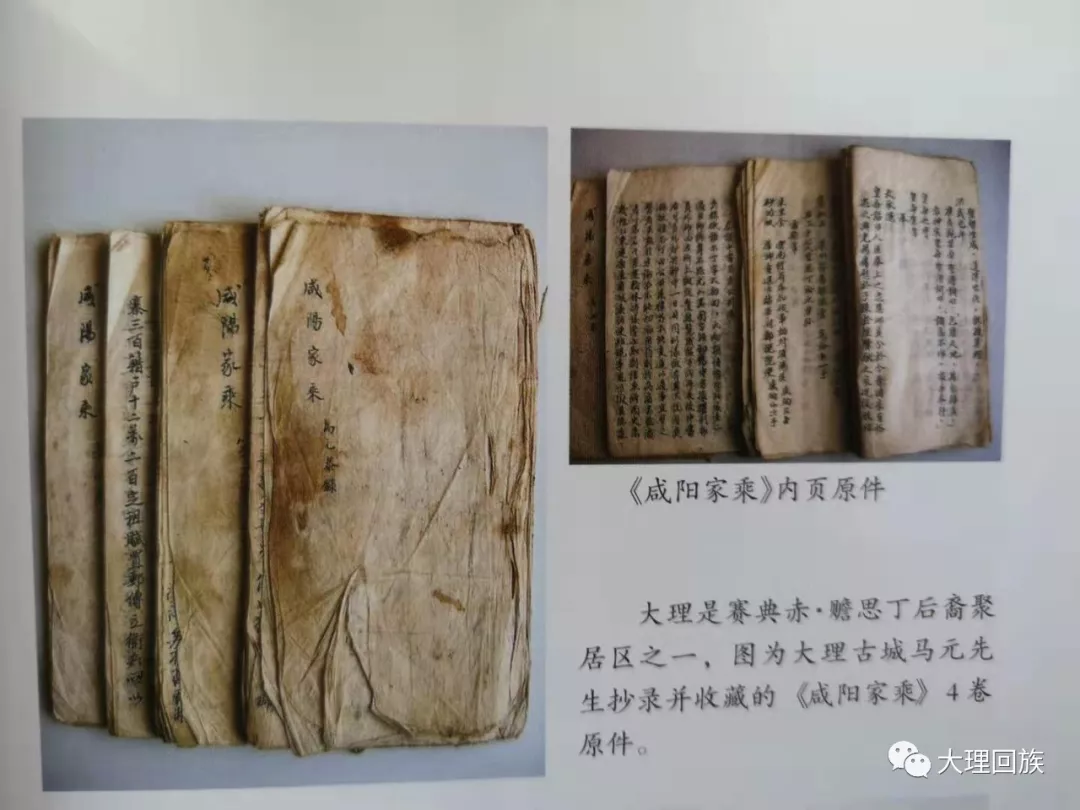
4 volumes; discovery location: Dali Ancient City; collection period: Republic of China era; collector: Mr. Ma Yuan (style name: Yibo), meticulously copied with a writing brush.
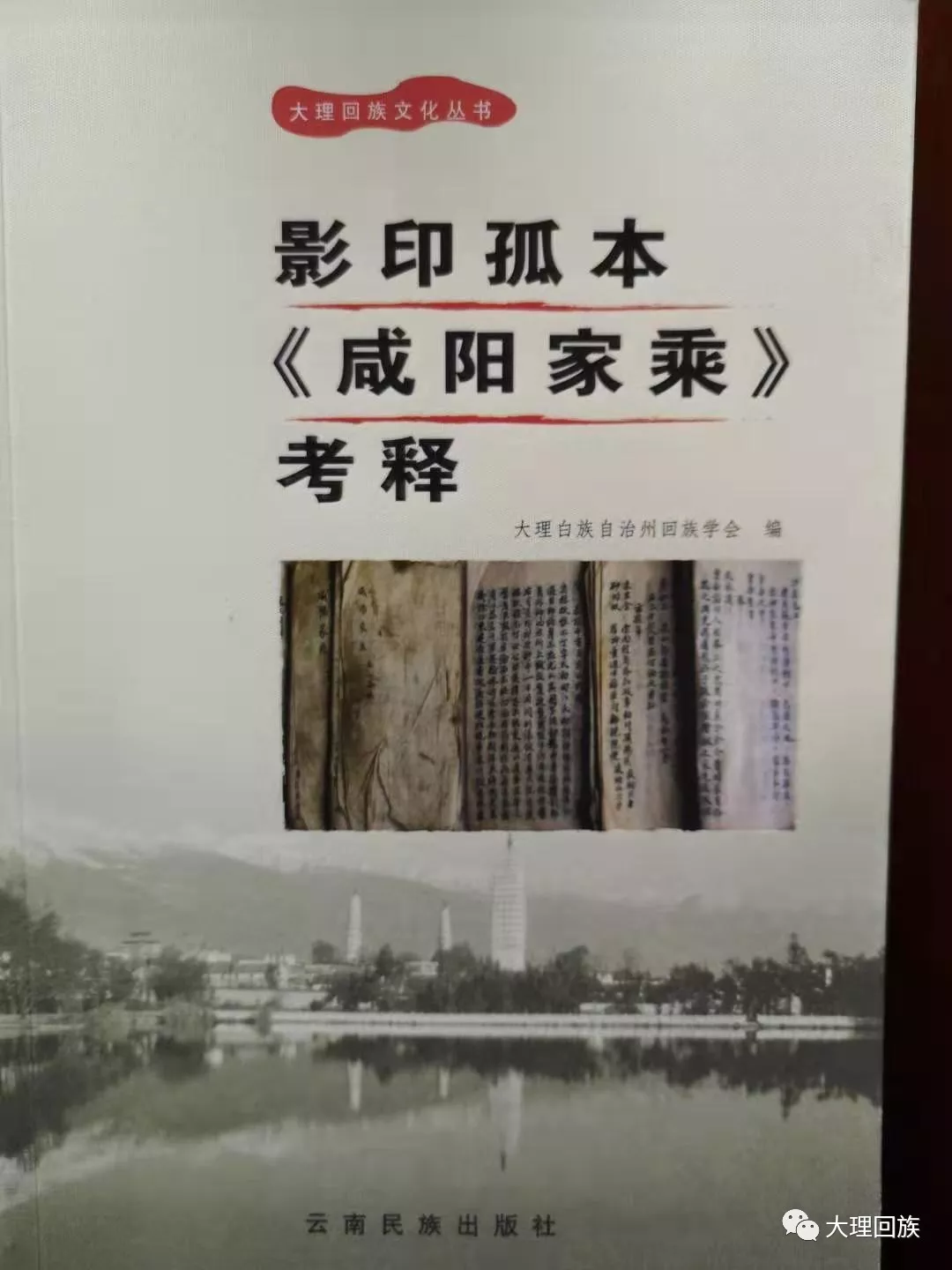
This genealogical record starts from the 26th descendant of the Prophet (Peace Be Upon Him), Suofeier, an Imperial Court Attendant King during the Song dynasty, extends to the 31st descendant, Sayyid Ajjal, in the Yuan dynasty, and continues through the 45th descendant, Ma Zhu, in the early Qing dynasty—compiled over eight generations. Beginning with the first ancestor, the Prophet Muhammad, it traces all the way down to the 47th Qing dynasty descendant, Ma Yingfang, spanning over 1,400 years. Its contents include the lineage from the first ancestor, the Prophet Muhammad, up to the 47th Qing descendant Ma Yingfang; the "General Preface to the Tombstone of Shams al-Din" and "Sayyid Ajjal's Achievements in Governing Yunnan" by the prominent Qing scholar Ma Zhu; eulogies by Emperor Taizong of the Tang and Emperor Taizu of the Ming; 6 imperial edicts from the first year of the Dade era of the Yuan dynasty; the prominent official posts held by Sai and his descendants; the settlement distribution of Sayyid Ajjal's 5 sons and 23 grandsons; and biographies of important figures. It serves as essential literature for studying Sayyid Ajjal, Yunnan history, Yunnan Hui history, and local gazetteers. Its origin is clear and its transmission well-documented; the Ming-dynasty Han scholar Shi Zhongbin recorded this genealogy in his authored book *Zhishen Lu*, demonstrating its authenticity and reliability.
After being organized, collated, and annotated by the author, the "Xianyang Family Genealogy" was included in the Dali Hui Culture Series by the Dali Prefecture Hui Association and officially published in July 2010.
2. "Ma Family Genealogy"
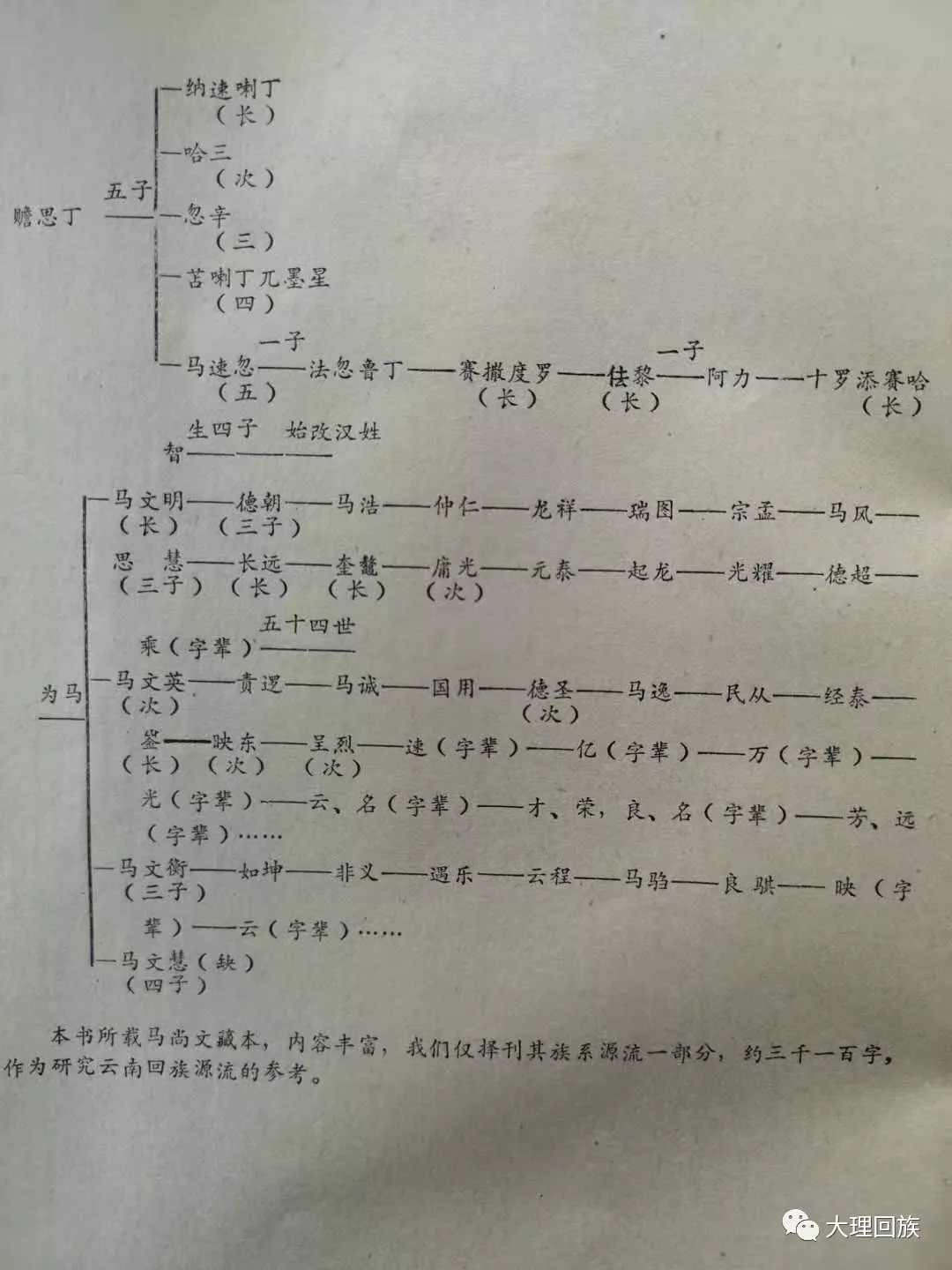
1 volume; discovery location: Dawei Geng, Weishan County; collection period: Republic of China era; collector: Mr. Ma Shangwen, handwritten manuscript with a writing brush. The cover reads: "In the 26th year of the Kangxi era of the Qing dynasty (1687, Dingmao year), the senior elder Ma Zhu of Yongchang took leave from the capital to return to Yunnan, gathering the clan to compile the genealogy." This volume was originally collected by Mr. Ma Yulin (style name: Shisheng) at the South Gate of Dali Ancient City, though it is unknown when it drifted to Weishan. The main contents of this volume include: *Tianfang Zhengxue* (Orthodox Islamic Learning), *Hui Jiao Hunyin Da Jin Tu* (Chart of Major Prohibitions in Islamic Marriage), *Tianfang Shijing Du Zan* (Readings and Praises of Islamic Classics), *Wushi Shi Guang* (Transmission Light of the Fiftieth Generation); lineage charts of the 55th–58th generations of descendants of Muhammad; charts of the ancestral origins of the lineage from Ibrahim to Isa; the Xianyang Family Lineage Record; genealogy lineages; the lineage of Ma Deling; "Sayyid Ajjal's Achievements in Governing Yunnan"; and supplementary notes. This family genealogy was discovered by faculty and students of the Chinese Department of the Yunnan Institute for Nationalities, who sent a photocopy to Mr. Lin Song at the Central University for Nationalities. Mr. Lin Song then passed it on to the Zheng He research expert Mr. Li Shihou, who included it in his edited book *Zheng He Family History Materials*, published by China Communications Press in 1985. Although both of the aforementioned genealogies originated from Dali Ancient City, their contents differ. The "Xianyang Family Genealogy" includes biographies of famous ministers such as Sayyid Ajjal, Nasrudin, Husain, Bayan, Manzilagatai, and Tuotuo, which the "Ma Family Genealogy" does not; conversely, the "Ma Family Genealogy" contains works like *Tianfang Zhengxue*, *Hui Jiao Hunyin Da Jin Tu*, *Tianfang Shijing Du Zan*, *Wushi Shi Guang*, and the origin charts of the lineage from Ibrahim to Isa, which are not included in the "Xianyang Family Genealogy."
3. "Sai Family General Clan Record", also known as "Sai Family Genealogy"
One volume; discovery location: Shiping County; compiled in the 28th year of the Qianlong era of the Qing dynasty (1763) by Sai Yu, the 14th descendant of Sayyid Ajjal, and proofread and supplemented in 1923 by Sai Hongbin; collector: Mr. Sha Rucheng (given name: Guozhen, commonly known by his style name) from Kunming. Main contents: Sayyid Ajjal Family Genealogy Treatise; an appendix on the True Sovereign of the White Emperor; the Sai Family Genealogy; appendices on historical imperial examination degrees and a collection of literary arts; imperial eulogies by Emperor Taizong of the Tang and the hundred-character holy title promulgated by Emperor Taizu of the Ming; the imperial eulogy "Sacrificial Text to Prince Xianyang Zhonghui Sai Gong" composed by Emperor Taizu of the Ming; the imperial eulogy "Sacrificial Text for the Imperial Edict Bestowing Honors on Yuan Pingzhang Political Affairs Official Sayyid Ajjal Shams al-Din" by Emperor Chengzu Wen; the "Sacrificial Text to Prince Xianyang Zhonghui Sai Gong" by the King of Annam; "Temple Inscription for Prince Xianyang" by Wang Chen; "Inscription for the Stele of the Newly Built Baogong Shrine" by Fan Chengxun; original couplets of the royal tomb; and "Record of the Expansion of the Front Pavilion and Rear Offering Hall before the Tomb of Prince Xianyang" by Jiang Yi. This was included in Mr. Li Shihou's book *Zheng He Family History Materials*, published by China Communications Press in 1985.
4. "Sayyid Ajjal Genealogy"
One volume; discovery location: Kunming; the genealogy preserved by Suofeier, the 26th descendant of the Prophet and Imperial Court Attendant King of the Song dynasty (titled *Western Origin Genealogy*), edited and compiled by the 31st descendant Sayyid Ajjal, revised by the 32nd descendant, Prince Zhongjian Husain, recompiled by the 33rd descendant, Prince Zhun Bayan, and revised and proofread four times during the Ming and Qing dynasties. During the Republic of China period, it was treasured in its original edition by Ma Dechao, the 53סט descendant and president of the Menghua (present-day Weishan) Association for Progress, and supplemented and published by the 53rd descendant Ma Yunhua. Collector: Mr. Sha Youxin, also known as Sha Rucheng (given name: Guozhen); "Youxin" is a name Mr. Sha adopted after the founding of the People's Republic of China.
Main contents: Ma Zhu's "General Preface to the Tombstone of Shams al-Din"; eulogies by Emperor Taizong of Tang, Emperor Shenzong of Song, and Emperor Taizu of Ming; Sayyid Ajjal's successive official positions and imperial bestowals; Ma Zhu's "Sayyid Ajjal's Achievements in Governing Yunnan"; supplementary examinations; the Xianyang Family Lineage Record; imperial edicts from successive dynasties; examinations of the western Yunnan branches; biographical sketches of Ma Zhu, Ma Dexin, and Ma Lianyuan; appendix: He Family Genealogy. This was included in *Zheng He Family History Materials* edited by Mr. Li Shihou, published by China Communications Press in 1985.
5. The Genealogy of Zheng He, Sixth-Generation Descendant of Sayyid Ajjal—*Zheng He Genealogy*
One volume; discovery location: Dongying, Beicheng, Yuxi; discovery date: 1936; collectors: Zheng Shaoming, Shaowen, Shaoen, and Shaoqing (four brothers).
In 1936, General Li Hongxiang of Yuxi advocated for the compilation of the county gazetteer and extensively solicited materials for it. Someone copied the *Zheng He Genealogy*—preserved by Zheng Shaoming and his brothers in Dongying Village, Yuxi—and presented it to Li Hongxiang. Recognizing its monumental significance, Li Hongxiang handed it over to the renowned scholar Yuan Jiagu. Yuan Jiagu entrusted it to his top disciple, Li Shihou, who authenticated it as an extant unique manuscript with tremendous historical value. Subsequently, Li Hongxiang, accompanied by Li Shihou, went to Dongying to borrow the original *Genealogy*. Upon authentication, the *Genealogy* was found to be backed with rice paper, printed with vermilion silk column border lines, and showed aged paper color, confirming it to be an artifact from the Ming dynasty.
Following meticulous textual research, Li Shihou authored the book *Textual Research and Commentary on the Zheng He Genealogy*, which was officially published in February 1937. After being photographed, the original *Genealogy* was stored in Wuhashan. In 1938, it was requested back to Yuxi by Zheng Shaoqing, and later borrowed by a man named Zheng Bai—who claimed to be a Zheng He descendant from Shadian—after which it went missing. Fortunately, Mr. Li Shihou retained a blueprint copy of the original *Genealogy*.
In June 2005, to commemorate the 600th anniversary of Zheng He's maritime voyages, Yunnan Chenguang Publishing House published the posthumous work of Mr. Li Shihou, *Facsimile Edition of the Original Zheng He Genealogy with Annotations*, making the blueprint originals and photographs preserved for over 60 years fully available to the public. The academic community was thrilled!
Main contents: The *Genealogy* begins recording from the first ancestor Zheng He, clarifying that Zheng He established his lineage by adopting the son of his elder brother Ma Wenming (named Zheng Ci), and continues all the way down to the 15th generation Zheng Yongsheng of the Qing dynasty, his sons the 16th generation Zheng Xingfu, Xinggui, and Xingwang, the 17th generation comprising the genealogy-preserving brothers Zheng Shaoming, and the 18th generation of contemporary brothers like Zheng Yunliang. This completely preserves the 600-year lineage of Zheng He's family, which is an extraordinary feat. At the same time, it provides a comprehensive interpretation of Zheng He's achievements and virtues, revealing two exclusive historical sources of great value. It represents yet another major discovery following the late-Qing discovery of the Mahazhi Stele in Yunnan.
Among the five Sayyid Ajjal family genealogies mentioned above, aside from Sai Yu's *Sai Family General Clan Record* and the *Zheng He Genealogy*, the *Xianyang Family Genealogy*, *Ma Family Genealogy*, and *Sayyid Ajjal Genealogy* share a common origin with divergent branches. They all stem from the *Western Origin Genealogy* preserved by Suofeier in the Song dynasty, compiled starting from Sayyid Ajjal in the Yuan dynasty, expanded and supplemented by Husain, Bayan, and Ma Zhu of the Ming and Qing dynasties, and finally revised by descendants after the Republic of China era. The difference lies in the varying focal points of their compiled contents, with each genealogy possessing its own unique characteristics. In addition, there is the Na Family Genealogy collected by Associate Professor Na Jufeng of Najaying; the He Family Genealogy of Xiaohui Village, Tonghai; the Sayyid Ajjal genealogy *Root Branches for a Hundred Generations* collected by Ma Saiheng of Dongying, Yuxi; and the *Sha Family Genealogy* of Dali. Whether due to not having seen the original manuscripts or because their contents are brief, they are not detailed here individually. Organizing and researching these genealogies holds great significance for our compilation of local gazetteers, village histories, and our ability to trace our sources and origins today.
Transcribed copy of the Ma Yunhua collection in Yongsheng view all
The Distribution and Organization of the Genealogy of Prince Xianyang Sayyid Ajjal: Yunnan Hui Genealogies, Sayyid Ajjal Descendants, and Family History
Abstract: This article organizes the key points of the original text "The Distribution and Organization of the Genealogy of Prince Xianyang Sayyid Ajjal: Yunnan Hui Genealogies, Sayyid Ajjal Descendants, and Family History," maintaining the original paragraph and image order. It is suitable for readers and researchers looking for long-tail keywords related to the Sayyid Ajjal genealogy, Yunnan Hui Muslims, and Hui clan records.
Ma Yingsheng
Genealogies are records documenting a single surname's lineage and the significant deeds of its figures. Using a specific format to record the lineage, biographical deeds, living environments, and local customs of a patrilineal blood-related family, they form an essential component of local gazetteers. The genealogy of Sayyid Ajjal records his family lineage along with the important figures and major events within his family. Hui Muslims entered Yunnan as early as the Tang and Song dynasties, but they primarily arrived during the Yuan dynasty alongside Sayyid Ajjal. His descendants spread throughout various regions of Yunnan and beyond the province, mainly comprising 16 surnames: Sha, Ma, Na, Hu, Qi, Jin, Mi, Sai, Ding, Sa, Ha, Su, Shan, Hu, Hai, and Bao. Over successive dynasties, several versions of family genealogies were compiled. A rough count of known versions circulating in Yunnan (excluding those outside the province) totals 9 versions. Below, we focus on introducing 5 versions that have been observed:
1. "Xianyang Family Genealogy", also known as "Dali Ma Surname Clan Lineage" or "Dali Ma Surname Genealogy"
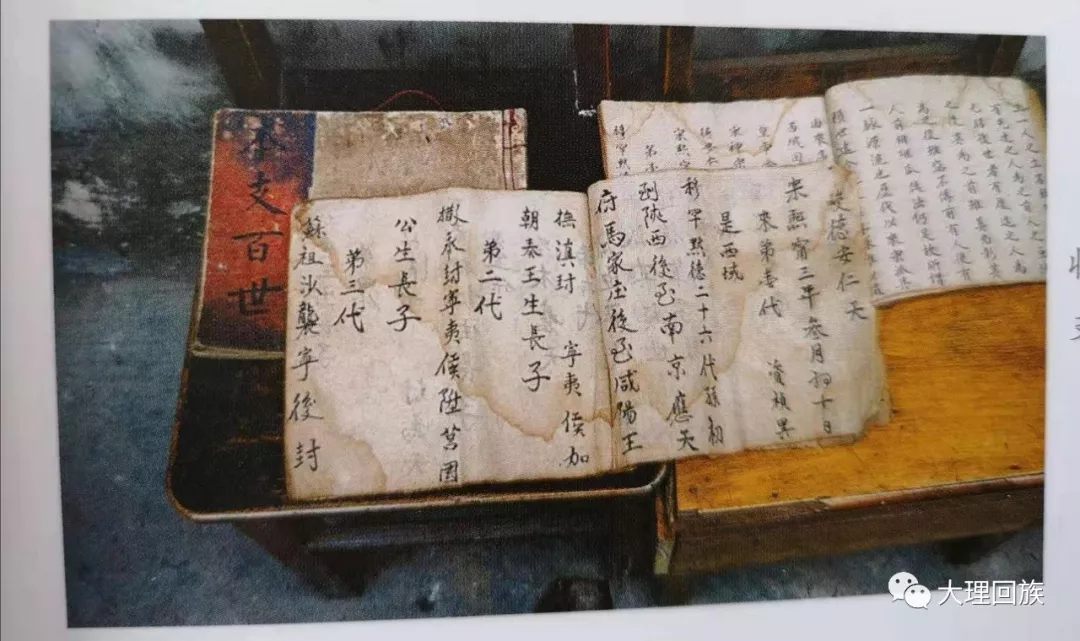
4 volumes; discovery location: Dali Ancient City; collection period: Republic of China era; collector: Mr. Ma Yuan (style name: Yibo), meticulously copied with a writing brush.
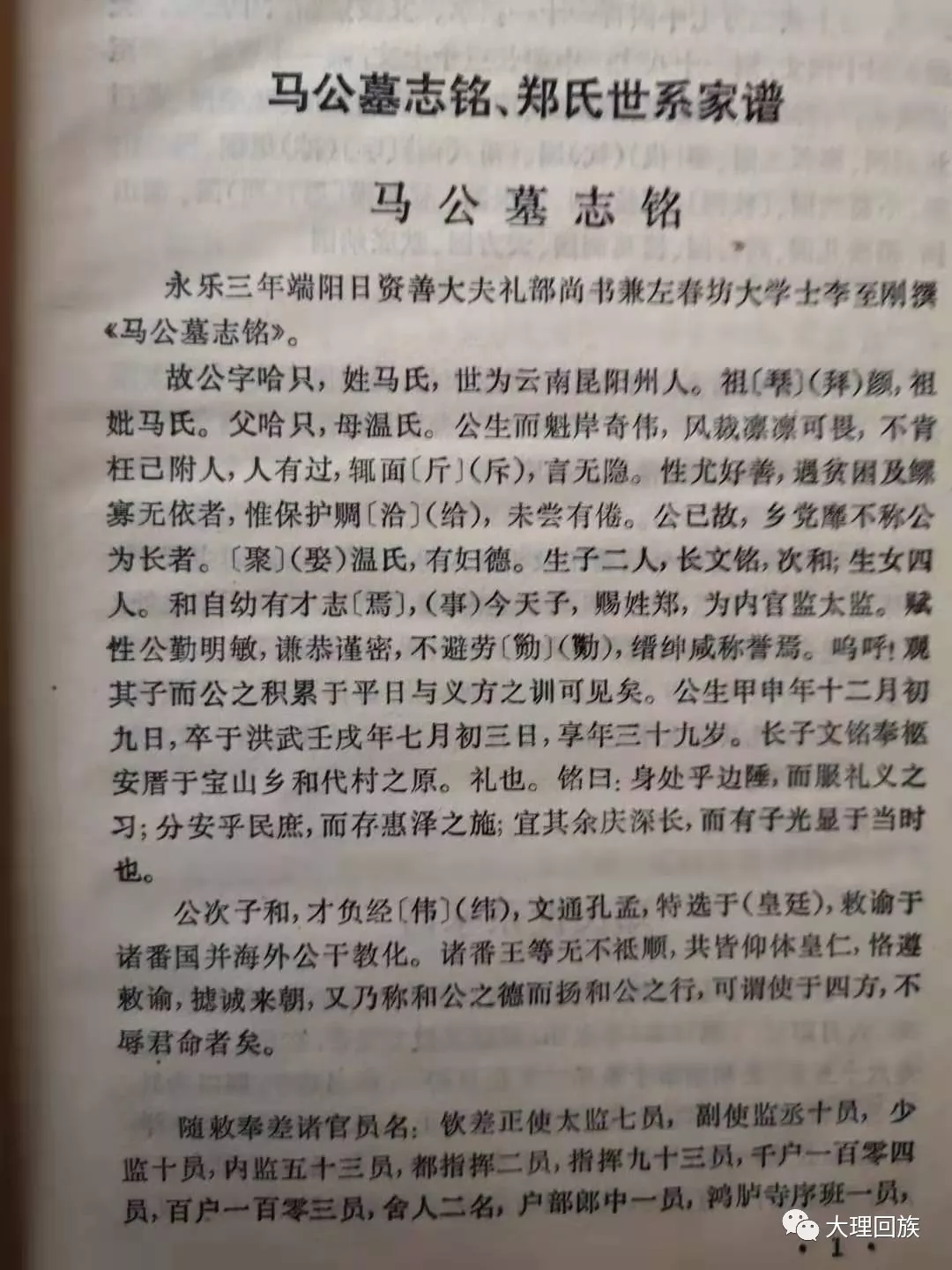
This genealogical record starts from the 26th descendant of the Prophet (Peace Be Upon Him), Suofeier, an Imperial Court Attendant King during the Song dynasty, extends to the 31st descendant, Sayyid Ajjal, in the Yuan dynasty, and continues through the 45th descendant, Ma Zhu, in the early Qing dynasty—compiled over eight generations. Beginning with the first ancestor, the Prophet Muhammad, it traces all the way down to the 47th Qing dynasty descendant, Ma Yingfang, spanning over 1,400 years. Its contents include the lineage from the first ancestor, the Prophet Muhammad, up to the 47th Qing descendant Ma Yingfang; the "General Preface to the Tombstone of Shams al-Din" and "Sayyid Ajjal's Achievements in Governing Yunnan" by the prominent Qing scholar Ma Zhu; eulogies by Emperor Taizong of the Tang and Emperor Taizu of the Ming; 6 imperial edicts from the first year of the Dade era of the Yuan dynasty; the prominent official posts held by Sai and his descendants; the settlement distribution of Sayyid Ajjal's 5 sons and 23 grandsons; and biographies of important figures. It serves as essential literature for studying Sayyid Ajjal, Yunnan history, Yunnan Hui history, and local gazetteers. Its origin is clear and its transmission well-documented; the Ming-dynasty Han scholar Shi Zhongbin recorded this genealogy in his authored book *Zhishen Lu*, demonstrating its authenticity and reliability.
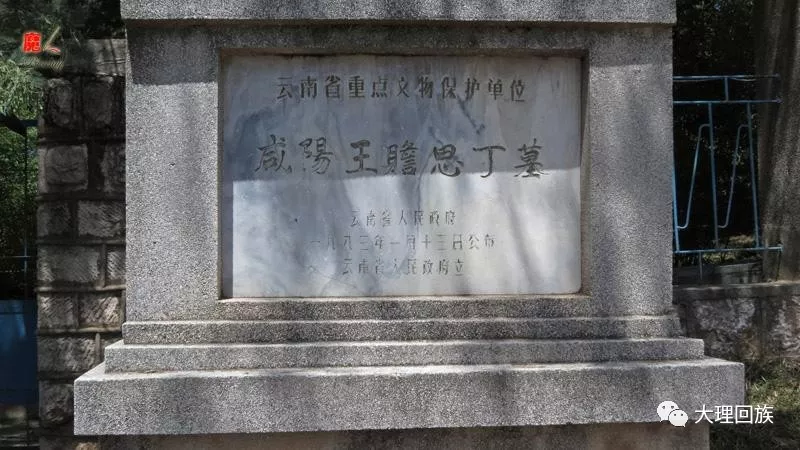
After being organized, collated, and annotated by the author, the "Xianyang Family Genealogy" was included in the Dali Hui Culture Series by the Dali Prefecture Hui Association and officially published in July 2010.
2. "Ma Family Genealogy"
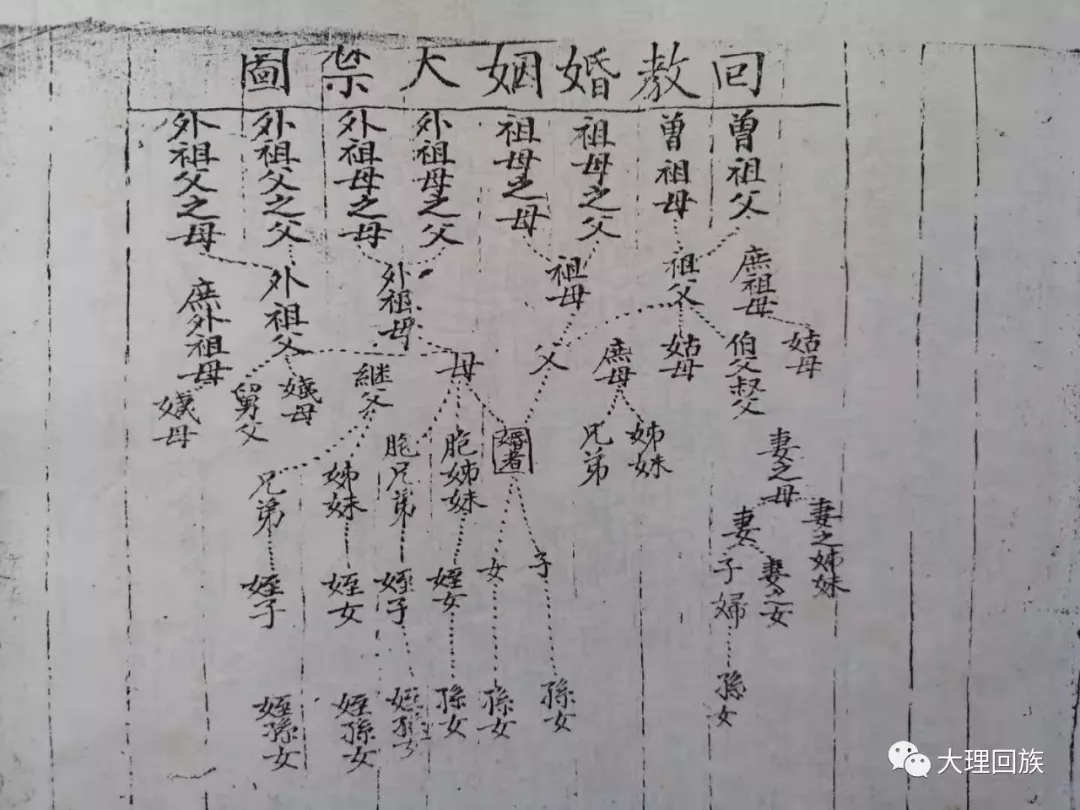
1 volume; discovery location: Dawei Geng, Weishan County; collection period: Republic of China era; collector: Mr. Ma Shangwen, handwritten manuscript with a writing brush. The cover reads: "In the 26th year of the Kangxi era of the Qing dynasty (1687, Dingmao year), the senior elder Ma Zhu of Yongchang took leave from the capital to return to Yunnan, gathering the clan to compile the genealogy." This volume was originally collected by Mr. Ma Yulin (style name: Shisheng) at the South Gate of Dali Ancient City, though it is unknown when it drifted to Weishan. The main contents of this volume include: *Tianfang Zhengxue* (Orthodox Islamic Learning), *Hui Jiao Hunyin Da Jin Tu* (Chart of Major Prohibitions in Islamic Marriage), *Tianfang Shijing Du Zan* (Readings and Praises of Islamic Classics), *Wushi Shi Guang* (Transmission Light of the Fiftieth Generation); lineage charts of the 55th–58th generations of descendants of Muhammad; charts of the ancestral origins of the lineage from Ibrahim to Isa; the Xianyang Family Lineage Record; genealogy lineages; the lineage of Ma Deling; "Sayyid Ajjal's Achievements in Governing Yunnan"; and supplementary notes. This family genealogy was discovered by faculty and students of the Chinese Department of the Yunnan Institute for Nationalities, who sent a photocopy to Mr. Lin Song at the Central University for Nationalities. Mr. Lin Song then passed it on to the Zheng He research expert Mr. Li Shihou, who included it in his edited book *Zheng He Family History Materials*, published by China Communications Press in 1985. Although both of the aforementioned genealogies originated from Dali Ancient City, their contents differ. The "Xianyang Family Genealogy" includes biographies of famous ministers such as Sayyid Ajjal, Nasrudin, Husain, Bayan, Manzilagatai, and Tuotuo, which the "Ma Family Genealogy" does not; conversely, the "Ma Family Genealogy" contains works like *Tianfang Zhengxue*, *Hui Jiao Hunyin Da Jin Tu*, *Tianfang Shijing Du Zan*, *Wushi Shi Guang*, and the origin charts of the lineage from Ibrahim to Isa, which are not included in the "Xianyang Family Genealogy."
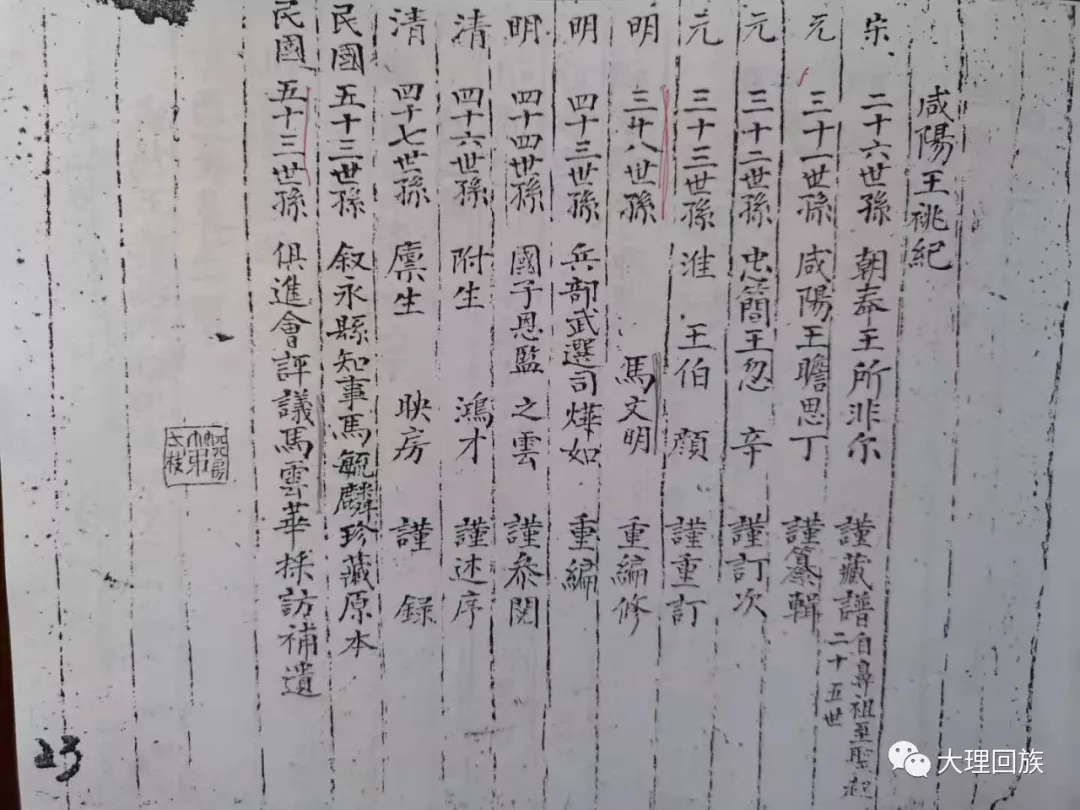
3. "Sai Family General Clan Record", also known as "Sai Family Genealogy"
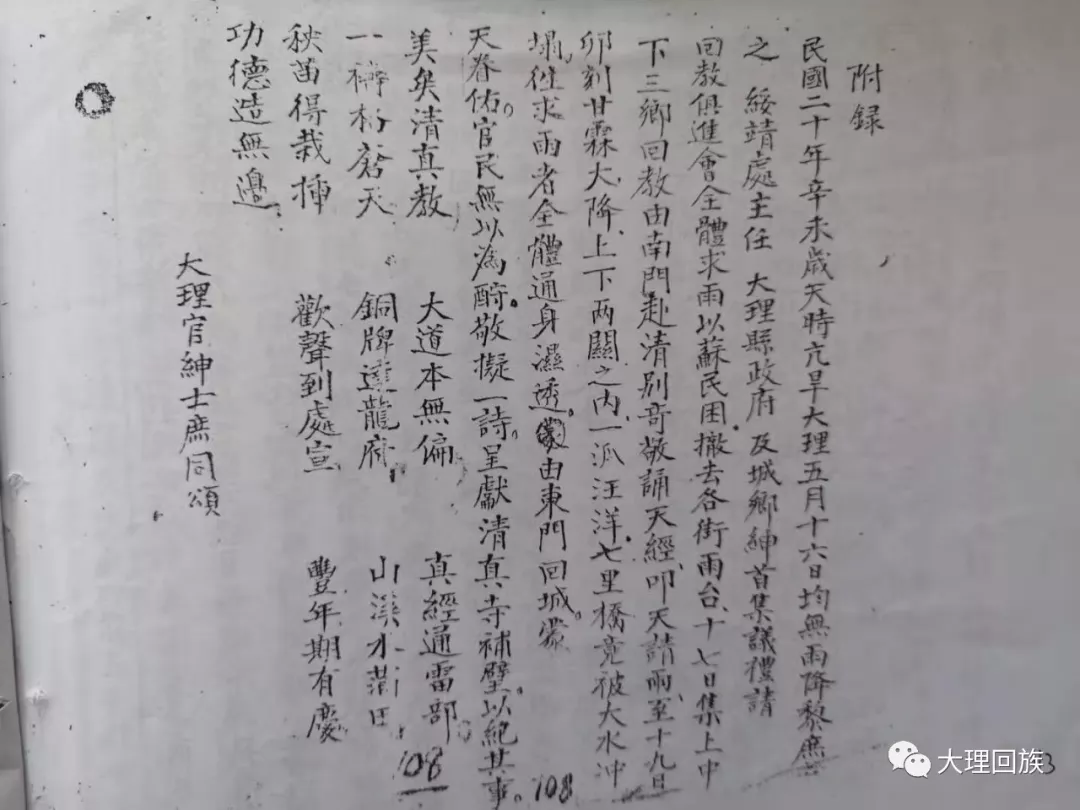
One volume; discovery location: Shiping County; compiled in the 28th year of the Qianlong era of the Qing dynasty (1763) by Sai Yu, the 14th descendant of Sayyid Ajjal, and proofread and supplemented in 1923 by Sai Hongbin; collector: Mr. Sha Rucheng (given name: Guozhen, commonly known by his style name) from Kunming. Main contents: Sayyid Ajjal Family Genealogy Treatise; an appendix on the True Sovereign of the White Emperor; the Sai Family Genealogy; appendices on historical imperial examination degrees and a collection of literary arts; imperial eulogies by Emperor Taizong of the Tang and the hundred-character holy title promulgated by Emperor Taizu of the Ming; the imperial eulogy "Sacrificial Text to Prince Xianyang Zhonghui Sai Gong" composed by Emperor Taizu of the Ming; the imperial eulogy "Sacrificial Text for the Imperial Edict Bestowing Honors on Yuan Pingzhang Political Affairs Official Sayyid Ajjal Shams al-Din" by Emperor Chengzu Wen; the "Sacrificial Text to Prince Xianyang Zhonghui Sai Gong" by the King of Annam; "Temple Inscription for Prince Xianyang" by Wang Chen; "Inscription for the Stele of the Newly Built Baogong Shrine" by Fan Chengxun; original couplets of the royal tomb; and "Record of the Expansion of the Front Pavilion and Rear Offering Hall before the Tomb of Prince Xianyang" by Jiang Yi. This was included in Mr. Li Shihou's book *Zheng He Family History Materials*, published by China Communications Press in 1985.
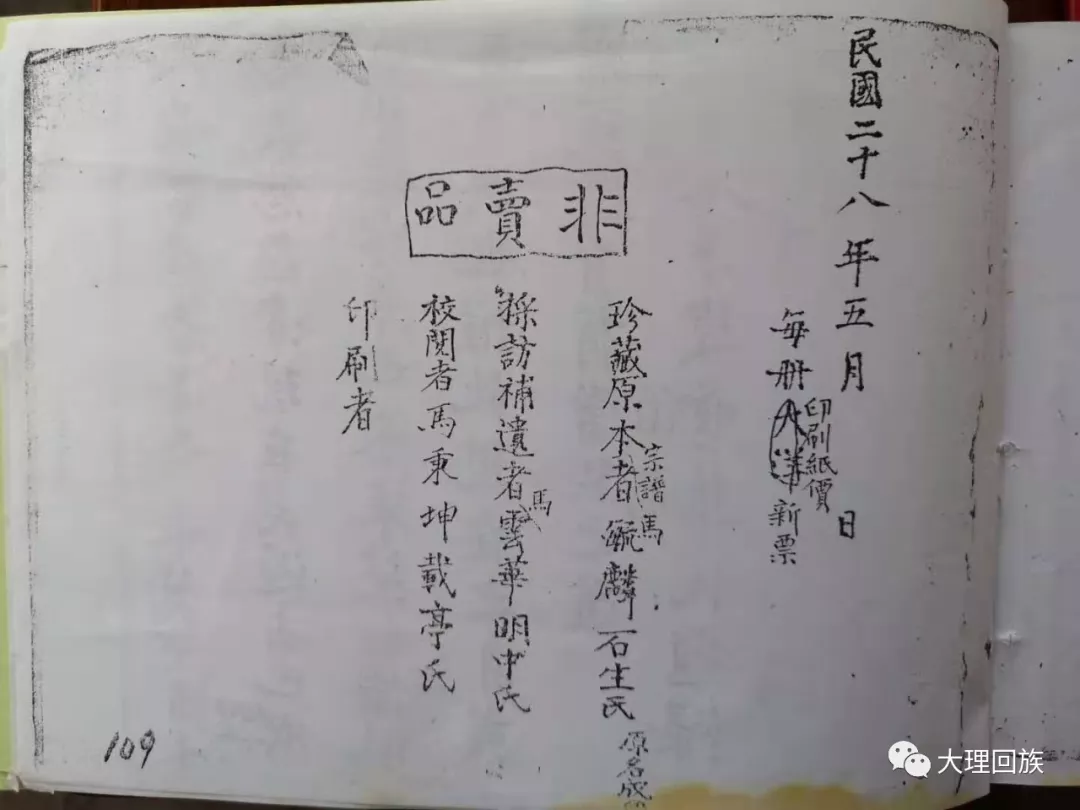
4. "Sayyid Ajjal Genealogy"
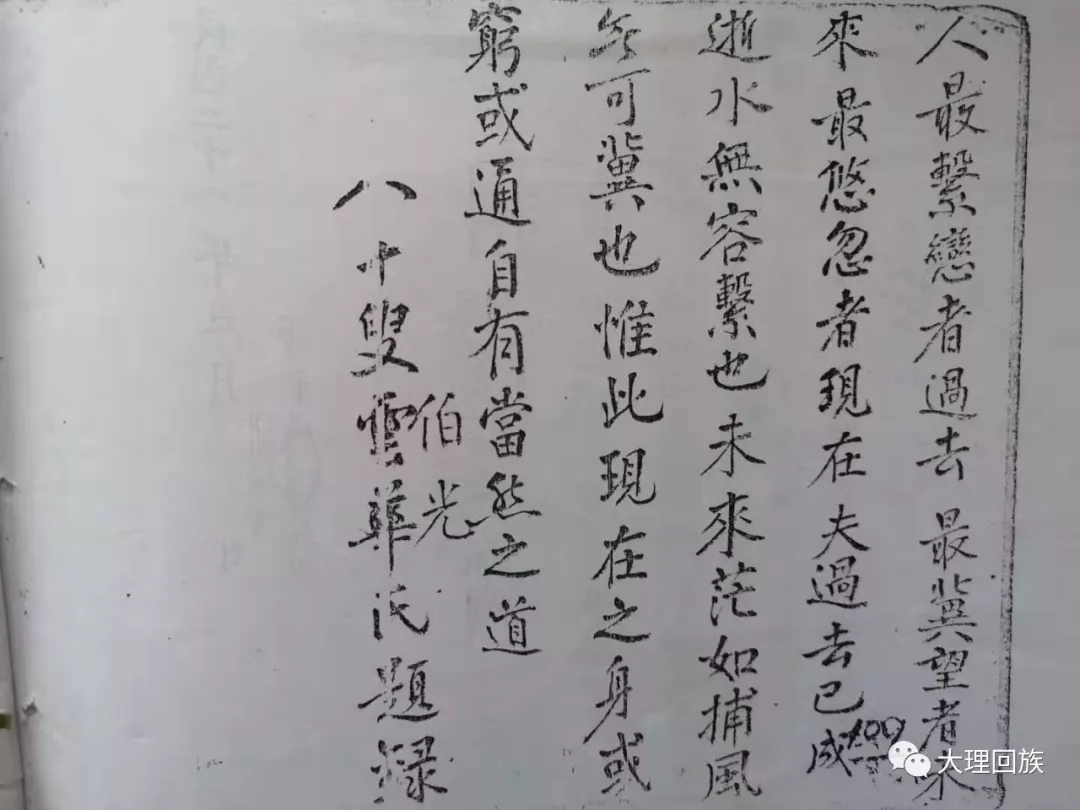
One volume; discovery location: Kunming; the genealogy preserved by Suofeier, the 26th descendant of the Prophet and Imperial Court Attendant King of the Song dynasty (titled *Western Origin Genealogy*), edited and compiled by the 31st descendant Sayyid Ajjal, revised by the 32nd descendant, Prince Zhongjian Husain, recompiled by the 33rd descendant, Prince Zhun Bayan, and revised and proofread four times during the Ming and Qing dynasties. During the Republic of China period, it was treasured in its original edition by Ma Dechao, the 53סט descendant and president of the Menghua (present-day Weishan) Association for Progress, and supplemented and published by the 53rd descendant Ma Yunhua. Collector: Mr. Sha Youxin, also known as Sha Rucheng (given name: Guozhen); "Youxin" is a name Mr. Sha adopted after the founding of the People's Republic of China.
Main contents: Ma Zhu's "General Preface to the Tombstone of Shams al-Din"; eulogies by Emperor Taizong of Tang, Emperor Shenzong of Song, and Emperor Taizu of Ming; Sayyid Ajjal's successive official positions and imperial bestowals; Ma Zhu's "Sayyid Ajjal's Achievements in Governing Yunnan"; supplementary examinations; the Xianyang Family Lineage Record; imperial edicts from successive dynasties; examinations of the western Yunnan branches; biographical sketches of Ma Zhu, Ma Dexin, and Ma Lianyuan; appendix: He Family Genealogy. This was included in *Zheng He Family History Materials* edited by Mr. Li Shihou, published by China Communications Press in 1985.
5. The Genealogy of Zheng He, Sixth-Generation Descendant of Sayyid Ajjal—*Zheng He Genealogy*
One volume; discovery location: Dongying, Beicheng, Yuxi; discovery date: 1936; collectors: Zheng Shaoming, Shaowen, Shaoen, and Shaoqing (four brothers).
In 1936, General Li Hongxiang of Yuxi advocated for the compilation of the county gazetteer and extensively solicited materials for it. Someone copied the *Zheng He Genealogy*—preserved by Zheng Shaoming and his brothers in Dongying Village, Yuxi—and presented it to Li Hongxiang. Recognizing its monumental significance, Li Hongxiang handed it over to the renowned scholar Yuan Jiagu. Yuan Jiagu entrusted it to his top disciple, Li Shihou, who authenticated it as an extant unique manuscript with tremendous historical value. Subsequently, Li Hongxiang, accompanied by Li Shihou, went to Dongying to borrow the original *Genealogy*. Upon authentication, the *Genealogy* was found to be backed with rice paper, printed with vermilion silk column border lines, and showed aged paper color, confirming it to be an artifact from the Ming dynasty.
Following meticulous textual research, Li Shihou authored the book *Textual Research and Commentary on the Zheng He Genealogy*, which was officially published in February 1937. After being photographed, the original *Genealogy* was stored in Wuhashan. In 1938, it was requested back to Yuxi by Zheng Shaoqing, and later borrowed by a man named Zheng Bai—who claimed to be a Zheng He descendant from Shadian—after which it went missing. Fortunately, Mr. Li Shihou retained a blueprint copy of the original *Genealogy*.
In June 2005, to commemorate the 600th anniversary of Zheng He's maritime voyages, Yunnan Chenguang Publishing House published the posthumous work of Mr. Li Shihou, *Facsimile Edition of the Original Zheng He Genealogy with Annotations*, making the blueprint originals and photographs preserved for over 60 years fully available to the public. The academic community was thrilled!
Main contents: The *Genealogy* begins recording from the first ancestor Zheng He, clarifying that Zheng He established his lineage by adopting the son of his elder brother Ma Wenming (named Zheng Ci), and continues all the way down to the 15th generation Zheng Yongsheng of the Qing dynasty, his sons the 16th generation Zheng Xingfu, Xinggui, and Xingwang, the 17th generation comprising the genealogy-preserving brothers Zheng Shaoming, and the 18th generation of contemporary brothers like Zheng Yunliang. This completely preserves the 600-year lineage of Zheng He's family, which is an extraordinary feat. At the same time, it provides a comprehensive interpretation of Zheng He's achievements and virtues, revealing two exclusive historical sources of great value. It represents yet another major discovery following the late-Qing discovery of the Mahazhi Stele in Yunnan.
Among the five Sayyid Ajjal family genealogies mentioned above, aside from Sai Yu's *Sai Family General Clan Record* and the *Zheng He Genealogy*, the *Xianyang Family Genealogy*, *Ma Family Genealogy*, and *Sayyid Ajjal Genealogy* share a common origin with divergent branches. They all stem from the *Western Origin Genealogy* preserved by Suofeier in the Song dynasty, compiled starting from Sayyid Ajjal in the Yuan dynasty, expanded and supplemented by Husain, Bayan, and Ma Zhu of the Ming and Qing dynasties, and finally revised by descendants after the Republic of China era. The difference lies in the varying focal points of their compiled contents, with each genealogy possessing its own unique characteristics. In addition, there is the Na Family Genealogy collected by Associate Professor Na Jufeng of Najaying; the He Family Genealogy of Xiaohui Village, Tonghai; the Sayyid Ajjal genealogy *Root Branches for a Hundred Generations* collected by Ma Saiheng of Dongying, Yuxi; and the *Sha Family Genealogy* of Dali. Whether due to not having seen the original manuscripts or because their contents are brief, they are not detailed here individually. Organizing and researching these genealogies holds great significance for our compilation of local gazetteers, village histories, and our ability to trace our sources and origins today.
Transcribed copy of the Ma Yunhua collection in Yongsheng
Remembering Satangji: The Lost Century-Old Halal Bakery and Dim Sum Legend of Guangzhou
Articles • Hasan09 posted the article • 0 comments • 6 views • 8 hours ago
Remembering Satangji: The Lost Century-Old Halal Bakery and Dim Sum Legend of Guangzhou
Abstract:
Drawing on rare historical and cultural archives alongside vintage staff photographs, this piece takes a deep dive into the history of 'Satangji Bakery,' a legendary Halal landmark in Guangzhou’s Hui Muslim community. We look back at its glory days making authentic Halal Cantonese mooncakes and traditional pastries, preserving a rich cultural heritage.
Staff photograph of Satangji Bakery (Photo courtesy of Qiuran Shi)
Did you know that Guangzhou's Hui Muslim history is packed with legendary Halal eateries? Some started out selling casual street eats, others made names for themselves with roasted duck, while a few grew into full-scale teahouses and restaurants.
They weren't just hits among Hui Muslims; they won rave reviews across the board from the general public too.
It’s a real shame that, as time rolled on, these historic Halal spots didn’t get the lucky second act that places like the Guangzhou Muslim Restaurant (Huimin Restaurant) managed to secure.
Today, we can only piece together what those days looked like through the few scattered photos and texts left behind by our elders. We're also hoping this piece might help us connect with anyone in the know who can share more stories and archives.
The spot we're spotlighting today is 'Satangji,' a classic Halal institution famous for cold drinks and street snacks. Our historical source here is an essay titled 'How I Ran Satangji' written by Mr. Sa Hanqiang (birth name Sa Yirou, courtesy name Hanqiang, 1911–1996).
Reply with 'Satangji' in our official account backend to grab a copy of the essay.
Special thanks to Mr. Zhang Zhongyi and Qiuran Shi for providing the archival support.
From 'Tangji' to 'Satangji'
According to Mr. Sa Hanqiang, his grandfather Sa Xianyang (1829–1895) once ran a shop called 'Tangji Pastry Shop' right by the Zhulanmen city gate, famous for saqima (traditional sweet Manchu-style pastry / fried dough cake) and 'five-spice salted crispy rice crackers.' By the time the business passed down to him, the original shop had been demolished. Starting back up as a street vendor, he kept the 'Tangji' name and added the family surname 'Sa' to the front—which is how 'Satangji' got its name.
The story of Satangji kicked off around 1930. Back then, a newly reclaimed plot of flat land down by the Changdi waterfront was bustling with sightseers and street peddlers. A 19-year-old Sa Hanqiang spotted the massive crowds, figured there was money to be made, and rented a little stall to sell tofu hua (silken tofu pudding / sweet beancurd). That was the launchpad for his street-vending hustle.
From that point on, Satangji's 'street vendor era' rolled on until 1944. Over those years, the stall's menu expanded from tofu hua to dangaozai (mini egg cakes / bite-sized sponge cakes). Meanwhile, due to the chaos of war, Mr. Sa Hanqiang bounced back and forth between Guangzhou, Hong Kong, and Guilin, living a pretty turbulent life.
Figuring that street vending was barely keeping the lights on and had no real future, he decided in 1944 to hang up his apron as a peddler and start setting up a proper, brick-and-mortar storefront.
From 'Opening a Proper Shop' to 'Public-Private Partnership'
In October 1944, Sa Hanqiang teamed up with his family to rent a storefront on Huiai East Road, where they started slinging dangaozai.
Because Satangji's dangaozai tasted amazing—and thanks to Sa Hanqiang’s sharp business instincts—the shop took off. Business boomed so fast that they were soon looking to scale up and open branch locations.
The first branch opened over in Xiguan, bringing an even wider lineup of snacks like big dangao (sponge cake), heliaosu (walnut cookies), danbaidui (crispy egg-white puffs), and danhuangbing (egg yolk biscuits).
When the Japanese surrendered and Guangzhou's markets bounced back into a boom, Satangji’s bankroll got a serious upgrade. They poured funds back into expanding their flagship spot on Huiai East Road, adding indoor seating and cold drinks to offset the slow summer slump.
Not long after, a second branch opened up on Zhongshan 4th Road. During this stretch, Mr. Sa Hanqiang used his savvy business sense and multi-pronged competitive playbook to completely edge out a wave of copycats and rivals.
By 1949, the PRC was founded and Guangzhou was liberated. Satangji's third branch opened for business on Zhongshan 5th Road. By this time, daily store operations were mostly being run by Sa Hanqiang’s younger brother and brother-in-law, while he described his own mindset back then as 'indifferent to shop affairs and badly drifting toward a life of ease.'
In 1955, backed by the care and support of the Party and government, Mr. Sa Hanqiang took charge of supplying desserts during the 'Soviet Economic Achievements Exhibition' held in Guangzhou.
In 1956, riding the wave of the era's major economic shifts, Satangji jumped into the trend of 'public-private partnerships' (joint state-private ownership), setting up distribution spots all over town as business stayed red-hot.
Memories of 'Satangji' featured in the 'Crossing the Crossroads' article by the WeChat account 'Junhua Tang'
As for how Satangji gradually lost its footing and faded into the history books, no further records have turned up just yet.
All we're left with is a deep sense of regret.
Portrait of Sa Hanqiang: Quick-witted, Innovative, and Out-of-the-Box
Looking back at how Mr. Sa Hanqiang built and ran Satangji, it’s clear as day that his secret weapon for turning an unheralded street cart into a household brand name was being 'quick-witted, fiercely innovative, and always playing an unexpected winning hand.'
Back when he first started out selling tofu hua (silken tofu pudding), he got super creative by using a giant earthenware basin to hold the pudding, decorating it with fresh flowers, and putting a huge emphasis on the hygiene and cleanliness of his Halal food, which totally made Satang Ji stand out from all the other food stalls.
When selling iced soy milk, he cleverly poured the frozen soy milk into a thermos flask to keep it cold so he could easily pour and serve it whenever.
When making dangaozai (traditional mini sponge cakes), he constantly fine-tuned his craft to boost efficiency and updated the mold designs so Satang Ji's treats always stayed a step ahead of the competition.
Not to mention how well he understood customer psychology while running the business, using all sorts of marketing tactics like advertising, designing custom packaging, studying product displays, and making things right in front of the crowd.
All of these are the exact reasons why Mr. Sa Hanqiang was able to grow Satang Ji step-by-step into a major success.
Satang Ji might be gone from our daily lives now, but we're still hoping that one day in the future, some passionate folks in the food and restaurant industry will bring back the "Satang Ji" name and let this legendary old Guangzhou Halal brand make a comeback.
Remember to reply with "Satang Ji" in the official account chat to grab the original text of "How I Ran Satang Ji"~ view all
Remembering Satangji: The Lost Century-Old Halal Bakery and Dim Sum Legend of Guangzhou
Abstract:
Drawing on rare historical and cultural archives alongside vintage staff photographs, this piece takes a deep dive into the history of 'Satangji Bakery,' a legendary Halal landmark in Guangzhou’s Hui Muslim community. We look back at its glory days making authentic Halal Cantonese mooncakes and traditional pastries, preserving a rich cultural heritage.
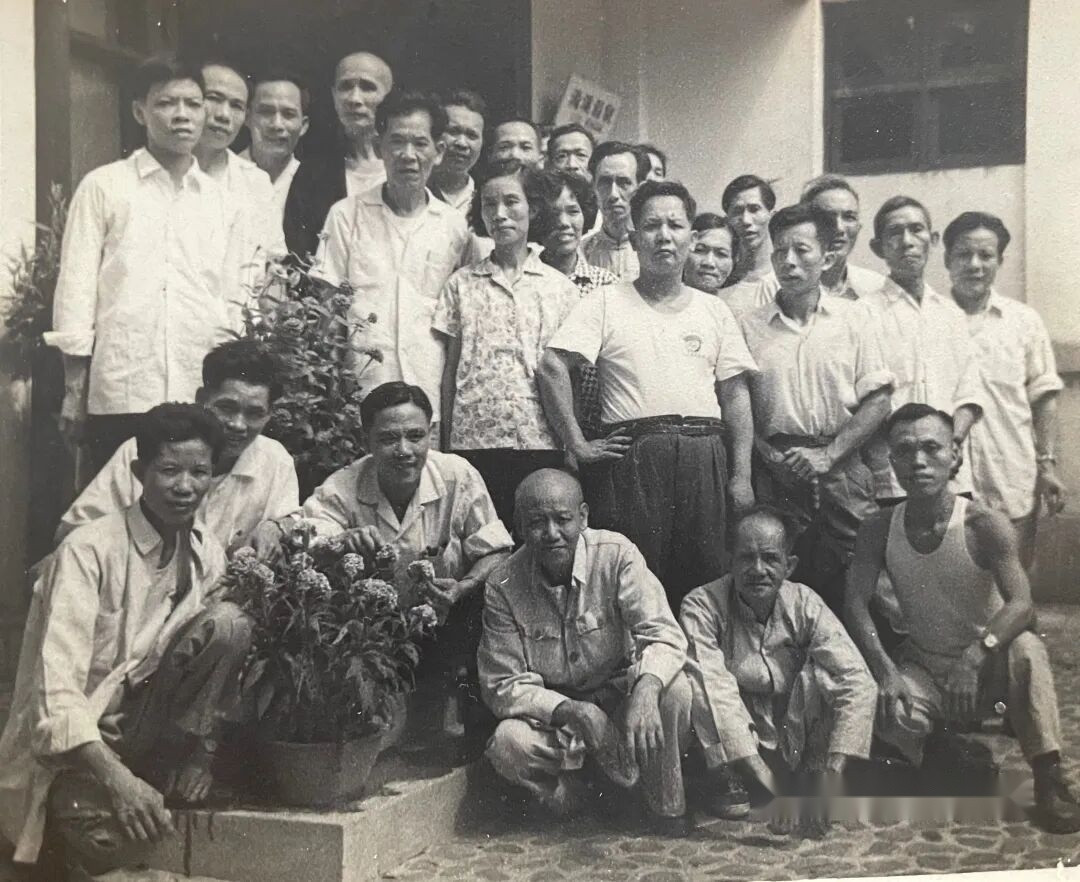
Staff photograph of Satangji Bakery (Photo courtesy of Qiuran Shi)
Did you know that Guangzhou's Hui Muslim history is packed with legendary Halal eateries? Some started out selling casual street eats, others made names for themselves with roasted duck, while a few grew into full-scale teahouses and restaurants.
They weren't just hits among Hui Muslims; they won rave reviews across the board from the general public too.
It’s a real shame that, as time rolled on, these historic Halal spots didn’t get the lucky second act that places like the Guangzhou Muslim Restaurant (Huimin Restaurant) managed to secure.
Today, we can only piece together what those days looked like through the few scattered photos and texts left behind by our elders. We're also hoping this piece might help us connect with anyone in the know who can share more stories and archives.
The spot we're spotlighting today is 'Satangji,' a classic Halal institution famous for cold drinks and street snacks. Our historical source here is an essay titled 'How I Ran Satangji' written by Mr. Sa Hanqiang (birth name Sa Yirou, courtesy name Hanqiang, 1911–1996).
Reply with 'Satangji' in our official account backend to grab a copy of the essay.
Special thanks to Mr. Zhang Zhongyi and Qiuran Shi for providing the archival support.
From 'Tangji' to 'Satangji'
According to Mr. Sa Hanqiang, his grandfather Sa Xianyang (1829–1895) once ran a shop called 'Tangji Pastry Shop' right by the Zhulanmen city gate, famous for saqima (traditional sweet Manchu-style pastry / fried dough cake) and 'five-spice salted crispy rice crackers.' By the time the business passed down to him, the original shop had been demolished. Starting back up as a street vendor, he kept the 'Tangji' name and added the family surname 'Sa' to the front—which is how 'Satangji' got its name.
The story of Satangji kicked off around 1930. Back then, a newly reclaimed plot of flat land down by the Changdi waterfront was bustling with sightseers and street peddlers. A 19-year-old Sa Hanqiang spotted the massive crowds, figured there was money to be made, and rented a little stall to sell tofu hua (silken tofu pudding / sweet beancurd). That was the launchpad for his street-vending hustle.
From that point on, Satangji's 'street vendor era' rolled on until 1944. Over those years, the stall's menu expanded from tofu hua to dangaozai (mini egg cakes / bite-sized sponge cakes). Meanwhile, due to the chaos of war, Mr. Sa Hanqiang bounced back and forth between Guangzhou, Hong Kong, and Guilin, living a pretty turbulent life.
Figuring that street vending was barely keeping the lights on and had no real future, he decided in 1944 to hang up his apron as a peddler and start setting up a proper, brick-and-mortar storefront.
From 'Opening a Proper Shop' to 'Public-Private Partnership'
In October 1944, Sa Hanqiang teamed up with his family to rent a storefront on Huiai East Road, where they started slinging dangaozai.

Because Satangji's dangaozai tasted amazing—and thanks to Sa Hanqiang’s sharp business instincts—the shop took off. Business boomed so fast that they were soon looking to scale up and open branch locations.
The first branch opened over in Xiguan, bringing an even wider lineup of snacks like big dangao (sponge cake), heliaosu (walnut cookies), danbaidui (crispy egg-white puffs), and danhuangbing (egg yolk biscuits).
When the Japanese surrendered and Guangzhou's markets bounced back into a boom, Satangji’s bankroll got a serious upgrade. They poured funds back into expanding their flagship spot on Huiai East Road, adding indoor seating and cold drinks to offset the slow summer slump.
Not long after, a second branch opened up on Zhongshan 4th Road. During this stretch, Mr. Sa Hanqiang used his savvy business sense and multi-pronged competitive playbook to completely edge out a wave of copycats and rivals.
By 1949, the PRC was founded and Guangzhou was liberated. Satangji's third branch opened for business on Zhongshan 5th Road. By this time, daily store operations were mostly being run by Sa Hanqiang’s younger brother and brother-in-law, while he described his own mindset back then as 'indifferent to shop affairs and badly drifting toward a life of ease.'
In 1955, backed by the care and support of the Party and government, Mr. Sa Hanqiang took charge of supplying desserts during the 'Soviet Economic Achievements Exhibition' held in Guangzhou.
In 1956, riding the wave of the era's major economic shifts, Satangji jumped into the trend of 'public-private partnerships' (joint state-private ownership), setting up distribution spots all over town as business stayed red-hot.
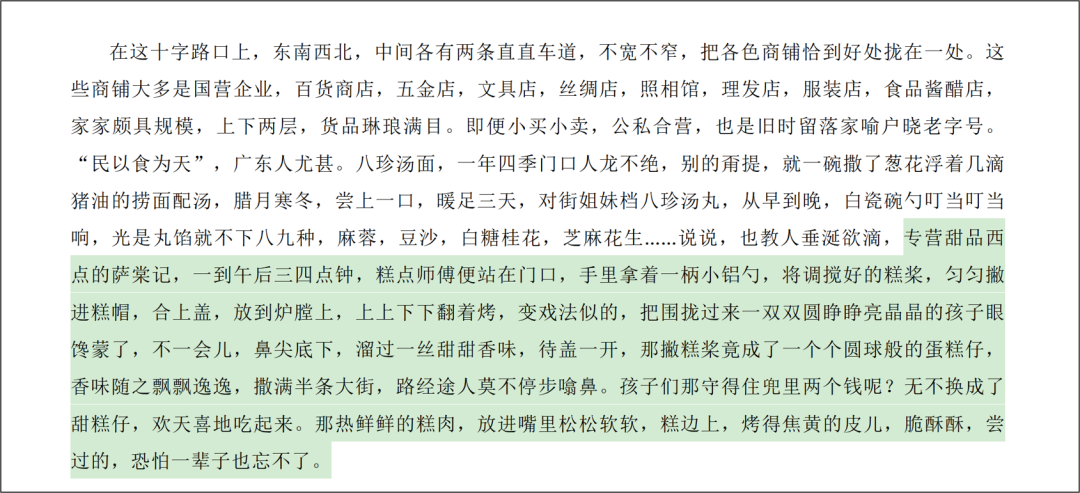
Memories of 'Satangji' featured in the 'Crossing the Crossroads' article by the WeChat account 'Junhua Tang'
As for how Satangji gradually lost its footing and faded into the history books, no further records have turned up just yet.
All we're left with is a deep sense of regret.
Portrait of Sa Hanqiang: Quick-witted, Innovative, and Out-of-the-Box
Looking back at how Mr. Sa Hanqiang built and ran Satangji, it’s clear as day that his secret weapon for turning an unheralded street cart into a household brand name was being 'quick-witted, fiercely innovative, and always playing an unexpected winning hand.'
Back when he first started out selling tofu hua (silken tofu pudding), he got super creative by using a giant earthenware basin to hold the pudding, decorating it with fresh flowers, and putting a huge emphasis on the hygiene and cleanliness of his Halal food, which totally made Satang Ji stand out from all the other food stalls.
When selling iced soy milk, he cleverly poured the frozen soy milk into a thermos flask to keep it cold so he could easily pour and serve it whenever.
When making dangaozai (traditional mini sponge cakes), he constantly fine-tuned his craft to boost efficiency and updated the mold designs so Satang Ji's treats always stayed a step ahead of the competition.
Not to mention how well he understood customer psychology while running the business, using all sorts of marketing tactics like advertising, designing custom packaging, studying product displays, and making things right in front of the crowd.
All of these are the exact reasons why Mr. Sa Hanqiang was able to grow Satang Ji step-by-step into a major success.
Satang Ji might be gone from our daily lives now, but we're still hoping that one day in the future, some passionate folks in the food and restaurant industry will bring back the "Satang Ji" name and let this legendary old Guangzhou Halal brand make a comeback.
Remember to reply with "Satang Ji" in the official account chat to grab the original text of "How I Ran Satang Ji"~
Guangzhou's Untold Stories: Exploring Ancient Muslim Tombs & Halal Heritage on the Maritime Silk Road
Articles • Hasan09 posted the article • 0 comments • 6 views • 8 hours ago
An Exploration of Guangzhou's Ancient Tomb of the Venerated Ancestor (Sa'd ibn Abi Waqqas) and the Muslim Cemetery: A Thousand Years of Maritime Silk Road Memories Where Over Ten Thousand Pious Predecessors Lie at Rest
Summary:
We're taking a deep dive into Guangzhou's Guihuagang Muslim Public Cemetery and the Ancient Tomb of the Venerated Ancestor (Sa'd ibn Abi Waqqas's Tomb). We'll revisit the historical legacy of this revered missionary from the Tang Dynasty, exploring its immense value as one of China's Four Great Ancient Muslim Tombs and the profound sentiment it holds for Muslim communities across generations.
A Historic Burial Ground, and Its Past Battles
Guangzhou's Muslim public cemetery was historically located in Guihuagang for a long time, centered around the tomb of Sa'd ibn Abi Waqqas – a companion of Prophet Muhammad who arrived in Guangzhou during the Tang Dynasty to spread Islam.
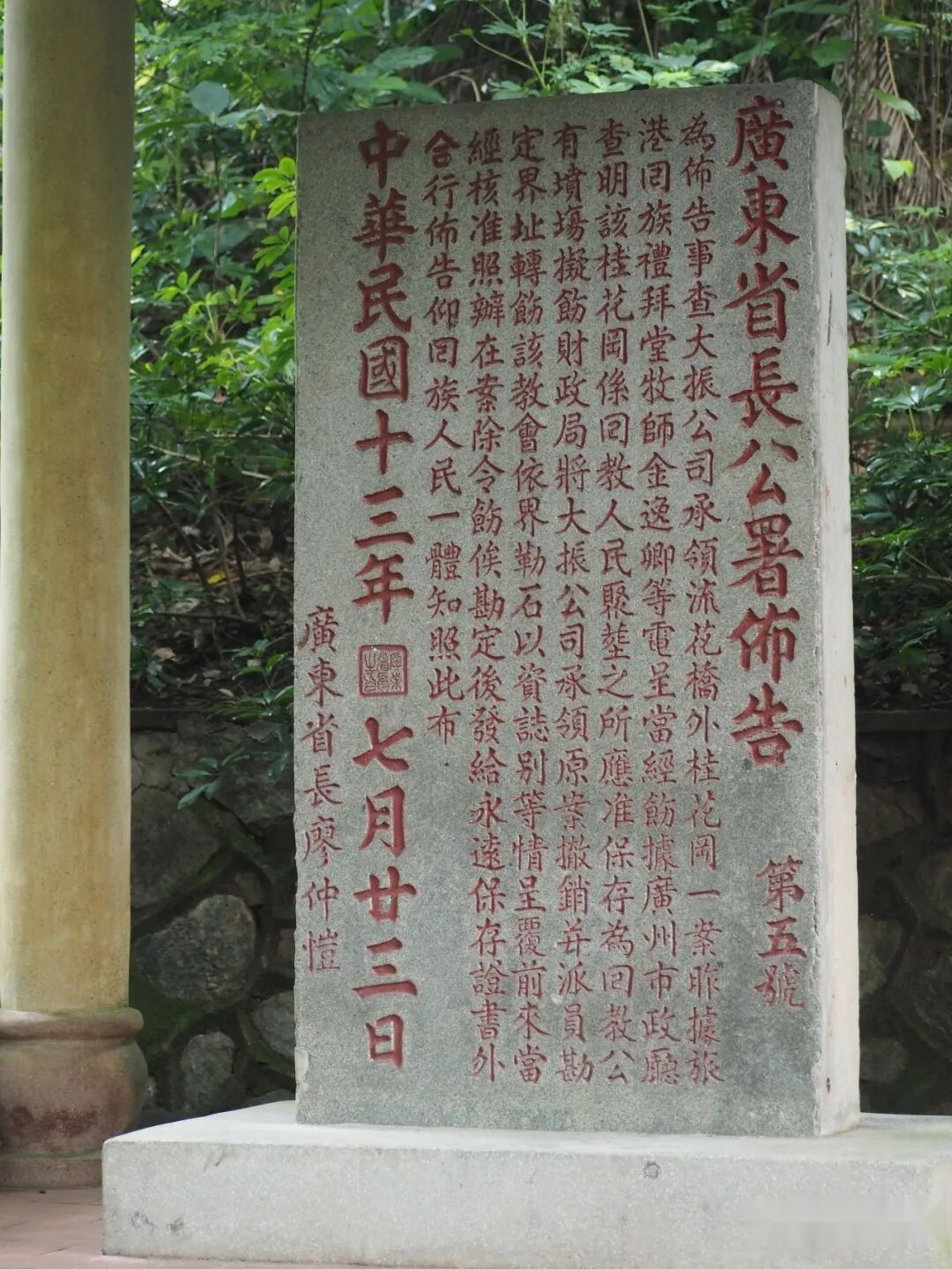
In 1924, Dazhen Company sought to use the Guihuagang land for development, leading to a lawsuit with the Muslim community. The Muslims ultimately won the case, with the court ruling that "Guihuagang is a burial ground for Muslim people." Liao Zhongkai, then Governor of Guangdong Province, even erected a monument to commemorate this decision.
Guangzhou's Muslims also erected another obelisk, inscribed with "Muslim Public Cemetery, Permanently Preserved by Decree." These monuments are still preserved today within the Xianxian Mosque / Ancient Tomb of Saad ibn Abi Waqqas, directly across from Yuexiu Park.
In 1925, the Guangzhou Municipal Finance Bureau further designated 19 plots of land, totaling 576 mu (approximately 95 acres), as a Muslim public cemetery.
Liao Zhongkai's Monument (Photo credit: Wuwei)
This Hill's Muslim Cemetery (Photo credit: Wuwei)
Relocating to Xinshi: The Rise of the Sino-Soviet Friendship Building
However, in 1955, the government decided to relocate the cemetery. The situation at this time was vastly different from the Republican era, and the local Muslim community was powerless to object. Over 500 mu (approximately 82 acres) of land in the Guihuagang and Zoumagang areas were then used to build the Sino-Soviet Friendship Building, along with the Guangzhou Railway Station, a stadium, and other facilities.
The Sino-Soviet Friendship Building was completed in just a few months. Back then, the friendship between China and the Soviet Union trumped everything. However, not long after, relations between China and the Soviet Union soured, and China needed to seek trade partners beyond the Soviet Union and Eastern Europe. This very building then became the venue for the Canton Fair (Guangjiao Hui), which remains world-famous to this day.
In 1959, the government decided to appropriate the burial plots around the Ancient Tomb of Saad ibn Abi Waqqas to build Guihuagang Park, which is now Orchid Garden Park (Lanpu Park). Following a resolution by the Second Islamic Congress, the community agreed to cede the burial grounds.
The Former Sino-Soviet Friendship Building
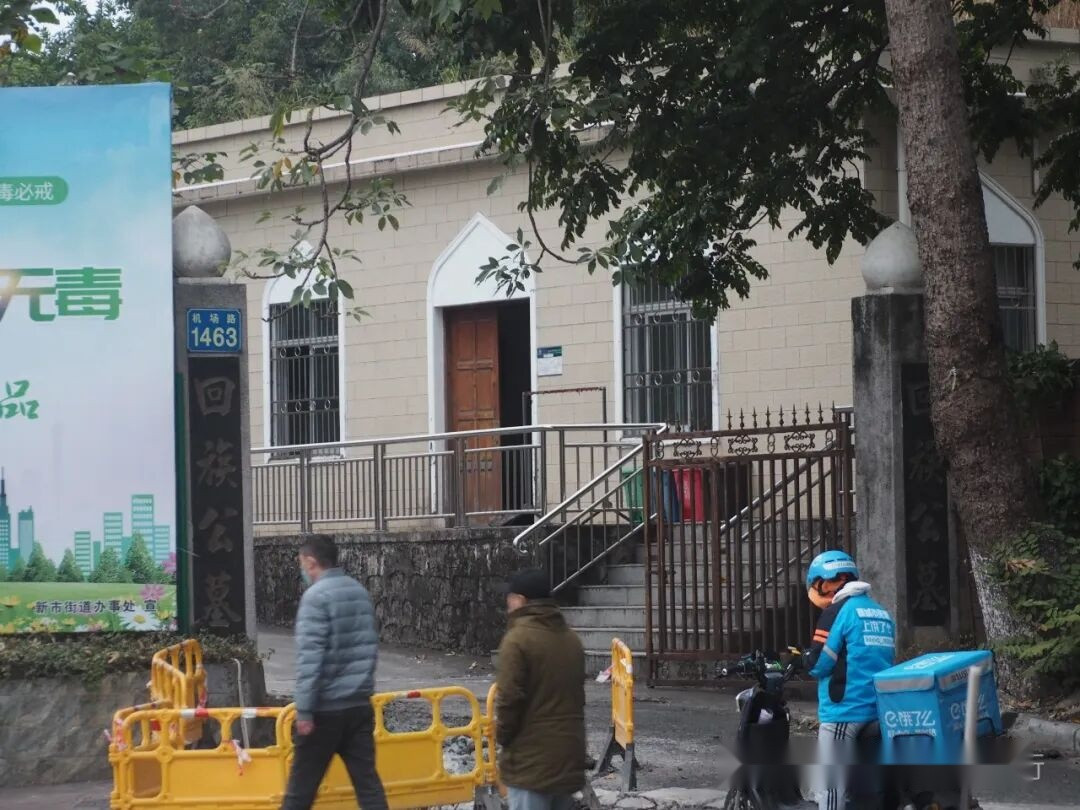
Most of the original graves were relocated to Dapu Ridge, north of Baiyun Mountain, and officially named "Guangzhou Xinshi Hui Muslim Cemetery." This new cemetery, at only 42.7 mu (approximately 7 acres), was significantly smaller than the original.
Inside the Hui Muslim Cemetery: Stories of the Departed
Back in the day, this area was pretty much out in the boonies. But today, the area around the Hui Muslim Cemetery has transformed into a bustling commercial district. Right across from the cemetery is Baixin Plaza, a huge shopping mall, with people constantly coming and going, even a fair number of foreigners. Many passersby are curious about the Hui Muslim Cemetery across the street, but not many get to go inside. The world within the cemetery seems so different from our usual stereotypes of Guangzhou.
I greeted the cemetery administrator, explained why I was there, and went in. In the middle of the cemetery stands a prayer hall (masjid). Walking through the corridors, you immediately see dense rows of gravestones. From the Qing Dynasty right up to the present day, over ten thousand Muslims have been laid to rest here.
Hui Muslim Cemetery (Photo credit: Wuwei)
Prayer Hall (Masjid) (Photo credit: Wuwei)
Most of the Qing Dynasty graves in the cemetery belong to local Guangzhou Muslims. And after the relocation to Xinshi, families were often buried together, with gravestones placed closely, side-by-side, leaving no gaps.
Because local Guangzhou Hui Muslims have lived in Han Chinese-majority areas for so long, they gradually adopted Han surnames and given names, and compiled family genealogies. In the cemetery, you can spot family plots like "Yao Fu" (Yao Family), "Yang Fu" (Yang Family), and "Zhou Fu" (Zhou Family). Some family plots even feature "Tang Hao" (ancestral hall names), such as "Yang Guanxi Tang" (Yang's Guanxi Hall), "Yang Jiguang Tang" (Yang's Jiguang Hall), "Xiao Yaojun Tang" (Xiao's Yaojun Hall), and "Ma Huayang Tang" (Ma's Huayang Hall).
Cemetery (Photo credit: Wuwei)
Yang Guanxi Tang (Photo credit: Wuwei)
Yang Fu (Photo credit: Wuwei)
Official Ranks on Gravestones
Most of Guangzhou's local Muslims are descendants of garrisons moved from the north to Guangzhou during the Qing Dynasty, which explains why many families held inherited official ranks passed down through generations.
Yang Yingrui, born in the Renzi year of Qianlong (1792) and who passed away in the Yichou year of Tongzhi (1865), held the official rank of Zheng Liupin (a civil or military Sixth Rank) "Wulüe Qiwei" (Military Strategist Cavalry Commander).
Yang Yingrui's grandson, Yang Kelin, lived a short life of only thirty years, born in the 20th year of Daoguang (1841) and passing away in the 10th year of Tongzhi (1871). He also inherited this official title.
Another grandson, Yang Kexiong, born in 1859 (the 8th year of the Xianfeng reign) and passing away in 1892 (the 18th year of the Guangxu reign), had his gravestone set up by his nephew Yizong. Guess what? That Zheng Liu Pin official rank (a sixth-rank official position) is still carved right there at the top of his tombstone.
Fu Bangzuo's official gig was actually pretty unique compared to the others. While most were military officers, he was a civil official, holding the 'Zhizhou' (prefect) title, which was a Cong Liu Pin (sixth-rank) position granted by the imperial court. The only thing is, his gravestone doesn't actually tell us which prefecture he was in charge of.
Yang Kexiong's Tomb (Photo by Wuwei)
Fu Bangzuo's Tomb (Photo by Wuwei)
Okay, so these official ranks from the imperial court? Super important, even when the Qing emperors were long gone during the Republic of China era. Take Jiang Tingliang, for example. Born in 1848 (the 28th year of Daoguang), he lived all the way until 1926 (the 15th year of the Republic). When he returned to Allah, his folks made sure to carve his Zheng Wu Pin (fifth-rank) title of 'Wude Qiwei' (a military official rank) — a title from the previous dynasty — right onto his tombstone.
Jiang Weimin, born in 1918 (the 7th year of the Republic), totally followed in the footsteps of other Guangzhou Muslim ancestors, dedicating his loyalty to the nation. The only difference? He joined the Nationalist Army (KMT forces) this time, climbing the ranks all the way to Army Captain and Company Commander.
In 1945 (the 34th year of the Republic), right when the Anti-Japanese War was about to wrap up with victory, he left this life. It's totally possible he died fighting the Japanese on the battlefield. The Guangdong Provincial Military Control Zone Command actually put up this tombstone for him. And get this: Muslim generals weren't a rare sight in the Nationalist Army at all. The most famous one? General Bai Chongxi, a Hui Muslim from Guilin, Guangxi.
Jiang Weimin's Tomb (Photo by Wuwei)
Most of the graves are actually pretty well-preserved, but you'll definitely spot some that look like they haven't seen maintenance in ages. We're talking half a gravestone buried in the dirt, and some even have massive trees bursting out of their stone coffins!
Damaged Tomb (Photo by Wuwei)
Fragments on the Ground (Photo by Wuwei)
The Stories on the Epitaphs
Gravestones these days are a bit different. They don't really brag about official ranks anymore. Instead, you'll see cool star and crescent symbols or verses from the Quran, clearly showing their Muslim identity. Some folks even get epitaphs written for their loved ones, which is awesome because it helps future generations get a glimpse into their lives.
Xu Liji, born in 1908, grew up in a humble family. But thanks to his brother-in-law's help, he managed to get into Sacred Heart College, balancing part-time work with studying English for three years. After graduating, he totally nailed it and joined a foreign firm — basically, if we're talking modern terms, he landed a job at a multinational corporation.
But then, out of nowhere, Japan invaded Guangzhou. He had to flee to Zhaoqing, where he started out as a small-time peddler, but get this, his business totally blew up! Once he became wealthy, he didn't forget to give back, investing in education by donating funds to set up the Zhaoqing Hui Muslim Primary School and even serving on its board himself. In 1953, he moved back to Guangzhou, where he eventually passed away and was laid to rest in the Xinshi Cemetery.
Xu Liji's Epitaph (Photo by Wuwei)
Ha Shaoguang, who was Ha Huanyiran's fourth younger brother, actually wrote her epitaph. She was born in 1918, and back in the Republic of China era, she got to go to school, attending the pretty famous Guangzhou Municipal Art School. After graduating in 1936, she spent her whole life as an art educator, returning to Allah when she was 72 years old.
Inscriptions on the Tomb (Photo by Wuwei)
After China's Reform and Opening Up, tons of people from other regions started flocking to Guangzhou, which totally made the city's Muslim community even more diverse.
Lots of Muslims from Northwest and North China actually returned to Allah in Guangzhou, and they're also buried right here in this cemetery. You can spot place names like Gansu, Qinghai, and Xinjiang carved on their gravestones.
And check this out: on the gravestones of Uyghur people, you'll even find Uyghur written in Arabic script. Talipu Maimaiti, from Bachu County in Kashgar, Xinjiang, passed away in 1994 and is buried here. His hometown is seriously over 5000 kilometers away from Guangzhou – I'm pretty sure that's the furthest distance, right?
Half-Exposed Gravestone (Photo by Wuwei)
Maimaiti from Bachu County (Photo by Wuwei)
The cemetery also has foreign Muslims buried there. One gravestone has the name 'Iwanda' written in Latin script, and from the text below, you can tell it's Indonesian. This person was born in 1990 in Medan, on Indonesia's Sumatra Island. Sadly, in 1995, this little one's short life came to an end right here in Guangzhou.
Iwanda's Tomb (Photo by Wuwei)
Flowers in front of the Tomb (Photo by Wuwei)
References:
Bao Yanzhong. *History of Islam in Guangzhou*. Guangzhou: Guangzhou Islamic Association, Guangzhou Hui Muslim Historical and Cultural Research Association, 2014.
Zhong Yuanxiu, Ma Jianzhao, Ma Fengda. *Research on Islamic Historical Sites in Guangzhou*. Yinchuan: Ningxia People's Publishing House, 2001.
Ma Qiang. *A Floating Spiritual Community—An Anthropological Study of Guangzhou Muslim Jama'at*. Beijing: China Social Sciences Press, 2006. view all
An Exploration of Guangzhou's Ancient Tomb of the Venerated Ancestor (Sa'd ibn Abi Waqqas) and the Muslim Cemetery: A Thousand Years of Maritime Silk Road Memories Where Over Ten Thousand Pious Predecessors Lie at Rest
Summary:
We're taking a deep dive into Guangzhou's Guihuagang Muslim Public Cemetery and the Ancient Tomb of the Venerated Ancestor (Sa'd ibn Abi Waqqas's Tomb). We'll revisit the historical legacy of this revered missionary from the Tang Dynasty, exploring its immense value as one of China's Four Great Ancient Muslim Tombs and the profound sentiment it holds for Muslim communities across generations.
A Historic Burial Ground, and Its Past Battles
Guangzhou's Muslim public cemetery was historically located in Guihuagang for a long time, centered around the tomb of Sa'd ibn Abi Waqqas – a companion of Prophet Muhammad who arrived in Guangzhou during the Tang Dynasty to spread Islam.
In 1924, Dazhen Company sought to use the Guihuagang land for development, leading to a lawsuit with the Muslim community. The Muslims ultimately won the case, with the court ruling that "Guihuagang is a burial ground for Muslim people." Liao Zhongkai, then Governor of Guangdong Province, even erected a monument to commemorate this decision.
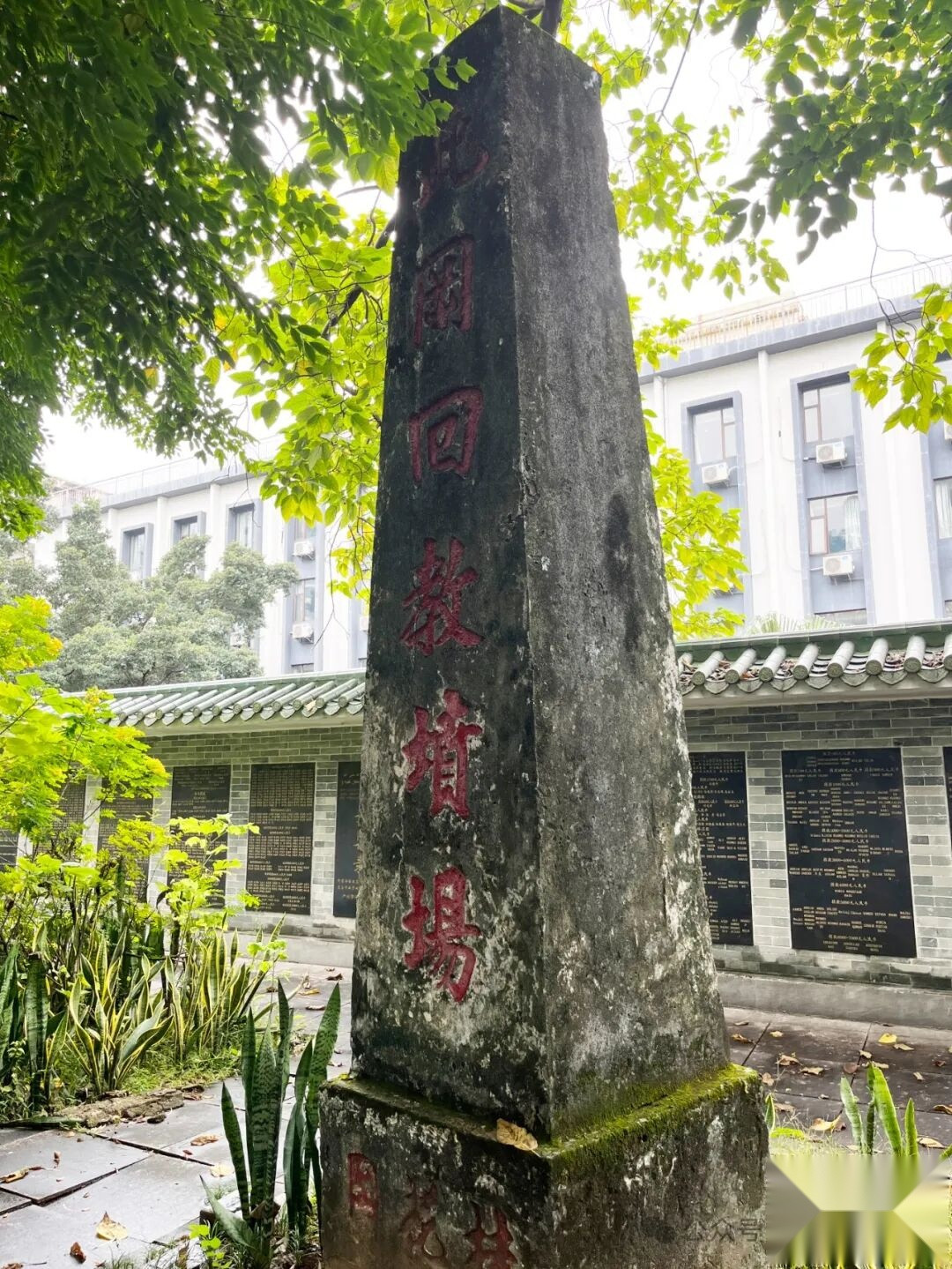
Guangzhou's Muslims also erected another obelisk, inscribed with "Muslim Public Cemetery, Permanently Preserved by Decree." These monuments are still preserved today within the Xianxian Mosque / Ancient Tomb of Saad ibn Abi Waqqas, directly across from Yuexiu Park.
In 1925, the Guangzhou Municipal Finance Bureau further designated 19 plots of land, totaling 576 mu (approximately 95 acres), as a Muslim public cemetery.
Liao Zhongkai's Monument (Photo credit: Wuwei)
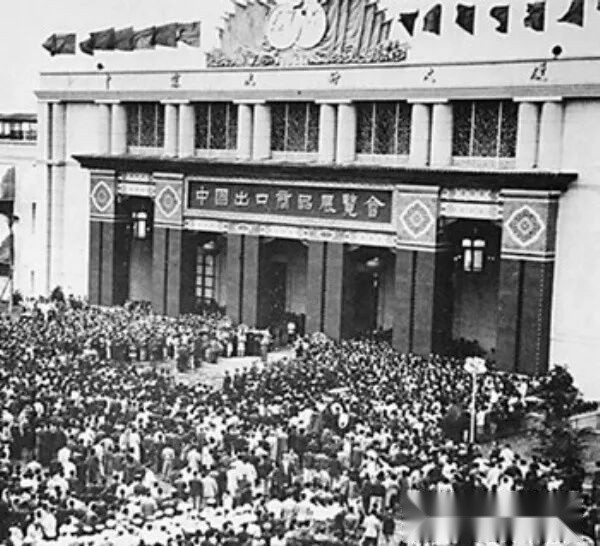
This Hill's Muslim Cemetery (Photo credit: Wuwei)
Relocating to Xinshi: The Rise of the Sino-Soviet Friendship Building
However, in 1955, the government decided to relocate the cemetery. The situation at this time was vastly different from the Republican era, and the local Muslim community was powerless to object. Over 500 mu (approximately 82 acres) of land in the Guihuagang and Zoumagang areas were then used to build the Sino-Soviet Friendship Building, along with the Guangzhou Railway Station, a stadium, and other facilities.
The Sino-Soviet Friendship Building was completed in just a few months. Back then, the friendship between China and the Soviet Union trumped everything. However, not long after, relations between China and the Soviet Union soured, and China needed to seek trade partners beyond the Soviet Union and Eastern Europe. This very building then became the venue for the Canton Fair (Guangjiao Hui), which remains world-famous to this day.
In 1959, the government decided to appropriate the burial plots around the Ancient Tomb of Saad ibn Abi Waqqas to build Guihuagang Park, which is now Orchid Garden Park (Lanpu Park). Following a resolution by the Second Islamic Congress, the community agreed to cede the burial grounds.
The Former Sino-Soviet Friendship Building
Most of the original graves were relocated to Dapu Ridge, north of Baiyun Mountain, and officially named "Guangzhou Xinshi Hui Muslim Cemetery." This new cemetery, at only 42.7 mu (approximately 7 acres), was significantly smaller than the original.
Inside the Hui Muslim Cemetery: Stories of the Departed
Back in the day, this area was pretty much out in the boonies. But today, the area around the Hui Muslim Cemetery has transformed into a bustling commercial district. Right across from the cemetery is Baixin Plaza, a huge shopping mall, with people constantly coming and going, even a fair number of foreigners. Many passersby are curious about the Hui Muslim Cemetery across the street, but not many get to go inside. The world within the cemetery seems so different from our usual stereotypes of Guangzhou.
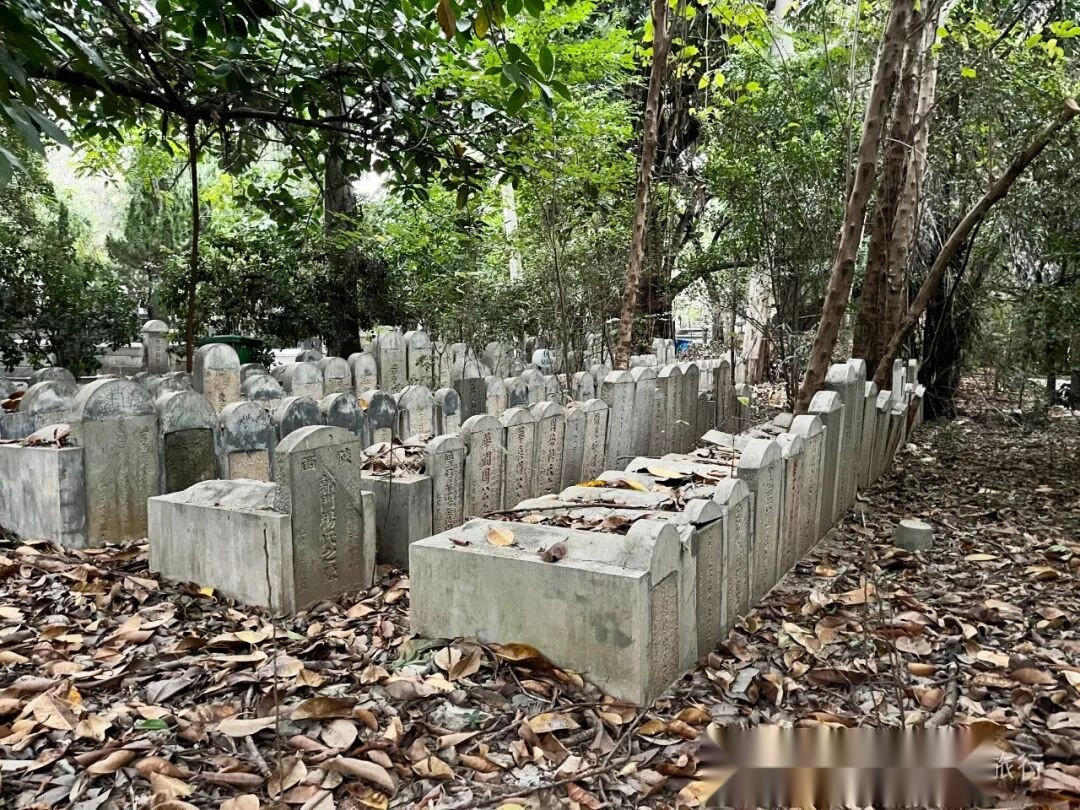
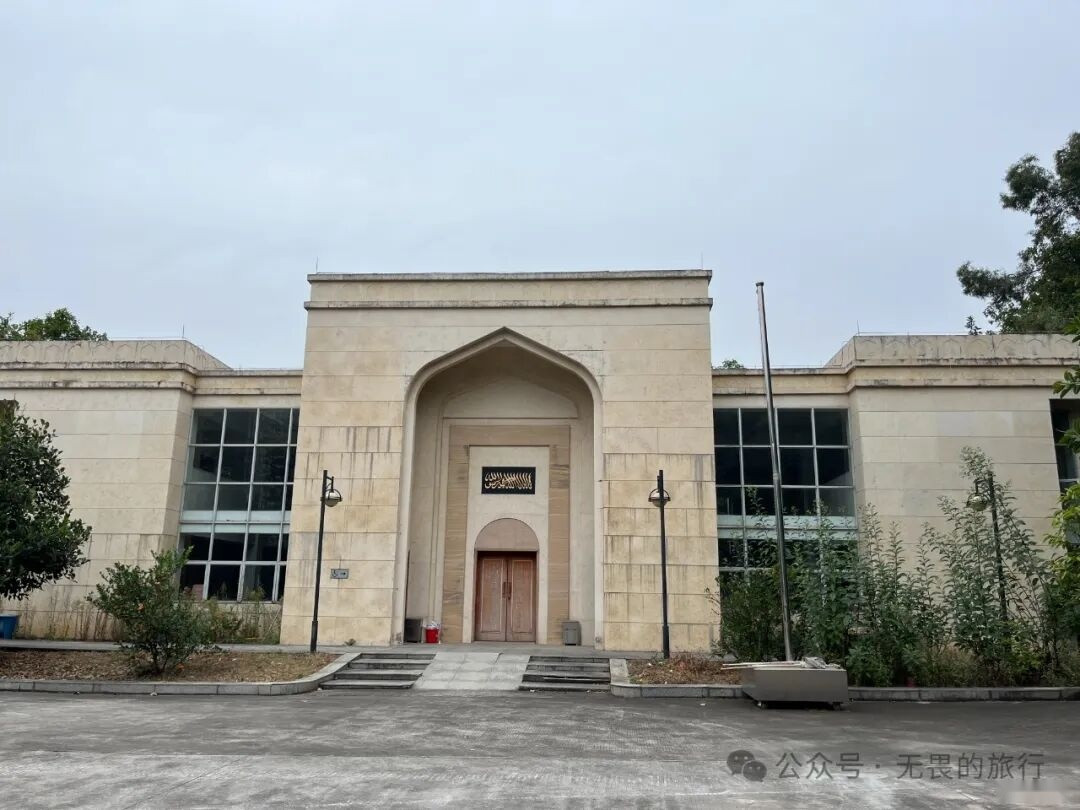
I greeted the cemetery administrator, explained why I was there, and went in. In the middle of the cemetery stands a prayer hall (masjid). Walking through the corridors, you immediately see dense rows of gravestones. From the Qing Dynasty right up to the present day, over ten thousand Muslims have been laid to rest here.
Hui Muslim Cemetery (Photo credit: Wuwei)
Prayer Hall (Masjid) (Photo credit: Wuwei)
Most of the Qing Dynasty graves in the cemetery belong to local Guangzhou Muslims. And after the relocation to Xinshi, families were often buried together, with gravestones placed closely, side-by-side, leaving no gaps.
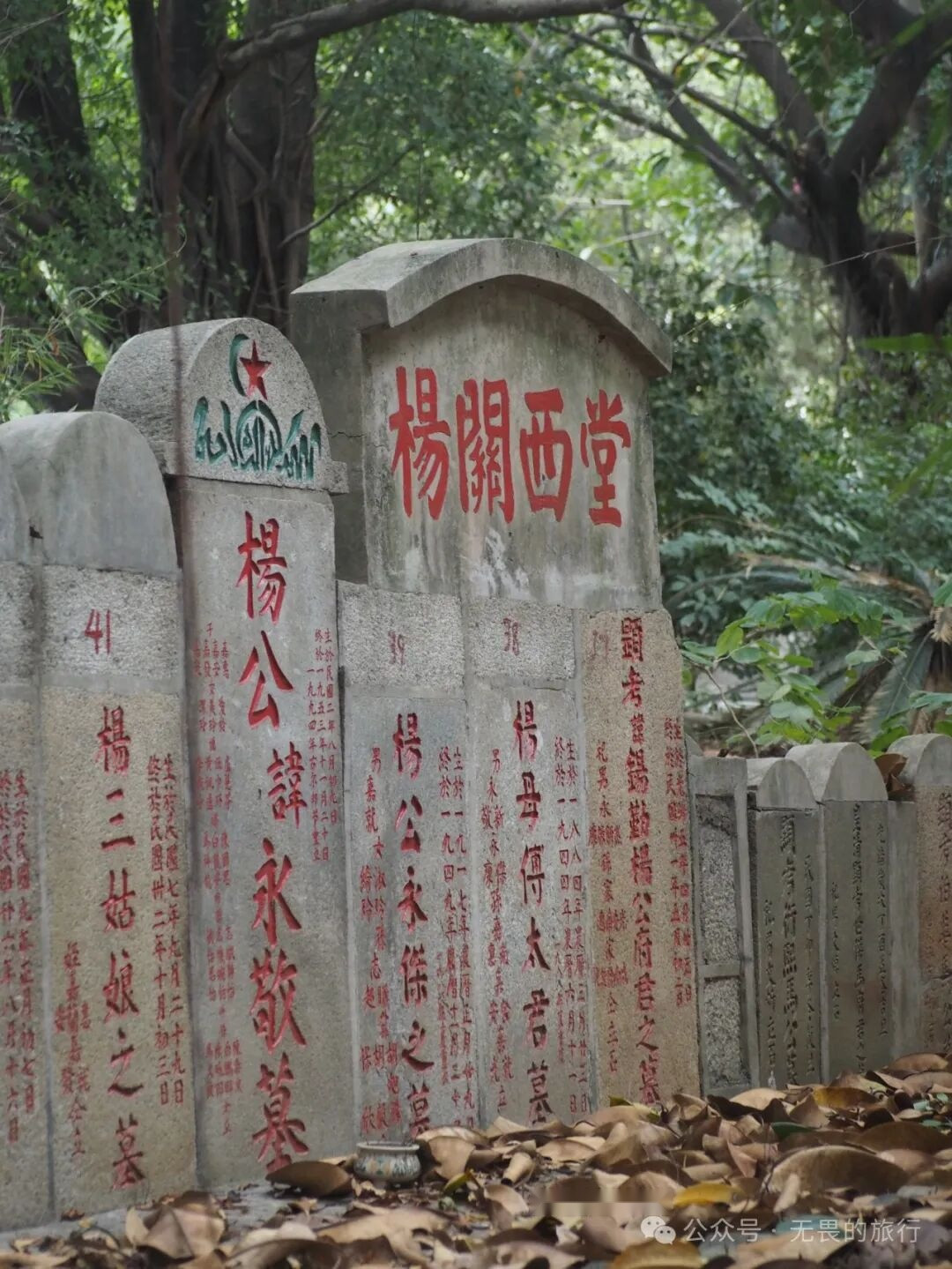
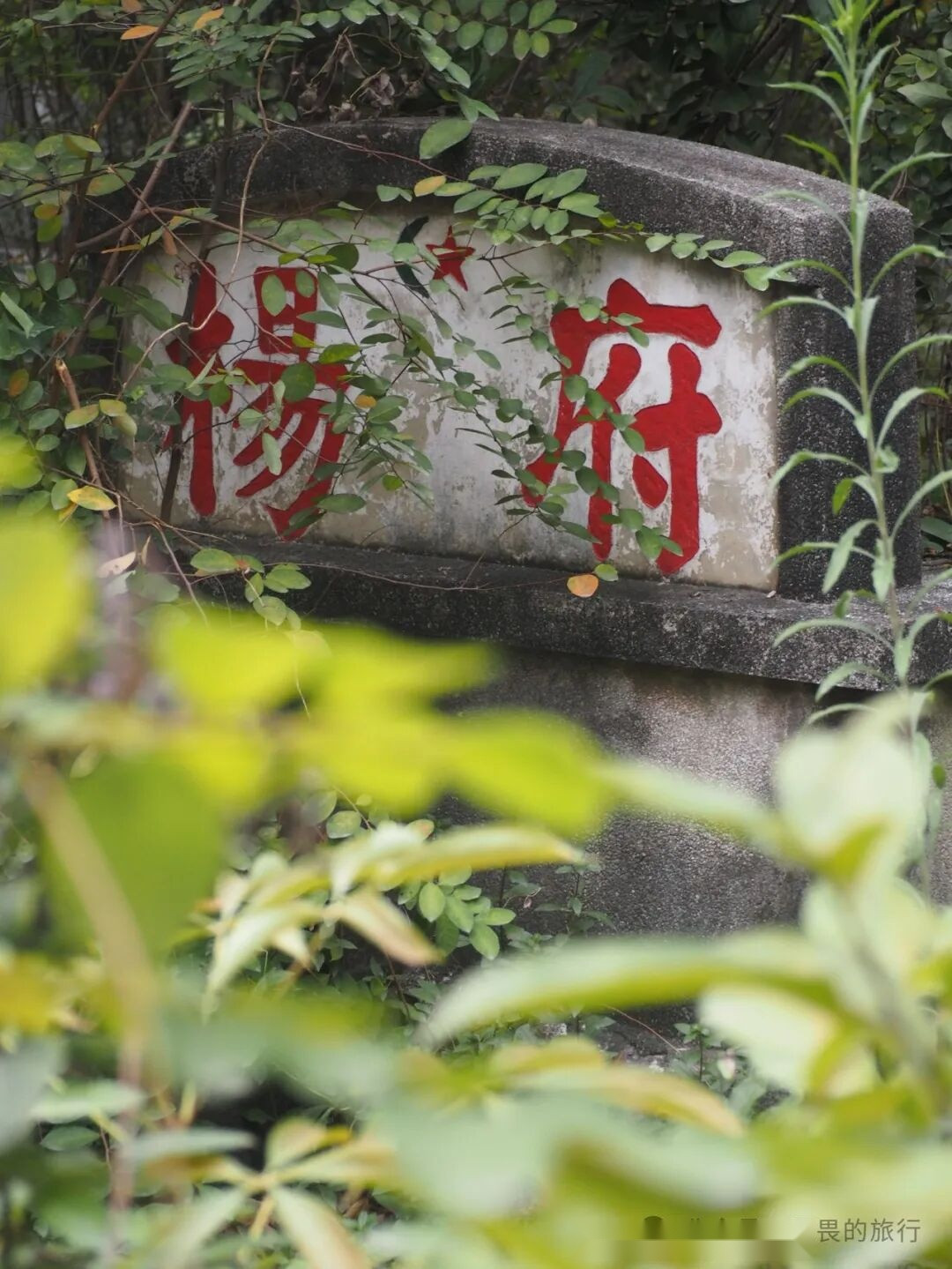
Because local Guangzhou Hui Muslims have lived in Han Chinese-majority areas for so long, they gradually adopted Han surnames and given names, and compiled family genealogies. In the cemetery, you can spot family plots like "Yao Fu" (Yao Family), "Yang Fu" (Yang Family), and "Zhou Fu" (Zhou Family). Some family plots even feature "Tang Hao" (ancestral hall names), such as "Yang Guanxi Tang" (Yang's Guanxi Hall), "Yang Jiguang Tang" (Yang's Jiguang Hall), "Xiao Yaojun Tang" (Xiao's Yaojun Hall), and "Ma Huayang Tang" (Ma's Huayang Hall).
Cemetery (Photo credit: Wuwei)
Yang Guanxi Tang (Photo credit: Wuwei)
Yang Fu (Photo credit: Wuwei)
Official Ranks on Gravestones
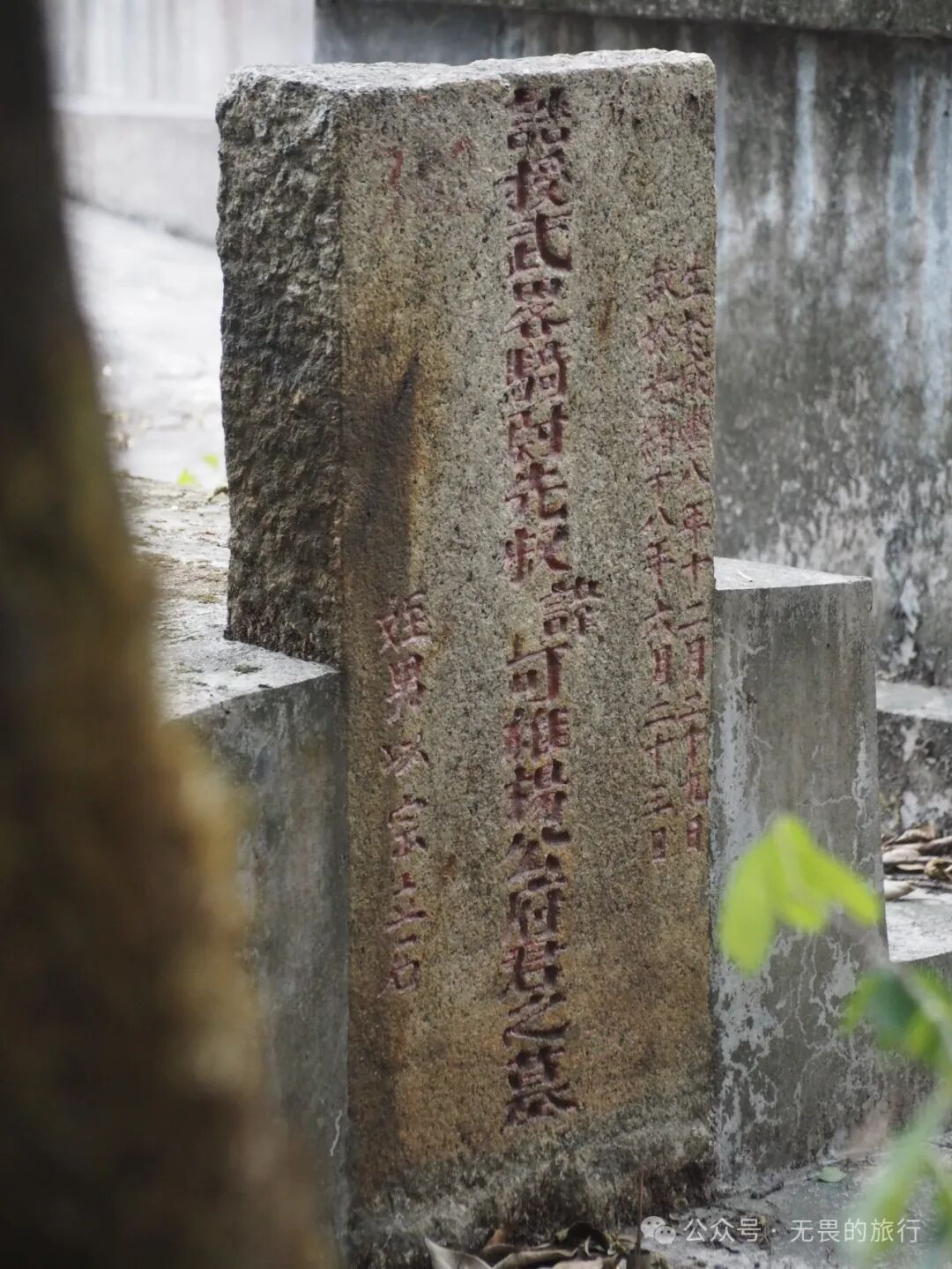
Most of Guangzhou's local Muslims are descendants of garrisons moved from the north to Guangzhou during the Qing Dynasty, which explains why many families held inherited official ranks passed down through generations.
Yang Yingrui, born in the Renzi year of Qianlong (1792) and who passed away in the Yichou year of Tongzhi (1865), held the official rank of Zheng Liupin (a civil or military Sixth Rank) "Wulüe Qiwei" (Military Strategist Cavalry Commander).
Yang Yingrui's grandson, Yang Kelin, lived a short life of only thirty years, born in the 20th year of Daoguang (1841) and passing away in the 10th year of Tongzhi (1871). He also inherited this official title.
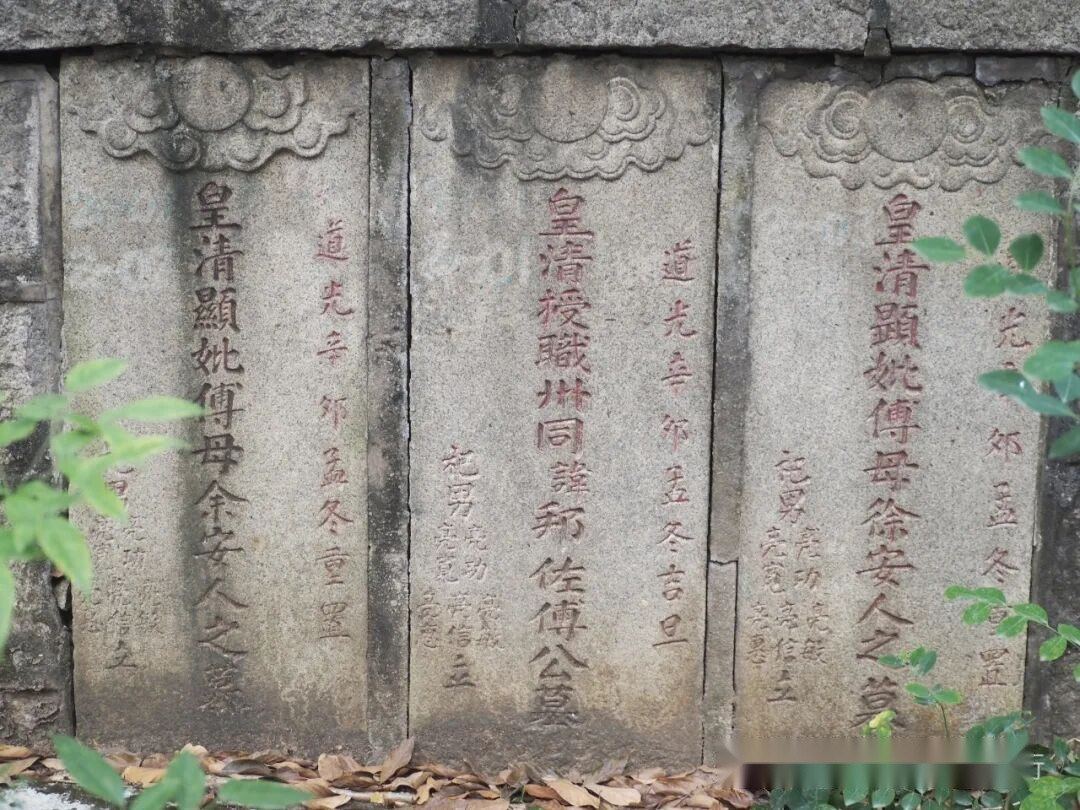
Another grandson, Yang Kexiong, born in 1859 (the 8th year of the Xianfeng reign) and passing away in 1892 (the 18th year of the Guangxu reign), had his gravestone set up by his nephew Yizong. Guess what? That Zheng Liu Pin official rank (a sixth-rank official position) is still carved right there at the top of his tombstone.
Fu Bangzuo's official gig was actually pretty unique compared to the others. While most were military officers, he was a civil official, holding the 'Zhizhou' (prefect) title, which was a Cong Liu Pin (sixth-rank) position granted by the imperial court. The only thing is, his gravestone doesn't actually tell us which prefecture he was in charge of.
Yang Kexiong's Tomb (Photo by Wuwei)
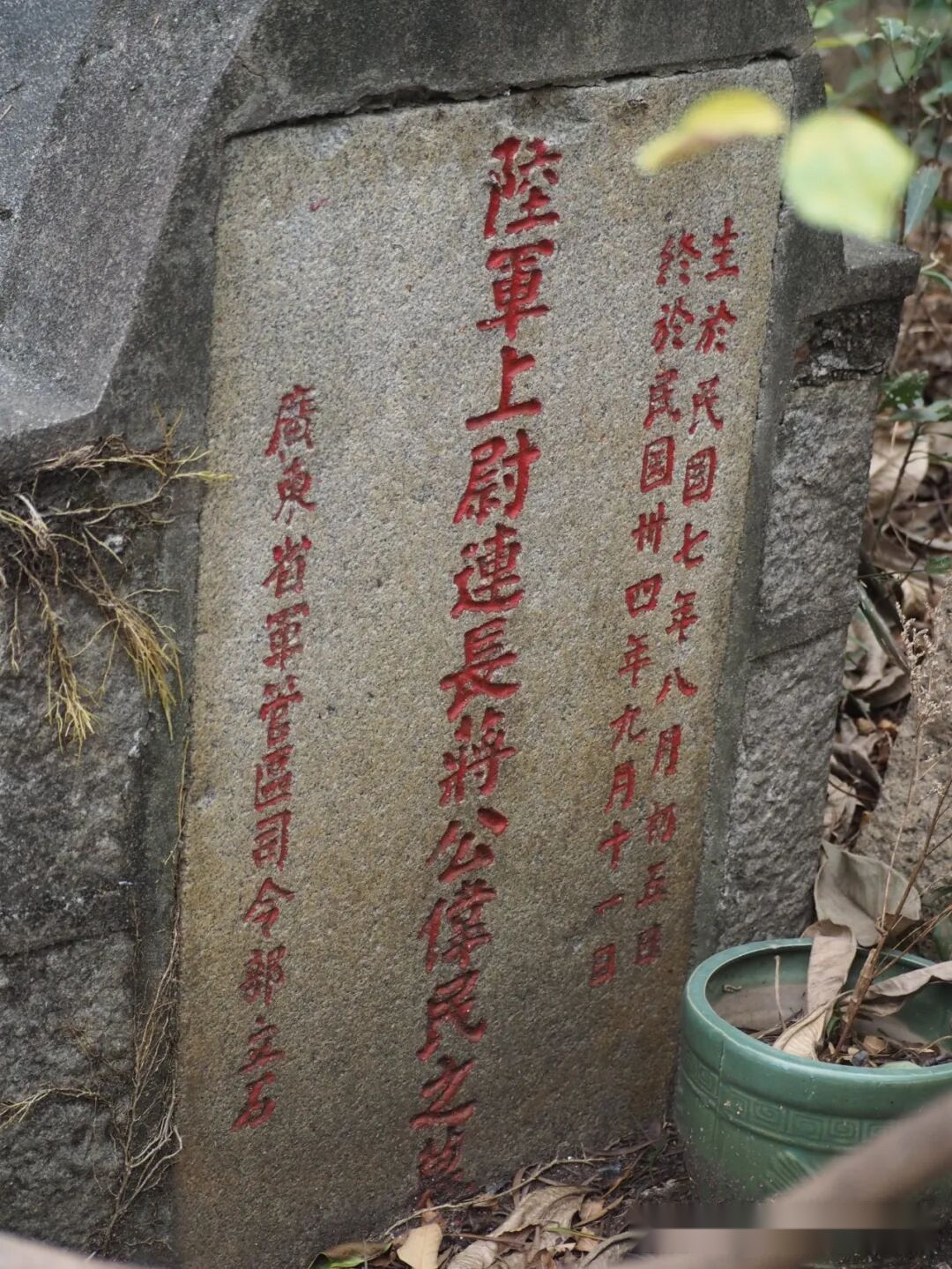
Fu Bangzuo's Tomb (Photo by Wuwei)
Okay, so these official ranks from the imperial court? Super important, even when the Qing emperors were long gone during the Republic of China era. Take Jiang Tingliang, for example. Born in 1848 (the 28th year of Daoguang), he lived all the way until 1926 (the 15th year of the Republic). When he returned to Allah, his folks made sure to carve his Zheng Wu Pin (fifth-rank) title of 'Wude Qiwei' (a military official rank) — a title from the previous dynasty — right onto his tombstone.
Jiang Weimin, born in 1918 (the 7th year of the Republic), totally followed in the footsteps of other Guangzhou Muslim ancestors, dedicating his loyalty to the nation. The only difference? He joined the Nationalist Army (KMT forces) this time, climbing the ranks all the way to Army Captain and Company Commander.
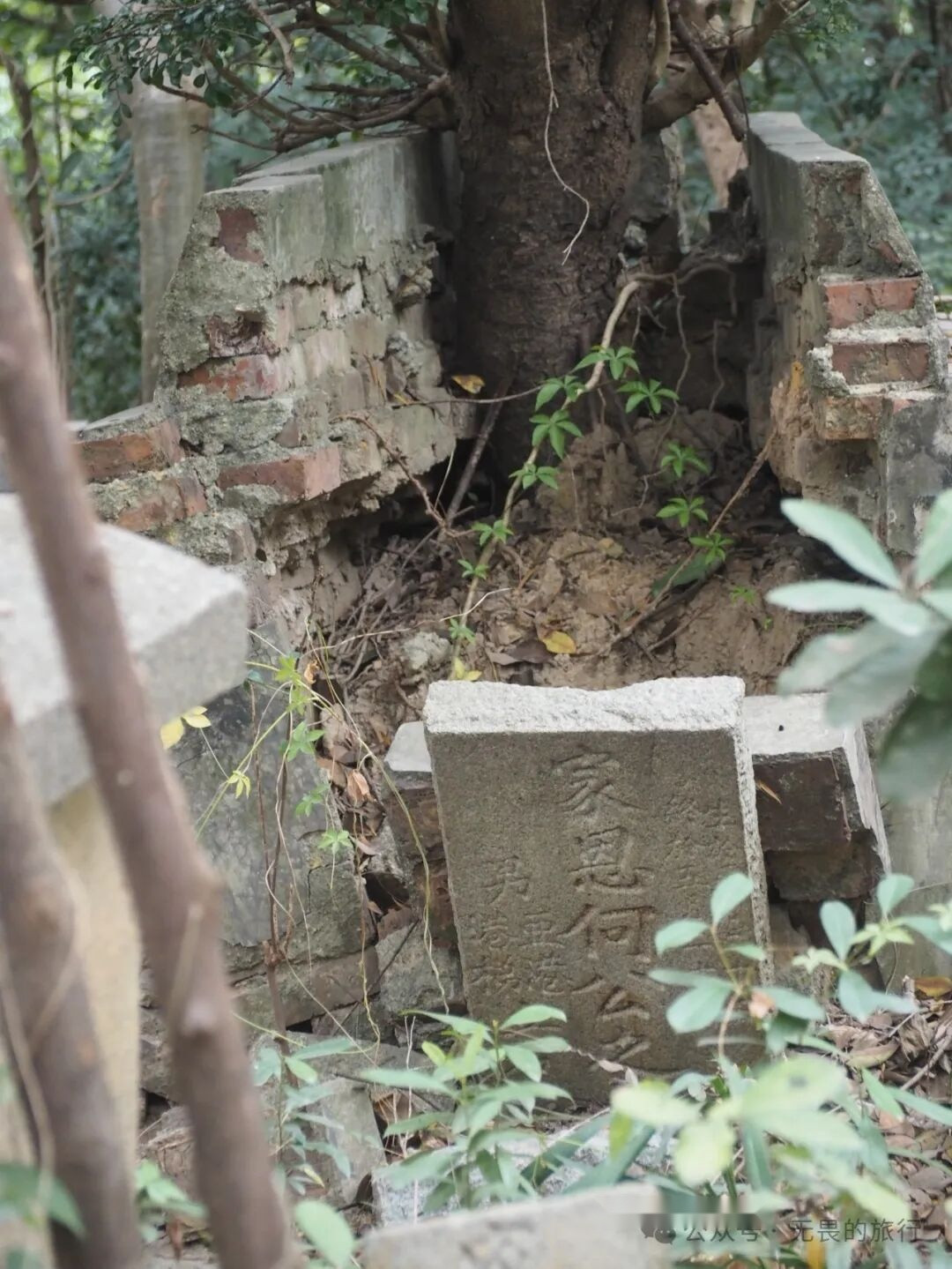
In 1945 (the 34th year of the Republic), right when the Anti-Japanese War was about to wrap up with victory, he left this life. It's totally possible he died fighting the Japanese on the battlefield. The Guangdong Provincial Military Control Zone Command actually put up this tombstone for him. And get this: Muslim generals weren't a rare sight in the Nationalist Army at all. The most famous one? General Bai Chongxi, a Hui Muslim from Guilin, Guangxi.
Jiang Weimin's Tomb (Photo by Wuwei)
Most of the graves are actually pretty well-preserved, but you'll definitely spot some that look like they haven't seen maintenance in ages. We're talking half a gravestone buried in the dirt, and some even have massive trees bursting out of their stone coffins!
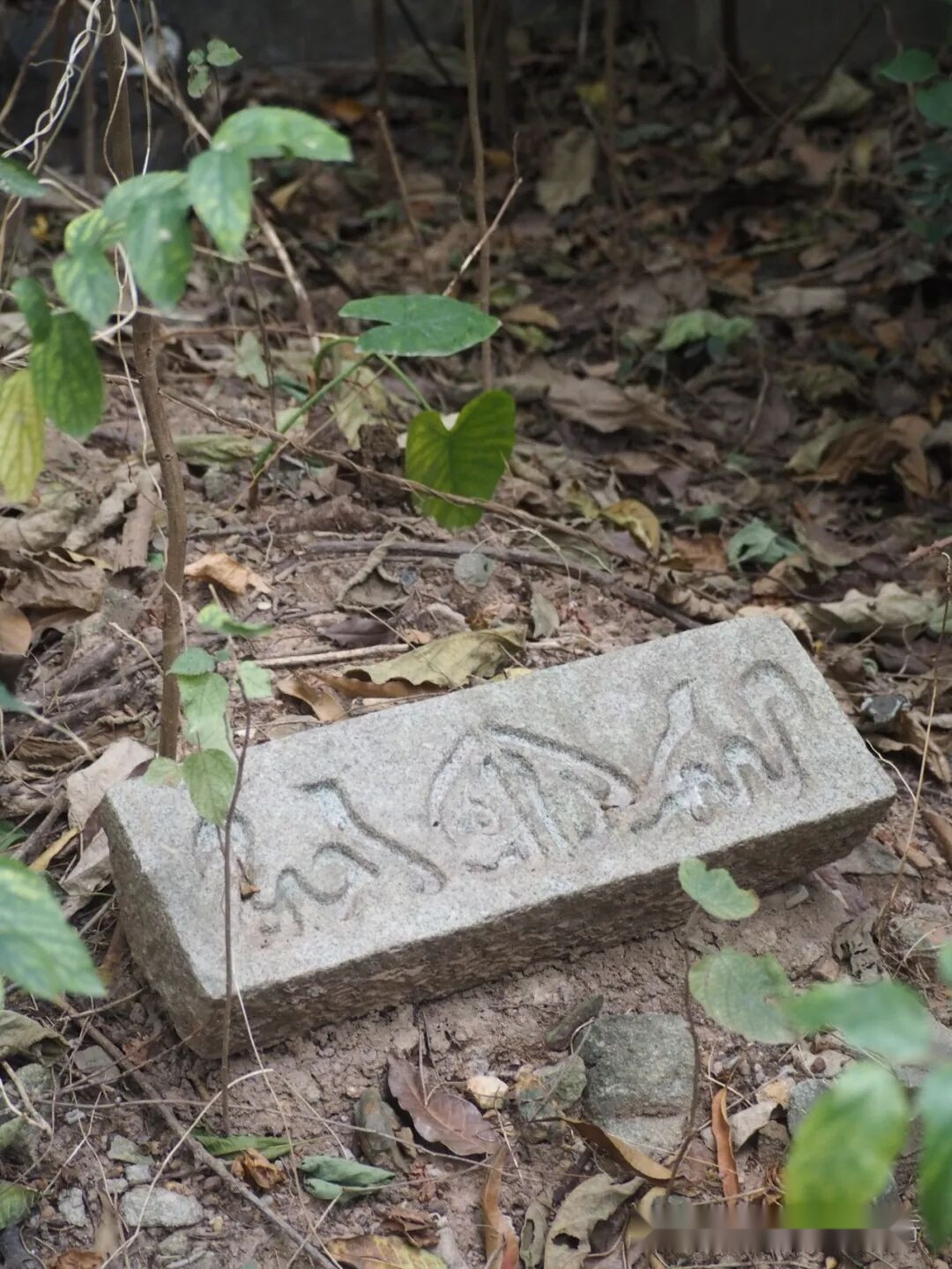
Damaged Tomb (Photo by Wuwei)
Fragments on the Ground (Photo by Wuwei)
The Stories on the Epitaphs
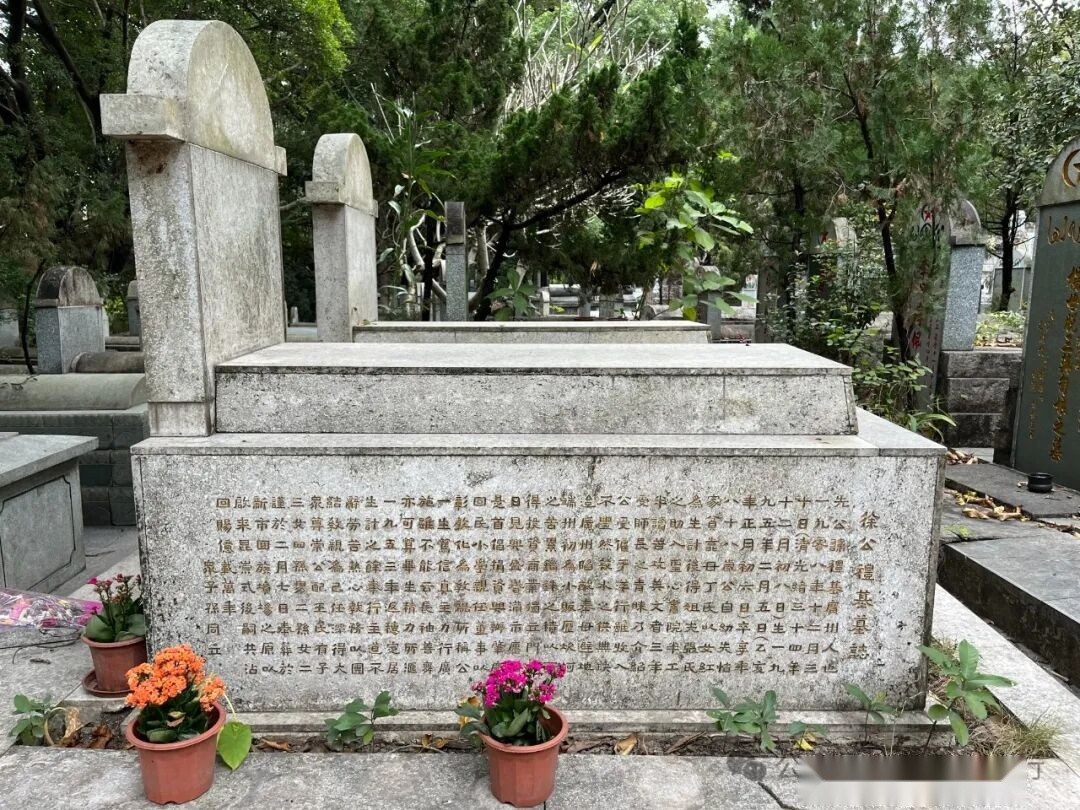
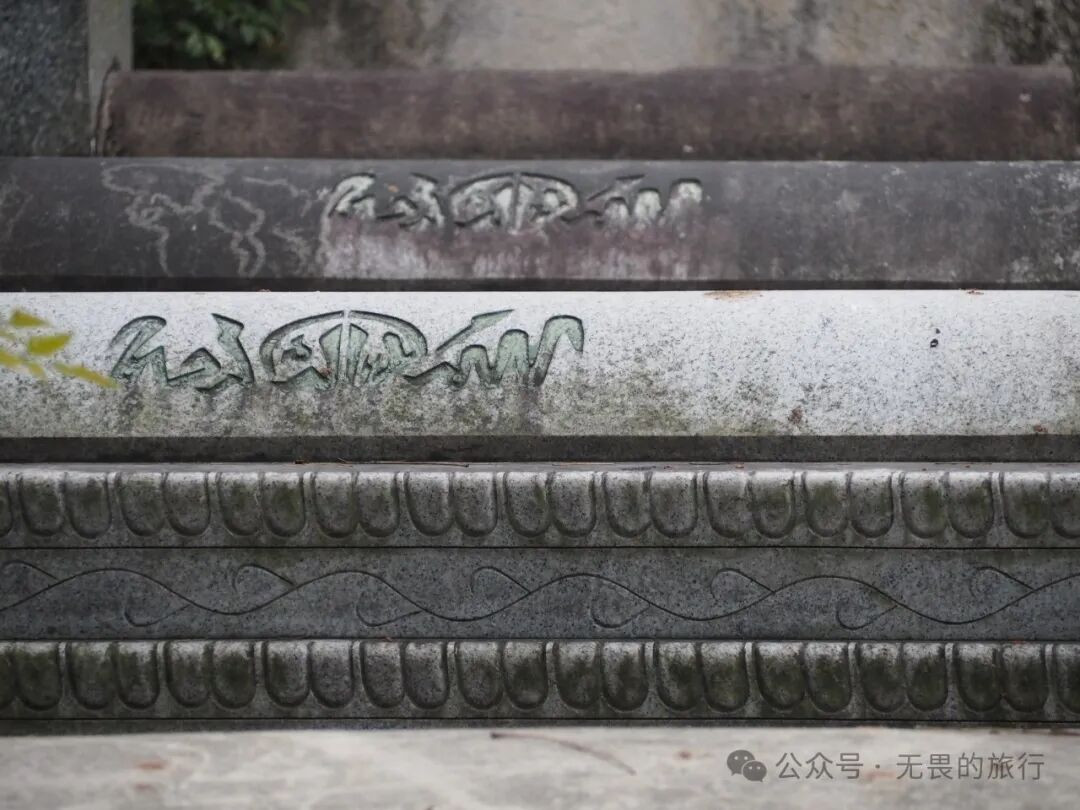
Gravestones these days are a bit different. They don't really brag about official ranks anymore. Instead, you'll see cool star and crescent symbols or verses from the Quran, clearly showing their Muslim identity. Some folks even get epitaphs written for their loved ones, which is awesome because it helps future generations get a glimpse into their lives.
Xu Liji, born in 1908, grew up in a humble family. But thanks to his brother-in-law's help, he managed to get into Sacred Heart College, balancing part-time work with studying English for three years. After graduating, he totally nailed it and joined a foreign firm — basically, if we're talking modern terms, he landed a job at a multinational corporation.
But then, out of nowhere, Japan invaded Guangzhou. He had to flee to Zhaoqing, where he started out as a small-time peddler, but get this, his business totally blew up! Once he became wealthy, he didn't forget to give back, investing in education by donating funds to set up the Zhaoqing Hui Muslim Primary School and even serving on its board himself. In 1953, he moved back to Guangzhou, where he eventually passed away and was laid to rest in the Xinshi Cemetery.
Xu Liji's Epitaph (Photo by Wuwei)
Ha Shaoguang, who was Ha Huanyiran's fourth younger brother, actually wrote her epitaph. She was born in 1918, and back in the Republic of China era, she got to go to school, attending the pretty famous Guangzhou Municipal Art School. After graduating in 1936, she spent her whole life as an art educator, returning to Allah when she was 72 years old.
Inscriptions on the Tomb (Photo by Wuwei)
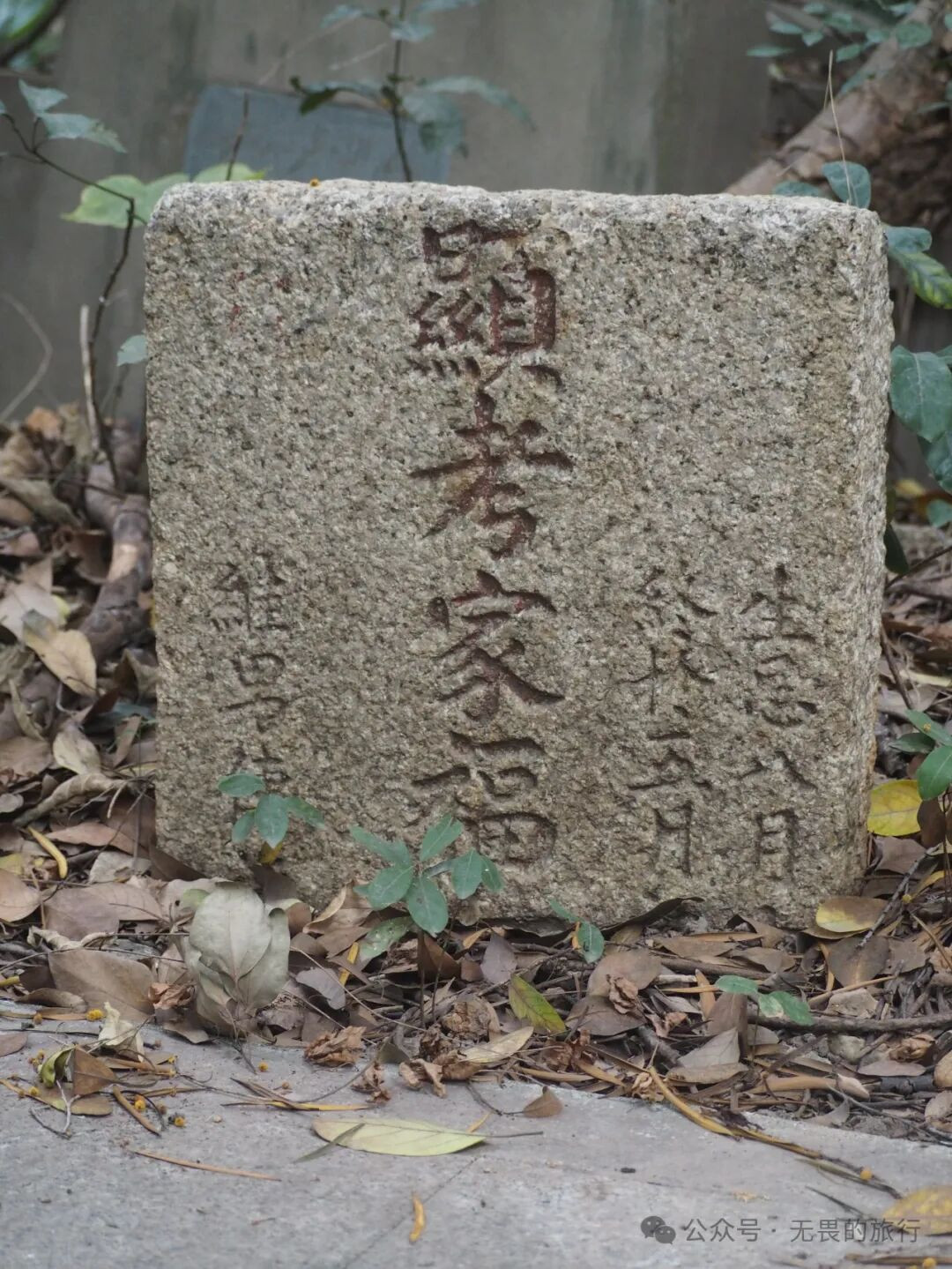
After China's Reform and Opening Up, tons of people from other regions started flocking to Guangzhou, which totally made the city's Muslim community even more diverse.
Lots of Muslims from Northwest and North China actually returned to Allah in Guangzhou, and they're also buried right here in this cemetery. You can spot place names like Gansu, Qinghai, and Xinjiang carved on their gravestones.
And check this out: on the gravestones of Uyghur people, you'll even find Uyghur written in Arabic script. Talipu Maimaiti, from Bachu County in Kashgar, Xinjiang, passed away in 1994 and is buried here. His hometown is seriously over 5000 kilometers away from Guangzhou – I'm pretty sure that's the furthest distance, right?
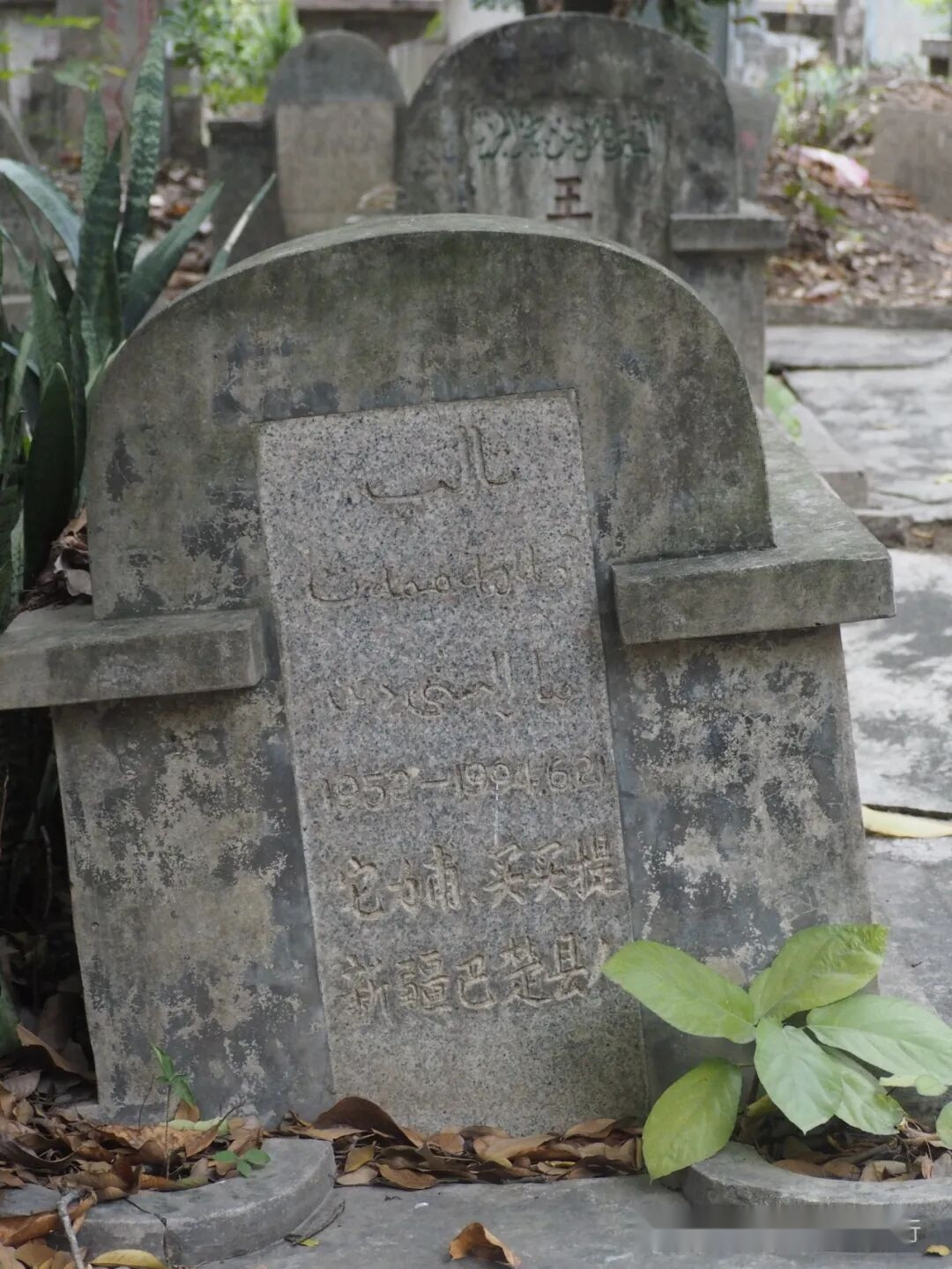
Half-Exposed Gravestone (Photo by Wuwei)
Maimaiti from Bachu County (Photo by Wuwei)
The cemetery also has foreign Muslims buried there. One gravestone has the name 'Iwanda' written in Latin script, and from the text below, you can tell it's Indonesian. This person was born in 1990 in Medan, on Indonesia's Sumatra Island. Sadly, in 1995, this little one's short life came to an end right here in Guangzhou.
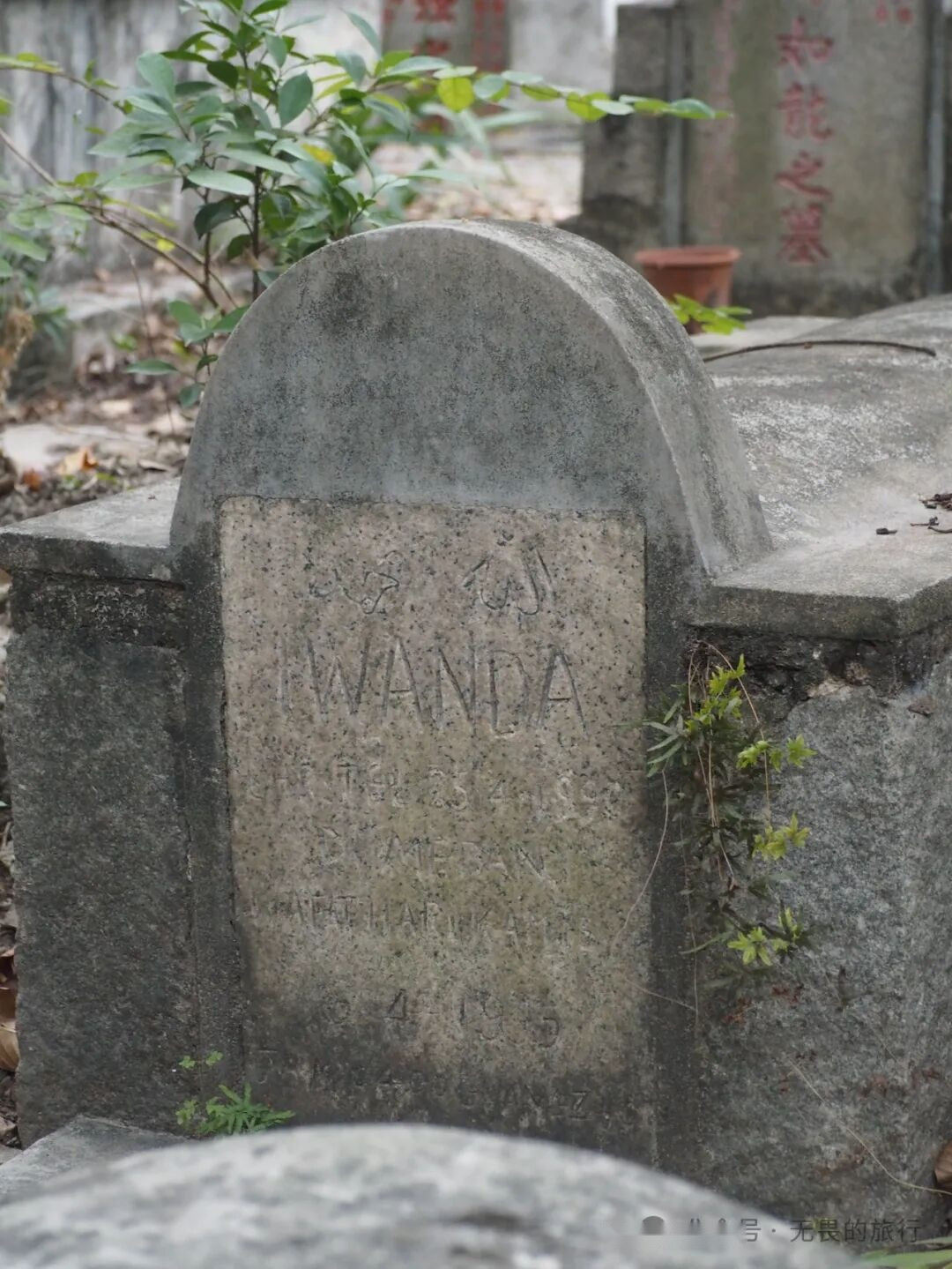
Iwanda's Tomb (Photo by Wuwei)
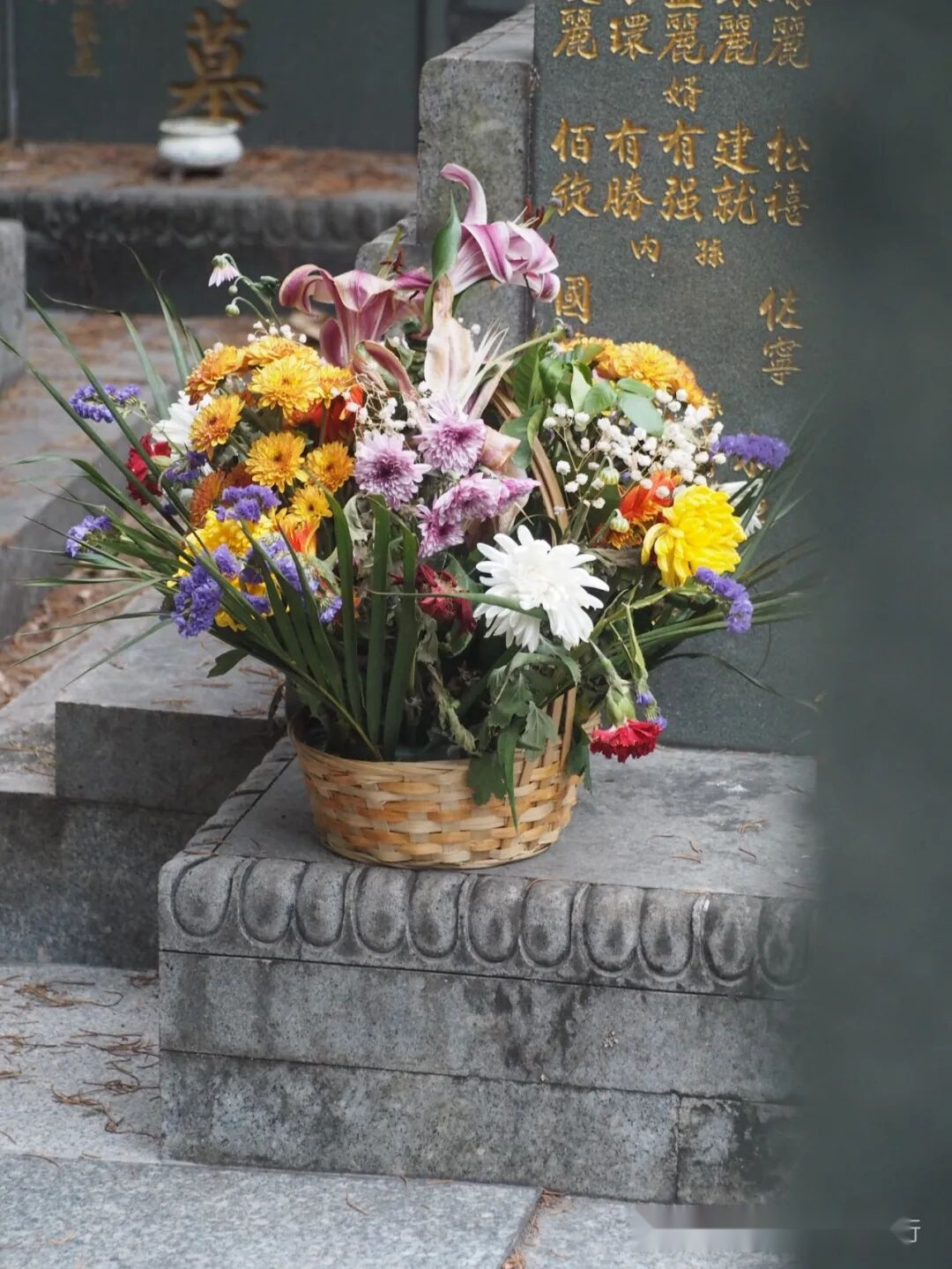
Flowers in front of the Tomb (Photo by Wuwei)
References:
Bao Yanzhong. *History of Islam in Guangzhou*. Guangzhou: Guangzhou Islamic Association, Guangzhou Hui Muslim Historical and Cultural Research Association, 2014.
Zhong Yuanxiu, Ma Jianzhao, Ma Fengda. *Research on Islamic Historical Sites in Guangzhou*. Yinchuan: Ningxia People's Publishing House, 2001.
Ma Qiang. *A Floating Spiritual Community—An Anthropological Study of Guangzhou Muslim Jama'at*. Beijing: China Social Sciences Press, 2006.
Guangzhou's Hidden Gem: Explore the 500-Year-Old Xiaodongying Mosque – Ming Dynasty Hui Muslim History & Ancient Lingnan Architecture
Articles • Hasan09 posted the article • 0 comments • 6 views • 8 hours ago
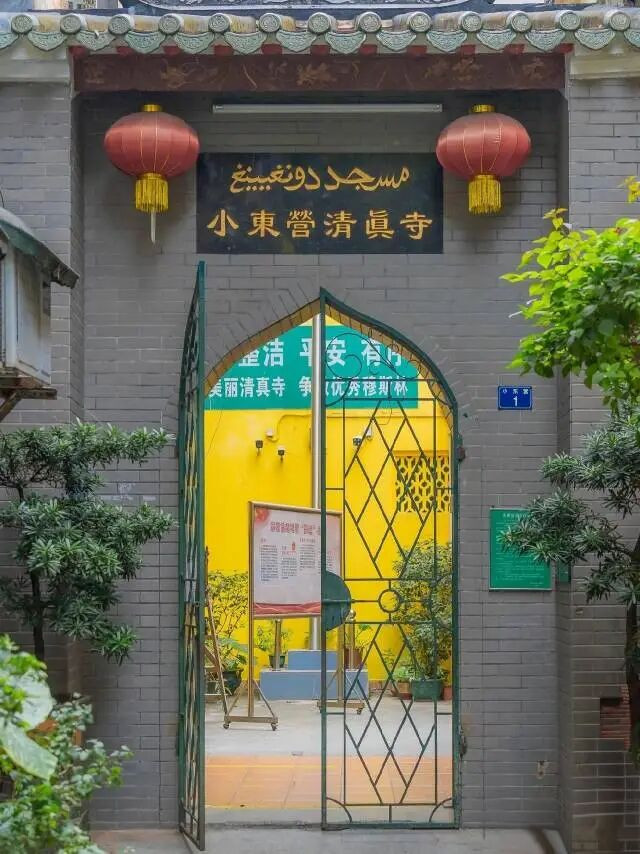
Checking Out Guangzhou's 500-Year-Old Xiaodongying Mosque: The Legend of its Ming Dynasty Hui Muslim Soldier Builders and Ancient Lingnan Courtyard Architecture
Here's the scoop:
We're taking a deep dive into Xiaodongying Mosque, tucked away in the historic alleys of Guangzhou's Yuexiu District. Get ready to explore its epic history, built by Ming Dynasty Hui Muslim garrison soldiers in Chenghua Year 4 (1468), and check out the halls that beautifully blend Lingnan courtyard aesthetics with Islamic architectural vibes.
Xiaodongying Mosque is chilling in the old alleys of Guangzhou's Yuexiu District. Founded in 1468, it's a super historic masjid.
It was actually built by Hui Muslim officers and soldiers stationed right here. Back in the day, Han Yong, the Viceroy of Liangguang (Guangdong and Guangxi), moved a massive number of troops from Nanjing to Guangzhou for military reasons. Among them were over 1,000 Hui Muslim soldiers! This Hui Muslim army set up camp in four spots, both inside and outside Guangzhou city: Dadong, Xiaodong, Xiying, and Zhuying, collectively known as the 'Huihui Camps' (Hui Muslim Camps). Fun fact: today's Xiaodongying Street is literally the original site of the Xiaodongying camp.
After centuries of epic changes and thoughtful renovations, it still rocks its ancient, dignified vibe. The architecture inside totally blends traditional Chinese and Islamic styles—think cool grey walls, dark tiles, awesome archways, and serene corridors. The courtyards are super peaceful and elegant, shaded by ancient trees, creating a calm and solemn atmosphere. The main prayer hall is simple yet grand, with intricate details showing off some serious craftsmanship, giving off quiet reverence and dignity everywhere you look.
This isn't just a spot for Muslims to offer dua and seek blessings; it's a living testament to Guangzhou's diverse culture and incredible ethnic harmony. Even though it's smack in the middle of a bustling city, it stays totally chill and untouched by the noise. Its ancient architecture holds centuries of faith and history, making it a peaceful, soulful cultural landmark in the old city.
Xiaodongying Mosque
Getting there: Hop on the subway to Ximenkou Station, take Exit B, and it's about an 800-meter walk.
Looking for your next adventure inspiration? This spot is perfect for #GuangzhouWeekend plans, a #FreeAttraction you'll definitely want to capture with #PhotographyDaily. It's all about #Travel and soaking up those #OldStreetVibes, discovering #CitySecrets, finding #HiddenGems, and generally just #SlowDownAndDiscover the joys of #UrbanExploration. view all
Checking Out Guangzhou's 500-Year-Old Xiaodongying Mosque: The Legend of its Ming Dynasty Hui Muslim Soldier Builders and Ancient Lingnan Courtyard Architecture
Here's the scoop:
We're taking a deep dive into Xiaodongying Mosque, tucked away in the historic alleys of Guangzhou's Yuexiu District. Get ready to explore its epic history, built by Ming Dynasty Hui Muslim garrison soldiers in Chenghua Year 4 (1468), and check out the halls that beautifully blend Lingnan courtyard aesthetics with Islamic architectural vibes.
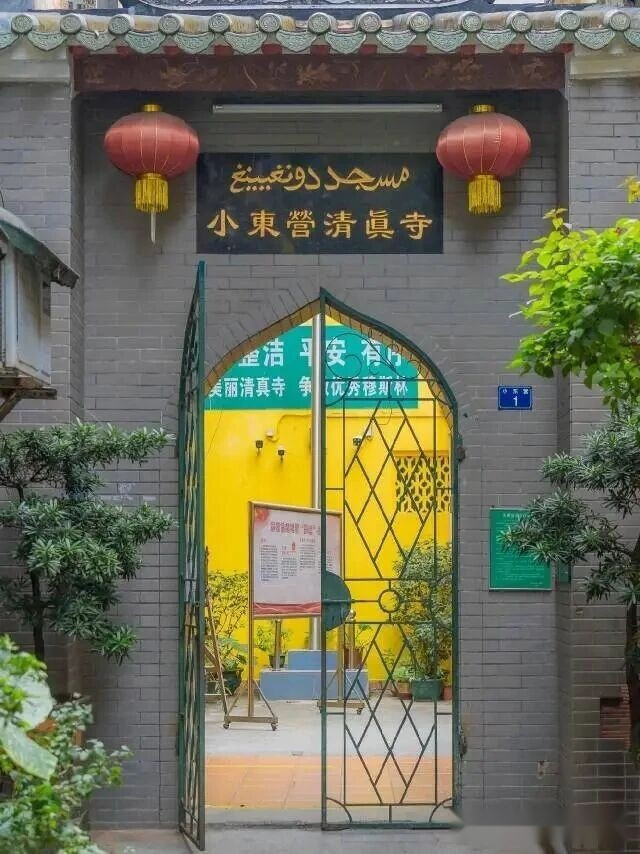
Xiaodongying Mosque is chilling in the old alleys of Guangzhou's Yuexiu District. Founded in 1468, it's a super historic masjid.
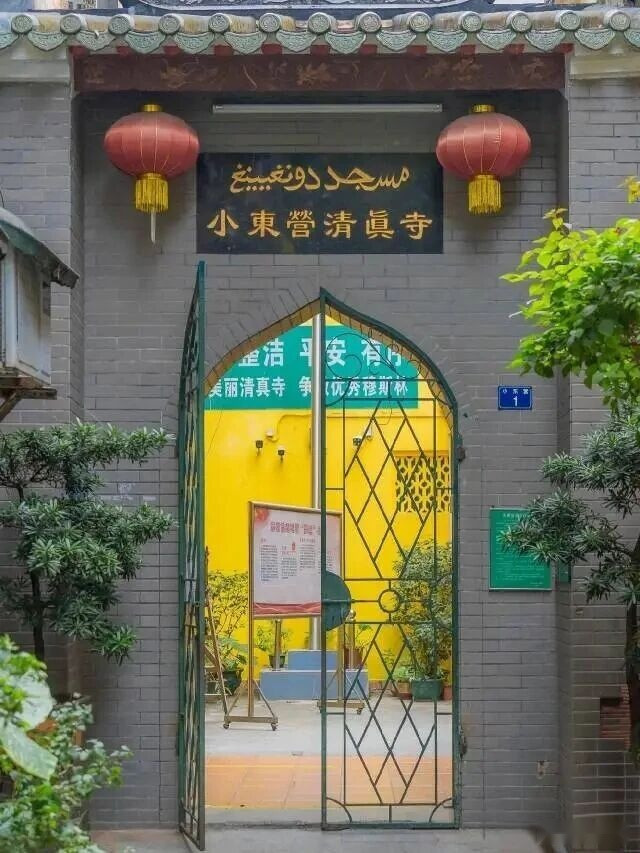
It was actually built by Hui Muslim officers and soldiers stationed right here. Back in the day, Han Yong, the Viceroy of Liangguang (Guangdong and Guangxi), moved a massive number of troops from Nanjing to Guangzhou for military reasons. Among them were over 1,000 Hui Muslim soldiers! This Hui Muslim army set up camp in four spots, both inside and outside Guangzhou city: Dadong, Xiaodong, Xiying, and Zhuying, collectively known as the 'Huihui Camps' (Hui Muslim Camps). Fun fact: today's Xiaodongying Street is literally the original site of the Xiaodongying camp.
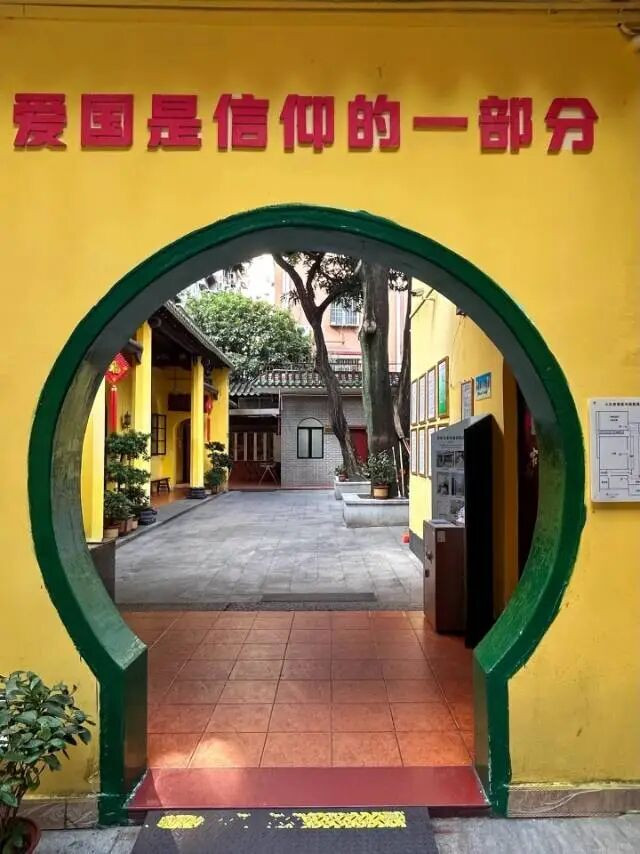
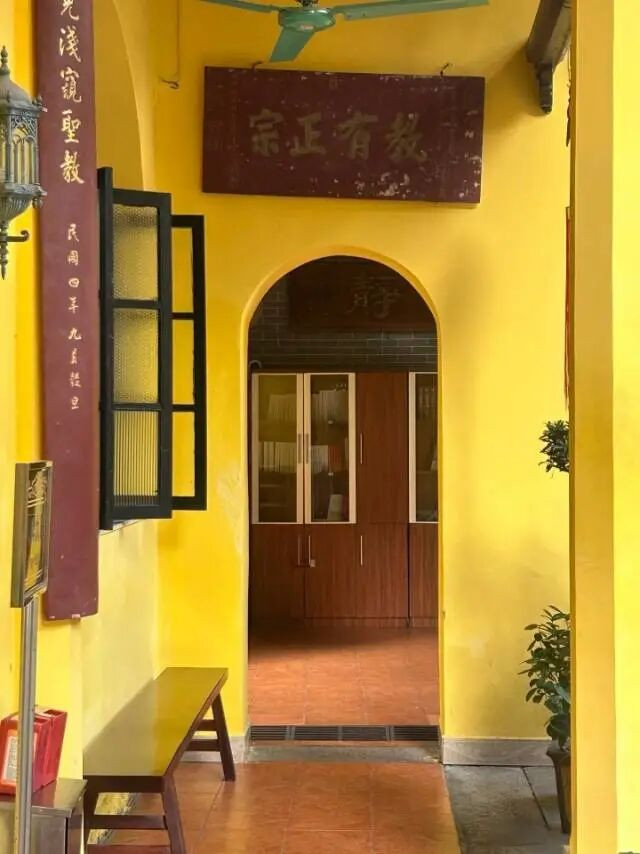
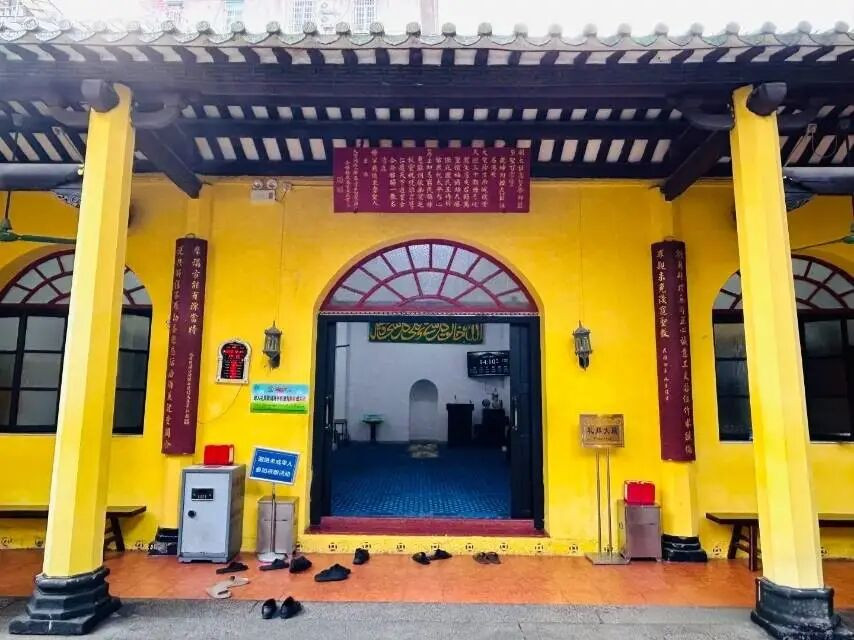
After centuries of epic changes and thoughtful renovations, it still rocks its ancient, dignified vibe. The architecture inside totally blends traditional Chinese and Islamic styles—think cool grey walls, dark tiles, awesome archways, and serene corridors. The courtyards are super peaceful and elegant, shaded by ancient trees, creating a calm and solemn atmosphere. The main prayer hall is simple yet grand, with intricate details showing off some serious craftsmanship, giving off quiet reverence and dignity everywhere you look.
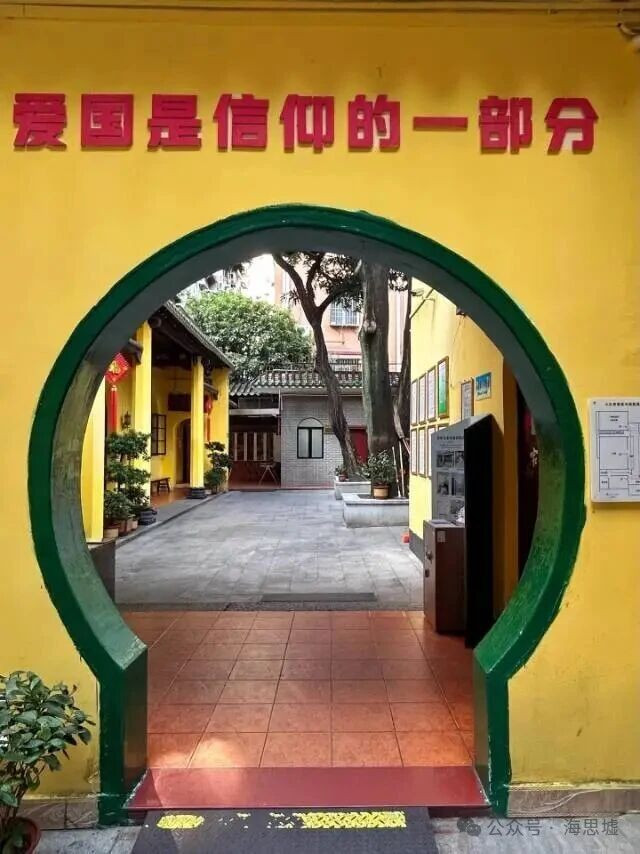
This isn't just a spot for Muslims to offer dua and seek blessings; it's a living testament to Guangzhou's diverse culture and incredible ethnic harmony. Even though it's smack in the middle of a bustling city, it stays totally chill and untouched by the noise. Its ancient architecture holds centuries of faith and history, making it a peaceful, soulful cultural landmark in the old city.
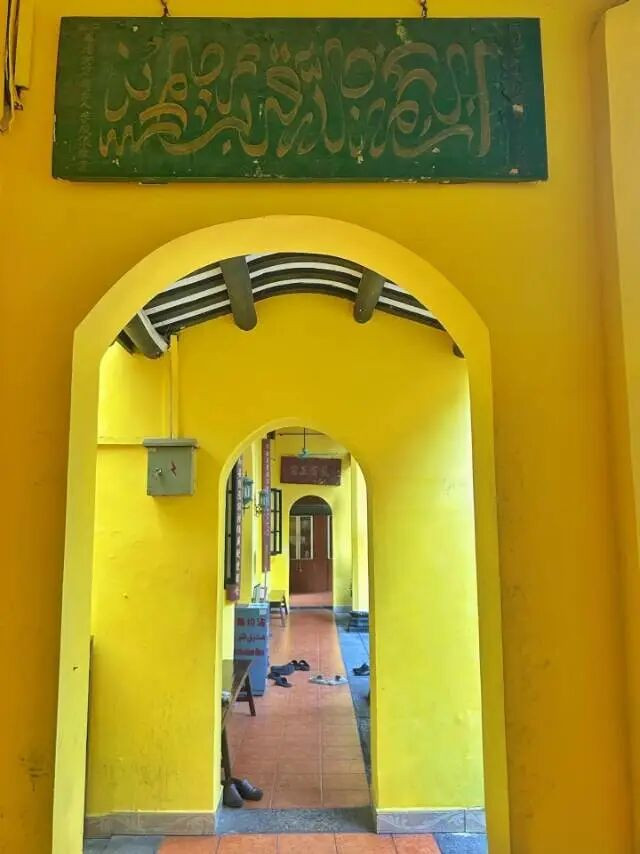
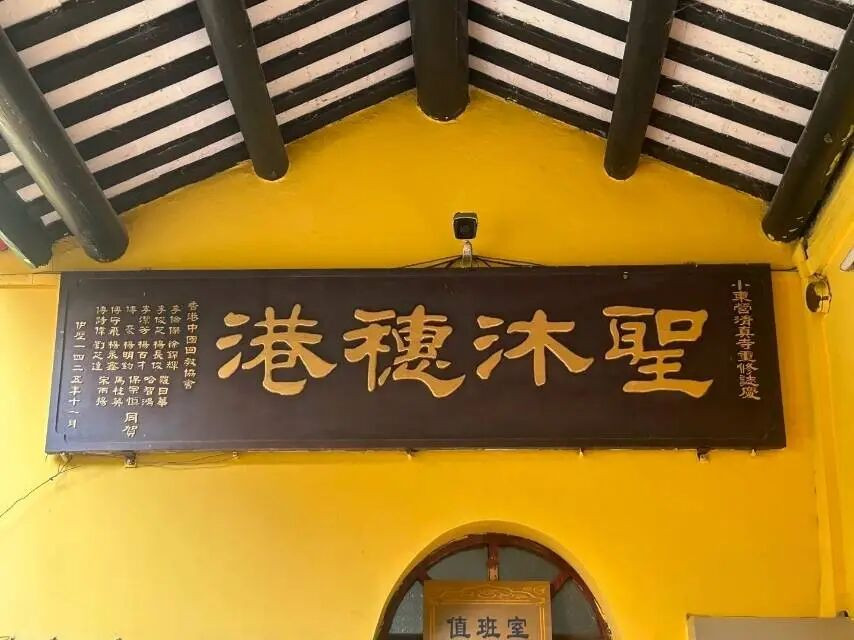
Xiaodongying Mosque
Getting there: Hop on the subway to Ximenkou Station, take Exit B, and it's about an 800-meter walk.
Looking for your next adventure inspiration? This spot is perfect for #GuangzhouWeekend plans, a #FreeAttraction you'll definitely want to capture with #PhotographyDaily. It's all about #Travel and soaking up those #OldStreetVibes, discovering #CitySecrets, finding #HiddenGems, and generally just #SlowDownAndDiscover the joys of #UrbanExploration.
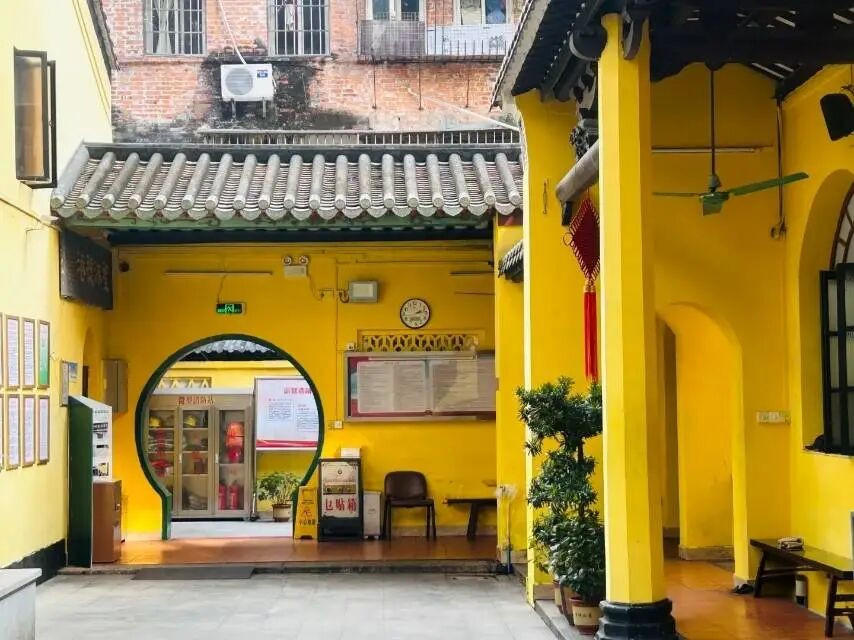
Exploring 6 Historic Qing-Dynasty Mosques in Zhaotong, Yunnan: A Halal Travel Guide
Articles • Hasan09 posted the article • 0 comments • 13 views • 23 hours ago
A Study of Six Traditional Historic Mosques in Zhaotong, Yunnan: Historical Origins of 'Gaituguiqiu' and a Complete Photo Collection of Ming and Qing Chinese-Style Palace Mosques
Abstract:
A detailed investigation of six precious traditional Ming and Qing-style historic mosques in Zhaotong, Yunnan. Combining the historical context of 'gaituguiqiu' (replacing native chieftains with imperial officials) during the reign of Emperor Yongzheng with the ancestral origins of General Ha Yuansheng's soldiers who settled in the region, this guide features nearly 80 precious real-life shots documenting the Sino-Arabic blended artistry of double-eave Xieshan roofs, exquisite carved water-milled bricks, wooden beams and rafters, and Arabic scripture plaques.
In August 2020, during our honeymoon trip, Zainab and I went to Zhaotong to hang out, and sister Azi showed us around Zhaotong's gorgeous traditional mosques.
During the Ming Dynasty, Zhaotong belonged to the Wumeng Native Prefecture and was governed by Yi ethnic chieftains. In 1726 (the fourth year of Emperor Yongzheng's reign), Yun-Gui Governor-General Ortai began implementing 'gaituguiqiu' (replacing native chieftains with imperial officials) in Wumeng. The Wumeng Native Prefecture raised troops to resist, and Weining Central Division Major Ha Yuansheng, alongside Central Division commander Liu Qiyuan, crushed the Wumeng Native Prefecture and local chieftains everywhere, finally completing the 'gaituguiqiu' and renaming Wumeng to Zhaotong. Ha Yuansheng was a Hui Muslim originally from Hejian, Hebei. During the 'gaituguiqiu' campaign, some Hui soldiers followed Ha Yuansheng into Zhaotong, and after the war ended, they 'registered their land and settled down.'
After Wumeng was pacified in 1732 (the tenth year of Emperor Yongzheng's reign), because the war had caused a sharp drop in the population, the newly appointed Yun-Gui Governor-General Gao Qizhuo ordered the reclamation of wasteland for garrison farming. Hui Muslim families and entire villages from the neighboring Weining area in Guizhou moved into Zhaotong to claim land, causing the Hui population in Zhaotong to surge. Most of the traditional mosques still standing today were built during this period.
1. Tuogu Grand Mosque: 1730
2. Longtouxiang Mosque: 1746
3. Chachong Mosque: 1734
4. Tiejiawan Mosque: 1738
5. Baxian Grand Mosque: 1779
6. Songjiashan Mosque: 1730
1. Tuogu Grand Mosque: 1730
On the morning of August 10, sister Azi drove us from Zhaotong to Ludian to kick off our tour of traditional mosques. Our first stop was Ludian's most famous Tuogu Grand Mosque.
We received a super warm welcome from Imam Hai at Tuogu Mosque, and he walked us through the history and various legends of Tuogu Mosque in great detail.
According to the stone inscriptions, Tuogu Mosque was built in 1730 when Anlong Town Central Division Imperial Guard Ma Xiangqian and conquering imperial examination graduates, the brothers Ma Lincan and Ma Linchi, donated funds to build the main prayer hall. In 1755, at the suggestion of Imam Sai Huanzhang, local fellow Muslims pooled funds to build the minaret (唤醒楼, huanxinglou), side halls, and other structures.
Before stepping into the masjid, the first thing that catches your eye is the hexagonal, triple-eaved, pyramidal-roofed minaret, with the three-bay wooden 'Wujuan Hall' (Hall of Indefatigable Study) right below it. Hanging on the minaret is a plaque reading 'Universal Mercy Over All Creation' (普慈万有), which was gifted in 1746 by Ye Daxiong, the Imperial Garrison General of Eastern Zhaotong, Yunnan and hereditary Cavalry Captain. This plaque originally hung in the main prayer hall and was later moved to the minaret.
Imam Hai pointed out that some of the stone pillars of the minaret actually feature ancient fossils—something you probably won't find in any other mosque anywhere else.
Passing through the Wujuan Hall brings you to the courtyard, where four ancient cypress trees are planted, and right across from them sits the main prayer hall. The center of the main hall reads 'Happy Paradise' (快乐天堂), and around it are eight Arabic calligraphy panels which, according to Imam Hai, were penned by the mosque's second imam, the senior elder Sai Huanzhang Sai Lao Baba.
Inside the main hall is the Mihrab (窑殿, yaodian—the prayer niche), and its roof is also a pyramidal-pavilion style structure, echoing the minaret in the distance.
An ancient Qing Dynasty tabu box (wooden box used for religious items), which Imam Hai said they don't use anymore because it's just way too heavy.
A stone stele dating back to the Qianlong Emperor's reign.
2. Longtouxiang Mosque: 1746
After checking out Tuogu Grand Mosque, we headed over to another famous historic mosque in Ludian, Longtouxiang Mosque, where we were warmly welcomed by Imam Ma Liming.
Built in 1746, Longtouxiang Mosque follows traditional Yunnan mosque architectural style, featuring a courtyard enclosed by a minaret, north and south side halls, and the main prayer hall. Unlike Tuogu Grand Mosque, Longtouxiang Mosque's Mihrab doesn't have a pyramidal pavilion on top, and its minaret only has four corners and two eaves, making its grandeur slightly milder than Tuogu's.
Longtouxiang's newly built prayer hall is entirely wooden and super majestic—you can spot it from way down the road. I’m totally down with this approach of building a new hall nearby without destroying historic cultural relics. Over the last few years, I’ve seen way too many places ruthlessly tear down centuries-old heritage architecture just to build a new hall.
3. Chachong Mosque: 1734
After leaving Longtouxiang Mosque, we hit up another historic mosque in Ludian, Chachong Mosque. Built in 1734, Chachong Mosque's minaret is a three-story, hexagonal, pyramidal-roofed structure just like the one at Tuogu Grand Mosque, only slightly smaller in scale. Hanging at the entrance of the main hall is a plaque reading 'Profound Mystery and Great Might' (玄奇大能) erected in reverence by Sa Depin in 1906.
Chachong Mosque is also gorgeous, though it's not quite as famous as nearby Tuogu Mosque and Longtouxiang Mosque. When we dropped by for a visit, the imam happened to be away attending a religious gathering at Longtouxiang Mosque, but the imam’s daughter was an old friend of sister Azi, so we all had a great time chatting together.
4. Tiejiawan Mosque: 1738
From Chachong Mosque, we headed over to Tiejiawan Mosque. Back in 1731, the Tie family settled down in the northeastern part of the Taoyuan basin in Ludian. In 1738, Tie Wanxuan, along with Tie Wanjin and Tie Zhongxuan, talked things over and decided to build Tiejiawan Mosque right on top of a little hill sitting between the villages of Tiejiawan and Tie Jiamen, with Tie Wanxuan stepping up as the imam.
Above the main hall's entrance hangs a plaque reading 'Great Virtue Transforms All' (Dade Dunhua), gifted in 1810 by Da Xiong, the hereditary commander-in-chief and military governor of Zhaotong Dongxiong and surrounding areas, alongside another plaque reading 'Pure and Elegant Transformation' (Qingzhen Yahua), erected in 1844 by Tie Chengjin from the Zhaotong Left Garrison.
5. Baxian Grand Mosque: 1779
Heading back to Zhaotong from Ludian as the evening rolled in, we made our way to Baxian Grand Mosque, easily the most famous masjid in Zhaotong.
Baxian Grand Mosque was first built in 1731 and rebuilt in 1779. After the Wumeng region was pacified in 1730, Zhaotong's old city was pretty much in ruins, so the military headquarters was temporarily set up at Baxian Grand Mosque. The very next year, the mosque launched Zhaoyang Academy right here—the first academy established in Zhaotong after the imperial court replaced local chieftains with appointed officials (gaitu guiliu). In 1898, Baxian Grand Mosque brought on Grand Imam Ma Minglun to lead the community, and the masjid was chosen by the thirty-six mosques across Zhaotong, Weining, and Ludian to serve as the head administrative masjid.
Flanking the entrance of the main hall are stone-carved couplets reading, 'Conquering one's own ego is the true path; returning to the divine law allows one to stand before Allah in prayer.' Up above in the main hall hangs a super unique Arabic wooden plaque inscribed with verses from Surah Az-Zukhruf (Chapter 43, Verse 44) of the Qur'an. Right behind the main hall sits the yaodian (dome-like rear prayer tower) featuring a triple-eaved, four-sided pyramidal roof.
6. Songjiashan Mosque: 1730
That evening, we caught the Maghrib prayer at Songjiashan Mosque. It was still dusk when we walked into the hall, but by the time we finished praying and stepped outside, night had completely fallen.
Songjiashan Mosque isn't far from Baxian Grand Mosque, and it's another seriously gorgeous historic masjid. In the early Yongzheng years, when the imperial government reformed the administrative system in Zhaotong, a branch of the Ma family from Xiaba in Weining followed General Hasenyuan—who had led troops to pacify Wumeng—straight to Zhaotong. They ended up settling by Baxian Lake and built Songjiashan Mosque in 1730. Songjiashan Mosque shares the exact same historical background as Baxian Grand Mosque, though because the local Muslim population was smaller, it's not quite as massive.
Songjiashan Mosque started painting the gorgeous ceiling murals inside its main hall in 1762, and the whole interior renovation was finally wrapped up in 1832, making it an insanely precious artistic treasure tucked inside the masjid. view all
A Study of Six Traditional Historic Mosques in Zhaotong, Yunnan: Historical Origins of 'Gaituguiqiu' and a Complete Photo Collection of Ming and Qing Chinese-Style Palace Mosques

Abstract:

A detailed investigation of six precious traditional Ming and Qing-style historic mosques in Zhaotong, Yunnan. Combining the historical context of 'gaituguiqiu' (replacing native chieftains with imperial officials) during the reign of Emperor Yongzheng with the ancestral origins of General Ha Yuansheng's soldiers who settled in the region, this guide features nearly 80 precious real-life shots documenting the Sino-Arabic blended artistry of double-eave Xieshan roofs, exquisite carved water-milled bricks, wooden beams and rafters, and Arabic scripture plaques.

In August 2020, during our honeymoon trip, Zainab and I went to Zhaotong to hang out, and sister Azi showed us around Zhaotong's gorgeous traditional mosques.

During the Ming Dynasty, Zhaotong belonged to the Wumeng Native Prefecture and was governed by Yi ethnic chieftains. In 1726 (the fourth year of Emperor Yongzheng's reign), Yun-Gui Governor-General Ortai began implementing 'gaituguiqiu' (replacing native chieftains with imperial officials) in Wumeng. The Wumeng Native Prefecture raised troops to resist, and Weining Central Division Major Ha Yuansheng, alongside Central Division commander Liu Qiyuan, crushed the Wumeng Native Prefecture and local chieftains everywhere, finally completing the 'gaituguiqiu' and renaming Wumeng to Zhaotong. Ha Yuansheng was a Hui Muslim originally from Hejian, Hebei. During the 'gaituguiqiu' campaign, some Hui soldiers followed Ha Yuansheng into Zhaotong, and after the war ended, they 'registered their land and settled down.'

After Wumeng was pacified in 1732 (the tenth year of Emperor Yongzheng's reign), because the war had caused a sharp drop in the population, the newly appointed Yun-Gui Governor-General Gao Qizhuo ordered the reclamation of wasteland for garrison farming. Hui Muslim families and entire villages from the neighboring Weining area in Guizhou moved into Zhaotong to claim land, causing the Hui population in Zhaotong to surge. Most of the traditional mosques still standing today were built during this period.

1. Tuogu Grand Mosque: 1730

2. Longtouxiang Mosque: 1746

3. Chachong Mosque: 1734

4. Tiejiawan Mosque: 1738

5. Baxian Grand Mosque: 1779

6. Songjiashan Mosque: 1730

1. Tuogu Grand Mosque: 1730

On the morning of August 10, sister Azi drove us from Zhaotong to Ludian to kick off our tour of traditional mosques. Our first stop was Ludian's most famous Tuogu Grand Mosque.

We received a super warm welcome from Imam Hai at Tuogu Mosque, and he walked us through the history and various legends of Tuogu Mosque in great detail.

According to the stone inscriptions, Tuogu Mosque was built in 1730 when Anlong Town Central Division Imperial Guard Ma Xiangqian and conquering imperial examination graduates, the brothers Ma Lincan and Ma Linchi, donated funds to build the main prayer hall. In 1755, at the suggestion of Imam Sai Huanzhang, local fellow Muslims pooled funds to build the minaret (唤醒楼, huanxinglou), side halls, and other structures.

Before stepping into the masjid, the first thing that catches your eye is the hexagonal, triple-eaved, pyramidal-roofed minaret, with the three-bay wooden 'Wujuan Hall' (Hall of Indefatigable Study) right below it. Hanging on the minaret is a plaque reading 'Universal Mercy Over All Creation' (普慈万有), which was gifted in 1746 by Ye Daxiong, the Imperial Garrison General of Eastern Zhaotong, Yunnan and hereditary Cavalry Captain. This plaque originally hung in the main prayer hall and was later moved to the minaret.

Imam Hai pointed out that some of the stone pillars of the minaret actually feature ancient fossils—something you probably won't find in any other mosque anywhere else.

Passing through the Wujuan Hall brings you to the courtyard, where four ancient cypress trees are planted, and right across from them sits the main prayer hall. The center of the main hall reads 'Happy Paradise' (快乐天堂), and around it are eight Arabic calligraphy panels which, according to Imam Hai, were penned by the mosque's second imam, the senior elder Sai Huanzhang Sai Lao Baba.

Inside the main hall is the Mihrab (窑殿, yaodian—the prayer niche), and its roof is also a pyramidal-pavilion style structure, echoing the minaret in the distance.

An ancient Qing Dynasty tabu box (wooden box used for religious items), which Imam Hai said they don't use anymore because it's just way too heavy.

A stone stele dating back to the Qianlong Emperor's reign.

2. Longtouxiang Mosque: 1746

After checking out Tuogu Grand Mosque, we headed over to another famous historic mosque in Ludian, Longtouxiang Mosque, where we were warmly welcomed by Imam Ma Liming.

Built in 1746, Longtouxiang Mosque follows traditional Yunnan mosque architectural style, featuring a courtyard enclosed by a minaret, north and south side halls, and the main prayer hall. Unlike Tuogu Grand Mosque, Longtouxiang Mosque's Mihrab doesn't have a pyramidal pavilion on top, and its minaret only has four corners and two eaves, making its grandeur slightly milder than Tuogu's.

Longtouxiang's newly built prayer hall is entirely wooden and super majestic—you can spot it from way down the road. I’m totally down with this approach of building a new hall nearby without destroying historic cultural relics. Over the last few years, I’ve seen way too many places ruthlessly tear down centuries-old heritage architecture just to build a new hall.

3. Chachong Mosque: 1734

After leaving Longtouxiang Mosque, we hit up another historic mosque in Ludian, Chachong Mosque. Built in 1734, Chachong Mosque's minaret is a three-story, hexagonal, pyramidal-roofed structure just like the one at Tuogu Grand Mosque, only slightly smaller in scale. Hanging at the entrance of the main hall is a plaque reading 'Profound Mystery and Great Might' (玄奇大能) erected in reverence by Sa Depin in 1906.

Chachong Mosque is also gorgeous, though it's not quite as famous as nearby Tuogu Mosque and Longtouxiang Mosque. When we dropped by for a visit, the imam happened to be away attending a religious gathering at Longtouxiang Mosque, but the imam’s daughter was an old friend of sister Azi, so we all had a great time chatting together.

4. Tiejiawan Mosque: 1738

From Chachong Mosque, we headed over to Tiejiawan Mosque. Back in 1731, the Tie family settled down in the northeastern part of the Taoyuan basin in Ludian. In 1738, Tie Wanxuan, along with Tie Wanjin and Tie Zhongxuan, talked things over and decided to build Tiejiawan Mosque right on top of a little hill sitting between the villages of Tiejiawan and Tie Jiamen, with Tie Wanxuan stepping up as the imam.

Above the main hall's entrance hangs a plaque reading 'Great Virtue Transforms All' (Dade Dunhua), gifted in 1810 by Da Xiong, the hereditary commander-in-chief and military governor of Zhaotong Dongxiong and surrounding areas, alongside another plaque reading 'Pure and Elegant Transformation' (Qingzhen Yahua), erected in 1844 by Tie Chengjin from the Zhaotong Left Garrison.

5. Baxian Grand Mosque: 1779

Heading back to Zhaotong from Ludian as the evening rolled in, we made our way to Baxian Grand Mosque, easily the most famous masjid in Zhaotong.

Baxian Grand Mosque was first built in 1731 and rebuilt in 1779. After the Wumeng region was pacified in 1730, Zhaotong's old city was pretty much in ruins, so the military headquarters was temporarily set up at Baxian Grand Mosque. The very next year, the mosque launched Zhaoyang Academy right here—the first academy established in Zhaotong after the imperial court replaced local chieftains with appointed officials (gaitu guiliu). In 1898, Baxian Grand Mosque brought on Grand Imam Ma Minglun to lead the community, and the masjid was chosen by the thirty-six mosques across Zhaotong, Weining, and Ludian to serve as the head administrative masjid.

Flanking the entrance of the main hall are stone-carved couplets reading, 'Conquering one's own ego is the true path; returning to the divine law allows one to stand before Allah in prayer.' Up above in the main hall hangs a super unique Arabic wooden plaque inscribed with verses from Surah Az-Zukhruf (Chapter 43, Verse 44) of the Qur'an. Right behind the main hall sits the yaodian (dome-like rear prayer tower) featuring a triple-eaved, four-sided pyramidal roof.

6. Songjiashan Mosque: 1730

That evening, we caught the Maghrib prayer at Songjiashan Mosque. It was still dusk when we walked into the hall, but by the time we finished praying and stepped outside, night had completely fallen.

Songjiashan Mosque isn't far from Baxian Grand Mosque, and it's another seriously gorgeous historic masjid. In the early Yongzheng years, when the imperial government reformed the administrative system in Zhaotong, a branch of the Ma family from Xiaba in Weining followed General Hasenyuan—who had led troops to pacify Wumeng—straight to Zhaotong. They ended up settling by Baxian Lake and built Songjiashan Mosque in 1730. Songjiashan Mosque shares the exact same historical background as Baxian Grand Mosque, though because the local Muslim population was smaller, it's not quite as massive.

Songjiashan Mosque started painting the gorgeous ceiling murals inside its main hall in 1762, and the whole interior renovation was finally wrapped up in 1832, making it an insanely precious artistic treasure tucked inside the masjid.


Decoding Hangzhou's Muslim Heritage: Rare Mosque Steles & Halal History
Articles • Hasan09 posted the article • 0 comments • 12 views • 23 hours ago
Academic Research: Deciphering Newly Discovered Imam Tombstones at Hangzhou's Yong'an Muslim Cemetery: New Evidence on Islamic History and the Fenghuang Mosque's Imam System
Abstract:
Through detailed textual research on newly discovered tombstones of imams dating from the Daoguang, Xianfeng, and Republican periods at Hangzhou's Yong'an Muslim Cemetery, this study fills a historical gap in the lineage of Hangzhou's Islamic leaders and provides precious first-hand physical evidence for the three-imam system historically practiced at Fenghuang Mosque (Phoenix Mosque).
Academic Research:
Discovery of Imam Tombstones at Hangzhou's Yong'an Muslim Cemetery
Guo Chengmei, Yang Hua
Abstract
Three tombstones respectively bearing the titles of "Grand Imam" and "Third Imam" have been discovered at the Yong'an Muslim Cemetery in Hangzhou. Dating to the Daoguang, Xianfeng, and Republican eras, these stones provide concrete evidence that Fenghuang Mosque once practiced a three-imam system. The subjects of these three tombstones have rarely been mentioned in academic circles, and their indisputable roles as religious leaders offer fresh content and fertile ground for researching late Qing and Republican-era Islam in Hangzhou. This article offers a preliminary decipherment of the inscriptions on these three steles. Around the 1930s, titles like "Grand Imam" disappeared from Yong'an Cemetery, replaced by terms such as "Ahong (Islamic teacher/imam)" and "Jiaozhang (chief imam/dean)", indicating that the Fenghuang Mosque's three-imam system was no longer in practice. This historical shift was linked to the rising status of community elders, the gradual dilution of the imams' administrative powers, and external influences.
Keywords
Fenghuang Mosque (Phoenix Mosque); Three-Imam System; Tombstones
1. The Discovery of Grand Imam, Third Imam, and Imam Tombstones in Hangzhou
Historically, the three-imam system was one of the organizational structures used in inland China's mosques, also known as the "Three-Path System." Emerging among Hui Muslims in interior China in the late 14th century, it was a mosque organization system composed of three religious roles: the Imam, the Khatib, and the Mu'adhdhin. In Ma Zhu's Qingzhen Zhinhai (Guide to Islam), the Imam, Khatib, and Mu'adhdhin are referred to sequentially as the "Grand Imam," "Second Imam," and "Third Imam," and are collectively called "religious leaders." Liu Zhi's Tianfang Dianli (Islamic Rites) refers to the Khatib as "Yujiao" (instructor of teachings) and the Mu'adhdhin as "Zangjiao" (praiser of teachings). Within the three-imam system, the Imam led the congregation in prayer and presided over public religious rituals and activities; the Khatib preached and admonished; and the Mu'adhdhin served as the muezzin, specifically calling the faithful to the mosque for prayer when the time arrived. This system was widely prevalent in Hui Muslim communities during the Ming and Qing dynasties and formed a hereditary practice. With social development, aside from a few religious communities that formally retained the "three-imam system," it gradually faded away by the mid-Republican period, and the institution ceased to exist.
Whether the historic Fenghuang Mosque (Phoenix Mosque) in Hangzhou practiced the three-imam system of mosque management is a question worthy of attention and study. Due to a scarcity of sources, it has remained unaddressed. Since 2017, and particularly starting two years ago, with the support of the Zhejiang Islamic Association, we have gained a general understanding of the Yong'an Muslim Cemetery through multiple field surveys. By numbering, registering, and photographing the tombs and steles, and by transcribing inscriptions and measuring stones for key monuments, we have gathered a wealth of precious first-hand material and achieved preliminary research results. Among them, several tombstones related to Fenghuang Mosque particularly caught our attention. Upon research, we discovered that the sparse words carved on these few stones actually pertain to the implementation of the three-imam system at Fenghuang Mosque. Below, this paper will focus on introducing the evidence found on these steles at the Yong'an Muslim Cemetery concerning the practice of the three-imam system at Fenghuang Mosque in the late Qing and early Republican periods.
The Yong'an Muslim Cemetery is located within the Yuquan Scenic Area in Hangzhou. Because Muslim cemeteries such as the one in the West Lake South Garden fell into ruin over time and left no space for burials, clan members raised funds in 1934 to purchase 99 mu of land at Lingfeng, Yuquan, West Lake, establishing the Yong'an Cemetery. In 1991, to beautify the West Lake scenic area, the Hangzhou municipal government banned further burials at the "Yong'an Cemetery" in the Yuquan scenic zone, designating the site as a permanent area for ancient Hui Muslim tombs. The original 44 burial plots were funded by the government and relocated to the Liuxia Hui Muslim Cemetery in the nearby suburbs.
The burial grounds of the Yong'an Muslim Cemetery currently contain roughly three categories of Muslim graves. The first consists of original burials from various dynasties prior to 1934 that were already located within the Yong'an graveyard, such as the 55th year of the Qianlong era (1790) "Tomb of Aunt Ding," the Daoguang-era (1838) "Joint Tomb of Wang Chunhui and Madam Liu," the Tongzhi-era (1867) "Tomb of Madam Wang and Madam Ding," and the Guangxu-era (1877) "Tomb of Ma Ermei." The second category comprises graves added as a public cemetery for Hangzhou's Muslims between the establishment of the cemetery in 1934 and 1991, when the Hangzhou municipal government prohibited further burials at Yong'an and designated it as ancient Hui Muslim graves. The third category includes a certain number of relocated tombs. After 1949, as Hangzhou accelerated urban construction and development, many ancient Muslim graves and modern burials originally located in development zones were relocated, and Yong'an Cemetery took in a portion of them. Because the cemetery is nestled in a tranquil mountain scenic area, the Hangzhou municipal government preserved it in its original state permanently. The 1991 government burial ban took effect in 1992, after which the Yong'an Cemetery distanced itself from urban clamor and settled into natural serenity. These ancient tombs and steles within the cemetery grounds have thus been preserved before us in their original locations and appearances.
The Yong'an Cemetery currently holds two tombstones bearing the title "Grand Imam" and one bearing the title "Third Imam." These three graves lie side by side in the southwest corner of the cemetery; from right to left, they are Er Zhiru the Third Imam, Tan Zhongling the Grand Imam, and Xiyuan the Grand Imam. Another tombstone bearing the title "Imam" is located on the southern side of the cemetery. Due to years of rainwater erosion on the hillside, mountain moisture, and sparse human traffic, the lower halves of the two "Grand Imam" tombstones have been buried in mountain mud, with moss clinging to the surface above ground. We conducted tentative preliminary excavations, leading to new discoveries regarding the inscriptions. For instance, on the tombstone of Grand Imam Xiyuan, originally only lines such as "Summer of the 12th year of the Republic of China, ninth month" and "Grand Imam of Fenghuang Mosque" were visible. After excavation, important information such as "Lord Xiyuan" and "Filial son Bai" was successively identified. Further excavation to read characters deeper down proved too difficult, so work was regretfully halted.
2. Inscriptions and Decipherment
The four tombstones recording the "Grand Imam," "Third Imam," and "Imam" are arranged in chronological order by their erection dates: the tombstone of Third Imam Er Zhiru, the tombstone of Grand Imam Tan Zhongling, the tombstone of Grand Imam Bai Xiyuan, and the joint tombstone of Imams Ding Yinchun and Yang Hongdao.
(1) Tombstone of Third Imam Er Zhiru and His Wife
Inscription: Joint tomb of the late Third Imam Er Gong of the Great Mosque and his surviving wife, Madam Ma. Erected in the sixth month of the seventh year of Daoguang. Filial sons Fuchang, Furui, Rongqing, Ronggui, and Rongchang bow a hundred times.
Decipherment: Carved from granite, the stele measures 125 cm in height, 65 cm in width, and 10 cm in thickness, in a rectangular shape. Erected in the seventh year of Daoguang (1827). The top is outlined with simple lines forming a pointed arch, a commonly used decorative shape in Islam. Below this are the horizontally arranged characters "Qing Gu" (the late Qing...), written in larger font. Eight vertical lines of text record the erection date, the identity of the tomb occupants, and information about the sponsors.
"Great Mosque" was a designation for Fenghuang Mosque in the late Qing period; academic research shows this usage first appears in the Tongzhi Xinyin edition of Wugong Yaoyao (Essentials of the Five Duties). The discovery of this stele pushes back the recorded use of "Great Mosque" by 44 years from existing historical sources.
The tomb occupant, Er Zhiru, served as the Third Imam of the Great Mosque. The surname Er is relatively rare, and history does not directly mention any famous Islamic figures with the surname Er. Among the donor lists in the surviving Qianlong 8th year (1743) stele "Inscription on the Reconstruction of the Zhenjiao Temple" at Fenghuang Mosque, individuals with the surname Er include: Er, instructor at Liuhe Cangzhou; Er Shengyong; Er Tongwen; Er Tai-nu; Er Yushu; Er Dezhang; Er Qianzhi; Er Bixian; Er Tianwei; and "Guangyu Hall Er." Among the existing tombstones in Yong'an Cemetery, this is the only one bearing the Er surname. The 8th year of Qianlong (1743) was only 84 years away from the 7th year of Daoguang (1827), and nearly two hundred years have passed since then. The number of Muslims with the surname Er in Hangzhou has undergone significant shifts and rapid decline, nearly vanishing entirely.
We believe that Third Imam Er Zhiru was a local religious scholar born in Hangzhou. Out-of-towners buried at Yong'an Cemetery usually have notations on their tombstones, such as: "Tomb of Chen Wenzhi of Kaifeng Prefecture, Henan" on Chen Wenzhi's tombstone; "Native of Nanshan County, Nansxiang, Yizhou Prefecture, Shandong" on Wang Shiqi's tombstone; and "Huaiyin Hall, Jinling" carved on Wang Hongtai's tombstone. These details clearly mark the ancestral homes and identities of the deceased. Tombstones lacking such information typically belong to locals, requiring no special explanatory inscription.
(2) Tombstone of Grand Imam Tan Zhongling
Inscription: (Arabic text) Bismillah al-Rahman al-Rahim. Imperial Qing bestowed the scholarly rank of Xiuzhiguo, Grand Imam of the Wulin Great Mosque, Lord Zhongling... Twelfth month of the fifth year of Xianfeng. Filial son Tan Shengxian, filial nephew Tan Shengde...
Decipherment: Carved from granite, the stele measures 100 cm in height, 65 cm in width, and 10 cm in thickness, in a rectangular shape. Erected in the fifth year of Xianfeng (1855). The upper portion features a circular design enclosing the Quranic text Bismillah al-Rahman al-Rahim, translated into Chinese as "In the name of Allah, the Most Gracious, the Most Merciful." The bottom of the tombstone is submerged in the ground, and the text at the lower end is buried and illegible. Based on typical tombstone layouts, we estimate that the buried text is brief and contains no critical information. Directly below "Lord" are likely the characters "Zhi Mu" (Tomb of); below "Shengxian and Shengde" are likely phrases like "Respectfully erected / jointly erected" or "bowing a hundred times / weeping a hundred times."
This is the second tombstone discovered at the Yong'an Muslim Cemetery inscribed with the name "Great Mosque." Wulin is an alternative name for Hangzhou. The Wulin Great Mosque is thus Hangzhou's Fenghuang Mosque.
The tombstone is engraved with the Arabic Quranic "Basmala." The Qing-era rank of Xiuzhiguo was a titular rank for civil officials of the eighth lower grade—a nominal official title without real power, roughly equivalent to a deputy staff member in modern civil service hierarchies. Several officials and their wives buried at Yong'an Cemetery who bear the designation "Imperial Qing" lack Arabic scriptures and terms like "Qingzhen" (Islamic/Halal) or "Hui Muslim." Examples include Liu Caizhang, a candidate prefectural judge in the 8th year of Guangxu; Ding Jinchun, bestowed the rank of Xiuzhiguo in the 9th year of Guangxu; Madam Chen in the guisi year of Guangxu; Zhang Zhizheng, bestowed the rank of official in the 19th year of Guangxu; and Madam Wang, bestowed a title in the 6th year of Tongzhi. Tan Zhongling is the only person in Yong'an Cemetery who held both an imperial court title and the position of Grand Imam.
Muslims with the surname Tan are scarce in Hangzhou. The 1743 Qianlong-era "Stele on the Reconstruction of the Zhenjiao Temple" at Fenghuang Mosque lists no local Hangzhou Muslims with the surname Tan. Aside from the tombstone of Grand Imam Tan Zhongling, Yong'an Muslim Cemetery contains only five tombstones bearing the Tan surname: the first is the tombstone of "Late Ancestral Grandmother Madam Tan," erected in the 27th year of the Republic (1938); the second is the tombstone of "Tan Liansheng and Madam Zhao," erected in 1955; the third is for "Tan Shunyuan," erected in 1973; the fourth is for "Tan Yunsun," erected in 1979; and the fifth is for "Hua Hanzhi and Tan Quanyun," erected in 1980. The occupants of these four post-liberation tombstones appear to be two generations of the same family.
The tomb occupant "Lord Xiyuan" has an uncertain surname. Referring to the sponsor at the lower left, "Filial son Bai," it is possible his name was Bai Xiyuan. However, a "filial son Bai" would not refer to Xiyuan as "Lord" (Jun); he should have used "Lord Father" (Fujun) or "Late Father." Consulting the 1743 Qianlong-era "Stele Inscription on the Reconstruction of the Zhenjiao Temple" by gentry member Ding Shishen of Hangzhou's Fenghuang Mosque, the text records two individuals with the surname Bai: one is "Bai, military commander of the Jiangsu Governor's central garrison," and the other is "Baba Bai." Baba, also called Papa, signifies an elder or a figure of prestige. Hangzhou's Buhetiy'er Tomb is popularly known as the Baba Tomb. Imams and religious leaders were also called Baba. Among the more than two hundred donors listed on that Qianlong stele are four Babas: Baba Bai, Baba Suo of Zhenjiang, Baba Ningbo, and Baba Wang.
The life deeds of Grand Imam Lord Xiyuan, Third Imam Er Zhiru, and Grand Imam Tan Zhongling mentioned above remain unknown.
(3) Tombstone of Grand Imam Bai Xiyuan
Inscription: (Arabic text) Bismillah al-Rahman al-Rahim. True Fenghuang Mosque Grand Imam Lord Xiyuan... Summer of the 12th year of the Republic of China, ninth month... Filial son Bai...
Decipherment: Carved from granite, the stele measures 125 cm in height, 80 cm in width, and 6 cm in thickness, in a square shape. Erected in the 12th year of the Republic of China (1923). The upper portion is engraved with a square design enclosing the Quranic text Bismillah al-Rahman al-Rahim, translated into Chinese as "In the name of Allah, the Most Gracious, the Most Merciful." To the right is the character "Zhen" (True), a spelling style also found on other steles at Yong'an Cemetery. "Zhen" seems to refer to "Qingzhen" (Islamic), a simplified writing convention of the time used to highlight the Muslim identity of the deceased. The face of the stele features two vertical lines of text, rendered in a font relatively smaller than the Arabic Basmala and the character "Zhen." The characters at the bottom of the tombstone are obscured, preventing further deep excavation and identification.
(4) Joint Tombstone of Imams Ding Yinchun and Yang Hongdao
Inscription: (Arabic text) Bismillah al-Rahman al-Rahim. Joint tomb of late Qing Fenghuang Mosque Imam Ding and Imam Yang. Right: Late great-grandfather Ding Gong Yinchun, great-grandmother Madam Feng. Left: Late Yang Gong Hongdao, Madam. Having no direct heirs, originally buried to the left of the Ding tomb, per instructions they were relocated here together for convenience. Sons Shouyuan, Shoucheng, Shoudao, Shoulian, Shouzhi; grandsons Ruiyan, Ruiheng, Ruiting, Ruixin, Ruilun, Ruizhen, Ruihua, Ruigan; great-grandsons Yongben, Wu Qianguan, Yongkang, Yongming, Yongquan, Yong'an, Yongkun, Yongxi, Yongqiang, Yongyue, Yongkou, Yongzhen, Yongjia, Yongqun, Yongning, Yongzhong respectfully erect this. Relocated here from Wansongling during Eid al-Fitr in 1987.
Decipherment: Carved from granite, the stele measures 163 cm in height, 76 cm in width, and 10 cm in thickness, square with an arched top. The upper portion features a floral decorative pattern formed by the Quranic text Bismillah al-Rahman al-Rahim, translated as "In the name of Allah, the Most Gracious, the Most Merciful." Twelve vertical lines of text are carved into the stone.
The inscription indicates that this is a joint relocation tomb for Imams Ding Yinchun and his wife, and Imam Yang Hongdao and his wife. The inscription states that the tombs were "relocated here from Wansongling." Wansongling stretches from the lake shore in the west to Jianggan in the east, formerly crossed by the Hangzhou city wall, thus serving as the boundary between the urban area and the mountain forests. In past times, this was the base of the imperial city. Wansongling is an ancient Muslim graveyard, and three Yuan-dynasty tomb covers still survive there. A bilingual commemorative monument reading "Site of the Wansongling Foreign Guests' Tombs" stands there, stating: "Since the Tang dynasty, Muslims from the Western Regions have traveled along the Maritime Silk Road to Hangzhou to propagate Islam. According to historical records, Islamic heritage sites in Hangzhou include Fenghuang Mosque, Huihui New Bridge, and the Foreign Guests' Tombs. The Wansongling Foreign Guests' Tomb cluster is one of the ancient Muslim cemeteries in Hangzhou, primarily interring early Western Region Muslims who stayed as guests in Hangzhou. Due to their great antiquity, most of the foreign guests' tombs are deeply buried underground. These three tombs are relatively representative, exhibiting the typical style of Western Region Muslim tombs. From the Tang dynasty down to the present, passed down through generations, Muslims in Hangzhou visit this site during Islamic festivals to recite scriptures and pay homage to the Muslim ancestors within the tombs—they were messengers of early Sino-Western economic exchange and pioneers in spreading Islam, Western Region culture, medicine, architecture, and art. We pray that Allah bestows His blessings upon them."
According to the tombstone inscription, the tomb of Yang Hongdao and his wife was originally located on the "left flank" of Ding Yinchun and his wife's tomb. Because the Yang family had "no surviving heirs," the descendants of the Ding family followed Yang Hongdao's dying wish when relocating Ding Yinchun's tomb, moving the Yang tomb alongside it and reburying them jointly with the Dings. The relocation took place during Eid al-Fitr in 1987. The author surmises that prior to the relocation, they each had their own separate tombstones, and when the relocation occurred, the Ding descendants newly fashioned this joint Imam tombstone.
Yang Hongdao participated in the translation and compilation of Wugong Yaoyao (Essentials of the Five Duties) during the Tongzhi reign. The 1871 "Preface to Wugong Yaoyao" by members of the Zhejiang Fenghuang Grand Mosque states: "We earnestly requested Teacher Yang Hongdao, who holds the position of Zhangjiao (religious leader), collaborating with Teacher Jingshan, to translate and explain the true scriptures and compile them into a volume. Gathering the essentials of all scriptures, they authored the regulations of the five daily duties, separating and analyzing them in detail, translating scriptural texts into Chinese characters. While pronunciations often relied on loan words, the principles were rendered with utmost precision and detail. The completed compilation and textual research focus exclusively on the five duties, recording without omission the heavenly commands, the Prophet's practices, and the routine habits of daily life down to the finest detail." This shows that Yang Hongdao held the status of a religious leader (Zhangjiao). "Teacher" (Shi) denotes a scriptural teacher. An appendix to the 1892 Fenghuang Mosque "Stele on the Reconstruction of the Zhenjiao Temple" records: "Received twenty-five silver dollars from Ahong Yang Hongdao," placing him at the very top of the list of donors and organizations. This reflects respect for the mosque's religious leader and also indicates that Yang Hongdao was at the helm of Fenghuang Mosque's religious affairs in the 18th year of Guangxu (1892). Since Fenghuang Mosque practiced the three-imam system during the Guangxu era, Yang Hongdao was undoubtedly the Grand Imam.
The tombstones of Ding Yinchun and Yang Hongdao bear the words "Late Qing," indicating that Ding and Yang lived in the late Qing period and also served as Imams during that time. The inscription refers to tomb occupant Ding Yinchun as "late great-grandfather" and notes that both Ding and Yang served as Imams. Imam is an Arabic transliteration meaning "prayer leader," "role model," or "leader." It refers to the prayer leader within a mosque who guides the Muslim congregation in performing ritual prayers and presides over public religious rituals and activities. The Imam is equivalent to the Grand Imam. The appearance of "Late Qing Fenghuang Mosque" and "Imams Ding and Yang" on the tombstone provides yet another piece of evidence supporting the practice of the three-imam system at Fenghuang Mosque during the late Qing and early Republican periods, following the tombstones of Third Imam Er Zhiru, Grand Imam Tan Zhongling, and Grand Imam Bai Xiyuan.
3. The Exit of the Three-Imam System from the Historical Stage
From the tombstone of Third Imam Er Zhiru, we know that Fenghuang Mosque practiced the three-imam management system no later than the sixth year of Daoguang (1827), though historical sources do not yet prove when this system was first instituted at the mosque. Steles at the Yong'an Muslim Cemetery show that after the tombstone of Grand Imam Bai Xiyuan in the 12th year of the Republic of China (1923), no further tombstones appeared bearing titles such as Grand Imam, Second Imam, or Third Imam. Aside from Ding Qingyun's tombstone from the 25th year of the Republic (1936), which addressed him as "Zhangjiao of the West Lake Mosque," contemporary and subsequent tombstones uniformly addressed the deceased as "Ahong" or "Jiaozhang." Examples include the 1933 tombstone of "Ahong Yang Hexuan," the 1934 tombstones of "Ahong Ma Jianting," "Ahong Li Fangxiao," and "Ahong Ding Changqing," the 1958 tombstone of "Chief Imam Liu Shihua" relocated from outside Qingbomen Ershixiang, the 1959 tombstone of "Ahong Su Zhenhuan," and the 1960 tombstone of "Chief Imam Yang Zhexhen."
The 1871 preface to Wugong Yaoyao states, "We earnestly request Teacher Yang Hongdao, who holds the position of Zhangjiao...", addressing Yang Hongdao with the title "Zhangjiao." This "Zhangjiao" is likely an abbreviation for "Grand Imam," because Fenghuang Mosque was already practicing the three-imam system during the Tongzhi era. Although we have no way of knowing what titles were inscribed on the pre-relocation tombstones of Ding and Yang, the new stele erected during the 1987 relocation bears the titles "Imam Ding" and "Imam Yang." Perhaps the Ding descendants saw records similar to "Imam" of Fenghuang Mosque on the original stones, though unfortunately the originals no longer survive. The shifts in titles used for the Ahongs who administered mosque affairs across different periods not only demonstrate that Hangzhou's Fenghuang Mosque practiced the three-imam management system during the late Qing and early Republican eras, but also indicate that around the 1930s, the three-imam system exited the historical stage, as titles like Grand Imam vanished and were gradually replaced by Jiaozhang (chief imam) and Ahong.
The transformation of the three-imam system in Hangzhou was closely tied to the rising status of community elders and the gradual weakening of the imams' administrative powers during the late Qing and early Republican periods. Fenghuang Mosque's temple affairs and social activities were managed by village elders (xianglao), while the imams (Ahongs and Jiaozhang) handled religious affairs. The main text of the 1743 Qianlong-era "Stele on the Reconstruction of the Zhenjiao Temple" at Fenghuang Mosque specifically praises four elders: "Now elders Lu Yehou, Wang Shushun, Mu Xiucang, Ma Chengyu and others have once again imitated past regulations, accumulating meager funds, sparing no effort in management, gathering workers and gathering materials, painting pillars and carving beams, reapplying white plaster, and in less than half a year making it magnificent and thoroughly renewed." It also records the names of 19 board elders and directors such as Wang Zhiping and Ma Congjing. The term "xianglao" (elder) generally referred to the Muslim masses of the mosque community in Chinese Islamic contexts, though in some regions it specifically designated members of the mosque's administrative body. The elders mentioned in the stele refer to mosque managers, a meaning previously reinforced by the prefix "director" (dongshi). The stele states: "Now the elders reconstruct, and directors assist in praise—this is a grand event of the times, truly a painstaking effort," emphasizing the importance of the elder directors in this mosque reconstruction.
Guo Chengmei published the full text of the Qianlong stele in 1999 under the title "Five Chinese Steles of Fenghuang Mosque," noting that the stele lists the names of 23 director-elders and surmising that "by then Fenghuang Mosque already possessed a management organization resembling a board of directors." The stele inscription makes no mention of imams. About thirty years later, Fenghuang Mosque welcomed an incoming "administering imam" named Ma Shifang (styled Huachuan) from Xianyang, Shaanxi, who made notable contributions to the translation and annotation of Islamic classics into Chinese, successively writing prefaces for Jin Tianzhu's Qingzhen Shiyi (Resolving Doubts on Islam) and Liu Zhi's Tianfang Zhisheng Shilu (True Records of the Ultimate Sage of Islam). One preface is dated: "Midsummer day of the intercalary month in thegui-si year, the 38th year of Qianlong, respectfully written by Ma Shifang of Longxi, Zhangjiao of the Wulin Zhenjiao Temple." Another preface is dated: "First day of the winter month in the bing-shen year, the 41st year of Qianlong, respectfully composed with ablutions and bows by the late student Ma Shifang Huachuan, administering Zhangjiao of the Wulin Qingzhen Temple." The Wulin Zhenjiao Temple and Qingzhen Temple refer to Hangzhou's Fenghuang Mosque. Ma Shifang participated in re-engraving Wu Zunqi's Xiuzhen Mengyin (Introduction to Cultivating Truth) and invited Jiang Yuanlong of Jiaxing to write a re-engraving preface. Ma Shifang's signing as "administering Zhangjiao" reflects his self-assurance and the power of his religious office. The 1892 "Stele on the Reconstruction of the Zhenjiao Temple" at Fenghuang Mosque records: "As for directing the affairs of scriptural study and repairs, gentlemen Zhu Zhengsu and Wang Xingsheng shared in the labor," praising the directors who repaired the temple. At the same time, the stele appendix records: "Received twenty-five silver dollars from Ahong Yang Hongdao," placing him at the very front of the donors and organizations. This honors the mosque's religious leader and shows that Yang Hongdao was directing the religious affairs of Fenghuang Mosque in 1892. The inscription accommodates both the elders and the Ahong, representing a balance in their relationship: one "directed scriptural study and repair affairs," while the other was the "Ahong"; one "had labor" in temple repairs, while the other donated 25 silver dollars; one appeared in the main text of the stele, the other in the appendix. Comparing them, the relative weight is clear at a glance. In the early Republican period, Ahongs rarely stepped forward in Fenghuang Mosque's external communications. For instance, Ma Zhaolong submitted a petition to protect ancient tombs in the 9th year of the Republic (1920); in 1925, Fenghuang Mosque board directors Zhang Qi, Jin Rudong, Sun Jialin, Sun Songting, Sun Zhongwei, Feng Yanbang, Feng Erxiao, and Jin Jingen submitted a petition to protect ancient tombs. In 1925, the China Islamic Association founded in Shanghai published a "Directory of Members" listing as many as 14 prominent figures from Hangzhou's business and academic circles, yet not a single Ahong was included. This situation indicates that religious leader and Ahong roles were gradually stepping back from social affairs, while directors and elders began to shine brightly.
The transformation of Hangzhou's three-imam system was also driven by external influences, appearing closely connected to the reforms of the three-imam system then underway in Shanghai's Islamic community. In 1922, voices emerged within Shanghai's Islamic community suggesting the abolition of the second imam and a change to the three-imam system. In the summer of 1925, elder Jin Zhian wrote a letter to the board of directors proposing that the leadership of prayer and the recitation of the Khutbah be performed by a single person, which in substance demanded the abolition of the second imam position. In May 1926, the China Islamic Association Monthly published a piece titled "Correspondence Exchanged with Mr. Yuan Hanchen," formally issued under the signature of "Respectfully written by the China Islamic Association." It formally proposed that every mosque should hire "principal and deputy imams (namely the Imam and the Mu'adhdhin)," expressing the hope that "our country's religious affairs everywhere should appropriately follow this system." The text stated: "Teachers at mosques in foreign countries have no practice of reciting scriptures and replacing people for compensation, yet they all receive stipends... In our Association's view, co-religionists across our country should urgently and appropriately adopt this system. Each mosque should raise public funds locally, engaging two individuals of superior character and learning as principal and deputy imams (namely the Imam and the Mu'adhdhin) to preside over religious affairs and preach doctrine, provided that the salaries offered are benchmarked against local conditions and sufficient to support their households." These reforms won the approval of the China Islamic Association. In 1940, approval was obtained from the Ministry of the Interior to formulate the "Measures for Mosque Management," which were circulated to all mosques nationwide for compliance and implementation. "However, during the War of Resistance, mosques in occupied areas were unable to implement them. Consequently, the Association revised the "Interim Measures for Mosque Management of the China Islamic Association," which was approved by the Ministry of the Interior for implementation in July 1947. In March 1948, the China Islamic Association Bulletin published the "Interim Measures" along with the "General Rules for the Organization of Mosque Boards of Directors" and "Precautions." These reaffirmed the adoption of the title "Jiaozhang" (chief imam/dean) and the management of all mosque affairs by the board of directors. The hiring or dismissal of the chief imam, the purchase or sale of mosque property, the income and expenditure of mosque funds, and various religious innovations and reforms could not be undertaken without the approval of the mosque board of directors.
Shanghai's reform of the three-imam system was relatively thorough: the second imam was abolished, the titles of the imams were changed, the Grand Imam (Imam) was renamed Jiaozhang (chief imam/dean), and the third imam (Mu'adhdhin) was renamed Deputy Jiaozhang (deputy dean). Shanghai's reform of the three-imam system exerted a major influence on neighboring Hangzhou's Muslims, who maintained close ties and also practiced the three-imam system. In the 1920s and 1930s, Hangzhou Muslims must have been aware of the events unfolding within Shanghai's religious circles regarding the three-imam system. With as many as 14 members of the China Islamic Association hailing from Hangzhou, they could not have turned a blind eye to the articles published in the China Islamic Association Monthly or the calls to abolish the second imam and adopt the principal-deputy imam system. Hangzhou was close at hand, and Fenghuang Mosque would naturally follow the trend; its reform of the three-imam system would not have been delayed until the China Islamic Association's 1940 nationwide circular, but would have been implemented earlier. Judging by the changes in Ahong titles on tombstones, titles like "Grand Imam" vanished after 1923, replaced by "Jiaozhang" and "Ahong," indicating that Fenghuang Mosque abandoned the three-imam system around the 1930s.
References
1. Ma Jian, trans., The Quran, Chinese Social Sciences Press, 1981.
2. Guo Chengmei, "Five Chinese Steles of Fenghuang Mosque," published in Islamic Culture Studies, Xi'an, 1999, No. 2.
3. Jiang Yuanlong, "Preface to the Re-engraving," 40th year of Qianlong, in Wu Zunqi, Xiuzhen Mengyin, Qingzhen Daodian, 2005, Vol. 15, p. 5.
4. Shanghai Mosque Board of Directors Meeting Motions, Republican period, 4 volumes, preserved at the Shanghai Islamic Association.
5. China Islamic Association, Directory of Members, 1925, preserved at the Shanghai Library.
6. China Islamic Association, China Islamic Association Bulletin, 1948, National Library of China Reader Website.
Notes
¹ Guo Chengmei (1949–), male, native of Jiaxing, Zhejiang, council member of the China Hui Muslim Association. Primarily engaged in local cultural and historical research on Hui Islam.
Yang Hua (1981–), female, native of Xi'an, Shaanxi, residing in Zhejiang, primarily engaged in local history research on Hui Islam.
² Ma Jian, trans., The Quran, Chapter 1, Verse 1, Chinese Social Sciences Press, 1981. Same below.
³ Ding Shishen, "Stele on the Reconstruction of the Zhenjiao Temple," 8th year of Qianlong (1743), preserved in the stele corridor of Fenghuang Mosque.
⁴ According to Ding descendant Ding Yongzhong, "Qianguan" was the son of Ding Ruiyuan by name, not biological, named Wu Qianguan (with the traditional Chinese character for guan). He was extremely filial, becoming a model for their generation.
⁵ 1871 "Preface to Wugong Yaoyao" by members of the Zhejiang Fenghuang Grand Mosque, found in Jingshan and Yang Hongdao, Wugong Yaoyao, preserved in the Dalian Library.
⁶ Ma Zhaolong, "Stele on the Reconstruction of the Zhenjiao Temple," 18th year of Guangxu, Qing dynasty, preserved at Fenghuang Mosque.
⁷ Ding Shishen: 1743 "Stele on the Reconstruction of the Zhenjiao Temple," preserved at Fenghuang Mosque.
⁸ Guo Chengmei, "Five Chinese Steles of Fenghuang Mosque," published in Islamic Culture Studies, Xi'an, 1999, No. 2.
⁹ Jiang Yuanlong stated: "Yanshan Yang Gong cherished the canon of our co-religionists, seeing how few understand this Path, and discussed it with Wulin Zhangjiao Teacher Huachuan Ma, urging several comrades to jointly plan a re-engraving and asking me to write a preface." See "Preface to the Re-engraving," 40th year of Qianlong, in Wu Zunqi, Xiuzhen Mengyin, Qingzhen Daodian, 2005, Vol. 15, p. 5.
¹⁰ The 1920 "Zhejiang Provincial Capital Police Department Proclamation No. 54 Stele" states: "According to Ma Zhaolong, President of the Zhejiang Branch of the China Islamic Progressive Association." The stele does not survive; a rubbing is kept at Fenghuang Mosque. "Petition to the Governor of Zhejiang Xia to Protect Ancient Muslim Tombs," published in Huiguang, Vol. 2, No. 2, Shanghai, 1925.
¹¹ China Islamic Association, Directory of Members, 1925, preserved at the Shanghai Library.
¹² Shanghai Mosque Board of Directors, Board Meeting Motions, 1922, Vol. 1, pp. 17, 19, 21, 32; Board Meeting Motions, 1925, Vol. 2, p. 31.
¹³ "Correspondence Exchanged with Mr. Yuan Hanchen," China Islamic Association Monthly, 1926, Vol. 1, No. 5, p. 45.
¹⁴ China Islamic Association Bulletin, combined issue of Vol. 7, Nos. 8 to 12, p. 21, March 1948. view all
Academic Research: Deciphering Newly Discovered Imam Tombstones at Hangzhou's Yong'an Muslim Cemetery: New Evidence on Islamic History and the Fenghuang Mosque's Imam System
Abstract:
Through detailed textual research on newly discovered tombstones of imams dating from the Daoguang, Xianfeng, and Republican periods at Hangzhou's Yong'an Muslim Cemetery, this study fills a historical gap in the lineage of Hangzhou's Islamic leaders and provides precious first-hand physical evidence for the three-imam system historically practiced at Fenghuang Mosque (Phoenix Mosque).
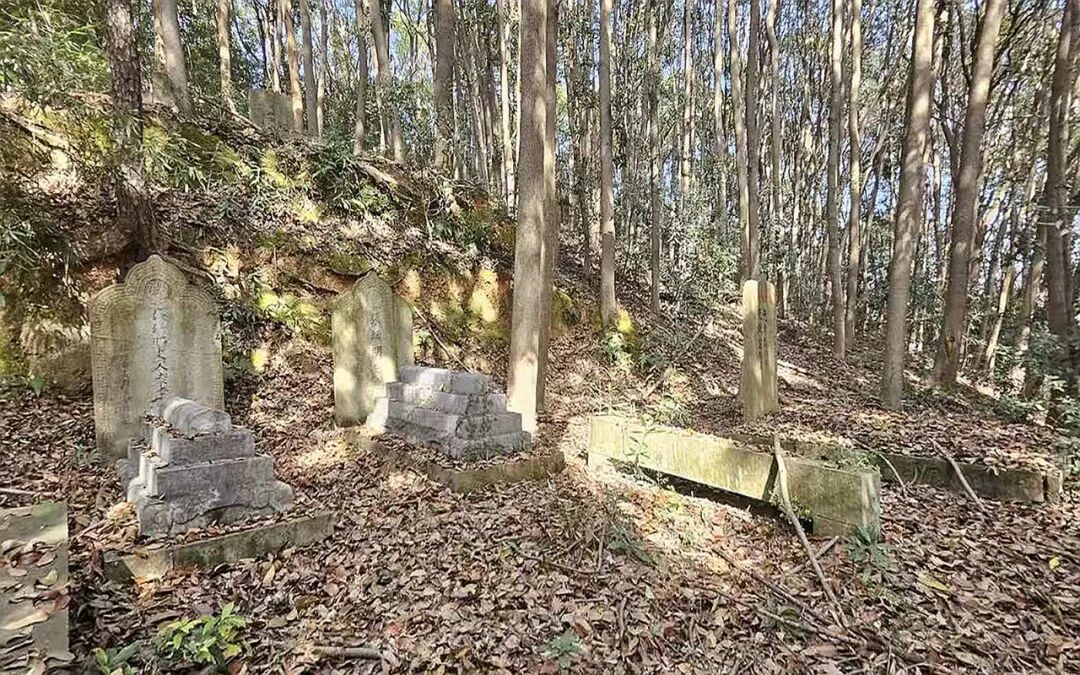
Academic Research:
Discovery of Imam Tombstones at Hangzhou's Yong'an Muslim Cemetery
Guo Chengmei, Yang Hua
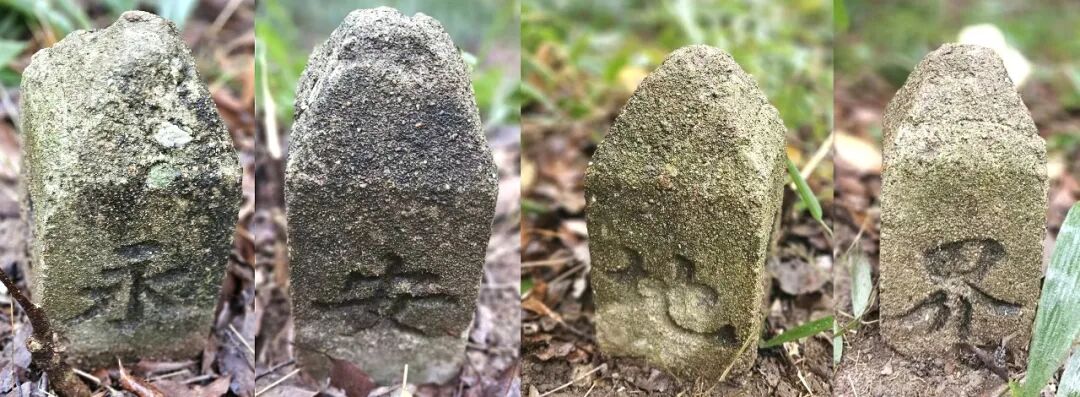
Abstract
Three tombstones respectively bearing the titles of "Grand Imam" and "Third Imam" have been discovered at the Yong'an Muslim Cemetery in Hangzhou. Dating to the Daoguang, Xianfeng, and Republican eras, these stones provide concrete evidence that Fenghuang Mosque once practiced a three-imam system. The subjects of these three tombstones have rarely been mentioned in academic circles, and their indisputable roles as religious leaders offer fresh content and fertile ground for researching late Qing and Republican-era Islam in Hangzhou. This article offers a preliminary decipherment of the inscriptions on these three steles. Around the 1930s, titles like "Grand Imam" disappeared from Yong'an Cemetery, replaced by terms such as "Ahong (Islamic teacher/imam)" and "Jiaozhang (chief imam/dean)", indicating that the Fenghuang Mosque's three-imam system was no longer in practice. This historical shift was linked to the rising status of community elders, the gradual dilution of the imams' administrative powers, and external influences.
Keywords
Fenghuang Mosque (Phoenix Mosque); Three-Imam System; Tombstones
1. The Discovery of Grand Imam, Third Imam, and Imam Tombstones in Hangzhou
Historically, the three-imam system was one of the organizational structures used in inland China's mosques, also known as the "Three-Path System." Emerging among Hui Muslims in interior China in the late 14th century, it was a mosque organization system composed of three religious roles: the Imam, the Khatib, and the Mu'adhdhin. In Ma Zhu's Qingzhen Zhinhai (Guide to Islam), the Imam, Khatib, and Mu'adhdhin are referred to sequentially as the "Grand Imam," "Second Imam," and "Third Imam," and are collectively called "religious leaders." Liu Zhi's Tianfang Dianli (Islamic Rites) refers to the Khatib as "Yujiao" (instructor of teachings) and the Mu'adhdhin as "Zangjiao" (praiser of teachings). Within the three-imam system, the Imam led the congregation in prayer and presided over public religious rituals and activities; the Khatib preached and admonished; and the Mu'adhdhin served as the muezzin, specifically calling the faithful to the mosque for prayer when the time arrived. This system was widely prevalent in Hui Muslim communities during the Ming and Qing dynasties and formed a hereditary practice. With social development, aside from a few religious communities that formally retained the "three-imam system," it gradually faded away by the mid-Republican period, and the institution ceased to exist.
Whether the historic Fenghuang Mosque (Phoenix Mosque) in Hangzhou practiced the three-imam system of mosque management is a question worthy of attention and study. Due to a scarcity of sources, it has remained unaddressed. Since 2017, and particularly starting two years ago, with the support of the Zhejiang Islamic Association, we have gained a general understanding of the Yong'an Muslim Cemetery through multiple field surveys. By numbering, registering, and photographing the tombs and steles, and by transcribing inscriptions and measuring stones for key monuments, we have gathered a wealth of precious first-hand material and achieved preliminary research results. Among them, several tombstones related to Fenghuang Mosque particularly caught our attention. Upon research, we discovered that the sparse words carved on these few stones actually pertain to the implementation of the three-imam system at Fenghuang Mosque. Below, this paper will focus on introducing the evidence found on these steles at the Yong'an Muslim Cemetery concerning the practice of the three-imam system at Fenghuang Mosque in the late Qing and early Republican periods.
The Yong'an Muslim Cemetery is located within the Yuquan Scenic Area in Hangzhou. Because Muslim cemeteries such as the one in the West Lake South Garden fell into ruin over time and left no space for burials, clan members raised funds in 1934 to purchase 99 mu of land at Lingfeng, Yuquan, West Lake, establishing the Yong'an Cemetery. In 1991, to beautify the West Lake scenic area, the Hangzhou municipal government banned further burials at the "Yong'an Cemetery" in the Yuquan scenic zone, designating the site as a permanent area for ancient Hui Muslim tombs. The original 44 burial plots were funded by the government and relocated to the Liuxia Hui Muslim Cemetery in the nearby suburbs.
The burial grounds of the Yong'an Muslim Cemetery currently contain roughly three categories of Muslim graves. The first consists of original burials from various dynasties prior to 1934 that were already located within the Yong'an graveyard, such as the 55th year of the Qianlong era (1790) "Tomb of Aunt Ding," the Daoguang-era (1838) "Joint Tomb of Wang Chunhui and Madam Liu," the Tongzhi-era (1867) "Tomb of Madam Wang and Madam Ding," and the Guangxu-era (1877) "Tomb of Ma Ermei." The second category comprises graves added as a public cemetery for Hangzhou's Muslims between the establishment of the cemetery in 1934 and 1991, when the Hangzhou municipal government prohibited further burials at Yong'an and designated it as ancient Hui Muslim graves. The third category includes a certain number of relocated tombs. After 1949, as Hangzhou accelerated urban construction and development, many ancient Muslim graves and modern burials originally located in development zones were relocated, and Yong'an Cemetery took in a portion of them. Because the cemetery is nestled in a tranquil mountain scenic area, the Hangzhou municipal government preserved it in its original state permanently. The 1991 government burial ban took effect in 1992, after which the Yong'an Cemetery distanced itself from urban clamor and settled into natural serenity. These ancient tombs and steles within the cemetery grounds have thus been preserved before us in their original locations and appearances.
The Yong'an Cemetery currently holds two tombstones bearing the title "Grand Imam" and one bearing the title "Third Imam." These three graves lie side by side in the southwest corner of the cemetery; from right to left, they are Er Zhiru the Third Imam, Tan Zhongling the Grand Imam, and Xiyuan the Grand Imam. Another tombstone bearing the title "Imam" is located on the southern side of the cemetery. Due to years of rainwater erosion on the hillside, mountain moisture, and sparse human traffic, the lower halves of the two "Grand Imam" tombstones have been buried in mountain mud, with moss clinging to the surface above ground. We conducted tentative preliminary excavations, leading to new discoveries regarding the inscriptions. For instance, on the tombstone of Grand Imam Xiyuan, originally only lines such as "Summer of the 12th year of the Republic of China, ninth month" and "Grand Imam of Fenghuang Mosque" were visible. After excavation, important information such as "Lord Xiyuan" and "Filial son Bai" was successively identified. Further excavation to read characters deeper down proved too difficult, so work was regretfully halted.
2. Inscriptions and Decipherment
The four tombstones recording the "Grand Imam," "Third Imam," and "Imam" are arranged in chronological order by their erection dates: the tombstone of Third Imam Er Zhiru, the tombstone of Grand Imam Tan Zhongling, the tombstone of Grand Imam Bai Xiyuan, and the joint tombstone of Imams Ding Yinchun and Yang Hongdao.
(1) Tombstone of Third Imam Er Zhiru and His Wife
Inscription: Joint tomb of the late Third Imam Er Gong of the Great Mosque and his surviving wife, Madam Ma. Erected in the sixth month of the seventh year of Daoguang. Filial sons Fuchang, Furui, Rongqing, Ronggui, and Rongchang bow a hundred times.
Decipherment: Carved from granite, the stele measures 125 cm in height, 65 cm in width, and 10 cm in thickness, in a rectangular shape. Erected in the seventh year of Daoguang (1827). The top is outlined with simple lines forming a pointed arch, a commonly used decorative shape in Islam. Below this are the horizontally arranged characters "Qing Gu" (the late Qing...), written in larger font. Eight vertical lines of text record the erection date, the identity of the tomb occupants, and information about the sponsors.
"Great Mosque" was a designation for Fenghuang Mosque in the late Qing period; academic research shows this usage first appears in the Tongzhi Xinyin edition of Wugong Yaoyao (Essentials of the Five Duties). The discovery of this stele pushes back the recorded use of "Great Mosque" by 44 years from existing historical sources.
The tomb occupant, Er Zhiru, served as the Third Imam of the Great Mosque. The surname Er is relatively rare, and history does not directly mention any famous Islamic figures with the surname Er. Among the donor lists in the surviving Qianlong 8th year (1743) stele "Inscription on the Reconstruction of the Zhenjiao Temple" at Fenghuang Mosque, individuals with the surname Er include: Er, instructor at Liuhe Cangzhou; Er Shengyong; Er Tongwen; Er Tai-nu; Er Yushu; Er Dezhang; Er Qianzhi; Er Bixian; Er Tianwei; and "Guangyu Hall Er." Among the existing tombstones in Yong'an Cemetery, this is the only one bearing the Er surname. The 8th year of Qianlong (1743) was only 84 years away from the 7th year of Daoguang (1827), and nearly two hundred years have passed since then. The number of Muslims with the surname Er in Hangzhou has undergone significant shifts and rapid decline, nearly vanishing entirely.
We believe that Third Imam Er Zhiru was a local religious scholar born in Hangzhou. Out-of-towners buried at Yong'an Cemetery usually have notations on their tombstones, such as: "Tomb of Chen Wenzhi of Kaifeng Prefecture, Henan" on Chen Wenzhi's tombstone; "Native of Nanshan County, Nansxiang, Yizhou Prefecture, Shandong" on Wang Shiqi's tombstone; and "Huaiyin Hall, Jinling" carved on Wang Hongtai's tombstone. These details clearly mark the ancestral homes and identities of the deceased. Tombstones lacking such information typically belong to locals, requiring no special explanatory inscription.
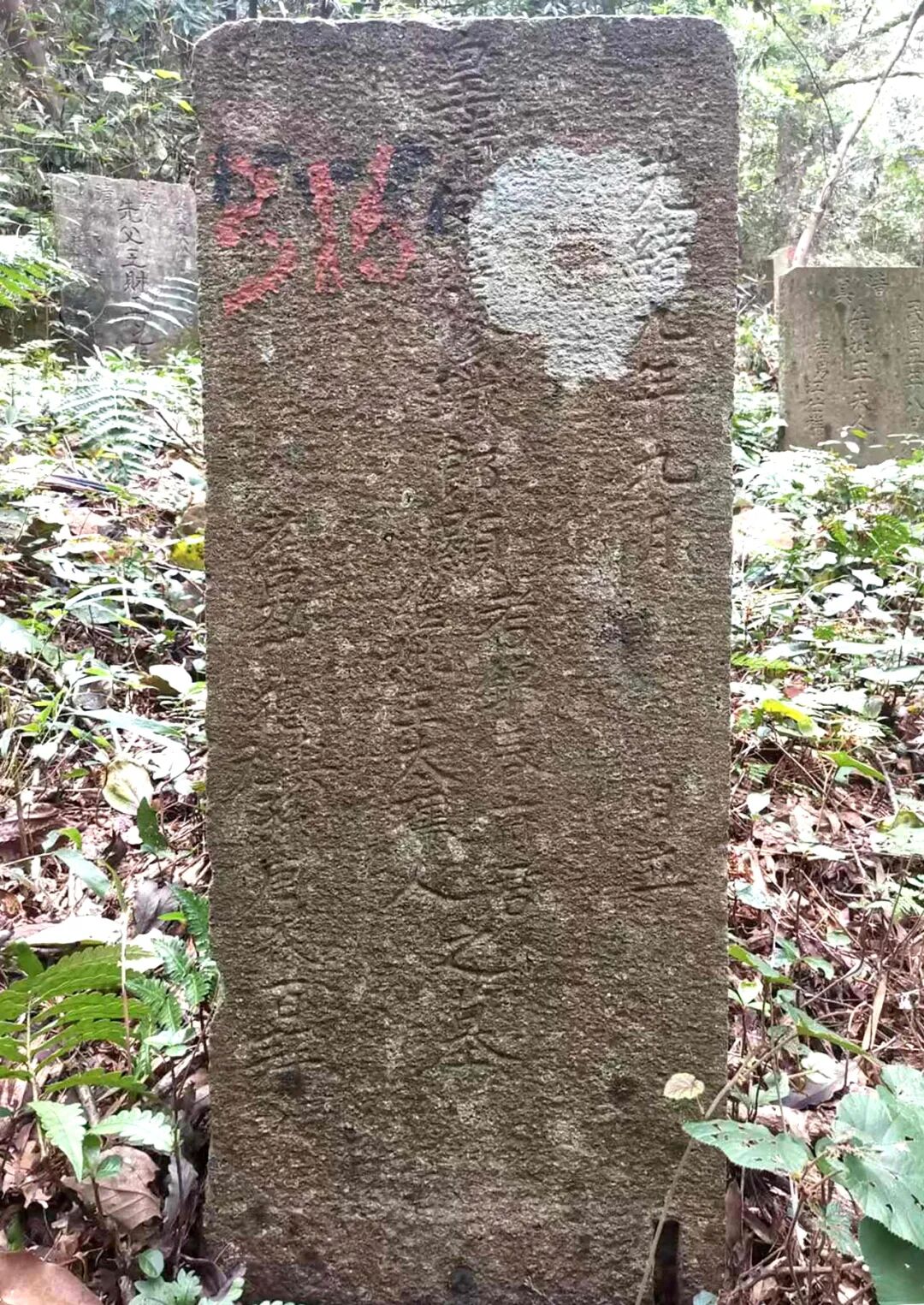
(2) Tombstone of Grand Imam Tan Zhongling
Inscription: (Arabic text) Bismillah al-Rahman al-Rahim. Imperial Qing bestowed the scholarly rank of Xiuzhiguo, Grand Imam of the Wulin Great Mosque, Lord Zhongling... Twelfth month of the fifth year of Xianfeng. Filial son Tan Shengxian, filial nephew Tan Shengde...
Decipherment: Carved from granite, the stele measures 100 cm in height, 65 cm in width, and 10 cm in thickness, in a rectangular shape. Erected in the fifth year of Xianfeng (1855). The upper portion features a circular design enclosing the Quranic text Bismillah al-Rahman al-Rahim, translated into Chinese as "In the name of Allah, the Most Gracious, the Most Merciful." The bottom of the tombstone is submerged in the ground, and the text at the lower end is buried and illegible. Based on typical tombstone layouts, we estimate that the buried text is brief and contains no critical information. Directly below "Lord" are likely the characters "Zhi Mu" (Tomb of); below "Shengxian and Shengde" are likely phrases like "Respectfully erected / jointly erected" or "bowing a hundred times / weeping a hundred times."
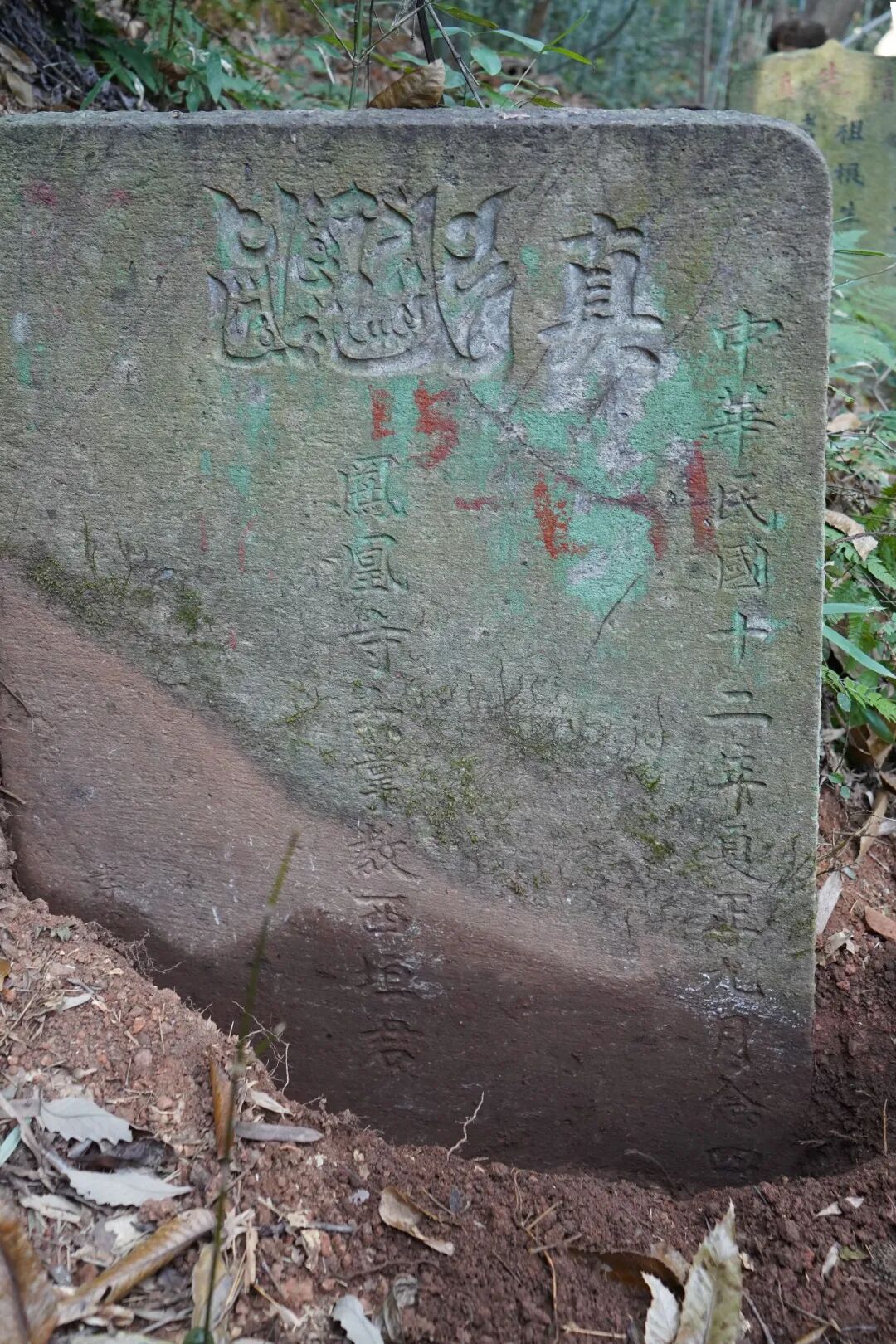
This is the second tombstone discovered at the Yong'an Muslim Cemetery inscribed with the name "Great Mosque." Wulin is an alternative name for Hangzhou. The Wulin Great Mosque is thus Hangzhou's Fenghuang Mosque.
The tombstone is engraved with the Arabic Quranic "Basmala." The Qing-era rank of Xiuzhiguo was a titular rank for civil officials of the eighth lower grade—a nominal official title without real power, roughly equivalent to a deputy staff member in modern civil service hierarchies. Several officials and their wives buried at Yong'an Cemetery who bear the designation "Imperial Qing" lack Arabic scriptures and terms like "Qingzhen" (Islamic/Halal) or "Hui Muslim." Examples include Liu Caizhang, a candidate prefectural judge in the 8th year of Guangxu; Ding Jinchun, bestowed the rank of Xiuzhiguo in the 9th year of Guangxu; Madam Chen in the guisi year of Guangxu; Zhang Zhizheng, bestowed the rank of official in the 19th year of Guangxu; and Madam Wang, bestowed a title in the 6th year of Tongzhi. Tan Zhongling is the only person in Yong'an Cemetery who held both an imperial court title and the position of Grand Imam.
Muslims with the surname Tan are scarce in Hangzhou. The 1743 Qianlong-era "Stele on the Reconstruction of the Zhenjiao Temple" at Fenghuang Mosque lists no local Hangzhou Muslims with the surname Tan. Aside from the tombstone of Grand Imam Tan Zhongling, Yong'an Muslim Cemetery contains only five tombstones bearing the Tan surname: the first is the tombstone of "Late Ancestral Grandmother Madam Tan," erected in the 27th year of the Republic (1938); the second is the tombstone of "Tan Liansheng and Madam Zhao," erected in 1955; the third is for "Tan Shunyuan," erected in 1973; the fourth is for "Tan Yunsun," erected in 1979; and the fifth is for "Hua Hanzhi and Tan Quanyun," erected in 1980. The occupants of these four post-liberation tombstones appear to be two generations of the same family.
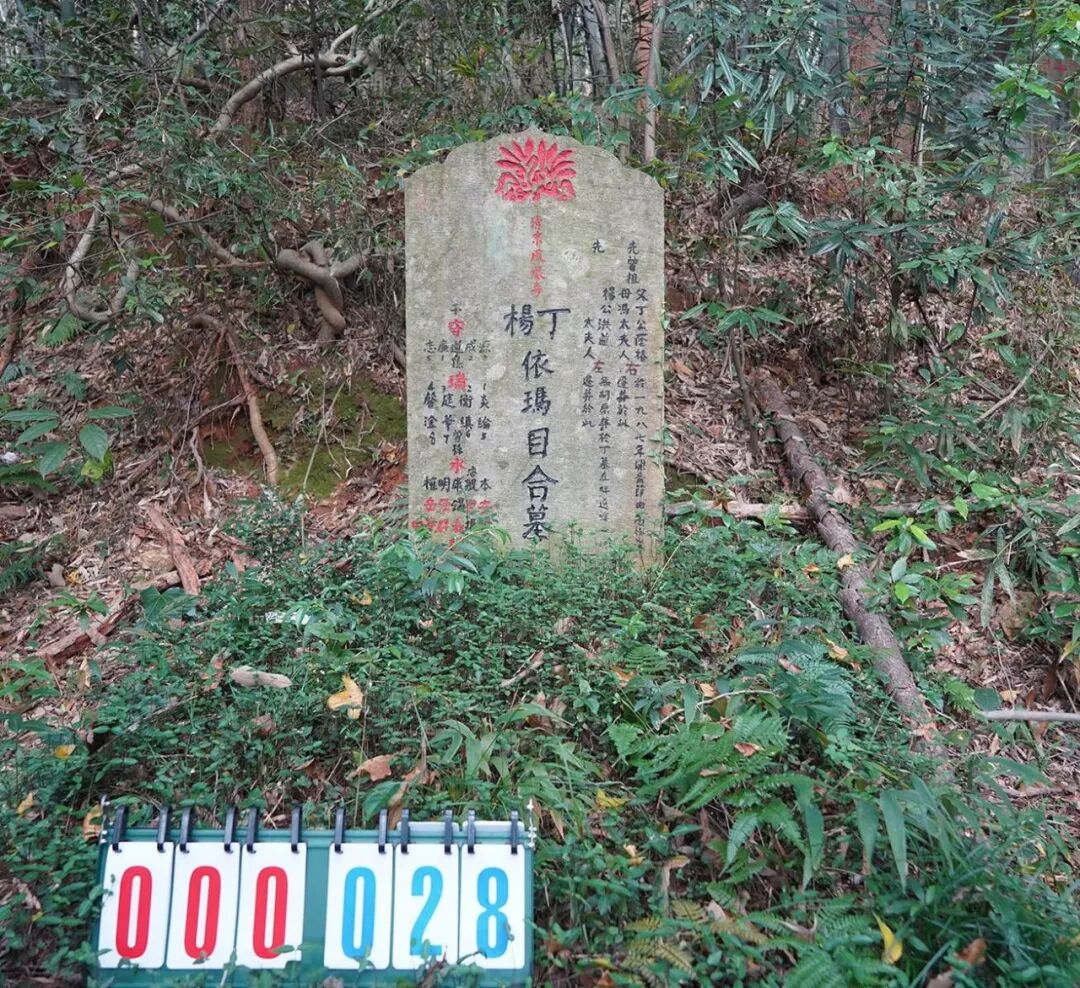
The tomb occupant "Lord Xiyuan" has an uncertain surname. Referring to the sponsor at the lower left, "Filial son Bai," it is possible his name was Bai Xiyuan. However, a "filial son Bai" would not refer to Xiyuan as "Lord" (Jun); he should have used "Lord Father" (Fujun) or "Late Father." Consulting the 1743 Qianlong-era "Stele Inscription on the Reconstruction of the Zhenjiao Temple" by gentry member Ding Shishen of Hangzhou's Fenghuang Mosque, the text records two individuals with the surname Bai: one is "Bai, military commander of the Jiangsu Governor's central garrison," and the other is "Baba Bai." Baba, also called Papa, signifies an elder or a figure of prestige. Hangzhou's Buhetiy'er Tomb is popularly known as the Baba Tomb. Imams and religious leaders were also called Baba. Among the more than two hundred donors listed on that Qianlong stele are four Babas: Baba Bai, Baba Suo of Zhenjiang, Baba Ningbo, and Baba Wang.
The life deeds of Grand Imam Lord Xiyuan, Third Imam Er Zhiru, and Grand Imam Tan Zhongling mentioned above remain unknown.
(3) Tombstone of Grand Imam Bai Xiyuan
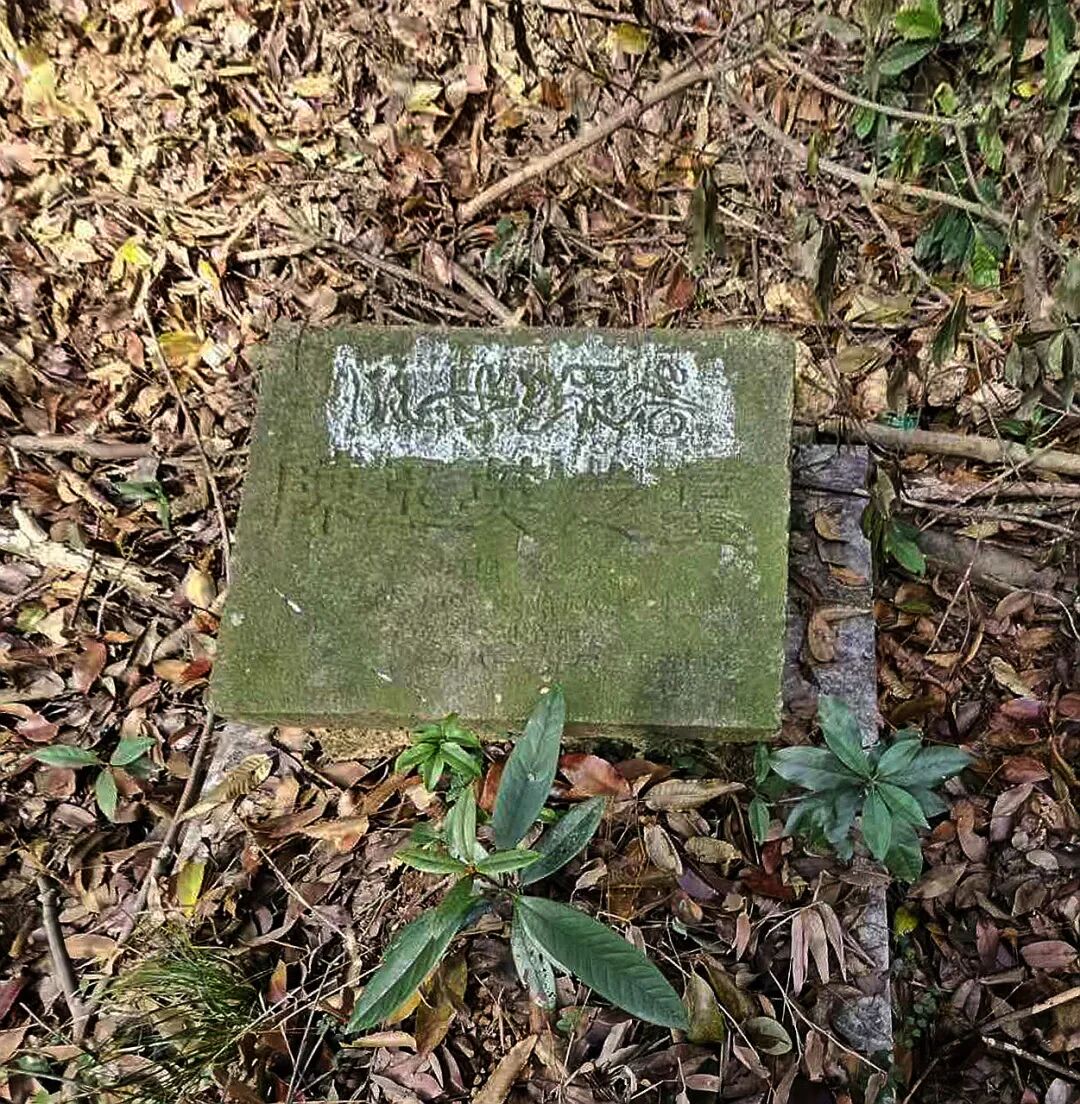
Inscription: (Arabic text) Bismillah al-Rahman al-Rahim. True Fenghuang Mosque Grand Imam Lord Xiyuan... Summer of the 12th year of the Republic of China, ninth month... Filial son Bai...
Decipherment: Carved from granite, the stele measures 125 cm in height, 80 cm in width, and 6 cm in thickness, in a square shape. Erected in the 12th year of the Republic of China (1923). The upper portion is engraved with a square design enclosing the Quranic text Bismillah al-Rahman al-Rahim, translated into Chinese as "In the name of Allah, the Most Gracious, the Most Merciful." To the right is the character "Zhen" (True), a spelling style also found on other steles at Yong'an Cemetery. "Zhen" seems to refer to "Qingzhen" (Islamic), a simplified writing convention of the time used to highlight the Muslim identity of the deceased. The face of the stele features two vertical lines of text, rendered in a font relatively smaller than the Arabic Basmala and the character "Zhen." The characters at the bottom of the tombstone are obscured, preventing further deep excavation and identification.
(4) Joint Tombstone of Imams Ding Yinchun and Yang Hongdao
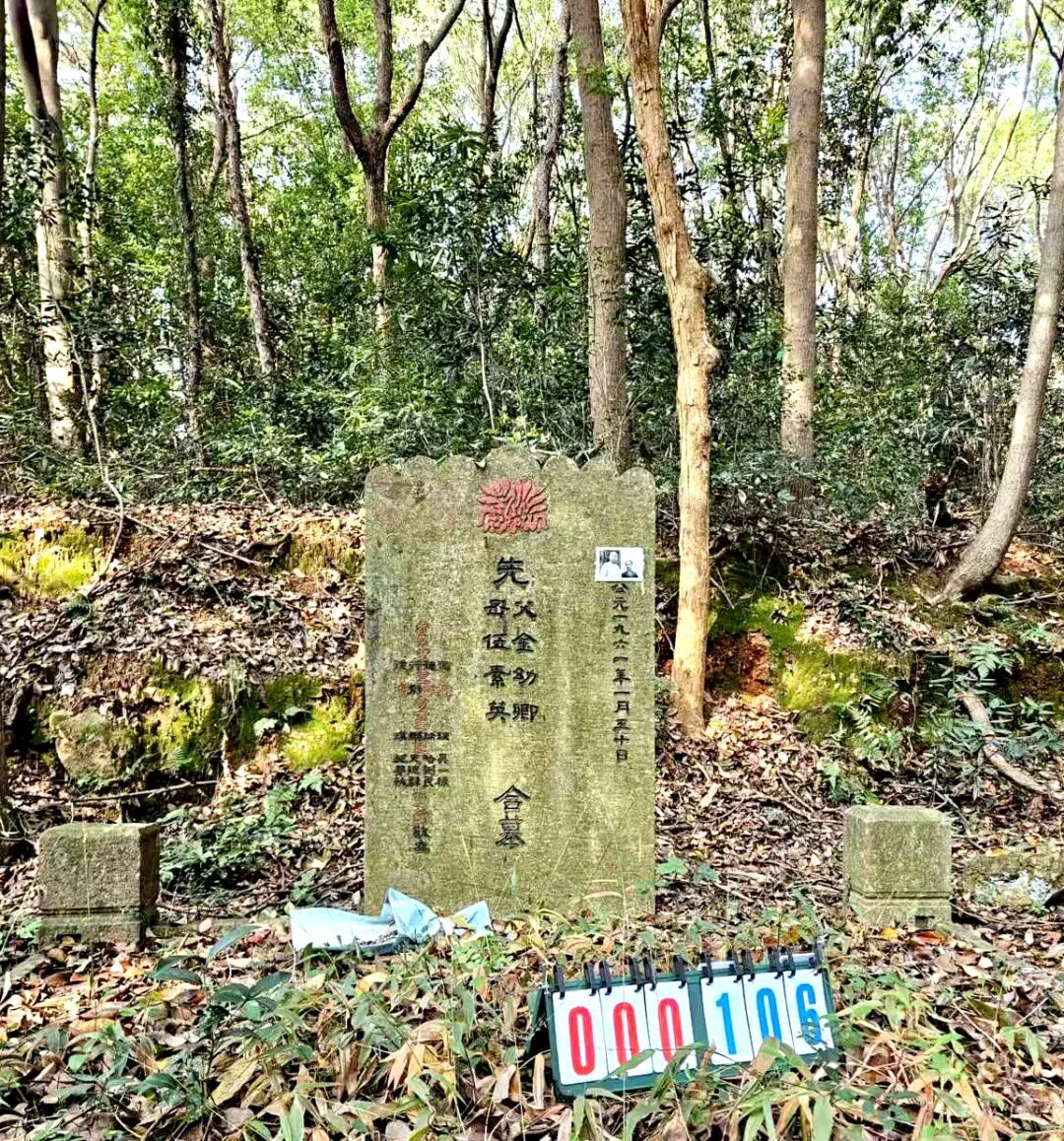
Inscription: (Arabic text) Bismillah al-Rahman al-Rahim. Joint tomb of late Qing Fenghuang Mosque Imam Ding and Imam Yang. Right: Late great-grandfather Ding Gong Yinchun, great-grandmother Madam Feng. Left: Late Yang Gong Hongdao, Madam. Having no direct heirs, originally buried to the left of the Ding tomb, per instructions they were relocated here together for convenience. Sons Shouyuan, Shoucheng, Shoudao, Shoulian, Shouzhi; grandsons Ruiyan, Ruiheng, Ruiting, Ruixin, Ruilun, Ruizhen, Ruihua, Ruigan; great-grandsons Yongben, Wu Qianguan, Yongkang, Yongming, Yongquan, Yong'an, Yongkun, Yongxi, Yongqiang, Yongyue, Yongkou, Yongzhen, Yongjia, Yongqun, Yongning, Yongzhong respectfully erect this. Relocated here from Wansongling during Eid al-Fitr in 1987.
Decipherment: Carved from granite, the stele measures 163 cm in height, 76 cm in width, and 10 cm in thickness, square with an arched top. The upper portion features a floral decorative pattern formed by the Quranic text Bismillah al-Rahman al-Rahim, translated as "In the name of Allah, the Most Gracious, the Most Merciful." Twelve vertical lines of text are carved into the stone.
The inscription indicates that this is a joint relocation tomb for Imams Ding Yinchun and his wife, and Imam Yang Hongdao and his wife. The inscription states that the tombs were "relocated here from Wansongling." Wansongling stretches from the lake shore in the west to Jianggan in the east, formerly crossed by the Hangzhou city wall, thus serving as the boundary between the urban area and the mountain forests. In past times, this was the base of the imperial city. Wansongling is an ancient Muslim graveyard, and three Yuan-dynasty tomb covers still survive there. A bilingual commemorative monument reading "Site of the Wansongling Foreign Guests' Tombs" stands there, stating: "Since the Tang dynasty, Muslims from the Western Regions have traveled along the Maritime Silk Road to Hangzhou to propagate Islam. According to historical records, Islamic heritage sites in Hangzhou include Fenghuang Mosque, Huihui New Bridge, and the Foreign Guests' Tombs. The Wansongling Foreign Guests' Tomb cluster is one of the ancient Muslim cemeteries in Hangzhou, primarily interring early Western Region Muslims who stayed as guests in Hangzhou. Due to their great antiquity, most of the foreign guests' tombs are deeply buried underground. These three tombs are relatively representative, exhibiting the typical style of Western Region Muslim tombs. From the Tang dynasty down to the present, passed down through generations, Muslims in Hangzhou visit this site during Islamic festivals to recite scriptures and pay homage to the Muslim ancestors within the tombs—they were messengers of early Sino-Western economic exchange and pioneers in spreading Islam, Western Region culture, medicine, architecture, and art. We pray that Allah bestows His blessings upon them."
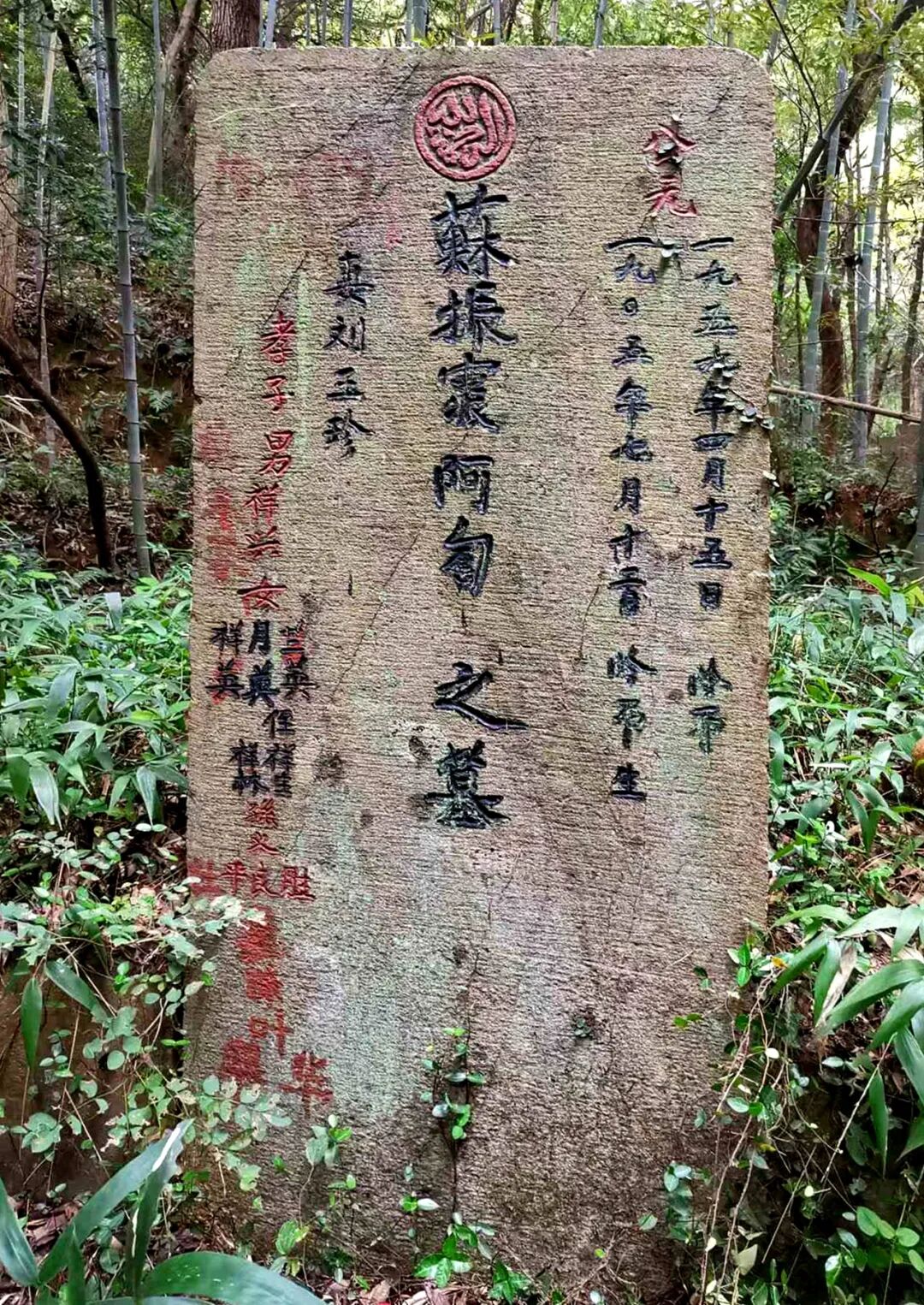
According to the tombstone inscription, the tomb of Yang Hongdao and his wife was originally located on the "left flank" of Ding Yinchun and his wife's tomb. Because the Yang family had "no surviving heirs," the descendants of the Ding family followed Yang Hongdao's dying wish when relocating Ding Yinchun's tomb, moving the Yang tomb alongside it and reburying them jointly with the Dings. The relocation took place during Eid al-Fitr in 1987. The author surmises that prior to the relocation, they each had their own separate tombstones, and when the relocation occurred, the Ding descendants newly fashioned this joint Imam tombstone.
Yang Hongdao participated in the translation and compilation of Wugong Yaoyao (Essentials of the Five Duties) during the Tongzhi reign. The 1871 "Preface to Wugong Yaoyao" by members of the Zhejiang Fenghuang Grand Mosque states: "We earnestly requested Teacher Yang Hongdao, who holds the position of Zhangjiao (religious leader), collaborating with Teacher Jingshan, to translate and explain the true scriptures and compile them into a volume. Gathering the essentials of all scriptures, they authored the regulations of the five daily duties, separating and analyzing them in detail, translating scriptural texts into Chinese characters. While pronunciations often relied on loan words, the principles were rendered with utmost precision and detail. The completed compilation and textual research focus exclusively on the five duties, recording without omission the heavenly commands, the Prophet's practices, and the routine habits of daily life down to the finest detail." This shows that Yang Hongdao held the status of a religious leader (Zhangjiao). "Teacher" (Shi) denotes a scriptural teacher. An appendix to the 1892 Fenghuang Mosque "Stele on the Reconstruction of the Zhenjiao Temple" records: "Received twenty-five silver dollars from Ahong Yang Hongdao," placing him at the very top of the list of donors and organizations. This reflects respect for the mosque's religious leader and also indicates that Yang Hongdao was at the helm of Fenghuang Mosque's religious affairs in the 18th year of Guangxu (1892). Since Fenghuang Mosque practiced the three-imam system during the Guangxu era, Yang Hongdao was undoubtedly the Grand Imam.
The tombstones of Ding Yinchun and Yang Hongdao bear the words "Late Qing," indicating that Ding and Yang lived in the late Qing period and also served as Imams during that time. The inscription refers to tomb occupant Ding Yinchun as "late great-grandfather" and notes that both Ding and Yang served as Imams. Imam is an Arabic transliteration meaning "prayer leader," "role model," or "leader." It refers to the prayer leader within a mosque who guides the Muslim congregation in performing ritual prayers and presides over public religious rituals and activities. The Imam is equivalent to the Grand Imam. The appearance of "Late Qing Fenghuang Mosque" and "Imams Ding and Yang" on the tombstone provides yet another piece of evidence supporting the practice of the three-imam system at Fenghuang Mosque during the late Qing and early Republican periods, following the tombstones of Third Imam Er Zhiru, Grand Imam Tan Zhongling, and Grand Imam Bai Xiyuan.
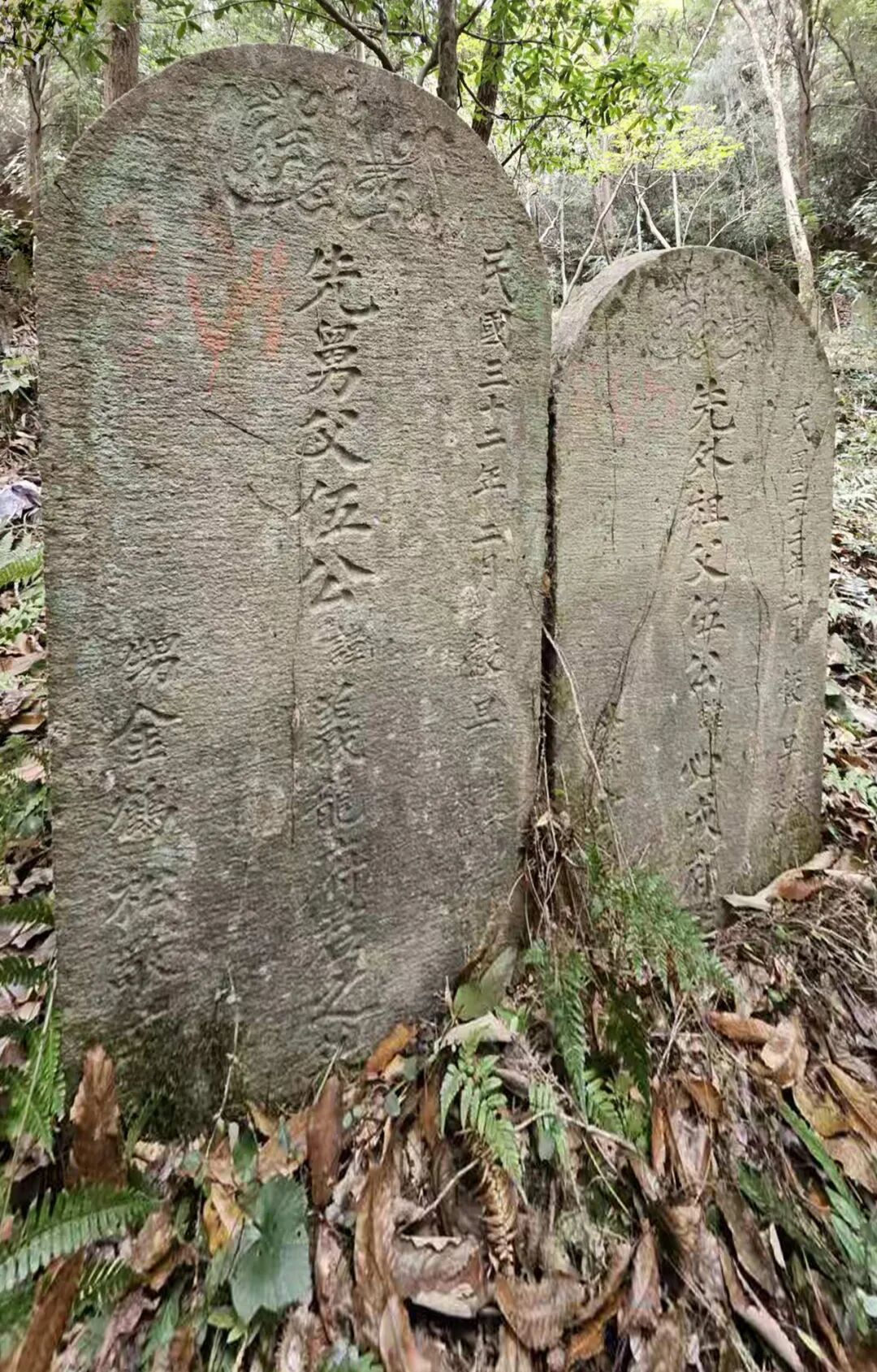
3. The Exit of the Three-Imam System from the Historical Stage
From the tombstone of Third Imam Er Zhiru, we know that Fenghuang Mosque practiced the three-imam management system no later than the sixth year of Daoguang (1827), though historical sources do not yet prove when this system was first instituted at the mosque. Steles at the Yong'an Muslim Cemetery show that after the tombstone of Grand Imam Bai Xiyuan in the 12th year of the Republic of China (1923), no further tombstones appeared bearing titles such as Grand Imam, Second Imam, or Third Imam. Aside from Ding Qingyun's tombstone from the 25th year of the Republic (1936), which addressed him as "Zhangjiao of the West Lake Mosque," contemporary and subsequent tombstones uniformly addressed the deceased as "Ahong" or "Jiaozhang." Examples include the 1933 tombstone of "Ahong Yang Hexuan," the 1934 tombstones of "Ahong Ma Jianting," "Ahong Li Fangxiao," and "Ahong Ding Changqing," the 1958 tombstone of "Chief Imam Liu Shihua" relocated from outside Qingbomen Ershixiang, the 1959 tombstone of "Ahong Su Zhenhuan," and the 1960 tombstone of "Chief Imam Yang Zhexhen."
The 1871 preface to Wugong Yaoyao states, "We earnestly request Teacher Yang Hongdao, who holds the position of Zhangjiao...", addressing Yang Hongdao with the title "Zhangjiao." This "Zhangjiao" is likely an abbreviation for "Grand Imam," because Fenghuang Mosque was already practicing the three-imam system during the Tongzhi era. Although we have no way of knowing what titles were inscribed on the pre-relocation tombstones of Ding and Yang, the new stele erected during the 1987 relocation bears the titles "Imam Ding" and "Imam Yang." Perhaps the Ding descendants saw records similar to "Imam" of Fenghuang Mosque on the original stones, though unfortunately the originals no longer survive. The shifts in titles used for the Ahongs who administered mosque affairs across different periods not only demonstrate that Hangzhou's Fenghuang Mosque practiced the three-imam management system during the late Qing and early Republican eras, but also indicate that around the 1930s, the three-imam system exited the historical stage, as titles like Grand Imam vanished and were gradually replaced by Jiaozhang (chief imam) and Ahong.
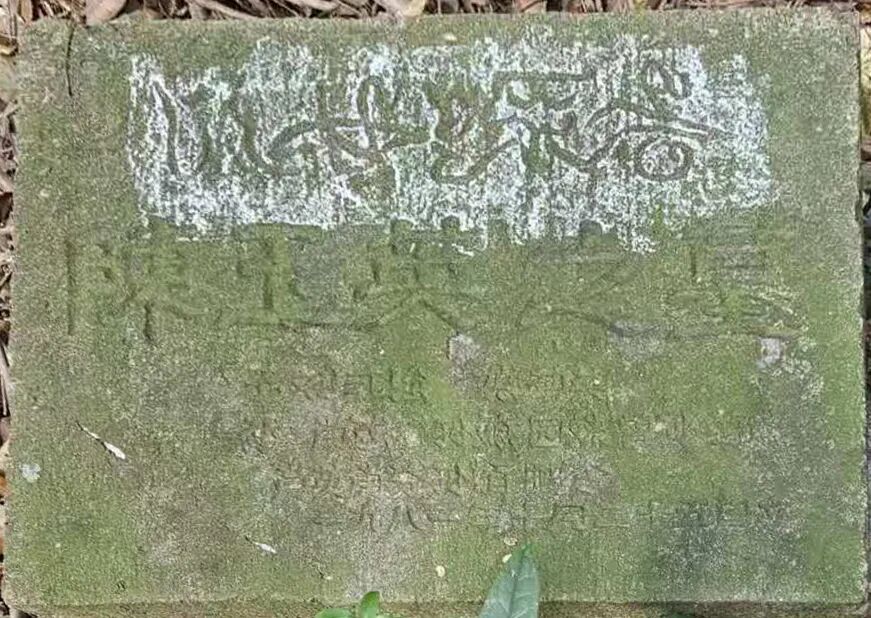
The transformation of the three-imam system in Hangzhou was closely tied to the rising status of community elders and the gradual weakening of the imams' administrative powers during the late Qing and early Republican periods. Fenghuang Mosque's temple affairs and social activities were managed by village elders (xianglao), while the imams (Ahongs and Jiaozhang) handled religious affairs. The main text of the 1743 Qianlong-era "Stele on the Reconstruction of the Zhenjiao Temple" at Fenghuang Mosque specifically praises four elders: "Now elders Lu Yehou, Wang Shushun, Mu Xiucang, Ma Chengyu and others have once again imitated past regulations, accumulating meager funds, sparing no effort in management, gathering workers and gathering materials, painting pillars and carving beams, reapplying white plaster, and in less than half a year making it magnificent and thoroughly renewed." It also records the names of 19 board elders and directors such as Wang Zhiping and Ma Congjing. The term "xianglao" (elder) generally referred to the Muslim masses of the mosque community in Chinese Islamic contexts, though in some regions it specifically designated members of the mosque's administrative body. The elders mentioned in the stele refer to mosque managers, a meaning previously reinforced by the prefix "director" (dongshi). The stele states: "Now the elders reconstruct, and directors assist in praise—this is a grand event of the times, truly a painstaking effort," emphasizing the importance of the elder directors in this mosque reconstruction.
Guo Chengmei published the full text of the Qianlong stele in 1999 under the title "Five Chinese Steles of Fenghuang Mosque," noting that the stele lists the names of 23 director-elders and surmising that "by then Fenghuang Mosque already possessed a management organization resembling a board of directors." The stele inscription makes no mention of imams. About thirty years later, Fenghuang Mosque welcomed an incoming "administering imam" named Ma Shifang (styled Huachuan) from Xianyang, Shaanxi, who made notable contributions to the translation and annotation of Islamic classics into Chinese, successively writing prefaces for Jin Tianzhu's Qingzhen Shiyi (Resolving Doubts on Islam) and Liu Zhi's Tianfang Zhisheng Shilu (True Records of the Ultimate Sage of Islam). One preface is dated: "Midsummer day of the intercalary month in thegui-si year, the 38th year of Qianlong, respectfully written by Ma Shifang of Longxi, Zhangjiao of the Wulin Zhenjiao Temple." Another preface is dated: "First day of the winter month in the bing-shen year, the 41st year of Qianlong, respectfully composed with ablutions and bows by the late student Ma Shifang Huachuan, administering Zhangjiao of the Wulin Qingzhen Temple." The Wulin Zhenjiao Temple and Qingzhen Temple refer to Hangzhou's Fenghuang Mosque. Ma Shifang participated in re-engraving Wu Zunqi's Xiuzhen Mengyin (Introduction to Cultivating Truth) and invited Jiang Yuanlong of Jiaxing to write a re-engraving preface. Ma Shifang's signing as "administering Zhangjiao" reflects his self-assurance and the power of his religious office. The 1892 "Stele on the Reconstruction of the Zhenjiao Temple" at Fenghuang Mosque records: "As for directing the affairs of scriptural study and repairs, gentlemen Zhu Zhengsu and Wang Xingsheng shared in the labor," praising the directors who repaired the temple. At the same time, the stele appendix records: "Received twenty-five silver dollars from Ahong Yang Hongdao," placing him at the very front of the donors and organizations. This honors the mosque's religious leader and shows that Yang Hongdao was directing the religious affairs of Fenghuang Mosque in 1892. The inscription accommodates both the elders and the Ahong, representing a balance in their relationship: one "directed scriptural study and repair affairs," while the other was the "Ahong"; one "had labor" in temple repairs, while the other donated 25 silver dollars; one appeared in the main text of the stele, the other in the appendix. Comparing them, the relative weight is clear at a glance. In the early Republican period, Ahongs rarely stepped forward in Fenghuang Mosque's external communications. For instance, Ma Zhaolong submitted a petition to protect ancient tombs in the 9th year of the Republic (1920); in 1925, Fenghuang Mosque board directors Zhang Qi, Jin Rudong, Sun Jialin, Sun Songting, Sun Zhongwei, Feng Yanbang, Feng Erxiao, and Jin Jingen submitted a petition to protect ancient tombs. In 1925, the China Islamic Association founded in Shanghai published a "Directory of Members" listing as many as 14 prominent figures from Hangzhou's business and academic circles, yet not a single Ahong was included. This situation indicates that religious leader and Ahong roles were gradually stepping back from social affairs, while directors and elders began to shine brightly.
The transformation of Hangzhou's three-imam system was also driven by external influences, appearing closely connected to the reforms of the three-imam system then underway in Shanghai's Islamic community. In 1922, voices emerged within Shanghai's Islamic community suggesting the abolition of the second imam and a change to the three-imam system. In the summer of 1925, elder Jin Zhian wrote a letter to the board of directors proposing that the leadership of prayer and the recitation of the Khutbah be performed by a single person, which in substance demanded the abolition of the second imam position. In May 1926, the China Islamic Association Monthly published a piece titled "Correspondence Exchanged with Mr. Yuan Hanchen," formally issued under the signature of "Respectfully written by the China Islamic Association." It formally proposed that every mosque should hire "principal and deputy imams (namely the Imam and the Mu'adhdhin)," expressing the hope that "our country's religious affairs everywhere should appropriately follow this system." The text stated: "Teachers at mosques in foreign countries have no practice of reciting scriptures and replacing people for compensation, yet they all receive stipends... In our Association's view, co-religionists across our country should urgently and appropriately adopt this system. Each mosque should raise public funds locally, engaging two individuals of superior character and learning as principal and deputy imams (namely the Imam and the Mu'adhdhin) to preside over religious affairs and preach doctrine, provided that the salaries offered are benchmarked against local conditions and sufficient to support their households." These reforms won the approval of the China Islamic Association. In 1940, approval was obtained from the Ministry of the Interior to formulate the "Measures for Mosque Management," which were circulated to all mosques nationwide for compliance and implementation. "However, during the War of Resistance, mosques in occupied areas were unable to implement them. Consequently, the Association revised the "Interim Measures for Mosque Management of the China Islamic Association," which was approved by the Ministry of the Interior for implementation in July 1947. In March 1948, the China Islamic Association Bulletin published the "Interim Measures" along with the "General Rules for the Organization of Mosque Boards of Directors" and "Precautions." These reaffirmed the adoption of the title "Jiaozhang" (chief imam/dean) and the management of all mosque affairs by the board of directors. The hiring or dismissal of the chief imam, the purchase or sale of mosque property, the income and expenditure of mosque funds, and various religious innovations and reforms could not be undertaken without the approval of the mosque board of directors.
Shanghai's reform of the three-imam system was relatively thorough: the second imam was abolished, the titles of the imams were changed, the Grand Imam (Imam) was renamed Jiaozhang (chief imam/dean), and the third imam (Mu'adhdhin) was renamed Deputy Jiaozhang (deputy dean). Shanghai's reform of the three-imam system exerted a major influence on neighboring Hangzhou's Muslims, who maintained close ties and also practiced the three-imam system. In the 1920s and 1930s, Hangzhou Muslims must have been aware of the events unfolding within Shanghai's religious circles regarding the three-imam system. With as many as 14 members of the China Islamic Association hailing from Hangzhou, they could not have turned a blind eye to the articles published in the China Islamic Association Monthly or the calls to abolish the second imam and adopt the principal-deputy imam system. Hangzhou was close at hand, and Fenghuang Mosque would naturally follow the trend; its reform of the three-imam system would not have been delayed until the China Islamic Association's 1940 nationwide circular, but would have been implemented earlier. Judging by the changes in Ahong titles on tombstones, titles like "Grand Imam" vanished after 1923, replaced by "Jiaozhang" and "Ahong," indicating that Fenghuang Mosque abandoned the three-imam system around the 1930s.
References
1. Ma Jian, trans., The Quran, Chinese Social Sciences Press, 1981.
2. Guo Chengmei, "Five Chinese Steles of Fenghuang Mosque," published in Islamic Culture Studies, Xi'an, 1999, No. 2.
3. Jiang Yuanlong, "Preface to the Re-engraving," 40th year of Qianlong, in Wu Zunqi, Xiuzhen Mengyin, Qingzhen Daodian, 2005, Vol. 15, p. 5.
4. Shanghai Mosque Board of Directors Meeting Motions, Republican period, 4 volumes, preserved at the Shanghai Islamic Association.
5. China Islamic Association, Directory of Members, 1925, preserved at the Shanghai Library.
6. China Islamic Association, China Islamic Association Bulletin, 1948, National Library of China Reader Website.
Notes
¹ Guo Chengmei (1949–), male, native of Jiaxing, Zhejiang, council member of the China Hui Muslim Association. Primarily engaged in local cultural and historical research on Hui Islam.
Yang Hua (1981–), female, native of Xi'an, Shaanxi, residing in Zhejiang, primarily engaged in local history research on Hui Islam.
² Ma Jian, trans., The Quran, Chapter 1, Verse 1, Chinese Social Sciences Press, 1981. Same below.
³ Ding Shishen, "Stele on the Reconstruction of the Zhenjiao Temple," 8th year of Qianlong (1743), preserved in the stele corridor of Fenghuang Mosque.
⁴ According to Ding descendant Ding Yongzhong, "Qianguan" was the son of Ding Ruiyuan by name, not biological, named Wu Qianguan (with the traditional Chinese character for guan). He was extremely filial, becoming a model for their generation.
⁵ 1871 "Preface to Wugong Yaoyao" by members of the Zhejiang Fenghuang Grand Mosque, found in Jingshan and Yang Hongdao, Wugong Yaoyao, preserved in the Dalian Library.
⁶ Ma Zhaolong, "Stele on the Reconstruction of the Zhenjiao Temple," 18th year of Guangxu, Qing dynasty, preserved at Fenghuang Mosque.
⁷ Ding Shishen: 1743 "Stele on the Reconstruction of the Zhenjiao Temple," preserved at Fenghuang Mosque.
⁸ Guo Chengmei, "Five Chinese Steles of Fenghuang Mosque," published in Islamic Culture Studies, Xi'an, 1999, No. 2.
⁹ Jiang Yuanlong stated: "Yanshan Yang Gong cherished the canon of our co-religionists, seeing how few understand this Path, and discussed it with Wulin Zhangjiao Teacher Huachuan Ma, urging several comrades to jointly plan a re-engraving and asking me to write a preface." See "Preface to the Re-engraving," 40th year of Qianlong, in Wu Zunqi, Xiuzhen Mengyin, Qingzhen Daodian, 2005, Vol. 15, p. 5.
¹⁰ The 1920 "Zhejiang Provincial Capital Police Department Proclamation No. 54 Stele" states: "According to Ma Zhaolong, President of the Zhejiang Branch of the China Islamic Progressive Association." The stele does not survive; a rubbing is kept at Fenghuang Mosque. "Petition to the Governor of Zhejiang Xia to Protect Ancient Muslim Tombs," published in Huiguang, Vol. 2, No. 2, Shanghai, 1925.
¹¹ China Islamic Association, Directory of Members, 1925, preserved at the Shanghai Library.
¹² Shanghai Mosque Board of Directors, Board Meeting Motions, 1922, Vol. 1, pp. 17, 19, 21, 32; Board Meeting Motions, 1925, Vol. 2, p. 31.
¹³ "Correspondence Exchanged with Mr. Yuan Hanchen," China Islamic Association Monthly, 1926, Vol. 1, No. 5, p. 45.
¹⁴ China Islamic Association Bulletin, combined issue of Vol. 7, Nos. 8 to 12, p. 21, March 1948.
Tracing the Lost History of Hangzhou's Three Yuan Dynasty Mosques & Muslim Heritage
Articles • Hasan09 posted the article • 0 comments • 13 views • 23 hours ago
Tracing the History and Evolution of the Three Hui Muslim Mosques in Hangzhou During the Yuan Dynasty: A Documentary Record of Jiangnan Muslim Masjids and Cultural Relics in the Song and Yuan Dynasties
Abstract:
This study examines and organizes the historical origins, rise, and fall of the three important masjids within the city of Hangzhou during the Yuan Dynasty. By combining historical local gazetteers and epigraphic records, it reveals the religious life, social status, and historical and cultural heritage value of the Muslim community in the Jiangnan metropolis during the Song and Yuan dynasties.
The growth of the Muslim population during the Yuan Dynasty led to the widespread construction of masjids as places for Islamic religious activities. The Yuan government gave explicit recognition to this phenomenon, and historical literature shifted from calling these prayer sites 'halls' (tang) to 'temples/masjids' (si). As recorded in the 'Records of Rebuilding the Masjid in Dingzhou': 'Today, near the capital and far across various circuits, there are over ten thousand masjids, all facing west to perform the ritual of prostrating and praying to Allah.' Hangzhou was no exception. Hui Muslims built masjids while strictly adhering to religious doctrines and fulfilling religious duties: 'Reciting scriptures and keeping the fast, returning to tranquility, with their elders leading them, called mullahs (manla). All scriptures are in foreign scripts, bowing and prostrating facing the wall, without setting up Buddha statues, simply using religious titles to praise and bless the deities.' Tian Rucheng's 'Travels and Sights of the West Lake' states: 'Zhenjiao Mosque was built south of Wenjin Lane by the Hui Muslim Grand Master Alaoding during the Yuan Zhida/Yanyou era (1314–1320).' [1]
Hui Muslims lived in communities surrounding their masjids, and the construction of a masjid actually marked the formation of local Muslim neighborhoods. A great number of Hui Muslims lived in Hangzhou during the Yuan Dynasty; building upon the Song Dynasty fanfang (foreign quarters), they naturally expanded into three major communities and built masjids, resulting in three masjids in Hangzhou at that time: Zhenjiao Mosque (True Teaching Mosque), the Hui Muslim Prayer Hall, and the Hui Clan Masjid. The Moroccan traveler Ibn Battuta described Hangzhou's third Muslim residential district, noting that 'the city is beautiful, and the street layout is like that of Islamic regions. Inside, there are a masjid and muezzins; when entering the city, it happened to be the time for the Dhuhr prayer, and their voices could be heard far and near.' [2] From this perspective, the Hui Muslim population residing in Hangzhou during the Yuan Dynasty was indeed quite substantial. Ibn Battuta also mentioned a wealthy merchant from Egypt named Othman ibn Anfani, stating that 'he also built a large congregational masjid in the city and endowed the masjid and the Sufi lodge with generous charitable funds.' 'The Muslims in this city are numerous. We stayed in this city for fifteen days, and we were invited every day and night. They were also very particular about their food and cuisine, and every day they accompanied us on horseback to tour the entire city.' [3] This account perfectly corroborates the historical facts reflected in Chinese-language literature, namely that there were two masjids and one Sufi lodge within the city of Hangzhou. It seems credible that Hangzhou had three masjids during the Yuan Dynasty.
Hangzhou's Zhenjiao Mosque appears frequently in historical records. The 'Records of Rebuilding the Masjid in Hangzhou Prefecture' from the sixth year of the Hongzhi reign in the Ming Dynasty (1493) records that a man named Alaoding during the Yuan Dynasty presided over the rebuilding of the masjid in the eighteenth year of the Shizu Zhiyuan reign (1281). Meanwhile, Tian Rucheng's 'Travels and Sights of the West Lake' states that Zhenjiao Mosque was built during 'the Yuan Yanyou era (1314–1320).' Originally built in the Song Dynasty, Zhenjiao Mosque may have fallen into disrepair by the end of the Song and suffered from the ravages of war, leaving it quite dilapidated. It was rebuilt in the early Yuan Dynasty by the Hui Muslim Grand Master Alaoding, becoming a famous masjid in Hangzhou. The exact date of the reconstruction remains difficult to pinpoint, though it may have been repaired during the Zhiyuan, Yanyou, or even Zhizheng periods. It is worth noting that Alaoding clearly played a major role in the reconstruction of Zhenjiao Mosque during the Yuan Dynasty. Today, Fenghuang Mosque (Phoenix Mosque) preserves a Yuan Dynasty Persian and Arabic inscription for the rebuilding of the masjid, though the exact date is untraced; it explicitly states that the masjid was 'built by Fakhr al-Din ibn Shihab al-Din ibn Alaoding Tarmati' [4]—the very same person known as the Hui Muslim Grand Master Alaoding in Chinese historical records. After its reconstruction, Zhenjiao Mosque stood tall; its 'foundation alone was five to six feet high, with tightly secured gates that few could casually enter, commonly known as the Masjid.' [5]
The Hui Muslim Prayer Hall went by various names in successive local gazetteers, including 'Hui Muslim Worship Hall', 'Western Regions Worship Hall', 'Western Regions Prayer Hall', and 'Hui Muslim New Bridge Prayer Hall'. It likely evolved from the Sufi lodge funded and built by the wealthy Egyptian merchant Othman ibn Anfani. Historical records show that the location of the Hui Muslim Prayer Hall was always closely linked to an adjacent 'bridge', distinguishing it from Zhenjiao Mosque.
This bridge was once called Daoming Bridge, Jishan Bridge, and later known as Hui Muslim New Bridge. The bridge ran east-west, and the street segment was once named 'Hui Muslim New Bridge Straight Street'. This bridge is located right between the present-day Fengle South Bridge and Jianqiao Bridge. Fengle South Bridge was built in recent years, with Fengle Bridge lying just to its north, perfectly matching the historical records. East of Hui Muslim New Bridge is Zhubao Lane (Jewelry Lane), running north-south, which divides the street into Upper Zhubao Lane and Lower Zhubao Lane. Today, the 'Hui Muslim Prayer Hall' no longer exists, but the Hui Muslim New Bridge still stands proudly over Hangzhou's Central Grand Canal (Zhonghe Canal).
Regarding the Hui Clan Masjid, according to the Ming Dynasty Chenghua edition of the 'Hangzhou Prefecture Gazetteer': 'Temurles, style name Zhouxian, was a native of Kangli. In the thirteenth year of the Zhizheng reign, as prefect of Hangzhou, when the Qihuang rebels invaded the prefecture, the Confucian school was reduced to rubble. Temurles argued that because the school was tied to moral education, he could not use hard times as an excuse, and thus planned its reconstruction. The original foundation was cramped, so he purchased the land of the Hui Clan Masjid to expand it.' [6] This indicates that it was an Islamic masjid built during the Yuan Dynasty. At the end of the Yuan Dynasty, due to military turmoil, many Hui Muslims suffered calamities. Coinciding with the destruction of the Confucian school, Temurles purchased the site to serve as the school grounds. The Hui Clan Masjid was likely its Yuan and Ming dynasty designation, while the Yongzheng edition of the 'Zhejiang General Gazetteer' and the Qianlong edition of the 'Hangzhou Prefecture Gazetteer' both simply referred to it as the 'Masjid'. The exact site of the Hui Clan Masjid is not recorded in historical gazetteers. However, because its site was converted into the prefectural Confucian school (known as the Fuxue), the location of the Hui Clan Masjid can still be determined based on the address of the prefectural school. The Yongzheng edition of the 'Zhejiang General Gazetteer' states that the prefectural school 'is located east of the prefecture, formerly outside Tongyue Gate. In the first year of Shaoxing, it was initially built at Lingjia Bridge, now known as the former site of Hui'an Temple west of Lingyun Bridge' [7]. Lingjia Bridge, as recorded in the 'Xianchun Lin'an Gazetteer', is located on the West River at
'Lingjia Bridge, Fengyu Lane entrance' [8]. Zhong Yulong wrote in 'Tales of Hangzhou': 'Under the Transport Office River, during the Southern Song dynasty, it was Fengyu Lane Prefecture School Lane, where the Hangzhou Prefectural School was established. In the Ming dynasty, it was called Confucian Temple Street, and the prefectural school was converted into the Confucian Temple.' The Transport Office River
was filled in in 1936 and renamed Laodong Road (Labor Road). 'The Prefectural School is on today's Laodong Road, which is Confucius Temple.' [9] Meanwhile, the Southern Song 'Capital Map' drawn in the sixth year of the Tongzhi reign in the Qing Dynasty (1867) [10] marks 'Houshi Street' between 'Fengle Bridge' and 'Jianqiao Bridge'. If one marks the respective locations of Fenghuang Mosque, the Hui Muslim Prayer Hall, and the Hui Clan Masjid around the 'Prefectural School' on the map, it becomes clear that all three masjids basically lie on the same east-west main axis.
Fenghuang Mosque sits in the middle, with the Hui Muslim Prayer Hall to the east and the Hui Clan Masjid to the west. The distances from Fenghuang Mosque to the other two masjids are nearly equal, and the distribution of the three masjids in Hangzhou during the Yuan Dynasty closely matches the residential patterns of Hui Muslims living around their masjids, as well as their commercial markets.
Furthermore, according to the Chenghua edition of the 'Hangzhou Prefecture Gazetteer': 'Xia Sizhong, style name Zhongyan, was a native of Gaoyou. In his youth, he served as a clerk. When Zhang's forces occupied Gaoyou, Sizhong followed them. When Zhang surrendered and pledged allegiance, his subordinates were appointed to various posts, and Sizhong was appointed as a counselor in the Jiangsu-Zhejiang Branch Secretariat, later reassigned as the Prefecture Administrator of Hangzhou. Sizhong was open-minded, quick, and unhindered, courageous and proactive when encountering matters, winning the respect of superiors and subordinates alike. After the Hangzhou school was devastated by the fires of war, the former prefect Temurles had just finished its reconstruction when the temple keeper was careless with fire, burning the whole complex down. Sizhong boldly took reconstruction upon himself. Previously, although Temurles had purchased the land of the masjid for expansion, he had not acquired all of it. Sizhong purchased the remainder in full, making the foundations vast and the temple buildings solemn and orderly. From then on, the Hangzhou school became the crown of western Zhejiang.' [11] The 'Complete Library of the Four Branches of Literature' (Gujin Tushu Jicheng) contains the exact same record: 'Xia Sizhong served as the Prefecture Administrator of Hangzhou. After the Hangzhou school was ravaged by war and fire, the former prefect Temurles had just finished rebuilding it when it was subsequently destroyed by fire. Sizhong took the restoration upon himself, building upon Temurles' legacy by purchasing all the land of the masjid to expand the school grounds. The buildings were solemn and orderly, making the Hangzhou school the crown of western Zhejiang.' [12] It appears that the Hui Clan Masjid during the Yuan Dynasty occupied quite a large area and scale. When Temurles built the prefectural school in the thirteenth year of the Zhizheng reign (1353), it did not occupy all the land of the masjid. Just as the school's reconstruction was 'newly completed', a fire broke out and reduced it to ashes.
Later, Hangzhou Prefect Xia Sizhong purchased all the remaining land belonging to the Hui Clan Masjid and heavily expanded the prefectural school, making 'the Hangzhou school the crown of western Zhejiang.' This also demonstrates that the Hui Muslims living in Hangzhou at that time were not only numerous in number but also possessed immense financial resources.
From this, it is clear that Hangzhou during the Yuan Dynasty indeed housed three masjids: Zhenjiao Mosque, the Hui Clan Masjid, and the Hui Muslim Prayer Hall. It was only during the Zhizheng period at the end of the Yuan Dynasty that the Hui Clan Masjid was abandoned due to military turmoil, and its site was acquired by the government to be used as land for the prefectural school [13].
[1] Tian Rucheng: 'Travels and Sights of the West Lake', Volume 18, 'Scenic Spots in the City Along the Southern Mountain Branch: Zhenjiao Mosque', Chinese Local Gazetteers Series edition.
[2] 'The Travels of Ibn Battuta', Ningxia People's Publishing House, 1985 edition, p. 557.
[3] Same as above.
[4] Cheng Tong: 'Persian and Arabic Inscriptions at Hangzhou Fenghuang Mosque - Also Discussing the Footsteps of Muslims in Hangzhou During the Yuan Dynasty', published in 'Shanghai Cultural Heritage', Issue 1, 2006.
[5] Tian Rucheng: 'Travels and Sights of the West Lake', Volume 18, 'Scenic Spots in the City Along the Southern Mountain Branch: Zhenjiao Mosque', Chinese Local Gazetteers Series edition.
[6] Chenghua 'Hangzhou Prefecture Gazetteer', 'Siku Quanshu Cunmu Congshu - Historical Works Collection', Qilu Publishing House, 1996 edition.
[7] Yongzheng 'Zhejiang General Gazetteer', Zhejiang Publishing House block-printed edition, 25th year of the Guangxu reign of the Qing Dynasty (1899).
[8] 'Xianchun Lin'an Gazetteer', included in 'Song and Yuan Local Gazetteers Collection', Zhonghua Book Company, 1990 edition.
[9] Zhong Yulong: 'Tales of Hangzhou', found in 'West Lake Historical Documents Integration' (Vol. 11), Hangzhou Publishing House, 2004 edition.
[10] 'Xianchun Lin'an Gazetteer', included in 'Song and Yuan Local Gazetteers Collection', Zhonghua Book Company, 1990 edition.
[11] Chenghua 'Hangzhou Prefecture Gazetteer', 'Siku Quanshu Cunmu Congshu - Historical Works Collection', Qilu Publishing House, 1996 edition.
[12] 'Gujin Tushu Jicheng - Economic Compilation, Electoral Canon', Volume 26, 'School Section Historical Events Part 2', Shanghai Zhonghua Book Company, 1934 edition.
[13] Guo Chengmei: 'The Hui Clan Masjid - Another Yuan Dynasty Masjid in Hangzhou', published in 'Islamic Culture Studies' (Xi'an), Issue 3, 2008.
Selected from 'History of Islam in Hangzhou'
Authored by Ma Jianchun view all
Tracing the History and Evolution of the Three Hui Muslim Mosques in Hangzhou During the Yuan Dynasty: A Documentary Record of Jiangnan Muslim Masjids and Cultural Relics in the Song and Yuan Dynasties
Abstract:
This study examines and organizes the historical origins, rise, and fall of the three important masjids within the city of Hangzhou during the Yuan Dynasty. By combining historical local gazetteers and epigraphic records, it reveals the religious life, social status, and historical and cultural heritage value of the Muslim community in the Jiangnan metropolis during the Song and Yuan dynasties.
The growth of the Muslim population during the Yuan Dynasty led to the widespread construction of masjids as places for Islamic religious activities. The Yuan government gave explicit recognition to this phenomenon, and historical literature shifted from calling these prayer sites 'halls' (tang) to 'temples/masjids' (si). As recorded in the 'Records of Rebuilding the Masjid in Dingzhou': 'Today, near the capital and far across various circuits, there are over ten thousand masjids, all facing west to perform the ritual of prostrating and praying to Allah.' Hangzhou was no exception. Hui Muslims built masjids while strictly adhering to religious doctrines and fulfilling religious duties: 'Reciting scriptures and keeping the fast, returning to tranquility, with their elders leading them, called mullahs (manla). All scriptures are in foreign scripts, bowing and prostrating facing the wall, without setting up Buddha statues, simply using religious titles to praise and bless the deities.' Tian Rucheng's 'Travels and Sights of the West Lake' states: 'Zhenjiao Mosque was built south of Wenjin Lane by the Hui Muslim Grand Master Alaoding during the Yuan Zhida/Yanyou era (1314–1320).' [1]
Hui Muslims lived in communities surrounding their masjids, and the construction of a masjid actually marked the formation of local Muslim neighborhoods. A great number of Hui Muslims lived in Hangzhou during the Yuan Dynasty; building upon the Song Dynasty fanfang (foreign quarters), they naturally expanded into three major communities and built masjids, resulting in three masjids in Hangzhou at that time: Zhenjiao Mosque (True Teaching Mosque), the Hui Muslim Prayer Hall, and the Hui Clan Masjid. The Moroccan traveler Ibn Battuta described Hangzhou's third Muslim residential district, noting that 'the city is beautiful, and the street layout is like that of Islamic regions. Inside, there are a masjid and muezzins; when entering the city, it happened to be the time for the Dhuhr prayer, and their voices could be heard far and near.' [2] From this perspective, the Hui Muslim population residing in Hangzhou during the Yuan Dynasty was indeed quite substantial. Ibn Battuta also mentioned a wealthy merchant from Egypt named Othman ibn Anfani, stating that 'he also built a large congregational masjid in the city and endowed the masjid and the Sufi lodge with generous charitable funds.' 'The Muslims in this city are numerous. We stayed in this city for fifteen days, and we were invited every day and night. They were also very particular about their food and cuisine, and every day they accompanied us on horseback to tour the entire city.' [3] This account perfectly corroborates the historical facts reflected in Chinese-language literature, namely that there were two masjids and one Sufi lodge within the city of Hangzhou. It seems credible that Hangzhou had three masjids during the Yuan Dynasty.
Hangzhou's Zhenjiao Mosque appears frequently in historical records. The 'Records of Rebuilding the Masjid in Hangzhou Prefecture' from the sixth year of the Hongzhi reign in the Ming Dynasty (1493) records that a man named Alaoding during the Yuan Dynasty presided over the rebuilding of the masjid in the eighteenth year of the Shizu Zhiyuan reign (1281). Meanwhile, Tian Rucheng's 'Travels and Sights of the West Lake' states that Zhenjiao Mosque was built during 'the Yuan Yanyou era (1314–1320).' Originally built in the Song Dynasty, Zhenjiao Mosque may have fallen into disrepair by the end of the Song and suffered from the ravages of war, leaving it quite dilapidated. It was rebuilt in the early Yuan Dynasty by the Hui Muslim Grand Master Alaoding, becoming a famous masjid in Hangzhou. The exact date of the reconstruction remains difficult to pinpoint, though it may have been repaired during the Zhiyuan, Yanyou, or even Zhizheng periods. It is worth noting that Alaoding clearly played a major role in the reconstruction of Zhenjiao Mosque during the Yuan Dynasty. Today, Fenghuang Mosque (Phoenix Mosque) preserves a Yuan Dynasty Persian and Arabic inscription for the rebuilding of the masjid, though the exact date is untraced; it explicitly states that the masjid was 'built by Fakhr al-Din ibn Shihab al-Din ibn Alaoding Tarmati' [4]—the very same person known as the Hui Muslim Grand Master Alaoding in Chinese historical records. After its reconstruction, Zhenjiao Mosque stood tall; its 'foundation alone was five to six feet high, with tightly secured gates that few could casually enter, commonly known as the Masjid.' [5]
The Hui Muslim Prayer Hall went by various names in successive local gazetteers, including 'Hui Muslim Worship Hall', 'Western Regions Worship Hall', 'Western Regions Prayer Hall', and 'Hui Muslim New Bridge Prayer Hall'. It likely evolved from the Sufi lodge funded and built by the wealthy Egyptian merchant Othman ibn Anfani. Historical records show that the location of the Hui Muslim Prayer Hall was always closely linked to an adjacent 'bridge', distinguishing it from Zhenjiao Mosque.
This bridge was once called Daoming Bridge, Jishan Bridge, and later known as Hui Muslim New Bridge. The bridge ran east-west, and the street segment was once named 'Hui Muslim New Bridge Straight Street'. This bridge is located right between the present-day Fengle South Bridge and Jianqiao Bridge. Fengle South Bridge was built in recent years, with Fengle Bridge lying just to its north, perfectly matching the historical records. East of Hui Muslim New Bridge is Zhubao Lane (Jewelry Lane), running north-south, which divides the street into Upper Zhubao Lane and Lower Zhubao Lane. Today, the 'Hui Muslim Prayer Hall' no longer exists, but the Hui Muslim New Bridge still stands proudly over Hangzhou's Central Grand Canal (Zhonghe Canal).
Regarding the Hui Clan Masjid, according to the Ming Dynasty Chenghua edition of the 'Hangzhou Prefecture Gazetteer': 'Temurles, style name Zhouxian, was a native of Kangli. In the thirteenth year of the Zhizheng reign, as prefect of Hangzhou, when the Qihuang rebels invaded the prefecture, the Confucian school was reduced to rubble. Temurles argued that because the school was tied to moral education, he could not use hard times as an excuse, and thus planned its reconstruction. The original foundation was cramped, so he purchased the land of the Hui Clan Masjid to expand it.' [6] This indicates that it was an Islamic masjid built during the Yuan Dynasty. At the end of the Yuan Dynasty, due to military turmoil, many Hui Muslims suffered calamities. Coinciding with the destruction of the Confucian school, Temurles purchased the site to serve as the school grounds. The Hui Clan Masjid was likely its Yuan and Ming dynasty designation, while the Yongzheng edition of the 'Zhejiang General Gazetteer' and the Qianlong edition of the 'Hangzhou Prefecture Gazetteer' both simply referred to it as the 'Masjid'. The exact site of the Hui Clan Masjid is not recorded in historical gazetteers. However, because its site was converted into the prefectural Confucian school (known as the Fuxue), the location of the Hui Clan Masjid can still be determined based on the address of the prefectural school. The Yongzheng edition of the 'Zhejiang General Gazetteer' states that the prefectural school 'is located east of the prefecture, formerly outside Tongyue Gate. In the first year of Shaoxing, it was initially built at Lingjia Bridge, now known as the former site of Hui'an Temple west of Lingyun Bridge' [7]. Lingjia Bridge, as recorded in the 'Xianchun Lin'an Gazetteer', is located on the West River at
'Lingjia Bridge, Fengyu Lane entrance' [8]. Zhong Yulong wrote in 'Tales of Hangzhou': 'Under the Transport Office River, during the Southern Song dynasty, it was Fengyu Lane Prefecture School Lane, where the Hangzhou Prefectural School was established. In the Ming dynasty, it was called Confucian Temple Street, and the prefectural school was converted into the Confucian Temple.' The Transport Office River
was filled in in 1936 and renamed Laodong Road (Labor Road). 'The Prefectural School is on today's Laodong Road, which is Confucius Temple.' [9] Meanwhile, the Southern Song 'Capital Map' drawn in the sixth year of the Tongzhi reign in the Qing Dynasty (1867) [10] marks 'Houshi Street' between 'Fengle Bridge' and 'Jianqiao Bridge'. If one marks the respective locations of Fenghuang Mosque, the Hui Muslim Prayer Hall, and the Hui Clan Masjid around the 'Prefectural School' on the map, it becomes clear that all three masjids basically lie on the same east-west main axis.
Fenghuang Mosque sits in the middle, with the Hui Muslim Prayer Hall to the east and the Hui Clan Masjid to the west. The distances from Fenghuang Mosque to the other two masjids are nearly equal, and the distribution of the three masjids in Hangzhou during the Yuan Dynasty closely matches the residential patterns of Hui Muslims living around their masjids, as well as their commercial markets.
Furthermore, according to the Chenghua edition of the 'Hangzhou Prefecture Gazetteer': 'Xia Sizhong, style name Zhongyan, was a native of Gaoyou. In his youth, he served as a clerk. When Zhang's forces occupied Gaoyou, Sizhong followed them. When Zhang surrendered and pledged allegiance, his subordinates were appointed to various posts, and Sizhong was appointed as a counselor in the Jiangsu-Zhejiang Branch Secretariat, later reassigned as the Prefecture Administrator of Hangzhou. Sizhong was open-minded, quick, and unhindered, courageous and proactive when encountering matters, winning the respect of superiors and subordinates alike. After the Hangzhou school was devastated by the fires of war, the former prefect Temurles had just finished its reconstruction when the temple keeper was careless with fire, burning the whole complex down. Sizhong boldly took reconstruction upon himself. Previously, although Temurles had purchased the land of the masjid for expansion, he had not acquired all of it. Sizhong purchased the remainder in full, making the foundations vast and the temple buildings solemn and orderly. From then on, the Hangzhou school became the crown of western Zhejiang.' [11] The 'Complete Library of the Four Branches of Literature' (Gujin Tushu Jicheng) contains the exact same record: 'Xia Sizhong served as the Prefecture Administrator of Hangzhou. After the Hangzhou school was ravaged by war and fire, the former prefect Temurles had just finished rebuilding it when it was subsequently destroyed by fire. Sizhong took the restoration upon himself, building upon Temurles' legacy by purchasing all the land of the masjid to expand the school grounds. The buildings were solemn and orderly, making the Hangzhou school the crown of western Zhejiang.' [12] It appears that the Hui Clan Masjid during the Yuan Dynasty occupied quite a large area and scale. When Temurles built the prefectural school in the thirteenth year of the Zhizheng reign (1353), it did not occupy all the land of the masjid. Just as the school's reconstruction was 'newly completed', a fire broke out and reduced it to ashes.
Later, Hangzhou Prefect Xia Sizhong purchased all the remaining land belonging to the Hui Clan Masjid and heavily expanded the prefectural school, making 'the Hangzhou school the crown of western Zhejiang.' This also demonstrates that the Hui Muslims living in Hangzhou at that time were not only numerous in number but also possessed immense financial resources.
From this, it is clear that Hangzhou during the Yuan Dynasty indeed housed three masjids: Zhenjiao Mosque, the Hui Clan Masjid, and the Hui Muslim Prayer Hall. It was only during the Zhizheng period at the end of the Yuan Dynasty that the Hui Clan Masjid was abandoned due to military turmoil, and its site was acquired by the government to be used as land for the prefectural school [13].
[1] Tian Rucheng: 'Travels and Sights of the West Lake', Volume 18, 'Scenic Spots in the City Along the Southern Mountain Branch: Zhenjiao Mosque', Chinese Local Gazetteers Series edition.
[2] 'The Travels of Ibn Battuta', Ningxia People's Publishing House, 1985 edition, p. 557.
[3] Same as above.
[4] Cheng Tong: 'Persian and Arabic Inscriptions at Hangzhou Fenghuang Mosque - Also Discussing the Footsteps of Muslims in Hangzhou During the Yuan Dynasty', published in 'Shanghai Cultural Heritage', Issue 1, 2006.
[5] Tian Rucheng: 'Travels and Sights of the West Lake', Volume 18, 'Scenic Spots in the City Along the Southern Mountain Branch: Zhenjiao Mosque', Chinese Local Gazetteers Series edition.
[6] Chenghua 'Hangzhou Prefecture Gazetteer', 'Siku Quanshu Cunmu Congshu - Historical Works Collection', Qilu Publishing House, 1996 edition.
[7] Yongzheng 'Zhejiang General Gazetteer', Zhejiang Publishing House block-printed edition, 25th year of the Guangxu reign of the Qing Dynasty (1899).
[8] 'Xianchun Lin'an Gazetteer', included in 'Song and Yuan Local Gazetteers Collection', Zhonghua Book Company, 1990 edition.
[9] Zhong Yulong: 'Tales of Hangzhou', found in 'West Lake Historical Documents Integration' (Vol. 11), Hangzhou Publishing House, 2004 edition.
[10] 'Xianchun Lin'an Gazetteer', included in 'Song and Yuan Local Gazetteers Collection', Zhonghua Book Company, 1990 edition.
[11] Chenghua 'Hangzhou Prefecture Gazetteer', 'Siku Quanshu Cunmu Congshu - Historical Works Collection', Qilu Publishing House, 1996 edition.
[12] 'Gujin Tushu Jicheng - Economic Compilation, Electoral Canon', Volume 26, 'School Section Historical Events Part 2', Shanghai Zhonghua Book Company, 1934 edition.
[13] Guo Chengmei: 'The Hui Clan Masjid - Another Yuan Dynasty Masjid in Hangzhou', published in 'Islamic Culture Studies' (Xi'an), Issue 3, 2008.
Selected from 'History of Islam in Hangzhou'
Authored by Ma Jianchun
Uncovering Yunnan Hui Muslim Heritage: The Genealogies of Sayyid Ajjal & Descendants
Articles • Hasan09 posted the article • 0 comments • 1 views • 1 hours ago
The Distribution and Organization of the Genealogy of Prince Xianyang Sayyid Ajjal: Yunnan Hui Genealogies, Sayyid Ajjal Descendants, and Family History
Abstract: This article organizes the key points of the original text "The Distribution and Organization of the Genealogy of Prince Xianyang Sayyid Ajjal: Yunnan Hui Genealogies, Sayyid Ajjal Descendants, and Family History," maintaining the original paragraph and image order. It is suitable for readers and researchers looking for long-tail keywords related to the Sayyid Ajjal genealogy, Yunnan Hui Muslims, and Hui clan records.
Ma Yingsheng
Genealogies are records documenting a single surname's lineage and the significant deeds of its figures. Using a specific format to record the lineage, biographical deeds, living environments, and local customs of a patrilineal blood-related family, they form an essential component of local gazetteers. The genealogy of Sayyid Ajjal records his family lineage along with the important figures and major events within his family. Hui Muslims entered Yunnan as early as the Tang and Song dynasties, but they primarily arrived during the Yuan dynasty alongside Sayyid Ajjal. His descendants spread throughout various regions of Yunnan and beyond the province, mainly comprising 16 surnames: Sha, Ma, Na, Hu, Qi, Jin, Mi, Sai, Ding, Sa, Ha, Su, Shan, Hu, Hai, and Bao. Over successive dynasties, several versions of family genealogies were compiled. A rough count of known versions circulating in Yunnan (excluding those outside the province) totals 9 versions. Below, we focus on introducing 5 versions that have been observed:
1. "Xianyang Family Genealogy", also known as "Dali Ma Surname Clan Lineage" or "Dali Ma Surname Genealogy"
4 volumes; discovery location: Dali Ancient City; collection period: Republic of China era; collector: Mr. Ma Yuan (style name: Yibo), meticulously copied with a writing brush.
This genealogical record starts from the 26th descendant of the Prophet (Peace Be Upon Him), Suofeier, an Imperial Court Attendant King during the Song dynasty, extends to the 31st descendant, Sayyid Ajjal, in the Yuan dynasty, and continues through the 45th descendant, Ma Zhu, in the early Qing dynasty—compiled over eight generations. Beginning with the first ancestor, the Prophet Muhammad, it traces all the way down to the 47th Qing dynasty descendant, Ma Yingfang, spanning over 1,400 years. Its contents include the lineage from the first ancestor, the Prophet Muhammad, up to the 47th Qing descendant Ma Yingfang; the "General Preface to the Tombstone of Shams al-Din" and "Sayyid Ajjal's Achievements in Governing Yunnan" by the prominent Qing scholar Ma Zhu; eulogies by Emperor Taizong of the Tang and Emperor Taizu of the Ming; 6 imperial edicts from the first year of the Dade era of the Yuan dynasty; the prominent official posts held by Sai and his descendants; the settlement distribution of Sayyid Ajjal's 5 sons and 23 grandsons; and biographies of important figures. It serves as essential literature for studying Sayyid Ajjal, Yunnan history, Yunnan Hui history, and local gazetteers. Its origin is clear and its transmission well-documented; the Ming-dynasty Han scholar Shi Zhongbin recorded this genealogy in his authored book *Zhishen Lu*, demonstrating its authenticity and reliability.
After being organized, collated, and annotated by the author, the "Xianyang Family Genealogy" was included in the Dali Hui Culture Series by the Dali Prefecture Hui Association and officially published in July 2010.
2. "Ma Family Genealogy"
1 volume; discovery location: Dawei Geng, Weishan County; collection period: Republic of China era; collector: Mr. Ma Shangwen, handwritten manuscript with a writing brush. The cover reads: "In the 26th year of the Kangxi era of the Qing dynasty (1687, Dingmao year), the senior elder Ma Zhu of Yongchang took leave from the capital to return to Yunnan, gathering the clan to compile the genealogy." This volume was originally collected by Mr. Ma Yulin (style name: Shisheng) at the South Gate of Dali Ancient City, though it is unknown when it drifted to Weishan. The main contents of this volume include: *Tianfang Zhengxue* (Orthodox Islamic Learning), *Hui Jiao Hunyin Da Jin Tu* (Chart of Major Prohibitions in Islamic Marriage), *Tianfang Shijing Du Zan* (Readings and Praises of Islamic Classics), *Wushi Shi Guang* (Transmission Light of the Fiftieth Generation); lineage charts of the 55th–58th generations of descendants of Muhammad; charts of the ancestral origins of the lineage from Ibrahim to Isa; the Xianyang Family Lineage Record; genealogy lineages; the lineage of Ma Deling; "Sayyid Ajjal's Achievements in Governing Yunnan"; and supplementary notes. This family genealogy was discovered by faculty and students of the Chinese Department of the Yunnan Institute for Nationalities, who sent a photocopy to Mr. Lin Song at the Central University for Nationalities. Mr. Lin Song then passed it on to the Zheng He research expert Mr. Li Shihou, who included it in his edited book *Zheng He Family History Materials*, published by China Communications Press in 1985. Although both of the aforementioned genealogies originated from Dali Ancient City, their contents differ. The "Xianyang Family Genealogy" includes biographies of famous ministers such as Sayyid Ajjal, Nasrudin, Husain, Bayan, Manzilagatai, and Tuotuo, which the "Ma Family Genealogy" does not; conversely, the "Ma Family Genealogy" contains works like *Tianfang Zhengxue*, *Hui Jiao Hunyin Da Jin Tu*, *Tianfang Shijing Du Zan*, *Wushi Shi Guang*, and the origin charts of the lineage from Ibrahim to Isa, which are not included in the "Xianyang Family Genealogy."
3. "Sai Family General Clan Record", also known as "Sai Family Genealogy"
One volume; discovery location: Shiping County; compiled in the 28th year of the Qianlong era of the Qing dynasty (1763) by Sai Yu, the 14th descendant of Sayyid Ajjal, and proofread and supplemented in 1923 by Sai Hongbin; collector: Mr. Sha Rucheng (given name: Guozhen, commonly known by his style name) from Kunming. Main contents: Sayyid Ajjal Family Genealogy Treatise; an appendix on the True Sovereign of the White Emperor; the Sai Family Genealogy; appendices on historical imperial examination degrees and a collection of literary arts; imperial eulogies by Emperor Taizong of the Tang and the hundred-character holy title promulgated by Emperor Taizu of the Ming; the imperial eulogy "Sacrificial Text to Prince Xianyang Zhonghui Sai Gong" composed by Emperor Taizu of the Ming; the imperial eulogy "Sacrificial Text for the Imperial Edict Bestowing Honors on Yuan Pingzhang Political Affairs Official Sayyid Ajjal Shams al-Din" by Emperor Chengzu Wen; the "Sacrificial Text to Prince Xianyang Zhonghui Sai Gong" by the King of Annam; "Temple Inscription for Prince Xianyang" by Wang Chen; "Inscription for the Stele of the Newly Built Baogong Shrine" by Fan Chengxun; original couplets of the royal tomb; and "Record of the Expansion of the Front Pavilion and Rear Offering Hall before the Tomb of Prince Xianyang" by Jiang Yi. This was included in Mr. Li Shihou's book *Zheng He Family History Materials*, published by China Communications Press in 1985.
4. "Sayyid Ajjal Genealogy"
One volume; discovery location: Kunming; the genealogy preserved by Suofeier, the 26th descendant of the Prophet and Imperial Court Attendant King of the Song dynasty (titled *Western Origin Genealogy*), edited and compiled by the 31st descendant Sayyid Ajjal, revised by the 32nd descendant, Prince Zhongjian Husain, recompiled by the 33rd descendant, Prince Zhun Bayan, and revised and proofread four times during the Ming and Qing dynasties. During the Republic of China period, it was treasured in its original edition by Ma Dechao, the 53סט descendant and president of the Menghua (present-day Weishan) Association for Progress, and supplemented and published by the 53rd descendant Ma Yunhua. Collector: Mr. Sha Youxin, also known as Sha Rucheng (given name: Guozhen); "Youxin" is a name Mr. Sha adopted after the founding of the People's Republic of China.
Main contents: Ma Zhu's "General Preface to the Tombstone of Shams al-Din"; eulogies by Emperor Taizong of Tang, Emperor Shenzong of Song, and Emperor Taizu of Ming; Sayyid Ajjal's successive official positions and imperial bestowals; Ma Zhu's "Sayyid Ajjal's Achievements in Governing Yunnan"; supplementary examinations; the Xianyang Family Lineage Record; imperial edicts from successive dynasties; examinations of the western Yunnan branches; biographical sketches of Ma Zhu, Ma Dexin, and Ma Lianyuan; appendix: He Family Genealogy. This was included in *Zheng He Family History Materials* edited by Mr. Li Shihou, published by China Communications Press in 1985.
5. The Genealogy of Zheng He, Sixth-Generation Descendant of Sayyid Ajjal—*Zheng He Genealogy*
One volume; discovery location: Dongying, Beicheng, Yuxi; discovery date: 1936; collectors: Zheng Shaoming, Shaowen, Shaoen, and Shaoqing (four brothers).
In 1936, General Li Hongxiang of Yuxi advocated for the compilation of the county gazetteer and extensively solicited materials for it. Someone copied the *Zheng He Genealogy*—preserved by Zheng Shaoming and his brothers in Dongying Village, Yuxi—and presented it to Li Hongxiang. Recognizing its monumental significance, Li Hongxiang handed it over to the renowned scholar Yuan Jiagu. Yuan Jiagu entrusted it to his top disciple, Li Shihou, who authenticated it as an extant unique manuscript with tremendous historical value. Subsequently, Li Hongxiang, accompanied by Li Shihou, went to Dongying to borrow the original *Genealogy*. Upon authentication, the *Genealogy* was found to be backed with rice paper, printed with vermilion silk column border lines, and showed aged paper color, confirming it to be an artifact from the Ming dynasty.
Following meticulous textual research, Li Shihou authored the book *Textual Research and Commentary on the Zheng He Genealogy*, which was officially published in February 1937. After being photographed, the original *Genealogy* was stored in Wuhashan. In 1938, it was requested back to Yuxi by Zheng Shaoqing, and later borrowed by a man named Zheng Bai—who claimed to be a Zheng He descendant from Shadian—after which it went missing. Fortunately, Mr. Li Shihou retained a blueprint copy of the original *Genealogy*.
In June 2005, to commemorate the 600th anniversary of Zheng He's maritime voyages, Yunnan Chenguang Publishing House published the posthumous work of Mr. Li Shihou, *Facsimile Edition of the Original Zheng He Genealogy with Annotations*, making the blueprint originals and photographs preserved for over 60 years fully available to the public. The academic community was thrilled!
Main contents: The *Genealogy* begins recording from the first ancestor Zheng He, clarifying that Zheng He established his lineage by adopting the son of his elder brother Ma Wenming (named Zheng Ci), and continues all the way down to the 15th generation Zheng Yongsheng of the Qing dynasty, his sons the 16th generation Zheng Xingfu, Xinggui, and Xingwang, the 17th generation comprising the genealogy-preserving brothers Zheng Shaoming, and the 18th generation of contemporary brothers like Zheng Yunliang. This completely preserves the 600-year lineage of Zheng He's family, which is an extraordinary feat. At the same time, it provides a comprehensive interpretation of Zheng He's achievements and virtues, revealing two exclusive historical sources of great value. It represents yet another major discovery following the late-Qing discovery of the Mahazhi Stele in Yunnan.
Among the five Sayyid Ajjal family genealogies mentioned above, aside from Sai Yu's *Sai Family General Clan Record* and the *Zheng He Genealogy*, the *Xianyang Family Genealogy*, *Ma Family Genealogy*, and *Sayyid Ajjal Genealogy* share a common origin with divergent branches. They all stem from the *Western Origin Genealogy* preserved by Suofeier in the Song dynasty, compiled starting from Sayyid Ajjal in the Yuan dynasty, expanded and supplemented by Husain, Bayan, and Ma Zhu of the Ming and Qing dynasties, and finally revised by descendants after the Republic of China era. The difference lies in the varying focal points of their compiled contents, with each genealogy possessing its own unique characteristics. In addition, there is the Na Family Genealogy collected by Associate Professor Na Jufeng of Najaying; the He Family Genealogy of Xiaohui Village, Tonghai; the Sayyid Ajjal genealogy *Root Branches for a Hundred Generations* collected by Ma Saiheng of Dongying, Yuxi; and the *Sha Family Genealogy* of Dali. Whether due to not having seen the original manuscripts or because their contents are brief, they are not detailed here individually. Organizing and researching these genealogies holds great significance for our compilation of local gazetteers, village histories, and our ability to trace our sources and origins today.
Transcribed copy of the Ma Yunhua collection in Yongsheng view all
The Distribution and Organization of the Genealogy of Prince Xianyang Sayyid Ajjal: Yunnan Hui Genealogies, Sayyid Ajjal Descendants, and Family History
Abstract: This article organizes the key points of the original text "The Distribution and Organization of the Genealogy of Prince Xianyang Sayyid Ajjal: Yunnan Hui Genealogies, Sayyid Ajjal Descendants, and Family History," maintaining the original paragraph and image order. It is suitable for readers and researchers looking for long-tail keywords related to the Sayyid Ajjal genealogy, Yunnan Hui Muslims, and Hui clan records.
Ma Yingsheng
Genealogies are records documenting a single surname's lineage and the significant deeds of its figures. Using a specific format to record the lineage, biographical deeds, living environments, and local customs of a patrilineal blood-related family, they form an essential component of local gazetteers. The genealogy of Sayyid Ajjal records his family lineage along with the important figures and major events within his family. Hui Muslims entered Yunnan as early as the Tang and Song dynasties, but they primarily arrived during the Yuan dynasty alongside Sayyid Ajjal. His descendants spread throughout various regions of Yunnan and beyond the province, mainly comprising 16 surnames: Sha, Ma, Na, Hu, Qi, Jin, Mi, Sai, Ding, Sa, Ha, Su, Shan, Hu, Hai, and Bao. Over successive dynasties, several versions of family genealogies were compiled. A rough count of known versions circulating in Yunnan (excluding those outside the province) totals 9 versions. Below, we focus on introducing 5 versions that have been observed:
1. "Xianyang Family Genealogy", also known as "Dali Ma Surname Clan Lineage" or "Dali Ma Surname Genealogy"
4 volumes; discovery location: Dali Ancient City; collection period: Republic of China era; collector: Mr. Ma Yuan (style name: Yibo), meticulously copied with a writing brush.
This genealogical record starts from the 26th descendant of the Prophet (Peace Be Upon Him), Suofeier, an Imperial Court Attendant King during the Song dynasty, extends to the 31st descendant, Sayyid Ajjal, in the Yuan dynasty, and continues through the 45th descendant, Ma Zhu, in the early Qing dynasty—compiled over eight generations. Beginning with the first ancestor, the Prophet Muhammad, it traces all the way down to the 47th Qing dynasty descendant, Ma Yingfang, spanning over 1,400 years. Its contents include the lineage from the first ancestor, the Prophet Muhammad, up to the 47th Qing descendant Ma Yingfang; the "General Preface to the Tombstone of Shams al-Din" and "Sayyid Ajjal's Achievements in Governing Yunnan" by the prominent Qing scholar Ma Zhu; eulogies by Emperor Taizong of the Tang and Emperor Taizu of the Ming; 6 imperial edicts from the first year of the Dade era of the Yuan dynasty; the prominent official posts held by Sai and his descendants; the settlement distribution of Sayyid Ajjal's 5 sons and 23 grandsons; and biographies of important figures. It serves as essential literature for studying Sayyid Ajjal, Yunnan history, Yunnan Hui history, and local gazetteers. Its origin is clear and its transmission well-documented; the Ming-dynasty Han scholar Shi Zhongbin recorded this genealogy in his authored book *Zhishen Lu*, demonstrating its authenticity and reliability.
After being organized, collated, and annotated by the author, the "Xianyang Family Genealogy" was included in the Dali Hui Culture Series by the Dali Prefecture Hui Association and officially published in July 2010.
2. "Ma Family Genealogy"
1 volume; discovery location: Dawei Geng, Weishan County; collection period: Republic of China era; collector: Mr. Ma Shangwen, handwritten manuscript with a writing brush. The cover reads: "In the 26th year of the Kangxi era of the Qing dynasty (1687, Dingmao year), the senior elder Ma Zhu of Yongchang took leave from the capital to return to Yunnan, gathering the clan to compile the genealogy." This volume was originally collected by Mr. Ma Yulin (style name: Shisheng) at the South Gate of Dali Ancient City, though it is unknown when it drifted to Weishan. The main contents of this volume include: *Tianfang Zhengxue* (Orthodox Islamic Learning), *Hui Jiao Hunyin Da Jin Tu* (Chart of Major Prohibitions in Islamic Marriage), *Tianfang Shijing Du Zan* (Readings and Praises of Islamic Classics), *Wushi Shi Guang* (Transmission Light of the Fiftieth Generation); lineage charts of the 55th–58th generations of descendants of Muhammad; charts of the ancestral origins of the lineage from Ibrahim to Isa; the Xianyang Family Lineage Record; genealogy lineages; the lineage of Ma Deling; "Sayyid Ajjal's Achievements in Governing Yunnan"; and supplementary notes. This family genealogy was discovered by faculty and students of the Chinese Department of the Yunnan Institute for Nationalities, who sent a photocopy to Mr. Lin Song at the Central University for Nationalities. Mr. Lin Song then passed it on to the Zheng He research expert Mr. Li Shihou, who included it in his edited book *Zheng He Family History Materials*, published by China Communications Press in 1985. Although both of the aforementioned genealogies originated from Dali Ancient City, their contents differ. The "Xianyang Family Genealogy" includes biographies of famous ministers such as Sayyid Ajjal, Nasrudin, Husain, Bayan, Manzilagatai, and Tuotuo, which the "Ma Family Genealogy" does not; conversely, the "Ma Family Genealogy" contains works like *Tianfang Zhengxue*, *Hui Jiao Hunyin Da Jin Tu*, *Tianfang Shijing Du Zan*, *Wushi Shi Guang*, and the origin charts of the lineage from Ibrahim to Isa, which are not included in the "Xianyang Family Genealogy."
3. "Sai Family General Clan Record", also known as "Sai Family Genealogy"
One volume; discovery location: Shiping County; compiled in the 28th year of the Qianlong era of the Qing dynasty (1763) by Sai Yu, the 14th descendant of Sayyid Ajjal, and proofread and supplemented in 1923 by Sai Hongbin; collector: Mr. Sha Rucheng (given name: Guozhen, commonly known by his style name) from Kunming. Main contents: Sayyid Ajjal Family Genealogy Treatise; an appendix on the True Sovereign of the White Emperor; the Sai Family Genealogy; appendices on historical imperial examination degrees and a collection of literary arts; imperial eulogies by Emperor Taizong of the Tang and the hundred-character holy title promulgated by Emperor Taizu of the Ming; the imperial eulogy "Sacrificial Text to Prince Xianyang Zhonghui Sai Gong" composed by Emperor Taizu of the Ming; the imperial eulogy "Sacrificial Text for the Imperial Edict Bestowing Honors on Yuan Pingzhang Political Affairs Official Sayyid Ajjal Shams al-Din" by Emperor Chengzu Wen; the "Sacrificial Text to Prince Xianyang Zhonghui Sai Gong" by the King of Annam; "Temple Inscription for Prince Xianyang" by Wang Chen; "Inscription for the Stele of the Newly Built Baogong Shrine" by Fan Chengxun; original couplets of the royal tomb; and "Record of the Expansion of the Front Pavilion and Rear Offering Hall before the Tomb of Prince Xianyang" by Jiang Yi. This was included in Mr. Li Shihou's book *Zheng He Family History Materials*, published by China Communications Press in 1985.
4. "Sayyid Ajjal Genealogy"
One volume; discovery location: Kunming; the genealogy preserved by Suofeier, the 26th descendant of the Prophet and Imperial Court Attendant King of the Song dynasty (titled *Western Origin Genealogy*), edited and compiled by the 31st descendant Sayyid Ajjal, revised by the 32nd descendant, Prince Zhongjian Husain, recompiled by the 33rd descendant, Prince Zhun Bayan, and revised and proofread four times during the Ming and Qing dynasties. During the Republic of China period, it was treasured in its original edition by Ma Dechao, the 53סט descendant and president of the Menghua (present-day Weishan) Association for Progress, and supplemented and published by the 53rd descendant Ma Yunhua. Collector: Mr. Sha Youxin, also known as Sha Rucheng (given name: Guozhen); "Youxin" is a name Mr. Sha adopted after the founding of the People's Republic of China.
Main contents: Ma Zhu's "General Preface to the Tombstone of Shams al-Din"; eulogies by Emperor Taizong of Tang, Emperor Shenzong of Song, and Emperor Taizu of Ming; Sayyid Ajjal's successive official positions and imperial bestowals; Ma Zhu's "Sayyid Ajjal's Achievements in Governing Yunnan"; supplementary examinations; the Xianyang Family Lineage Record; imperial edicts from successive dynasties; examinations of the western Yunnan branches; biographical sketches of Ma Zhu, Ma Dexin, and Ma Lianyuan; appendix: He Family Genealogy. This was included in *Zheng He Family History Materials* edited by Mr. Li Shihou, published by China Communications Press in 1985.
5. The Genealogy of Zheng He, Sixth-Generation Descendant of Sayyid Ajjal—*Zheng He Genealogy*
One volume; discovery location: Dongying, Beicheng, Yuxi; discovery date: 1936; collectors: Zheng Shaoming, Shaowen, Shaoen, and Shaoqing (four brothers).
In 1936, General Li Hongxiang of Yuxi advocated for the compilation of the county gazetteer and extensively solicited materials for it. Someone copied the *Zheng He Genealogy*—preserved by Zheng Shaoming and his brothers in Dongying Village, Yuxi—and presented it to Li Hongxiang. Recognizing its monumental significance, Li Hongxiang handed it over to the renowned scholar Yuan Jiagu. Yuan Jiagu entrusted it to his top disciple, Li Shihou, who authenticated it as an extant unique manuscript with tremendous historical value. Subsequently, Li Hongxiang, accompanied by Li Shihou, went to Dongying to borrow the original *Genealogy*. Upon authentication, the *Genealogy* was found to be backed with rice paper, printed with vermilion silk column border lines, and showed aged paper color, confirming it to be an artifact from the Ming dynasty.
Following meticulous textual research, Li Shihou authored the book *Textual Research and Commentary on the Zheng He Genealogy*, which was officially published in February 1937. After being photographed, the original *Genealogy* was stored in Wuhashan. In 1938, it was requested back to Yuxi by Zheng Shaoqing, and later borrowed by a man named Zheng Bai—who claimed to be a Zheng He descendant from Shadian—after which it went missing. Fortunately, Mr. Li Shihou retained a blueprint copy of the original *Genealogy*.
In June 2005, to commemorate the 600th anniversary of Zheng He's maritime voyages, Yunnan Chenguang Publishing House published the posthumous work of Mr. Li Shihou, *Facsimile Edition of the Original Zheng He Genealogy with Annotations*, making the blueprint originals and photographs preserved for over 60 years fully available to the public. The academic community was thrilled!
Main contents: The *Genealogy* begins recording from the first ancestor Zheng He, clarifying that Zheng He established his lineage by adopting the son of his elder brother Ma Wenming (named Zheng Ci), and continues all the way down to the 15th generation Zheng Yongsheng of the Qing dynasty, his sons the 16th generation Zheng Xingfu, Xinggui, and Xingwang, the 17th generation comprising the genealogy-preserving brothers Zheng Shaoming, and the 18th generation of contemporary brothers like Zheng Yunliang. This completely preserves the 600-year lineage of Zheng He's family, which is an extraordinary feat. At the same time, it provides a comprehensive interpretation of Zheng He's achievements and virtues, revealing two exclusive historical sources of great value. It represents yet another major discovery following the late-Qing discovery of the Mahazhi Stele in Yunnan.
Among the five Sayyid Ajjal family genealogies mentioned above, aside from Sai Yu's *Sai Family General Clan Record* and the *Zheng He Genealogy*, the *Xianyang Family Genealogy*, *Ma Family Genealogy*, and *Sayyid Ajjal Genealogy* share a common origin with divergent branches. They all stem from the *Western Origin Genealogy* preserved by Suofeier in the Song dynasty, compiled starting from Sayyid Ajjal in the Yuan dynasty, expanded and supplemented by Husain, Bayan, and Ma Zhu of the Ming and Qing dynasties, and finally revised by descendants after the Republic of China era. The difference lies in the varying focal points of their compiled contents, with each genealogy possessing its own unique characteristics. In addition, there is the Na Family Genealogy collected by Associate Professor Na Jufeng of Najaying; the He Family Genealogy of Xiaohui Village, Tonghai; the Sayyid Ajjal genealogy *Root Branches for a Hundred Generations* collected by Ma Saiheng of Dongying, Yuxi; and the *Sha Family Genealogy* of Dali. Whether due to not having seen the original manuscripts or because their contents are brief, they are not detailed here individually. Organizing and researching these genealogies holds great significance for our compilation of local gazetteers, village histories, and our ability to trace our sources and origins today.
Transcribed copy of the Ma Yunhua collection in Yongsheng
Remembering Satangji: The Lost Century-Old Halal Bakery and Dim Sum Legend of Guangzhou
Articles • Hasan09 posted the article • 0 comments • 6 views • 8 hours ago
Remembering Satangji: The Lost Century-Old Halal Bakery and Dim Sum Legend of Guangzhou
Abstract:
Drawing on rare historical and cultural archives alongside vintage staff photographs, this piece takes a deep dive into the history of 'Satangji Bakery,' a legendary Halal landmark in Guangzhou’s Hui Muslim community. We look back at its glory days making authentic Halal Cantonese mooncakes and traditional pastries, preserving a rich cultural heritage.
Staff photograph of Satangji Bakery (Photo courtesy of Qiuran Shi)
Did you know that Guangzhou's Hui Muslim history is packed with legendary Halal eateries? Some started out selling casual street eats, others made names for themselves with roasted duck, while a few grew into full-scale teahouses and restaurants.
They weren't just hits among Hui Muslims; they won rave reviews across the board from the general public too.
It’s a real shame that, as time rolled on, these historic Halal spots didn’t get the lucky second act that places like the Guangzhou Muslim Restaurant (Huimin Restaurant) managed to secure.
Today, we can only piece together what those days looked like through the few scattered photos and texts left behind by our elders. We're also hoping this piece might help us connect with anyone in the know who can share more stories and archives.
The spot we're spotlighting today is 'Satangji,' a classic Halal institution famous for cold drinks and street snacks. Our historical source here is an essay titled 'How I Ran Satangji' written by Mr. Sa Hanqiang (birth name Sa Yirou, courtesy name Hanqiang, 1911–1996).
Reply with 'Satangji' in our official account backend to grab a copy of the essay.
Special thanks to Mr. Zhang Zhongyi and Qiuran Shi for providing the archival support.
From 'Tangji' to 'Satangji'
According to Mr. Sa Hanqiang, his grandfather Sa Xianyang (1829–1895) once ran a shop called 'Tangji Pastry Shop' right by the Zhulanmen city gate, famous for saqima (traditional sweet Manchu-style pastry / fried dough cake) and 'five-spice salted crispy rice crackers.' By the time the business passed down to him, the original shop had been demolished. Starting back up as a street vendor, he kept the 'Tangji' name and added the family surname 'Sa' to the front—which is how 'Satangji' got its name.
The story of Satangji kicked off around 1930. Back then, a newly reclaimed plot of flat land down by the Changdi waterfront was bustling with sightseers and street peddlers. A 19-year-old Sa Hanqiang spotted the massive crowds, figured there was money to be made, and rented a little stall to sell tofu hua (silken tofu pudding / sweet beancurd). That was the launchpad for his street-vending hustle.
From that point on, Satangji's 'street vendor era' rolled on until 1944. Over those years, the stall's menu expanded from tofu hua to dangaozai (mini egg cakes / bite-sized sponge cakes). Meanwhile, due to the chaos of war, Mr. Sa Hanqiang bounced back and forth between Guangzhou, Hong Kong, and Guilin, living a pretty turbulent life.
Figuring that street vending was barely keeping the lights on and had no real future, he decided in 1944 to hang up his apron as a peddler and start setting up a proper, brick-and-mortar storefront.
From 'Opening a Proper Shop' to 'Public-Private Partnership'
In October 1944, Sa Hanqiang teamed up with his family to rent a storefront on Huiai East Road, where they started slinging dangaozai.
Because Satangji's dangaozai tasted amazing—and thanks to Sa Hanqiang’s sharp business instincts—the shop took off. Business boomed so fast that they were soon looking to scale up and open branch locations.
The first branch opened over in Xiguan, bringing an even wider lineup of snacks like big dangao (sponge cake), heliaosu (walnut cookies), danbaidui (crispy egg-white puffs), and danhuangbing (egg yolk biscuits).
When the Japanese surrendered and Guangzhou's markets bounced back into a boom, Satangji’s bankroll got a serious upgrade. They poured funds back into expanding their flagship spot on Huiai East Road, adding indoor seating and cold drinks to offset the slow summer slump.
Not long after, a second branch opened up on Zhongshan 4th Road. During this stretch, Mr. Sa Hanqiang used his savvy business sense and multi-pronged competitive playbook to completely edge out a wave of copycats and rivals.
By 1949, the PRC was founded and Guangzhou was liberated. Satangji's third branch opened for business on Zhongshan 5th Road. By this time, daily store operations were mostly being run by Sa Hanqiang’s younger brother and brother-in-law, while he described his own mindset back then as 'indifferent to shop affairs and badly drifting toward a life of ease.'
In 1955, backed by the care and support of the Party and government, Mr. Sa Hanqiang took charge of supplying desserts during the 'Soviet Economic Achievements Exhibition' held in Guangzhou.
In 1956, riding the wave of the era's major economic shifts, Satangji jumped into the trend of 'public-private partnerships' (joint state-private ownership), setting up distribution spots all over town as business stayed red-hot.
Memories of 'Satangji' featured in the 'Crossing the Crossroads' article by the WeChat account 'Junhua Tang'
As for how Satangji gradually lost its footing and faded into the history books, no further records have turned up just yet.
All we're left with is a deep sense of regret.
Portrait of Sa Hanqiang: Quick-witted, Innovative, and Out-of-the-Box
Looking back at how Mr. Sa Hanqiang built and ran Satangji, it’s clear as day that his secret weapon for turning an unheralded street cart into a household brand name was being 'quick-witted, fiercely innovative, and always playing an unexpected winning hand.'
Back when he first started out selling tofu hua (silken tofu pudding), he got super creative by using a giant earthenware basin to hold the pudding, decorating it with fresh flowers, and putting a huge emphasis on the hygiene and cleanliness of his Halal food, which totally made Satang Ji stand out from all the other food stalls.
When selling iced soy milk, he cleverly poured the frozen soy milk into a thermos flask to keep it cold so he could easily pour and serve it whenever.
When making dangaozai (traditional mini sponge cakes), he constantly fine-tuned his craft to boost efficiency and updated the mold designs so Satang Ji's treats always stayed a step ahead of the competition.
Not to mention how well he understood customer psychology while running the business, using all sorts of marketing tactics like advertising, designing custom packaging, studying product displays, and making things right in front of the crowd.
All of these are the exact reasons why Mr. Sa Hanqiang was able to grow Satang Ji step-by-step into a major success.
Satang Ji might be gone from our daily lives now, but we're still hoping that one day in the future, some passionate folks in the food and restaurant industry will bring back the "Satang Ji" name and let this legendary old Guangzhou Halal brand make a comeback.
Remember to reply with "Satang Ji" in the official account chat to grab the original text of "How I Ran Satang Ji"~ view all
Remembering Satangji: The Lost Century-Old Halal Bakery and Dim Sum Legend of Guangzhou
Abstract:
Drawing on rare historical and cultural archives alongside vintage staff photographs, this piece takes a deep dive into the history of 'Satangji Bakery,' a legendary Halal landmark in Guangzhou’s Hui Muslim community. We look back at its glory days making authentic Halal Cantonese mooncakes and traditional pastries, preserving a rich cultural heritage.
Staff photograph of Satangji Bakery (Photo courtesy of Qiuran Shi)
Did you know that Guangzhou's Hui Muslim history is packed with legendary Halal eateries? Some started out selling casual street eats, others made names for themselves with roasted duck, while a few grew into full-scale teahouses and restaurants.
They weren't just hits among Hui Muslims; they won rave reviews across the board from the general public too.
It’s a real shame that, as time rolled on, these historic Halal spots didn’t get the lucky second act that places like the Guangzhou Muslim Restaurant (Huimin Restaurant) managed to secure.
Today, we can only piece together what those days looked like through the few scattered photos and texts left behind by our elders. We're also hoping this piece might help us connect with anyone in the know who can share more stories and archives.
The spot we're spotlighting today is 'Satangji,' a classic Halal institution famous for cold drinks and street snacks. Our historical source here is an essay titled 'How I Ran Satangji' written by Mr. Sa Hanqiang (birth name Sa Yirou, courtesy name Hanqiang, 1911–1996).
Reply with 'Satangji' in our official account backend to grab a copy of the essay.
Special thanks to Mr. Zhang Zhongyi and Qiuran Shi for providing the archival support.
From 'Tangji' to 'Satangji'
According to Mr. Sa Hanqiang, his grandfather Sa Xianyang (1829–1895) once ran a shop called 'Tangji Pastry Shop' right by the Zhulanmen city gate, famous for saqima (traditional sweet Manchu-style pastry / fried dough cake) and 'five-spice salted crispy rice crackers.' By the time the business passed down to him, the original shop had been demolished. Starting back up as a street vendor, he kept the 'Tangji' name and added the family surname 'Sa' to the front—which is how 'Satangji' got its name.
The story of Satangji kicked off around 1930. Back then, a newly reclaimed plot of flat land down by the Changdi waterfront was bustling with sightseers and street peddlers. A 19-year-old Sa Hanqiang spotted the massive crowds, figured there was money to be made, and rented a little stall to sell tofu hua (silken tofu pudding / sweet beancurd). That was the launchpad for his street-vending hustle.
From that point on, Satangji's 'street vendor era' rolled on until 1944. Over those years, the stall's menu expanded from tofu hua to dangaozai (mini egg cakes / bite-sized sponge cakes). Meanwhile, due to the chaos of war, Mr. Sa Hanqiang bounced back and forth between Guangzhou, Hong Kong, and Guilin, living a pretty turbulent life.
Figuring that street vending was barely keeping the lights on and had no real future, he decided in 1944 to hang up his apron as a peddler and start setting up a proper, brick-and-mortar storefront.
From 'Opening a Proper Shop' to 'Public-Private Partnership'
In October 1944, Sa Hanqiang teamed up with his family to rent a storefront on Huiai East Road, where they started slinging dangaozai.
Because Satangji's dangaozai tasted amazing—and thanks to Sa Hanqiang’s sharp business instincts—the shop took off. Business boomed so fast that they were soon looking to scale up and open branch locations.
The first branch opened over in Xiguan, bringing an even wider lineup of snacks like big dangao (sponge cake), heliaosu (walnut cookies), danbaidui (crispy egg-white puffs), and danhuangbing (egg yolk biscuits).
When the Japanese surrendered and Guangzhou's markets bounced back into a boom, Satangji’s bankroll got a serious upgrade. They poured funds back into expanding their flagship spot on Huiai East Road, adding indoor seating and cold drinks to offset the slow summer slump.
Not long after, a second branch opened up on Zhongshan 4th Road. During this stretch, Mr. Sa Hanqiang used his savvy business sense and multi-pronged competitive playbook to completely edge out a wave of copycats and rivals.
By 1949, the PRC was founded and Guangzhou was liberated. Satangji's third branch opened for business on Zhongshan 5th Road. By this time, daily store operations were mostly being run by Sa Hanqiang’s younger brother and brother-in-law, while he described his own mindset back then as 'indifferent to shop affairs and badly drifting toward a life of ease.'
In 1955, backed by the care and support of the Party and government, Mr. Sa Hanqiang took charge of supplying desserts during the 'Soviet Economic Achievements Exhibition' held in Guangzhou.
In 1956, riding the wave of the era's major economic shifts, Satangji jumped into the trend of 'public-private partnerships' (joint state-private ownership), setting up distribution spots all over town as business stayed red-hot.
Memories of 'Satangji' featured in the 'Crossing the Crossroads' article by the WeChat account 'Junhua Tang'
As for how Satangji gradually lost its footing and faded into the history books, no further records have turned up just yet.
All we're left with is a deep sense of regret.
Portrait of Sa Hanqiang: Quick-witted, Innovative, and Out-of-the-Box
Looking back at how Mr. Sa Hanqiang built and ran Satangji, it’s clear as day that his secret weapon for turning an unheralded street cart into a household brand name was being 'quick-witted, fiercely innovative, and always playing an unexpected winning hand.'
Back when he first started out selling tofu hua (silken tofu pudding), he got super creative by using a giant earthenware basin to hold the pudding, decorating it with fresh flowers, and putting a huge emphasis on the hygiene and cleanliness of his Halal food, which totally made Satang Ji stand out from all the other food stalls.
When selling iced soy milk, he cleverly poured the frozen soy milk into a thermos flask to keep it cold so he could easily pour and serve it whenever.
When making dangaozai (traditional mini sponge cakes), he constantly fine-tuned his craft to boost efficiency and updated the mold designs so Satang Ji's treats always stayed a step ahead of the competition.
Not to mention how well he understood customer psychology while running the business, using all sorts of marketing tactics like advertising, designing custom packaging, studying product displays, and making things right in front of the crowd.
All of these are the exact reasons why Mr. Sa Hanqiang was able to grow Satang Ji step-by-step into a major success.
Satang Ji might be gone from our daily lives now, but we're still hoping that one day in the future, some passionate folks in the food and restaurant industry will bring back the "Satang Ji" name and let this legendary old Guangzhou Halal brand make a comeback.
Remember to reply with "Satang Ji" in the official account chat to grab the original text of "How I Ran Satang Ji"~
Guangzhou's Untold Stories: Exploring Ancient Muslim Tombs & Halal Heritage on the Maritime Silk Road
Articles • Hasan09 posted the article • 0 comments • 6 views • 8 hours ago
An Exploration of Guangzhou's Ancient Tomb of the Venerated Ancestor (Sa'd ibn Abi Waqqas) and the Muslim Cemetery: A Thousand Years of Maritime Silk Road Memories Where Over Ten Thousand Pious Predecessors Lie at Rest
Summary:
We're taking a deep dive into Guangzhou's Guihuagang Muslim Public Cemetery and the Ancient Tomb of the Venerated Ancestor (Sa'd ibn Abi Waqqas's Tomb). We'll revisit the historical legacy of this revered missionary from the Tang Dynasty, exploring its immense value as one of China's Four Great Ancient Muslim Tombs and the profound sentiment it holds for Muslim communities across generations.
A Historic Burial Ground, and Its Past Battles
Guangzhou's Muslim public cemetery was historically located in Guihuagang for a long time, centered around the tomb of Sa'd ibn Abi Waqqas – a companion of Prophet Muhammad who arrived in Guangzhou during the Tang Dynasty to spread Islam.
In 1924, Dazhen Company sought to use the Guihuagang land for development, leading to a lawsuit with the Muslim community. The Muslims ultimately won the case, with the court ruling that "Guihuagang is a burial ground for Muslim people." Liao Zhongkai, then Governor of Guangdong Province, even erected a monument to commemorate this decision.
Guangzhou's Muslims also erected another obelisk, inscribed with "Muslim Public Cemetery, Permanently Preserved by Decree." These monuments are still preserved today within the Xianxian Mosque / Ancient Tomb of Saad ibn Abi Waqqas, directly across from Yuexiu Park.
In 1925, the Guangzhou Municipal Finance Bureau further designated 19 plots of land, totaling 576 mu (approximately 95 acres), as a Muslim public cemetery.
Liao Zhongkai's Monument (Photo credit: Wuwei)
This Hill's Muslim Cemetery (Photo credit: Wuwei)
Relocating to Xinshi: The Rise of the Sino-Soviet Friendship Building
However, in 1955, the government decided to relocate the cemetery. The situation at this time was vastly different from the Republican era, and the local Muslim community was powerless to object. Over 500 mu (approximately 82 acres) of land in the Guihuagang and Zoumagang areas were then used to build the Sino-Soviet Friendship Building, along with the Guangzhou Railway Station, a stadium, and other facilities.
The Sino-Soviet Friendship Building was completed in just a few months. Back then, the friendship between China and the Soviet Union trumped everything. However, not long after, relations between China and the Soviet Union soured, and China needed to seek trade partners beyond the Soviet Union and Eastern Europe. This very building then became the venue for the Canton Fair (Guangjiao Hui), which remains world-famous to this day.
In 1959, the government decided to appropriate the burial plots around the Ancient Tomb of Saad ibn Abi Waqqas to build Guihuagang Park, which is now Orchid Garden Park (Lanpu Park). Following a resolution by the Second Islamic Congress, the community agreed to cede the burial grounds.
The Former Sino-Soviet Friendship Building
Most of the original graves were relocated to Dapu Ridge, north of Baiyun Mountain, and officially named "Guangzhou Xinshi Hui Muslim Cemetery." This new cemetery, at only 42.7 mu (approximately 7 acres), was significantly smaller than the original.
Inside the Hui Muslim Cemetery: Stories of the Departed
Back in the day, this area was pretty much out in the boonies. But today, the area around the Hui Muslim Cemetery has transformed into a bustling commercial district. Right across from the cemetery is Baixin Plaza, a huge shopping mall, with people constantly coming and going, even a fair number of foreigners. Many passersby are curious about the Hui Muslim Cemetery across the street, but not many get to go inside. The world within the cemetery seems so different from our usual stereotypes of Guangzhou.
I greeted the cemetery administrator, explained why I was there, and went in. In the middle of the cemetery stands a prayer hall (masjid). Walking through the corridors, you immediately see dense rows of gravestones. From the Qing Dynasty right up to the present day, over ten thousand Muslims have been laid to rest here.
Hui Muslim Cemetery (Photo credit: Wuwei)
Prayer Hall (Masjid) (Photo credit: Wuwei)
Most of the Qing Dynasty graves in the cemetery belong to local Guangzhou Muslims. And after the relocation to Xinshi, families were often buried together, with gravestones placed closely, side-by-side, leaving no gaps.
Because local Guangzhou Hui Muslims have lived in Han Chinese-majority areas for so long, they gradually adopted Han surnames and given names, and compiled family genealogies. In the cemetery, you can spot family plots like "Yao Fu" (Yao Family), "Yang Fu" (Yang Family), and "Zhou Fu" (Zhou Family). Some family plots even feature "Tang Hao" (ancestral hall names), such as "Yang Guanxi Tang" (Yang's Guanxi Hall), "Yang Jiguang Tang" (Yang's Jiguang Hall), "Xiao Yaojun Tang" (Xiao's Yaojun Hall), and "Ma Huayang Tang" (Ma's Huayang Hall).
Cemetery (Photo credit: Wuwei)
Yang Guanxi Tang (Photo credit: Wuwei)
Yang Fu (Photo credit: Wuwei)
Official Ranks on Gravestones
Most of Guangzhou's local Muslims are descendants of garrisons moved from the north to Guangzhou during the Qing Dynasty, which explains why many families held inherited official ranks passed down through generations.
Yang Yingrui, born in the Renzi year of Qianlong (1792) and who passed away in the Yichou year of Tongzhi (1865), held the official rank of Zheng Liupin (a civil or military Sixth Rank) "Wulüe Qiwei" (Military Strategist Cavalry Commander).
Yang Yingrui's grandson, Yang Kelin, lived a short life of only thirty years, born in the 20th year of Daoguang (1841) and passing away in the 10th year of Tongzhi (1871). He also inherited this official title.
Another grandson, Yang Kexiong, born in 1859 (the 8th year of the Xianfeng reign) and passing away in 1892 (the 18th year of the Guangxu reign), had his gravestone set up by his nephew Yizong. Guess what? That Zheng Liu Pin official rank (a sixth-rank official position) is still carved right there at the top of his tombstone.
Fu Bangzuo's official gig was actually pretty unique compared to the others. While most were military officers, he was a civil official, holding the 'Zhizhou' (prefect) title, which was a Cong Liu Pin (sixth-rank) position granted by the imperial court. The only thing is, his gravestone doesn't actually tell us which prefecture he was in charge of.
Yang Kexiong's Tomb (Photo by Wuwei)
Fu Bangzuo's Tomb (Photo by Wuwei)
Okay, so these official ranks from the imperial court? Super important, even when the Qing emperors were long gone during the Republic of China era. Take Jiang Tingliang, for example. Born in 1848 (the 28th year of Daoguang), he lived all the way until 1926 (the 15th year of the Republic). When he returned to Allah, his folks made sure to carve his Zheng Wu Pin (fifth-rank) title of 'Wude Qiwei' (a military official rank) — a title from the previous dynasty — right onto his tombstone.
Jiang Weimin, born in 1918 (the 7th year of the Republic), totally followed in the footsteps of other Guangzhou Muslim ancestors, dedicating his loyalty to the nation. The only difference? He joined the Nationalist Army (KMT forces) this time, climbing the ranks all the way to Army Captain and Company Commander.
In 1945 (the 34th year of the Republic), right when the Anti-Japanese War was about to wrap up with victory, he left this life. It's totally possible he died fighting the Japanese on the battlefield. The Guangdong Provincial Military Control Zone Command actually put up this tombstone for him. And get this: Muslim generals weren't a rare sight in the Nationalist Army at all. The most famous one? General Bai Chongxi, a Hui Muslim from Guilin, Guangxi.
Jiang Weimin's Tomb (Photo by Wuwei)
Most of the graves are actually pretty well-preserved, but you'll definitely spot some that look like they haven't seen maintenance in ages. We're talking half a gravestone buried in the dirt, and some even have massive trees bursting out of their stone coffins!
Damaged Tomb (Photo by Wuwei)
Fragments on the Ground (Photo by Wuwei)
The Stories on the Epitaphs
Gravestones these days are a bit different. They don't really brag about official ranks anymore. Instead, you'll see cool star and crescent symbols or verses from the Quran, clearly showing their Muslim identity. Some folks even get epitaphs written for their loved ones, which is awesome because it helps future generations get a glimpse into their lives.
Xu Liji, born in 1908, grew up in a humble family. But thanks to his brother-in-law's help, he managed to get into Sacred Heart College, balancing part-time work with studying English for three years. After graduating, he totally nailed it and joined a foreign firm — basically, if we're talking modern terms, he landed a job at a multinational corporation.
But then, out of nowhere, Japan invaded Guangzhou. He had to flee to Zhaoqing, where he started out as a small-time peddler, but get this, his business totally blew up! Once he became wealthy, he didn't forget to give back, investing in education by donating funds to set up the Zhaoqing Hui Muslim Primary School and even serving on its board himself. In 1953, he moved back to Guangzhou, where he eventually passed away and was laid to rest in the Xinshi Cemetery.
Xu Liji's Epitaph (Photo by Wuwei)
Ha Shaoguang, who was Ha Huanyiran's fourth younger brother, actually wrote her epitaph. She was born in 1918, and back in the Republic of China era, she got to go to school, attending the pretty famous Guangzhou Municipal Art School. After graduating in 1936, she spent her whole life as an art educator, returning to Allah when she was 72 years old.
Inscriptions on the Tomb (Photo by Wuwei)
After China's Reform and Opening Up, tons of people from other regions started flocking to Guangzhou, which totally made the city's Muslim community even more diverse.
Lots of Muslims from Northwest and North China actually returned to Allah in Guangzhou, and they're also buried right here in this cemetery. You can spot place names like Gansu, Qinghai, and Xinjiang carved on their gravestones.
And check this out: on the gravestones of Uyghur people, you'll even find Uyghur written in Arabic script. Talipu Maimaiti, from Bachu County in Kashgar, Xinjiang, passed away in 1994 and is buried here. His hometown is seriously over 5000 kilometers away from Guangzhou – I'm pretty sure that's the furthest distance, right?
Half-Exposed Gravestone (Photo by Wuwei)
Maimaiti from Bachu County (Photo by Wuwei)
The cemetery also has foreign Muslims buried there. One gravestone has the name 'Iwanda' written in Latin script, and from the text below, you can tell it's Indonesian. This person was born in 1990 in Medan, on Indonesia's Sumatra Island. Sadly, in 1995, this little one's short life came to an end right here in Guangzhou.
Iwanda's Tomb (Photo by Wuwei)
Flowers in front of the Tomb (Photo by Wuwei)
References:
Bao Yanzhong. *History of Islam in Guangzhou*. Guangzhou: Guangzhou Islamic Association, Guangzhou Hui Muslim Historical and Cultural Research Association, 2014.
Zhong Yuanxiu, Ma Jianzhao, Ma Fengda. *Research on Islamic Historical Sites in Guangzhou*. Yinchuan: Ningxia People's Publishing House, 2001.
Ma Qiang. *A Floating Spiritual Community—An Anthropological Study of Guangzhou Muslim Jama'at*. Beijing: China Social Sciences Press, 2006. view all
An Exploration of Guangzhou's Ancient Tomb of the Venerated Ancestor (Sa'd ibn Abi Waqqas) and the Muslim Cemetery: A Thousand Years of Maritime Silk Road Memories Where Over Ten Thousand Pious Predecessors Lie at Rest
Summary:
We're taking a deep dive into Guangzhou's Guihuagang Muslim Public Cemetery and the Ancient Tomb of the Venerated Ancestor (Sa'd ibn Abi Waqqas's Tomb). We'll revisit the historical legacy of this revered missionary from the Tang Dynasty, exploring its immense value as one of China's Four Great Ancient Muslim Tombs and the profound sentiment it holds for Muslim communities across generations.
A Historic Burial Ground, and Its Past Battles
Guangzhou's Muslim public cemetery was historically located in Guihuagang for a long time, centered around the tomb of Sa'd ibn Abi Waqqas – a companion of Prophet Muhammad who arrived in Guangzhou during the Tang Dynasty to spread Islam.
In 1924, Dazhen Company sought to use the Guihuagang land for development, leading to a lawsuit with the Muslim community. The Muslims ultimately won the case, with the court ruling that "Guihuagang is a burial ground for Muslim people." Liao Zhongkai, then Governor of Guangdong Province, even erected a monument to commemorate this decision.
Guangzhou's Muslims also erected another obelisk, inscribed with "Muslim Public Cemetery, Permanently Preserved by Decree." These monuments are still preserved today within the Xianxian Mosque / Ancient Tomb of Saad ibn Abi Waqqas, directly across from Yuexiu Park.
In 1925, the Guangzhou Municipal Finance Bureau further designated 19 plots of land, totaling 576 mu (approximately 95 acres), as a Muslim public cemetery.
Liao Zhongkai's Monument (Photo credit: Wuwei)
This Hill's Muslim Cemetery (Photo credit: Wuwei)
Relocating to Xinshi: The Rise of the Sino-Soviet Friendship Building
However, in 1955, the government decided to relocate the cemetery. The situation at this time was vastly different from the Republican era, and the local Muslim community was powerless to object. Over 500 mu (approximately 82 acres) of land in the Guihuagang and Zoumagang areas were then used to build the Sino-Soviet Friendship Building, along with the Guangzhou Railway Station, a stadium, and other facilities.
The Sino-Soviet Friendship Building was completed in just a few months. Back then, the friendship between China and the Soviet Union trumped everything. However, not long after, relations between China and the Soviet Union soured, and China needed to seek trade partners beyond the Soviet Union and Eastern Europe. This very building then became the venue for the Canton Fair (Guangjiao Hui), which remains world-famous to this day.
In 1959, the government decided to appropriate the burial plots around the Ancient Tomb of Saad ibn Abi Waqqas to build Guihuagang Park, which is now Orchid Garden Park (Lanpu Park). Following a resolution by the Second Islamic Congress, the community agreed to cede the burial grounds.
The Former Sino-Soviet Friendship Building
Most of the original graves were relocated to Dapu Ridge, north of Baiyun Mountain, and officially named "Guangzhou Xinshi Hui Muslim Cemetery." This new cemetery, at only 42.7 mu (approximately 7 acres), was significantly smaller than the original.
Inside the Hui Muslim Cemetery: Stories of the Departed
Back in the day, this area was pretty much out in the boonies. But today, the area around the Hui Muslim Cemetery has transformed into a bustling commercial district. Right across from the cemetery is Baixin Plaza, a huge shopping mall, with people constantly coming and going, even a fair number of foreigners. Many passersby are curious about the Hui Muslim Cemetery across the street, but not many get to go inside. The world within the cemetery seems so different from our usual stereotypes of Guangzhou.
I greeted the cemetery administrator, explained why I was there, and went in. In the middle of the cemetery stands a prayer hall (masjid). Walking through the corridors, you immediately see dense rows of gravestones. From the Qing Dynasty right up to the present day, over ten thousand Muslims have been laid to rest here.
Hui Muslim Cemetery (Photo credit: Wuwei)
Prayer Hall (Masjid) (Photo credit: Wuwei)
Most of the Qing Dynasty graves in the cemetery belong to local Guangzhou Muslims. And after the relocation to Xinshi, families were often buried together, with gravestones placed closely, side-by-side, leaving no gaps.
Because local Guangzhou Hui Muslims have lived in Han Chinese-majority areas for so long, they gradually adopted Han surnames and given names, and compiled family genealogies. In the cemetery, you can spot family plots like "Yao Fu" (Yao Family), "Yang Fu" (Yang Family), and "Zhou Fu" (Zhou Family). Some family plots even feature "Tang Hao" (ancestral hall names), such as "Yang Guanxi Tang" (Yang's Guanxi Hall), "Yang Jiguang Tang" (Yang's Jiguang Hall), "Xiao Yaojun Tang" (Xiao's Yaojun Hall), and "Ma Huayang Tang" (Ma's Huayang Hall).
Cemetery (Photo credit: Wuwei)
Yang Guanxi Tang (Photo credit: Wuwei)
Yang Fu (Photo credit: Wuwei)
Official Ranks on Gravestones
Most of Guangzhou's local Muslims are descendants of garrisons moved from the north to Guangzhou during the Qing Dynasty, which explains why many families held inherited official ranks passed down through generations.
Yang Yingrui, born in the Renzi year of Qianlong (1792) and who passed away in the Yichou year of Tongzhi (1865), held the official rank of Zheng Liupin (a civil or military Sixth Rank) "Wulüe Qiwei" (Military Strategist Cavalry Commander).
Yang Yingrui's grandson, Yang Kelin, lived a short life of only thirty years, born in the 20th year of Daoguang (1841) and passing away in the 10th year of Tongzhi (1871). He also inherited this official title.
Another grandson, Yang Kexiong, born in 1859 (the 8th year of the Xianfeng reign) and passing away in 1892 (the 18th year of the Guangxu reign), had his gravestone set up by his nephew Yizong. Guess what? That Zheng Liu Pin official rank (a sixth-rank official position) is still carved right there at the top of his tombstone.
Fu Bangzuo's official gig was actually pretty unique compared to the others. While most were military officers, he was a civil official, holding the 'Zhizhou' (prefect) title, which was a Cong Liu Pin (sixth-rank) position granted by the imperial court. The only thing is, his gravestone doesn't actually tell us which prefecture he was in charge of.
Yang Kexiong's Tomb (Photo by Wuwei)
Fu Bangzuo's Tomb (Photo by Wuwei)
Okay, so these official ranks from the imperial court? Super important, even when the Qing emperors were long gone during the Republic of China era. Take Jiang Tingliang, for example. Born in 1848 (the 28th year of Daoguang), he lived all the way until 1926 (the 15th year of the Republic). When he returned to Allah, his folks made sure to carve his Zheng Wu Pin (fifth-rank) title of 'Wude Qiwei' (a military official rank) — a title from the previous dynasty — right onto his tombstone.
Jiang Weimin, born in 1918 (the 7th year of the Republic), totally followed in the footsteps of other Guangzhou Muslim ancestors, dedicating his loyalty to the nation. The only difference? He joined the Nationalist Army (KMT forces) this time, climbing the ranks all the way to Army Captain and Company Commander.
In 1945 (the 34th year of the Republic), right when the Anti-Japanese War was about to wrap up with victory, he left this life. It's totally possible he died fighting the Japanese on the battlefield. The Guangdong Provincial Military Control Zone Command actually put up this tombstone for him. And get this: Muslim generals weren't a rare sight in the Nationalist Army at all. The most famous one? General Bai Chongxi, a Hui Muslim from Guilin, Guangxi.
Jiang Weimin's Tomb (Photo by Wuwei)
Most of the graves are actually pretty well-preserved, but you'll definitely spot some that look like they haven't seen maintenance in ages. We're talking half a gravestone buried in the dirt, and some even have massive trees bursting out of their stone coffins!
Damaged Tomb (Photo by Wuwei)
Fragments on the Ground (Photo by Wuwei)
The Stories on the Epitaphs
Gravestones these days are a bit different. They don't really brag about official ranks anymore. Instead, you'll see cool star and crescent symbols or verses from the Quran, clearly showing their Muslim identity. Some folks even get epitaphs written for their loved ones, which is awesome because it helps future generations get a glimpse into their lives.
Xu Liji, born in 1908, grew up in a humble family. But thanks to his brother-in-law's help, he managed to get into Sacred Heart College, balancing part-time work with studying English for three years. After graduating, he totally nailed it and joined a foreign firm — basically, if we're talking modern terms, he landed a job at a multinational corporation.
But then, out of nowhere, Japan invaded Guangzhou. He had to flee to Zhaoqing, where he started out as a small-time peddler, but get this, his business totally blew up! Once he became wealthy, he didn't forget to give back, investing in education by donating funds to set up the Zhaoqing Hui Muslim Primary School and even serving on its board himself. In 1953, he moved back to Guangzhou, where he eventually passed away and was laid to rest in the Xinshi Cemetery.
Xu Liji's Epitaph (Photo by Wuwei)
Ha Shaoguang, who was Ha Huanyiran's fourth younger brother, actually wrote her epitaph. She was born in 1918, and back in the Republic of China era, she got to go to school, attending the pretty famous Guangzhou Municipal Art School. After graduating in 1936, she spent her whole life as an art educator, returning to Allah when she was 72 years old.
Inscriptions on the Tomb (Photo by Wuwei)
After China's Reform and Opening Up, tons of people from other regions started flocking to Guangzhou, which totally made the city's Muslim community even more diverse.
Lots of Muslims from Northwest and North China actually returned to Allah in Guangzhou, and they're also buried right here in this cemetery. You can spot place names like Gansu, Qinghai, and Xinjiang carved on their gravestones.
And check this out: on the gravestones of Uyghur people, you'll even find Uyghur written in Arabic script. Talipu Maimaiti, from Bachu County in Kashgar, Xinjiang, passed away in 1994 and is buried here. His hometown is seriously over 5000 kilometers away from Guangzhou – I'm pretty sure that's the furthest distance, right?
Half-Exposed Gravestone (Photo by Wuwei)
Maimaiti from Bachu County (Photo by Wuwei)
The cemetery also has foreign Muslims buried there. One gravestone has the name 'Iwanda' written in Latin script, and from the text below, you can tell it's Indonesian. This person was born in 1990 in Medan, on Indonesia's Sumatra Island. Sadly, in 1995, this little one's short life came to an end right here in Guangzhou.
Iwanda's Tomb (Photo by Wuwei)
Flowers in front of the Tomb (Photo by Wuwei)
References:
Bao Yanzhong. *History of Islam in Guangzhou*. Guangzhou: Guangzhou Islamic Association, Guangzhou Hui Muslim Historical and Cultural Research Association, 2014.
Zhong Yuanxiu, Ma Jianzhao, Ma Fengda. *Research on Islamic Historical Sites in Guangzhou*. Yinchuan: Ningxia People's Publishing House, 2001.
Ma Qiang. *A Floating Spiritual Community—An Anthropological Study of Guangzhou Muslim Jama'at*. Beijing: China Social Sciences Press, 2006.
Guangzhou's Hidden Gem: Explore the 500-Year-Old Xiaodongying Mosque – Ming Dynasty Hui Muslim History & Ancient Lingnan Architecture
Articles • Hasan09 posted the article • 0 comments • 6 views • 8 hours ago
Checking Out Guangzhou's 500-Year-Old Xiaodongying Mosque: The Legend of its Ming Dynasty Hui Muslim Soldier Builders and Ancient Lingnan Courtyard Architecture
Here's the scoop:
We're taking a deep dive into Xiaodongying Mosque, tucked away in the historic alleys of Guangzhou's Yuexiu District. Get ready to explore its epic history, built by Ming Dynasty Hui Muslim garrison soldiers in Chenghua Year 4 (1468), and check out the halls that beautifully blend Lingnan courtyard aesthetics with Islamic architectural vibes.
Xiaodongying Mosque is chilling in the old alleys of Guangzhou's Yuexiu District. Founded in 1468, it's a super historic masjid.
It was actually built by Hui Muslim officers and soldiers stationed right here. Back in the day, Han Yong, the Viceroy of Liangguang (Guangdong and Guangxi), moved a massive number of troops from Nanjing to Guangzhou for military reasons. Among them were over 1,000 Hui Muslim soldiers! This Hui Muslim army set up camp in four spots, both inside and outside Guangzhou city: Dadong, Xiaodong, Xiying, and Zhuying, collectively known as the 'Huihui Camps' (Hui Muslim Camps). Fun fact: today's Xiaodongying Street is literally the original site of the Xiaodongying camp.
After centuries of epic changes and thoughtful renovations, it still rocks its ancient, dignified vibe. The architecture inside totally blends traditional Chinese and Islamic styles—think cool grey walls, dark tiles, awesome archways, and serene corridors. The courtyards are super peaceful and elegant, shaded by ancient trees, creating a calm and solemn atmosphere. The main prayer hall is simple yet grand, with intricate details showing off some serious craftsmanship, giving off quiet reverence and dignity everywhere you look.
This isn't just a spot for Muslims to offer dua and seek blessings; it's a living testament to Guangzhou's diverse culture and incredible ethnic harmony. Even though it's smack in the middle of a bustling city, it stays totally chill and untouched by the noise. Its ancient architecture holds centuries of faith and history, making it a peaceful, soulful cultural landmark in the old city.
Xiaodongying Mosque
Getting there: Hop on the subway to Ximenkou Station, take Exit B, and it's about an 800-meter walk.
Looking for your next adventure inspiration? This spot is perfect for #GuangzhouWeekend plans, a #FreeAttraction you'll definitely want to capture with #PhotographyDaily. It's all about #Travel and soaking up those #OldStreetVibes, discovering #CitySecrets, finding #HiddenGems, and generally just #SlowDownAndDiscover the joys of #UrbanExploration. view all
Checking Out Guangzhou's 500-Year-Old Xiaodongying Mosque: The Legend of its Ming Dynasty Hui Muslim Soldier Builders and Ancient Lingnan Courtyard Architecture
Here's the scoop:
We're taking a deep dive into Xiaodongying Mosque, tucked away in the historic alleys of Guangzhou's Yuexiu District. Get ready to explore its epic history, built by Ming Dynasty Hui Muslim garrison soldiers in Chenghua Year 4 (1468), and check out the halls that beautifully blend Lingnan courtyard aesthetics with Islamic architectural vibes.
Xiaodongying Mosque is chilling in the old alleys of Guangzhou's Yuexiu District. Founded in 1468, it's a super historic masjid.
It was actually built by Hui Muslim officers and soldiers stationed right here. Back in the day, Han Yong, the Viceroy of Liangguang (Guangdong and Guangxi), moved a massive number of troops from Nanjing to Guangzhou for military reasons. Among them were over 1,000 Hui Muslim soldiers! This Hui Muslim army set up camp in four spots, both inside and outside Guangzhou city: Dadong, Xiaodong, Xiying, and Zhuying, collectively known as the 'Huihui Camps' (Hui Muslim Camps). Fun fact: today's Xiaodongying Street is literally the original site of the Xiaodongying camp.
After centuries of epic changes and thoughtful renovations, it still rocks its ancient, dignified vibe. The architecture inside totally blends traditional Chinese and Islamic styles—think cool grey walls, dark tiles, awesome archways, and serene corridors. The courtyards are super peaceful and elegant, shaded by ancient trees, creating a calm and solemn atmosphere. The main prayer hall is simple yet grand, with intricate details showing off some serious craftsmanship, giving off quiet reverence and dignity everywhere you look.
This isn't just a spot for Muslims to offer dua and seek blessings; it's a living testament to Guangzhou's diverse culture and incredible ethnic harmony. Even though it's smack in the middle of a bustling city, it stays totally chill and untouched by the noise. Its ancient architecture holds centuries of faith and history, making it a peaceful, soulful cultural landmark in the old city.
Xiaodongying Mosque
Getting there: Hop on the subway to Ximenkou Station, take Exit B, and it's about an 800-meter walk.
Looking for your next adventure inspiration? This spot is perfect for #GuangzhouWeekend plans, a #FreeAttraction you'll definitely want to capture with #PhotographyDaily. It's all about #Travel and soaking up those #OldStreetVibes, discovering #CitySecrets, finding #HiddenGems, and generally just #SlowDownAndDiscover the joys of #UrbanExploration.
Exploring 6 Historic Qing-Dynasty Mosques in Zhaotong, Yunnan: A Halal Travel Guide
Articles • Hasan09 posted the article • 0 comments • 13 views • 23 hours ago
A Study of Six Traditional Historic Mosques in Zhaotong, Yunnan: Historical Origins of 'Gaituguiqiu' and a Complete Photo Collection of Ming and Qing Chinese-Style Palace Mosques
Abstract:
A detailed investigation of six precious traditional Ming and Qing-style historic mosques in Zhaotong, Yunnan. Combining the historical context of 'gaituguiqiu' (replacing native chieftains with imperial officials) during the reign of Emperor Yongzheng with the ancestral origins of General Ha Yuansheng's soldiers who settled in the region, this guide features nearly 80 precious real-life shots documenting the Sino-Arabic blended artistry of double-eave Xieshan roofs, exquisite carved water-milled bricks, wooden beams and rafters, and Arabic scripture plaques.
In August 2020, during our honeymoon trip, Zainab and I went to Zhaotong to hang out, and sister Azi showed us around Zhaotong's gorgeous traditional mosques.
During the Ming Dynasty, Zhaotong belonged to the Wumeng Native Prefecture and was governed by Yi ethnic chieftains. In 1726 (the fourth year of Emperor Yongzheng's reign), Yun-Gui Governor-General Ortai began implementing 'gaituguiqiu' (replacing native chieftains with imperial officials) in Wumeng. The Wumeng Native Prefecture raised troops to resist, and Weining Central Division Major Ha Yuansheng, alongside Central Division commander Liu Qiyuan, crushed the Wumeng Native Prefecture and local chieftains everywhere, finally completing the 'gaituguiqiu' and renaming Wumeng to Zhaotong. Ha Yuansheng was a Hui Muslim originally from Hejian, Hebei. During the 'gaituguiqiu' campaign, some Hui soldiers followed Ha Yuansheng into Zhaotong, and after the war ended, they 'registered their land and settled down.'
After Wumeng was pacified in 1732 (the tenth year of Emperor Yongzheng's reign), because the war had caused a sharp drop in the population, the newly appointed Yun-Gui Governor-General Gao Qizhuo ordered the reclamation of wasteland for garrison farming. Hui Muslim families and entire villages from the neighboring Weining area in Guizhou moved into Zhaotong to claim land, causing the Hui population in Zhaotong to surge. Most of the traditional mosques still standing today were built during this period.
1. Tuogu Grand Mosque: 1730
2. Longtouxiang Mosque: 1746
3. Chachong Mosque: 1734
4. Tiejiawan Mosque: 1738
5. Baxian Grand Mosque: 1779
6. Songjiashan Mosque: 1730
1. Tuogu Grand Mosque: 1730
On the morning of August 10, sister Azi drove us from Zhaotong to Ludian to kick off our tour of traditional mosques. Our first stop was Ludian's most famous Tuogu Grand Mosque.
We received a super warm welcome from Imam Hai at Tuogu Mosque, and he walked us through the history and various legends of Tuogu Mosque in great detail.
According to the stone inscriptions, Tuogu Mosque was built in 1730 when Anlong Town Central Division Imperial Guard Ma Xiangqian and conquering imperial examination graduates, the brothers Ma Lincan and Ma Linchi, donated funds to build the main prayer hall. In 1755, at the suggestion of Imam Sai Huanzhang, local fellow Muslims pooled funds to build the minaret (唤醒楼, huanxinglou), side halls, and other structures.
Before stepping into the masjid, the first thing that catches your eye is the hexagonal, triple-eaved, pyramidal-roofed minaret, with the three-bay wooden 'Wujuan Hall' (Hall of Indefatigable Study) right below it. Hanging on the minaret is a plaque reading 'Universal Mercy Over All Creation' (普慈万有), which was gifted in 1746 by Ye Daxiong, the Imperial Garrison General of Eastern Zhaotong, Yunnan and hereditary Cavalry Captain. This plaque originally hung in the main prayer hall and was later moved to the minaret.
Imam Hai pointed out that some of the stone pillars of the minaret actually feature ancient fossils—something you probably won't find in any other mosque anywhere else.
Passing through the Wujuan Hall brings you to the courtyard, where four ancient cypress trees are planted, and right across from them sits the main prayer hall. The center of the main hall reads 'Happy Paradise' (快乐天堂), and around it are eight Arabic calligraphy panels which, according to Imam Hai, were penned by the mosque's second imam, the senior elder Sai Huanzhang Sai Lao Baba.
Inside the main hall is the Mihrab (窑殿, yaodian—the prayer niche), and its roof is also a pyramidal-pavilion style structure, echoing the minaret in the distance.
An ancient Qing Dynasty tabu box (wooden box used for religious items), which Imam Hai said they don't use anymore because it's just way too heavy.
A stone stele dating back to the Qianlong Emperor's reign.
2. Longtouxiang Mosque: 1746
After checking out Tuogu Grand Mosque, we headed over to another famous historic mosque in Ludian, Longtouxiang Mosque, where we were warmly welcomed by Imam Ma Liming.
Built in 1746, Longtouxiang Mosque follows traditional Yunnan mosque architectural style, featuring a courtyard enclosed by a minaret, north and south side halls, and the main prayer hall. Unlike Tuogu Grand Mosque, Longtouxiang Mosque's Mihrab doesn't have a pyramidal pavilion on top, and its minaret only has four corners and two eaves, making its grandeur slightly milder than Tuogu's.
Longtouxiang's newly built prayer hall is entirely wooden and super majestic—you can spot it from way down the road. I’m totally down with this approach of building a new hall nearby without destroying historic cultural relics. Over the last few years, I’ve seen way too many places ruthlessly tear down centuries-old heritage architecture just to build a new hall.
3. Chachong Mosque: 1734
After leaving Longtouxiang Mosque, we hit up another historic mosque in Ludian, Chachong Mosque. Built in 1734, Chachong Mosque's minaret is a three-story, hexagonal, pyramidal-roofed structure just like the one at Tuogu Grand Mosque, only slightly smaller in scale. Hanging at the entrance of the main hall is a plaque reading 'Profound Mystery and Great Might' (玄奇大能) erected in reverence by Sa Depin in 1906.
Chachong Mosque is also gorgeous, though it's not quite as famous as nearby Tuogu Mosque and Longtouxiang Mosque. When we dropped by for a visit, the imam happened to be away attending a religious gathering at Longtouxiang Mosque, but the imam’s daughter was an old friend of sister Azi, so we all had a great time chatting together.
4. Tiejiawan Mosque: 1738
From Chachong Mosque, we headed over to Tiejiawan Mosque. Back in 1731, the Tie family settled down in the northeastern part of the Taoyuan basin in Ludian. In 1738, Tie Wanxuan, along with Tie Wanjin and Tie Zhongxuan, talked things over and decided to build Tiejiawan Mosque right on top of a little hill sitting between the villages of Tiejiawan and Tie Jiamen, with Tie Wanxuan stepping up as the imam.
Above the main hall's entrance hangs a plaque reading 'Great Virtue Transforms All' (Dade Dunhua), gifted in 1810 by Da Xiong, the hereditary commander-in-chief and military governor of Zhaotong Dongxiong and surrounding areas, alongside another plaque reading 'Pure and Elegant Transformation' (Qingzhen Yahua), erected in 1844 by Tie Chengjin from the Zhaotong Left Garrison.
5. Baxian Grand Mosque: 1779
Heading back to Zhaotong from Ludian as the evening rolled in, we made our way to Baxian Grand Mosque, easily the most famous masjid in Zhaotong.
Baxian Grand Mosque was first built in 1731 and rebuilt in 1779. After the Wumeng region was pacified in 1730, Zhaotong's old city was pretty much in ruins, so the military headquarters was temporarily set up at Baxian Grand Mosque. The very next year, the mosque launched Zhaoyang Academy right here—the first academy established in Zhaotong after the imperial court replaced local chieftains with appointed officials (gaitu guiliu). In 1898, Baxian Grand Mosque brought on Grand Imam Ma Minglun to lead the community, and the masjid was chosen by the thirty-six mosques across Zhaotong, Weining, and Ludian to serve as the head administrative masjid.
Flanking the entrance of the main hall are stone-carved couplets reading, 'Conquering one's own ego is the true path; returning to the divine law allows one to stand before Allah in prayer.' Up above in the main hall hangs a super unique Arabic wooden plaque inscribed with verses from Surah Az-Zukhruf (Chapter 43, Verse 44) of the Qur'an. Right behind the main hall sits the yaodian (dome-like rear prayer tower) featuring a triple-eaved, four-sided pyramidal roof.
6. Songjiashan Mosque: 1730
That evening, we caught the Maghrib prayer at Songjiashan Mosque. It was still dusk when we walked into the hall, but by the time we finished praying and stepped outside, night had completely fallen.
Songjiashan Mosque isn't far from Baxian Grand Mosque, and it's another seriously gorgeous historic masjid. In the early Yongzheng years, when the imperial government reformed the administrative system in Zhaotong, a branch of the Ma family from Xiaba in Weining followed General Hasenyuan—who had led troops to pacify Wumeng—straight to Zhaotong. They ended up settling by Baxian Lake and built Songjiashan Mosque in 1730. Songjiashan Mosque shares the exact same historical background as Baxian Grand Mosque, though because the local Muslim population was smaller, it's not quite as massive.
Songjiashan Mosque started painting the gorgeous ceiling murals inside its main hall in 1762, and the whole interior renovation was finally wrapped up in 1832, making it an insanely precious artistic treasure tucked inside the masjid. view all
A Study of Six Traditional Historic Mosques in Zhaotong, Yunnan: Historical Origins of 'Gaituguiqiu' and a Complete Photo Collection of Ming and Qing Chinese-Style Palace Mosques
Abstract:
A detailed investigation of six precious traditional Ming and Qing-style historic mosques in Zhaotong, Yunnan. Combining the historical context of 'gaituguiqiu' (replacing native chieftains with imperial officials) during the reign of Emperor Yongzheng with the ancestral origins of General Ha Yuansheng's soldiers who settled in the region, this guide features nearly 80 precious real-life shots documenting the Sino-Arabic blended artistry of double-eave Xieshan roofs, exquisite carved water-milled bricks, wooden beams and rafters, and Arabic scripture plaques.
In August 2020, during our honeymoon trip, Zainab and I went to Zhaotong to hang out, and sister Azi showed us around Zhaotong's gorgeous traditional mosques.
During the Ming Dynasty, Zhaotong belonged to the Wumeng Native Prefecture and was governed by Yi ethnic chieftains. In 1726 (the fourth year of Emperor Yongzheng's reign), Yun-Gui Governor-General Ortai began implementing 'gaituguiqiu' (replacing native chieftains with imperial officials) in Wumeng. The Wumeng Native Prefecture raised troops to resist, and Weining Central Division Major Ha Yuansheng, alongside Central Division commander Liu Qiyuan, crushed the Wumeng Native Prefecture and local chieftains everywhere, finally completing the 'gaituguiqiu' and renaming Wumeng to Zhaotong. Ha Yuansheng was a Hui Muslim originally from Hejian, Hebei. During the 'gaituguiqiu' campaign, some Hui soldiers followed Ha Yuansheng into Zhaotong, and after the war ended, they 'registered their land and settled down.'
After Wumeng was pacified in 1732 (the tenth year of Emperor Yongzheng's reign), because the war had caused a sharp drop in the population, the newly appointed Yun-Gui Governor-General Gao Qizhuo ordered the reclamation of wasteland for garrison farming. Hui Muslim families and entire villages from the neighboring Weining area in Guizhou moved into Zhaotong to claim land, causing the Hui population in Zhaotong to surge. Most of the traditional mosques still standing today were built during this period.
1. Tuogu Grand Mosque: 1730
2. Longtouxiang Mosque: 1746
3. Chachong Mosque: 1734
4. Tiejiawan Mosque: 1738
5. Baxian Grand Mosque: 1779
6. Songjiashan Mosque: 1730
1. Tuogu Grand Mosque: 1730
On the morning of August 10, sister Azi drove us from Zhaotong to Ludian to kick off our tour of traditional mosques. Our first stop was Ludian's most famous Tuogu Grand Mosque.
We received a super warm welcome from Imam Hai at Tuogu Mosque, and he walked us through the history and various legends of Tuogu Mosque in great detail.
According to the stone inscriptions, Tuogu Mosque was built in 1730 when Anlong Town Central Division Imperial Guard Ma Xiangqian and conquering imperial examination graduates, the brothers Ma Lincan and Ma Linchi, donated funds to build the main prayer hall. In 1755, at the suggestion of Imam Sai Huanzhang, local fellow Muslims pooled funds to build the minaret (唤醒楼, huanxinglou), side halls, and other structures.
Before stepping into the masjid, the first thing that catches your eye is the hexagonal, triple-eaved, pyramidal-roofed minaret, with the three-bay wooden 'Wujuan Hall' (Hall of Indefatigable Study) right below it. Hanging on the minaret is a plaque reading 'Universal Mercy Over All Creation' (普慈万有), which was gifted in 1746 by Ye Daxiong, the Imperial Garrison General of Eastern Zhaotong, Yunnan and hereditary Cavalry Captain. This plaque originally hung in the main prayer hall and was later moved to the minaret.
Imam Hai pointed out that some of the stone pillars of the minaret actually feature ancient fossils—something you probably won't find in any other mosque anywhere else.
Passing through the Wujuan Hall brings you to the courtyard, where four ancient cypress trees are planted, and right across from them sits the main prayer hall. The center of the main hall reads 'Happy Paradise' (快乐天堂), and around it are eight Arabic calligraphy panels which, according to Imam Hai, were penned by the mosque's second imam, the senior elder Sai Huanzhang Sai Lao Baba.
Inside the main hall is the Mihrab (窑殿, yaodian—the prayer niche), and its roof is also a pyramidal-pavilion style structure, echoing the minaret in the distance.
An ancient Qing Dynasty tabu box (wooden box used for religious items), which Imam Hai said they don't use anymore because it's just way too heavy.
A stone stele dating back to the Qianlong Emperor's reign.
2. Longtouxiang Mosque: 1746
After checking out Tuogu Grand Mosque, we headed over to another famous historic mosque in Ludian, Longtouxiang Mosque, where we were warmly welcomed by Imam Ma Liming.
Built in 1746, Longtouxiang Mosque follows traditional Yunnan mosque architectural style, featuring a courtyard enclosed by a minaret, north and south side halls, and the main prayer hall. Unlike Tuogu Grand Mosque, Longtouxiang Mosque's Mihrab doesn't have a pyramidal pavilion on top, and its minaret only has four corners and two eaves, making its grandeur slightly milder than Tuogu's.
Longtouxiang's newly built prayer hall is entirely wooden and super majestic—you can spot it from way down the road. I’m totally down with this approach of building a new hall nearby without destroying historic cultural relics. Over the last few years, I’ve seen way too many places ruthlessly tear down centuries-old heritage architecture just to build a new hall.
3. Chachong Mosque: 1734
After leaving Longtouxiang Mosque, we hit up another historic mosque in Ludian, Chachong Mosque. Built in 1734, Chachong Mosque's minaret is a three-story, hexagonal, pyramidal-roofed structure just like the one at Tuogu Grand Mosque, only slightly smaller in scale. Hanging at the entrance of the main hall is a plaque reading 'Profound Mystery and Great Might' (玄奇大能) erected in reverence by Sa Depin in 1906.
Chachong Mosque is also gorgeous, though it's not quite as famous as nearby Tuogu Mosque and Longtouxiang Mosque. When we dropped by for a visit, the imam happened to be away attending a religious gathering at Longtouxiang Mosque, but the imam’s daughter was an old friend of sister Azi, so we all had a great time chatting together.
4. Tiejiawan Mosque: 1738
From Chachong Mosque, we headed over to Tiejiawan Mosque. Back in 1731, the Tie family settled down in the northeastern part of the Taoyuan basin in Ludian. In 1738, Tie Wanxuan, along with Tie Wanjin and Tie Zhongxuan, talked things over and decided to build Tiejiawan Mosque right on top of a little hill sitting between the villages of Tiejiawan and Tie Jiamen, with Tie Wanxuan stepping up as the imam.
Above the main hall's entrance hangs a plaque reading 'Great Virtue Transforms All' (Dade Dunhua), gifted in 1810 by Da Xiong, the hereditary commander-in-chief and military governor of Zhaotong Dongxiong and surrounding areas, alongside another plaque reading 'Pure and Elegant Transformation' (Qingzhen Yahua), erected in 1844 by Tie Chengjin from the Zhaotong Left Garrison.
5. Baxian Grand Mosque: 1779
Heading back to Zhaotong from Ludian as the evening rolled in, we made our way to Baxian Grand Mosque, easily the most famous masjid in Zhaotong.
Baxian Grand Mosque was first built in 1731 and rebuilt in 1779. After the Wumeng region was pacified in 1730, Zhaotong's old city was pretty much in ruins, so the military headquarters was temporarily set up at Baxian Grand Mosque. The very next year, the mosque launched Zhaoyang Academy right here—the first academy established in Zhaotong after the imperial court replaced local chieftains with appointed officials (gaitu guiliu). In 1898, Baxian Grand Mosque brought on Grand Imam Ma Minglun to lead the community, and the masjid was chosen by the thirty-six mosques across Zhaotong, Weining, and Ludian to serve as the head administrative masjid.
Flanking the entrance of the main hall are stone-carved couplets reading, 'Conquering one's own ego is the true path; returning to the divine law allows one to stand before Allah in prayer.' Up above in the main hall hangs a super unique Arabic wooden plaque inscribed with verses from Surah Az-Zukhruf (Chapter 43, Verse 44) of the Qur'an. Right behind the main hall sits the yaodian (dome-like rear prayer tower) featuring a triple-eaved, four-sided pyramidal roof.
6. Songjiashan Mosque: 1730
That evening, we caught the Maghrib prayer at Songjiashan Mosque. It was still dusk when we walked into the hall, but by the time we finished praying and stepped outside, night had completely fallen.
Songjiashan Mosque isn't far from Baxian Grand Mosque, and it's another seriously gorgeous historic masjid. In the early Yongzheng years, when the imperial government reformed the administrative system in Zhaotong, a branch of the Ma family from Xiaba in Weining followed General Hasenyuan—who had led troops to pacify Wumeng—straight to Zhaotong. They ended up settling by Baxian Lake and built Songjiashan Mosque in 1730. Songjiashan Mosque shares the exact same historical background as Baxian Grand Mosque, though because the local Muslim population was smaller, it's not quite as massive.
Songjiashan Mosque started painting the gorgeous ceiling murals inside its main hall in 1762, and the whole interior renovation was finally wrapped up in 1832, making it an insanely precious artistic treasure tucked inside the masjid.
Decoding Hangzhou's Muslim Heritage: Rare Mosque Steles & Halal History
Articles • Hasan09 posted the article • 0 comments • 12 views • 23 hours ago
Academic Research: Deciphering Newly Discovered Imam Tombstones at Hangzhou's Yong'an Muslim Cemetery: New Evidence on Islamic History and the Fenghuang Mosque's Imam System
Abstract:
Through detailed textual research on newly discovered tombstones of imams dating from the Daoguang, Xianfeng, and Republican periods at Hangzhou's Yong'an Muslim Cemetery, this study fills a historical gap in the lineage of Hangzhou's Islamic leaders and provides precious first-hand physical evidence for the three-imam system historically practiced at Fenghuang Mosque (Phoenix Mosque).
Academic Research:
Discovery of Imam Tombstones at Hangzhou's Yong'an Muslim Cemetery
Guo Chengmei, Yang Hua
Abstract
Three tombstones respectively bearing the titles of "Grand Imam" and "Third Imam" have been discovered at the Yong'an Muslim Cemetery in Hangzhou. Dating to the Daoguang, Xianfeng, and Republican eras, these stones provide concrete evidence that Fenghuang Mosque once practiced a three-imam system. The subjects of these three tombstones have rarely been mentioned in academic circles, and their indisputable roles as religious leaders offer fresh content and fertile ground for researching late Qing and Republican-era Islam in Hangzhou. This article offers a preliminary decipherment of the inscriptions on these three steles. Around the 1930s, titles like "Grand Imam" disappeared from Yong'an Cemetery, replaced by terms such as "Ahong (Islamic teacher/imam)" and "Jiaozhang (chief imam/dean)", indicating that the Fenghuang Mosque's three-imam system was no longer in practice. This historical shift was linked to the rising status of community elders, the gradual dilution of the imams' administrative powers, and external influences.
Keywords
Fenghuang Mosque (Phoenix Mosque); Three-Imam System; Tombstones
1. The Discovery of Grand Imam, Third Imam, and Imam Tombstones in Hangzhou
Historically, the three-imam system was one of the organizational structures used in inland China's mosques, also known as the "Three-Path System." Emerging among Hui Muslims in interior China in the late 14th century, it was a mosque organization system composed of three religious roles: the Imam, the Khatib, and the Mu'adhdhin. In Ma Zhu's Qingzhen Zhinhai (Guide to Islam), the Imam, Khatib, and Mu'adhdhin are referred to sequentially as the "Grand Imam," "Second Imam," and "Third Imam," and are collectively called "religious leaders." Liu Zhi's Tianfang Dianli (Islamic Rites) refers to the Khatib as "Yujiao" (instructor of teachings) and the Mu'adhdhin as "Zangjiao" (praiser of teachings). Within the three-imam system, the Imam led the congregation in prayer and presided over public religious rituals and activities; the Khatib preached and admonished; and the Mu'adhdhin served as the muezzin, specifically calling the faithful to the mosque for prayer when the time arrived. This system was widely prevalent in Hui Muslim communities during the Ming and Qing dynasties and formed a hereditary practice. With social development, aside from a few religious communities that formally retained the "three-imam system," it gradually faded away by the mid-Republican period, and the institution ceased to exist.
Whether the historic Fenghuang Mosque (Phoenix Mosque) in Hangzhou practiced the three-imam system of mosque management is a question worthy of attention and study. Due to a scarcity of sources, it has remained unaddressed. Since 2017, and particularly starting two years ago, with the support of the Zhejiang Islamic Association, we have gained a general understanding of the Yong'an Muslim Cemetery through multiple field surveys. By numbering, registering, and photographing the tombs and steles, and by transcribing inscriptions and measuring stones for key monuments, we have gathered a wealth of precious first-hand material and achieved preliminary research results. Among them, several tombstones related to Fenghuang Mosque particularly caught our attention. Upon research, we discovered that the sparse words carved on these few stones actually pertain to the implementation of the three-imam system at Fenghuang Mosque. Below, this paper will focus on introducing the evidence found on these steles at the Yong'an Muslim Cemetery concerning the practice of the three-imam system at Fenghuang Mosque in the late Qing and early Republican periods.
The Yong'an Muslim Cemetery is located within the Yuquan Scenic Area in Hangzhou. Because Muslim cemeteries such as the one in the West Lake South Garden fell into ruin over time and left no space for burials, clan members raised funds in 1934 to purchase 99 mu of land at Lingfeng, Yuquan, West Lake, establishing the Yong'an Cemetery. In 1991, to beautify the West Lake scenic area, the Hangzhou municipal government banned further burials at the "Yong'an Cemetery" in the Yuquan scenic zone, designating the site as a permanent area for ancient Hui Muslim tombs. The original 44 burial plots were funded by the government and relocated to the Liuxia Hui Muslim Cemetery in the nearby suburbs.
The burial grounds of the Yong'an Muslim Cemetery currently contain roughly three categories of Muslim graves. The first consists of original burials from various dynasties prior to 1934 that were already located within the Yong'an graveyard, such as the 55th year of the Qianlong era (1790) "Tomb of Aunt Ding," the Daoguang-era (1838) "Joint Tomb of Wang Chunhui and Madam Liu," the Tongzhi-era (1867) "Tomb of Madam Wang and Madam Ding," and the Guangxu-era (1877) "Tomb of Ma Ermei." The second category comprises graves added as a public cemetery for Hangzhou's Muslims between the establishment of the cemetery in 1934 and 1991, when the Hangzhou municipal government prohibited further burials at Yong'an and designated it as ancient Hui Muslim graves. The third category includes a certain number of relocated tombs. After 1949, as Hangzhou accelerated urban construction and development, many ancient Muslim graves and modern burials originally located in development zones were relocated, and Yong'an Cemetery took in a portion of them. Because the cemetery is nestled in a tranquil mountain scenic area, the Hangzhou municipal government preserved it in its original state permanently. The 1991 government burial ban took effect in 1992, after which the Yong'an Cemetery distanced itself from urban clamor and settled into natural serenity. These ancient tombs and steles within the cemetery grounds have thus been preserved before us in their original locations and appearances.
The Yong'an Cemetery currently holds two tombstones bearing the title "Grand Imam" and one bearing the title "Third Imam." These three graves lie side by side in the southwest corner of the cemetery; from right to left, they are Er Zhiru the Third Imam, Tan Zhongling the Grand Imam, and Xiyuan the Grand Imam. Another tombstone bearing the title "Imam" is located on the southern side of the cemetery. Due to years of rainwater erosion on the hillside, mountain moisture, and sparse human traffic, the lower halves of the two "Grand Imam" tombstones have been buried in mountain mud, with moss clinging to the surface above ground. We conducted tentative preliminary excavations, leading to new discoveries regarding the inscriptions. For instance, on the tombstone of Grand Imam Xiyuan, originally only lines such as "Summer of the 12th year of the Republic of China, ninth month" and "Grand Imam of Fenghuang Mosque" were visible. After excavation, important information such as "Lord Xiyuan" and "Filial son Bai" was successively identified. Further excavation to read characters deeper down proved too difficult, so work was regretfully halted.
2. Inscriptions and Decipherment
The four tombstones recording the "Grand Imam," "Third Imam," and "Imam" are arranged in chronological order by their erection dates: the tombstone of Third Imam Er Zhiru, the tombstone of Grand Imam Tan Zhongling, the tombstone of Grand Imam Bai Xiyuan, and the joint tombstone of Imams Ding Yinchun and Yang Hongdao.
(1) Tombstone of Third Imam Er Zhiru and His Wife
Inscription: Joint tomb of the late Third Imam Er Gong of the Great Mosque and his surviving wife, Madam Ma. Erected in the sixth month of the seventh year of Daoguang. Filial sons Fuchang, Furui, Rongqing, Ronggui, and Rongchang bow a hundred times.
Decipherment: Carved from granite, the stele measures 125 cm in height, 65 cm in width, and 10 cm in thickness, in a rectangular shape. Erected in the seventh year of Daoguang (1827). The top is outlined with simple lines forming a pointed arch, a commonly used decorative shape in Islam. Below this are the horizontally arranged characters "Qing Gu" (the late Qing...), written in larger font. Eight vertical lines of text record the erection date, the identity of the tomb occupants, and information about the sponsors.
"Great Mosque" was a designation for Fenghuang Mosque in the late Qing period; academic research shows this usage first appears in the Tongzhi Xinyin edition of Wugong Yaoyao (Essentials of the Five Duties). The discovery of this stele pushes back the recorded use of "Great Mosque" by 44 years from existing historical sources.
The tomb occupant, Er Zhiru, served as the Third Imam of the Great Mosque. The surname Er is relatively rare, and history does not directly mention any famous Islamic figures with the surname Er. Among the donor lists in the surviving Qianlong 8th year (1743) stele "Inscription on the Reconstruction of the Zhenjiao Temple" at Fenghuang Mosque, individuals with the surname Er include: Er, instructor at Liuhe Cangzhou; Er Shengyong; Er Tongwen; Er Tai-nu; Er Yushu; Er Dezhang; Er Qianzhi; Er Bixian; Er Tianwei; and "Guangyu Hall Er." Among the existing tombstones in Yong'an Cemetery, this is the only one bearing the Er surname. The 8th year of Qianlong (1743) was only 84 years away from the 7th year of Daoguang (1827), and nearly two hundred years have passed since then. The number of Muslims with the surname Er in Hangzhou has undergone significant shifts and rapid decline, nearly vanishing entirely.
We believe that Third Imam Er Zhiru was a local religious scholar born in Hangzhou. Out-of-towners buried at Yong'an Cemetery usually have notations on their tombstones, such as: "Tomb of Chen Wenzhi of Kaifeng Prefecture, Henan" on Chen Wenzhi's tombstone; "Native of Nanshan County, Nansxiang, Yizhou Prefecture, Shandong" on Wang Shiqi's tombstone; and "Huaiyin Hall, Jinling" carved on Wang Hongtai's tombstone. These details clearly mark the ancestral homes and identities of the deceased. Tombstones lacking such information typically belong to locals, requiring no special explanatory inscription.
(2) Tombstone of Grand Imam Tan Zhongling
Inscription: (Arabic text) Bismillah al-Rahman al-Rahim. Imperial Qing bestowed the scholarly rank of Xiuzhiguo, Grand Imam of the Wulin Great Mosque, Lord Zhongling... Twelfth month of the fifth year of Xianfeng. Filial son Tan Shengxian, filial nephew Tan Shengde...
Decipherment: Carved from granite, the stele measures 100 cm in height, 65 cm in width, and 10 cm in thickness, in a rectangular shape. Erected in the fifth year of Xianfeng (1855). The upper portion features a circular design enclosing the Quranic text Bismillah al-Rahman al-Rahim, translated into Chinese as "In the name of Allah, the Most Gracious, the Most Merciful." The bottom of the tombstone is submerged in the ground, and the text at the lower end is buried and illegible. Based on typical tombstone layouts, we estimate that the buried text is brief and contains no critical information. Directly below "Lord" are likely the characters "Zhi Mu" (Tomb of); below "Shengxian and Shengde" are likely phrases like "Respectfully erected / jointly erected" or "bowing a hundred times / weeping a hundred times."
This is the second tombstone discovered at the Yong'an Muslim Cemetery inscribed with the name "Great Mosque." Wulin is an alternative name for Hangzhou. The Wulin Great Mosque is thus Hangzhou's Fenghuang Mosque.
The tombstone is engraved with the Arabic Quranic "Basmala." The Qing-era rank of Xiuzhiguo was a titular rank for civil officials of the eighth lower grade—a nominal official title without real power, roughly equivalent to a deputy staff member in modern civil service hierarchies. Several officials and their wives buried at Yong'an Cemetery who bear the designation "Imperial Qing" lack Arabic scriptures and terms like "Qingzhen" (Islamic/Halal) or "Hui Muslim." Examples include Liu Caizhang, a candidate prefectural judge in the 8th year of Guangxu; Ding Jinchun, bestowed the rank of Xiuzhiguo in the 9th year of Guangxu; Madam Chen in the guisi year of Guangxu; Zhang Zhizheng, bestowed the rank of official in the 19th year of Guangxu; and Madam Wang, bestowed a title in the 6th year of Tongzhi. Tan Zhongling is the only person in Yong'an Cemetery who held both an imperial court title and the position of Grand Imam.
Muslims with the surname Tan are scarce in Hangzhou. The 1743 Qianlong-era "Stele on the Reconstruction of the Zhenjiao Temple" at Fenghuang Mosque lists no local Hangzhou Muslims with the surname Tan. Aside from the tombstone of Grand Imam Tan Zhongling, Yong'an Muslim Cemetery contains only five tombstones bearing the Tan surname: the first is the tombstone of "Late Ancestral Grandmother Madam Tan," erected in the 27th year of the Republic (1938); the second is the tombstone of "Tan Liansheng and Madam Zhao," erected in 1955; the third is for "Tan Shunyuan," erected in 1973; the fourth is for "Tan Yunsun," erected in 1979; and the fifth is for "Hua Hanzhi and Tan Quanyun," erected in 1980. The occupants of these four post-liberation tombstones appear to be two generations of the same family.
The tomb occupant "Lord Xiyuan" has an uncertain surname. Referring to the sponsor at the lower left, "Filial son Bai," it is possible his name was Bai Xiyuan. However, a "filial son Bai" would not refer to Xiyuan as "Lord" (Jun); he should have used "Lord Father" (Fujun) or "Late Father." Consulting the 1743 Qianlong-era "Stele Inscription on the Reconstruction of the Zhenjiao Temple" by gentry member Ding Shishen of Hangzhou's Fenghuang Mosque, the text records two individuals with the surname Bai: one is "Bai, military commander of the Jiangsu Governor's central garrison," and the other is "Baba Bai." Baba, also called Papa, signifies an elder or a figure of prestige. Hangzhou's Buhetiy'er Tomb is popularly known as the Baba Tomb. Imams and religious leaders were also called Baba. Among the more than two hundred donors listed on that Qianlong stele are four Babas: Baba Bai, Baba Suo of Zhenjiang, Baba Ningbo, and Baba Wang.
The life deeds of Grand Imam Lord Xiyuan, Third Imam Er Zhiru, and Grand Imam Tan Zhongling mentioned above remain unknown.
(3) Tombstone of Grand Imam Bai Xiyuan
Inscription: (Arabic text) Bismillah al-Rahman al-Rahim. True Fenghuang Mosque Grand Imam Lord Xiyuan... Summer of the 12th year of the Republic of China, ninth month... Filial son Bai...
Decipherment: Carved from granite, the stele measures 125 cm in height, 80 cm in width, and 6 cm in thickness, in a square shape. Erected in the 12th year of the Republic of China (1923). The upper portion is engraved with a square design enclosing the Quranic text Bismillah al-Rahman al-Rahim, translated into Chinese as "In the name of Allah, the Most Gracious, the Most Merciful." To the right is the character "Zhen" (True), a spelling style also found on other steles at Yong'an Cemetery. "Zhen" seems to refer to "Qingzhen" (Islamic), a simplified writing convention of the time used to highlight the Muslim identity of the deceased. The face of the stele features two vertical lines of text, rendered in a font relatively smaller than the Arabic Basmala and the character "Zhen." The characters at the bottom of the tombstone are obscured, preventing further deep excavation and identification.
(4) Joint Tombstone of Imams Ding Yinchun and Yang Hongdao
Inscription: (Arabic text) Bismillah al-Rahman al-Rahim. Joint tomb of late Qing Fenghuang Mosque Imam Ding and Imam Yang. Right: Late great-grandfather Ding Gong Yinchun, great-grandmother Madam Feng. Left: Late Yang Gong Hongdao, Madam. Having no direct heirs, originally buried to the left of the Ding tomb, per instructions they were relocated here together for convenience. Sons Shouyuan, Shoucheng, Shoudao, Shoulian, Shouzhi; grandsons Ruiyan, Ruiheng, Ruiting, Ruixin, Ruilun, Ruizhen, Ruihua, Ruigan; great-grandsons Yongben, Wu Qianguan, Yongkang, Yongming, Yongquan, Yong'an, Yongkun, Yongxi, Yongqiang, Yongyue, Yongkou, Yongzhen, Yongjia, Yongqun, Yongning, Yongzhong respectfully erect this. Relocated here from Wansongling during Eid al-Fitr in 1987.
Decipherment: Carved from granite, the stele measures 163 cm in height, 76 cm in width, and 10 cm in thickness, square with an arched top. The upper portion features a floral decorative pattern formed by the Quranic text Bismillah al-Rahman al-Rahim, translated as "In the name of Allah, the Most Gracious, the Most Merciful." Twelve vertical lines of text are carved into the stone.
The inscription indicates that this is a joint relocation tomb for Imams Ding Yinchun and his wife, and Imam Yang Hongdao and his wife. The inscription states that the tombs were "relocated here from Wansongling." Wansongling stretches from the lake shore in the west to Jianggan in the east, formerly crossed by the Hangzhou city wall, thus serving as the boundary between the urban area and the mountain forests. In past times, this was the base of the imperial city. Wansongling is an ancient Muslim graveyard, and three Yuan-dynasty tomb covers still survive there. A bilingual commemorative monument reading "Site of the Wansongling Foreign Guests' Tombs" stands there, stating: "Since the Tang dynasty, Muslims from the Western Regions have traveled along the Maritime Silk Road to Hangzhou to propagate Islam. According to historical records, Islamic heritage sites in Hangzhou include Fenghuang Mosque, Huihui New Bridge, and the Foreign Guests' Tombs. The Wansongling Foreign Guests' Tomb cluster is one of the ancient Muslim cemeteries in Hangzhou, primarily interring early Western Region Muslims who stayed as guests in Hangzhou. Due to their great antiquity, most of the foreign guests' tombs are deeply buried underground. These three tombs are relatively representative, exhibiting the typical style of Western Region Muslim tombs. From the Tang dynasty down to the present, passed down through generations, Muslims in Hangzhou visit this site during Islamic festivals to recite scriptures and pay homage to the Muslim ancestors within the tombs—they were messengers of early Sino-Western economic exchange and pioneers in spreading Islam, Western Region culture, medicine, architecture, and art. We pray that Allah bestows His blessings upon them."
According to the tombstone inscription, the tomb of Yang Hongdao and his wife was originally located on the "left flank" of Ding Yinchun and his wife's tomb. Because the Yang family had "no surviving heirs," the descendants of the Ding family followed Yang Hongdao's dying wish when relocating Ding Yinchun's tomb, moving the Yang tomb alongside it and reburying them jointly with the Dings. The relocation took place during Eid al-Fitr in 1987. The author surmises that prior to the relocation, they each had their own separate tombstones, and when the relocation occurred, the Ding descendants newly fashioned this joint Imam tombstone.
Yang Hongdao participated in the translation and compilation of Wugong Yaoyao (Essentials of the Five Duties) during the Tongzhi reign. The 1871 "Preface to Wugong Yaoyao" by members of the Zhejiang Fenghuang Grand Mosque states: "We earnestly requested Teacher Yang Hongdao, who holds the position of Zhangjiao (religious leader), collaborating with Teacher Jingshan, to translate and explain the true scriptures and compile them into a volume. Gathering the essentials of all scriptures, they authored the regulations of the five daily duties, separating and analyzing them in detail, translating scriptural texts into Chinese characters. While pronunciations often relied on loan words, the principles were rendered with utmost precision and detail. The completed compilation and textual research focus exclusively on the five duties, recording without omission the heavenly commands, the Prophet's practices, and the routine habits of daily life down to the finest detail." This shows that Yang Hongdao held the status of a religious leader (Zhangjiao). "Teacher" (Shi) denotes a scriptural teacher. An appendix to the 1892 Fenghuang Mosque "Stele on the Reconstruction of the Zhenjiao Temple" records: "Received twenty-five silver dollars from Ahong Yang Hongdao," placing him at the very top of the list of donors and organizations. This reflects respect for the mosque's religious leader and also indicates that Yang Hongdao was at the helm of Fenghuang Mosque's religious affairs in the 18th year of Guangxu (1892). Since Fenghuang Mosque practiced the three-imam system during the Guangxu era, Yang Hongdao was undoubtedly the Grand Imam.
The tombstones of Ding Yinchun and Yang Hongdao bear the words "Late Qing," indicating that Ding and Yang lived in the late Qing period and also served as Imams during that time. The inscription refers to tomb occupant Ding Yinchun as "late great-grandfather" and notes that both Ding and Yang served as Imams. Imam is an Arabic transliteration meaning "prayer leader," "role model," or "leader." It refers to the prayer leader within a mosque who guides the Muslim congregation in performing ritual prayers and presides over public religious rituals and activities. The Imam is equivalent to the Grand Imam. The appearance of "Late Qing Fenghuang Mosque" and "Imams Ding and Yang" on the tombstone provides yet another piece of evidence supporting the practice of the three-imam system at Fenghuang Mosque during the late Qing and early Republican periods, following the tombstones of Third Imam Er Zhiru, Grand Imam Tan Zhongling, and Grand Imam Bai Xiyuan.
3. The Exit of the Three-Imam System from the Historical Stage
From the tombstone of Third Imam Er Zhiru, we know that Fenghuang Mosque practiced the three-imam management system no later than the sixth year of Daoguang (1827), though historical sources do not yet prove when this system was first instituted at the mosque. Steles at the Yong'an Muslim Cemetery show that after the tombstone of Grand Imam Bai Xiyuan in the 12th year of the Republic of China (1923), no further tombstones appeared bearing titles such as Grand Imam, Second Imam, or Third Imam. Aside from Ding Qingyun's tombstone from the 25th year of the Republic (1936), which addressed him as "Zhangjiao of the West Lake Mosque," contemporary and subsequent tombstones uniformly addressed the deceased as "Ahong" or "Jiaozhang." Examples include the 1933 tombstone of "Ahong Yang Hexuan," the 1934 tombstones of "Ahong Ma Jianting," "Ahong Li Fangxiao," and "Ahong Ding Changqing," the 1958 tombstone of "Chief Imam Liu Shihua" relocated from outside Qingbomen Ershixiang, the 1959 tombstone of "Ahong Su Zhenhuan," and the 1960 tombstone of "Chief Imam Yang Zhexhen."
The 1871 preface to Wugong Yaoyao states, "We earnestly request Teacher Yang Hongdao, who holds the position of Zhangjiao...", addressing Yang Hongdao with the title "Zhangjiao." This "Zhangjiao" is likely an abbreviation for "Grand Imam," because Fenghuang Mosque was already practicing the three-imam system during the Tongzhi era. Although we have no way of knowing what titles were inscribed on the pre-relocation tombstones of Ding and Yang, the new stele erected during the 1987 relocation bears the titles "Imam Ding" and "Imam Yang." Perhaps the Ding descendants saw records similar to "Imam" of Fenghuang Mosque on the original stones, though unfortunately the originals no longer survive. The shifts in titles used for the Ahongs who administered mosque affairs across different periods not only demonstrate that Hangzhou's Fenghuang Mosque practiced the three-imam management system during the late Qing and early Republican eras, but also indicate that around the 1930s, the three-imam system exited the historical stage, as titles like Grand Imam vanished and were gradually replaced by Jiaozhang (chief imam) and Ahong.
The transformation of the three-imam system in Hangzhou was closely tied to the rising status of community elders and the gradual weakening of the imams' administrative powers during the late Qing and early Republican periods. Fenghuang Mosque's temple affairs and social activities were managed by village elders (xianglao), while the imams (Ahongs and Jiaozhang) handled religious affairs. The main text of the 1743 Qianlong-era "Stele on the Reconstruction of the Zhenjiao Temple" at Fenghuang Mosque specifically praises four elders: "Now elders Lu Yehou, Wang Shushun, Mu Xiucang, Ma Chengyu and others have once again imitated past regulations, accumulating meager funds, sparing no effort in management, gathering workers and gathering materials, painting pillars and carving beams, reapplying white plaster, and in less than half a year making it magnificent and thoroughly renewed." It also records the names of 19 board elders and directors such as Wang Zhiping and Ma Congjing. The term "xianglao" (elder) generally referred to the Muslim masses of the mosque community in Chinese Islamic contexts, though in some regions it specifically designated members of the mosque's administrative body. The elders mentioned in the stele refer to mosque managers, a meaning previously reinforced by the prefix "director" (dongshi). The stele states: "Now the elders reconstruct, and directors assist in praise—this is a grand event of the times, truly a painstaking effort," emphasizing the importance of the elder directors in this mosque reconstruction.
Guo Chengmei published the full text of the Qianlong stele in 1999 under the title "Five Chinese Steles of Fenghuang Mosque," noting that the stele lists the names of 23 director-elders and surmising that "by then Fenghuang Mosque already possessed a management organization resembling a board of directors." The stele inscription makes no mention of imams. About thirty years later, Fenghuang Mosque welcomed an incoming "administering imam" named Ma Shifang (styled Huachuan) from Xianyang, Shaanxi, who made notable contributions to the translation and annotation of Islamic classics into Chinese, successively writing prefaces for Jin Tianzhu's Qingzhen Shiyi (Resolving Doubts on Islam) and Liu Zhi's Tianfang Zhisheng Shilu (True Records of the Ultimate Sage of Islam). One preface is dated: "Midsummer day of the intercalary month in thegui-si year, the 38th year of Qianlong, respectfully written by Ma Shifang of Longxi, Zhangjiao of the Wulin Zhenjiao Temple." Another preface is dated: "First day of the winter month in the bing-shen year, the 41st year of Qianlong, respectfully composed with ablutions and bows by the late student Ma Shifang Huachuan, administering Zhangjiao of the Wulin Qingzhen Temple." The Wulin Zhenjiao Temple and Qingzhen Temple refer to Hangzhou's Fenghuang Mosque. Ma Shifang participated in re-engraving Wu Zunqi's Xiuzhen Mengyin (Introduction to Cultivating Truth) and invited Jiang Yuanlong of Jiaxing to write a re-engraving preface. Ma Shifang's signing as "administering Zhangjiao" reflects his self-assurance and the power of his religious office. The 1892 "Stele on the Reconstruction of the Zhenjiao Temple" at Fenghuang Mosque records: "As for directing the affairs of scriptural study and repairs, gentlemen Zhu Zhengsu and Wang Xingsheng shared in the labor," praising the directors who repaired the temple. At the same time, the stele appendix records: "Received twenty-five silver dollars from Ahong Yang Hongdao," placing him at the very front of the donors and organizations. This honors the mosque's religious leader and shows that Yang Hongdao was directing the religious affairs of Fenghuang Mosque in 1892. The inscription accommodates both the elders and the Ahong, representing a balance in their relationship: one "directed scriptural study and repair affairs," while the other was the "Ahong"; one "had labor" in temple repairs, while the other donated 25 silver dollars; one appeared in the main text of the stele, the other in the appendix. Comparing them, the relative weight is clear at a glance. In the early Republican period, Ahongs rarely stepped forward in Fenghuang Mosque's external communications. For instance, Ma Zhaolong submitted a petition to protect ancient tombs in the 9th year of the Republic (1920); in 1925, Fenghuang Mosque board directors Zhang Qi, Jin Rudong, Sun Jialin, Sun Songting, Sun Zhongwei, Feng Yanbang, Feng Erxiao, and Jin Jingen submitted a petition to protect ancient tombs. In 1925, the China Islamic Association founded in Shanghai published a "Directory of Members" listing as many as 14 prominent figures from Hangzhou's business and academic circles, yet not a single Ahong was included. This situation indicates that religious leader and Ahong roles were gradually stepping back from social affairs, while directors and elders began to shine brightly.
The transformation of Hangzhou's three-imam system was also driven by external influences, appearing closely connected to the reforms of the three-imam system then underway in Shanghai's Islamic community. In 1922, voices emerged within Shanghai's Islamic community suggesting the abolition of the second imam and a change to the three-imam system. In the summer of 1925, elder Jin Zhian wrote a letter to the board of directors proposing that the leadership of prayer and the recitation of the Khutbah be performed by a single person, which in substance demanded the abolition of the second imam position. In May 1926, the China Islamic Association Monthly published a piece titled "Correspondence Exchanged with Mr. Yuan Hanchen," formally issued under the signature of "Respectfully written by the China Islamic Association." It formally proposed that every mosque should hire "principal and deputy imams (namely the Imam and the Mu'adhdhin)," expressing the hope that "our country's religious affairs everywhere should appropriately follow this system." The text stated: "Teachers at mosques in foreign countries have no practice of reciting scriptures and replacing people for compensation, yet they all receive stipends... In our Association's view, co-religionists across our country should urgently and appropriately adopt this system. Each mosque should raise public funds locally, engaging two individuals of superior character and learning as principal and deputy imams (namely the Imam and the Mu'adhdhin) to preside over religious affairs and preach doctrine, provided that the salaries offered are benchmarked against local conditions and sufficient to support their households." These reforms won the approval of the China Islamic Association. In 1940, approval was obtained from the Ministry of the Interior to formulate the "Measures for Mosque Management," which were circulated to all mosques nationwide for compliance and implementation. "However, during the War of Resistance, mosques in occupied areas were unable to implement them. Consequently, the Association revised the "Interim Measures for Mosque Management of the China Islamic Association," which was approved by the Ministry of the Interior for implementation in July 1947. In March 1948, the China Islamic Association Bulletin published the "Interim Measures" along with the "General Rules for the Organization of Mosque Boards of Directors" and "Precautions." These reaffirmed the adoption of the title "Jiaozhang" (chief imam/dean) and the management of all mosque affairs by the board of directors. The hiring or dismissal of the chief imam, the purchase or sale of mosque property, the income and expenditure of mosque funds, and various religious innovations and reforms could not be undertaken without the approval of the mosque board of directors.
Shanghai's reform of the three-imam system was relatively thorough: the second imam was abolished, the titles of the imams were changed, the Grand Imam (Imam) was renamed Jiaozhang (chief imam/dean), and the third imam (Mu'adhdhin) was renamed Deputy Jiaozhang (deputy dean). Shanghai's reform of the three-imam system exerted a major influence on neighboring Hangzhou's Muslims, who maintained close ties and also practiced the three-imam system. In the 1920s and 1930s, Hangzhou Muslims must have been aware of the events unfolding within Shanghai's religious circles regarding the three-imam system. With as many as 14 members of the China Islamic Association hailing from Hangzhou, they could not have turned a blind eye to the articles published in the China Islamic Association Monthly or the calls to abolish the second imam and adopt the principal-deputy imam system. Hangzhou was close at hand, and Fenghuang Mosque would naturally follow the trend; its reform of the three-imam system would not have been delayed until the China Islamic Association's 1940 nationwide circular, but would have been implemented earlier. Judging by the changes in Ahong titles on tombstones, titles like "Grand Imam" vanished after 1923, replaced by "Jiaozhang" and "Ahong," indicating that Fenghuang Mosque abandoned the three-imam system around the 1930s.
References
1. Ma Jian, trans., The Quran, Chinese Social Sciences Press, 1981.
2. Guo Chengmei, "Five Chinese Steles of Fenghuang Mosque," published in Islamic Culture Studies, Xi'an, 1999, No. 2.
3. Jiang Yuanlong, "Preface to the Re-engraving," 40th year of Qianlong, in Wu Zunqi, Xiuzhen Mengyin, Qingzhen Daodian, 2005, Vol. 15, p. 5.
4. Shanghai Mosque Board of Directors Meeting Motions, Republican period, 4 volumes, preserved at the Shanghai Islamic Association.
5. China Islamic Association, Directory of Members, 1925, preserved at the Shanghai Library.
6. China Islamic Association, China Islamic Association Bulletin, 1948, National Library of China Reader Website.
Notes
¹ Guo Chengmei (1949–), male, native of Jiaxing, Zhejiang, council member of the China Hui Muslim Association. Primarily engaged in local cultural and historical research on Hui Islam.
Yang Hua (1981–), female, native of Xi'an, Shaanxi, residing in Zhejiang, primarily engaged in local history research on Hui Islam.
² Ma Jian, trans., The Quran, Chapter 1, Verse 1, Chinese Social Sciences Press, 1981. Same below.
³ Ding Shishen, "Stele on the Reconstruction of the Zhenjiao Temple," 8th year of Qianlong (1743), preserved in the stele corridor of Fenghuang Mosque.
⁴ According to Ding descendant Ding Yongzhong, "Qianguan" was the son of Ding Ruiyuan by name, not biological, named Wu Qianguan (with the traditional Chinese character for guan). He was extremely filial, becoming a model for their generation.
⁵ 1871 "Preface to Wugong Yaoyao" by members of the Zhejiang Fenghuang Grand Mosque, found in Jingshan and Yang Hongdao, Wugong Yaoyao, preserved in the Dalian Library.
⁶ Ma Zhaolong, "Stele on the Reconstruction of the Zhenjiao Temple," 18th year of Guangxu, Qing dynasty, preserved at Fenghuang Mosque.
⁷ Ding Shishen: 1743 "Stele on the Reconstruction of the Zhenjiao Temple," preserved at Fenghuang Mosque.
⁸ Guo Chengmei, "Five Chinese Steles of Fenghuang Mosque," published in Islamic Culture Studies, Xi'an, 1999, No. 2.
⁹ Jiang Yuanlong stated: "Yanshan Yang Gong cherished the canon of our co-religionists, seeing how few understand this Path, and discussed it with Wulin Zhangjiao Teacher Huachuan Ma, urging several comrades to jointly plan a re-engraving and asking me to write a preface." See "Preface to the Re-engraving," 40th year of Qianlong, in Wu Zunqi, Xiuzhen Mengyin, Qingzhen Daodian, 2005, Vol. 15, p. 5.
¹⁰ The 1920 "Zhejiang Provincial Capital Police Department Proclamation No. 54 Stele" states: "According to Ma Zhaolong, President of the Zhejiang Branch of the China Islamic Progressive Association." The stele does not survive; a rubbing is kept at Fenghuang Mosque. "Petition to the Governor of Zhejiang Xia to Protect Ancient Muslim Tombs," published in Huiguang, Vol. 2, No. 2, Shanghai, 1925.
¹¹ China Islamic Association, Directory of Members, 1925, preserved at the Shanghai Library.
¹² Shanghai Mosque Board of Directors, Board Meeting Motions, 1922, Vol. 1, pp. 17, 19, 21, 32; Board Meeting Motions, 1925, Vol. 2, p. 31.
¹³ "Correspondence Exchanged with Mr. Yuan Hanchen," China Islamic Association Monthly, 1926, Vol. 1, No. 5, p. 45.
¹⁴ China Islamic Association Bulletin, combined issue of Vol. 7, Nos. 8 to 12, p. 21, March 1948. view all
Academic Research: Deciphering Newly Discovered Imam Tombstones at Hangzhou's Yong'an Muslim Cemetery: New Evidence on Islamic History and the Fenghuang Mosque's Imam System
Abstract:
Through detailed textual research on newly discovered tombstones of imams dating from the Daoguang, Xianfeng, and Republican periods at Hangzhou's Yong'an Muslim Cemetery, this study fills a historical gap in the lineage of Hangzhou's Islamic leaders and provides precious first-hand physical evidence for the three-imam system historically practiced at Fenghuang Mosque (Phoenix Mosque).
Academic Research:
Discovery of Imam Tombstones at Hangzhou's Yong'an Muslim Cemetery
Guo Chengmei, Yang Hua
Abstract
Three tombstones respectively bearing the titles of "Grand Imam" and "Third Imam" have been discovered at the Yong'an Muslim Cemetery in Hangzhou. Dating to the Daoguang, Xianfeng, and Republican eras, these stones provide concrete evidence that Fenghuang Mosque once practiced a three-imam system. The subjects of these three tombstones have rarely been mentioned in academic circles, and their indisputable roles as religious leaders offer fresh content and fertile ground for researching late Qing and Republican-era Islam in Hangzhou. This article offers a preliminary decipherment of the inscriptions on these three steles. Around the 1930s, titles like "Grand Imam" disappeared from Yong'an Cemetery, replaced by terms such as "Ahong (Islamic teacher/imam)" and "Jiaozhang (chief imam/dean)", indicating that the Fenghuang Mosque's three-imam system was no longer in practice. This historical shift was linked to the rising status of community elders, the gradual dilution of the imams' administrative powers, and external influences.
Keywords
Fenghuang Mosque (Phoenix Mosque); Three-Imam System; Tombstones
1. The Discovery of Grand Imam, Third Imam, and Imam Tombstones in Hangzhou
Historically, the three-imam system was one of the organizational structures used in inland China's mosques, also known as the "Three-Path System." Emerging among Hui Muslims in interior China in the late 14th century, it was a mosque organization system composed of three religious roles: the Imam, the Khatib, and the Mu'adhdhin. In Ma Zhu's Qingzhen Zhinhai (Guide to Islam), the Imam, Khatib, and Mu'adhdhin are referred to sequentially as the "Grand Imam," "Second Imam," and "Third Imam," and are collectively called "religious leaders." Liu Zhi's Tianfang Dianli (Islamic Rites) refers to the Khatib as "Yujiao" (instructor of teachings) and the Mu'adhdhin as "Zangjiao" (praiser of teachings). Within the three-imam system, the Imam led the congregation in prayer and presided over public religious rituals and activities; the Khatib preached and admonished; and the Mu'adhdhin served as the muezzin, specifically calling the faithful to the mosque for prayer when the time arrived. This system was widely prevalent in Hui Muslim communities during the Ming and Qing dynasties and formed a hereditary practice. With social development, aside from a few religious communities that formally retained the "three-imam system," it gradually faded away by the mid-Republican period, and the institution ceased to exist.
Whether the historic Fenghuang Mosque (Phoenix Mosque) in Hangzhou practiced the three-imam system of mosque management is a question worthy of attention and study. Due to a scarcity of sources, it has remained unaddressed. Since 2017, and particularly starting two years ago, with the support of the Zhejiang Islamic Association, we have gained a general understanding of the Yong'an Muslim Cemetery through multiple field surveys. By numbering, registering, and photographing the tombs and steles, and by transcribing inscriptions and measuring stones for key monuments, we have gathered a wealth of precious first-hand material and achieved preliminary research results. Among them, several tombstones related to Fenghuang Mosque particularly caught our attention. Upon research, we discovered that the sparse words carved on these few stones actually pertain to the implementation of the three-imam system at Fenghuang Mosque. Below, this paper will focus on introducing the evidence found on these steles at the Yong'an Muslim Cemetery concerning the practice of the three-imam system at Fenghuang Mosque in the late Qing and early Republican periods.
The Yong'an Muslim Cemetery is located within the Yuquan Scenic Area in Hangzhou. Because Muslim cemeteries such as the one in the West Lake South Garden fell into ruin over time and left no space for burials, clan members raised funds in 1934 to purchase 99 mu of land at Lingfeng, Yuquan, West Lake, establishing the Yong'an Cemetery. In 1991, to beautify the West Lake scenic area, the Hangzhou municipal government banned further burials at the "Yong'an Cemetery" in the Yuquan scenic zone, designating the site as a permanent area for ancient Hui Muslim tombs. The original 44 burial plots were funded by the government and relocated to the Liuxia Hui Muslim Cemetery in the nearby suburbs.
The burial grounds of the Yong'an Muslim Cemetery currently contain roughly three categories of Muslim graves. The first consists of original burials from various dynasties prior to 1934 that were already located within the Yong'an graveyard, such as the 55th year of the Qianlong era (1790) "Tomb of Aunt Ding," the Daoguang-era (1838) "Joint Tomb of Wang Chunhui and Madam Liu," the Tongzhi-era (1867) "Tomb of Madam Wang and Madam Ding," and the Guangxu-era (1877) "Tomb of Ma Ermei." The second category comprises graves added as a public cemetery for Hangzhou's Muslims between the establishment of the cemetery in 1934 and 1991, when the Hangzhou municipal government prohibited further burials at Yong'an and designated it as ancient Hui Muslim graves. The third category includes a certain number of relocated tombs. After 1949, as Hangzhou accelerated urban construction and development, many ancient Muslim graves and modern burials originally located in development zones were relocated, and Yong'an Cemetery took in a portion of them. Because the cemetery is nestled in a tranquil mountain scenic area, the Hangzhou municipal government preserved it in its original state permanently. The 1991 government burial ban took effect in 1992, after which the Yong'an Cemetery distanced itself from urban clamor and settled into natural serenity. These ancient tombs and steles within the cemetery grounds have thus been preserved before us in their original locations and appearances.
The Yong'an Cemetery currently holds two tombstones bearing the title "Grand Imam" and one bearing the title "Third Imam." These three graves lie side by side in the southwest corner of the cemetery; from right to left, they are Er Zhiru the Third Imam, Tan Zhongling the Grand Imam, and Xiyuan the Grand Imam. Another tombstone bearing the title "Imam" is located on the southern side of the cemetery. Due to years of rainwater erosion on the hillside, mountain moisture, and sparse human traffic, the lower halves of the two "Grand Imam" tombstones have been buried in mountain mud, with moss clinging to the surface above ground. We conducted tentative preliminary excavations, leading to new discoveries regarding the inscriptions. For instance, on the tombstone of Grand Imam Xiyuan, originally only lines such as "Summer of the 12th year of the Republic of China, ninth month" and "Grand Imam of Fenghuang Mosque" were visible. After excavation, important information such as "Lord Xiyuan" and "Filial son Bai" was successively identified. Further excavation to read characters deeper down proved too difficult, so work was regretfully halted.
2. Inscriptions and Decipherment
The four tombstones recording the "Grand Imam," "Third Imam," and "Imam" are arranged in chronological order by their erection dates: the tombstone of Third Imam Er Zhiru, the tombstone of Grand Imam Tan Zhongling, the tombstone of Grand Imam Bai Xiyuan, and the joint tombstone of Imams Ding Yinchun and Yang Hongdao.
(1) Tombstone of Third Imam Er Zhiru and His Wife
Inscription: Joint tomb of the late Third Imam Er Gong of the Great Mosque and his surviving wife, Madam Ma. Erected in the sixth month of the seventh year of Daoguang. Filial sons Fuchang, Furui, Rongqing, Ronggui, and Rongchang bow a hundred times.
Decipherment: Carved from granite, the stele measures 125 cm in height, 65 cm in width, and 10 cm in thickness, in a rectangular shape. Erected in the seventh year of Daoguang (1827). The top is outlined with simple lines forming a pointed arch, a commonly used decorative shape in Islam. Below this are the horizontally arranged characters "Qing Gu" (the late Qing...), written in larger font. Eight vertical lines of text record the erection date, the identity of the tomb occupants, and information about the sponsors.
"Great Mosque" was a designation for Fenghuang Mosque in the late Qing period; academic research shows this usage first appears in the Tongzhi Xinyin edition of Wugong Yaoyao (Essentials of the Five Duties). The discovery of this stele pushes back the recorded use of "Great Mosque" by 44 years from existing historical sources.
The tomb occupant, Er Zhiru, served as the Third Imam of the Great Mosque. The surname Er is relatively rare, and history does not directly mention any famous Islamic figures with the surname Er. Among the donor lists in the surviving Qianlong 8th year (1743) stele "Inscription on the Reconstruction of the Zhenjiao Temple" at Fenghuang Mosque, individuals with the surname Er include: Er, instructor at Liuhe Cangzhou; Er Shengyong; Er Tongwen; Er Tai-nu; Er Yushu; Er Dezhang; Er Qianzhi; Er Bixian; Er Tianwei; and "Guangyu Hall Er." Among the existing tombstones in Yong'an Cemetery, this is the only one bearing the Er surname. The 8th year of Qianlong (1743) was only 84 years away from the 7th year of Daoguang (1827), and nearly two hundred years have passed since then. The number of Muslims with the surname Er in Hangzhou has undergone significant shifts and rapid decline, nearly vanishing entirely.
We believe that Third Imam Er Zhiru was a local religious scholar born in Hangzhou. Out-of-towners buried at Yong'an Cemetery usually have notations on their tombstones, such as: "Tomb of Chen Wenzhi of Kaifeng Prefecture, Henan" on Chen Wenzhi's tombstone; "Native of Nanshan County, Nansxiang, Yizhou Prefecture, Shandong" on Wang Shiqi's tombstone; and "Huaiyin Hall, Jinling" carved on Wang Hongtai's tombstone. These details clearly mark the ancestral homes and identities of the deceased. Tombstones lacking such information typically belong to locals, requiring no special explanatory inscription.
(2) Tombstone of Grand Imam Tan Zhongling
Inscription: (Arabic text) Bismillah al-Rahman al-Rahim. Imperial Qing bestowed the scholarly rank of Xiuzhiguo, Grand Imam of the Wulin Great Mosque, Lord Zhongling... Twelfth month of the fifth year of Xianfeng. Filial son Tan Shengxian, filial nephew Tan Shengde...
Decipherment: Carved from granite, the stele measures 100 cm in height, 65 cm in width, and 10 cm in thickness, in a rectangular shape. Erected in the fifth year of Xianfeng (1855). The upper portion features a circular design enclosing the Quranic text Bismillah al-Rahman al-Rahim, translated into Chinese as "In the name of Allah, the Most Gracious, the Most Merciful." The bottom of the tombstone is submerged in the ground, and the text at the lower end is buried and illegible. Based on typical tombstone layouts, we estimate that the buried text is brief and contains no critical information. Directly below "Lord" are likely the characters "Zhi Mu" (Tomb of); below "Shengxian and Shengde" are likely phrases like "Respectfully erected / jointly erected" or "bowing a hundred times / weeping a hundred times."
This is the second tombstone discovered at the Yong'an Muslim Cemetery inscribed with the name "Great Mosque." Wulin is an alternative name for Hangzhou. The Wulin Great Mosque is thus Hangzhou's Fenghuang Mosque.
The tombstone is engraved with the Arabic Quranic "Basmala." The Qing-era rank of Xiuzhiguo was a titular rank for civil officials of the eighth lower grade—a nominal official title without real power, roughly equivalent to a deputy staff member in modern civil service hierarchies. Several officials and their wives buried at Yong'an Cemetery who bear the designation "Imperial Qing" lack Arabic scriptures and terms like "Qingzhen" (Islamic/Halal) or "Hui Muslim." Examples include Liu Caizhang, a candidate prefectural judge in the 8th year of Guangxu; Ding Jinchun, bestowed the rank of Xiuzhiguo in the 9th year of Guangxu; Madam Chen in the guisi year of Guangxu; Zhang Zhizheng, bestowed the rank of official in the 19th year of Guangxu; and Madam Wang, bestowed a title in the 6th year of Tongzhi. Tan Zhongling is the only person in Yong'an Cemetery who held both an imperial court title and the position of Grand Imam.
Muslims with the surname Tan are scarce in Hangzhou. The 1743 Qianlong-era "Stele on the Reconstruction of the Zhenjiao Temple" at Fenghuang Mosque lists no local Hangzhou Muslims with the surname Tan. Aside from the tombstone of Grand Imam Tan Zhongling, Yong'an Muslim Cemetery contains only five tombstones bearing the Tan surname: the first is the tombstone of "Late Ancestral Grandmother Madam Tan," erected in the 27th year of the Republic (1938); the second is the tombstone of "Tan Liansheng and Madam Zhao," erected in 1955; the third is for "Tan Shunyuan," erected in 1973; the fourth is for "Tan Yunsun," erected in 1979; and the fifth is for "Hua Hanzhi and Tan Quanyun," erected in 1980. The occupants of these four post-liberation tombstones appear to be two generations of the same family.
The tomb occupant "Lord Xiyuan" has an uncertain surname. Referring to the sponsor at the lower left, "Filial son Bai," it is possible his name was Bai Xiyuan. However, a "filial son Bai" would not refer to Xiyuan as "Lord" (Jun); he should have used "Lord Father" (Fujun) or "Late Father." Consulting the 1743 Qianlong-era "Stele Inscription on the Reconstruction of the Zhenjiao Temple" by gentry member Ding Shishen of Hangzhou's Fenghuang Mosque, the text records two individuals with the surname Bai: one is "Bai, military commander of the Jiangsu Governor's central garrison," and the other is "Baba Bai." Baba, also called Papa, signifies an elder or a figure of prestige. Hangzhou's Buhetiy'er Tomb is popularly known as the Baba Tomb. Imams and religious leaders were also called Baba. Among the more than two hundred donors listed on that Qianlong stele are four Babas: Baba Bai, Baba Suo of Zhenjiang, Baba Ningbo, and Baba Wang.
The life deeds of Grand Imam Lord Xiyuan, Third Imam Er Zhiru, and Grand Imam Tan Zhongling mentioned above remain unknown.
(3) Tombstone of Grand Imam Bai Xiyuan
Inscription: (Arabic text) Bismillah al-Rahman al-Rahim. True Fenghuang Mosque Grand Imam Lord Xiyuan... Summer of the 12th year of the Republic of China, ninth month... Filial son Bai...
Decipherment: Carved from granite, the stele measures 125 cm in height, 80 cm in width, and 6 cm in thickness, in a square shape. Erected in the 12th year of the Republic of China (1923). The upper portion is engraved with a square design enclosing the Quranic text Bismillah al-Rahman al-Rahim, translated into Chinese as "In the name of Allah, the Most Gracious, the Most Merciful." To the right is the character "Zhen" (True), a spelling style also found on other steles at Yong'an Cemetery. "Zhen" seems to refer to "Qingzhen" (Islamic), a simplified writing convention of the time used to highlight the Muslim identity of the deceased. The face of the stele features two vertical lines of text, rendered in a font relatively smaller than the Arabic Basmala and the character "Zhen." The characters at the bottom of the tombstone are obscured, preventing further deep excavation and identification.
(4) Joint Tombstone of Imams Ding Yinchun and Yang Hongdao
Inscription: (Arabic text) Bismillah al-Rahman al-Rahim. Joint tomb of late Qing Fenghuang Mosque Imam Ding and Imam Yang. Right: Late great-grandfather Ding Gong Yinchun, great-grandmother Madam Feng. Left: Late Yang Gong Hongdao, Madam. Having no direct heirs, originally buried to the left of the Ding tomb, per instructions they were relocated here together for convenience. Sons Shouyuan, Shoucheng, Shoudao, Shoulian, Shouzhi; grandsons Ruiyan, Ruiheng, Ruiting, Ruixin, Ruilun, Ruizhen, Ruihua, Ruigan; great-grandsons Yongben, Wu Qianguan, Yongkang, Yongming, Yongquan, Yong'an, Yongkun, Yongxi, Yongqiang, Yongyue, Yongkou, Yongzhen, Yongjia, Yongqun, Yongning, Yongzhong respectfully erect this. Relocated here from Wansongling during Eid al-Fitr in 1987.
Decipherment: Carved from granite, the stele measures 163 cm in height, 76 cm in width, and 10 cm in thickness, square with an arched top. The upper portion features a floral decorative pattern formed by the Quranic text Bismillah al-Rahman al-Rahim, translated as "In the name of Allah, the Most Gracious, the Most Merciful." Twelve vertical lines of text are carved into the stone.
The inscription indicates that this is a joint relocation tomb for Imams Ding Yinchun and his wife, and Imam Yang Hongdao and his wife. The inscription states that the tombs were "relocated here from Wansongling." Wansongling stretches from the lake shore in the west to Jianggan in the east, formerly crossed by the Hangzhou city wall, thus serving as the boundary between the urban area and the mountain forests. In past times, this was the base of the imperial city. Wansongling is an ancient Muslim graveyard, and three Yuan-dynasty tomb covers still survive there. A bilingual commemorative monument reading "Site of the Wansongling Foreign Guests' Tombs" stands there, stating: "Since the Tang dynasty, Muslims from the Western Regions have traveled along the Maritime Silk Road to Hangzhou to propagate Islam. According to historical records, Islamic heritage sites in Hangzhou include Fenghuang Mosque, Huihui New Bridge, and the Foreign Guests' Tombs. The Wansongling Foreign Guests' Tomb cluster is one of the ancient Muslim cemeteries in Hangzhou, primarily interring early Western Region Muslims who stayed as guests in Hangzhou. Due to their great antiquity, most of the foreign guests' tombs are deeply buried underground. These three tombs are relatively representative, exhibiting the typical style of Western Region Muslim tombs. From the Tang dynasty down to the present, passed down through generations, Muslims in Hangzhou visit this site during Islamic festivals to recite scriptures and pay homage to the Muslim ancestors within the tombs—they were messengers of early Sino-Western economic exchange and pioneers in spreading Islam, Western Region culture, medicine, architecture, and art. We pray that Allah bestows His blessings upon them."
According to the tombstone inscription, the tomb of Yang Hongdao and his wife was originally located on the "left flank" of Ding Yinchun and his wife's tomb. Because the Yang family had "no surviving heirs," the descendants of the Ding family followed Yang Hongdao's dying wish when relocating Ding Yinchun's tomb, moving the Yang tomb alongside it and reburying them jointly with the Dings. The relocation took place during Eid al-Fitr in 1987. The author surmises that prior to the relocation, they each had their own separate tombstones, and when the relocation occurred, the Ding descendants newly fashioned this joint Imam tombstone.
Yang Hongdao participated in the translation and compilation of Wugong Yaoyao (Essentials of the Five Duties) during the Tongzhi reign. The 1871 "Preface to Wugong Yaoyao" by members of the Zhejiang Fenghuang Grand Mosque states: "We earnestly requested Teacher Yang Hongdao, who holds the position of Zhangjiao (religious leader), collaborating with Teacher Jingshan, to translate and explain the true scriptures and compile them into a volume. Gathering the essentials of all scriptures, they authored the regulations of the five daily duties, separating and analyzing them in detail, translating scriptural texts into Chinese characters. While pronunciations often relied on loan words, the principles were rendered with utmost precision and detail. The completed compilation and textual research focus exclusively on the five duties, recording without omission the heavenly commands, the Prophet's practices, and the routine habits of daily life down to the finest detail." This shows that Yang Hongdao held the status of a religious leader (Zhangjiao). "Teacher" (Shi) denotes a scriptural teacher. An appendix to the 1892 Fenghuang Mosque "Stele on the Reconstruction of the Zhenjiao Temple" records: "Received twenty-five silver dollars from Ahong Yang Hongdao," placing him at the very top of the list of donors and organizations. This reflects respect for the mosque's religious leader and also indicates that Yang Hongdao was at the helm of Fenghuang Mosque's religious affairs in the 18th year of Guangxu (1892). Since Fenghuang Mosque practiced the three-imam system during the Guangxu era, Yang Hongdao was undoubtedly the Grand Imam.
The tombstones of Ding Yinchun and Yang Hongdao bear the words "Late Qing," indicating that Ding and Yang lived in the late Qing period and also served as Imams during that time. The inscription refers to tomb occupant Ding Yinchun as "late great-grandfather" and notes that both Ding and Yang served as Imams. Imam is an Arabic transliteration meaning "prayer leader," "role model," or "leader." It refers to the prayer leader within a mosque who guides the Muslim congregation in performing ritual prayers and presides over public religious rituals and activities. The Imam is equivalent to the Grand Imam. The appearance of "Late Qing Fenghuang Mosque" and "Imams Ding and Yang" on the tombstone provides yet another piece of evidence supporting the practice of the three-imam system at Fenghuang Mosque during the late Qing and early Republican periods, following the tombstones of Third Imam Er Zhiru, Grand Imam Tan Zhongling, and Grand Imam Bai Xiyuan.
3. The Exit of the Three-Imam System from the Historical Stage
From the tombstone of Third Imam Er Zhiru, we know that Fenghuang Mosque practiced the three-imam management system no later than the sixth year of Daoguang (1827), though historical sources do not yet prove when this system was first instituted at the mosque. Steles at the Yong'an Muslim Cemetery show that after the tombstone of Grand Imam Bai Xiyuan in the 12th year of the Republic of China (1923), no further tombstones appeared bearing titles such as Grand Imam, Second Imam, or Third Imam. Aside from Ding Qingyun's tombstone from the 25th year of the Republic (1936), which addressed him as "Zhangjiao of the West Lake Mosque," contemporary and subsequent tombstones uniformly addressed the deceased as "Ahong" or "Jiaozhang." Examples include the 1933 tombstone of "Ahong Yang Hexuan," the 1934 tombstones of "Ahong Ma Jianting," "Ahong Li Fangxiao," and "Ahong Ding Changqing," the 1958 tombstone of "Chief Imam Liu Shihua" relocated from outside Qingbomen Ershixiang, the 1959 tombstone of "Ahong Su Zhenhuan," and the 1960 tombstone of "Chief Imam Yang Zhexhen."
The 1871 preface to Wugong Yaoyao states, "We earnestly request Teacher Yang Hongdao, who holds the position of Zhangjiao...", addressing Yang Hongdao with the title "Zhangjiao." This "Zhangjiao" is likely an abbreviation for "Grand Imam," because Fenghuang Mosque was already practicing the three-imam system during the Tongzhi era. Although we have no way of knowing what titles were inscribed on the pre-relocation tombstones of Ding and Yang, the new stele erected during the 1987 relocation bears the titles "Imam Ding" and "Imam Yang." Perhaps the Ding descendants saw records similar to "Imam" of Fenghuang Mosque on the original stones, though unfortunately the originals no longer survive. The shifts in titles used for the Ahongs who administered mosque affairs across different periods not only demonstrate that Hangzhou's Fenghuang Mosque practiced the three-imam management system during the late Qing and early Republican eras, but also indicate that around the 1930s, the three-imam system exited the historical stage, as titles like Grand Imam vanished and were gradually replaced by Jiaozhang (chief imam) and Ahong.
The transformation of the three-imam system in Hangzhou was closely tied to the rising status of community elders and the gradual weakening of the imams' administrative powers during the late Qing and early Republican periods. Fenghuang Mosque's temple affairs and social activities were managed by village elders (xianglao), while the imams (Ahongs and Jiaozhang) handled religious affairs. The main text of the 1743 Qianlong-era "Stele on the Reconstruction of the Zhenjiao Temple" at Fenghuang Mosque specifically praises four elders: "Now elders Lu Yehou, Wang Shushun, Mu Xiucang, Ma Chengyu and others have once again imitated past regulations, accumulating meager funds, sparing no effort in management, gathering workers and gathering materials, painting pillars and carving beams, reapplying white plaster, and in less than half a year making it magnificent and thoroughly renewed." It also records the names of 19 board elders and directors such as Wang Zhiping and Ma Congjing. The term "xianglao" (elder) generally referred to the Muslim masses of the mosque community in Chinese Islamic contexts, though in some regions it specifically designated members of the mosque's administrative body. The elders mentioned in the stele refer to mosque managers, a meaning previously reinforced by the prefix "director" (dongshi). The stele states: "Now the elders reconstruct, and directors assist in praise—this is a grand event of the times, truly a painstaking effort," emphasizing the importance of the elder directors in this mosque reconstruction.
Guo Chengmei published the full text of the Qianlong stele in 1999 under the title "Five Chinese Steles of Fenghuang Mosque," noting that the stele lists the names of 23 director-elders and surmising that "by then Fenghuang Mosque already possessed a management organization resembling a board of directors." The stele inscription makes no mention of imams. About thirty years later, Fenghuang Mosque welcomed an incoming "administering imam" named Ma Shifang (styled Huachuan) from Xianyang, Shaanxi, who made notable contributions to the translation and annotation of Islamic classics into Chinese, successively writing prefaces for Jin Tianzhu's Qingzhen Shiyi (Resolving Doubts on Islam) and Liu Zhi's Tianfang Zhisheng Shilu (True Records of the Ultimate Sage of Islam). One preface is dated: "Midsummer day of the intercalary month in thegui-si year, the 38th year of Qianlong, respectfully written by Ma Shifang of Longxi, Zhangjiao of the Wulin Zhenjiao Temple." Another preface is dated: "First day of the winter month in the bing-shen year, the 41st year of Qianlong, respectfully composed with ablutions and bows by the late student Ma Shifang Huachuan, administering Zhangjiao of the Wulin Qingzhen Temple." The Wulin Zhenjiao Temple and Qingzhen Temple refer to Hangzhou's Fenghuang Mosque. Ma Shifang participated in re-engraving Wu Zunqi's Xiuzhen Mengyin (Introduction to Cultivating Truth) and invited Jiang Yuanlong of Jiaxing to write a re-engraving preface. Ma Shifang's signing as "administering Zhangjiao" reflects his self-assurance and the power of his religious office. The 1892 "Stele on the Reconstruction of the Zhenjiao Temple" at Fenghuang Mosque records: "As for directing the affairs of scriptural study and repairs, gentlemen Zhu Zhengsu and Wang Xingsheng shared in the labor," praising the directors who repaired the temple. At the same time, the stele appendix records: "Received twenty-five silver dollars from Ahong Yang Hongdao," placing him at the very front of the donors and organizations. This honors the mosque's religious leader and shows that Yang Hongdao was directing the religious affairs of Fenghuang Mosque in 1892. The inscription accommodates both the elders and the Ahong, representing a balance in their relationship: one "directed scriptural study and repair affairs," while the other was the "Ahong"; one "had labor" in temple repairs, while the other donated 25 silver dollars; one appeared in the main text of the stele, the other in the appendix. Comparing them, the relative weight is clear at a glance. In the early Republican period, Ahongs rarely stepped forward in Fenghuang Mosque's external communications. For instance, Ma Zhaolong submitted a petition to protect ancient tombs in the 9th year of the Republic (1920); in 1925, Fenghuang Mosque board directors Zhang Qi, Jin Rudong, Sun Jialin, Sun Songting, Sun Zhongwei, Feng Yanbang, Feng Erxiao, and Jin Jingen submitted a petition to protect ancient tombs. In 1925, the China Islamic Association founded in Shanghai published a "Directory of Members" listing as many as 14 prominent figures from Hangzhou's business and academic circles, yet not a single Ahong was included. This situation indicates that religious leader and Ahong roles were gradually stepping back from social affairs, while directors and elders began to shine brightly.
The transformation of Hangzhou's three-imam system was also driven by external influences, appearing closely connected to the reforms of the three-imam system then underway in Shanghai's Islamic community. In 1922, voices emerged within Shanghai's Islamic community suggesting the abolition of the second imam and a change to the three-imam system. In the summer of 1925, elder Jin Zhian wrote a letter to the board of directors proposing that the leadership of prayer and the recitation of the Khutbah be performed by a single person, which in substance demanded the abolition of the second imam position. In May 1926, the China Islamic Association Monthly published a piece titled "Correspondence Exchanged with Mr. Yuan Hanchen," formally issued under the signature of "Respectfully written by the China Islamic Association." It formally proposed that every mosque should hire "principal and deputy imams (namely the Imam and the Mu'adhdhin)," expressing the hope that "our country's religious affairs everywhere should appropriately follow this system." The text stated: "Teachers at mosques in foreign countries have no practice of reciting scriptures and replacing people for compensation, yet they all receive stipends... In our Association's view, co-religionists across our country should urgently and appropriately adopt this system. Each mosque should raise public funds locally, engaging two individuals of superior character and learning as principal and deputy imams (namely the Imam and the Mu'adhdhin) to preside over religious affairs and preach doctrine, provided that the salaries offered are benchmarked against local conditions and sufficient to support their households." These reforms won the approval of the China Islamic Association. In 1940, approval was obtained from the Ministry of the Interior to formulate the "Measures for Mosque Management," which were circulated to all mosques nationwide for compliance and implementation. "However, during the War of Resistance, mosques in occupied areas were unable to implement them. Consequently, the Association revised the "Interim Measures for Mosque Management of the China Islamic Association," which was approved by the Ministry of the Interior for implementation in July 1947. In March 1948, the China Islamic Association Bulletin published the "Interim Measures" along with the "General Rules for the Organization of Mosque Boards of Directors" and "Precautions." These reaffirmed the adoption of the title "Jiaozhang" (chief imam/dean) and the management of all mosque affairs by the board of directors. The hiring or dismissal of the chief imam, the purchase or sale of mosque property, the income and expenditure of mosque funds, and various religious innovations and reforms could not be undertaken without the approval of the mosque board of directors.
Shanghai's reform of the three-imam system was relatively thorough: the second imam was abolished, the titles of the imams were changed, the Grand Imam (Imam) was renamed Jiaozhang (chief imam/dean), and the third imam (Mu'adhdhin) was renamed Deputy Jiaozhang (deputy dean). Shanghai's reform of the three-imam system exerted a major influence on neighboring Hangzhou's Muslims, who maintained close ties and also practiced the three-imam system. In the 1920s and 1930s, Hangzhou Muslims must have been aware of the events unfolding within Shanghai's religious circles regarding the three-imam system. With as many as 14 members of the China Islamic Association hailing from Hangzhou, they could not have turned a blind eye to the articles published in the China Islamic Association Monthly or the calls to abolish the second imam and adopt the principal-deputy imam system. Hangzhou was close at hand, and Fenghuang Mosque would naturally follow the trend; its reform of the three-imam system would not have been delayed until the China Islamic Association's 1940 nationwide circular, but would have been implemented earlier. Judging by the changes in Ahong titles on tombstones, titles like "Grand Imam" vanished after 1923, replaced by "Jiaozhang" and "Ahong," indicating that Fenghuang Mosque abandoned the three-imam system around the 1930s.
References
1. Ma Jian, trans., The Quran, Chinese Social Sciences Press, 1981.
2. Guo Chengmei, "Five Chinese Steles of Fenghuang Mosque," published in Islamic Culture Studies, Xi'an, 1999, No. 2.
3. Jiang Yuanlong, "Preface to the Re-engraving," 40th year of Qianlong, in Wu Zunqi, Xiuzhen Mengyin, Qingzhen Daodian, 2005, Vol. 15, p. 5.
4. Shanghai Mosque Board of Directors Meeting Motions, Republican period, 4 volumes, preserved at the Shanghai Islamic Association.
5. China Islamic Association, Directory of Members, 1925, preserved at the Shanghai Library.
6. China Islamic Association, China Islamic Association Bulletin, 1948, National Library of China Reader Website.
Notes
¹ Guo Chengmei (1949–), male, native of Jiaxing, Zhejiang, council member of the China Hui Muslim Association. Primarily engaged in local cultural and historical research on Hui Islam.
Yang Hua (1981–), female, native of Xi'an, Shaanxi, residing in Zhejiang, primarily engaged in local history research on Hui Islam.
² Ma Jian, trans., The Quran, Chapter 1, Verse 1, Chinese Social Sciences Press, 1981. Same below.
³ Ding Shishen, "Stele on the Reconstruction of the Zhenjiao Temple," 8th year of Qianlong (1743), preserved in the stele corridor of Fenghuang Mosque.
⁴ According to Ding descendant Ding Yongzhong, "Qianguan" was the son of Ding Ruiyuan by name, not biological, named Wu Qianguan (with the traditional Chinese character for guan). He was extremely filial, becoming a model for their generation.
⁵ 1871 "Preface to Wugong Yaoyao" by members of the Zhejiang Fenghuang Grand Mosque, found in Jingshan and Yang Hongdao, Wugong Yaoyao, preserved in the Dalian Library.
⁶ Ma Zhaolong, "Stele on the Reconstruction of the Zhenjiao Temple," 18th year of Guangxu, Qing dynasty, preserved at Fenghuang Mosque.
⁷ Ding Shishen: 1743 "Stele on the Reconstruction of the Zhenjiao Temple," preserved at Fenghuang Mosque.
⁸ Guo Chengmei, "Five Chinese Steles of Fenghuang Mosque," published in Islamic Culture Studies, Xi'an, 1999, No. 2.
⁹ Jiang Yuanlong stated: "Yanshan Yang Gong cherished the canon of our co-religionists, seeing how few understand this Path, and discussed it with Wulin Zhangjiao Teacher Huachuan Ma, urging several comrades to jointly plan a re-engraving and asking me to write a preface." See "Preface to the Re-engraving," 40th year of Qianlong, in Wu Zunqi, Xiuzhen Mengyin, Qingzhen Daodian, 2005, Vol. 15, p. 5.
¹⁰ The 1920 "Zhejiang Provincial Capital Police Department Proclamation No. 54 Stele" states: "According to Ma Zhaolong, President of the Zhejiang Branch of the China Islamic Progressive Association." The stele does not survive; a rubbing is kept at Fenghuang Mosque. "Petition to the Governor of Zhejiang Xia to Protect Ancient Muslim Tombs," published in Huiguang, Vol. 2, No. 2, Shanghai, 1925.
¹¹ China Islamic Association, Directory of Members, 1925, preserved at the Shanghai Library.
¹² Shanghai Mosque Board of Directors, Board Meeting Motions, 1922, Vol. 1, pp. 17, 19, 21, 32; Board Meeting Motions, 1925, Vol. 2, p. 31.
¹³ "Correspondence Exchanged with Mr. Yuan Hanchen," China Islamic Association Monthly, 1926, Vol. 1, No. 5, p. 45.
¹⁴ China Islamic Association Bulletin, combined issue of Vol. 7, Nos. 8 to 12, p. 21, March 1948.
Tracing the Lost History of Hangzhou's Three Yuan Dynasty Mosques & Muslim Heritage
Articles • Hasan09 posted the article • 0 comments • 13 views • 23 hours ago
Tracing the History and Evolution of the Three Hui Muslim Mosques in Hangzhou During the Yuan Dynasty: A Documentary Record of Jiangnan Muslim Masjids and Cultural Relics in the Song and Yuan Dynasties
Abstract:
This study examines and organizes the historical origins, rise, and fall of the three important masjids within the city of Hangzhou during the Yuan Dynasty. By combining historical local gazetteers and epigraphic records, it reveals the religious life, social status, and historical and cultural heritage value of the Muslim community in the Jiangnan metropolis during the Song and Yuan dynasties.
The growth of the Muslim population during the Yuan Dynasty led to the widespread construction of masjids as places for Islamic religious activities. The Yuan government gave explicit recognition to this phenomenon, and historical literature shifted from calling these prayer sites 'halls' (tang) to 'temples/masjids' (si). As recorded in the 'Records of Rebuilding the Masjid in Dingzhou': 'Today, near the capital and far across various circuits, there are over ten thousand masjids, all facing west to perform the ritual of prostrating and praying to Allah.' Hangzhou was no exception. Hui Muslims built masjids while strictly adhering to religious doctrines and fulfilling religious duties: 'Reciting scriptures and keeping the fast, returning to tranquility, with their elders leading them, called mullahs (manla). All scriptures are in foreign scripts, bowing and prostrating facing the wall, without setting up Buddha statues, simply using religious titles to praise and bless the deities.' Tian Rucheng's 'Travels and Sights of the West Lake' states: 'Zhenjiao Mosque was built south of Wenjin Lane by the Hui Muslim Grand Master Alaoding during the Yuan Zhida/Yanyou era (1314–1320).' [1]
Hui Muslims lived in communities surrounding their masjids, and the construction of a masjid actually marked the formation of local Muslim neighborhoods. A great number of Hui Muslims lived in Hangzhou during the Yuan Dynasty; building upon the Song Dynasty fanfang (foreign quarters), they naturally expanded into three major communities and built masjids, resulting in three masjids in Hangzhou at that time: Zhenjiao Mosque (True Teaching Mosque), the Hui Muslim Prayer Hall, and the Hui Clan Masjid. The Moroccan traveler Ibn Battuta described Hangzhou's third Muslim residential district, noting that 'the city is beautiful, and the street layout is like that of Islamic regions. Inside, there are a masjid and muezzins; when entering the city, it happened to be the time for the Dhuhr prayer, and their voices could be heard far and near.' [2] From this perspective, the Hui Muslim population residing in Hangzhou during the Yuan Dynasty was indeed quite substantial. Ibn Battuta also mentioned a wealthy merchant from Egypt named Othman ibn Anfani, stating that 'he also built a large congregational masjid in the city and endowed the masjid and the Sufi lodge with generous charitable funds.' 'The Muslims in this city are numerous. We stayed in this city for fifteen days, and we were invited every day and night. They were also very particular about their food and cuisine, and every day they accompanied us on horseback to tour the entire city.' [3] This account perfectly corroborates the historical facts reflected in Chinese-language literature, namely that there were two masjids and one Sufi lodge within the city of Hangzhou. It seems credible that Hangzhou had three masjids during the Yuan Dynasty.
Hangzhou's Zhenjiao Mosque appears frequently in historical records. The 'Records of Rebuilding the Masjid in Hangzhou Prefecture' from the sixth year of the Hongzhi reign in the Ming Dynasty (1493) records that a man named Alaoding during the Yuan Dynasty presided over the rebuilding of the masjid in the eighteenth year of the Shizu Zhiyuan reign (1281). Meanwhile, Tian Rucheng's 'Travels and Sights of the West Lake' states that Zhenjiao Mosque was built during 'the Yuan Yanyou era (1314–1320).' Originally built in the Song Dynasty, Zhenjiao Mosque may have fallen into disrepair by the end of the Song and suffered from the ravages of war, leaving it quite dilapidated. It was rebuilt in the early Yuan Dynasty by the Hui Muslim Grand Master Alaoding, becoming a famous masjid in Hangzhou. The exact date of the reconstruction remains difficult to pinpoint, though it may have been repaired during the Zhiyuan, Yanyou, or even Zhizheng periods. It is worth noting that Alaoding clearly played a major role in the reconstruction of Zhenjiao Mosque during the Yuan Dynasty. Today, Fenghuang Mosque (Phoenix Mosque) preserves a Yuan Dynasty Persian and Arabic inscription for the rebuilding of the masjid, though the exact date is untraced; it explicitly states that the masjid was 'built by Fakhr al-Din ibn Shihab al-Din ibn Alaoding Tarmati' [4]—the very same person known as the Hui Muslim Grand Master Alaoding in Chinese historical records. After its reconstruction, Zhenjiao Mosque stood tall; its 'foundation alone was five to six feet high, with tightly secured gates that few could casually enter, commonly known as the Masjid.' [5]
The Hui Muslim Prayer Hall went by various names in successive local gazetteers, including 'Hui Muslim Worship Hall', 'Western Regions Worship Hall', 'Western Regions Prayer Hall', and 'Hui Muslim New Bridge Prayer Hall'. It likely evolved from the Sufi lodge funded and built by the wealthy Egyptian merchant Othman ibn Anfani. Historical records show that the location of the Hui Muslim Prayer Hall was always closely linked to an adjacent 'bridge', distinguishing it from Zhenjiao Mosque.
This bridge was once called Daoming Bridge, Jishan Bridge, and later known as Hui Muslim New Bridge. The bridge ran east-west, and the street segment was once named 'Hui Muslim New Bridge Straight Street'. This bridge is located right between the present-day Fengle South Bridge and Jianqiao Bridge. Fengle South Bridge was built in recent years, with Fengle Bridge lying just to its north, perfectly matching the historical records. East of Hui Muslim New Bridge is Zhubao Lane (Jewelry Lane), running north-south, which divides the street into Upper Zhubao Lane and Lower Zhubao Lane. Today, the 'Hui Muslim Prayer Hall' no longer exists, but the Hui Muslim New Bridge still stands proudly over Hangzhou's Central Grand Canal (Zhonghe Canal).
Regarding the Hui Clan Masjid, according to the Ming Dynasty Chenghua edition of the 'Hangzhou Prefecture Gazetteer': 'Temurles, style name Zhouxian, was a native of Kangli. In the thirteenth year of the Zhizheng reign, as prefect of Hangzhou, when the Qihuang rebels invaded the prefecture, the Confucian school was reduced to rubble. Temurles argued that because the school was tied to moral education, he could not use hard times as an excuse, and thus planned its reconstruction. The original foundation was cramped, so he purchased the land of the Hui Clan Masjid to expand it.' [6] This indicates that it was an Islamic masjid built during the Yuan Dynasty. At the end of the Yuan Dynasty, due to military turmoil, many Hui Muslims suffered calamities. Coinciding with the destruction of the Confucian school, Temurles purchased the site to serve as the school grounds. The Hui Clan Masjid was likely its Yuan and Ming dynasty designation, while the Yongzheng edition of the 'Zhejiang General Gazetteer' and the Qianlong edition of the 'Hangzhou Prefecture Gazetteer' both simply referred to it as the 'Masjid'. The exact site of the Hui Clan Masjid is not recorded in historical gazetteers. However, because its site was converted into the prefectural Confucian school (known as the Fuxue), the location of the Hui Clan Masjid can still be determined based on the address of the prefectural school. The Yongzheng edition of the 'Zhejiang General Gazetteer' states that the prefectural school 'is located east of the prefecture, formerly outside Tongyue Gate. In the first year of Shaoxing, it was initially built at Lingjia Bridge, now known as the former site of Hui'an Temple west of Lingyun Bridge' [7]. Lingjia Bridge, as recorded in the 'Xianchun Lin'an Gazetteer', is located on the West River at
'Lingjia Bridge, Fengyu Lane entrance' [8]. Zhong Yulong wrote in 'Tales of Hangzhou': 'Under the Transport Office River, during the Southern Song dynasty, it was Fengyu Lane Prefecture School Lane, where the Hangzhou Prefectural School was established. In the Ming dynasty, it was called Confucian Temple Street, and the prefectural school was converted into the Confucian Temple.' The Transport Office River
was filled in in 1936 and renamed Laodong Road (Labor Road). 'The Prefectural School is on today's Laodong Road, which is Confucius Temple.' [9] Meanwhile, the Southern Song 'Capital Map' drawn in the sixth year of the Tongzhi reign in the Qing Dynasty (1867) [10] marks 'Houshi Street' between 'Fengle Bridge' and 'Jianqiao Bridge'. If one marks the respective locations of Fenghuang Mosque, the Hui Muslim Prayer Hall, and the Hui Clan Masjid around the 'Prefectural School' on the map, it becomes clear that all three masjids basically lie on the same east-west main axis.
Fenghuang Mosque sits in the middle, with the Hui Muslim Prayer Hall to the east and the Hui Clan Masjid to the west. The distances from Fenghuang Mosque to the other two masjids are nearly equal, and the distribution of the three masjids in Hangzhou during the Yuan Dynasty closely matches the residential patterns of Hui Muslims living around their masjids, as well as their commercial markets.
Furthermore, according to the Chenghua edition of the 'Hangzhou Prefecture Gazetteer': 'Xia Sizhong, style name Zhongyan, was a native of Gaoyou. In his youth, he served as a clerk. When Zhang's forces occupied Gaoyou, Sizhong followed them. When Zhang surrendered and pledged allegiance, his subordinates were appointed to various posts, and Sizhong was appointed as a counselor in the Jiangsu-Zhejiang Branch Secretariat, later reassigned as the Prefecture Administrator of Hangzhou. Sizhong was open-minded, quick, and unhindered, courageous and proactive when encountering matters, winning the respect of superiors and subordinates alike. After the Hangzhou school was devastated by the fires of war, the former prefect Temurles had just finished its reconstruction when the temple keeper was careless with fire, burning the whole complex down. Sizhong boldly took reconstruction upon himself. Previously, although Temurles had purchased the land of the masjid for expansion, he had not acquired all of it. Sizhong purchased the remainder in full, making the foundations vast and the temple buildings solemn and orderly. From then on, the Hangzhou school became the crown of western Zhejiang.' [11] The 'Complete Library of the Four Branches of Literature' (Gujin Tushu Jicheng) contains the exact same record: 'Xia Sizhong served as the Prefecture Administrator of Hangzhou. After the Hangzhou school was ravaged by war and fire, the former prefect Temurles had just finished rebuilding it when it was subsequently destroyed by fire. Sizhong took the restoration upon himself, building upon Temurles' legacy by purchasing all the land of the masjid to expand the school grounds. The buildings were solemn and orderly, making the Hangzhou school the crown of western Zhejiang.' [12] It appears that the Hui Clan Masjid during the Yuan Dynasty occupied quite a large area and scale. When Temurles built the prefectural school in the thirteenth year of the Zhizheng reign (1353), it did not occupy all the land of the masjid. Just as the school's reconstruction was 'newly completed', a fire broke out and reduced it to ashes.
Later, Hangzhou Prefect Xia Sizhong purchased all the remaining land belonging to the Hui Clan Masjid and heavily expanded the prefectural school, making 'the Hangzhou school the crown of western Zhejiang.' This also demonstrates that the Hui Muslims living in Hangzhou at that time were not only numerous in number but also possessed immense financial resources.
From this, it is clear that Hangzhou during the Yuan Dynasty indeed housed three masjids: Zhenjiao Mosque, the Hui Clan Masjid, and the Hui Muslim Prayer Hall. It was only during the Zhizheng period at the end of the Yuan Dynasty that the Hui Clan Masjid was abandoned due to military turmoil, and its site was acquired by the government to be used as land for the prefectural school [13].
[1] Tian Rucheng: 'Travels and Sights of the West Lake', Volume 18, 'Scenic Spots in the City Along the Southern Mountain Branch: Zhenjiao Mosque', Chinese Local Gazetteers Series edition.
[2] 'The Travels of Ibn Battuta', Ningxia People's Publishing House, 1985 edition, p. 557.
[3] Same as above.
[4] Cheng Tong: 'Persian and Arabic Inscriptions at Hangzhou Fenghuang Mosque - Also Discussing the Footsteps of Muslims in Hangzhou During the Yuan Dynasty', published in 'Shanghai Cultural Heritage', Issue 1, 2006.
[5] Tian Rucheng: 'Travels and Sights of the West Lake', Volume 18, 'Scenic Spots in the City Along the Southern Mountain Branch: Zhenjiao Mosque', Chinese Local Gazetteers Series edition.
[6] Chenghua 'Hangzhou Prefecture Gazetteer', 'Siku Quanshu Cunmu Congshu - Historical Works Collection', Qilu Publishing House, 1996 edition.
[7] Yongzheng 'Zhejiang General Gazetteer', Zhejiang Publishing House block-printed edition, 25th year of the Guangxu reign of the Qing Dynasty (1899).
[8] 'Xianchun Lin'an Gazetteer', included in 'Song and Yuan Local Gazetteers Collection', Zhonghua Book Company, 1990 edition.
[9] Zhong Yulong: 'Tales of Hangzhou', found in 'West Lake Historical Documents Integration' (Vol. 11), Hangzhou Publishing House, 2004 edition.
[10] 'Xianchun Lin'an Gazetteer', included in 'Song and Yuan Local Gazetteers Collection', Zhonghua Book Company, 1990 edition.
[11] Chenghua 'Hangzhou Prefecture Gazetteer', 'Siku Quanshu Cunmu Congshu - Historical Works Collection', Qilu Publishing House, 1996 edition.
[12] 'Gujin Tushu Jicheng - Economic Compilation, Electoral Canon', Volume 26, 'School Section Historical Events Part 2', Shanghai Zhonghua Book Company, 1934 edition.
[13] Guo Chengmei: 'The Hui Clan Masjid - Another Yuan Dynasty Masjid in Hangzhou', published in 'Islamic Culture Studies' (Xi'an), Issue 3, 2008.
Selected from 'History of Islam in Hangzhou'
Authored by Ma Jianchun view all
Tracing the History and Evolution of the Three Hui Muslim Mosques in Hangzhou During the Yuan Dynasty: A Documentary Record of Jiangnan Muslim Masjids and Cultural Relics in the Song and Yuan Dynasties
Abstract:
This study examines and organizes the historical origins, rise, and fall of the three important masjids within the city of Hangzhou during the Yuan Dynasty. By combining historical local gazetteers and epigraphic records, it reveals the religious life, social status, and historical and cultural heritage value of the Muslim community in the Jiangnan metropolis during the Song and Yuan dynasties.
The growth of the Muslim population during the Yuan Dynasty led to the widespread construction of masjids as places for Islamic religious activities. The Yuan government gave explicit recognition to this phenomenon, and historical literature shifted from calling these prayer sites 'halls' (tang) to 'temples/masjids' (si). As recorded in the 'Records of Rebuilding the Masjid in Dingzhou': 'Today, near the capital and far across various circuits, there are over ten thousand masjids, all facing west to perform the ritual of prostrating and praying to Allah.' Hangzhou was no exception. Hui Muslims built masjids while strictly adhering to religious doctrines and fulfilling religious duties: 'Reciting scriptures and keeping the fast, returning to tranquility, with their elders leading them, called mullahs (manla). All scriptures are in foreign scripts, bowing and prostrating facing the wall, without setting up Buddha statues, simply using religious titles to praise and bless the deities.' Tian Rucheng's 'Travels and Sights of the West Lake' states: 'Zhenjiao Mosque was built south of Wenjin Lane by the Hui Muslim Grand Master Alaoding during the Yuan Zhida/Yanyou era (1314–1320).' [1]
Hui Muslims lived in communities surrounding their masjids, and the construction of a masjid actually marked the formation of local Muslim neighborhoods. A great number of Hui Muslims lived in Hangzhou during the Yuan Dynasty; building upon the Song Dynasty fanfang (foreign quarters), they naturally expanded into three major communities and built masjids, resulting in three masjids in Hangzhou at that time: Zhenjiao Mosque (True Teaching Mosque), the Hui Muslim Prayer Hall, and the Hui Clan Masjid. The Moroccan traveler Ibn Battuta described Hangzhou's third Muslim residential district, noting that 'the city is beautiful, and the street layout is like that of Islamic regions. Inside, there are a masjid and muezzins; when entering the city, it happened to be the time for the Dhuhr prayer, and their voices could be heard far and near.' [2] From this perspective, the Hui Muslim population residing in Hangzhou during the Yuan Dynasty was indeed quite substantial. Ibn Battuta also mentioned a wealthy merchant from Egypt named Othman ibn Anfani, stating that 'he also built a large congregational masjid in the city and endowed the masjid and the Sufi lodge with generous charitable funds.' 'The Muslims in this city are numerous. We stayed in this city for fifteen days, and we were invited every day and night. They were also very particular about their food and cuisine, and every day they accompanied us on horseback to tour the entire city.' [3] This account perfectly corroborates the historical facts reflected in Chinese-language literature, namely that there were two masjids and one Sufi lodge within the city of Hangzhou. It seems credible that Hangzhou had three masjids during the Yuan Dynasty.
Hangzhou's Zhenjiao Mosque appears frequently in historical records. The 'Records of Rebuilding the Masjid in Hangzhou Prefecture' from the sixth year of the Hongzhi reign in the Ming Dynasty (1493) records that a man named Alaoding during the Yuan Dynasty presided over the rebuilding of the masjid in the eighteenth year of the Shizu Zhiyuan reign (1281). Meanwhile, Tian Rucheng's 'Travels and Sights of the West Lake' states that Zhenjiao Mosque was built during 'the Yuan Yanyou era (1314–1320).' Originally built in the Song Dynasty, Zhenjiao Mosque may have fallen into disrepair by the end of the Song and suffered from the ravages of war, leaving it quite dilapidated. It was rebuilt in the early Yuan Dynasty by the Hui Muslim Grand Master Alaoding, becoming a famous masjid in Hangzhou. The exact date of the reconstruction remains difficult to pinpoint, though it may have been repaired during the Zhiyuan, Yanyou, or even Zhizheng periods. It is worth noting that Alaoding clearly played a major role in the reconstruction of Zhenjiao Mosque during the Yuan Dynasty. Today, Fenghuang Mosque (Phoenix Mosque) preserves a Yuan Dynasty Persian and Arabic inscription for the rebuilding of the masjid, though the exact date is untraced; it explicitly states that the masjid was 'built by Fakhr al-Din ibn Shihab al-Din ibn Alaoding Tarmati' [4]—the very same person known as the Hui Muslim Grand Master Alaoding in Chinese historical records. After its reconstruction, Zhenjiao Mosque stood tall; its 'foundation alone was five to six feet high, with tightly secured gates that few could casually enter, commonly known as the Masjid.' [5]
The Hui Muslim Prayer Hall went by various names in successive local gazetteers, including 'Hui Muslim Worship Hall', 'Western Regions Worship Hall', 'Western Regions Prayer Hall', and 'Hui Muslim New Bridge Prayer Hall'. It likely evolved from the Sufi lodge funded and built by the wealthy Egyptian merchant Othman ibn Anfani. Historical records show that the location of the Hui Muslim Prayer Hall was always closely linked to an adjacent 'bridge', distinguishing it from Zhenjiao Mosque.
This bridge was once called Daoming Bridge, Jishan Bridge, and later known as Hui Muslim New Bridge. The bridge ran east-west, and the street segment was once named 'Hui Muslim New Bridge Straight Street'. This bridge is located right between the present-day Fengle South Bridge and Jianqiao Bridge. Fengle South Bridge was built in recent years, with Fengle Bridge lying just to its north, perfectly matching the historical records. East of Hui Muslim New Bridge is Zhubao Lane (Jewelry Lane), running north-south, which divides the street into Upper Zhubao Lane and Lower Zhubao Lane. Today, the 'Hui Muslim Prayer Hall' no longer exists, but the Hui Muslim New Bridge still stands proudly over Hangzhou's Central Grand Canal (Zhonghe Canal).
Regarding the Hui Clan Masjid, according to the Ming Dynasty Chenghua edition of the 'Hangzhou Prefecture Gazetteer': 'Temurles, style name Zhouxian, was a native of Kangli. In the thirteenth year of the Zhizheng reign, as prefect of Hangzhou, when the Qihuang rebels invaded the prefecture, the Confucian school was reduced to rubble. Temurles argued that because the school was tied to moral education, he could not use hard times as an excuse, and thus planned its reconstruction. The original foundation was cramped, so he purchased the land of the Hui Clan Masjid to expand it.' [6] This indicates that it was an Islamic masjid built during the Yuan Dynasty. At the end of the Yuan Dynasty, due to military turmoil, many Hui Muslims suffered calamities. Coinciding with the destruction of the Confucian school, Temurles purchased the site to serve as the school grounds. The Hui Clan Masjid was likely its Yuan and Ming dynasty designation, while the Yongzheng edition of the 'Zhejiang General Gazetteer' and the Qianlong edition of the 'Hangzhou Prefecture Gazetteer' both simply referred to it as the 'Masjid'. The exact site of the Hui Clan Masjid is not recorded in historical gazetteers. However, because its site was converted into the prefectural Confucian school (known as the Fuxue), the location of the Hui Clan Masjid can still be determined based on the address of the prefectural school. The Yongzheng edition of the 'Zhejiang General Gazetteer' states that the prefectural school 'is located east of the prefecture, formerly outside Tongyue Gate. In the first year of Shaoxing, it was initially built at Lingjia Bridge, now known as the former site of Hui'an Temple west of Lingyun Bridge' [7]. Lingjia Bridge, as recorded in the 'Xianchun Lin'an Gazetteer', is located on the West River at
'Lingjia Bridge, Fengyu Lane entrance' [8]. Zhong Yulong wrote in 'Tales of Hangzhou': 'Under the Transport Office River, during the Southern Song dynasty, it was Fengyu Lane Prefecture School Lane, where the Hangzhou Prefectural School was established. In the Ming dynasty, it was called Confucian Temple Street, and the prefectural school was converted into the Confucian Temple.' The Transport Office River
was filled in in 1936 and renamed Laodong Road (Labor Road). 'The Prefectural School is on today's Laodong Road, which is Confucius Temple.' [9] Meanwhile, the Southern Song 'Capital Map' drawn in the sixth year of the Tongzhi reign in the Qing Dynasty (1867) [10] marks 'Houshi Street' between 'Fengle Bridge' and 'Jianqiao Bridge'. If one marks the respective locations of Fenghuang Mosque, the Hui Muslim Prayer Hall, and the Hui Clan Masjid around the 'Prefectural School' on the map, it becomes clear that all three masjids basically lie on the same east-west main axis.
Fenghuang Mosque sits in the middle, with the Hui Muslim Prayer Hall to the east and the Hui Clan Masjid to the west. The distances from Fenghuang Mosque to the other two masjids are nearly equal, and the distribution of the three masjids in Hangzhou during the Yuan Dynasty closely matches the residential patterns of Hui Muslims living around their masjids, as well as their commercial markets.
Furthermore, according to the Chenghua edition of the 'Hangzhou Prefecture Gazetteer': 'Xia Sizhong, style name Zhongyan, was a native of Gaoyou. In his youth, he served as a clerk. When Zhang's forces occupied Gaoyou, Sizhong followed them. When Zhang surrendered and pledged allegiance, his subordinates were appointed to various posts, and Sizhong was appointed as a counselor in the Jiangsu-Zhejiang Branch Secretariat, later reassigned as the Prefecture Administrator of Hangzhou. Sizhong was open-minded, quick, and unhindered, courageous and proactive when encountering matters, winning the respect of superiors and subordinates alike. After the Hangzhou school was devastated by the fires of war, the former prefect Temurles had just finished its reconstruction when the temple keeper was careless with fire, burning the whole complex down. Sizhong boldly took reconstruction upon himself. Previously, although Temurles had purchased the land of the masjid for expansion, he had not acquired all of it. Sizhong purchased the remainder in full, making the foundations vast and the temple buildings solemn and orderly. From then on, the Hangzhou school became the crown of western Zhejiang.' [11] The 'Complete Library of the Four Branches of Literature' (Gujin Tushu Jicheng) contains the exact same record: 'Xia Sizhong served as the Prefecture Administrator of Hangzhou. After the Hangzhou school was ravaged by war and fire, the former prefect Temurles had just finished rebuilding it when it was subsequently destroyed by fire. Sizhong took the restoration upon himself, building upon Temurles' legacy by purchasing all the land of the masjid to expand the school grounds. The buildings were solemn and orderly, making the Hangzhou school the crown of western Zhejiang.' [12] It appears that the Hui Clan Masjid during the Yuan Dynasty occupied quite a large area and scale. When Temurles built the prefectural school in the thirteenth year of the Zhizheng reign (1353), it did not occupy all the land of the masjid. Just as the school's reconstruction was 'newly completed', a fire broke out and reduced it to ashes.
Later, Hangzhou Prefect Xia Sizhong purchased all the remaining land belonging to the Hui Clan Masjid and heavily expanded the prefectural school, making 'the Hangzhou school the crown of western Zhejiang.' This also demonstrates that the Hui Muslims living in Hangzhou at that time were not only numerous in number but also possessed immense financial resources.
From this, it is clear that Hangzhou during the Yuan Dynasty indeed housed three masjids: Zhenjiao Mosque, the Hui Clan Masjid, and the Hui Muslim Prayer Hall. It was only during the Zhizheng period at the end of the Yuan Dynasty that the Hui Clan Masjid was abandoned due to military turmoil, and its site was acquired by the government to be used as land for the prefectural school [13].
[1] Tian Rucheng: 'Travels and Sights of the West Lake', Volume 18, 'Scenic Spots in the City Along the Southern Mountain Branch: Zhenjiao Mosque', Chinese Local Gazetteers Series edition.
[2] 'The Travels of Ibn Battuta', Ningxia People's Publishing House, 1985 edition, p. 557.
[3] Same as above.
[4] Cheng Tong: 'Persian and Arabic Inscriptions at Hangzhou Fenghuang Mosque - Also Discussing the Footsteps of Muslims in Hangzhou During the Yuan Dynasty', published in 'Shanghai Cultural Heritage', Issue 1, 2006.
[5] Tian Rucheng: 'Travels and Sights of the West Lake', Volume 18, 'Scenic Spots in the City Along the Southern Mountain Branch: Zhenjiao Mosque', Chinese Local Gazetteers Series edition.
[6] Chenghua 'Hangzhou Prefecture Gazetteer', 'Siku Quanshu Cunmu Congshu - Historical Works Collection', Qilu Publishing House, 1996 edition.
[7] Yongzheng 'Zhejiang General Gazetteer', Zhejiang Publishing House block-printed edition, 25th year of the Guangxu reign of the Qing Dynasty (1899).
[8] 'Xianchun Lin'an Gazetteer', included in 'Song and Yuan Local Gazetteers Collection', Zhonghua Book Company, 1990 edition.
[9] Zhong Yulong: 'Tales of Hangzhou', found in 'West Lake Historical Documents Integration' (Vol. 11), Hangzhou Publishing House, 2004 edition.
[10] 'Xianchun Lin'an Gazetteer', included in 'Song and Yuan Local Gazetteers Collection', Zhonghua Book Company, 1990 edition.
[11] Chenghua 'Hangzhou Prefecture Gazetteer', 'Siku Quanshu Cunmu Congshu - Historical Works Collection', Qilu Publishing House, 1996 edition.
[12] 'Gujin Tushu Jicheng - Economic Compilation, Electoral Canon', Volume 26, 'School Section Historical Events Part 2', Shanghai Zhonghua Book Company, 1934 edition.
[13] Guo Chengmei: 'The Hui Clan Masjid - Another Yuan Dynasty Masjid in Hangzhou', published in 'Islamic Culture Studies' (Xi'an), Issue 3, 2008.
Selected from 'History of Islam in Hangzhou'
Authored by Ma Jianchun