
Notification settings New notifications
Establishment of party-state supervision and control over recruitment of clergy and other personnel
napio posted the article • 0 comments • 1317 views • 2025-03-02 06:09
A final provision empowers the CIA to police "foreign" influence on Islam. The plan specifically names the Tablighi Jamaat as an illegal foreign extremist organization. Further, the plan stipulates that donations to mosques must be scrutinized for ties to foreign extremist groups. The CIA also mandates the strict prohibition of "materials containing extremist ideology" and foreign teachers. These mandates effectively label any version of Islam from outside China, and any religious texts not produced by the CIA, to be illegal and extremist. The latter of these provisions suggests that the CIA has been vested with the formal authority to enact book bans in mosque spaces.
Taken together, these calls to increase regulation empower the CIA and constrain Islamic ritual and lifestyle practices to only those party-state-approved forms. In mandating a central role for the CIA in the appointment of mosque personnel and the enforcement of regulations on halal labeling, the educational system, financial donations, and contact with foreign Islamic communities, the Five-Year Plan seeks to eliminate any avenues for independent religious association and effect the centralization of religious authority under the umbrella of party-state oversight.
Strengthening of "Chinese" elements in Islamic culture
After outlining methods by which to increase regulation and oversight of religious practice, the CIA’s Five-Year Plan puts forward directives for actively promoting Chinese cultural elements within Islam. The document contends that the overarching goal of cultural improvement is to foreground "Chinese aesthetics and Chinese elements" in Islamic culture within China. Taking such actions, the CIA contends, is necessary for the improvement of the "cultural self-confidence" of China’s Muslims. In contrast to previous sections that focus on theological, ritual, or ideological concerns, these measures target material practices and aesthetics in architecture and dress. Within these provisions, the CIA gives instruction about how these measures ought to be publicized to larger audiences, including those in Muslim-majority countries beyond China.
As in previous sections, the CIA prescribes increased study under party-state supervision in order to inculcate the "correct" attitudes toward traditional Chinese culture. Specifically, clergy are instructed to incorporate lessons about "exceptional Chinese traditional culture" into mosque educational programming, training of imams, and communications to lay believers. Specifically, the plan flags the 2017 report issued by the Central Committee and the State Council entitled "Opinions on the Implementation of the Development Project to Promote Exceptional Traditional Chinese Culture" (于实施中华优秀传统文化传承发展工程的意见) as necessary for religious communities to study.
The plan devotes a significant portion of text to discussing specifics related to the integration of Chinese cultural elements into mosque construction and other architectural forms. Regarding the issue of mosque architecture, the report dictates that communities ought to familiarize themselves with the "Conference Minutes on Mosque Architectural Style" (清真寺建筑风格研讨会纪要). The report stipulates that renovation of existing mosques as well as any construction of new ones must follow legal stipulations on aesthetics and be "suited to China’s characteristics and highlight Chinese elements." In addition, the plan charges that mosque construction must observe norms related to frugality and modesty and should not "chase after large and exotic features, nor should they take foreign architectural styles as their standard."
By mandating that mosques should emphasize "Chinese elements," the CIA has delimited the permissible forms of architectural expression. The plan not only deems "foreign" styles inappropriate for construction but also establishes them as "exotic" and inconsistent with the principle of frugality. These designations enable the CIA to alter mosques on the grounds that they are misusing funding on ornate and non-native elements. Non-Chinese style mosques are not only out of line with the cultural imperatives of the Sinicization campaign but also scrutinized for crimes related to financial misuse.
Beyond the regulations imposed on mosque construction, the plan intends to standardize other elements of Islamic culture—namely dress and language. Firstly, the report dictates that religious dress for the purposes of ritual, including the Hajj pilgrimage to Mecca, should "reflect Chinese styles." The report continues to stress the importance of maintaining Sinicized standards of dress in the face of pressures to adopt non-native habits. It mandates that clergy should "correct those people who deliberately uphold the incorrect practice of imitating foreign styles of dress." These declarations empower the CIA to ban religious garments, particularly hijabs. A final measure demands that Islamic communities must conduct religious affairs (specifically "preaching and evangelism") in standard Mandarin. This provision is yet another means of establishing the linguistic hegemony of Chinese and displacing Arabic from use in Muslim communities.
Combined, these measures have produced the most visible evidence of the Sinicization campaign. The CIA, through the provisions made in these sections, has the authority to enact measures that force the renovation of "foreign" or "Arabic-style" mosques and place limitations on the wearing of "foreign" religious dress. These sections entrench Chinese aesthetic styles as the standard for Islamic communities and specifically designate elements that might be considered "foreign" as suspect. The designation of these styles as not just "incorrect" for the Chinese context but as extravagant and wasteful makes them more than mere aesthetic choices. Instead, wearing "foreign" clothes or building "foreign" buildings is rendered a marker of extremist intent.
Having established the criteria for what might be considered "Chinese elements" of Islamic culture to be promoted, the CIA’s Five-Year Plan further stipulates that Islamic communities must be active promoters of the narratives connected to the Sinicization Campaign. The plan urges the promotion of official publications from the Association, namely the magazine Chinese Muslim (中国穆斯林), as critical for disseminating positive messaging about the campaign. Moreover, the plan recommends the use of the app Chinese Muslim Portal (华伊之窗) for broadcasting success stories and "telling the story of Sinicization well." Implicit in this mandate is the narrative foregrounding of Sinicized mosques as well as the integration of Chinese culture or philosophical teachings into mosque curricula.
This focus on outward-facing publicity also extends to international exchanges with majority-Islamic states. The plan urges continued cooperation on joint efforts, particularly those connected to curbing "extremism." As such, the CIA stresses the need to continue to build relationships with the Islamic world, even as Islamic practices seen as "foreign" to China are tagged as a sign of potential danger.
These dictates to "strengthen cultural construction" place a central aesthetic, linguistic, and theological emphasis on "Chinese" elements as the core of Islam in China. By characterizing "foreign" aesthetics as wasteful spending of public resources and marks of latent extremism, the Five-Year Plan ties Sinicization efforts to party-state objectives related to both poverty alleviation and anti-corruption. In citing the need to promote "traditional" styles of art, architecture, and scriptural interpretation, the Five-Year Plan places Sinicization under the umbrella of policies related to heritage preservation.
5. Linkage of religious communities to state-supported poverty alleviation campaigns
The CIA deepens its commitments to party-state objectives by declaring that Sinicization plays a key role in the ‘Great Rejuvenation of the Chinese Nation’. In accordance with such directives, the CIA Five-Year Plan stresses the need for Islamic communities to participate in “developing charitable activities to serve the public good.” These initiatives are directly linked to the party-state’s larger narratives on poverty alleviation and China’s overall developmental goals.
The Five-Year Plan states that Islamic charitable organizations will “be active participants in the mission for poverty alleviation,” and specifically will “implement precise support for poverty alleviation targets.” Further, the plan specifies that these poverty-alleviation efforts will work in coordination with the UFWD, and its designated areas for poverty relief. These passages directly link Sinicization to the state’s program of developmental aid.
Additionally, the plan outlines ways in which religious charity will be aligned with state-based initiatives, remarking how the CIA may expand “public interest” charitable campaigns connected to the observation of Ramadan. These charitable drives are directly linked to party-state-backed initiatives. The section closes by compelling local branches to use mosque-centered events like the celebration of Eid al-Fitr or Eid al-Adha to conduct “public interest charity” aimed at poverty reduction.
These dictates from the CIA serve to justify Sinicizing interventions as necessary for the reduction of poverty in rural communities. Combined with the previous sections concerning prohibitions on “exotic” mosque construction, the CIA casts “foreign” aesthetics in architecture or decoration as antithetical to the party-state’s drive to eliminate poverty. In imploring mosque communities to take a role in “public interest charity” for the purpose of poverty relief, the Five-Year Plan enables the CIA to play a supervisory role in how mosque finances are conducted, and where resources for mosque communities are allocated.
6. Establishment of party-state supervision and control over recruitment of clergy and other personnel
The final set of directives covered in the Five-Year Plan concern recruitment and training of religious clergy and mosque staff. The CIA specifies that training programs for clergy must be set up to be “suitable for our country.” Further, the plan stipulates that personnel trained to be Islamic clergy will be relied upon to provide support for the Sinicization of Islam, and thus aspects of the program must be included in training. Among the primary objectives of the curricular reform is to increase oversight over the China Islamic Institute, which is chosen by the plan to become “the pinnacle for cultivating Islamic talent in China” as well as “the base for training patriotic Islamic personnel.”
To accomplish these objectives, the plan designates broad authority to the CIA to compile and supervise the establishment of a common curriculum. This mandate places all regional Islamic Institutes under the CIA’s management and names the CIA as responsible for producing a common set of teaching materials to reflect the overarching goal of Sinicization. As in previous sections, the plan mandates that these course materials should “use the common national language and minority languages,” as primary modes of instruction. These designations reinforce the linguistic supremacy of the Chinese language and simultaneously marginalize the study of texts written in Persian and Arabic. Further, the plan decrees that the curriculum of Islamic Institutes should “increase the number of courses about the classic works of Chinese Islam, and add strength to courses about Chinese history and culture, contemporary Chinese society, and the general situation of religion in China.”
The plan also makes similar declarations regarding the status of “mosque education,” and aims to increase the CIA’s ability to supervise the training of imams outside of Islamic Institutes. Like the provisions made for standardization of education at the Islamic Institutes, the plan mandates that mosques conducting clerical education adopt a standardized curriculum built around patriotic education, and include instruction in Chinese culture, history, geography, and the core socialist values. Importantly, the plan specifies that the handbook, “Methods for Supervising Islamic Mosque Education” (《伊斯兰教经堂教育管理办法》) be used as a common resource for the oversight of such programs.
view all
A final provision empowers the CIA to police "foreign" influence on Islam. The plan specifically names the Tablighi Jamaat as an illegal foreign extremist organization. Further, the plan stipulates that donations to mosques must be scrutinized for ties to foreign extremist groups. The CIA also mandates the strict prohibition of "materials containing extremist ideology" and foreign teachers. These mandates effectively label any version of Islam from outside China, and any religious texts not produced by the CIA, to be illegal and extremist. The latter of these provisions suggests that the CIA has been vested with the formal authority to enact book bans in mosque spaces.
Taken together, these calls to increase regulation empower the CIA and constrain Islamic ritual and lifestyle practices to only those party-state-approved forms. In mandating a central role for the CIA in the appointment of mosque personnel and the enforcement of regulations on halal labeling, the educational system, financial donations, and contact with foreign Islamic communities, the Five-Year Plan seeks to eliminate any avenues for independent religious association and effect the centralization of religious authority under the umbrella of party-state oversight.
Strengthening of "Chinese" elements in Islamic culture
After outlining methods by which to increase regulation and oversight of religious practice, the CIA’s Five-Year Plan puts forward directives for actively promoting Chinese cultural elements within Islam. The document contends that the overarching goal of cultural improvement is to foreground "Chinese aesthetics and Chinese elements" in Islamic culture within China. Taking such actions, the CIA contends, is necessary for the improvement of the "cultural self-confidence" of China’s Muslims. In contrast to previous sections that focus on theological, ritual, or ideological concerns, these measures target material practices and aesthetics in architecture and dress. Within these provisions, the CIA gives instruction about how these measures ought to be publicized to larger audiences, including those in Muslim-majority countries beyond China.
As in previous sections, the CIA prescribes increased study under party-state supervision in order to inculcate the "correct" attitudes toward traditional Chinese culture. Specifically, clergy are instructed to incorporate lessons about "exceptional Chinese traditional culture" into mosque educational programming, training of imams, and communications to lay believers. Specifically, the plan flags the 2017 report issued by the Central Committee and the State Council entitled "Opinions on the Implementation of the Development Project to Promote Exceptional Traditional Chinese Culture" (于实施中华优秀传统文化传承发展工程的意见) as necessary for religious communities to study.
The plan devotes a significant portion of text to discussing specifics related to the integration of Chinese cultural elements into mosque construction and other architectural forms. Regarding the issue of mosque architecture, the report dictates that communities ought to familiarize themselves with the "Conference Minutes on Mosque Architectural Style" (清真寺建筑风格研讨会纪要). The report stipulates that renovation of existing mosques as well as any construction of new ones must follow legal stipulations on aesthetics and be "suited to China’s characteristics and highlight Chinese elements." In addition, the plan charges that mosque construction must observe norms related to frugality and modesty and should not "chase after large and exotic features, nor should they take foreign architectural styles as their standard."
By mandating that mosques should emphasize "Chinese elements," the CIA has delimited the permissible forms of architectural expression. The plan not only deems "foreign" styles inappropriate for construction but also establishes them as "exotic" and inconsistent with the principle of frugality. These designations enable the CIA to alter mosques on the grounds that they are misusing funding on ornate and non-native elements. Non-Chinese style mosques are not only out of line with the cultural imperatives of the Sinicization campaign but also scrutinized for crimes related to financial misuse.
Beyond the regulations imposed on mosque construction, the plan intends to standardize other elements of Islamic culture—namely dress and language. Firstly, the report dictates that religious dress for the purposes of ritual, including the Hajj pilgrimage to Mecca, should "reflect Chinese styles." The report continues to stress the importance of maintaining Sinicized standards of dress in the face of pressures to adopt non-native habits. It mandates that clergy should "correct those people who deliberately uphold the incorrect practice of imitating foreign styles of dress." These declarations empower the CIA to ban religious garments, particularly hijabs. A final measure demands that Islamic communities must conduct religious affairs (specifically "preaching and evangelism") in standard Mandarin. This provision is yet another means of establishing the linguistic hegemony of Chinese and displacing Arabic from use in Muslim communities.
Combined, these measures have produced the most visible evidence of the Sinicization campaign. The CIA, through the provisions made in these sections, has the authority to enact measures that force the renovation of "foreign" or "Arabic-style" mosques and place limitations on the wearing of "foreign" religious dress. These sections entrench Chinese aesthetic styles as the standard for Islamic communities and specifically designate elements that might be considered "foreign" as suspect. The designation of these styles as not just "incorrect" for the Chinese context but as extravagant and wasteful makes them more than mere aesthetic choices. Instead, wearing "foreign" clothes or building "foreign" buildings is rendered a marker of extremist intent.
Having established the criteria for what might be considered "Chinese elements" of Islamic culture to be promoted, the CIA’s Five-Year Plan further stipulates that Islamic communities must be active promoters of the narratives connected to the Sinicization Campaign. The plan urges the promotion of official publications from the Association, namely the magazine Chinese Muslim (中国穆斯林), as critical for disseminating positive messaging about the campaign. Moreover, the plan recommends the use of the app Chinese Muslim Portal (华伊之窗) for broadcasting success stories and "telling the story of Sinicization well." Implicit in this mandate is the narrative foregrounding of Sinicized mosques as well as the integration of Chinese culture or philosophical teachings into mosque curricula.
This focus on outward-facing publicity also extends to international exchanges with majority-Islamic states. The plan urges continued cooperation on joint efforts, particularly those connected to curbing "extremism." As such, the CIA stresses the need to continue to build relationships with the Islamic world, even as Islamic practices seen as "foreign" to China are tagged as a sign of potential danger.
These dictates to "strengthen cultural construction" place a central aesthetic, linguistic, and theological emphasis on "Chinese" elements as the core of Islam in China. By characterizing "foreign" aesthetics as wasteful spending of public resources and marks of latent extremism, the Five-Year Plan ties Sinicization efforts to party-state objectives related to both poverty alleviation and anti-corruption. In citing the need to promote "traditional" styles of art, architecture, and scriptural interpretation, the Five-Year Plan places Sinicization under the umbrella of policies related to heritage preservation.
5. Linkage of religious communities to state-supported poverty alleviation campaigns
The CIA deepens its commitments to party-state objectives by declaring that Sinicization plays a key role in the ‘Great Rejuvenation of the Chinese Nation’. In accordance with such directives, the CIA Five-Year Plan stresses the need for Islamic communities to participate in “developing charitable activities to serve the public good.” These initiatives are directly linked to the party-state’s larger narratives on poverty alleviation and China’s overall developmental goals.
The Five-Year Plan states that Islamic charitable organizations will “be active participants in the mission for poverty alleviation,” and specifically will “implement precise support for poverty alleviation targets.” Further, the plan specifies that these poverty-alleviation efforts will work in coordination with the UFWD, and its designated areas for poverty relief. These passages directly link Sinicization to the state’s program of developmental aid.
Additionally, the plan outlines ways in which religious charity will be aligned with state-based initiatives, remarking how the CIA may expand “public interest” charitable campaigns connected to the observation of Ramadan. These charitable drives are directly linked to party-state-backed initiatives. The section closes by compelling local branches to use mosque-centered events like the celebration of Eid al-Fitr or Eid al-Adha to conduct “public interest charity” aimed at poverty reduction.
These dictates from the CIA serve to justify Sinicizing interventions as necessary for the reduction of poverty in rural communities. Combined with the previous sections concerning prohibitions on “exotic” mosque construction, the CIA casts “foreign” aesthetics in architecture or decoration as antithetical to the party-state’s drive to eliminate poverty. In imploring mosque communities to take a role in “public interest charity” for the purpose of poverty relief, the Five-Year Plan enables the CIA to play a supervisory role in how mosque finances are conducted, and where resources for mosque communities are allocated.
6. Establishment of party-state supervision and control over recruitment of clergy and other personnel
The final set of directives covered in the Five-Year Plan concern recruitment and training of religious clergy and mosque staff. The CIA specifies that training programs for clergy must be set up to be “suitable for our country.” Further, the plan stipulates that personnel trained to be Islamic clergy will be relied upon to provide support for the Sinicization of Islam, and thus aspects of the program must be included in training. Among the primary objectives of the curricular reform is to increase oversight over the China Islamic Institute, which is chosen by the plan to become “the pinnacle for cultivating Islamic talent in China” as well as “the base for training patriotic Islamic personnel.”
To accomplish these objectives, the plan designates broad authority to the CIA to compile and supervise the establishment of a common curriculum. This mandate places all regional Islamic Institutes under the CIA’s management and names the CIA as responsible for producing a common set of teaching materials to reflect the overarching goal of Sinicization. As in previous sections, the plan mandates that these course materials should “use the common national language and minority languages,” as primary modes of instruction. These designations reinforce the linguistic supremacy of the Chinese language and simultaneously marginalize the study of texts written in Persian and Arabic. Further, the plan decrees that the curriculum of Islamic Institutes should “increase the number of courses about the classic works of Chinese Islam, and add strength to courses about Chinese history and culture, contemporary Chinese society, and the general situation of religion in China.”
The plan also makes similar declarations regarding the status of “mosque education,” and aims to increase the CIA’s ability to supervise the training of imams outside of Islamic Institutes. Like the provisions made for standardization of education at the Islamic Institutes, the plan mandates that mosques conducting clerical education adopt a standardized curriculum built around patriotic education, and include instruction in Chinese culture, history, geography, and the core socialist values. Importantly, the plan specifies that the handbook, “Methods for Supervising Islamic Mosque Education” (《伊斯兰教经堂教育管理办法》) be used as a common resource for the oversight of such programs.
In short, Document 10’s mandates envision a homogeneous, culturally Sinicized community of faith, tightly supervised by the party-state.
napio posted the article • 0 comments • 1178 views • 2025-03-02 06:09
Proposal sixteen declares that religion must not obstruct the functions of secular society or the interests of the state.66 Included under this broad umbrella, the document lists education, marriage, family planning, judicial process, and other unspecified functions of the state. The document follows by establishing a strict separation of religion and the state, particularly in education, specifying that Islamic spaces are not permitted to serve as educational institutions for underaged students. The section also recommends a more thorough adherence to the principles of Xi Jinping Thought and Socialism with Chinese Characteristics in the educational curriculum as a preventative measure.67
Following on, proposal seventeen offers protections against another perceived form of foreign influence identified by the “Three Transformations” discourse: pan-halalification. The document justifies placing limitations on halal labeling to prevent the “overgeneralization” of the concept. It proclaims that such measures are necessary to protect the “legitimate rights and interests” of minority communities. Only matters pertaining to the use of food—specifically animal products—may be subject to halal designations.68 The document continues to justify such interventions in the name of keeping public order, adding that markets should not be interfered with “in the name of halal.”69 Moreover, the document rejects the use of expanded halal branding for the purpose of increasing foreign trade or exports.70
The document’s extensive outlining of the dangers of “foreign” influence and the need to guard against the “Three Transformations” reflects a greater fear of “de-Sinicization.” Fears that the erasure of “traditional” Chinese culture might be brought on by the adoption of “foreign”—specifically Arab—cultural and ideological systems became a prominent theme among China’s academic policymaking establishment prior to the beginning of the campaign.71 In prohibiting any measures that might carve out special status for Islam, the Arabic language, or halal certification, the document stresses the need for Islamic practice to conform to a perceived “Chinese” (and implicitly, Han) cultural core of nationhood. The emphasis on vigilance against the infiltration of domestic Islamic communities from outside also recalls Maoist-era tropes of Muslims being vulnerable to manipulation by those who would harm China.72
The fifth large section of the document concerns recommendations for managing service to migrant Muslims, with special emphasis placed on educating migrants to “respect local customs, religious traditions, and historical patterns.” In proposal eighteen, the document suggests that local Islamic associations ought to work in tandem with local governments to monitor and control migrants’ religious activities. The justification for such oversight is to stem the dissemination of sectarian ideologies and stop “the spread of negative remarks.”73 Local Islamic associations are tasked with preventing outsiders from preaching at mosques. While proposals nineteen and twenty are missing from the leaked document, the header’s focus on the proper management of migration suggests that they, too, likely deal with the subject.
These measures reflect the party-state’s preoccupation with migration more generally. Since coming to power in 2013, Xi Jinping has prioritized extensive oversight and management of migration. Crackdowns on resource and service distribution to migrants in the Xi era have reinforced the household registration (hukou) system’s status as an internal bordering regime.74 The party-state’s justifications for these types of interventions that place limitations on movement and service provision frequently invoke the principle of “stability maintenance”—an increasingly critical component of the CCP’s legitimating narratives.75 Notions that rural migrants possess lower levels of “quality” (素质) illustrate another tie between levels of economic development and the sense of threat from extremism in party-state narratives. Here, the party-state construes migrant mobility as vulnerable or susceptible to malign foreign influence. Implicit in these judgments is a linkage between rurality, lower levels of development, and exposure to “incorrect” or “extreme” versions of Islam that might subvert party-state authority.
In the final segments, the document lays out roles for the China Islamic Association (CIA) and its local branches in Sinicization processes. The document declares in proposal twenty-one that “the China Islamic Association is a bridge for the party and the government to unite and communicate with religious figures and the majority of the faithful.”76 As such, the document recommends increased ideological training to strengthen the CIA and provides direction for its regulatory and oversight work. In this bridge-building capacity, the document suggests that the CIA should be empowered to dictate proper matters of training clergy, setting standards for religious and scriptural interpretation, and resolving ethnic or religious conflicts.
Expanding on the roles and responsibilities to be undertaken by the CIA, the document’s pronouncements in proposal twenty-two empower the association to organize and oversee the operation of schools for training clergy in scriptural interpretation, subject to approval by the religious work department. The document highlights the need to limit the capacity of these institutions, stating the CIA must “strictly control the scale and scope of enrollments.”77 Proposal twenty-three builds on these suggestions by listing specific criteria for student acceptance and certification. As a means of standardizing and formalizing “mosque education,” the document recommends entry thresholds as well as standardized curricula and assessments. These measures would formalize what has been traditionally localized and overseen by imams directly.78 Additionally, the proposal stipulates that graduates, once scriptural education is complete, must undertake studies on the PRC’s ethnic and religious law as well as Chinese culture.
The final set of suggestions concerns the proper management of communication about Islam and Islamic identity—particularly in online spaces. Proposal twenty-four charges the CIA as well as religious work departments with control of online discourse about religious matters, including enacting strict crackdowns against those who set up “illegal” religious communities online or use online spaces for proselytization. Proposal twenty-five argues that the party-state’s religious work organs must promote positive messaging to “enhance the people’s understanding of Islam and religious believers in China.”79
In its conclusion, the document drives home that the management of Islam is of critical interest to both national and local governments. Governments and party committees in “key areas” are implored to consider the management of Islamic communities as a matter of the highest priority. Officials are reminded to be “firm Marxist atheists,” and ethnic minority cadres are implored to “lead the way in maintaining a lifestyle in keeping with modern civilization.” In a closing exhortation, cadres are implored to uphold the principles of the mass line and to strive to unite people of all ethnic backgrounds. Borrowing a favorite phrase from Xi himself, the document closes by reminding cadres that these acts should be done in the name of working towards “the realization of the China Dream of the great rejuvenation of the Chinese nation.”80
2.2 Summary: Implications of Document No. 10
The directives in Document 10 operationalize previous remarks made by Xi in the aftermath of attacks in 2014. The specific directives to establish party-state control over the aesthetics of Islamic spaces have been the single most visible aspect of the Sinicization campaign as it has been carried out beyond Xinjiang. However, in articulating a need for party-state interventions in matters of scriptural interpretation, Islamic education, halal branding, the flow of Muslim migrants, online communication, and myriad other matters, the document provides directives for the full range of policies that have become associated with the campaign. In very broad terms, the document provides a set of benchmarks for local governments and local Islamic Associations to work toward in their implementation of the campaign. While the prescriptions in some cases provide only broad sketches, they also illustrate the party-state’s priorities in managing Islam.
Of similar importance is the document’s clear and specific designation of the China Islamic Association as a bridge entity between the party-state apparatus and local communities. The enlistment of the CIA and local branches in the efforts to enforce standards of correctness in all matters ranging from architectural aesthetics, curricular content in schools, certification and branding of foodstuffs, and spiritual and ideological communication illustrates both the organization’s centrality to the success of the project and its close relationship with the party-state itself.
Expanding the party-state’s role in registering mosques, policing the content of sermons, monitoring the flow of migrants, administering religious schools, and other matters places almost all religious activity in Islamic communities under centralized control. While consolidating measures may affect little change in places with an established CIA presence, for those communities that traditionally operated outside of CIA supervision, these measures make dramatic changes in the structure of religious authority, the conduct of religious ritual, the communication of religious doctrine, and the training of clergy.
In short, Document 10’s mandates envision a homogeneous, culturally Sinicized community of faith, tightly supervised by the party-state.
view all
To curb this threat and reinforce Chinese cultural, linguistic, and aesthetic supremacy, the document makes several proposals. It advises that any newly constructed Islamic spaces must “highlight Chinese style” in their architecture. Additionally, the document stipulates that further cultural protections must be given to “traditional” Chinese-style mosques.64 Further measures establish prohibitions on the recognition of Arabic as a minority language and affording Arabic special status in education. It warns that Arabic schools must not be allowed to offer religious lessons or to be used for religious activities.65
Proposal sixteen declares that religion must not obstruct the functions of secular society or the interests of the state.66 Included under this broad umbrella, the document lists education, marriage, family planning, judicial process, and other unspecified functions of the state. The document follows by establishing a strict separation of religion and the state, particularly in education, specifying that Islamic spaces are not permitted to serve as educational institutions for underaged students. The section also recommends a more thorough adherence to the principles of Xi Jinping Thought and Socialism with Chinese Characteristics in the educational curriculum as a preventative measure.67
Following on, proposal seventeen offers protections against another perceived form of foreign influence identified by the “Three Transformations” discourse: pan-halalification. The document justifies placing limitations on halal labeling to prevent the “overgeneralization” of the concept. It proclaims that such measures are necessary to protect the “legitimate rights and interests” of minority communities. Only matters pertaining to the use of food—specifically animal products—may be subject to halal designations.68 The document continues to justify such interventions in the name of keeping public order, adding that markets should not be interfered with “in the name of halal.”69 Moreover, the document rejects the use of expanded halal branding for the purpose of increasing foreign trade or exports.70
The document’s extensive outlining of the dangers of “foreign” influence and the need to guard against the “Three Transformations” reflects a greater fear of “de-Sinicization.” Fears that the erasure of “traditional” Chinese culture might be brought on by the adoption of “foreign”—specifically Arab—cultural and ideological systems became a prominent theme among China’s academic policymaking establishment prior to the beginning of the campaign.71 In prohibiting any measures that might carve out special status for Islam, the Arabic language, or halal certification, the document stresses the need for Islamic practice to conform to a perceived “Chinese” (and implicitly, Han) cultural core of nationhood. The emphasis on vigilance against the infiltration of domestic Islamic communities from outside also recalls Maoist-era tropes of Muslims being vulnerable to manipulation by those who would harm China.72
The fifth large section of the document concerns recommendations for managing service to migrant Muslims, with special emphasis placed on educating migrants to “respect local customs, religious traditions, and historical patterns.” In proposal eighteen, the document suggests that local Islamic associations ought to work in tandem with local governments to monitor and control migrants’ religious activities. The justification for such oversight is to stem the dissemination of sectarian ideologies and stop “the spread of negative remarks.”73 Local Islamic associations are tasked with preventing outsiders from preaching at mosques. While proposals nineteen and twenty are missing from the leaked document, the header’s focus on the proper management of migration suggests that they, too, likely deal with the subject.
These measures reflect the party-state’s preoccupation with migration more generally. Since coming to power in 2013, Xi Jinping has prioritized extensive oversight and management of migration. Crackdowns on resource and service distribution to migrants in the Xi era have reinforced the household registration (hukou) system’s status as an internal bordering regime.74 The party-state’s justifications for these types of interventions that place limitations on movement and service provision frequently invoke the principle of “stability maintenance”—an increasingly critical component of the CCP’s legitimating narratives.75 Notions that rural migrants possess lower levels of “quality” (素质) illustrate another tie between levels of economic development and the sense of threat from extremism in party-state narratives. Here, the party-state construes migrant mobility as vulnerable or susceptible to malign foreign influence. Implicit in these judgments is a linkage between rurality, lower levels of development, and exposure to “incorrect” or “extreme” versions of Islam that might subvert party-state authority.
In the final segments, the document lays out roles for the China Islamic Association (CIA) and its local branches in Sinicization processes. The document declares in proposal twenty-one that “the China Islamic Association is a bridge for the party and the government to unite and communicate with religious figures and the majority of the faithful.”76 As such, the document recommends increased ideological training to strengthen the CIA and provides direction for its regulatory and oversight work. In this bridge-building capacity, the document suggests that the CIA should be empowered to dictate proper matters of training clergy, setting standards for religious and scriptural interpretation, and resolving ethnic or religious conflicts.
Expanding on the roles and responsibilities to be undertaken by the CIA, the document’s pronouncements in proposal twenty-two empower the association to organize and oversee the operation of schools for training clergy in scriptural interpretation, subject to approval by the religious work department. The document highlights the need to limit the capacity of these institutions, stating the CIA must “strictly control the scale and scope of enrollments.”77 Proposal twenty-three builds on these suggestions by listing specific criteria for student acceptance and certification. As a means of standardizing and formalizing “mosque education,” the document recommends entry thresholds as well as standardized curricula and assessments. These measures would formalize what has been traditionally localized and overseen by imams directly.78 Additionally, the proposal stipulates that graduates, once scriptural education is complete, must undertake studies on the PRC’s ethnic and religious law as well as Chinese culture.
The final set of suggestions concerns the proper management of communication about Islam and Islamic identity—particularly in online spaces. Proposal twenty-four charges the CIA as well as religious work departments with control of online discourse about religious matters, including enacting strict crackdowns against those who set up “illegal” religious communities online or use online spaces for proselytization. Proposal twenty-five argues that the party-state’s religious work organs must promote positive messaging to “enhance the people’s understanding of Islam and religious believers in China.”79
In its conclusion, the document drives home that the management of Islam is of critical interest to both national and local governments. Governments and party committees in “key areas” are implored to consider the management of Islamic communities as a matter of the highest priority. Officials are reminded to be “firm Marxist atheists,” and ethnic minority cadres are implored to “lead the way in maintaining a lifestyle in keeping with modern civilization.” In a closing exhortation, cadres are implored to uphold the principles of the mass line and to strive to unite people of all ethnic backgrounds. Borrowing a favorite phrase from Xi himself, the document closes by reminding cadres that these acts should be done in the name of working towards “the realization of the China Dream of the great rejuvenation of the Chinese nation.”80
2.2 Summary: Implications of Document No. 10
The directives in Document 10 operationalize previous remarks made by Xi in the aftermath of attacks in 2014. The specific directives to establish party-state control over the aesthetics of Islamic spaces have been the single most visible aspect of the Sinicization campaign as it has been carried out beyond Xinjiang. However, in articulating a need for party-state interventions in matters of scriptural interpretation, Islamic education, halal branding, the flow of Muslim migrants, online communication, and myriad other matters, the document provides directives for the full range of policies that have become associated with the campaign. In very broad terms, the document provides a set of benchmarks for local governments and local Islamic Associations to work toward in their implementation of the campaign. While the prescriptions in some cases provide only broad sketches, they also illustrate the party-state’s priorities in managing Islam.
Of similar importance is the document’s clear and specific designation of the China Islamic Association as a bridge entity between the party-state apparatus and local communities. The enlistment of the CIA and local branches in the efforts to enforce standards of correctness in all matters ranging from architectural aesthetics, curricular content in schools, certification and branding of foodstuffs, and spiritual and ideological communication illustrates both the organization’s centrality to the success of the project and its close relationship with the party-state itself.
Expanding the party-state’s role in registering mosques, policing the content of sermons, monitoring the flow of migrants, administering religious schools, and other matters places almost all religious activity in Islamic communities under centralized control. While consolidating measures may affect little change in places with an established CIA presence, for those communities that traditionally operated outside of CIA supervision, these measures make dramatic changes in the structure of religious authority, the conduct of religious ritual, the communication of religious doctrine, and the training of clergy.
In short, Document 10’s mandates envision a homogeneous, culturally Sinicized community of faith, tightly supervised by the party-state.
removals of Arabic signage followed province-by-province implementation and were unevenly enforced.
napio posted the article • 0 comments • 1205 views • 2025-03-02 06:09
Bans on the use of Arabic script in public places reflect the principles contained in Document 10 that Arabic should not be considered an ethnic minority language, and that the use of Arabic is itself a sign of the recent ‘Saudization’ and ‘Arabization’. By extension, the party-state offers no formal legal protection for Arabic language education for Muslim minorities (see 5.3 Removal of Arabic Provision and 5.4 Control of Publishing), nor for the usage of Arabic calligraphic inscriptions as a distinctive marker of Hui culture.
As with other measures, removals of Arabic signage followed province-by-province implementation and were unevenly enforced. ‘Halal’ signs in Arabic were removed from shops and restaurants in Ningxia beginning in March 2018, in the wake of similar measures applied to businesses in Xinjiang. Such removals often took place overnight, with previous decor clumsily painted over. Arabic halal signs were replaced with a simple government-issued logo (see 4.3 Pan-Halalification). Following this initial implementation in Ningxia, mandates to remove Arabic signage were slowly enacted across the rest of China, with the majority coming into effect across 2019-2020.
The severity of the bans on Arabic language has varied. In some places, removals have extended to blacking out Arabic script on vases inside mosques. Elsewhere, Arabic calligraphy displayed in the interior of mosques in other locations has remained untouched. In some regions, the directives against halal signage and Arabic script have broadened to encompass businesses with Islamic-sounding Chinese names, forcing them to rebrand.
Almost 1000 signs in Linxia, Gansu, were replaced in 2018, in addition to further bans on halal labeling. In 2020, residents in Hebei and Shandong were required to cover the du’a plaques that decorate gateways to private homes. In 2018 in Pingliang, Gansu, famous for its Muslim-Chinese calligraphers and where hanging du’a is a prized local tradition, party-state officials reportedly threatened locals, stating that their doors and gates would be “broken” if they did not cover them.
Such variation in the standards for when Arabic script should be considered acceptable is further complicated by pressure from Islamophobic activists who circulate guides online detailing how to employ government tiplines to spur further crackdowns from local government. One such guide published on the question-and-answer website Zhuanlan Zhihu (roughly similar to Quora), details how in 2018, an activist used a hotline to the mayor of Ordos, Inner Mongolia, to report a signboard outside the Dongsheng Mosque in that city for containing content that “greatly overstepped the confines of religious activities” (for further details of this case, see 6.0 Surveillance and Monitoring). The signboard outside the mosque was removed as a result, and the activist’s report led to a further investigation that forced the removal of Arabic calligraphic decorations and Islamic symbols inside the mosque premises. Intervention by activists effectively ensured the local authorities had to take action that exceeded the original targets of the Sinicization campaign. Similarly, in May 2023, Islamophobic netizens reported a restaurant in Beijing for hanging a Chinese-language plaque reading “the Lord grant peace” (主赐平安). Although the sign was in Chinese, the ensuing investigation nevertheless ordered the restaurant to take their plaque down.
4.3 Pan-Halalification
Official discourse from the party-state has decried the use of halal labeling as a brand, arguing that the designation of a diverse range of products as halal in search of profit carries negative consequences for China’s economy as well as its national security. In 2016, the Party Secretary of Ningxia, Li Jianhua, denounced the overuse of halal labeling as a distortion of the market and as a danger to national security: “As expanded use of halal labeling, with products such as halal water, halal paper, halal toothpaste, and halal makeup, from the perspective of national security, we must increase our vigilance. We must recognize the slightest signs, prevent the smallest mistakes, and establish dialectical thinking, whilst also fully respecting ethnic minority customs and habits. We must work to prevent the generalization of halal labeling, seek advantage and evade harm, and provide scientific leadership.” Halal labeling has been a particular lightning rod for online Islamophobic activists, who view any use of halal labeling as a sign of spreading Islamism and de-Sinicization.
Restrictions on halal labeling began to be enforced from mid-2016, with systematic bans and regulation in place from 2018 onwards. Store owners stocking items labeled as halal outside the party-state’s narrow definition of the term have been forced to return stock to sellers or had their items confiscated and, in some instances, destroyed. In March 2017, Ningxia announced steps to remove ‘wrongly labeled’ halal products (i.e., goods labeled ‘halal’ that did not contain meat products) from markets. In early 2018, Ningxia issued new regulations on halal signage, including a standardized halal sign for businesses to display. In addition to banning the usage of any halal signage beyond the official approved provincial design, the regulations also stipulated that names, signs, and trademarks for businesses could not contain the term ‘qingzhen’ (halal) or any other words with Islamic connotations. According to the regulations, violators of halal labeling rules will receive a warning first, and will then be fined if they do not change their labels. Businesses have been threatened with removal of their business licenses or closure orders for non-compliance.
State agencies (i.e., the Food and Drug Administration, often in cooperation with local security forces or Religious and Ethnic Affairs), police businesses through frequent and far-ranging inspections to identify signs with unauthorized halal branding and stocks of products with inappropriate halal labeling. Companies found to violate these restrictions have been forced to remove halal labeling from their packaging. Indicative of the scale of such oversight, Huiji district in Zhengzhou, Henan, reported that they had conducted 25 inspections of halal produce and shopkeepers within a six-month period, and distributed over 3000 pamphlets and awareness-raising items to grassroots-level cadres and large merchants.
Inspections are sweeping in scope and can intrude significantly into business operations and space. For instance, in a neighborhood inspection conducted in 2021 in Lanzhou by the Gaolan Street Office, local businesses were reminded that halal signage must be used only on products “within the scope of halal food,” and signage at the entrances to halal restaurants must be restricted to the Chinese characters ‘qingzhen’ (清真). Display of halal signage in pinyin, English, Arabic, or Uyghur is forbidden, as is the use of Islamic symbols such as the crescent moon or a dome. Businesses were further instructed to close any prayer spaces for employees. Such measures produce substantial consequences for Muslim consumers. A lack of proper signage and branding further complicates the practice of procuring halal meat — a process already riven with ambiguities due to the lack of a nationwide standard process of certification and the proliferation of impostor halal vendors.
view all
4.2 Arabic Script
Bans on the use of Arabic script in public places reflect the principles contained in Document 10 that Arabic should not be considered an ethnic minority language, and that the use of Arabic is itself a sign of the recent ‘Saudization’ and ‘Arabization’. By extension, the party-state offers no formal legal protection for Arabic language education for Muslim minorities (see 5.3 Removal of Arabic Provision and 5.4 Control of Publishing), nor for the usage of Arabic calligraphic inscriptions as a distinctive marker of Hui culture.
As with other measures, removals of Arabic signage followed province-by-province implementation and were unevenly enforced. ‘Halal’ signs in Arabic were removed from shops and restaurants in Ningxia beginning in March 2018, in the wake of similar measures applied to businesses in Xinjiang. Such removals often took place overnight, with previous decor clumsily painted over. Arabic halal signs were replaced with a simple government-issued logo (see 4.3 Pan-Halalification). Following this initial implementation in Ningxia, mandates to remove Arabic signage were slowly enacted across the rest of China, with the majority coming into effect across 2019-2020.
The severity of the bans on Arabic language has varied. In some places, removals have extended to blacking out Arabic script on vases inside mosques. Elsewhere, Arabic calligraphy displayed in the interior of mosques in other locations has remained untouched. In some regions, the directives against halal signage and Arabic script have broadened to encompass businesses with Islamic-sounding Chinese names, forcing them to rebrand.
Almost 1000 signs in Linxia, Gansu, were replaced in 2018, in addition to further bans on halal labeling. In 2020, residents in Hebei and Shandong were required to cover the du’a plaques that decorate gateways to private homes. In 2018 in Pingliang, Gansu, famous for its Muslim-Chinese calligraphers and where hanging du’a is a prized local tradition, party-state officials reportedly threatened locals, stating that their doors and gates would be “broken” if they did not cover them.
Such variation in the standards for when Arabic script should be considered acceptable is further complicated by pressure from Islamophobic activists who circulate guides online detailing how to employ government tiplines to spur further crackdowns from local government. One such guide published on the question-and-answer website Zhuanlan Zhihu (roughly similar to Quora), details how in 2018, an activist used a hotline to the mayor of Ordos, Inner Mongolia, to report a signboard outside the Dongsheng Mosque in that city for containing content that “greatly overstepped the confines of religious activities” (for further details of this case, see 6.0 Surveillance and Monitoring). The signboard outside the mosque was removed as a result, and the activist’s report led to a further investigation that forced the removal of Arabic calligraphic decorations and Islamic symbols inside the mosque premises. Intervention by activists effectively ensured the local authorities had to take action that exceeded the original targets of the Sinicization campaign. Similarly, in May 2023, Islamophobic netizens reported a restaurant in Beijing for hanging a Chinese-language plaque reading “the Lord grant peace” (主赐平安). Although the sign was in Chinese, the ensuing investigation nevertheless ordered the restaurant to take their plaque down.
4.3 Pan-Halalification
Official discourse from the party-state has decried the use of halal labeling as a brand, arguing that the designation of a diverse range of products as halal in search of profit carries negative consequences for China’s economy as well as its national security. In 2016, the Party Secretary of Ningxia, Li Jianhua, denounced the overuse of halal labeling as a distortion of the market and as a danger to national security: “As expanded use of halal labeling, with products such as halal water, halal paper, halal toothpaste, and halal makeup, from the perspective of national security, we must increase our vigilance. We must recognize the slightest signs, prevent the smallest mistakes, and establish dialectical thinking, whilst also fully respecting ethnic minority customs and habits. We must work to prevent the generalization of halal labeling, seek advantage and evade harm, and provide scientific leadership.” Halal labeling has been a particular lightning rod for online Islamophobic activists, who view any use of halal labeling as a sign of spreading Islamism and de-Sinicization.
Restrictions on halal labeling began to be enforced from mid-2016, with systematic bans and regulation in place from 2018 onwards. Store owners stocking items labeled as halal outside the party-state’s narrow definition of the term have been forced to return stock to sellers or had their items confiscated and, in some instances, destroyed. In March 2017, Ningxia announced steps to remove ‘wrongly labeled’ halal products (i.e., goods labeled ‘halal’ that did not contain meat products) from markets. In early 2018, Ningxia issued new regulations on halal signage, including a standardized halal sign for businesses to display. In addition to banning the usage of any halal signage beyond the official approved provincial design, the regulations also stipulated that names, signs, and trademarks for businesses could not contain the term ‘qingzhen’ (halal) or any other words with Islamic connotations. According to the regulations, violators of halal labeling rules will receive a warning first, and will then be fined if they do not change their labels. Businesses have been threatened with removal of their business licenses or closure orders for non-compliance.
State agencies (i.e., the Food and Drug Administration, often in cooperation with local security forces or Religious and Ethnic Affairs), police businesses through frequent and far-ranging inspections to identify signs with unauthorized halal branding and stocks of products with inappropriate halal labeling. Companies found to violate these restrictions have been forced to remove halal labeling from their packaging. Indicative of the scale of such oversight, Huiji district in Zhengzhou, Henan, reported that they had conducted 25 inspections of halal produce and shopkeepers within a six-month period, and distributed over 3000 pamphlets and awareness-raising items to grassroots-level cadres and large merchants.
Inspections are sweeping in scope and can intrude significantly into business operations and space. For instance, in a neighborhood inspection conducted in 2021 in Lanzhou by the Gaolan Street Office, local businesses were reminded that halal signage must be used only on products “within the scope of halal food,” and signage at the entrances to halal restaurants must be restricted to the Chinese characters ‘qingzhen’ (清真). Display of halal signage in pinyin, English, Arabic, or Uyghur is forbidden, as is the use of Islamic symbols such as the crescent moon or a dome. Businesses were further instructed to close any prayer spaces for employees. Such measures produce substantial consequences for Muslim consumers. A lack of proper signage and branding further complicates the practice of procuring halal meat — a process already riven with ambiguities due to the lack of a nationwide standard process of certification and the proliferation of impostor halal vendors.
China local authorities deployed a range of tactics to defuse muslim community opposition.
napio posted the article • 0 comments • 1316 views • 2025-03-02 06:00
Due to the sheer numbers of mosques identified as in need of renovation, a number of building companies have advertised themselves as capable of undertaking mosque renovation projects on the basis of previous redesign projects, using architectural renderings of remodeled mosques to illustrate their work. In an ironic parallel with the official rhetoric that celebrates mosque Sinicization as a return to ‘traditional’ mosque architecture in China, many of the companies undertaking this work specialize in heritage projects. The growth in companies advertising for such tenders indicates the profitability of the projects. One company advertising their availability for renovation work priced their services at 349 RMB/square meter.
As the campaign to forcibly renovate mosques progressed, local authorities deployed a range of tactics to defuse community opposition. These practices often include pre-circulation of designs to proposed renovations to mosque committees as part of ‘consultation’ processes. The logic of Sinicization, and PRC policy-making in general, means that such renovations should appear to be supported by the community. Renovation work is often further overseen and inspected by local Islamic Association cadres, deepening their supervision of mosque affairs. For example, through an inspection of mosques in the Dongchuan district of Kunming, Yunnan, in 2022, Islamic Association cadres asserted the need for further training of imams, and thorough implementation of Party-state religious policy.
In some instances, mosque officials and religious personnel have been taken on study tours to areas where mosques had previously been Sinicized. In Pingliang, Gansu, reluctant imams were taken on study tours to Guyuan, Ningxia. As with other such study tours, this tour constitutes both a threat to the imams in question, and a demonstration by the government that Sinicization is inevitable. Other measures deployed include house-to-house visits made by cadres or PSB officials to congregation households, and threats of tax audits or salary cuts to government employees and businesses if they do not support Sinicization work. As with other policies, threats to remove licenses from imams or replace mosque committees who do not agree to the changes are also deployed to coerce individuals into agreement.
Overall, representatives of the Party-state have sought to manufacture the appearance of consent to the renovations from Muslim communities, often in the teeth of intense local opposition. Extensive efforts to shape and coordinate online conversations around renovations are also in evidence. Long essays purporting to be written by Muslim commentators in support of Sinicization circulate online, while commentators protesting renovations are censored almost instantly. Locals are generally warned not to ‘spread rumors’ about renovations online or talk to the press, and mosques are often closed to the public during renovations to prevent protests.
Despite this work and despite the existence of guides to ‘managing public opinion’ around mosque renovations, several localized protests have resisted mosque Sinicization, resulting in numerous arrests. Occasionally these protests attract international attention as was the case with those opposing renovations to the Najiaying Mosque in Yunnan in 2023. However, it is likely that many more small-scale protests have unfolded without reporting. In 2021, an imam from Zhaotong was arrested for opposing the demolition of the minaret of his mosque. Other reports state that Muslim cadres and local entrepreneurs in Yunnan have also either been arrested or removed from their posts following opposition to renovations across Yunnan. Local residents similarly reported that the imam and head of the management committee for Dongguan Great Mosque in Xining were detained and forced to sign documents supporting the renovations in 2021. Locals were again warned not to talk to the press or spread images or news. In Buga, Yunnan, after attempting to coerce the local community into signing forms giving them permission to rectify the Baoshan Mosque, the local authorities eventually deployed riot police to ensure that the demolitions proceeded. Although in the case of some famous mosques, renovations were delayed to defuse protests, ultimately proposed renovations have gone ahead. As these examples — especially the previously mentioned cases of Najiaying, Weizhou, and Zheqiao — attest, forced architectural renovations to mosques have been a flashpoint issue. Mosques are symbols of community pride, and mosque building, renovation, and expansion projects are normally funded by the community themselves.
Communities have also reported punitive actions taken against them in the wake of protests. Imams or mosque committees who spearhead opposition are replaced by figures aligned with the Party-state (see 3.0 Organization). In Yunnan, tight restrictions on fasting for Ramadan for officials in 2024 were widely perceived as punishment for public opposition to mosque Sinicization the year before. Efforts to coerce communities to accept unwanted mosque renovations provide a visible demonstration of the ‘irresistibility’ of the Sinicization program. These shows of force enhance the influence of local Islamic Associations within the mosque community and break the ability of locals to resist other changes. In general, architectural Sinicization functions as the opening move in bringing the Party-state into the mosque. Once achieved, the Party-state may impose further transformations of practice, culture, and education within mosque walls.
view all
The party-state provided funding for renovations, primarily channeled through the United Front Work Department and via the relevant branches of the CIA. Qujing City, Yunnan, estimated in 2021 that it had spent 19m RMB on supporting renovations over the preceding year. Estimates for renovations to 19 mosques in Qinghai, to be completed over two years, were costed at close to 27m RMB, according to figures in a widely circulated PPT of proposed renovations. In Xining, that would put the cost of renovations to a single mosque at around 1.4m RMB apiece. These estimates likely do not represent the full costs of renovations, as they do not include costs for adding “Chinese” decorative elements following the removal of pagodas and domes, as occurred in several Xining mosques (such as Shulinxiang Mosque, pictured below) following the initial removal of domes and minarets. This oversight reflects the logic of the campaign: “foreign” architectural elements were first removed as dangerous precursors to extremism, before appropriately “Chinese” elements were added to replace them.
Due to the sheer numbers of mosques identified as in need of renovation, a number of building companies have advertised themselves as capable of undertaking mosque renovation projects on the basis of previous redesign projects, using architectural renderings of remodeled mosques to illustrate their work. In an ironic parallel with the official rhetoric that celebrates mosque Sinicization as a return to ‘traditional’ mosque architecture in China, many of the companies undertaking this work specialize in heritage projects. The growth in companies advertising for such tenders indicates the profitability of the projects. One company advertising their availability for renovation work priced their services at 349 RMB/square meter.
As the campaign to forcibly renovate mosques progressed, local authorities deployed a range of tactics to defuse community opposition. These practices often include pre-circulation of designs to proposed renovations to mosque committees as part of ‘consultation’ processes. The logic of Sinicization, and PRC policy-making in general, means that such renovations should appear to be supported by the community. Renovation work is often further overseen and inspected by local Islamic Association cadres, deepening their supervision of mosque affairs. For example, through an inspection of mosques in the Dongchuan district of Kunming, Yunnan, in 2022, Islamic Association cadres asserted the need for further training of imams, and thorough implementation of Party-state religious policy.
In some instances, mosque officials and religious personnel have been taken on study tours to areas where mosques had previously been Sinicized. In Pingliang, Gansu, reluctant imams were taken on study tours to Guyuan, Ningxia. As with other such study tours, this tour constitutes both a threat to the imams in question, and a demonstration by the government that Sinicization is inevitable. Other measures deployed include house-to-house visits made by cadres or PSB officials to congregation households, and threats of tax audits or salary cuts to government employees and businesses if they do not support Sinicization work. As with other policies, threats to remove licenses from imams or replace mosque committees who do not agree to the changes are also deployed to coerce individuals into agreement.
Overall, representatives of the Party-state have sought to manufacture the appearance of consent to the renovations from Muslim communities, often in the teeth of intense local opposition. Extensive efforts to shape and coordinate online conversations around renovations are also in evidence. Long essays purporting to be written by Muslim commentators in support of Sinicization circulate online, while commentators protesting renovations are censored almost instantly. Locals are generally warned not to ‘spread rumors’ about renovations online or talk to the press, and mosques are often closed to the public during renovations to prevent protests.
Despite this work and despite the existence of guides to ‘managing public opinion’ around mosque renovations, several localized protests have resisted mosque Sinicization, resulting in numerous arrests. Occasionally these protests attract international attention as was the case with those opposing renovations to the Najiaying Mosque in Yunnan in 2023. However, it is likely that many more small-scale protests have unfolded without reporting. In 2021, an imam from Zhaotong was arrested for opposing the demolition of the minaret of his mosque. Other reports state that Muslim cadres and local entrepreneurs in Yunnan have also either been arrested or removed from their posts following opposition to renovations across Yunnan. Local residents similarly reported that the imam and head of the management committee for Dongguan Great Mosque in Xining were detained and forced to sign documents supporting the renovations in 2021. Locals were again warned not to talk to the press or spread images or news. In Buga, Yunnan, after attempting to coerce the local community into signing forms giving them permission to rectify the Baoshan Mosque, the local authorities eventually deployed riot police to ensure that the demolitions proceeded. Although in the case of some famous mosques, renovations were delayed to defuse protests, ultimately proposed renovations have gone ahead. As these examples — especially the previously mentioned cases of Najiaying, Weizhou, and Zheqiao — attest, forced architectural renovations to mosques have been a flashpoint issue. Mosques are symbols of community pride, and mosque building, renovation, and expansion projects are normally funded by the community themselves.
Communities have also reported punitive actions taken against them in the wake of protests. Imams or mosque committees who spearhead opposition are replaced by figures aligned with the Party-state (see 3.0 Organization). In Yunnan, tight restrictions on fasting for Ramadan for officials in 2024 were widely perceived as punishment for public opposition to mosque Sinicization the year before. Efforts to coerce communities to accept unwanted mosque renovations provide a visible demonstration of the ‘irresistibility’ of the Sinicization program. These shows of force enhance the influence of local Islamic Associations within the mosque community and break the ability of locals to resist other changes. In general, architectural Sinicization functions as the opening move in bringing the Party-state into the mosque. Once achieved, the Party-state may impose further transformations of practice, culture, and education within mosque walls.
The removal of domes, minarets, and Islamic symbols from mosques across China has been the single most visible and widely reported aspect of the Sinicization of Islam.
napio posted the article • 0 comments • 1583 views • 2025-03-02 05:55
The removal of domes, minarets, and Islamic symbols from mosques across China has been the single most visible and widely reported aspect of the Sinicization of Islam. Like other aspects of aesthetic Sinicization, the determination that ‘Arabic’-style elements in mosque architecture must be corrected dates to the emergence of the ‘Three Transformations’ campaign in Ningxia.
The China Islamic Association first held a conference on mosque architecture in Xi’an in April 2017. The conference concluded that in the previous decade, there had been a trend towards Arabization in mosque architecture across the country that must be corrected. In addition, mosques had grown overly large, overly ostentatious, and had exceeded approved construction specifications. Remarks made at the conference further noted that, in compliance with party-state dictates, mosques should not serve as landmarks, nor become tourist destinations. Delegates to the conference were reminded by the President of the CIA that only when Islam “integrates with Chinese culture” will it be able to “take root and grow in this land of China.” Delegates were also taken on site visits to several historic mosques in Shaanxi, including Xi’an’s famous Huajuexiang Mosque. The resulting “Conference Minutes on Mosque Architectural Style” were dispersed through the country-wide network of Islamic Associations for study.
In mid-2018, as the large-scale removal of Arabic script began across the northwest, evidence of the removal of “Arab-style” or otherwise “foreign” architectural elements from mosques and other public buildings first emerged. In practice, renovations have targeted domes, tall minarets in a non-pagoda style, and Islamic symbols, such as the crescent moon and star commonly placed atop mosque roofs. Although most of the media coverage of architectural Sinicization focuses on mosques, renovations have also targeted non-religious buildings constructed with decorative Islamic elements, such as domes or arched windows. For example, in Jinan, Shandong Province, the famous halal restaurant, Bainian Yunting Hui Hotpot Restaurant, situated next to the city’s Great Southern Mosque, removed its prominent ornamental golden domes and the Arabic script on its sign by May 2016. By July 2022, images from Baidu Maps’ street view indicated that all mentions of halal had vanished from the storefront’s branding.
Before 2017, this was a common practice for buildings located near prominent mosques (as was the case with those buildings surrounding Yinchuan’s Nanguan Mosque), or areas with a strong Hui heritage.
Often, the adoption of these Islamic architectural motifs was a deliberate choice on the part of the local authorities to promote their regions as destinations for foreign businesses or tourism. Renovations to city districts to remove architecture intended to celebrate Islamic heritage have taken place in Hohhot, Jilin, and cities throughout Ningxia (most notably, Yinchuan). In Linxia, the local government reported the removal of Islamic decorative elements from the roofs of 14 multi-storey buildings, in addition to a widespread campaign that replaced almost 1,000 shop signs with Arabic elements in 2018.
As with other aspects of the campaign, different provinces have implemented different timetables for Sinicizing mosque architecture. Mosques in Ningxia were Sinicized first — roughly between 2018-2020 — in keeping with the broader identification of Ningxia as a priority destination for Sinicization work. The campaign was subsequently implemented across the country. Several major mosques in Yunnan were among the last targeted, only undergoing Sinicization in late 2023. Much of the architectural work to renovate mosques was completed during Covid-19 lockdowns, when mosques were formally closed to worshippers. Within this broader pattern, however, authorities have worked to carefully prepare plans for renovations to mosques of particular size or historic significance to Muslim communities across China.
As of 2024, analysis suggests that all major mosques across China have now been Sinicized. A Financial Times satellite survey from 2023 found that three-quarters of the 2,132 mosques identified as having ‘Arabic’ elements had been modified or destroyed. Whilst the differing implementation timetables, and indeed the cost, scale, and complexity of the work required, mean that it is possible that some smaller mosques remain unaffected to date, it can be anticipated that ultimately all mosques in China deemed to have unacceptable architectural features will be subject to renovation.
In the earliest stages of the campaign, renovations were often crude. Given the political weight placed on the Three Transformations campaign and the definition of mosque rectification work as part of combatting extremism, authorities moved fast to renovate mosques, with little concern for the quality of work done or the state in which mosques were left. Domes and other unacceptable elements were simply torn off, sometimes in a manner so blunt that extensive damage was done to the remaining fabric of the mosque. Numerous photographs from this time period show domes stripped off mosques and simply left lying in the courtyards below. In the case of a newly refurbished mosque in Zheqiao, Gansu, the 2019 operation to remove its dome, minarets, and decorative elements to its doors and windows effectively destroyed the mosque itself. Residents were warned not to circulate images or videos of the damaged mosques. Some who posted longer videos of the demolition and damage done to the mosque were later arrested for doing so.
Early mosque Sinicization work also overlapped substantially with the moves to close or demolish mosques “lacking the correct permissions” (未批先建清真寺) and other unregistered religious venues (see 7.0 Mosque Closures). In August 2018, for instance, the local government moved to demolish Weizhou Grand Mosque in Ningxia on the grounds that it had constructed an extension that exceeded the scope of the building permits it had obtained for the work. Following fierce opposition and protests that attracted international attention, the government backed down from the plan to demolish the mosque. However, after defusing the protest, the mosque was later Sinicized, with pagoda roofs replacing its domes.
As the campaign has progressed, forced renovations have moved towards replacing ‘Arabic’ features with Chinese equivalents. As most mosques are not rebuilt wholesale — and indeed the wood-built traditional mosques held up as models to emulate are much more expensive to build — renovation often means simply replacing domes with tiled roofs and capping off shortened minarets. The resulting hybrid mosques, with their original walls unchanged, are stylistically awkward, with little harmony between original design and the new impositions. Standards for what aspects of architectural design are considered acceptable vary considerably. In a tender for renovations to a mosque in Ningxia in 2022, in addition to stating that the proposed buildings should be traditionally Chinese in style, the call also stated that the exterior colour of the mosque should be adjusted to remove any green elements. This stands in contrast to guidelines issued for mosque renovations in Hualong, Qinghai, which stated that renovations to the nine local ‘Arabic-style’ mosques should be “practical, economic, green [Islamic] and beautiful.” In one exceptional case in Jinan, even party-approved slogans in Arabic failed to meet standards of appropriateness. The outer wall of the Chinese-style Great Southern Mosque of Jinan bore the party slogan “Love Your Country, Love Your Faith” in calligraphic Arabic. However, after Sinicization, the script was hastily removed and replaced by the Twelve Core Socialist Values in Chinese (see photos on following page).
view all
4.1 Mosque and Architectural Renovations
The removal of domes, minarets, and Islamic symbols from mosques across China has been the single most visible and widely reported aspect of the Sinicization of Islam. Like other aspects of aesthetic Sinicization, the determination that ‘Arabic’-style elements in mosque architecture must be corrected dates to the emergence of the ‘Three Transformations’ campaign in Ningxia.
The China Islamic Association first held a conference on mosque architecture in Xi’an in April 2017. The conference concluded that in the previous decade, there had been a trend towards Arabization in mosque architecture across the country that must be corrected. In addition, mosques had grown overly large, overly ostentatious, and had exceeded approved construction specifications. Remarks made at the conference further noted that, in compliance with party-state dictates, mosques should not serve as landmarks, nor become tourist destinations. Delegates to the conference were reminded by the President of the CIA that only when Islam “integrates with Chinese culture” will it be able to “take root and grow in this land of China.” Delegates were also taken on site visits to several historic mosques in Shaanxi, including Xi’an’s famous Huajuexiang Mosque. The resulting “Conference Minutes on Mosque Architectural Style” were dispersed through the country-wide network of Islamic Associations for study.
In mid-2018, as the large-scale removal of Arabic script began across the northwest, evidence of the removal of “Arab-style” or otherwise “foreign” architectural elements from mosques and other public buildings first emerged. In practice, renovations have targeted domes, tall minarets in a non-pagoda style, and Islamic symbols, such as the crescent moon and star commonly placed atop mosque roofs. Although most of the media coverage of architectural Sinicization focuses on mosques, renovations have also targeted non-religious buildings constructed with decorative Islamic elements, such as domes or arched windows. For example, in Jinan, Shandong Province, the famous halal restaurant, Bainian Yunting Hui Hotpot Restaurant, situated next to the city’s Great Southern Mosque, removed its prominent ornamental golden domes and the Arabic script on its sign by May 2016. By July 2022, images from Baidu Maps’ street view indicated that all mentions of halal had vanished from the storefront’s branding.
Before 2017, this was a common practice for buildings located near prominent mosques (as was the case with those buildings surrounding Yinchuan’s Nanguan Mosque), or areas with a strong Hui heritage.
Often, the adoption of these Islamic architectural motifs was a deliberate choice on the part of the local authorities to promote their regions as destinations for foreign businesses or tourism. Renovations to city districts to remove architecture intended to celebrate Islamic heritage have taken place in Hohhot, Jilin, and cities throughout Ningxia (most notably, Yinchuan). In Linxia, the local government reported the removal of Islamic decorative elements from the roofs of 14 multi-storey buildings, in addition to a widespread campaign that replaced almost 1,000 shop signs with Arabic elements in 2018.
As with other aspects of the campaign, different provinces have implemented different timetables for Sinicizing mosque architecture. Mosques in Ningxia were Sinicized first — roughly between 2018-2020 — in keeping with the broader identification of Ningxia as a priority destination for Sinicization work. The campaign was subsequently implemented across the country. Several major mosques in Yunnan were among the last targeted, only undergoing Sinicization in late 2023. Much of the architectural work to renovate mosques was completed during Covid-19 lockdowns, when mosques were formally closed to worshippers. Within this broader pattern, however, authorities have worked to carefully prepare plans for renovations to mosques of particular size or historic significance to Muslim communities across China.
As of 2024, analysis suggests that all major mosques across China have now been Sinicized. A Financial Times satellite survey from 2023 found that three-quarters of the 2,132 mosques identified as having ‘Arabic’ elements had been modified or destroyed. Whilst the differing implementation timetables, and indeed the cost, scale, and complexity of the work required, mean that it is possible that some smaller mosques remain unaffected to date, it can be anticipated that ultimately all mosques in China deemed to have unacceptable architectural features will be subject to renovation.
In the earliest stages of the campaign, renovations were often crude. Given the political weight placed on the Three Transformations campaign and the definition of mosque rectification work as part of combatting extremism, authorities moved fast to renovate mosques, with little concern for the quality of work done or the state in which mosques were left. Domes and other unacceptable elements were simply torn off, sometimes in a manner so blunt that extensive damage was done to the remaining fabric of the mosque. Numerous photographs from this time period show domes stripped off mosques and simply left lying in the courtyards below. In the case of a newly refurbished mosque in Zheqiao, Gansu, the 2019 operation to remove its dome, minarets, and decorative elements to its doors and windows effectively destroyed the mosque itself. Residents were warned not to circulate images or videos of the damaged mosques. Some who posted longer videos of the demolition and damage done to the mosque were later arrested for doing so.
Early mosque Sinicization work also overlapped substantially with the moves to close or demolish mosques “lacking the correct permissions” (未批先建清真寺) and other unregistered religious venues (see 7.0 Mosque Closures). In August 2018, for instance, the local government moved to demolish Weizhou Grand Mosque in Ningxia on the grounds that it had constructed an extension that exceeded the scope of the building permits it had obtained for the work. Following fierce opposition and protests that attracted international attention, the government backed down from the plan to demolish the mosque. However, after defusing the protest, the mosque was later Sinicized, with pagoda roofs replacing its domes.
As the campaign has progressed, forced renovations have moved towards replacing ‘Arabic’ features with Chinese equivalents. As most mosques are not rebuilt wholesale — and indeed the wood-built traditional mosques held up as models to emulate are much more expensive to build — renovation often means simply replacing domes with tiled roofs and capping off shortened minarets. The resulting hybrid mosques, with their original walls unchanged, are stylistically awkward, with little harmony between original design and the new impositions. Standards for what aspects of architectural design are considered acceptable vary considerably. In a tender for renovations to a mosque in Ningxia in 2022, in addition to stating that the proposed buildings should be traditionally Chinese in style, the call also stated that the exterior colour of the mosque should be adjusted to remove any green elements. This stands in contrast to guidelines issued for mosque renovations in Hualong, Qinghai, which stated that renovations to the nine local ‘Arabic-style’ mosques should be “practical, economic, green [Islamic] and beautiful.” In one exceptional case in Jinan, even party-approved slogans in Arabic failed to meet standards of appropriateness. The outer wall of the Chinese-style Great Southern Mosque of Jinan bore the party slogan “Love Your Country, Love Your Faith” in calligraphic Arabic. However, after Sinicization, the script was hastily removed and replaced by the Twelve Core Socialist Values in Chinese (see photos on following page).
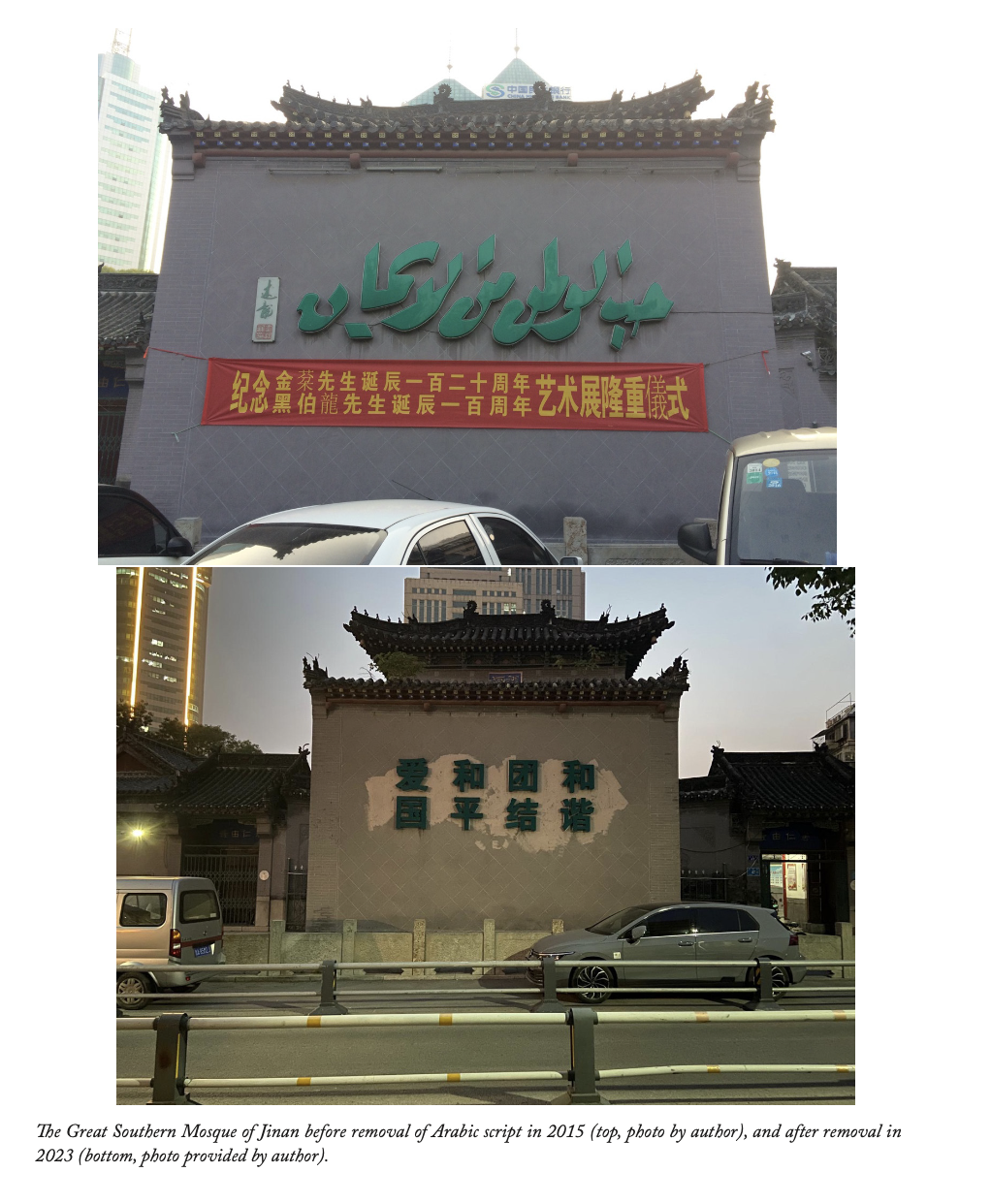
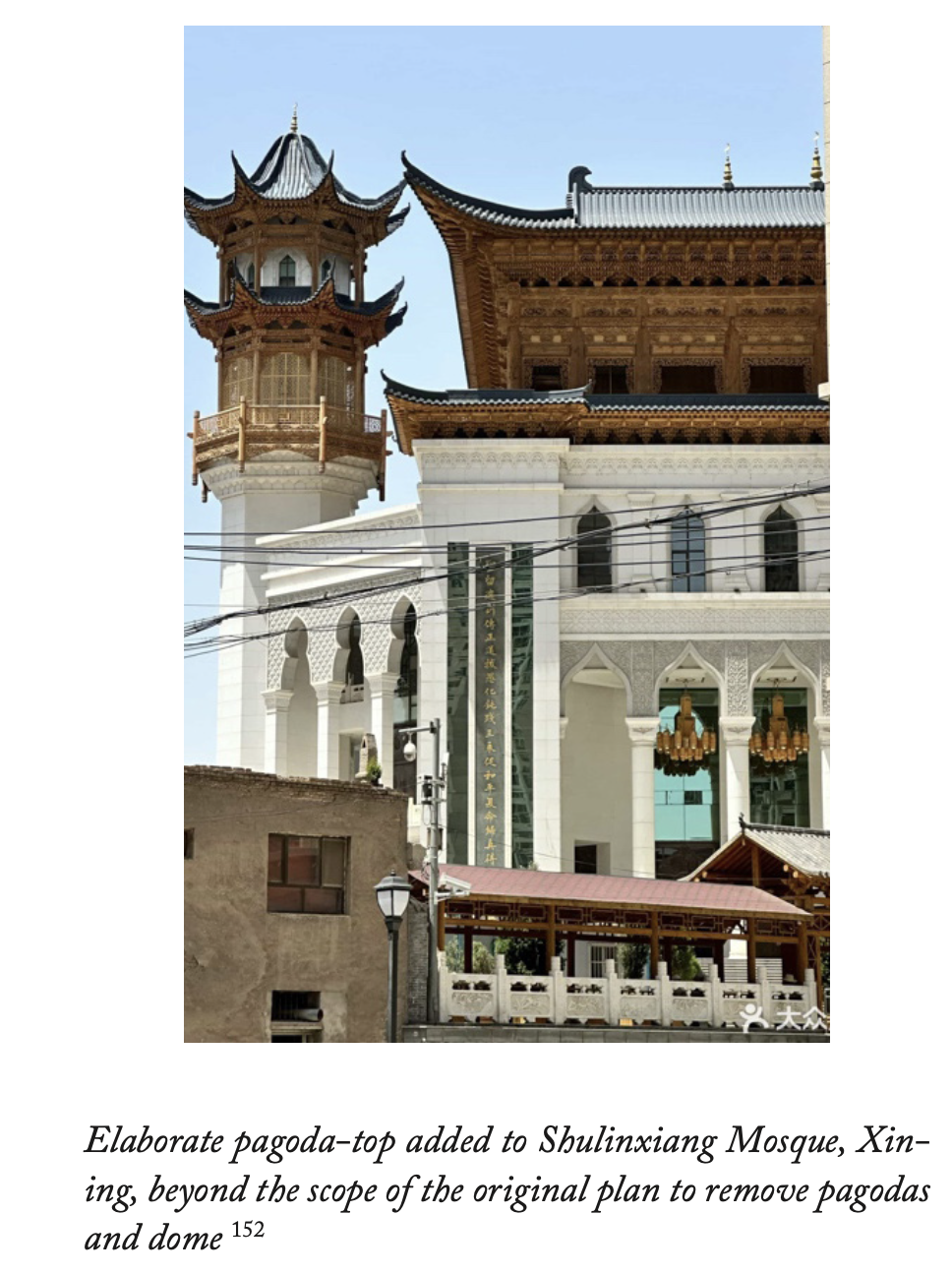
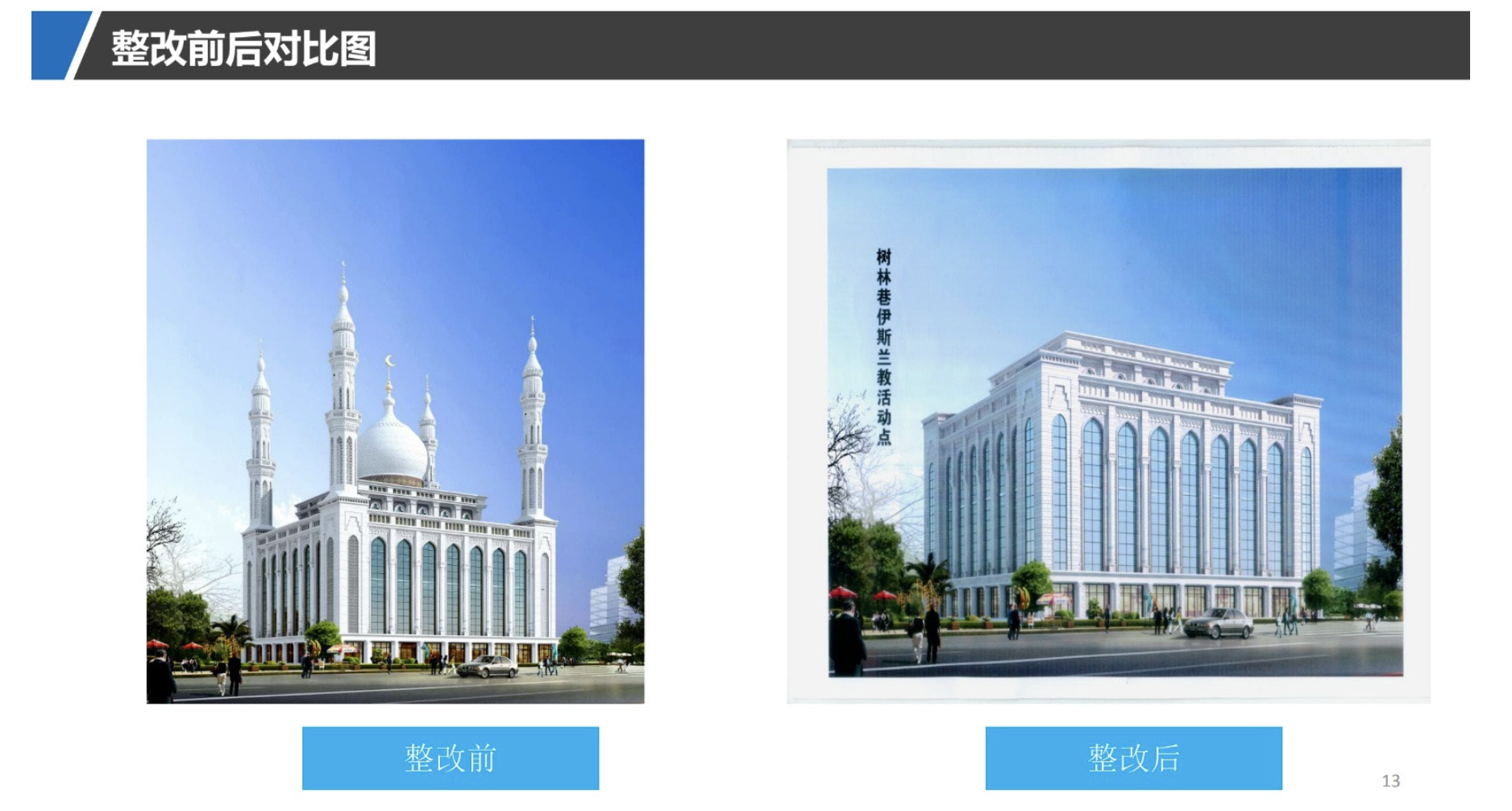
the party-state’s rhetoric implies that signifiers of Islamic identity should be restricted solely to the mosque
napio posted the article • 0 comments • 1211 views • 2025-03-02 05:44
The emergence of measures under the umbrella term ‘Resisting the Three Transformations’ (反三化) was one of the earliest and most visible manifestations of the Sinicization of Islam. In both cases, ‘Saudization’ and ‘Arabization’ are loosely defined, with little concrete connection made — either in justification or implementation of policy — to practices linked to Saudi Arabia or the broader Islamic world. However, both terms infer that influences from abroad are corrupting Islam in China, leaving Muslim communities vulnerable to extremism, a danger requiring state intervention. In party-state justifications, extremism is always defined as a foreign force. Both terms reinforce perceptions that ‘foreign Islam’ is dangerous. In contrast, ‘Chinese Islam’ is implied to be ‘safe’ and ‘normal’ when appropriately guided by the party-state.
The third transformation, ‘pan-halalification,’ is distinct from the other two, as this term refers to a perceived expansion of halal labeling to products and places outside of its ‘normal’ usage as defined by the party-state (i.e., in relation to the status of animal products, especially meat). This term acts as a proxy for discussion of the spread of religious influence, implicitly defining any expansion of the visibility of Islam as a threat to the party-state and a precursor to extremism. Its appearance within the Three Transformations campaign highlights the party-state’s commitment to building a secular society, with an ever-narrower demarcation of the spaces where religion is permissible.
The concept of the Three Transformations was first articulated amid counter-terror and de-extremification measures enacted in the XUAR. References to the need to counter ‘Arabization’ and ‘Saudization’ in Islam in Ningxia first officially appear outside the XUAR in a December 2016 speech given by Ningxia Party Secretary Li Jianhua to the Ningxia Autonomous Region Religious Work Conference, where such changes are explicitly mentioned alongside work in Xinjiang. Li stated that “the central government holds that we must be strictly on guard against the phenomena of ‘Arabization’ and ‘Saudization’ of Islam in regions such as Ningxia and Xinjiang, the infiltration of foreign Islam is not a religious problem but a political problem.” Li further singled out pan-halalification as an early sign of the development of religious extremism, and signaled his opposition to the idea that Arabic is a Hui language. By singling out the Arabic language, and pointing the finger at ‘infiltration’ by ‘foreign’ practices, Li’s efforts draw clear and bright lines between party-state-approved practice and the “extremism” exemplified by the ‘Three Transformations.’
In the initial stages of the campaign against the Three Transformations, the most readily observed targets of policy measures were aesthetic: markers showcasing the influence of ‘foreign’ Islam were removed from public places — particularly where they occur in public art, signage, and architecture. In practice, so-called ‘Arabic’-style mosque architecture (including tall minarets and onion domes), overtly Islamic styles of dress and veiling, the public use of Arabic script, and halal labeling and certification have been identified as evidence of the ‘Three Transformations’ and targeted for suppression. Taken together, the interventions represent an increased policing of any visual markers of Muslim presence in public space. In many instances, the party-state’s rhetoric implies that signifiers of Islamic identity should be restricted solely to the mosque.
As with other aspects of Sinicization policy, party-state action to remove aesthetic markers of foreign influence was first taken in Ningxia in 2016, continuing into 2017. The measures taken to “resist the Three Transformations” were later folded into broader Sinicization policy. After the Three Transformations campaign identified unacceptable practices of Islam linked to latent extremism, the Five-Year Plan bestowed power to define ‘normal’ practice of faith on the CIA. Interventions made by the party-state under the Three Transformations also demonstrate the intersections between counter-terrorism and ‘anti-extremist’ work and the broader Sinicization campaign, as signs of the Three Transformations are explicitly understood as signifiers indicating a vulnerability to extremism. As of 2024, mosques continue to be monitored for any evidence of the Three Transformations. Policing of mosque architecture, dress, and halal labeling continues to provide a rationale for further, programmatic interventions into Muslim communities.
In the section below, we outline examples of party-state interventions taken against practices identified as exemplary of the Three Transformations. We discuss how the party-state’s crackdown targeted mosque architecture, public use of Arabic script, halal branding and certification, practices of dress, and public broadcasting of the call to prayer (adhan).
view all
4.0 Aesthetics
The emergence of measures under the umbrella term ‘Resisting the Three Transformations’ (反三化) was one of the earliest and most visible manifestations of the Sinicization of Islam. In both cases, ‘Saudization’ and ‘Arabization’ are loosely defined, with little concrete connection made — either in justification or implementation of policy — to practices linked to Saudi Arabia or the broader Islamic world. However, both terms infer that influences from abroad are corrupting Islam in China, leaving Muslim communities vulnerable to extremism, a danger requiring state intervention. In party-state justifications, extremism is always defined as a foreign force. Both terms reinforce perceptions that ‘foreign Islam’ is dangerous. In contrast, ‘Chinese Islam’ is implied to be ‘safe’ and ‘normal’ when appropriately guided by the party-state.
The third transformation, ‘pan-halalification,’ is distinct from the other two, as this term refers to a perceived expansion of halal labeling to products and places outside of its ‘normal’ usage as defined by the party-state (i.e., in relation to the status of animal products, especially meat). This term acts as a proxy for discussion of the spread of religious influence, implicitly defining any expansion of the visibility of Islam as a threat to the party-state and a precursor to extremism. Its appearance within the Three Transformations campaign highlights the party-state’s commitment to building a secular society, with an ever-narrower demarcation of the spaces where religion is permissible.
The concept of the Three Transformations was first articulated amid counter-terror and de-extremification measures enacted in the XUAR. References to the need to counter ‘Arabization’ and ‘Saudization’ in Islam in Ningxia first officially appear outside the XUAR in a December 2016 speech given by Ningxia Party Secretary Li Jianhua to the Ningxia Autonomous Region Religious Work Conference, where such changes are explicitly mentioned alongside work in Xinjiang. Li stated that “the central government holds that we must be strictly on guard against the phenomena of ‘Arabization’ and ‘Saudization’ of Islam in regions such as Ningxia and Xinjiang, the infiltration of foreign Islam is not a religious problem but a political problem.” Li further singled out pan-halalification as an early sign of the development of religious extremism, and signaled his opposition to the idea that Arabic is a Hui language. By singling out the Arabic language, and pointing the finger at ‘infiltration’ by ‘foreign’ practices, Li’s efforts draw clear and bright lines between party-state-approved practice and the “extremism” exemplified by the ‘Three Transformations.’
In the initial stages of the campaign against the Three Transformations, the most readily observed targets of policy measures were aesthetic: markers showcasing the influence of ‘foreign’ Islam were removed from public places — particularly where they occur in public art, signage, and architecture. In practice, so-called ‘Arabic’-style mosque architecture (including tall minarets and onion domes), overtly Islamic styles of dress and veiling, the public use of Arabic script, and halal labeling and certification have been identified as evidence of the ‘Three Transformations’ and targeted for suppression. Taken together, the interventions represent an increased policing of any visual markers of Muslim presence in public space. In many instances, the party-state’s rhetoric implies that signifiers of Islamic identity should be restricted solely to the mosque.
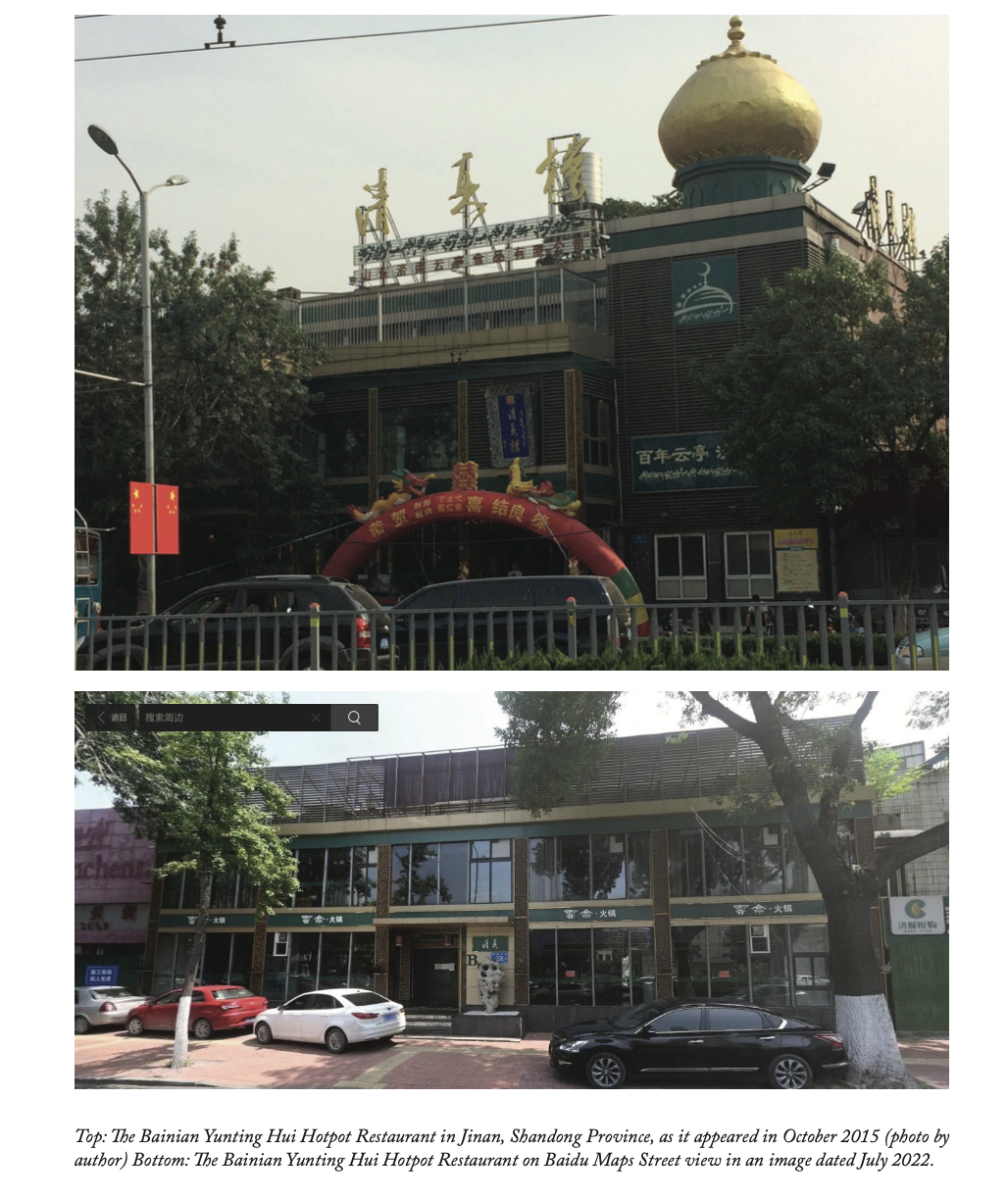
As with other aspects of Sinicization policy, party-state action to remove aesthetic markers of foreign influence was first taken in Ningxia in 2016, continuing into 2017. The measures taken to “resist the Three Transformations” were later folded into broader Sinicization policy. After the Three Transformations campaign identified unacceptable practices of Islam linked to latent extremism, the Five-Year Plan bestowed power to define ‘normal’ practice of faith on the CIA. Interventions made by the party-state under the Three Transformations also demonstrate the intersections between counter-terrorism and ‘anti-extremist’ work and the broader Sinicization campaign, as signs of the Three Transformations are explicitly understood as signifiers indicating a vulnerability to extremism. As of 2024, mosques continue to be monitored for any evidence of the Three Transformations. Policing of mosque architecture, dress, and halal labeling continues to provide a rationale for further, programmatic interventions into Muslim communities.
In the section below, we outline examples of party-state interventions taken against practices identified as exemplary of the Three Transformations. We discuss how the party-state’s crackdown targeted mosque architecture, public use of Arabic script, halal branding and certification, practices of dress, and public broadcasting of the call to prayer (adhan).
Imam Training and Appointments in China
napio posted the article • 0 comments • 1444 views • 2025-03-02 05:36
Imams have always been required to attend occasional training on Party doctrine; as community leaders, working with United Front — and hence the Party-state — has always been a part of their role. However, the number of political training sessions required of imams has dramatically increased since 2014, as has oversight of the content taught within mosques (see 5.0 Cultural Control). In particular, the state has taken much closer control of imam appointments, and has further tightened systems for the appointment, management, and training of religious professionals. This has included:
a) audits of existing religious personnel and the creation of a public SARA database of religious clergy,
b) crackdowns on unregistered imams,
c) tightened appointment regulations for imams, and
d) increased political requirements placed on imams.
Imam licenses are issued by regional Islamic Associations, and are valid for five years. Most provinces have had regulations requiring some formal revalidation of credentials for license renewal for some years, although the requirements for revalidation varied by province. However, audits have intensified in recent years, with some regions requiring all imams to retrain and register. In 2019, Qingtongxia, Ningxia, conducted a complete audit and “clean-up” of all mosque religious personnel, requiring them all to exchange their licenses, likely as part of a province-wide audit ordered after the identification of serious failures in religious work in Ningxia. 115 Linxia similarly audited religious students in mosques across 2017-18, checking for “over-quota” enrollments, and students below the age of 18. As part of the process, Linxia established detailed logs of students in the city. 116 The newly established databases of registered clergy provide further heft to the increased oversight of religious professionals. Launched in May 2023 on the SARA website, the database contains extensive information on individuals, including names, ID numbers, photographs, and titles. 117 It allows users to swiftly check the credentials of any imam (or indeed religious professionals of other faiths). 118
In-post evaluations of imams have also been substantially enhanced, with a focus on political performance. Islamic Associations across the country have established codes of conduct for imams, requiring them to work to actively promote cultural change and Sinicization. Assessment procedures and reviews provide teeth to ensure imams must work towards Party ends. In 2021, Wuhan Islamic Association required imams and mosque leaders to sign “target pledges,” committing them to the work objectives outlined at their conference, a process overseen by representatives from the city’s Ethnic and Religious Affairs Committee. 119 Qinghai Islamic Association has published new, detailed regulations (currently in a pilot phase) for the annual assessment of imams in the province. 120 Under this system, imam performance is to be assessed on an annual basis through a series of inspections and year-end assessments. Although led by the Islamic Association, evaluation committees may include local cadres and cadres from Religious Affairs. Political thought is the category of performance given the greatest weight within the evaluation, and underperforming imams are given a warning and provided with suggestions for improvement. Without improvement, they can be unilaterally dismissed. 121 United Front and local cadre involvement in annual reviews of imam performance is evident in other provinces as well. 122
The tightening of oversight over existing imams is matched by increased oversight of imam appointments. Although imam appointments are theoretically overseen by mosque management committees, both the new standards for appointment processes and oversight of the mosque management committees ensure that only imams acceptable to the Party can be appointed. Once again, the rhetorical justification around such changes is about “standardization,” and ensuring the quality of personnel. Both the “Measures for the Qualifications of Islamic Clergy” and “Measures for the Appointment of Major Clerical Positions in Islamic Activity Venues” contain regulations intended to favor in-province candidates, and ensure final approval of imams and imam appointments is determined by the local Islamic Association. 123
Emerging local regulations suggest that implementation is going further than required by Islamic Association regulations. For instance, regulations on imam appointment trialed in 2023 in the Ningxia city of Zhongwei’s Shapotou district begin with a strong assertion of the role of imams in “conscientiously implementing the important theories of General Secretary Xi Jinping on religious work,” ensuring Sinicization, and their duty to ceaselessly strengthen the identification of their congregations with “our great motherland, the Chinese peoples, Chinese culture, the Chinese Communist Party and Socialism with Chinese characteristics.” The document further stipulates that imams be licensed by the Ningxia Islamic Association, and that mosque management committees are not permitted to draw up their own shortlists. Instead, they will be presented with a shortlist of 3-5 candidates chosen by the local Religious Bureau. Two candidates selected from the list by the mosque management committee will then be interviewed by local government, PSB, undergo a formal written examination, and a sermon competition overseen by the United Front. 124 The whole process ensures that political acceptability of candidates is prioritized over any wishes of the congregation, and further makes it impossible for a mosque to appoint an imam from outside Ningxia. Additionally, registered imams are required to report any travel plans that would take them outside the province to their village, township, and local Religious Bureau for approval. 125
The tightening of control over non-compliant imams is backed by threats to strip them of their credentials. In Hualong, for instance, imam Ma Guoxiang was detained for fifteen days in 2018 and stripped of his credentials as an imam for “spreading extreme opinions and inappropriate language” in his preaching. 126 Online reports suggest that the removal of licenses from imams in Hualong targeted large numbers of clerics, as part of a broad parcel of actions taken to police Islamic activity including multiple mosque closures. 127 Muslim social media accounts have repeatedly posted a four-minute recording from 2019 of an official in Hualong announcing the names of numerous sanctioned imams, seemingly as a tacit protest against the measures. 128 Policing imams via control of their licenses is an ongoing tactic for control: the CIA stripped licenses from three Ningxia imams for unknown reasons in mid-2023. 129
Removal of imam credentials can have serious consequences, beyond even the deprivation of livelihood. In Henan, imam Han Daoliang was dismissed after Zhengzhou officials accused him of being Salafi, forcing him into exile in Malaysia. 130 Elsewhere, scattered evidence suggests that some unregistered imams may have been given longer jail sentences. One request seeking legal advice submitted by a poster to an online platform in late 2018 says that her husband was detained on suspicion of the crime of “disturbing public order” for being an unregistered imam. 131
Such action to control imam licenses works in tandem with previous measures to tighten control of mosque management committees, who previously had significant latitude in their choice of imam. Monitoring of imams and other Islamic scholars has also involved attempts to recruit imams to work directly on behalf of the party-state: in late 2020, NPR reported on the case of a newly appointed imam and member of the local Islamic Association, who was offered a salary and lucrative board position to secretly report back to security authorities. 132
Congregations who resist the installation of a government-approved imam can also find themselves targeted. In a 2019 case reported by Bitter Winter, a mosque in Xining was shut down during Friday prayers for purported violation of fire safety regulations. However, worshippers suggested that this was revenge for their refusal to accept the appointment of an imam whose religious stances did not reflect those of the congregation. 133 In 2018 in Hualong County, Qinghai, thirteen were arrested under the “Sweeping Black and Eliminating Evil” campaign in response to an incident in which Yaqutan Village Mosque attempted to install an imam without official approval. 134
3.5 Impact of Organizational Interventions
All changes to the organization share a singular goal: reducing any resistance to the implementation of Sinicization policy, and ensuring that local Islamic leadership can be coerced into the appearance of support for the campaigns. Changes to the composition of mosque management committees and village-level committees often precede renovations or other interventions into mosque affairs. By co-opting mosque management committees and grassroots Party organizations, the party-state manufactures the authority and justification for these changes. The combined campaign to control the appointments of imams, the operations of Islamic Associations and village-level governance, and to atomize mosques and provincial Islam, has been largely successful in ensuring that widescale resistance to Sinicization policy has been impossible.
This expanded party-state control not only minimizes resistance but also solidifies the party-state’s position in the community. Further surveillance, messaging and facilitation of indoctrination, and centralization of authority are all made possible by establishing such granular levels of control. In a striking example of authoritarian centralization, the party-state is using localized offices and stakeholders to draw religious communities into compliance with nationalized aims.
view all
3.4 Imam Training and Appointments
Imams have always been required to attend occasional training on Party doctrine; as community leaders, working with United Front — and hence the Party-state — has always been a part of their role. However, the number of political training sessions required of imams has dramatically increased since 2014, as has oversight of the content taught within mosques (see 5.0 Cultural Control). In particular, the state has taken much closer control of imam appointments, and has further tightened systems for the appointment, management, and training of religious professionals. This has included:
a) audits of existing religious personnel and the creation of a public SARA database of religious clergy,
b) crackdowns on unregistered imams,
c) tightened appointment regulations for imams, and
d) increased political requirements placed on imams.
Imam licenses are issued by regional Islamic Associations, and are valid for five years. Most provinces have had regulations requiring some formal revalidation of credentials for license renewal for some years, although the requirements for revalidation varied by province. However, audits have intensified in recent years, with some regions requiring all imams to retrain and register. In 2019, Qingtongxia, Ningxia, conducted a complete audit and “clean-up” of all mosque religious personnel, requiring them all to exchange their licenses, likely as part of a province-wide audit ordered after the identification of serious failures in religious work in Ningxia. 115 Linxia similarly audited religious students in mosques across 2017-18, checking for “over-quota” enrollments, and students below the age of 18. As part of the process, Linxia established detailed logs of students in the city. 116 The newly established databases of registered clergy provide further heft to the increased oversight of religious professionals. Launched in May 2023 on the SARA website, the database contains extensive information on individuals, including names, ID numbers, photographs, and titles. 117 It allows users to swiftly check the credentials of any imam (or indeed religious professionals of other faiths). 118
In-post evaluations of imams have also been substantially enhanced, with a focus on political performance. Islamic Associations across the country have established codes of conduct for imams, requiring them to work to actively promote cultural change and Sinicization. Assessment procedures and reviews provide teeth to ensure imams must work towards Party ends. In 2021, Wuhan Islamic Association required imams and mosque leaders to sign “target pledges,” committing them to the work objectives outlined at their conference, a process overseen by representatives from the city’s Ethnic and Religious Affairs Committee. 119 Qinghai Islamic Association has published new, detailed regulations (currently in a pilot phase) for the annual assessment of imams in the province. 120 Under this system, imam performance is to be assessed on an annual basis through a series of inspections and year-end assessments. Although led by the Islamic Association, evaluation committees may include local cadres and cadres from Religious Affairs. Political thought is the category of performance given the greatest weight within the evaluation, and underperforming imams are given a warning and provided with suggestions for improvement. Without improvement, they can be unilaterally dismissed. 121 United Front and local cadre involvement in annual reviews of imam performance is evident in other provinces as well. 122
The tightening of oversight over existing imams is matched by increased oversight of imam appointments. Although imam appointments are theoretically overseen by mosque management committees, both the new standards for appointment processes and oversight of the mosque management committees ensure that only imams acceptable to the Party can be appointed. Once again, the rhetorical justification around such changes is about “standardization,” and ensuring the quality of personnel. Both the “Measures for the Qualifications of Islamic Clergy” and “Measures for the Appointment of Major Clerical Positions in Islamic Activity Venues” contain regulations intended to favor in-province candidates, and ensure final approval of imams and imam appointments is determined by the local Islamic Association. 123
Emerging local regulations suggest that implementation is going further than required by Islamic Association regulations. For instance, regulations on imam appointment trialed in 2023 in the Ningxia city of Zhongwei’s Shapotou district begin with a strong assertion of the role of imams in “conscientiously implementing the important theories of General Secretary Xi Jinping on religious work,” ensuring Sinicization, and their duty to ceaselessly strengthen the identification of their congregations with “our great motherland, the Chinese peoples, Chinese culture, the Chinese Communist Party and Socialism with Chinese characteristics.” The document further stipulates that imams be licensed by the Ningxia Islamic Association, and that mosque management committees are not permitted to draw up their own shortlists. Instead, they will be presented with a shortlist of 3-5 candidates chosen by the local Religious Bureau. Two candidates selected from the list by the mosque management committee will then be interviewed by local government, PSB, undergo a formal written examination, and a sermon competition overseen by the United Front. 124 The whole process ensures that political acceptability of candidates is prioritized over any wishes of the congregation, and further makes it impossible for a mosque to appoint an imam from outside Ningxia. Additionally, registered imams are required to report any travel plans that would take them outside the province to their village, township, and local Religious Bureau for approval. 125
The tightening of control over non-compliant imams is backed by threats to strip them of their credentials. In Hualong, for instance, imam Ma Guoxiang was detained for fifteen days in 2018 and stripped of his credentials as an imam for “spreading extreme opinions and inappropriate language” in his preaching. 126 Online reports suggest that the removal of licenses from imams in Hualong targeted large numbers of clerics, as part of a broad parcel of actions taken to police Islamic activity including multiple mosque closures. 127 Muslim social media accounts have repeatedly posted a four-minute recording from 2019 of an official in Hualong announcing the names of numerous sanctioned imams, seemingly as a tacit protest against the measures. 128 Policing imams via control of their licenses is an ongoing tactic for control: the CIA stripped licenses from three Ningxia imams for unknown reasons in mid-2023. 129
Removal of imam credentials can have serious consequences, beyond even the deprivation of livelihood. In Henan, imam Han Daoliang was dismissed after Zhengzhou officials accused him of being Salafi, forcing him into exile in Malaysia. 130 Elsewhere, scattered evidence suggests that some unregistered imams may have been given longer jail sentences. One request seeking legal advice submitted by a poster to an online platform in late 2018 says that her husband was detained on suspicion of the crime of “disturbing public order” for being an unregistered imam. 131
Such action to control imam licenses works in tandem with previous measures to tighten control of mosque management committees, who previously had significant latitude in their choice of imam. Monitoring of imams and other Islamic scholars has also involved attempts to recruit imams to work directly on behalf of the party-state: in late 2020, NPR reported on the case of a newly appointed imam and member of the local Islamic Association, who was offered a salary and lucrative board position to secretly report back to security authorities. 132
Congregations who resist the installation of a government-approved imam can also find themselves targeted. In a 2019 case reported by Bitter Winter, a mosque in Xining was shut down during Friday prayers for purported violation of fire safety regulations. However, worshippers suggested that this was revenge for their refusal to accept the appointment of an imam whose religious stances did not reflect those of the congregation. 133 In 2018 in Hualong County, Qinghai, thirteen were arrested under the “Sweeping Black and Eliminating Evil” campaign in response to an incident in which Yaqutan Village Mosque attempted to install an imam without official approval. 134
3.5 Impact of Organizational Interventions
All changes to the organization share a singular goal: reducing any resistance to the implementation of Sinicization policy, and ensuring that local Islamic leadership can be coerced into the appearance of support for the campaigns. Changes to the composition of mosque management committees and village-level committees often precede renovations or other interventions into mosque affairs. By co-opting mosque management committees and grassroots Party organizations, the party-state manufactures the authority and justification for these changes. The combined campaign to control the appointments of imams, the operations of Islamic Associations and village-level governance, and to atomize mosques and provincial Islam, has been largely successful in ensuring that widescale resistance to Sinicization policy has been impossible.
This expanded party-state control not only minimizes resistance but also solidifies the party-state’s position in the community. Further surveillance, messaging and facilitation of indoctrination, and centralization of authority are all made possible by establishing such granular levels of control. In a striking example of authoritarian centralization, the party-state is using localized offices and stakeholders to draw religious communities into compliance with nationalized aims.
Mosque Management Committees in China
napio posted the article • 0 comments • 1317 views • 2025-03-02 05:31
Oversight of mosque management committees has increased dramatically, with new regulations intended to increase financial transparency and to ensure that mosques appoint state-approved imams. As noted above, mosque management committees in theory have decisive authority over the affairs of a single mosque. Formed by representatives of the local congregation, mosque management committees manage mosque buildings, the financial affairs of the congregation, and any property owned by the mosque, which in some instances includes rental properties. Mosque management committees also convene selection processes for imams. As imams often serve three-year terms before rotating to a different mosque, mosque management committees are often the greatest continuity in the life of a mosque community.
Since 2017 the party-state and the CIA have moved to assert much tighter control over mosque management committees, especially in areas of dense Muslim settlement. The new “Administrative Measures for Religious Activity Venues,” issued by SARA in 2023, require the establishment of “democratic management organizations” within each individual religious venue. The rules for composition of the committees permit “other relevant figures” to sit, opening the door for cadres to direct the affairs of religious institutions as serving committee members. The first listed duty of members of the management committee (Article 30) is to teach their fellow citizens to be patriotic and to adhere to Sinicization. Registration requirements ensure that local Party offices and the relevant district associations of national religious groups (i.e., local branches of the CIA) have broad oversight of committee composition and membership. Furthermore, religious venues are required to have a supervisory mechanism to oversee committee member behavior. If a misbehaving committee member is not removed in a timely fashion, local authorities have the power to intervene. The text also states that religious venues should not have relationships to each other.
The “Measures for the Democratic Management of Mosques,” republished by the CIA in August 2023, can be read as the official interpretation of the SARA regulations for Islamic communities. The full regulations provide extensive regulation on the duties of the committees, and the permitted scope of mosque activities. These measures explicitly place mosque management committees under CIA guidance. The Measures also include a wide range of causes for which members of the mosque management committee must be dismissed – including refusal to abide by CIA regulations, attendance at unapproved religious events, and actions that would ‘damage internal Islamic harmony’, echoing the SARA regulations.
In numerous cases, on-the-ground stipulations for mosque management committees exceed the requirements of the new regulations. These regulations have been enforced to remove mosque management committee members who might have spearheaded opposition to changes. As with many aspects of Sinicization policy, the formal changes to regulations for mosque management committees have been preceded by years of tightening regulation.
Beginning in 2018, Qinghai has trialed a requirement that leadership of the mosque management committee has been required to be held concurrently by the village Party Secretary and the head of the Village Committee. Mosque management committee members were also required to attend political training on laws, religious policy and key Party Congresses. A document issued in 2019 by the Party committee of Tianya District, in Sanya, Hainan, contains a similar stipulation that mosque committees must contain a Party member. These changes suggest that requirements for mosque management committees to contain at least some Party members may be widespread. Under the tightened rules for Party members outlined above, they cannot display religious faith nor attend religious events, meaning that a mosque management head who is also the village Party Secretary would be formally barred from routine Islamic observance.
Overall, the picture points towards much greater oversight and attention to mosque management committees. Elections to mosque committees take place under careful management of the local United Front and local Party cadres: in a 2023 example from Tianjin, twenty chosen neighbourhood representatives participated in the voting process under the watchful eye of district cadres. Mosque management committees are increasingly given extensive training: in 2024, Sichuan required mosque management committees from 14 prefectures to attend a seven-day training, with an emphasis on Sinicization and the importance of strict governance of religion.
Changes to mosque management committees have been utilized as a precursor to pushing through further measures likely to be unpalatable to the community. In Hualong, Qinghai, the head of a mosque management committee was detained for seven days for “inappropriate language” concerning the appointment of a new imam to the Xining Dongguan Great Mosque. In the wake of his detention, “revisions” were made to the composition of the mosque management committee. In Huangniwan, a village near Linxia in Gansu, an investigation into mosque finances was used as justification for removal of mosque management committee members who might have resisted proposals to merge mosques in the village (see 7.0 Mosque Mergers). In Yunnan, following high-profile protests against architectural renovations at Najiaying Mosque in summer 2023, a notice on the renovations was issued in the name of the Najiaying Mosque Management Committee and the Najiaying Mosque Supervisory Committee – however, observers noted that in fact both committees had been dismissed and replaced by Party supporters and United Front figures.
The changes to regulation of management committees allow much greater oversight of the management of individual venues. The combined impact of the duties placed on mosque management committee members requires them also to act as agents of Party religious policy, with consequences for any who resist. The on-the-ground requirement for mosque management committees to contain a Party member found in Qinghai and elsewhere in effect transform these bodies into Party committees within mosques, whilst the reinforced directives against any relationship between mosques work to atomize mosque communities, ensuring they are connected only via the Islamic Association bodies.
There are hints of resistance to this from within communities who had been used to significant self-governance. As an example, inset text messages within an essay by an Islamophobic activist describe a particularly fraught conference held to discuss proposed renovations to mosques in Weishan, Yunnan. The writer reports that at the conference, one mosque representative made the case that, as mosques are governed by their communities, “the signatures and seals of any Islamic Association or management committee are all powerless.” However, as non-compliant committee members are removed for any resistance, the ability of communities to influence the direction of their mosques decreases. In the place of genuinely democratic mosque management committees is merely a veneer of community inclusion pasted across religious policy determined from within the Islamic Associations and the United Front.
view all
3.3 Mosque Management Committees (寺管会)
Oversight of mosque management committees has increased dramatically, with new regulations intended to increase financial transparency and to ensure that mosques appoint state-approved imams. As noted above, mosque management committees in theory have decisive authority over the affairs of a single mosque. Formed by representatives of the local congregation, mosque management committees manage mosque buildings, the financial affairs of the congregation, and any property owned by the mosque, which in some instances includes rental properties. Mosque management committees also convene selection processes for imams. As imams often serve three-year terms before rotating to a different mosque, mosque management committees are often the greatest continuity in the life of a mosque community.
Since 2017 the party-state and the CIA have moved to assert much tighter control over mosque management committees, especially in areas of dense Muslim settlement. The new “Administrative Measures for Religious Activity Venues,” issued by SARA in 2023, require the establishment of “democratic management organizations” within each individual religious venue. The rules for composition of the committees permit “other relevant figures” to sit, opening the door for cadres to direct the affairs of religious institutions as serving committee members. The first listed duty of members of the management committee (Article 30) is to teach their fellow citizens to be patriotic and to adhere to Sinicization. Registration requirements ensure that local Party offices and the relevant district associations of national religious groups (i.e., local branches of the CIA) have broad oversight of committee composition and membership. Furthermore, religious venues are required to have a supervisory mechanism to oversee committee member behavior. If a misbehaving committee member is not removed in a timely fashion, local authorities have the power to intervene. The text also states that religious venues should not have relationships to each other.
The “Measures for the Democratic Management of Mosques,” republished by the CIA in August 2023, can be read as the official interpretation of the SARA regulations for Islamic communities. The full regulations provide extensive regulation on the duties of the committees, and the permitted scope of mosque activities. These measures explicitly place mosque management committees under CIA guidance. The Measures also include a wide range of causes for which members of the mosque management committee must be dismissed – including refusal to abide by CIA regulations, attendance at unapproved religious events, and actions that would ‘damage internal Islamic harmony’, echoing the SARA regulations.
In numerous cases, on-the-ground stipulations for mosque management committees exceed the requirements of the new regulations. These regulations have been enforced to remove mosque management committee members who might have spearheaded opposition to changes. As with many aspects of Sinicization policy, the formal changes to regulations for mosque management committees have been preceded by years of tightening regulation.
Beginning in 2018, Qinghai has trialed a requirement that leadership of the mosque management committee has been required to be held concurrently by the village Party Secretary and the head of the Village Committee. Mosque management committee members were also required to attend political training on laws, religious policy and key Party Congresses. A document issued in 2019 by the Party committee of Tianya District, in Sanya, Hainan, contains a similar stipulation that mosque committees must contain a Party member. These changes suggest that requirements for mosque management committees to contain at least some Party members may be widespread. Under the tightened rules for Party members outlined above, they cannot display religious faith nor attend religious events, meaning that a mosque management head who is also the village Party Secretary would be formally barred from routine Islamic observance.
Overall, the picture points towards much greater oversight and attention to mosque management committees. Elections to mosque committees take place under careful management of the local United Front and local Party cadres: in a 2023 example from Tianjin, twenty chosen neighbourhood representatives participated in the voting process under the watchful eye of district cadres. Mosque management committees are increasingly given extensive training: in 2024, Sichuan required mosque management committees from 14 prefectures to attend a seven-day training, with an emphasis on Sinicization and the importance of strict governance of religion.
Changes to mosque management committees have been utilized as a precursor to pushing through further measures likely to be unpalatable to the community. In Hualong, Qinghai, the head of a mosque management committee was detained for seven days for “inappropriate language” concerning the appointment of a new imam to the Xining Dongguan Great Mosque. In the wake of his detention, “revisions” were made to the composition of the mosque management committee. In Huangniwan, a village near Linxia in Gansu, an investigation into mosque finances was used as justification for removal of mosque management committee members who might have resisted proposals to merge mosques in the village (see 7.0 Mosque Mergers). In Yunnan, following high-profile protests against architectural renovations at Najiaying Mosque in summer 2023, a notice on the renovations was issued in the name of the Najiaying Mosque Management Committee and the Najiaying Mosque Supervisory Committee – however, observers noted that in fact both committees had been dismissed and replaced by Party supporters and United Front figures.
The changes to regulation of management committees allow much greater oversight of the management of individual venues. The combined impact of the duties placed on mosque management committee members requires them also to act as agents of Party religious policy, with consequences for any who resist. The on-the-ground requirement for mosque management committees to contain a Party member found in Qinghai and elsewhere in effect transform these bodies into Party committees within mosques, whilst the reinforced directives against any relationship between mosques work to atomize mosque communities, ensuring they are connected only via the Islamic Association bodies.
There are hints of resistance to this from within communities who had been used to significant self-governance. As an example, inset text messages within an essay by an Islamophobic activist describe a particularly fraught conference held to discuss proposed renovations to mosques in Weishan, Yunnan. The writer reports that at the conference, one mosque representative made the case that, as mosques are governed by their communities, “the signatures and seals of any Islamic Association or management committee are all powerless.” However, as non-compliant committee members are removed for any resistance, the ability of communities to influence the direction of their mosques decreases. In the place of genuinely democratic mosque management committees is merely a veneer of community inclusion pasted across religious policy determined from within the Islamic Associations and the United Front.
3.2 China Islamic Association
napio posted the article • 0 comments • 1411 views • 2025-03-02 05:22
Management of local branches of the China Islamic Associations (CIA) is perceived as a precondition for CCP control of mosques and Islamic communities more broadly. The Five-Year Plan and Document 10 both envisage an expanded role for the CIA, and the national structure of Islamic Associations has effectively served as implementing organizations for Sinicization policy. Formally, the CIA does not have control of individual mosques, as it is intended to serve as a conduit between religious communities and the Party-state. Individual mosque management committees are theoretically the highest authority over the affairs of a single mosque, and mosques are required to be independent of each other. Party-state policy continues to assert the mosque management committee as a representative of the democratic control of mosque affairs by the people.
As a result, the level of influence enjoyed by the Islamic Association had previously varied by region. As Doyon notes, the relationships between local Islamic Associations and mosque management committees were previously differentiated by region: in small Muslim communities, where donations were low, the local Islamic Association had significant control of mosque affairs; in larger Muslim communities with higher levels of donations, the mosque management committees were the primary directors of mosque affairs, with the Islamic Association acting primarily as a mediator between the mosque and local government. In Qinghai, Gansu, and Ningxia, mosque management committees retained primary control of imam appointments, with the CIA merely approving the chosen candidates. Mosque management committees also control finances and property for individual mosques, some of which lease space to shopkeepers. Control of mosque management committees thus ensures much tighter control of imam appointments, allowing the Party-state to install members who will stringently facilitate and enforce Sinicization policies.
The 2018 incorporation of the State Administration for Religious Affairs (SARA), the bureau which previously sat above the CIA and the other official religious organizations, into the UFWD brought religious affairs back under the direct control of the Party. In addition, changes to the CIA’s Constitution in 2022 further emphasize the extent to which the Association serves the Party, with repeated references to Xi Jinping Thought added to the text. Requirements for the head of the Islamic Association stress the importance of their political credentials, while “extensive knowledge of Islam” is listed as desirable but not essential. Where earlier constitutions stated the Association “is a patriotic religious group and Islamic religious organization for Muslims of all ethnic groups in the country,” the 2022 revision states that “The Association is a national Islamic patriotic religious group and a non-profit social organization for religious affairs, formed voluntarily by Muslims and people who care about and support the cause of Islam.” This change opens the door for non-Muslim participation in the CIA and de-emphasizes ethnicity (minzu) within the Association.
Since 2016, the CIA has expanded its roles and remit within mosque communities, fulfilling the “bridge” role anticipated in Document 10. Since the 2018 passing of the revised Regulations on Religious Affairs, SARA has issued a number of ordinances designed to regularize and regulate the activity of religious organizations, in cooperation with other relevant departments. These have included the Administrative Measures for Religious Groups (宗教团体管理办法, 2019), Notice on Registration of Legal Persons of Religious Venues (关于宗教活动场所办理法人登记事项的通知, 2019), Measures for the Administration of Islamic Hajj Affairs (伊斯兰教朝觐事务管理办法, 2020), Administrative Measures for Religious Clergy (宗教教职人员管理办法, 2021) and the Measures for the Establishment of Religious Institutes (宗教院校管理办法, 2021); and Measures for the Administration of Internet Religious Information Services (互联网宗教信息服务管理办法, 2021). As a whole, the new regulations mandate greater oversight of mosque personnel and mosque administration, with stringent requirements on financial reporting and legal duties. Dissemination and study of the new regulations has been core to CIA activity, reflecting the new emphasis within their constitution on adherence to the national legal system.
To guide implementation of the above, the CIA has issued a series of specific regulations designed for Islamic communities, collectively known as the “three measures and the one code.” Respectively, these are the “Measures for the Democratic Management of Mosques” (清真寺民主管理办法), “Measures for the Qualifications of Islamic Clergy” (伊斯兰教教职人员资格认定办法), “Measures for the Appointment of Major Clerical Positions in Islamic Activity Venues” (伊斯兰教活动场所主要教职聘任办法), and “Code of Conduct for Islamic Clergy” (伊斯兰教教职人员行为守则). The four regulations were issued in 2019, and have since been revised in 2023. Collectively, the regulations seek to standardize the patchwork of regulation of clergy and venues that had emerged since 2017.
Additionally, CIA bodies have become the visible faces of Sinicization policy by organizing lecture tours on Sinicization, overseeing architectural renovations, and hosting preaching competitions and training sessions. Despite the lack of a formal hierarchical relationship between individual mosques and the CIA, branch associations increasingly exercise authority over individual mosques, issuing directives for policy implementation as supported by the suite of SARA regulations. For instance, regulations issued by the Hohhot Islamic Association in August 2019 include stipulations that mosques should a) not permit storage of illegal religious publications, b) strengthen management of religious personnel and should not host Tablighi Jamaat missionaries, c) not permit storage of personal property in the mosque, and d) that minors cannot be forced to attend religious activities. Duplicates of the new regulations were issued to both the city United Front Department and the Huimin city district (回民区) United Front. The Hohhot Islamic Association has since established a ‘China Exceptional Traditional Culture Activity Centre’ inside Hohhot Great Mosque, with an inauguration ceremony held in December 2020.
view all
3.2 China Islamic Association
Management of local branches of the China Islamic Associations (CIA) is perceived as a precondition for CCP control of mosques and Islamic communities more broadly. The Five-Year Plan and Document 10 both envisage an expanded role for the CIA, and the national structure of Islamic Associations has effectively served as implementing organizations for Sinicization policy. Formally, the CIA does not have control of individual mosques, as it is intended to serve as a conduit between religious communities and the Party-state. Individual mosque management committees are theoretically the highest authority over the affairs of a single mosque, and mosques are required to be independent of each other. Party-state policy continues to assert the mosque management committee as a representative of the democratic control of mosque affairs by the people.
As a result, the level of influence enjoyed by the Islamic Association had previously varied by region. As Doyon notes, the relationships between local Islamic Associations and mosque management committees were previously differentiated by region: in small Muslim communities, where donations were low, the local Islamic Association had significant control of mosque affairs; in larger Muslim communities with higher levels of donations, the mosque management committees were the primary directors of mosque affairs, with the Islamic Association acting primarily as a mediator between the mosque and local government. In Qinghai, Gansu, and Ningxia, mosque management committees retained primary control of imam appointments, with the CIA merely approving the chosen candidates. Mosque management committees also control finances and property for individual mosques, some of which lease space to shopkeepers. Control of mosque management committees thus ensures much tighter control of imam appointments, allowing the Party-state to install members who will stringently facilitate and enforce Sinicization policies.
The 2018 incorporation of the State Administration for Religious Affairs (SARA), the bureau which previously sat above the CIA and the other official religious organizations, into the UFWD brought religious affairs back under the direct control of the Party. In addition, changes to the CIA’s Constitution in 2022 further emphasize the extent to which the Association serves the Party, with repeated references to Xi Jinping Thought added to the text. Requirements for the head of the Islamic Association stress the importance of their political credentials, while “extensive knowledge of Islam” is listed as desirable but not essential. Where earlier constitutions stated the Association “is a patriotic religious group and Islamic religious organization for Muslims of all ethnic groups in the country,” the 2022 revision states that “The Association is a national Islamic patriotic religious group and a non-profit social organization for religious affairs, formed voluntarily by Muslims and people who care about and support the cause of Islam.” This change opens the door for non-Muslim participation in the CIA and de-emphasizes ethnicity (minzu) within the Association.
Since 2016, the CIA has expanded its roles and remit within mosque communities, fulfilling the “bridge” role anticipated in Document 10. Since the 2018 passing of the revised Regulations on Religious Affairs, SARA has issued a number of ordinances designed to regularize and regulate the activity of religious organizations, in cooperation with other relevant departments. These have included the Administrative Measures for Religious Groups (宗教团体管理办法, 2019), Notice on Registration of Legal Persons of Religious Venues (关于宗教活动场所办理法人登记事项的通知, 2019), Measures for the Administration of Islamic Hajj Affairs (伊斯兰教朝觐事务管理办法, 2020), Administrative Measures for Religious Clergy (宗教教职人员管理办法, 2021) and the Measures for the Establishment of Religious Institutes (宗教院校管理办法, 2021); and Measures for the Administration of Internet Religious Information Services (互联网宗教信息服务管理办法, 2021). As a whole, the new regulations mandate greater oversight of mosque personnel and mosque administration, with stringent requirements on financial reporting and legal duties. Dissemination and study of the new regulations has been core to CIA activity, reflecting the new emphasis within their constitution on adherence to the national legal system.
To guide implementation of the above, the CIA has issued a series of specific regulations designed for Islamic communities, collectively known as the “three measures and the one code.” Respectively, these are the “Measures for the Democratic Management of Mosques” (清真寺民主管理办法), “Measures for the Qualifications of Islamic Clergy” (伊斯兰教教职人员资格认定办法), “Measures for the Appointment of Major Clerical Positions in Islamic Activity Venues” (伊斯兰教活动场所主要教职聘任办法), and “Code of Conduct for Islamic Clergy” (伊斯兰教教职人员行为守则). The four regulations were issued in 2019, and have since been revised in 2023. Collectively, the regulations seek to standardize the patchwork of regulation of clergy and venues that had emerged since 2017.
Additionally, CIA bodies have become the visible faces of Sinicization policy by organizing lecture tours on Sinicization, overseeing architectural renovations, and hosting preaching competitions and training sessions. Despite the lack of a formal hierarchical relationship between individual mosques and the CIA, branch associations increasingly exercise authority over individual mosques, issuing directives for policy implementation as supported by the suite of SARA regulations. For instance, regulations issued by the Hohhot Islamic Association in August 2019 include stipulations that mosques should a) not permit storage of illegal religious publications, b) strengthen management of religious personnel and should not host Tablighi Jamaat missionaries, c) not permit storage of personal property in the mosque, and d) that minors cannot be forced to attend religious activities. Duplicates of the new regulations were issued to both the city United Front Department and the Huimin city district (回民区) United Front. The Hohhot Islamic Association has since established a ‘China Exceptional Traditional Culture Activity Centre’ inside Hohhot Great Mosque, with an inauguration ceremony held in December 2020.
Part II: Sinicization in Practice: Implementation and Effects
napio posted the article • 0 comments • 1263 views • 2025-03-02 05:17
To analyze these processes, we have collated a database of items dealing with the implementation of Sinicization policy. The sources collected vary widely, from China Islamic Association briefings and reports, local government policy reports, and local United Front branch updates to social media posts written by individuals with interest in the implementation of Sinicization policy. While in most instances links to the original evidence are provided, in limited instances the authors have elected to provide a code in place of the original reference for social media posts made by private individuals to protect their identities. Further information is available on request from the researchers. Much information around the Sinicization of Islam is suppressed, and affected communities are discouraged from talking publicly about measures they have experienced. As a result, although we attempt to present as full and comprehensive a picture as possible to understand Sinicization in action, inevitably there is more information available on certain aspects and on certain locations. This report should be taken as a preliminary survey of these domains.
3.0 Organization
Control of religious organizations is understood as a precondition for the implementation of religious work policies. This has entailed a tightening of policies on four fronts, namely 1) an emphasis on the behavior and responsibilities of grassroots cadres, 2) tightening control over the China Islamic Association (CIA), 3) mosque committees, and 4) mosque personnel.
3.1 Policing Cadre Behavior
Across the PRC, disciplinary inspections of cadres form a key backdrop to the implementation of Sinicization policy. Performance of atheism has always been an expectation for high-ranking party officials. However, in practice, it was often tacitly accepted that village-level officials were also sometimes religiously active. Indeed, the party-state has a long, sometimes complicated history of working with and in religious communities, creating a “middle ground” in which space is made for Islamic community, in practice and law. While increased attention to grassroots cadre behavior and campaigns for ensuring moral probity among officials have been a feature of the Xi years more broadly, measures for the Sinicization of religion have been accompanied by tightening of religious discipline for cadres across the board. The religious attitudes of local officials were identified as a key barrier to the achievement of Party policy objectives, and hence, reform of grassroots cadre behavior has been prioritized as necessary for achieving the broader policy aims of the Sinicization campaign.
Such emphasis on religious discipline is most clearly seen in the 2018 revision to the Regulations on Discipline and Punishment for Chinese Communist Party, which added a clause (Article 62) specifically stating that Party members who hold religious faith themselves should be provided with “thought education.” If, following intervention, there is no change observed in their beliefs, they should be persuaded to give up their membership or stripped of it. Those who participate in activities which “use religion as incitement” are also to be expelled. The Regulations represent the most concrete instantiation of earlier commitments to atheism as a key aspect of cadre discipline found in resolutions such as the “Certain Principles for Political Life within the Party Under the New Situation” (关于新形势下党内政治生活的若干准则), passed at the sixth Plenary Session of the 18th National Congress.
A 2018 inspection tour of Ningxia conducted under the auspices of the Central Commission for Discipline Inspection found that Ningxia party organizations had ‘serious shortcomings’ in the leadership of religious work. In response, the Ningxia Party Committee launched a series of activities, intended to reassert the “Marxist view of ethnicity and religion” to cadres at all levels within the provincial system. The measures also note refinements to working practices and functional positioning for cadres dealing with ethnic and religious work. These emphasize oversight of cadres involved in such work, noting that cadres found to have taken ‘inappropriate actions’ in handling religious affairs will be strictly dealt with.
The impact of the updated Regulations can be seen across China, and especially in areas with concentrations of Islamic population. In Linxia, 4,557 cadres and party members were required to sign formal commitments of atheism. Section-level cadres were required to attend training on the spirit of the 19th National Congress of the CPC in order that they could better guide those under their supervision to realize their previously pledged commitment to atheism. Inspections were launched of all cadres found to have worn religious garments, with further monitoring of behavior following thereafter. Retired cadres in the area were also required to attend training to reassert the primacy of the Party, in a move that echoes reports from Qinghai and Ningxia that retired cadres have been banned from performing the Hajj.
In 2019, Aksai Kazakh Prefecture in Gansu reported that – in response to the issue of “Party members and public officials participating in the Hajj,” which had been raised as an issue by an earlier disciplinary inspection – the prefectural government had banned all Party members from religious belief and initiated investigations into Party members found to have previously performed the Hajj. Several were subjected to intensive personalized interventions intended to transform their thinking following these investigations, although the outcome of such interventions remains unclear from the available reports. Zhangjiachuan, Gansu, conducted similar inspections and mass training on party-state religious policies and atheism for cadres across 2020, with a particular focus on village-level cadres and on ensuring that cadres were banned from performing the Hajj. Zhangjiachuan reported improvement of pre-appointment approval mechanisms to ensure that religious believers and clergy could not serve as village cadres. The area also reported reforms to reporting procedures to ensure that responsibility for religious work could not be evaded to guarantee the implementation of religious policy at the local level.
Reassertion of the importance of cadres holding the ‘correct’ attitude to religion has functioned both as a statement of the priority that religious work has under the current regime, a rationale for the removal of cadres at the grassroots, and a tool for checking enforcement. Disciplinary oversight has further aided the development of new working methods at the grassroots level. These changes are seen most noticeably in Ningxia, which – following a 2018 disciplinary inspection – instituted a series of training for cadres on Xi Jinping Thought and approaches to religious work, as well as a series of reforms to working practices to ensure that grassroots-level officials were held accountable for fulfilling their duties in religious work. These reforms created cross-department working groups, thereby strengthening Party groups at the lowest level. These groups have allowed extensive coordination between local cadres, United Front, PSB, and other relevant organizations, effectively combating the fragmented authoritarianism that often characterizes PRC governance at the lowest level. Disciplinary inspections continue to be utilized as a method for inspecting religious work across key areas, as in the September 2023 inspection of religious work in Pingliang in Gansu.
Scrutinizing cadres suspected to hold religious beliefs through training and investigations – and threatening disciplinary measures for those found to be ‘two-faced’ – ensured that when instructions like those given in “Document 10” were circulated, local governments rushed to show that they were implementing them accordingly. For example, in Linxia from 2017 onwards, a number of departments that seemingly had little to do with Islamic work held meetings to study the spirit of Xi Jinping’s instructions, including Linxia Archives and the Environmental Bureau. Following its study meeting, the Environmental Bureau determined that its own remit included tackling the use of loudspeakers in mosques to broadcast the call to prayer under regulations on noise pollution. In 2018, Linxia convened an all-prefecture conference to study the spirit of Xi Jinping’s instructions on Islamic work. Later that month, local county leaders down to the township level in Hezheng County, Linxia were required to sign commitments to Sinicization and resisting the Three Transformations. In effect, the scope of religious work was expanded to all areas of government, leaving officials to determine the scope of implementation within their own domains.
The impact of these measures to police cadres’ behavior has been far-reaching. In areas where village cadres are now also expected to lead mosque management committees as part of further organizational changes, the presence of an official who cannot participate in the life of the community is an interruption to the normal conduct of religious affairs. In a recent case in Yunnan, Party members were explicitly banned from fasting during Ramadan, in contrast to previous years when this had been tolerated. The threat of being labelled a “two-faced official” has made that designation into a self-fulfilling prophecy: cadres who never previously saw any inherent antagonism between being a part of the party and being a member of the religious community now find themselves having to navigate complicated tensions between their professional and social worlds. Pressure to enforce the party-state’s bans by reporting those who violate them places these ‘unofficially’ religious cadres under tremendous strain.
view all
As detailed in Part I above, Sinicization is a sprawling project, with implications that touch all aspects of life in affected communities. In Part II of this report, we explore how Sinicization policy has been implemented and discuss its impact on China’s Muslim communities. To do so, we divide Sinicization policy into five main areas of implementation, namely 1) organization, 2) aesthetics, 3) scripture, language, and education, 4) surveillance and monitoring, and 5) mosque mergers. These categories are loose and do not represent policy domains as defined in state documents. Moreover, these domains should not be understood as isolated from each other – rather, actions clustered in each domain work to bolster other areas of impact. Additionally, certain measures (notably the expansion of rural surveillance and tightening of control over Party committees) act to reinforce the implementation of Sinicization policy, but are themselves part of wider authoritarian policy implementation in the contemporary PRC.
To analyze these processes, we have collated a database of items dealing with the implementation of Sinicization policy. The sources collected vary widely, from China Islamic Association briefings and reports, local government policy reports, and local United Front branch updates to social media posts written by individuals with interest in the implementation of Sinicization policy. While in most instances links to the original evidence are provided, in limited instances the authors have elected to provide a code in place of the original reference for social media posts made by private individuals to protect their identities. Further information is available on request from the researchers. Much information around the Sinicization of Islam is suppressed, and affected communities are discouraged from talking publicly about measures they have experienced. As a result, although we attempt to present as full and comprehensive a picture as possible to understand Sinicization in action, inevitably there is more information available on certain aspects and on certain locations. This report should be taken as a preliminary survey of these domains.
3.0 Organization
Control of religious organizations is understood as a precondition for the implementation of religious work policies. This has entailed a tightening of policies on four fronts, namely 1) an emphasis on the behavior and responsibilities of grassroots cadres, 2) tightening control over the China Islamic Association (CIA), 3) mosque committees, and 4) mosque personnel.
3.1 Policing Cadre Behavior
Across the PRC, disciplinary inspections of cadres form a key backdrop to the implementation of Sinicization policy. Performance of atheism has always been an expectation for high-ranking party officials. However, in practice, it was often tacitly accepted that village-level officials were also sometimes religiously active. Indeed, the party-state has a long, sometimes complicated history of working with and in religious communities, creating a “middle ground” in which space is made for Islamic community, in practice and law. While increased attention to grassroots cadre behavior and campaigns for ensuring moral probity among officials have been a feature of the Xi years more broadly, measures for the Sinicization of religion have been accompanied by tightening of religious discipline for cadres across the board. The religious attitudes of local officials were identified as a key barrier to the achievement of Party policy objectives, and hence, reform of grassroots cadre behavior has been prioritized as necessary for achieving the broader policy aims of the Sinicization campaign.
Such emphasis on religious discipline is most clearly seen in the 2018 revision to the Regulations on Discipline and Punishment for Chinese Communist Party, which added a clause (Article 62) specifically stating that Party members who hold religious faith themselves should be provided with “thought education.” If, following intervention, there is no change observed in their beliefs, they should be persuaded to give up their membership or stripped of it. Those who participate in activities which “use religion as incitement” are also to be expelled. The Regulations represent the most concrete instantiation of earlier commitments to atheism as a key aspect of cadre discipline found in resolutions such as the “Certain Principles for Political Life within the Party Under the New Situation” (关于新形势下党内政治生活的若干准则), passed at the sixth Plenary Session of the 18th National Congress.
A 2018 inspection tour of Ningxia conducted under the auspices of the Central Commission for Discipline Inspection found that Ningxia party organizations had ‘serious shortcomings’ in the leadership of religious work. In response, the Ningxia Party Committee launched a series of activities, intended to reassert the “Marxist view of ethnicity and religion” to cadres at all levels within the provincial system. The measures also note refinements to working practices and functional positioning for cadres dealing with ethnic and religious work. These emphasize oversight of cadres involved in such work, noting that cadres found to have taken ‘inappropriate actions’ in handling religious affairs will be strictly dealt with.
The impact of the updated Regulations can be seen across China, and especially in areas with concentrations of Islamic population. In Linxia, 4,557 cadres and party members were required to sign formal commitments of atheism. Section-level cadres were required to attend training on the spirit of the 19th National Congress of the CPC in order that they could better guide those under their supervision to realize their previously pledged commitment to atheism. Inspections were launched of all cadres found to have worn religious garments, with further monitoring of behavior following thereafter. Retired cadres in the area were also required to attend training to reassert the primacy of the Party, in a move that echoes reports from Qinghai and Ningxia that retired cadres have been banned from performing the Hajj.
In 2019, Aksai Kazakh Prefecture in Gansu reported that – in response to the issue of “Party members and public officials participating in the Hajj,” which had been raised as an issue by an earlier disciplinary inspection – the prefectural government had banned all Party members from religious belief and initiated investigations into Party members found to have previously performed the Hajj. Several were subjected to intensive personalized interventions intended to transform their thinking following these investigations, although the outcome of such interventions remains unclear from the available reports. Zhangjiachuan, Gansu, conducted similar inspections and mass training on party-state religious policies and atheism for cadres across 2020, with a particular focus on village-level cadres and on ensuring that cadres were banned from performing the Hajj. Zhangjiachuan reported improvement of pre-appointment approval mechanisms to ensure that religious believers and clergy could not serve as village cadres. The area also reported reforms to reporting procedures to ensure that responsibility for religious work could not be evaded to guarantee the implementation of religious policy at the local level.
Reassertion of the importance of cadres holding the ‘correct’ attitude to religion has functioned both as a statement of the priority that religious work has under the current regime, a rationale for the removal of cadres at the grassroots, and a tool for checking enforcement. Disciplinary oversight has further aided the development of new working methods at the grassroots level. These changes are seen most noticeably in Ningxia, which – following a 2018 disciplinary inspection – instituted a series of training for cadres on Xi Jinping Thought and approaches to religious work, as well as a series of reforms to working practices to ensure that grassroots-level officials were held accountable for fulfilling their duties in religious work. These reforms created cross-department working groups, thereby strengthening Party groups at the lowest level. These groups have allowed extensive coordination between local cadres, United Front, PSB, and other relevant organizations, effectively combating the fragmented authoritarianism that often characterizes PRC governance at the lowest level. Disciplinary inspections continue to be utilized as a method for inspecting religious work across key areas, as in the September 2023 inspection of religious work in Pingliang in Gansu.
Scrutinizing cadres suspected to hold religious beliefs through training and investigations – and threatening disciplinary measures for those found to be ‘two-faced’ – ensured that when instructions like those given in “Document 10” were circulated, local governments rushed to show that they were implementing them accordingly. For example, in Linxia from 2017 onwards, a number of departments that seemingly had little to do with Islamic work held meetings to study the spirit of Xi Jinping’s instructions, including Linxia Archives and the Environmental Bureau. Following its study meeting, the Environmental Bureau determined that its own remit included tackling the use of loudspeakers in mosques to broadcast the call to prayer under regulations on noise pollution. In 2018, Linxia convened an all-prefecture conference to study the spirit of Xi Jinping’s instructions on Islamic work. Later that month, local county leaders down to the township level in Hezheng County, Linxia were required to sign commitments to Sinicization and resisting the Three Transformations. In effect, the scope of religious work was expanded to all areas of government, leaving officials to determine the scope of implementation within their own domains.
The impact of these measures to police cadres’ behavior has been far-reaching. In areas where village cadres are now also expected to lead mosque management committees as part of further organizational changes, the presence of an official who cannot participate in the life of the community is an interruption to the normal conduct of religious affairs. In a recent case in Yunnan, Party members were explicitly banned from fasting during Ramadan, in contrast to previous years when this had been tolerated. The threat of being labelled a “two-faced official” has made that designation into a self-fulfilling prophecy: cadres who never previously saw any inherent antagonism between being a part of the party and being a member of the religious community now find themselves having to navigate complicated tensions between their professional and social worlds. Pressure to enforce the party-state’s bans by reporting those who violate them places these ‘unofficially’ religious cadres under tremendous strain.
The “Five Year Plan For the Sinicisation of Islam” makes several consequential declarations.
napio posted the article • 0 comments • 1267 views • 2025-03-02 05:11
The “Five-Year Plan for the Sinicization of Islam” makes several consequential declarations. First, it establishes the linguistic and cultural hegemony of Chinese for Islamic theology, practice, and education. By specifying in multiple instances that the proper language of scriptural exegesis, ritual observance, and religious education is the “common national language” (i.e., standard Mandarin), the CIA’s plan marginalizes Persian and Arabic as languages associated with Islamic identity. Further, the linguistic emphasis on Chinese enables the embedding of party-approved interpretations of scripture and religious texts into the canon of commonly used texts for worship.
The broad directives that allow CIA supervision of Islamic charity firmly place the management of aesthetic and material aspects of Islamic buildings under the purview of party-state development planning.
Likewise, the CIA’s plan restructures the curriculum for training practitioners of Islam in order to feature secular, Chinese commentaries. The repeated insistence that pride of place be given to the study of Chinese history and culture supplants education about the history of the transmission and development of global Islam. Instead, core texts root the practice of Islam in an almost exclusively localized tradition. In holding up Sinicized Islamic histories and exegesis as “standard,” the CIA designates those teachings and practices from abroad as extreme.
Beyond establishing control over the practice of Islam, the plan also links Sinicization directly to the state’s developmental goals. The designation of non-Chinese architectural styles as imprudently wasting public funding allows interventions by the CIA and the UFWD under the onus of pursuing anticorruption and poverty alleviation measures. The broad directives that allow CIA supervision of Islamic charity also align it with the party-state’s larger developmental agenda and firmly place the management of aesthetic and material aspects of Islamic buildings under the purview of party-state development planning.
Finally, the Five-Year Plan gives broad authority to the CIA to police what may be considered “correct” practice of Islam. In providing a strong supervisory role to the CIA over processes of scriptural interpretation, educational curriculum development, clergy and mosque personnel selection, charitable donations, and even halal branding, the plan curtails the influence of independent Islamic authority figures and centralizes power. In this empowered role, the CIA is able to act as the arbiter of standard practice of faith and also as the guarantor that Sinicization processes align with the party-state’s objectives.
view all
2.4 Summary: Implications of the “Five-Year Plan”
The “Five-Year Plan for the Sinicization of Islam” makes several consequential declarations. First, it establishes the linguistic and cultural hegemony of Chinese for Islamic theology, practice, and education. By specifying in multiple instances that the proper language of scriptural exegesis, ritual observance, and religious education is the “common national language” (i.e., standard Mandarin), the CIA’s plan marginalizes Persian and Arabic as languages associated with Islamic identity. Further, the linguistic emphasis on Chinese enables the embedding of party-approved interpretations of scripture and religious texts into the canon of commonly used texts for worship.
The broad directives that allow CIA supervision of Islamic charity firmly place the management of aesthetic and material aspects of Islamic buildings under the purview of party-state development planning.
Likewise, the CIA’s plan restructures the curriculum for training practitioners of Islam in order to feature secular, Chinese commentaries. The repeated insistence that pride of place be given to the study of Chinese history and culture supplants education about the history of the transmission and development of global Islam. Instead, core texts root the practice of Islam in an almost exclusively localized tradition. In holding up Sinicized Islamic histories and exegesis as “standard,” the CIA designates those teachings and practices from abroad as extreme.
Beyond establishing control over the practice of Islam, the plan also links Sinicization directly to the state’s developmental goals. The designation of non-Chinese architectural styles as imprudently wasting public funding allows interventions by the CIA and the UFWD under the onus of pursuing anticorruption and poverty alleviation measures. The broad directives that allow CIA supervision of Islamic charity also align it with the party-state’s larger developmental agenda and firmly place the management of aesthetic and material aspects of Islamic buildings under the purview of party-state development planning.
Finally, the Five-Year Plan gives broad authority to the CIA to police what may be considered “correct” practice of Islam. In providing a strong supervisory role to the CIA over processes of scriptural interpretation, educational curriculum development, clergy and mosque personnel selection, charitable donations, and even halal branding, the plan curtails the influence of independent Islamic authority figures and centralizes power. In this empowered role, the CIA is able to act as the arbiter of standard practice of faith and also as the guarantor that Sinicization processes align with the party-state’s objectives.
China Islamic Association Five-Year Plan for the Sinicization of Islam (2018–2022)
napio posted the article • 0 comments • 1284 views • 2025-03-02 05:00
The Chinese Islamic Association (CIA) has played a key role in the formulation of Sinicization policy. Working in close cooperation with the UFWD, the CIA has been pivotal in outlining standards for “correct” practice of Islam in line with ideological priorities, distributing materials related to Sinicization, facilitating the training of clergy, and promoting messages about the campaign to clergy and the general public alike. The CIA’s “Five-Year Plan for the Sinicization of Islam (2018–2022)” operationalized many of the directives established by Document 10 of the Xinjiang Papers.
The CIA’s “Five-Year Plan” begins by grounding the need for Sinicization in a party-state-approved retelling of the history of Islam in China. This introduction contends that Islam in contemporary China is “uniquely Chinese” due to a gradual process of integration of foreign Muslims into Chinese society. The report stresses the linkages between clergy and governmental bureaucracy, arguing that “during the Yuan Dynasty, specialized agencies for supervising and managing Islamic affairs were established in central and local governments.” After establishing this precedent for the central government’s intervention in the governance of religious affairs, the CIA emphasizes the historical use of Confucian texts for the purposes of Islamic scriptural exegesis. These legacies of direct governmental oversight and adaptation to Confucian traditions, the report suggests, have allowed Muslims in China to uphold patriotic values and participate fully in struggles for national liberation in the modern era.
In contrast, the CIA remarks that, in recent years, globalization has caused some Chinese Muslims to fall under the sway of “foreign” ideologies. Some unwitting Muslims, the report claims, have been misled into the perpetration of “violent terrorist acts” on the basis of falsehoods about the faith. Among the evidence that the CIA cites for the growth of this threat within Chinese Islamic society is the fact that “some places have blindly imitated foreign styles of mosque construction.” Likewise, the report attests that “some Muslim believers imitate foreign styles of clothing.” Moreover, the report cautions that concepts like halal have been “generalized” beyond traditional areas of application. Finally, the report contends that some Muslims have “rejected the study of the classics of Chinese Islam,” which are rooted in Confucian interpretation, and instead “one-sidedly stress adherence to foreign religious standards.”
In laying out these terms, the CIA grounds the “correct” practice of Islam in China in “traditional” Chinese cultural practices and texts written in the Chinese language. Embracing aesthetics of architecture or dress, or interpretations of scriptural exegesis from outside this narrow canon, is therefore marked as a sign of latent extremism. Sinicization, the report concludes, is the remedy to such dangers and the means by which China can pursue the “healthy development of Islam.”
As a counter to such dangers, the CIA outlines a program built on the ideological foundation of Xi Jinping Thought and the Core Socialist Values as outlined at the recently concluded 19th Party Congress. This framework, the report stresses, will allow for the promotion of the “Chinese character” of Islam by “advancing the development of Islamic scriptural ideology, institutions, and culture” in line with party-state principles. Essential to the success of these developmental efforts, the report outlines, is educating both clergy and the lay public of Muslim believers about Sinicization efforts, strengthening ties to Chinese culture. These dictates from the CIA implicitly affirm the party-state’s drive to restrict Islamic theology and practice to core texts written in Chinese. Further, they align the CIA’s goals for oversight of the faith with party-state developmental ideologies.
Specifically, the CIA plan outlines six broad aspects of Sinicization it intends to enact:
Intensification of patriotic education
Establishment of a “correct” standard for scriptural interpretation with “Chinese characteristics”
Tightening of rules and regulations regarding the observation of religious faith (particularly halal diet)
Strengthening of “Chinese” elements in Islamic culture
Linkage of religious communities to state-supported poverty alleviation campaigns
Establishment of party-state supervision and control over the recruitment of clergy and other personnel
1. Intensification of patriotic education
The CIA groups much of the ideological programming to be enacted throughout the campaign under the header of “patriotic education.” In pursuit of deepening patriotism, the CIA prescribes larger uptake and expansion of the “Four Enters” program—including via the study of Xi Jinping Thought in mosques. Further, the plan proposes that mosque communities should become vehicles for the transmission of patriotic content by hosting events like “sermon competitions” and various training sessions related to the Core Socialist Values. The document stresses that this curriculum should “draw further attention to the Chinese character and contemporary values of Islam in China.” The CIA’s plan effectively positions imams as agents of Sinicization and facilitators of patriotic education.
2. Establishment of a “correct” standard for scriptural interpretation with “Chinese characteristics”
Ensuring that clergy provide “correct” scriptural exegesis is also a core concern of the CIA’s Sinicization plan. Here, the CIA advocates “establishing a system of Islamic theology with Chinese characteristics (经学思想体系中国特色伊斯兰教经学思想建设).” These measures rely heavily on the dissemination of party-approved editions of religious texts (i.e., the Qur’an and Hadith) and party supervision of religious communication (i.e., sermons). The report declares that to “correctly interpret the Qur’an and Hadith,” the CIA must oversee the publication of edited and annotated versions of these texts, which must be “in keeping with the requirements for contemporary China’s developmental progress and China’s exceptional traditional culture.”
To buttress the doctrines contained within these texts, the CIA prescribes the compilation of sermons to streamline religious communication. Specifically, the plan advocates for the expansion and updating of The New Collection of Wa’z Sermons (《新编卧尔兹演讲集》), the 7th volume of which was eventually published by the CIA’s Teaching Affairs Steering Committee (中国伊斯兰教务指导委员会) in March 2021. The Five-Year Plan stresses that these sermons should “focus on the similarities between the Core Socialist Values and the core teachings and traditional virtues of Islam.”
3. Tightening of rules and regulations regarding the observation of religious faith
In addition to correcting scriptural interpretation, the CIA’s Five-Year Plan places strong emphasis on strengthening oversight and regulation of Islamic practice. The plan focuses on establishing the primacy and superiority of Chinese law and warning against interpretations of religious doctrine that would contravene national law. It justifies such measures as means by which mosque communities may prevent illegal religious activity and achieve standardization of religious practice. Primarily, the CIA prescribes additional training of teams responsible for mosque communities—namely, the “three teams” of the Islamic Association, the Mosque Management Committees, and religious teaching staff.
Beyond matters of personnel selection and control, the Five-Year Plan also emphasizes the importance of implementing regulations to prevent religion from “interfering” with society. The document stresses that governance and the application of law should not be impeded by religious activity. In particular, the CIA advocates for the use of regulations on religious practices to prevent minors from undertaking religious education and ensuring a strict separation of education and religion. In this way, the plan curtails long-established systems of mosque-based study of religious texts among young adherents for the purpose of training clergy.
view all
2.3 China Islamic Association Five-Year Plan for the Sinicization of Islam (2018–2022)
The Chinese Islamic Association (CIA) has played a key role in the formulation of Sinicization policy. Working in close cooperation with the UFWD, the CIA has been pivotal in outlining standards for “correct” practice of Islam in line with ideological priorities, distributing materials related to Sinicization, facilitating the training of clergy, and promoting messages about the campaign to clergy and the general public alike. The CIA’s “Five-Year Plan for the Sinicization of Islam (2018–2022)” operationalized many of the directives established by Document 10 of the Xinjiang Papers.
The CIA’s “Five-Year Plan” begins by grounding the need for Sinicization in a party-state-approved retelling of the history of Islam in China. This introduction contends that Islam in contemporary China is “uniquely Chinese” due to a gradual process of integration of foreign Muslims into Chinese society. The report stresses the linkages between clergy and governmental bureaucracy, arguing that “during the Yuan Dynasty, specialized agencies for supervising and managing Islamic affairs were established in central and local governments.” After establishing this precedent for the central government’s intervention in the governance of religious affairs, the CIA emphasizes the historical use of Confucian texts for the purposes of Islamic scriptural exegesis. These legacies of direct governmental oversight and adaptation to Confucian traditions, the report suggests, have allowed Muslims in China to uphold patriotic values and participate fully in struggles for national liberation in the modern era.
In contrast, the CIA remarks that, in recent years, globalization has caused some Chinese Muslims to fall under the sway of “foreign” ideologies. Some unwitting Muslims, the report claims, have been misled into the perpetration of “violent terrorist acts” on the basis of falsehoods about the faith. Among the evidence that the CIA cites for the growth of this threat within Chinese Islamic society is the fact that “some places have blindly imitated foreign styles of mosque construction.” Likewise, the report attests that “some Muslim believers imitate foreign styles of clothing.” Moreover, the report cautions that concepts like halal have been “generalized” beyond traditional areas of application. Finally, the report contends that some Muslims have “rejected the study of the classics of Chinese Islam,” which are rooted in Confucian interpretation, and instead “one-sidedly stress adherence to foreign religious standards.”
In laying out these terms, the CIA grounds the “correct” practice of Islam in China in “traditional” Chinese cultural practices and texts written in the Chinese language. Embracing aesthetics of architecture or dress, or interpretations of scriptural exegesis from outside this narrow canon, is therefore marked as a sign of latent extremism. Sinicization, the report concludes, is the remedy to such dangers and the means by which China can pursue the “healthy development of Islam.”
As a counter to such dangers, the CIA outlines a program built on the ideological foundation of Xi Jinping Thought and the Core Socialist Values as outlined at the recently concluded 19th Party Congress. This framework, the report stresses, will allow for the promotion of the “Chinese character” of Islam by “advancing the development of Islamic scriptural ideology, institutions, and culture” in line with party-state principles. Essential to the success of these developmental efforts, the report outlines, is educating both clergy and the lay public of Muslim believers about Sinicization efforts, strengthening ties to Chinese culture. These dictates from the CIA implicitly affirm the party-state’s drive to restrict Islamic theology and practice to core texts written in Chinese. Further, they align the CIA’s goals for oversight of the faith with party-state developmental ideologies.
Specifically, the CIA plan outlines six broad aspects of Sinicization it intends to enact:
Intensification of patriotic education
Establishment of a “correct” standard for scriptural interpretation with “Chinese characteristics”
Tightening of rules and regulations regarding the observation of religious faith (particularly halal diet)
Strengthening of “Chinese” elements in Islamic culture
Linkage of religious communities to state-supported poverty alleviation campaigns
Establishment of party-state supervision and control over the recruitment of clergy and other personnel
1. Intensification of patriotic education
The CIA groups much of the ideological programming to be enacted throughout the campaign under the header of “patriotic education.” In pursuit of deepening patriotism, the CIA prescribes larger uptake and expansion of the “Four Enters” program—including via the study of Xi Jinping Thought in mosques. Further, the plan proposes that mosque communities should become vehicles for the transmission of patriotic content by hosting events like “sermon competitions” and various training sessions related to the Core Socialist Values. The document stresses that this curriculum should “draw further attention to the Chinese character and contemporary values of Islam in China.” The CIA’s plan effectively positions imams as agents of Sinicization and facilitators of patriotic education.
2. Establishment of a “correct” standard for scriptural interpretation with “Chinese characteristics”
Ensuring that clergy provide “correct” scriptural exegesis is also a core concern of the CIA’s Sinicization plan. Here, the CIA advocates “establishing a system of Islamic theology with Chinese characteristics (经学思想体系中国特色伊斯兰教经学思想建设).” These measures rely heavily on the dissemination of party-approved editions of religious texts (i.e., the Qur’an and Hadith) and party supervision of religious communication (i.e., sermons). The report declares that to “correctly interpret the Qur’an and Hadith,” the CIA must oversee the publication of edited and annotated versions of these texts, which must be “in keeping with the requirements for contemporary China’s developmental progress and China’s exceptional traditional culture.”
To buttress the doctrines contained within these texts, the CIA prescribes the compilation of sermons to streamline religious communication. Specifically, the plan advocates for the expansion and updating of The New Collection of Wa’z Sermons (《新编卧尔兹演讲集》), the 7th volume of which was eventually published by the CIA’s Teaching Affairs Steering Committee (中国伊斯兰教务指导委员会) in March 2021. The Five-Year Plan stresses that these sermons should “focus on the similarities between the Core Socialist Values and the core teachings and traditional virtues of Islam.”
3. Tightening of rules and regulations regarding the observation of religious faith
In addition to correcting scriptural interpretation, the CIA’s Five-Year Plan places strong emphasis on strengthening oversight and regulation of Islamic practice. The plan focuses on establishing the primacy and superiority of Chinese law and warning against interpretations of religious doctrine that would contravene national law. It justifies such measures as means by which mosque communities may prevent illegal religious activity and achieve standardization of religious practice. Primarily, the CIA prescribes additional training of teams responsible for mosque communities—namely, the “three teams” of the Islamic Association, the Mosque Management Committees, and religious teaching staff.
Beyond matters of personnel selection and control, the Five-Year Plan also emphasizes the importance of implementing regulations to prevent religion from “interfering” with society. The document stresses that governance and the application of law should not be impeded by religious activity. In particular, the CIA advocates for the use of regulations on religious practices to prevent minors from undertaking religious education and ensuring a strict separation of education and religion. In this way, the plan curtails long-established systems of mosque-based study of religious texts among young adherents for the purpose of training clergy.
Key Documents: Xinjiang Papers Document 10 and China Islamic Association Five-Year Plan for the Sinicization of Islam (2018-2022)
napio posted the article • 0 comments • 1307 views • 2025-03-02 04:37
2.1 Xinjiang Papers - Document 10
The “Notice of the General Office of the Central Committee of the Communist Party of China and the General Office of the State Council on Printing and Distributing ‘Suggestions on Strengthening and Improving Islamic Work in the New Situation’” (better known as Document 10 of the Xinjiang Papers), issued on April 19, 2018, provides a detailed series of instructions for ‘Islamic work’ to be enacted over the coming years. The “Suggestions” were distributed to all levels of government and relevant departments, with instructions to relevant departments to ‘adhere to the spirit of the suggestions’ in developing concrete measures to achieve their aims. Although the “Suggestions” postdate the beginning of the Sinicization campaigns, they represent a codification of the scope and logic of the campaign.
The “Suggestions” begin with, in effect, a state of the field: “Correctly Recognizing the Current Situation and Foundational Tasks of Our Country’s Islamic Work.” The document explains that “Islam in China has, on the whole, preserved a harmonious and stable situation, but it has been influenced by global Islam and international circumstances, which have also given rise to a few prominent challenges that require a high level of close attention.” Based on this pronouncement, the document identifies its recommendations as necessary for reasons of “national political and ideological security, interethnic unity, religious harmony, societal stability, and national unity.”
Citing various “outstanding problems” with Islam in China, the document also attributes blame to negligent local officials who have allowed ‘extremism’ to fester. Ominously, the report proclaims that there are “problems in Islamic work at the grassroots level that are not managed, are not desired to be managed, or are not dared to be managed” by the party-state. Among the many dangers associated with the “external use of Islam to infiltrate China,” the document cites the “Three Transformations” as latent signs of danger. Further, the document specifies that “increased mobility of religious believers” poses challenges to the party-state’s ability to regulate Islam. The document also warns, “a few feudalistic religious privileges have arisen from the ashes,” and that “contradictions and disputes between Islamic sects and orders are unceasing.” Each of these troubles, the report reasons, leaves China vulnerable to extremism or attacks by terrorists.
The “Suggestions” provide at least seven broad categories of proposed reforms and at least twenty-five specific mandates for the management of religious faith. Overall, the document emphasizes the need to build a “System of Islamic Ideology with Chinese Characteristics (中国特色伊斯兰教经学思想体系).” To facilitate these suggestions, the document prescribes a leading role for the China Islamic Association (CIA), recommending that the association serve as a facilitator of these measures and a link between the party and the state on both national and local levels, as well as local religious communities.
These propositions stress the importance of adapting Islam to a specifically Chinese context, using the history of localized adaptation of Islam as a baseline for all Islamic practice. Further, they promote a limited reading of the history of Islam in China that draws heavily on a “correct” understanding of Islamic tradition (i.e., theological work in the Chinese language).
Among the foundational actions taken to secure the Sinicization of Islam is outlined in Proposal Five, which suggests constructing a “system of study of the classics of Islamic theology with Chinese characteristics.” To build this system of party-state-approved theology, Proposal Five calls upon officials involved in Islamic religious work to “firmly grasp the leading authority and influence of classical interpretation and firmly oppose extremists attempting to advance misinterpretations.” The document also mandates that “each region must programmatically train a core group that is highly trained in scriptural exegesis, and generally improve the scriptural exegesis and preaching abilities of those in religious circles.” In so doing, the document not only emphasizes that clergy must maintain “correct” interpretation, but also must undergo a more universal and systematic training in interpretation, supervised by the party-state.
Moving from matters of ideology, the document begins to outline a series of recommendations for “Improving the Level of Legalization of Islamic Work.” Proposal Six, which stresses the need to establish the “mindset of rule of law” in regulating Islam, declares that to “manage Islamic affairs according to the rule of law,” local religious and governmental officials must “follow the law in stopping illegal religious activities, and resolutely follow the law to crack down against illegal criminal acts committed under the pretense of advancing Islam.”
Proposal Seven builds on these specifications about establishing “a mindset of rule of law” by making extensive and specific parameters for the construction, funding, and oversight of community religious spaces—specifically, mosques. In effect, the proposal makes a commitment to reducing the overall number of mosques and places strict limitations on where and when new mosques may be constructed. Specifically, in the “western regions,” the suggestions recommend a total prohibition on new mosque construction, except in the case of relocation of migrants or in renovations taking place in urban spaces. In these exceptional cases of relocation projects or renovations to city districts, the document stresses that local governments are to uphold the principle of “demolish many and build few” (拆多建少).
Further limitations regarding expansion and construction are specified. The report dictates that mosques serving a single sect, theological tradition, or ethnic group are not to be permitted. Furthermore, any expansion of existing mosques is to be strictly monitored. Citing specific challenges related to the internal migration of Muslim populations, the document urges that central and eastern regions must “research and resolve the issue of migrant Muslims living a religious lifestyle.” Relatedly, the document warns against mosque construction in communities that lack a historic mosque or in those communities where in-migration of Muslims has made existing mosques unable to serve the community’s needs. The suggestions declare, “In principle, no new mosques are to be built.”
The document also places strict limitations on where funds for mosque construction may be raised, sanctioning only donations from local voluntary contributions from religious leaders and lay congregation. External sources of funding, specifically contributions from abroad, are expressly prohibited. Any funding for the expansion or alteration of mosque spaces must be approved and limited where possible. Expansive oversight powers regarding both construction and fundraising are recommended to be given to municipal or county departments for religious work, including the ability to enact punitive measures against unapproved or unregistered construction activities.52
Effectively, proposal seven gives broad power to the party-state to establish aesthetic control over Islamic spaces. It establishes Chinese architectural styles as the standard and opens deviations from this standard to be considered extravagant misuses of public funding or potential signs of extremism. The proposal also effectively prevents any expansion of religious communities. The restrictions on new buildings—especially those prohibiting new construction to account for shifts in populations—discourage mosque attendance or the proliferation of mosques throughout China. These interventions effectively stem the movement of Islamic migrant populations.
Proposal eight extends such management to the internal affairs of mosques—especially the supervision of mosque finances and training and management of mosque leadership—to the UFWD and Religious Work Departments. The proposal prohibits the use of borrowing to build or expand religious venues.53 In cases with “chaotic, weak or lax management or where contradictions are prominent,” proposal eight empowers local government intervention to fully replace leadership.54 Compounding these suggestions, proposal nine suggests stricter enforcement of regulations on religious personnel and advocates stripping credentials away from those clergy found to have violated the law, spread religious extremist ideas, or otherwise “undermined religious and ethnic unity and religious harmony.”55 Moreover, the document pushes the government to create an “information query system” for religious personnel to strengthen centralized supervision of mosque clergy.56
By embedding party-state authority in processes of training, management, and oversight of mosque personnel, including religious clergy, the party-state gains power to specifically dictate who is licensed to lead religious rituals and how Islam is preached. Moreover, the central placement of the UFWD and Religious Work Departments in these processes of training, certification, and management broadly gives the party-state the power to observe and monitor religious communities.
The document also urges local authorities to place limitations on the observation of religious activities. This includes enforcing a reduction in the size and scale of religious observations and implementing a general reduction in the number of religious events being held. The document further recommends a prohibition on adding religious events that “do not have historical inheritance,” preventing the introduction of new religious rituals, particularly those from foreign Islamic communities.57
Like the preceding sets of proposals, the eleventh provides a number of interventions in the conduct of religious affairs, particularly those concerned with “sectarian problems.” Specifically, it expands the role of the party-state in overseeing the management of Islamic sects, especially the Sufi menhuan (门宦, religious orders), to prevent “the revival of feudal religious privileges.” It also calls for party-state prevention of passing on spiritual authority within menhuan and empowers the party-state to manage issues with the memorialization of previous religious leaders—specifically the practice of building shrines to honor Sufi religious saints. Prohibitions against the creation of new religious sects or the splitting of existing religious communities are also established.58
As a set of final restrictions on religious practice, the document places a number of limitations on the Hajj pilgrimage, claiming these to be a necessary measure to tame the “Hajj fever” that has sprung up in certain communities. Among the steps prescribed are limitations on annual visits allowed, prohibitions on individuals taking multiple pilgrimages, and also implementing mandatory ideological training for those who would go on the Hajj—both before and after undertaking the journey.59 These measures intend to place party-state figures in charge of defining “correct” religious practices.
Next, the document moves toward measures directly aimed at securitizing Islam and preventing the spread of “extremism.” These dictates place heavy scrutiny on any practice that might be linked to “foreign” Islam and highlight the degree to which non-approved formats for religious observation have been scrutinized as threatening to ideological and national security.
Proposal thirteen provides a comprehensive discussion of why the party-state’s efforts should be focused on curbing “religious extremism.” In particular, it advises that religious extremism “creates divisions between different sects, faiths, and ethnic groups, and advocates violence.”60 As a counter, it outlines several aspects of “de-extremification work,” including curbing the “transmissions of illegal religious texts online.”61
The document continues to make a strong connection between “foreign” Islam and extremist behavior, identifying the “infiltration of foreign forces” as “not purely a religious issue, but a serious political issue.”62 It empowers the Ministry of Public Security (公安局), the Ministry of State Security (安全局), the UFWD, and the Department of Religious Work to conduct interventions against foreign Islam—especially the “Dawa Missionary Group” (the Tablighi Jamaat). Likewise, the document suggests extending increased authority to the CIA to police interactions with religious communities from overseas—in particular with regard to receiving foreign donations, which the proposal prohibits.
The proposal also advocates a crackdown on studying abroad. Those who “study religion abroad without permission” are specified as needing special intervention. Alongside these, the document stresses that those returning from studying abroad who “plan to engage in religious professions” must be strictly scrutinized.
A number of prohibitions on economic engagement are identified in proposal 14. The proposal broadly dictates that the government must prevent “religious factors” from influencing trade and finance. Here, the document is emphatic that local authorities should prevent the practice of “Islamic finance.” Further, the document states that specific enterprises or commercial associations should not be focused on a single ethnic or religious group. These measures target growing economic linkages between Muslim ethnic minority groups and business ventures from the Islamic world and reassert state control over economic engagement with foreign entities. These curtailments come in the midst of the Chinese party-state’s efforts to build economic ties with (largely majority-Muslim) countries in South and Central Asia, East Africa, and the Middle East via the Belt and Road Initiative.
Proposal fifteen engages with cultural and linguistic practices as matters of security, effectively establishing Arabic language use as threatening to China’s cultural security. The document implores measures to be taken to prevent the “de-Sinicization” (去中国化) of Islam, citing “Arabization” and “Saudification” as threats. Harking back to the introduction, proposal 15 notes growing foreign influence in a number of daily practices for Muslims.63
view all
2.0 Key Documents: Xinjiang Papers Document 10 and China Islamic Association Five-Year Plan for the Sinicization of Islam (2018-2022)
2.1 Xinjiang Papers - Document 10
The “Notice of the General Office of the Central Committee of the Communist Party of China and the General Office of the State Council on Printing and Distributing ‘Suggestions on Strengthening and Improving Islamic Work in the New Situation’” (better known as Document 10 of the Xinjiang Papers), issued on April 19, 2018, provides a detailed series of instructions for ‘Islamic work’ to be enacted over the coming years. The “Suggestions” were distributed to all levels of government and relevant departments, with instructions to relevant departments to ‘adhere to the spirit of the suggestions’ in developing concrete measures to achieve their aims. Although the “Suggestions” postdate the beginning of the Sinicization campaigns, they represent a codification of the scope and logic of the campaign.
The “Suggestions” begin with, in effect, a state of the field: “Correctly Recognizing the Current Situation and Foundational Tasks of Our Country’s Islamic Work.” The document explains that “Islam in China has, on the whole, preserved a harmonious and stable situation, but it has been influenced by global Islam and international circumstances, which have also given rise to a few prominent challenges that require a high level of close attention.” Based on this pronouncement, the document identifies its recommendations as necessary for reasons of “national political and ideological security, interethnic unity, religious harmony, societal stability, and national unity.”
Citing various “outstanding problems” with Islam in China, the document also attributes blame to negligent local officials who have allowed ‘extremism’ to fester. Ominously, the report proclaims that there are “problems in Islamic work at the grassroots level that are not managed, are not desired to be managed, or are not dared to be managed” by the party-state. Among the many dangers associated with the “external use of Islam to infiltrate China,” the document cites the “Three Transformations” as latent signs of danger. Further, the document specifies that “increased mobility of religious believers” poses challenges to the party-state’s ability to regulate Islam. The document also warns, “a few feudalistic religious privileges have arisen from the ashes,” and that “contradictions and disputes between Islamic sects and orders are unceasing.” Each of these troubles, the report reasons, leaves China vulnerable to extremism or attacks by terrorists.
The “Suggestions” provide at least seven broad categories of proposed reforms and at least twenty-five specific mandates for the management of religious faith. Overall, the document emphasizes the need to build a “System of Islamic Ideology with Chinese Characteristics (中国特色伊斯兰教经学思想体系).” To facilitate these suggestions, the document prescribes a leading role for the China Islamic Association (CIA), recommending that the association serve as a facilitator of these measures and a link between the party and the state on both national and local levels, as well as local religious communities.
These propositions stress the importance of adapting Islam to a specifically Chinese context, using the history of localized adaptation of Islam as a baseline for all Islamic practice. Further, they promote a limited reading of the history of Islam in China that draws heavily on a “correct” understanding of Islamic tradition (i.e., theological work in the Chinese language).
Among the foundational actions taken to secure the Sinicization of Islam is outlined in Proposal Five, which suggests constructing a “system of study of the classics of Islamic theology with Chinese characteristics.” To build this system of party-state-approved theology, Proposal Five calls upon officials involved in Islamic religious work to “firmly grasp the leading authority and influence of classical interpretation and firmly oppose extremists attempting to advance misinterpretations.” The document also mandates that “each region must programmatically train a core group that is highly trained in scriptural exegesis, and generally improve the scriptural exegesis and preaching abilities of those in religious circles.” In so doing, the document not only emphasizes that clergy must maintain “correct” interpretation, but also must undergo a more universal and systematic training in interpretation, supervised by the party-state.
Moving from matters of ideology, the document begins to outline a series of recommendations for “Improving the Level of Legalization of Islamic Work.” Proposal Six, which stresses the need to establish the “mindset of rule of law” in regulating Islam, declares that to “manage Islamic affairs according to the rule of law,” local religious and governmental officials must “follow the law in stopping illegal religious activities, and resolutely follow the law to crack down against illegal criminal acts committed under the pretense of advancing Islam.”
Proposal Seven builds on these specifications about establishing “a mindset of rule of law” by making extensive and specific parameters for the construction, funding, and oversight of community religious spaces—specifically, mosques. In effect, the proposal makes a commitment to reducing the overall number of mosques and places strict limitations on where and when new mosques may be constructed. Specifically, in the “western regions,” the suggestions recommend a total prohibition on new mosque construction, except in the case of relocation of migrants or in renovations taking place in urban spaces. In these exceptional cases of relocation projects or renovations to city districts, the document stresses that local governments are to uphold the principle of “demolish many and build few” (拆多建少).
Further limitations regarding expansion and construction are specified. The report dictates that mosques serving a single sect, theological tradition, or ethnic group are not to be permitted. Furthermore, any expansion of existing mosques is to be strictly monitored. Citing specific challenges related to the internal migration of Muslim populations, the document urges that central and eastern regions must “research and resolve the issue of migrant Muslims living a religious lifestyle.” Relatedly, the document warns against mosque construction in communities that lack a historic mosque or in those communities where in-migration of Muslims has made existing mosques unable to serve the community’s needs. The suggestions declare, “In principle, no new mosques are to be built.”
The document also places strict limitations on where funds for mosque construction may be raised, sanctioning only donations from local voluntary contributions from religious leaders and lay congregation. External sources of funding, specifically contributions from abroad, are expressly prohibited. Any funding for the expansion or alteration of mosque spaces must be approved and limited where possible. Expansive oversight powers regarding both construction and fundraising are recommended to be given to municipal or county departments for religious work, including the ability to enact punitive measures against unapproved or unregistered construction activities.52
Effectively, proposal seven gives broad power to the party-state to establish aesthetic control over Islamic spaces. It establishes Chinese architectural styles as the standard and opens deviations from this standard to be considered extravagant misuses of public funding or potential signs of extremism. The proposal also effectively prevents any expansion of religious communities. The restrictions on new buildings—especially those prohibiting new construction to account for shifts in populations—discourage mosque attendance or the proliferation of mosques throughout China. These interventions effectively stem the movement of Islamic migrant populations.
Proposal eight extends such management to the internal affairs of mosques—especially the supervision of mosque finances and training and management of mosque leadership—to the UFWD and Religious Work Departments. The proposal prohibits the use of borrowing to build or expand religious venues.53 In cases with “chaotic, weak or lax management or where contradictions are prominent,” proposal eight empowers local government intervention to fully replace leadership.54 Compounding these suggestions, proposal nine suggests stricter enforcement of regulations on religious personnel and advocates stripping credentials away from those clergy found to have violated the law, spread religious extremist ideas, or otherwise “undermined religious and ethnic unity and religious harmony.”55 Moreover, the document pushes the government to create an “information query system” for religious personnel to strengthen centralized supervision of mosque clergy.56
By embedding party-state authority in processes of training, management, and oversight of mosque personnel, including religious clergy, the party-state gains power to specifically dictate who is licensed to lead religious rituals and how Islam is preached. Moreover, the central placement of the UFWD and Religious Work Departments in these processes of training, certification, and management broadly gives the party-state the power to observe and monitor religious communities.
The document also urges local authorities to place limitations on the observation of religious activities. This includes enforcing a reduction in the size and scale of religious observations and implementing a general reduction in the number of religious events being held. The document further recommends a prohibition on adding religious events that “do not have historical inheritance,” preventing the introduction of new religious rituals, particularly those from foreign Islamic communities.57
Like the preceding sets of proposals, the eleventh provides a number of interventions in the conduct of religious affairs, particularly those concerned with “sectarian problems.” Specifically, it expands the role of the party-state in overseeing the management of Islamic sects, especially the Sufi menhuan (门宦, religious orders), to prevent “the revival of feudal religious privileges.” It also calls for party-state prevention of passing on spiritual authority within menhuan and empowers the party-state to manage issues with the memorialization of previous religious leaders—specifically the practice of building shrines to honor Sufi religious saints. Prohibitions against the creation of new religious sects or the splitting of existing religious communities are also established.58
As a set of final restrictions on religious practice, the document places a number of limitations on the Hajj pilgrimage, claiming these to be a necessary measure to tame the “Hajj fever” that has sprung up in certain communities. Among the steps prescribed are limitations on annual visits allowed, prohibitions on individuals taking multiple pilgrimages, and also implementing mandatory ideological training for those who would go on the Hajj—both before and after undertaking the journey.59 These measures intend to place party-state figures in charge of defining “correct” religious practices.
Next, the document moves toward measures directly aimed at securitizing Islam and preventing the spread of “extremism.” These dictates place heavy scrutiny on any practice that might be linked to “foreign” Islam and highlight the degree to which non-approved formats for religious observation have been scrutinized as threatening to ideological and national security.
Proposal thirteen provides a comprehensive discussion of why the party-state’s efforts should be focused on curbing “religious extremism.” In particular, it advises that religious extremism “creates divisions between different sects, faiths, and ethnic groups, and advocates violence.”60 As a counter, it outlines several aspects of “de-extremification work,” including curbing the “transmissions of illegal religious texts online.”61
The document continues to make a strong connection between “foreign” Islam and extremist behavior, identifying the “infiltration of foreign forces” as “not purely a religious issue, but a serious political issue.”62 It empowers the Ministry of Public Security (公安局), the Ministry of State Security (安全局), the UFWD, and the Department of Religious Work to conduct interventions against foreign Islam—especially the “Dawa Missionary Group” (the Tablighi Jamaat). Likewise, the document suggests extending increased authority to the CIA to police interactions with religious communities from overseas—in particular with regard to receiving foreign donations, which the proposal prohibits.
The proposal also advocates a crackdown on studying abroad. Those who “study religion abroad without permission” are specified as needing special intervention. Alongside these, the document stresses that those returning from studying abroad who “plan to engage in religious professions” must be strictly scrutinized.
A number of prohibitions on economic engagement are identified in proposal 14. The proposal broadly dictates that the government must prevent “religious factors” from influencing trade and finance. Here, the document is emphatic that local authorities should prevent the practice of “Islamic finance.” Further, the document states that specific enterprises or commercial associations should not be focused on a single ethnic or religious group. These measures target growing economic linkages between Muslim ethnic minority groups and business ventures from the Islamic world and reassert state control over economic engagement with foreign entities. These curtailments come in the midst of the Chinese party-state’s efforts to build economic ties with (largely majority-Muslim) countries in South and Central Asia, East Africa, and the Middle East via the Belt and Road Initiative.
Proposal fifteen engages with cultural and linguistic practices as matters of security, effectively establishing Arabic language use as threatening to China’s cultural security. The document implores measures to be taken to prevent the “de-Sinicization” (去中国化) of Islam, citing “Arabization” and “Saudification” as threats. Harking back to the introduction, proposal 15 notes growing foreign influence in a number of daily practices for Muslims.63
the party-state began the process of localized implementation of Sinicisation policies.
napio posted the article • 0 comments • 1201 views • 2025-03-02 04:20
The processes of standardization and ideological management undertaken in this initial phase of Sinicisation served as a precursor for the implementation of the next stage of the campaign, where the party-state turned its focus to reducing the density of mosques and gaining control over personnel management. These policies intended to deepen Sinicisation, achieve consolidation of party-state control, and compel the transformation of religious communities.
To enforce and implement these policies, the party-state has utilized a number of legal instruments. The party-state often cites statutes concerning building registration and planning. Concerns for proper maintenance of registration have also been used to justify the party-state’s involvement in the policing of religious clergy and mosque personnel. In some instances, the party-state has justified interventions on economic or financial grounds. Preservation of cultural heritage stands as yet another justification for alterations to mosque architecture. Most of these justifications align with broad goals of national security and counterterrorism. At each stage of the project, the party-state’s interventions have been accompanied by targeted surveillance to monitor implementation. The surveillance undertaken as part of the Sinicisation campaign has employed both high-tech digital infrastructure as well as on-the-ground human intelligence.
Better understanding the various parameters and directives that the campaign of Sinicisation encompasses requires an overview of the two key documents—the CIA’s Five-Year Plan and Document 10 of the Xinjiang Papers—which provide instruction on how the campaign ought to be implemented and detailed discussions of the broad objectives and basic functions of the campaign. In the following section, we provide an outline of these key documents and their implications for how Sinicisation has been pursued.
view all
Following this period of policy formulation, the party-state began the process of localized implementation of Sinicisation policies. This implementation period allowed party-state actors on subnational (and in many cases subprovincial) levels to refine tactics related to policy implementation and messaging surrounding the campaign. The localized rollout of these policies resulted in a few locations—namely, Ningxia Hui Autonomous Region and southern Gansu province—serving as early test cases for working out best practices related to policy implementation. Lessons learned from the implementation of policies in these initial locations were quickly applied to Islamic communities throughout the rest of China. By late 2019, Sinicisation policies were underway in provinces in East China. In the summer of 2021, processes of Sinicisation were being undertaken in Qinghai province. By mid-2023, these measures were being implemented in holdouts in conservative Hui communities like Najiaying and Shadian in southeastern Yunnan.
The processes of standardization and ideological management undertaken in this initial phase of Sinicisation served as a precursor for the implementation of the next stage of the campaign, where the party-state turned its focus to reducing the density of mosques and gaining control over personnel management. These policies intended to deepen Sinicisation, achieve consolidation of party-state control, and compel the transformation of religious communities.
To enforce and implement these policies, the party-state has utilized a number of legal instruments. The party-state often cites statutes concerning building registration and planning. Concerns for proper maintenance of registration have also been used to justify the party-state’s involvement in the policing of religious clergy and mosque personnel. In some instances, the party-state has justified interventions on economic or financial grounds. Preservation of cultural heritage stands as yet another justification for alterations to mosque architecture. Most of these justifications align with broad goals of national security and counterterrorism. At each stage of the project, the party-state’s interventions have been accompanied by targeted surveillance to monitor implementation. The surveillance undertaken as part of the Sinicisation campaign has employed both high-tech digital infrastructure as well as on-the-ground human intelligence.
Better understanding the various parameters and directives that the campaign of Sinicisation encompasses requires an overview of the two key documents—the CIA’s Five-Year Plan and Document 10 of the Xinjiang Papers—which provide instruction on how the campaign ought to be implemented and detailed discussions of the broad objectives and basic functions of the campaign. In the following section, we provide an outline of these key documents and their implications for how Sinicisation has been pursued.
The current system of Islam Sinicization policies has roots in a cohort of scholars and policymakers within the party-state bureaucracy
napio posted the article • 0 comments • 1242 views • 2025-03-02 04:18
The current system of Sinicization policies has roots in a cohort of scholars and policymakers within the party-state bureaucracy and the Chinese Academy of Social Sciences’ advocacy for a so-called ‘second-generation’ of minzu policies.27 These proposed policies called for the abandonment of minzu identification altogether and pressed for the adoption of a system that prioritized “contact, communication and fusion.”28
Often, these calls for reform were justified as necessary for the preservation of societal stability under the party-state’s rule. The 2009 unrest in Xinjiang especially galvanized policymakers who framed control over ethnic identity as a central concern of the party-state.29 In response, calls for greater assimilation became louder and more influential within the central administration. By the time Xi ascended into leadership, a shift towards a homogenizing, assimilative nation-state building process was in evidence. Changes in the staffing and structure of the administration of ethnic politics illustrated such shifts.30
These measures were swiftly implemented in Turkic and Muslim communities in Xinjiang. Though the party-state’s efforts to link unrest in Xinjiang to the larger politics of the US-led Global War on Terror (GWOT) began in the immediate aftermath of the 9/11 attacks, securitization around Islamic identity intensified following July 5, 2009 unrest in Urumqi.31 After a number of attacks occurred between 2009 and 2014, Xi leaned into more aggressive strategies of assimilation to counter “extremist” religious ideologies. In a speech given in Urumqi on April 30, 2014, following an inspection tour of Xinjiang in the wake of the Kunming attacks earlier in the month, Xi outlined the dangers of the so-called “three forces” (三股势力) of terrorism, separatism and religious extremism. Highlighting the unique dangers posed by infiltrators from abroad, Xi warned, “There are ‘seeds’ outside the country, ‘soil’ inside the country, and ‘markets’ online, which are the main reasons for the active violent and terrorist activities in Xinjiang.”32
Following two further attacks in Urumqi (on April 28 and May 22) Xi declared the opening of the “Strike Hard Against Violent Terrorism Campaign (严厉打击暴力恐怖活动专项行动).” Speaking privately to the Second Central Xinjiang Work Forum on May 28, Xi characterized “extremist” (read “foreign”) Islamic ideology as a virus. His remarks stressed that this “disease” of religious extremism must be treated with Sinicisation, declaring, “Heart disease needs heart medicine. For Xinjiang, this ‘heart medicine’ is the correct view of the motherland and nation, Chinese culture, the socialist core value system and socialist core values.”33
Publicly, Xi emphasized the centrality of “traditional Chinese values” in informing the party-state’s policies on ethnic and religious affairs. In an April 2016 address to the National Conference of Work Related to Religious Affairs, Xi pronounced that religious communities in China should “interpret religious doctrines in a way that is conducive to modern China’s progress and in line with our excellent traditional culture” and warned that China must “resolutely guard against overseas infiltrations via religious means and prevent ideological infringement by extremists.”34 During his 2017 address to the 19th Party Congress of the Chinese Communist Party, Xi reprised this rhetoric by promising “We will remain committed to the principle that religions in China must be Chinese in orientation and provide active guidance to religions so that they can adapt to socialist society.”35
Practically, the party-state has devised a comprehensive and iterative set of policy measures intended to implement the call to Sinicisation made in Xi’s remarks. The most visible enactment of these measures by the party-state–undertaken as part of the so-called “People’s War on Terror” (人民反恐战争)–has occurred in Xinjiang’s Uyghur, Kazakh and other Turkic and Muslim communities.36 However, Muslim minority communities throughout China have seen the implementation of measures aimed at de-Islamification and officials from areas with significant Muslim minority populations have coordinated with their counterparts in Xinjiang on “counter-terrorism” measures.37
The policies of Sinicisation enacted in Islamic communities encompass a wide array of interventions and measures enacted primarily by local governments in communication with the UFWD and the Chinese Islamic Association (CIA). After a series of workshops and white papers released between 2014 and 2017 which defined the threats related to the so-called “Three Transformations” (三化) of ”Saudification” (沙化), Arabization (阿化), and pan-halalification (清真概念泛化), policymakers in the central bureaucracy developed a comprehensive and multifaceted program of Sinicisation in response. The party-state adopted a gradualist approach to implementing Sinicisation strategies, first experimenting with processes and tactics at local levels, then expanding to implementing them nationwide. Further, the party-state has implemented policy in phases, building off of earlier foundations to entrench and extend Sinicisation processes. As a result, the process of implementing policy has been piecemeal and iterative.
In initial stages, beginning in early 2018, key speeches and strategic policy documents articulated overarching goals and best practices for Sinicisation nationwide. In particular, two documents—“The Five Year Workplan for Adhering to the Sinicisation of Islam in China, 2018-2022” (坚持我国伊斯兰教中国化方向五年工作规划纲, 2018-2022) and “Suggestions on Strengthening and Improving Islamic Work in the New Situation (关于加强和改进新形势下伊斯兰教工作的意见)”—provide guiding principles for the campaign, and set strategic priorities.38
These imperatives were developed at a central level in close cooperation with the CIA, and outline broad objectives of the campaign—namely, entrenching patriotic education, eliminating “foreign” religious influence in aesthetics, scriptural interpretation and practice of worship, re-centering religious practice on “traditional” Chinese culture, and establishing channels for party-state surveillance. For example, the Five Year Plan emphasized the necessity of promoting the “Four Enters Program to Bring Chinese Exceptional Traditional Culture into Mosques” (中华优秀传统文化四进清真寺活动, hereafter referred to as “The Four Enters”), an initiative to ‘exceptional traditional Chinese culture’ in mosques begun in 2014.39
These guiding documents also established the ideological justification for party-state intervention in religious affairs—largely, countering “religious extremism” and protection of a historically-rooted, “uniquely Chinese Islam.” Further, these documents established benchmarks for progress toward Sinicisation and standards for the “correct” practice of faith in Islamic communities. Through such specifications the documents created a template for Sinicisation to be enacted by authorities on the ground at the local level.
__________________________________________________________________________
36 Klimeš 2018, Byler 2021, Clarke 2022.
37 Ji Yuqiao, ‘Ningxia Learns from Xinjiang How to Fight
Terrorism - Global Times’, Global Times, 27 Novem-
ber 2018, sec. Society, https://www.globaltimes.cn/con-
tent/1129272.shtml; Stroup 2022, p.157–65.
38 Better known as “Document No. 10” in the “Xinjiang
Papers.” We will hereafter refer to it as such.
39 https://news.ifeng.com/a/20141212/42699377_0.shtml view all
The current system of Sinicization policies has roots in a cohort of scholars and policymakers within the party-state bureaucracy and the Chinese Academy of Social Sciences’ advocacy for a so-called ‘second-generation’ of minzu policies.27 These proposed policies called for the abandonment of minzu identification altogether and pressed for the adoption of a system that prioritized “contact, communication and fusion.”28
Often, these calls for reform were justified as necessary for the preservation of societal stability under the party-state’s rule. The 2009 unrest in Xinjiang especially galvanized policymakers who framed control over ethnic identity as a central concern of the party-state.29 In response, calls for greater assimilation became louder and more influential within the central administration. By the time Xi ascended into leadership, a shift towards a homogenizing, assimilative nation-state building process was in evidence. Changes in the staffing and structure of the administration of ethnic politics illustrated such shifts.30
These measures were swiftly implemented in Turkic and Muslim communities in Xinjiang. Though the party-state’s efforts to link unrest in Xinjiang to the larger politics of the US-led Global War on Terror (GWOT) began in the immediate aftermath of the 9/11 attacks, securitization around Islamic identity intensified following July 5, 2009 unrest in Urumqi.31 After a number of attacks occurred between 2009 and 2014, Xi leaned into more aggressive strategies of assimilation to counter “extremist” religious ideologies. In a speech given in Urumqi on April 30, 2014, following an inspection tour of Xinjiang in the wake of the Kunming attacks earlier in the month, Xi outlined the dangers of the so-called “three forces” (三股势力) of terrorism, separatism and religious extremism. Highlighting the unique dangers posed by infiltrators from abroad, Xi warned, “There are ‘seeds’ outside the country, ‘soil’ inside the country, and ‘markets’ online, which are the main reasons for the active violent and terrorist activities in Xinjiang.”32
Following two further attacks in Urumqi (on April 28 and May 22) Xi declared the opening of the “Strike Hard Against Violent Terrorism Campaign (严厉打击暴力恐怖活动专项行动).” Speaking privately to the Second Central Xinjiang Work Forum on May 28, Xi characterized “extremist” (read “foreign”) Islamic ideology as a virus. His remarks stressed that this “disease” of religious extremism must be treated with Sinicisation, declaring, “Heart disease needs heart medicine. For Xinjiang, this ‘heart medicine’ is the correct view of the motherland and nation, Chinese culture, the socialist core value system and socialist core values.”33
Publicly, Xi emphasized the centrality of “traditional Chinese values” in informing the party-state’s policies on ethnic and religious affairs. In an April 2016 address to the National Conference of Work Related to Religious Affairs, Xi pronounced that religious communities in China should “interpret religious doctrines in a way that is conducive to modern China’s progress and in line with our excellent traditional culture” and warned that China must “resolutely guard against overseas infiltrations via religious means and prevent ideological infringement by extremists.”34 During his 2017 address to the 19th Party Congress of the Chinese Communist Party, Xi reprised this rhetoric by promising “We will remain committed to the principle that religions in China must be Chinese in orientation and provide active guidance to religions so that they can adapt to socialist society.”35
Practically, the party-state has devised a comprehensive and iterative set of policy measures intended to implement the call to Sinicisation made in Xi’s remarks. The most visible enactment of these measures by the party-state–undertaken as part of the so-called “People’s War on Terror” (人民反恐战争)–has occurred in Xinjiang’s Uyghur, Kazakh and other Turkic and Muslim communities.36 However, Muslim minority communities throughout China have seen the implementation of measures aimed at de-Islamification and officials from areas with significant Muslim minority populations have coordinated with their counterparts in Xinjiang on “counter-terrorism” measures.37
The policies of Sinicisation enacted in Islamic communities encompass a wide array of interventions and measures enacted primarily by local governments in communication with the UFWD and the Chinese Islamic Association (CIA). After a series of workshops and white papers released between 2014 and 2017 which defined the threats related to the so-called “Three Transformations” (三化) of ”Saudification” (沙化), Arabization (阿化), and pan-halalification (清真概念泛化), policymakers in the central bureaucracy developed a comprehensive and multifaceted program of Sinicisation in response. The party-state adopted a gradualist approach to implementing Sinicisation strategies, first experimenting with processes and tactics at local levels, then expanding to implementing them nationwide. Further, the party-state has implemented policy in phases, building off of earlier foundations to entrench and extend Sinicisation processes. As a result, the process of implementing policy has been piecemeal and iterative.
In initial stages, beginning in early 2018, key speeches and strategic policy documents articulated overarching goals and best practices for Sinicisation nationwide. In particular, two documents—“The Five Year Workplan for Adhering to the Sinicisation of Islam in China, 2018-2022” (坚持我国伊斯兰教中国化方向五年工作规划纲, 2018-2022) and “Suggestions on Strengthening and Improving Islamic Work in the New Situation (关于加强和改进新形势下伊斯兰教工作的意见)”—provide guiding principles for the campaign, and set strategic priorities.38
These imperatives were developed at a central level in close cooperation with the CIA, and outline broad objectives of the campaign—namely, entrenching patriotic education, eliminating “foreign” religious influence in aesthetics, scriptural interpretation and practice of worship, re-centering religious practice on “traditional” Chinese culture, and establishing channels for party-state surveillance. For example, the Five Year Plan emphasized the necessity of promoting the “Four Enters Program to Bring Chinese Exceptional Traditional Culture into Mosques” (中华优秀传统文化四进清真寺活动, hereafter referred to as “The Four Enters”), an initiative to ‘exceptional traditional Chinese culture’ in mosques begun in 2014.39
These guiding documents also established the ideological justification for party-state intervention in religious affairs—largely, countering “religious extremism” and protection of a historically-rooted, “uniquely Chinese Islam.” Further, these documents established benchmarks for progress toward Sinicisation and standards for the “correct” practice of faith in Islamic communities. Through such specifications the documents created a template for Sinicisation to be enacted by authorities on the ground at the local level.
__________________________________________________________________________
36 Klimeš 2018, Byler 2021, Clarke 2022.
37 Ji Yuqiao, ‘Ningxia Learns from Xinjiang How to Fight
Terrorism - Global Times’, Global Times, 27 Novem-
ber 2018, sec. Society, https://www.globaltimes.cn/con-
tent/1129272.shtml; Stroup 2022, p.157–65.
38 Better known as “Document No. 10” in the “Xinjiang
Papers.” We will hereafter refer to it as such.
39 https://news.ifeng.com/a/20141212/42699377_0.shtml
Islam under the early PRC (1949-1978) and Revival in the era of Reform and Opening (1978-2014)
napio posted the article • 0 comments • 1217 views • 2025-03-02 04:11
After the founding of the People’s Republic of China in 1949, the system of ethnic classification put in place by the ruling Chinese Communist Party (CCP) for the first time distinguished Muslims on the basis of nationality rather than grouping them together as a single category of citizens—as had been the case during both the late Qing and Republican eras. With the establishment of the “nationality” (minzu) categorization system in 1957, the former category of “Hui” now comprised only Sinophone Muslims.15
In the early years of the PRC, the new system of ethnic categorization effectively began to decouple religious and ethnic identity. Such differentiation aroused suspicion and disapproval from some in the Hui clergy and religious elite.16 Despite this, many Muslims bought into the CCP’s efforts to reshape China. Many hoped the designation of autonomous regions for Uyghurs in Xinjiang and Hui in Ningxia were indications that the CCP would deliver the kind of cultural autonomy they hoped for.17
However, even in the early stages of the Mao era, limitations on Islamic expression began to create tensions between Muslims and the party-state. The China Islamic Association (中国伊斯兰教协会, CIA), founded in 1953 through actions of the United Front Department and the state Religious Affairs Bureau to serve as a bridge between Muslims and the state, aligned quickly with the party-state’s agenda.18 As a “patriotic” organization, the CIA became a conduit through which party-state policy could be transmitted, and CCP oversight of religious practice could be facilitated.19
By 1957-58, the growing hostility of the party-state toward religiously observant Muslims made open practice of the faith difficult. The party-state moved to promote “democratic reforms” that had the effect of suppressing religious activity, closing or demolishing mosques, and rendering the open practice of ordinary religious activity difficult.20 Suppression of religion deepened during the Cultural Revolution (1966-1976).21 In most communities, the closure of religious spaces and the danger posed by open religious observance rendered the practice of faith impossible.
Revival in the era of Reform and Opening (1978-2014)
The ascendance of Deng Xiaoping in 1978 saw a rehabilitation of ethnic and religious identification.22 In particular, official registration of people as “Hui” increased as otherwise secularized people rediscovered distant Muslim ancestors.23 Communities, often with funding or assistance from national or local governments, rebuilt community mosques, expanded community education about Islam, and began to seek commercial and cultural ties with the global Islamic community.24
In many respects, the period lasting from the start of the Reform Era and continuing up until Xi’s declaration of a People’s War on Terror in 2014 marked a period of relative openness and autonomy for Muslims living outside of the Turkic communities of Xinjiang—especially for ethnic Hui Muslims. In some Islamic minority autonomous communities, clergy worked closely with local government, serving as mediators working to encourage civic values in the community on Islamic terms.25 With the announcement of the Belt and Road Initiative (BRI) as the centerpiece of China’s diplomatic outreach in the Xi era, China’s Muslims (and Hui, in particular) were touted as critically important cultural ambassadors to the larger Islamic world.26
-------------------------------------------------------------
15 Mullaney 2011.
16 Cieciura 2014, p. 15
17 Cieciura 2014, p.14-15
18 Cieciura 2014, p. 16-17; Yang, 2012, p. 70.
19 Yang 2012, p. 70.
20 Ciecura 2014, p. 17-18.
21 Yang 2012, p. 72-76
22 Gladney 2004.
23 Gladney 1991, p. 261-293.
24 Gillette 2002, McCarthy 2009, Stroup 2019.
25 Erie 2016.
26 Chen 2020, Brown and O’Brien 2020. view all
After the founding of the People’s Republic of China in 1949, the system of ethnic classification put in place by the ruling Chinese Communist Party (CCP) for the first time distinguished Muslims on the basis of nationality rather than grouping them together as a single category of citizens—as had been the case during both the late Qing and Republican eras. With the establishment of the “nationality” (minzu) categorization system in 1957, the former category of “Hui” now comprised only Sinophone Muslims.15
In the early years of the PRC, the new system of ethnic categorization effectively began to decouple religious and ethnic identity. Such differentiation aroused suspicion and disapproval from some in the Hui clergy and religious elite.16 Despite this, many Muslims bought into the CCP’s efforts to reshape China. Many hoped the designation of autonomous regions for Uyghurs in Xinjiang and Hui in Ningxia were indications that the CCP would deliver the kind of cultural autonomy they hoped for.17
However, even in the early stages of the Mao era, limitations on Islamic expression began to create tensions between Muslims and the party-state. The China Islamic Association (中国伊斯兰教协会, CIA), founded in 1953 through actions of the United Front Department and the state Religious Affairs Bureau to serve as a bridge between Muslims and the state, aligned quickly with the party-state’s agenda.18 As a “patriotic” organization, the CIA became a conduit through which party-state policy could be transmitted, and CCP oversight of religious practice could be facilitated.19
By 1957-58, the growing hostility of the party-state toward religiously observant Muslims made open practice of the faith difficult. The party-state moved to promote “democratic reforms” that had the effect of suppressing religious activity, closing or demolishing mosques, and rendering the open practice of ordinary religious activity difficult.20 Suppression of religion deepened during the Cultural Revolution (1966-1976).21 In most communities, the closure of religious spaces and the danger posed by open religious observance rendered the practice of faith impossible.
Revival in the era of Reform and Opening (1978-2014)
The ascendance of Deng Xiaoping in 1978 saw a rehabilitation of ethnic and religious identification.22 In particular, official registration of people as “Hui” increased as otherwise secularized people rediscovered distant Muslim ancestors.23 Communities, often with funding or assistance from national or local governments, rebuilt community mosques, expanded community education about Islam, and began to seek commercial and cultural ties with the global Islamic community.24
In many respects, the period lasting from the start of the Reform Era and continuing up until Xi’s declaration of a People’s War on Terror in 2014 marked a period of relative openness and autonomy for Muslims living outside of the Turkic communities of Xinjiang—especially for ethnic Hui Muslims. In some Islamic minority autonomous communities, clergy worked closely with local government, serving as mediators working to encourage civic values in the community on Islamic terms.25 With the announcement of the Belt and Road Initiative (BRI) as the centerpiece of China’s diplomatic outreach in the Xi era, China’s Muslims (and Hui, in particular) were touted as critically important cultural ambassadors to the larger Islamic world.26
-------------------------------------------------------------
15 Mullaney 2011.
16 Cieciura 2014, p. 15
17 Cieciura 2014, p.14-15
18 Cieciura 2014, p. 16-17; Yang, 2012, p. 70.
19 Yang 2012, p. 70.
20 Ciecura 2014, p. 17-18.
21 Yang 2012, p. 72-76
22 Gladney 2004.
23 Gladney 1991, p. 261-293.
24 Gillette 2002, McCarthy 2009, Stroup 2019.
25 Erie 2016.
26 Chen 2020, Brown and O’Brien 2020.
Short history of Islam in China prior to the PRC (approximately 700-1949)
napio posted the article • 0 comments • 1237 views • 2025-03-02 04:07
Though China is typically not considered part of the “Islamic World,” Muslim communities have long lived within the territorial boundaries of Chinese-administered states. At present, China’s estimated Muslim population totals just over 1.8% of China’s 1.4 billion people–approximately 25 million people in all.2
Of China’s 56 recognized nationalities (referred to as 民族, “minzu”), ten are predominantly Muslim, with Hui and Uyghurs being the largest and second largest Muslim groups respectively.3
While China’s Islamic community is overwhelmingly Sunni, Muslims in China belong to a wide array of sectarian and jurisprudence traditions. In addition to the non-Sufi, primarily Hanafi schools of the Gedimu and Yihewani sects, many of China’s Muslims belong to Sufi orders, including several in the Naqshbandiyya tradition.4 Likewise, a small percentage of China’s Muslims belong to Salafi congregations.5
Geographically, China’s Islamic heartland predominantly rests in the northwestern “Qur’an Belt” (comprising Ningxia Hui Autonomous Region, Gansu, eastern Qinghai and Xinjiang Uyghur Autonomous Region).6
However, significant Islamic communities also reside in Yunnan, Henan, Hebei, Hainan, Shandong, Shaanxi and Inner Mongolia, and Hui enclave communities exist in most of China’s major cities.7
Short history of Islam in China prior to the PRC (approximately 700-1949)
The history of Islam in China stretches back almost as far as the beginning of the faith itself. Muslim traders first arrived in China via sea routes through the Indian Ocean as early as the 7th century.8 In addition, other Muslims arrived via overland travel along trade routes that made up the Silk Road. Yet another wave of Muslim settlement occurred with the arrival of Muslim (usually Turkic) armies of the Yuan Dynasty who conquered China in the 12th and 13th centuries.9
As a result, by the Ming Dynasty (1368-1644), Chinese-speaking Muslim communities existed alongside Mongolic and Turkic Muslim groups throughout China, especially in Shaanxi, Ningxia, Gansu and eastern Qinghai.10 Islam in China thus bore the influence of the Arab, Persian and Turkic Muslims, as well as the local Chinese whom they converted or with whom they intermarried. Though at the outset these communities were regarded as temporary residents in China, intermarriage and integration gave these communities a sense of rootedness in China.11
Through this long history, the process of integrating Muslims into various Sino-centered administrative states has been uneven. Internecine sectarian conflicts between rival Sufi orders led to the outbreak of violence in Qinghai, Gansu, and Ningxia as well as Yunnan in the 18th and 19th centuries. These so-called “Muslim Rebellions,” which the Qing armies brutally suppressed, resulted in devastation and massive loss of human life.12
These conflicts also sowed seeds of mistrust between Muslims and non-Muslims that still influence interethnic relations in the northwest and elsewhere today.13
In the aftermath of these conflicts, the Qing attempted several “civilizing” missions in Muslim regions.
————————————————————
2 Estimates taken from the CIA World Factbook (accessed
September 14, 2023): https://www.cia.gov/the-world-fact-
book/countries/china/#people-and-society
3 The other groups are (from largest population to smallest):
Kazakh, Dongxiang, Kyrgyz, Salar, Tajik (Pamiri), Bao’an,
Uzbek, and Tatar. See, Guo 2020, p. 3-5.
4 Ha 2022.
5Al Sudairi 2016.
6 Gladney 1991, p. 27
7 See population figures in Stroup 2022.
8 Gladney 1987, p. 498.
9 Lipman 1997, p. 31-35.
10 Gladney 1991, Lipman 1997, Israeli 2002.
11 Benite 2005.
12 Kim 2004, Atwill 2005.
13 Stroup 2024.
14 Schluessel 2020. view all
Though China is typically not considered part of the “Islamic World,” Muslim communities have long lived within the territorial boundaries of Chinese-administered states. At present, China’s estimated Muslim population totals just over 1.8% of China’s 1.4 billion people–approximately 25 million people in all.2
Of China’s 56 recognized nationalities (referred to as 民族, “minzu”), ten are predominantly Muslim, with Hui and Uyghurs being the largest and second largest Muslim groups respectively.3
While China’s Islamic community is overwhelmingly Sunni, Muslims in China belong to a wide array of sectarian and jurisprudence traditions. In addition to the non-Sufi, primarily Hanafi schools of the Gedimu and Yihewani sects, many of China’s Muslims belong to Sufi orders, including several in the Naqshbandiyya tradition.4 Likewise, a small percentage of China’s Muslims belong to Salafi congregations.5
Geographically, China’s Islamic heartland predominantly rests in the northwestern “Qur’an Belt” (comprising Ningxia Hui Autonomous Region, Gansu, eastern Qinghai and Xinjiang Uyghur Autonomous Region).6
However, significant Islamic communities also reside in Yunnan, Henan, Hebei, Hainan, Shandong, Shaanxi and Inner Mongolia, and Hui enclave communities exist in most of China’s major cities.7
Short history of Islam in China prior to the PRC (approximately 700-1949)
The history of Islam in China stretches back almost as far as the beginning of the faith itself. Muslim traders first arrived in China via sea routes through the Indian Ocean as early as the 7th century.8 In addition, other Muslims arrived via overland travel along trade routes that made up the Silk Road. Yet another wave of Muslim settlement occurred with the arrival of Muslim (usually Turkic) armies of the Yuan Dynasty who conquered China in the 12th and 13th centuries.9
As a result, by the Ming Dynasty (1368-1644), Chinese-speaking Muslim communities existed alongside Mongolic and Turkic Muslim groups throughout China, especially in Shaanxi, Ningxia, Gansu and eastern Qinghai.10 Islam in China thus bore the influence of the Arab, Persian and Turkic Muslims, as well as the local Chinese whom they converted or with whom they intermarried. Though at the outset these communities were regarded as temporary residents in China, intermarriage and integration gave these communities a sense of rootedness in China.11
Through this long history, the process of integrating Muslims into various Sino-centered administrative states has been uneven. Internecine sectarian conflicts between rival Sufi orders led to the outbreak of violence in Qinghai, Gansu, and Ningxia as well as Yunnan in the 18th and 19th centuries. These so-called “Muslim Rebellions,” which the Qing armies brutally suppressed, resulted in devastation and massive loss of human life.12
These conflicts also sowed seeds of mistrust between Muslims and non-Muslims that still influence interethnic relations in the northwest and elsewhere today.13
In the aftermath of these conflicts, the Qing attempted several “civilizing” missions in Muslim regions.
————————————————————
2 Estimates taken from the CIA World Factbook (accessed
September 14, 2023): https://www.cia.gov/the-world-fact-
book/countries/china/#people-and-society
3 The other groups are (from largest population to smallest):
Kazakh, Dongxiang, Kyrgyz, Salar, Tajik (Pamiri), Bao’an,
Uzbek, and Tatar. See, Guo 2020, p. 3-5.
4 Ha 2022.
5Al Sudairi 2016.
6 Gladney 1991, p. 27
7 See population figures in Stroup 2022.
8 Gladney 1987, p. 498.
9 Lipman 1997, p. 31-35.
10 Gladney 1991, Lipman 1997, Israeli 2002.
11 Benite 2005.
12 Kim 2004, Atwill 2005.
13 Stroup 2024.
14 Schluessel 2020.
Foundations of Sinicization: Historical Background and Policy Development
napio posted the article • 0 comments • 1278 views • 2025-03-02 04:01
In practice, the guidelines established by the documents we overview produced a vast system of policies whose implementation and enforcement depends upon a complicated network of actors, infrastructure, and tactics. In Part 2 of this report, we provide a preliminary overview of this wide-ranging campaign, assessing its implementation in five key areas: 1) Mosque Organization, 2) Aesthetics, 3) Cultural Control, 4) Surveillance and Monitoring, and 5) Mosque Closures. In each domain we illustrate how party-state interventions seek to securitize religious identity and restrict Islamic expression to only those party-state approved practices. In so doing, the party-state depicts any practices from international Islam as inherently threatening to China’s national security and cultural existence. Similarly, through these measures, the Sinicisation empowers the party-state as the arbiter of cultural correctness in Muslim communities and marginalizes—and in some cases totally silences—non-standard or non-hegemonic practice.
The effects of this campaign are wide-ranging. Because of the broad powers they give to the party-state to suppress religious activity falling outside its own narrowly construed parameters, the measures identified in this report present a profound threat to Muslim identity and practice within the People’s Republic of China (PRC). The concealed nature of much of the policies in question means that, to date, the impacts of these policies have been systematically underestimated by observers.
Among our top-line findings is that the campaign is iterative and progressive in implementation. To date, we estimate that the campaign enforced the closure of approximately one third of all mosques in Ningxia Hui Autonomous Region. We suggest that these closures represent only the first stages of the campaign and that further measures to affect party-state control will continue to be implemented in the future. In our conclusion, we make a number of suggestions about where future research can continue to expand our understanding of this campaign and its influence on China’s Muslim communities.
view all
In practice, the guidelines established by the documents we overview produced a vast system of policies whose implementation and enforcement depends upon a complicated network of actors, infrastructure, and tactics. In Part 2 of this report, we provide a preliminary overview of this wide-ranging campaign, assessing its implementation in five key areas: 1) Mosque Organization, 2) Aesthetics, 3) Cultural Control, 4) Surveillance and Monitoring, and 5) Mosque Closures. In each domain we illustrate how party-state interventions seek to securitize religious identity and restrict Islamic expression to only those party-state approved practices. In so doing, the party-state depicts any practices from international Islam as inherently threatening to China’s national security and cultural existence. Similarly, through these measures, the Sinicisation empowers the party-state as the arbiter of cultural correctness in Muslim communities and marginalizes—and in some cases totally silences—non-standard or non-hegemonic practice.
The effects of this campaign are wide-ranging. Because of the broad powers they give to the party-state to suppress religious activity falling outside its own narrowly construed parameters, the measures identified in this report present a profound threat to Muslim identity and practice within the People’s Republic of China (PRC). The concealed nature of much of the policies in question means that, to date, the impacts of these policies have been systematically underestimated by observers.
Among our top-line findings is that the campaign is iterative and progressive in implementation. To date, we estimate that the campaign enforced the closure of approximately one third of all mosques in Ningxia Hui Autonomous Region. We suggest that these closures represent only the first stages of the campaign and that further measures to affect party-state control will continue to be implemented in the future. In our conclusion, we make a number of suggestions about where future research can continue to expand our understanding of this campaign and its influence on China’s Muslim communities.
This report lays out a comprehensive survey of the impacts of the sinicization of Islam programs on Hui communities from 2017 to the present.
napio posted the article • 0 comments • 1202 views • 2025-03-02 02:54
This report provides detailed analysis of key policy documents undergirding sinicization policy to reveal the framework, ambitions and proposed measures of sinicization policy. The general office of the state council’s “opinions on suggestions for strengthening and improving islamic work under the new situation”, more commonly known as document no. 10 of the xinjiang papers, and the china islamic association’s (2018) “five year plan for maintaining progress toward the sinicization of islam in our nation (2018-2022)” together provide a blueprint for radical transformation of islamic communities and social organisation, alongside further measures for reducing the numbers of mosques and additional surveillance of muslim migrants within china. Th e rhetoric of this campaign established clear norms of appropriateness for islamic religious belief and practice in accordance with standards set by the party-state. Analysis of policy implementation demonstrates that policy toward the sinicization of islam is taking place across china. The campaigns have targeted behaviours seen as precursors to extremism, ensured tighter state control of mosques and religious organisations, and have promoted ‘chinese culture’ to islamic communities. Policy implementation has been iterative and progres- sive, with progress toward campaign objectives proceed- ing at diff erent paces and to diff erent timelines in dif- ferent regions of the prc. Whilst it is likely that this is simply due to structures of implementation at the provincial level, this has also served to dilute the possibility of open community protest against sinicisation and to obscure the true impact of sinicisation measures.
The party-state applies signifi cant pressure to Islamic communities to ensure compliance with sinicization policy. These measures have included targeted arrests of key individuals, including imams, dissidents and mosque management committee members, interventions into mosque management committees and imam selection processes, ‘study visits’ for key local religious professionals and offi cials, and Public Security Bureau (PSB) deployment around forced mosque renovations considered to be of high sensitivity. Other coercive tac- tics have included leverage of health and safety regula- tions and other bureaucratic processes to enforce clo- sures, and outright threats of demolition made against targeted mosques and religious institutions. Such pro- cesses of quiet coercion have similarly served to dilute public opposition and obscure the true impact of Sini- cisation measures. In general, Ningxia Hui Autonomous Region (NHAR) has served as a testing ground for policy implementa- tion, with key measures piloted in the region prior to the formal launch of the Five-Year Plan in late 2018. Policy development in Ningxia shows links between Si- nicisation policy and counter-terror initiatives, many of them drawn from or influenced by the securitisation of identity and religion that has occurred in the Xinjiang Uyghur Autonomous Region (XUAR) since 2014. We estimate that all mosques with ‘Arabic’ features have either been subject to architectural sinicization or will be targeted in further policy cycles. Schools, nurseries and informal religious infrastructure, including unregistered mosques, have been shuttered en masse since 2017, many of them under campaigns intended to target criminal gangs and so-called “black society.” Our analysis shows that in addition to architectural renovations made to mosques and closures of informal religious establishments, from 2020 onwards, the par- ty-state has moved to close mosques in Ningxia under ‘mosque consolidation’ programmes. We suggest that over a thousand mosques in Ningxia may have been targeted, with further evidence indicating that similar programmes are now underway in Gansu and Ningxia. In addition to enforcing architectural norms, the par- ty-state’s Sincisation measures stridently police lan- guage usage within Islamic religious communities to establish the linguistic hegemony of Chinese over more the traditional Arabic and Persian. Party-state interven- tions into language and scripture mandate that Chinese should be preferred as a language of worship, and that content preached in mosques should be in line with socialism with Chinese characteristics. Additionally, the state has moved to take much tighter control of scrip- tural interpretation and Islamic education, with impacts on freedom of belief and freedom of association. The priority placed on sinicization measures both re- flects the core place of the campaign to Xi Jinping’s vi- sion of ethnic and religious policy, as well as the general advance of authoritarianism under Xi’s leadership. The sinicization of Islam reflects an increasingly authoritar- ian crackdown on both expression and practice of iden- tity across the PRC. The party-state’s policing of Islamic communities further highlights how the pursuit of such campaigns tightens central party-state administrative control over local governance structures. Measures for the sinicization of Islam have been accompanied by discipline inspections of local officials and, in some in- stances, measures to replace village-level committees. Reform of mosque management committees and bodies of the China Islamic Association has been core to en- suring implementation of measures nationwide. Enact- ment of the campaign’s wide-ranging and multifaceted mission has required institutional restructuring within the party-state bureaucracy. New inter-bureaucratic ties between party and state institutions—particularly the China Islamic Association and the United Front Work Development—have been forged to ensure coordina- tion in devising and implementing sinicization policy. Islamophobic activisms and the outsourcing of surveillance to the public has dramatically sharpened the impact of the campaign, as activists push for evermore draconian policing of Muslim communities, Islamic expression and observance. There remains a need for further research into sinicization policy and its impacts on the lives of targeted communities. sinicization is not just taking place in Islamic communities; there are parallel sinicization initiatives targeting other religious and ethnoreligious communities across the PRC. Given the grave human rights concerns posed by sinicization in Islamic communities, urgent investigation into parallel campaigns is needed. view all
This report provides detailed analysis of key policy documents undergirding sinicization policy to reveal the framework, ambitions and proposed measures of sinicization policy. The general office of the state council’s “opinions on suggestions for strengthening and improving islamic work under the new situation”, more commonly known as document no. 10 of the xinjiang papers, and the china islamic association’s (2018) “five year plan for maintaining progress toward the sinicization of islam in our nation (2018-2022)” together provide a blueprint for radical transformation of islamic communities and social organisation, alongside further measures for reducing the numbers of mosques and additional surveillance of muslim migrants within china. Th e rhetoric of this campaign established clear norms of appropriateness for islamic religious belief and practice in accordance with standards set by the party-state. Analysis of policy implementation demonstrates that policy toward the sinicization of islam is taking place across china. The campaigns have targeted behaviours seen as precursors to extremism, ensured tighter state control of mosques and religious organisations, and have promoted ‘chinese culture’ to islamic communities. Policy implementation has been iterative and progres- sive, with progress toward campaign objectives proceed- ing at diff erent paces and to diff erent timelines in dif- ferent regions of the prc. Whilst it is likely that this is simply due to structures of implementation at the provincial level, this has also served to dilute the possibility of open community protest against sinicisation and to obscure the true impact of sinicisation measures.
The party-state applies signifi cant pressure to Islamic communities to ensure compliance with sinicization policy. These measures have included targeted arrests of key individuals, including imams, dissidents and mosque management committee members, interventions into mosque management committees and imam selection processes, ‘study visits’ for key local religious professionals and offi cials, and Public Security Bureau (PSB) deployment around forced mosque renovations considered to be of high sensitivity. Other coercive tac- tics have included leverage of health and safety regula- tions and other bureaucratic processes to enforce clo- sures, and outright threats of demolition made against targeted mosques and religious institutions. Such pro- cesses of quiet coercion have similarly served to dilute public opposition and obscure the true impact of Sini- cisation measures. In general, Ningxia Hui Autonomous Region (NHAR) has served as a testing ground for policy implementa- tion, with key measures piloted in the region prior to the formal launch of the Five-Year Plan in late 2018. Policy development in Ningxia shows links between Si- nicisation policy and counter-terror initiatives, many of them drawn from or influenced by the securitisation of identity and religion that has occurred in the Xinjiang Uyghur Autonomous Region (XUAR) since 2014. We estimate that all mosques with ‘Arabic’ features have either been subject to architectural sinicization or will be targeted in further policy cycles. Schools, nurseries and informal religious infrastructure, including unregistered mosques, have been shuttered en masse since 2017, many of them under campaigns intended to target criminal gangs and so-called “black society.” Our analysis shows that in addition to architectural renovations made to mosques and closures of informal religious establishments, from 2020 onwards, the par- ty-state has moved to close mosques in Ningxia under ‘mosque consolidation’ programmes. We suggest that over a thousand mosques in Ningxia may have been targeted, with further evidence indicating that similar programmes are now underway in Gansu and Ningxia. In addition to enforcing architectural norms, the par- ty-state’s Sincisation measures stridently police lan- guage usage within Islamic religious communities to establish the linguistic hegemony of Chinese over more the traditional Arabic and Persian. Party-state interven- tions into language and scripture mandate that Chinese should be preferred as a language of worship, and that content preached in mosques should be in line with socialism with Chinese characteristics. Additionally, the state has moved to take much tighter control of scrip- tural interpretation and Islamic education, with impacts on freedom of belief and freedom of association. The priority placed on sinicization measures both re- flects the core place of the campaign to Xi Jinping’s vi- sion of ethnic and religious policy, as well as the general advance of authoritarianism under Xi’s leadership. The sinicization of Islam reflects an increasingly authoritar- ian crackdown on both expression and practice of iden- tity across the PRC. The party-state’s policing of Islamic communities further highlights how the pursuit of such campaigns tightens central party-state administrative control over local governance structures. Measures for the sinicization of Islam have been accompanied by discipline inspections of local officials and, in some in- stances, measures to replace village-level committees. Reform of mosque management committees and bodies of the China Islamic Association has been core to en- suring implementation of measures nationwide. Enact- ment of the campaign’s wide-ranging and multifaceted mission has required institutional restructuring within the party-state bureaucracy. New inter-bureaucratic ties between party and state institutions—particularly the China Islamic Association and the United Front Work Development—have been forged to ensure coordina- tion in devising and implementing sinicization policy. Islamophobic activisms and the outsourcing of surveillance to the public has dramatically sharpened the impact of the campaign, as activists push for evermore draconian policing of Muslim communities, Islamic expression and observance. There remains a need for further research into sinicization policy and its impacts on the lives of targeted communities. sinicization is not just taking place in Islamic communities; there are parallel sinicization initiatives targeting other religious and ethnoreligious communities across the PRC. Given the grave human rights concerns posed by sinicization in Islamic communities, urgent investigation into parallel campaigns is needed.
The Chinese government’s policies of Sinicization show a blanket disregard for freedom of religion not only of all Muslims in China, but all religious communities in the country.
ReplyFAIZA posted a question • 1 users followed • 0 replies • 1851 views • 2023-11-23 06:47
Zhanargul Zhumatai, a Kazakh woman from Urumqi, Xinjiang, was imprisoned in a Xinjiang concentration camp for two years
leo posted the article • 0 comments • 1394 views • 2023-01-10 13:32
view all

Kurshat Sirajidin, a young Uyghur man. went back to East Turkistan in 2016 to see family. Arrested in July 2021 while working as English teacher in Shanghai.
Uyghur Genocide • leo posted the article • 1 comments • 1417 views • 2023-01-10 13:22
view all

Uyghur Genocide Database | Uyghur internment camps | reports emerged documenting the deaths of individuals in mass internment camps
leo posted the article • 0 comments • 1247 views • 2022-11-21 13:02
• Yaqup Haji, a 45-year-old Uyghur businessman and philan- thropist from Ghulja (Yining) city, Ili (Yili) Kazakh Autono- mous Prefecture, who died in or around September 2021 after being tortured in a mass internment camp or prison, where he had been held since 2018. A friend of Yaqup Haji told RFA that authorities had detained him for making contributions to religious causes, and that authorities had tortured him, includ- ing by holding him in solitary confinement.
• Zeynephan Memtimin, a 40-year-old Uyghur woman who died in 2020 in a prison in Keriye (Yutian) county, Hotan pre- fecture, where she was serving a 10-year sentence for violating family planning policies.62 Authorities previously held Zeynephan Memtimin in a mass internment camp beginning in 2017, for having fled a hospital where she was due to undergo a forced abortion in 2014.63 Officials did not disclose the cause of her death to relatives.
• Yaqup Hesen, a 43-year-old goldsmith who died on May 1, 2022, 20 days after being released from a prison in Ghulja (Yining) city, Ili (Yili) Kazakh Autonomous Prefecture, where he had been held for three years. A neighborhood committee official told RFA that authorities had detained him for pray- ing. Family members sought medical treatment for Yaqup Hesen for an unspecified illness at multiple hospitals following his release. Yaqup Hesen’s 20-year-old son died, reportedly of grief, at his father’s funeral. view all
• Yaqup Haji, a 45-year-old Uyghur businessman and philan- thropist from Ghulja (Yining) city, Ili (Yili) Kazakh Autono- mous Prefecture, who died in or around September 2021 after being tortured in a mass internment camp or prison, where he had been held since 2018. A friend of Yaqup Haji told RFA that authorities had detained him for making contributions to religious causes, and that authorities had tortured him, includ- ing by holding him in solitary confinement.
• Zeynephan Memtimin, a 40-year-old Uyghur woman who died in 2020 in a prison in Keriye (Yutian) county, Hotan pre- fecture, where she was serving a 10-year sentence for violating family planning policies.62 Authorities previously held Zeynephan Memtimin in a mass internment camp beginning in 2017, for having fled a hospital where she was due to undergo a forced abortion in 2014.63 Officials did not disclose the cause of her death to relatives.
• Yaqup Hesen, a 43-year-old goldsmith who died on May 1, 2022, 20 days after being released from a prison in Ghulja (Yining) city, Ili (Yili) Kazakh Autonomous Prefecture, where he had been held for three years. A neighborhood committee official told RFA that authorities had detained him for pray- ing. Family members sought medical treatment for Yaqup Hesen for an unspecified illness at multiple hospitals following his release. Yaqup Hesen’s 20-year-old son died, reportedly of grief, at his father’s funeral.
CECC Annual Report 2022 | AUTHORITIES CONTINUED TO PLACE INDIVIDUALS INTO FORCED LABOR
leo posted the article • 0 comments • 1137 views • 2022-11-21 12:56
Full pdf link: https://www.cecc.gov/sites/chi ... 0.pdf
AUTHORITIES CONTINUED TO PLACE INDIVIDUALS INTO FORCED LABOR
According to subsequent research published by Zenz in June 2022, XUAR authorities intensified and institutionalized the place- ment of Turkic Muslims into forced labor situations, likely forcing hundreds of thousands of mass internment camp detainees to work within the XUAR and transferring millions of ‘‘rural surplus labor- ers’’ within and outside of the XUAR. Zenz’s research indicates that authorities increased ‘‘the scope and scale’’ of forced labor transfers in 2021 and published plans to move increasing numbers of rural laborers into industrial work, as well as to train workers in coercive labor programs in higher skilled labor.
GOVERNMENT-SPONSORED FORCED LABOR CONTRAVENES CHINA’S INTERNATIONAL OBLIGATIONS
PRC government-sponsored forced labor contravenes inter- national human rights standards and China’s international obliga- tions. Government-sponsored forced labor programs in the XUAR constitute human trafficking under the Palermo Protocol and a crime against humanity under the Rome Statute. In February 2022, the International Labour Organization (ILO) released the an- nual report of the Committee of Experts on the Application of Con- ventions and Recommendations. The Committee expressed its ‘‘. . . deep concern in respect of the policy directions expressed in numerous national and regional policy and regulatory documents . . .’’ with regard to the government’s detention and labor policies among ethnic minorities from the XUAR. The Committee re- quested that the Chinese government review, repeal, and revise its policies in order to serve ethnic minority individuals in the XUAR rather than discriminate against them. According to the report, as a signatory to the ILO’s Discrimination (Employment and Occu- pation) Convention (C111), China is obligated to create a ‘‘. . . na- tional policy to promote equality of opportunity and treatment and eliminate discrimination in respect of employment and occupation,’’ and ‘‘. . . to repeal any statutory provisions and modify any admin- istrative instructions or practices which are inconsistent with such policy.’’ In April 2022, the National People’s Congress Standing Committee ratified the ILO’s Forced Labour Convention of 1930 (C029) and Abolition of Forced Labour Convention of 1957 (C105). C029 requires countries to prohibit the use of forced labor and make the use of forced labor ‘‘punishable as a penal offence.’’
Human Trafficking
Countries that ratify C105 are prohibited from using forced labor ‘‘as a means of political coercion or education’’ or ‘‘as a means of racial, social, national or religious discrimination.’’According to a human rights advocate, the PRC’s multiple violations of inter- national human rights standards on forced labor diminished mean- ingful expectations that the government will work in good faith to meet the ILO forced labor conventions. view all

Full pdf link: https://www.cecc.gov/sites/chi ... 0.pdf
AUTHORITIES CONTINUED TO PLACE INDIVIDUALS INTO FORCED LABOR
According to subsequent research published by Zenz in June 2022, XUAR authorities intensified and institutionalized the place- ment of Turkic Muslims into forced labor situations, likely forcing hundreds of thousands of mass internment camp detainees to work within the XUAR and transferring millions of ‘‘rural surplus labor- ers’’ within and outside of the XUAR. Zenz’s research indicates that authorities increased ‘‘the scope and scale’’ of forced labor transfers in 2021 and published plans to move increasing numbers of rural laborers into industrial work, as well as to train workers in coercive labor programs in higher skilled labor.
GOVERNMENT-SPONSORED FORCED LABOR CONTRAVENES CHINA’S INTERNATIONAL OBLIGATIONS
PRC government-sponsored forced labor contravenes inter- national human rights standards and China’s international obliga- tions. Government-sponsored forced labor programs in the XUAR constitute human trafficking under the Palermo Protocol and a crime against humanity under the Rome Statute. In February 2022, the International Labour Organization (ILO) released the an- nual report of the Committee of Experts on the Application of Con- ventions and Recommendations. The Committee expressed its ‘‘. . . deep concern in respect of the policy directions expressed in numerous national and regional policy and regulatory documents . . .’’ with regard to the government’s detention and labor policies among ethnic minorities from the XUAR. The Committee re- quested that the Chinese government review, repeal, and revise its policies in order to serve ethnic minority individuals in the XUAR rather than discriminate against them. According to the report, as a signatory to the ILO’s Discrimination (Employment and Occu- pation) Convention (C111), China is obligated to create a ‘‘. . . na- tional policy to promote equality of opportunity and treatment and eliminate discrimination in respect of employment and occupation,’’ and ‘‘. . . to repeal any statutory provisions and modify any admin- istrative instructions or practices which are inconsistent with such policy.’’ In April 2022, the National People’s Congress Standing Committee ratified the ILO’s Forced Labour Convention of 1930 (C029) and Abolition of Forced Labour Convention of 1957 (C105). C029 requires countries to prohibit the use of forced labor and make the use of forced labor ‘‘punishable as a penal offence.’’
Human Trafficking
Countries that ratify C105 are prohibited from using forced labor ‘‘as a means of political coercion or education’’ or ‘‘as a means of racial, social, national or religious discrimination.’’According to a human rights advocate, the PRC’s multiple violations of inter- national human rights standards on forced labor diminished mean- ingful expectations that the government will work in good faith to meet the ILO forced labor conventions.
CECC Annual Report 2022 | Islam in China
leo posted the article • 0 comments • 1412 views • 2022-11-21 12:37
Full pdf link:
Islam
This past year, the PRC continued to impose the policy of ‘‘sinicization’’ on ethnic minority Muslims throughout the country, promoting the eradication of distinct ethnic and religious character- istics and increasing assimilation with Han Chinese culture. The PRC continued its campaign to remove characteristically Muslim elements from mosques throughout the country. Authorities also continued to target girls wearing headscarves to school, ‘‘quietly’’ rooting out the practice ‘‘at the majority of schools, at all levels, by various means’’ since 2019, according to Radio Free Asia. Along with large-scale surveillance operations targeting Muslim communities, the central government has also continued to target Muslim worship by undertaking surveillance and interfering with religious activities at mosques and has imposed quotas on the number of Muslims permitted to gather to observe Ramadan. Examples of widespread violations of freedom of religion include:
• In July 2021, authorities in Xining municipality, Qinghai province, announced the removal of domes and a minaret from the front gate of Dongguan Mosque. Scholar David R. Stroup has described Dongguan Mosque as China’s ‘‘most prominent and culturally important mosque’’ and one of its largest.51 One report claimed that authorities had implemented similar re- movals from at least 10 other mosques throughout Xining.
• On November 3, 2021, seven Muslim girls were locked out of their elementary school in Changge city, Xuchang munici- pality, Henan province, for wearing headscarves.
• Beginning on October 15, government and Party officials launched their latest round of ‘‘wo’erzi’’ (a Chinese trans- literation of the Arabic word for ‘‘admonition,’’ or sermon) preaching tours, sending preaching groups to mosques throughout Qinghai to promote Party and government policies, loyalty to the Party, and Party-approved interpretations of the Quran.
• In 2022, the Wall Street Journal (WSJ) reported that the Central Commission for Discipline Inspection had launched a corruption investigation into Chinese People’s Political Con- sultative Conference Vice Chair and member of the Hui ethnic minority Wang Zhengwei. Wang, formerly head of the State Ethnic Affairs Commission and former Governor of the Ningxia Hui Autonomous Region, was known for encouraging the build- ing of mosques ‘‘on a relatively grand scale’’ and supporting mechanisms for the certification of halal foods. According to the WSJ, the investigation into Wang Zhengwei was ‘‘prompted by concerns that Mr. Wang had promoted ‘unrestrained Mus- lim culture’ and encouraged religious extremism.’’ view all
Full pdf link:
IslamThis past year, the PRC continued to impose the policy of ‘‘sinicization’’ on ethnic minority Muslims throughout the country, promoting the eradication of distinct ethnic and religious character- istics and increasing assimilation with Han Chinese culture. The PRC continued its campaign to remove characteristically Muslim elements from mosques throughout the country. Authorities also continued to target girls wearing headscarves to school, ‘‘quietly’’ rooting out the practice ‘‘at the majority of schools, at all levels, by various means’’ since 2019, according to Radio Free Asia. Along with large-scale surveillance operations targeting Muslim communities, the central government has also continued to target Muslim worship by undertaking surveillance and interfering with religious activities at mosques and has imposed quotas on the number of Muslims permitted to gather to observe Ramadan. Examples of widespread violations of freedom of religion include:
• In July 2021, authorities in Xining municipality, Qinghai province, announced the removal of domes and a minaret from the front gate of Dongguan Mosque. Scholar David R. Stroup has described Dongguan Mosque as China’s ‘‘most prominent and culturally important mosque’’ and one of its largest.51 One report claimed that authorities had implemented similar re- movals from at least 10 other mosques throughout Xining.
• On November 3, 2021, seven Muslim girls were locked out of their elementary school in Changge city, Xuchang munici- pality, Henan province, for wearing headscarves.
• Beginning on October 15, government and Party officials launched their latest round of ‘‘wo’erzi’’ (a Chinese trans- literation of the Arabic word for ‘‘admonition,’’ or sermon) preaching tours, sending preaching groups to mosques throughout Qinghai to promote Party and government policies, loyalty to the Party, and Party-approved interpretations of the Quran.
• In 2022, the Wall Street Journal (WSJ) reported that the Central Commission for Discipline Inspection had launched a corruption investigation into Chinese People’s Political Con- sultative Conference Vice Chair and member of the Hui ethnic minority Wang Zhengwei. Wang, formerly head of the State Ethnic Affairs Commission and former Governor of the Ningxia Hui Autonomous Region, was known for encouraging the build- ing of mosques ‘‘on a relatively grand scale’’ and supporting mechanisms for the certification of halal foods. According to the WSJ, the investigation into Wang Zhengwei was ‘‘prompted by concerns that Mr. Wang had promoted ‘unrestrained Mus- lim culture’ and encouraged religious extremism.’’
CECC Annual Report 2022 | XINJIANG
leo posted the article • 0 comments • 1452 views • 2022-11-21 12:10
XINJIANG
• Key findings from a cache of tens of thousands of files ob- tained from public security bureaus in two counties in the Xinjiang Uyghur Autonomous Region (XUAR) included: the key role of senior Communist Party and central government offi- cials in carrying out the mass detention and other persecution of Turkic Muslims in the XUAR; the highly securitized nature of detention in the region’s camps and prisons; the high rate of imprisonment in Konasheher (Shufu) county in Kashgar pre- fecture, XUAR, as authorities increasingly sentenced Turkic Muslims to formal imprisonment; and arbitrary deprivation of liberty in camps and prisons.
• Reports published during the Commission’s 2022 reporting year indicated that XUAR officials increasingly sentenced many Turkic and Muslim individuals to long prison terms, sometimes following their detention in mass internment camps. According to international reporting and analysts’ re- view of satellite imagery, officials have converted many former mass internment camps into prisons or other types of formal detention facilities.
• International researchers and journalists found evidence that authorities continued to expand detention facilities, in- cluding mass internment camps. Based on research and anal- ysis of leaked official documents and satellite imagery, BuzzFeed News journalists estimated in July 2021 that au- thorities in the XUAR had enough space in detention facilities in the region, including prisons and mass internment camps, to detain more than one million people at the same time.
• Authorities in the XUAR maintained a system of forced labor that involved former mass internment camp detainees and other Turkic and Muslim individuals. In its annual report re- leased in February 2022, the International Labour Organiza- tion expressed ‘‘deep concern’’ over forced labor in the XUAR and asserted that the ‘‘extensive use of forced labor’’ involving Turkic and/or Muslim minorities in the region violated the Em- ployment Policy Convention of 1964.
• In September 2021, official media in the XUAR announced a new plan pairing Uyghur children with children from across the country, a move that observers believe is designed to con- trol Uyghurs’ lives and eliminate Uyghurs’ cultural identity.
Executive Summary
Called the ‘‘Pomegranate Flower Plan,’’ the initiative matched Uyghur toddlers and elementary school students from a village in Kashgar prefecture with predominantly Han Chinese chil- dren from other parts of China, in order to establish ‘‘kinship’’ ties between the children.
• During the 2022 Ramadan period, which lasted from April 1 to May 1, authorities in parts of Urumqi municipality and Kashgar and Hotan prefectures reportedly enforced quotas for local Muslims allowed to fast during the holiday, and required them to register with officials. Reports published this past year showed that authorities have sentenced Turkic Muslims in the XUAR, including members of the clergy, to lengthy prison terms.
• Turkic women who had been detained in mass internment camps in the XUAR provided evidence to the Uyghur Tribunal that many female detainees were raped in the camps. One former camp detainee testified that unmarried, divorced, and widowed women were raped in a camp where she was detained and that men paid to come to camps to rape female detainees. view all
XINJIANG
• Key findings from a cache of tens of thousands of files ob- tained from public security bureaus in two counties in the Xinjiang Uyghur Autonomous Region (XUAR) included: the key role of senior Communist Party and central government offi- cials in carrying out the mass detention and other persecution of Turkic Muslims in the XUAR; the highly securitized nature of detention in the region’s camps and prisons; the high rate of imprisonment in Konasheher (Shufu) county in Kashgar pre- fecture, XUAR, as authorities increasingly sentenced Turkic Muslims to formal imprisonment; and arbitrary deprivation of liberty in camps and prisons.
• Reports published during the Commission’s 2022 reporting year indicated that XUAR officials increasingly sentenced many Turkic and Muslim individuals to long prison terms, sometimes following their detention in mass internment camps. According to international reporting and analysts’ re- view of satellite imagery, officials have converted many former mass internment camps into prisons or other types of formal detention facilities.
• International researchers and journalists found evidence that authorities continued to expand detention facilities, in- cluding mass internment camps. Based on research and anal- ysis of leaked official documents and satellite imagery, BuzzFeed News journalists estimated in July 2021 that au- thorities in the XUAR had enough space in detention facilities in the region, including prisons and mass internment camps, to detain more than one million people at the same time.
• Authorities in the XUAR maintained a system of forced labor that involved former mass internment camp detainees and other Turkic and Muslim individuals. In its annual report re- leased in February 2022, the International Labour Organiza- tion expressed ‘‘deep concern’’ over forced labor in the XUAR and asserted that the ‘‘extensive use of forced labor’’ involving Turkic and/or Muslim minorities in the region violated the Em- ployment Policy Convention of 1964.
• In September 2021, official media in the XUAR announced a new plan pairing Uyghur children with children from across the country, a move that observers believe is designed to con- trol Uyghurs’ lives and eliminate Uyghurs’ cultural identity.
Executive Summary
Called the ‘‘Pomegranate Flower Plan,’’ the initiative matched Uyghur toddlers and elementary school students from a village in Kashgar prefecture with predominantly Han Chinese chil- dren from other parts of China, in order to establish ‘‘kinship’’ ties between the children.
• During the 2022 Ramadan period, which lasted from April 1 to May 1, authorities in parts of Urumqi municipality and Kashgar and Hotan prefectures reportedly enforced quotas for local Muslims allowed to fast during the holiday, and required them to register with officials. Reports published this past year showed that authorities have sentenced Turkic Muslims in the XUAR, including members of the clergy, to lengthy prison terms.
• Turkic women who had been detained in mass internment camps in the XUAR provided evidence to the Uyghur Tribunal that many female detainees were raped in the camps. One former camp detainee testified that unmarried, divorced, and widowed women were raped in a camp where she was detained and that men paid to come to camps to rape female detainees.
CECC Annual Report 2022 | ETHNIC MINORITY RIGHTS
leo posted the article • 0 comments • 1140 views • 2022-11-21 11:50
link: https://www.cecc.gov/sites/chi ... 0.pdf
ETHNIC MINORITY RIGHTS
Findings
• During the Commission’s 2022 reporting year, People’s Re- public of China (PRC) authorities implemented policies that limited the freedom of ethnic minority groups to express their cultural and religious identities, in contravention of the PRC Regional Ethnic Autonomy Law and international law such as the International Covenant on Civil and Political Rights (ICCPR) and the International Covenant on Economic, Social and Cultural Rights.
• During this reporting year, PRC officials introduced lan- guage and education policies that prioritized the acquisition of Mandarin Chinese and the reduction of ethnic minority lan- guage instruction. Australian scholar James Leibold said, ‘‘[T]he education system is now the front lines in President Xi Jinping’s assault on ethnic minority cultures in China.’’
• Authorities implemented programs and activities in Hui reli- gious communities this past year which were aimed at ‘‘sinicizing’’ Islamic practices, a trend observers say limits Hui Muslims’ ability to practice their religion and culture.
• Following protests in the Inner Mongolia Autonomous Re- gion in fall 2020 over a new policy to reduce Mongolian lan- guage instruction in schools, authorities worked to eliminate dissent among Mongol parents, students, teachers, and others in the region. Officials launched mass ‘‘rectification’’ and ‘‘re- education’’ campaigns, including through ‘‘patriotism courses,’’ to shore up support throughout all segments of Mongol society for the PRC’s sinicization policies. view all
link: https://www.cecc.gov/sites/chi ... 0.pdf
ETHNIC MINORITY RIGHTS
Findings
• During the Commission’s 2022 reporting year, People’s Re- public of China (PRC) authorities implemented policies that limited the freedom of ethnic minority groups to express their cultural and religious identities, in contravention of the PRC Regional Ethnic Autonomy Law and international law such as the International Covenant on Civil and Political Rights (ICCPR) and the International Covenant on Economic, Social and Cultural Rights.
• During this reporting year, PRC officials introduced lan- guage and education policies that prioritized the acquisition of Mandarin Chinese and the reduction of ethnic minority lan- guage instruction. Australian scholar James Leibold said, ‘‘[T]he education system is now the front lines in President Xi Jinping’s assault on ethnic minority cultures in China.’’
• Authorities implemented programs and activities in Hui reli- gious communities this past year which were aimed at ‘‘sinicizing’’ Islamic practices, a trend observers say limits Hui Muslims’ ability to practice their religion and culture.
• Following protests in the Inner Mongolia Autonomous Re- gion in fall 2020 over a new policy to reduce Mongolian lan- guage instruction in schools, authorities worked to eliminate dissent among Mongol parents, students, teachers, and others in the region. Officials launched mass ‘‘rectification’’ and ‘‘re- education’’ campaigns, including through ‘‘patriotism courses,’’ to shore up support throughout all segments of Mongol society for the PRC’s sinicization policies.
CECC Annual Report 2022 | MASS INTERNMENT CAMPS
leo posted the article • 0 comments • 1257 views • 2022-11-21 11:45
Authorities continued to operate a system of extrajudicial mass internment camps in the Xinjiang Uyghur Autonomous Region (XUAR) in which they have arbitrarily detained over a million indi- viduals from predominantly Muslim ethnic minority groups, includ- ing Uyghurs, Kazakhs, Kyrgyz, Hui, and others.46 In April 2022, the U.S. Government reiterated its determination that the Chinese government is committing genocide against Muslim minorities in China.47 [For more information on arbitrary detention in China’s mass internment camps, see Section X—Xinjiang.]
The infos from CECC Annual Report 2022
https://www.cecc.gov/sites/chi ... 0.pdf view all
Authorities continued to operate a system of extrajudicial mass internment camps in the Xinjiang Uyghur Autonomous Region (XUAR) in which they have arbitrarily detained over a million indi- viduals from predominantly Muslim ethnic minority groups, includ- ing Uyghurs, Kazakhs, Kyrgyz, Hui, and others.46 In April 2022, the U.S. Government reiterated its determination that the Chinese government is committing genocide against Muslim minorities in China.47 [For more information on arbitrary detention in China’s mass internment camps, see Section X—Xinjiang.]
The infos from CECC Annual Report 2022
https://www.cecc.gov/sites/chi ... 0.pdf
Uyghur Genocide Database | Meryem Emet | muslim concentration camps in china
Uyghur Genocide • leo posted the article • 0 comments • 1219 views • 2022-11-21 11:39
link:https://www.cecc.gov/sites/chi ... 0.pdf
Meryem Emet
2022-00124
Date of Detention: Unknown date in 2017
Place of Detention: A prison in Kucha (Kuche) county, Aksu prefecture, XUAR
Charge(s): Unknown
Status: Sentenced to 20 years
Context: In 2017, authorities in Urumqi municipality, XUAR, detained Meryem Emet and later sentenced her to 20 years in prison. Her sentence was reportedly con- nected with her marriage to a Turkish national, and with her having met and spoken with Turkish Prime Minister Recep Tayyip Erdog ̆an during his 2012 visit to Urumqi. Additional Information: After her detention, XUAR au- thorities forced her two children, then ages four and six, into boarding schools in Urumqi, where teachers sub- jected them to traumatizing disciplinary measures includ- ing beatings and being forced to hold stress positions. After nearly 20 months at the schools, the two children were left unable to communicate in Uyghur. view all
link:https://www.cecc.gov/sites/chi ... 0.pdf
Meryem Emet
2022-00124
Date of Detention: Unknown date in 2017
Place of Detention: A prison in Kucha (Kuche) county, Aksu prefecture, XUAR
Charge(s): Unknown
Status: Sentenced to 20 years
Context: In 2017, authorities in Urumqi municipality, XUAR, detained Meryem Emet and later sentenced her to 20 years in prison. Her sentence was reportedly con- nected with her marriage to a Turkish national, and with her having met and spoken with Turkish Prime Minister Recep Tayyip Erdog ̆an during his 2012 visit to Urumqi. Additional Information: After her detention, XUAR au- thorities forced her two children, then ages four and six, into boarding schools in Urumqi, where teachers sub- jected them to traumatizing disciplinary measures includ- ing beatings and being forced to hold stress positions. After nearly 20 months at the schools, the two children were left unable to communicate in Uyghur.
Uyghur Genocide database | Helchem Pazil
leo posted the article • 0 comments • 1211 views • 2022-11-21 11:37
Helchem Pazil
2022-00112
Date of Detention: Unknown date in 2018 or 2019 Place of Detention: Changji Women’s Prison, Changji Hui Autonomous Prefecture, Xinjiang Uyghur Autono- mous Region (XUAR)
Charge(s): Inciting ethnic hatred; gathering a crowd to disturb public order
Status: Sentenced to 17 years
Context: In a court judgment issued in 2019, the Korla (Ku’erle) Municipal People’s Court in Bayangol (Bayinguoleng) Mongol Autonomous Prefecture, XUAR, sentenced 78-year-old Helchem Pazil and several of her relatives, including her three daughters and a daughter- in-law, to prison in connection with private gatherings in which they discussed family life and Islam. view all
Helchem Pazil
2022-00112
Date of Detention: Unknown date in 2018 or 2019 Place of Detention: Changji Women’s Prison, Changji Hui Autonomous Prefecture, Xinjiang Uyghur Autono- mous Region (XUAR)
Charge(s): Inciting ethnic hatred; gathering a crowd to disturb public order
Status: Sentenced to 17 years
Context: In a court judgment issued in 2019, the Korla (Ku’erle) Municipal People’s Court in Bayangol (Bayinguoleng) Mongol Autonomous Prefecture, XUAR, sentenced 78-year-old Helchem Pazil and several of her relatives, including her three daughters and a daughter- in-law, to prison in connection with private gatherings in which they discussed family life and Islam.