

Renovation Was Only the Start: China’s Campaign to Erase Religious Landmarks
Despite completing a state-mandated "rectification" to strip its religious identity, a mosque in Ningxia is now being further demolished. With cranes currently removing its minarets, the building’s fate is sealed. This shows that "sinicization" (renovation) is not the final stop, but rather a tactical step toward the ultimate goal of "clearing out" these sites entirely.
Collapse Read »
Collapse Read »
Chinese Youth Who Risked It All to Film Uyghur Camps Gets Nabbed by ICE
Chinese Youth Who Risked It All to Film Uyghur Camps Gets Nabbed by ICE
This is a story about guts, a getaway, and a cruel twist of irony.
In October 2020, Guan Heng, a young guy from Henan, China, drove solo deep into the heart of Xinjiang. Armed with a long-lens camera, he documented the internment facilities hidden behind the wilderness, towns, and military barracks. To get this footage out to the world, he embarked on a hair-raising escape: zigzagging through South America, and finally, piloting a small boat alone for 23 hours across the ocean, making landfall in Florida from the Bahamas. After arriving in the US in 2021, he released the videos as planned. These clips became key evidence for the international community—including the Pulitzer Prize-winning team at BuzzFeed News—to confirm what China was doing in Xinjiang.
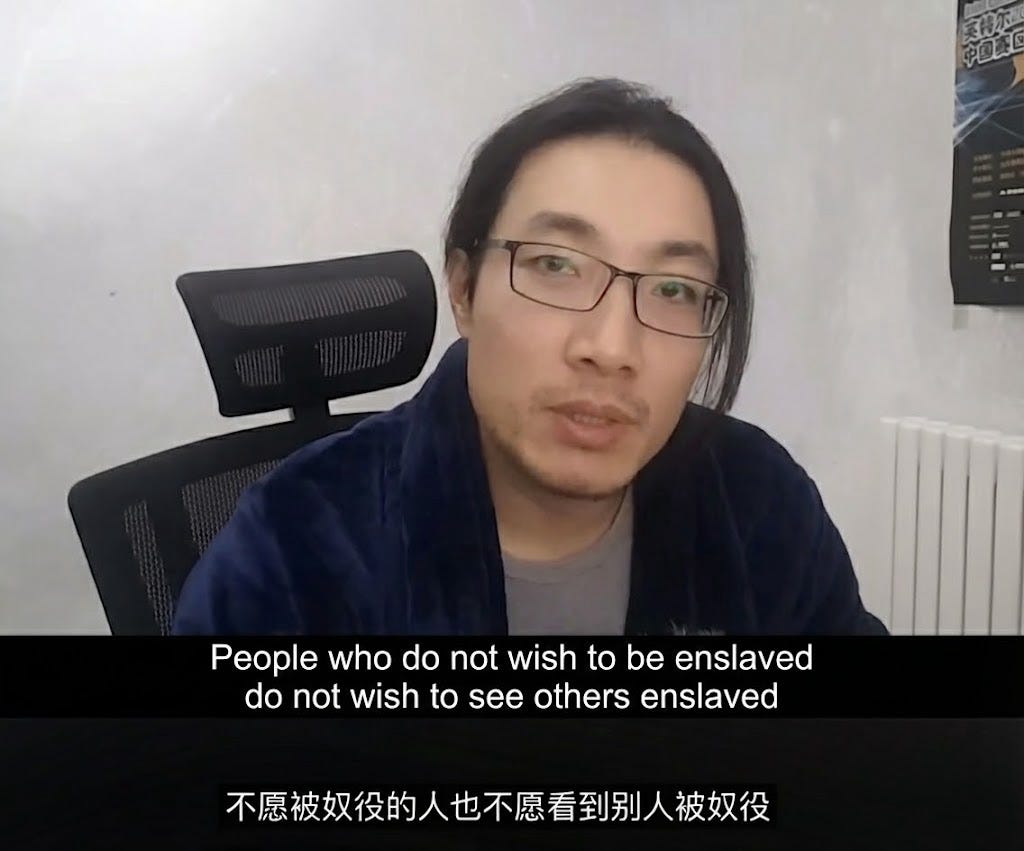
Guan Heng thought he was safe. But four years later, he lost his freedom right here in the States. In August 2025, during an ICE raid targeting his housemates, Guan was arrested in Upstate New York for "illegal entry." Now, sitting in the Broome County Correctional Facility, he faces the threat of deportation—being forced back to the very country he risked everything to escape.
On the morning of August 21, 2025, in a residential neighborhood in Upstate New York, Guan Heng was jolted awake by a violent pounding on the door. It was ICE agents.
They weren't there for him. Their target was his roommate—a couple in the business of flipping shops who had been reported due to a financial dispute. But when the agents stormed in with a search warrant, they "bumped into" the 38-year-old Guan Heng, and he was taken into custody on the spot. The exchange went like this:
Agent: "How’d you get into the country?"
Guan: "I drove a boat over from the ocean myself."
Agent: "Do you have an I-94 form (arrival record)?"
Guan: "No."
Guan was first taken to an ICE office, then tossed in a county jail near Albany for a day. From there, he was shipped to an immigration detention center in Buffalo for nearly a week, before finally landing where he is now—Broome County Correctional Facility.
"They couldn't care less if I have a work permit or what the status of my asylum case is," Guan said, his voice thick with confusion and frustration during a phone interview with Human Rights in China in October 2025. "They only care about how I entered. They just say I didn't come through a normal customs checkpoint, so the act itself is illegal."
His pending asylum interview, his legal work permit, his New York State driver's license... in the eyes of ICE, all of it was worth zilch compared to the fact of his "Entry Without Inspection."
With the Trump administration cracking down hard on illegal immigration, the Broome County jail is packed to the gills. Months have passed, and Guan waits for the outcome of his case in a state of anxiety and depression. Nobody there knows what this young man from China went through over the past few years; nobody knows that the footage he risked his life to shoot provided crucial corroboration of the Chinese authorities' actions against the Uyghurs. And nobody knows the immense danger he faces if he gets sent back.
1. "I wanted to go to Xinjiang and see for myself what was really going on."
Guan Heng calls Nanyang, Henan his home. He was born in November 1987.
According to Guan and his mother, his parents divorced when he was young, and he was raised by his grandmother. After she passed, he’s been on his own. Before leaving China in July 2021, he worked a bunch of different gigs—ran a fast-food joint, worked in the oil fields for a few years, and later freelanced. By his own account, he learned how to "jump the Great Firewall" (bypass internet censorship) pretty early on.
Unlike many young Chinese people, Guan didn't just use the VPN to watch movies or listen to music. He used the internet to touch the "forbidden zones" buried by official narratives: from the Great Famine of the 1960s to the Tiananmen Square incident in 1989. This raw information from the outside world hit him hard, cracking his worldview wide open.
"I learned bit by bit, and finally realized that the Chinese government was hiding so many dirty secrets," he recalled in a jailhouse phone interview with the author in November 2025. He said that since graduating college, he had become a silent dissident—someone living under the regime, but whose mind had already "broken out of prison."
In 2019, Guan rode a motorcycle from Shanghai all the way to Xinjiang as an adventure tourist. He thought it would be a scenic road trip, but he slammed into an invisible wall of high-pressure control.
" The vibe was obvious," he said. "As soon as you enter Xinjiang, there are checkpoints everywhere, police and armed guards all over the place. Even checking into a hotel requires repeated registration and facial recognition." At gas stations, he faced strict restrictions just for being on a motorcycle. This trip gave him a firsthand look at the government's harsh social management system in the region, though he didn't fully understand the depth of it at the time.
In 2020, when COVID hit, Guan was locked down at home like hundreds of millions of other Chinese people. Bored out of his mind surfing the web, he clicked on a report from the famous American outlet BuzzFeed News (BFN). The report used satellite imagery and data to reveal a massive network of concentration camps spread across Xinjiang.
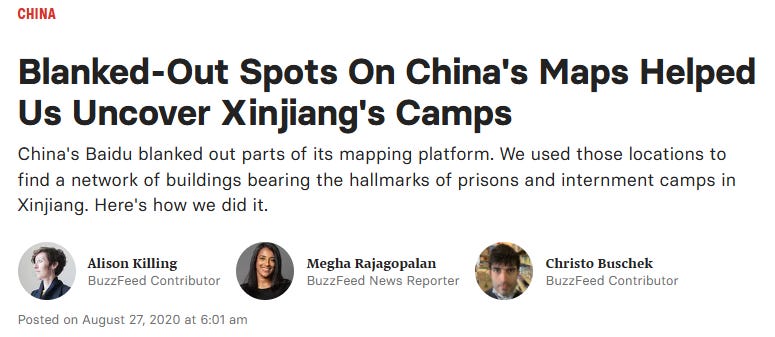
In that moment, the questions from his 2019 trip were answered. He realized those checkpoints, police, and facial recognition systems he saw were actually the outer perimeter of this massive surveillance state.
"Knowing the Chinese government, they love covering up stuff they don't want people to see," Guan said. "It really piqued my interest, especially since I'd been there and knew nothing about it. I immediately wanted to go back and see with my own eyes what the hell was going on."
He knew perfectly well that for a regular guy to do this as a tourist was basically a "suicide mission." "I fully expected the risks," he said calmly. He started prepping like he was planning a covert op: instead of his own pro gear, he rented a long-range DV camcorder online so he could film from a safe distance.
He prepped two SD cards. One for filming, which he’d hide in a secret spot in the car immediately after shooting; and a dummy card to stick back in the camera. "I was afraid of getting stopped and searched," he said. "At least they wouldn't know what I'd filmed."
In October 2020, Guan Heng drove alone toward the trouble spot he’d visited a year prior—Xinjiang.
2. "Roaming" Xinjiang for three days: Verifying prison coordinates one by one.
Guan's trip wasn't an aimless wander; it was a treasure hunt based on a map. That "map" consisted of satellite coordinates marked as suspected "detention camps" in the BuzzFeed News report.
He spent three whole days crisscrossing the vast lands of Xinjiang, fact-checking the coordinates marked as gray (low confidence), yellow (medium confidence), and red (high confidence).
His first stop was Hami City. Before hitting the city, he went to a place called "Beicun," marked with a gray tag. It was a pink building, no barbed wire, didn't look like anyone was there—didn't look like a prison.
Next, he drove into downtown Hami and found a yellow marker. The sign out front read "Hami Compulsory Drug Rehabilitation Center." It was in a busy area with heavy traffic, which made Guan skeptical. "A rehab center in a busy downtown isn't likely to be a detention camp." But right after that, he found another yellow marker—"Xinjiang Production and Construction Corps 13th Division Detention Center."
This place immediately put him on edge. It was tucked at the end of a small alley. Not only did the detention center itself have towering walls, but several adjacent courtyards were also ringed with high walls and barbed wire—definitely not normal residential compounds. This matched the description of the concentration camps perfectly.
To cover his tracks, Guan bought some snacks at a shop at the alley entrance on his way out and "deliberately" paid with WeChat. "If I got questioned," he explained later, "at least I’d have an excuse for why I was in that dead-end alley."
The second day, Guan was on the road constantly. He passed through three counties: Mulei, Jimsar, and Fukang. He found that many of the BFN markers pointed to existing "detention centers" or "jails"—Mulei County Detention Center, Jimsar County Detention Center, Fukang City Detention Center. In Mulei, he found two gray markers: a "Farmers and Herdsmen Training School" and a "Vocational Education Center." Although the buildings looked abandoned, the barbed wire still on the walls seemed to whisper of their former use.
That day's journey made him realize the scale of the campaign was far bigger than he imagined—the authorities weren't just building new facilities; they were utilizing, retrofitting, and expanding the entire existing incarceration system.
However, this was tricky. Watchtowers and barbed wire are standard for jails, so judging by appearance alone, it was hard to tell if they were being used as concentration camps for Uyghurs.
On the third day, Guan drove through three cities: Urumqi, Dabancheng, and Korla. This was his most productive—and most dangerous—day.
In the suburbs of Urumqi, following the coordinates, he found the "Urumqi No. 2 Education and Correction Bureau (Drug Rehab Center)." He parked far away, posed as a jogger out for a morning run, and filmed with a GoPro as he walked. He not only captured the rehab center but also discovered three other heavily guarded compounds nearby. At the gate of one facility, he filmed a vegetable truck unloading—proof the facility was active.
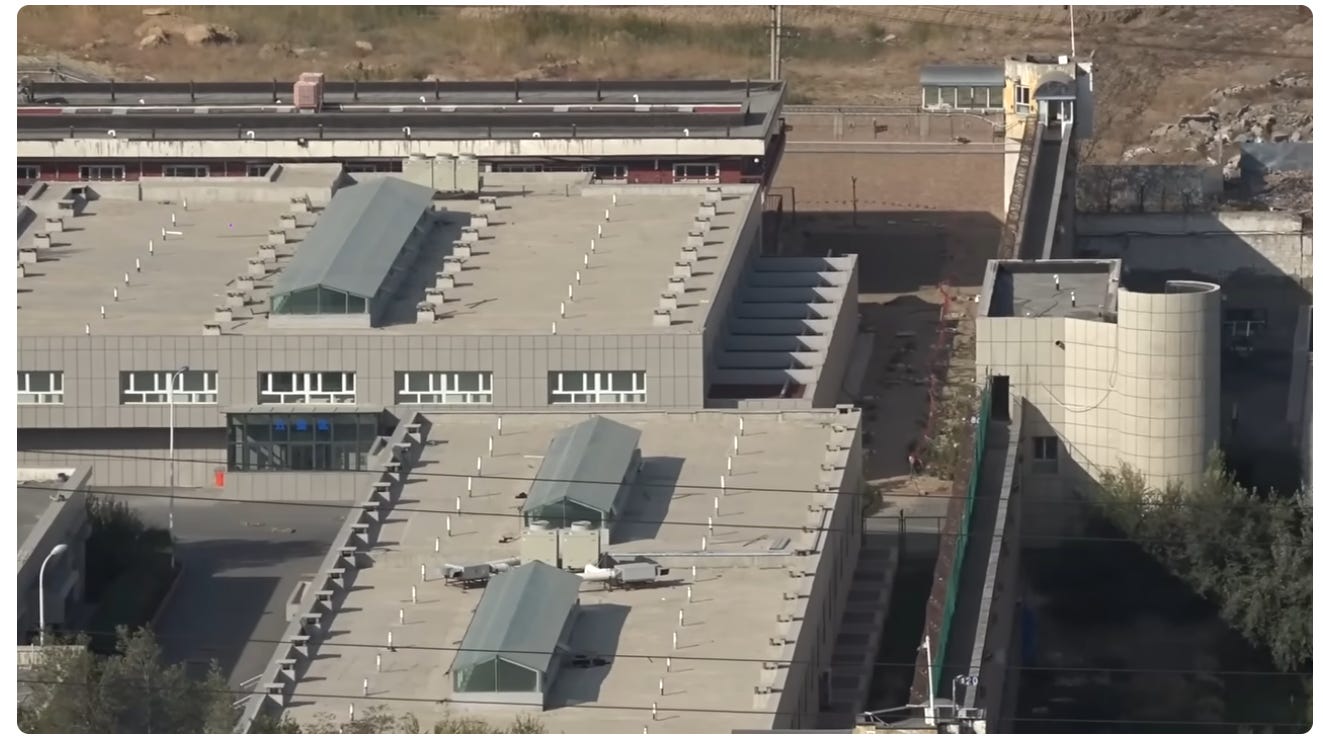
Right after, at a place nearby called "Gaoke Road," he made his key discovery. On one side of the road lay a sprawling complex of huge facilities, complete with high walls and watchtowers, yet it wasn't marked on any map. Guan zoomed in with his long lens and successfully captured the bold red characters on the roof: "Reform through Labor, Reform through Culture."
That afternoon, he headed to Dabancheng. This was a "red marker," hidden deep in the wilderness far from the highway, without even a gravel road leading to it. Guan parked by a pond and climbed a high dirt mound alone.
"I was nothing but nervous," he recalled. Lying flat on the mound, his lens filled with a brand-new, massive, but seemingly unopened facility. He snapped his shots and hurried down, breaking into a cold sweat—he realized there was actually a house on top of the hill he’d just climbed, and down by the pond where he parked, a fisherman had appeared out of nowhere.
Forcing himself to stay calm, he walked up to the guy. "Hey boss, catch anything?" After confirming the guy hadn't noticed his shady behavior, he got in his car and sped off.
The final stop was Korla, 339 kilometers from Urumqi. Here, the coordinates pointed behind a military base (there were tanks at the gate). It was a massive, heavily guarded facility, and the only way in was through the military camp.
As Guan tried to pull off onto the shoulder to get a shot, someone from a shop next to the base walked out and stared him down, dead in the eyes.
In the tension of the standoff, Guan thought fast. He slammed on the gas, drifting his high-chassis SUV in the dirt, spinning donuts, deliberately acting like a guy just testing out his car's performance. The "shopkeeper" seemed confused by this crazy driver, watched for a bit, and then boredly went back inside.
The second the guy turned around, Guan stopped, whipped out his long-lens DV, and captured the final scene of his video.
3. Drifting at sea for a day and a night: Smuggling into the US from the Bahamas.
The video was done. Guan Heng possessed a "digital bomb," but he quickly realized a fatal problem: he couldn't hit the "publish" button without blowing himself up.
"I knew, finishing the video was one thing, but once it hit the internet, the police would definitely find me," Guan said in the interview. "If they got to me, the videos would either never get out or be deleted, and my life would be in danger."
The only way out he could think of was to leave China first.
But the fuse on this bomb was stretched painfully long. Since the outbreak in 2020, China's borders had been sealed. Guan had nowhere to go, sitting on this footage in depression and anxiety. Finally, in the summer of 2021, a window opened. On July 4, he left via Shekou, departed from Hong Kong, and flew to Ecuador, a South American country that was visa-free for Chinese passports at the time.
He stayed in Ecuador for over two months for one reason: to get the Pfizer vaccine. He didn't trust the Chinese domestic vaccines, but the policy back home was getting stricter—"No vax meant a red health code, you couldn't go anywhere."
After two shots, he flew to another visa-free country—The Bahamas. Here, he was separated from his final destination by just a strip of water. He wanted to buy a boat from China and have it shipped to save money, but his Bahamian visa was ticking away—he recalls only having 14 days—and logistics were slow. By October 2021, he couldn't wait any longer. He spent his last $3,000 at a local marine supply store on a small inflatable boat and an outboard motor. He launched from Freeport, Bahamas, aiming for Florida. Google Maps said it was about 85 miles as the crow flies.
According to Guan, he had zero nautical experience, didn't know how to row, and got seasick easily. This was his first time "captaining" a vessel. His only tools were a mechanical compass and a phone with offline GPS maps.
"I was drifting on the ocean for nearly 23 hours," he recalled. He brought plenty of food and water, but was so nervous he "only drank one can of Coke the whole time." The biggest threat wasn't the waves, but his sketchy engine.
"I didn't have much money, so I didn't buy a closed fuel tank," he said. "I had to hold a gas can and pour fuel directly into the engine while the boat was rocking violently." Gasoline spilled everywhere, filling the dinghy with heavy fumes, ready to explode at the slightest spark.
"That boat turned into a floating bomb," Guan said. "I was actually terrified, because if it caught fire, I'd never make it to America."
He planned to land at night to avoid detection. But in the endless drifting, his only thought was "just get there."
The next morning, he saw the Florida coastline in the distance. Around 9 AM, the boat hit the sand. There were already tourists taking morning walks on the beach, and an elderly couple was walking toward him. Guan's heart was in his throat, terrified they would call the cops.
Ignoring the boat and his scattered luggage, he grabbed his most important backpack. The moment the boat hit the shallows, he jumped off and sprinted into the coastal bushes. Hiding in the brush, gasping for air, he watched a Coast Guard patrol boat cruise by just offshore. But he was safe.
Just like that, through smuggling, Guan Heng arrived in the "Free World" he had longed for.
4. The video shocks the web, but he and his family pay a heavy price.
According to Guan, before he launched from the Bahamas, he had already scheduled the video release. "I didn't know if I'd make it to the US alive," he said. "I couldn't wait until I arrived to publish." The video about the Xinjiang concentration camps finally went public on his YouTube channel on October 5, 2021.
The video immediately triggered a massive reaction. As rare, first-person footage from a Chinese citizen, Guan's video was quickly reported on and cited by media outlets like Deutsche Welle and Radio Free Asia. More importantly, it provided key on-the-ground proof for the Pulitzer Prize-winning team at BuzzFeed News. In interviews, BFN reporters emphasized the extraordinary value of Guan's footage, praising his courage and stating that the new information confirmed their analysis of what was happening in Xinjiang.
Meanwhile, as the one who lit the fuse, Guan himself faced pressure beyond his worst nightmares—a massive wave of attacks from Chinese state security and online propaganda trolls began immediately.
Shortly after the video dropped, a YouTuber named "Science Guy K-One Meter" posted a "doxxing" video, stripping Guan's personal info bare—real name, birthday, college, home address—everything. This "Science Guy," typically, posts pro-CCP content.
"They doxxed Guan Heng," said Ms. Luo, Guan's mother, in an interview with Human Rights in China on November 1, 2025. Her voice trembled with anger. "The comments underneath were incredibly nasty, calling him a traitor to the Han race, and saying things like 'hope he gets accidentally killed by a black brother in America'."
Simultaneously, a "siege" on his YouTube channel began. "First they reported me for 'privacy violations' because I filmed a guard, and YouTube took my video down," Guan recalled.
He was forced to appeal and use YouTube's tools to blur the face. Once the video was back up, the attackers saw this tactic worked and started "mass reporting" all his videos. Guan's dashboard was instantly flooded with "violation notifications."
This precise cyber-violence, launched by the state machine, combined with the systematic technical siege, broke Guan psychologically.
" The pressure was immense," Guan recalled. "I basically stopped paying attention, actively avoided looking at it." The insane cyberbullying drove him into severe depression. To protect himself, he cut off information from the outside world. Because of this, he didn't even know until his recent arrest just how huge of an impact his video had made internationally. He only knew he was being organizedly "doxxed" by the state, and he was scared.
He went into hiding. But the real eye of the storm exploded in his hometown of Nanyang, Henan.
According to Guan and his mother, just over a month after the video release, in January 2022, a systematic "guilt by association" campaign led by state security targeted all his relatives.
"When I went back from Taiwan [in late 2023], everyone in the family was super nervous," Ms. Luo said. "They were worried I'd be detained at the airport because they'd already been interrogated."
Ms. Luo said her four sisters in Henan and Zhengzhou were summoned by local state security almost simultaneously. "The police told them," Ms. Luo said, "'If you have any news about Guan Heng, report it immediately. If you know something and don't report it, you know the consequences.'"
In late January 2022, four police officers took Guan's father from his home for an interrogation that lasted from noon until 9 PM. They confiscated his phone to "recover data" at the Nanyang City Bureau. That night, they dragged his father to Guan's grandmother's house—where he lived before leaving—seized his computer tower, and issued a "confiscation list." Over a month later (March 2022), state security interrogated his father again.
Agents also found the aunt Guan was closest to growing up. They took his aunt and uncle separately for interrogation. This psychological warfare completely broke his aunt. "She's so scared she can't sleep at night now," Ms. Luo said. "She later told Guan's father point-blank: 'Please don't come to me about Guan Heng anymore! We have to live here, I'm afraid it will affect my kids, afraid of getting implicated! Please stop harassing me!'"
Guan didn't know any of this. While he thought he was just digesting the trauma of online abuse alone in New York, his entire family back in China had been thoroughly "combed through" and terrified by state security.
And so, carrying his trauma and a complete break from his homeland, Guan lived alone in the US for three years. Until the summer of 2025, when fate pushed him into another cage in the most absurd way possible.
5. From one cage to another.
For over three years in the US, Guan Heng tried to rebuild his life in solitude. On October 25, 2021, he filed for asylum in New York, got his work permit, bought a used car, and started out driving Uber and delivering food in NYC. Later, he switched to long-haul trucking "because living in the truck meant I didn't need an apartment." When he quit trucking, he decided to move out of the city.
"I really love the state parks upstate," he said. Seeking a quieter environment closer to nature, he moved to a small town near Albany in the spring of 2025.
He was just a tenant. The house he shared was run by a Chinese couple, the "sub-landlords." His quiet life lasted until that morning in 2025, when the violent banging of ICE agents shattered the peace.
During the raid, Guan showed his work permit and asylum documents to prove his identity. But it seemed that in the enforcement logic of ICE—under the Department of Homeland Security (DHS)—Guan's status with US Citizenship and Immigration Services (USCIS) didn't matter.
Arrested as an "illegal immigrant" solely because he entered by sea, Guan was bounced from the ICE office to a county jail, then to the Buffalo detention center, and finally to Broome County jail.
At first, he was in the immigration unit. "It was okay there," he said. "I was with other immigrants, people in the same boat. We had things to talk about, played ball and cards, it was lively."
But a month later, he was moved to a unit with American inmates—many of whom, he says, are sex offenders.
He was thrown back into total isolation. "Nothing to talk about with them," he said on the phone, sounding down. " The air in the hall is bad, makes me cough if I stay too long, so mostly I just stay alone in the yard or my cell."
It was in this extreme loneliness that he began to reflect on his life.
"I met an inmate here, another immigrant," Guan said. "She told me something that really stuck with me. She said: 'Two is always better than one.'"
That hit him hard. "I thought to myself," he reflected, "if I had family or friends with me, I might not have moved upstate, and I wouldn't have been caught. If I had a partner, my mental state would be much better."
He realized that the "lone wolf" trait that allowed him to pull off the Xinjiang feat was also his Achilles' heel right now.
"Before, I always felt like a solitary warrior, that I had to solve every problem myself," he said. "But once I really got into prison, I realized that no matter how capable I am individually, I can't do anything. I have to rely completely on outside help."
Now, he realizes he must step out of his self-imposed isolation and rely on American civil society and human rights organizations to stop US law enforcement from sending him back to China—a place he risked death to expose, and where the consequences of his return would be unthinkable.
6. Rescue across the bars, and "I did the right thing."
While Guan Heng sat in Broome County jail facing the massive risk of deportation, letters of testimony began arriving in his lawyer's hands. These letters revealed a fact Guan himself hadn't known: the footage he shot alone had become a crucial piece of the puzzle for the international community's focus on the human rights crisis in Xinjiang.
The first letter came from the very source that inspired him. The Pulitzer Prize-winning team at BuzzFeed News (Megha Rajagopalan, Alison Killing, Christo Buschek), upon hearing of Guan's plight, co-signed a letter of support. They confirmed that the "Ground Truth" provided by Guan filled the final gap in their satellite image analysis.
"Mr. Guan provided key corroboration for our investigation at great personal risk. His courage is extraordinary... There is no other plausible reason for him to be near many of these detention sites, as they are often in remote areas... If captured, the danger he faces would increase significantly," the BFN team wrote. They noted specifically that Guan's evidence helped confirm the existence of the new prison in Dabancheng—directly puncturing the Chinese government's lie that the "re-education camps had been closed."
The letter concluded: "We believe that if Mr. Guan is returned to China, he will face immense danger. Therefore, we call on the US to grant Mr. Guan asylum and end his detention and the threat of deportation."
The second letter came from Janice M. Englehart, producer of the documentary All Static & Noise.
Guan's footage was included in this documentary about the Uyghur condition, which has been screened in New Zealand, Australia, Japan, and the UK to expose the Chinese government's abuses.
Janice stated in her support letter: "Mr. Guan risked his own safety and that of his family to provide important video evidence. This evidence corroborates satellite imagery, confirming the existence of internment camps operated by the Chinese government in the Xinjiang Uyghur Autonomous Region... His efforts in 2020 supported researchers, journalists, and filmmakers, allowing them to confidently understand and broadcast what is happening in a region of China that has long been inaccessible to many Western journalists, diplomats, and visitors."
At the end of the letter, Janice was blunt: "Mr. Guan's actions are entirely in the US national interest." She warned that if deported, Guan would likely face torture or even death on charges of "espionage" or "collusion with foreign forces."
Another testimony came from Zhou Fengsuo, Executive Director of Human Rights in China. He said he noticed the young man on Twitter as early as November 17, 2021, just days after Guan arrived in the US, and reached out to him. "I thought then that he was someone acting on his conscience," Zhou recalled. But he also sensed the trauma in Guan. "He was very low-key, even evasive. Even in the US, he was living in a sort of 'hiding'."
Zhou pointed out, "This (the Uyghur issue) is a high-voltage red line for Han people. If he is sent back, given the social impact of this event, he will definitely face a very severe prison sentence." More importantly, Zhou believes Guan's ordeal reveals the common plight of many freedom seekers today: "They yearn for freedom and flee tyranny, yet live in multiple layers of fear." In his testimony, Zhou wrote, "On one hand, they have to dodge US immigration jail; on the other, they have to dodge transnational repression from the CCP."
This is the true picture of Guan Heng's last three years—surviving in the crack between "double fears," until one side finally caught him.
"America is a country built by people who love freedom," Zhou appealed in closing. "A person who loves freedom, resists tyranny, and has paid a huge price for it should be allowed to stay. He belongs in this country."
At the same time, Rushan Abbas, Executive Director of the Campaign for Uyghurs, and renowned Uyghur poet Abduweli Ayup also stepped forward to voice support for this Han man who spoke up for their people.
"If he gets sent back, he's truly dead meat." On November 10, 2025, Guan's mother, Ms. Luo, said trembling in an interview. Now in Taiwan, she is terrified for her son. Her biggest wish is for the US court to make a just ruling, stop the ICE deportation process, and let her son stay in the US. At least then, he's safe.
Ms. Luo's fear isn't baseless; similar tragedies have happened before. Young scholar Feng Siyu, a graduate of Amherst College, is a cautionary tale. She was a visiting scholar at Xinjiang University's Folklore Research Center in 2017, working with the center's director, famous anthropologist Rahile Dawut. However, Rahile was arrested in December 2017 and sentenced to life in prison the following year; Feng Siyu was also suddenly arrested in 2018 and eventually sentenced to a heavy 15 years.
Now, an effort involving Pulitzer winners, filmmakers, Uyghur leaders, and human rights activists is trying to build a "protective wall" to block ICE's deportation and get Guan his freedom back.
On October 20, 2025, in a New York state jail, wearing a prison uniform, Guan Heng waits for his December immigration hearing. When the author reached him by phone and told him his risky footage was key proof for a Pulitzer-winning report, he sounded pretty surprised.
He says he doesn't regret what he did. After going through all this, he's even more convinced that what he did was "right."
"Because I'm personally tasting what it's like to lose freedom now, I can understand even more what those people in the camps are feeling," he said on the prison phone. "I need outside help now, and they need it too. So, I still think I did the right thing."
"I feel this is a massive, unchecked, and uncontrolled evil being committed by the Chinese government," he added. "It has caused the pain of separation and loss of freedom for countless families. So, even now, I still firmly oppose everything the Chinese government is doing in Xinjiang."
But as an "illegal immigrant" stripped of his freedom, his only hope now lies in the urgent rescue efforts of lawyers, journalists, and human rights organizations on the outside.
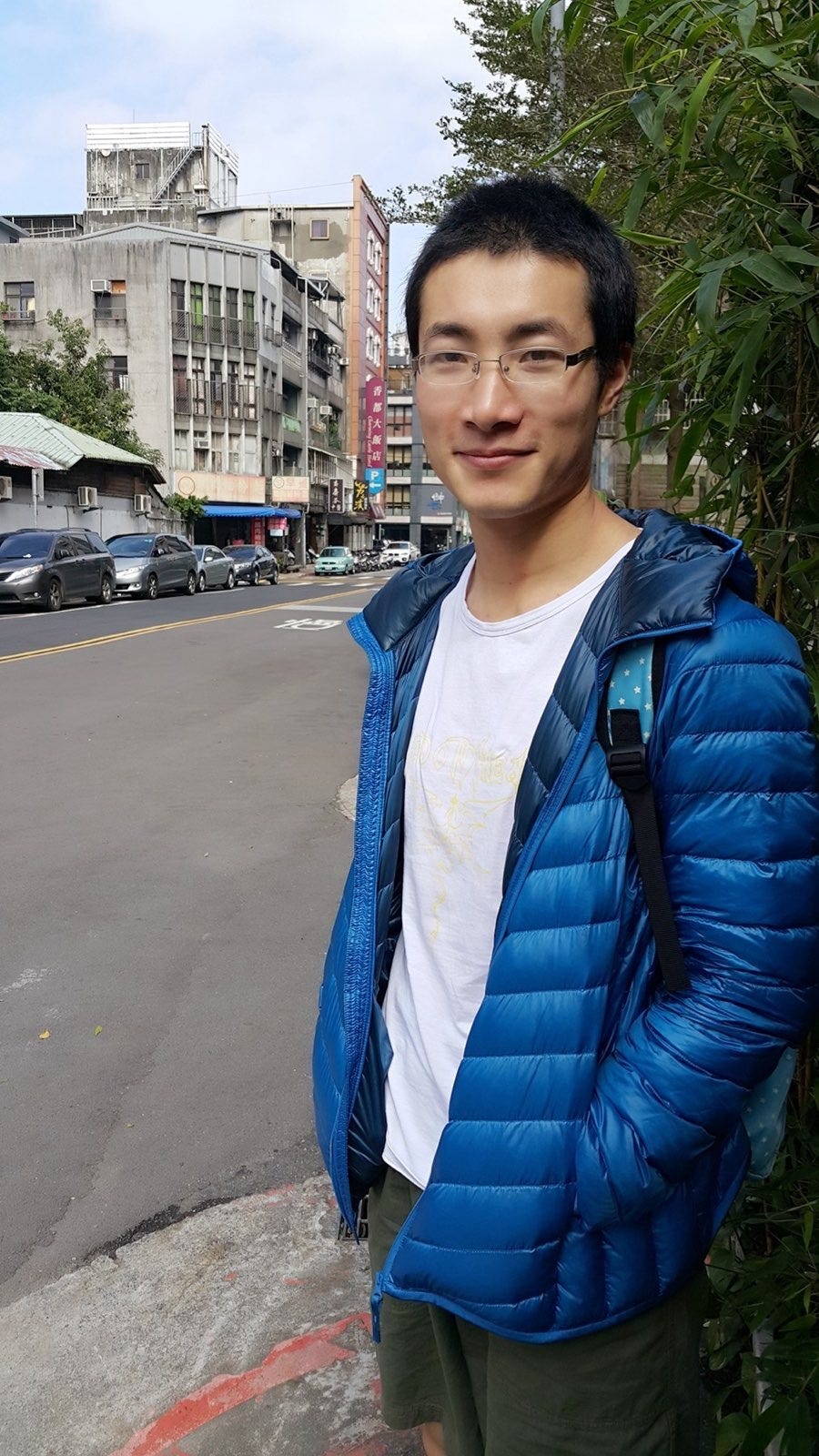
Guan Heng in 2019
On December 15, Guan Heng's asylum case opens in New York. His fate hangs in the balance, resting on one question: Will this free world he risked everything to reach choose to protect him, or send him back to the homeland he exposed at the risk of death and fled in search of liberty and justice? Collapse Read »
This is a story about guts, a getaway, and a cruel twist of irony.
In October 2020, Guan Heng, a young guy from Henan, China, drove solo deep into the heart of Xinjiang. Armed with a long-lens camera, he documented the internment facilities hidden behind the wilderness, towns, and military barracks. To get this footage out to the world, he embarked on a hair-raising escape: zigzagging through South America, and finally, piloting a small boat alone for 23 hours across the ocean, making landfall in Florida from the Bahamas. After arriving in the US in 2021, he released the videos as planned. These clips became key evidence for the international community—including the Pulitzer Prize-winning team at BuzzFeed News—to confirm what China was doing in Xinjiang.
Guan Heng thought he was safe. But four years later, he lost his freedom right here in the States. In August 2025, during an ICE raid targeting his housemates, Guan was arrested in Upstate New York for "illegal entry." Now, sitting in the Broome County Correctional Facility, he faces the threat of deportation—being forced back to the very country he risked everything to escape.
On the morning of August 21, 2025, in a residential neighborhood in Upstate New York, Guan Heng was jolted awake by a violent pounding on the door. It was ICE agents.
They weren't there for him. Their target was his roommate—a couple in the business of flipping shops who had been reported due to a financial dispute. But when the agents stormed in with a search warrant, they "bumped into" the 38-year-old Guan Heng, and he was taken into custody on the spot. The exchange went like this:
Agent: "How’d you get into the country?"
Guan: "I drove a boat over from the ocean myself."
Agent: "Do you have an I-94 form (arrival record)?"
Guan: "No."
Guan was first taken to an ICE office, then tossed in a county jail near Albany for a day. From there, he was shipped to an immigration detention center in Buffalo for nearly a week, before finally landing where he is now—Broome County Correctional Facility.
"They couldn't care less if I have a work permit or what the status of my asylum case is," Guan said, his voice thick with confusion and frustration during a phone interview with Human Rights in China in October 2025. "They only care about how I entered. They just say I didn't come through a normal customs checkpoint, so the act itself is illegal."
His pending asylum interview, his legal work permit, his New York State driver's license... in the eyes of ICE, all of it was worth zilch compared to the fact of his "Entry Without Inspection."
With the Trump administration cracking down hard on illegal immigration, the Broome County jail is packed to the gills. Months have passed, and Guan waits for the outcome of his case in a state of anxiety and depression. Nobody there knows what this young man from China went through over the past few years; nobody knows that the footage he risked his life to shoot provided crucial corroboration of the Chinese authorities' actions against the Uyghurs. And nobody knows the immense danger he faces if he gets sent back.
1. "I wanted to go to Xinjiang and see for myself what was really going on."
Guan Heng calls Nanyang, Henan his home. He was born in November 1987.
According to Guan and his mother, his parents divorced when he was young, and he was raised by his grandmother. After she passed, he’s been on his own. Before leaving China in July 2021, he worked a bunch of different gigs—ran a fast-food joint, worked in the oil fields for a few years, and later freelanced. By his own account, he learned how to "jump the Great Firewall" (bypass internet censorship) pretty early on.
Unlike many young Chinese people, Guan didn't just use the VPN to watch movies or listen to music. He used the internet to touch the "forbidden zones" buried by official narratives: from the Great Famine of the 1960s to the Tiananmen Square incident in 1989. This raw information from the outside world hit him hard, cracking his worldview wide open.
"I learned bit by bit, and finally realized that the Chinese government was hiding so many dirty secrets," he recalled in a jailhouse phone interview with the author in November 2025. He said that since graduating college, he had become a silent dissident—someone living under the regime, but whose mind had already "broken out of prison."
In 2019, Guan rode a motorcycle from Shanghai all the way to Xinjiang as an adventure tourist. He thought it would be a scenic road trip, but he slammed into an invisible wall of high-pressure control.
" The vibe was obvious," he said. "As soon as you enter Xinjiang, there are checkpoints everywhere, police and armed guards all over the place. Even checking into a hotel requires repeated registration and facial recognition." At gas stations, he faced strict restrictions just for being on a motorcycle. This trip gave him a firsthand look at the government's harsh social management system in the region, though he didn't fully understand the depth of it at the time.
In 2020, when COVID hit, Guan was locked down at home like hundreds of millions of other Chinese people. Bored out of his mind surfing the web, he clicked on a report from the famous American outlet BuzzFeed News (BFN). The report used satellite imagery and data to reveal a massive network of concentration camps spread across Xinjiang.
In that moment, the questions from his 2019 trip were answered. He realized those checkpoints, police, and facial recognition systems he saw were actually the outer perimeter of this massive surveillance state.
"Knowing the Chinese government, they love covering up stuff they don't want people to see," Guan said. "It really piqued my interest, especially since I'd been there and knew nothing about it. I immediately wanted to go back and see with my own eyes what the hell was going on."
He knew perfectly well that for a regular guy to do this as a tourist was basically a "suicide mission." "I fully expected the risks," he said calmly. He started prepping like he was planning a covert op: instead of his own pro gear, he rented a long-range DV camcorder online so he could film from a safe distance.
He prepped two SD cards. One for filming, which he’d hide in a secret spot in the car immediately after shooting; and a dummy card to stick back in the camera. "I was afraid of getting stopped and searched," he said. "At least they wouldn't know what I'd filmed."
In October 2020, Guan Heng drove alone toward the trouble spot he’d visited a year prior—Xinjiang.
2. "Roaming" Xinjiang for three days: Verifying prison coordinates one by one.
Guan's trip wasn't an aimless wander; it was a treasure hunt based on a map. That "map" consisted of satellite coordinates marked as suspected "detention camps" in the BuzzFeed News report.
He spent three whole days crisscrossing the vast lands of Xinjiang, fact-checking the coordinates marked as gray (low confidence), yellow (medium confidence), and red (high confidence).
His first stop was Hami City. Before hitting the city, he went to a place called "Beicun," marked with a gray tag. It was a pink building, no barbed wire, didn't look like anyone was there—didn't look like a prison.
Next, he drove into downtown Hami and found a yellow marker. The sign out front read "Hami Compulsory Drug Rehabilitation Center." It was in a busy area with heavy traffic, which made Guan skeptical. "A rehab center in a busy downtown isn't likely to be a detention camp." But right after that, he found another yellow marker—"Xinjiang Production and Construction Corps 13th Division Detention Center."
This place immediately put him on edge. It was tucked at the end of a small alley. Not only did the detention center itself have towering walls, but several adjacent courtyards were also ringed with high walls and barbed wire—definitely not normal residential compounds. This matched the description of the concentration camps perfectly.
To cover his tracks, Guan bought some snacks at a shop at the alley entrance on his way out and "deliberately" paid with WeChat. "If I got questioned," he explained later, "at least I’d have an excuse for why I was in that dead-end alley."
The second day, Guan was on the road constantly. He passed through three counties: Mulei, Jimsar, and Fukang. He found that many of the BFN markers pointed to existing "detention centers" or "jails"—Mulei County Detention Center, Jimsar County Detention Center, Fukang City Detention Center. In Mulei, he found two gray markers: a "Farmers and Herdsmen Training School" and a "Vocational Education Center." Although the buildings looked abandoned, the barbed wire still on the walls seemed to whisper of their former use.
That day's journey made him realize the scale of the campaign was far bigger than he imagined—the authorities weren't just building new facilities; they were utilizing, retrofitting, and expanding the entire existing incarceration system.
However, this was tricky. Watchtowers and barbed wire are standard for jails, so judging by appearance alone, it was hard to tell if they were being used as concentration camps for Uyghurs.
On the third day, Guan drove through three cities: Urumqi, Dabancheng, and Korla. This was his most productive—and most dangerous—day.
In the suburbs of Urumqi, following the coordinates, he found the "Urumqi No. 2 Education and Correction Bureau (Drug Rehab Center)." He parked far away, posed as a jogger out for a morning run, and filmed with a GoPro as he walked. He not only captured the rehab center but also discovered three other heavily guarded compounds nearby. At the gate of one facility, he filmed a vegetable truck unloading—proof the facility was active.
Right after, at a place nearby called "Gaoke Road," he made his key discovery. On one side of the road lay a sprawling complex of huge facilities, complete with high walls and watchtowers, yet it wasn't marked on any map. Guan zoomed in with his long lens and successfully captured the bold red characters on the roof: "Reform through Labor, Reform through Culture."
That afternoon, he headed to Dabancheng. This was a "red marker," hidden deep in the wilderness far from the highway, without even a gravel road leading to it. Guan parked by a pond and climbed a high dirt mound alone.
"I was nothing but nervous," he recalled. Lying flat on the mound, his lens filled with a brand-new, massive, but seemingly unopened facility. He snapped his shots and hurried down, breaking into a cold sweat—he realized there was actually a house on top of the hill he’d just climbed, and down by the pond where he parked, a fisherman had appeared out of nowhere.
Forcing himself to stay calm, he walked up to the guy. "Hey boss, catch anything?" After confirming the guy hadn't noticed his shady behavior, he got in his car and sped off.
The final stop was Korla, 339 kilometers from Urumqi. Here, the coordinates pointed behind a military base (there were tanks at the gate). It was a massive, heavily guarded facility, and the only way in was through the military camp.
As Guan tried to pull off onto the shoulder to get a shot, someone from a shop next to the base walked out and stared him down, dead in the eyes.
In the tension of the standoff, Guan thought fast. He slammed on the gas, drifting his high-chassis SUV in the dirt, spinning donuts, deliberately acting like a guy just testing out his car's performance. The "shopkeeper" seemed confused by this crazy driver, watched for a bit, and then boredly went back inside.
The second the guy turned around, Guan stopped, whipped out his long-lens DV, and captured the final scene of his video.
3. Drifting at sea for a day and a night: Smuggling into the US from the Bahamas.
The video was done. Guan Heng possessed a "digital bomb," but he quickly realized a fatal problem: he couldn't hit the "publish" button without blowing himself up.
"I knew, finishing the video was one thing, but once it hit the internet, the police would definitely find me," Guan said in the interview. "If they got to me, the videos would either never get out or be deleted, and my life would be in danger."
The only way out he could think of was to leave China first.
But the fuse on this bomb was stretched painfully long. Since the outbreak in 2020, China's borders had been sealed. Guan had nowhere to go, sitting on this footage in depression and anxiety. Finally, in the summer of 2021, a window opened. On July 4, he left via Shekou, departed from Hong Kong, and flew to Ecuador, a South American country that was visa-free for Chinese passports at the time.
He stayed in Ecuador for over two months for one reason: to get the Pfizer vaccine. He didn't trust the Chinese domestic vaccines, but the policy back home was getting stricter—"No vax meant a red health code, you couldn't go anywhere."
After two shots, he flew to another visa-free country—The Bahamas. Here, he was separated from his final destination by just a strip of water. He wanted to buy a boat from China and have it shipped to save money, but his Bahamian visa was ticking away—he recalls only having 14 days—and logistics were slow. By October 2021, he couldn't wait any longer. He spent his last $3,000 at a local marine supply store on a small inflatable boat and an outboard motor. He launched from Freeport, Bahamas, aiming for Florida. Google Maps said it was about 85 miles as the crow flies.
According to Guan, he had zero nautical experience, didn't know how to row, and got seasick easily. This was his first time "captaining" a vessel. His only tools were a mechanical compass and a phone with offline GPS maps.
"I was drifting on the ocean for nearly 23 hours," he recalled. He brought plenty of food and water, but was so nervous he "only drank one can of Coke the whole time." The biggest threat wasn't the waves, but his sketchy engine.
"I didn't have much money, so I didn't buy a closed fuel tank," he said. "I had to hold a gas can and pour fuel directly into the engine while the boat was rocking violently." Gasoline spilled everywhere, filling the dinghy with heavy fumes, ready to explode at the slightest spark.
"That boat turned into a floating bomb," Guan said. "I was actually terrified, because if it caught fire, I'd never make it to America."
He planned to land at night to avoid detection. But in the endless drifting, his only thought was "just get there."
The next morning, he saw the Florida coastline in the distance. Around 9 AM, the boat hit the sand. There were already tourists taking morning walks on the beach, and an elderly couple was walking toward him. Guan's heart was in his throat, terrified they would call the cops.
Ignoring the boat and his scattered luggage, he grabbed his most important backpack. The moment the boat hit the shallows, he jumped off and sprinted into the coastal bushes. Hiding in the brush, gasping for air, he watched a Coast Guard patrol boat cruise by just offshore. But he was safe.
Just like that, through smuggling, Guan Heng arrived in the "Free World" he had longed for.
4. The video shocks the web, but he and his family pay a heavy price.
According to Guan, before he launched from the Bahamas, he had already scheduled the video release. "I didn't know if I'd make it to the US alive," he said. "I couldn't wait until I arrived to publish." The video about the Xinjiang concentration camps finally went public on his YouTube channel on October 5, 2021.
The video immediately triggered a massive reaction. As rare, first-person footage from a Chinese citizen, Guan's video was quickly reported on and cited by media outlets like Deutsche Welle and Radio Free Asia. More importantly, it provided key on-the-ground proof for the Pulitzer Prize-winning team at BuzzFeed News. In interviews, BFN reporters emphasized the extraordinary value of Guan's footage, praising his courage and stating that the new information confirmed their analysis of what was happening in Xinjiang.
Meanwhile, as the one who lit the fuse, Guan himself faced pressure beyond his worst nightmares—a massive wave of attacks from Chinese state security and online propaganda trolls began immediately.
Shortly after the video dropped, a YouTuber named "Science Guy K-One Meter" posted a "doxxing" video, stripping Guan's personal info bare—real name, birthday, college, home address—everything. This "Science Guy," typically, posts pro-CCP content.
"They doxxed Guan Heng," said Ms. Luo, Guan's mother, in an interview with Human Rights in China on November 1, 2025. Her voice trembled with anger. "The comments underneath were incredibly nasty, calling him a traitor to the Han race, and saying things like 'hope he gets accidentally killed by a black brother in America'."
Simultaneously, a "siege" on his YouTube channel began. "First they reported me for 'privacy violations' because I filmed a guard, and YouTube took my video down," Guan recalled.
He was forced to appeal and use YouTube's tools to blur the face. Once the video was back up, the attackers saw this tactic worked and started "mass reporting" all his videos. Guan's dashboard was instantly flooded with "violation notifications."
This precise cyber-violence, launched by the state machine, combined with the systematic technical siege, broke Guan psychologically.
" The pressure was immense," Guan recalled. "I basically stopped paying attention, actively avoided looking at it." The insane cyberbullying drove him into severe depression. To protect himself, he cut off information from the outside world. Because of this, he didn't even know until his recent arrest just how huge of an impact his video had made internationally. He only knew he was being organizedly "doxxed" by the state, and he was scared.
He went into hiding. But the real eye of the storm exploded in his hometown of Nanyang, Henan.
According to Guan and his mother, just over a month after the video release, in January 2022, a systematic "guilt by association" campaign led by state security targeted all his relatives.
"When I went back from Taiwan [in late 2023], everyone in the family was super nervous," Ms. Luo said. "They were worried I'd be detained at the airport because they'd already been interrogated."
Ms. Luo said her four sisters in Henan and Zhengzhou were summoned by local state security almost simultaneously. "The police told them," Ms. Luo said, "'If you have any news about Guan Heng, report it immediately. If you know something and don't report it, you know the consequences.'"
In late January 2022, four police officers took Guan's father from his home for an interrogation that lasted from noon until 9 PM. They confiscated his phone to "recover data" at the Nanyang City Bureau. That night, they dragged his father to Guan's grandmother's house—where he lived before leaving—seized his computer tower, and issued a "confiscation list." Over a month later (March 2022), state security interrogated his father again.
Agents also found the aunt Guan was closest to growing up. They took his aunt and uncle separately for interrogation. This psychological warfare completely broke his aunt. "She's so scared she can't sleep at night now," Ms. Luo said. "She later told Guan's father point-blank: 'Please don't come to me about Guan Heng anymore! We have to live here, I'm afraid it will affect my kids, afraid of getting implicated! Please stop harassing me!'"
Guan didn't know any of this. While he thought he was just digesting the trauma of online abuse alone in New York, his entire family back in China had been thoroughly "combed through" and terrified by state security.
And so, carrying his trauma and a complete break from his homeland, Guan lived alone in the US for three years. Until the summer of 2025, when fate pushed him into another cage in the most absurd way possible.
5. From one cage to another.
For over three years in the US, Guan Heng tried to rebuild his life in solitude. On October 25, 2021, he filed for asylum in New York, got his work permit, bought a used car, and started out driving Uber and delivering food in NYC. Later, he switched to long-haul trucking "because living in the truck meant I didn't need an apartment." When he quit trucking, he decided to move out of the city.
"I really love the state parks upstate," he said. Seeking a quieter environment closer to nature, he moved to a small town near Albany in the spring of 2025.
He was just a tenant. The house he shared was run by a Chinese couple, the "sub-landlords." His quiet life lasted until that morning in 2025, when the violent banging of ICE agents shattered the peace.
During the raid, Guan showed his work permit and asylum documents to prove his identity. But it seemed that in the enforcement logic of ICE—under the Department of Homeland Security (DHS)—Guan's status with US Citizenship and Immigration Services (USCIS) didn't matter.
Arrested as an "illegal immigrant" solely because he entered by sea, Guan was bounced from the ICE office to a county jail, then to the Buffalo detention center, and finally to Broome County jail.
At first, he was in the immigration unit. "It was okay there," he said. "I was with other immigrants, people in the same boat. We had things to talk about, played ball and cards, it was lively."
But a month later, he was moved to a unit with American inmates—many of whom, he says, are sex offenders.
He was thrown back into total isolation. "Nothing to talk about with them," he said on the phone, sounding down. " The air in the hall is bad, makes me cough if I stay too long, so mostly I just stay alone in the yard or my cell."
It was in this extreme loneliness that he began to reflect on his life.
"I met an inmate here, another immigrant," Guan said. "She told me something that really stuck with me. She said: 'Two is always better than one.'"
That hit him hard. "I thought to myself," he reflected, "if I had family or friends with me, I might not have moved upstate, and I wouldn't have been caught. If I had a partner, my mental state would be much better."
He realized that the "lone wolf" trait that allowed him to pull off the Xinjiang feat was also his Achilles' heel right now.
"Before, I always felt like a solitary warrior, that I had to solve every problem myself," he said. "But once I really got into prison, I realized that no matter how capable I am individually, I can't do anything. I have to rely completely on outside help."
Now, he realizes he must step out of his self-imposed isolation and rely on American civil society and human rights organizations to stop US law enforcement from sending him back to China—a place he risked death to expose, and where the consequences of his return would be unthinkable.
6. Rescue across the bars, and "I did the right thing."
While Guan Heng sat in Broome County jail facing the massive risk of deportation, letters of testimony began arriving in his lawyer's hands. These letters revealed a fact Guan himself hadn't known: the footage he shot alone had become a crucial piece of the puzzle for the international community's focus on the human rights crisis in Xinjiang.
The first letter came from the very source that inspired him. The Pulitzer Prize-winning team at BuzzFeed News (Megha Rajagopalan, Alison Killing, Christo Buschek), upon hearing of Guan's plight, co-signed a letter of support. They confirmed that the "Ground Truth" provided by Guan filled the final gap in their satellite image analysis.
"Mr. Guan provided key corroboration for our investigation at great personal risk. His courage is extraordinary... There is no other plausible reason for him to be near many of these detention sites, as they are often in remote areas... If captured, the danger he faces would increase significantly," the BFN team wrote. They noted specifically that Guan's evidence helped confirm the existence of the new prison in Dabancheng—directly puncturing the Chinese government's lie that the "re-education camps had been closed."
The letter concluded: "We believe that if Mr. Guan is returned to China, he will face immense danger. Therefore, we call on the US to grant Mr. Guan asylum and end his detention and the threat of deportation."
The second letter came from Janice M. Englehart, producer of the documentary All Static & Noise.
Guan's footage was included in this documentary about the Uyghur condition, which has been screened in New Zealand, Australia, Japan, and the UK to expose the Chinese government's abuses.
Janice stated in her support letter: "Mr. Guan risked his own safety and that of his family to provide important video evidence. This evidence corroborates satellite imagery, confirming the existence of internment camps operated by the Chinese government in the Xinjiang Uyghur Autonomous Region... His efforts in 2020 supported researchers, journalists, and filmmakers, allowing them to confidently understand and broadcast what is happening in a region of China that has long been inaccessible to many Western journalists, diplomats, and visitors."
At the end of the letter, Janice was blunt: "Mr. Guan's actions are entirely in the US national interest." She warned that if deported, Guan would likely face torture or even death on charges of "espionage" or "collusion with foreign forces."
Another testimony came from Zhou Fengsuo, Executive Director of Human Rights in China. He said he noticed the young man on Twitter as early as November 17, 2021, just days after Guan arrived in the US, and reached out to him. "I thought then that he was someone acting on his conscience," Zhou recalled. But he also sensed the trauma in Guan. "He was very low-key, even evasive. Even in the US, he was living in a sort of 'hiding'."
Zhou pointed out, "This (the Uyghur issue) is a high-voltage red line for Han people. If he is sent back, given the social impact of this event, he will definitely face a very severe prison sentence." More importantly, Zhou believes Guan's ordeal reveals the common plight of many freedom seekers today: "They yearn for freedom and flee tyranny, yet live in multiple layers of fear." In his testimony, Zhou wrote, "On one hand, they have to dodge US immigration jail; on the other, they have to dodge transnational repression from the CCP."
This is the true picture of Guan Heng's last three years—surviving in the crack between "double fears," until one side finally caught him.
"America is a country built by people who love freedom," Zhou appealed in closing. "A person who loves freedom, resists tyranny, and has paid a huge price for it should be allowed to stay. He belongs in this country."
At the same time, Rushan Abbas, Executive Director of the Campaign for Uyghurs, and renowned Uyghur poet Abduweli Ayup also stepped forward to voice support for this Han man who spoke up for their people.
"If he gets sent back, he's truly dead meat." On November 10, 2025, Guan's mother, Ms. Luo, said trembling in an interview. Now in Taiwan, she is terrified for her son. Her biggest wish is for the US court to make a just ruling, stop the ICE deportation process, and let her son stay in the US. At least then, he's safe.
Ms. Luo's fear isn't baseless; similar tragedies have happened before. Young scholar Feng Siyu, a graduate of Amherst College, is a cautionary tale. She was a visiting scholar at Xinjiang University's Folklore Research Center in 2017, working with the center's director, famous anthropologist Rahile Dawut. However, Rahile was arrested in December 2017 and sentenced to life in prison the following year; Feng Siyu was also suddenly arrested in 2018 and eventually sentenced to a heavy 15 years.
Now, an effort involving Pulitzer winners, filmmakers, Uyghur leaders, and human rights activists is trying to build a "protective wall" to block ICE's deportation and get Guan his freedom back.
On October 20, 2025, in a New York state jail, wearing a prison uniform, Guan Heng waits for his December immigration hearing. When the author reached him by phone and told him his risky footage was key proof for a Pulitzer-winning report, he sounded pretty surprised.
He says he doesn't regret what he did. After going through all this, he's even more convinced that what he did was "right."
"Because I'm personally tasting what it's like to lose freedom now, I can understand even more what those people in the camps are feeling," he said on the prison phone. "I need outside help now, and they need it too. So, I still think I did the right thing."
"I feel this is a massive, unchecked, and uncontrolled evil being committed by the Chinese government," he added. "It has caused the pain of separation and loss of freedom for countless families. So, even now, I still firmly oppose everything the Chinese government is doing in Xinjiang."
But as an "illegal immigrant" stripped of his freedom, his only hope now lies in the urgent rescue efforts of lawyers, journalists, and human rights organizations on the outside.
Guan Heng in 2019
On December 15, Guan Heng's asylum case opens in New York. His fate hangs in the balance, resting on one question: Will this free world he risked everything to reach choose to protect him, or send him back to the homeland he exposed at the risk of death and fled in search of liberty and justice? Collapse Read »
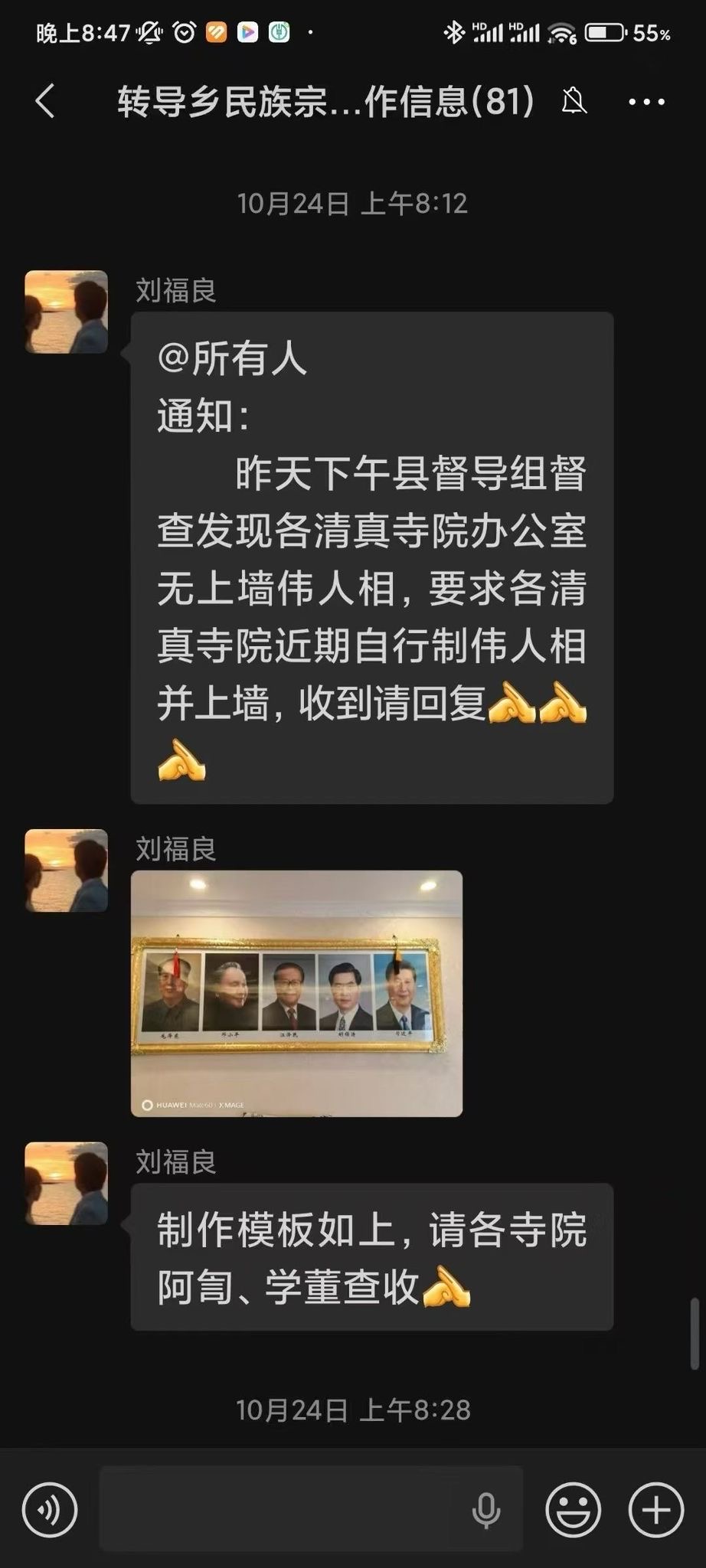
The Chinese government has begun to compel the display of portraits of Chinese political figures inside the Mosques (Masajid)
The Chinese government has begun to mandate the display of portraits of Chinese political figures inside the Mosques (Masajid)
The translated content in these two images:
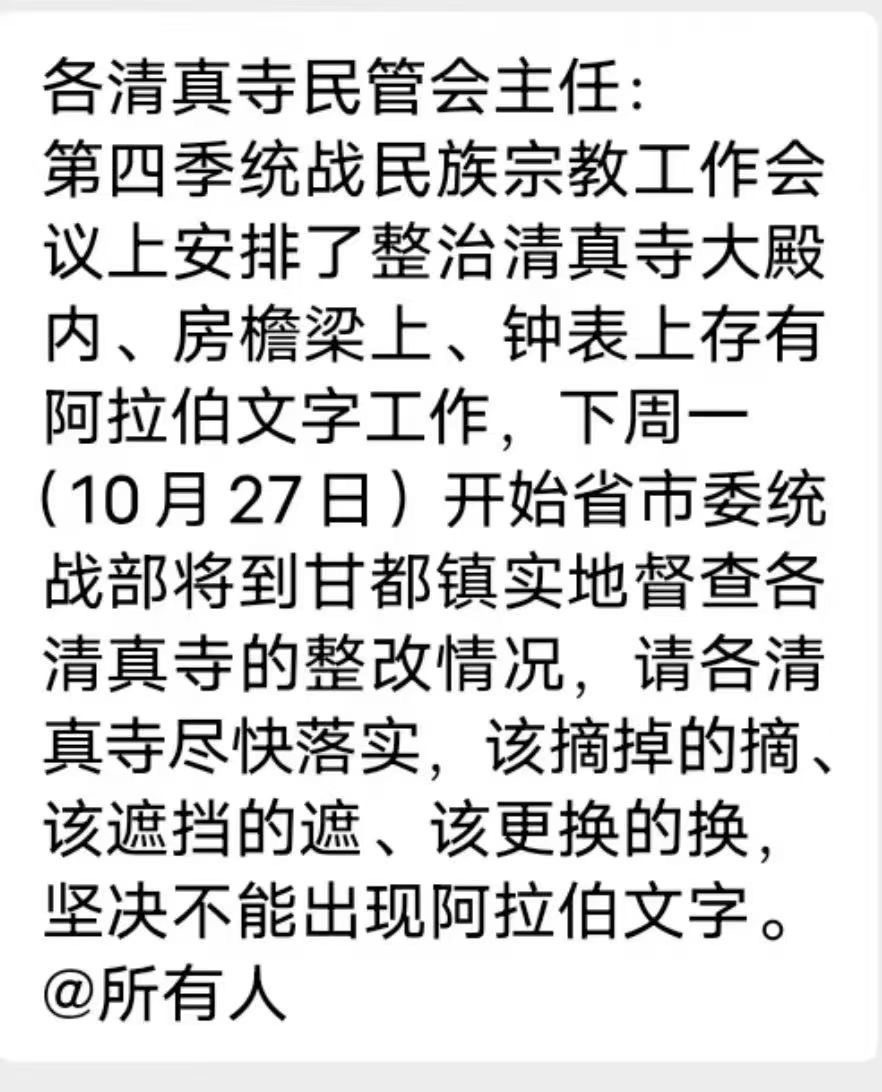
To all Chairmen of the Mosque Management Committees (Majlis):
At the Fourth Quarter United Front Work Department meeting on ethnic and religious affairs, arrangements were made to rectify (tashih) the presence of Arabic script (or Al-Kitabat al-Arabiyyah) inside the main prayer hall (Musalla), on the eaves and beams, and on the clocks of our Mosques (Masajid).
Starting next Monday, October 27th, the United Front Work Departments of the Provincial and Municipal Committees will be conducting on-site supervision in Gandu Town, Qinghai province, China. to check the rectification status of all Mosques.
I urge all Mosques to implement these changes immediately. What needs to be taken down, take it down; what needs to be covered, cover it; and what needs to be replaced, replace it. There must be absolutely no visible Arabic script (Kalam Allah).
@Everyone
Forwarding Information from the Township Ethnic and Religious Affairs... Working Group (81)
8:12 AM, October 24th
Liu Fuliang @Everyone - Notice:
The County Supervision Group inspected yesterday afternoon and found that there were no portraits of the Great Leaders (Zu'ama' al-A'zham) displayed on the walls of the Mosque offices.
All Mosques are now required to print and mount the Leaders' portraits on the walls themselves in the near future. Please reply to confirm receipt. Collapse Read »
The Beijing Education Commission has issued a decree to completely remove "Halal" and "Hui" labels from school canteens, and to ban the use of any religious or ethnic elements.
• The Beijing Education Commission has issued a decree to completely remove "Halal" and "Hui" labels from school canteens and to ban the use of any religious or ethnic elements.
• This is not mere "secularization," as some might call it; rather, it is a blatant policy of assimilation (or, in Arabic, tahawwul).
• 1: It prevents minority groups from openly expressing their dietary culture and their way of life (sunnah).
• 2: It is a complete erasure of the term Halal (the Divinely permissible) from the canteens, dining tables, and the entire campus environment.
• 3: It compels our Hui Muslim students to lose their separate space for their religious diet (Tayyib and Halal) by forcing them into a "mixed dining" arrangement.
• Internal Document (or: Confidential).

• The Beijing Municipal Education Commission (BMEC).
• Notice on Carrying out an Inspection, Investigation, and Rectification of School Canteens Involving Ethnic and Religious Matters.
• To the Education Committees of all Districts, Yanshan Education Committee, Social Affairs Bureau of the Economic Development Zone, all Universities and Colleges, all Secondary Vocational Schools, and all Directly-Affiliated Schools:
• Recently, some isolated localities and schools across the country have faced issues regarding the management of on-campus dining for ethnic minority teachers and students who observe Halal dietary practices, leading to some public controversy and media attention.
• Based on the requirements of relevant directives, and in order to ensure sound ethnic and religious work in schools, proactively resolve potential risks related to ethnic and religious issues in the education sector, and prevent the over-generalization (or "abuse") of the Halal concept, we are hereby issuing this notice regarding the inspection and rectification of issues in Halal canteen management:
I. Manifestation of Issues
• First, connecting the Halal diet exclusively to a specific ethnicity and simply labeling canteens as "Hui Canteens."
• Second, failing to consider the actual proportion of students in the school, and instead either exclusively running a Halal canteen or solely providing Halal meals.
• Third, using inappropriate language in canteen publicity materials, bidding announcements, and other procedures, which highlights religious factors like Halal or "Hui ethnicity."

II. Scope of Inspection
• A comprehensive investigation is to be launched across all types and levels of schools throughout the city to ascertain the complete situation, leaving no blind spots.
III. Principles for Rectification of Identified Issues
• First, Respect for Customs. This means respecting the customs and traditions of ethnic minorities and fulfilling the normal meal requirements of ethnic minority teachers and students who observe the Halal diet.
• In schools where Hui (Muslim) and other ethnic minority teachers and students are relatively concentrated, we should not impose a one-size-fits-all approach by providing only Halal meals. Instead, we must diversify the meal options through multiple channels to satisfy the dining needs of all ethnic groups, and promote mixed dining.
• Second, Accurate Definition. We must define and manage Halal food from the perspective of ethnic minority customs, strictly limiting Halal food to only those items containing animal meat or its derivatives.
• This must not be defined by Islamic religious law (Shari'ah). Food items that do not contain meat, animal fats, or dairy ingredients are not allowed to be labeled with the term "Halal."
• Third, Halal dining must not be tied to a specific ethnicity, and canteens should not be simply named "Hui Canteen" or similar.

• Fourth, for any current labeling such as Halal (Hui) Canteen, Hui (Muslim) Meal Counter, Halal (Hui) Cooking Area, or any other signs bearing the terms Halal or Hui, and any Islamic symbols (Shu'ur Islamiya), the school canteens must be thoroughly purged of these religious markers. These can be adjusted to be named Local (Ethnic) Restaurant, Local (Ethnic) Flavor Counter, or similar.
IV. Work Requirements
• First, Pay Attention to Methods. The inspection and rectification work is quite sensitive, so during the process, we must focus on the methods used, adhere to a cautious and stable approach, ensure meticulous planning and comprehensive coordination. We must adopt the principle of 'Do More, Say Less,' and 'Act, Don't Talk,' to prevent public controversy.
• Second, Ensure Harmony and Stability. All districts must strengthen policy guidance for key schools, and all units must genuinely engage in ideological work with teachers, students, and parents. We must use the summer break to actively and prudently advance the rectification to ensure harmony and stability.
• Third, Strict Deadlines. All units are requested to report the inspection results and the corresponding rectification of any issues (see Appendices 1 and 2) to the Commission via email by July 18th.
• The email subject line must specify "** School Canteen Inspection" or "** District Canteen Inspection," to be sent to the email address [email protected]. All district education committees must compile the information by district and then submit it to the Commission.
• Contact Person: Chang Yong (Higher Education) 55530245
• Zou Xiang (Primary and Secondary Schools) 55530249
• Cao Tiange (Information Submission) 1811570681
• Appendix: 1. Inspection Report Form (Primary and Secondary Schools)
1. Inspection Report Form (Higher Education)
• Beijing Municipal Education Commission
• July 15, 2025
Collapse Read »
• This is not mere "secularization," as some might call it; rather, it is a blatant policy of assimilation (or, in Arabic, tahawwul).
• 1: It prevents minority groups from openly expressing their dietary culture and their way of life (sunnah).
• 2: It is a complete erasure of the term Halal (the Divinely permissible) from the canteens, dining tables, and the entire campus environment.
• 3: It compels our Hui Muslim students to lose their separate space for their religious diet (Tayyib and Halal) by forcing them into a "mixed dining" arrangement.
• Internal Document (or: Confidential).
• The Beijing Municipal Education Commission (BMEC).
• Notice on Carrying out an Inspection, Investigation, and Rectification of School Canteens Involving Ethnic and Religious Matters.
• To the Education Committees of all Districts, Yanshan Education Committee, Social Affairs Bureau of the Economic Development Zone, all Universities and Colleges, all Secondary Vocational Schools, and all Directly-Affiliated Schools:
• Recently, some isolated localities and schools across the country have faced issues regarding the management of on-campus dining for ethnic minority teachers and students who observe Halal dietary practices, leading to some public controversy and media attention.
• Based on the requirements of relevant directives, and in order to ensure sound ethnic and religious work in schools, proactively resolve potential risks related to ethnic and religious issues in the education sector, and prevent the over-generalization (or "abuse") of the Halal concept, we are hereby issuing this notice regarding the inspection and rectification of issues in Halal canteen management:
I. Manifestation of Issues
• First, connecting the Halal diet exclusively to a specific ethnicity and simply labeling canteens as "Hui Canteens."
• Second, failing to consider the actual proportion of students in the school, and instead either exclusively running a Halal canteen or solely providing Halal meals.
• Third, using inappropriate language in canteen publicity materials, bidding announcements, and other procedures, which highlights religious factors like Halal or "Hui ethnicity."
II. Scope of Inspection
• A comprehensive investigation is to be launched across all types and levels of schools throughout the city to ascertain the complete situation, leaving no blind spots.
III. Principles for Rectification of Identified Issues
• First, Respect for Customs. This means respecting the customs and traditions of ethnic minorities and fulfilling the normal meal requirements of ethnic minority teachers and students who observe the Halal diet.
• In schools where Hui (Muslim) and other ethnic minority teachers and students are relatively concentrated, we should not impose a one-size-fits-all approach by providing only Halal meals. Instead, we must diversify the meal options through multiple channels to satisfy the dining needs of all ethnic groups, and promote mixed dining.
• Second, Accurate Definition. We must define and manage Halal food from the perspective of ethnic minority customs, strictly limiting Halal food to only those items containing animal meat or its derivatives.
• This must not be defined by Islamic religious law (Shari'ah). Food items that do not contain meat, animal fats, or dairy ingredients are not allowed to be labeled with the term "Halal."
• Third, Halal dining must not be tied to a specific ethnicity, and canteens should not be simply named "Hui Canteen" or similar.
• Fourth, for any current labeling such as Halal (Hui) Canteen, Hui (Muslim) Meal Counter, Halal (Hui) Cooking Area, or any other signs bearing the terms Halal or Hui, and any Islamic symbols (Shu'ur Islamiya), the school canteens must be thoroughly purged of these religious markers. These can be adjusted to be named Local (Ethnic) Restaurant, Local (Ethnic) Flavor Counter, or similar.
IV. Work Requirements
• First, Pay Attention to Methods. The inspection and rectification work is quite sensitive, so during the process, we must focus on the methods used, adhere to a cautious and stable approach, ensure meticulous planning and comprehensive coordination. We must adopt the principle of 'Do More, Say Less,' and 'Act, Don't Talk,' to prevent public controversy.
• Second, Ensure Harmony and Stability. All districts must strengthen policy guidance for key schools, and all units must genuinely engage in ideological work with teachers, students, and parents. We must use the summer break to actively and prudently advance the rectification to ensure harmony and stability.
• Third, Strict Deadlines. All units are requested to report the inspection results and the corresponding rectification of any issues (see Appendices 1 and 2) to the Commission via email by July 18th.
• The email subject line must specify "** School Canteen Inspection" or "** District Canteen Inspection," to be sent to the email address [email protected]. All district education committees must compile the information by district and then submit it to the Commission.
• Contact Person: Chang Yong (Higher Education) 55530245
• Zou Xiang (Primary and Secondary Schools) 55530249
• Cao Tiange (Information Submission) 1811570681
• Appendix: 1. Inspection Report Form (Primary and Secondary Schools)
1. Inspection Report Form (Higher Education)
• Beijing Municipal Education Commission
• July 15, 2025
Collapse Read »
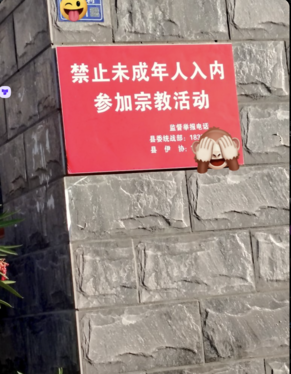
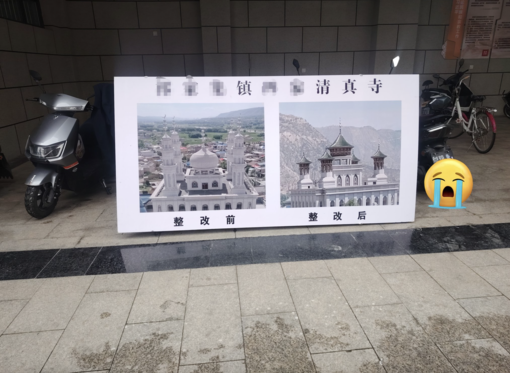
The Communist Party of China often emphasizes the freedom of ethnic and religious affairs, but strictly controls Muslims and their beliefs in Linxia Hui Autonomous…
The Communist Party of China often emphasizes the freedom of ethnic and religious affairs, but strictly controls Muslims and their beliefs in Linxia Hui Autonomous…
Collapse Read »
Collapse Read »
Hui Muslims who fled oppression in China are concerned about the president-elect’s vows to tighten asylum policy.
They survived re-education camps in China’s western Xinjiang region. They were released from detention centers and psychiatric hospitals. They watched their loved ones disappear one by one and feared when it would be their turn.
Then they managed to get out of China and reached the soil of the United States, many by trekking through the brutal jungle in Panama known as the Darién Gap on their way to the U.S. southern border.
They are Hui Muslims, a state-recognized ethnic minority group in China, where the government is determined to crack down on Islam. As President-elect Donald J. Trump promises to build detention camps and enlist the military to carry out mass deportations, the future of this group of immigrants is precarious. Deportation could mean years in jail or labor camps.
“My mother told me to stay here,” said Yan, a single mother who came to the United States in July with her 10-year-old son, Masoud, through the Darién Gap. “‘If you come back,’” she quoted her own mother as saying, “‘there’ll be no good outcome for you. Who knows — they might even sentence you to life imprisonment.’”
In China, Yan was detained by the police for 15 days, then sent to a psychiatric hospital for more than 20 days because her phone showed that she had made small donations to two online Quran prayer groups. The police said she supported religious terrorists and called her a “radical religious fanatic.” She considers herself not very religious and doesn’t even wear a head scarf.
A growing number of Chinese are migrating to escape bleak economic prospects and political oppression. Many have joined Venezuelans, Ecuadoreans and Haitians trying to reach the United States through the Darién Gap. More than 38,000 Chinese migrants were temporarily detained on the southern border of the United States in the 2024 fiscal year, up from 24,000 the previous year, according to U.S. Customs and Border Protection. It’s not clear how many of them are Muslims.
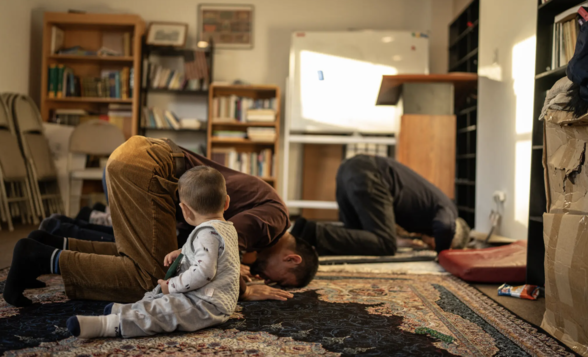
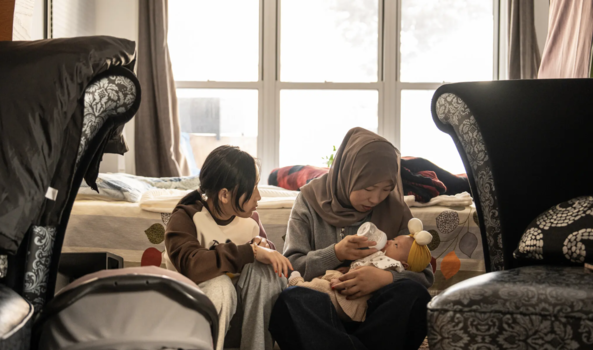
Many Hui Muslims are making the crossing with their families.
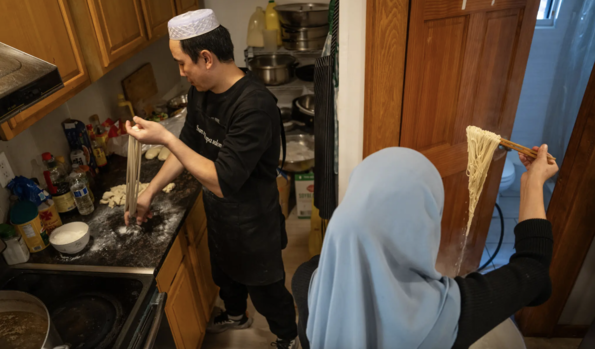
On a recent Friday afternoon, Yan and Masoud were among the 15 adults and six children who had gathered at a three-story house in Flushing, Queens, in New York City. Most of them had stayed there, a shelter for Muslim immigrants from China, just after arriving in the United States. They get together on Fridays with newcomers to chat, pray and discuss their lives, faith and current affairs. Then they cook a big meal with the flavors of northwestern China’s cuisine: beef noodles, spicy chicken and steamed buns.
The shelter offers the immigrants free boarding for the first two weeks before they can find places to settle down. Known as Home of Muslim, it also serves as a community center where they can seek solace and support one another.
They exchange personal stories, often full of trauma, sorrow and anger, said Ma Ju, the founder and a financial backer of the shelter. Once, he walked into the living room, he said, and saw a group of women in one another’s arms, weeping.
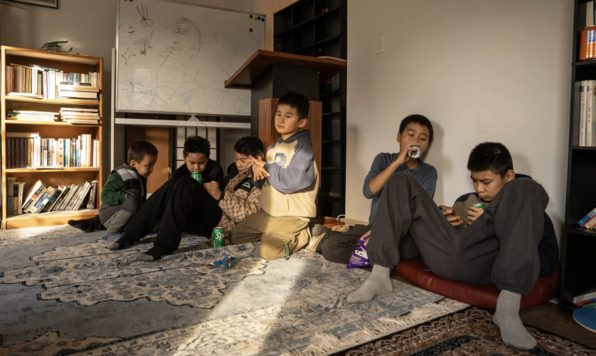
Mr. Ma, a businessman and a critic of the government’s policies to make Islam in China more Chinese, started the shelter in February 2023 as more Chinese came from the southern border. Over 350 people have stayed at the refuge. Most of them are Hui Muslims, though some are Uyghurs, Tibetans or Han Chinese.
“They are all traumatized,” Mr. Ma said. “But sometimes, they didn’t even know what they experienced was oppression and discrimination.”
Of the roughly 25 million Muslims in China, 11 million are Hui, who have a big presence in the northwest but also live in enclaves around the nation. The Hui are better integrated into Chinese society than Uyghurs, the biggest Muslim group, who live primarily in Xinjiang. Unlike Uyghurs, who are ethnically Turkic, the Hui look similar to the country’s dominant ethnic group, the Han. The Hui haven’t faced the same degree of persecution as the Uyghurs, but the crackdown on Islam has shaken the group.
The Chinese Communist Party fears ideological competition from any religion. Across the country, the government has demolished minarets and domes of mosques, banned the public use of Arabic script, forbidden children to attend Quran schools and sent the most religious Muslims to re-education camps.
That Friday afternoon at the shelter, Yong, a Hui Muslim from Xinjiang, was one of the cooks. For years, he operated a successful halal restaurant in Urumqi, Xinjiang’s capital city. Nearly 90 percent of his customers were Uyghurs, he said. When the government expanded re-education camps in 2017, his customers started to dwindle in number. A year later, nearly 80 percent of them had disappeared, he said.
Then Yong’s three uncles and his brother-in-law, all Hui Muslims, were sent to re-education centers for going to mosques “too often” or for having studied at religious schools when they were young. His mother was taken to the local police station for questioning after she was spotted wearing a scarf at home. She was released after making a written promise that she would not wear a scarf again.
“At that time, my wife and I were living in constant fear,” Yong said, “feeling like even the slightest misstep could get us into serious trouble.” He and his wife arrived in America in May 2023, having transited the Darién Gap. He now drives an ambulance in Queens, and his wife works at a halal restaurant in New York City.
Most people I interviewed for this column asked that I use only their given names for fear that their family members in China could face harassment or worse punishment from the authorities.
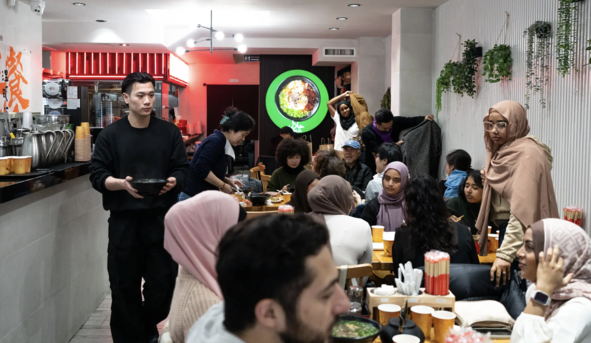
Another cook at the shelter was Ye Chengxiang, a Hui Muslim from northwestern Qinghai Province. In 2017, the authorities destroyed the minaret on the mosque of his hometown. Then in 2022, Mr. Ye, also a restaurant owner, was forced to take down its halal sign amid a campaign to ban Arabic script.
Mr. Ye, 43, grew up listening to horror stories about his older family members’ experiences. He was determined to leave the country. It took him a decade to get Chinese passports for his family of four. On Dec. 11, 2023, he arrived in San Diego with his wife and two teenage daughters by way of the Darién Gap.
“There were moments on the road when it felt like I was going to die, completely unable to keep going,” he said. “But after I got to this land of freedom, the hardship was nothing. Totally worth it.”
In November, his wife, Sophie, gave birth to their third child. He recently opened a halal restaurant in Rego Park, Queens, with other Muslim immigrants. Another group who stayed at the shelter opened a halal noodle restaurant in Manhattan.
But Mr. Ma, the founder of the shelter, said Muslim migrants faced obstacles in making lives in America. Pork dishes, which many Muslims don’t eat, feature heavily in most Chinese restaurants. One former resident of the shelter, with Mr. Ma’s help, found a job at a warehouse — and was called “a terrorist” by co-workers, Han Chinese immigrants, on his first day.
After Mr. Trump won the election, Mr. Ma said, his phone rang almost nonstop for a week. The callers were anxious. They spoke little English, so they had limited access to official information.
Mr. Ma said he had invited a lawyer to the shelter to explain the importance of applying for political asylum. Most Chinese migrants entering the United States from the southern border are released on parole by immigration authorities. Then they can apply for asylum. Under the current protocols, the lawyer told them, once they had a pending case, they should be protected from deportation.
“It would be lying if anyone says they are not scared,” said Yan, the single mother. “Everyone is on edge.” She said she would accept being deported but would make the painful decision to have someone adopt her son, who has problems learning, if it meant he could stay in the United States.
“My son has to stay here,” she said. “Going back would mean no chance of survival for him.” Collapse Read »
Then they managed to get out of China and reached the soil of the United States, many by trekking through the brutal jungle in Panama known as the Darién Gap on their way to the U.S. southern border.
They are Hui Muslims, a state-recognized ethnic minority group in China, where the government is determined to crack down on Islam. As President-elect Donald J. Trump promises to build detention camps and enlist the military to carry out mass deportations, the future of this group of immigrants is precarious. Deportation could mean years in jail or labor camps.
“My mother told me to stay here,” said Yan, a single mother who came to the United States in July with her 10-year-old son, Masoud, through the Darién Gap. “‘If you come back,’” she quoted her own mother as saying, “‘there’ll be no good outcome for you. Who knows — they might even sentence you to life imprisonment.’”
In China, Yan was detained by the police for 15 days, then sent to a psychiatric hospital for more than 20 days because her phone showed that she had made small donations to two online Quran prayer groups. The police said she supported religious terrorists and called her a “radical religious fanatic.” She considers herself not very religious and doesn’t even wear a head scarf.
A growing number of Chinese are migrating to escape bleak economic prospects and political oppression. Many have joined Venezuelans, Ecuadoreans and Haitians trying to reach the United States through the Darién Gap. More than 38,000 Chinese migrants were temporarily detained on the southern border of the United States in the 2024 fiscal year, up from 24,000 the previous year, according to U.S. Customs and Border Protection. It’s not clear how many of them are Muslims.
Many Hui Muslims are making the crossing with their families.
On a recent Friday afternoon, Yan and Masoud were among the 15 adults and six children who had gathered at a three-story house in Flushing, Queens, in New York City. Most of them had stayed there, a shelter for Muslim immigrants from China, just after arriving in the United States. They get together on Fridays with newcomers to chat, pray and discuss their lives, faith and current affairs. Then they cook a big meal with the flavors of northwestern China’s cuisine: beef noodles, spicy chicken and steamed buns.
The shelter offers the immigrants free boarding for the first two weeks before they can find places to settle down. Known as Home of Muslim, it also serves as a community center where they can seek solace and support one another.
They exchange personal stories, often full of trauma, sorrow and anger, said Ma Ju, the founder and a financial backer of the shelter. Once, he walked into the living room, he said, and saw a group of women in one another’s arms, weeping.
Mr. Ma, a businessman and a critic of the government’s policies to make Islam in China more Chinese, started the shelter in February 2023 as more Chinese came from the southern border. Over 350 people have stayed at the refuge. Most of them are Hui Muslims, though some are Uyghurs, Tibetans or Han Chinese.
“They are all traumatized,” Mr. Ma said. “But sometimes, they didn’t even know what they experienced was oppression and discrimination.”
Of the roughly 25 million Muslims in China, 11 million are Hui, who have a big presence in the northwest but also live in enclaves around the nation. The Hui are better integrated into Chinese society than Uyghurs, the biggest Muslim group, who live primarily in Xinjiang. Unlike Uyghurs, who are ethnically Turkic, the Hui look similar to the country’s dominant ethnic group, the Han. The Hui haven’t faced the same degree of persecution as the Uyghurs, but the crackdown on Islam has shaken the group.
The Chinese Communist Party fears ideological competition from any religion. Across the country, the government has demolished minarets and domes of mosques, banned the public use of Arabic script, forbidden children to attend Quran schools and sent the most religious Muslims to re-education camps.
That Friday afternoon at the shelter, Yong, a Hui Muslim from Xinjiang, was one of the cooks. For years, he operated a successful halal restaurant in Urumqi, Xinjiang’s capital city. Nearly 90 percent of his customers were Uyghurs, he said. When the government expanded re-education camps in 2017, his customers started to dwindle in number. A year later, nearly 80 percent of them had disappeared, he said.
Then Yong’s three uncles and his brother-in-law, all Hui Muslims, were sent to re-education centers for going to mosques “too often” or for having studied at religious schools when they were young. His mother was taken to the local police station for questioning after she was spotted wearing a scarf at home. She was released after making a written promise that she would not wear a scarf again.
“At that time, my wife and I were living in constant fear,” Yong said, “feeling like even the slightest misstep could get us into serious trouble.” He and his wife arrived in America in May 2023, having transited the Darién Gap. He now drives an ambulance in Queens, and his wife works at a halal restaurant in New York City.
Most people I interviewed for this column asked that I use only their given names for fear that their family members in China could face harassment or worse punishment from the authorities.
Another cook at the shelter was Ye Chengxiang, a Hui Muslim from northwestern Qinghai Province. In 2017, the authorities destroyed the minaret on the mosque of his hometown. Then in 2022, Mr. Ye, also a restaurant owner, was forced to take down its halal sign amid a campaign to ban Arabic script.
Mr. Ye, 43, grew up listening to horror stories about his older family members’ experiences. He was determined to leave the country. It took him a decade to get Chinese passports for his family of four. On Dec. 11, 2023, he arrived in San Diego with his wife and two teenage daughters by way of the Darién Gap.
“There were moments on the road when it felt like I was going to die, completely unable to keep going,” he said. “But after I got to this land of freedom, the hardship was nothing. Totally worth it.”
In November, his wife, Sophie, gave birth to their third child. He recently opened a halal restaurant in Rego Park, Queens, with other Muslim immigrants. Another group who stayed at the shelter opened a halal noodle restaurant in Manhattan.
But Mr. Ma, the founder of the shelter, said Muslim migrants faced obstacles in making lives in America. Pork dishes, which many Muslims don’t eat, feature heavily in most Chinese restaurants. One former resident of the shelter, with Mr. Ma’s help, found a job at a warehouse — and was called “a terrorist” by co-workers, Han Chinese immigrants, on his first day.
After Mr. Trump won the election, Mr. Ma said, his phone rang almost nonstop for a week. The callers were anxious. They spoke little English, so they had limited access to official information.
Mr. Ma said he had invited a lawyer to the shelter to explain the importance of applying for political asylum. Most Chinese migrants entering the United States from the southern border are released on parole by immigration authorities. Then they can apply for asylum. Under the current protocols, the lawyer told them, once they had a pending case, they should be protected from deportation.
“It would be lying if anyone says they are not scared,” said Yan, the single mother. “Everyone is on edge.” She said she would accept being deported but would make the painful decision to have someone adopt her son, who has problems learning, if it meant he could stay in the United States.
“My son has to stay here,” she said. “Going back would mean no chance of survival for him.” Collapse Read »
Christian converts in Kosovo, where the vast majority of people are Muslim, hope to revive a pre-Islamic past they see as a key to their European identity.
The Catholic priest stood at the altar in the hilltop church for the mass baptism, dunking dozens of heads in water and tracing a cross with his finger on each forehead.
Then he rejoiced at Christianity’s recovery of souls in a land where the vast majority of people are Muslim — as the men, women and children standing before him had been.
The ceremony was one of many in recent months in Kosovo, a formerly Serbian territory inhabited largely by ethnic Albanians that declared itself an independent state in 2008. In a census last spring, 93 percent of the population professed itself Muslim and only 1.75 percent Roman Catholic.

A small number of ethnic Albanian Christian activists, all converts from Islam, are urging their ethnic kin to look to the church as an expression of their identity. They call it the “return movement,” a push to revive a pre-Islamic past they see as an anchor of Kosovo’s place in Europe and a barrier to religious extremism spilling over from the Middle East.
Until the Ottoman Empire conquered what is today Kosovo and other areas of the Balkans in the 14th century, bringing with it Islam, ethnic Albanians were primarily Catholics. Under Ottoman rule, which lasted until 1912, most of Kosovo’s people switched faiths.
By reversing that process, said Father Fran Kolaj, the priest who carried out the baptisms outside the village of Llapushnik, ethnic Albanians can recover their original identity.
Ethnic Albanians, who trace their roots to an ancient people called the Illyrians, live mainly in Albania, a country on the Adriatic Sea. But they also make up a large majority of the population in neighboring Kosovo and more than a quarter of the population in North Macedonia.
At the church where the baptisms took place, nationalist emblems jostle with religious iconography. The double-headed eagle symbol of Albania decorates the steeple and also a screen behind the altar.
“It is time for us to return to the place where we belong — with Christ,” Father Kolaj said in an interview.
In many Muslim lands, renouncing Islam can bring severe punishment, sometimes even death. So far, the baptism ceremonies taking place in Kosovo have stirred no violent opposition, though there have been some angry denunciations online. (It is not known how many conversions have so far taken place.)
But historians, who agree that Christianity was present in Kosovo long before the Ottoman Empire brought Islam, question the thinking behind the movement.
“From a historical perspective what they say is true,” said Durim Abdullahu, a historian at the University of Pristina. But, he added, “their logic means that we should all become pagans” because the people living on the territory of today’s Kosovo before the arrival of Christianity and later Islam were nonbelievers.
Like many other Kosovars, Mr. Abdullahu said he believed that Serbia, which has a mostly Orthodox Christian population, had helped stoke the return movement as a way of sowing discord in Kosovo. While Serbia has long been accused of undermining Kosovo’s stability, there is no evidence it has been promoting the conversions.

Archaeologists in 2022 uncovered the remains of a sixth-century Roman church near Pristina, and in 2023 found a mosaic with an inscription indicating that early Albanians, or at least a people perhaps related to them, were Christians.
Still, Christophe Goddard, a French archaeologist working at the site, said it was wrong to impose modern concepts of nation and ethnicity on ancient peoples. “This is not history but modern politics,” he said.
Traces of Kosovo’s distant pre-Islamic past also survived in a small number of families that clung to Roman Catholicism despite the risk of being ostracized by their Muslim neighbors.
Marin Sopi, 67, a retired Albanian language teacher who was baptized 16 years ago, said his family had been “closet Catholics” for generations. In childhood, he recalled, he and his family observed Ramadan with Muslim friends but secretly celebrated Christmas at home.
“We were Muslims during the day and Christians at night,” he said. Since coming out as a Christian, he said, 36 members of his extended family have formally abandoned Islam.
Islam and Christianity in Kosovo mostly coexisted in peace — until Orthodox Christian soldiers and nationalist paramilitary gangs from Serbia began torching mosques and expelling Muslims from the homes in the 1990s.
Foreign Christian missionaries have kept their distance from Kosovo’s conversion campaign. But some ethnic Albanians living in Western Europe have offered support, seeing a return to Catholicism as Kosovo’s best hope of one day entering the European Union, a largely Christian club.
Arber Gashi, an ethnic Albanian living in Switzerland, traveled to Kosovo to attend the baptism ceremony at the church in Llapushnik, which overlooks the scene of a major battle in 1998 between Serb forces and the Kosovo Liberation Army.
He and other activists worry that funding for mosque-building and other activities from Turkey and countries in the Middle East like Qatar and Saudi Arabia, with their more conservative approaches, threatens Kosovo’s traditionally laid-back form of Islam. Most of this money has gone into economic development projects unrelated to religion.
The center of Pristina has a statue honoring Mother Teresa, the Catholic nun and Nobel Peace Prize laureate of Albanian descent, and is dominated by a large Roman Catholic cathedral built after the war with Serbia. But Turkey is currently funding the construction nearby of a giant new mosque that will be even bigger.
Mr. Gashi also said that he feared a return of the Islamic extremism that emerged in Kosovo’s first, chaotic decade of independence. By some counts, Kosovo provided more recruits to the Islamic State in Syria than any other European country.
Christianity, on the other hand, would open a path to Europe, he said.
A crackdown by the authorities in recent years has silenced extremism and reinforced Kosovo’s traditionally relaxed take on Islam. The streets of Pristina are lined with bars serving a wide range of alcohol. Veiled women are extremely rare.
Gezim Gjin Hajrullahu, 57, a teacher who was among those baptized recently in Llapushnik, said he had joined the Catholic church “not for the sake of religion itself” but for the “sake of our national identity” as ethnic Albanians. His wife also converted.
Kosovo’s ethnic Albanian prime minister, Albin Kurti, in an interview in Pristina, played down the importance of religion to Albanian identity. “For us, religions came and went but we are still here,” he said. “For Albanians, in terms of identity, religion was never of first importance.”
That sets them apart from other peoples in the now vanished, multiethnic federal state of Yugoslavia, which disintegrated during the Balkan wars of the early 1990s. The main warring parties in the early phases of the conflict spoke much the same language and looked similar but were clearly distinguished from one another by religion — Serbs by Orthodox Christianity, Croats by Roman Catholicism and Bosnians by Islam.
Activists in the return movement believe that ethnic Albanians also need to cement their national loyalties with religion in the form of Roman Catholicism.
Boik Breca, a former Muslim active in the movement, insisted that the Catholic church is not an alien intrusion but the true expression of Albanian identity and evidence that Kosovo belongs in Europe.
He said his interest in Christianity began when Kosovo, along with Serbia, was still part of Yugoslavia. He was sent to jail off the coast of Croatia as a political prisoner. Many of his fellow inmates were Catholics, he recalled, and helped stir what he now sees as his true faith and a belief that “our ancestors were all Catholics.”
“To be a true Albanian,” he said, “you have to be Christian.”
This view is widely disputed, including by Mr. Kurti, the prime minister.
“I don’t buy that,” he said.
The current push against Islam began with a meeting in October 2023 in Decani, a bastion of nationalist sentiment near Kosovo’s border with Albania. The gathering, attended by nationalist intellectuals and former Kosovo Liberation Army fighters, discussed ways to promote “Albanian-ness” and decided that Christianity would help.
“We are no longer Muslims as of today,” attendees said, adopting the slogan: “To be only Albanians.”
The meeting led to the formation of what was initially called the Movement for the Abandonment of the Islamic Faith, a provocative name since largely dropped in favor of the “Movement of Return.”
From his office in Pristina, decorated with a model of Mecca, Kosovo’s grand mufti, Naim Ternava, has watched the return movement with anxiety and dismay. The push for Muslims to switch to Christianity, he said, risked disrupting religious harmony and was being used by “foreign agents to spread hatred of Islam.”
“Our mission,” he added, “is to keep people in our religion. I tell people to remain in Islam.”
Collapse Read »
Then he rejoiced at Christianity’s recovery of souls in a land where the vast majority of people are Muslim — as the men, women and children standing before him had been.
The ceremony was one of many in recent months in Kosovo, a formerly Serbian territory inhabited largely by ethnic Albanians that declared itself an independent state in 2008. In a census last spring, 93 percent of the population professed itself Muslim and only 1.75 percent Roman Catholic.
A small number of ethnic Albanian Christian activists, all converts from Islam, are urging their ethnic kin to look to the church as an expression of their identity. They call it the “return movement,” a push to revive a pre-Islamic past they see as an anchor of Kosovo’s place in Europe and a barrier to religious extremism spilling over from the Middle East.
Until the Ottoman Empire conquered what is today Kosovo and other areas of the Balkans in the 14th century, bringing with it Islam, ethnic Albanians were primarily Catholics. Under Ottoman rule, which lasted until 1912, most of Kosovo’s people switched faiths.
By reversing that process, said Father Fran Kolaj, the priest who carried out the baptisms outside the village of Llapushnik, ethnic Albanians can recover their original identity.
Ethnic Albanians, who trace their roots to an ancient people called the Illyrians, live mainly in Albania, a country on the Adriatic Sea. But they also make up a large majority of the population in neighboring Kosovo and more than a quarter of the population in North Macedonia.
At the church where the baptisms took place, nationalist emblems jostle with religious iconography. The double-headed eagle symbol of Albania decorates the steeple and also a screen behind the altar.
“It is time for us to return to the place where we belong — with Christ,” Father Kolaj said in an interview.
In many Muslim lands, renouncing Islam can bring severe punishment, sometimes even death. So far, the baptism ceremonies taking place in Kosovo have stirred no violent opposition, though there have been some angry denunciations online. (It is not known how many conversions have so far taken place.)
But historians, who agree that Christianity was present in Kosovo long before the Ottoman Empire brought Islam, question the thinking behind the movement.
“From a historical perspective what they say is true,” said Durim Abdullahu, a historian at the University of Pristina. But, he added, “their logic means that we should all become pagans” because the people living on the territory of today’s Kosovo before the arrival of Christianity and later Islam were nonbelievers.
Like many other Kosovars, Mr. Abdullahu said he believed that Serbia, which has a mostly Orthodox Christian population, had helped stoke the return movement as a way of sowing discord in Kosovo. While Serbia has long been accused of undermining Kosovo’s stability, there is no evidence it has been promoting the conversions.
Archaeologists in 2022 uncovered the remains of a sixth-century Roman church near Pristina, and in 2023 found a mosaic with an inscription indicating that early Albanians, or at least a people perhaps related to them, were Christians.
Still, Christophe Goddard, a French archaeologist working at the site, said it was wrong to impose modern concepts of nation and ethnicity on ancient peoples. “This is not history but modern politics,” he said.
Traces of Kosovo’s distant pre-Islamic past also survived in a small number of families that clung to Roman Catholicism despite the risk of being ostracized by their Muslim neighbors.
Marin Sopi, 67, a retired Albanian language teacher who was baptized 16 years ago, said his family had been “closet Catholics” for generations. In childhood, he recalled, he and his family observed Ramadan with Muslim friends but secretly celebrated Christmas at home.
“We were Muslims during the day and Christians at night,” he said. Since coming out as a Christian, he said, 36 members of his extended family have formally abandoned Islam.
Islam and Christianity in Kosovo mostly coexisted in peace — until Orthodox Christian soldiers and nationalist paramilitary gangs from Serbia began torching mosques and expelling Muslims from the homes in the 1990s.
Foreign Christian missionaries have kept their distance from Kosovo’s conversion campaign. But some ethnic Albanians living in Western Europe have offered support, seeing a return to Catholicism as Kosovo’s best hope of one day entering the European Union, a largely Christian club.
Arber Gashi, an ethnic Albanian living in Switzerland, traveled to Kosovo to attend the baptism ceremony at the church in Llapushnik, which overlooks the scene of a major battle in 1998 between Serb forces and the Kosovo Liberation Army.
He and other activists worry that funding for mosque-building and other activities from Turkey and countries in the Middle East like Qatar and Saudi Arabia, with their more conservative approaches, threatens Kosovo’s traditionally laid-back form of Islam. Most of this money has gone into economic development projects unrelated to religion.
The center of Pristina has a statue honoring Mother Teresa, the Catholic nun and Nobel Peace Prize laureate of Albanian descent, and is dominated by a large Roman Catholic cathedral built after the war with Serbia. But Turkey is currently funding the construction nearby of a giant new mosque that will be even bigger.
Mr. Gashi also said that he feared a return of the Islamic extremism that emerged in Kosovo’s first, chaotic decade of independence. By some counts, Kosovo provided more recruits to the Islamic State in Syria than any other European country.
Christianity, on the other hand, would open a path to Europe, he said.
A crackdown by the authorities in recent years has silenced extremism and reinforced Kosovo’s traditionally relaxed take on Islam. The streets of Pristina are lined with bars serving a wide range of alcohol. Veiled women are extremely rare.
Gezim Gjin Hajrullahu, 57, a teacher who was among those baptized recently in Llapushnik, said he had joined the Catholic church “not for the sake of religion itself” but for the “sake of our national identity” as ethnic Albanians. His wife also converted.
Kosovo’s ethnic Albanian prime minister, Albin Kurti, in an interview in Pristina, played down the importance of religion to Albanian identity. “For us, religions came and went but we are still here,” he said. “For Albanians, in terms of identity, religion was never of first importance.”
That sets them apart from other peoples in the now vanished, multiethnic federal state of Yugoslavia, which disintegrated during the Balkan wars of the early 1990s. The main warring parties in the early phases of the conflict spoke much the same language and looked similar but were clearly distinguished from one another by religion — Serbs by Orthodox Christianity, Croats by Roman Catholicism and Bosnians by Islam.
Activists in the return movement believe that ethnic Albanians also need to cement their national loyalties with religion in the form of Roman Catholicism.
Boik Breca, a former Muslim active in the movement, insisted that the Catholic church is not an alien intrusion but the true expression of Albanian identity and evidence that Kosovo belongs in Europe.
He said his interest in Christianity began when Kosovo, along with Serbia, was still part of Yugoslavia. He was sent to jail off the coast of Croatia as a political prisoner. Many of his fellow inmates were Catholics, he recalled, and helped stir what he now sees as his true faith and a belief that “our ancestors were all Catholics.”
“To be a true Albanian,” he said, “you have to be Christian.”
This view is widely disputed, including by Mr. Kurti, the prime minister.
“I don’t buy that,” he said.
The current push against Islam began with a meeting in October 2023 in Decani, a bastion of nationalist sentiment near Kosovo’s border with Albania. The gathering, attended by nationalist intellectuals and former Kosovo Liberation Army fighters, discussed ways to promote “Albanian-ness” and decided that Christianity would help.
“We are no longer Muslims as of today,” attendees said, adopting the slogan: “To be only Albanians.”
The meeting led to the formation of what was initially called the Movement for the Abandonment of the Islamic Faith, a provocative name since largely dropped in favor of the “Movement of Return.”
From his office in Pristina, decorated with a model of Mecca, Kosovo’s grand mufti, Naim Ternava, has watched the return movement with anxiety and dismay. The push for Muslims to switch to Christianity, he said, risked disrupting religious harmony and was being used by “foreign agents to spread hatred of Islam.”
“Our mission,” he added, “is to keep people in our religion. I tell people to remain in Islam.”
Collapse Read »
Hundreds of Hui Muslims Protest Arrest of Respected Imam in Yunnan Province, China Mainland
Hundreds of Hui Muslims Protest Arrest of Respected Imam in Yunnan Province, China Mainland
On December 15 and 16, hundreds of Hui Muslims gathered outside the city government office in Yuxi, Yunnan Province, to protest the arrest of a well-respected local imam by Chinese authorities. The incident highlights the Chinese Communist Party’s growing control over religious groups, extending beyond the predominantly Muslim regions of northwest China.
According to reports, Imam Ma Yuwei was forcibly detained by plainclothes police officers on the morning of December 15 while dining at a restaurant near Nie’er Square in Yuxi. That same day, his brother in Shadian narrowly avoided arrest thanks to strong opposition from local residents. These actions sparked outrage among the local Muslim community, who took to the streets demanding Ma Yuwei’s release. The protests continued into the morning of December 16.
Sources revealed that Ma Yuwei had been under surveillance and investigation by unidentified individuals for the past year. For safety reasons, he and his father had been living in a mosque for months and rarely ventured outside. On this rare occasion, while dining out, Ma was surrounded and taken away by armed officers. Protesters claim the police did not present an arrest warrant or official identification, and the only reason given for his detention was his preaching of the Quran.
This is not an isolated incident. In recent years, the Chinese government has increased pressure on various religious groups, including Uyghur Muslims in Xinjiang, through measures such as setting up so-called “re-education camps.” These actions have drawn widespread international condemnation.
The Yunnan protests suggest that these crackdowns may now be extending to Hui Muslim communities outside northwest China. Protesters pointed to repeated instances of oppression against Hui Muslims since 2017, including arrests, detentions, and suppressions, creating a cycle of conflict. They refuted government claims that no Hui Muslims have been detained in “camps,” arguing that substantial evidence indicates tens of thousands of Hui Muslims have been imprisoned.
Tensions remained high at the protest site. Police reportedly tried to disperse the crowd outside the city government office, leading to confrontations. Protesters began organizing efforts to identify undercover officers within the crowd to prepare for potential crackdowns. Witnesses reported seeing large numbers of military and police vehicles heading toward Yuxi overnight, raising concerns about further escalation.
Protesters have submitted a petition to the Yuxi city government demanding an explanation for Ma Yuwei’s arrest and guarantees of religious freedom for Hui Muslims. The petition also highlighted long-standing conflicts between the mosque and local authorities, including allegations regarding its religious activities and management.
This incident is another example of the worsening state of religious freedom in China. The government’s tightened control over religion has increasingly affected not only Uyghur Muslims in Xinjiang but also Hui Muslims and other religious groups, including Christians, in other regions of the country. Collapse Read »
On December 15 and 16, hundreds of Hui Muslims gathered outside the city government office in Yuxi, Yunnan Province, to protest the arrest of a well-respected local imam by Chinese authorities. The incident highlights the Chinese Communist Party’s growing control over religious groups, extending beyond the predominantly Muslim regions of northwest China.
According to reports, Imam Ma Yuwei was forcibly detained by plainclothes police officers on the morning of December 15 while dining at a restaurant near Nie’er Square in Yuxi. That same day, his brother in Shadian narrowly avoided arrest thanks to strong opposition from local residents. These actions sparked outrage among the local Muslim community, who took to the streets demanding Ma Yuwei’s release. The protests continued into the morning of December 16.
Sources revealed that Ma Yuwei had been under surveillance and investigation by unidentified individuals for the past year. For safety reasons, he and his father had been living in a mosque for months and rarely ventured outside. On this rare occasion, while dining out, Ma was surrounded and taken away by armed officers. Protesters claim the police did not present an arrest warrant or official identification, and the only reason given for his detention was his preaching of the Quran.
This is not an isolated incident. In recent years, the Chinese government has increased pressure on various religious groups, including Uyghur Muslims in Xinjiang, through measures such as setting up so-called “re-education camps.” These actions have drawn widespread international condemnation.
The Yunnan protests suggest that these crackdowns may now be extending to Hui Muslim communities outside northwest China. Protesters pointed to repeated instances of oppression against Hui Muslims since 2017, including arrests, detentions, and suppressions, creating a cycle of conflict. They refuted government claims that no Hui Muslims have been detained in “camps,” arguing that substantial evidence indicates tens of thousands of Hui Muslims have been imprisoned.
Tensions remained high at the protest site. Police reportedly tried to disperse the crowd outside the city government office, leading to confrontations. Protesters began organizing efforts to identify undercover officers within the crowd to prepare for potential crackdowns. Witnesses reported seeing large numbers of military and police vehicles heading toward Yuxi overnight, raising concerns about further escalation.
Protesters have submitted a petition to the Yuxi city government demanding an explanation for Ma Yuwei’s arrest and guarantees of religious freedom for Hui Muslims. The petition also highlighted long-standing conflicts between the mosque and local authorities, including allegations regarding its religious activities and management.
This incident is another example of the worsening state of religious freedom in China. The government’s tightened control over religion has increasingly affected not only Uyghur Muslims in Xinjiang but also Hui Muslims and other religious groups, including Christians, in other regions of the country. Collapse Read »
Australian ruling Labor Party Senator Fatima Payman said that the prime minister’s decision to indefinitely suspend her
Australian ruling Labor Party Senator Fatima Payman said that the prime minister’s decision to indefinitely suspend her from the party’s caucus after supporting a motion in parliament to recognise a Palestinian state had left her in “exile.

Collapse Read »
Collapse Read »
The Chinese government is trying to change the Eid customs, prayers and traditions by making Uyghurs consume food along with Chinese people
The Chinese government is trying to change the Eid customs, prayers and traditions by making Uyghurs consume food along with Chinese people [and] adding Chinese elements to the Eid festivals, thereby removing the Muslim Eid elements.
On an important Muslim holiday last month, police and security officials in China’s far-western region of Xinjiang set up camps to keep an eye on Uyghurs, took Uyghurs to see communist-themed films, and visited Uyghur homes to make sure they weren’t practicing Muslim religious activities.
The moves around the Qurban Eid, also known as Eid al-Adha or the Feast of the Sacrifice, which fell on June 17 this year in Xinjiang — one of two official Muslim holidays in China — appeared to be attempts to undermine the observation of the Muslim holy day, outside experts said.
Chinese authorities are trying to weaken Uyghurs’ ethnic and religious identity and forge their loyalty to the Chinese state and the Communist Party, while maintaining security, the experts said.
“It looks like they are trying to Sinicize Eid,” said Erkin Ekrem, a professor at Hacettepe University in Ankara, Turkey, and vice president of the World Uyghur Congress.
“The Chinese government is trying to change the Eid customs, prayers and traditions [by] making Uyghurs consume food along with Chinese people [and] adding Chinese elements to the Eid festivals, thereby removing the Muslim Eid elements,” he added.
RELATED STORIES
China pushes ‘Sinicization of Islam’ in Xinjiang as Ramadan arrives
Most Uyghurs banned from praying on Islamic holiday, even in their homes
Chinese use Muslim holiday for propaganda purposes, celebrating with Uyghurs

A screen displays Chinese President Xi Jinping near a mosque in Kashgar, northwestern China's Xinjiang region, June 4, 2019. (AFPTV)
Before 2017, when the Chinese government started cracking down on religious activities in the predominantly Muslim region, men would observe the holiday by visiting mosques for special prayers, cooking meals, spending time with relatives and welcoming guests to their homes.
Since then, authorities have also forbidden Islamic dress for women, beards for men, and Muslim names for children. They have also prevented Uyghurs from fasting during the Islamic holy month of Ramadan and encouraged the consumption of pork and alcohol, which Islam forbids.
Chinese national consciousness
On the eve of Eid, Ma Xingrui, Communist Party secretary of Xinjiang, visited communities in Urumqi, the region’s capital, and asked residents to strengthen Chinese national consciousness and insist on the Sinicization of Islam.
Public security officers celebrated the holiday with Uyghurs and other ethnicities in Xinjiang and promoted “the common consciousness of the Chinese nation,” the Xinjiang Daily reported on June 19.
The Keriye County Public Security Bureau in Hotan invited teachers at area primary schools, students and parents on June 16 to participate in social activities at a police camp to “build strong Chinese national consciousness and celebrate Eid,” the report said.
On the same day, police in Qitai county in the Changji Hui Autonomous Prefecture invited Uyghur “relatives” with whom they had been paired up under a previous monitoring program to visit a museum to watch communist-themed films.
On June 17, members of the Public Security Bureau in the prefecture’s Manas county visited Uyghur homes and danced with residents, who had no choice but to join in, the news report said.
“The police showed their concern for the public by their actions and also planted the seeds of national unity deep in everyone’s hearts,” it said.
Assimilation policies
Henryk Szadziewski, director of research at the Uyghur Human Rights Project, said public security agents interfere in Muslim holidays like Eid al-Adha to push assimilationist policies in Xinjiang.
Uyghur identification with Turkic culture along with a belief in Islam and related social and political values are considered a threat because they are outside the control of the Chinese state, he told Radio Free Asia.

Attendees watch video of a Muslim praying during a government reception held for the Eid al-Fitr holiday in Beijing, China, May 13, 2021. (Ng Han Guan/AP)
“China’s policies are intended to weaken those kinds of affinities outside which are beyond the borders of China and to ensure Uyghurs allegiances are pinned to the Chinese state and, of course, the Chinese Communist Party,” Szadziewski said.
But the Chinese government separates Islam in China from Islam in the rest of the world, Erkin Ekrem of the World Uyghur Congress said.
“In China, the Sinicization of Islam is being carried out vigorously,” he told RFA. “They are trying to create a nation away from Islamic beliefs and customs.”
“Deemphasizing the religion adding in this secular Chinese national consciousness [is] meant to delink Eid al-Adha from its religious origin,” he said. “That is one of the aims here.”
Translated by RFA Uyghur. Edited by Roseanne Gerin and Malcolm Foster. Collapse Read »
On an important Muslim holiday last month, police and security officials in China’s far-western region of Xinjiang set up camps to keep an eye on Uyghurs, took Uyghurs to see communist-themed films, and visited Uyghur homes to make sure they weren’t practicing Muslim religious activities.
The moves around the Qurban Eid, also known as Eid al-Adha or the Feast of the Sacrifice, which fell on June 17 this year in Xinjiang — one of two official Muslim holidays in China — appeared to be attempts to undermine the observation of the Muslim holy day, outside experts said.
Chinese authorities are trying to weaken Uyghurs’ ethnic and religious identity and forge their loyalty to the Chinese state and the Communist Party, while maintaining security, the experts said.
“It looks like they are trying to Sinicize Eid,” said Erkin Ekrem, a professor at Hacettepe University in Ankara, Turkey, and vice president of the World Uyghur Congress.
“The Chinese government is trying to change the Eid customs, prayers and traditions [by] making Uyghurs consume food along with Chinese people [and] adding Chinese elements to the Eid festivals, thereby removing the Muslim Eid elements,” he added.
RELATED STORIES
China pushes ‘Sinicization of Islam’ in Xinjiang as Ramadan arrives
Most Uyghurs banned from praying on Islamic holiday, even in their homes
Chinese use Muslim holiday for propaganda purposes, celebrating with Uyghurs
A screen displays Chinese President Xi Jinping near a mosque in Kashgar, northwestern China's Xinjiang region, June 4, 2019. (AFPTV)
Before 2017, when the Chinese government started cracking down on religious activities in the predominantly Muslim region, men would observe the holiday by visiting mosques for special prayers, cooking meals, spending time with relatives and welcoming guests to their homes.
Since then, authorities have also forbidden Islamic dress for women, beards for men, and Muslim names for children. They have also prevented Uyghurs from fasting during the Islamic holy month of Ramadan and encouraged the consumption of pork and alcohol, which Islam forbids.
Chinese national consciousness
On the eve of Eid, Ma Xingrui, Communist Party secretary of Xinjiang, visited communities in Urumqi, the region’s capital, and asked residents to strengthen Chinese national consciousness and insist on the Sinicization of Islam.
Public security officers celebrated the holiday with Uyghurs and other ethnicities in Xinjiang and promoted “the common consciousness of the Chinese nation,” the Xinjiang Daily reported on June 19.
The Keriye County Public Security Bureau in Hotan invited teachers at area primary schools, students and parents on June 16 to participate in social activities at a police camp to “build strong Chinese national consciousness and celebrate Eid,” the report said.
On the same day, police in Qitai county in the Changji Hui Autonomous Prefecture invited Uyghur “relatives” with whom they had been paired up under a previous monitoring program to visit a museum to watch communist-themed films.
On June 17, members of the Public Security Bureau in the prefecture’s Manas county visited Uyghur homes and danced with residents, who had no choice but to join in, the news report said.
“The police showed their concern for the public by their actions and also planted the seeds of national unity deep in everyone’s hearts,” it said.
Assimilation policies
Henryk Szadziewski, director of research at the Uyghur Human Rights Project, said public security agents interfere in Muslim holidays like Eid al-Adha to push assimilationist policies in Xinjiang.
Uyghur identification with Turkic culture along with a belief in Islam and related social and political values are considered a threat because they are outside the control of the Chinese state, he told Radio Free Asia.
Attendees watch video of a Muslim praying during a government reception held for the Eid al-Fitr holiday in Beijing, China, May 13, 2021. (Ng Han Guan/AP)
“China’s policies are intended to weaken those kinds of affinities outside which are beyond the borders of China and to ensure Uyghurs allegiances are pinned to the Chinese state and, of course, the Chinese Communist Party,” Szadziewski said.
But the Chinese government separates Islam in China from Islam in the rest of the world, Erkin Ekrem of the World Uyghur Congress said.
“In China, the Sinicization of Islam is being carried out vigorously,” he told RFA. “They are trying to create a nation away from Islamic beliefs and customs.”
“Deemphasizing the religion adding in this secular Chinese national consciousness [is] meant to delink Eid al-Adha from its religious origin,” he said. “That is one of the aims here.”
Translated by RFA Uyghur. Edited by Roseanne Gerin and Malcolm Foster. Collapse Read »
US Congressman Greg Casar:"I'm boycotting Netanyahu’s address. We need Netanyahu to stop bombing Gaza & secure a ceasefire deal so the hostages can come home. "
Today, I'm boycotting Netanyahu’s address. We don’t need a PR stunt — we need Netanyahu to stop bombing Gaza & secure a ceasefire deal so the hostages can come home. The U.S. must stop unconditional military aid & work toward a long-term peace for Israelis and Palestinians.
 Collapse Read »
Collapse Read »
Happening right now in Washington, D.C. Massive crowds are marching to demand the arrest of war criminal Benjamin Netanyahu.
Netanyahu Wanted!
Netanyahu Wanted in Washington, DC!!
Netanyahu Wanted By The Killed Innocents!!!
Happening right now in Washington, D.C. Massive crowds are marching to demand the arrest of war criminal Benjamin Netanyahu.
Collapse Read »
Netanyahu Wanted in Washington, DC!!
Netanyahu Wanted By The Killed Innocents!!!
Happening right now in Washington, D.C. Massive crowds are marching to demand the arrest of war criminal Benjamin Netanyahu.
Collapse Read »
“Congress should not be inviting Netanyahu, a war criminal, to a joint session.” - US Senator Bernie Sanders
“I hope that my colleagues who attend Mr. Netanyahu’s remarks remember this as they rise, time and time again, to give him a standing ovation: as a result of Israeli restrictions on humanitarian aid, children, women, innocent people in Gaza are now starving to death” -
@SenSanders
Collapse Read »
@SenSanders
Collapse Read »
What’s happening in Gaza now is the last straw for so many of us. People are sick and tired of being abused by the political system
Dr. Jill Stein
What’s happening in Gaza now is the last straw for so many of us. People are sick and tired of being abused by the political system, and no one is more outraged than Muslim and Arab Americans. It's time for all of us to claim our power and demand more from our democracy. It's time to light that spark for change.
Collapse Read »
BREAKING: Female Palestinian prisoner Marah Bakir was just set free after 8 years in Israeli prisons.
BREAKING: Female Palestinian prisoner Marah Bakir was just set free after 8 years in Israeli prisons.
Bakir was released along with 38 other prisoners as part of a prisoner swap deal between the Palestinian resistance and the Israeli occupation. Collapse Read »
Bakir was released along with 38 other prisoners as part of a prisoner swap deal between the Palestinian resistance and the Israeli occupation. Collapse Read »
Former Obama national security advisor Stuart Seldowitz, he saying that killing 4,000 Palestinian children “wasn’t enough.”
Former Obama national security advisor Stuart Seldowitz, he saying that killing 4,000 Palestinian children “wasn’t enough.”
New York Senator Chuck Schumer continues to grovel to Israel, as he attended a rally yesterday in support of the Israeli colonial regime.
New York Senator Chuck Schumer continues to grovel to Israel, as he attended a rally yesterday in support of the Israeli colonial regime. He supports giving aid to the Israeli government for American weapons, making him one of the executioners of the Palestinian people.
His hands are stained with the blood of innocent Palestinian children.
Collapse Read »
His hands are stained with the blood of innocent Palestinian children.
Collapse Read »
BREAKING: The House of Representatives just voted to give Israel $14.3 billion in more weapons to deepen US complicity in Israel's genocidal attacks against Palestinians in Gaza.
BREAKING: The House of Representatives just voted to give Israel $14.3 billion in more weapons to deepen US complicity in Israel's genocidal attacks against Palestinians in Gaza. A shameful day in Congress.
 Collapse Read »
Collapse Read »
Birmingham stands with the people of Gaza and for a ceasefire.
Birmingham New Street station tonight. Birmingham stands with the people of Gaza and for a ceasefire.
Collapse Read »
Collapse Read »
Palestinian journalist Salman Al-Bashir made emotional remarks live on television shortly after the death of his colleague Mohammad Abu Hattab in southern Gaza.
Palestinian journalist Salman Al-Bashir made emotional remarks live on television shortly after the death of his colleague Mohammad Abu Hattab in southern Gaza.
"I never thought for a moment that I would be announcing the martyrdom of [Abu Hattab], who stood next to me here 30 minutes ago," said Bashir. "We can’t take it anymore, we are exhausted. We are victims. The only difference between us is the time of death. We are killed one after another." "This gear and helmet do not protect any journalist, they are just empty slogans," said Bashir, as he took off his press vest and helmet. "We are victims, live on air. We are victims awaiting our turn to be killed." At least 36 journalists have been killed since the war began on 7 October, of whom 31 are Palestinian, four are Israeli and one Lebanese Collapse Read »
"I never thought for a moment that I would be announcing the martyrdom of [Abu Hattab], who stood next to me here 30 minutes ago," said Bashir. "We can’t take it anymore, we are exhausted. We are victims. The only difference between us is the time of death. We are killed one after another." "This gear and helmet do not protect any journalist, they are just empty slogans," said Bashir, as he took off his press vest and helmet. "We are victims, live on air. We are victims awaiting our turn to be killed." At least 36 journalists have been killed since the war began on 7 October, of whom 31 are Palestinian, four are Israeli and one Lebanese Collapse Read »
Sen. Chris Van Hollen (D-MD) points out that according to the UN, about six times more children have been killed in Gaza
Sen. Chris Van Hollen (D-MD) points out that according to the UN, about six times more children have been killed in Gaza in just three weeks than have been killed in Ukraine during the entire war.
Collapse Read »
Collapse Read »
Thousands of Afghans are stranded at the border with Pakistan.
Thousands of Afghans are stranded at the border with Pakistan. Islamabad has given 1.7 million Afghans it says are living illegally in the country until today/November 1 to leave voluntarily or be forcibly removed sparking this mass exodus
Collapse Read »
Collapse Read »
The name of 40 dead Palestinian medical workers under the Israeli bombs
The 40 dead were Palestinian medical workers.

In the minds of the highest of the races of Israel, they were the sacrificial lambs of the imperial dream;
In the minds of politicians, they are mere pawns;
In the minds of the ignorant, they are "terrorists" from birth to death;
In the minds of most ordinary people, they are not even as good as a blade of grass passing by, and they will think that their death will only pollute their eyeballs and emotions of browsing information.
Collapse Read »
In the minds of the highest of the races of Israel, they were the sacrificial lambs of the imperial dream;
In the minds of politicians, they are mere pawns;
In the minds of the ignorant, they are "terrorists" from birth to death;
In the minds of most ordinary people, they are not even as good as a blade of grass passing by, and they will think that their death will only pollute their eyeballs and emotions of browsing information.
Collapse Read »
US Congresswoman Rashida Tlaib opposes the US Congress '$14.3 billion aid to the Israeli government.
A statement by US Congresswoman Rashida Tlaib, who opposes the US Congress '$14.3 billion aid to the Israeli government.

"The American people do not support funding for war crimes-
like the use of white phosphorus bombs-and are calling for a
ceasefire. As the Israeli government carries out ethnic cleansing
in Gaza, President Biden is cheering on Netanyahu, whose own
citizens are protesting his refusal to support a ceasefire. We must
be laser focused on saving lives, no matter their faith or ethnicity.
The number of children killed in Gaza in just three weeks has
surpassed the annual number of children killed across the world's
conflict zones since 2019-yet instead of helping end this
violence, President Biden baselessly casts doubt on the
Palestinian death toll. U.S. funding for the Israeli military with no
humanitarian conditions will take us father away from ending the
violence and reaching peace. Achieving a just and lasting peace
requires lifting the blockade, ending the occupation, and
dismantling the dehumanizing system of apartheid. Not only do
some of my colleagues want to send more weapons to carry out
war crimes and violations of international law, but they want to do
it by providing tax breaks to billionaires and undermining crucial
investments in our communities. Instead of funding more bombs
with American taxpayer dollars, our leaders should be calling for a
ceasefire now, before this violence claims thousands more lives."
Collapse Read »
"The American people do not support funding for war crimes-
like the use of white phosphorus bombs-and are calling for a
ceasefire. As the Israeli government carries out ethnic cleansing
in Gaza, President Biden is cheering on Netanyahu, whose own
citizens are protesting his refusal to support a ceasefire. We must
be laser focused on saving lives, no matter their faith or ethnicity.
The number of children killed in Gaza in just three weeks has
surpassed the annual number of children killed across the world's
conflict zones since 2019-yet instead of helping end this
violence, President Biden baselessly casts doubt on the
Palestinian death toll. U.S. funding for the Israeli military with no
humanitarian conditions will take us father away from ending the
violence and reaching peace. Achieving a just and lasting peace
requires lifting the blockade, ending the occupation, and
dismantling the dehumanizing system of apartheid. Not only do
some of my colleagues want to send more weapons to carry out
war crimes and violations of international law, but they want to do
it by providing tax breaks to billionaires and undermining crucial
investments in our communities. Instead of funding more bombs
with American taxpayer dollars, our leaders should be calling for a
ceasefire now, before this violence claims thousands more lives."
Collapse Read »
Jewish protesters in New York call for 'Stand Right' and oppose Israel (Oct 13, 2023)
Jewish protesters in New York call for 'Stand Right' and oppose Israel (Oct 13, 2023)
Large protests took place across New York, including one involving Jewish organisations opposed to the Israeli occupation of Palestine. Cries of "Free Palestine" rang out in New York on Friday, as thousands of protesters took to the streets to denounce Israeli bombings in the Gaza Strip. Calling for an end to Israeli occupation and the liberation of the Palestinian territories, protesters took up multiple blocks in a city that serves as a crossroads for religions and nationalities spanning the world. The protest -- which drew demonstrators of all origins, some sporting Palestinian flags and keffiyehs -- accused Israel of "genocide" and called for the US to withdraw support for its Middle Eastern ally.
Collapse Read »
Large protests took place across New York, including one involving Jewish organisations opposed to the Israeli occupation of Palestine. Cries of "Free Palestine" rang out in New York on Friday, as thousands of protesters took to the streets to denounce Israeli bombings in the Gaza Strip. Calling for an end to Israeli occupation and the liberation of the Palestinian territories, protesters took up multiple blocks in a city that serves as a crossroads for religions and nationalities spanning the world. The protest -- which drew demonstrators of all origins, some sporting Palestinian flags and keffiyehs -- accused Israel of "genocide" and called for the US to withdraw support for its Middle Eastern ally.
Collapse Read »
Iranian media published a video of the terrorist attack on the Shakhcherakh mosque.
Iranian media published a video of the terrorist attack on the Shakhcherakh mosque.
Click and watch the video: https://video.twimg.com/ext_tw ... V.mp4
 Collapse Read »
Click and watch the video: https://video.twimg.com/ext_tw ... V.mp4
Collapse Read »
In the capital city of Addis Ababa, Ethiopia, the pagan oromuma gov’t is directly shot to the Muslims people today in the great Anwar Mosque.
In the capital city of Addis Ababa, Ethiopia, the pagan oromuma gov’t is directly shot to the Muslims people today in the great Anwar Mosque. Due to this attack, may be many Muslims are killed & wounded. The cruel & the pagan oromuma must go immediately. Stop killing innocent!!!!

Collapse Read »
Collapse Read »
The background story of why Yunnan Najiaying Hui people’s so struggle to defend the mosque.
The Yunnan Najiaying Hui people’s struggle to defend the mosque has similar historical precedents. In 1974, the conflict between the CCP and the Hui people in Yunnan escalated, and thousands of Hui people Muslims went to Kunming to protest the closure of mosques during the Cultural Revolution and demand religious freedom. The Hui people confronted the government and ended with the armed suppression of the PLA. A total of about 1,600 Muslims were killed, of which 866 came from Shadian, Yunan province.
Collapse Read »
Collapse Read »
Najiaying mosque latest news: The Chinese police and armed military still control the Najiaying town and Najiaying mosque
Najiaying mosque latest news: The Chinese police and armed military still control the Najiaying town, they locked the door of the mosque. Local hui people Muslim gather and try to prevent CCP secret attacks at night.
click and watch video:
https://video.twimg.com/ext_tw ... 1.mp4
Collapse Read »
click and watch video:
https://video.twimg.com/ext_tw ... 1.mp4
Collapse Read »
The Xi Jinping government has also sent out hungry wolf-like troops to suppress the Hui Muslim in Najiaying town!
The Chinese Communist Party not only sent out mad dog-like police to surround the Najiaying mosque. Now, the Xi Jinping government has also sent out hungry wolf-like troops to suppress the Hui Muslim in Najiaying town!”
Local Muslim pray and say “ Allah is the most greatest” to protest.
click and watch the video:
https://video.twimg.com/ext_tw ... T.mp4
Collapse Read »
Local Muslim pray and say “ Allah is the most greatest” to protest.
click and watch the video:
https://video.twimg.com/ext_tw ... T.mp4
Collapse Read »
